As the country’s only dedicated bird conservation NPO, it is important for BirdLife South Africa to keep in touch with the public and inform them about important bird conservation matters.

BirdLife South Africa therefore distributes a free, monthly electronic newsletter to its members and other interested people. The newsletter contains interesting articles about birds, BirdLife South Africa’s work, and other relevant information.

If you would like to receive this attractive and informative e-newsletter, all you need to do is it provide us with your contact details by completing the subscription form.

If you wish to submit an article or if you would like copies of previous issues of the e-newsletter, please contact BirdLife South Africa by clicking the email button on the right.

Below are a list of archived monthly newsletters from recent years. For our 2022 e-newsletter page, please click here.

Dyer Island in dire straits

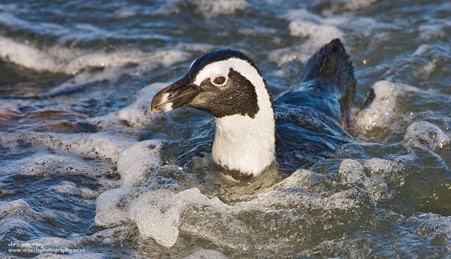
Avian influenza in the Western Cape in 2021 has had a devastating effect on the seabird populations on Dyer Island, off Gansbaai. The impact on the island’s Endangered African Penguins has been particularly severe.

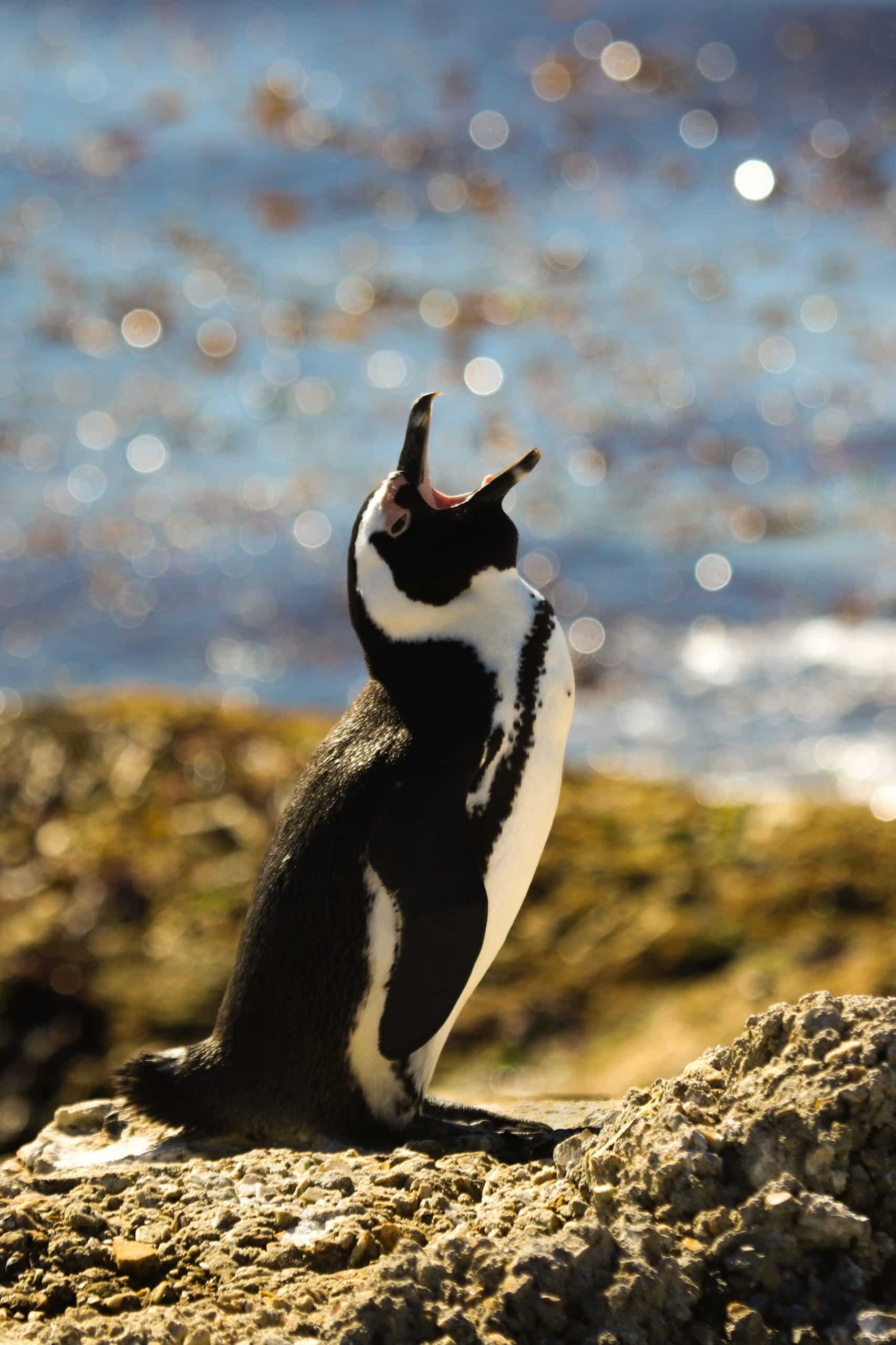
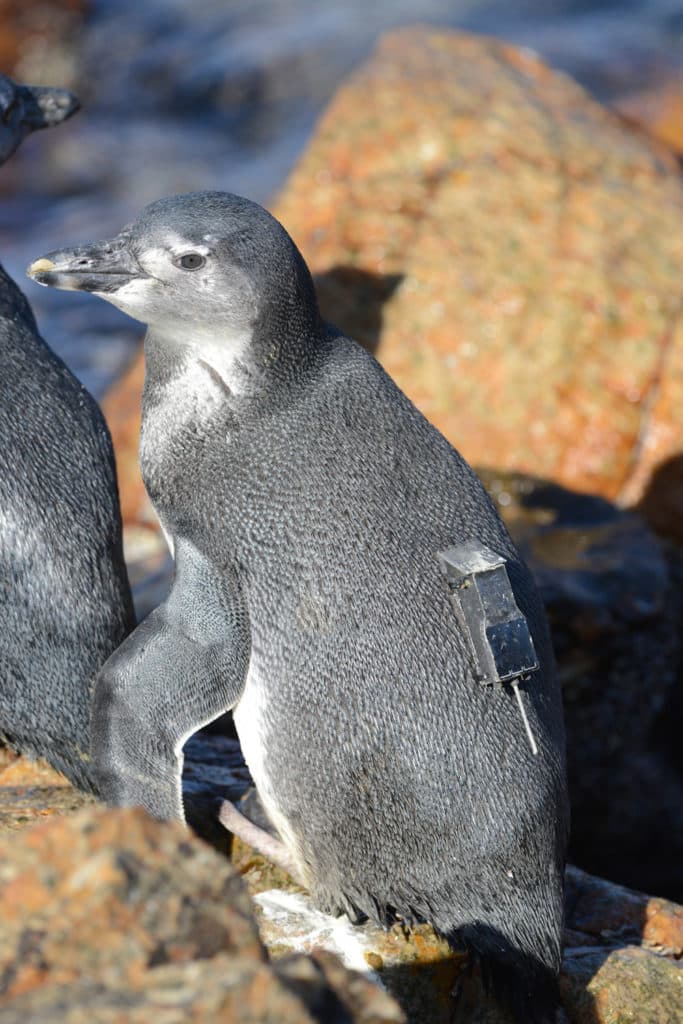
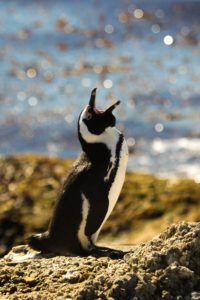
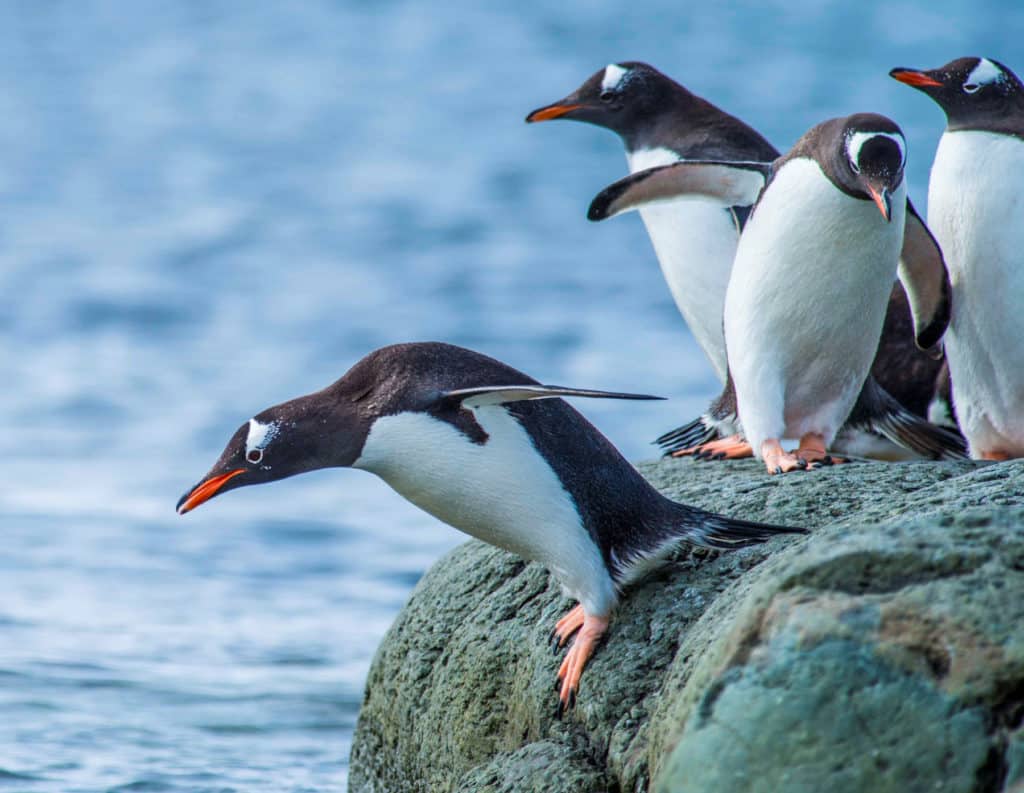
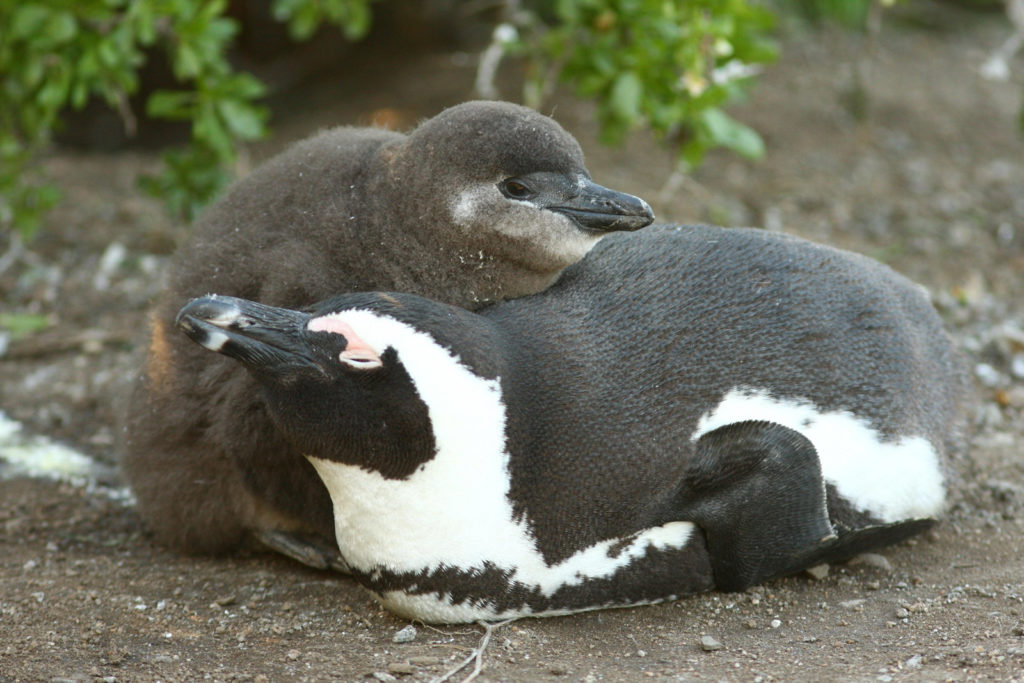
The African Penguin, already an Endangered species, is at further risk due to the recent outbreak of avian influenza. Credit Daniel Danckwerts

There is no cure for avian influenza and the best course of action is to lower the viral load in the environment by removing sick birds and carcasses. The staff of CapeNature, the management authority for Dyer Island, are working around the clock to ensure that dead birds are taken away as swiftly as possible, and slowly but surely we are seeing the tide turn: the number of carcasses removed has dropped from more than 500 per day to about 65. We thank every CapeNature staff member who has been part of this effort.

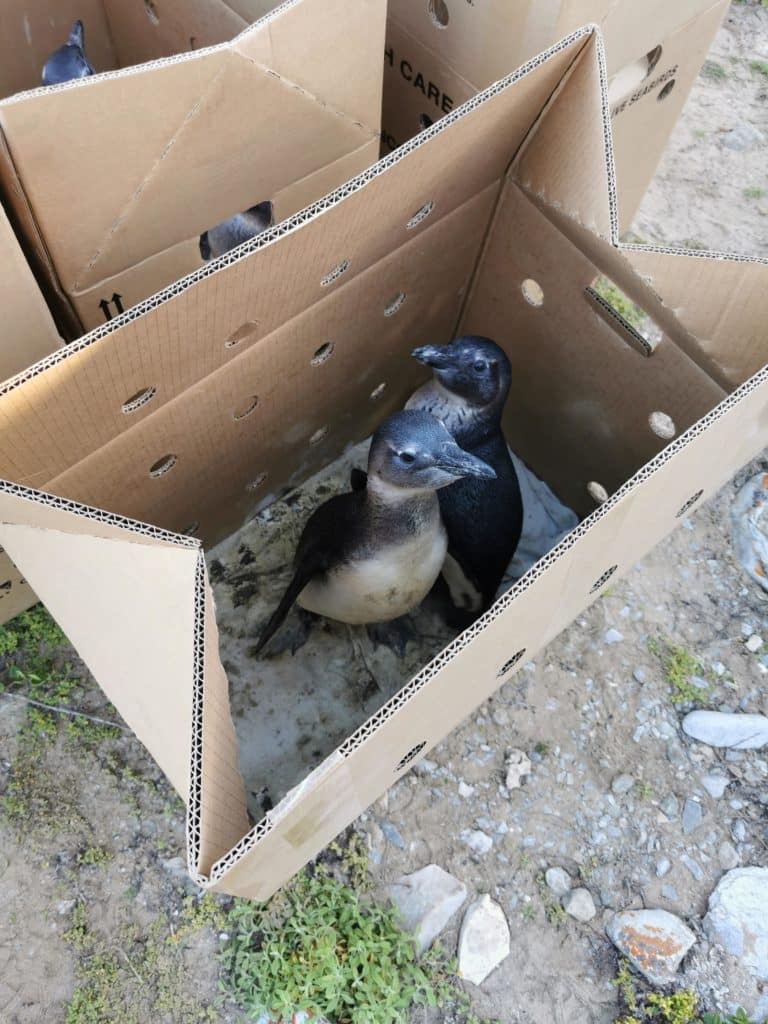
The staff have also been removing compromised young African Penguins from the island and taking them to the African Penguin and Seabird Sanctuary (APSS), a project of the Dyer Island Conservation Trust in Gansbaai, where every effort is being made to rehabilitate them. And this is where you can help. The extra quarantine requirements and additional precautions have resulted in an increase in the costs of rehabilitation. Just to feed the young birds for the next six weeks, we estimate we will need R100 800.

In the past the APSS relied on donations from tourists and other visitors, but now we’ve been hit by two pandemics: one bringing the world to a standstill and the other decimating our seabird populations.

So why remove African Penguin chicks from Dyer Island? It’s not because the adults are bad parents – in fact they do an excellent job to feed and raise their young despite challenging circumstances . October–November is the end of the breeding season and chicks are supposed to be fat and healthy and ready to start fending for themselves. But the parents face a dilemma: they not only have to feed their young, but also have to undergo a full change of feathers. This means they must build up enough fat reserves (about three times their normal body weight) to stay on land for the entire moult because they are not waterproof and cannot hunt.

For various reasons, some parents start their moult before their offspring are ready to fledge. The chicks of these birds will either starve to death on the island or venture into the ocean without the fat reserves they need to survive the challenges of the wild. In a perfect world this could be considered a natural process of selection, but in our less-than-perfect world humans have taken millions of penguin eggs for consumption as a delicacy; scraped tons of guano off islands where penguins bred, forcing them to nest in the open instead of in insulated and protective burrows; and spilled toxic oil into the penguins’ habitat.

So in this world we need to take action to prevent the possible extinction of one of South Africa’s most iconic animals – an extinction, if it happens, predicted for 2026. At the moment #EveryPenguinCounts. Removing and raising by hand underweight chicks and the chicks of moulting parents is just one part of the bigger African Penguin Biodiversity Management Plan.

Please support us. One donation from you is one small step towards preventing the extinction of the African Penguin. Donations can be made via 

https://www.givengain.com/cc/powertothepenguins/ or https://dict.org.za/dict-projects/african-penguin-seabird-sanctuary/

For tax benefits available to South African, UK and US donors, please go to https://dict.org.za/donate/

BRENDA WALTERS, DYER ISLAND CONSERVATION TRUST


Avian influenza 2021

The carcass of a Cape Cormorant floating in Table Bay. Credit Alistair McInnes

Over the course of 2021 an outbreak of a highly contagious and pathogenic strain (HPAI, H5N1) of avian influenza has severely affected South Africa’s seabirds, especially the Cape Cormorant. CapeNature reported that by 1 October 2021 18 388 seabird fatalities due to the virus had been recorded in the Western Cape, of which 17 926 were Cape Cormorants. The area most affected is Dyer Island, where 12 203 dead birds have been reported to date.

The virus was first detected in May in the Western Cape, mostly in gulls. The first Cape Cormorants were diagnosed with it in mid-September and positive cases exploded exponentially across the province over the following weeks, peaking at approximately 700 new cases per day.

Unfortunately there is no curative or preventative treatment for this virus, but the safe removal of carcasses and sick birds, among other measures, can mitigate its impact. However, to prevent the spread of the disease, Anton Bredell (the Minister of Local Government, Environmental Affairs and Development Planning) has urged the public to avoid areas where seabirds may congregate and not to collect sick or dead birds. This means that people must not attempt to assist or transport sick birds, but rather alert local conservation authorities of any carcasses or birds displaying symptoms so that the case can be properly managed. Symptoms may range from tame behaviour or weakness to muscle twitches and seizures.

It has been estimated that the 2021 outbreak of avian influenza has led to the loss of 15% of the Cape Cormorant population, a massive blow to this Endangered seabird species. BirdLife South Africa, the South African Foundation for the Conservation of Coastal Birds (SANCCOB), the Department of Forestry, Fisheries and the Environment, CapeNature, SANParks, West Coast District Municipality, Bergrivier Local Municipality, the Robben Island Museum, Western Cape Veterinary Services, Dyer Island Conservation Trust, the Owl Orphanage St. Helena Bay, Dwarskersbos Snake Rescue and local veterinarians are all collaborating to monitor and manage the situation.

For contact details and more information:

https://www.birdlife.org.za/…/BirdLife-South-Africa…

https://www.elsenburg.com/servic…/veterinary-services-0…

https://sanccob.co.za/suspected-avian-influenza-hpai…

COASTAL SEABIRD TEAM


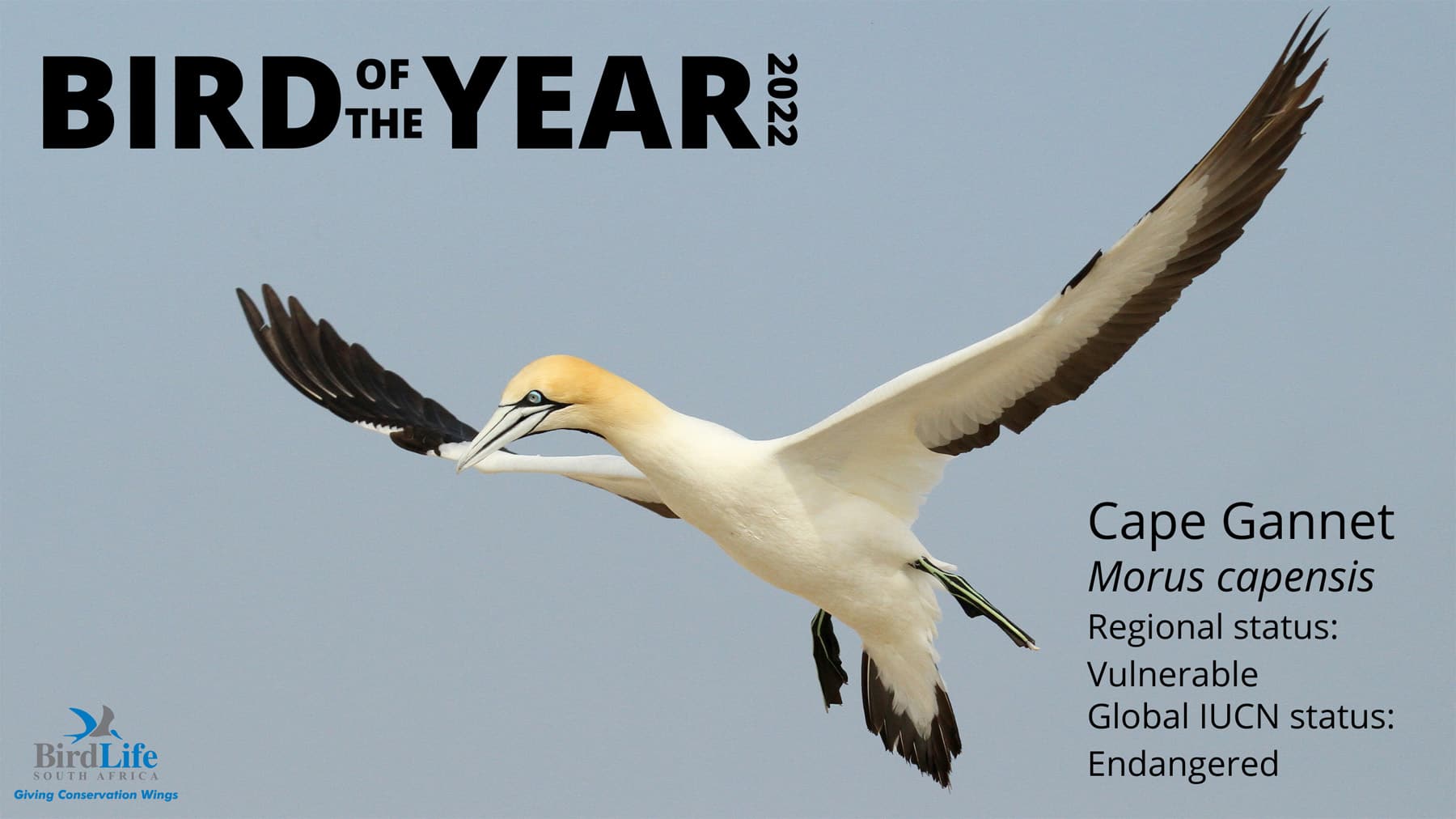
The new Bird of the Year

Gannets are spectacular, high-speed diving birds and with their unusually narrow-set eyes and exquisitely painted faces they are as unmistakable as they are beautiful. They feed primarily on sardines and anchovies, which are small schooling fish at the base of the food web. To compete with the many other seabirds, fish and mammals that also prey on these fish, gannets plunge-dive to depths of more than 20m. To do this, they hover some 30m up in the air, spot a fish and plummet head-first towards it. By streamlining the body and extending the wings backward, they can reach speeds of up to 100km/h before cutting the water’s surface with their sharp beaks.

Breeding on only six islands in South Africa and Namibia, the Cape Gannet population has experienced a decline of more than 50% in the past 60 years and the species is now listed as Endangered. Food scarcity, resulting from the combination of a shift in the distribution of anchovies and sardines and competition with one of the most important commercial fisheries in South Africa, is a factor in this decline. To compensate, gannets often resort to feeding on hake discards thrown off the back of trawl vessels. This, however, is a double-edged sword: the birds risk becoming entangled in the fishing nets and the hake discards, while sufficient for adults, do not provide enough nutrition for growing chicks.

Throughout 2022, BirdLife South Africa will create awareness about the Cape Gannet by producing an informative poster, developing learning resources for schools (free to download from https://www.birdlife.org.za/bird-of-the-year-2022/), publishing articles in African Birdlife magazine and on social media, delivering presentations to interested groups and selling merchandise. Cape Gannet merchandise (T-shirts, pin badges and plush toys) will be sold by the Shop for the Birds! from January 2022 (https://shop.birdlife.org.za).

BirdLife South Africa is grateful to the Hans Hoheisen Charitable Trust for sponsoring the Bird of the Year 2022.

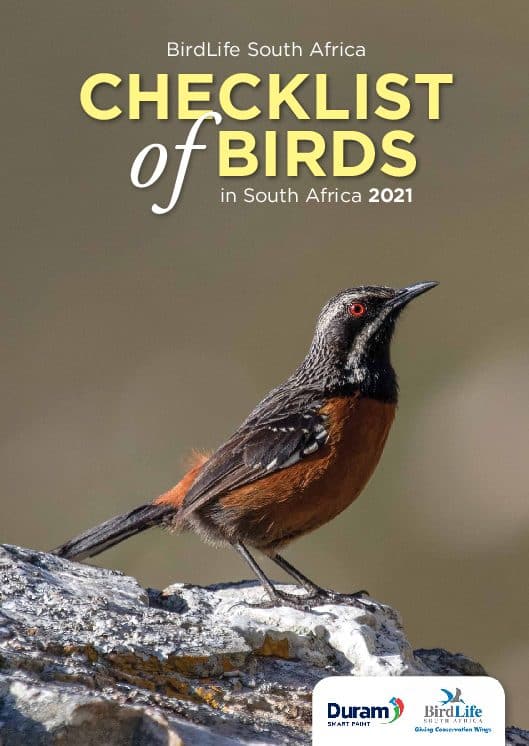
Don’t forget that all the educational resources for Bird of the Year 2021, the Cape Rockjumper, are still available for free online. You can download lesson plans, infographics, fact files and drawings for the Cape Rockjumper at https://www.birdlife.org.za/bird-of-the-year-2021/


Noise pollution & penguins

African Penguins congregate in large groups at sea, especially when preening, and often use
calls to locate each other. Photograph from animal-borne video logger.

The cacophony of calls emanating from an African Penguin colony is probably a familiar auditory memory for anyone who has visited the colonies at Boulders Beach or Betty’s Bay. However, most people are unfamiliar with the penguins’ social communication systems at sea and it is in this habitat that these auditory cues are likely to be crucially important in locating profitable foraging areas and forming groups to minimise their chances of being predated on while preening or commuting. A recent study based on recordings from animal-borne video recorders has shown that African Penguins regularly call at sea and do so using at least three types of call.

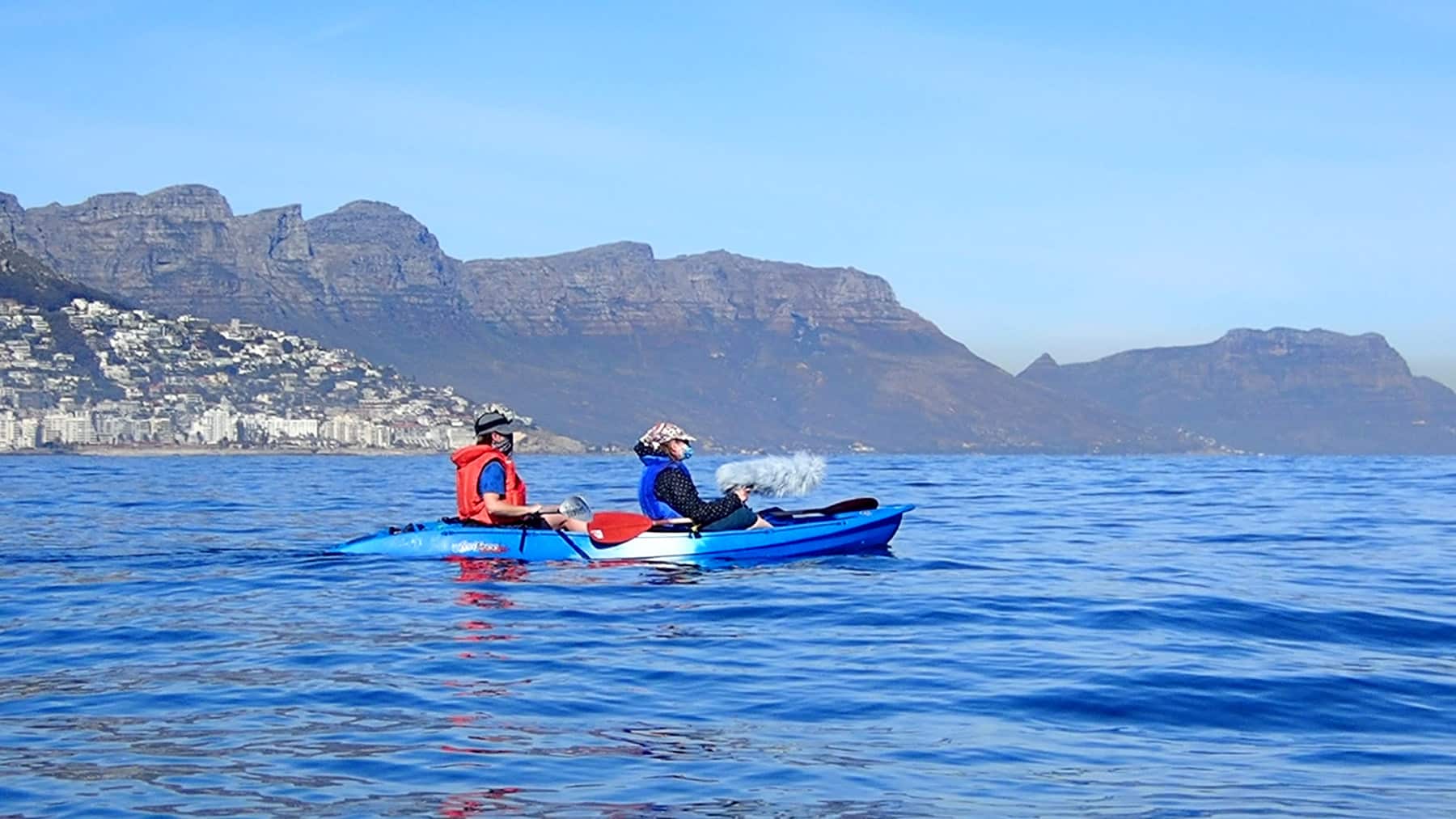
Christina Hagen of BirdLife South Africa and researcher Dr Andréa Thiebault recording
African Penguin calls offshore of Cape Town. Credit Alistair McInnes

Given that penguins spend a considerable amount of time below the sea’s surface, they are also exposed to underwater sounds. Recent research has established the first evidence for underwater penguin calls, but as yet little is known about the relative importance of these marine communication systems for African Penguins. Nor do we understand how the penguins’ communication networks may be influenced by artificial noise from vessel traffic and seismic surveys, sources of marine noise pollution that are known to negatively impact many other marine animals, including whales and dolphins.

To fill these knowledge gaps, the project Acoustic Foraging Networks in African Penguins (AFNAP), led by Dr Andréa Thiebault from the University of Paris-Saclay, has been established and will work in partnership with BirdLife South Africa’s coastal seabird team, Nelson Mandela University and SANCCOB. The project aims to understand the surface and underwater acoustic communication systems of African Penguins, the functions of these calls in relation to different behaviours (including those that influence foraging success) and how these communication networks are influenced by increasing anthropogenic noise in the marine environment.

A key site we are concerned about is Algoa Bay, home to two of the largest global breeding colonies of African Penguins and where there has been an exponential increase in shipping traffic recently. The results of this study will be used to inform the sustainable management of activities associated with marine noise pollution to limit this threat in an increasingly hostile marine environment for these birds.

AFNAP has been generously supported by a European Union Marie Sklodowska-Curie grant and funding from the French National Centre for Research–International Emerging Action, as well as Tygerberg Bird Club, which sponsored an expensive miniature hydrophone. If you too would like to contribute to the AFNAP project, please contact me at alistair.mcinnes@birdlife.org.za. For more information about the AFNAP project, please visit https://www.cb.universite-paris-saclay.fr/afnap/

DR ALISTAIR McINNES, SEABIRD CONSERVATION PROGRAMME MANAGER


Working together for Blue Swallows

Checking a section of KwaZulu-Natal’s mistbelt grassland for Blue Swallows. Credit Steve McKean

Fewer than 50 pairs of Blue Swallows remain in South Africa and it is essential to monitor them so that efficient and effective action can be taken to conserve them – to measure is to know! 

The Blue Swallow population has been declining steadily over the past 20 years, due mainly to the destruction of its mistbelt grassland habitat. As only 2% of the grassland biome is conserved in formal protected areas, it is crucial that we continue to work with private and communal landowners to protect what is left of this species’ habitat and to monitor breeding success and population trends. Over the past hundred years, mistbelt grassland and forest in southern KwaZulu-Natal and Mpumalanga have been fragmented and destroyed. What remains of these important habitats has to be protected and managed if the Critically Endangered Blue Swallow and Endangered Cape Parrot, as well as other threatened species, are to survive.

A Blue Swallow nest with eggs. Credit Steve McKean

We are monitoring areas where Blue Swallows are known to feed and breed, including nest sites, and are continually looking for new areas where they may occur, using techniques that predict suitable habitat localities. This involves travelling to more than 30 sites, finding and checking nest holes and documenting active nests, including the numbers of eggs laid and chicks hatched and fledged.

Blue Swallows breed in KwaZulu-Natal and Mpumalanga between October and April each year. During the 2020–2021 season we monitored 36 nest sites and recorded 47 fledged chicks, a 38% increase over the previous year. So far this season we have recorded four nests with eggs, but it is still early days; with frequent and ongoing monitoring we will no doubt document a lot more.

We are grateful for funding support provided by the IUCN Save Our Species Fund (co-funded by the European Union), Hans Hoheisen Charitable Trust, N3 Toll Concession and Baynesfield Estate.

For more information, please contact us at steve@conservation-outcomes.org or melissa.whitecross@birdlife.org.za. Alternatively, go to www.conservation-outcomes.org or www.birdlife.org.za

STEVE McKEAN, CONSERVATION OUTCOMES, AND DR MELISSA WHITECROSS, LANDSCAPE CONSERVATION PROGRAMME MANAGER, BIRDLIFE SOUTH AFRICA


Not a stilt in sight

Birding Big Day, hosted each year on the last Saturday of November by BirdLife South Africa, is is a highly anticipated event on the birding calendar. Teams have just 24 hours to record as many bird species as possible within a pre-defined area, plus the chance to take the national or provincial title.

This year, Team BirdLife South Africa set an ambitious challenge: to record as many species as possible no more than 50km from the Johannesburg head office, Isdell House. This, we knew, would be difficult, given that the area is predominantly urbanised and many important birding sites (such as Marievale Bird Sanctuary) are outside the 50km radius. We persevered nevertheless, motivated by our goal to raise funds to send a community bird guide on the Flock to Marion cruise in January 2022. We would like to cover the expenses of one of the eight community bird guides and have been accepting pledges for every species recorded by the official team on the day. So far we have raised R12 000 of the R19 000 needed… 

Our day was an incredible success, though we fell shy of our target of 211 species due to adverse weather conditions. We set off from Isdell House at 04h00 and birded the wider Gauteng area until after 21h00 that evening – almost 18 hours of marathon birding! Highlights from the day included a vagrant Slaty Egret, the rare African Cuckoo Hawk, Ovambo Sparrowhawk, Short-toed Rock Thrush, Striped Pipit, Verreaux’s Eagle, Cape Vulture, Red-chested Flufftail, Sand Martin, Great Reed Warbler and African Rail. Torrential rain during the middle of the day reduced bird activity at our wetland sites and we missed a few obvious species such as Pied Kingfisher and Black-winged Stilt as a result. We ended on 191 species, with Spotted Eagle-Owl the last bird of the day as we returned to Isdell House. 

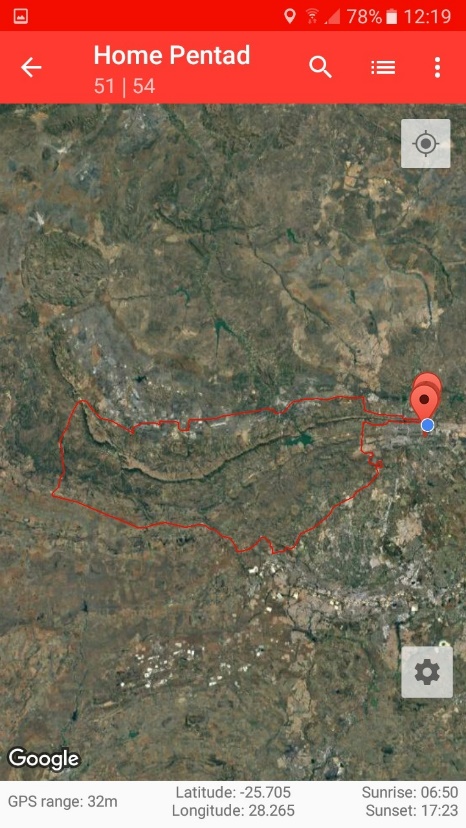
Centred on Isdell House, BirdLife South Africa’s head office, our route covered areas to the west, north and east of Johannesburg.


If you would like to help us reach our goal of R19 000 to support a community bird guide on the Flock to Marion cruise, please consider pledging an amount of your choosing for our total of 191 species recorded. For more information, please contact BBD@birdlife.org.za

DANIEL DANCKWERTS, ACTING COMMUNICATIONS MANAGER


Escape to the Karoo

The KhoiSan Karoo Conservancy is divided into the Karoo Gariep Nature Reserve and the Hanover Aardvark Reserve, which together offer a range of activities and accommodation options. Owned by PC Ferreira, the conservancy is run as a black empowerment company to support previously suppressed Khoi people and provides work and mentorship for several Khoi women. Through their own efforts, these women now own some R400 000 worth of game animals and, as some of the few black female game breeders in South Africa, they have a sustainable source of income for their families.
New Holme Nature Lodge is located in the Karoo Gariep Nature Reserve and comfortably sleeps up to 27 guests in eight newly renovated rooms. The Karoo Gariep property also offers a self-catering log cabin (Stoffels Rus) and a tented campsite. Guests who prefer not to self-cater can take up a fully catered option. 

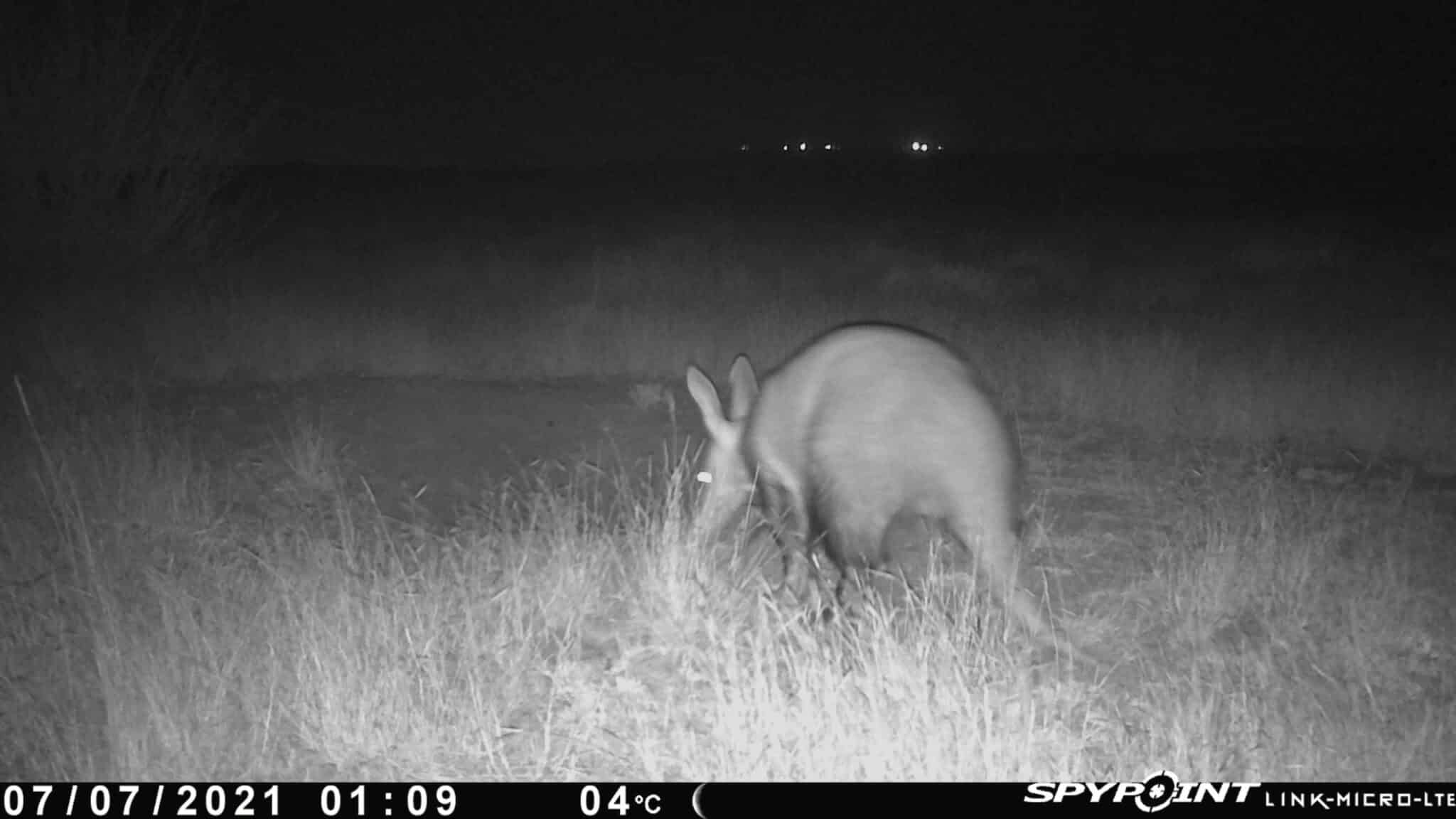
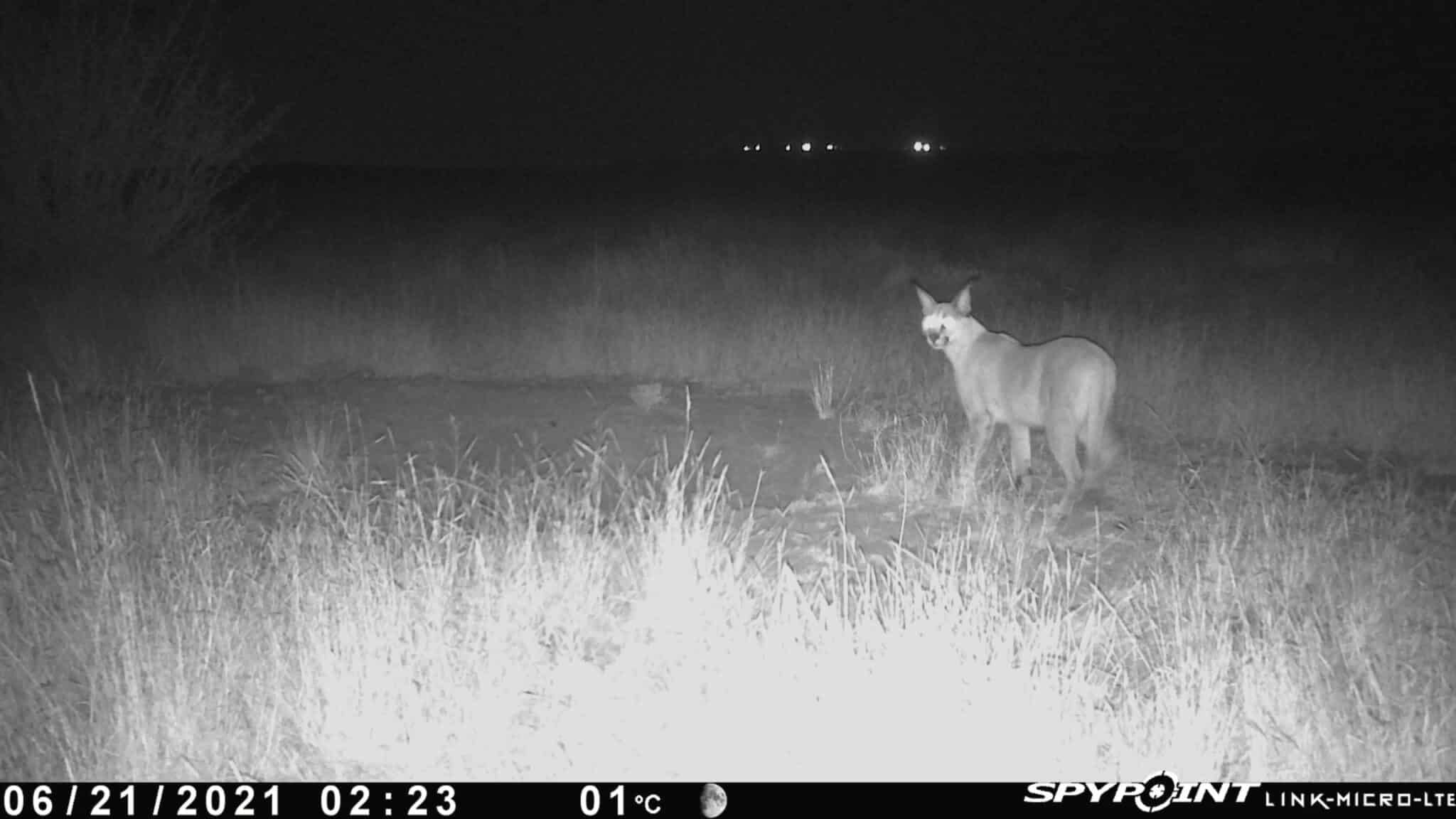
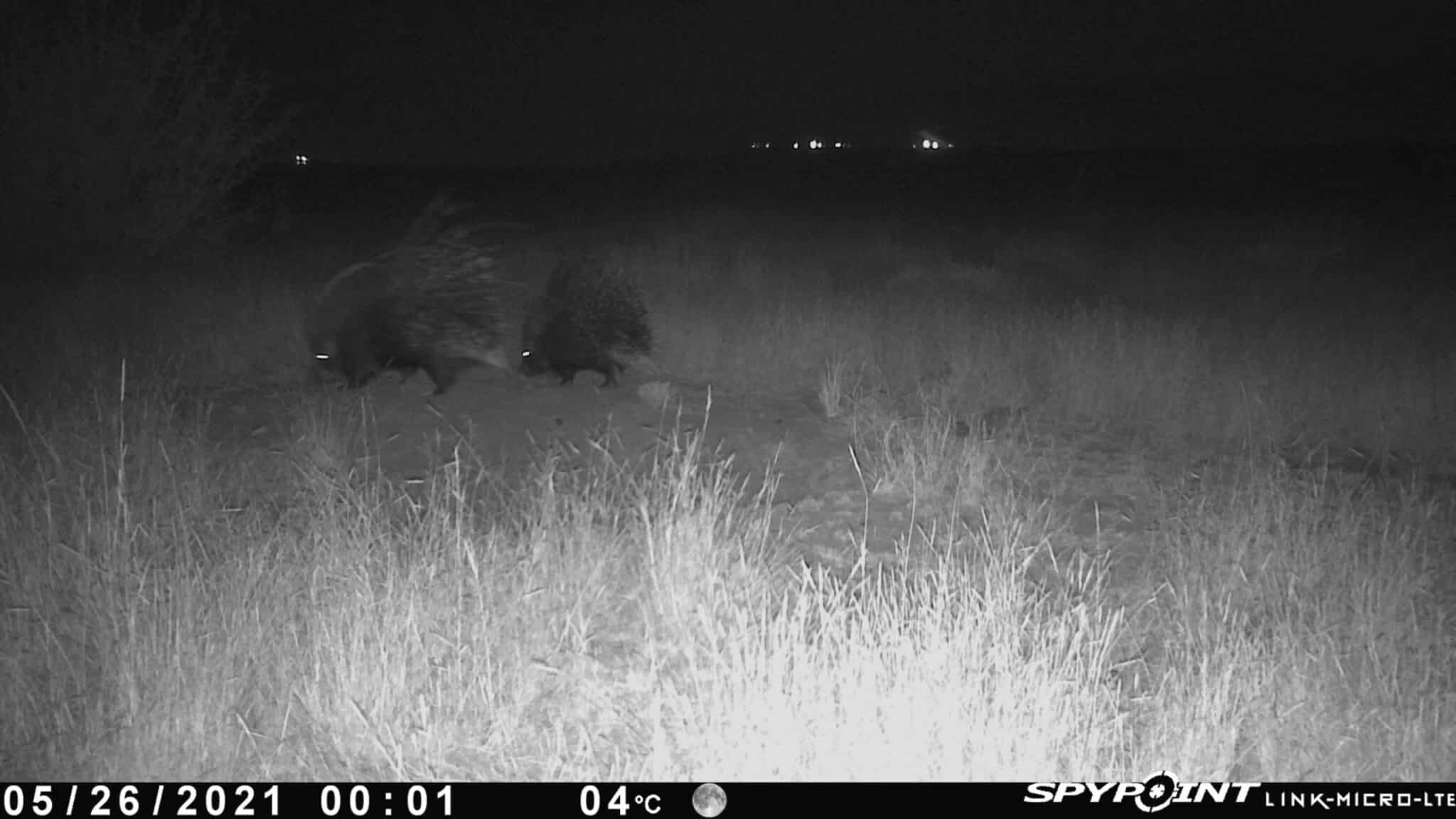
The KhoiSan Karoo Conservancy is well known for its ‘Shy 5’ safaris, which offer visitors the chance to see aardvark, aardwolf, black-footed cat, bat-eared fox and striped polecat, as well as the Cape porcupine. Some 218 bird species have been recorded, including most of the Karoo specials. Among these are the Karoo Korhaan, Ludwig’s Bustard, Double-banded and Burchell’s coursers, Namaqua Sandgrouse, Fairy Flycatcher, Layard’s Titbabbler, Grey-backed Sparrow-Lark and Pink-billed and Melodious larks. Other sought-after species include Orange River Francolin, Verreaux’s Eagle, Black Stork, Blue Korhaan and Short-toed Rock Thrush.

The Khoisan Karoo Conservancy is a BirdLife South Africa Recommended Accommodation Option. BirdLife South Africa members travelling to and from the Flock to Marion cruise in January 2022 will be treated to an exclusive 10% discount on all accommodation and birding activities. 

For more information, please call (0)82 567 9211, send an e-mail to stay@khoisankaroo.co.za or visit www.khoisankaroo.co.za 


Will the Hookpod work in South Africa?

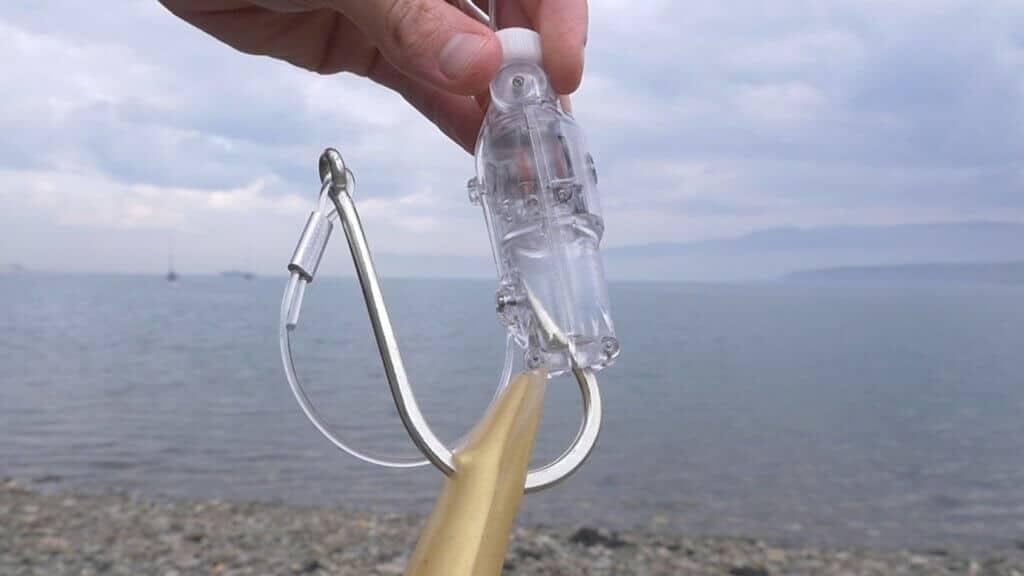
The compact Hookpod encases the barb of the hook and prevents seabirds from swallowing it as they dive in pursuit of bait. Credit Mark Avery

It was the high number of seabirds that drowned after swallowing baited hooks set by tuna longline fishing vessels that first caught the attention of scientists as being the leading cause of population declines some three decades ago, particularly in the Southern Ocean where most pelagic seabird species breed and forage. A bird-scaring line was the first mitigation measure invented (by a Japanese fisherman; hence the name ‘tori’, Japanese for ‘bird’, line) to reduce the number of seabirds caught. However, research showed that significant reductions could be achieved in this longline fishery only when the tori line was used in conjunction with other measures, namely the addition of extra weights to the lines and the setting of the lines at night. 

Andrea Angel and Deon Antwerpen aboard a longline vessel in 2018 while testing Hookpod samples. Credit Alén Angel-Wanless

It’s not easy to interfere with or change fishing gear or how the fisheries operate, as any proud fisherman will point out. ‘You don’t mess with the gear!’ they say. Implementing mitigation measures in pelagic longline fishing fleets has therefore been slow, while seabird populations continue to decline the world over.

So when British brothers Ben and Pete Kibel came up with the idea of the Hookpod in 2005, they worked very closely with fishermen for several years to perfect a solution that would fit seamlessly into fishing operations, enabling them to catch fish but not birds.

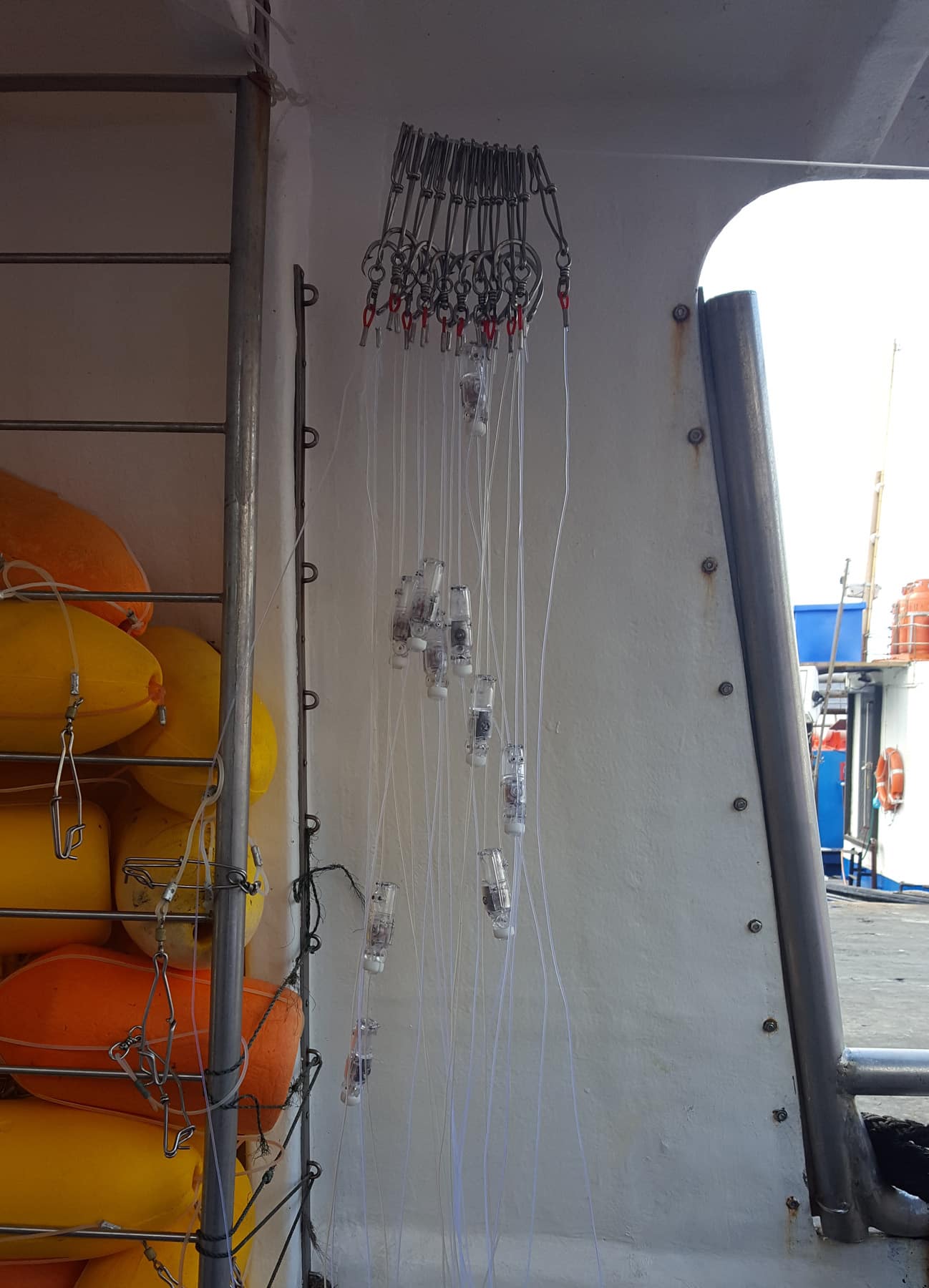
The Hookpod is a hook-shielding device that works by disarming the baited hook. The added weight at the hook causes it to sink rapidly out of the reach of diving birds, while a water pressure release mechanism automatically opens the pod at depths below 20m to reveal the baited hook. 

Hookpods attached to branch lines and ready to be deployed. Credit Andrea Angel

The initial prototype was trialled by South African, Brazilian and Australian fleets in 2012, leading to significant improvements, and it has since been demonstrated that the Hookpod is the most effective method of preventing seabird bycatch in the pelagic longline fleet. The Agreement for the Conservation of Albatrosses and Petrels therefore recommended that it be adopted as the best-practice, stand-alone bycatch mitigation measure. In 2019 it was incorporated into the South African Longline Fisheries Permit Conditions, but with no practical demonstration and proof that it will not impact target catch or unduly disrupt fishing operations, there has been no uptake of the Hookpod locally.

In a bid to remedy this situation, the Albatross Task Force (ATF) engaged with Deon Antwerpen, a pelagic longline skipper, and with a few samples provided by Becky Ingham of Hookpod Ltd we were able to share with him the potential of this novel measure in 2018. But proper trials were needed and finally this year, thanks to a generous donation from a US supporter, we have secured most of the funding needed to do just that. Starting next year, Deon will make his vessel and crew available, and accommodate the ATF on board, to test the Hookpod during actual fishing operations using his gear.

If successful, we hope to demonstrate that the Hookpod can be used as a stand-alone mitigation measure and that other fishermen will follow Deon’s lead in using it – and thereby join the journey to eliminating seabird bycatch in this fishery. 

If you wish to contribute or to know more about this project, please send me an e-mail at andrea.angel@birdlife.org.za 

ANDREA ANGEL, ALBATROSS TASK FORCE MANAGER


The devil’s in the detail!

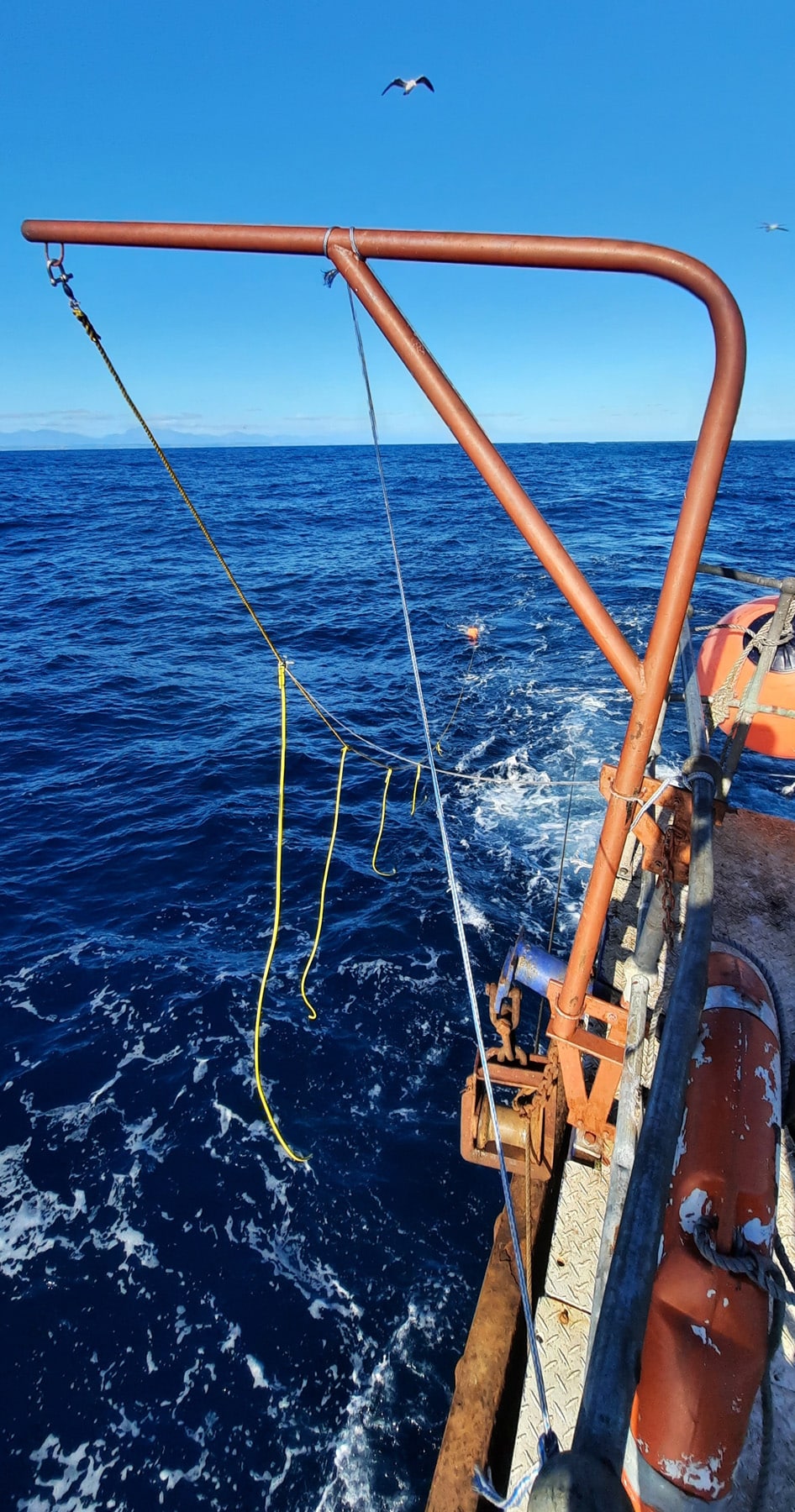
The new structure and bird-scaring line being tested at sea aboard the inshore fishing vessel
Imbongi. Credit Reason Nyengera

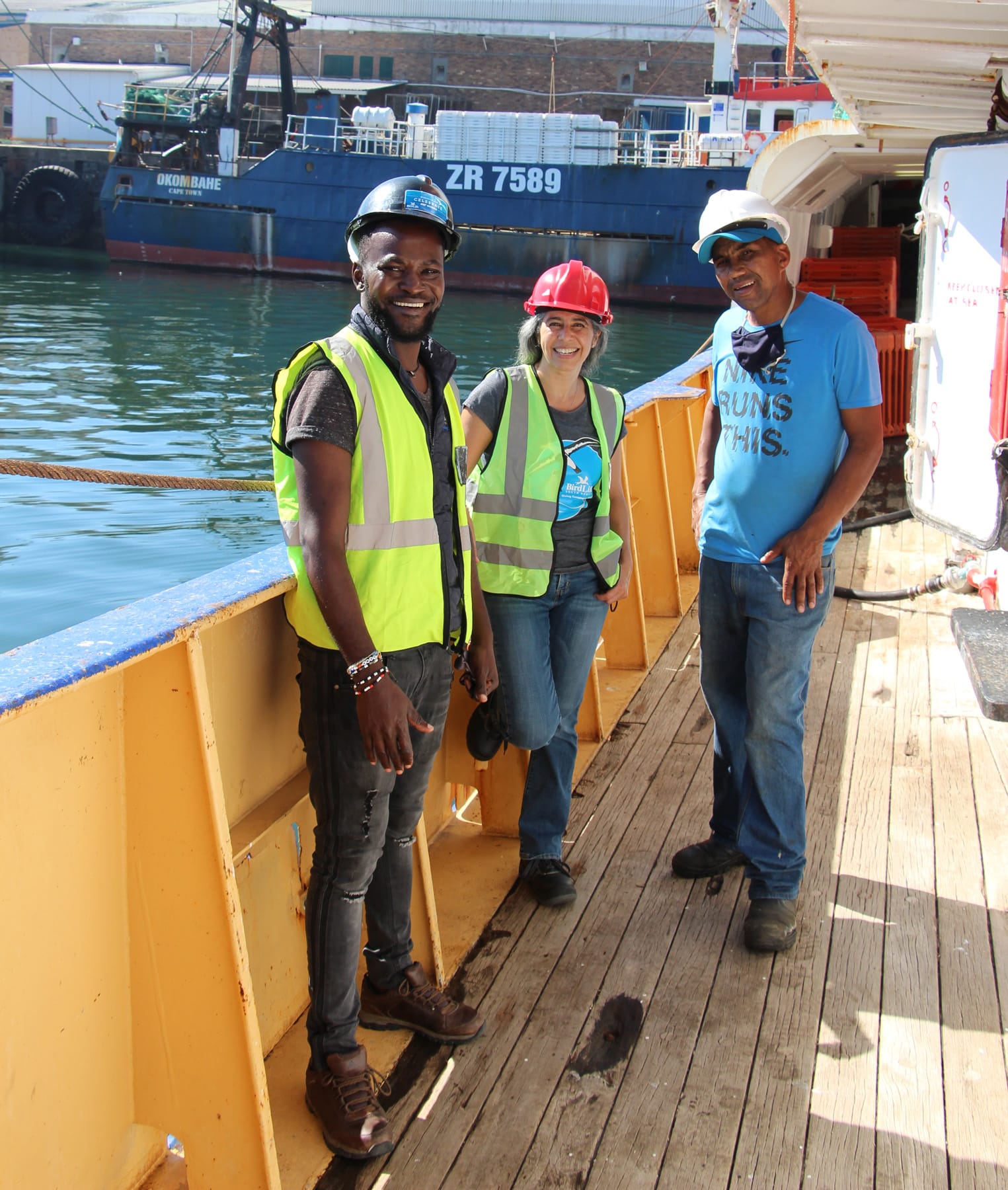
ATF team members Reason Nyengera and Andrea Angel with a fisherman. Working together, they find practical ways to attach bird scaring lines to the gear of individual fishing vessels. Credit Andrew Gordon

Opportunities are often long in the making and in the world of conservation I know I am not alone in saying that patience and perseverance are two words we learn to take in our stride. It took the ATF several years of working side-by-side with fishing crews of the South African Deep-sea Trawling Industry Association (SADSTIA) to tackle the significant issue of seabird bycatch (bird mortalities caused by interactions with fishing gear) in the offshore hake trawl fishery. But it paid off. The implementation of mitigation measures in this fleet prevents the deaths of close to 10 000 seabirds every year and today, thanks to ongoing engagement with SADSTIA, we can sustain this success.

So having tackled the hake trawl fleet, we could move on to other fisheries – or could we? Our focus had been the offshore trawl sector, which has a higher fishing quota and more and bigger vessels than other sectors and operates off the edge of the continental shelf, where most pelagic seabirds such as albatrosses and petrels occur. The smaller inshore trawl sector has fewer and often smaller vessels, but they use basically the same fishing method and can also fish close to the continental shelf edge. Concerns about seabird bycatch are therefore similar in both fleets, yet only the offshore sector had mandatory bycatch mitigation measures added to its permit conditions in 2006. 

It’s often when ignoring the detail that conflict arises, because the measures we so painstakingly developed for the offshore sector could not simply be transferred to the inshore vessels without in some cases quite significant changes, including structural. Finding out what and how mitigation measures could be adapted meant doing research and it was not until earlier this year that a two-year grant from the Marine Stewardship Council’s research fund made it possible for us to engage with the inshore fishing association, South East Coast Inshore Fishing Association (SECIFA), in earnest. 

As we did with the offshore sector, the ATF headed for the harbour to work closely with the fishermen on solutions for the very diverse inshore fleet. Its vessels range between 12m and 30m in length and some sit quite low in the water, leaving no doubt that the more than 50m-long bird-scaring lines (BSLs), the principal mitigation measure developed for the offshore fleet, would have to be altered. A greater challenge is the absence of attachment points for the BSLs. To be effective, they must be set parallel to and on the seaward side of each of the two trawl cables holding the net from the stern of the vessel. However, the cables run through ‘blocks’ or steel rings suspended from a beam, which often sticks out over the side of the vessel, with no possible means of attachment for a BSL. 

So not only are the vessels small, medium or large, but their blocks are located in different positions on, on the side of or over the edge of the vessel. Moreover, in more than half the cases, the nets are hauled over the side of the vessel rather than over the stern as in the offshore fleet. Each difference presented a challenge, but we met them one at a time, often with help from ATF teams in Latin America and Namibia that have dealt with similar issues. However, our greatest resource is the fishermen themselves. Once there is understanding that we are not there to impose but to work together, magic happens, doors open and dialogue begins. 

ATF member Reason Nyengera recently returned from the project’s first trip trialling a lighter and shorter BSL and a new attachment structure. The latter was developed and fitted by one of the company’s mechanics after he had spent time with Reason going over what was needed, and it proved to be a much simpler design than the one we had come up with. Fishermen know their vessel, what it needs to do and where there is room for change and adaptation. Collaborative work is therefore the best way to take a step closer to solving the challenges faced by this fleet in addressing seabird bycatch. 

If you would like to know more about this project, please e-mail me at andrea.angel@birdlife.org.za

ANDREA ANGEL, ALBATROSS TASK FORCE MANAGER


Birding with Aldo, by Zoom

Since April 2020 Birding with Aldo has provided an expert and insightful way to begin, or further, your birding career without leaving home. The courses, each comprising two or three sessions, are small, interactive, relaxed and engaging. Focusing on how to become a birder rather than learning by rote endless characters for each species, they feature unique protocols for remembering birds and interactive techniques such as polling, annotation, chat room, open mike and comparative species slides. Participants get recording links after each session and PDF copies for reference. 

The calendar below gives the next few months’ schedule of courses, all inexpensively priced. BirdLife South Africa members will receive 10% discount. 

Begin Birding with Aldo 17, 19 & 21 January 2022

Raptors with Aldo 24, 26 & 28 January 

Intermediate Birding 7, 9 & 11 February 

Bring Birds to your Garden 14, 16 & 18 February 

Kruger with Aldo 28 February, 2 & 4 March 

Customised courses are available for BirdLife South Africa bird clubs and have already been run for Wits Bird Club and BirdLife Sisonke, both very well attended.

The courses make a great gift for the festive season and beyond, and personalised vouchers that can be given to a family member or friend are available.

Go to www.birdingwithaldo.com or send an e-mail to birdingwithaldo@gmail.com for more information. ‘Birding with Aldo’ and ‘Birding with Aldo Participants’ on Facebook offer a daily ‘Bird of the Day’ challenge to test your identification skills.

Aldo’s courses bring out the best of Zoom and are perfectly comfortable and thoroughly professional. He loves sharing his birding with others and although he draws on 55 years of experience, he has not forgotten his early birding struggles and strives to make birding as accessible as possible. 


2022 is almost here…

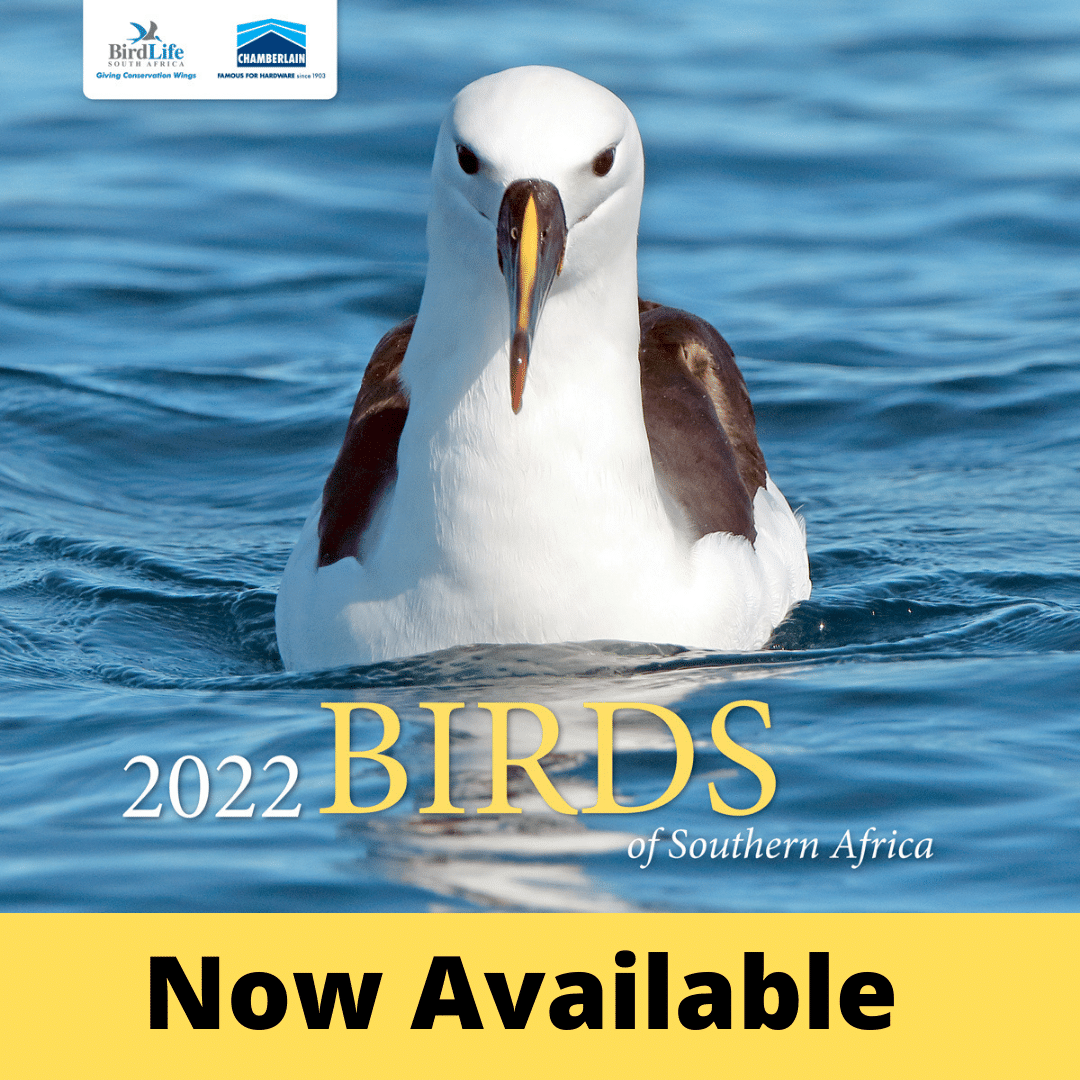
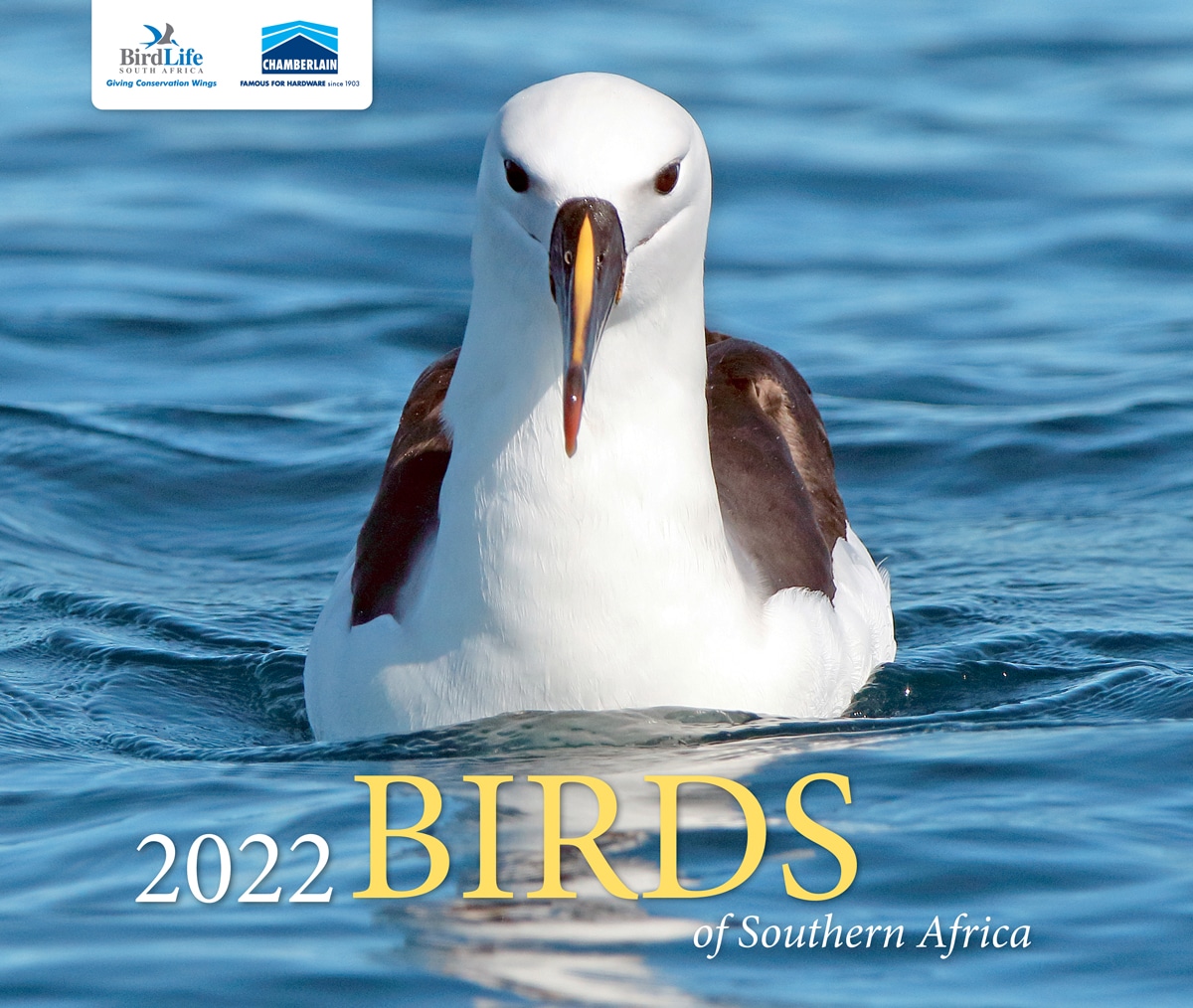
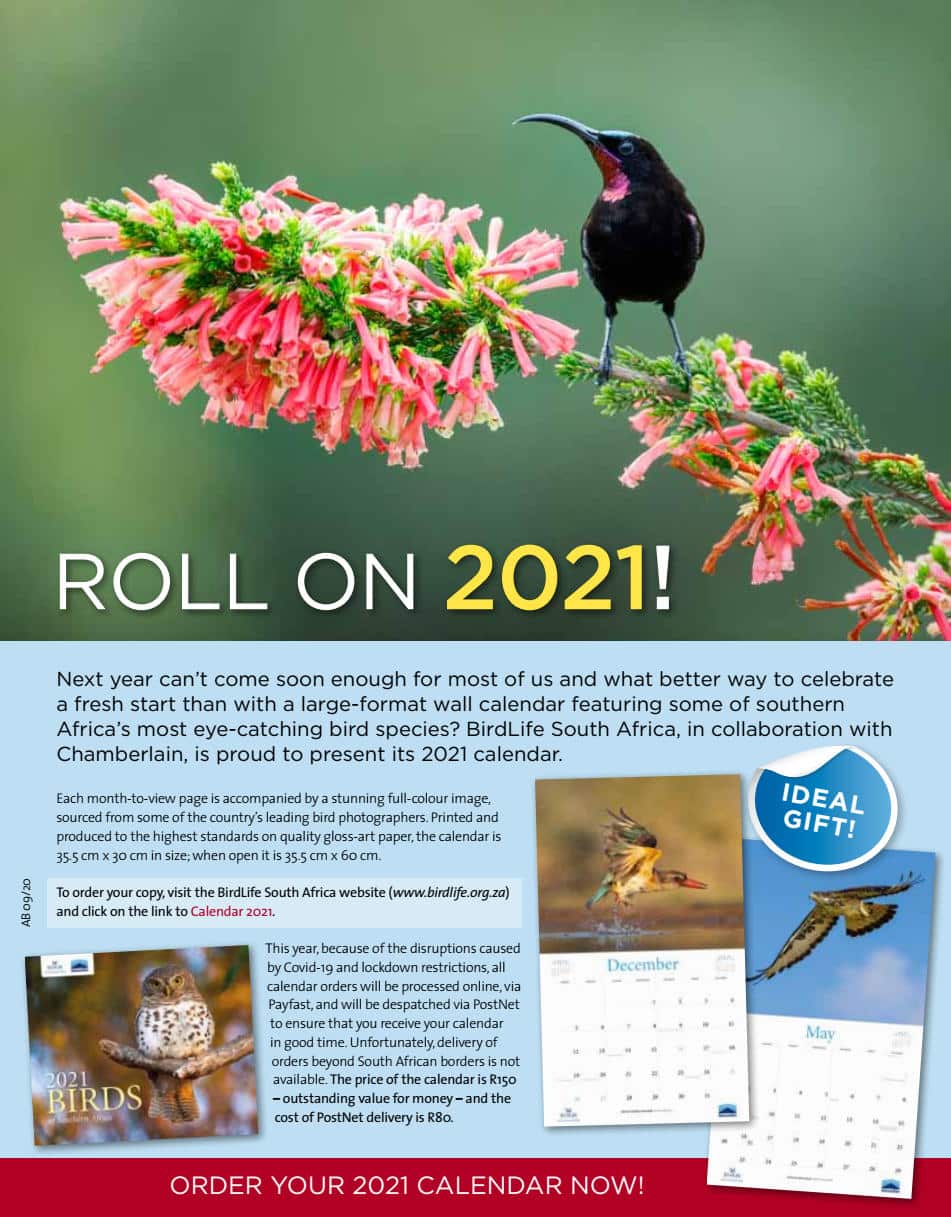
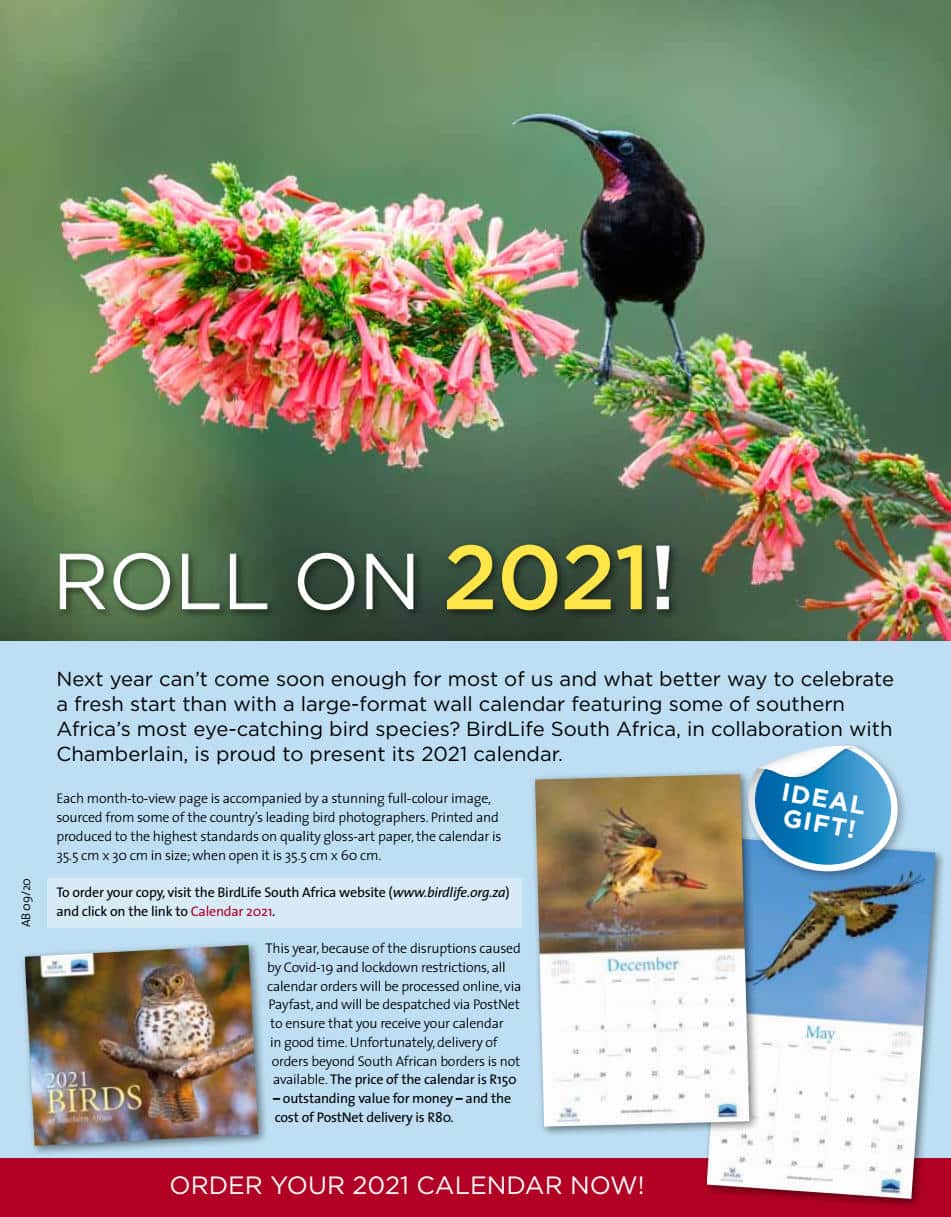
Be sure to buy your copy of the 2022 Birds of Southern Africa calendar and you won’t just be getting an attractive and useful wall hanging; you’ll be helping to give conservation wings. Produced in collaboration with Chamberlain, the large-format calendar features striking photographs of some of the region’s most eye-catching bird species.

Priced at R175 each, the calendars can be ordered online at https://www.birdlife.org.za/support-us/2022-calendar/ and will be delivered either Postnet to Postnet or by Fastway Couriers. Alternatively, you can collect yours at Isdell House by prior arrangement. For more information, please contact me at membership@birdlife.org.za

SHIREEN GOULD, MEMBERSHIP MANAGER


Win a hamper of books!

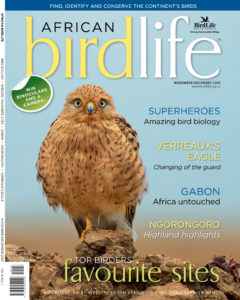
One lucky new subscriber to African Birdlife magazine will win a hamper of Struik Nature books valued at R1000! Only R340 buys you six bi-monthly issues of African Birdlife, which is packed with expert information about the magnificent birds of Africa. At the same time you will be showing your support for BirdLife South Africa’s invaluable work in bird research and conservation.

To subscribe and automatically get entered into the draw for this hamper, please visit https://www.birdlife.org.za/support-us/subscribe-to-african-birdlife-magazine/#. Ts & Cs apply. Entries close on 28 February 2022.


Wakkerstroom Centre upgrade

At the Wakkerstroom Education Centre, like any property, there is always something that needs to be done. We have identified two areas of concern and would greatly appreciate any donations, be they monetary or items/plants, to help us make these improvements.

  • The old boundary fence from the edge of the wetland up to the centre needs to be replaced with bird-friendly fencing.
  • Spaces around the centre’s buildings would make ideal indigenous garden patches that attract insects, birds and small mammals. These patches will provide opportunities to observe and enjoy these special visitors while at the same time implementing conservation principles and water-saving techniques. They would also contribute to our outdoor classroom programme, which promotes the connection between nature and people.

If you would like to learn more or make a donation, please contact me on 081 726 5282 or at kristi.garland@birdlife.org.za

KRISTI GARLAND, WAKKERSTROOM TOURISM AND EDUCATION CENTRE MANAGER


Letaba is for the birds

Letaba is one of the loveliest of the Kruger National Park’s rest camps and offers some of the best birding in South Africa. To make this experience even more special, the Honorary Rangers will arrange some exciting off-the-beaten-track birding opportunities along the Letaba River.


Prof. Engelbrecht is an accomplished ornithologist and a recipient of Birdlife South Africa’s Eagle-Owl Award for his exceptional contribution to bird conservation. He will share what he knows about finding birds, recognising calls and interpreting behaviour during informal talks and game drives in open game-viewing vehicles.

All this is for a good cause, as proceeds will go to conservation projects in our national parks. 

Date: 7–20 February 2022

Venue: Letaba Rest Camp, Kruger National Park

Cost: R2190 per person (includes activities, brunches and game drives; excludes accommodation)

Contact: Charles Hardy charlois@mweb.co.za

More information: https://www.sanparksvolunteers.org/events/letaba-birding-experience-with-prof-derek-engelbrecht/ or click here 


Welcome Kirsten!

Kirsten Day, the new member of the Policy and Advocacy team.

In mid-November, BirdLife South Africa’s Policy and Advocacy Programme welcomed a new team member: Kirsten Day. In her new role as part-time Advocacy Officer, Kirsten will be responsible for coordinating many of BirdLife South Africa’s responses to development applications and authorisations that threaten priority species and habitats (i.e. the organisation’s ‘casework’). She will also contribute to BirdLife South Africa’s inputs on relevant legal and policy developments, and to the development and dissemination of various position statements and guidance documents.

Kirsten’s qualifications and wealth of professional experience make her a valuable addition to the Policy and Advocacy team. She has a Master’s degree in Environmental Management and a second Master’s in Environmental Law from the University of Cape Town (UCT). Following a 14-year career in environmental consulting, focusing primarily on Environmental Impact Assessment, Kirsten has been completing a PhD in Environmental Risk. The focus of her research is on controversy as a product of different and often divergent perceptions of environmental risk among stakeholders in response to technological innovation. She has a particular interest in the theory and practice of risk communication and conflict management. While doing her PhD, she has been teaching a post-graduate module on the theory and practice of environmental assessment and management at UCT. In her spare time she enjoys being outdoors: trail running, hiking and, of course, watching birds.

DR MELISSA LEWIS, POLICY AND ADVOCACY PROGRAMME MANAGER


Swarovski special

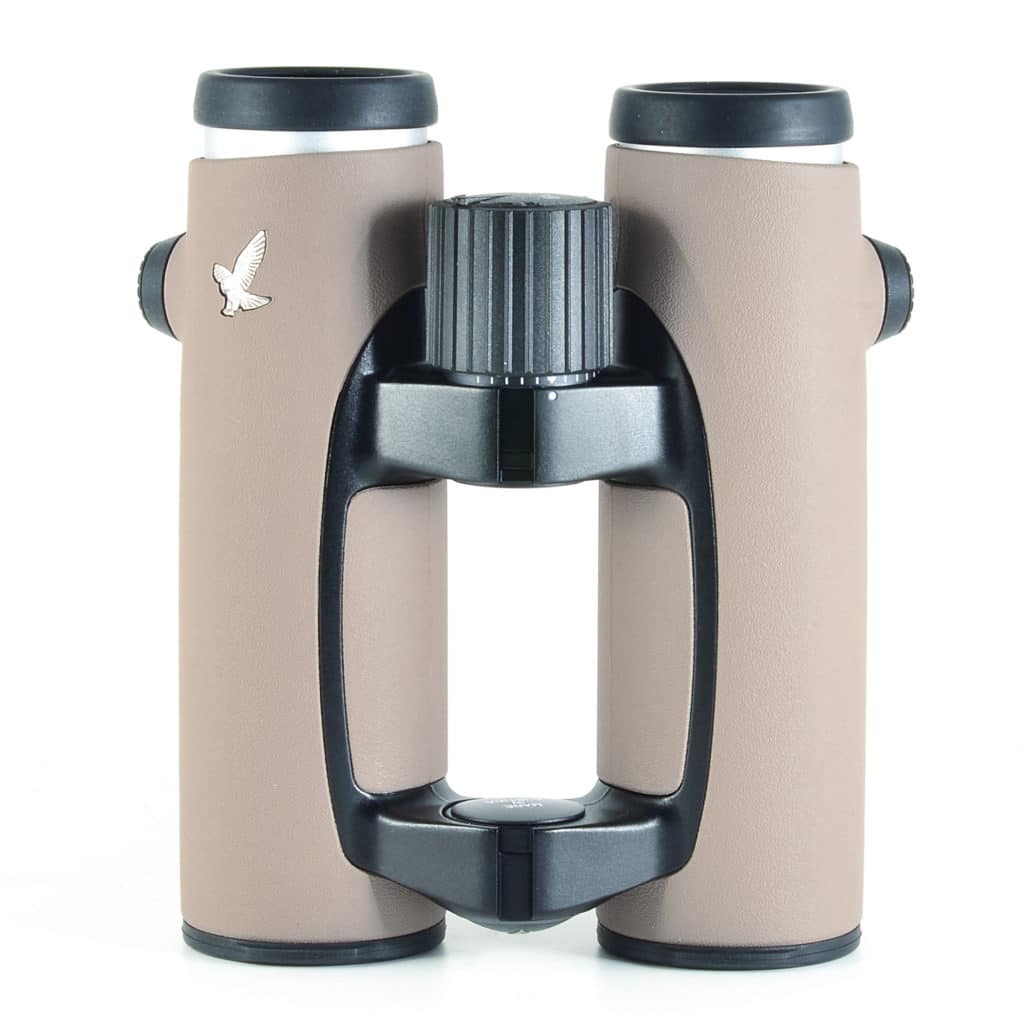
BirdLife South Africa’s partners at Swarovski Optik are running a limited special on Swarovski CL Companion 8×30 binoculars ahead of the Flock to Marion cruise. Purchase a pair of new binoculars at the unbeatable price of R24 000 before the end of January 2022 and receive a free lens cleaning kit. The price includes a R500 donation to BirdLife South Africa. For more information, please visit www.shop.birdlife.org.za


ZEISS special

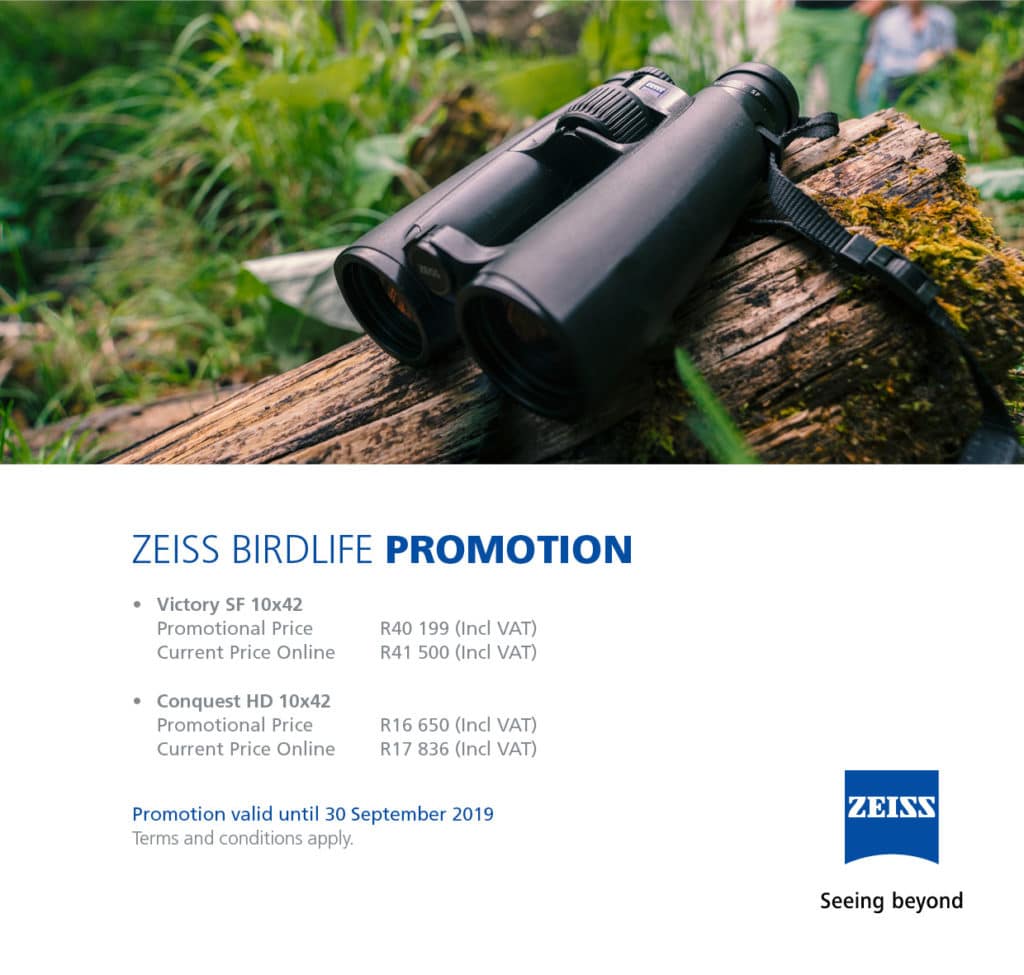
BirdLife South Africa’s partners at ZEISS are running a limited special ahead of the Flock to Marion cruise in January 2022. Every purchase of ZEISS Terra binoculars will come with a free cleaning kit, while for purchases of ZEISS Conquest HD binoculars the free gift is a ZEISS harness. Buy a pair of top-of-the-range ZEISS Victory SF binoculars and you will receive a free ZEISS cleaning kit and harness. All purchases made in December 2021 and January 2022 will also receive a free one-year subscription to African Birdlife magazine. For more information, please visit www.shop.birdlife.org.za or contact info.za@zeiss.com 


Flamingos at Kamfers Dam

A relatively small number of Lesser Flamingos breed at Kamfers Dam. Credit Mark D. Anderson

One of the most attractive bird species in Africa, the Lesser Flamingo is highly gregarious and occurs in large flocks when feeding and breeding. Its main breeding site is Lake Natron, in Tanzania’s Great Rift Valley, but it also nests at three wetlands in southern Africa, including Kamfers Dam near Kimberley. 
Although the population is estimated to number more than two million birds, it has apparently been in steady decline due to habitat loss and disturbance. Conservation interventions are therefore necessary to reverse the negative population trend.

Through research and conservation efforts, BirdLife South Africa aims to contribute to the conservation of Kamfers Dam, an Important Bird and Biodiversity Area, and its Lesser Flamingos. These efforts include monitoring breeding flamingos, analysing water quality, addressing threats to the birds (for example, collision with power lines and other infrastructure), liaising with landowners around Kamfers Dam and implementing responsible tourism.

In partnership with AfriCam and to increase awareness of the plight of the Lesser Flamingos, BirdLife South Africa has installed a live webcam at Kamfers Dam. You can watch what the flamingos are getting up to at https://www.africam.com/wildlife/stream/flamingos-live  

Please consider donating money to the important conservation work that is being undertaken to conserve Kamfers Dam and its flamingos and other biodiversity. With your contribution, we hope to make a real difference and ensure the future survival of this charismatic species!

For more information, go to https://www.birdlife.org.za/what-we-do/landscape-conservation/what-we-do/wetlands-grasslands/lesser-flamingo/

Please also consider donating to our crowd-funding initiative at https://www.givengain.com/cc/flamingo-conservation-at-kamfers-dam/ 


An Agulhas Long-billed Lark claims the crown as hide-and-seek champion. Credit Alan Lee

Hide-and-seek champion

Amazing predator sightings filled the five days in mid-September that I spent in the Overberg helping Sanjo Rose with field work for her Master’s degree. On arrival at our base at Haarwegskloof Renosterveld Reserve, we quickly located the resident Jackal Buzzards nesting in a grove of gum trees. An orientation walk that afternoon resulted in the first of many Black Harrier sightings and a few days later, regular activity and food drops at a certain location suggested a nest with chicks. Cape Vultures from the Potberg colony nearby drifted lazily overhead. A drive to bolster the pentad list added Black-winged and Yellow-billed kites and a splendid sighting of a Martial Eagle. Another special morning started with dawn views of a Spotted Eagle-Owl perched splendidly on a bitter aloe and progressed to a potentially exciting encounter between a Secretarybird and some Helmeted Guineafowl. The Secretarybird, though, settled for locusts instead.

Non-feathered predators seen included three mongoose species – Cape grey, large grey and yellow – while camera traps recorded caracals, African wild cats and genets. Perhaps the only predators of birds that I didn’t see were snakes, although various species had been recorded in the area. Other wildlife that would happily snack on eggs includes bushpigs and baboons. And as evidence that predators were active, walks in the reserve often turned up tufts of feathers of birds that had become protein for some other creature.

My mission in the Overberg was not, however, to spot raptors or predators but to assist Sanjo with her research into the Agulhas Long-billed Lark. Previous work done at Haarwegskloof by Celeste de Kock showed that the species was fairly abundant in the area, while atlas data suggest that it is doing rather well over the 14 years that the project has been running; at least there have been no declines in the population.

The Overberg is one of the most transformed landscapes in the Western Cape; the rolling hills once covered by renosterveld are now intensively managed agricultural land that produces tonnes of maize, wheat, canola, wool and lamb chops. Bakkies and trucks race along roads that switch from dust to mud from one day to the next. Patches of indigenous vegetation are a minimal component of the landscape. So why are birds so abundant and why is the region so species-rich?

A well-hidden Agulhas Long-billed Lark’s nest. Credit Alan Lee

By comparison, before arriving in the Overberg I’d been in the Tankwa Karoo National Park, where the pentad at Elandsberg had produced 39 species in three days of comprehensive birding effort. Haarwegskloof gave me a final pentad tally of 85, albeit with an extra day of effort, and the Potberg pentad of De Hoop Nature Reserve had produced 50 species in an afternoon of marginal effort. And while it’s true that the Overberg receives far more rainfall than the Tankwa, on this occasion the latter had benefited from good winter rainfall and put on the most spectacular flower show I’ve ever seen. Nomadic bird species – Grey-backed and Black-eared sparrowlarks, Yellow and Black-headed canaries and Lark-like Bunting – were particularly abundant.

But still, given the transformed landscape and high diversity and abundance of predators, how do regular birds survive – and even thrive – in the Overberg? Experts here suggest that the remnant patches of renosterveld combined with the adjacent high-productivity terrain may be the key. So far, we still can’t say conclusively that the birds (and our target lark in particular) are not nesting in the transformed landscape.

Interestingly, Warwick Tarboton’s book on nests and eggs does not include an entry for the Agulhas Long-Billed Lark. That there are so few nest records for such an abundant bird is quite astounding, but it does suggest that from a hide-and-seek perspective this lark is the champion. During our first field season in 2020 we had no idea what we were looking for; our nest searches had to be guided by the nests of other long-billed lark species. Our first attempts with Vincent Ward and Susan Miller were unsuccessful, although we did catch a few females with brood patches, indicating breeding (the species is also under-represented in the SAFRING database). So how could we get to the bottom of their breeding strategy? Sanjo’s project, like those before it, is focusing on data that will provide statistical results that can be written up as a thesis; specifically, occurrence in the landscape. A far trickier chapter aims to describe nesting location and success. I wasn’t sure it would come to fruition, but at the end of 2020 Sanjo’s extraordinary, dedicated efforts in the field had finally produced for her the first nests. 

Now I was there to help again. Unbelievably, beginner’s luck was on my side and I found two nests on my first full day in the field. I spent the morning with a male, foolishly falling for his distraction display until, some hours later, I realised I was being taken in and started to move on. I couldn’t believe my luck when, driving into an adjacent territory, I spotted a male with a caterpillar in his beak. A significant amount of time and patience later, the female confirmed the delivery spot: incredibly in the middle of the track! Nestled in the swathe of annuals was a well-concealed nest with two chicks about 10 days old. That afternoon, a patient walk and a good dose of persistence would bag me my second nest, which contained three dainty speckled brown eggs. Unbelievably, I’d walked right past it during my first pass through the suspected location. 

This was going to be a breeze! Except my luck was up. I spent hours following larks over the next three mornings but came up empty handed. The Agulhas Long-billed Lark had reclaimed its crown as hide-and-seek champion. Will Sanjo and her team of assistants be able to take it back this breeding season? Stay tuned for the next exciting update, or get involved by taking a trip to the Overberg and joining the game. Every nest is a special event.

DR ALAN LEE, EKAPA SCIENCE AND INNOVATION MANAGER


Birding to enjoy the best of South Africa

With more than 800 bird species, South Africa is a very rewarding country for birders and the spirit of Birding Big Day (BBD) lies in enjoying the challenge of finding birds with family, friends and like-minded people in various parts of our diverse country.
BBD allows birders to decide how seriously they want to take this challenge. Some teams will aim to break national and provincial records; others will take a more relaxed line and stay in their own gardens or a local park. Simply getting out and doing some birding – maybe aiming to log 20 species or submit one atlas card – will bring a sense of achievement and well-being, and adding friends or family to the mix will increase the level of fun.

But we also want to use BBD to tell South Africans and the rest of the world about the wonderful bird diversity in this country. So please consider publishing a BBD trip report or a few photos on social media, as well as logging your sightings on BirdLasser and sharing your data to the BBD online maps. More than 48 000 records were logged during BBD 2020 (see https://www.birdlasser.com/events/bbd2020) – maybe we can log even more in 2021!

So how do you join BBD? It’s easy! Decide where you want to bird, create a team of up to four people and decide on a name for your team. 

For more information, visit https://www.birdlife.org.za/support-us/events/birding-big-day-2021/ (where you will also find the link to register) or send an e-mail to bbd@birdlife.org.za

ERNST RETIEF, BIRDING BIG DAY ORGANISER


Get a start on 2022!

We are excited to announce that stocks of the 2022 Birds of Southern Africa calendar have arrived and can be ordered online at https://www.birdlife.org.za/support-us/2022-calendar/. Produced in collaboration with Chamberlain, the large-format wall calendar features striking photographs of some of the region’s most eye-catching bird species.

Priced at R175 each, the calendars can be delivered either Postnet to Postnet or by Fastway Couriers. Alternatively, you can collect yours at Isdell House by prior arrangement. 

For more information, please contact me at membership@birdlife.org.za

SHIREEN GOULD, MEMBERSHIP MANAGER


Abelana’s exclusive safaris

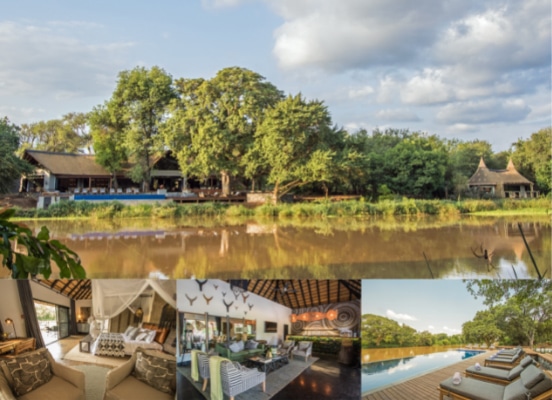
Abelana Game Reserve offers luxurious accommodation options and safari experiences that are tailored to suit guests’ preferences.

Blanketing 15 000ha of rich mesic savanna in the Lowveld, Abelana Game Reserve is located within one of South Africa’s major tourism hotspots, close to Phalaborwa and adjacent to the Greater Kruger National Park and Selati Game Reserve. Here guests are aware of a feeling of exclusivity as they enjoy an authentic and luxurious safari experience tailored to suit their preferences.

The reserve’s varied topography and mosaic of rich habitats, including a 10km stretch of riverine woodland along the semi-perennial Selati River, make it a prime birding destination. Raptors in particular abound and include African Fish Eagle (there are several resident pairs), Peregrine Falcon, Martial and Verreaux’s eagles, Bateleur and five vulture species (White-backed, White-headed, Lappet-faced, Cape and Hooded).

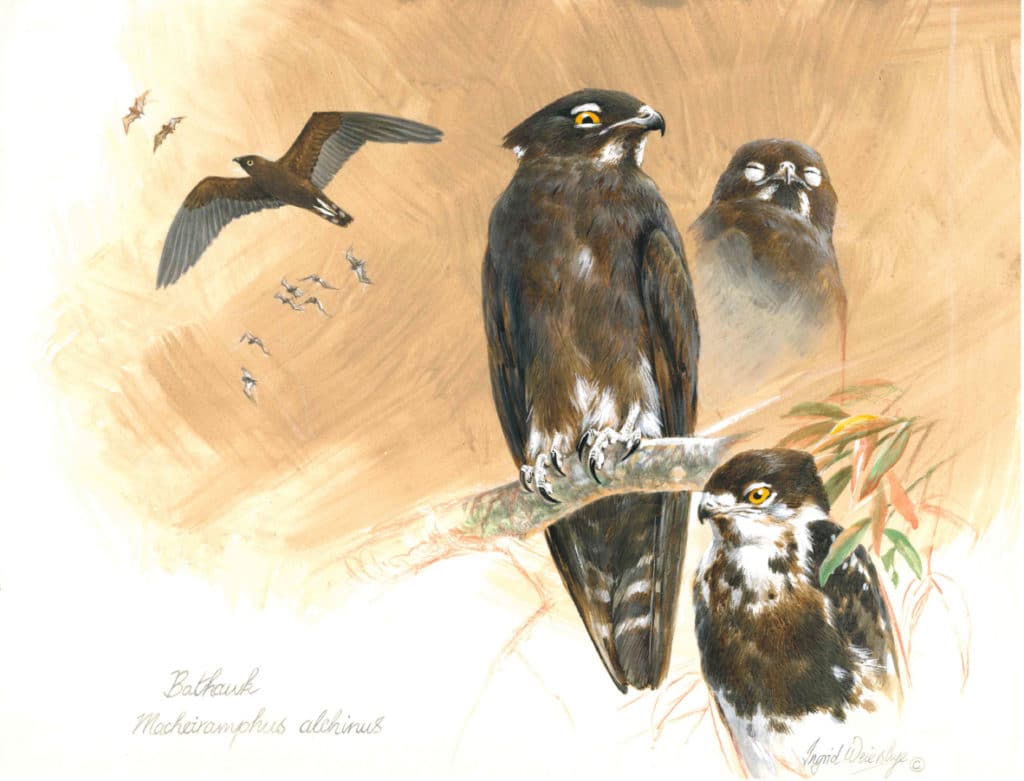
The rich riverine woodland hosts the comical Retz’s Helmet-shrike, while its brood parasite, the uncommon Thick-billed Cuckoo, is a regular visitor in summer, from October to April. Bat Hawks are sometimes seen along the river at dusk when they emerge to hunt among the large leadwood trees. Other notable species among the well over 400 that are known to occur in the region are Shelley’s Francolin, Saddle-billed Stork, Bronze-winged Courser, Purple-crested Turaco, African Emerald Cuckoo (in summer), Gorgeous Bush-shrike, White-breasted Cuckooshrike, Bearded Scrub Robin, Stierling’s Wren-Warbler and Bushveld Pipit.

In terms of accommodation, there is a lodge at each end of the reserve – Abelana Safari Camp at the southern end and Abelana River Lodge in the north – so it is very possible that only a single vehicle containing guests would be exploring this large area at any one time.

Abelana Safari Camp occupies an elevated position amid mighty granite outcrops and overlooks a large waterhole. The views over the bushveld are spectacular and daily guided game drives afford guests the opportunity to explore large tracts of bushveld with no one else around. The Meru-style, solar-powered tents are simple yet comfortable and well equipped, offering beds in either a twin or a king-size configuration and an en-suite bathroom. Food is freshly prepared in a home-cooked style, often over an open fire, and using the finest locally sourced fresh produce.

The newly rebuilt Abelana River Lodge overlooks the Selati River and has 20 luxurious thatched rooms with en-suite facilities, including an outdoor shower, and a spacious deck that looks onto the river. Also overlooking the river is the communal indoor/outdoor dining area with a bar and a fire pit. Various activities are offered, including guided game drives, birdwatching, photography and stargazing.

Abelana Game Reserve and the lodges in it are BirdLife South Africa Recommended Accommodations.

For more information, please call +27 (0)61 952 4302 or e-mail info@abelanagamereserve.com. Alternatively, visit www.abelanagamereserve.com, Facebook Abelanagamereserve or Instagram @abelanagamereserve

DANIEL KEITH DANCKWERTS, ACTING COMMUNICATIONS MANAGER


Martial Eagles breed at Ingula

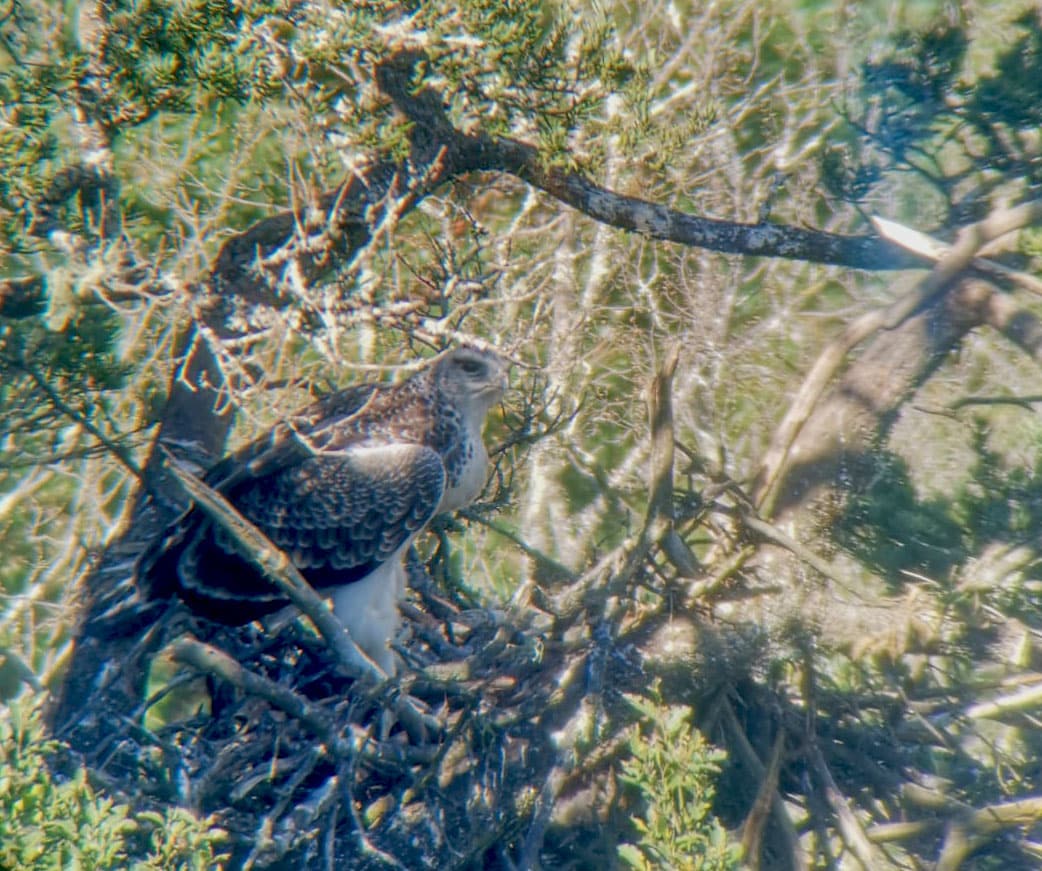
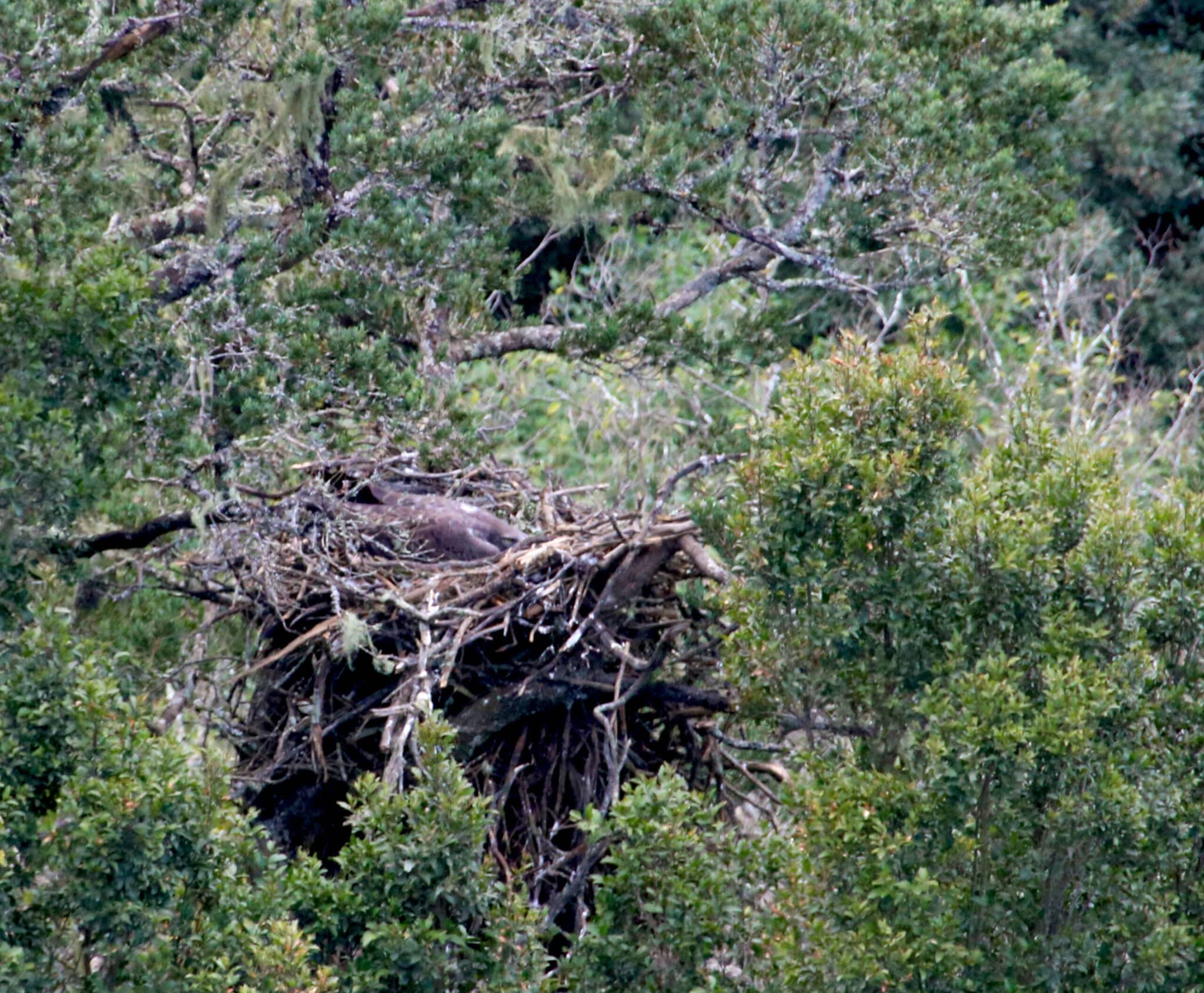
An adult Martial Eagle incubates the egg in May 2021. Credit Carina Pienaar

Ingula Nature Reserve is the chosen breeding ground for at least 10 threatened bird species and several more are found in the immediate vicinity. One of these threatened species nesting in the afromontane forest on the escarpment between KwaZulu-Natal and the Free State is the globally Endangered Martial Eagle. 

A photo of the fledging juvenile in September 2021, taken through a spotting scope. Credit Carina Pienaar

With a wingspan of 2.6m, the Martial Eagle is Africa’s largest eagle and, at up to 4kg, is the fifth heaviest eagle on earth. These mighty eagles were first recorded breeding in Ingula Nature Reserve in 2014, when they also successfully fledged a chick. Since then, the breeding activity has been infrequent and the nest unused for the past three years, although adults and juveniles are seen in the district fairly regularly. 

In May 2021, however, while the manager of BirdLife South Africa’s Raptor and Large Terrestrial Birds Project was being given a tour of the reserve, a single adult Martial Eagle was seen flying with nesting material in its claws. Upon inspection, an adult was recorded incubating on the nest. Martial Eagles incubate a single egg for approximately 50 days so we monitored the nest monthly to determine the progress of the chick. On 22 September we found a grown, fully feathered juvenile on a branch in the vicinity of the nest – the breeding attempt had been successful! 

Juvenile Martial Eagles remain in the nesting area for up to three months after fledging while they are learning to hunt but are still dependent on the adults for meals. Following fledging, they remain in their mostly white plumage for up to seven years until they reach sexual maturity and can find their own mate and establish their own territory. During this time, they become skilful hunters of other birds, reptiles and small mammals, and can spot prey up to 5km away. The size of their territory depends on the availability of food, but they usually have a home territory of 150km²

The fact that the pair has now successfully raised at least three chicks (the result of one additional breeding attempt is unknown) is very positive for Ingula and the surrounding area, as it indicates that the grassland can support enough small mammals and other prey items to sustain not only one adult but up to three, since some immature eagles are also frequently observed in the area after fledging. Management of the Ingula Nature Reserve will remain focused on sustaining healthy ecosystems that will support populations of threatened species such as the Martial Eagle. 

CARINA PIENAAR, INGULA PROJECT MANAGER


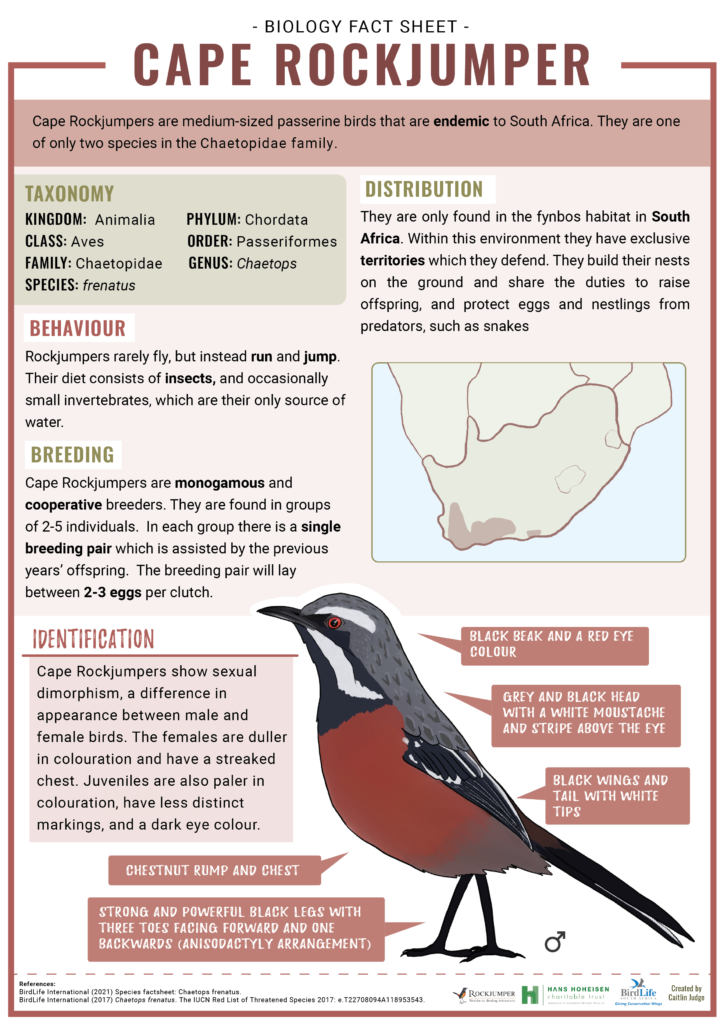
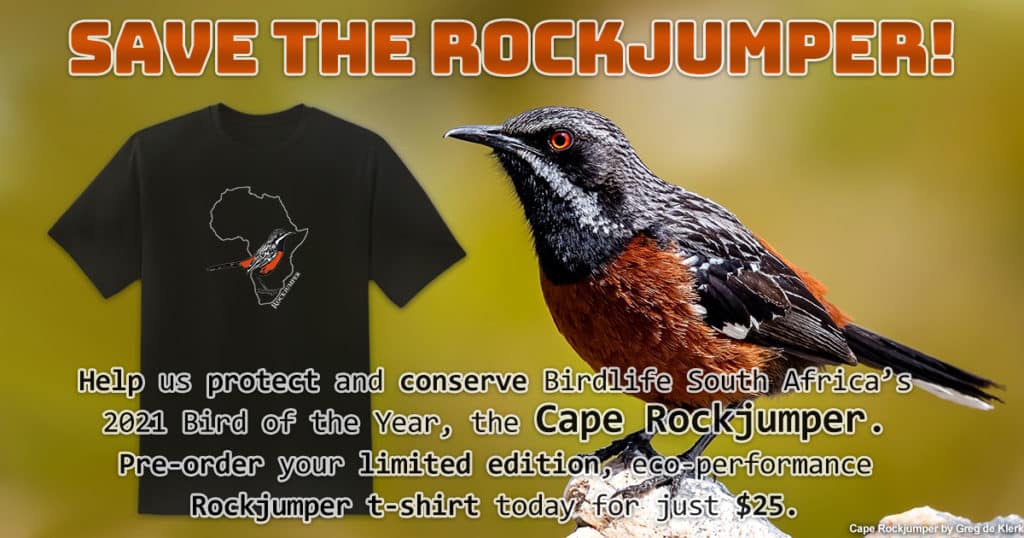
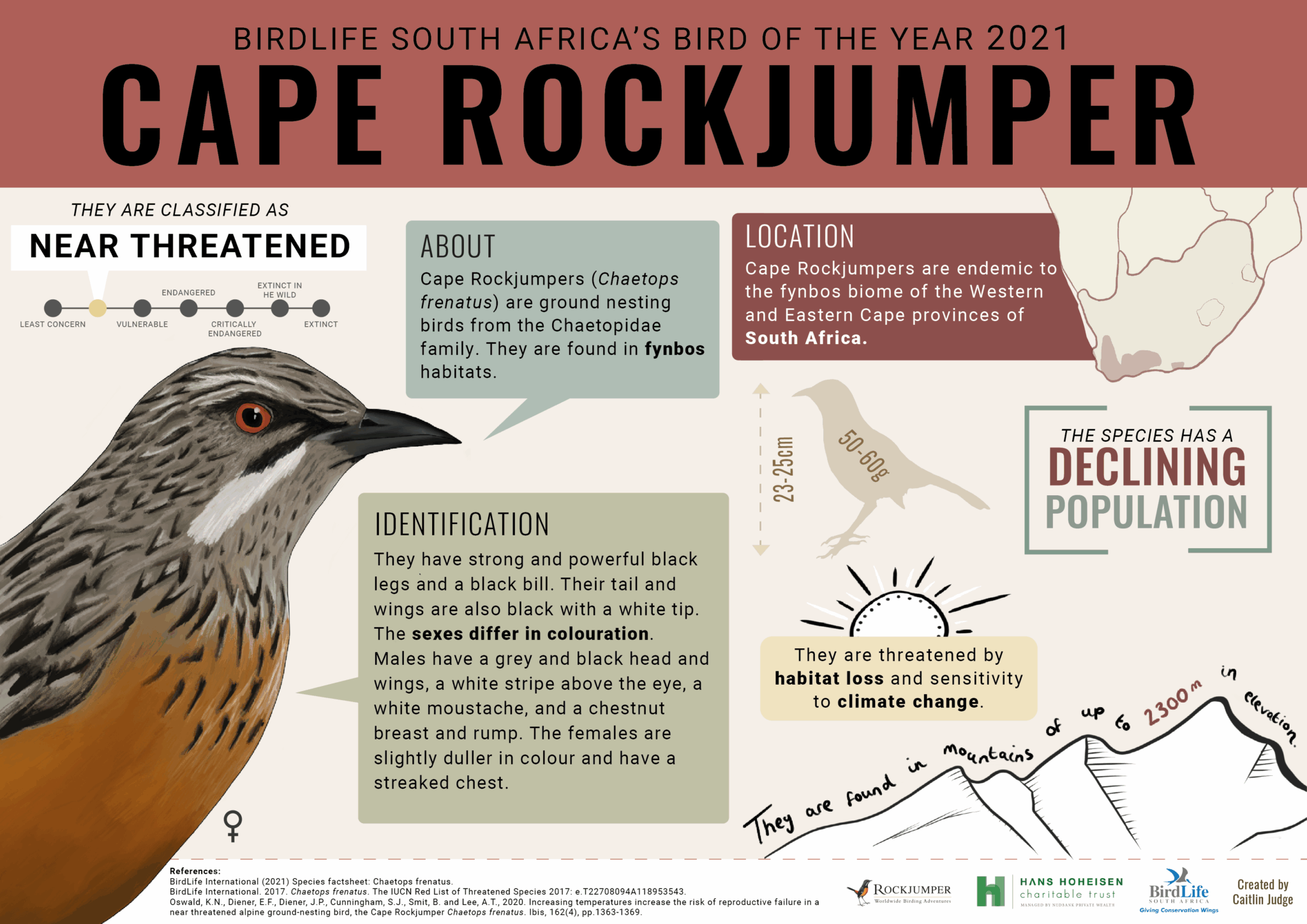
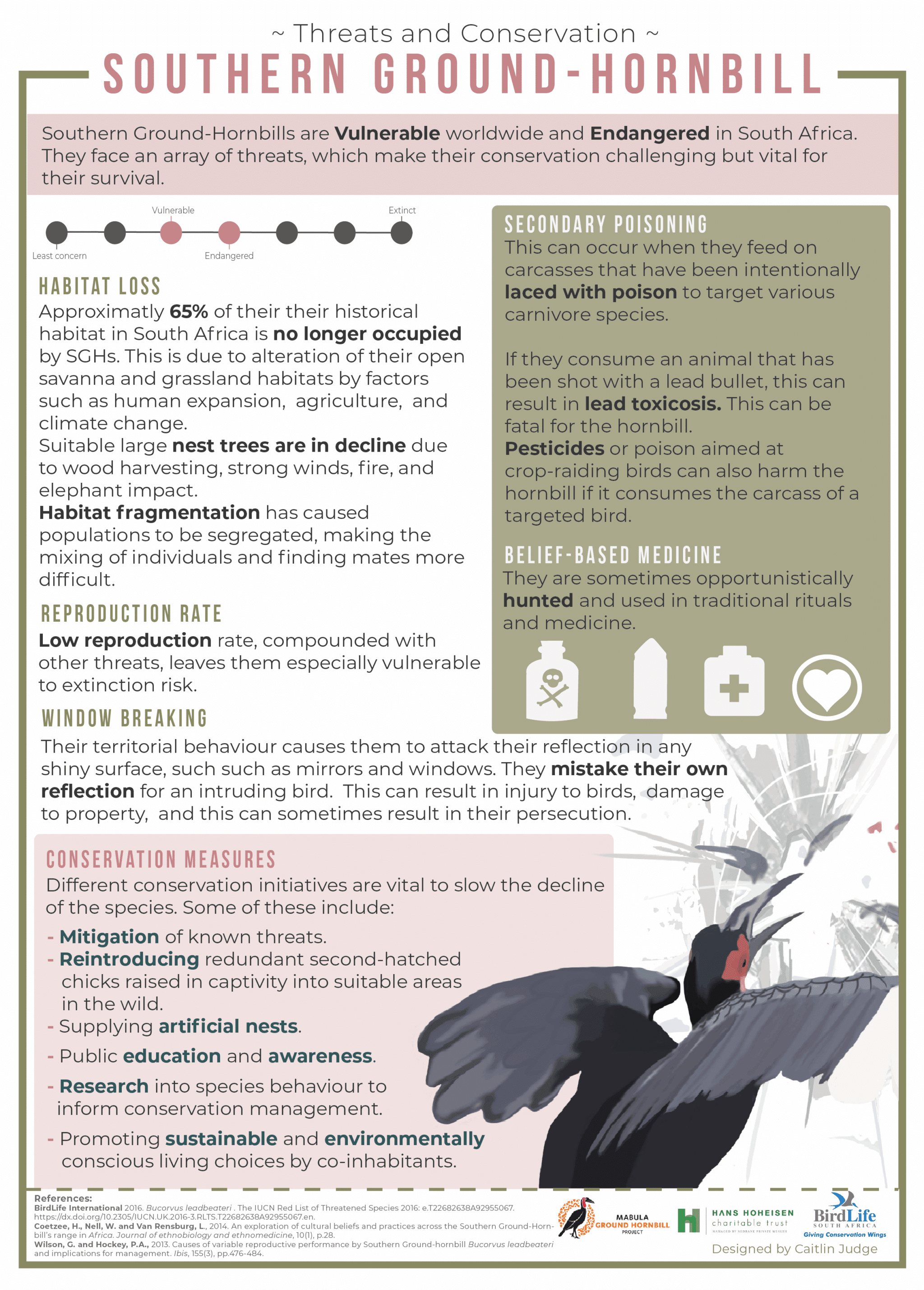
Learn about the Cape Rockjumper

Did you know that the temperature is estimated to rise 2–3°C in South Africa as a result of climate change? Learn more about how this may affect species such as the Cape Rockjumper, and what we can do to help, in this month’s Bird of the Year infographic. All the educational resources about the 2021 Bird of the Year are available for free on BirdLife South Africa’s social platforms and website at https://www.birdlife.org.za/bird-of-the-year-2021/

We are proud to be partnering with Rockjumper Worldwide Birding Adventures and are grateful to the Hans Hoheisen Charitable Trust for its support of this campaign.

CAITLIN JUDGE, BIRD OF THE YEAR ILLUSTRATOR


Seabirds need your help

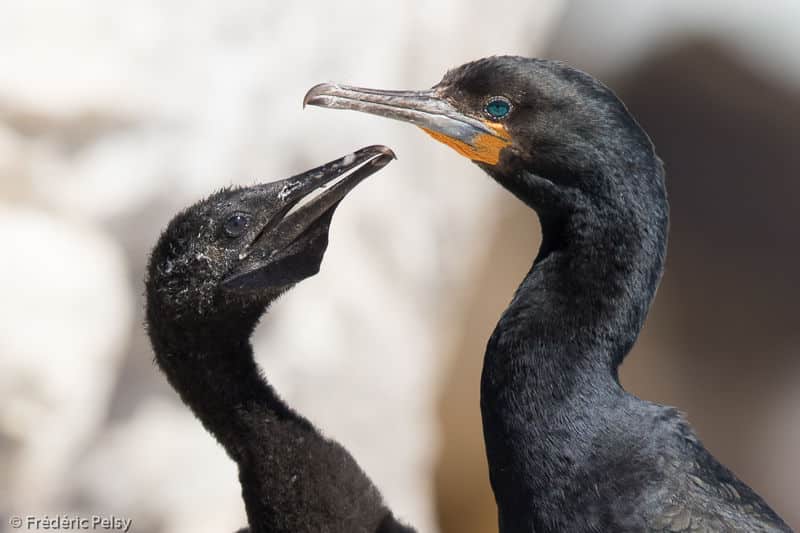
Cape Cormorants. Credit Frédéric Pelsy

We know quite a lot about the distribution of South Africa’s seabird species during the breeding season and current conservation and management strategies have been built around this knowledge. This is largely because it is relatively easy to retrieve a tracking logger from a bird that regularly returns to its nest to incubate or feed chicks. Once the chicks fledge, however, the parents no longer return to this central location and travel instead to distant profitable foraging grounds. To find out where adult seabirds go during this time, we need tracking loggers that enable us to download data remotely. Unfortunately, these loggers cost a pretty penny, which is the main reason why we still don’t know where many seabird species go when they are not breeding.

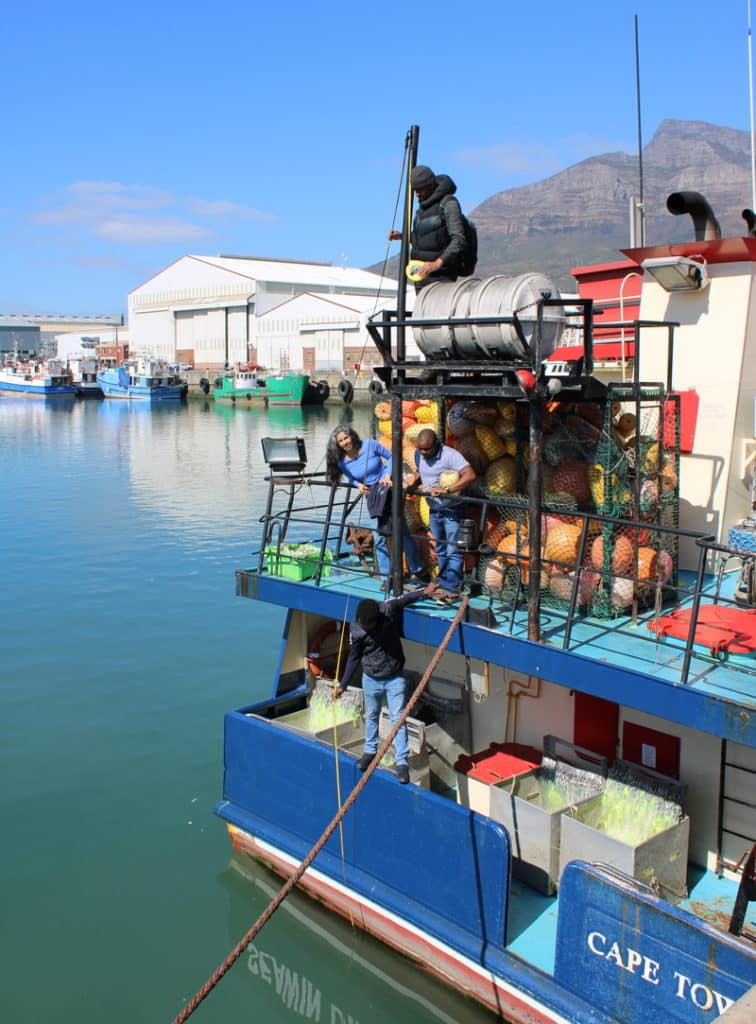
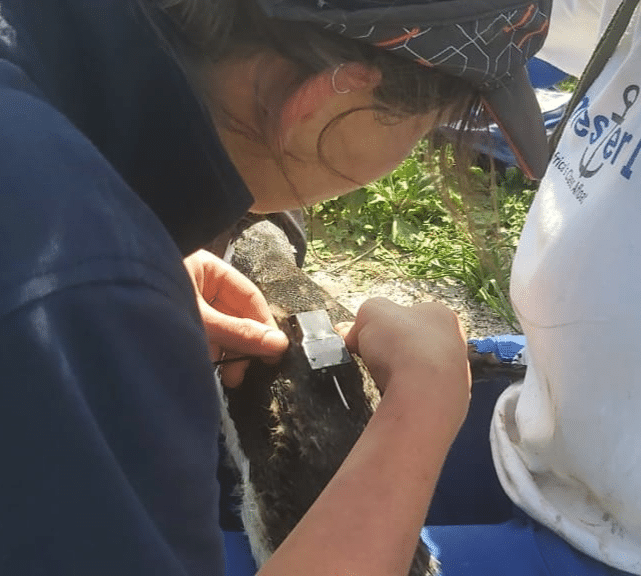
BirdLife South Africa’s Seabird Conservation Programme has recognised the paucity of non-breeding tracking data as a serious impediment to developing effective conservation and management strategies for threatened seabird species. This is essentially because the larger distribution of non-breeding seabirds increases the probability that they will interact with potentially risky anthropogenic activities. Although knowledge about the non-breeding distribution of seabirds is crucial for their conservation, the expensive price tag of GPS loggers has prevented us from discovering and protecting the non-breeding grounds of South Africa’s seabirds and therefore limits their conservation. Now, for the first time, BirdLife South Africa’s Seabird Conservation team plans to track two Endangered seabird species, the Cape Gannet and the Cape Cormorant, using sophisticated GPS devices outside the breeding season. But we need your help to do so. 

Once we know more about the at-sea foraging movements of South Africa’s seabirds, we plan to present the information to the relevant government structures in the form of proposals for marine Important Bird Areas that need greater protection. We will also investigate anthropogenic (such as fishery activities) and natural (such as climate) drivers of their foraging behaviour in the hope that these relationships can be used to improve ecosystem-based fisheries management.

If you would like to help discover where Cape Gannets and Cape Cormorants go during this crucial period when they are not breeding, please contribute via our crowdfunding initiative at https://experiment.com/benguelaseabirds

Donations of all sizes are welcome!

DR TEGAN CARPENTER-KLING, COASTAL SEABIRD PROJECT MANAGER


Unravelling migration mysteries

As summer migrants join us for our holiday season, in the November/December issue of African Birdlife Peter Ryan and Michelle Vrettos consider the costs and benefits of their long journeys. We also check in on the progress of the Gough Island Restoration Programme, go birding in the Northern Cape and venture much further afield to the Ennedi Natural and Cultural Reserve in Chad. Closer to home, Andrew Jenkins has compiled a stunning portfolio of coastal bird photos and we follow the fortunes of the African Grass Owls of Kyalami.


An Empowering People recce in Zululand

Andrew de Blocq with community bird guides in Dlinza Forest.

A BirdLife South Africa team comprising Dr Hanneline Smit-Robinson (Head of Conservation), Dr Isabel Human (HR Manager and Executive Assistant) and myself travelled to Zululand in KwaZulu-Natal recently for a series of meetings and to get a better feel for local challenges and opportunities ahead of an anticipated expansion of the Empowering People Programme. 

The Empowering People Programme was created during a strategic restructuring exercise at BirdLife South Africa in 2019 and aims to use birds and bird conservation to empower local communities by providing training and creating jobs within the biodiversity economy. Currently, the programme includes the longstanding Avitourism Project, which has community bird guide training and broader avitourism development at its heart. Thanks to the generous support of the Italtile & Ceramic Foundation, which has a significant footprint of community empowerment in the province, the programme is due to employ a manager soon and set in motion a community conservation initiative in KwaZulu-Natal. 

BirdLife South Africa, represented here by Hanneline Smit-Robinson and Andrew de Blocq, aims to support Themba Mthembu in his efforts to raise awareness of the need to protect birds in northern KwaZulu-Natal.

This initiative will draw on our well-established network of more than 20 community bird guides operating between Durban and the Mozambique border. We intend to use these guides to deliver community education for both children and adults to address local issues and to increase awareness of birds and the environment. We are also looking for funding to implement several upskilling initiatives for these guides, including the development of entrepreneurs and a workshop to empower women.

During the five-day trip to the area, Hanneline, Isabel and I met with most of the local community bird guides and gave them new uniforms that have been sponsored by Swarovski Optik and Whylo Distributors. We were also able to hand over to them eight cameras, several copies of Sasol Birds of Southern Africa provided by Struik Nature Publishers and some Eskom Red Data Books, as well as a number of pairs of donated binoculars. This was my first opportunity to meet most of the guides, although I communicated extensively with them during the pandemic and in connection with the Community Bird Guide Relief Fund in 2020.

We visited Themba Mthembu’s training facility, the Zulu Bird Camp, outside Tembe Elephant Park. As well as training guides, this facility reached a significant number of schoolchildren and young adults through its community education activities. However, the pandemic dealt it a distressing blow and we intend to find ways to support Themba in his important work. We also visited Amatigulu Nature Reserve, where community grazing intrusions are proving a very difficult challenge for the under-resourced reserve management.

Meetings with representatives of the Wilderness Leadership School and the WildTomorrowFund were an important part of our trip. These organisations are significant local role players and there is considerable scope for collaboration and synergy that we look forward to pursuing. We were also able to share a meal with Andrew Whysall of Whylo Distributors, a long-time supporter of the Community Bird Guide Project, and Hugh Chittenden, the renowned naturalist and author.

This trip was immensely beneficial in helping us to better understand the local context, challenges, opportunities and existing initiatives, as well as the needs of local communities. We are looking forward to taking our work further in this strategically important area.

ANDREW DE BLOCQ, AVITOURISM PROJECT MANAGER


Indigenous names for South Africa’s birds

As its title implies, the Indigenous Bird Names of South Africa (IBNSA) working group aims to put names to birds in South Africa’s indigenous languages. English and Afrikaans have been excluded from the group’s mandate as these languages already have their own full lists of bird names.

At the first meeting in August, Dr Johan Meyer was appointed chair of the group’s committee, which will oversee the language-specific working groups tasked to assign a preferred name to all the species listed in the Checklist of Birds of South Africa. This is no easy undertaking for a number of reasons. In many cases, a species does not occur in parts of the country where a specific language is spoken. Some species may share a group name, or conversely some may have several names, each specific to a regional dialect.

The names found in today’s bird books, such as Cape Rockjumper, were standardised at some time in the past in a process that is ongoing as taxonomic updates continue to be made. For languages such as English, French and Spanish the standardisation is now done at international level. Locally, the Afrikaans ‘Voëlnaamgroep’ standardises the regional list of Afrikaans bird names. For the other languages spoken in South Africa, generic names for many bird groups exist, but very few species-specific names. Most young speakers of African languages do not know the names of birds in their own language, which could lead to names being lost.

Building on the work of the broader African Bird Names Group, the IBNSA will bring together people doing research into bird names, ornithologists, linguists and, most importantly, birders who traditionally speak the language in question, as it is from them that the species names will originate. Each name should reflect not only the language but also the culture of the people to whom the language belongs – and it should capture the essence of the bird as experienced in that culture. Language specialists will be on hand to guide the process, which will inevitably involve much discussion.

Although the aim is to devise species-specific names for all South African birds in all nine of the country’s African languages, the group will initially focus on isiZulu (facilitated by Prof. Adrian Coopman) and Sesotho (facilitated by Lucas Namanyane and Johan Meyer). If anyone with a knowledge of bird names in any of the region’s African languages would like to help us, they can contact Johan at meyer.ij@gmail.com. We will soon be putting out a call for funding to facilitate the workshops that will be held during the course of 2022. We look forward to hearing from you!

JOHAN MEYER, CHAIR OF THE IBNSA; ALAN LEE, EKAPA SCIENCE AND INNOVATION PROGRAMME MANAGER; AND ANDREW DE BLOCQ, AVITOURISM PROJECT MANAGER 


Birding at Zvakanaka

Situated in the Soutpansberg, Limpopo, Zvakanaka Farm is an idyllic getaway 11km north of Louis Trichardt, just off the N1. It is also an ideal stopover for the Kruger National Park’s Pafuri and Punda Maria gates, Mapungubwe National Park, Zimbabwe via Beit Bridge, Mozambique via Pafuri and Botswana via Pontdrift and Platjan.

The farm is 54ha in extent and contains grassland, wetland and semi-deciduous scrub-forest. There are numerous trails that range from a gentle stroll to a serious hike to the top of a mountain, from which there are stunning views in all directions.

The birdlife is plentiful and varied, delighting guests with dawn and dusk choruses. Zvakanaka Farm falls within Pentad 2255_2955 of the SABP2 project (The South African Bird Atlas Project 2), which contains 209 species; the tally for the farm itself, at 133, also includes Garden and Olive-tree warblers, Pink-throated Twinspot and Yellow-throated Longclaw. When you book, please indicate whether you are a birder and we will e-mail you the most up-to-date list for the pentad, with the farm’s species ticked.

On the walking trails, look out for Olive and Gorgeous bush-shrikes, Narina Trogon, Yellow-streaked Greenbul, Cape Rock Thrush, Eastern Nicator, Green Twinspot, Scaly-throated Honeyguide, White-starred and Chorister robin-chats, Bearded Scrub Robin, Blue-mantled Crested Flycatcher, Crowned and Verreaux’s eagles and Black Sparrowhawk, among many others.

An excellent and well-known bird guide in the area is Samson Mulaudzi, who can help you see elusive species such as Blue-spotted Wood Dove, Bat Hawk, African Broadbill, Orange Ground Thrush and Magpie Mannikin. Samson can be contacted at www.birdingsoutpansberg-venda.co.za

Zvakanaka Farm’s accommodation comprises Igababa Cabin, Madala’s Cottage and Fook Farmhouse Flat, all of which are self-contained homes fully equipped for self-catering; Kubla’s Caravan, which is also fully equipped for self-catering; and Zvakanaka Campsite. All facilities are fully electrified and have braai stands and pit fires.

Igababa Cabin sleeps two, has an en-suite bathroom (shower, not bath), an outdoor double bath and a small wallow pool, and is very secluded.

Looking out from Igababa Cabin.

Madala’s Cottage sleeps 2–4 and has a double bedroom with en-suite bathroom (shower) plus an outdoor shower and double bath. There are two single beds in a small bedroom with access to its own bathroom (shower).

William’s Site in the campsite.


There is also Kubla’s Caravan, which sleeps two and has an adjacent unit with a scullery and a bathroom with gas-heated shower.


For enquiries or to book, contact Gail and Al Maytham at 084 400 4595 or gail@zka.co.za. Also see www.zka.co.za


OECMs in the Western Cape

‘Other Effective Area-based Conservation Measures’ (OECMs) is a conservation designation for areas that are achieving the effective in situ conservation of biodiversity outside protected areas. OECMs are integral to creating a network of connected conservation areas across various landscapes that prioritise sustained, high-value biodiversity conservation. They can encompass a range of governance and management regimes, like those recognised through biodiversity stewardship, and can be implemented by a diverse set of actors, including local communities, the private sector, non-governmental organisations and government agencies.

OECMs are being trialled in the Western Cape through a project funded by WWF Nedbank Green Trust and led by BirdLife South Africa in partnership with Conservation Outcomes, CapeNature, World Wide Fund for Nature – South Africa (WWF-SA), the South African National Biodiversity Institute (SANBI), Wilderness Foundation Africa, the Department of Forestry, Fisheries and the Environment (DFFE) and the International Union for Conservation of Nature’s (IUCN) World Commission of Protected Areas.

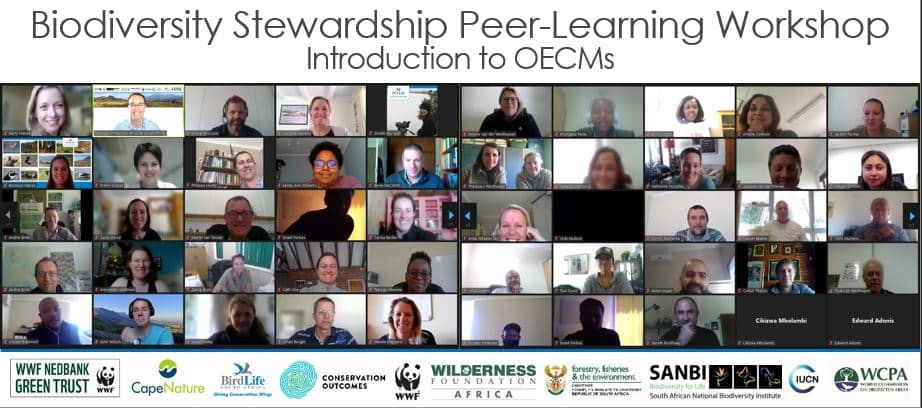
This project, which featured in the June issue of BirdLife South Africa’s e-newsletter, aims to identify and assess potential OECMs in the province, to understand and quantify the capacity and resource requirements needed to assess these OECMs, and to provide training to key stakeholders to support their assessment and reporting in the Western Cape. With the support of CapeNature, this year’s Western Cape Biodiversity Stewardship Peer-learning Workshop adopted an OECM theme and provided an exceptional platform for introducing OECMs to stewardship and other conservation practitioners from across the province. Designed and led by BirdLife South Africa and Conservation Outcomes, the programme comprised an introductory virtual meeting and an in-person practical workshop at the beautiful Karoo Desert Botanical Gardens in Worcester, as well as a virtual ‘practical’ alternative.

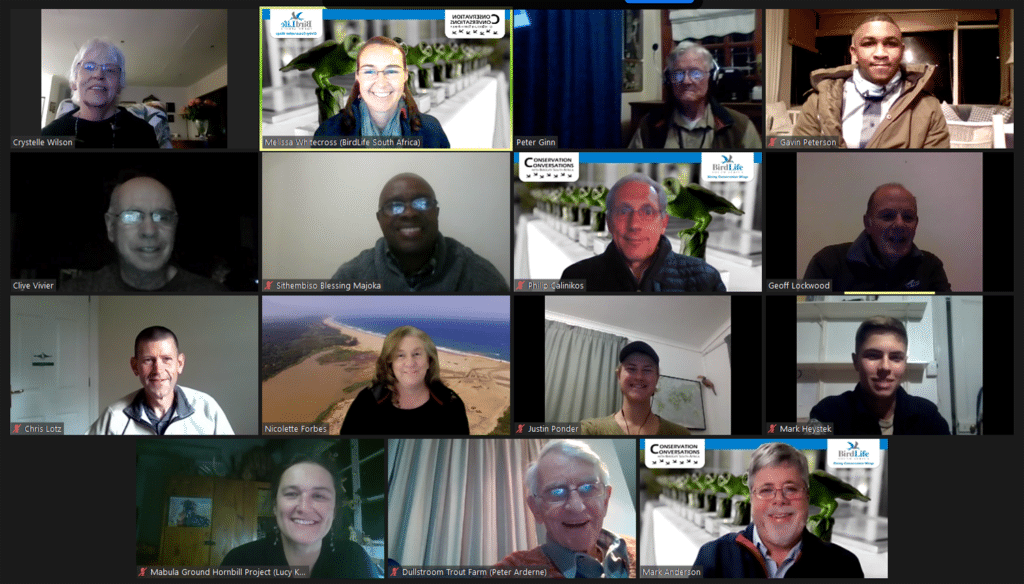
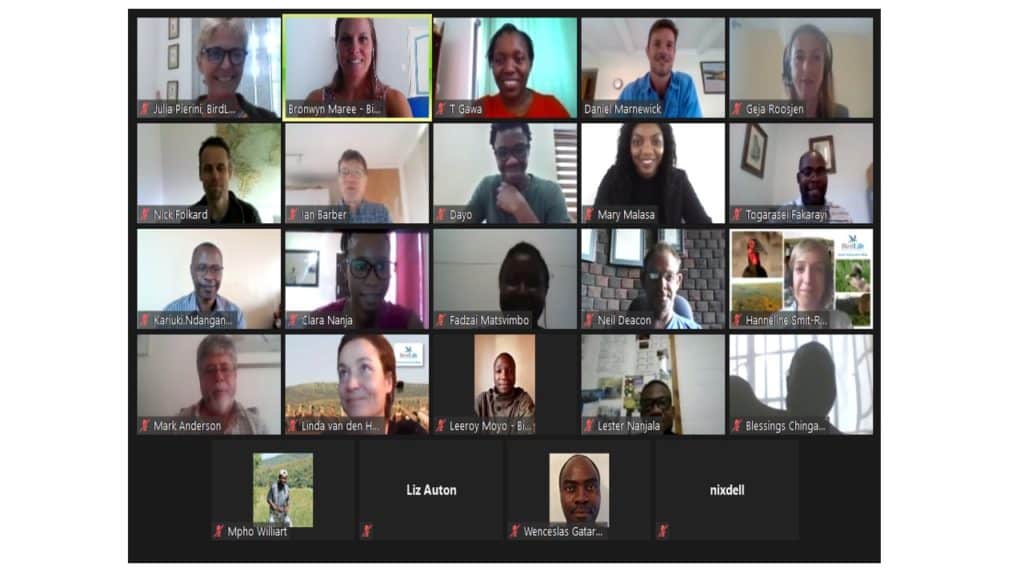
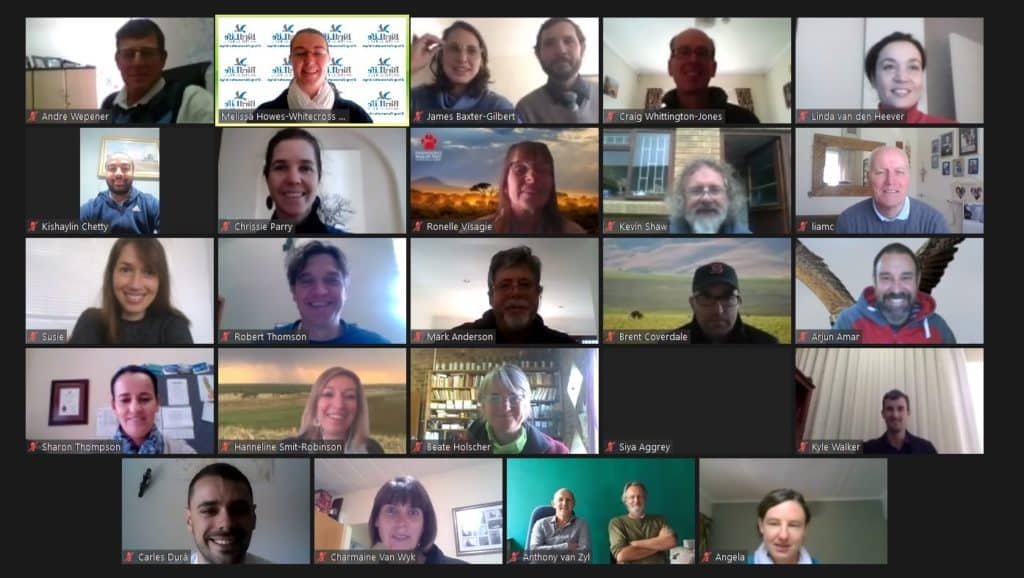
A screenshot of participants in the virtual workshop that introduced OECMs.

Wilderness Foundation Africa provided an excellent background to OECMs in the introductory virtual event, with contributions from the DFFE and other project partners. Following this, BirdLife South Africa and Conservation Outcomes guided participants through the application of the site-based methodology to identify and assess OECMS in the practical workshops, supported by outstanding case study presentations from key OECM stakeholders CapeNature and Overberg Renosterveld Conservation Trust. These events attracted over 70 participants from more than 10 key stakeholder groups and were regarded as an unqualified success, providing a solid grounding in the background, identification and assessment of OECMs. 

OECMs offer a significant opportunity to increase the recognition of and support for effective long-term conservation that is taking place outside currently designated protected areas and they will help South Africa to reach its conservation estate targets, including those of the draft Post-2020 Global Biodiversity Framework, which call for 30% of the world’s marine, freshwater and terrestrial spaces to be well protected and conserved by 2030 through an expanded and well-connected network of protected areas and OECMs.

The Western Cape pilot project is led by BirdLife South Africa’s Dr Melissa Whitecross, Bronwyn Maree and myself, with support from Conservation Outcomes, CapeNature and other partners. It will run from June 2021 to June 2023.

For more information, please contact me at giselle.murison@birdlife.org.za or visit the website https://www.birdlife.org.za/what-we-do/landscape-conservation/what-we-do/protecting-ecosystems/oecms/ 

DR GISELLE MURISON, WESTERN CAPE ESTUARIES CONSERVATION PROJECT MANAGER

African Penguin. Credit Andrew de Blocq

Empty nest syndrome

Since 1950 seabird population numbers have decreased by about 70%, making them one of the most threatened groups of birds globally. This dramatic decline is due largely to the challenges the birds face both on land and at sea, such as the depletion of food resources due to climate change or competition with fisheries; introduced predators and diseases; loss of breeding habitat; and mortality linked to fisheries bycatch. Marine protected areas, in which commercial activities are limited or prohibited, have been proposed as the most appropriate strategy to mitigate against this ensemble of challenges. However, in order to locate them where they will be most effective and give the best advantage to the seabirds at the lowest socio-economic cost, we need in-depth knowledge of how a species uses its environment throughout the year.

The distributions of South Africa’s seabird species during the breeding season are relatively well known and current conservation and management strategies have been built around this knowledge. This is largely because it is relatively easy to retrieve a tracking logger from a bird that returns regularly to its nest to incubate or feed chicks. Once the chicks fledge, the parents no longer return to this central location, but travel instead to distant profitable foraging grounds. To follow adult seabirds at this time, tracking loggers that enable the user to download data remotely are needed. Unfortunately these loggers are expensive, which is the main reason why we still don’t know where many seabird species go when they are not breeding.

BirdLife South Africa’s Seabird Conservation Programme has recognised the lack of non-breeding tracking data as a serious impediment to developing conservation and management strategies for threatened seabird species. This is essentially because the larger range of non-breeding seabirds increases the probability that they will encounter human activities that are potentially risky for them. To address the shortfall in tracking information on non-breeding birds, the Seabird Conservation Programme aims to track South Africa’s three Endangered seabird species – African Penguin, Cape Gannet and Cape Cormorant – during crucial life-history stages such as juvenile and post-breeding. The identification of important foraging areas for non-breeding birds will be used to inform not only marine spatial planning initiatives, but also an ecosystem-based approach to fisheries through the Department of Forestry, Fisheries and the Environment. 

At present the Seabird Conservation Programme does not have enough funding to carry out all the work we would like to. Thanks to the support of the Charl van der Merwe Trust over the past decade, we now largely know where African Penguins go to find food just before and just after their annual moult. This information has not only improved our knowledge about the species, but has proved invaluable when participating in conservation and management negotiations within South African government structures. We – and the penguins – are sincerely grateful for the continued support of the Charl van der Merwe Trust.

If you would like to help fund the Seabird Conservation Programme’s efforts to track non-breeding seabirds, please contact me at tegan.carpenter-kling@birdlife.org.za or visit www.birdlife.org.za/what-we-do/seabird-conservation/support-us/

DR TEGAN CARPENTER-KLING, COASTAL SEABIRD PROJECT MANAGER


Shade aid for Tankwa

As climate change denialism evaporates like a puddle under the blazing sun in the face of mounting evidence that the effects of warming temperatures exacerbate disaster situations, conversations around the world are starting to change from ‘Is it happening?’ to ‘What can we do about it?’

On a positive note, Wendy Foden, the research manager for SANParks and chair of the IUCN’s Climate Change Adaptation Group, says that modellers of long-term warming trends are beginning to favour a more likely 4°C warmer planet by the end of the century over the more pessimistic 8°C warmer planet. But that is still a lot of warming. For species at the thermal edge, even 4°C is likely to be too much. In essence, as we change to more sustainable technologies, there is a lag effect that will continue to result in warming, even if we were able to make a complete switch to green energy today.

Dr Susie Cunningham at the FitzPatrick Institute is increasingly starting to consider management solutions for the species she knows best: those of the arid environments. The Hot Birds project has undertaken a wide range of baseline research subjects to establish beyond doubt that climate change impacts for birds in arid environments will see population declines and local extinctions. For those species already making considerable behavioural trade-offs to stay alive in the heat there is little room to adapt, especially when there is no water around. 

The Tankwa Karoo is part of the Greater Cape Floristic Region and one of the driest places in South Africa, where summer temperatures hover between the mid-40s and 50°C. Ironically, as the eagle flies it is not too far from Jonkershoek, one of the country’s wettest locations. But the Cape Fold Mountains catch most of the rain, leaving little for Tankwa in their rain shadow. Water is precious and a host of species rely on natural and artificial water sources to stay alive.

By providing shade at waterholes, could we offset to a small but vital extent the exposure some of our important bird species experience when they come to drink? This is the question that SANParks, the FitzPatrick Institute and BirdLife South Africa want to answer. Tackling the field work will be Sean Morar, an MSc student in Conservation Biology at the Fitz. 

When I was last in the Tankwa Karoo in 2017, a long and severe drought was reducing the landscape to dust and tumbleweeds. The large Oudebaaskraal Dam and the waterholes in the national park thronged with avian activity. By contrast, 2021 has been one of the wettest years recently recorded and during the scouting and planning trip in September 2021 our team had to navigate streams and mud puddles. Driving to the research base, we were escorted by Black-eared and Grey-backed sparrow-larks and many Lark-like Buntings, nomadic species that had been absent in 2017. The normally dusty plains were awash with yellow and orange daisies and the hills were purple with Ruschia and Lampranthus flowers. It was truly a privilege to see the Tankwa in all its floristic glory.

But the ravages of drought were still evident; dotted among the hardy resurrection bushes, now gloriously green, were brown and black smudges of skeletal plants that hadn’t made it. A poignant site was a magnificently flowering desert rose. It was the only one, its century-old companions no more than decaying stumps in an empty plain.

Susie and Sean will be implementing a before-after controlled experiment designed to determine the influence of shade at water points. Sean will also be conducting point counts to determine how species are influenced by the presence of water in the landscape. Susie’s previous work has shown that waterholes dramatically change the species richness of avian communities over small spatial scales. Another goal of the project is to quantify the influence of water on bird densities: are birds still willing to fly long distances between water and foraging grounds or are they making yet another trade-off to beat the heat? Sean will be conducting the research over this coming summer and preliminary results will be on your screens early next year. We would like to think they will bring another message of hope. 

DR ALAN LEE, SCIENCE AND INNOVATION PROGRAMME MANAGER


Hampers to help celebrate 25 years 

Looking for that gift with a difference that can’t fail to bring pleasure? Don’t know what to buy for hubby? Shop for the Birds! and Elaine’s Birding have not one, but three answers for you – and the birds in your garden will love them too…

Finch Hamper

A galvanised food tray, a small (300g) suet pop, a large (550g) suet pop, a peanut pop and a seed pop. Price: R420 (including VAT).

Cape Robin-Chat Hamper

A galvanised seed storage box, wild bird seed (2kg), luv bugs larvae (100g), a small seed bell on a rope, a green top suet ball feeder and a pack of three mini suet balls. Price: R499 (including VAT).

Weaver Hamper

A galvanised storage chest, orange nectar sachets (150g), a small seed bell on a rope, a terracotta suet ball holder, a bird grub suet ball (200g), luv bugs larvae (100g) and wild bird seed (2kg). Price: R599 (including VAT).

Delivery/Collection

Hampers can be delivered to your door by courier, in which case a courier fee of R173 per hamper will be added to your invoice. Please allow 7–15 days for despatch once payment has been received. Alternatively, let us know if you would like to collect from BirdLife South Africa’s Isdell House in Dunkeld, Johannesburg, so that a date and time can be arranged. 

For more information or to place an order, please send an e-mail to shop@birdlife.org.za. Include your first and last names, your physical address for delivery, your postcode and province and your cell phone number. Also let us know whether you prefer a courier delivery or to collect your purchase at Isdell House and we’ll send you an invoice. 

All items mentioned are subject to availability and Elaine’s Birding reserves the right to substitute any items if necessary. Please note that these hampers are not available from our online store.

CLARE NEALL, EVENTS MANAGER


Mouse-Free Marion gains momentum


A large Wandering Albatross chick being attacked by a mouse on Marion Island. Credit Stefan and Janine Schoombie

The Mouse-Free Marion (MFM) Project, a partnership between BirdLife South Africa and the Department of Forestry, Fisheries and the Environment (DFFE), was established to restore this sub-Antarctic territory. South Africa’s Marion Island is home to globally important populations of seabirds, which are being devastated by an inconspicuous menace – house mice. These tiny terrors were accidentally introduced by visiting sealing parties more than 200 years ago and have been wreaking havoc on the ecology of the island ever since. In recent decades their adverse impact has escalated dramatically, as they have started preying on the eggs, chicks and even adults of many of the island’s breeding seabirds.


It has been predicted that if left unchecked, the mice will cause the local extinction of the majority of the island’s seabird species, including the Wandering Albatross. The MFM Project is working to eradicate the invasive mice from Marion Island, thus helping to secure a positive future for this iconic species and the many other seabirds that call the island home. The conservation benefits of the project will extend beyond seabirds, enabling plants, invertebrates and the entire ecosystem to recover. 

The Covid-19 pandemic has delayed many projects and the MFM Project is no exception. However, it has made significant progress in 2021, notably with the appointments of key staff members. Since the appointment of Dr Anton Wolfaardt as the project’s manager in February, two more staff members have been added to the Mouse-Free Marion team. Keith Springer, who has led rodent eradication efforts on islands in Australia and New Zealand, joined the project as operations manager in July and the following month Robyn Adams was appointed as communications officer and project assistant. The MFM Project is in the process of finalising the appointment of an international philanthropy officer, who will be responsible for leading the project’s fundraising efforts. 

An eradication operation on an island that lies some 2000km from South Africa is a highly challenging and ambitious task, but it is also an urgent one and it can, and must, succeed. Recently, positive news of the successful completion of the baiting component of the Gough Island Restoration Programme has provided further impetus and encouragement for the MFM Project. While this is incredibly encouraging, for both Gough and Marion, it’s useful to note that Marion Island is significantly larger than Gough Island. If our efforts are successful, Marion will be the largest island from which introduced rodents have been eradicated in a single operation. 

Even from a home, removing a rodent infestation is not easy. Eradicating mice from a sub-Antarctic island larger than the city of Bloemfontein will be orders of magnitude more difficult. Eradication requires that every single mouse is removed, and thus it differs fundamentally from a control operation, which seeks to keep the pest population at a low level. Pest control officers in the city of Bloemfontein would be delighted to remove 99.9% of the pests in their patch, yet an eradication project with the same outcome would be a complete failure.

The cost to safeguard Marion Island’s seabirds is substantial and will rely on funding from a number of sources. To this end, a ‘Sponsor a Hectare’ crowd-funding initiative has been established to source some of the funds needed to conduct the eradication operation. The ‘Sponsor a Hectare’ initiative has set a target to raise R30-million of these funds. Marion Island covers just under 30 000ha. A donation of R1000 for each hectare will ensure that we reach this target. 

To date, the project has inspired more than 900 donations from all over the world. The first 100ha sponsorship came from Taiwan and support has been received from many other countries, including Canada, the USA, the UK, Australia and, of course, South Africa. Bird clubs have been generous supporters of the project, with many members eagerly awaiting their opportunity to visit Marion Island during the Flock to Marion cruise in 2022. Currently, donations have secured 8% of the 30 000ha target. Although there is still a long way to go to reach the funding goal, the project is fast gaining momentum. 

To help save Marion Island’s seabirds and secure a lasting conservation legacy, please visit https://mousefreemarion.org/sponsor-now/. For more information about the project, go to Mousefreemarion.org or subscribe to the newsletter for regular news updates. 

ROBYN ADAMS, COMMUNICATIONS OFFICER AND PROJECT ASSISTANT, MOUSE-FREE MARION PROJECT


Win on BBD 2021!

Participate in Birding Big Day (BBD) this year and you could win big! On 27 November 2021 you can bird all day and set your own target of species logged or attempt to break a record. The area you cover can be large or small or you can confine yourself to your garden or a local park, but wherever you go you will be able to enjoy the remarkable diversity of birds South Africa has to offer.

This year we have added a new 5km radius category to the standard 50km one and it will be ideal for birders who don’t want to travel too far and are content to atlas a pentad or just cover their local patch. They can still upload their sightings using BirdLasser and there will be a dedicated online map for this category.

To participate in BBD 2021, create a team of at least four birders, choose an area to bird in and then register. You can log your sightings on the BirdLasser mobile app or simply list the species as you go.

For more information, visit https://www.birdlife.org.za/support-us/events/birding-big-day-2021/ or e-mail me at ernst.retief@birdlife.org.za. To register, go to https://www.birdlife.org.za/birding-big-day-2021-entry-form/

Lucky draw

Stand a chance to win a pair of Swarovski CL 8×30 binoculars valued at R25 000! If you participate in Birding Big Day 2021 and your team donates at least R300 to BirdLife South Africa, each team member will be entered into a lucky draw for these binoculars. To be eligible for the prize:

  • Only members of Birding Big Day teams with a maximum of four members (not clubs or community groups) that have registered on the BirdLife South Africa website will be entered into the lucky draw; 
  • BirdLife South Africa employees and their immediate families are not eligible; 
  • The details of each member must be entered correctly on the registration form; 
  • The team must make a donation of R300 or more to BirdLife South Africa before 31 December 2021; 
  • The team must log at least 20 bird species on the day and submit the records either through BirdLasser or on paper as per the BBD rules; 
  • All the eligible team members will be entered into the lucky draw. 

ERNST RETIEF, BIRDING BIG DAY ORGANISER


Big Birding Weekend in Zululand

As one of South Africa’s top birding destinations, Zululand is where you’ll want to be for Birding Big Day. Click on this link to find out more about the Big Birding Weekend at Ghost Mountain Inn.


Mabula Ground Hornbill Project updates

The Mabula Ground Hornbill Project was recently announced as one of six recipients of the Whitley Award, which is presented by the UK-based Whitley Fund for Nature. To hear Sir David Attenborough talk about our work as he presented the awards virtually was the most incredible experience for all the dedicated people who have worked so hard to understand Southern Ground-Hornbills and find ways to keep them safe. The project would never have made it without you, so each and every one of our team sends our supporters a massive thank you for helping us to achieve our goals.

Then, as a bonus, BirdLife South Africa presented the project with a prestigious Eagle Owl Award – wonderful recognition of our work in such a beautiful form. Award ceremonies are less fun via Zoom, but we are extremely grateful for all the attention being focused on Southern Ground-Hornbills. Our heartfelt congratulations go to all the other award winners too – amazing work is being done for birds in South Africa and conservation around the world.

We at the Mabula Ground Hornbill Project encourage contributions from citizen scientists as part of our National Monitoring Plan and were delighted to receive this photograph taken by Morné Vermeulen of an incredible sighting of Southern Ground-Hornbills. It shows an adult male and a sub-adult presenting a united and threatening front to a circling Tawny Eagle in a bid to appear as intimidating and dangerous as possible. The hornbills had been carrying food items to an active nest when the Tawny Eagle attempted to swoop in and snatch their prey. This is just one of the many photos of sightings sent to us each month.

We’re very happy to report that a group of three Southern Ground-Hornbills has been released successfully into a new site. With the assistance of the reserve’s ecology team, we set up the temporary aviary in just a day and brought in the pair-bonded group on 22 July. The four-week acclimatisation period passed smoothly and then the group was released into the reserve and has stayed together ever since. As this group is located in the foothills of the Waterberg, near our headquarters, it forms part of our strategic core of Mabula–Marakele breeding groups. Our goal is to establish at least 10 breeding groups as a viable self-sustaining population in Limpopo. The next priority will be to resolve the growing gene flow gap in northern Zululand; we hope to reconnect the Limpopo–Mpumalanga population with the KwaZulu-Natal–Eastern Cape population. 

This adult female was one of the redundant second chicks we rescued from a wild nest and now
she is ready to take on the role of a breeding female in a reintroduced wild group.

One of the reintroduced birds flying where Southern Ground-Hornbills haven’t flown for years.

Kyle Brand, a lecturer at the Tshwane University of Technology, and some of his students have developed ‘super nests’ for the ground-hornbills and continue to improve on their design. The latest version is pieced together more quickly and easily than previous ones, as an automated laser cutter produces the individual panels for alignment. The new nests are also lighter (at 30kg) and allow improved air flow for climate control within the nests. We hope to have 20 of these new nests available for the start of the 2021 breeding season! If you are interested in sponsoring a nest, please get in touch with us (www.ground-hornbill.org.za). 

The Mabula Ground Hornbill Project has recently provided some individuals of the BirdLife Zimbabwe team with the skills needed to establish the conservation status of their country’s Southern Ground-Hornbills by using the power of citizen science. The determined team has now set up seven WhatsApp champion groups and the sightings are starting to flood in. We hope to add more groups in the coming weeks and months. What started as a theoretical plan for monitoring a widespread, low-density species in South Africa has become a reality and it is working like a charm. 

In South Africa, more than 500 sighting records come in per month; now Namibia and Zimbabwe are picking up steam and a few other range states are setting up their own national reporting networks. It is gratifying to know that a network of citizen scientists who love ground-hornbills can provide a wealth of data on the birds’ density across the range and their persistence outside protected areas.

We’re excited that the Covid-19 vaccine is finally widely available! As our team members get their jabs, we’re preparing for the coming breeding season. The ground-hornbills are getting vaccinated too – but there’s not a needle in sight. Avian avulavirus 1, which leads to Newcastle disease, is a threat to Southern Ground-Hornbill populations and we’ve given the vaccine to both captive and reintroduced birds. It is administered through their food, so no stressful captures or injections are necessary, and it will help to maintain a healthy reintroduction population that we hope will produce new – and healthy – chicks for future reintroductions.

And to ensure that the 2021 rearing season runs smoothly, we’ve put some finishing touches to the Baobab Rearing Facility. The protruding front of each unit helps to create a healthy distance between humans/rearers on the outside and the hornbill chick inside. At the back of each unit is the aviary the chick will fledge into as it start its journey to becoming an adult hornbill in the reintroduction programme. 

With the invaluable and much-appreciated assistance of Tincup Animation, Triggerfish Animation, Sonic Studios (Durban) and Sonovision (Gauteng), we are producing a conservation animation that will be another tool in our ever-growing kit to help raise awareness about the Southern Ground-Hornbill and improve conservation efforts throughout its natural range. Dr John Kani (English and isiXhosa) and Dr Gcina Mphlophe (isiZulu) have done incredible voice-overs for the animation, and I was delighted to be able to spend some time with Dr Kani during the recording process.

DR LUCY KEMP, MANAGER, MABULA GROUND HORNBILL PROJECT 


Kruger Challenge postponed

The Kruger Challenge is a fundraiser in aid of the Critically Endangered White-winged Flufftail, one of the world’s rarest birds, for which Rockjumper Birding Tours is also the BirdLife International Species Champion. The inaugural Kruger Challenge, hosted by Rockjumper Birding Tours, BirdLife South Africa and Middelpunt Wetland Trust, took place in the Kruger National Park in February 2019 and was so successful that there has been a demand for another such event. We had been planning to hold another challenge in February 2022, but have decided to hold off for another year in view of the uncertainty surrounding Covid-19. We would like to apologise for the inconvenience that the postponement might cause to our valued supporters and thank you for your understanding.

In 2023 we will return to the Lowveld for a second event and hope to see you there! Eighteen teams following 10 different routes that run the length of the Kruger National Park will take on the challenge to experience first-class birding and Big Five experiences. Each team of nine members in an open safari vehicle will be accompanied by a birding expert and a registered Kruger guide. During this fun challenge, which will start in Skukuza and end in Mopani, the competitive teams will try to find and identify as many bird and mammal species as they can. Each species recorded will be awarded points based on its rarity.

The routes will vary in pace from competitive to relaxed. The competitive routes will be complemented by a non-competitive route in the north of the park and one in the south, as well as photographic and special Kruger Bush Camp routes. The rates for most include breakfast and dinner, except for the Bush Camp routes, which include all meals. 

Please check BirdLife South Africa’s social media platforms for the latest updates on the Kruger Challenge. You can also visit and bookmark the Kruger Challenge page at https://www.birdlife.org.za/support-us/events/the-kruger-bird-wildlife-challenge/ 

DR HANNELINE SMIT-ROBINSON, HEAD OF CONSERVATION, AND KYRONE JOSIAH, CONSERVATION INTERN


2022 calendars are here!

We are excited to announce that the 2022 Birds of Southern Africa calendar is now in stock and can be ordered online at https://www.birdlife.org.za/support-us/2022-calendar/. Produced in collaboration with Chamberlain, the large-format wall calendar features stunning photographs of some of the region’s most eye-catching bird species.

Priced at R175 each, the calendars can be delivered either Postnet to Postnet or by Fastway Couriers. Alternatively, you can collect yours at Isdell House by prior arrangement. For more information, please contact me at membership@birdlife.org.za

SHIREEN GOULD, MEMBERSHIP MANAGER


River Valley Nature Reserve

Located in a picturesque horseshoe of the iVungu River, River Valley Nature Reserve is a small remnant of once-pristine natural coastline. With its grassland and its riverine and coastal forests, the reserve counts impala, nyala, the shy bushbuck and several smaller and more elusive antelope species among its mammals, as well as a pair of Cape clawless otters whose tracks may be seen along the muddy verges of the river. Some 145 bird species are also known to occur, including the beautiful Narina Trogon, the Crowned Eagle, Knysna and Purple-crested turacos, Green Malkoha, Freckled and Fiery-necked nightjars and Blue-mantled Crested Flycatcher. The reserve is also conveniently situated near other top birding destinations in KwaZulu-Natal and serves as a wonderful base from which to explore the surrounding region. Accommodation is available in luxurious cottages overlooking the river, while the property also features a small campsite. 

For more information, please e-mail info@rivervalleynaturereserve.co.za, tel. 083 263 5537 or go to www.rivervalleynaturereserve.co.za 

BirdLife South Africa aims to promote South Africa as a top-class birdwatching destination that is vital to the long-term conservation of the country’s wild birds and their habitats. With this in mind, we have a network of BirdLife South Africa-recommended accommodation establishments that we encourage birders to make use of. For more information or to have your property listed, please visit www.birdlife.org.za/go-birding/accommodations/

DANIEL KEITH DANCKWERTS, ACTING COMMUNICATIONS MANAGER


175 years of ZEISS

To find out more about the ZEISS special offers, including a chance to win a trip to Colombia, click on this link.

Linda van den Heever and Andrew de Blocq met with Bernard van Lente, the project manager at Zinave National Park (centre), to discuss various criteria relating to the Vulture Safe Zone initiative. Credit Melissa Whitecross

Marabou Storks breeding in a baobab tree in Zinave National Park. Credit Melissa Whitecross

Vulture Safe Zones for Mozambique

BirdLife South Africa’s Vulture Project is successfully establishing Vulture Safe Zones in many areas of South Africa. However, since vultures travel vast distances with little regard for country borders, it is important to expand the initiative into southern Africa’s Transfrontier Conservation Areas (TFCAs).

With the support of the Peace Parks Foundation, a Vulture Project team comprising Melissa Whitecross, Andrew de Blocq and myself recently visited Zinave National Park, a 400 000ha reserve on the banks of the Save River in Mozambique, to assess its potential as a Vulture Safe Zone. We were impressed by the sheer scale of this wilderness area and could see it becoming a sanctuary for southern Africa’s embattled vulture populations. Although vultures do not currently breed in the park, there is every reason to believe that they may do so in future, as increases in game introductions are slowly opening up the vegetation. We observed numerous Critically Endangered White-backed Vultures during the visit, as well as the elusive and also Critically Endangered White-headed Vulture. The presence of the latter is of special significance, as the Great Limpopo TFCA, which straddles the South Africa–Mozambique border, is arguably one of the last remaining refuges of this species in southern Africa.

The success of the trip was underscored by a visit to the 145 000ha Karingani Game Reserve, situated on the border of Kruger National Park, whose management has also expressed an interest in joining the initiative. Karingani hosts about 65 White-backed Vulture nests, as well as several nests of White-headed and Endangered Lappet-faced vultures. Both Zinave and Karingani will be enormous assets to the Vulture Safe Zone initiative and could play a vital role in ensuring that vultures remain part of the southern African landscape.

LINDA VAN DEN HEEVER, VULTURE PROJECT MANAGER


Spring Alive

A parade of ‘spring migrants’ at a local primary school. Credit Kristi Garland

Africa’s Spring Alive season is about to start and we are delighted to welcome two new countries to our network: Senegal and Ivory Coast. Across the continent, teachers, parents and volunteers will be educating children about birds and nature through our seven Spring Alive focus species. Although these birds breed in Europe, they couldn’t do it without the rest, warmth and nourishment that Africa provides. 

In the coming weeks, many migratory birds will be returning to Africa for a much-deserved rest after the intensive activity of the breeding season in Europe. They will use their time on our continent to moult their old feathers and grow shiny new plumage to impress next year’s mate. They will also eat as much as they can, building up their fat stores before setting off to start the process all over again.

The nesting habits of the Spring Alive focus species are as varied as the birds themselves. Here’s a glimpse of what these migrants get up to during the northern hemisphere’s spring and summer:

Penthouse apartment
The White Stork is not afraid to build its nest near humans, often locating it high up on telegraph poles, church roofs or even people’s houses. Male White Storks return to the same nest every year, adding to its height until it can reach an incredible two metres. Their nests are so big that smaller birds such as sparrows and starlings often breed in the sides of these towering structures, which become multi-storey, high-rise apartment blocks. In a network of ‘stork villages’ in Europe, storks are both protected and celebrated by humans. The district of Cheshinovo-Obleshevo in North Macedonia, for example, holds annual Stork Day festivities and has even updated its coat of arms to feature the White Stork. The Macedonian Ecological Society (a BirdLife partner) works with energy companies in the area to re-model potentially dangerous power lines that could electrocute nesting storks.

Life underground
Unlike most birds, which make their nests out of twigs, the Sand Martin digs deep burrows into the sandy banks of rivers or lakes or into coastal cliffs. The martins like to nest in large groups ranging from 12 to several hundred pairs and their tunnels can stretch for more than a metre! In modern times, though, humans have modified waterways, putting in flood control and anti-erosion structures, and the natural cliffs are being lost. Quarries are one of the few remaining habitats where Sand Martins can set up a colony, but they are also working landscapes that constantly change as new areas are excavated. Our sponsor HeidelbergCement solves this problem by attracting birds to cliffs in unused parts of the quarry and making sure the machinery is kept a safe distance away.

Hidden in plain sight
Most birds like to build their nests out of harm’s way, but the Common Ringed Plover has another strategy, barely bothering to build a nest at all and laying its eggs directly onto the beach. The eggs, however, are perfectly camouflaged to look like pebbles. Even the chicks are grey and mottled like the stony shingle of the shoreline. If a predator does manage to sniff out the nest, the parents have another trick up their sleeve: they stagger away from the nest, calling out and feigning a broken wing to lure the predator towards them. Sadly, this plover’s population is declining due to wetlands being polluted or drained to make way for agriculture, especially along its migratory journey. The Ghana Wildlife Society (a BirdLife partner) runs school birding trips to local wetlands, using the Common Ringed Plover as an ambassador for these vital habitats.

Sculpted to perfection
Barn Swallows used to nest in caves, but today they nest almost exclusively in small gaps underneath the roofs of houses, churches and, of course, barns. They build their distinctive cup-shaped nests out of hundreds of tiny pellets of mud that they collect in their beaks. Unfortunately, modern buildings have fewer suitable cavities for the birds to use. There is also sometimes little or no mud to build the nests from, especially in urban areas or during unseasonably dry weather. To combat this, Spring Alive runs workshops across Europe on how to create artificial Barn Swallow nests. The Bird Protection and Study Society of Serbia has even employed artists from a local ceramics museum to coach families on the best techniques to make clay homes for the birds.

Where are those migrants? Primary school learners on the lookout for birds arriving at Wakkerstroom after their long flight down Africa. Credit Kristi Garland

A flying visit
The Common Cuckoo’s habit of laying its eggs in other birds’ nests is notorious worldwide, to the extent that the word ‘cuckoo’ has become synonymous with an unwelcome intruder. The deception starts with the adult female, whose plumage mimics that of the fearsome Eurasian Sparrowhawk. By scaring off other birds, she is able to lay her eggs in their nests unchallenged. As a species, the Common Cuckoo can target more than a hundred different bird species, including the Eurasian Reed Warbler, Pied Wagtail and European Robin. However, individual females tend to specialise in targeting just one species, laying eggs that are the same colour and pattern as those of the host.
The similarities end when the chick hatches. It quickly grows big, pushes the host’s eggs and chicks out of the nest and calls loudly, mimicking the sound of a whole nest full of chicks begging to be fed. This may sound shocking, but it’s worth remembering that cuckoos don’t understand that they are tricking other birds; they evolved this strategy because it helps their species to survive. Despite this, the Common Cuckoo’s population is in decline and scientists around the world are satellite-tagging individuals of the species to understand why. The first cuckoo to be tagged by the Beijing Cuckoo Project (a collaboration between several conservation organisations, including BirdLife) was christened ‘Flappy McFlapperson’ by local schoolchildren. Flappy became famous, inspiring thousands of followers with her amazing journey from China to Africa.

Life on the wing
The Common Swift spends most of its life in mid-air and never lands on the ground. You might be forgiven for thinking it has trouble finding nesting materials, but that is not so. This ingenious master of the skies builds its nests out of anything that can be gathered on the wing, including feathers, straw, hay and seeds, and glues them together with its own saliva. Swifts form lifelong pairs, meeting up with the same partner every year after journeying thousands of kilometres from their wintering grounds. We humans love it when they arrive, as their streamlined silhouette and screeching call herald the start of spring. World Swift Day takes place on 7 June every year, and in Spain the town of Alange holds a Swift Festival in celebration of the birds. Organisations across the Spring Alive partnership hold tutorials on how to build artificial nesting boxes to help these birds out and SEO/BirdLife, our partner in Spain, even has its own recovery centre to care for swift chicks that jump out of the nest prematurely during increasingly common heat waves.

A dinner date
What kind of food would you eat on your ideal date? Curry? Pizza? Sushi? Or a delicious dead wasp? Don’t worry, your date has removed its sting by hitting it against a hard rock – the perfect way to win a female European Bee-eater’s heart. During courtship, the male will impress the female with his hunting prowess, depositing a series of bees, wasps, hornets, dragonflies and even butterflies at her feet. And while the male seems to do most of the work at the start of the relationship, when the eggs are laid the couple share the duties equally, taking turns to incubate the eggs and feed the chicks in their sandy cliff-side burrow. Their neighbours in the colony might even help out too.

Africa has plenty of resident bird species too and they breed right here, so it’s still important to keep up to date with this year’s Spring Alive theme, ‘How should we protect birds’ nests?’ From letting your garden grow to building a nest box, there are plenty of simple actions you can take to help local birds raise their chicks in safety. Added to these actions, BirdLife South Africa has developed a range of lesson plans and activities for you to use at school, in a junior bird club or in your own home with children and grandchildren. To access these resources and stay up to date with the monthly competitions, please send me an e-mail at kristi.garland@birdlife.org.za 

KRISTI GARLAND, WAKKERSTROOM TOURISM AND EDUCATION CENTRE MANAGER


Vulnerable to climate change

As well as facing the threat of habitat loss, some animal species of the fynbos biome have been highlighted as being directly vulnerable to temperature increases. The Cape Rockjumper is one such species and it is important to understand its specific vulnerabilities if we are to have any chance to protect it.

You can learn more about the Cape Rockjumper and the challenges it faces in the lesson plans for this and previous months, as well as the other educational resources – all for free – on BirdLife South Africa’s social platforms and website at https://www.birdlife.org.za/bird-of-the-year-2021

We are proud to be partnering with Rockjumper Worldwide Birding Adventures and are grateful to the Hans Hoheisen Charitable Trust for its support of this campaign.

CAITLIN JUDGE, BIRD OF THE YEAR ILLUSTRATOR 


On foot in Big 5 country, the team inspect a possible Southern Banded Snake Eagle nest site.

Chasing forest phantoms

After a tip-off from Malcolm Drummond, a staunch supporter of BirdLife South Africa, that there were potential breeding pairs of Southern Banded Snake Eagles at Phinda Private Game Reserve in northern KwaZulu-Natal, we quickly initiated contact with the reserve’s management. They were keen to help the Southern Banded Snake Eagle Conservation Project in any way they could and agreed to allow a BirdLife South Africa team to attempt to fit one of the eagles with a tracker. If we were successful, this would be the third Southern Banded Snake Eagle to be tracked by the project – and in the world. 

BirdLife South Africa’s Dr Melissa Whitecross, bird-ringer Craig Nattrass and I were full of optimism as we made our way to Phinda. The reserve had many surprises for us, not least the level of support provided by its staff. In the weeks leading up to our three-night stay, guides and ecological monitors had been keeping tabs on where Southern Banded Snake Eagles were being frequently seen, so they could direct us immediately to where we were likely to encounter them. But rather than just point us in the right direction and wish us luck, they accompanied us and supported our efforts to an extraordinary extent. Firstly, ecological monitor Charli de Vos drove and guided us every day, having adjusted her own busy schedule. We are very grateful for her invaluable assistance over the four days we spent looking for the eagles. Even the reserve’s manager, Simon Naylor, made time to join in the search. Some mornings there were as many as three vehicles out in the bush, their occupants all looking and listening for our elusive quarry. We could not have wished for more support or a more capable team. But to catch the forest phantoms that are Southern Banded Snake Eagles you sometimes need more than a capable team – like a fisherman, you need time, patience and luck.

In a patch of sand forest on our first morning, our hearts skipped a beat when we heard the snake eagle’s unmistakable call, a sound that to my mind conjures images of a mythical and majestic chicken. We glimpsed the bird in the distance as it disappeared between the trees. The following days were filled with excitement as we located individuals – and disappointment when they flushed or flew off before we could even put out the trap. On two nail-biting occasions we managed to set up the trap and a snake eagle showed interest – but not enough to be caught. Both birds had probably already found a meal that morning.

Although we weren’t successful in our bid to fit a tracking device to a Southern Banded Snake Eagle in the short time we spent at Phinda, we did observe some new and interesting behaviour, identify breeding territories and build relationships with our collaborators on the ground. We therefore feel confident that we can refine our approach and will soon return to the reserve with a better chance of catching one of these shy and endangered eagles. 

CHRISTIAAN WILLEM BRINK, RAPTOR AND LARGE TERRESTRIAL BIRD PROJECT MANAGER


New bird guides fledge

The seven newly qualified guides, with trainer Wayne Johnson (far right) and Andrew de Blocq (far left).

BirdLife South Africa’s Community Bird Guide Project is one of its most successful and impactful initiatives, having trained more than 200 people from rural and disadvantaged backgrounds to become professional bird guides over the past 20 years. More than 40 of them are still active as bird guides and they have formed a strong network within South Africa. Bearing a hallmark of excellence, they are much appreciated by birders and have become ambassadors for conservation within their own communities. Other bird guide graduates have used their qualification as a stepping stone into conservation, hospitality, education and other related careers.

BirdLife South Africa is pleased to announce that a new cohort of guides has recently graduated. With support from Eskom, an associate in the Ingula Partnership, we have completed the training of seven new guides who are based mostly in the grasslands of the Free State and western KwaZulu-Natal, with one on the boundary of Gauteng and North West. The training was led by Wayne Johnson of African Edu-Eco, one of BirdLife South Africa’s recommended course providers, and was conducted at the Wakkerstroom Tourism and Education Centre. The guides have been well drilled in the art of bird guiding, with a significant focus on the development of soft skills and entrepreneurial initiative, which can be easily adapted and will ensure sustainable livelihoods for the graduates.

We encourage all birders to contact these new bird guides and book tours in their areas (see the captions to their photographs). While they are finding their feet in their new careers, we would also welcome any offers of mentorship in their local areas. Their contact details, as well as those of other BirdLife South Africa community bird guides, can be found at www.birdlife.org.za/go-birding/community-bird-guides/

ANDREW DE BLOCQ, AVITOURISM PROJECT MANAGER

Bongani Ngwenya: Hammanskraal, Zaagkuilsdrift, Dinokeng and surrounds

Bonginkosi Ndaba: Ingula Nature Reserve and surrounds, Van Reenen

Dolly Khanye: Memel and surrounds

Mpho Motaung: Golden Gate National Park

Phadi Mashapane: Golden Gate National Park

Steven Segang: Ingula Nature Reserve and surrounds, Ladysmith

Toka Mosikidi: Harrismith, QwaQwa and surrounds, northern Drakensberg


Join us as an intern!

birdlife-logoAre you looking to work in conservation and would like to get a foot in the door at a respected NPO? BirdLife South Africa is offering two exciting internships for 2022, one in the Conservation Division and the Landscape Conservation Programme and the other in the Regional Conservation and Empowering People programmes. The Conservation Division comprises six programmes and the successful applicant will assist the Head of Conservation in overseeing the running of these. The Landscape Conservation Programme works to protect and preserve South Africa’s key bird species and their habitats.

Applicants for both internships should have administration, marketing, fundraising and research skills and should be keen to make a contribution to the conservation of the natural environment. Those applying for the internship in the Conservation Division and Landscape Conservation Programme should also have writing skills and an interest in avian conservation. Applicants for the position in the Regional Conservation and Empowering People programmes should be interested in area-based conservation and avitourism.

These internships will give the successful candidates exposure to the inner workings of a conservation NPO and help to develop the well-rounded and elevated administrative skill set that is vitally important to any effective conservation programme.

Both positions are full-time and contracted for one year, commencing 4 January 2022. Applicants should be willing to commit to the internship for at least 12 months.

The closing date to submit applications is 30 September 2021.

For comprehensive information, please go to https://www.birdlife.org.za/who-we-are/vacancies/

DR HANNELINE SMIT-ROBINSON, HEAD OF CONSERVATION, AND DR ISABEL HUMAN, HR MANAGER


Celebrating migrants

World Migratory Bird Day, celebrated on 9 October this year, is an annual global campaign dedicated to raising awareness of migratory birds and the need for international collaboration to conserve these special birds and their habitats. The theme for 2021 is ‘Sing, Fly, Soar – Like a Bird!’ We invite you to participate in World Migratory Bird Day by watching and listening to birds wherever you are. Take part in this year’s BirdLife South Africa and BirdLasser’s Migratory Bird Day Challenge and log as many birds as you can see in a 72-hour period. Can we beat the total of 111 participants and 86 migratory species recorded in 2020? 

To register, go to https://birdlasser.com/challenges/WMBD2021/overview 

Good luck to all participants in this year’s challenge and don’t forget to take a moment to appreciate the sounds and colours of these special long-distance travellers!

BRONWYN MAREE, EAST ATLANTIC FLYWAY INITIATIVE PROJECT MANAGER


Local is lekker

The September/October 2021 issue of African Birdlife is about getting out to enjoy springtime birding, with features on the Zaagkuildrift to Kgomo-Kgomo route and the excellent birding spots around Mbombela in Mpumalanga. We also venture to Zambia and, with Peter Steyn, muse on European Honey Buzzards in southern Africa. Sadly, we reflect on the lives of three well-known members of the sub-region’s birding community who have died in the past few months. A stunning photographic portfolio provides a feast for the eyes, and with news of recent research as well as puzzles, there’s plenty for the brain to chew on too.


Get ready for 2022!

BirdLife South Africa, in collaboration with Chamberlain, is proud to present the 2022 Birds of Southern Africa calendar. Available from mid-September, calendars can be ordered via our online shop at www.birdlife.org.za and cost R175 each, plus the Postnet charge. They will also be available for collection at BirdLife South Africa’s head office in Dunkeld West by arrangement.

Last year the calendars sold out and many people were disappointed, so be sure to order yours soon.

For more information, please e-mail me at membership@birdlife.org.za

SHIREEN GOULD, MEMBERSHIP MANAGER 


A bib to protect birds

In 2013, a US study estimated that 1.3–4 billion birds were killed by cats annually. In Cape Town alone, the number of birds that fall prey to the city’s 300 000 or so domestic cats each year is about 450 000, according to research by Rob Simmons, Colleen Seymour and Justin O’Riain (https://africageographic.com/stories/domestic-cat-predation-on-wild-animals-in-cape-town/). The killing of birds by feline pets is a highly emotive issue that unsheathes the claws of many a cat lover and releases a tsunami of anger from bird lovers.

Cats rely on stealth and camouflage to stalk their prey, so making them more visible would enable birds to see them long before they got within pouncing range. That’s where the Birdy Bib comes in; the brightly coloured fabric collar slides over your cat’s existing collar, making it highly visible to all birds. Studies on similar products in the USA show that brightly coloured fabric collars can reduce bird kills by up to 87% (www.birdsbesafe.com).

When television producer Phillip Lennon’s cat killed a second Buff-spotted Flufftail in two weeks, he decided to do something about it. After some research, the idea for Birdy Bib was born. The collar is recommended by BirdLife South Africa as a measure that reduces the number of birds killed by domestic cats in our country. 

A significant portion of the proceeds of the sale of each Birdy Bib is donated to BirdLife South Africa. What’s more, the Birdy Bib is a South African product hand-made by women on the Lower South Coast of KwaZulu-Natal, who also benefit from the sale of each Birdy Bib. The brightly coloured fabric used to make the bibs is sourced from Africa and no two are the same, as a mix of different coloured fabrics goes into each bib. 

You can purchase your Birdy Bib now from BirdLife South Africa’s online store for a launch price of only R249 for a pack of two. To buy your Birdy Bib, visit our online shop here.

CLARE NEALL, EVENTS MANAGER


SANCCOB rehabilitator Curtly Ambrose fed the penguins before they were released. Credit David Roberts/SANCCOB

Penguin sleepover at De Hoop

When African Penguins are ready to breed, they usually return to the colonies where they hatched. But not always. The Boulders Beach, Stony Point and Robben Island colonies were all established (or in the case of Robben Island, re-established after an absence of 200 years) naturally in the 1980s by penguins that obviously didn’t return to their natal colonies. We don’t know what makes a penguin choose a breeding colony or at what point they ‘imprint’ on their natal colony. There have been suggestions that it may be when they go to sea for the first time and look back at the coastline.

Heading out to sea. Credit Christina Hagen/BirdLife South Africa

In their bid to persuade penguins to establish a breeding colony at De Hoop Nature Reserve, BirdLife South Africa, CapeNature and SANCCOB are releasing juvenile penguins at the site in the hope that some will return to breed after 3–6 years of life at sea, where they mature and learn how to hunt. The first two groups of 58 penguins were released in June 2021, but they spent very little time at the site before heading out to sea. The project team decided to adapt this method for the third group of 30 penguins, which was released in August. To give the birds more time to de-stress after the long journey and to get used to the sights and smells of the colony – and possibly increase their chances of imprinting – they spent the night there before being released the following morning. The ideal situation would be to keep the penguins there for longer. This is a logistically challenging option as the penguins would have to be cared for in a remote location, but it hasn’t been ruled out for future releases. 

On arrival at De Hoop, the penguins were shepherded into a pen within the predator-proof fence around the colony area and although they seemed nervous about the strange sights and sounds, they settled in for a quiet night. SANCCOB rehabilitator Curtly Ambrose and vet David Roberts gave them one more meal of sardines just after sunrise before the gate of the pen was opened. As the pen was about 50m from the sea, we had closed off a pathway to channel them towards the water, so that we could keep track of all of them. It took a few minutes for them to realise they were free to go before they rushed off in a group. After only a short pause, they entered the water together and made their way out to sea. There they will travel along the coastline and learn to fish. When they feel the urge to breed, we hope that they will remember the spot where they took their first ocean swim!

CHRISTINA HAGEN, PAMELA ISDELL FELLOW OF PENGUIN CONSERVATION


Sizwe with a load of sandbags for the predator-proof fence at De Hoop Nature Reserve.

Seabirds need a new bakkie

The Seabird Conservation Programme is trying to raise funds to replace its ageing workhorse bakkie, Sizwe, which has been a trusty steed for more than a decade. But its time has come and we need a replacement to transport the people and materials our work depends on. At present, much of this work is centred on establishing a new African Penguin colony at De Hoop Nature Reserve. Christina Hagen, the project leader, visits the site regularly to check the predator-proof fence and surveillance system so that when penguins start to breed they will be safe from caracals and the like. Many of her trips involve carrying equipment to improve the infrastructure.

We began to transport hand-reared chicks from SANCCOB in Cape Town to De Hoop earlier this year and have released three batches already. This work will continue for the next five years to increase the chances that penguins will recruit to the colony, so the bakkie will make the round trip many times. It will also be used to deliver bird-scaring lines to the fishing industry for the important work that the Albatross Task Force is doing to mitigate seabird bycatch by fishing vessels.

The Seabird Conservation Programme is therefore appealing for funds so that Sizwe can be replaced with a more reliable bakkie that will meet the demands of our efforts to conserve South Africa’s threatened seabirds. If you would like to support this initiative, please contact me at alistair.mcinnes@birdlife.org.za

DR ALISTAIR McINNES, SEABIRD CONSERVATION PROGRAMME MANAGER


A dual role for Simmy

Since mid-August, Dr Simeon (Simmy) Bezeng Bezeng has been acting as the interim Regional Conservation Programme Manager at BirdLife South Africa, following the resignation of Daniel Marnewick at the end of April. This interim arrangement will continue until the end of the year. He will support Bronwyn Maree in her role as manager of the East Atlantic Flyway project while still handling his own project, the Biodiversity Assessment for Prioritisation in Africa (BASPA), with a focus on providing support and guidance to selected African country partners on Red Listing and identifying Key Biodiversity Areas (KBAs).

Simmy’s role as the Regional Red List coordinator for the IUCN Species Survival Commission (SSC) includes providing the training and support to African countries that enables them to implement the IUCN Red List standard when they assess the risks of species going extinct and ecosystems collapsing. He obtained his certification as a Red List trainer after completing the relevant course and is one of only two certified Red List trainers in Africa. He also serves on the IUCN SSC Steering and Red List committees and the National Red List Alliance, which provide global guidance to the Red List of Threatened Species.

In addition, as the KBA Regional Focal Point for western and southern Africa Simmy helps to build capacity in countries of these regions, enabling them to establish KBA National Coordination Groups (NCGs) and to identify the most important sites for the global persistence of biodiversity. Through his efforts, KBAs have been identified and NCGs have been created in South Africa, Uganda, Mozambique and Malawi. NCGs have also been formed in Kenya, Tunisia and Nigeria, while Zambia, Zimbabwe, Botswana, Ethiopia, Gabon, Madagascar and São Tomé and Príncipe have expressed interest.

Congratulations to Simmy and we wish him every success as he takes on the additional responsibilities of Regional Conservation Programme Manager.

DR HANNELINE SMIT-ROBINSON, HEAD OF CONSERVATION


Support White-winged Flufftail conservation

The White-winged Flufftail is distinguished from other flufftail species by its white secondary flight feathers. Credit Warwick Tarboton

Motion-detecting camera traps give us a glimpse into the life of the highly elusive White-winged Flufftail. Credit Kyle Lloyd

The White-winged Flufftail is listed as Critically Endangered and its survival is threatened by the degradation and destruction of its wetland habitat. BirdLife South Africa staff were instrumental in discovering the first breeding record of the species in the southern hemisphere, describing its call and improving the conservation status of locations where it is known to be present. But there is a lot more work to be done if we are to prevent this very rare species from becoming extinct in the wild.

During its 2020–2021 breeding season I surveyed some 16 sites using acoustic devices, but we need more funds to continue the search in the upcoming season and to safeguard the locations known to host this elusive bird. Please consider donating to this important cause. BirdLife South Africa can issue 18A tax certificates for donations of R500 or more if specifically requested to do so. 

To donate, you can use Payfast by selecting the ‘Species of conservation concern’ fund option or you can make an EFT:

Bank: First National Bank

Branch code: 250655

Account name: BirdLife South Africa 

Account number: 62067506281 

Reference: initial&surname_WWF

Swift number: FIRNZAJJ

If you have any queries, please contact me at kyle.lloyd@birdlife.org.za. For more information about the White-winged Flufftail Conservation Project, go to https://www.birdlife.org.za/what-we-do/landscape-conservation/what-we-do/wetlands-grasslands/white-winged-flufftail/

DR KYLE J. LLOYD, ROCKJUMPER FELLOW OF WHITE-WINGED FLUFFTAIL CONSERVATION

Other environmental variables are measured to determine the habitat requirements of the species. Credit Sipho Ndebele

Cape Rockjumper resources

The Cape Rockjumper, BirdLife South Africa’s Bird of the Year for 2021, has been highlighted as likely to be particularly vulnerable to the higher temperatures and variations in the rainfall pattern brought about by climate change. Research into the species has underlined the importance of understanding the species-specific mechanisms that may expose some birds to greater risk from such changes.

Learn more about these challenges from the latest infographic on this charismatic species, which is available for free on the BirdLife South Africa website at https://www.birdlife.org.za/bird-of-the-year-2021/ and on our social platforms. 

We are proud to be partnering with Rockjumper Worldwide Birding Adventures and are grateful to the Hans Hoheisen Charitable Trust for its support of this campaign.

CAITLIN JUDGE, BIRD OF THE YEAR ILLUSTRATOR 


Final relief for bird guides

One of the few feel-good stories to come out of the past 18 months was the success of the Community Bird Guide Relief Fund launched by BirdLife South Africa. When the Level 5 lockdown came into force in 2020, birders around the country rallied around the community bird guides in their time of need. With no prospect of work for six months, more than 40 guides were able to rely on the fund as a lifeline and contributions from individuals, companies, bird clubs and other donors kept them going until local travel re-opened at the end of the year.

With the return to Level 4 lockdown we began to worry again about the guides. Our concerns were compounded last month when violence and looting broke out in KwaZulu-Natal, where many of the guides operate, and the committee for the Community Bird Guide Relief Fund decided to pay out the remaining funds held over from last year. The guides expressed tremendous gratitude when they received this final payment in late July, as they had been struggling again as a consequence of limited local travel and very few international clients.

The guides are very grateful for all the support the Community Bird Guide Relief Fund has given them.

The Community Bird Guide Relief Fund is now closed, but if you would still like to support the guides there are several avenues for doing so. You could donate to BirdLife South Africa’s Avitourism Project, which assists the guides by providing uniforms and marketing their services, or you could approach an individual guide and ask about his or her needs. Best of all, though, you could use the guides’ services when birding in their areas – they will add immense value to your birding experience. 

All the community bird guides’ details can be found at https://www.birdlife.org.za/go-birding/community-bird-guides/. Alternatively, you can e-mail me at andrew.deblocq@birdlife.org.za

ANDREW DE BLOCQ, AVITOURISM PROJECT MANAGER


A community project at Ntsikeni

Ntsikeni Nature Reserve offers breathtaking views and a diversity of bird species. Credit Sipho Ndebele

Run by the Ntsikeni Liaison Forum, Ntsikeni Lodge and May Lodge provide affordable accommodation for overnight visitors and a conference venue respectively. Ntsikeni Lodge is the perfect place to warm up by the fire on a misty day. Credit Sipho Ndebele

Located in southern KwaZulu-Natal between Underberg and Kokstad, Ntsikeni Nature Reserve protects an area of 9500ha. It lies within the Southern Drakensberg Strategic Water Resource Area and supplies water to the Ngwagwane and Umzimkhulu river systems. It also protects one of the largest high-altitude wetlands in South Africa and one that has been declared a Ramsar wetland of international importance. As one of the few locations in Africa that supports the globally Critically Endangered White-winged Flufftail, Ntsikeni Vlei has been identified as an important site for the conservation of this species.

At a meeting of the White-winged Flufftail International Working Group in 2019, the launch of a project that would involve the local community was identified as a priority action and the Department of Forestry, Fisheries and the Environment was to look into opportunities to develop such a project. Ntsikeni Nature Reserve is bordered to the south and east by many villages of the Umzimkhulu Local Municipality within the Sisonke District Municipality, where the unemployment rate is high and the youth unemployment rate even higher; few people older than 20 have higher education and more than 60% of households are headed by women. 

The rolling grasslands, steep rocky mountains and boggy wetlands of Ntsikeni Nature Reserve provide a haven for threatened birds such as Bearded Vulture, Wattled Crane and White-winged Flufftail. Credit Sipho Ndebele

Two tourist lodges built in the reserve in 2003 as a community development project are administered by the Ntsikeni Liaison Forum, which acts as a go-between for the reserve authority and the rural community. The lodges, however, are operating at a loss and are not being maintained. Nevertheless, Ntsikeni Nature Reserve provides a means to alleviate poverty and develop skills in the area through community-based projects. This not only develops a community’s appreciation of the value of nature, but also opens up more opportunities for job creation through improved ecosystem service delivery.

BirdLife South Africa’s primary focus is to conserve the most important sites for bird species and their habitats, mitigate direct threats to these and create an environment in which effective conservation can be facilitated by engaging with local communities. For the Ntsikeni project, the organisation has identified objectives that fall broadly into three categories, based on the most pressing conservation and management requirements of the reserve and the needs of the surrounding communities: ecotourism development, habitat restoration and reserve infrastructure. Phase 1 of the Ntsikeni Community Project will focus on developing ecotourism and includes:

  • providing the public with tourist information (a website interface, signage, maps, brochures and checklists);
  • providing an automated booking and payment system on the proposed website for accommodation at Ntsikeni Lodge and conference facilities at May Lodge;
  • establishing and maintaining hiking trails with signage and infrastructure for erosion control and river crossings;
  • documenting, preserving and mapping notable sites, whether cultural (such as San rock art) or natural (such as waterfalls, Bearded Vulture nest), for the benefit of visitors and erecting signboards to communicate the history and significance of these sites.

Funding is needed to carry out this work. If you are interested in supporting the Ntsikeni Nature Reserve Community Project, please contact me at kyle.lloyd@birdlife.org.za. You can find out more about the project at https://www.youtube.com/watch?v=2IXM7DN4xfU

DR KYLE J. LLOYD, ROCKJUMPER FELLOW OF WHITE-WINGED FLUFFTAIL CONSERVATION


Caught on camera

BirdLife South Africa assists Ekapa Minerals with monitoring the various bird and mammal species on Rooifontein, a beautiful farm just outside Kimberley that is owned and managed by the mining company. The mobile app BirdLasser is used to compile a bird list for the property, while camera traps placed at strategic points record mammals. One of the camera traps is positioned at the entrance to an aardvark burrow and has taken some amazing images. BirdLife South Africa will continue to work with Ekapa to ensure that Rooifontein continues to cater to the needs of its animal inhabitants.

ERNST RETIEF, SPATIAL PLANNING AND PROJECT MANAGER

Not surprisingly, many images have been captured of the secretive aardvark as it visits its burrow.


Caracal has been caught only once on camera.


A family of porcupines – two adults and a pup – was photographed one night. When presumably the same family was ‘caught’ again a few weeks later, the pup was considerably larger.


Rooifontein is home to various antelope species and we regularly record springbok and kudu.


Taita Falcon conservation

A Taita Falcon in Niassa National Reserve. Credit Claire Spottiswoode

BirdLife South Africa’s virtual workshop to develop strategies for the conservation of the Taita Falcon in southern Africa was attended by 10 participants who are or have been involved in research on the species. They included independent ornithological consultants, representatives from BirdLife Zimbabwe and the president of the Peregrine Fund, and the discussion benefited considerably from their varied expertise, enabling us to set a course for our work in the year ahead.

As Taita Falcon Species Guardians, Anthony van Zyl and Dr Andrew Jenkins gave an overview of their 15 years of monitoring the Taita Falcon population in South Africa. Unfortunately, their surveys seem to be documenting a steady decline. As the species is poorly understood and the South African population is at the edge of its range, it is difficult to determine what conservation action is advisable and whether the decline can be reversed. We speculate that large-scale habitat transformation and the occupation of the Taitas’ territory by larger falcons may be major contributors to the downward trend. Modelling by BirdLife South Africa’s Robin Colyn seems to indicate that this is indeed the case. The habitat transformation may well be irreparable, which does not bode well for the long-term survival of South Africa’s Taita Falcons.

However, we do not know enough about the biology and ecology of the species to fully interpret the results of the monitoring. The current low sample size of active territories in South Africa makes any in-depth study here difficult. This and the need to identify and protect more viable Taita strongholds refocused our sights further afield. A survey at Niassa National Reserve in northern Mozambique, which may well be a stronghold, was identified as a priority for Taita Falcon conservation. One of the most exciting outcomes of the workshop was that we have potentially secured funding for this endeavour through the Peregrine Fund. BirdLife South Africa is immensely grateful to the fund for its interest in this ambitious project. 

If a healthy Taita Falcon population is found in Niassa National Reserve, this would be a huge leap forward for the conservation of the species in southern Africa. We hope that the in-depth research required to guide Taita Falcon conservation could be conducted on such a population.

CHRISTIAAN WILLEM BRINK, RAPTOR AND LARGE TERRESTRIAL BIRD PROJECT MANAGER


KBAs in Zambia

Key Biodiversity Areas (KBAs) are the most important places in the world for species and their habitats. Faced with a global environmental crisis, we need to focus our collective efforts on conserving the areas that matter most. The KBA Programme supports the identification, mapping, monitoring and conservation of KBAs to help safeguard the most critical sites for nature on our planet – from rainforests to reefs, mountains to marshes, deserts to grasslands and the deepest parts of the oceans. By mapping these important areas, and understanding the spatial limits of the various trigger species, governments, industry and other stakeholders can make informed decisions about how these areas are managed and protected, and where to avoid unsustainable developments.

The Global Standard for the Identification of Key Biodiversity Areas (published by the IUCN in 2016) sets out globally agreed criteria for the ‘bottom-up’ consultative, science-based identification of KBAs to be led by the National Coordination Group. The KBA Standard was developed by building on the criteria of Important Bird and Biodiversity Areas (IBAs), which are areas identified as being globally important for the conservation of bird populations. All existing IBAs identified before the KBA Standard in 2016 qualify as KBAs, either Global or Regional. It is important – and a global priority – that countries implement programmes that reassess these KBA sites against the KBA Standard and identify new KBAs, taking into account additional taxa and ecosystems.

On 28 June 2021, a virtual workshop was held to introduce the concept of KBAs to relevant stakeholders in Zambia; understand the spatial planning tools and biodiversity data that already exist; and provide guidance on the next steps to initiate the KBA process and assessment. My colleague Dr Simeon Bezeng, the KBA Regional Focal Point for western and southern Africa, and I, together with BirdWatch Zambia, the BirdLife partner in Zambia, set up this workshop and it was conducted in collaboration with the KBA Secretariat, the IUCN, Botanical Gardens Conservation International, WWF–Zambia and the Frankfurt Zoological Society. There were more than 30 participants and two of the key outcomes were the nomination and acceptance of BirdWatch Zambia to take the lead in driving the KBA process forward in Zambia and the development of a road map outlining the next steps to securing the buy-in of key government departments and other relevant stakeholders. BirdLife South Africa’s Regional Conservation Programme looks forward to assisting BirdWatch Zambia as this important process unfolds in Zambia.

For more information, please contact me at bronwyn.maree@birdlife.org.za

BRONWYN MAREE, EAST ATLANTIC FLYWAY INITIATIVE PROJECT MANAGER


Critical lessons from tracking penguins

Katta Ludynia of SANCCOB (left) and Tegan Carpenter-Kling of BirdLife South Africa retrieve a GPS logger from an African Penguin breeding at Boulder’s Beach, near Simon’s Town.

Winter is the African Penguin’s core breeding season in South Africa and a busy period for conservation scientists who are conducting research into the species. Scientists from BirdLife South Africa, the Southern African Foundation for the Conservation of Coastal Birds (SANCCOB), South African National Parks (SANParks), Nelson Mandela University and the University of Paris are investigating how prey availability, competition for prey with fisheries and increasing marine traffic influence the penguins’ foraging performance during this critical life stage. Once we have a better understanding of how the ensemble of anthropogenic and natural stressors influence the survival of Africa’s only penguin species, we can help inform conservation and management strategies that we hope will alleviate some of the pressures these birds face.

An image grabbed from a miniaturised camera attached to an adult African Penguin from the
Stony Point breeding colony in 2021. Penguins are corralling fish into a bait ball while another
seabird, probably a Sooty Shearwater, dives in for a share too.

To do this, we use some of the latest technology available to study the birds in their marine environment. Over the course of the breeding season, GPS loggers, hydrophones and animal-borne cameras were attached to adult penguins breeding in the Stony Point and Simon’s Town colonies. These remarkable miniaturised devices give us valuable insight into the lives of the aquatic birds. It’s incredible to think that just a few decades ago many scientists thought that this was impossible! 

During June and July, we and colleagues from SANCCOB, SANParks and CapeNature deployed loggers on birds breeding at the Stony Point and Simon’s Town colonies. A camera attached to a bird breeding at Stony Point revealed amazing footage of many seabirds feeding on a fish bait ball near Hermanus. This is the largest bait ball that has been recorded since these devices were first deployed in 2015 and hopefully a sign that fish stocks are relatively healthy during the current breeding season.

Our field season is nearly complete and so far we are exceedingly happy with the data we have already collected. The logger deployments at Stony Point will be used to compare these results with the Automated Penguin Monitoring System’s outputs in the hope that we can track the condition of penguins continuously and in real time during their breeding season. These data will be extremely valuable for implementing adaptive management strategies to counter at-sea threats to these birds.

DR TEGAN CARPENTER-KLING, COASTAL SEABIRD PROJECT MANAGER, AND DR ALISTAIR McINNES, SEABIRD CONSERVATION PROGRAMME MANAGER


Be a Conservation League Donor

Don’t miss out – the Conservation League Donor competition closes at the end of August. Become a Conservation League Donor and you could win a four-night stay for two people at Zimanga Private Game Reserve, valued at R40 000. To qualify, you need to be a paid-up member of BirdLife South Africa and make a minimum donation of R3000 in addition to your membership fee. We can issue a Section 18A tax certificate for this donation. All new and current Conservation League Donors will be entered into the lucky draw.

Entries must be received by 31 August 2021 and the draw will take place on 7 September 2021.

The prize includes accommodation, all meals, four game drives, one lagoon or scavenger hide session, one Mkombe or Behjane hide session and one overnight hide session. Zimanga is the first reserve in Africa designed for avid safari enthusiasts while simultaneously addressing the needs of wildlife photographers of all levels, offering exclusive wildlife-viewing experiences and innovative photographic opportunities unlike any found elsewhere on the continent. The prize will need to be redeemed by April 2022 (booking subject to availability).

For more information, please contact me at membership@birdlife.org.za

SHIREEN GOULD, MEMBERSHIP MANAGER


And we have a winner!

Congratulations to Russell Adams, who won a pair of ZEISS Terra ED 10×42 binoculars in the lucky draw competition for new BirdLife South Africa members at the Virtual African Bird Fair at the end of July. We wish Russell many happy hours of birding with his new binoculars!

SHIREEN GOULD, MEMBERSHIP MANAGER


Shop for the Birds! online

Despite Shop for the Birds! having been closed for many months because of Covid-19, we have had numerous requests from BirdLife South Africa members who have wanted to purchase items. So it’s been a natural progression for us to go online. Uploading our products is still a work in progress, but the fun is about to begin as we go out in search of fresh and interesting bird-related items to stock.

We plan to assist you with your monthly bird seed and suet purchases, we will soon start operating a second-hand bird book shelf and if you’re after a new book that’s not in stock we’ll do our best to source it for you (minimum orders may apply). Bulk book orders are our speciality, and we’ll happily discuss the sourcing of corporate gifts, room drops and year-end gifts. We’re also excited about the imminent arrival of our Flock to Marion Island merchandise.

In the meantime, we have lots of familiar items, such as bird books, general titles and children’s books, African Birdlife magazines, soft toys, lapel pins, coffee, mugs, ZEISS binoculars, lens wipes, T-shirts and bird food and feeders on our shelves, as well as gift vouchers and cards for all occasions.

Please keep in touch; our members, friendships and connections are incredibly important to us and we look forward to the weather warming up and to a time when we are once again able to open our shop doors at Isdell House and offer you a coffee and a biscotti while you browse!


BirdLife South Africa’s wishlist

These are the items currently on the BirdLife South Africa Wishlist:

  • A high-clearance vehicle. BirdLife South Africa’s community bird guides are ambassadors for the environment in their communities. Support from the Italtile & Ceramic Foundation has enabled us to expand our community conservation work in northern KwaZulu-Natal with a project that falls under the Empowering People Programme and aims to offer established community bird guides opportunities for further training. We still need a vehicle for this project and, given the areas to be visited, it should ideally be one with high clearance. Please e-mail Dr Hanneline Smit-Robinson at hanneline.smit-robinson@birdlife.org.za for more information or if you can assist.
  • Birding equipment. The community bird guides and the education programmes in their communities are in need of optical equipment, especially spotting scopes but also binoculars. Old laptops are incredibly useful, as are cameras and lenses and also bird books. Please e-mail Andrew de Blocq at andrew.deblocq@birdlife.org.za for more information or if you can donate any of these items.
  • The pump for the Isdell House ponds in Dunkeld West needs a service; any assistance would be greatly appreciated.
  • Funds for a new protocol for the BirdLasser app. The BirdLasser team accepted BirdLife South Africa’s proposal to add a point count and transect protocol to the BirdLasser mobile application. This new protocol will enable us to obtain population data for threatened and other bird species. Accurate population data are important for various reasons, for example, when evaluating the Red List status of birds. We are looking for funding to cover the development costs. If you would like to make a donation to help cover these costs, please e-mail Ernst Retief at ernst.retief@birdlife.org.za

Lucky gets lucky with a new scope

Swarovski Optik has been supporting BirdLife South Africa’s Community Bird Guide Project for two decades, providing financial contributions as well as loan equipment for some of the top guides. In July, Lucky Ngwenya became the first of the guides to be loaned a Swarovski spotting scope. Based at the BirdLife South Africa Wakkerstroom Tourism and Education Centre, Lucky is widely known as a ‘lark whisperer’ and has shown countless local and international visitors their Rudd’s Lark and Botha’s Lark lifers. He is incredibly grateful for this very useful addition to his guiding kit and will be putting it to good use on his tours. To book a tour with Lucky, please contact Kristi Garland at wakkerstroom@birdlife.org.za

ANDREW DE BLOCQ, AVITOURISM PROJECT MANAGER

Lucky Ngwenya with his Swarovski Optik spotting scope.


Another Virtual African Bird Fair success

With an audience of more than 1800 people tuning in from across Africa and around the world, this year’s Virtual African Bird Fair was the biggest event in African birding. It came together thanks to its sponsors, speakers, exhibitors and auction donors – and, of course, all the participants who, undaunted by the intricacies of the interactive software program, managed to find their way around our novel virtual event platform. As most of the events took place on the Saturday, families were able to spend quality time together listening to a talk or attending a workshop.

Although guest speakers Chris Packham CBE and David Lindo were the major drawcards, there were many others who contributed to the action-packed programme and we are grateful to everyone who donated their time, effort and enthusiasm. If you missed them, the free sessions are available on BirdLife South Africa’s YouTube channel. 

Seventy items were on offer in the silent auction, ranging from accommodation, wine and art to binoculars, hampers and books. A late donation of 10 air tickets from Kulula.com lifted the bidding stakes, creating a fun, fast-paced and exciting end to the auction deadline. The Bird Search game saw those with a competitive streak quick off the mark – yes, we all love a challenge! We eagerly watched the scores climb and before too long our winner appeared. Even the intervention of the late afternoon rugby match between the Springboks and the British & Irish Lions did not distract from our Wine Down Quiz, which is becoming the most popular bird quiz on the continent. Who thought multiple-choice questions were easy?

The Virtual African Bird Fair is one of BirdLife South Africa’s most important annual events, and not just because it raises unencumbered funding for our important conservation work. It also serves to increase awareness about birds and their conservation in South Africa and beyond our borders.

The organising team thanks everyone who contributed and attended, and we look forward to seeing you all again at the Virtual African Bird Fair in 2022.

CLARE NEALL, EVENTS MANAGER


The IOCongress is coming to Durban

The 28th International Ornithological Congress will take place from 15 to 19 August 2022 and will include 45 state-of-the-art symposiums, more than 500 ‘live’ talk slots, 34 round-table discussions, unlimited virtual posters and nine plenary sessions. All scientifically valid submissions will be included in the virtual programme as pre-recorded oral presentations and the best presentations to have been submitted early will be selected for in-person ‘live’ talks during the physical conference. Attendance can be in person or virtual and all contributions will be available as pre-recorded podcasts at any time, so every presentation can be seen regardless of timetabling or location. The entire programme of virtual presentation podcasts will then form the conference proceedings.

There will be time for ‘play’ too: half-day birding excursions and small group birding outings with local guides early each morning, as well as opportunities to combine the conference with wider birding and safari opportunities in southern Africa. 

For more information, visit https://iocongress2022.com/ 

As a supporting partner, BirdLife South Africa is looking forward to seeing you in person or virtually at the IOCongress™ in Durban in August next year. 

KYRONE JOSIAH, CONSERVATION AND AVITOURISM INTERN


Lindsey moves to BirdLife International

At the end of July, BirdLife South Africa said farewell to Lindsey Smith, who has spent the past seven months as part-time assistant to the Regional Conservation and Policy & Advocacy programmes. As an admitted attorney with a wealth of experience in administering protected area and biodiversity conservation, Lindsey has certainly made her mark during her time with the organisation. The Policy & Advocacy Programme in particular has benefited enormously from her well-reasoned and pragmatic legal opinions. She has played an especially pronounced role in screening and commenting on development applications, analysing the legal and policy framework applicable to Lesser Flamingo conservation at Kamfers Dam and exploring ways in which the BirdLife Africa partnership can more actively engage with the World Heritage Convention.

Lindsey also provided administrative services to the Regional Conservation Programme and was responsible for the development of marketing materials and for logistical support for the Cycle in the Bush event. In her role as Key Biodiversity Area (KBA) Secretary, she assisted Daniel Marnewick, the KBA African Representative and Community Chair, and Dr Simeon Bezeng, the KBA Regional Focal Point for western and southern Africa. She also provided invaluable input into the development of the Regional Conservation Programme Strategy (2021–2025). 

As part of BirdLife International’s global policy team, Lindsey will work to deliver on a range of significant biodiversity and development policy and advocacy initiatives, with a particular focus on safeguarding biodiversity associated with renewable energy and other developments. We have no doubt that Lindsey will make a valuable contribution to BirdLife International’s work and we wish her every success.

DR HANNELINE SMIT-ROBINSON, HEAD OF CONSERVATION, AND DR MELISSA LEWIS, POLICY & ADVOCACY PROGRAMME MANAGER 

Bird of the Year 2021

Classified as Near Threatened, the Cape Rockjumper faces a number of challenges that threaten its future, prime among them being habitat loss and climate change. Learn more about these challenges from the latest infographic about this charismatic species, which is available for free on the BirdLife South Africa website at https://www.birdlife.org.za/bird-of-the-year-2021/ and on our social platforms. 

We are proud to be partnering with Rockjumper Worldwide Birding Adventures and are grateful to the Hans Hoheisen Charitable Trust for its support of this campaign.

CAITLIN JUDGE, BIRD OF THE YEAR ILLUSTRATOR 


Penguins at De Hoop 

Juvenile African Penguins wait to be released after arriving at De Hoop Nature Reserve. Credit David Roberts/SANCCOB

The African Penguin population is decreasing rapidly, primarily due to lack of food. A shift in fish stocks away from the species’ former feeding grounds along the west coast of South Africa and competition with the fishing industry have meant that African Penguins breeding on the west coast are struggling to find food. The birds have been unable to follow the changed prey distribution because of a lack of safe breeding sites along the southern Cape coast. Penguins established a small colony at De Hoop Nature Reserve in 2003, but predation by caracals caused them to abandon it a few years later. 

In 2015, when BirdLife South Africa began investigating whether it would be possible to establish new African Penguin colonies, the erstwhile De Hoop colony was chosen as an ideal candidate for the site. In partnership with CapeNature, BirdLife South Africa designed and constructed a predator-proof fence to ensure that this time the penguins would be safe. To entice penguins to recolonise the area naturally, life-like penguin decoys and penguin calls broadcast by loudspeakers help create the impression that penguins are breeding there.

One of the penguins fitted with a GPS tracker. Credit Alistair McInnes/BirdLife South Africa

After waiting two years to test whether natural colonisation would happen, BirdLife South Africa and CapeNature approached the Southern African Foundation for the Conservation of Coastal Birds (SANCCOB) to assist with taking the next step, which is to release penguins at the colony. The first release of 30 penguins took place on 11 June. One week later, a second group of 28 birds was released. 

These releases will be the first of many and are the culmination of many years of work. Although there are more years of hard work ahead of us, it is an important step to take now, as the longer we wait, the more penguins we lose.

The released penguins were hand-reared at SANCCOB; most hatched from abandoned eggs rescued at the Stony Point penguin colony and incubated at the organisation’s Table View facility. The penguins are released as fledglings that have not yet chosen a place to breed. Once an African Penguin starts breeding at a colony, it will return there year after year. The released fledglings left the colony area, as expected and is normal for penguins of this age. However, we hope that they will return to De Hoop Nature Reserve to breed when they are ready to do so in three to six years’ time. 

In addition to the released birds being individually marked with Passive Integrated Transponders for post-release monitoring, four of them were fitted with GPS trackers to monitor their movements immediately after release.

We are grateful to our partners, CapeNature and SANCCOB, and all the donors who have made this work possible, particularly Pamela Isdell, the Patron of the African Penguin.

CHRISTINA HAGEN, PAMELA ISDELL FELLOW OF PENGUIN CONSERVATION


Birding allsorts

Whether you’re interested in biology (predator–prey tussles), species focus (Montagu’s Harrier and South African Shelduck), birding personalities (Peter Steyn), off-the-beaten-track birding (Baviaanskloof) or reviews of the latest equipment (spotting scopes), you’ll find it in the July/August issue of African Birdlife. Or perhaps you just like to marvel at stunning bird portraits – they’re here too. Plus you get the latest news from the Fitz, SABAP and BirdLife South Africa, chances to test your birding wits and a round-up of rare bird sightings. What better for a cosy read on the couch?


Virtual African Bird Fair 2021

The Virtual African Bird Fair platform is now open for registration at https://eventmobi.com/birdfair/. In addition to being able to interact with exhibitors and online stores and to network with other birders around the continent and beyond – all of which is free – participants are invited to listen to keynote speakers and attend workshops. The fee charged for these events will go towards the conservation of South Africa’s birds.

Keynote speakers are Chris Packham, CBE, an English naturalist, nature photographer, television presenter and author; and David Lindo, a British birder, broadcaster, tour leader and author, also known as the Urban Birder. The fee for each lecture is R100 per person.

The three workshops are

  • Basics of Birding with Lance Robinson
  • Raptors with Niel Cillié and Prof. Johann Knobel
  • Bird Photography Masterclass with Albert Froneman

The fee is R100 per person per workshop or R250 for a workshop bundle pass that will give you access to all three workshops.

To read more about the Virtual African Bird Fair, please go to https://www.birdlife.org.za/virtual-african-bird-fair-2021/ 

CLARE NEALL, EVENTS MANAGER


Thank you, Bryan!

Bryan Butler has been associated with Somerset West Bird Club since 2012, when he became a committee member after volunteering to take over the production of Batis. As the newsletter’s editor he made many changes, including opening it to advertising and introducing colour. When Brian Dennis retired as the club’s chairman in 2015, Bryan took over and, among other achievements, led the club back into the BirdLife South Africa fold.

Born in England, Bryan moved to South Africa with his parents in 1947. He was schooled in Port Elizabeth and Johannesburg and graduated from Rhodes with a degree in Psychology and English. Initially he practised as a market researcher, then moved into advertising and became the media director of one of the largest agencies. At the time of his retirement he was the managing director of the company that handled the advertising placements of companies such as Unilever.

As a young man Bryan was a keen birder, but marriage, children and business commitments edged out his hobby. When his two children left home he returned to birding and was a founder member of the Rand Barbets Bird Club in Johannesburg. He and his wife Jill retired to Somerset West in 2002 and after Jill passed away 10 years later Bryan attended a birding course presented by Anton Odendaal. He was hooked back into his favourite hobby.

An inspirational chairman, Bryan has left big shoes to fill. His good sense of humour and ready wit made any club meeting a joyful experience, and when Covid struck he remained enthusiastic, helping the club to stay on track under difficult circumstances. He will be missed as chairman, but fortunately is still available for help and information – we’ll be sure to make use of his experience!


World Albatross Day

On 19 June BirdLife South Africa joined the rest of the world in celebrating World Albatross Day, an initiative of the Agreement on the Conservation of Albatrosses and Petrels (ACAP). ACAP works by coordinating international activities aimed at finding best-practice solutions that reduce the threats to albatross and petrel populations. The theme for this year’s World Albatross Day – Ensuring Albatross-friendly Fisheries – drew attention to the dangers posed to albatrosses by fishing gear and to how these dangers can be mitigated. In support of this day, we at the Albatross Task Force (ATF) in South Africa featured the two most threatened albatross species, one of which, the Critically Endangered Tristan Albatross, occurs in our waters.

Albatrosses, the largest flying birds, are exquisitely adapted to effortlessly brave the wildest of storms and howling winds. These slow-maturing seabirds with an extraordinary lifespan of approximately 70 years, readily circumnavigate the Southern Ocean, covering thousands of kilometres to bring back a single meal for their chick. Their quest for food, however, often brings them into close contact with fishing vessels. Attracted to fish discards and the baited hooks, they are easily injured or killed when they become ensnared in or collide with fishing gear. This form of mortality is known as ‘bycatch’ and it is a leading cause of declining populations among the 22 albatross species around the world.

Credit: Charlie Thomas

Bycatch can take several forms, depending on the fishing gear used. In the trawl fishery, as the birds engage in a feeding frenzy behind the vessel, they can be fatally struck by the cables towing the net and dragged under by the force of the water. In demersal (sea-floor) and pelagic (open-ocean) longline fisheries the seabirds, mostly albatrosses and petrels, are attracted to baited hooks that target fish such as tuna and hake. As baited hooks take some time to sink to their fishing depth, scavenging albatrosses attack the bait, get caught on the hooks and ultimately drown.

The international ATF is a team of seabird bycatch experts supported by the Birdlife International Marine Programme and its efforts to ensure that fisheries are albatross-friendly are ongoing. By directly engaging and collaborating with fisheries stakeholders on the ground, the BirdLife South Africa ATF team is implementing seabird bycatch mitigation measures in various fisheries. A dramatic reduction in albatross deaths has been achieved in the hake trawl fishery, from 7300 fatalities annually in 2004–2005 to fewer than 100 today. With much still to be done in other fisheries, as well as in maintaining the reductions already achieved, the work of the ATF remains critical.

World Albatross Day featured several online activities and campaigns, including free downloadable infographic posters produced by ACAP. These posters have been made available to schools and members of the public to draw attention to the albatrosses’ conservation crisis. The Grey-headed Albatross was crowned the 2021 Albatross World Cup champion during a Twitter campaign @AlbyTaskForce and Instagram pages @albatross_stories. Organised by the international ATF team, the campaign featured fun short video clips on each of the 22 albatross species, and the Grey-headed won the poll – thanks for voting! Let’s keep working together to highlight the unnecessary mortality of these magnificent birds and try to reduce it. In case you missed the celebrations, please check hashtags #WorldAlbatrossDay, #WAD2021 and #AlbatrossWorldCup. Visit our Twitter @AlbyTaskForce and Instagram pages @albatross_stories. You can find out what we do here in South Africa at https://www.birdlife.org.za/what-we-do/seabird-conservation/what-we-do/albatross-task-force/ and internationally at https://www.rspb.org.uk/our-work/policy-insight/marine-and-coastal/saving-seabirds-globally/the-albatross-task-force/. Please join us next year on the same day to celebrate our magnificent albatrosses.

REASON NYENGERA, ALBATROSS TASK FORCE PROJECT MANAGER


Congratulations to Owl Award recipients

Warm congratulations to the recipients of BirdLife South Africa’s 2021 Owl Awards. The presentation of the awards took place virtually on 22 June, with an audience of about 600. All those who received Owl Awards are making important contributions to the conservation of South Africa’s birds.

The recipients are:

EAGLE-OWL AWARDS: Geoff Lockwood, Mabula Ground Hornbill Project

OWL AWARDS: Dullstroom Trout Farm, Nicolette Forbes, Peter Ginn, Chris Lotz, Sithembiso Blessing Majoka, Gavin Petersen, Saul Sithole, Clive Vivier, Crystelle Wilson 

OWLET AWARD: Mark Heystek and Justin Ponder.

To read the citations, go to https://www.birdlife.org.za/support-us/events/owl-awards/


Government says no to Karpowership

The draft EIA for Algoa Bay recognised that underwater noise may adversely affect African Penguins by increasing their foraging effort and, consequently, negatively impacting their reproductive success. However, an underwater noise impact assessment was not performed. Credit Chris van Rooyen

On 23 June 2021, the Department of Forestry, Fisheries and the Environment (DFFE) announced its decision in respect of three applications submitted by Karpowership SA (Pty) Ltd to develop gas-to-power via powerships in the ports of Nqgura, Richards Bay and Saldanha Bay. In a win for conservation, all three applications were refused.

Karpowership had received preferred bidder status in terms of the Department of Mineral Resources and Energy’s Risk Mitigation Independent Power Producer Procurement Programme. However, the proposed projects have long been fraught with controversy. In 2020, the applicants evoked an emergency provision in South Africa’s environmental legislation to try to sidestep entirely the requirement to conduct environmental impact assessments (EIAs) and obtain environmental authorisations. The DFFE initially granted this exemption. However, its decision to do so was ultimately reversed following public outcry over the apparent abuse of process and Karpowerships was directed to conduct EIAs. 

When eventually released for comment, the draft EIAs and their supporting specialist reports attracted a throng of objections. BirdLife South Africa’s submissions focused specifically on the proposed operations at Saldanha Bay and the Port of Ngqura (in Algoa Bay), both of which hold populations of South Africa’s most threatened seabirds. 

BirdLife South Africa’s central concerns pertained to the EIAs’ failure to quantify potential underwater noise emissions. The draft EIAs recognised that such emissions may adversely affect marine species (such as the Endangered African Penguins breeding on the nearby Jaheel and St Croix islands) and their specialist reports emphasised the need to properly assess underwater noise levels and their potential impacts. However, no such assessments were undertaken. This and other gaps in the EIAs meant that the DFFE was not presented with adequate information to understand fully the projects’ potential impacts. Other shortcomings included inadequacies in the public participation process and the addition of significant new information to the final EIAs that was not made available for public comment.

BirdLife South Africa welcomes the DFFE’s decision on these applications. Our organisation is becoming increasingly concerned about marine noise pollution and its impacts on African Penguins and other marine predators and considers it crucial that such impacts receive adequate consideration in development application processes. In addition to protecting various threatened species against impacts that had been identified as potentially harmful, the DFFE’s decision on the Karpowership applications sends an important message to environmental assessment practitioners that shoddily performed EIAs will not be accepted. All too often, South Africa’s EIA process is, unfortunately, diminished to a tick-box exercise, in which potential negative impacts go without rigorous assessment and little effort is made to identify meaningful mitigation measures. This approach is incompatible with the constitutional imperative to secure ecologically sustainable development. We are encouraged by the DFFE’s refusal to tolerate it in this instance and hope that the department will remain firm in this stance when deciding the appeals that Karpowership has submitted in respect of these three applications.

DR MELISSA LEWIS, POLICY & ADVOCACY PROGRAMME MANAGER


Membership fees go up

BirdLife South Africa’s membership fees increase annually on 1 July each year. The new fees for 2021–2022 are:

Ordinary members R650

Senior citizens R470

Youth/Students R450

For any membership-related queries, please contact me at membership@birdlife.org.za

SHIREEN GOULD, MEMBERSHIP MANAGER


Conservation League Donor competition

Become a Conservation League Donor and you could win this great prize! To qualify, you need to be a paid-up member of BirdLife South Africa and make a minimum donation of R3000 in addition to your membership fee. We can issue a Section 18A tax certificate for this donation. All current and new Conservation League Donors will be entered into the lucky draw.

Entries must be received by 31 August 2021 and the draw will take place on 7 September 2021.

The prize includes accommodation, all meals, four game drives, one lagoon or scavenger hide session, one Mkombe or Behjane hide session and one overnight hide session. Zimanga is the first reserve in Africa designed for avid safari enthusiasts while simultaneously addressing the needs of wildlife photographers of all levels, offering exclusive wildlife-viewing experiences and innovative photographic opportunities unlike any found elsewhere on the continent. The prize will need to be redeemed by April 2022 (booking subject to availability).

For more information, please contact me at membership@birdlife.org.za

SHIREEN GOULD, MEMBERSHIP MANAGER


A new, ‘innovative’ manager

Credit: Anja Kirchdoerfer Lee

BirdLife South Africa has appointed Dr Alan Lee as the Ekapa Science and Innovation Manager, to work with Dr Hanneline Smit-Robinson and Ernst Retief in continuing the valuable information pipeline for spatial products that help inform conservation decisions and management. Alan is a conservation biologist and data scientist with a passion for the natural world and figuring out how it works. He is no stranger to BirdLife South Africa, having worked on surveys of fynbos and Karoo birds over the past decade. 

He lives and conducts most of his research on Blue Hill Nature Reserve in the Western Cape. This remote location offers few distractions and, in his previous independent capacity, enabled him to maintain a prolific contribution to Africa’s ornithology. He has accomplished several projects that were largely thought to be impossible: obtaining density estimates for Blue-headed Macaw and other parrot species; a biome-wide survey of the endemic birds of the fynbos conducted on foot and by bicycle; getting the Ostrich journal’s impact factor over 1; and obtaining density estimates, population sizes and ecological parameters to determine the distribution of the Fynbos Buttonquail. For having undertaken and completed these projects, some people consider him to be an ‘extreme biologist’, but Alan considers himself largely retired from such a role and at BirdLife South Africa he prefers to see himself rather as Ned Leeds (Spiderman’s guy in the chair). In essence, he is looking forward to working with BirdLife South Africa staff and partners (and their data) to create an enviable scientific publication record for the organisation. 

Since taking up the position as the editor of Ostrich in 2016 and guiding it over its strongest period in recent history, Alan’s firm relationship with BirdLife South Africa has continued. In essence, this is because the organisation’s vision is also his own: to see a country where nature and people live in greater harmony and more equitably and sustainably. Similarly, his life mission, like BirdLife South Africa’s, is to contribute to bird conservation by informing policy through science-based research. 

Alan is affiliated to the FitzPatrick Institute at the University of Cape Town and the School of Life Sciences at the University of KwaZulu-Natal. He is a member of the SABAP2 steering committee and holds the scientific chair for the International Ornithological Congress’s local organising committee. He is also the manager of Blue Hill Nature Reserve, a consultant to various organisations and academic bodies, and the founder of the Uniondale Fitness Club. 


On our wish list

With the support of Italtile & Ceramic Foundation, BirdLife South Africa is expanding its conservation work in conjunction with communities in northern KwaZulu-Natal. Our aim is to get established community bird guides involved and provide them with up-skilling and additional training opportunities. These men and women are ambassadors for the environment in their communities.

We will be appointing a manager for the Empowering People Programme to oversee this work in Zululand, but we still need a vehicle for the project. In view of the roads to be travelled and the areas to be visited, we ideally need a vehicle with high clearance. If you are able to assist or would like to find out more, please contact me at hanneline.smit-robinson@birdlife.org.za

DR HANNELINE SMIT-ROBINSON, HEAD OF CONSERVATION


Ostrich goes above and beyond

Not only the scientific journal of BirdLife South Africa, Ostrich is also the leading journal for African ornithology, yet it has always lagged in the top 20 rankings of international ornithological journals. But things are looking up, and for the first time its impact factor has risen above 1. But what is an impact factor? In short, it is a measure of how often research published in a journal appeared in other scientific journals over the preceding two years. Over the period 2018–2019, on average each paper in Ostrich was cited at least once, giving the journal an impact score of 1.36 for 2020. There are many ways of ranking journals, but impact factor is the best known. Ostrich has been improving on all metrics, including the more stable five-year impact factor (now 1.26) and the Scopus CiteScore (1.8). 

To fully appreciate this recent achievement requires an understanding of how science and academia work. Generally, scientists need to publish in a peer-reviewed journal in order to have their research results validated by the scientific community. There are numerous types of journals, many of which will publish ornithological work. In academia there is great pressure – both social and institutional – to publish in ‘top’ journals, which are those with high impact factor scores. 

These scores depend mostly on how often work in the journal is referred to in other research: cited research is ‘important’ research. This means that prestigious journals get many submissions and can pick and choose what they publish, thus ensuring they stay ‘high impact’. At the other end of the spectrum, journals with a low impact factor get fewer submissions and have to make do with what they get. Top international journals, such as Science and Nature, have impact factors of about 40; the top ornithological journals punch only slightly above 2. ‘Sub-1’ journals, which Ostrich was, are held in low esteem in the world of academia. When leading research is going to other journals, it is an uphill battle to increase the impact factor – if your impact factor is low, how do you attract the articles that will get cited and thus increase your impact factor?

So how did Ostrich do it? When I took over the journal in 2016 I introduced an advisory board that including respected names in the field: Prof. Colleen Downs, Prof. Phoebe Barnard and Prof. Adrian Craig, among others. Since Ostrich is also Africa’s journal of ornithology and half of Africa speaks French, I also instituted translations of abstracts into French: special thanks go to Imad Cherkoui for his efforts over the years. Social media accounts were set up for the first time, with a particularly active Twitter account (@ostrichJAO). To increase regional and professional coverage, up-and-coming ornithologists were approached to be associate editors, while others in the top ranks were actively solicited for articles. I too contributed my best research to special issues. 

Particular thanks must also go to Susie Cunningham, Chevonne Reynolds, Doug Harebottle and Petra Sumasgutner, who organised special issues of Ostrich on topical themes. In fact, the increase in the journal impact factor was probably kick-started by a special issue by Rob Little dedicated to the late Phil Hockey in 2015. 

Relationships with the publishers, NISC and Taylor & Francis, were improved. NISC agreed to do individual issue covers. Service to authors became a top priority and a special effort was made to identify interesting research submitted that needed additional work to improve articles from authors for whom English was only a distant language. Also, close attention was paid to reviewers’ decisions, as ignoring their decisions undermines the integrity of the journal. Almost all South Africa’s top ornithologists were probably shocked and annoyed by rejections from Ostrich over the past few years. On the plus side, going forward they will have more to boast about when their articles are published in Ostrich

DR ALAN LEE, SCIENCE AND INNOVATION MANAGER


Buy your raffle ticket now!

You can help our country’s birds by purchasing a ticket in BirdLife South Africa’s annual raffle. But you need to be fast, as there were only 1000 tickets available and we have sold 810. 

A sincere thank you to everybody who has bought a ticket. All funds raised go to BirdLife South Africa’s important conservation work.

JEANETTE SMITH, COMMUNICATIONS MANAGER


Protecting personal information

The Protection of Personal Information Act (‘POPIA’) is effective from 1 July 2021. POPIA regulates how we manage personal information and special personal information of individuals and juristic persons. As per our privacy policy, your personal information is being processed in line with our terms and conditions and for the legitimate purpose for which it was provided.

You are hereby notified that you are entitled to refuse consent for your personal information to be held in our database. You may exercise your right to refuse by notifying BirdLife South Africa at newsletter@birdlife.org.za, now or at any time in the future, that you no longer wish to be listed on our database. Should you elect not to respond, it will be accepted that you have consented to be a part of this database. Please ensure that your personal information is updated as required. 

Should we intend to use your information for any purpose other than for which it was collected, we will seek your consent.

For more information, please go to https://www.birdlife.org.za/privacy-policy/

Thank you for allowing us to keep your information safe.


Bird of the Year 2021

Lesson plans about BirdLife South Africa’s Bird of the Year for 2021, the Cape Rockjumper, explore topics such as its biology and conservation and how it is affected by the changing climate. This educational material is available free on our social media platforms and our website at https://www.birdlife.org.za/bird-of-the-year-2021/, and you can also download a great new poster!

We are proud to be partnering with Rockjumper Worldwide Birding Adventures and are grateful to the Hans Hoheisen Charitable Trust for its support of this campaign.

CAITLIN JUDGE, BIRD OF THE YEAR ILLUSTRATOR 


BirdLife South Africa’s 2020 Annual Report

Compiling an annual report for a conservation organisation such as BirdLife South Africa gives insight into the enormous amount of work that a dedicated and hardworking team can achieve in 12 months. Although the report is only a summary of all that we did in 2020, it does provide a glimpse into our staff’s ongoing efforts to conserve South Africa’s birds and their habitats.

Sappi kindly sponsored the design, paper and printing costs of the report. E-mail info@birdlife.org.za if you would like a hard or soft copy of it. Alternatively, it can be downloaded from www.birdlife.org.za (follow the link on the home page).


The Saul Sithole Memorial Library

Saul Sithole (right) with Austin Roberts (left).

One of the unsung heroes of ornithology in southern Africa was recognised on 29 May when, at its Annual General Meeting, BirdLife South Africa commemorated Saul Sithole for his significant contribution to our understanding of birds by naming its library after him.

For more than 60 years, Saul Sithole (1908–1997) was an invaluable assistant to South African anthropologists and ornithologists, including Austin Roberts. Little-known highlights of his career were a six-week collecting trip into the wilds of Zululand in 1932 and being alongside Dr Robert Broom at the Sterkfontein Caves in August 1936 when the Australopithecus africanus skull known as ‘Mrs Ples’ was discovered.

Saul was born in Standerton and grew up in Mamelodi in Pretoria. He started his career at the city’s Transvaal (now Ditsong) Natural History Museum in 1928, initially as a cleaner, and two years later joined the Vernay-Lang Kalahari expedition, a collaborative effort between the museum and the American Museum of Natural History in New York. This marked the beginning of his specialisation in birds. His last expedition was to the Blouberg region of Limpopo with the ornithologist OPM Prozesky.

Saul’s proudest moment , as he related to the entomologist Charles Kock during a trip to Angola in 1956, was when he showed Austin Roberts how to collect black-and-white striped beetles in the dunes of Namibia. Roberts acknowledged the rare find in Ostrich, BirdLife South Africa’s ornithological journal.

The organisation is grateful to Themba Zitha, Saul’s great-grandson, and other members of his family for permission to commemorate the unsung ornithologist in this way.

JEANETTE SMITH, COMMUNICATIONS MANAGER


New leader for Cycle in the Bush

Unfortunately, ongoing travel restrictions in the United Kingdom will prevent Phil Liggett from leading our popular mountain biking fundraising event, Cycle in the Bush, in 2021. We have, however, engaged Stephen McGown to take his place.

After living and working in the United Kingdom for seven years, Stephen and his wife decided to return home to South Africa. While travelling by motorbike from London to South Africa, Stephen was abducted with a Dutchman and a Swedish national in Mali by Al Qaeda. He was held hostage deep in the Sahara Desert for almost six years, with very little contact with his family. Finally released in 2017, he is the longest surviving Al Qaeda hostage to date.

Stephen’s story of resilience, survival and overcoming adversity has enthralled and inspired audiences and is most apt during this global pandemic. Above all, he embraces and shares the philosophy that ‘freedom is an attitude’.

We invite you to join Cycle in the Bush 2021 and have the chance to meet Stephen and hear his story of inspiration while cycling in Big 5 territory at Abelana Game Reserve. The event takes place from 24 to 27 September and costs R13 000 per person sharing.

Non-cycling spouses, partners and friends are welcome to join in! Bring your own regular mountain bike or E-bike or hire one – a limited number are available at additional cost.

For more information or to book, contact me at lindsey.smith@birdlife.org.za. Terms and conditions apply.

LINDSEY SMITH, ADMINISTRATIVE ASSISTANT TO THE REGIONAL CONSERVATION AND POLICY & ADVOCACY PROGRAMMES


Gill Memorial Medal goes to David Allan

The Gill Memorial Medal is awarded for outstanding lifetime contributions to ornithology in southern Africa and those who have already received it have all been distinguished experts in this field. David Allan, ornithologist at the Durban Natural Science Museum, is the most recent recipient, recognised by BirdLife South Africa for more than four decades of contributions to the knowledge and conservation of birds.

An accomplished academic ornithologist, David is also an avid and enormously experienced birdwatcher who has always favoured application over theory and active and effective conservation over the simple generation and analysis of data. During his career, he has brought to bear his unique blend of pragmatism, sincerity and deep knowledge to further our understanding of the region’s birds and to highlight and mitigate the threats they face. 

On being presented with the medal, David said, ‘It is a deep honour to receive this award from an organisation of the stature of BirdLife South Africa. I am delighted to have been able to contribute to the cause so close to BirdLife South Africa’s mission: the understanding and conservation of South Africa’s rich and unique avifauna.’

David has always had the enthusiasm, the time and the humility required to mentor younger ornithologists, speak to, chair or administer bird clubs (including many within the BirdLife South Africa stable), deliver courses in bird identification, lead outings and otherwise encourage and nurture a passion for birds in the general public. A long-time member of BirdLife South Africa, he is a thoroughly deserving recipient of its Gill Memorial Medal.

In a career that is hopefully far from over, David has written several books and some 400 popular and semi-popular articles on southern African birds, as well as more than 200 scientific papers, about 70 of which are in peer-reviewed journals. He is a regular contributor to African Birdlife, BirdLife South Africa’s magazine, and wrote a column for it for five years.

Born in Nakuru, Kenya, in 1958, David moved to Johannesburg with his family when he was nine years old. His tertiary education began with a BA in law, obtained at Wits in 1981. He obtained his MSc with distinction in 1994 while playing an increasingly significant role in the Southern African Bird Atlas Project, one of the largest and most ambitious citizen science initiatives of its time. In 1996, David moved to Durban and took up a position as the Curator of Birds at the Durban Natural Science Museum, where he remains to this day.

JEANETTE SMITH, COMMUNICATIONS MANAGER


LAB flies online!

This year’s Learn About Birds (LAB) conference had to adapt to the impacts of the global pandemic and, like many of BirdLife South Africa’s current events, it took to the virtual skies. So although it’s the fifth LAB that’s been held, it was the first that participants experienced virtually. They could choose to attend both the Science and Layman’s LAB content or just the Conservation Conversations-themed Layman’s LAB lectures in the evenings. 

At Science LAB, which ran during the days of 27 and 28 May, some of South Africa’s top ornithologists described their recent undertakings. The two plenary lectures were outstanding. Dr Susie Cunningham, from the FitzPatrick Institute of African Ornithology, University of Cape Town, opened day one with an overview of how birds in the Kalahari, in particular Southern Yellow-billed Hornbills, Fork-tailed Drongos and Southern Pied Babblers, are adapting their behaviour to cope with the impacts of warming temperatures. Prof. Pierre Pistorius, head of the Marine Apex Predator Research Unit, Nelson Mandela University, started day two with a plenary about seabirds as ocean sentinels and the incredible advances made with technology to understand more about the ecology and conservation of these wide-ranging pelagic birds.

The remainder of Science LAB saw talks covering themes of thermoregulation, urban ecology, conservation, forest ecology and large terrestrial birds, and there was also a major focus on seabird research and conservation. The best MSc presentation was won by Shamiso Banda for her talk, ‘A significant shift in cephalopod diet of the Sooty Albatross during a pronounced El Niño event’. The top PhD award for the best presentation went to Kailen Padayachee, who shared his research titled ‘Temporal and spatial changes in DDT: a global systematic review’. 

Each evening two Layman’s LAB lectures provided fascinating insights into birds and birding. Dr Temidayo Osinubi shared his postdoc research into the Woodland Kingfisher and its three subspecies across Africa. He was followed by Prof. Phoebe Barnard, his former supervisor, who gave an overview of her lifetime’s work investigating the impacts of climate change on birds endemic to fynbos in the Western Cape. In day two’s Layman’s LAB lectures Etienne Marais discussed in depth the ethics of birding and how to minimise the impact of our birding activities on the birds themselves. The final talk of Layman’s LAB was an outstanding overview of the ecology and conservation of Southern Ocean seabirds by Dr Anton Wolfaardt, which raised the excitement level in anticipation of next year’s Flock to Marion cruise. The Layman’s LAB lucky draw winner who took home a copy of Peter Ginn and Geoff McIlleron’s Ultimate Guide to Birds of Southern Africa was Dave McDonald. 

Following the virtual AGM on Saturday, Canon South Africa’s sponsored photographic workshop presented by Andrew Aveley was well attended and very insightful. Participants were given a thorough demonstration of how to improve their wildlife photography and which cameras are best suited to photographing birds. The two lucky winners at the Canon workshop were Barbi Forsyth, who received four copies of Andrew Aveley’s eBooks on photography, and Elizma Petzsch, who took home the Canon South Africa prize – a Powershot Zoom with a year’s subscription to the BirdPro app.

We are grateful to our partners the FitzPatrick Institute of African Ornithology and our sponsor Canon South Africa, as well as all our supporters who attended the 2021 Virtual LAB and helped to generate much-needed funds for the Landscape Conservation Programme. We look forward to another LAB in 2023 and will hopefully be able to host this event in person. Keep an eye on BirdLife South Africa’s media channels to find out more. 

DR MELISSA WHITECROSS, LANDSCAPE CONSERVATION PROGRAMME MANAGER


Conservation League Donor competition

Become a Conservation League Donor and you could win this great prize! To qualify, you need to be a paid-up member of BirdLife South Africa and make a minimum donation of R3000 in addition to your membership fee. We can issue a Section 18A tax certificate for this donation. All current and new Conservation League Donors will be entered into the lucky draw.

Entries must be received by 31 August 2021 and the draw will take place on 7 September 2021.

The prize includes accommodation, all meals, four game drives, one lagoon or scavenger hide session, one Mkombe or Behjane hide session and one overnight hide session. Zimanga is the first reserve in Africa designed for avid safari enthusiasts while simultaneously addressing the needs of wildlife photographers of all levels, offering exclusive wildlife-viewing experiences and innovative photographic opportunities unlike any found elsewhere on the continent. The prize will need to be redeemed by April 2022 (booking subject to availability).

For more information, please contact me at membership@birdlife.org.za

SHIREEN GOULD, MEMBERSHIP MANAGER


Platinum sponsors for bird fair

Welcome ZEISS, MSC Cruises, Italtile, Ford Wildlife Foundation and the Automobile Association of South Africa to the Virtual African Bird Fair, and thank you for sponsoring the biggest event in African birding!

This virtual event includes a star-studded line-up of speakers and excellent opportunities to interact with exhibitors and network with other birders on the continent and around the world. There will also be an online auction.

BirdLife South Africa is using an amazing platform that allows a range of people to present both pre-recorded and live talks. There will also be discussions, interviews, demonstrations and even a quiz, and a wide variety of exhibitors will be in attendance. Best of all, the event will be truly African because of its virtual nature. We expect several thousand people to join us over the two days, especially as the Virtual African Bird Fair is being marketed globally.

Proceeds raised from the fair go straight into supporting BirdLife South Africa’s important conservation work.

Registration details for the event will be announced in due course. 

CLARE NEALL, EVENTS MANAGER


Flock to Marion 2022 update

MSC Cruises recently notified passengers who have booked for Flock to Marion 2022 of a ship change from the MSC Lirica to the MSC Musica. In addition, the voyage now leaves Cape Town on 24 January and returns to Durban on 31 January 2022, instead of vice versa.

What does this actually mean? Well, we welcome the MSC Musica as our new vessel, as it is larger and better configured for birding. It’s also very elegant, with a large auditorium for lectures, and there’s even bird décor in some of the lounges! 

The organising team is now busy processing the reallocation of cabins. Thankfully, we have been informed that these changes constitute the final arrangements for this once-in-a-lifetime voyage. We ask you to please bear with us and with MSC Cruises. The past year has not been easy and the company has had to make some tough decisions. 

BirdLife South Africa remains enormously grateful to MSC Cruises for all that is being done to ensure a successful Flock to Marion voyage. We apologise for the inconveniences that the postponement and other changes have caused, and we thank you for your support as we negotiate these largely uncharted waters. Flock to Marion will happen. We will sail to the Southern Ocean. We will see some awesome seabirds and marine mammals. And we will enjoy the camaraderie of like-minded people who love seabirds, the ocean and the natural world.

CLARE NEALL, EVENTS MANAGER


Tours before and after Marion 

There’s a good chance of seeing Drakensberg Rockjumpers at high altitude in the Drakensberg.

Travelling to Cape Town to begin the Flock to Marion voyage or disembarking in Durban and you’d like to do some birding while you’re in these bird-rich areas? Local operators will be happy to help you extend your birding time; you’ll find information about additional trips on the dedicated page https://www.birdlife.org.za/flock-to-marion-tours/

One such operator is Birding Ecotours, a BirdLife South Africa-recommended tour operator that will donate 5% of its tour prices to our important conservation work. Its set itineraries, with target specials, are listed below. 

Pre-Flock tours

  • 12–14 January 2022: The Garden Route (Knysna Warbler, Knysna Woodpecker, Buff-spotted and Red-chested flufftails)
  • 15–17 January 2022: Agulhas Plains endemics and specials (Agulhas Long-billed Lark, Southern Tchagra, Knysna Woodpecker)
  • 18–20 & 21–23 January 2022: Tankwa Karoo and tough fynbos species (Protea Canary, Cinnamon-breasted Warbler, Karoo Eremomela, Ludwig’s Bustard)
  • 21 January 2022: Cape Peninsula and False Bay (Cape Rockjumper, Cape Siskin, Victorin’s Warbler, African Penguin)
  • 22 January 2022: West Coast (waders, Black Harrier, Cape Long-billed Lark, Chestnut-banded Plover)
  • 23 January 2022: More tough species (Fynbos [Hottentot] Buttonquail, Knysna Warbler, Striped Flufftail)

Post-Flock tours

  • 1–3 February 2022: Natal Midlands, Sani Pass and Lesotho endemics (Drakensberg Rockjumper, Blue Swallow, Orange Ground Thrush, Bearded Vulture) NB Passport required for entry into Lesotho.
  • 4–8 February 2022: Zululand (Spotted Ground Thrush, Green Barbet, Lemon-breasted Canary, African Broadbill, Southern Banded Snake Eagle)

ANDREW DE BLOCQ, AVITOURISM PROJECT MANAGER


Mouse-Free Marion needs admin help 

BirdLife South Africa and the Department of Forestry, Fisheries and the Environment (DFFE) are collaborating on the Mouse-Free Marion (MFM) Project to rid Marion Island of the mice that are having a devastating impact on its seabirds, invertebrates and plants, as well as its ecological functioning. More information about the project is available at https://mousefreemarion.org/

A special entity, the Mouse-Free Marion Non-Profit Company, has been established by BirdLife South Africa to implement the project. 

The MFM Project is looking for an accounting or bookkeeping firm that would be prepared to provide either pro bono or reduced-rate assistance with the financial management of this project. The initial staff complement of the MFM Project will be about six people, but this number will increase in 2023 when the eradication work is undertaken. The project will also procure goods and services, both in South Africa and internationally.

The financial responsibilities will include:

  • Full bookkeeping and payroll function 
  • Relevant statutory and tax submissions 
  • Assistance with the annual audit

It may be easier if the firm were based in Johannesburg (or at least Gauteng) and had experience in dealing with Public Benefit Organisations, foreign currency transactions and customs.

Please contact me at ceo@birdlife.org.za or Fanie du Plessis (Head of Finance & Operations) at accounts@birdlife.org.za if you are willing to assist or you know of a company that may be interested in assisting. 

An involvement with this work represents an opportunity to make a significant contribution to an immensely important conservation project.

MARK D. ANDERSON, CHIEF EXECUTIVE OFFICER


Rolling out OECMs 

The Berg River mouth is a priority estuary for protected and conservation area expansion in the Western Cape, including the roll-out of OECMs. It is partly covered by a biodiversity partnership area (conservancy), which will be assessed as a potential OECM during this project. This floodplain habitat in the upper Berg River estuary is covered by the conservancy. Credit Andrew Bance

When the Aichi Targets, specifically Target 11, were ratified in 2011 by the United Nations Convention on Biological Diversity (CBD), the global conservation community agreed that ‘by 2020, at least 17% of terrestrial and inland water, and 10% of coastal and marine areas, especially areas of particular importance for biodiversity and ecosystem services, will be conserved through effectively and equitably managed, ecologically representative and well-connected systems of protected areas and other effective area-based conservation measures, and integrated into the wider landscapes and seascapes’.

Although the term ‘Other Effective Area-based Conservation Measures’ (OECMs) has been around since 2011, it was only formally defined in 2018. An OECM is ‘a geographically defined area other than a Protected Area, which is governed and managed in ways that achieve positive and sustained long-term outcomes for the in situ conservation of biodiversity, with associated ecosystem functions and services and, where applicable, cultural, spiritual, socio-economic and other locally relevant values’. (CBD/COP/DEC/14/8) (CBD, 2018). 

The delay in pinning down the definition has resulted in a delay in the roll-out of OECM reporting in many countries, with the further consequence that the majority of countries have fallen short of their Target 11 commitments; global coverage is currently estimated at 16%. Potential OECMs include private nature reserves, biosphere reserve buffer areas, botanical gardens, military land and Ramsar sites.

The post-2020 draft biodiversity framework proposes a new area-based target to replace Aichi Target 11: 30% of land and sea, comprising protected areas and OECMs. This encourages countries to put more effort into expanding their conservation estates over the next decade and it is thus imperative that South Africa continues to drive the expansion of its conservation estate through biodiversity stewardship, protected area expansion and the formal declaration and reporting of OECMs. Both the Department of Forestry, Fisheries and the Environment (DFFE) and the South African National Biodiversity Institute (SANBI) support the roll-out of OECMs and will assist with the facilitation and institutionalisation of OECMs within South Africa’s policy frameworks to recognise and report on conservation areas at a national level in line with commitments to the CBD. However, in practice, OECMs will need to be rolled out and managed at a provincial level through each province’s conservation authorities. 

BirdLife South Africa’s Daniel Marnewick was instrumental in driving the project ‘Assessing South Africa’s Conservation Areas’ (2018–2019), where BirdLife South Africa partnered with the DFFE and SANBI to support the effective integration of OECMs into biodiversity stewardship and the expansion of South Africa’s protected and conserved areas. This previous project aimed to align global and national frameworks and processes and use OECMs to expand and strengthen the current categories under biodiversity stewardship. The full project report (Marnewick et al. 2020) can be downloaded here.

While the former project defined clear synergies between biodiversity stewardship and OECMs, it is still unclear as to how provincial authorities will integrate and manage OECMs within their own frameworks. There is a legitimate concern that the provincial biodiversity stewardship programmes are already under-resourced and therefore any additional resource and capacity needed to undertake OECM work will not be available or easily mobilised. BirdLife South Africa will undertake to assess the resource and capacity requirements needed to facilitate the roll-out of OECMs in the Western Cape as a case study for other provinces to follow. The major aims of this project will be firstly to identify and assess potential OECMs in the Western Cape; secondly to quantify the capacity and resource requirements required by CapeNature to feed this information into a national OECM implementation strategy; and thirdly to provide skills development, support and reporting assistance to the OECM assessment process with CapeNature. The project aims to provide the DFFE and SANBI with results that will form the basis for the development of a national OECM implementation strategy under the auspices of biodiversity stewardship and to facilitate the assessment of OECMs that allow South Africa to report these to the World Conservation Monitoring Centre’s world database on OECMs in order to meet the CBD’s 2021–2030 biodiversity framework targets.

This project will be led by Giselle Murison, Bronwyn Maree and myself from BirdLife South Africa, with support from Conservation Outcomes and CapeNature. The project will run from June 2021 to February 2023. 

For more information, please contact me at melissa.whitecross@birdlife.org.za

DR MELISSA WHITECROSS, LANDSCAPE CONSERVATION PROGRAMME MANAGER


Owl Awards

BirdLife South Africa recognises the valuable contributions that people and organisations make to the conservation of South Africa’s birds and their habitats. This recognition comes in the form of the presentation of Owl Awards to deserving recipients.

Please register for this event via the Conservation Conversation webinar link: Webinar Registration – Zoom.

JEANETTE SMITH, COMMUNICATIONS MANAGER


Birding Big Day 2021

There’s a new look to Birding Big Day (BBD) this year. Instead of the Community and Open categories, we’re introducing two new options: the 50km Radius Category, which is similar to the Open Category, and the 5km Radius Category.

Teams who select the 50km-radius option can have one or more members, but can only qualify for national and provincial records if they comprise 2–4 members. We decided to create the 5km Radius Category because many birders asked for one covering a smaller area – and we listened!

For more information, please visit https://bit.ly/2QTzzAF

To register, go to https://bit.ly/3hZ1jij

ERNST RETIEF, SPATIAL PLANNING AND DATA PROJECT MANAGER


Bird of the Year 2021

Find out how to tell the difference between South Africa’s (and the world’s!) only two rockjumpers from the latest infographic about BirdLife South Africa’s 2021 Bird of the Year. And the new fact file will tell you about the specialised environment that the Cape Rockjumper inhabits. Discover more about this awesome endemic species from all the Bird of the Year 2021 resources, which can be accessed for free at https://www.birdlife.org.za/bird-of-the-year-2021

We are proud to be partnering with Rockjumper Worldwide Birding Adventures and are grateful to the Hans Hoheisen Charitable Trust for its support of this campaign.

CAITLIN JUDGE, BIRD OF THE YEAR ILLUSTRATOR 

What a summer!

At diagonally opposite ends of South Africa, there were a lot of happy birders this past summer. In the south-west, many had stunning views of the first Crested Honey Buzzard to grace our shores (or was it? Read Callen Cohen’s explanation), while good rains in the north-east brought out no-longer-so-secretive Striped Crakes. And to emphasise just how good a summer it was, no fewer than six pages of the May/June issue of African Birdlife are dedicated to ‘Sightings in the Subregion’. There’s also a focus on cuckoos, plus observations of nesting Wahlberg’s Eagles, trips to Plettenberg Bay, Addo and the Okavango and an interview with doyen of birding Warwick Tarboton. 

Cycle in the Bush 2021

The lodge’s deck overlooking the Selati River is a good spot for relaxing after the ride while still watching out for birds. Credit Abelana Game Reserve

Abelana River Lodge welcomes participants in the Cycle in the Bush event. Credit Abelana Game Reserve

BirdLife South Africa’s popular fundraising event with renowned cycling commentator Phil Liggett is back! This year it will be held at Abelana Game Reserve, a private Big 5 community-owned reserve adjacent to the Greater Kruger Region from 24–27 September.

Partnering once again with Escape Cycle Tours and with the Abelana reserve, BirdLife South Africa has secured this exclusive opportunity to enjoy a weekend of cycling, game drives, excellent birding and delicious dining for only R13 000 per person. The offer includes shared accommodation at Abelana River Lodge for three nights, a guided cycle ride, a game drive each day and all meals. Non-cycling spouses, partners and friends are also welcome and additional activities such as guided walks and game drives will be available. Participants are welcome to bring their own E-bike or regular mountain bike, or bike rentals are available on request. Transport between Johannesburg and the venue is also available on request.

Abelana River Lodge is beautifully situated on the Selati River in Abelana Game Reserve and lies adjacent to the Greater Kruger National Park and the Selati Game Reserve. The Mashishimale community owns Abelana Game Reserve and the lodge’s operations partner leases the land and works with the community to uplift and empower its people while protecting the wilderness under its stewardship.

Cyclists stand a good chance of seeing White-backed Vultures soaring over the reserve. Credit Abelana Game Reserve

With just two lodges – Abelana Safari Camp in the south and Abelana River Lodge in the north –Abelana Game Reserve ensures that guests exploring its 15 000ha are unlikely to see another game-viewing vehicle. It hosts a range of ecosystems, from granite outcrops in the south to riparian forest dominated by large trees in the north, and is a paradise for birders wanting to see the likes of African Fish Eagle, Peregrine Falcon, Arnot’s Chat, Thick-billed Cuckoo, Bat Hawk and Pel’s Fishing Owl.

Numbers for this exciting event are limited, so be sure to book early. Contact me at lindsey.smith@birdlife.org.za to make a booking or request more information. Terms and conditions apply.

LINDSEY SMITH, ADMINISTRATIVE ASSISTANT, REGIONAL CONSERVATION AND POLICY & ADVOCACY PROGRAMMES


Conservation League Donor competition

All current and new Conservation League Donors will be entered into a lucky draw for a four-night stay for two people at Zimanga Private Game Reserve worth R40 000. To qualify as a Conservation League Donor you need to be a paid-up member of BirdLife South Africa and have made a minimum donation of R3000. (We can issue a Section 18A Tax Certificate for this donation.) The competition closes on 31 August 2021.

The prize includes accommodation, all meals, four game drives, one lagoon or scavenger hide session, one Mkombe or Behjane hide session and one overnight hide session. Zimanga is the first reserve in Africa designed for avid safari enthusiasts while simultaneously addressing the needs of wildlife photographers of all levels, offering exclusive wildlife-viewing experiences and innovative photographic opportunities unlike any found elsewhere on the continent. The prize must be redeemed by April 2022 (booking subject to availability).

For more information, please contact me at membership@birdlife.org.za

SHIREEN GOULD, MEMBERSHIP MANAGER

Welcome Clare

A Certified Meeting Professional (CMP), Clare Neall has spent many years in the global events, conference, incentive and exhibition industry. She will be working with the BirdLife South Africa team at Isdell House in Johannesburg to coordinate all aspects of the forthcoming Virtual African Bird Fair in July and the Flock to Marion voyage next January. We wish her well in this position.

Virtual African Bird Fair 

Following the success of last year’s Virtual African Bird Fair, the 2021 event will take place over a day and a half at the end of July and you can expect all the typical attributes of a physical fair, including talks, workshops, exhibitor stalls, an auction and social networking. The virtual edition was born out of the need to re-imagine our popular African Bird Fair – traditionally held in Johannesburg each year – in the face of Covid-19. The proceeds go straight into supporting BirdLife South Africa’s important conservation work. So, save the date: 30–31 July! Registration details will be announced in due course.

CLARE NEALL, EVENTS MANAGER

92nd Annual General Meeting

During the meeting, members and guests will have an opportunity to listen to BirdLife South Africa’s Chairman, Philip Calinikos, presenting his 2020 report and Professor Anusuya Chinsamy-Turan delivering the President’s address. Members can also consider and adopt the annual report of the Chief Executive Officer, Mark Anderson, as well as the report of the Treasurer, Manuela Krog, and the audited 2020 financial statements. Also during the AGM, the prestigious Gill Memorial Medal will be awarded to a worthy recipient.

To attend, please register using the link

https://us02web.zoom.us/webinar/register/WN_hqxKZVYRQ0GxMzKRiezwDw

For additional information, please visit https://www.birdlife.org.za/support-us/events/birdlife-south-africas-annual-general-meeting/

Alternatively, contact me at isabel.human@birdlife.org.za

DR ISABEL HUMAN, HR MANAGER AND EXECUTIVE ASSISTANT

Oil and gas exploration in the KAZA TFCA?

Sub-Saharan Africa is the only global region where extreme poverty is increasing. Economic growth is the most powerful instrument for reducing poverty, yet it frequently goes hand in hand with increased infrastructure development and resource extraction, intensified agriculture and ultimately a negative impact on the natural environment. While most African countries are economically poor, the continent is one of the most biodiversity-rich in the world. 

The most important places for biodiversity often straddle national borders, requiring political collaboration and coordination to ensure their effective conservation. Transfrontier Conservation Areas (TFCAs) are areas that extend across two or more countries and where the natural and cultural heritage resources and the biodiversity value and ecosystem services need to be collaboratively managed. TFCAs encompass different types of conservation and biodiversity stewardship areas, including national parks, private game reserves, communally managed areas and hunting concessions. These areas play a critical role in the management of transboundary ecosystems, while also providing areas for tourism development, investment for sustainable development and employment opportunities that will help to reduce poverty.

The Kavango-Zambezi (KAZA) TFCA is the world’s largest TFCA, covering approximately 520 000km². It lies in the Kavango and Zambezi river basins where Angola, Botswana, Namibia, Zambia and Zimbabwe converge and it features such iconic areas as the Okavango Delta and Victoria Falls, both of which are World Heritage Sites. Apart from sustaining conservation, one of the key aims within this TFCA is to provide local communities with alternative livelihoods – the capacity to bring in an income. The initiative places a strong emphasis on the sustainable management and wise use of natural resources and its vision is ‘to establish a world-class transfrontier conservation and tourism destination area in the Okavango and Zambezi River Basin regions of Angola, Botswana, Namibia, Zambia and Zimbabwe within the context of sustainable development’.

Kavango-Zambezi TFCA, where Angola, Namibia, Botswana, Zambia and Zimbabwe converge. Courtesy of Peace Parks Foundation

Unfortunately, the KAZA TFCA is facing several threats. These include exploration for oil and gas reserves, which has generated considerable international concern with regard to the environmental impacts of any eventual resource extraction, especially if this involves hydraulic fracturing (fracking). While ReconAfrica (a Canadian company) has obtained an exploration right in Botswana, our understanding is that its investigations in this country are still in the desk-top phase and that an environmental impact assessment (EIA) has yet to commence. In Namibia, however, the company has obtained an Environmental Clearance Certificate (ECC) to drill test wells and has begun doing so. It also recently applied for an ECC to conduct a 2D seismic survey in the Kavango West and East regions in northern Namibia.

Last month, BirdLife South Africa submitted objections to this most recent application. In our submission, we rejected the assertions that fracking-related concerns are irrelevant at the exploration stage and that oil and gas extraction is compatible with the goal and vision of the KAZA TFCA. The reality is that exploration occurs with the purpose of identifying viable oil and gas resources. We therefore do not agree that the question of whether to allow exploration to proceed in, or close to, an ecologically sensitive area can be entirely divorced from the impacts that such extraction would have on the area of interest and beyond; and we oppose exploration with the intention to ultimately extract oil and/or gas within the KAZA TFCA. Our submission additionally identified a variety of shortcomings with the application’s supporting EIA and Environmental Management Plan, which we argued need to be addressed before a decision is made on whether to grant an ECC. We further highlighted our concerns regarding media reports that ReconAfrica’s exploratory drilling in Namibia has not taken environmentally responsible measures to protect the local water supply from contamination; and argued that the applicant should not be granted an additional ECC if it is unable to demonstrate that it has implemented appropriate mitigation measures under its existing authorisations. 

BirdLife South Africa will continue to track this matter closely in collaboration with other BirdLife partners and to engage in any future public participation processes as and when these arise.

DR MELISSA LEWIS, POLICY & ADVOCACY PROGRAMME MANAGER, AND BRONWYN MAREE, EAST ATLANTIC FLYWAY INITIATIVE PROJECT MANAGER

Protecting the Klein River estuary

A wetland area at the Klein River estuary that will be protected through BirdLife South Africa’s new stewardship project.

The Klein River estuary is known for its incredible birdlife and is one of the country’s most important estuaries for conservation. It and the adjacent habitats are utilised by upwards of 200 bird species, including resident threatened species such as African Marsh Harrier, Great White Pelican, Greater Flamingo and Caspian Tern. On the south bank, the wetland and terrestrial habitats comprise critically endangered vegetation types like Agulhas Limestone Fynbos, as well as well-established and intact stretches of milkwood thicket. Currently, the estuarine and fynbos habitats have limited protection and are vulnerable to an increasing number of threats, including the encroachment of invasive alien plants such as rooikrans.

The new project to protect fynbos, forest and wetland habitats forms part of BirdLife South Africa’s Estuaries Conservation Programme. Using the tools of biodiversity stewardship, we will work with riparian landowners and the wider community at the Klein River estuary to increase protection for it and improve management of its biodiversity-rich lands. 

This project contributes to the initiative of the larger Walker Bay Fynbos Conservancy to grow its protected area network. By facilitating the formal protection of more than 1500ha of threatened estuarine and fynbos habitat along the Klein River estuary’s south bank and improving habitat management and biodiversity security, it will contribute to the conservation of the area’s diverse and abundant birdlife.

DR GISELLE MURISON, WESTERN CAPE ESTUARIES CONSERVATION PROJECT MANAGER

Upper Wilge Protected Environment

The grasslands and wetlands in the Eastern Free State fulfil an important role, not only as habitat to threatened birds and other animals, but also as an important water catchment area. BirdLife South Africa, the Ingula Partnership, the Endangered Wildlife Trust and the Department of Small Business Development, Tourism and Environmental Affairs in the Free State have been working alongside landowners to conserve the landscape between Harrismith, Van Reenen and Verkykerskop, and its biodiversity, as the proposed Upper Wilge Protected Environment. 

The proposed Upper Wilge Protected Environment.

This proposed protected environment is located in the Northern Drakensberg Water Source Area, one of 22 Strategic Water Source Areas in South Africa. Of this area, 86% is still natural and 8% is cultivated, according to a 2013 report by WWF-SA, and most of the water it produces is used by residents in Pretoria and Johannesburg. The Upper Wilge is also critical for several threatened bird species in South Africa that reside in intact grasslands and wetlands, including the country’s three crane species: the Vulnerable Wattled and Blue and the Endangered Grey Crowned. Other bird species of conservation concern that are regularly recorded and breed in this area are the Vulnerable endemic Yellow-breasted Pipit and near-endemic Southern Bald Ibis, the Near Threatened Blue Korhaan and Denham’s Bustard and the Endangered Secretarybird. Other critically important wildlife species, including the Vulnerable sungazer, are also found here.

Grassland and wetland that would be protected by the proposed Upper Wilge Protected Environment. Credit Carina Pienaar

In addition, the Upper Wilge provides a critical, well-managed buffer zone for Eskom’s Ingula Pumped Storage Scheme and Ingula Nature Reserve (a Ramsar wetland system of international importance). This buffer zone will provide additional protection to the Ingula Nature Reserve and help to protect its biodiversity, including more than 24 threatened bird species. 

BirdLife South Africa aims to protect areas of particular importance for biodiversity and ecosystem services by means of effectively and equitably managed, ecologically representative and well-connected systems of protected areas that are integrated into broader landscapes. Currently, only 16% of grasslands in South Africa is adequately protected. Declaring the Upper Wilge a protected environment will contribute an additional 24 078ha of grassland and wetland to the country’s protected area network. 

Please help BirdLife South Africa support the declaration of the Upper Wilge Protected Environment by signing our online form at https://bit.ly/3udsqsV. We can all play a part in protecting South Africa’s threatened ecosystems and biodiversity!

CARINA PIENAAR, INGULA PROJECT MANAGER

Building bonds and saving penguins

Alistair McInnes, followed by Tegan Carpenter-Kling, Andrea Angel and Christina Hagen,
explored the beautiful coastline of Infanta, near De Hoop Nature Reserve. Credit Reason
Nyengera

Maintaining team cohesion and morale has been difficult during the Covid-19 pandemic, but with case numbers in South Africa at a relatively low level and important conservation work needing to be done, the Seabird Conservation team recently went to De Hoop Nature Reserve to bond while doing manual labour.

BirdLife South Africa is working with CapeNature and SANCCOB to re-establish an African Penguin colony at De Hoop, along South Africa’s southern Cape coast. Penguins attempted to colonise the site naturally in the mid-2000s, but abandoned it due to predation by caracals. At the end of 2018 we constructed a predator-proof fence around the site as part of an attempt to re-establish the colony. The fenced area doesn’t reduce the habitat available for predators such as leopard and caracal, as it represents a very small part of the reserve that is open to them. Life-like decoys and penguin calls have been put in place to make it seem like an already established colony, enticing penguins to come ashore. The next step will be to release juvenile penguins at the site to get them to imprint on it as a future breeding site. More on that in the coming months!

While the fence has been effective at preventing access by larger animals, smaller predators such as mongooses and genets have been able to find an entry point in rocky areas where the base of the fence has been more difficult to secure. To prevent them from gaining access, we are placing rock-filled gabions along the base of the fence. Each bag weighs 20kg and needs to be carried about 300m downhill from the road to the fence. The team carried 50 bags and managed to secure the last major portion of fence needing this work. 

Two of the African Penguin decoys at the colony site. Credit Reason Nyengera

We also took some time out to enjoy the beautiful coastline and, of course, went birding. Some highlights included a Southern Tchagra, a lifer for two of our team, and sea-watching that produced Great and Sooty shearwaters. It was a great way to re-connect as a team and do some important work on the penguin colony project!

CHRISTINA HAGEN, PAMELA ISDELL FELLOW OF PENGUIN CONSERVATION

Artificial colonies provide hope for penguins 

The waters off the southern African coast are some of the most productive in the world. They are home to a wide array of marine species, including dolphins, whales and sharks as well as seabirds such as penguins, cormorants and gannets. Humans are increasingly placing at risk the survival of many of these birds because of climate change, their fishing and coastal development activities and events such as oil spills.

The African Penguin is a case in point. Found only in South Africa and Namibia at the south-western tip of Africa, this species, unlike other penguins, bucks the cold climate trend and survives in temperatures higher than 30°C. Over the past few decades its population has decreased dramatically: from a known total estimated at between 1.5 and 3 million birds, it dropped to 300 000 birds by 1956 and kept on decreasing. ‘Last year there were fewer than 13 000 pairs in South Africa,’ says Dr Alistair McInnes, the manager of BirdLife South Africa’s Seabird Conservation Programme. At only 1% of the size of its population in the 1900s, the species is classified as Endangered on the IUCN Red List. According to a 2018 study, African Penguins may be all but extinct from the west coast of South Africa by 2035 if current patterns are maintained.

Decoys have been deployed at De Hoop Nature Reserve in the hope that African Penguins will
be encouraged to try again to establish a colony there. Credit Christina Hagen

The collection of penguin eggs and harvesting of guano for fertiliser contributed to the population decline in the past and today the massive decline continues to be driven by the reduced availability of the penguins’ preferred prey of anchovies and sardines. Shifts in the distribution of these species and high fishing pressure around the birds’ breeding colonies threaten the survival of African Penguins. Growing penguin chicks need a diet very high in lipids, which sardines and anchovies provide. And as if conditions for the penguins weren’t bad enough, research suggests that when seabird chicks are fed on lower quality ‘junk food’, they develop more slowly and can experience decreased cognitive ability, making it harder for the young birds to find food once they have fledged.

Because of the fishes’ distributional shifts, there is now a mismatch between penguin breeding islands and the fish stocks, as breeding penguins can’t hunt farther than 40km, at most, from the nest if they are to feed their young regularly. African Penguins generally breed on islands where they are safe from terrestrial predators. ‘There is a 600km stretch of coastline between Dyer Island and Port Elizabeth where there are no islands – and therefore no breeding penguins – which effectively splits the South African population in two,’ explains Alistair.

It is to counter this situation that BirdLife South Africa is planning to create new penguin colonies on a stretch of South Africa’s south coast that has no offshore islands but high fish abundance. The aim is to create resilience in the penguin population by increasing the number of colonies, to bridge the gap between the western and eastern populations and to enable penguins to breed in a region that has healthy supplies of prey. ‘Working with CapeNature and other penguin experts, we identified De Hoop Nature Reserve on the south coast, 300km east of Cape Town, as a suitable place to start,’ says Alistair.

Previous penguin breeding attempts in the area were unsuccessful because of predation, which led to the colonies being abandoned. To prevent this from recurring, BirdLife South Africa has installed a predator-proof fence – designed in conjunction with a wildlife fence expert – along the perimeter of the site. The site has also been equipped with a remote monitoring system with cameras that send alerts to project staff when predators are detected.

Because penguins breed in colonies, they are less likely to adopt a new site with no penguins already breeding there. Consequently, BirdLife South Africa is using decoys and playing penguin calls to attract birds from the sea. Working with SANCCOB, we are also planning to release young penguins from De Hoop to encourage them to return and breed. Once penguins start breeding in a colony they return there annually, a trait that helps them find the same mate again. It is hoped that these strategies will persuade penguins to colonise De Hoop and thus contribute to increasing their numbers.

Collaboration is critical to advancing penguin conservation. To this end, BirdLife South Africa’s Coastal Seabird Project is working with the government and the fishing industry, advocating for an approach to fisheries management that incorporates ecosystem and socio-economic concerns. An example of this approach is the African Penguin Island Closure Experiment. Since 2009 we have been working closely with other NGOs, seabird scientists and the government to assess the impact of purse-seine fishing closures around four of the largest African Penguin breeding colonies. Results of this study will be used by fisheries management to make decisions that may limit resource competition in sensitive penguin habitat.

In addition, the Coastal Seabird Project is working on different approaches that integrate ecosystem concerns into the way catch limits are set for sardines and anchovies, the key prey species for three of the four most threatened coastal seabird species in South Africa.

There have been many studies identifying areas where breeding African Penguins go to forage. To ensure that all phases of the species’ life cycle are protected, since 2012 we have tracked non-breeding penguins from major colonies such as Dassen Island, Stony Point and Bird Island. At present we are analysing the data, which will be critical to assessing the expansion of marine protected areas.

The African Penguin is facing an uncertain future but by moving penguins closer to their food and trying to ensure there are more fish in the sea, we hope to enable their populations to thrive again.

CHRISTINA HAGEN, PAMELA ISDELL FELLOW OF PENGUIN CONSERVATION

Canon photography workshop at LAB

As part of the Learn About Birds (LAB) Conference and Virtual Flock 2021 proceedings, BirdLife South Africa has teamed up with Canon South Africa and Andrew Aveley to bring you a two-hour workshop that is sure to help you improve your bird and wildlife photography skills. 

Andrew has spent more than 20 years capturing the unique wildlife of Africa with his signature style of photographic magic. From expansive landscapes to the tiniest insects and flowers, he has photographed Africa’s biodiversity and has also led photographic tours for many high-profile clients to Africa’s major wilderness areas. 

Andrew’s passion for bird photography will be shared during this interactive webinar that will provide participants with a new set of photographic skills to add to their personal photographic journeys. The workshop will start at 13h00 SAST on 29 May 2021 (after the BirdLife South Africa AGM) and will run for two hours. It costs R250 per person and registration and payment can be made through Quicket at https://www.quicket.co.za/events/130409-learn-about-birds-lab-conference-canon-photography-workshop/?preview=t

To find out more, please visit https://www.birdlife.org.za/support-us/events/learn-about-birds-lab-conference/. If you have any questions, please e-mail lab2021@birdlife.org.za

DR MELISSA WHITECROSS, LANDSCAPE CONSERVATION PROGRAMME MANAGER

The Kruger Challenge is back! 

This photo of a Bateleur was taken during the inaugural Kruger Birding & Wildlife Challenge.
Credit Clayton Burne

Jointly hosted by BirdLife South Africa and Rockjumper Birding Tours, the Kruger Birding & Wildlife Challenge is back by popular demand! It will take place from 2 to 9 February 2022 in the Kruger National Park, starting in Skukuza and ending in Mopani. You can look forward to:

  • First-class birding in one of the world’s great untouched wildernesses
  • Unrivalled wildlife experiences, including the Big Five
  • Excellent safari drives in small groups, guided by an expert birder and a professional Kruger driver
  • A fun challenge to find and identify as many bird and mammal species as you can, scoring points for each species based on its rarity
  • Meeting and spending time with like-minded birders and conservationists.

And there’s a group discount! If someone books a group of nine guests, the organiser of that group can receive 50% discount on his or her individual booking. Prices start from R22 950 per person sharing. For more information and to pre-register your booking, please e-mail Sarah Dell at sarah@rockjumper.com

The Kruger Birding & Wildlife Challenge is a fun fundraiser for the conservation of one of the world’s rarest birds, the Critically Endangered White-winged Flufftail.

DR HANNELINE SMIT-ROBINSON, HEAD OF CONSERVATION, AND KYRONE JOSIAH, CONSERVATION AND AVITOURISM INTERN

This leopard cub was also photographed during the previous Kruger Wildlife Challenge. Credit Julian Parsons


Bird of the Year 2021

Did you know that the Cape Rockjumper is one of only two species in the Chaetopidae family? You will find this nugget of information in the first fact file of our Bird of the Year 2021 series, along with many more. All the Bird of the Year resources can be accessed for free at https://www.birdlife.org.za/bird-of-the-year-2021

We are proud to be partnering with Rockjumper Worldwide Birding Adventures and are grateful to the Hans Hoheisen Charitable Trust for its support of this campaign.

CAITLIN JUDGE, BIRD OF THE YEAR ILLUSTRATOR 

Return of the Kruger Challenge!

A coffee break during the 2019 Kruger Birding and Wildlife Challenge. The inaugural event proved to be very popular and paved the way for making this a fundraiser dedicated to the conservation of the White-winged Flufftail and the protection of the wetland habitats that are important for this species.

Hosted jointly by BirdLife South Africa and Rockjumper Birding Tours, the second Kruger Birding and Wildlife Challenge will take place from 2 to 9 February 2022, starting at Skukuza and ending at the Mopani rest camp. This incredible naturalist experience builds on the success of the 2019 event and is not to be missed.

We have increased the options and now offer various routes – competitive, non-competitive in the northern or southern sections of the park, and photographic – as well as an exclusive luxury bush camp experience. Rates for most of the routes include breakfast and dinner, but those for the special bush camp routes include all meals. Flock to Marion passengers joining the Kruger Birding and Wildlife Challenge can easily connect via a flight from Cape Town to Skukuza.

The Kruger Birding and Wildlife Challenge is a fun fundraiser for the conservation of one of the world’s rarest birds, the Critically Endangered White-winged Flufftail.

For more information and to book, please e-mail Sarah Dell at sarah@rockjumper.com 

DR HANNELINE SMIT-ROBINSON, HEAD OF CONSERVATION

Community conservation at Ntsikeni 

Ntsikeni Nature Reserve spans an entire local catchment within the Southern Drakensberg Strategic Water Source Area and, at more than 1700m above sea level, protects one of the largest high-altitude wetlands in South Africa – one that has also been declared a Ramsar wetland of international importance. Credit Glen Valentine

Established as recently as 2020, the Empowering People Programme encompasses the older Avitourism Project, which trains community members to become professional bird guides and provides them with post-training support. As part of BirdLife South Africa’s five-year conservation strategy, the Empowering People Programme plans to expand and include community conservation projects that will educate, uplift and empower local communities to earn livelihoods. 

At selected sites around South Africa we aim to create an environment that will permit effective conservation and at the same time alleviate poverty and develop skills within the community. The first such site, Ntsikeni Nature Reserve, is located between Underberg and Kokstad and protects an area of 9500ha, including an entire local catchment within a Strategic Water Source Area that supplies and regulates water for downstream users. Two tourist lodges were built in the reserve in 2003 as a community development project. Ezemvelo KZN Wildlife has 15 permanent staff positions within the reserve, most of which are filled by members of the local community. In addition, Ntsikeni Vlei is one of the few sites in Africa to support the globally Critically Endangered White-winged Flufftail. 

We have broadly identified the most pressing conservation and management requirements for effective conservation at Ntsikeni as the development of ecotourism facilities, the restoration of habitat and the upgrading and maintenance of reserve infrastructure. BirdLife South Africa, the Department of Forestry, Fisheries and the Environment and other partners are currently seeking support to develop the existing project to the benefit of the local community and to ensure the effective conservation of this important Strategic Water Source Area. 

DR HANNELINE SMIT-ROBINSON, HEAD OF CONSERVATION, AND DR KYLE LLOYD, WHITE-WINGED FLUFFTAIL PROJECT MANAGER

Win a stay at Zimanga

All new and current Conservation League Donors will be entered into a lucky draw to win this fantastic prize. To qualify as a Conservation League Donor, you need to be a paid-up member of BirdLife South Africa and have made a minimum donation of R3000. (We can issue a Section 18A Tax Certificate for this donation.) Entries must be received by 31 August 2021.

The prize includes accommodation, all meals, four game drives, one lagoon or scavenger hide session, one Mkombe or Behjane hide session and one overnight hide session. Zimanga is the first reserve in Africa designed for avid safari enthusiasts while simultaneously addressing the needs of wildlife photographers of all levels, offering exclusive wildlife-viewing experiences and innovative photographic opportunities unlike any found elsewhere on the continent. The prize must be redeemed by April 2022 (booking subject to availability).

For more information, please contact me at membership@birdlife.org.za

SHIREEN GOULD, MEMBERSHIP MANAGER

Virtual LAB is coming up in May!

The 5th Learn About Birds (LAB) conference is once again co-hosted by BirdLife South Africa and the FitzPatrick Institute of African Ornithology and will cater to the seasoned scientist as well as the weekend birder. It promises to deliver an impressive range of talks, ranging from the latest cutting-edge ornithological research to the most relevant topics in bird conservation today.

These include the future of birds in a warming world, the perils facing ocean birds and fynbos endemics and how they adapt, and the mysterious intra-African migration of the Woodland Kingfisher, our most vocal bushveld visitor. Panel discussions will weigh ecology and conservation against the demands of the economy or give pointers to newly fledged scientists on how to make the transition from student to employee. Whatever your level of expertise, this year’s Virtual LAB is not to be missed.

Registrations close on 30 April 2021, so follow this link and sign up now to avoid disappointment:

https://www.birdlife.org.za/support-us/events/learn-about-birds-lab-conference/

LINDA VAN DEN HEEVER, VULTURE PROJECT MANAGER

Training community bird guides in the grasslands

Lucky Ngwenya from the Wakkerstroom Tourism and Education Centre shows trainee bird guides the ropes. Credit Wayne Johnson

BirdLife South Africa’s longstanding Community Bird Guide Project has trained more than 200 previously disadvantaged individuals to become professional freelance bird guides. The pandemic put training plans on hold in 2020, but we were able to resume the project in March 2021, when eight trainee guides gathered at the BirdLife South Africa Wakkerstroom Tourism and Education Centre. Their training is an extension of our work within the Ingula Partnership and is funded by Eskom and carried out by accredited trainer Wayne Johnson of African Edu-Eco.

The trainee guides out with senior community bird guide, Norman Ncube. Credit Wayne Johnson

The eight candidates will cover a vast area between them, encompassing Golden Gate National Park, Memel, QwaQwa to Harrismith, and Ingula Nature Reserve near Van Reenen, as well as popular birding sites north of Pretoria. Wayne has reported that they have shown enthusiasm and commitment in the face of a gruelling programme. Three and a half weeks of in-person training in March is to be followed by a remote window during which the trainees will learn their local patches before returning in August/September to complete their tuition and assessments. To learn both theoretical and practical aspects of guiding, they will be mentored by three of the existing community bird guides in the Wakkerstroom area.

We are very excited to have community bird guides being trained again and particularly that we could host this training at our centre in Wakkerstroom, which last hosted guide training more than a decade ago. We will update our members and supporters on the guides’ progress later in the year, as we are sure many birders will be eager to hire local bird guides in these popular birding hotspots in the grasslands.

We would like to thank Eskom for its support, the Ingula Partnership Steering Committee for its guidance, Wayne Johnson for his forward-thinking mentorship and Kristi Garland of the Wakkerstroom Centre for her on-the-ground support.

ANDREW DE BLOCQ, AVITOURISM PROJECT MANAGER

The Virtual African Bird Fair returns

The biggest event in African birding will once again be gracing your screens in 2021. The Virtual African Bird Fair was born out of the need to re-imagine our popular African Bird Fair, traditionally held in Johannesburg each year, in the face of the pandemic. It proved to be hugely successful, with over 2000 people from more than 30 countries tuning in to the inaugural event in 2020. This year we are looking to take this exciting event to even greater heights. 

You can expect all the typical attributes of a physical fair, including talks, workshops, exhibitor stalls, an auction and social networking, with the added benefit of being able to enjoy all this from your own home. We are bringing in some of the biggest names in African birding to give presentations and are putting together an attractive list of sponsors and exhibitors as well. 

This year’s event will take place over a day and a half, with an opening ceremony and an evening activity on the Friday followed by a jam-packed Saturday with parallel presentations to choose from. There will be something for everyone, from the beginner birder to the expert ornithologist.

If you would like to be a sponsor or exhibitor at this year’s event, please e-mail birdfair2021@birdlife.org.za and we will send you the necessary information. Please watch BirdLife South Africa’s social media channels for more information as it is released.

ANDREW DE BLOCQ, AVITOURISM PROJECT MANAGER

Capturing the spirit of wild places

Conserving Africa’s wild places is a large part of BirdLife South Africa’s work. Anyone who has visited these places will understand the peace and awe that are to be experienced when sitting on the bank of the Limpopo, Zambezi or Letaba, for example. Elephant tracks in the sand, a crocodile sunning itself on a riverbank, a Hamerkop in a pool, vultures wheeling above – all these sights stir up the indescribable feelings associated with being in a wild place. 

White Storks. Credit Willie Sonnenberg

Marula against a grey sky. Credit Willie Sonnenberg

Willie and Dan Sonnenberg, dedicated birders and conservationists, have just launched their website Sand Rivers (www.sandrivers.co.za), which showcases Willie’s beautiful paintings and the duo’s evocative photographs of African landscapes and wildlife. Original paintings, prints of paintings and prints of photographs are available for sale via the website. Should you as a BirdLife South Africa member purchase a painting or print, 7.5% of each sale will be donated to BirdLife South Africa. 

Please take a look.

DAN SONNENBERG


Binocular bargain 

This brand-new (still in the box), never-used pair of beige Swarovski EL 10×32 binoculars is for sale at R34 000, negotiable (retail price R42 000). For more information, e-mail me at dale.r.morris@gmail.com 

DALE MORRIS, PROFESSIONAL WILDLIFE PHOTOGRAPHER, CONSERVATION WRITER, WILDLIFE GUIDE


Rockjumper T-shirts

The protection and conservation of biodiversity are firmly at the core of the Rockjumper Birding Team, so we are excited to offer you this opportunity to order a limited-edition, eco-performance Rockjumper T-shirt!

Your purchase will help fund the exceptional conservation initiatives for the mountain fynbos endemic Cape Rockjumper, BirdLife South Africa’s 2021 Bird of the Year. You will also be supporting a cleaner planet, as each T-shirt is made from 70% recycled contents – that’s equivalent to approximately three water bottles.

Click here to order your Rockjumper T-shirt and help us to raise awareness of the habitat loss and climate change threats facing the Cape Rockjumper – and the funds needed to counter them.

Our T-shirts are super soft and designed to draw moisture away from the body and they make wonderful gifts for your nature-loving family and friends.

TEAM ROCKJUMPER, SPECIES CHAMPION

Bird ID training at Ingula 

Steven Segang gives a presentation to horse patrollers at Ingula Nature Reserve. Credit Carina Pienaar

In birdwatching, understanding the relationship between birds and people is often ignored within many African communities, unless they are engaged in research or working in a biodiversity area. Growing up as a young boy on a rural farm, I had a close relationship with nature and birds, yet many people saw them mainly as a food source – and still do in a number of communities even today. This practice has been a way of life and is being passed on from generation to generation, as are the cultural beliefs and omens attached to birds. It took me a long time to understand how all things are connected in nature, to build up the enthusiasm and interest in nature that I have today. It is only by acquiring environmental knowledge and experience that we can communicate with our communities, to change their mindset and behaviour towards the environment and its birds.

Birds have been used as symbols in art, music and religion for thousands of years. Some species, like honeyguides and cormorants, have been used, too, to help locate or to catch food. Feathers have long been used for bedding, as well as for quill pens and for fletching arrows. Birds have often been regarded as sacred or are seen as bringing bad luck and death. It is critical to understand these concepts and how people perceive birds and other animals to have mutual understanding.

A guided walk around the Ingula offices offered an opportunity to demonstrate the use of a field guide. Credit Carina Pienaar

On the other side of the coin, birdwatching has become a major leisure activity. Millions of people around the world, amounting to nearly half of all households in some developed countries, put out feeders to attract birds to their gardens. In essence, understanding birds is not just science; it is understanding relationships and interactions between people and the environment they live in, with the aim of a harmonious existence.

To effect a change in mindset it is necessary to think outside the box. If you really look at it, most people already have substantial indigenous knowledge about birds and their behaviour. Some might know that certain birds change colour when seasons change, but they don’t really understand why. We were recently involved with the training of horse patrollers in the Ingula Nature Reserve and it was through engaging with them that we were able to appreciate what they know and at the same time add to their understanding of bird biology and ecology. The participants were guided through steps on the identification of birds and why we must care for and learn about them. It is amazing to teach others that birding is a form of leisure and contributes to health, and how avitourism contributes to our economic growth. They can now increase their knowledge through our mentorship in order to assist and add value to bird research and data collection at Ingula Nature Reserve.

STEVEN SEGANG, INGULA PROJECT ASSISTANT

Flufftail breeding done for another year

A camera trap caught a male White-winged Flufftail displaying.

Thanks to Christiaan Brink (left), Kyrone Josiah (centre) and Luna the dog for their assistance in retrieving the monitoring equipment. Credit Kyle Lloyd

March marks the end of the White-winged Flufftail’s breeding season. This Critically Endangered bird was first found to breed in South Africa during the summer of 2018 and over the past year BirdLife South Africa set up three long-term study sites in the Dullstroom area to find out more about it. 

Given its highly cryptic behaviour, little is known about the biology of the White-winged Flufftail. To observe the species, motion-detecting camera traps and acoustic devices are placed in high-altitude wetlands where it is known to occur. Camera-trap tunnels, developed by BirdLife South Africa to improve detection rates, mimic the dense sedge vegetation undergrowth used by the White-winged Flufftail to elude predators. With the assistance of several colleagues, I deployed passive monitoring equipment in October 2020 and retrieved it in March. During this time, I measured and collected several environmental variables that will help to explain the patterns observed from the monitoring equipment. It is hoped that more breeding records of chicks and juveniles have been captured by the devices to provide more information about these critical life stages. 

I am very grateful to Hannes Marais, Shirley Sibya (Mpumalanga Tourism and Parks Agency) and my colleagues Dr Melissa Whitecross, Carina Pienaar, Christiaan Brink, Kyrone Josiah and Kyle Walker for their assistance with field work. 

DR KYLE LLOYD, ROCKJUMPER FELLOW OF WHITE-WINGED FLUFFTAIL CONSERVATION

A new communications manager 

New communications manager Jeanette Smith has been tasked with collaborating with the media at various levels and initiating ideas to preserve and promote BirdLife South Africa’s objectives, with a special focus on social media. She has several qualifications, including a BTech in Journalism from the Tshwane University of Technology, and extensive experience in journalism, NGOs, content development, digital marketing and social media. Having started her working life as a journalist, Jeanette has been employed in eastern Europe and the UK. Since returning to South Africa she has worked for several large corporations and NGOs. Jeanette is a member of the International Communication Association.

Bird of the Year 2021

The Cape Rockjumper, our Bird of the Year for 2021, is a monogamous and cooperative breeder and this month’s handy infographic tells you all about its breeding biology. You can access all the educational resources about this special bird for free at https://www.birdlife.org.za/bird-of-the-year-2021.

We are proud to be partnering with Rockjumper Worldwide Birding Adventures and are grateful to the Hans Hoheisen Charitable Trust for its support of this campaign.

CAITLIN JUDGE, BIRD OF THE YEAR ILLUSTRATOR 


Where do we go next?

In addition to introducing you to birding in iSimangaliso and Madagascar, the latest issue of African Birdlife takes an up-close look at nesting Verreaux’s Eagle-Owls, observes a mix of raptors breeding in a remnant pine plantation, reviews mirrorless cameras, reports on a bumper crop of midsummer rarities and interviews one of South Africa’s premier photojournalists about conservation photography. Plus, there are binoculars and books to be won, the latest news from SABAP and the FitzPatrick Institute and, of course, readers’ own contributions.


Sharpening our talent for talons

Bird guide Paul Nkhumane points out a Black-fronted Bush-shrike in the Magoebaskloof forest while Christiaan fights mounting pain in the back of his neck. Credit Andrew de Blocq

Andrew advertises BirdLife South Africa merchandise against the backdrop of a very full Letaba River. Credit Christiaan W. Brink

When Avitourism Project manager Andrew de Blocq and I were invited to attend a raptor identification course hosted by the Honorary Rangers’ Association in Letaba Rest Camp, Kruger National Park, we recognised a chance to escape the confines of the office as well as a fine opportunity to sharpen raptor our ID skills. And for me, as manager of BirdLife South Africa’s raptor projects, it would be a particularly valuable experience.

We broke the long drive to Kruger by staying over at the Magoebaskloof Birders’ Cottages, right across from the artisanal coffee house as you descend into the Magoebaskloof valley. The cottages are beautifully situated right in the cloud forest and offer spectacular views. It was here that the birding started in earnest, with Andrew, a wise old owl when it comes to birding, feeding me, little more than a hatchling, titbits of knowledge. That evening we enjoyed our first beers since the alcohol ban was lifted and an African Wood Owl came to join our celebrations while steaks sizzled in the background.

To bag some forest birds and support BirdLife South Africa’s network of knowledgeable guides, early the next morning we went birding with Paul Nkhumane in the surrounding forest. Paul proved to be an excellent guide and great company, and with his experienced direction we managed to get some real gems: Barratt’s Warbler, Black-fronted Bush-shrike, African Emerald Cuckoo and White-starred Robin. But as the focus of the trip was raptors, the real highlight was a European Honey Buzzard which, seen at quite a distance, initially caused quite a bit of speculation and debate. Paul also taught me a valuable lesson: forest birding is neck-breaking work.

At Letaba, the meet and greet with the rest of our group was the ‘new normal’ clunky affair of masks and awkward hand waves instead of handshakes. But we were an affable group, despite the necessary safety precautions. The course consisted of a series of lectures on all the raptors of South Africa, organised into key groups by a series of diagnostic features to facilitate identification. The presenter, Joe Grosel, continuously entertained and kept us engaged with the content, offering endless interesting anecdotes and observations on the species being discussed. Far from experiencing any boredom in the classroom, I was only sorry that there was not more time for Joe to share even more of his experiences (luckily he was happy to do this at the evening braais). On many occasions we left the classroom and drove into the reserve to put our newly acquired identification skills to the test under Joe’s tutelage. 

Christiaan remembers his grandmother’s friend. Credit Andrew de Blocq

On the third day we set off on our first extended morning game drive and by this point the banter about which vehicle will spot the most raptors had turned into a fierce competition. Having just completed the section on brown eagle identification – a tricky business – we set out hoping to find large brown quarry. Spotting a parked car down a side road and hoping to get the better of the other vehicle, our team took a detour. We were rewarded by the driver of the car confidently informing us that there was a Tawny Eagle in the grass off to the left. An excited discussion followed as we debated which of the large brown eagles it was. The most experienced birder in our vehicle, and therefore the least likely to be swayed by the confident assertions of a layman, gently guided the rest of the vehicle to an embarrassing conclusion: it was a Common Buzzard. What little ambiguity existed was removed the moment the bird jumped onto a stump and exposed its yellow, unfeathered tarsi, leaving the rest of us red-faced. 

In terms of raptors it was a productive trip and our team managed to tick 23 species. The only group that eluded us were the harriers. With all this practice propping up our confidence, we went into the final exam. BirdLife South Africa shone, with Andrew taking first place with full marks and me coming in third, having being fooled by a juvenile Pale Chanting Goshawk and an Ayres’s Hawk Eagle sitting in the grass. And so the course came to an end, with friendly farewells and many a thank you.

On our way out of the camp we stopped at a bench to pay homage to one of my grandmother’s very close friends who passed away recently and whose ashes were scattered at Letaba. The bench, overlooking the Letaba River, was sponsored by her husband and the words on the plaque – ‘Don’t cry for me for I have come home’ – are testament to the connection people feel with the beautiful natural history of our country and the importance of preserving it.

CHRISTIAAN W. BRINK, RAPTOR & LARGE TERRESTRIAL BIRD PROJECT MANAGER 


Conservation through art

Cape Rockjumpers: The Outcry.

The Cape Rockjumper first came to my attention when BirdLife South Africa announced that it was the 2021 Bird of the Year. Although I have always liked birds and had already painted a number of species, my enthusiasm for them was still in its infancy – until I was introduced to this special bird. As soon as I became aware of these rufous little bounces of energy I was captivated, by their lively personality as much as their reddish-brown beauty. The curiosity and determination so evident in their eyes and the striking coloration of their plumage got me itching to pick up a brush.

In my painting, the male and female are portrayed in their natural fynbos habitat, the male apparently calling out in an urgent bid to draw attention to the species’ threatened status. (My thanks go to photographer Michael Buckham for the use of his photographic material in compiling this composition.)

To increase awareness of the rockjumper’s plight and to promote its protection, I have decided to donate a percentage of the revenue from sales of the artwork prints to BirdLife South Africa and its conservation efforts. A limited edition of 20 certified prints of the highest quality are now available. If you would like to purchase one of these prints, please e-mail me at info@daleenroodt.com for more information.

About the artist

I am a botanical artist and scientific illustrator living in Hillcrest, KwaZulu-Natal. After I completed my postgrad in languages, my passion for art and nature got the upper hand and I decided to pursue botanical art as a career. Initially this involved doing scientific illustrations for the University of Pretoria and SANBI, as well as a two-year botanical art assignment for a renowned boutique hotel. These projects kick-started my career and set the platform for many collaborations to follow. Although my predominant focus has always been on painting indigenous orchids in their natural environment, of late bird illustrations are beginning to feature more in my portfolio. Please see my website (www.daleenroodt.com) for examples of what is flowing from my brush.

About the prints

Watercolour, each 345 x 265mm. Certified and printed on Hahnemühle Museum Etching 350gsm. Cost R1400, of which 15% will be donated to BirdLife South Africa. Postage not included.

DALEEN ROODT, BOTANICAL ARTIST AND SCIENTIFIC ILLUSTRATOR


The Automated Penguin Monitoring System installed at the African Penguin colony on St Croix Island, Algoa Bay. The scale and pit-tag antenna (on the right of the system) records penguin weights and identities before and after foraging trips. These data are processed and transmitted in near-real time via various electronic systems housed in the box on the left. Credit Alistair McInnes

Penguin watch in Algoa Bay

As the population of Africa’s only penguin species continues to decrease, we need to explore novel methods to keep tabs on the penguins’ condition on an appropriate scale that can inform timeous and effective management responses. The Automated Penguin Monitoring System (APMS) is a remote system that passively monitors and records the condition of penguins (the weight gained or lost during a foraging trip and the time spent at sea) at their breeding colonies and transmits the data in near-real time via cell phone networks. This information has an important bearing on the African Penguins’ breeding success and ultimately the species’ population recovery.

In collaboration with engineers from the University of Cape Town’s Electrical Engineering Department and seabird scientists from the Southern African Foundation for the Conservation of Coastal Birds (SANCCOB), BirdLife South Africa’s Seabird Conservation Programme recently installed an upgraded APMS at St Croix Island in Algoa Bay, the home of the world’s largest African Penguin colony. The precipitous decline in penguin numbers at this colony since 2015 has sounded the alarm for seabird conservationists, who are now exploring the possible drivers of this collapse. 

The APMS will collect important data to assess the response of foraging penguins to various threats in the bay and these data will hopefully inform the implementation of management and policy interventions that can diminish these threats.

DR ALISTAIR McINNES, SEABIRD CONSERVATION PROGRAMME MANAGER


Bat Hawk watch in Mpumalanga

The Bat Hawk is an enigmatic raptor that specialises in feeding on insectivorous bats (20–75g) and is thus active mainly at dawn and dusk. It is well adapted for this way of life, having excellent eyesight, pointed wings with unslotted feathers for rapid flight and a specially adapted middle claw that enables it to capture its bat prey efficiently. It also takes birds such as swifts and swallows, as well as insects. In flight it resembles a small, dark falcon and can be identified by its arched, pointed black wings, small head and stout, rectangular tail. It often hunts in riparian habitat, especially where there are high concentrations of bats and swifts. A Bat Hawk’s home range can be as large as 400km²!

One of the Bat Hawk pair lines the nest bowl with fresh eucalyptus leaves.


The BatHawkCam monitoring project was launched in August 2020 under the auspices of the Wildlife and Environment Society of South Africa (WESSA) Lowveld with the support of Jeremy Anderson, the late Petri Viljoen, Rael Loon, Peter Retief, Garth Batchelor and Stewart Matheson, as well as Terry Pappas of Bat Hawk LSA and Micro Aviation. A camera installed near an active Bat Hawk nest at an undisclosed site in the Mbombela region, Mpumalanga, is providing fascinating insights into the natural history of the species, including its breeding and feeding behaviour.

Bat Hawks locate their nests on horizontal branches of trees such as eucalypts, baobabs and African star chestnuts, whose pale bark seems to guide the hawks to the nest in low light conditions. They generally build a stick platform, 560–660mm in diameter and 380mm thick, with an inner basin of thinner sticks, and use the same nest over and over again.

The wing profile of the Bat Hawk is pointed, with a high aspect ratio, and its primary feathers are stiff and unslotted. The high aspect ratio ensures that the hawks’ manoeuvrability is equal to that of their bat prey.


The pair bond is strong and the male and female share incubation duties. Only one egg – plain white or lightly marked with reddish-brown blotches – is laid and hatches after 51–53 days. The female broods more during the nestling period, which lasts an additional 35–40 days. 

The information gathered by the BatHawkCam project will help to establish a population and habitat viability assessment and a biodiversity management plan for this species. To raise funds to keep the camera operating, WESSA Lowveld is selling a limited edition of prints of an original Bat Hawk painting by Ingrid Weiersbye.

Prints of this Bat Hawk painting by Ingrid Weiersbye, on Epson radiant white fine art paper and signed by the artist, are being sold to raise funds to continue the BatHawkCam monitoring project.


If you would like to purchase one of these high-quality signed prints, please deposit R550 + R99 postage (Postnet to Postnet) in the account of WESSA Lowveld: Standard Bank, account number 132835126 (reference ‘BatHawks’ and your surname). E-mail BatHawks@icon.co.za with your confirmation and delivery address. For more information, telephone 084 811 4314.

RAEL LOON


Rockjumper T-shirt

With conservation firmly in mind, Rockjumper Worldwide Birding Adventures invites you to order this limited-edition eco-performance T-shirt! Your purchase will help to fund the conservation of the Cape Rockjumper, a mountain fynbos endemic. Perfect for outdoor wear, the T-shirt is made of super-soft material that draws moisture away from the body. It makes a wonderful gift for nature-loving family and friends.

To place your order, go to https://mailchi.mp/rockjumperbirding/rockjumper-t-shirts


Who deserves an Owl Award?

This year the annual Owl Awards presentation will be a virtual event that forms part of BirdLife South Africa’s Conservation Conversations webinar series and will be hosted on 22 June 2021 at 19h00. We’d like to know who you think deserves an Owl Award for making a valuable contribution to the conservation of South Africa’s birds and their habitats. All the information you need to nominate someone for any of the Owl Award categories can be found at https://www.birdlife.org.za/wp-content/uploads/2021/02/BirdLife-South-Africa-Owl-Awards_2021_Call-for-Nominations.pdf. Please submit your nomination to me at Isabel.human@birdlife.org.za on or before 20 April 2021. 

DR ISABEL HUMAN, HR MANAGER AND EXECUTIVE ASSISTANT


AGM 2021: a Virtual Affair 

BirdLife South Africa cordially invites all members to attend its 92nd Annual General Meeting, which will be held at 10h00 (CAT) on Saturday, 29 May 2021. It will be a virtual meeting (via Zoom) and hosted from Isdell House in Johannesburg. There will also be a presentation of the Gill Memorial Medal Award. This, BirdLife South Africa’s most prestigious award, is presented for outstanding lifetime contributions to ornithology in southern Africa. The organisation’s Honorary President, Prof. Anusuya Chinsamy-Turan, will deliver the president’s address.

To register, please go to https://us02web.zoom.us/webinar/register/WN_hqxKZVYRQ0GxMzKRiezwDw

The minutes of the 2020 AGM are available at https://www.birdlife.org.za/support-us/events/birdlife-south-africas-91st-annual-general-meeting/

Agenda for BirdLife South Africa’s 92nd Annual General Meeting

  1. Apologies
  2. Confirmation of the minutes of the 91st AGM
  3. Matters arising from the minutes of the 91st AGM
  4. Chairman’s 2020 Report
  5. President’s Address
  6. Consideration and adoption of the annual report of the Chief Executive Officer
  7. Consideration and adoption of the report of the Treasurer and the audited 2020 Annual Financial Statements
  8. Appointment of External Auditors
  9. Nomination and Election of Office Bearers in accordance with BirdLife South Africa’s Constitution 
  10. Presentation of the Gill Memorial Medal
  11. BirdLife South Africa Initiatives and Publications
  12. Resolutions
  13. Any Other Business

Should you have any questions, please contact Dr Isabel Human at Isabel.human@birdlife.org.za


LAB 2021: don’t miss early bird tickets 

BirdLife South Africa understands the challenges experienced over the past 12 months because of the Covid-19 pandemic and we’ve heard your calls for an event that reduces the risk of exposure to the virus, is more inclusive, allows for a larger audience and doesn’t require travel. So this year our Learn About Birds (LAB) Conference will be virtual. From your own home you will be able to learn about recent ornithological research and gain some insights into avian-related work carried out by non-academic stakeholders. Importantly, though, you will also be contributing to BirdLife South Africa’s conservation goals, as most of the proceeds from your participation will go to our Landscape Conservation Programme’s projects. 

The two segments of LAB – Science and Layman’s – will take place on 27 and 28 May: Science LAB from 08h30 until 15h30 (SAST), followed by Layman’s LAB at 17h00 and 19h00 each day. This timing will allow you to attend both segments if you wish. Not just for scientists, Science LAB is an opportunity for non-academics as well as academics to be present at interesting panel discussions and to learn about recent significant ornithological research in South Africa and around the world. 

This year’s plenary speakers include Dr Susie Cunningham from the FitzPatrick Institute of African Ornithology and Dr Pierre Pistorius from the Department of Zoology at Nelson Mandela University. The four lectures at Layman’s Lab will be presented by Prof. Phoebe Barnard (the impacts of climate on our birds), Dr Temidayo Osinubi (his research on the Woodland Kingfisher, an intra-African migrant), Dr Anton Wolfaardt (birds of the Southern Ocean, in preparation for next year’s Flock to Marion) and Etienne Marais (endemics of South Africa).

Register now for the conference and you can still save, as early bird rates end on 31 March 2021. They are R700 per person for both Science LAB and Layman’s LAB (a saving of R100) and R300 per person for Layman’s LAB only (a saving of R50). To gain access to the conference, you must have registered by 30 April 2021.

For more information and to find the registration link, please go to https://www.birdlife.org.za/support-us/events/learn-about-birds-lab-conference/ or contact us at lab2021@birdlife.org.za

KYRONE JOSIAH AND DR MELISSA WHITECROSS, LANDSCAPE CONSERVATION PROGRAMME


Cycle in the Bush 2021

Participants stand a good chance of seeing White-backed Vultures while cycling. Credit Abelana Game Reserve

The lodge’s deck overlooking the Selati River is a good spot for relaxing after your ride, while still  keeping a lookout for birds. Credit Abelana Game Reserve

BirdLife South Africa is pleased to be partnering once again with Escape Cycle Tours and with Abelana Game Reserve to bring you the 2021 BirdLife South Africa Cycle in the Bush event with internationally renowned cycling commentator, Phil Liggett. From 24 to 27 September 2021, join Phil for a weekend of cycling, game drives, excellent birding and delicious dining at Abelana River Lodge. 

We have been able to secure this exclusive opportunity at only R13 000 per person. This includes three nights’ shared accommodation and all meals, along with a guided cycle ride and a game drive each day. 

Beautifully situated on the Selati River in Abelana Game Reserve, Abelana River Lodge is adjacent to the Greater Kruger National Park and Selati Game Reserve. The Mashishimale community owns Abelana Game Reserve and the lodge’s operations partner leases the land and works with the community to uplift and empower its people while conserving and protecting the wilderness under its stewardship. 

African Barred Owlets are sometimes seen at night. Credit Abelana Game Reserve

With just two lodges – Abelana Safari Camp in the south and Abelana River Lodge in the north – the reserve provides guests with a truly immersive and authentic safari experience. At such low density, they could easily be in the only vehicle exploring the 15 000ha of this Big Five territory at any one time. Geographically, the reserve is blessed with a range of ecosystems, from the distinctive granite outcrops and koppies of the south to beautiful riparian forest dominated by large trees in the north. It is also a birders’ paradise, particularly along the Selati River. An impressive number of bird species make their home here, including the African Fish Eagle, Peregrine Falcon, Arnot’s Chat, Thick-billed Cuckoo and Bat Hawk, as well as the elusive Pel’s Fishing Owl.

The number of participants for this exciting event is limited, so be sure to book early to avoid disappointment. Please contact me at lindsey.smith@birdlife.org.za for more information or to book.

LINDSEY SMITH, ADMINISTRATIVE ASSISTANT, REGIONAL CONSERVATION AND POLICY & ADVOCACY PROGRAMMES


Waterfall Bird Club

Waterfall Bird Club started as a casual group of birders at Waterfall Hills in 2012 and subsequently invited residents of the other Waterfall Estates to join it. As more people became interested in becoming members, the club was put on a more formal footing under the direction of a management committee. Its current membership stands at 90. 

Members meet on the third Wednesday of every month in the Manor House Auditorium at Waterfall Hills Estate. The meetings start at 17h30 for 18h00 and last an hour, during which time an invited speaker gives a presentation on a bird- or conservation-related topic and answers questions during and after the talk. Guided walks are arranged within the Waterfall Estates, which boast 37km of paved walkways meandering through green corridors and along the Jukskei River. The bird list for Waterfall Estates stands at 252. The next walk is scheduled for Wednesday, 17 March at 06h30 and will take place in Waterfall Country Estate. 

Visits to local birding spots such as Walter Sisulu Botanical Garden, Marievale Bird Sanctuary and Rietvlei, Suikerbosrand and Rietfontein nature reserves are also organised. From time to time overnight trips are arranged to places like Nylsvlei, Ingula and Wakkerstroom. 

For information about joining Waterfall Bird Club, please go to the BirdLife South Africa website. Support us by joining a bird club.

SHIREEN GOULD, MEMBERSHIP PROGRAMME MANAGER, AND YVONNE DROSTE, WATERFALL BIRD CLUB


Membership developments

BirdLife South Africa is excited to let you know that we have a new membership database software programme running through Salesforce. The transition started in late 2020 and the team started working live in Salesforce in mid-January. There have been some teething problems, but we are working with Sean from Connelly Consulting to work through the challenges. The new database should enable us to manage our members’ details more easily and facilitate sending out renewal invoices. It also has a broader range of standard reports, which means we don’t need an outside consultant to script reports.

Problems with the delivery of African Birdlife by the South African Post Office have led BirdLife South Africa to work with a courier company instead. This will only be for delivery within South Africa and to subscribers in larger towns and cities. The relevant division of the courier company specialises in delivering magazines and the cost is much in line with that charged by the SA Post Office. The courier company will collect the magazines from the printer and take them to its warehouse to sort them before distribution. Each magazine will then be delivered to a subscriber’s physical address and left in a house post box, at a gate or with security at a complex. No signature is required. An SMS will be sent to the subscriber to let them know that the magazine will be delivered shortly and a second SMS will be sent after the magazine has been delivered.

It was hoped that this method could be implemented for delivery of the March/April issue of the magazine, but the courier company has requested changes to be made with the layout and format of the addresses supplied to them. The membership team is currently working to implement these changes.

If you subscribe to the magazine and have not yet provided a physical address, please e-mail it to either Baile at memadmin@birdlife.org.za or Janine at subscriptions@birdlife.org.za. We do understand that some subscribers prefer to have their magazines delivered by the SA Post Office, in which case this method will remain in place. Please note that if your physical address is outside a town (such as a farm or a plot), the courier company will not be able to deliver your magazine.

Many subscribers are aware of the difficulties we face in getting the magazines delivered and we hope you agree that this is the right step to ensure safe and prompt delivery.

SHIREEN GOULD, MEMBERSHIP PROGRAMME MANAGER


Return of the Bird Fair

After a very successful debut in 2020, we plan to take this year’s Virtual African Bird Fair to the next level by making it bigger, better and even more interactive – and you won’t want to miss it! Details of the biggest event in African birding will be announced soon, so please watch BirdLife South Africa’s website and social media feeds.


A rockjumper on your wall…

If you would like extra copies of the colourful and informative Bird of the Year poster featuring the Cape Rockjumper, e-mail Kathleen April at reception@birdlife.org.za. We have partnered, fittingly, with Rockjumper Worldwide Birding Adventures in our efforts to raise awareness of the 2021 Bird of the Year. This work is funded by the Hans Hoheisen Charitable Trust.


Tuesday webinars return

February’s Conservation Conversations webinars are in full swing (to check out the line-up, visit www.birdlife.org.za/blsa-conversations/), while in March Melissa Whitecross and Andrew de Blocq will be co-hosting some enthralling sessions, including the launch of our ‘Birding in National Parks’ series presented by Chris Patton of SANParks. During this series, which will run on the first Tuesday of each month from March to November, we will highlight a different national park and its extraordinary birds and will provide gems of birding information that will make your next trip into nature a successful one.

Other speakers taking to your screens in March will be BirdLife South Africa staffers Linda van den Heever, Simmy Bezeng, Ernst Retief and Andrew de Blocq. As the manager of the Vulture Project, Linda will showcase the important work being done to understand how vultures help to mitigate the spread of diseases. Simmy, the Regional Red List and KBA Programme Officer, will talk about how he works around Africa to improve the skills of conservation planners and is involved in Red List assessments for biodiversity in Kenya, Nigeria, Mozambique and Uganda. Our Spatial Planning and Data Manager, Ernst will describe the incredible work being done by the Science and Innovation Programme to develop fine-scale habitat suitability models for 96 of South Africa’s threatened birds and how these models are now influencing decision-makers. And finally, Andrew will present the second instalment of the ‘How to be birder’ series. If you missed part 1, you can watch it here.

Visit the website to find out more, or to register for the webinar series please click here.


Finding flufftails

Surveys spanned most the length of the Eastern Escarpment. Credit: Sipho Ndebele

The Critically Endangered White-winged Flufftail is a habitat specialist that breeds in high-altitude wetlands. In the past its distribution spanned the Eastern Escarpment from the Eastern Cape to Mpumalanga, but over the years inland wetlands have been degraded and destroyed by drainage, peat fires and erosion and sedimentation. We simply don’t know whether the flufftails still occur at sites where they were seen in the past – and the fact that we don’t know hampers our efforts to conserve the species because we don’t know where we should focus those efforts.

Various environmental variables were collected to gain a better understanding of the flufftail’s habitat requirements and to assess the health of each wetland. Credit: Sipho Ndebele

For the past few months I have been conducting surveys of South Africa’s Eastern Escarpment to establish the species’ current distribution in the country. As well as historic sites, I explored new sites on both private and protected land where the flufftails have never been seen before. The selection of these sites was based on a habitat suitability model developed by BirdLife South Africa’s Science and Innovation team, which predicts where White-winged Flufftails are likely to occur given their habitat requirements.

Conducting surveys at several wetlands in Mpumalanga, Free State and KwaZulu-Natal, from Dullstroom in the north to Franklin in the south, I used acoustic devices to determine whether White-winged Flufftails were present. These devices provide the best means of detecting this highly cryptic species and they do not interfere with the birds’ breeding attempts. The data collected will be processed over the next few months and then made available to the National White-winged Flufftail Task Team to help it to prioritise and focus conservation efforts.

BirdLife South Africa is grateful to the many landowners and provincial conservation governing bodies that assisted with the 2020–2021 acoustic surveys.

DR KYLE LLOYD, ROCKJUMPER FELLOW OF WHITE-WINGED FLUFFTAIL CONSERVATION


A project assistant for Ingula

Steven Segang, the Ingula Project’s new assistant.

In January BirdLife South Africa appointed Steven Segang to provide assistance in the Ingula Nature Reserve. Steven brings vast knowledge of cranes and community engagement to Ingula and we look forward to having him as a member of our team.

His primary tasks will be to conduct routine bird surveys, including breeding surveys of 13 priority threatened species, notably all cranes, Yellow-breasted Pipit, Secretarybird and Southern Bald Ibis; guiding visitors to the reserve; and assisting with environmental awareness and education in the nature reserve. He will also help with the development of ecotourism opportunities and materials for Ingula.

Steven started working as a community awareness officer for the Endangered Wildlife Trust in 2004 at Barberspan in North West and the following year studied Environmental Education through Rhodes University. In 2009 he completed an Environmental Education internship at the International Crane Foundation in the USA and represented the foundation at the Audubon Conference in the same year. From 2013 until August 2019 he worked on the Mpumalanga Highveld, during which time he received numerous awards, including the Endangered Wildlife Trust’s Monthly Achiever Award. His qualifications include a Tourist Guide Certificate from Unisa and a Community-based Natural Resource Management Certificate from the Southern African Wildlife College, and he has received training from the Animal Demography Unit in bird ringing (Safring) and to be a field assistant for avian scientific research.

Married with two children, Steven currently lives in the Ladysmith area, although his home is still in Sannieshof in North West. Reserved by nature, he loves watching birds and sport. His long-term ambition is to study for a degree in environment management.

Judging from his experience and passion, we believe Steven will be a great asset to the Ingula Nature Reserve and we look forward to working with him!

CARINA PIENAAR, INGULA PROJECT MANAGER


Support for US migratory birds

Western Osprey is one of the many species protected by the Migratory Bird Treaty Act. Credit: Melissa Lewis

The first international treaty dedicated specifically to migratory bird conservation was adopted in 1916 as a bilateral agreement between the United States (US) and Britain (on behalf of Canada). Since then, a wealth of international instruments for migratory bird conservation have emerged around the globe, many of which were modelled in part on the 1916 treaty.

More than a century after its adoption the world’s first migratory bird treaty remains in force, as does the statute by which the US sought to achieve its domestic implementation: the 1918 Migratory Bird Treaty Act (MBTA). This Act has proved to be one of the country’s most stringent and effective environmental laws, in large measure because it is used to hold companies accountable for activities that incidentally kill or harm birds. Such activities include, for example, the misapplication of pesticides; the release of highly toxic chemicals into a pond; the operation of oil pits without taking precautions to protect birds; and the erection of power lines in areas with high bird density. The MBTA has also been used against companies responsible for avoidable environmental disasters, such as the Exxon Valdez and Deepwater Horizon oil spills.

In recent years, however, the US Department of the Interior has attempted to weaken the MBTA by interpreting it only to prohibit the killing of birds where this was the underlying purpose of the activity in question. The implications of such an interpretation are significant. For instance, it cannot be said that industrial activities such as those mentioned above are specifically directed at killing birds, even if it is inevitable that they will do so. Under the new interpretation, such activities would therefore become immune from enforcement under the Act and any knowledge that they will cause bird deaths would be irrelevant.

Initially, the weakened interpretation of the MBTA was laid out only in a written Opinion of the Solicitor of the Department of the Interior. This document was challenged by several states and NGOs and in August 2020 was overturned by a US District Court on the basis that it was contrary to the purpose and meaning of the MBTA. Despite this ruling, on 7 January 2021 a final regulation specifying that the MBTA does not apply to conduct that results in the incidental death of migratory birds was published in the Federal Register. This rule was scheduled to come into effect on 8 February.

Fortunately, this is not the end of the story. On 19 January 2021 BirdLife partners the National Audubon Society and the American Bird Conservancy, along with several other conservation organisations, filed a federal lawsuit challenging the new rule. In addition, on his first day in office President Joe Biden signed an executive order directing that the rule be reviewed and the rule’s entry into force has since been put on hold. We at BirdLife South Africa sincerely hope that the rule is overturned and that the Act continues to play a strong role in the protection of migratory birds for years to come.

DR MELISSA LEWIS, POLICY & ADVOCACY PROGRAMME MANAGER, AND CANDICE LEWIS (INDEPENDENT)


Lindsey joins the team

Lindsey Smith joins the Regional Conservation and Policy & Advocacy programmes as their administrative assistant. Credit: Lindsey Smith

Two of BirdLife South Africa’s important programmes – Regional Conservation and Policy & Advocacy – are delighted to welcome new team member Lindsey Smith as their administrative assistant. Having spent more than eight years at the Cradle of Humankind World Heritage Site in Gauteng managing the environmental, cultural heritage and protected area programmes, Lindsey has a wealth of experience in administering protected area and biodiversity conservation. She is also an admitted attorney, specialising in environmental and biodiversity law and with a particular interest in governance, compliance and enforcement matters. After spending the past year in the UK, she recently returned to South Africa and in mid-January began working part-time for BirdLife South Africa.

Lindsey’s experience in conservation is sure to be an asset to both programmes. She will support the Regional Conservation Programme with tasks that include marketing and media, communications, fundraising and database management. Her legal background will be put to good use in the Policy & Advocacy Programme, in which she will be helping with research and communications and will be assessing and commenting on relevant development applications and proposed changes to environmental laws and policies.

DANIEL MARNEWICK, REGIONAL CONSERVATION PROGRAMME MANAGER, AND DR MELISSA LEWIS, POLICY & ADVOCACY PROGRAMME MANAGER


Mouse-Free Marion Project milestone

Dr Anton Wolfaardt has taken up the challenge of pushing the Mouse-Free Marion Project forward.

BirdLife South Africa supporters who have been following closely the Mouse-Free Marion Project will be used to hearing the oft-repeated message ‘We’re working on it!’ It’s no secret that the project has taken longer than anticipated to get going and has often struggled to maintain momentum. But all that is now changing. Dr Anton Wolfaardt has accepted the mammoth challenge of managing this crucial undertaking, beginning on 1 February.

Anton has plenty of experience in the realm of marine and seabird conservation. He first visited Marion Island in 1994 as part of the South African National Antarctic Programme’s overwintering team. The years following saw him working in marine conservation along South Africa’s coast and with other BirdLife South Africa partners such as CapeNature. 2008 marked a change, when Anton moved to the Falkland Islands and began to focus more on island seabird populations.

When the Agreement on the Conservation of Albatrosses and Petrels (ACAP) created a position to co-ordinate the interests of the UK and its overseas territories in Antarctica, Anton jumped at the chance to live and work in this incredibly special part of the world. He returned to South Africa in 2013, but remained part of the ACAP team as a co-convener for its Seabird Bycatch Working Group. It was in this capacity that he recently worked with BirdLife South Africa on the Common Oceans Tuna Project, funded by the Food and Agriculture Organization. Anton’s participation in the various workshops was immensely valuable in contributing to the achievement of the project’s goals.

BirdLife South Africa could not have appointed a better candidate for this position and we look forward to working with Anton to get this globally important project under way. He has already hit the ground running and we hope to be able to share updates about his progress very soon.

NINI VAN DER MERWE, ISLAND RESTORATION PROJECT MANAGER


All South Africa’s birds

Looking for your annual checklist ‘fix’? Just go to https://www.birdlife.org.za/media-and-resources/bird-checklists/ and you’ll find the English and Afrikaans versions of Checklist of Birds in South Africa 2021, fully updated and ready for download in PDF format or, combined, in Excel. You’ll also find, in Excel, checklists of endemic and Red List bird species.

Adjustments to this year’s checklist include the addition of three new confirmed species for South Africa: Spur-winged Lapwing, Lesser Cuckoo and Madagascar Pratincole; changes to the scientific names of 17 species; and amendments to the common names of three species (Whimbrel, for example, was changed to Eurasian Whimbrel due to the split into Eurasian and Hudsonian whimbrels). The new total of bird species in South Africa, including the Prince Edward Islands, is 873.

BirdLife South Africa would like to thank the committee’s chair and members for their dedication and hard work. They are Chris Lotz (chairman), David Allan, Rauri Bowie, Hugh Chittenden, Callan Cohen, Bob Dowsett, Guy Gibbon, Trevor Hardaker, Etienne Marais, Faansie Peacock, Ernst Retief, Peter Ryan, Hanneline Smit-Robinson and Melissa Whitecross.


PhD prize for Melissa

BirdLife South Africa’s Dr Melissa Lewis has been recognised for having written the best PhD dissertation defended at Tilburg University (the Netherlands) in the past academic year. A jury of the university’s vice-deans of research selected her dissertation for first prize, which was awarded at an online ceremony on 21 January.

Melissa’s dissertation sought to examine the role of the African-Eurasian Migratory Waterbird Agreement (AEWA) in, and its implications for, the conservation and management of migratory birds and to make suggestions regarding how AEWA’s contribution to these objectives could be enhanced. AEWA is an intergovernmental treaty dedicated to the conservation of migratory waterbirds and their habitats and Melissa embarked upon this project after several years of experience as its legal adviser. From the outset, it was intended that her academic research and AEWA activities would be mutually supportive, and several of the recommendations made in her thesis have been incorporated into internationally adopted guidance documents.

BirdLife South Africa plays an active role in the functioning of AEWA, both internationally and domestically. 2021 is an especially busy year in this regard, since AEWA’s primary governing body, the Meeting of the Parties (MOP), is scheduled to meet in October. Such meetings are held once every three years. In the lead-up to the AEWA MOP, BirdLife South Africa has contributed to BirdLife International’s comments on various of the documents proposed for adoption. We are also assisting the South African government with the compilation of its national reports on AEWA implementation; with identifying ‘AEWA flyway network sites’ (sites that are internationally or nationally important for the conservation of AEWA species); and with developing a national AEWA implementation plan. If developed successfully, this plan will be the first of its kind in the flyway and will provide a useful example to other AEWA Parties, especially in Africa.

BirdLife South Africa’s staff also act as coordinators of the International Working Groups for two of AEWA’s International Species Action Plans, those relating to the White-winged Flufftail and Benguela seabirds. An international meeting for the latter will be held next month with participants from South Africa, Namibia and Angola.

DR MELISSA LEWIS, POLICY & ADVOCACY PROGRAMME MANAGER, AND DR HANNELINE SMIT-ROBINSON, HEAD OF CONSERVATION


A new assistant bookkeeper

Julia Coldham has joined BirdLife South Africa as the new assistant bookkeeper and will be based at Isdell House, assisting me in the day-to-day financial administration and bookkeeping functions. She completed her BCompt degree through Unisa and has worked in accounts for many years. Julia is looking forward to learning more about BirdLife South Africa and furthering her experience in accounting.

ROSE KNIGHT, BOOKKEEPER

Right: Julia Coldham has joined BirdLife South Africa to help keep the books.


A bird photography adventure

‘No mate, this fish is mine!’ Pied Kingfishers along the Chobe. Credit: Lou Coetzer

A popular approach to birding is to rush from destination to destination in search of the next bird species on a tick list. Similarly, many photographers are caught up in what I call ‘the portrait pandemic’, whereby they set up their cameras in such a way that their photographs turn out to be mostly stationary portraits. Birders get to tick a species, photographers get to capture images (albeit stiff) and both spend time in the natural world enjoying the company of like-minded friends.

So what’s the problem? They are missing out on even more handsome rewards. By slowing down and experiencing bird interactions and behaviours, birders would find a much deeper spiritual fulfilment in seeing and understanding birds’ activities. And photographers would go home with a visible record of the stories that nature had shared with them – stories that are invariably better than we can ever anticipate.

There is hardly a better place on earth to experience and photograph bird behaviour than from the custom-designed photography boats of CNP Safaris in Chobe. The view of nature from the water is profoundly different from experiencing wildlife on terra firma. Not only are we among about 500 bird species, but we experience them from a unique perspective and can photograph their ‘stories’.

By joining Birdlife South Africa and CNP Safaris on this extraordinary safari, you will not only be rewarded with some truly amazing nature experiences, but you will also be supporting Birdlife South Africa in its conservation efforts. See you soon on the magical Chobe River!

LOU COETZER, CEO CNP SAFARIS


Bird of the Year 2021

Not only stunning to look at (and illustrate), the Cape Rockjumper is special for a number of reasons and thoroughly deserves to be named Bird of the Year for 2021. To begin with, it is endemic to South Africa, and specifically to the fynbos habitat of the country’s south-west. Even more specifically, it is found at higher altitudes within this habitat. It is also classified as Near Threatened.

Throughout the year we will be releasing on a monthly basis educational material such as infographics and lesson plans to raise awareness about the species. These will be available for free on our social media platforms and our website at https://www.birdlife.org.za/bird-of-the-year-2021/. Watch out for the new resources each month!

We are proud to be partnering with Rockjumper Worldwide Birding Adventures in this campaign and are grateful to the Hans Hoheisen Charitable Trust for its support.

CAITLIN JUDGE, ILLUSTRATOR


BirdLife Partners planning ahead

In 2019 the BirdLife Partners in southern Africa convened at Victoria Falls in Zimbabwe to share experiences and discuss projects under way in each country, as well as consider initiatives for the conservation of species and landscapes that could be established across the region. The meeting also gave stakeholders in Zimbabwe who were interested in identifying and documenting Key Biodiversity Areas (KBAs) an opportunity to discuss the way forward and receive basic training in the KBA process.

In January 2021 representatives of BirdLife South Africa, BirdLife Zimbabwe, BirdLife Botswana, BirdWatch Zambia, the Wildlife and Environmental Society of Malawi, the Royal Society for the Protection of Birds (RSPB), BirdLife International and the BirdLife Africa Regional Partnership Secretariat all came together virtually for a follow-up meeting. The online forum enabled many more staff members from each organisation to attend and contribute to the regional planning meeting. Patricia Zurita, CEO of BirdLife International, opened the meeting and, as always, her introduction was motivational. After sharing an overview of the Global Flyways Programme, she wished the participants a fruitful workshop.

Representatives of five BirdLife Partners in southern Africa met virtually in January to cement relationships and plan how to safeguard the region’s biodiversity.

Two key objectives of the meeting were, firstly, to discuss projects currently under way, highlighting case studies applicable to other Partners in the region and sharing challenges experienced in each country; and secondly, to establish by means of collective brainstorming priorities for the conservation of species and habitat and for policy and advocacy along the East Atlantic Flyway. This is important to ensure a regional approach to bird conservation in southern Africa, particularly for migratory species, which know no international borders.

Increasingly, funding opportunities are becoming more difficult to access, as many of the larger funding agencies require multi-stakeholder applications that span multiple countries, so as to benefit a larger area for biodiversity as well as improve human livelihoods. BirdLife is well positioned to utilise the strong relationships of the Partnership and collate project proposals on a regional level to leverage this international funding. During the workshop, Partners worked together in break-out groups to design collaborative actions that can address the priorities established and deliver high-impact and long-term conservation, and to link these actions to particular funding opportunities.

Many southern African countries are facing an increasing number of development applications or are seeing destructive practices (such as mining) destroy areas that protect endangered species and important habitats. The workshop created a platform for Partners to discuss and plan policy and advocacy interventions to tackle future developments.

The virtual meeting showcased the exceptional work being done in the region, built on the strong relationships already established and came up with key actions to take forward in the coming year. It was a pleasure to host this event with such a passionate group of conservationists.

BRONWYN MAREE, EAST ATLANTIC FLYWAY INITIATIVE PROJECT MANAGER


Virtually the same, just better

The past year has been challenging, if not traumatic, for many of us, but amid the doom and gloom the pandemic has also brought some small new joys. One of these is the pleasure of attending morning meetings in our pyjama bottoms (or so I understand – no admission of guilt here). Another is that conferences, even international events, are more accessible, without the economic or environmental cost of travelling to far-flung destinations.

There are some downsides to not meeting face to face, but virtual events do mean no more dodgy hotel rooms and missed flights, no more flight shame from the hideous carbon footprint of air travel, and no need to make small talk over cheap brown liquid passed off as coffee. We are free to dip in and out of online conference sessions without disrupting the flow, and while talking to a blank screen can be daunting, it is far less off-putting than conversing with a distracted professor in real life.

So I’m looking forward to the new experience of the biennial Learn About Birds (LAB) conference being held virtually this year. BirdLife South Africa and the FitzPatrick Institute of African Ornithology, University of Cape Town, are delighted to invite you to join the Virtual Learn About Birds conference, to be held online on 27 and 28 May 2021. The event is going virtual this year to keep our most valuable assets safe and healthy, informed and intrigued.

There will be two parts to LAB: Science LAB and Layman’s LAB. The latter will be of interest to anyone who wants to learn more about birds and birding and will include talks on bird conservation, research and identification. To keep it accessible, we will host Layman’s LAB after regular working hours at 17h00 and 19h00 SAST, so you can tune in while you tune out of your busy workday.

Science LAB will include plenary lectures, live panel discussions, 15-minute scientific talks and five-minute speed talks by ornithologists and conservationists working on southern African birds. We will host this part of the conference between 08h30 and 15h30 SAST. Although the presentations will be more technical and targeted at students, academics and conservation professionals, we encourage anyone who wishes to deepen their knowledge of birds to attend.

Why not attend both? If you register before 31 March 2021, attendance for both Science LAB and Layman’s LAB costs just R700. This fee will go towards covering the costs of hosting the event; any profits will go to BirdLife South Africa’s Landscape Conservation Programme.

For more information, visit https://www.birdlife.org.za/support-us/events/learn-about-birds-lab-conference/. Abstracts for Science LAB must be submitted before 28 February 2021.

SAMANTHA RALSTON-PATON, BIRDS AND RENEWABLE ENERGY PROJECT MANAGER


Shop for the Birds!

Due to the continued challenges caused by the Covid-19 pandemic – and the recent second wave of increased infections in South Africa – we have decided to close Shop for the Birds! until further notice. All orders received and acknowledged by me will still be finalised, but no new orders will be processed until the shop re-opens. We will keep you updated and hope to start the shop’s activities up again in some form relatively soon. Thank you for your patience.

SHIREEN GOULD, MEMBERSHIP MANAGER


Let’s play cards!

The illustrations for the card game were drawn by professional birder Faansie Peacock. Credit: Esma Marnewick

The 12 Action Cards in the pack keep the game interesting. Credit: Esma Marnewick

Get the family together for the Chirpy 2 card game because this fun and educational activity is for kids and adults alike. Older kids can play a challenging game in which they have to establish a reserve with various types of birds (grassland species, seabirds, waterbirds), swapping cards to create the best reserve. The more diverse, rare or endangered your birds are, the more popular your reserve will be and the higher your score. It’s a game that requires some thinking!

Younger kids can play a Top Trumps-like game. You can also add the Chirpy 1 card game to this option.

As you play, you’ll learn about the birds on the cards, their conservation status and the actions that determine their survival.

Chirpy 2 is available in all major supermarkets; you’ll find it on the magazines shelf and it costs R139. You can also order the game online at www.weg.co.za. Chirpy 1 is still available online for R100. For more information, e-mail verkope@media24.com or phone 021 406 2205.

ESMA MARNEWICK, DEPUTY EDITOR OF WEG / GO MAGAZINE


LAB 2021 goes online

The 5th biennial Learn About Birds (LAB) conference, which was due to be held in Wilderness on 27 and 28 May, will be moving to a virtual platform due to the current global pandemic and venue limitations, in compliance with the current National State of Disaster.

Co-hosted by BirdLife South Africa and the FitzPatrick Institute of African Ornithology, University of Cape Town, the conference is usually divided into a Science LAB session, where the country’s top ornithologists present their latest research, and a parallel Layman’s LAB session, which includes popular talks on the conservation, research and identification of birds.

By using a virtual platform this year, we will be able to keep all participants safe while providing ornithologists and conservationists with an opportunity to present their work to a wide audience. The Science LAB will run from 08h30 to 15h30 SAST on both days and will stage a mix of plenary lectures, live discussions, 15-minute scientific talks and five-minute speed talks. We welcome presenters from around the world who are conducting research or conservation work on southern Africa’s birds.

Instead of running parallel with Science LAB, Layman’s LAB will take place in the evenings of 27 and 28 May. The first Layman’s lecture will start at 17h00 and the second at 19h00.

As the LAB conference is one of the Landscape Conservation Programme’s major fundraising events, BirdLife South Africa will be charging a small fee for attending it virtually. This will help to pay for the time spent by the programme’s staff on organising the event and the cost of utilising the virtual platform. Any proceeds gained over and above these costs will be used for the species and ecosystem conservation work conducted by the Landscape Conservation Programme in South Africa. The aim of this programme is to see critical sites and ecosystems, and the ecological services associated with them, sustainably managed and protected to promote the preservation of diverse and healthy bird populations, as well as other biodiversity and people. Funds raised through the LAB conference will support specifically the Vulture Conservation and the Birds and Renewable Energy projects. For more information, please e-mail lab2021@birdlife.org.za.

Registration for LAB 2021 will begin from 11 January 2021 and can be completed via the BirdLife South Africa website at https://www.birdlife.org.za/support-us/events/learn-about-birds-lab-conference/.


RATES PER PERSON

Early Bird (11 January–31 March 2021)
Science and Layman’s LAB: R700
Layman’s LAB only: R300 

Standard (1–30 April 2021)
Science and Layman’s LAB: R800
Layman’s LAB only: R350

SUBMITTING ABSTRACTS

Abstracts for Science LAB can be submitted between 11 January and 28 February 2021 via the online registration form on the LAB web page, https://www.birdlife.org.za/support-us/events/learn-about-birds-lab-conference/.


Welcome, Christiaan

Christiaan W. Brink is the new manager of the Raptor & Large Terrestrial Bird Project.

Christiaan Willem Brink started his career in conservation with a degree in Zoology from the University of Pretoria, followed by an MSc in Conservation Biology from the University of Cape Town, where he is now completing a PhD on the role of supplementary feeding sites in vulture conservation. He also spent two years working as a field biologist for the Department of Environment, Forestry and Fisheries on Marion Island, focusing on various seal and seabird species.

In his new role, Christiaan is looking forward to working with our team of dedicated conservationists on some of the bird species that inspired him to become a biologist. He hopes that his scientific expertise, broad field experience and understanding of the key role played by people and communities in conservation will make a valuable contribution to the implementation of effective conservation initiatives.

DR MELISSA HOWES-WHITECROSS, LANDSCAPE CONSERVATION PROGRAMME MANAGER


Lucky 13 for Southern Bald Ibis

The artificial breeding site for Southern Bald Ibises on the Bedford Dam in Ingula Nature Reserve. Credit: Carina Pienaar

There were several highlights for BirdLife South Africa’s Southern Bald Ibis project in 2020, the latest of which was the fitting of two GSM tracking devices to juveniles at the artificial breeding site in Ingula Nature Reserve. This followed the fledging of no fewer than 13 chicks at the site, which was set up by Eskom to ensure that the existing breeding colony would still be protected after the construction of the Bedford Dam.

A GSM tracking device on a juvenile Southern Bald Ibis. Credit: Kyle Lloyd

During the planning of Eskom’s Ingula Pumped Storage Scheme on the Drakensberg escarpment 25km from Van Reenen, it became clear that the waterfall that flowed into the wetland on which the Bedford Dam was to be built would be inundated when the dam filled. This would be bad news for the Southern Bald Ibis breeding colony that nested on the waterfall’s cliffs each year. As the species is Vulnerable and endemic to South Africa, Lesotho and Eswatini, Eskom recognised the importance of this colony and constructed an artificial breeding site for it – the first for the species. The colony has been monitored annually to test how effective this intervention has been.

Since relocating to the new nesting site in 2016, the colony has consistently produced four fledglings. All four successful nests were located on the ledges below the ‘potholes’ that were constructed to encourage nesting. In 2019 up to 30 adults used the artificial site for roosting, and in 2020 there was a sudden increase in breeding activity, with nine nests in total and 13 chicks reaching fledging age. Three of the nests were located in the potholes.

This success was noteworthy for a number of reasons. After the previous four breeding seasons had consistently produced four chicks, it was thought that the site’s capacity had been reached. And although the potholes apparently provided valuable shelter from the elements for adults and fledglings, their design seemed to lack certain characteristics that would have made them suitable for nests. Both assumptions have been proved wrong; nests in the potholes produced four of the 13 chicks that fledged.

A juvenile Southern Bald Ibis safely back on the nest after being fitted with the tracking device.  Credit: Carina Pienaar

According to previous literature, the Southern Bald Ibis has an average success rate of 0.3–0.6 per breeding attempt. The female usually lays between one and three eggs in a nest but, due to sibling rivalry, limited food resources and sometimes predation, only one chick will survive. This breeding event, however, has yielded a success rate of 1.4 fledglings per nest – a major improvement!

Furthermore, a team was able to ring 10 of the 13 juveniles in December, two of which were also fitted with new GSM tracking devices. They will form part of a study of the post-fledging spatial distribution and habitat use of young Southern Bald Ibises, which in turn is an element of a larger project to determine the breeding success, habitat preferences, land use and spatial movement of the species. All the information garnered will help BirdLife South Africa to make informed conservation decisions that will benefit the Southern Bald Ibis. Citizen science is also playing a role in the larger project, with volunteers monitoring breeding colonies throughout the species’ range.

Many thanks to all who helped to fit the tracking devices: Craig and Sunika Nattrass for retrieving and ringing the juveniles and fitting the devices; and Dr Kyle Lloyd for ringing the birds.

CARINA PIENAAR, INGULA PROJECT MANAGER


Marking a milestone

Breeding is a hot topic for the January/February 2021 issue of African Birdlife, which looks at how plovers and brood parasites, weavers, bush-shrikes and owls go about this essential activity. The magazine also celebrates its 50th issue with a feature on top birder Trevor Hardaker, valuable tips for bird photographers and tales to whet a traveller’s appetite, whether for a weekend getaway or an excursion to a seldom-explored corner of Africa.


Support for community bird guides

For me, the stand-out positive of 2020 was the immense support shown to our community bird guides. When the national lockdown hit in March, these guides were left stranded. We made a call to the birding community to contribute to the relief fund we set up for them and were blown away by the generous response, which supported 40 guides during the period they had no work. Once the local guiding market opened up to them again, we reached out to birders to support them by making use of their services. Again, the response filled us with gratitude. And then, out of the blue, we received other donations in kind to help the guides.

Last month, without a prompt or request, Jacana Media offered to donate 16 copies of bird-related books. These volumes will be treasured by the guides, who are hungry to learn and expand their expertise, but may not have been able to afford to buy them. We thank Jacana Media for their unsolicited generosity and for the outstanding relationship that we continue to share in so many ways, including book development and our mutually beneficial webinars.

It is very heartening to know that the birding community is endlessly generous, kind and welcoming. It is indeed a privilege to have so many wonderful members and supporters in the BirdLife South Africa fold.

ANDREW DE BLOCQ, AVITOURISM PROJECT MANAGER


Gough go-ahead

Atlantic Yellow-nosed Albatrosses breeding on Gough Island. Credit: Nini van der Merwe

In November 2020, the board of trustees of the Royal Society for the Protection of Birds (RSPB) gave the official green light for the Gough Island Restoration Programme to go ahead with its operational phase in 2021. It was decided that waiting until 2022 would bring no better chance of success, that the restoration of Gough Island needs to happen as soon as possible and that the team is in a position to be confident that we can see this through in the months ahead. 

This decision – not an easy one to make given the current global circumstances surrounding the Covid-19 pandemic – came after the project had to be postponed due to the virus in March 2020. The team now hopes to pick up where we left off and continue our work to rid the island of invasive mice and prevent the annual loss of an estimated two million eggs and chicks. In February and March we will send two teams – aviculture and construction – out to the island. They will have a few months to complete the work they started in 2020 and ensure that the island is ready for the baiting to begin during the austral winter. If all goes according to plan, Gough Island will be mouse free by the end of winter.

2021 will be a challenging year for the project, but we have all worked very hard to get to this point. We are grateful for the continued support from our partners and donors that has carried us through the tough times. 

NINI VAN DER MERWE, ISLAND RESTORATION PROJECT MANAGER

Farewell 2020

As we look forward to a new year, I am happy to be able to announce that, while the Covid-19 storm is not yet behind us, BirdLife South Africa is managing to weather it, and it is pleasing to see that our conservation successes continue. Our competent and hardworking staff deserve much praise for their achievements in 2020. We are also immensely grateful for the support we have received from our Board, volunteers, affiliated bird clubs, members, collaborators and donors. ‘Giving conservation wings’ is truly a collaborative effort.

MARK D. ANDERSON, CHIEF EXECUTIVE OFFICER


Birding Big Day, a highlight of 2020!

BirdLife South Africa’s 36th Birding Big Day took place on Saturday, 28 November and welcomed more than 350 participating teams, almost 50 more than took part last year. Of these, 320 teams logged their data using BirdLasser while the rest submitted paper lists. We also had an increase in the number of community category participants, with more school and other community groups taking part. This means that over 1500 people participated in the formal event and we know that many others did so informally. Of particular interest is the number of teams that registered for the first time, possibly as a result of the garden lockdown challenge during which people downloaded BirdLasser and learnt how to use this app.

The Raven Dikkops scored the most bird species during Birding Big Day 2020 – 335 – and set a new record.

It was also good to see that more teams targeted the provincial challenges, which were first included in last year’s event. The goal for many teams was to beat last year’s provincial totals and as a result records were set for eight of South Africa’s nine provinces. Only the Eastern Cape’s 2019 record survived. For a list of the winning teams and their totals, see the table below. 

The total of 653 species seen by all the teams was down from last year, mainly because the pelagic trip out of Cape Town was cancelled due to rough seas. Even so, this is an excellent total, with more than 75% of South Africa’s bird species being recorded during Birding Big Day. 

A highlight of the event this year was that The Raven Dikkops, comprising Bradley Arthur, Michael Mills, Marc Cronje and Callan Cohen, set a new record of 335 species, adding 10 species to the previous record. Well done to them!

In addition, the teams recorded 48 769 records on BirdLasser, which is almost 9000 more than in 2019. Over 1200 records were received for species of conservation concern and the FitzPatrick Institute’s Michael Brooks reported a massive increase in data submitted to the Southern African Bird Atlas Project during the day. This shows that Birding Big Day is not just about a fun and competitive day of birding, but also about making an important contribution to the collection of valuable bird distribution data. We also hope that some of the first-time participants will become regular contributors to the various citizen science projects. 

BirdLife South Africa would like to thank Henk Nel and his team at BirdLasser for their wonderful support. We would also like to thank those who have paid for badges or made donations. The funds raised for Birding Big Day support BirdLife South Africa’s conservation work, so every cent is much appreciated. 

We would also like to thank ZEISS, who was our corporate sponsor this year, and BirdPro (http://birdproapp.com/), who donated three apps as prizes. 

The next Birding Big Day will be held on Saturday, 27 November 2021 and we look forward to seeing how many records will be broken then!

ERNST RETIEF, BIRDING BIG DAY ORGANISER


Region Team name Team members Number of species recorded in 2020 (and in 2019)
South Africa First place:

The Raven Dikkops

Bradley Arthur

Michael Mills

Marc Cronje

Callan Cohen

335 (325)
Second place:

Zonke Inyoni

Martin Benadie

Joe Grosel

Selwyn Rautenbach

Allan Weideman

329
Third place:

Hamerkop

Ehren Eksteen

Johan Eksteen

Lourens Grobler

Duncan McKenzie

323
Mpumalanga The Raven Dikkops Bradley Arthur

Michael Mills

Marc Cronje

Callan Cohen

335 (311)
Free State SABAP TwoCan Dawie Kleynhans

Sarieta Kleynhans

194 (185)
Northern Cape The Lebanese Smit Titz S Smit

Alwyn Smit

Suzanne von Maltitz

Adrian von Maltitz

153 (149)
North West Bushwillow Birders Lance Robinson

Hanneline Smit-Robinson

Dylan Vasapolli

Leon Spies

269 (244)
Western Cape 230 Ostriches Rudi Minnie

Josef van Wyngaard

Dominic Rollinson

Christiaan Viljoen

244 (236)
Eastern Cape KWT KINGbirders Garth Shaw

Jean Shaw

180 (185)
Gauteng Soaring iSuzu’s Michael Johnson

Samuel Brewis

Corrie van Wyk

220 (215) 
Limpopo Zonke Inyoni Martin Benadie

Joe Grosel

Selwyn Rautenbach

Allan Weideman

329 (325)
KwaZulu-Natal Pops @ Sons Chris Kelly

Laurie Kelly

Dennis Kelly

Dave Shuttleworth

265 (237)
RSA species All the teams 653 (667)


Searching for swallows

Mpumalanga’s grasslands have been fragmented by human activities that have transformed
the landscape. Credit Kyle Lloyd

An abandoned mine shaft once used by Blue Swallows is now overgrown by bushes that block the birds’ flight path into the tunnel. Natural excavators such as aardvarks have disappeared from the area. Credit Kyle Lloyd

Often associated with mesic grassland, the Blue Swallow is an intra-African migrant that nests in aardvark holes, natural depressions and abandoned prospectors’ mine shafts. Its global population has decreased substantially over the past few decades, resulting in it being classified as Vulnerable by the IUCN in 2019. Nowhere in South Africa has this decrease been more dramatic than in Mpumalanga: from 29 pairs in 1987 to four pairs in 2015.

The Mpumalanga Tourism and Parks Agency (MTPA) has been closely monitoring the swallow’s decline and, with the aid of several ornithologists, has safeguarded key nesting sites. These historical sites are now fragmented islands in a sea of plantation that stretches to the horizon. Along with Theo Mol and Lientjie Cohen of the MTPA, Frank Webb of BirdLife Lowveld and ornithologist Garth Batchelor, I visited Mpumalanga’s Blue Swallow sites to find out whether the species still occurs in the province.

We went to areas around Graskop, Sabie, Kaapsehoop and Schoemanskloof and found most of these sites to be devoid of insect and grassland bird diversity and many of the mine shafts overgrown or collapsed. Our observations painted a depressing picture of a degraded grassland ecosystem with few resources available to a bird that needs to fledge young and build up reserves for an annual migration.

One site, however, proved to be an exception, boasting wild flowers and insects galore. Flocks of grassland birds flew this way and that, hawking insects on the wing. While trying to find a known mining shaft, we heard the diagnostic call of a Blue Swallow overhead and looked up to see a male Blue Swallow fly across our path. A further search revealed two males and two females in total, but we shall have to survey the site more closely to determine whether they are breeding there.

Nevertheless, just seeing these Blue Swallows gives us hope that the species can survive in Mpumalanga – and motivation for researchers as they use existing monitoring data to pinpoint the drivers of decline and work with land managers to improve the state of the grasslands that overlap with historical Blue Swallow distribution patterns.

DR KYLE LLOYD, ROCKJUMPER FELLOW OF WHITE-WINGED FLUFFTAIL CONSERVATION


Spotting leopards to save penguins

Christina Hagen, Ayesha Hargey and Gareth Mann (Panthera) during the camera set-up.

In the mid-2000s, predation by terrestrial predators contributed to the failure of a breeding attempt by African Penguins and the abandonment of their colony in De Hoop Nature Reserve. BirdLife South Africa, CapeNature and SANCCOB are now working to re-establish the colony in this area, which has been protected by a predator-proof fence. An initial small-scale camera trap survey showed that there are leopards, caracals and other predators in the vicinity, but not how many nor if the same individuals frequent the area.

After receiving initial advice from the Cape Leopard Trust, we have partnered with Panthera and the Institute for Communities and Wildlife in Africa (iCWild) at UCT and procured a research permit from CapeNature to conduct a large-scale camera trap survey across the reserve. Our main aim is to determine the population density of leopards across the reserve and try to identify individual ones. We will also learn more about the movements of other potential penguin predators. This will help to better implement measures to mitigate predation and protect the colony. 

A female Spur-winged Goose struts past a camera, followed by her brood.

In mid-September we set up a network of 40 camera stations, each about 2km apart, in the reserve. Two cameras are deployed at each station to photograph both sides of the animals. This is especially important for leopards so that we can identify individuals by their unique pattern of spots. The stations were positioned along roads or paths, as leopards and other carnivores tend to make use of the easiest routes through dense vegetation, and to enable us to get clearer images. The cameras will be taken down in early December. When checked halfway through the survey, they had captured over 36 700 photos over 27 days.

Ayesha Hargey, who will be analysing the data for her Master’s thesis, is still working through the photos (with the help of a machine learning programme developed by Panthera) but so far has identified several individual leopards, including a mother and cub. There are also images of caracals, genets, honey badgers and many ungulates such as bontebok and zebra. The data will be shared with CapeNature to contribute to its knowledge of the reserve’s biodiversity. 

The results from this survey will ensure that we are well informed and able to make the decisions most likely to increase our chances of establishing a successful penguin colony. 

CHRISTINA HAGEN, PAMELA ISDELL FELLOW OF PENGUIN CONSERVATION


Support avitourism this festive season

David Letsoalo, a BirdLife South Africa community bird guide operating in Magoebaskloof.

It’s no secret that the pandemic has severely affected South Africa’s tourism industry, which was the fastest-growing sector of our economy. Although the country’s borders are now open, with regulations, the arrival of international travellers is still uncertain due to Covid-19 resurgences in the northern hemisphere in particular. Avitourism, a birding-related travel niche, is driven by both overseas and local visitors, but recent data from Statistics SA have shown that the local market is unlikely to be able to sufficiently replace the international contribution. Income from tourists accommodated in September 2020 was down 70% from the same period last year, despite an increase in domestic travel after the end of the hard lockdown.

BirdLife South Africa has several affiliates in the avitourism sector of the tourism industry. The past few months have been very tough for them all as revenue dried up. A slow re-opening of local travel has offered a lifeline, but they need your support in order to recover some financial security in the short term. These affiliates include our much-beloved community bird guides (who are relying solely on bookings now that their relief fund has been depleted), our Birder Friendly Establishments and our Birder Friendly Tour Operators.

Please consider making use of these guides, establishment and tour operators. They have all been vetted by BirdLife South Africa and will add greatly to your birding experiences, especially if you visit an area in which you are unfamiliar with the local birds and their haunts. All the affiliates’ details can be found on our website:

Community Bird Guides https://birdlife.org.za/go-birding/community-bird-guides 

Birder Friendly Establishments https://www.birdlife.org.za/go-birding/bird-friendly-establishments/

Birder Friendly Tour Operators https://www.birdlife.org.za/go-birding/bird-friendly-tour-operators/

For any questions or feedback relating to any of these affiliated people/companies, please contact me at andrew.deblocq@birdlife.org.za

ANDREW DE BLOCQ, AVITOURISM PROJECT MANAGER


Keep track of 2021

Be sure that you don’t miss out on a copy of the 2021 Birds of Southern Africa calendar. In collaboration with Chamberlain, BirdLife South Africa is proud to present its 2021 calendar, with 12 eye-catching images for the months of the year and a bonus one on the cover! As in 2019, the calendars still cost R150 each (excluding delivery) and will make beautiful gifts for friends and family, colleagues and clients.

This year, due to the disruptions caused by Covid-19 and lockdown restrictions, all calendar orders will be taken online at www.birdlife.org.za and payments will be processed via PayFast. The calendars will be despatched via PostNet at a reduced rate of R80. Unfortunately, delivery of orders outside South Africa is not currently available.

SHIREEN GOULD, MEMBERSHIP PROGRAMME MANAGER


Linda van den Heever and Mark Anderson (far right) joined Angus Anthony (far left) and other volunteers to monitor the White-backed Vulture breeding colony at Dronfield Nature Reserve for the 28th consecutive year.

GPS for vultures

October 2020 saw researchers and volunteers return to Dronfield Nature Reserve, near Kimberley, for the 28th year to monitor the White-backed Vulture breeding colony there. BirdLife South Africa staff joined them to find out more about the source of lead poisoning at the reserve.

The team, led by Angus Anthony, monitored the breeding success of 97 nests and ringed and tagged 42 nestlings. BirdLife South Africa’s project to combat lead poisoning in vultures has previously highlighted elevated levels of lead among vulture chicks at Dronfield. Using GPS technology, it now aims to track the movements of juvenile White-backed Vultures from Dronfield to determine whether exposure to lead as nestlings results in behavioural changes that may make them more susceptible to anthropogenic threats as free-flying juveniles or, indeed, compromise their ability to forage successfully.

With the assistance of Melissa Howes-Whitecross and Craig Nattrass, GPS transmitters were fitted to five White-backed Vulture chicks. They were selected based on their blood levels, with two devices fitted to chicks with low lead levels and three to chicks with high lead levels. The chicks’ movements will be monitored closely to determine where the birds are feeding so that the possible source of the lead can be traced and mitigated.

LINDA VAN DEN HEEVER, VULTURE PROJECT MANAGER


Last chance to learn about…

As we round off 2020, we’re very grateful that we’ve been able to create and share educational resources – infographics, lesson plans, fact files and other illustrated awareness-raising material – about the awesome Southern Ground-Hornbill, the 2020 Bird of the Year. These resources are available in English, Afrikaans, isiXhosa and Tshivenda and they can all be accessed for free at https://www.birdlife.org.za/bird-of-the-year-2020/

We are proud to have partnered with the Mabula Ground Hornbill Project, the BirdLife Species Guardians for the Southern Ground-Hornbill, and are grateful to the Hans Hoheisen Charitable Trust for its support for this campaign.

CAITLIN JUDGE, ILLUSTRATOR


Support bird conservation in South Africa

In 2021, the names of all Conservation League Donors will go into a lucky draw to win a 4-night stay for two at Zimanga Private Game Reserve in KwaZulu-Natal, valued at R40 000. This prize includes accommodation, all meals, four game drives, one lagoon or scavenger hide session, one Mkombe or Behjane hide session and one overnight hide session.

All existing and new Conservation League Donors who sign up and pay before 31 August 2021 will stand a chance to win this fantastic prize. The draw will take place at The African Bird Fair in September 2021 and the prize will need to be redeemed by April 2022 (booking subject to availability).

To qualify as a Conservation League Donor, supporters need to be paid up members of BirdLife South Africa and make a minimum donation of R3000. We are able to issue a Section 18A Tax Certificate for your donation, which means that your contribution towards bird conservation is tax deductible.

For more information, contact me at membership@birdlife.org.za 

SHIREEN GOULD, MEMBERSHIP MANAGER


Tracking Endangered cormorants

This screen grab from an animal-borne video logger shows the Cape Cormorant pursuing a mixed-species school of horse mackerel and anchovies.

Prof. Pierre Pistorius and Eleanor Weideman (NMU) were joined on Dyer Island by Dr Alistair McInnes of BirdLife South Africa.

Cape Cormorants are globally Endangered and face a plight similar to that of other threatened coastal seabird species – like the African Penguin – that target the same prey: small pelagic fish such as sardines and anchovies. Unlike the African Penguin, however, little is known about the movements of these birds while they’re breeding at various coastal localities in the Benguela Upwelling System. One of these localities, Dyer Island near Gansbaai, is home to the largest population of breeding Cape Cormorants in South Africa.

Together with seabird scientists from Nelson Mandela University (NMU), we went to Dyer Island and fitted small GPS loggers and animal-borne video cameras on 18 of the birds attending small chicks. The 16 tracks that we retrieved showed a diversity of movements, with many cormorants foraging close to shore (presumably mostly on anchovies, which have been recorded inshore in recent months), but also a good sample foraging directly offshore. We were quite surprised to see that a few birds also fed on horse mackerel, an important target fish for the mid-water trawl fishery. The small video loggers we retrieved showed some remarkable footage of benthic feeding by the cormorants in both sandy open water and kelp habitat.

The information gleaned from our very productive trip will be used to identify important foraging areas and associated habitat types. It will also be incorporated into various marine spatial planning initiatives that can ultimately help to protect important habitat for Cape Cormorants and other top marine predators.

DR ALISTAIR McINNES, SEABIRD CONSERVATION PROGRAMME MANAGER


Birding Big Year 2021

During the recent Birding Big Day, Finn, Christine, Craig and Wren Widdows got a taste of what 2021 will offer.

For our family, the rigours of 2020 have convinced us that we need to throw caution to the wind and embrace the moment, right now. Our dream of immersing ourselves in nature and providing our son and daughter with a childhood grounded in the outdoors – could this be possible? Slowly, as our family’s life returned to its pre-2020 form, we knew we had to make this dream a reality.

‘We’ are the Widdows, an ecologist and an occupational therapist established in 2005, married in 2013 and expanded in 2016 and 2018. Our daughter Wren and son Finn are avid nature lovers who find the most joy when barefoot in the bush. As bird lovers and budding twitchers, our children have been moved from safari tents to bird hides since they were a few weeks old. 

A Birding Big Year – one calendar year dedicated to searching for as many bird species as possible – has always been on our bucket list. Yes, we’re going to attempt to track down some of our country’s more secretive species, with four-year-old Wren and two-year-old Finn on board – what could possibly go wrong? Given the impressive diversity of birds and incredible biomes within our country, we have decided to make this a proudly South African adventure. We are taking sabbaticals, packing up our home and trading in our old life for one incredible year in 2021. 

Since the Covid-19 pandemic has had a significant impact on South Africa’s tourism, we are using our journey to raise funds and support for the Community Bird Guide Training Project run by BirdLife South Africa. Over the past 20 years or so the project has successfully trained more than 200 individuals from historically disadvantaged communities to become professional bird and nature guides. Its goals are to enable individuals to benefit from avitourism and empower them to become successful entrepreneurs with sustainable livelihoods. By supporting these community guides, we also support their families and broader communities.

We would like to appeal to South African birders to support this initiative by visiting our project funding page to assist in the continued training of bird guides. All funds donated via this link will be paid through to BirdLife South Africa. By working with this initiative, we can continue to bring together job creation and conservation at a community level. 

Throughout our Birding Big Year, we also aim to connect with various registered bird guides from the project, contracting and promoting their services while birding in the areas they operate in. If you would like to support our family along the way, either financially (personal support page; this is different to the project support link above) or maybe you know a good birding spot that we simply must see, we would love to hear from you.

Our Birding Big Year is not only about chasing rarities and adding to our year list, but rather an opportunity to rediscover ourselves and how we fit into our natural world. Hopefully, through our journey we will be able to encourage more families to get involved in the incredibly entertaining hobby that is birding. You will be able to follow us on this exciting journey by checking ‘Our Birding Big Year 2021’ on Facebook and Instagram. Should you see a bewildered family at your next twitch or birding outing, just know that’s us.

DR CRAIG WIDDOWS


Southern Ground-Hornbill – a perfect gift!

Shop for the Birds! has a range of Southern Ground-Hornbill items that make beautiful gifts at this time of year, for family and friends – or yourself! And by purchasing them, you’re also supporting our important conservation work.

T-shirts are selling for R260 each, fluffy toys for R150 and pin badges for R35.

Shop for the Birds! is currently not open every day, so please contact me at membership@birdlife.org.za for more information about its opening times.

SHIREEN GOULD, MEMBERSHIP MANAGER

Will BBD 2020 break the record?

Saturday, 28 November is BirdLife South Africa’s 36th Birding Big Day (BBD) and already it’s looking as though it will break 2019’s record of just over 300 participating teams, with most of the registrations received so far coming from teams that will be competing for the first time. Henk Nel from BirdLasser and I think this may result from so many birders having embraced BirdLasser during lockdown and taken part in challenges, and they are now keen to go for another. If all the regular BBD teams register this year as well, the total should easily surpass the 300 mark.

So why not join in the fun? Form a team of at least four birders, choose an area to bird in (maximum 50km radius) and count the species you see for as long as you like on 28 November. You can log your sightings on the BirdLasser mobile app or simply jot them down on a piece of paper. For more information about BBD, go to https://www.birdlife.org.za/support-us/events/birding-big-day-2020/.

Please register for the project at https://www.birdlife.org.za/support-us/events/birding-big-day-2020/entry-form/.

BBD promises to be great fun, so select your team, decide on your route and register! If you would like further information, please contact me at ernst.retief@birdlife.org.za.

ERNST RETIEF, BBD ORGANISER


African Birdlife, present & future

The November/December 2020 issue of African Birdlife is nothing if not eclectic: Mitch Reardon considers the culture around Ostriches; conservation photographer Pete Oxford challenges all bird photographers; Grant Atkinson takes us to Kenya; and we examine the rise of the Rose-ringed Parakeet in South African towns. There are also binocular reviews, a portfolio of stunning images and a new competition, in addition to all the regular features.

You certainly won’t want to miss this issue. For this reason, and because of the frequently late and sometimes non-delivery of your magazines, we would like to become less reliant on the SA Post Office in future. If you subscribe to African Birdlife and have not yet informed us of your physical address, please e-mail the details to Baile at memadmin@birdlife.org.za or Janine at subscriptions@birdlife.org.za. We do understand that some subscribers may not want their magazine delivered to their home or office; in this case, please e-mail Baile asking her to continue sending your magazine via the SA Post Office. 


Raptor ID? A cinch!

There’s a wealth of raptors in the Kruger Park in February and you could be there sharpening up your identification skills for these often tricky species, with the help of Joe Grosel. Joe’s legendary knowledge and practical approach will help you ID raptors of all shapes, sizes and colours in no time, while his personal anecdotes and general birding knowledge will keep you entertained and informed.

The weekend’s activities include morning and afternoon bird- and game-viewing drives in open vehicles. The course will be hosted by SANParks Honorary Rangers at Letaba Camp in the centre of the park, which offers some of the best raptor viewing in Africa. Proceeds from the course will contribute to conservation in our national parks.

Date: 4–7 February 2021

Venue: Letaba Camp, Kruger National Park

Cost: R2550 per person (includes course material and outings; excludes accommodation)

Contact: Charles Hardy at charlois@mweb.co.za


Global Bird Weekend

The global birding community is close-knit and vibrant, but in 2020 its ability to interact was severely limited by the Covid-19 pandemic and the resulting restrictions on international travel and cancellation of several large birding events. So when Tim Appleton, the founder of the British Birdfair, came up with the idea of the Global Bird Weekend (www.globalbirding.org) as a way for birders around the world to unite to celebrate birds and birding, he received a lot of support. The weekend was planned to coincide with the annual eBird Big Day on 17 October and to enable birders to not only share sightings from all over the world, but also raise funds to fight the illegal bird trade that threatens so many species.

Divan Swanepoel of ZEISS South Africa approached BirdLife South Africa about partnering up for the event. As ZEISS is a major BirdLife South Africa supporter, we were only too happy to work with Divan and his colleagues. A large contingent of BirdLife South Africa staff ventured out into various parts of the country – Kalahari, Memel, Magaliesberg, Cape Town, Zaagkuilsdrift, Wakkerstroom, Johannesburg – on the Saturday and in fact submitted checklists from eight of the nine provinces. The team’s final tally of species seen came to 228 on the day and included some special South African endemics, which were useful additions to the global list. It ended up at a whopping 6899 species long!

The Global Bird Weekend was a lot of fun for our staff, who shared sightings and photographs throughout the day, and it raised significant funds for bird conservation. We thank ZEISS for partnering with us for the event and for supplying team shirts on the day.

If you would like to contribute to the cause, you can still do so on the ZEISS fundraising page (https://www.justgiving.com/fundraising/zeiss). 

ANDREW DE BLOCQ, AVITOURISM PROJECT MANAGER


Anyone interested?

Join ecologists and professional bird guides on important long-term monitoring projects in the Kruger National Park. Credit Laurence Kruger

BirdLife South Africa and the Skukuza Science Leadership Initiative (SSLI) are entering a new partnership that aims to provide exciting and exclusive opportunities for birders while simultaneously benefiting trainee community bird guides, science and conservation. We are currently looking for expressions of interest to determine whether this is a viable project. If you would like to be included in communications about this new opportunity, please e-mail me at andrew.deblocq@birdlife.org.za

You could be one (or two) of eight birders participating in week of bird surveying and game viewing in the heart of the Kruger National Park. You will be accommodated at the remarkable SSLI Campus in the Skukuza village, from where you will venture out by vehicle and on foot to survey selected long-term monitoring sites across the south of the park. The eight birders will be divided into four couples, each accompanied by an SSLI ecologist and/or professional bird guide as well as a game guard and a trainee bird guide from the local community. After the morning surveys are complete, birding teams will return to camp and have the rest of the day to either enjoy a guided game drive or assist with data entry and analysis. Evening dinners on the deck will be followed by fireside discussions with resident scientists on a broad range of conservation topics. 

What is special about this opportunity? 

  • It’s a rare chance to enjoy the country’s premier national park on foot;
  • It enables you to support the development of local community bird guides while enjoying your own birding;
  • It contributes to long-term research designed to understand the effects of fire, elephants and climate change on bird communities in the Kruger Park;
  • You’ll learn from Kruger’s foremost ecologists in an informal setting;
  • You’ll experience a week in the life of a scientist in the park;
  • You’ll enjoy an all-inclusive, catered Kruger experience away from the busy rest camps;
  • The various daily activities are led by professional safari and bird guides with intimate knowledge of the park and its birds and other biodiversity.

This opportunity would be best suited for couples, but individuals are welcome to book if they are willing to share accommodation. Non-birding family members can be accommodated at a reduced rate and childminders can be arranged during the morning sessions. The fee for the six-night stay will include three meals a day, all guided activities and transport after arrival, all accommodation costs, game guard fees, staff costs and expert lectures. The participants’ fees will also be used to sponsor the local trainee community bird guides, providing them with invaluable experience. The cost per person sharing will be around R3000 per night.

We feel that this is an incredibly worthwhile venture in terms of the development of community bird guides and support for science and conservation in the Kruger National Park, and providing our supporters with once-in-a-lifetime birding experiences in South Africa’s top birding destination. If you would like to be included in communications about it or be involved, please e-mail me at andrew.deblocq@birdlife.org.za. We are looking forward to getting this initiative off the ground, so please get in touch and let us know whether this is something you might support!

ANDREW DE BLOCQ, AVITOURISM PROJECT MANAGER


Gough in the time of Covid

A Tristan Albatross chick. Credit Nini van der Merwe

I think I’m far from alone in finding that life has been strange under lockdown for much of this year. After months of isolation and working remotely, it therefore came as a refreshing change to travel to Gough Island on the annual Department of Environment, Forestry and Fisheries’ relief voyage as part of the RSPB-led team for the Gough Island Restoration Programme (GIRP). To protect the take-over support team, the crew of the SA Agulhas II and, of course, the outgoing overwintering team, all voyage participants had to be quarantined for 14 days in a Cape Town hotel. During this time, the entire team underwent two tests for Covid-19 and only individuals who had a double negative test were allowed to proceed to the SA Agulhas II. Although the quarantine was not the most fun I’ve had this year, it was quite nice to be able to go about without wearing masks or other PPE for the remainder of the trip, as by that point everyone on board the vessel and on the island had been cleared as Covid-free. 

We left Cape Town harbour just before midnight on Saturday, 19 September and arrived at Tristan da Cunha five days later. No passengers were allowed to disembark due to health and safety protocols and cargo off-loading was completed in two days. From there we sailed to Gough, arriving at mid-day on the 27th. We hit the ground running, off-loading all passengers and making a start on cargo work while it was still light. Our time on the island this year was shorter than usual, totalling only 12 days instead of 18–20. Fortunately we had fewer on-island jobs to do, as well as much less cargo than in 2019. 

The SA Agulhas II with a Sooty Albatross in the foreground. Credit Nini van der Merwe

One of our main objectives was to off-load the new cargo and, after unpacking, store it safely in the temporary infrastructure that the GIRP team had built earlier in the year. Once that was completed, we spent a few days doing a detailed inspection of the infrastructure to identify any areas that might require repairs or replacement. Luckily, we discovered that it had held up very well and needed only a few minor repairs. This was particularly reassuring as it means that GIRP is, logistically, in a very good position to go ahead in 2021. 

Despite the shorter time on Gough, we were able to appreciate the magnificent natural beauty of the island. September is a magical month there, as it marks the return of many of the breeding seabird species. In the early evenings the air is thick with the sounds of Great Shearwaters and various prions and petrels. It’s the start of the Atlantic Yellow-Nosed Albatross breeding season and a short walk from base puts you within easy viewing of these amazing birds, many of which are on nests. 

Although the final decision to attempt the mouse eradication operation in 2021 has not yet been made, the recent visit to Gough has been very informative in offering assurance that, at least on Gough, the project is in a very good position to go ahead next year. The GIRP team is working incredibly hard to ensure that we will be as ready as we can be should we get the go-ahead – and seeing the magic of Gough again has definitely re-ignited our motivation to continue to work hard to save as soon as we possibly can the two million birds lost each year. 

NINI VAN DER MERWE, ISLAND RESTORATION PROJECT MANAGER


Bird of the Year now multilingual

BirdLife South Africa’s 2020 Bird of the Year, the Southern Ground-Hornbill, is classified as Endangered in South Africa. This month’s infographic and lesson plan show the different threats faced by these magnificent birds and how we could mitigate them to protect the species.

We have also produced the first set of resource materials that has been translated into Afrikaans, isiXhosa and Tshivenda. All the educational material, which includes fact files, infographics and lesson plans, is available for free at https://www.birdlife.org.za/bird-of-the-year-2020/.

We are proud to be partnering with the Mabula Ground Hornbill Project, the BirdLife Species Guardians for the Southern Ground-Hornbill, and are grateful to the Hans Hoheisen Charitable Trust for its support for this campaign.

CAITLIN JUDGE, ILLUSTRATOR


Thanks GARDENA!

GARDENA has very generously donated a range of gardening equipment to BirdLife South Africa, which will be used at Isdell House and the Wakkerstroom Tourism & Education Centre. We are very grateful to GARDENA for this gift. Our old gardening tools will be donated to rural schools in the greater Wakkerstroom area.


Bookkeeping vacancy

BirdLife South Africa is offering an opportunity to someone with bookkeeping knowledge and experience to fulfil a supporting role to the organisation’s bookkeeper. The position will give valuable insight into the wide variety of administrative and bookkeeping tasks that need to be done in a non-profit organisation. This full-time position will commence on 1 February 2021 and will be based at Isdell House, Dunkeld West, Johannesburg. The closing date for applications is 21 November 2020. Please visit https://www.birdlife.org.za/who-we-are/vacancies/.

FANIE DU PLESSIS, HEAD OF FINANCE & OPERATIONS


Flufftail monitoring season begins

Camera traps in dense wetland vegetation capture images of passing White-winged Flufftails and other animals, providing insight into their undisturbed behaviour and an estimate of population size. Credit Melissa Howes-Whitecross

Motion-detecting cameras are an essential tool when it comes to studying the behaviour of the elusive White-winged Flufftail, as they can provide a glimpse into the largely unknown lives of this Critically Endangered species. Since its discovery and formal description in 1877, there have been only a few scattered sightings of this flufftail in South Africa. Most sightings are chance events or are achieved only after many hours of walking through wetland in the hope of flushing the bird. They are becoming even rarer as suitable wetland habitat is degraded or destroyed as a result of various human activities. The small sample size of records accumulated over the past 140 years has resulted in a limited understanding of White-winged Flufftail biology and has restricted the ability of conservation managers to conserve the species effectively.

Caught on camera! A male White-winged Flufftail captured by a motion-detecting camera last season.

In 2016, a survey methodology was developed that greatly improved the detection of White-winged Flufftails in dense wetland vegetation. Dubbed the ‘BirdLife South Africa Rallid Survey Method’, it makes use of a metal frame and camouflaged shade cloth. A motion-detecting camera mounted on the frame captures images of birds walking through the structure. The use of the cameras not only yields high numbers of records compared to the traditional flushing method, but is also non-invasive, with minimal impact on the sensitive wetland environment. Since its inception, the Rallid Survey Method has been refined and deployed annually during the White-winged Flufftail’s breeding season. 

For the 2020–2021 season too, BirdLife South Africa staff have deployed monitoring equipment to observe the behaviour and abundance of White-winged Flufftails . The work was intensive, but the images we’ve already seen of the birds are our reward. In the largest effort yet, 51 cameras have been deployed at three sites and we hope they will show us a good breeding year, given that rains have already fallen early in the wet season. The knowledge obtained from the monitoring data will be used to help guide conservation managers and landowners to better manage wetlands for the flufftails. Every monitoring season improves our ability to protect the species and bring it back from the brink of extinction.

DR KYLE LLOYD, ROCKJUMPER FELLOW OF WHITE-WINGED FLUFFTAIL CONSERVATION


We can’t wait for 2021!

Collaborating this year with Chamberlain, BirdLife South Africa proudly presents its 2021 calendar, with 12 eye-catching images for the months of the year and a bonus one on the cover! The calendars sell for R150 each (excluding delivery) and will make beautiful gifts for friends and family, colleagues and clients.

This year, due to the disruptions caused by Covid-19 and lockdown restrictions, all calendar orders will be taken online at www.birdlife.org.za and payments will be processed via PayFast. The calendars will be despatched via PostNet at a reduced rate of R80. Unfortunately, delivery of orders outside South Africa is not currently available.

SHIREEN GOULD, MEMBERSHIP PROGRAMME MANAGER


Getting the height right

The wind works its magic at keeping seabirds away from the baited hooks used by fishing vessels. Credit Yuri Artukhin

Andrea Angel and Reason Nyengera of the Albatross Task Force work with the crew of a South African pelagic longline vessel to determine the optimal attachment height for a bird-scaring line. Credit Victor Ncongo

‘We need a tori pole for the tori line,’ came the request from the crew aboard the pelagic longline vessel. They weren’t asking for something to do with British party politics, but for a way to improve the effectiveness of a mitigation measure to prevent seabird mortality. Longline fishing, as its name suggests, involves the deployment of several thousand baited hooks attached to kilometres of fishing line. However, before the hooks sink out of reach they pose a threat to seabirds that dive for the bait, unaware that it hides a weapon that could kill them. Preventing these unnecessary deaths is precisely what the Albatross Task Force is aiming to achieve.

The word tori, meaning ‘bird’ in Japanese, was coined by a fisherman who developed the first concept of a scarecrow for seabirds in the 1970s. The name stuck and has since become associated with one of the main mitigation measures – a bird-scaring line – to prevent seabirds from getting caught in fishing gear.

The tori line is attached to the stern of a fishing vessel, from where the longline of baited hooks is deployed. The line, with colourful streamers attached, is flown above the fishing line and the streamers, fluttering wildly in the constant sea winds, scare the birds away, ideally for as long as it takes for the hooks to sink out of reach behind the vessel.

For the bird-scaring line to work effectively, however, it needs to be attached high enough to not interfere with the setting of the hooks, yet low enough for birds not to fly in underneath it. Much research has gone into fine-tuning this balance to match different fishing techniques, such as setting speeds and the weighting of hooks to determine the ideal length of the tori line and the height at which it should be attached.

In South Africa, the attachment points in most of the longline vessels are not high enough and tori poles are needed to increase their height and thus the reach and effectiveness of the bird-scaring line as it flies above the hook line. Fitting a tori pole has its challenges and overcoming these is the purpose of our direct engagement with individual vessel owners in harbour. So far, the Albatross Task Force has advised or assisted in the installation of tori poles in 60% of demersal and 40% of pelagic longline fleets, directly improving the effectiveness of seabird mortality mitigation measures.

ANDREA ANGEL, ALBATROSS TASK FORCE MANAGER


Species Environmental Assessment Guideline

Investigations by specialists constitute an invaluable component of the environmental impact assessment (EIA) process. Until recently, however, there were no standardised requirements for how such investigations should be conducted and reported on. The result was that competent authorities were frequently presented with reports that lacked sufficient information for decision-making. 

To address this challenge, a series of protocols has been developed that provides a minimum set of assessment and reporting criteria for various environmental themes. The protocols that need to be complied with for any particular development application are identified through the national web-based screening tool, which is a geographically based, web-enabled application that makes it possible to screen a proposed development site for environmental sensitivities (such as the possible presence of species of conservation concern) before an application for environmental authorisation is submitted. (Notably, BirdLife South Africa’s Science and Innovation Programme has contributed spatial layers to this tool.)

The first batch of protocols, published on 20 March 2020, addresses agriculture, noise, defence, civil aviation, terrestrial biodiversity, aquatic biodiversity and the impacts of onshore wind energy generation facilities on birds. On 30 October the Terrestrial Plant and Animal Species Protocols were gazetted. These are intended to standardise species-level aspects of EIAs and the reporting of potential impacts of proposed developments on species of conservation concern. 

Over the past two years, BirdLife South Africa has collaborated with the South African National Biodiversity Institute (SANBI), the Council for Scientific and Industrial Research (CSIR) and several commissioned species specialists to produce a Species Environmental Assessment Guideline to support the Terrestrial Plant and Animal Species Protocols. While the protocols themselves are legally binding and must be complied with, the guideline describes the manner in which species specialists, environmental assessment practitioners and the proponents of development projects can ensure compliance with the protocols’ requirements. It provides background and context to these requirements, as well as guidance on sampling and data collection methodologies for the different taxonomic groups represented in the Terrestrial Animal and Plant Species Protocols. A draft of the guideline was made available for public comment in early 2020 and the final version was recently completed.

The BirdLife South Africa staff who contributed to this project were Jonathan Booth, the former Advocacy Officer; Samantha Ralston-Paton, the Birds and Renewable Energy Project Manager; and myself. The guideline’s lead author is Luke Verburgt from Enviro-Insight and SANBI’s project leaders were Abigail Bahindwa and Domitilla Raimondo. 

The final guideline document will be published on SANBI’s website (https://bgis.sanbi.org) during the course of this month and will be updated periodically in response to revisions to the species layers of the national web-based environmental screening tool. 

DR MELISSA LEWIS, POLICY AND ADVOCACY PROGRAMME MANAGER

BBD 2020 – register now!

The 36th Birding Big Day (BBD) will take place on Saturday, 28 November 2020 and BirdLife South Africa invites all birders to participate and enjoy the wonderful bird diversity we have in this country. You do not need to be an expert birder to take part and can even confine your birding to your garden or local park for merely an hour or two.

To join in the fun, all you need to do is make up a team of at least four members, choose an area with a maximum 50km radius and then bird within that area to see as many species as possible. You can decide to log your sightings on the BirdLasser mobile app or simply jot the species down on a piece of paper. For more information about BBD, go to https://www.birdlife.org.za/support-us/events/birding-big-day-2020/

Please register for the project at https://www.birdlife.org.za/support-us/events/birding-big-day-2020/entry-form/

You can also attempt to surpass the provincial totals set last year (see the link above to the BBD page). Just to remind you, each province will have its own BirdLasser event page; you just log your sightings and your team’s totals will update to each provincial page. However, you will have to calculate your route carefully to make sure it does not cross provincial boundaries. 

BBD promises to be great fun, so select your team, decide on your route and register! If you need more information, please contact me at ernst.retief@birdlife.org.za 

ERNST RETIEF, BBD ORGANISER


Flocking in 2021

Along with its annual Flock, BirdLife South Africa will be hosting next year the fifth Learn About Birds (LAB) conference, in collaboration with the FitzPatrick Institute of African Ornithology. The dates are 27–29 May 2021 and the location is Wilderness, so we will partnering with local bird clubs BirdLife Plettenberg Bay and the Lake Bird Club to bring you exciting birding opportunities.

Keep an eye on BirdLife South Africa’s website, e-mailers and social media feeds for more information about the venue and presenters, as well as how to submit abstracts. This event promises to be an exciting one, with great excursions planned and parallel Science and Layman’s LABs to keep all participants entertained.

We will be monitoring the Covid-19 situation closely and will ensure that strict hygiene and safety protocols are in place. Should the physical event not be able to take place, we are making contingency plans for a virtual Flock in 2021. For more information, please contact us at info@birdlife.org.za

DR MELISSA HOWES-WHITECROSS, LANDSCAPE CONSERVATION PROGRAMME MANAGER


Conservation League Donor competition

Congratulations go to Patricia Lehle, who won our annual Conservation League lucky draw and is now the proud owner of a pair of ZEISS Conquest HD 10×42 binoculars! We wish her many happy years of birding with these outstanding optics.

Thank you to all our existing and new Conservation League donors for your loyal support. Your kind donations enable BirdLife South Africa to continue our important and much-needed conservation work. We would also like to thank ZEISS, and Gail Giordani and Divan Swanepoel in particular, for always being willing to support BirdLife South Africa. ZEISS has been a generous supporter and donor to our organisation for many years and for that we are extremely grateful.

SHIREEN GOULD, MEMBERSHIP PROGRAMME MANAGER


2021 calendar

Collaborating this year with Chamberlain, BirdLife South Africa proudly presents its 2021 calendar, with 12 eye-catching images for the months of the year and a bonus one on the cover! The calendars sell for R150 each (excluding delivery) and will make beautiful gifts for friends and family, colleagues and clients.

This year, due to the disruptions caused by Covid-19 and lockdown restrictions, all calendar orders will be taken online at www.birdlife.org.za and payments will be processed via PayFast. The calendars will be despatched via PostNet at a reduced rate of R80. Unfortunately, delivery of orders outside South Africa is not currently available.

SHIREEN GOULD, MEMBERSHIP PROGRAMME MANAGER


30 episodes and counting…

Please consider making a donation to keep our webinars going.

Every Tuesday night at 19h00, you are invited to join us via Zoom for Conservation Conversations with BirdLife South Africa. The webinars, which started out as part of the lockdown contingency plans to help keep members informed about the work that BirdLife South Africa is doing, have become a weekly staple and ‘ray of sunshine’ for many who are still confined to their homes during these uncertain times. All of them are recorded and posted to YouTube for anyone who is unable to join in the live fun. Recordings of previous webinars can be accessed through our BirdLife South Africa YouTube channel or by visiting the Conservation Conversations webpage www.birdlife.org.za/blsa-conversations/. If you haven’t already done so, you can register for upcoming webinars on the same webpage.

BirdLife South Africa has launched its own podcast channel, which allows listeners to hear the webinars without drawing the heavy data required for downloading the videos as well. The simultaneous live stream of our webinars to Facebook Live through the BirdLife South Africa Facebook page has enabled us to reach a wider audience and offers an alternative to the Zoom platform for viewers who would still like to participate in the live webinar and ask questions during the event. You do not have to be a member of BirdLife South Africa to take part in our webinars. 

We are grateful to the many generous followers who have sent donations via the Quicket collection platform at www.quicket.co.za/event/103556/collect or the BirdLife South Africa website to help cover the cost of producing these webinars. Continued donations are appreciated.

October has been dubbed ‘avitourism month’ by the webinar team and features spectacular talks by Andrew de Blocq, Albert Froneman, Richard Flack and Trevor Hardaker. All these talks highlight different aspects of birding as a hobby, from the lingo to photographic skills and even South Africa’s best birds. Be sure to check out the recordings if you missed the conversations via the website.

November, the final month of Conservation Conversations for this year, also promises excellent speakers. BirdLife South Africa’s new Honorary President Anusuya Chinsamy-Turan will talk about the evolution of birds; BirdLife South Africa Board member and renowned author Vernon Head will tell his favourite birding stories; Dr Caroline Howes-Whitecross will showcase the diversity of birds found within the City of Johannesburg’s boundaries; and author and illustrator Duncan Butchart will share his insights into how best to garden for birds. 

We have thoroughly enjoyed bringing you these weekly webinars and cannot wait to bring you more exciting talks in 2021. We have begun planning for our next season, which will kick off on 12 January 2021. Keep an eye on our social media feeds and website to find out who will be joining us online for more exciting, educational and entertaining webinars. 

For more information, go to www.birdlife.org.za/blsa-conversations/ or e-mail conversations@birdlife.org.za 

DR MELISSA HOWES-WHITECROSS, LANDSCAPE CONSERVATION PROGRAMME MANAGER AND HOST OF CONSERVATION CONVERSATIONS


Birding in Kruger

Tawny Eagle. Credit T. Yates

SANParks Honorary Rangers: West Rand Region invite you to their 23rd Kruger National Park Birding Weekends scheduled for January and February 2021. While recognising that the safety and well-being of members, guests, SANParks staff and South Africans in general remain a priority, they also know that conservation in the national parks must continue despite the current difficult conditions resulting from Covid-19, and that conservation cannot survive without tourism.

Hopeful that Covid-19 has passed its peak in South Africa, the Honorary Rangers: West Rand Region have therefore taken the decision to cautiously resume certain fundraising activities scheduled for late 2020 and early 2021, while being guided by lockdown regulations and prescribed safety protocols. These activities include the popular summer birding weekends in Kruger. From R3600 per person sharing, they include dawn and dusk drives in the company of birding experts.

For more information, contact Norma on 011 476 3057 or westrandbirders@gmail.com


KBAs and effective conservation 

An apex predator in Central and South America, the jaguar is classified as Near Threatened on the IUCN Red List and is losing ground to deforestation, among other threats. The identification of KBAs within its extensive range could play a role in its ultimate survival, highlighting the global value of this system. Credit Brent Chambers

In conservation circles it is a well-known fact that there is more biodiversity to be conserved than there is money to do so. If we are to reverse the decline of threatened species, ecosystems and habitats, therefore, we need to be sure that we are investing in the most important places.

Often NGOs, philanthropists, governments and big business that want to invest in the environment have been faced with too much choice and not enough guidance. They are pulled in different directions by the conservation sector, which advocates for conserving globally threatened species such as those listed as threatened on the IUCN Red List; or species with small ranges that are more susceptible to extinction due to habitat loss; or large intact wilderness areas with fully functioning ecosystems and greater potential to deliver ecosystem processes such as carbon sequestration at scale; or sites that are unique and irreplaceable.

Given that these are all important considerations, in 2016 the international conservation community came together and developed a globally recognised standard to identify Key Biodiversity Areas (KBAs) – the most important sites for biodiversity globally. The KBA approach captures the ideas mentioned above under 11 criteria. Following the development of this agreed approach, 13 of the leading conservation institutions came together to form the KBA Partnership, the largest such partnership to exist to date. 

It has been a timely birth for this global currency, given that in 2020 the world is forging a new biodiversity strategy for the next decade, and it will rely on indicators such as KBAs to both guide where we achieve our conservation targets and to measure our effectiveness. This blueprint for where nature matters most was recently described by global KBA advocates in an online article, much of which is based on the work done in South Africa.

South Africa became the first mega-diverse country to comprehensively test the KBA standard and complete the identification of KBAs at national level and across multiple species types and ecosystems. A group of experts, including from BirdLife South Africa, systematically identified hundreds of KBAs across the entire country to help build a greater understanding of the global significance of many sites, especially for geographically restricted species and ecosystems. South Africa is a world leader in systematic biodiversity planning, as well as in the recognition of other important sites, such as Important Bird and Biodiversity Areas (IBAs) and Critical Biodiversity Areas (CBAs). This comprehensive, newly identified KBA network will complement these biodiversity priority areas and assist in the making of better decisions and in management. As a world leader, South Africa is setting an example for countries regionally and globally. 

As countries come together to identify and map KBAs nationally, a blueprint is being developed to conserve nature in an actionable manner. KBAs will go a long way towards ensuring that we protect our species and ecosystems as we focus on developing the next 10-year strategy to conserve nature. 

HIRAL NAIK, ASSISTANT TO REGIONAL CONSERVATION AND POLICY & ADVOCACY PROGRAMMES


Conserving White-winged Flufftails and wetlands

Middelpunt Wetland, near Dullstroom, is the only known breeding site for White-winged Flufftail in the southern hemisphere. Credit Hanneline Smit-Robinson

When the Department of Environment, Forestry and Fisheries (DEFF) arranged an introductory meeting with the departments of Water and Sanitation and of Mineral Resources and Energy to discuss their interest and concerns regarding the conservation of the White-winged Flufftail, various other stakeholders were invited to join in. Among those present were BirdLife South Africa (represented by Dr Melissa Lewis, the manager of the Policy and Advocacy Programme, and myself), Middelpunt Wetland Trust, Dullstroom Trout Farm and the Mpumalanga Tourism Parks Agency. 

During the meeting, colleagues from the DEFF explained the importance of the Critically Endangered White-winged Flufftail as a flagship species for the conservation of high-altitude wetlands and drew attention to a number of threats that impact on the species’ survival in the wild. They also referred to South Africa’s responsibility to protect the flufftail under the African Eurasian Migratory Waterbird Agreement (AEWA) and to the various actions highlighted for implementation within the AEWA White-winged Flufftail International Single Species Action Plan. Several of the wetlands where the flufftail is known to occur are earmarked to be designated Ramsar sites of international importance.

BirdLife South Africa greatly valued this opportunity to raise the profile of the White-winged Flufftail and to enter into discussions with the departments of Water and Sanitation and of Mineral Resources and Energy, facilitated by the DEFF.

DR HANNELINE SMIT-ROBINSON, HEAD OF CONSERVATION


Where do penguins go?

Utilisation distributions of non-breeding African Penguins that bred at Dassen Island (2012–2019), Stony Point (2018–2019) and Bird Island (2012–2015).

Tegan Carpenter-Kling attaches a GPS logger to the back of a non-breeding African Penguin. Credit Marlene Van Onselen

Thanks to a massive collaborative effort by researchers, we know relatively well where African Penguins forage during the breeding season. When the penguins are no longer feeding chicks, however, they are free to roam much further from their colonies in search of food, far past the boundaries of marine protected areas. Our knowledge about where they go outside the breeding season is far less extensive so, prompted by this gap and the growing need to protect the species, BirdLife South Africa’s Seabird Conservation Programme and the FitzPatrick Institute of African Ornithology have tracked non-breeding African Penguins annually since 2012 from major colonies such as Dassen Island, Stony Point and Bird Island. In consequence, BirdLife South Africa has one of the largest long-term datasets of non-breeding penguin GPS tracks.

In her role as manager of the Coastal Seabird Project, in September Tegan Carpenter-Kling deployed GPS loggers on 10 adult African Penguins that were looking after chicks about to fledge on Dassen Island. In the weeks to come she will deploy loggers on another 10 penguins at Stony Point and track their movements from her home and office. For what’s left of the year she will use the data, together with the long-term dataset, to investigate the influence of fish and fishing pressure on the distribution of non-breeding African Penguins. Her findings will be crucial in assessments for the future expansion of marine protected areas and other spatial management initiatives for the benefit of these penguins.


Attention magazine subscribers

Due to the frequently late and sometimes non-delivery of magazines, we would like to move away from using the SA Post Office. If you subscribe to African Birdlife and have not yet informed us of your physical address, please e-mail the details to Baile at memadmin@birdlife.org.za or Janine at subscriptions@birdlife.org.za. We do understand that some subscribers may not want their magazine delivered to their home or office; in this case, please e-mail Baile asking her to continue sending your magazine via the SA Post Office. 


Lead and vultures

Craig Nattrass, along with his team of experienced climbers, traversed challenging
terrain to collect samples from Cape Vulture chicks at a breeding colony above the
Karnmelkspruit. Credit Melissa Howes-Whitecross

Research conducted on White-backed Vulture chicks at Dronfield Nature Reserve in 2019 has shown that lead may adversely affect a vulture’s ability to manufacture haemoglobin, the oxygen-carrying protein in the blood. As a result, chicks with high levels of lead in their blood may be severely anaemic, which may compromise their survival once they fledge. This was the first conclusive study to show the negative impact that lead may have on vulture physiology. To improve our understanding of the impact of lead on South Africa’s vultures, the research has now been expanded to include Cape Vulture chicks.

Last month, Melissa Howes-Whitecross and I, accompanied by a team of experienced climbers, travelled to a Cape Vulture breeding colony near the town of Lady Grey in the Eastern Cape. The colony comprises about 60 nests, which are situated on several ledges along sheer cliffs above the Karnmelkspruit Gorge. Although the terrain proved incredibly challenging, the climbing team, led by Craig Nattrass and Jennie Hewlett of Onderstepoort, managed to collect several valuable samples for the project. These have been submitted for analysis and the results will be published, along with the White-backed Vulture data, early in 2021.

We would like to thank Ian Cloete, the owner of the farm Karnmelkspruit, for giving us access to his property and for his incredible kindness and support. We would also like to thank the Ford Wildlife Foundation, whose continued support of BirdLife South Africa’s Vulture Project enables the team to reach some barely accessible locations.

LINDA VAN DEN HEEVER, VULTURE PROJECT MANAGER


Specially for birders…

Sustain Safaris Scheduled Tours has a special offer for you: book for five or more people and one travels for free! (Maximum six people per guide.)

As the travel and safari industry gets moving again, Sustain Safaris has scheduled a superb range of small-group, set-departure tours for 2020 and 2021 at great prices. We also arrange Tailor-made Tours and Day Tours. Our Scheduled Tours include:

KwaZulu-Natal Midlands & Drakensberg, 6–9 November 2020 (4 days). Visits Tillietudlem, Marutswa, Ntsikeni, Sani Pass, Karkloof, Benvie Gardens and Krantzkloof;

KwaZulu-Natal, 13–20 December 2020 (8 days). Visits Tillietudlem, Marutswa, Ntsikeni, Sani Pass, Karkloof, Benvie Gardens, St Lucia, uMkhuze, Ongoye, Dlinza, Mtunzini and Sappi Stanger; 

KwaZulu-Natal & Wakkerstroom, 3–13 January 2021 (11 days). Visits Tillietudlem, Marutswa, Ntsikeni, Sani Pass, Karkloof, Benvie Gardens, Wakkerstroom, uMkhuze, Muzi Pan, Nibela Peninsula, iSimangaliso (Western and Eastern shores), Bonamanzi, Dlinza, Ongoye, St Lucia, Umlalazi, Amatikulu and Sappi Stanger;

KwaZulu-Natal Zululand & Maputaland 17–21 January (5 days). Visits Dlinza, Ongoye, St Lucia, iSimangaliso (Eastern and Western shores), Bonamanzi, Nibela Peninsula, Muzi Pan, uMkhuze, Umlalazi, Amatikulu and Sappi Stanger.

The cost of all four tours includes guide, comfortable yet affordable accommodation, three meals per day, transport and entrance fees. The last three also include the services of a Zululand community site guide for half a day. The tours are aimed at birders, wildlife enthusiasts, photographers and general biodiversity lovers.

Importantly, we have put in place a Covid-19 protocol and amended booking T&Cs, and use a Client Medical Declaration Form. We believe leisure accommodation and provincial borders will be open, but if not, we can either amend or postpone the tour. 

In the next issue we will focus on three variations on a Transfrontier Conservation Area theme.

For enquiries, please contact Michael Wright on 083 670 1436, info@sustainsafaris.com, https://www.sustainsafaris.com/scheduled-tours


Birds connect our world

Imagine undertaking a journey like no other, a pilgrimage of thousands of kilometres, twice a year every year. This is exactly what migratory birds do! World Migratory Bird Day gives us a nudge to stop and think about these amazing journeys, the equally amazing birds that make them, the threats they face en route and the importance of these long-distance fliers in our world today.

When you look up and see the first migratory bird of the season, do you ever consider the harrowing flight it has made, covering about 14 000km in the case of the Red Knot or up to 90 000km if it is an Arctic Tern? That’s a journey like no other, following a route its forebears have undertaken for millions of years, and an astonishing feat that requires endurance, strength and stamina.

Since 2006, World Migratory Bird Day has been celebrated on the second Saturdays in May and October , reflecting the cyclical nature of this long-haul migration. Aiming to engage people living along all the major flyways, the celebration is a global campaign dedicated to raising awareness of migratory birds and the importance of working across national boundaries to protect them.

‘Birds Connect Our World’ is the theme for 2020 and it seems particularly relevant when humans around the globe are under some level of restricted movement due to the Covid-19 pandemic. It highlights the importance of conserving and restoring ecological connectivity and the integrity of the ecosystems that support the natural cycles of migratory birds. These birds fly thousands of kilometres, relying on a complex migration strategy that requires numerous connected sites along a travel path that often spans hemispheres.

A Red Knot in breeding plumage.

Unfortunately, their journeys have become both more dangerous and more onerous as they face increased and more diverse threats, including habitat loss resulting from urbanisation, agricultural expansion, infrastructure development and climate change. Coordinated conservation action is therefore required to mitigate these threats. The birds stop over at specific sites along their migratory route to refuel and if these sites are not properly protected the consequences are likely to be dire – and not just for the birds. It is not only they that benefit from successful migrations; migratory birds are very important for ensuring that entire ecosystems are fully functioning, for example by dispersing seeds and controlling pests. They also provide many economic benefits, contributing to tourism, research, education and recreational activities that connect us to nature and to each other.

The East Atlantic Flyway, a recognised route for migratory birds, spans 75 countries and covers an area of approximately 45 605 000 km². Some of the most important sites found along this flyway are the Wadden Sea (Netherlands), a major staging and wintering site for waterbirds; the Banc d’Arguin National Park (Mauritania), which accounts for more than 30% of all the waders using this flyway; Sandwich Harbour (Namibia), the most important wetland for waterbirds in southern Africa; and, closer to home, Langebaan Lagoon (South Africa), which supports high numbers of waterbirds.

As the manager of BirdLife South Africa’s East Atlantic Flyway project, funded by the Royal Society for the Protection of Birds, I will be working in Angola, Botswana, Namibia, South Africa, Zambia and Zimbabwe to identify and address the threats faced by priority species and sites along the flyway and to conserve and connect these ecologically important areas through regional cooperation and transboundary biodiversity conservation. To our travelling friends and welcomed visitors, we say ‘Mi casa es tu casa’. 

For more information, visit www.worldmigratorybirdday.org

BRONWYN MAREE, EAST ATLANTIC FLYWAY INITIATIVE PROJECT MANAGER


Keeping Black Harriers safe

With wind energy presenting a new threat to South Africa’s scarcest endemic raptor, the Black Harrier, BirdLife South Africa has teamed up with two of the world’s foremost experts on the species, Dr Rob Simmons and Dr Marie-Sophie Garcia-Heras, to provide evidence-based guidelines on how to assess and minimise that risk. The guidelines draw on up-to-date research and spatial information, including fine-scale habitat suitability models developed by BirdLife South Africa’s Science and Innovation Programme. They are the third in a series of guidelines on species most at risk from wind energy; others have been produced for the Cape Vulture and Verreaux’s Eagle. 

By providing advice on the appropriate location, impact assessment and management of wind energy facilities proposed within the ranges of species at risk, we hope to reduce conflict between wind energy and wildlife, and create a healthier environment for all. 

For more information, read our press release at https://www.birdlife.org.za/wp-content/uploads/2020/09/BirdLife-South-Africa-Media-release-A-close-shave-for-scarce-bird-of-prey.pdf. Our Birds and Renewable Energy webpage, https://www.birdlife.org.za/what-we-do/landscape-conservation/what-we-do/birds-renewable-energy/, is also very informative.

SAMANTHA RALSTON-PATON, BIRDS AND RENEWABLE ENERGY PROJECT MANAGER


Southern Ground-Hornbill

Classified as Vulnerable worldwide and Endangered in South Africa, the Southern Ground-Hornbill faces an array of threats that make protecting the species a challenge. Some of the threats – and efforts to mitigate them – are highlighted in one of our recent fact files, while the species’ prominence in African cultures is featured in another. Do you, for example, know why it’s called the ‘rain bird’?

All the educational material about the Southern Ground-Hornbill, the 2020 Bird of the Year, can be downloaded for free from https://www.birdlife.org.za/bird-of-the-year-2020/ 

We are proud to be partnering with the Mabula Ground Hornbill Project, which is the BirdLife Species Guardian for the Southern Ground-Hornbill, and are grateful to the Hans Hoheisen Charitable Trust for supporting this campaign.

CAITLIN JUDGE, ILLUSTRATOR

The Virtual African Bird Fair

Watching the opening ceremony.

For about 15 years BirdLife South Africa has held physical African Bird Fairs, initially at the Johannesburg Zoo and latterly at the Walter Sisulu National Botanical Garden, and these popular events have been important activities on the calendars of Gauteng birders. Due to Covid-19, we had to change our mindset and we took on the challenge of transforming a physical fair into a virtual one – a first for BirdLife South Africa!

The easy way out would have been to cancel The African Bird Fair and leave it at that. But every week since the beginning of lockdown we have been hosting Conservation Conversation webinars that attract about 1000 viewers watching live and as many tuning in to the recording posted later on YouTube. The webinars’ popularity told us that the audience is there; we just need to continue spreading knowledge, creating communication opportunities and supporting the birding community in South Africa during the Covid-19 pandemic. When it came to providing a fully fledged virtual fair, what we may have lacked in experience, we certainly made up for in motivation and inclination!

We found a company, Participate Technologies, to build a customised platform that would include the most important ingredients of a bird fair: speakers, exhibitors, learning, community and interaction. After that, the challenge was to find enough funding to make sure that we could host the fair with free admittance. The response was overwhelming, from both sponsors and exhibitors. We realised that the need to have a virtual presence, whether necessitated by the pandemic or by technological shifts in society, had become an important factor to companies and organisations across domains.

We were fortunate to secure five Platinum Sponsors: ZEISS, the Hans Hoheisen Charitable Trust, Italtile, Boundless Southern Africa and MSC Cruises. Our Gold Sponsors were Pick n Pay, Ford Wildlife Foundation, Swarovski, Canon and Leica, while Game Parks Publishing and Penguin Random House were our Silver Sponsors. We extend a special thank you to all these companies for their support and commitment to The Virtual African Bird Fair.

For the first time in the event’s 15-year history we had the opportunity to make it truly African. This meant that not only were attendees from all over Africa participating, but exhibitors and our BirdLife Africa Partners were involved too. More than 70 exhibitors were on the platform, showcasing products from around the world and important conservation efforts in their own countries, while local support from South African exhibitors included our affiliated bird clubs.

Just one of the many exhibitors at The Virtual African Bird Fair 2020.

The backbone of each African Bird Fair has always been the enthralling, high-quality speakers that we bring to the stage for birders to learn from and be entertained by – and the virtual platform allowed us to do this in spades. The schedule for the day operated over three channels, which we called our Main Feeder, Feeder 1 and Feeder 3, the implication being that this was where our attendees would congregate for their day’s sustenance. For most of the day we had three parallel sessions running, giving ample choice of content. The schedule began at 06h30 with a live game drive courtesy of WildEarth, which streamed wildlife from Kruger to Kenya. We then had some sessions for the kids before kicking off the proceedings in earnest with the official opening. This was a star-studded affair, headed by Mmaloko Kubayi-Ngubane, the Minister of Tourism in South Africa; Patricia Zurita, the CEO of BirdLife International; and Prof. Peter Ryan, the director of the FitzPatrick Institute of African Ornithology.

Through the middle of the day we covered such diverse topics as African and South African birding destinations; International Vulture Awareness Day; the conservation work of BirdLife South Africa, its African partners in the BirdLife family and some of our NGO partners in South Africa; the intricacies of bird art; current ornithological research at the FitzPatrick Institute; the value of citizen science projects such as the African Bird Atlas Project; and how to inspire new and young birders in Africa. We also had two panel discussions, one international panel led by Patricia Zurita covering the effects of the global pandemic on avitourism and birding events, and another chaired by BirdLife South Africa CEO Mark Anderson, which explored the value of local bird clubs.

We had three lectures to bring the event to a close: Duncan Butchart gave an inspiring talk on how to rewild your garden spaces to support and attract birds; Prof. Anusuya Chinsamy-Turan, world-renowned palaeontologist and Honorary BirdLife South Africa President, explained the evolutionary origin of birds, flight and feathers; and then Peter Harrison MBE, the ‘David Attenborough of the Seas’, delivered our keynote conservation lecture on albatrosses. While a standing ovation is difficult to achieve on a virtual platform, the chat room comments were a veritable waterfall of applause. This was also our only paid event of the day, raising funds for albatross conservation. But there was more: the climax of the fair was the Biggest Bird Quiz in Africa, which tested attendees’ new knowledge. Never before has The African Bird Fair delivered such a wealth and diversity of content! 

Fifteen years on, we feel comfortable in knowing what works and what doesn’t when it comes to organising a physical bird fair, but that doesn’t mean to say that everything will run perfectly or that we can predict challenges before they happen. This is even more likely to be the case for a virtual fair, especially in its first year when everything is new to the organisers, speakers, exhibitors, sponsors and, of course, the attendees. Overall, though, the day progressed smoothly and any technical issues were resolved timeously. Our technical support team worked around the clock to ensure that we could deliver what we promised in terms of content – not even load shedding could faze us! We are proud to have produced what we feel was a world-class show, with many lessons learnt for future fairs, both virtual and physical.

This entire Virtual African Bird Fair would not have been possible without those who tuned in and supported us throughout the day. Your attendance and participation were outstanding and a true testament to the community to which we enjoy bringing such events. To our sponsors and exhibitors, your commitment and involvement made us proud to introduce your names and products into a digital space. Although the experience was a first for many of you, your enthusiasm and support made it worthwhile. To our speakers and presenters, we believe that content is key and you provided and produced the golden key! Thank you for the time and effort spent on your presentations; we hope you enjoyed both preparing your ‘stage’ and being part of our show. 

Finally, to the team that worked on the Virtual African Bird Fair, our partners, and now friends, at Participate Technologies – you were the magicians behind the day. Your professional support throughout the process made us very proud to have partnered with you and we believe this is the start of something very exciting for our birding community. And to our BirdLife South Africa colleagues who threw themselves into the event – it would not have been possible without you!

What’s next? The future is bright for events and fundraising initiatives and we now have a baseline to work from – and that means there’s only one way to go: up! We can’t ignore the benefits of physical events, but a virtual platform has opened the doors to so many new opportunities. Who’s to say that we can’t have both? Watch out for 2021 – it could see the first hybrid African Bird Fair, with several physical locations being brought together to the rest, virtually.

For those who missed out or still want to see what The African Bird Fair was all about, please visit https://bit.ly/birdfair2020

JULIE BAYLEY, EVENTS AND MARKETING CO-ORDINATOR; DR MELISSA HOWES-WHITECROSS, LANDSCAPE CONSERVATION PROGRAMME MANAGER; ANDREW DE BLOCQ, AVITOURISM PROJECT MANAGER


Guide relief fund roundup

The onset of the lockdown in South Africa was catastrophic. Our economy nose-dived, taking many people’s livelihoods with it; our national relief efforts were plundered by tenderpreneurs and corrupt officials; our country’s initial feel-good, #StrongerTogether attitude waned and a general feeling of anger and helplessness took its place. However, as always, we South Africans showed that we are resilient and will find a way to come together in the toughest times.

One instance of this ubuntu was the Community Bird Guide Relief Fund. Recognising the difficulties that would lie ahead for community bird guides, BirdLife South Africa proactively established this fund for the men and women from historically disadvantaged communities who have completed our training course to become freelance professional bird guides. These individuals have gone on to establish a benchmark in the industry as expert guides and are much in demand by birders visiting their sites. 

However, as travel ground to a halt these guides were up against the ropes. Most are single breadwinners in extended families and we knew we had to help them get through this lean period. We made a crowdfunding appeal to the birding community to support their guides and within just a few weeks we had disbursed payments to more than 30 guides. We then received enough funding to continue this on a monthly basis and were even able to increase the number of beneficiaries to more than 40. 

The generosity of individuals, clubs and organisations raised R700 000 in total, a testament to the regard that the birding community has for these guides and the goodwill that exists among birders in South Africa. These monthly contributions were a lifeline for the guides, and both we and they cannot thank you enough for this support. While we were not able to entirely replace their income, the disbursements were enough to cover monthly food, electricity, water and other essentials for them and their families. 

Now, as the lockdown has dropped to Level 2 and interprovincial travel is re-opening, we have reassessed our options. Many of our guides have begun working again, albeit in smaller groups and in accordance with lockdown regulations. The committee behind the fund took the decision to stop asking for donations in August and to switch to asking people to support the guides directly by booking their services. We will continue to disburse payments until mid-November, when the fund will be completely depleted. 

If you would like to book a community bird guide, you can find their details at https://www.birdlife.org.za/go-birding/community-bird-guides/. We have guides in Gauteng, Mpumalanga, Limpopo and KwaZulu-Natal, and would ask any birders going to these provinces to see which guides service the sites they intend to visit. Though there are several popular established guides, we also ask that you try out some of the newer recruits. And please don’t forget the female community bird guides – they sometimes struggle to get as much work as their male peers. By supporting the bird guides you are enabling them to support in turn their families and communities. Most of our guides are involved in community initiatives such as school programmes and vegetable gardens, so remember to ask about these and contribute if you have the means.

BirdLife South Africa does not actively manage these guides, but we do have an excellent relationship with each of them and market their services through our networks. All bookings and tour costs need to be discussed with the guide in question. If you have any queries about supporting the guide training project or any related issues, you can contact me at andrew.deblocq@birdlife.org.za

ANDREW DE BLOCQ, AVITOURISM PROJECT MANAGER


Help us make Marion mouse-free

Wandering Albatrosses performing a courtship display on Marion Island. Credit John Dickens

Momentum for the Mouse-Free Marion Project is growing and recently included the establishment of a management committee and the advertising of a contract position for a project manager. The project’s goal – to eradicate the house mouse from Marion Island in 2023 – is a challenging one, which is why BirdLife South Africa is looking for someone with experience and dedication who will get the enterprise up and running in 2023. And if the project is a success, it could effectively prevent 17 seabird species from going extinct on the island, including a quarter of the globe’s nesting Wandering Albatrosses, the largest seabird on the planet.

The management committee, set up by BirdLife South Africa and the Department of Environment, Forestry and Fisheries, will oversee the implementation of the eradication plan, including the appointment of a project manager to start in early 2021. This challenging position will require extensive experience of complex, large-scale projects in demanding conditions. Similar eradication endeavours have been successful on more than 160 islands and involved highly skilled teams with expert knowledge of the harsh conditions and the risks associated with these operations.

The project manager will need to play the key role in contracting the team and making sure that all preparations are made for the effective removal of all mice from Marion Island in 2023. Successful eradication will ultimately eliminate the extinction risk posed by these alien predators to the 17 seabird species, including four threatened albatrosses. We can make a serious difference to the conservation of these and other seabird species globally if we get this right.

If you are interested in this position, go to https://www.birdlife.org.za/who-we-are/vacancies/ to find out more. 

DR ALISTAIR McINNES, SEABIRD CONSERVATION PROGRAMME MANAGER


Zululand zone for vultures

The beautiful Zululand region in northern KwaZulu-Natal is home to five of South Africa’s nine vulture species and an important breeding area for these magnificent birds, particularly for the tree-nesting and Critically Endangered White-backed Vulture. Driven by Clive Vivier, the owner of Leopard Mountain Lodge, landowners in the region have committed to managing their properties in ways that will maximise the safety of vultures. Covering the length of the Zululand Important Bird and Biodiversity Area, the new Zululand Vulture Safe Zone stretches from Pongola in the north to the Mkuze section of the iSimangaliso National Park.

Many of the landowners maintain supplementary feeding sites for the local vulture populations and have set up a mobile chat group to monitor the whereabouts of the birds and coordinate a feeding programme in the hope that a consistent supply of food will minimise the lure of carcasses laced with poison by poachers. In addition, they will now ensure that carcasses and gut piles put out at ‘vulture restaurants’ are free of lead and contaminants; that water reservoirs are fitted with escape ladders to prevent drowning; and that lead-free ammunition is used for hunting and culling. Certain members of their staff will receive poison response training, nesting trees will be safeguarded, powerlines will be monitored and nesting vultures will be kept free of disturbance.

Although Vulture Safe Zones may not remove the threats that poachers pose to vultures, they will go a long way towards minimising those threats that can be prevented. BirdLife South Africa would like to thank the landowners and reserve managers who are committed to ensuring that vultures remain an enduring part of the Zululand landscape.

LINDA VAN DEN HEEVER, VULTURE PROJECT MANAGER


Out & about with African Birdlife

Tired of being cooped up in lockdown? Aren’t we all. But the latest issue of African Birdlife offers solace by highlighting Hermanus and Zululand as local birding destinations and helping to plan trips further afield to Ethiopia and the Vumba in Zimbabwe. Or you could subscribe and win a holiday in the Waterberg. And if you haven’t yet had your fill of reading detective stories, try the one involving a Madagascar Pratincole…


Reaching out to partners

Over the past few months the staff of the Conservation Division have been exploring partnerships with other conservation organisations. Colleagues working on avitourism, Seabird Conservation and Landscape Conservation projects have held discussions with WILDTRUST, Singita Lowveld Trust, Boundless Southern Africa, Good Work Foundation and Ecotraining to investigate opportunities for collaboration. We already have a Memorandum of Understanding with the Peace Parks Foundation and have been able to expand our current work within its structure, focusing on projects of mutual interest within Transfrontier Conservation Areas across the southern African region. These include Vulture Safe Zones, Key Biodiversity Areas (KBAs), Other Effective Area-based Conservation Measures (OECMs) and avitourism opportunities relating to the training and upskilling of guides.

Daniel Marnewick and Bronwyn Maree of the Regional Conservation Programme have been looking into collaboration beyond South Africa’s borders and their discussions with other BirdLife Partners (BirdLife Zimbabwe, BirdWatch Zambia and BirdLife Botswana) have focused on the potential of identifying KBAs and OECMs, the establishment of Vulture Safe Zones and the opportunities for avitourism in the Kavango Zambezi (KAZA) region. Daniel and Bronwyn have also been researching other opportunities in Angola and Namibia.

DR HANNELINE SMIT-ROBINSON, HEAD OF CONSERVATION


Environmental NGOs after Covid-19

What role can environmental NGOs play in the post-Covid economic recovery? It’s a question that members of the International Union for Conservation of Nature (IUCN) and South Africa’s Department of Environment, Forestry and Fisheries (DEFF) have been considering for the past six months. Their first meeting, held in April, was attended by Environmental Affairs Minister Barbara Creecy, who directed participants to work in four dialogue groups and provided further input through representatives from the DEFF.

The discussions and report sessions have continued over the past few months and BirdLife South Africa’s involvement has been centred on nature-based tourism (Andrew de Blocq and myself), biodiversity conservation (Daniel Marnewick) and green infrastructure (Melissa Howes-Whitecross and Giselle Murison). Giselle chaired the discussion group on green infrastructure and took its recommendations to the minister in a subsequent meeting in July. Andrew led a subgroup within the nature-based tourism group that focused on diversifying skill sets and livelihoods for trained guides. The Independent Philanthropy Association of South Africa (IPASA) subsequently joined the IUCN and DEFF in a follow-up symposium to seek synergies and engage potential new funders.

BirdLife South Africa continues to be involved in the dialogue groups, with discussions now being opened to IUCN members within the SADC region.

DR HANNELINE SMIT-ROBINSON, HEAD OF CONSERVATION


2021 calendar

BirdLife South Africa, in collaboration with Chamberlain, is proud to present its 2021 calendar, with 12 eye-catching images, one for each month of the year. The calendars are selling for R150 each (excluding delivery) and make beautiful gifts for friends, loved ones, colleagues and clients.

This year, due to the disruptions caused by Covid-19 and lockdown restrictions, all calendar orders will be processed online at www.birdlife.org.za and payments can be made via PayFast. The calendars will be despatched via Postnet at a reduced rate of R80. Unfortunately, delivery of orders outside South Africa is not currently available.

SHIREEN GOULD, MEMBERSHIP MANAGER


Rain bird

As a large and unmistakable inhabitant of the bushveld, the Southern Ground-Hornbill plays a prominent role in African cultures and is perhaps best known as a harbinger of the rainy season. Bad omen or protector, it appears to have a number of different attributes, as this month’s infographic describes. And such attributes are both interesting in themselves and important to consider for the conservation of the species.

The free educational material, which includes fact files, infographics and lesson plans, as well as stickers, are all available at https://www.birdlife.org.za/bird-of-the-year-2020/

We are proud to be partnering with the Mabula Ground Hornbill Project, which is the BirdLife Species Guardian for the Southern Ground-Hornbill, and are grateful to the Hans Hoheisen Charitable Trust for its support for this campaign.

CAITLIN JUDGE, ILLUSTRATOR 


An appeal for binoculars

Field rangers are the backbone of every protected area; on the ground they help to keep wildlife and humans safe. These brave men patrol our reserve day and night, walking among dangerous game without fear. To be able to detect poachers from afar, keep eyes on vulture activity and monitor rhinos and other endangered wildlife, they need the right resources.

We appeal to the public: if you have a pair of binoculars you no longer use, please consider donating it to our rangers to assist them in their daily work. With the right tools, our team can be far more effective in keeping safe our wildlife, in the air and on the ground.

If you have binoculars to donate, please contact us at compliance@manyoni.co.za and we can arrange collection or easily courier them using PEP PAXI services.

KAREN ODENDAAL, 082 885 1824, MKUZE 8319


Spring Alive!

Waiting for spring migrants. Credit Kristi Garland

Spring Alive is an international project that encourages children to take an interest in nature and specifically the conservation of migratory birds, take action for birds and other wildlife and participate in events organised by BirdLife Partners in Europe, Asia and Africa. Having begun in Europe in 2006, the project soon spread to Central Asia and, in 2010, it extended into Africa. Here, from September until mid-December, children and adults look out for the return of the same seven species from their breeding grounds in the north.

The project brings together children and their teachers and families to record their first sightings of the easily recognised migratory birds: Barn Swallows, White Storks, Common Cuckoos, Sand Martins, Common Swifts, Common Ringed Plovers and European Bee-eaters. The first sightings of these mascots of migration are posted on www.springalive.net to create a real-time map of the incredible journeys the birds make every year. Each spring a theme is selected by the International Steering Group to guide the season’s objectives.

Spring migrants mask parade at Country College. Credit Kristi Garland

Spring Alive encompasses many indoor and outdoor events designed to engage children, schools and the wider community in the conservation of migratory birds. I lead the project in South Africa and design a range of take-home resources and activities for schools and community groups, as well as add to the growing collection of storybooks about the migrants. The resources for the 2020 season include a ‘Chasing Migration’ board game and a kamishibai story about the Common Ringed Plover.

‘Chasing Migration’ takes participants on an adventure of discovery from the northern hemisphere to the south. Each one plays as a mascot – Ari the European Bee-eater, Ringo the White Stork, Sterling the Common Swift, Cloud the Barn Swallow, Stone the Sand Martin, Cedar the Common Cuckoo or Wren the Common Ringed Plover – and the aim is to collect as many energy points as possible by answering questions relating to the mascot species, important aspects of migration and being a good birder. Answer correctly and you gain energy to continue the migration; a wrong answer means you lose energy. There are safe stopovers where participants can rest for a while before taking to the skies again. The winner is the one who not only completes the migration, but also has the most energy at the end of the game.

Practising identification skills. Credit Kristi Garland

Kamishibai is a form of Japanese street theatre and storytelling that was popular during the Depression of the 1930s and the post-war period in Japan before the advent of television. Using this format, a story was created around the migration of the Common Ringed Plover with artwork by a local Wakkerstroom resident, Carol Preston. Carol has supported the Spring Alive project for the past three years and worked with me and another local, Judy-Lynn Wheeler, on the storybooks Ringo, the White Stork and The Family of Bee-eaters

Under the theme of how to be a good birder, the Spring Alive annual art competition is open to all children in South Africa under the age of 16. Using paints, pencils or any other medium, they should design a picture that shows how to watch birds, being respectful of the area and the birds being watched. If they want something more to sink their teeth into, they can create their own kamishibai story about one of the Spring Alive mascots, presenting it either in a PowerPoint format with voice-over or a recording of themselves telling the story in the traditional kamishibai way. Awesome prizes can be won for both the art and the kamishibai competitions; entries close on 15 December 2020.

Wildlife groups, clubs, teachers and others who would like to become more involved in Spring Alive can contact me at kristi.garland@birdlife.org.za or 081 726 5282 for more details.

KRISTI GARLAND, WAKKERSTROOM CENTRE MANAGER

Wattled Crane success

The proud Wattled Crane parents guard the nest site where the chick was hidden.
Credit Carina Pienaar

Located near De Beers Pass on the escarpment between Harrismith and Ladysmith, the 8000ha Ingula Nature Reserve protects high-altitude grassland and marshy wetland. It’s also home to more than 13 threatened species monitored for breeding activity each year. For most of these species, breeding takes place in summer; however some, like the regionally Critically Endangered Wattled Crane, more often than not breed in winter.

The Wattled Crane is one of four Critically Endangered species recorded in the reserve, the others being the White-winged Flufftail and the Bearded and White-backed vultures. High-altitude wetland covers about 1200ha of the reserve and is of critical importance for water production and filtration – and not only for the surrounding area, but also for Gauteng. Managing this wetland and the surrounding grassland to optimise and maintain their biodiversity is a priority and the relevant authority takes great care to ensure that good grazing patterns are implemented and to limit traditional annual fires to areas that require the removal of old, moribund vegetation.

To show just how important Wattled Cranes are at Ingula, BirdLife South Africa’s Robin Colyn developed a Wattle Crane Species Action Plan in 2015, which has recently been revised. The plan aims to inform optimal management of the wetland for the cranes and other biodiversity, using the Wattled Crane as an indicator species.

Ingula Nature Reserve’s wetland in summer. Credit Fifi Meyer

Although there are still challenges, recent developments have proven that management seems to be effective for the resident pair of Wattled Cranes. Since we started to actively monitor their breeding in 2014, five chicks have fledged – most recently at the beginning of this month. This current fledgling, named Lockdown Lucy, is now the third in three consecutive years and the second chick to have hatched in this particular nest. Visitors to Ingula are frequently treated to sightings of the proud family, as the previous chick remained in the reserve until March 2020, just before incubation commenced for Lockdown Lucy.

Another pair can be seen on a neighbouring farm and it too has had some breeding success, raising a chick in 2018. Unfortunately we haven’t been able to confirm more recent chicks, although breeding behaviour has been recorded.

The Southern African Bird Atlas Project 2 considers the Wattled Crane to be a regional rarity for the Free State, as it is confined mostly to these eastern wetlands. It may not be so rare at Ingula, but it is still a sight to be valued, respected and celebrated!

CARINA PIENAAR, INGULA PROJECT MANAGER


The Virtual African Bird Fair

For about 15 years BirdLife South Africa has held physical bird fairs, initially at the Johannesburg Zoo and latterly at the Walter Sisulu National Botanical Garden. They have been very popular and an important activity on the calendar of Gauteng birders. Due to Covid-19, we have decided to organise a virtual event in 2020. And, as it will be virtual, we can now make it a truly African event. Already we have secured the support of many South African organisations, as well as a growing number of those that work all round the continent.

We are using an amazing platform that will allow a range of people to present both live and pre-recorded talks. There will also be discussions, interviews, demonstrations and even a quiz. Many exhibitors will be present, from bird tour operators and bird clubs to optics companies and bird feeder manufacturers.

Our weekly Conservation Conversation webinars are a great success, with up to 1000 people watching live and just as many tuning in to the subsequent recording on YouTube. So we know we can reach a large audience. As The Virtual African Bird Fair is being marketed globally, we’re expecting that several thousands of people will join us during the course of the day.

So what are you waiting for? Register now at https://eventapp.co.za/birdlife/

Need a little more persuasion? Two of the speakers joining us will be Peter Harrison and Graeme Arnott, and you can be sure they will have plenty of interest to say.

Peter Harrison MBE has led birding expeditions all over the globe and has written and/or illustrated more than a dozen bird books, most famously Seabirds: An Identification Guide. In early 2021 he will be launching a completely new identification guide, with all-new text and plates. Peter has dedicated his life to protecting birds and was rewarded with the Conservation Gold Medal Award by the RSPB. The Linnaean Society of New York bestowed on him the Eisenmann Medal for Excellence in Ornithology in 2017 and Britain’s Queen Elizabeth II has made him a Member of the British Empire. Peter will be familiar to those who joined us on Flock at Sea in 2017 and, as the keynote speaker at The Virtual African Bird Fair 2020, he will once again regale us with tales of albatrosses.

Graeme Arnott is one of southern Africa’s best bird artists. Having grown up in Zimbabwe, he now resides in Kenton-on-Sea in the Eastern Cape, where he is a full-time artist. He most recently illustrated most of the passerines for Roberts VII. Graeme has donated one of his paintings as an item for The Virtual African Bird Fair’s silent auction, the proceeds of which will help to support BirdLife South Africa’s important work. He will be exhibiting other artworks for sale – and donating one-third of the proceeds – and, in an interview with Tim Cockcroft from his studio, will be contributing to our session on bird art.

For more information, please contact me at julie.bayley@birdlife.org.za (exhibitors and virtual platform); Andrew de Blocq at andrew.deblocq@birdlife.org.za (speakers and schedule information); or Tanya Caldwell at tanya.caldwell@birdlife.org.za (sponsorship).

JULIE BAYLEY, MARKETING AND EVENTS COORDINATOR


Southern Banded Snake Eagles in KZN

The Southern Banded Snake Eagle team (left to right): Dr Jess Briner, Junior Gabela,
Kyle Walker, Craig Nattrass and Dr Melissa Howes-Whitecross. Credit Melissa Howes-
Whitecross

Mtunzini, a town nestled in coastal forest bordering the Umlalazi Nature Reserve, is home to a small population of Critically Endangered Southern Banded Snake Eagles. With only 50 individuals estimated to occur in South Africa, the species is regarded as one of our rarest raptors. It’s also one of the least understood, although we do know that its preferred habitat of dense coastal forest and savanna-like thicket is being taken over by mining, forestry and agricultural enterprises; what is left is highly fragmented across the eagle’s range. But if we can protect this species, one of the few apex avian predators in coastal forest, all the other wildlife of this habitat will benefit.

Over the past five years, BirdLife South Africa has sought to improve our knowledge of the Southern Banded Snake Eagles of coastal KwaZulu-Natal. Many hours of observation, together with location data collected by citizen scientists, have led us to a better understanding of the species’ distribution in South Africa. Now it is time for the next phase of this long-term study, which will be carried out using GSM solar-charged tracking devices to monitor the daily movements of adult birds in their territories.

With the help of Junior Gabela, a superb bird guide in the Mtunzini area, Dr Jessica Briner, a wildlife expert from Briner Veterinary Services, and Craig Nattrass, a skilled bird ringer from the Wits Bird Club, the BirdLife South Africa team – Dr Melissa Howes-Whitecross and myself – embarked on the first Southern Banded Snake Eagle trapping trip. Our hopes were high as we travelled down to Mtunzini in the first week of August, but with reservations; the birds are notoriously difficult to locate.

A feather moult assessment of one of the female Southern Banded Snake Eagles.
Credit Kyle Walker

We set out at dawn the next day and drove around for an hour before eagle-eyed Junior spotted a pair of the snake eagles perched in the forest canopy. After we’d deployed the necessary equipment, the female came in and, with bird in hand, we worked rapidly to fit a small ring around her leg and a lightweight tracker on her back and to take blood samples for DNA purposes. After the procedure the female took flight and has been active in her territory ever since. The capture of the second female progressed in much the same way, although we were kindly given a helping hand by a few Mtunzini locals. A third snake eagle proved to be more of a challenge and we had to settle for two out of three – a score we are still ecstatic about.

The two females are the first Southern Banded Snake Eagles to be tracked to date and their daily movements as recorded by the tracker will improve our understanding of their habitat preferences and, in particular, how they use eucalyptus plantations and their highly fragmented natural forest habitat. The results of this study will help to inform conservation authorities, landowners, farmers and plantation managers about the Southern Banded Snake Eagle’s habitat requirements, with a particular focus on improving the interface between natural forest and eucalyptus plantations. Our thanks go to Hugh Chittenden and Fred Mittermayer for their help during the trapping trip and continued updates.

BirdLife South Africa would like to hear from you if you have recently seen these special birds. Please e-mail the location of the sighting and a brief description of the snake eagle’s behaviour to me at kyle.walker@birdlife.org.za. With your help, we would like to improve the conservation of this cryptic species and the few remaining fragments of forest in which it survives.

KYLE WALKER, RAPTOR AND LARGE TERRESTRIAL BIRD PROJECT MANAGER


More about Southern Ground-Hornbills

Different bird species live in different environments – biomes – that provide the conditions the birds require to exist and, hopefully, thrive. This month we provide a lesson plan about how the environment contributes to the breeding success of our Bird of the Year, the Southern Ground-Hornbill, and about different biomes and how they relate to survival, reproduction and conservation. We also offer another great colouring-in page for kids (and others) to add to their collection.

The lesson plan and colouring-in page for August, as well as all the educational material for previous months of the year, are available for free download on our website at https://www.birdlife.org.za/bird-of-the-year-2020/ 

We are proud to be partnering with the Mabula Ground Hornbill Project (the BirdLife Species Guardian for the Southern Ground-Hornbill) and are grateful to the Hans Hoheisen Charitable Trust for its support for this campaign.

CAITLIN JUDGE, ILLUSTRATOR


Especially for birders – and bird guides

Birding Ecotours, a Birder Friendly Tour Operator, is raising funds to assist community bird guides in South Africa (https://www.birdingecotours.com/birdlife-south-africa-community-guides/) and around the world (https://www.birdingecotours.com/guides-relief-effort/), and thanks to generous fellow birders we’d raised about R50 000 by the end of July – and still counting. This has literally put food on the table for a good number of people who usually earn a living from bird guiding but whose source of income abruptly dried up several months ago due to Covid-19.

To raise more funds to help meet the huge need and assist a greater number of people through these difficult times, we’re offering a 5% discount to tour participants and are also donating 5% of the total tour cost to community bird guides – who desperately need the money right now – for any of our tours booked before the end of September this year (we’re extending this offer beyond the original end of August deadline especially for readers of the BirdLife South Africa newsletter!). More details about how this will work can be found at https://www.birdingecotours.com/guides-relief-effort/

To make a booking, please e-mail info@birdingecotours.com and if you quote ‘BLSA’ we’ll donate the 5% to BirdLife South Africa’s community bird guide relief fund; otherwise we’ll allocate it to the bird guide whom we feel needs it the most. We work with guides all over the world, from Indonesia to Ecuador to Cameroon, and some of them are really suffering right now.

Effectively we’re giving away 10%: 5% tour discount to you as a client and 5% to a community bird guide. This applies to day trips as well as longer tours, all of which are detailed at www.birdingecotours.com. We are only taking bookings for 2021 and 2022 tours and are not running any tours at present so as to avoid risking anyone’s safety. If the pandemic is not under control by the time your tour is due, there will be no penalties if you postpone for this reason.

If you prefer to simply donate rather than join a tour, please go to https://www.birdlife.org.za/birdlife-guide-relief-fund/ and you can donate online via BirdLife South Africa.


Updates from Ostrich 

To view the latest issue of Ostrich online, go to https://www.tandfonline.com/toc/tost20/current

With ornithologists cancelling field trips and writing up their research during lockdown, the Ostrich team has been very busy recently. A number of articles have been published online ahead of print and can be found at https://www.tandfonline.com/action/showAxaArticles?journalCode=tost20

These include a number of important papers, such as this one on the impact of wind turbines on birds, a collaboration between BirdLife South Africa and the FitzPatrick Institute of African Ornithology https://www.tandfonline.com/doi/abs/10.2989/00306525.2020.1770889

Another is a report from Ben Dilley and his team on rats and prions on Tristan da Cunha https://www.tandfonline.com/doi/abs/10.2989/00306525.2020.1771622

One of two papers on the White-winged Flufftail can be found at https://www.tandfonline.com/doi/abs/10.2989/00306525.2020.1737259

A team from the University of KwaZulu-Natal reports on the ranging behaviour of Long-crested Eagles at https://www.tandfonline.com/doi/abs/10.2989/00306525.2020.1770888

And an interesting nest manipulation experiment on Monteiro’s Hornbill is documented at https://www.tandfonline.com/doi/abs/10.2989/00306525.2020.1794998

Please contact the authors or editor should you require access to an article.


A human right to a healthy planet

More than 100 civil society organisations from around the world are petitioning the United Nations (UN), and if they’re successful the world body will make history by adding a new article to the Universal Declaration of Human Rights for the first time since its inception in 1948. The pioneering addition is the universal human right to live on a healthy planet. BirdLife South Africa is a core #1Planet1Right campaign partner and you can play your part by signing the petition at https://www.birdlife.org.za/

The #1Planet1Right campaign is dedicated to establishing this new human right and is led by BirdLife International, the world’s largest conservation partnership. Joining it are other civil society organisations such as ClientEarth and the Global Pact for the Environment, while Dr David R. Boyd, the UN’s Special Rapporteur on human rights and the environment, has endorsed it. On Earth Day, #1Planet1Right sent a letter to UN Secretary-General António Guterres officially requesting the new human right and it will continue to put pressure on the UN by launching the global petition.

So why is this necessary? According to the World Health Organization, 23% of global deaths are linked to damage to and the destruction of our natural environment, while hundreds of millions of people suffer from illnesses related to living in an unhealthy or unnatural environment. 

Climate change results directly in more intense and frequent storms, droughts and wildfires and rising sea levels, which in turn threaten the lives of billions of people. The Covid-19 pandemic has its roots in habitat loss and the illegal wildlife trade. This new human right could help to ensure that the green recovery the world needs to rebuild society following the pandemic takes into account both biodiversity and climate emergencies. 

#1Planet1Right calls on the UN to vote to include discussion of the right to a healthy natural environment at the UN Human Rights Council, in the UN General Assembly and as an urgent topic at the UN Summit on Biodiversity in mid-September 2020, with a view to including it in the Universal Declaration of Human Rights by 2023.

Commenting on the proposed new right, Dr Boyd says, ‘The right to a healthy planet, as a universally recognised human right, would be a powerful addition to the toolkit for saving the planet. The right to a healthy environment already provides the foundation for much of the progress we are seeing in different nations around the globe. What we need to do now is seize this moment of global eco-crisis to secure United Nations recognition of this right so that everyone, everywhere benefits. The human right to a healthy planet, if recognised by all nations, could be the most important human right of the 21st century.’

Patricia Zurita, CEO of BirdLife International, adds, ‘Our planet’s health is our health. If our planet is sick, we become sick. And right now, our planet has never been more ill. The survival of humanity is already threatened by the climate and biodiversity crises, and this pandemic has pushed us one step closer to the brink. In order to transform, and save society, the starting point must be to ensure that every person has the same baseline – guaranteeing everyone the right to a healthy planet.’


Last chance to win!

Time is running out, but your name can still be entered into the lucky draw to win a pair of ZEISS binoculars. All existing and new Conservation League Donors stand a chance to win a fantastic pair of ZEISS Conquest HD 10×42 binoculars worth R19 800.

To qualify as a Conservation League Donor, you need to be a paid-up member of BirdLife South Africa (either an ordinary or a senior citizen member) and make a minimum donation of R2800. We can issue Section 18A tax certificates, so your donation will be tax deductible.

To be eligible for the lucky draw, please complete the accompanying form and e-mail it back to me at membership@birdlife.org.za. Entries close on 31 August 2020 and the draw will take place on Saturday, 5 September 2020. 

If you know someone who may be interested in supporting BirdLife South Africa’s worthwhile and relevant work, please suggest that they too sign up as a Conservation League Donor. For more information, please do not hesitate to contact me.

SHIREEN GOULD, MEMBERSHIP MANAGER

Sasol 5 is here!

For a long time the Sasol illustrated field guides have been on the top shelf of the proverbial bookcase stacked with excellent bird books in South Africa. Now the fifth edition of Sasol Birds of Southern Africa, or Sasol 5, has set a new benchmark for local field guides, with the inclusion of a new species, additional annotations to assist with identification and an innovative barcode function to play bird calls via a paired free app.

On 9 July BirdLife South Africa co-hosted the launch of this latest edition, with its two associated apps. As befitting the times, this was a virtual event: a panel comprising four authors and one of the artists answered questions in an interview that was broadcast live to more than 2500 viewers in their homes, as well as many more who watched the recording later on YouTube.

Pippa Parker, publisher of the Struik Nature imprint for Penguin Random House, opened the proceedings and was followed by Mark Anderson, CEO of BirdLife South Africa, who explained why it was such an easy decision for the organisation to endorse this excellent publication. Facilitator Mike Buckham then introduced authors Dr Warwick Tarboton, Prof. Peter Ryan, Dr Dom Rollinson and Niall Perrins and artist Faansie Peacock and proceeded to lead them in an engaging discussion prompted by questions from the audience as well as his own.

The topics covered included the history of the Sasol guides, the choice of the cover species, this guide’s additional features, Faansie’s innovative illustration techniques, the science behind decisions to include or exclude species, anecdotes relating to the new records for the subregion and a fun guessing game as to which new species might make it into the next edition. The event was the first virtual launch for Struik Nature, whose staff commented that it was a lockdown highlight. It certainly set a record for a launch attendance, as the online platform allowed many more people to ‘attend’ than a physical event could.


The launch of Sasol 5 covered the English and Afrikaans editions and checklists, as well as the apps.

Available in English or Afrikaans, Sasol 5 can be ordered through BirdLife South Africa and we are currently offering it at a discounted price. To get your copy, go to https://www.birdlife.org.za/sasol-vol-5-pre-order or e-mail membership@birdlife.org.za. The free bird calls app (called Struik Nature Calls) and the app version of the book (Sasol E-Birds) are available at the relevant app stores. The Sasol E-Birds app can be downloaded for half price until the end of July, so don’t delay!

It was a pleasure to be involved with this launch and we would like to thank Pippa and the Struik Nature team for inviting us to partner with them on this auspicious occasion. Sasol 5 is a welcome addition to South African birding libraries and will help to foster a love for birds and the environment that will spur future conservation efforts.

ANDREW DE BLOCQ, AVITOURISM PROJECT MANAGER


Pied Crows proliferating

Image credit Charles J. Sharp

With the support of the Bakwena N1N4 Toll Concession, BirdLife South Africa convened a workshop to analyse why the Pied Crow population is on the rise in this country and identify what this could mean for the environment at large. The meeting – virtual, of course – was an opportunity to work on a review of Pied Crows compiled by Dr Andrew Jenkins and Anthony van Zyl and has resulted in an up-to-date account of the status of Pied Crows in South Africa.

An indigenous medium to large bird, the Pied Crow is found across much of sub-Saharan Africa and in South Africa has a close affiliation with urban and rural settlements, road networks and electricity and cellular infrastructure. Recent evidence indicates that the population of these social birds has grown steadily in parts of the country, most significantly in the Northern Cape. The growth can be attributed to a number of factors, such as climate change, altered land-use practices and an expanding road and power network. However, before any meaningful management decisions are made, potentially to the detriment of co-existing wildlife, it is important to understand the species’ ecological role. The workshop was used as a platform for academics, conservation managers, industry and NGOs to discuss a need for action and to strategise future research, infrastructure and landscape management plans.

Over the years, the Pied Crow has gained a somewhat unsavoury reputation in some quarters, particularly among farmers. It is a highly intelligent and adaptable species, capable of colonising new environments that were inaccessible to it before humans came and developed them; in the Northern Cape, for example, it has quickly capitalised on the advent of tall electricity pylons and cell-phone towers. As generalist predators, these crows are known to feed on reptiles, small mammals, carrion and even newborn lambs. Their impact on agriculture is relatively well documented and has led to small-scale efforts – often in vain – to eradicate them from the farming landscape. Unfortunately, most control methods are indiscriminate, if not illegal, and often lead to incidental persecution of endangered animals.

Furthermore, limited research into the biology of Pied Crows has preliminarily highlighted their impact on young tortoises, small nesting birds and even large nesting vultures. The evidence is anecdotal, but they are known to aggressively mob large birds of prey and have been seen plucking tail feathers from raptors in flight. The increasing number of conflicts and resulting physiological and psychological impacts on young raptors could become debilitating.

Thank you to all the attendees who contributed to a successful Pied Crow workshop.

Although evidence seems to be mounting against this ‘native invader’, the exact role that Pied Crows play in the environment is still poorly understood. As one of the few avian scavengers remaining in the Karoo landscape, their activities as the road-kill clean-up crew may be substantially more important than we currently understand. So before any lethal control methods can be proposed, we need to refine our understanding of the biology of the species. In the meantime, its close affiliation with anthropogenic infrastructure and its reliance on waste should be the starting point of an action plan. Improving the waste management systems around towns and rural settlements will limit the consistent source of food required by large flocks of Pied Crows and their chicks. Similarly, better infrastructure management will limit the number of available nesting sites and reduce breeding attempts.

The workshop concluded with a clear set of research questions and objectives for land-use managers and NGOs to act upon. The comprehensive Pied Crow review, which now includes clearly defined objectives and an action plan, will be published on the BirdLife South Africa website later this year. We will endeavour to maintain the collaborative momentum and push for further research and improved infrastructure and landscape management over the coming years. The solution to the Pied Crow conundrum is immensely complicated, but with the help of numerous stakeholders the revised research and management objectives will lead to a better understanding of Pied Crows – and thus improved conservation efforts.

KYLE WALKER, RAPTOR AND LARGE TERRESTRIAL BIRD PROJECT MANAGER


Where to see Southern Ground-Hornbills

Southern Ground-Hornbills occur in savanna, open woodland and grassland habitats, and you can learn more about these vital environments in this month’s fact file about BirdLife South Africa’s Bird of the Year for 2020. In July we are also releasing a new sticker design that you can use to help promote these fascinating and Endangered birds and our important campaign.

July’s fact file, along with the other fact files, infographics and lesson plans, are available at https://www.birdlife.org.za/bird-of-the-year-2020/ and can be downloaded for free.

We are proud to be partnering with the Mabula Ground Hornbill Project (the BirdLife Species Guardian for the Southern Ground-Hornbill) and are grateful to the Hans Hoheisen Charitable Trust for its support for this campaign.

CAITLIN JUDGE, ILLUSTRATOR


Update: Flock to Marion 2021

Previously BirdLife South Africa told Flock to Marion passengers via various media that we would provide feedback about next year’s voyage to Marion Island by mid-July 2020. Given the extremely difficult and unpredictable circumstances in our country (and, indeed, around the world), we have been working with cruise company MSC to find a viable solution that benefits all. These discussions are now at an advanced stage and we will soon be in a position to provide clarity.

We understand that you would like to like to know whether Flock to Marion will go ahead or be postponed and we appreciate the urgency of this matter for many of you. We are in regular contact with MSC and hope to communicate the way forward in the near future. Before we do so, however, we need to ensure that all avenues have been considered and all bases covered. In the meantime, we are grateful for your patience.

MARK D. ANDERSON, CEO


Paul and Sally Bartho at Epupa Falls.

We have a winner!

Paul Bartho is the lucky winner of the Jackpot Birding cash prize – congratulations! The draw, overseen by Andrew Mitchell, the chairman of BirdLife South Africa’s Audit & Risk Committee, took place at Isdell House on 15 July and the winning ticket was pulled by Yvonne Pennington, a member of the Board of Directors. We sold 835 tickets for the raffle, raising valuable funds for BirdLife South Africa’s important conservation work. Thank you very much to everyone who supported us by buying a ticket or encouraging others to do so.

Paul, a member of BirdLife South Africa, is an avid birder based in KwaZulu-Natal.

EMMA ASKES


15 episodes and counting…


Every Tuesday evening at 19h00 BirdLife South Africa’s Dr Melissa Howes-Whitecross hosts a Conservation Conversations webinar via Zoom. Started as an effort to keep members informed during lockdown about BirdLife South Africa’s work, these virtual meetings have become a weekly staple and a ‘ray of sunshine’ for many who are confined to their homes. All the webinars are recorded and posted on YouTube for anyone who is unable to join in the live fun. Recordings of previous webinars can also be accessed on BirdLife South Africa’s YouTube channel or by visiting the Conservation Conversations webpage (see below). You can also register for upcoming webinars at this site.

The simultaneous live stream of the webinars to Facebook Live through the BirdLife South Africa Facebook page has enabled us to reach a wider audience and offers viewers who would still like to participate in the live event and ask questions an alternative to the Zoom platform. You do not have to be a member of BirdLife South Africa to take part.

We are grateful to the many generous souls who have sent in donations for the production of the webinars via the Quicket collections platform at www.quicket.co.za/event/103556/collect or the BirdLife South Africa website.

The White-winged Flufftail and the birds of the Benguela ecosystem have featured so far in July’s talks, and Daniel Marnewick explained how the global biodiversity conservation community will adapt to a world after Covid-19, in light of how the pandemic has already affected the ‘Big Year for Biodiversity’ plans that the Congress on Biological Diversity had made for 2020. In the final talk for July, in collaboration with Jacana Media, Lee Gutteridge and Kersey Lawrence will share their insights into the tracks of birds in southern Africa.

Coming up in August, BirdLife South Africa’s CEO Mark Anderson will discuss the conservation of Lesser Flamingos at Kamfers Dam; Reason Nyengera will describe what it’s like living at sea in order to protect seabirds; the National Lead Task Team will explain what is being done to shield wildlife from the impacts of lead; and Dr Warwick Tarboton and Fanie du Plessis will talk about what has been achieved in the 20 years of the Nylsvley Woodland Bird Census. Be sure to tune in for these amazing meetings every Tuesday at 19h00.

For more information, please go to www.birdlife.org.za/blsa-conversations/ or e-mail conversations@birdlife.org.za

DR MELISSA HOWES-WHITECROSS, LANDSCAPE CONSERVATION PROGRAMME MANAGER


Another bumper issue!

As postal delays are continuing to impact delivery of copies of the July/August issue of African Birdlife, BirdLife South Africa members and subscribers to the magazine are being sent a link to the digital version, as was done for the May/June 2020 issue. So one way or another, you’ll be able to marvel at amazing photos of Peregrines and birds in action in the Kruger Park and read thought-provoking articles on effects of Covid-19 on birdlife, accipiter range expansions and contractions, temperature control in Southern Ground-Hornbills, atlasing in Kenya – and those are just the main features…


The long way round…

Steve Kafka (centre) and his crew back in Dunedin after 226 days at sea. Credit: Marc Severinsen

I’ve often been asked how far I’d be willing to go for conservation and until recently I thought I’d go a long way. But Steve Kafka, captain of the RSV Evohe, and his crew have gone much further than most.

Chartered by the Royal Society for the Protection of Birds (RSPB), the Evohe transported members of the Gough Island Restoration Programme to the island to begin preparations to set bait for invasive house mice. Although the charter officially started only in February 2020, the New Zealand-registered yacht had to leave her home port of Dunedin on 27 November 2019 to reach Cape Town in time. By March she had completed one trip to Gough and was about to embark on the second when the realities of the Covid-19 pandemic became unavoidable and the programme was postponed.

With borders closing, the Evohe returned to Gough to evacuate stranded team members so that they could return to their various home countries. In the meantime, backup teams in the UK and South Africa worked around the clock, liaising with embassies to find secure routes to get everyone home. It was decided that the safest option would be for the Evohe to travel from Gough to Ascension Island, just below 8°S in the Atlantic Ocean and 13 days’ sailing away. From there a Royal Air Force flight took the team members back to the UK and they dispersed to their respective home countries, arriving three weeks after leaving Gough Island.

For the Evohe, however, the journey home was just beginning. Most countries had closed their borders by now and Steve and his crew decide their best route would be via the Panama Canal. Once in the Pacific Ocean they sailed south-westward, past the Galápagos Islands and onwards to New Zealand. They initially intended to stop at Tahiti, but with favourable trade winds and concerned that they may not be allowed to leave the port, they kept going and arrived back in Dunedin on 12 July – an incredible 226 days after their departure in November.

While most of us have been inundated with daily statistics, updates and information about the pandemic, the crew aboard the Evohe were isolated from world news. Their journey turned out very different from the one planned, but it certainly was an adventure. Next time someone asks me how far I’m willing to go for conservation, I might reconsider my response – spending 226 days at sea will not be part of my answer!

The RSPB is immensely grateful to Steve and his crew for their willingness to adapt in the face of challenging circumstances and for striving to get the team home safely. It is hoped the eradication programme on Gough Island will be reinstated in 2021, but a decision will only be made later this year. For more information about the programme or to make a donation, please go to https://www.goughisland.com/

NINI VAN DER MERWE, INTERNATIONAL LIAISON AND COMMUNICATIONS COORDINATOR


High tech helps at De Hoop

A screenshot from the DeepAlert system on the day of installation.

Motion trigger cameras can be very useful for monitoring, but in certain situations they produce a lot of false triggers from wind-blown vegetation, insects and the like. BirdLife South Africa is working with CapeNature and SANCCOB to re-establish a colony of African Penguins in the De Hoop Nature Reserve. To protect the penguins from terrestrial predators such as leopards and caracals, a fence has been erected and is monitored remotely using a network of CCTV cameras.

While the cameras are working well, there have been many motion triggers that aren’t relevant. It takes a long time to go through these false triggers and we are concerned that important ones, either penguins or potential predators, could get lost in the ‘noise’ of all the others.

Enter DeepAlert, a system developed for the security industry to conduct real-time video analytics, monitor for specific triggers and send an alert to specified contacts. The mini-PC hub can be connected to any commercially available camera system and uses a sophisticated deep learning system to classify images from the cameras. Tests before installation show that, although there aren’t existing classifications for any of the animals that occur at De Hoop, the DeepAlert system still picks them up.

I installed the system at the end of June and so far it is working extremely well, with the number of alerts decreasing from 50–100 per day to fewer than 10! This represents a massive time saving and reassures me that we’re not missing anything important. We are extremely grateful to DeepAlert for providing this service to BirdLife South Africa free of charge.

The predator-proof fence installed to protect the future penguin colony from terrestrial predators. Credit: Christina Hagen

CHRISTINA HAGEN, PAMELA ISDELL FELLOW OF PENGUIN CONSERVATION


Especially for birders

Birder Friendly Establishment

SPECIAL OFFER: A BIRDING & WILDLIFE SAFARI DEAL IN THE KAROO

Karoo Gariep is the ideal spot for Karoo birding. Situated just off the N1 halfway between Cape Town and Johannesburg, it is perfect for getting friends from both cities together for a Karoo kuier. With 206 species recorded, there is a good chance you’ll find just the bird you’re looking for.

We’ll take you on two birding drives per day in our game-viewing vehicle, plus a night drive to find the Shy 5: aardvark, aardwolf, black-footed cat, bat-eared fox and porcupine. We’ll also guide you on a walk to see Khoi engravings. We provide two good meals a day, a braai in the veld at sunset, and sundowners at the hippo pool to watch the only hippos in the Northern Cape.

This 3-night safari, including three drives a day and meals, normally costs R3200 per person, but for BirdLife South Africa members we are offering it at R2800 per person (group size 8–12).

Contact PC Ferreira on 082 567 9211, e-mail info@karoogariep.co.za or go to www.karoogariep.co.za

Birder Friendly Tour Operator

SUSTAIN SAFARIS WILDLIFE & BIRDING SAFARIS

On our scheduled tours, book six or more people per vehicle and one travels for free!

As the tourism industry gets moving again, Sustain Safaris has scheduled a superb range of small-group set-departure tours for 2020/2021 at great prices. These are:

  • Budget north-eastern South Africa & Kruger. 5–15 October 2020 (11 days). Two national parks and several other reserves.
  • North-eastern South Africa & south-eastern Zimbabwe. 20–29 October 2020 (10 days). Two national parks and several other reserves.
  • Eastern South Africa. 16–29 November 2020 (14 days). Two World Heritage Sites, a national park and several other reserves.
  • Exclusive north-eastern South Africa & Kruger. 6–16 March 2021 (11 days). Two national parks and several other reserves.

Birders, wildlife enthusiasts, photographers and everyone interested in biodiversity will love these tours!

Please note: we have a Covid-19 protocol, amended booking Ts&Cs and a client medical declaration form; see our website for further details. We believe leisure accommodation and national borders will be open by early October, but will change the itinerary or postpone the tour if they are not.

There’s more to come in next month’s newsletter, including tours to KwaZulu-Natal (8 days), KwaZulu-Natal & Wakkerstroom (11 days), the KwaZulu-Natal bush (5 days) and KwaZulu-Natal Berg & Midlands (4 days).

Contact Michael Wright on 083 670 1436, e-mail info@sustainsafaris.com or go to https://www.sustainsafaris.com/scheduled-tours


The Meat Safety Act and birds

In February this year the Department of Agriculture, Land Reform and Rural Development (DALRRD) published proposed amendments to the Meat Safety Act (Act 40 of 2000). Their purpose is far from clear and the implications for wild animals are equally confusing.

The central objective of the Meat Safety Act is to promote the safety of meat and other animal products. To this end, it prescribes various requirements with regard to activities relating to meat and other products, such as how they are processed at abattoirs, checks by independent inspectors, and import and export.

The Act applies only to certain animals listed, which currently include ‘domesticated animals’ (among them various bird species) and 15 species of ‘wild game’, such as eland, blue wildebeest, buffalo, crocodile, elephant, hippo and zebra. Of these, only the elephant is classified nationally as a threatened or protected species. Notably, a comprehensive regime for regulating game meat has yet to be introduced. Such regulations as there are within the Act are ill-designed for controlling the safety of meat and other products from harvested game. Draft regulations pertaining specifically to game, such as provisions for how game should be shot and dressed, were published in 2016, but a final version has yet to be gazetted. BirdLife South Africa has stressed the need for such regulations and noted that they should take into account future additions to the list, such as game birds. We have also pointed out that the revised draft should be published for public comment before being finalised.

Lappet-faced Vulture. Credit: Albert Froneman

The proposed amendments focus exclusively on the species to which the Act applies. As currently framed, they would replace the current list with one that does not distinguish between domesticated and wild animals and includes various species – and some higher taxonomic groups, such as ducks and geese (Anatidae) – that are not listed at present. They would also extend the application of the Act to ‘all other species of animals […] including birds, fish and reptiles that may be slaughtered as food for human and animal consumption’.

Because the proposed amendments would expand the coverage of the Meat Safety Act to a wide variety of animals, some of which are threatened, concerns have been raised as to whether these species would remain protected by the relevant conservation laws. The short answer is yes, but we feel that the amendments themselves should include clearer recognition of this.

The Meat Safety Act does not override South Africa’s existing conservation laws. Indeed, DALRRD attempted to clarify this by emphasising that the Act does not determine which animals can be slaughtered and that this issue is governed by Department of Environment, Forestry and Fisheries legislation. In addition, the proposed amendments themselves specify that the slaughter of threatened species ‘must be in line with the relevant conservation provisions’.

Although this is a step in the right direction, BirdLife South Africa feels that three issues are not satisfactorily recognised in the proposed amendments. The first is that the utilisation of wild animals is governed by a myriad of provincial as well as national conservation laws. Secondly, this suite of legislation is applicable not only to ‘threatened’ species. And thirdly, South Africa’s conservation laws impose restrictions on not only the slaughter of animals, but also other activities, such as the possession, trade and export of parts of animals of certain species.

In light of these concerns, we have proposed that the following statement be included in the amendments: ‘This schedule includes species of wild animals whose utilisation is regulated by national and/or provincial conservation legislation. The slaughter of these animals, and any associated activities that are regulated by the applicable conservation laws (e.g. possession, trade, export), must occur in compliance with these laws and the notices, licences and permits issued thereunder.’ We have also recommended a requirement that meat safety inspectors not approve game meat unless they have proof that the animal was legally harvested.

BirdLife South Africa views the process of commenting on the proposed amendments as an opportunity to highlight two issues that pose a threat to both conservation and human health but are not adequately regulated. The first is the belief-based consumption of meat or other products from poisoned animals, particularly in respect of vultures whose parts are sold as muthi. The second is the consumption of game that has been shot with lead ammunition, which is a health risk both to birds that feed on carcasses and to humans who regularly eat game meat.

Given that the Meat Safety Act is intended to ‘provide for measures to promote meat safety and the safety of animal products’, it constitutes an appropriate avenue for regulating both these issues to address the threats they pose to human health. If the Act’s application is to be extended to additional species, we encourage DALRRD to take these threats into consideration.

DR MELISSA LEWIS, POLICY AND ADVOCACY PROGRAMME MANAGER


Halala the women of Africa!

Prof. Claire Spottiswoode receives the 2019 Gill Memorial Medal Award from then Honorary President of BirdLife South Africa, Prof. Colleen Downs. Credit Arno Ellmer

Exceptional women have made momentous contributions in many spheres throughout history. Personally, I draw great inspiration from Rachel Carson, author of the landmark publication Silent Spring (1962), which initiated to a large extent the contemporary environmental movement. Carson was explicit about the perils of human domination over nature, a consequence of which may be said to be evident in the pandemic we are experiencing today. Six decades ago, she wrote, ‘We stand now where two roads diverge. But unlike the roads in Robert Frost’s familiar poem, they are not equally fair. The road we have long been travelling is deceptively easy, a smooth super-highway on which we progress with great speed, but at its end lies disaster. The other fork of the road – the one less travelled by – offers our last, our only chance to reach a destination that assures the preservation of the earth.’

South Africa celebrates Women’s Day on 9 August as a tribute to the brave women who on that day in 1956 marched to the Union Buildings to protest the extension of Pass Laws to women. Even today, gender representation remains a pressing issue and in some ways the playing field is still asymmetric – as it is when humans dominate nature. BirdLife South Africa is privileged to employ a whole contingent of dynamic women and has strong female representation on its Board of Directors. Its Honorary President and some Honorary Patrons, as women, have made an impact in their own right and continue to contribute to ‘Giving conservation wings’. Female community bird guides, trained by BirdLife South Africa, are among the trailblazers in the avitourism industry and women lead some of our associated bird clubs. African Birdlife, BirdLife South Africa’s bi-monthly magazine, is driven by a woman-only team led by editor Eve Gracie.

In August, to celebrate women, we will feature some of these women daily and in doing so will pay homage to all the amazing women who make a difference.

DR ISABEL HUMAN, HR MANAGER


In celebration of albatrosses

Reason Nyengera and Andrea Angel display the Albatross Task Force’s World Albatross Day banner at Kalk Bay harbour, Cape Town. Credit Albatross Task Force

Inaugurated by the Agreement on the Conservation of Albatrosses and Petrels (ACAP), World Albatross Day on 19 June marked the culmination of a 12-month build-up and brought together scientists, artists, birders and young people from around the world to honour the 22 albatross species and draw attention to the conservation crisis they face.

From the world’s largest flying bird, the Wandering Albatross, to the striking Chatham and the enigmatic elegance of the Sooty, albatrosses are magnificent birds. Spending most of their lives flying at extreme latitudes over vast marine expanses, defying the darkest and stormiest of seas in their search for food, they are true ocean nomads. But they are also the most threatened group of birds, with 21 of the 22 species threatened with extinction.

James Watts’s artwork of the 22 albatross species.

This year’s theme for World Albatross Day is ‘Eradicating island pests’. Species introduced to islands, such as rodents, cats and pigs, are attacking and killing nesting albatross adults and chicks. These pests have been removed from some sub-Antarctic islands such as the Antipodes and Macquarie and once again they are safe havens for breeding seabirds, including albatrosses. Efforts are under way to rid Gough and Midway islands of ‘killer mice’ and they will go a long way towards slowing population declines in five albatross species, among them the Critically Endangered Tristan Albatross.

One of the more insidious threats faced by albatrosses is from interactions with fishing gear in South African and international waters, which cause the deaths of thousands of birds every year. Efforts to reduce and mitigate these are ongoing and the principal objective of Albatross Task Force teams around the world.

A composite of albatross paintings by Artists and Biologists Unite for Nature made into a poster. Credit ABUN

To help raise awareness, field scientists working with albatrosses on their breeding islands and at sea created and displayed more than 30 banners to promote World Albatross Day. Artists and Biologists Unite for Nature dedicated their 30th project to painting and drawing the 22 albatross species in a series of promotional online images to help raise awareness. The project produced 324 works of art, some of which have been made into posters.

Naturally, we of the Albatross Task Force were keen to play our part and not only highlight the many threats these flagship species face, but also remind ourselves of our responsibility to conserve and protect all biodiversity. By protecting albatrosses, scientists are restoring island habitats and thus benefitting other threatened seabird species and many endemic plant and other animal species as well. At sea, our work with fisheries is increasing awareness about seabird mortality and promoting more sustainable fishing practices, as well as preventing seabird deaths.

You can still celebrate World Albatross Day. Follow the work of albatross experts from around the world by watching their short talks on the conservation work they do. Youngsters can take part in our albatross colouring competition, which closes at the end of June. Or you can find out about each species from informational species summaries provided by ACAP, which are available for download as a PDF.

If you would like to support albatross conservation work in South Africa, please donate to the Albatross Task Force programme. To find out more about the work we do, you can contact Andrea Angel and Reason Nyengera or visit our website.

ANDREA ANGEL, ALBATROSS TASK FORCE MANAGER


New manager for East Atlantic Flyway

Bronwyn Maree will begin her role as project manager for BirdLife South Africa’s East Atlantic Flyway Initiative in July. Credit Future For Nature

Bronwyn Maree has returned to BirdLife South Africa to take up the role of project manager of the East Atlantic Flyway Initiative (EAFI) within the Regional Conservation Programme. The multiple stakeholders in the initiative comprise BirdLife partner countries along the length of the flyway, from Europe through North and West Africa to southern Africa. In her new position, Bronwyn will supervise support for regional and global conservation efforts aligned with the initiative – an undertaking by the Royal Society for the Protection of Birds (RSPB) – and will help the RSPB to revise and implement the EAFI strategy. A comprehensive suite of projects is being set in motion along the flyway, with focuses on species research and monitoring, identifying Key Biodiversity Areas and using Other Effective Area-based Conservation Measures (OECMs) to protect key migratory stopover sites.

Fortunate to have grown up in a family that loved the outdoors and nature, Bronwyn chose the sciences and conservation when the time came to decide what to study. She obtained a triple major BSc at the University of Cape Town and then a BSc Honours and Master’s at Rhodes University in ichthyology and fisheries science. In 2008 BirdLife South Africa recruited her as an instructor in the Albatross Task Force (ATF) and she went on to become leader of the team, working primarily in the deep-sea hake trawl fishery to reduce seabird bycatch. In 2014 she won the Future For Nature Award for the strides made in this work.

After seven years of adventure and many trips to sea, Bronwyn moved on to Common Oceans, a project of the United Nations’ Food and Agriculture Organization housed under BirdLife South Africa’s roof. Through BirdLife International she has also developed training materials and facilitated workshops for fisheries compliance officers and to communicate in West Africa the ecosystem approach to fisheries management. Then, at the beginning of 2019, she was given the opportunity to transfer her skills to the terrestrial world, concentrating on human–wildlife conflict in the urban environment, with a particular focus on baboons.

When not working, Bronwyn enjoys competing in triathlons and she is an active member of Constantia Rotary Club, where she participates in community projects. She will start in her new position in July, and we are very happy to welcome her back into the BirdLife South Africa team.

HIRAL NAIK, REGIONAL CONSERVATION PROGRAMME AND POLICY & ADVOCACY PROGRAMME ASSISTANT


Conservation Conversations


Seven o’clock on a Tuesday evening is a special time for savvy bird lovers. That’s when they get to experience live a conversation pertinent to bird conservation – and each week the topic is guaranteed to be fascinating. But if you can’t make it at seven, you can always watch the webinars via our YouTube channel at a time that suits you.

Our YouTube channel subscriber numbers continue to climb, having increased from 172 before we began Conservation Conversations to 338 currently. We encourage all our members to visit the BirdLife South Africa YouTube channel and subscribe to it. Recordings of previous webinars can be accessed via the channel or by visiting the Conservation Conversations webpage www.birdlife.org.za/blsa-conversations/. You can also register for upcoming webinars at the site.

The simultaneous live stream of the webinars to Facebook Live through the BirdLife South Africa Facebook page has enabled us to reach an even wider audience and offers viewers who would still like to ask questions during the event an alternative to the Zoom platform. You do not have to be a member of BirdLife South Africa to take part in our webinars.

We welcome donations to assist with the production of these webinars. If you would like to contribute, please make your donation at www.quicket.co.za/event/103556/collect or via the BirdLife South Africa website. We are extremely grateful to the individuals who have donated so far.

Please consider making a donation to keep our webinars going.

June has produced some exciting sessions, including a talk on the Southern African Bird Atlas Project by Ernst Retief and, on Youth Day, a panel discussion about what it’s like to be a conservationist at BirdLife South Africa. During this particular webinar, Jacana Media kindly donated a conservationist kick-starter book prize, which was won by Luke Bridle. Our monthly Jacana Media book giveaway competition continues, and we look forward to presenting this month’s winner with a collection of natural history books.

We can look ahead to some really interesting talks in July, kicking off with the White-winged Flufftail conservation story. Daniel Marnewick will give some insight into how the global biodiversity conservation community is beginning to adapt to a world after Covid-19 in light of the pandemic’s impact on the ‘Big Year for Biodiversity’ plans for 2020, while Alistair McInnes will share an overview of efforts to protect seabirds endemic to the Benguela ecosystem. And in our final talk for the month we will be partnering with Jacana Media to bring our viewers a webinar with well-known photographer Isak Pretorius, who will share his tips for successful bird photography and reveal where South Africa’s bird photography hotspots are. Be sure to tune in for these amazing ‘conversations’ every Tuesday at 19h00.

To find out more about our webinars, visit www.birdlife.org.za/blsa-conversations/ or e-mail conversations@birdlife.org.za

DR MELISSA HOWES-WHITECROSS, LANDSCAPE CONSERVATION PROGRAMME MANAGER AND HOST OF CONSERVATION CONVERSATIONS WITH BIRDLIFE SOUTH AFRICA


Our new Honorary President

Prof. Anusuya Chinsamy-Turan has been elected BirdLife South Africa’s new Honorary President.

At BirdLife South Africa’s AGM on 13 June, Prof. Anusuya Chinsamy-Turan was elected as the organisation’s new Honorary President. She takes over from Prof. Colleen Downs, whose four-year term has come to an end.

Prof. Chinsamy-Turan is a South African vertebrate palaeontologist known for her expertise in the study of the microstructure of fossil teeth and bones of extinct and extant vertebrates. The head of the Department of Biological Sciences at the University of Cape Town from 2012 until 2015, she has written four books and many scientific publications. Among several honours, she won the Distinguished Women in Science Award in 2002 and the South African Woman of the Year Award in 2005. The National Research Foundation granted her its President’s Award in 1995 and the Transformation Award in 2012, and the following year she won the World Academy of Sciences Sub-Saharan Africa Prize for popularising science.

Anusuya also has an interest in the study of extinct birds and the conservation of extant ones.

MARK D. ANDERSON, CEO


An addition to the seabird team

Tegan Carpenter-Kling conducting research on Wandering Albatrosses on Marion Island. Credit John Dickens

The Seabird Conservation team welcomes its latest recruit, Tegan Carpenter-Kling, who joins as the new manager of the Coastal Seabirds Project. She has an impressive history with seabirds, having gained her MSc for a study of the foraging ecology of Gentoo Penguins that involved field work at some enviable destinations, such as Possession and Marion islands. Currently she is completing her PhD at Nelson Mandela University on the habitat use of marine top predators, including seabirds, in the Southern Ocean.

Tegan spent two years on Marion Island, where she had the opportunity to work on diverse seabird groups, such as penguins, albatrosses and petrels. A significant part of her field work included the deployment of bio-loggers on various seabird species to record their behaviour at sea and where they go to forage. This experience will be invaluable for her new post, where she will use similar technology to continue an assessment of where African Penguins go during the non-breeding season, before and after they moult.

An important aspect of Tegan’s work going forward will be to translate the bio-logging (GPS) data of the seabirds at sea into models that can identify foraging hotspots in the Benguela Upwelling Region. This is crucial information for the assessment of marine protected area expansion. It can also be used to inform an ecosystem approach to the management of resource competition in the purse-seine fishery.

Tegan is currently applying sophisticated techniques to model the top predator data in her PhD and she will adopt these skills to assess the status of South Africa’s threatened coastal seabirds, especially where and why they visit various localities in the Benguela Upwelling Region. We are confident that she will make a difference for seabird conservation in South Africa and hope that she will enjoy her time working with us.

DR ALISTAIR McINNES, SEABIRD CONSERVATION PROGRAMME MANAGER


More about Southern Ground-Hornbills

Building upon what you’ve already learnt about Southern Ground-Hornbills, this month’s fact file tells you about their social structure and their breeding behaviour. We also have a new colouring page for you to try!

All the educational material from this and previous months, including fact files and lesson plans, are available for free on the BirdLife South Africa website at www.birdlife.org.za/bird-of-the-year-2020/

We are proud to be partnering with the Mabula Ground Hornbill Project (the BirdLife Species Guardian for the Southern Ground-Hornbill) and are grateful to the Hans Hoheisen Charitable Trust for its support for this campaign.

CAITLIN JUDGE, ILLUSTRATOR


Are you in it to win it?

There’s not much time left, but your name can still be entered into the lucky draw to win a pair of ZEISS binoculars. All existing and new Conservation League Donors stand a chance to win this fantastic pair of ZEISS Conquest HD 10×42 binoculars worth R19 800.

To qualify as a Conservation League Donor, you need to be a paid-up member of BirdLife South Africa (either an ordinary or a senior citizen member) and make a minimum donation of R2800. We can issue Section 18A tax certificates, so your donation will be tax deductible.

To be eligible for the lucky draw, please complete the accompanying form and e-mail it back to Shireen Gould at membership@birdlife.org.za. The entries for the lucky draw close on 31 August 2020 and the draw will take place on Saturday, 5 September 2020.

If you know someone who may be interested in supporting BirdLife South Africa’s worthwhile and relevant work, please suggest that they too sign up as a Conservation League Donor. For more information, please do not hesitate to contact me.

SHIREEN GOULD, MEMBERSHIP MANAGER


Jackpot Birding!

Who needs a pick-me-up prize? This could be just for you – purchasing a ticket couldn’t be easier and the R500 you pay for it is a contribution to conservation. But there are only a few weeks left, so be sure that you don’t miss out!

BirdLife South Africa recognises that, due to current travel restrictions caused by the Covid-19 pandemic, an international birding tour now or in the foreseeable future is unlikely to be possible. However, we have a commitment to our supporters and have therefore amended this year’s raffle prize of a trip to Brazil for two people to R100 000 cash.

All funds raised go to BirdLife South Africa and its important conservation work. Entries close at midnight on 12 July 2020 or when all the tickets have been sold, whichever comes first. The draw will take place on 15 July 2020 at Isdell House, BirdLife South Africa’s head office in Dunkeld West.

Ts&Cs apply. For more information, please visit www.birdlife.org.za/jackpot-birding


#BlackBirdersWeek

Christian Cooper, who was threatened in Central Park. Credit New York Times

We hope that 25 May 2020 – the day that George Floyd died – will be known by future historians as the date when the world changed meaningfully and for the better, despite the disturbing nature of the event that precipitated the change. The groundswell of awareness of ingrained and systemic racism, which began in the USA but quickly spread right around the world, needs to lead to societal change so that George Floyd and others did not die in vain. In a world already gripped by health and economic crises, it is notable that news networks were dominated by race relations for several weeks.

While BirdLife South Africa stands in solidarity with the protests in the USA, we are distinctly aware that police brutality and systemic racism are severe problems in South Africa too. We are also aware that the birding community does not currently reflect our country’s demographics and that there are barriers to entry for people of colour to enjoy nature as part of this community.

A few hours before the death of George Floyd, another incident took place that made the news before being eclipsed by the events in Minneapolis. A birder, Christian Cooper, was watching warblers in New York’s Central Park when he saw a dog running amok. He approached the owner, a white woman, about leashing her dog in accordance with the rules of the park. She responded by saying she would call the police and tell them that an African-American man was threatening her life, which she proceeded to do when he refused to back down. Christian began filming the interaction and the video soon went viral. The woman’s behaviour clearly demonstrated her understanding that the police and justice system could be used as a weapon against a person of colour because of the different ways that she and he would be treated based purely on the colour of their skin.

The schedule for #BlackBirdersWeek.

The international birding community took inspiration from the response to this incident and declared the following week #BlackBirdersWeek to promote diversity and inclusion in nature-loving communities. BirdLife South Africa is actively striving to transform the organisation, including board, staff and membership, on both a racial and a gender basis and is, for example, raising awareness about birds in diverse communities and pointing out bird lovers of colour as examples that the birding community can be accessible to all. These actions are directly aligned with the ethos of #BlackBirdersWeek.

We ran a string of social media and communications content, including a number of Facebook, Instagram and Twitter posts as well as a short slot in our weekly Conservation Conversations webinar that ended in a call to help our community bird guides, some of South Africa’s top black birders, through the Community Bird Guide Relief Fund. One particular highlight was a video we released that focused on more than 20 birders of colour from around Africa, including BirdLife staff, specialist guides and recreational birders, each of whom supplied a quote explaining why birds are important to them. We encourage you to look through other web content created by both us and our partners such as Audubon in the USA and BirdLife International. Our partnership took this initiative to heart and opened itself up to welcome marginalised demographics. The message is clear: birds and birding are for everyone.

The response to our involvement in and promotion of #BlackBirdersWeek has been overwhelmingly positive, which bodes well for more inclusivity going forward. However, there were a few critical responses that some of our supporters took the time to mail in, and we thank them for being open and willing to engage. We do understand that we have taken a stance on a topic that is viewed by some as contentious and have thus opened ourselves up for criticism. But we are proud to actively support #BlackBirdersWeek and do not believe that acknowledging the biases against people of colour currently in our communities is the same as denigrating birders who do not identify as such. We would all like to be at a point where race does not matter in issues such as this, but right now there are stark differences in how different people are treated based on characteristics such as skin colour and gender, and that needs to be addressed urgently.

ANDREW DE BLOCQ, AVITOURISM PROJECT MANAGER

In celebration of albatrosses

Inaugurated by the Agreement on the Conservation of Albatrosses and Petrels (ACAP), World Albatross Day on 19 June marked the culmination of a 12-month build-up and brought together scientists, artists, birders and young people from around the world to honour the 22 albatross species and draw attention to the conservation crisis they face.

From the world’s largest flying bird, the Wandering Albatross, to the striking Chatham and the enigmatic elegance of the Sooty, albatrosses are magnificent birds. Spending most of their lives flying at extreme latitudes over vast marine expanses, defying the darkest and stormiest of seas in their search for food, they are true ocean nomads. But they are also the most threatened group of birds, with 21 of the 22 species threatened with extinction.

This year’s theme for World Albatross Day is ‘Eradicating island pests’. Species introduced to islands, such as rodents, cats and pigs, are attacking and killing nesting albatross adults and chicks. These pests have been removed from some sub-Antarctic islands such as the Antipodes and Macquarie and once again they are safe havens for breeding seabirds, including albatrosses. Efforts are under way to rid Gough and Midway islands of ‘killer mice’ and they will go a long way towards slowing population declines in five albatross species, among them the Critically Endangered Tristan Albatross.

One of the more insidious threats faced by albatrosses is from interactions with fishing gear in South African and international waters, which cause the deaths of thousands of birds every year. Efforts to reduce and mitigate these are ongoing and the principal objective of Albatross Task Force teams around the world.

To help raise awareness, field scientists working with albatrosses on their breeding islands and at sea created and displayed more than 30 banners to promote World Albatross Day. Artists and Biologists Unite for Nature dedicated their 30th project to painting and drawing the 22 albatross species in a series of promotional online images to help raise awareness. The project produced 324 works of art, some of which have been made into posters.

Naturally, we of the Albatross Task Force were keen to play our part and not only highlight the many threats these flagship species face, but also remind ourselves of our responsibility to conserve and protect all biodiversity. By protecting albatrosses, scientists are restoring island habitats and thus benefitting other threatened seabird species and many endemic plant and other animal species as well. At sea, our work with fisheries is increasing awareness about seabird mortality and promoting more sustainable fishing practices, as well as preventing seabird deaths.

You can still celebrate World Albatross Day. Follow the work of albatross experts from around the world by watching their short talks on the conservation work they do. Youngsters can take part in our albatross colouring competition, which closes at the end of June. Or you can find out about each species from informational species summaries provided by ACAP, which are available for download as a PDF.

If you would like to support albatross conservation work in South Africa, please donate to the Albatross Task Force programme. To find out more about the work we do, you can contact Andrea Angel and Reason Nyengera or visit our website.

ANDREA ANGEL, ALBATROSS TASK FORCE MANAGER


New manager for East Atlantic Flyway

Bronwyn Maree has returned to BirdLife South Africa to take up the role of project manager of the East Atlantic Flyway Initiative (EAFI) within the Regional Conservation Programme. The multiple stakeholders in the initiative comprise BirdLife partner countries along the length of the flyway, from Europe through North and West Africa to southern Africa. In her new position, Bronwyn will supervise support for regional and global conservation efforts aligned with the initiative – an undertaking by the Royal Society for the Protection of Birds (RSPB) – and will help the RSPB to revise and implement the EAFI strategy. A comprehensive suite of projects is being set in motion along the flyway, with focuses on species research and monitoring, identifying Key Biodiversity Areas and using Other Effective Area-based Conservation Measures (OECMs) to protect key migratory stopover sites.

Fortunate to have grown up in a family that loved the outdoors and nature, Bronwyn chose the sciences and conservation when the time came to decide what to study. She obtained a triple major BSc at the University of Cape Town and then a BSc Honours and Master’s at Rhodes University in ichthyology and fisheries science. In 2008 BirdLife South Africa recruited her as an instructor in the Albatross Task Force (ATF) and she went on to become leader of the team, working primarily in the deep-sea hake trawl fishery to reduce seabird bycatch. In 2014 she won the Future For Nature Award for the strides made in this work.

After seven years of adventure and many trips to sea, Bronwyn moved on to Common Oceans, a project of the United Nations’ Food and Agriculture Organization housed under BirdLife South Africa’s roof. Through BirdLife International she has also developed training materials and facilitated workshops for fisheries compliance officers and to communicate in West Africa the ecosystem approach to fisheries management. Then, at the beginning of 2019, she was given the opportunity to transfer her skills to the terrestrial world, concentrating on human–wildlife conflict in the urban environment, with a particular focus on baboons.

When not working, Bronwyn enjoys competing in triathlons and she is an active member of Constantia Rotary Club, where she participates in community projects. She will start in her new position in July, and we are very happy to welcome her back into the BirdLife South Africa team.

HIRAL NAIK, REGIONAL CONSERVATION PROGRAMME AND POLICY & ADVOCACY PROGRAMME ASSISTANT


Conservation Conversations

Seven o’clock on a Tuesday evening is a special time for savvy bird lovers. That’s when they get to experience live a conversation pertinent to bird conservation – and each week the topic is guaranteed to be fascinating. But if you can’t make it at seven, you can always watch the webinars via our YouTube channel at a time that suits you.

Our YouTube channel subscriber numbers continue to climb, having increased from 172 before we began Conservation Conversations to 338 currently. We encourage all our members to visit the BirdLife South Africa YouTube channel and subscribe to it. Recordings of previous webinars can be accessed via the channel or by visiting the Conservation Conversations webpage www.birdlife.org.za/blsa-conversations/. You can also register for upcoming webinars at the site.

The simultaneous live stream of the webinars to Facebook Live through the BirdLife South Africa Facebook page has enabled us to reach an even wider audience and offers viewers who would still like to ask questions during the event an alternative to the Zoom platform. You do not have to be a member of BirdLife South Africa to take part in our webinars.

We welcome donations to assist with the production of these webinars. If you would like to contribute, please make your donation at www.quicket.co.za/event/103556/collect or via the BirdLife South Africa website. We are extremely grateful to the individuals who have donated so far.

June has produced some exciting sessions, including a talk on the Southern African Bird Atlas Project by Ernst Retief and, on Youth Day, a panel discussion about what it’s like to be a conservationist at BirdLife South Africa. During this particular webinar, Jacana Media kindly donated a conservationist kick-starter book prize, which was won by Luke Bridle. Our monthly Jacana Media book giveaway competition continues, and we look forward to presenting this month’s winner with a collection of natural history books.

We can look ahead to some really interesting talks in July, kicking off with the White-winged Flufftail conservation story. Daniel Marnewick will give some insight into how the global biodiversity conservation community is beginning to adapt to a world after Covid-19 in light of the pandemic’s impact on the ‘Big Year for Biodiversity’ plans for 2020, while Alistair McInnes will share an overview of efforts to protect seabirds endemic to the Benguela ecosystem. And in our final talk for the month we will be partnering with Jacana Media to bring our viewers a webinar with well-known photographer Isak Pretorius, who will share his tips for successful bird photography and reveal where South Africa’s bird photography hotspots are. Be sure to tune in for these amazing ‘conversations’ every Tuesday at 19h00.

To find out more about our webinars, visit www.birdlife.org.za/blsa-conversations/ or e-mail conversations@birdlife.org.za

DR MELISSA HOWES-WHITECROSS, LANDSCAPE CONSERVATION PROGRAMME MANAGER AND HOST OF CONSERVATION CONVERSATIONS WITH BIRDLIFE SOUTH AFRICA


Our new Honorary President

At BirdLife South Africa’s AGM on 13 June, Prof. Anusuya Chinsamy-Turan was elected as the organisation’s new Honorary President. She takes over from Prof. Colleen Downs, whose four-year term has come to an end.

Prof. Chinsamy-Turan is a South African vertebrate palaeontologist known for her expertise in the study of the microstructure of fossil teeth and bones of extinct and extant vertebrates. The head of the Department of Biological Sciences from 2012 until 2015, she has written four books and many scientific publications. Among several honours, she won the Distinguished Women in Science Award in 2002 and the South African Woman of the Year Award in 2005. The National Research Foundation granted her its President’s Award in 1995 and the Transformation Award in 2012, and the following year she won the World Academy of Sciences Sub-Saharan Africa Prize for popularising science.

Anusuya also has an interest in the study of extinct birds and the conservation of extant ones.

MARK D. ANDERSON, CEO


An addition to the seabird team

The Seabird Conservation team welcomes its latest recruit, Tegan Carpenter-Kling, who joins as the new manager of the Coastal Seabirds Project. She has an impressive history with seabirds, having gained her MSc for a study of the foraging ecology of Gentoo Penguins that involved field work at some enviable destinations, such as Possession and Marion islands. Currently she is completing her PhD at Nelson Mandela University on the habitat use of marine top predators, including seabirds, in the South Ocean.

Tegan spent two years on Marion Island, where she had the opportunity to work on diverse seabird groups, such as penguins, albatrosses and petrels. A significant part of her field work included the deployment of bio-loggers on various seabird species to record their behaviour at sea and where they go to forage. This experience will be invaluable for her new post, where she will use similar technology to continue an assessment of where African Penguins go during the non-breeding season, before and after they moult.

An important aspect of Tegan’s work going forward will be to translate the bio-logging (GPS) data of the seabirds at sea into models that can identify foraging hotspots in the Benguela Upwelling Region. This is crucial information for the assessment of marine protected area expansion. It can also be used to inform an ecosystem approach to the management of resource competition in the purse-seine fishery.

Tegan is currently applying sophisticated techniques to model the top predator data in her PhD and she will adopt these skills to assess the status of South Africa’s threatened coastal seabirds, especially where and why they visit various localities in the Benguela Upwelling Region. We are confident that she will make a difference for seabird conservation in South Africa and hope that she will enjoy her time working with us.

DR ALISTAIR McINNES, SEABIRD CONSERVATION PROGRAMME MANAGER


More about Southern Ground-Hornbills

Building upon what you’ve already learnt about Southern Ground-Hornbills, this month’s fact file tells you about their social structure and their breeding behaviour. We also have a new colouring page for you to try!

All the educational material from this and previous months, including fact files and lesson plans, are available for free on the BirdLife South Africa website at www.birdlife.org.za/bird-of-the-year-2020/

We are proud to be partnering with the Mabula Ground Hornbill Project (the BirdLife Species Guardian for the Southern Ground-Hornbill) and are grateful to the Hans Hoheisen Charitable Trust for its support for this campaign.

CAITLIN JUDGE, ILLUSTRATOR


Are you in it to win it?

There’s not much time left, but your name can still be entered into the lucky draw to win a pair of ZEISS binoculars. All existing and new Conservation League Donors stand a chance to win this fantastic pair of ZEISS Conquest HD 10×42 binoculars worth R19 800.

To qualify as a Conservation League Donor, you need to be a paid-up member of BirdLife South Africa (either an ordinary or a senior citizen member) and make a minimum donation of R2800. We can issue Section 18A tax certificates, so your donation will be tax deductible.

To be eligible for the lucky draw, please complete the accompanying form and e-mail it back to Shireen Gould at membership@birdlife.org.za. The entries for the lucky draw close on 31 August 2020 and the draw will take place on Saturday, 5 September 2020.

If you know someone who may be interested in supporting BirdLife South Africa’s worthwhile and relevant work, please suggest that they too sign up as a Conservation League Donor. For more information, please do not hesitate to contact me.

SHIREEN GOULD, MEMBERSHIP MANAGER


Jackpot Birding!

Who needs a pick-me-up prize? This could be just for you – purchasing a ticket couldn’t be easier and the R500 you pay for it is a contribution to conservation. But there are only a few weeks left, so be sure that you don’t miss out!

BirdLife South Africa recognises that, due to current travel restrictions caused by the Covid-19 pandemic, an international birding tour now or in the foreseeable future is unlikely to be possible. However, we have a commitment to our supporters and have therefore amended this year’s raffle prize of a trip to Brazil for two people to R100 000 cash.

All funds raised go to BirdLife South Africa and its important conservation work. Entries close at midnight on 12 July 2020 or when all the tickets have been sold, whichever comes first. The draw will take place on 15 July 2020 at Isdell House, BirdLife South Africa’s head office in Dunkeld West.

Ts&Cs apply. For more information, please visit www.birdlife.org.za/jackpot-birding


#BlackBirdersWeek

We hope that 25 May 2020 – the day that George Floyd died – will be known by future historians as the date when the world changed meaningfully and for the better, despite the disturbing nature of the event that precipitated the change. The groundswell of awareness of ingrained and systemic racism, which began in the USA but quickly spread right around the world, needs to lead to societal change so that George Floyd and others did not die in vain. In a world already gripped by health and economic crises, it is notable that news networks were dominated by race relations for several weeks.

While BirdLife South Africa stands in solidarity with the protests in the USA, we are distinctly aware that police brutality and systemic racism are severe problems in South Africa too. We are also aware that the birding community does not currently reflect our country’s demographics and that there are barriers to entry for people of colour to enjoy nature as part of this community.

A few hours before the death of George Floyd, another incident took place that made the news before being eclipsed by the events in Minneapolis. A birder, Christian Cooper, was watching warblers in New York’s Central Park when he saw a dog running amok. He approached the owner, a white woman, about leashing her dog in accordance with the rules of the park. She responded by saying she would call the police and tell them that an African-American man was threatening her life, which she proceeded to do when he refused to back down. Christian began filming the interaction and the video soon went viral. The woman’s behaviour clearly demonstrated her understanding that the police and justice system could be used as a weapon against a person of colour because of the different ways that she and he would be treated based purely on the colour of their skin.

The international birding community took inspiration from the response to this incident and declared the following week #BlackBirdersWeek to promote diversity and inclusion in nature-loving communities. BirdLife South Africa is actively striving to transform the organisation, including board, staff and membership, on both a racial and a gender basis and is, for example, raising awareness about birds in diverse communities and pointing out bird lovers of colour as examples that the birding community can be accessible to all. These actions are directly aligned with the ethos of #BlackBirdersWeek.

We ran a string of social media and communications content, including a number of Facebook, Instagram and Twitter posts as well as a short slot in our weekly Conservation Conversations webinar that ended in a call to help our community bird guides, some of South Africa’s top black birders, through the Community Bird Guide Relief Fund. One particular highlight was a video we released that highlighted more than 20 birders of colour from around Africa, including BirdLife staff, specialist guides and recreational birders, each of whom supplied a quote explaining why birds are important to them. We encourage you to look through other web content created by both us and our partners such as Audubon in the USA and BirdLife International. Our partnership took this initiative to heart and opened itself up to welcome marginalised demographics. The message is clear: birds and birding are for everyone.

The response to our involvement in and promotion of #BlackBirdersWeek has been overwhelmingly positive, which bodes well for more inclusivity going forward. However, there were a few critical responses that some of our supporters took the time to mail in, and we thank them for being open and willing to engage. We do understand that we have taken
a stance on a topic that is viewed by some as contentious and have thus opened ourselves up for criticism. But we are proud to actively support #BlackBirdersWeek and do not believe that acknowledging the biases against people of colour currently in our communities is the same as denigrating birders who do not identify as such. We would all like to be at a point where race does not matter in issues such as this, but right now there are stark differences in how different people are treated based on characteristics such as skin colour and gender, and that needs to be addressed urgently.

ANDREW DE BLOCQ, AVITOURISM PROJECT MANAGER

Coronavirus, Conservation, Climate & Change

This time has forced us all to reflect on what is important. Credit Sam Ralston-Paton

Things change so quickly. One moment I was following reports of a dangerous new virus in China, horrified and fascinated at the same time, yet I felt safe believing it was far from my personal reality. The next, I was having tea with my beloved grandmother, our family matriarch, and wondering if the tightness in my chest was stress-induced or the dreaded Covid-19. Was I putting my loved ones at risk?

The national lockdown came shortly after that. Almost overnight, the way we all work, shop and interact changed. Decisions were made that prioritise people’s lives over the economy.

Ben Okri wrote that ‘not only will we survive this pandemic, but we will be judged by how we survived it, by what we became afterwards’. It is hard to imagine that much good can come out of this global crisis, but it has forced us all to reflect, learn and even imagine a different future.

Many of the measures we are taking to minimise the spread of Covid-19 are also good for the environment – at least in the short term. Traffic, noise pollution ad carbon emissions are down. Teleconferencing and working from home are teaching people new ways of interacting, new ways of operating. We are learning that physical isolation does not mean social isolation. People in cities are waking up to the dawn chorus, some for the first time in their lives. We are taking moments to appreciate nature from our windows. Small things matter. We have been forced to think about what is really important to us – the people we love and the planet we love.

Beautiful things can emerge from seemingly desolate places. Credit Sam Ralston-Paton

My hope is that the Covid-19 crisis will be a catalyst, transforming our society into one that is more sustainable. The other option is that we go back to business as usual once the danger has passed. Or worse, our drive to restore the economy could be based on a philosophy of ‘develop at all costs’, which will result in unprecedented increases in carbon emissions and a disregard for the environment. Will funding for conservation and climate change mitigation dry up? Or will we chart a new, gentler path together, based on love, collective responsibility and the knowledge that we are all connected, even if we are physically apart? What lessons can we learn from this crisis that could help us address other existential threats, including the ongoing loss of biodiversity and degradation of natural habitats?

Why has the world responded so quickly and decisively against the virus, and at the same time dragged its feet (gone backwards even) on measures to address carbon emissions, air pollution and habitat loss when, in the longer term, these are likely to have greater effects on human health and welfare? Perhaps it is because of how quickly the virus spreads and because deaths can be easily tracked and attributed to a single ‘enemy’. Droughts, fires, floods and extreme weather events are harder to predict. They could happen tomorrow – or in 50 years. Scientists are loathe to attribute these events to a single reason. We can say with confidence that extreme weather events are likely to occur more often as a result of climate change and that without healthy, intact natural habitats the impact of these events is likely to be more severe. But there is rarely one single cause, rather a myriad of factors that all interact in complex ways. Do we inadvertently use this uncertainty about when, where and exactly how climate change and habitat loss will affect our lives as doubt about its existence? Does this give us a gap, some wiggle-room, to bury our heads in the sand?

The virus is also personal. Some of us may have been infected and many of us know someone who knows someone who has tested positive. Our individual roles in either contributing to or helping to slow the spread of the virus can’t be ignored. Many of us have never paid so much attention to our own health; our homes, hands and tools have never been so clean! It is the responsible thing to do.

Our personal contributions to global climate change and unsustainable land-use practices are less tangible and easier to ignore. Time and space separate us from the consequences of our lifestyle choices as consumers and we are often ignorant of our personal contributions to these crises. Even when armed with knowledge of the harm we are doing, it is easy to feel overwhelmed by the complex messaging and myriad options available to living more sustainably. Clear and simple messaging in relation to the coronavirus has helped people to feel empowered and respond to the pandemic. Wash your hands, sneeze into your elbow and stay at home. Can we come up with messaging that is as simple and clear in relation to the environment? What are the three most important things we can all do?

The Covid-19 crisis has also taught us that the actions of individuals can only take us so far. International cooperation and decisive action from (some) governments, informed by science, have undoubtedly saved lives. The role of strong leadership, sound governance, science-based policies and a precautionary approach has never been more important. In the face of a pandemic, we cannot afford to ‘wait and see’ if the scientists have got it right.

Covid-19 has shown us that people are willing to take extraordinary measures, even give up their freedom, if they believe it is for the greater good. We can change quickly, if we all set our minds to it. Once this crisis has passed, the world will have changed. How will you help shape the future?

SAM RALSTON, BIRDS AND RENEWABLE ENERGY PROJECT MANAGER


Relief fund for community bird guides

Lucky Ngwenya guides birders at Wakkerstroom. Credit Mark D. Anderson

The national lockdown is a difficult time for all South Africans, especially those who have lost their income. Many breadwinners are wondering how they will get their families through this period, with no money for food, water, electricity, medicines… And with no travel permitted for at least six weeks, the tourism industry is particularly hard hit – along with our community bird guides.

BirdLife South Africa has trained upwards of 200 men and women to be professional bird guides and there are currently more than 50 affiliated community bird guides. These guides are all admired, skilful and well-liked birders who have shown countless lifers to their appreciative clients. Recognising the struggles they are enduring, especially with the announcement of an extension to the lockdown, we have set up the Community Bird Guide Relief Fund and are appealing to all our supporters to help to provide for our guides financially so that they can cover their basic expenses during this time. We have already received fantastic support from the birding community and would like to express our and the guides’ immense gratitude. However, the amount we can allocate to each guide is still limited, and we are anticipating an extended period of difficulty for them even after the lockdown has been lifted.

Donations to the relief fund are eligible for Section 18A tax certificates; please e-mail proof of payment to bookkeeper@birdlife.org.za with your full name, postal address and the amount to claim. Contributions can be made via EFT to BirdLife South Africa with the reference ‘BG_initials_surname’ (this is important for us to track the donations).

Banking details:

Account name: BirdLife South Africa

Bank: First National Bank, Randburg

Branch code: 254005

Account number: 62067506281

SWIFT: FIRNZAJJ

Alternatively, you may use the SnapScan QR code below. Please make sure to change the reference on your payment to ‘BG_initials_surname’ before processing the payment so that we can track it. Also note that we pay an administration charge on any SnapScan donations, so EFT is preferred.

The funds will be distributed using an application process, which will be overseen by four staff members and our honorary treasurer, Manuela Krog. Community bird guides are encouraged to apply as soon as possible using the online form at www.birdlife.org.za/birdlife-guide-relief-fund-form/. Any further questions can be addressed to me at andrew.deblocq@birdlife.org.za

ANDREW DE BLOCQ, AVITOURISM PROJECT MANAGER


More about Southern Ground-Hornbills

We’re very excited to release this month the second fact file and first lesson plan featuring the Southern Ground-Hornbill, the 2020 Bird of the Year, with a focus on how the species is adapted to its ground-dwelling lifestyle. We hope you enjoy learning more about these fascinating hornbills as we release new educational content each month. You can access the lesson plan at https://www.birdlife.org.za/bird-of-the-year-2020/

CAITLIN JUDGE, ILLUSTRATOR


Join our weekly webinar!

BirdLife South Africa has taken to the online ‘skies’ to spread some lockdown love and keep bird and nature enthusiasts entertained during these difficult times. Every Tuesday evening at 19h00, we will host a webinar discussing all sorts of conservation-, birding- and nature-related topics.

The debut webinar took place on 14 April and saw CEO Mark Anderson present on the BirdLife global partnership, with guest appearances from Dr Chris Lotz (director of Birding Ecotours) and Jim Lawrence (the global marketing manager for BirdLife International). To watch the recorded version of this live webinar, please go to our new Conservation Conversations site, www.birdlife.org.za/blsa-conversations/. You will also be able to register for upcoming webinars at this site and receive your Zoom access link to join in the fun.

The webinars are free for all to join and you do not have to be a member of BirdLife South Africa to take part.

At the next webinar, on 21 April, Christina Hagen, the Pamela Isdell Fellow of Penguin Conservation, will talk about her incredible work at De Hoop Nature Reserve, where she is attempting to establish a new African Penguin colony. This exciting presentation is not to be missed.

For more information, go to www.birdlife.org.za/blsa-conversations/ or e-mail conversations@birdlife.org.za

DR MELISSA HOWES-WHITECROSS, LANDSCAPE CONSERVATION PROGRAMME MANAGER


Read African Birdlife digitally

Subscribe to the digital version of African Birdlife and you can still get your birding fix, locally and throughout Africa, without leaving home. Act now to take advantage of special rates!

What will you get if you subscribe? The digital version of African Birdlife – and as soon as it’s published. The magazine’s popular mix of conservation, biology, news and views, rarities reports, book reviews and previews of the latest equipment, all complemented by world-class photography, will keep you entertained until you can once again venture out to your favourite birding spot.


The call of the African Penguin resembles the braying of a donkey; hence their former name,
Jackass Penguin. Credit Andrew de Blocq

World Penguin Day

Everyone loves penguins – and with good reason. Not only are these birds beautiful, charismatic and sometimes comedians, they are also good indicators of ocean health. They are sensitive to changes in the sea; and they breed on land, allowing us to study them easily. Penguins are most often associated in people’s minds with the ice and snow of the Antarctic, but they actually evolved in warmer climates and became adapted to the cold later on. In fact, New Zealand is the current hotspot of global penguin diversity, hosting six of the 18 species.

In Africa, we have just a single species, so it is important that we look after it. The African Penguin is found only in South Africa and Namibia, but sadly its population has decreased by more than 60% over the past 30 years. The numbers have fallen so drastically because there is much less of the penguins’ favourite prey, sardines and anchovies, available. High fishing pressure along the west coast of South Africa and changing ocean conditions due to climate change mean that penguins aren’t finding enough food. BirdLife South Africa is working on two fronts to tackle this problem. The first is to address the lack of food at their existing colonies by advocating for the protection of important foraging areas, both around colonies and when the birds forage more widely outside the breeding season. The second is to help the penguins adapt to a changing distribution of fish by creating new colonies along the south coast of South Africa, in areas of high fish abundance. Read more about our work at www.birdlife.org.za/what-we-do/seabird-conservation/what-we-do/coastal-seabird-conservation

Penguins around the world face a multitude of threats. Credit BirdLife International

World Penguin Day is celebrated on 25 April every year. It is a day to celebrate the diversity of penguin species around the world, but also to learn about simple actions everyone can do to help safeguard penguins and the marine environment. Here are some ideas:

CHRISTINA HAGEN, PAMELA ISDELL FELLOW OF PENGUIN CONSERVATION


Fundraisers at Ingula

There was plenty to see for non-birders too, including this protea at the lookout point. Credit
Carina Coetzer

As a volunteer conservation organisation, the SANParks Honorary Rangers organises birding weekends around South Africa and channels the proceeds into conservation. In January and February the Johannesburg region hosted two weekends at Ingula Nature Reserve, which is owned and managed by Eskom. Both weekends were fully booked – a total of 40 visitors.

Ingula is located near Van Reenen and, true to its nature, demonstrated what escarpment weather is like. Birders were blown off their feet by wind and the incredible scenery, and showered with threatened grassland species as well as rain. But even though the weather left much to be desired, the birding did not disappoint. A total of 136 species was seen over the two weekends, with some of the special sightings that included all three cranes, Yellow-breasted Pipit, Southern Bald Ibis, Rufous-breasted and Black sparrowhawks, Ground Woodpecker, Secretarybird, Black Stork, Wahlberg’s Eagle, Cape Vulture, Denham’s Bustard and Orange-breasted Waxbill.

The groups were guided by BirdLife South Africa staffers and the chairman of Ladysmith Birders, and BirdLife South Africa donated a special prize for a raffle organised by SANParks Honorary Rangers: Johannesburg Region, which helped to raise even more funds for conservation efforts.

Both weekends were a huge success and the rangers are already planning the next event – watch this space! A big thank you goes to all who helped in the arrangements for the weekends, particularly Eskom management for giving us access to the nature reserve and visitor centre’s facilities. And to all visitors, we hope to see you again soon!

CARINA COETZER, INGULA PROJECT MANAGER; PETER NELSON, ESKOM SENIOR ENVIRONMENTAL CONSULTANT (PEAKING); STUART GALLOWAY, SANPARKS HONORARY RANGERS: JOHANNESBURG REGION


Win ZEISS binoculars!

The time’s coming round again for our annual Conservation League lucky draw. All existing and new Conservation League Donors stand a chance to win a pair of ZEISS Conquest HD 10×42 binoculars worth R19 800. To qualify as a Conservation League Donor, you need to be a paid-up member of BirdLife South Africa (either an ordinary or a senior citizen member) and have made a minimum donation of R2800. We can issue Section 18A tax certificates, so your donation will be tax deductible.

To be eligible for the lucky draw, please complete the attached form and e-mail it back to me at membership@birdlife.org.za or contact me directly. Entries close on 31 August 2020 and the draw is scheduled to take place at The African Bird Fair on Saturday, 5 September 2020.

If you know someone who may be interested in supporting BirdLife South Africa’s relevant and worthwhile work, please suggest that they too sign up as a Conservation League Donor.

For more information, please do not hesitate to contact me.

SHIREEN GOULD, MEMBERSHIP MANAGER


For dedicated service…

Dr Hanneline Smit-Robinson took up her position at BirdLife South Africa on 1 June 2010. For most of the past 10 years she managed the Terrestrial Bird Conservation Programme (as the Oppenheimer Fellow of Conservation), but in 2019 was appointed to the position of Head of Conservation. The organisation’s portfolio of conservation projects has grown significantly during her tenure.

Christina Hagen and Ernst Retief also started working at BirdLife South Africa in 2010. As the Pamela Isdell Fellow of Penguin Conservation, Christina is involved in a number of initiatives to help protect coastal seabirds, but especially the African Penguin. The establishment of a mainland colony of African Penguins has been her most ambitious project and, if successful, could contribute significantly to the conservation of this embattled species.

Ernst is a social scientist, top birder and IT guru and his current responsibility is the Spatial Planning and Data Management Project. He is one of the most important driving forces behind SABAP2 and it is through his efforts that the project is amassing massive amounts of bird spatial data.

MARK D. ANDERSON, CEO


A day in the life of … remote working

The Membership team

The Membership team: Shireen, Baile and Janine.

Shireen, Baile and Janine are up and running and we are able to access the membership database from our homes. Reflex Solutions assisted with setting up a Virtual Private Network (VPN) connection for the team, enabling us to process payments, follow up queries and more. Even though we are not available telephonically, we are able to answer e-mailed questions. Membership-related queries can be sent to either Shireen at membership@birdlife.org.za or Baile at memadmin@birdlife.org.za. Direct subscription queries can be sent to Janine at subscriptions@birdlife.org.za

Unfortunately, no magazines or membership cards can be posted at this stage, but we have implemented a system to keep track of what needs to be posted once the national lockdown is over.

Wishing you well during the lockdown and keep safe!

The Seabird Conservation team

The Seabird Conservation team: Reason, Christina, Andrew, Andrea and Alistair.

Working remotely has been challenging for the Seabird Conservation Programme since lockdown was enforced in March, but we are all engaged with our projects remotely so we are confident we can still make a difference to seabird conservation.

Some aspects of our work, like harbour visits and monitoring the efficacy of seabird bycatch mitigation measures by ATF project manager Reason Nyengera, have been put on hold. The production of our bird-scaring lines has also been paused due to the temporary closure of operations by our partners at the Ocean View Association for Persons with Disabilities, who manufacture the lines. We have informed many of the fishing vessel managers that we are available to support them remotely if they experience difficulties in deploying or maintaining their bird-scaring lines, so that we can continue to mitigate against seabird bycatch.

There are many other aspects of our work that we can pursue remotely. Christina Hagen is collaborating with statisticians and electrical engineers to develop remote monitoring systems for the new African Penguin colony at De Hoop. The purpose of these systems is to flag predator movements near the fence and alert us when the fence voltage is too low. Fortunately, the bulk of this work is desktop based. These developments will be crucial when the penguins decide to nest here, so that we have all the bases covered to prevent any intrusions by predators into the colony.

Andrew de Blocq, our coastal seabirds manager, is currently working on the development of a model that can identify the drivers of foraging hotspots frequented by non-breeding African Penguins from GPS tracking data. This information will be used to inform conservation planning initiatives such as the roll-out of the next round of marine protected areas. Hopefully it will also be incorporated into an ecosystem approach to managing our purse-seine fisheries.

Our ATF leader, Andrea Angel, is busy with various bycatch mitigation projects, including an exciting collaboration to test the efficacy of an electronic compliance device that can indicate whether a bird-scaring line is deployed.

Nini van der Merwe continues to support the Royal Society for the Protection of Birds in the implementation of contingency plans associated with the postponement of the Gough Island Restoration Programme. We are holding thumbs that the eradication of mice on Gough will go ahead in 2021.

While we all miss the company of colleagues in our Cape Town office, we have managed to adapt to our remote set-up by conducting regular catch-up meetings and making use of Microsoft Teams to work on remote documents collaboratively. Importantly, we manage to keep up the spirit of the team at the end of each week with our ‘wine-down Friday’ meetings, which are a lot of fun – remotely, of course!

The Science and Innovation team

Working remotely has forced the Science and Innovation team to look at how we can continue to add value and achieve our goals in spite of the challenges presented during these trying times. For Robin Colyn, manager of the Science and Innovation Programme, it has meant nurturing good communication through the platforms available to provide the support required to remain productive and positive.

Data and Spatial Planning manager Ernst Retief believes the lockdown has provided a unique opportunity to work on projects that require long hours of dedicated effort, such as GIS work. Under normal circumstances, when travelling to do field work and attend meetings in person took up time, it would have been impossible to achieve the amount of GIS work accomplished during the past few weeks. As for me, Nolumanyano Camago, I find the weekly Zoom meetings helpful, as they improve teamwork and bring team members closer. Overall, focusing on the delivery of distinct project milestones, as opposed to short-term activities, has been a beneficial approach to our current virtual environment.

SHIREEN GOULD, MEMBERSHIP MANAGER; ALISTAIR McINNES, SEABIRD CONSERVATION PROGRAMME MANAGER; NOLU CAMAGU, BIRDS AND RENEWABLE ENERGY INTERN


Membership cards

We would like to draw our members’ attention to the fact that we can no longer post membership cards for renewals received during the lockdown. We will, however, e-mail a PDF copy of your membership card to you after payment has been captured. This will affect all members who have paid from mid-March 2020 onwards. We will continue to e-mail PDF copies of membership cards after the Covid-19 lockdown has been lifted.

If you have any queries, please contact me at membership@birdlife.org.za

SHIREEN GOULD, MEMBERSHIP MANAGER


Please Note: If you have arrived here from our April newsletter email, please click here for the correct content.

Flocking bad news

In response to the South African government’s directive that bans gatherings of more than 100 people, the board of BirdLife South Africa has decided to cancel Flock to the Wilderness 2020, due to be held during the last weekend in May. We are making this announcement sooner rather than later in a bid to limit the impact of costs for our members and supporters.

Please note the following:

  • Refunds for Wilderness Hotel bookings will be paid according to the hotel’s cancellation policy. Please contact the hotel directly.
  • For refunds for bookings at other accommodation establishments, please contact them directly to cancel the booking and arrange a possible refund.
  • Any payments for the AGM lunch that have been erroneously made to BirdLife South Africa will be refunded. Please contact me at julie.bayley@birdlife.org.za
  • The AGM will be rescheduled and will most likely take place at Isdell House in Johannesburg. Platforms for joining remotely (such as Zoom) will be made available. A date for this will be communicated in due course.

We trust that you will understand and support this decision and hope to arrange a Flock to the Wilderness at a later stage to enjoy this beautiful part of South Africa. We apologise for any inconvenience caused and thank you for your understanding.

JULIE BAYLEY, EVENTS & MARKETING MANAGER


Out of office… Members of BirdLife South Africa staff are now connected to one another only by electronic means.

BirdLife South Africa’s offices closed

BirdLife South Africa has closed its offices at Isdell House to help prevent its staff, members and volunteers, as well as members of the public, from contracting Covid-19. We have put in place measures to ensure that our staff can work from remote locations, so our bird conservation efforts will continue. All the staff will be in e-mail (and in some cases cell phone, WhatsApp, Skype and Zoom) contact; their e-mail addresses can be obtained at https://www.birdlife.org.za/who-we-are/meet-the-team/

We will re-open the offices as soon as it is considered safe to do so and let you know when this happens. We believe that closing our offices is the responsible action to take and will continue to support government directives. We apologise for any inconvenience caused and thank you for your understanding.

MARK D. ANDERSON, CEO BIRDLIFE SOUTH AFRICA


Bird of the Year 2020

This month we bring you the first fact file and colouring-in page depicting the 2020 Bird of the Year, the Southern Ground-Hornbill, with a focus on its biology and unique identification features. We hope you enjoy learning more about this iconic species as we release new educational content each month!

CAITLIN JUDGE, ILLUSTRATOR


Jackpot Birding

BirdLife South Africa is offering you the chance to win an 8-day Atlantic Coastal Forest Tour to Brazil with Rockjumper Worldwide Birding Adventures for two people sharing, including return flights from Johannesburg to Rio de Janeiro.

For only R500 a ticket, you stand a chance to win this incredible lucky-draw prize. There are only 1000 tickets available and they’re going to go fast, so be sure to secure yours now!

All funds raised will go directly to BirdLife South Africa and its important conservation work. Entries close at midnight on 12 July 2020 or when all the tickets have been sold, whichever comes first. The draw will take place on 15 July 2020.

To purchase a ticket and to view the full itinerary and Ts&Cs, please visit https://www.birdlife.org.za/jackpot-birding/ 


Saving the Albatross

Guests enjoyed canapés and wine at the Saving the Albatross event hosted by the British High Commissioner, Nigel Casey. Credit Tania Anderson

Renowned US marine biologist Robert C. Murphy was on his way to Antarctica when he caught sight of a long-winged bird gliding above the waves and declared, ‘I now belong to a higher cult of mortals for I have seen the albatross.’

It is indeed awe-inspiring to see a Wandering Albatross using its 3.5m wingspan to soar effortlessly in the face of winds that challenge even the most seaworthy of ships. And it is this same awe that drives conservation efforts to curb human impacts on albatrosses and other seabirds. 

In their quest for food, seabirds follow fishing vessels and can be accidentally ensnared on fishing hooks or trawl cables. ‘Bycatch’ is the official term for the killing of seabirds in this way and it sanitises a deeply troubling problem. Seabird bycatch is the most immediate and pervasive threat facing albatrosses today and unless action is taken, the world could lose its albatrosses.

In response to the widespread slaying of Endangered and Critically Endangered seabirds, the Royal Society for the Protection of Birds (RSPB), a BirdLife International partner organisation, launched the Albatross Task Force programme in 2006. Housed within BirdLife South Africa’s Seabird Conservation Programme, the local Albatross Task Force team has been working on improving the conservation status of albatrosses and other pelagic seabirds that come to forage in South Africa’s rich oceans. Not only a hotspot for seabirds, our waters are also a rich fishing ground, and vast numbers of seabirds can be seen feeding in the wake of fishing vessels. 

Using trained seabird specialists, the Cape Town-based team engages directly with fishermen to find win-win solutions that address the threat of bycatch and through its hands-on approach it has reduced albatross bycatch in the offshore hake trawl fishery by an incredible 99%. In the foreign longline fleet that fishes in South African waters, an 85% reduction in seabird bycatch has been achieved. In numbers, this equates to reducing annual albatross deaths from 7400 to less than 200 in the trawl fishery today. 

Guest speakers included Prof. Peter Ryan and Nigel Casey. Credit Tania Anderson

However, while these successes are cause for celebration, there is still much more to do. Other fleets are still recording bycatch, so research still needs to be done aboard these vessels and existing mitigation measures need to be adapted. Advocacy work is required to implement the mitigation measures and, more importantly, to ensure that they are complied with at sea. Achieving the Albatross Task Force’s long-term goal of reducing the threat of bycatch across all South African fishing fleets thus requires sustainable sources of funding. 

With this in mind, a ‘Saving the Albatross’ reception was held at the British High Commissioner’s residence in Bishopscourt, Cape Town, on a warm summer’s evening in February. Together, BirdLife South Africa, the British High Commissioner Nigel Casey and Golden Bird Patrons welcomed more than 200 guests to the residence’s garden to raise funds for the Albatross Task Force. 

Guest speakers at the event included Nigel Casey, Dr Guy Preston, the deputy director-general of environmental programmes at the Department of Environment, Forestry & Fisheries, Mark D. Anderson, CEO of BirdLife South Africa, and Prof. Peter Ryan, the director of the FitzPatrick Institute, University of Cape Town.

The highlight of the evening was an auction by Strauss & Co. of a magnificent bronze sculpture of an albatross in mid-flight. Especially designed and cast for this event by wildlife sculptor Donald Greig, it helped to raise much-needed funds for the Albatross Task Force. 

All these funds as well as donations from BirdLife South Africa’s generous supporters at the event will be used to continue the Albatross Task Force team’s work in South Africa, with the primary focus on:

  • Engaging with non-compliant vessels;
  • Adapting mitigation measures to meet the needs of smaller, but not necessarily less impactful fleets;
  • Investigating potentially high seabird bycatch estimates in other South African fisheries; 
  • Maintaining engagement with compliant fleets;
  • Training observers and facilitating courses for fishermen that aim to increase awareness of the importance of the sustainable use of our ocean’s resources. 

Nigel Casey said that he was delighted to host the event to help raise the required funds. ‘The huge reduction in the number of albatrosses being lost is a great joint UK–South African achievement by BirdLife South Africa, the RSPB and others involved in the Albatross Task Force.’

If you would like to support the Albatross Task Force, please visit BirdLife South Africa’s website to donate or contact Andrea Angel at andrea.angel@birdlife.or.za

ANDREA ANGEL, ALBATROSS TASK FORCE LEADER, & JULIE BAYLEY, EVENTS & MARKETING MANAGER


Another Covid-19 casualty

Atlantic Yellow-nosed Albatrosses nesting among phylica trees on Gough Island. Credit Nini van der Merwe

The Royal Society for the Protection of Birds (RSPB) has made the difficult decision to delay the operational phase of the Gough Island Restoration Programme until 2021 in view of the current Covid-19 pandemic. Senior management made the announcement on 18 March, citing as one of the major reasons the increase in global travel restrictions, which pose a considerable challenge to a project involving such an internationally diverse team. 

The programme’s board has concluded that it would be better to wait and ensure that the best possible team is available since, as we all know, there can be no second chances for a mission of this magnitude. Partners in the undertaking have been sympathetic and have commended the RSPB for making the tough, but ultimately justified decision. It is hoped that the programme can rely on the continued support of all the organisations involved. BirdLife South Africa will certainly keep up its commitment to this vitally important project to save more than two million seabird chicks that are affected annually by the mice on Gough Island. 

For more information, please see this blog by Martin Harper, the RSPB’s Global Conservation Director: https://community.rspb.org.uk/ourwork/b/martinharper/posts/an-update-on-the-gough-island-restoration-project

NINI VAN DER MERWE, INTERNATIONAL LIAISON AND COMMUNICATIONS COORDINATOR, SEABIRD CONSERVATION PROGRAMME


The readers have spoken

From 9 January to 29 February 2020 African Birdlife readers were invited to complete an online survey that aimed to ascertain whether they are satisfied with the current content of the magazine. Respondents were also given the opportunity to suggest changes they would like to see. The survey was advertised widely by e-mail and on Facebook and Twitter.

Of the 1169 participants who responded, most declared that they are very happy with African Birdlife. Nevertheless, we are grateful to those who provided constructive feedback that will help us to improve the magazine and ensure that it remains a world-class publication.

We would like to extend a big thank you to all who participated in the survey, and especially to ZEISS for sponsoring an incredible lucky-draw prize.


Wanted: Owl Award nominations 

Since 1999, BirdLife South Africa has been presenting Owl Awards to acknowledge the individuals and companies who donate time, energy and money so that we are able to continue our conservation programmes. The organisation’s contribution to the protection of birds and their habitats is made possible by the collaborative efforts of volunteers, members and donors as well as its regular staff, and the Owl Awards were initiated to recognise the commitment of these stalwarts to helping us ‘give conservation wings’.

The call for nominations for the 2020 BirdLife South Africa Owl Awards is now open.

An Owl Award recognises the nominee’s important contribution to BirdLife South Africa and/or bird conservation over the past year or the donation of funds, materials, time or expertise. A total of nine awards each year may be presented to individuals or organisations.

An Eagle-Owl Award is presented for the nominee’s outstanding voluntary contribution to BirdLife South Africa and/or bird conservation. The nominee – either an individual or an organisation – should have made a significant and measurable contribution over at least five years to BirdLife South Africa’s conservation goals. Two Eagle-Owl Awards are presented each year.

An Owlet Award recognises the outstanding contribution to BirdLife South Africa and/or bird conservation made by a nominee aged 18 years or younger. Only one of these is presented each year.

Nominations can be made only by BirdLife South Africa members and staff, board members and bird clubs. Recommendations from partner organisations must be made via a BirdLife South Africa employee. A nomination should indicate the relevant category (Owl, Eagle-Owl or Owlet) and the motivation should address the relevant criteria as listed above.

Please submit nominations to me at isabel.human@birdlife.org.za by 17 June 2020. 

If you need additional information, please don’t hesitate to contact me.

DR ISABEL HUMAN, HR MANAGER & EXECUTIVE ASSISTANT

New! SA Listers’ Club

With 870 recorded bird species – more than 8% of the entire global tally – South Africa is regarded as one of the top birding destinations in the world. Of these 870, 18 are endemic and another 31 are near-endemic. And yet, until now there has been no consolidated platform on which country listers could publish their totals.

BirdLife South Africa, as the primary NGO dedicated to conserving the country’s birds, has responded to this need by founding the South Africa Listers’ Club, which is hosted on our website. All listers, whether based in South Africa or not, who have a South Africa list of more than 300 species are welcome to submit their totals via the official webpage through a simple form. Please note that your lists should conform to the official checklist produced and updated annually by BirdLife South Africa.

The eligible listing area comprises all of sovereign South Africa, up to and including the 200-nautical-mile Exclusive Economic Zone around continental South Africa and the Prince Edward Islands. This sets it apart from the geographical southern Africa list.

BirdLife South Africa hopes that the South Africa Listers’ Club will encourage birders to explore this wonderful country, strengthen their appreciation of local bird species and ultimately help us to protect these birds and their habitats. We also ask birders to always bird responsibly and follow the BirdLife South Africa Birding Code of Ethics.

Please encourage your family, friends and fellow birders to submit their totals and support this platform so that the proudly South African birding community grows.

For any queries about this list, please e-mail salistersclub@birdlife.org.za

ANDREW DE BLOCQ, COASTAL SEABIRD CONSERVATION PROJECT MANAGER


#FlufftailFestival

Learners at the Small is BIG Waxi the Hero Puppet show. 
Credit: Karen Strever

BirdLife South Africa staff members at the Flufftail Festival. 
Credit: Melissa Howes-Whitecross

On Friday 7 and Saturday 8 February, Johannesburg Zoo hosted the annual Flufftail Festival, which raises awareness about water (a critical resource) and wetlands (a threatened habitat) through waterbirds (especially the Critically Endangered White-winged Flufftail) and will lead, it is hoped, to environmental action being taken.

The festival was a fun-filled educational event, with learners from Goza Primary School in Soweto attending the school day on Friday. This was followed by a community-focused day on Saturday, when participants braved rainy weather to get involved.
A wide range of activity stations and games were set up for the wetland-themed event, including the popular Small is BIG Waxi the Hero puppet show, which introduced the learners to bird conservation through Waxi, the Orange-breasted Waxbill (Africa’s smallest finch) who goes in search of Fluffy, the White-winged Flufftail.

Participants had fun creating a wetland food web to show how all life is connected and needs to be protected, and while engaging in the Wetland Ways activity they identified good and bad practices encountered in a wetland. During the Build a Bird game they built a bird puzzle and learned what food birds need to survive – and that degraded wetlands cannot provide enough food for them.

These activities provided an educational and fun experience for both learners and community members, who were given the opportunity to pledge to ‘love and care for water, wetlands and waterbirds as they support life on earth’. On both days the event closed with an interactive ceremony that summarised the journey the participants had taken through the zoo, including a question session with prizes. During the ceremony on the first day, Manzi the mascot also entertained the learners.

We are grateful to all the partners who joined BirdLife South Africa to make this year’s festival possible: Rand Water (Water Wise), the Rare Finch Conservation Group, Joburg City Parks and Zoo (JCPZ), Toyota, Social Development Department: Targeted Beneficiaries Unit (Youth) and the Gauteng Department of Agriculture and Rural Development (GDARD).

ELELWANI MAKHUVHA, CONSERVATION ADMINISTRATIVE INTERN


Bird Safari – to play and to win

The complete board game.

Make sure your safari vehicle gets to the finish line first!

Now’s your chance to pit your birding skills against those of friends and family, with Bird Safari, a new birding board game that is endorsed by BirdLife South Africa. And you won’t be the only winner: for every game sold, R30 goes towards bird conservation.

Bird Safari is an Afrikaans/English board game that can be played by individuals or teams of two, who identify birds by means of photos, calls or descriptions. Just decide which level of skill you want to play, then head towards the finish line – and if you’re there first, you get to claim bragging rights! It’s a great way to test your knowledge and build your skills, while having fun at the same time.

You can purchase Bird Safari for R550 at Shop for the Birds! at the BirdLife South Africa office in Johannesburg – simply call in or e-mail (shopforthebirds@birdlife.org.za).

Or you could enter a lucky draw to win the board game. Just send an e-mail with ‘Bird Safari Competition’ in the subject line to info@birdsafari.co.za and give your full name in the message – it’s as simple as that. The competition closes on 29 February 2020.

For more information about the game, go to https://www.birdsafari.co.za

JULIE BAYLEY, MARKETING & EVENTS COORDINATOR


Who merits a 2020 Owl Award?

The BirdLife South Africa Owl Awards ceremony originated from our need to acknowledge the companies and individuals who donate their time, money and expertise to the organisation, making it possible for us to continue our conservation programmes and projects. The first awards were presented in 1999.

BirdLife South Africa is making an enormous contribution to the conservation of our country’s birds and their habitats, thanks to the collaborative efforts of our staff and members, as well as volunteers and donors. During the annual Owl Awards function, the contributions of some of the people and companies who are helping to ‘give conservation wings’ are acknowledged through the presentation of trophies and certificates.

The call for nominations for the 2020 BirdLife South Africa Owl Awards is now open. An Owl Award recognises the nominee’s important contribution to BirdLife South Africa and/or bird conservation over the past year or the donation of funds, materials, time or expertise. A total of nine awards each year may be presented to individuals or organisations.

An Eagle-Owl Award is presented for the nominee’s outstanding voluntary contribution to BirdLife South Africa and/or bird conservation. The nominee – either an individual or an organisation – should have made a significant and measurable contribution over at least five years to BirdLife South Africa’s conservation goals. Two Eagle-Owl Awards are presented each year. An Owlet Award recognises the outstanding contribution to BirdLife South Africa and/or bird conservation made by a nominee aged 18 years or younger. Only one of these is presented each year.

Nominations can be made only by BirdLife South Africa members and staff, board members and bird clubs. Recommendations from partner organisations must be made via a BirdLife South Africa employee. A nomination should indicate the relevant category (Owl, Eagle-Owl or Owlet) and the motivation should address the relevant criteria as listed above.

Please submit nominations to me at Isabel.human@birdlife.org.za by 17 June 2020. The award ceremony will take place at Isadell House on Thursday, 23 July at 09h30 for 10h00.

If you need additional information, please don’t hesitate to contact me.

ISABEL HUMAN, HR MANAGER & EXECUTIVE ASSISTANT


Roberts’ artwork for sale

The John Voelcker Bird Book Fund is offering for sale a range of artworks from the second edition of Roberts’ Bird Guide. The illustrated plates available are large and small, specialist and mixed, and they can be viewed at http://www.robertsbirds.co.za/fieldguide-images. Purchase one of these beautiful artworks and you’ll be doing not only yourself a favour, but also BirdLife South Africa – the fund is donating 25% from each sale to the organisation to benefit its many vital conservation projects.


First off the press…

As 2020 gets under way, BirdLife South Africa is looking forward to bringing you a year’s worth of educational resources for the Bird of the Year, the Southern Ground-Hornbill. We have collaborated with illustrator Caitlin Judge to produce a mixture of infographics, fact files and lesson plans. Look out for updates, as materials will be released monthly on our website, social media and by e-mail.

We hope you enjoy this first infographic and learn something new about these incredible birds.

2020 Bird of the Year

The Southern Ground-Hornbill soft toys will be available in Shop for the Birds! soon.

Every year, BirdLife South Africa selects one of the more than 850 regularly occurring bird species in this country to carry the illustrious title of Bird of the Year. In 2019 the Secretarybird had a very successful year, with more than 800 sightings of individuals reported through the special BirdLasser challenge and media coverage across the country. We are grateful to all who participated and assisted BirdLife South Africa in raising the profile of these incredible birds.

As the new year rings in, a new species steps up to spearhead 2020’s Bird of the Year campaign, and now it’s the turn of the Southern Ground-Hornbill to take the stage. BirdLife South Africa is proud to be partnering with the Hans Hoheisen Charitable Trust and WESSA to once again develop free education materials and illustrations that will teach both young and old all about the life history and conservation of the Southern Ground-Hornbill. This year we will also be partnering with BirdLife Species Guardians the Mabula Ground Hornbill Project, a team of dedicated conservationists led by Dr Lucy Kemp that is working hard to protect, preserve and promote the Southern Ground-Hornbill across southern Africa and beyond.

The Southern Ground-Hornbill Bucorvus leadbeateri is the largest hornbill species in South Africa. It has a jet-black body accented by a large red throat and red eye patches. The bill is long and robust and is used to overturn stones, break branches and peck at the bird’s rodent, reptile, invertebrate and small bird prey. Southern Ground-Hornbills are social creatures and usually occur in family groups, which include an alpha pair and several beta-male helpers. Groups defend territories and use a chorus of booming calls to sound their presence at the break of dawn.

Free Bird of the Year materials

Southern Ground-Hornbills calling to proclaim their territory. Credit: Albert Froneman

As always, part of the Bird of the Year initiative includes the production of exciting and fun educational materials, which include lesson plans and fact sheets designed for use in the classroom or at home to raise awareness about Southern Ground-Hornbills, the challenges they face and the conservation efforts being made to protect them. Caitlin Judge, a talented illustrator and environmentalist, will help us to create many of the items, including infographics, cartoons and colouring pages. All the materials produced will be freely available via the BirdLife South Africa website at www.birdlife.org.za/events/bird-of-the-year and will be promoted via our social media and online platforms.

Look out for this year’s poster

Every year BirdLife South Africa produces the Bird of the Year poster, which is distributed in the March/April issue of African Birdlife, our bi-monthly magazine. Also watch out for the Bird of the Year articles, which have been compiled by David Allan and Lucy Kemp and will appear in each issue during 2020. There is much to learn about the Southern Ground-Hornbill and David and Lucy will share many little-known facts with readers.

Merchandise

This year’s Bird of the Year pin badges will be on sale at Shop for the Birds! and various BirdLife South Africa events during the year, including the annual African Bird Fair. We will also be selling soft toy replicas of the Southern Ground-Hornbill. Be sure to get yours before they sell out!

DR MELISSA HOWES-WHITECROSS, LANDSCAPE CONSERVATION PROGRAMME MANAGER


Birding for conservation in Ndumo

Walking among sycamore fig trees at the edge of Shokwe Pan in Ndumo. Credit: Rory Cuthbert

As a volunteer conservation organisation, the SANParks Honorary Rangers organise various birding weekends around the country and channels the proceeds into conservation. For several years, the Johannesburg Region has arranged an annual birding weekend to Ndumo Game Reserve in northern KwaZulu-Natal. Ndumo is a gem of a birding destination and hosts many specials. More than 140 bird species were seen during last year’s weekend, including Palm-nut Vulture, African Broadbill, Neergaard’s Sunbird, Pink-throated Twinspot, Rudd’s Apalis and Narina Trogon. Pel’s Fishing Owl has been seen in previous years.

Proceeds from last year’s event generated a R10 000 donation to Birdlife South Africa, which will go towards the Raptor Conservation Project.

In January and February 2020, Johannesburg Region will also be hosting two birding weekends at the Ingula Nature Reserve near Van Reenen, both of which are fully booked. More than 320 bird species have been seen at Ingula, including specials such as White-winged Flufftail, Yellow-breasted Pipit, Wattled Crane, Rudd’s Lark and Bearded Vulture.

Both these birding weekends are new fundraising projects and the hope is to make them regular features on the birding calendar. BirdLife South Africa assists with marketing and guiding for both events.

If you would like to find out more about the SANParks Honorary Rangers, please visit https://www.sanparksvolunteers.org/

For more information about the Ndumo weekend, please contact Stuart Galloway

JHB.Birding@honoraryrangers.org


All aboard Flock to Marion 2021!

Gentoo Penguins. Credit: Peter Hills

Flock to Marion 2021 is due to leave Durban on 25 January 2021 and will return to Cape Town harbour on 1 February after voyaging into the Southern Ocean. The seven-night cruise on MSC Opera is a unique voyage for conservation, education and fundraising that aims to raise awareness about seabirds, to create an opportunity for birders to observe seabirds not usually seen on traditional pelagic birding trips, and to raise funds for BirdLife South Africa’s important work (including the Mouse Free Marion Project).

The cruise liner will travel into the Southern Ocean towards Marion Island and we expect both the birding and the cetacean watching to be superb. We are talking about possible sightings of 11 different albatrosses, five penguin species, 16 petrel and seven storm petrel species and seven each of prions and shearwaters, not to mention 16 whale and dolphin species. To help us find all of these, BirdLife South Africa has arranged for 40 specialist bird and cetacean guides to be on hand during the voyage and we have the generous support of some of South Africa’s – and indeed the world’s – top bird guiding companies.

Wandering Albatross. Credit: Otto Schmidt

There will also be a series of interesting lectures on seabirds, cetaceans, Marion Island and Antarctica on board. Peter Harrison, the ‘David Attenborough of the oceans’, will give some lectures, including his spellbinding talks on albatrosses and penguins. We are also pleased to announce that Peter’s new seabird book will be launched during Flock to Marion 2021 and he will be available to sign and personalise copies during the voyage.

So the only thing left for you to do is to book directly with MSC Cruises online at https://www.msccruises.co.za/cruise-deals/msc-opera-2020_21

JULIE BAYLEY, MARKETING & EVENTS COORDINATOR


Flocking to the Wilderness

Flocking good news: Flock to the Wilderness 2020 is all set to take place over the weekend of 29–31 May, with the AGM starting at 10h00 on Saturday, 30 May. Flock, centred at The Wilderness Hotel, will also comprise activities such as a post-AGM lunch, bird tours and a conservation talk provided by the ever-supportive BirdLife Plettenberg Bay, Lakes Bird Club and Nature’s Valley Trust. This is a great opportunity to explore and appreciate the fantastic birdlife that can be found in and around the Wilderness area.

BirdLife South Africa has reserved rooms at The Wilderness Hotel (https://wildernesshotel.co.za) for our members who wish to stay there. A number of alternative accommodation options are also available in and around the beautiful Wilderness area.

Six bird tours have been arranged for Saturday afternoon and Sunday morning, guided by BirdLife Plettenberg Bay and Lakes Bird Club respectively. No more than 25 minutes’ drive from Wilderness, these tours will provide two hours of relaxed birding with a wide variety of species to be seen. It is also a great opportunity to tick the Knysna specials: Turaco, Warbler and Woodpecker. These tours will be limited to a maximum of 10 birders on each one, making the birding far more intimate and exciting.

If you are looking for a birding experience that’s a little different, be sure not to miss the #SaveTheShores tour on Saturday afternoon. This one-hour educational talk will be presented by the Nature’s Valley Trust team at the Touws River mouth and will focus on the conservation issues relating to beach breeding birds. Here you will learn about the threats to these species and the local conservation and research efforts being undertaken to mitigate them. Although you may not see a wide variety of species, you will definitely walk away with a better appreciation and awareness of the wonderful birds we share our beaches with.

Detailed information about the tours and how to book will soon be available on www.birdlife.org.za. We look forward to seeing you all there!

JULIE BAYLEY, MARKETING & EVENTS COORDINATOR


Shop for a Cause!

Looking for the perfect gift, or needing to stock up on bird food? Or you’re planning to start birding and need some bird guides and advice? Then it’s time you stop in at Shop for the Birds!, located at the BirdLife South Africa head office (Isdell House) in Dunkeld West, Johannesburg. There is plenty on offer for all ages: fluffy toys and learning material for the kids, many different books to choose from, plus a range of eco-friendly gifts, including bamboo coffee cups and stainless steel straws.

The shop also stocks its very own coffee, which has been blended by the amazing team at Outliers Coffee Roasters (http://www.outlierscoffee.co.za). Our coffee is known as ‘Dawn Chorus’ and each bag sold benefits BirdLife South Africa and our terrestrial bird conservation division. So for your early morning outings, make sure you’re prepared with a delicious cuppa that is giving back to BirdLife South Africa!

You can check out the Shop for the Birds! Facebook page for updates and specials.

JULIE BAYLEY, MARKETING & EVENTS COORDINATOR

Annual Taita survey

The 2019 Taita Falcon survey team (left to right) Andrew Jenkins, Anthony van Zyl, Kyle Walker and Melissa Howes-Whitecross.

In December, core members of the Taita Falcon team Anthony van Zyl and Andrew Jenkins were joined by Kyle Walker, a recent BSc Honours graduate from the FitzPatrick Insitute of the University of Cape Town, and Dr Melissa Howes-Whitecross in their survey of the Mpumalanga/Limpopo escarpment for this rare species.


Kyle Walker and Anthony van Zyl watch patiently for any hint of movement on the big red cliffs of the Blyde River Canyon that could reveal the presence of a Taita Falcon. Credit: Melissa Howes-Whitecross

The Taita Falcon is a small, cliff-nesting raptor that preys almost exclusively on small birds it catches in high-speed, mid-air strikes. It is one of the rarest raptors in Africa, with just a scattering of small, isolated populations known in the south-eastern half of the continent. The South African population was discovered in the late 1980s and is thought to comprise fewer than 20 individuals, with breeding pairs found only on the high cliffs of the eastern escarpment. Given the low numbers of known breeding sites and the limited extent of its aggregate range, the Taita Falcon is considered to be Critically Endangered in South Africa.

As the smallest of the three bird-eating falcon species resident on the escarpment cliffs of Mpumalanga and Limpopo, Taita Falcon pairs may be pressured by pairs of Peregrine and Lanner falcons, both of which overlap with the Taita in terms of their resource requirements and are likely to be dominant in territorial interactions. Compounding this, the two larger falcons seem to be more tolerant of ongoing changes in habitat quality, in particular the encroachment of rural development and commercial agriculture into pristine woodland and savanna. Hypothetically, this could lead to the Taita Falcon territories being taken over by either Peregrines or Lanners.

Kyle Walker, Andrew Jenkins and Anthony van Zyl watch the cliffs overlooking the Swadini Resort. Credit: Melissa Howes-Whitecross

The recent loss of the Taita Falcon site at the J.G. Strydom Tunnel is a case in point. In August this year, dedicated Taita Falcon guide Michael Kumako observed a pair of Peregrines displacing the Taitas from this site. During the December survey, the team recorded two Peregrine fledglings being fed by their parents on the cliff that has been the go-to location for visiting birders to see Taita Falcon for the past 15–20 years.

Protecting the pristine and ecologically functional woodlands that typically occur on the slopes below the cliffs occupied by Taita Falcons, as well as the healthy grasslands along the top of the cliffs, may be vital for sustaining the remaining pairs of this extremely rare species in South Africa. If we can achieve this, we will be giving these diminutive falcons access to abundant small-bird prey over habitats where they perhaps have a competitive edge over their larger counterparts. In early 2020, the team will be submitting an exciting scientific publication that synthesises what they have discovered about the raptor community along the eastern escarpment and what the future looks like for the Taita Falcon.

DR MELISSA HOWES-WHITECROSS, ACTING MANAGER, TERRESTRIAL BIRD CONSERVATION PROGRAMME & DR ANDREW JENKINS, AVISENSE


Out with the old…

BirdLife South Africa’s 2020 Birds of Southern Africa calendar not only helps you to keep track of important dates, but brightens each month with a stunning image of a southern African bird.

To order your 2020 Birds of Southern Africa calendar for R150 (excluding postage/delivery), or for more information, e-mail me at membership@birdlife.org.za

SHIREEN GOULD, MEMBERSHIP MANAGER


Records, records and more records!

BirdLife South Africa’s 35th Birding Big Day (BBD) took place on Saturday, 30 November 2019. Almost 300 teams of birders attempted to see as many bird species as possible within a 24-hour period and within 50km of a central point. Most of the species were logged on the BirdLasser mobile app, while a few teams submitted paper lists.

For the first time, teams using the BirdLasser app could compete at provincial as well as national level. This levelled the playing field a bit, as teams in provinces that host fewer species were always at a disadvantage to teams participating in more species-rich provinces.

Despite very hot conditions over the country on BBD, a few records were broken or equalled. The first is for the combined total number of species seen by all of the teams. A whopping 667 species were recorded, breaking the previous record of 654 set in 2017. The seabirds logged by team Anne’s Birding Boys on a pelagic trip helped to add species to the overall list not recorded in the past. In previous years, the sea conditions prohibited BBD teams from going out to sea, so it was wonderful that they could do so this year.

Also well done to team A Bowl of Corncrakes, who managed to equal the team record of 325 species set by Zonke Inyoni in 2006. The team, consisting of John Davies, Garth Bowen, Darren Pietersen and Kyle Middleton, covered the area to the east of Polokwane and did extremely well under testing conditions.

As the provincial challenges were held for the first time this year, we have lots of first-time record holders. Congratulations to each of the teams who came in first. In the Eastern Cape, two teams shared the spoils and in other provinces the winning margin was only a few species. The bar has now been set in each province and we look forward to seeing how many of these records will still stand in 2020.

BirdLife South Africa would like to thank Henk Nel and his team at BirdLasser for their wonderful support. We would also like to thank those who have paid for badges or made donations. Funds raised for BBD supports the conservation work of BirdLife South Africa, so every cent is much appreciated.

We would also like to thank Elaine’s Birding for corporate sponsorship of the event. Please support Elaine’s company; for more information, see www.elainesbirding.co.za

Birding Big Day 2020 will be held on Saturday, 28 November. Time will tell how many records will be broken during next year’s event!

ERNST RETIEF, REGIONAL CONSERVATION MANAGER


New flufftail survey season starts

The Dullstroom wetlands, where field work for White-winged Flufftail research was undertaken in November.

Working in the wetlands.

Robin Colyn, who leads the White-winged Flufftail project, interns Elelwani Makhuvha and Nolumanyano Camagu, and I recently installed 45 camera traps and three acoustic devices across several wetland systems around the Greater Lakenvlei Protected Environment. The aim for this season’s research is to gain further insight into the current size of the White-winged Flufftail population in South Africa, as well as an understanding of the birds’ fine-scale use of a large wetland system as habitat conditions fluctuate.

Field work was conducted over five days after the first big rain in the district and will continue throughout summer. Sites were chosen after taking into consideration a number of factors: distance from one another, differing conditions of the habitat (relatively pristine or used by livestock), and the presence of topographical barriers, such as a steep hillside. Selecting for these differing aspects in a wetland system not only will help us to determine the relative abundance of individual flufftails, but will also allow for finer determination of some ecological and conservation facets.

BirdLife South Africa’s research on the Critically Endangered and highly secretive White-winged Flufftail has made the news several times over the past three years, initially when an effective method for studying the species was developed. This method has been refined and has led to the discovery of the species’ successful breeding in South African wetlands and its vocalisations and habitat requirements. Many unanswered questions still loom, but thanks to the involvement of Middelpunt Wetland Trust and Rockjumper Birding Adventures we can continue with the research necessary to help conserve the White-winged Flufftail.

CARINA COETZER, ACTING ROCKJUMPER FELLOW OF WHITE-WINGED FLUFFTAIL CONSERVATION


Conservation Division restructured

Over the past six months the Conservation Division has been undergoing a restructuring process, resulting in a number of important changes that will ensure that BirdLife South Africa remains relevant, cutting-edge and in the vanguard of efforts to protect this country’s precious birdlife and its habitats.

The organisation’s work on species and habitat has been integrated into a single Landscape Conservation programme – led by Dr Melissa Howes-Whitecross – to create a more holistic approach that brings together sites and species. Looking towards the rest of Africa, the new Regional Conservation programme will be led by Daniel Marnewick (far left) and will support BirdLife Partners throughout the continent, especially in securing important habitats for birds and other biodiversity by establishing strong partnerships, delineating Key Biodiversity Areas and providing in-country red list training and policy support. The third new programme, under the leadership of Robin Colyn, will focus on science and innovation.

The Policy and Advocacy programme remains unchanged, as does the Seabird Conservation programme. For the latter, Dr Alistair McInnes and his team recently held a breakaway session to discuss their strategy for the next five years.

Having conducted a fair, competitive and transparent recruitment process, we are pleased to announce that Melissa, Daniel and Robin have been appointed managers of the respective programmes and they will take up their positions on 2 January 2020.

We are proud and privileged to have such a good team at BirdLife South Africa.

Congratulations, Melissa, Daniel and Robin – we wish you all the best in your challenging and important new roles!

DR HANNELINE SMIT-ROBINSON, HEAD OF CONSERVATION

2020 is almost here!

BirdLife South Africa’s 2020 Birds of Southern Africa calendar gives you 12 stunning images – one per month – of your favourite birds. It makes a beautiful gift for friends and family, colleagues and clients – and not forgetting yourself!

To order your 2020 Birds of Southern Africa calendar for R150 (excluding postage/delivery), or for more information, e-mail me at membership@birdlife.org.za

SHIREEN GOULD, MEMBERSHIP MANAGER


Stepping outside silos

An adult Black Harrier flying around wind turbines.
Credit: R.E. Simmons

One of our favourite things to do is bring people who have unique experiences and diverse perspectives, expertise and priorities together in one place. This is because learning happens when we step outside our own spheres and members from different communities can start to see things from someone else’s perspective. 

The Birds and Renewable Energy team was lucky enough to be part of three such events last month. At Windaba, the South African Wind Energy Association’s annual conference, Sam Ralston-Paton, representatives from industry and government and an international consultant formed a panel to share insights and explore strategies for delivering a sustainable roll-out of 17.7 gigawatts of wind energy by 2030. Some exciting ideas emerged and we look forward to seeing these come to fruition. 

The second event was the annual Birds and Wind Energy Forum. Co-hosted by BirdLife South Africa and the Endangered Wildlife Trust (EWT), this brings together local researchers, environmental consultants and consulting bird specialists, as well as representatives of industry and government, to discuss the latest lessons learnt and challenges faced in our efforts to ensure that the impact of renewable energy on birds is kept at a sustainable level. BirdLife South Africa committed that it will not support the development of wind turbines in areas of high sensitivity, where birds are breeding and where there is a lot of bird activity. The forum provided an opportunity to consult with stakeholders, as BirdLife South Africa introduced the draft Guidelines on Wind Energy for the Black Harrier, a brochure that has recently been released. These guidelines document the options available to reduce the impacts of wind energy on this rare and Endangered raptor, a southern African endemic. If you would like a copy, please e-mail energy@birdlife.org.za

We also shared details of Robin Colyn’s Landscape Conservation Modelling Project, which uses habitat suitability models to help steer development away from habitat that can host rare and threatened species. The summary of the proceedings will be available on the Birds and Renewable Energy mailing list. Please subscribe to this list to gain access to the Birds and Wind Energy Forum presentations or if you would like to know more about this topic.

Africa is at the edge of a renewable energy revolution and while South Africa may be leading the continent in terms of installed wind energy capacity, we are not alone in having to deal with the environmental challenges that energy infrastructure brings. The BirdLife Africa Energy Forum has been established to improve the capacity of the BirdLife Africa Partnership to engage in the energy sector in order to stop or mitigate the negative impacts that renewable energy infrastructure can have on birds. The topic of the forum’s second meeting was powerlines, and we heard of the progress being made by BirdLife Partners in Tunisia and Egypt to promote bird-friendly energy infrastructure. These meetings are held online, demonstrating that we can keep our carbon emissions down and still overcome geographical barriers.

SAMANTHA RALSTON-PATON, BIRDS AND RENEWABLE ENERGY PROJECT MANAGER, AND NOLUMANYANO CAMAGU, BIRDS AND RENEWABLE ENERGY INTERN


Go green for the festive season

Membership to BirdLife South Africa is the perfect green gift for loved ones, friends and clients this festive season – and it’s a gift that lasts the whole year! The recipient will be given a membership card, two bird-call ringtones for their cell phone, a monthly e-newsletter and a subscription to African Birdlife magazine. Wings 1 is the standard membership, while Wings 2 includes a copy of Roberts Birds of Southern Africa field guide.

For more information, please contact me at membership@birdlife.org.za

SHIREEN GOULD, MEMBERSHIP MANAGER


Fast & Featherless in the bush 

Team Fast and Featherless 2019.
Credit Trish Liggett

From 1 to 4 November 2019, BirdLife South Africa’s Important Bird and Biodiversity Areas (IBA) Programme hosted an exciting mountain bike adventure at Pafuri in the Kruger National Park. To make the event even more thrilling, Phil Liggett, the renowned ‘voice of cycling’, was welcomed as the guest of honour. Phil has a passion for conservation and he and his wife Trish have been patrons of BirdLife South Africa’s Fast & Featherless team for many years.

Guests were hosted by Return Africa at Pafuri, which was the base for the daily bike rides and game drives. They would leave early in the morning to avoid cycling in the midday heat and cycle approximately 24km each day, accompanied by the exceptional guides organised by Return Africa, who ensured that each route was fun, exciting and safe for all. Each ride brought a diversity of birds plus elephants and buffaloes, as well as picturesque landscapes unlike those of any other region of South Africa.

Group 1 makes a quick pitstop.
Credit Jan Basch

Between rides, guests had the opportunity to enjoy game-viewing on evening drives, sundowners, bush dinners and even the opportunity to watch the Springboks win the Rugby World Cup. Phil recounted fascinating stories about the Tour de France, and BirdLife South Africa and ZEISS staff members gave informative talks.

The event raised almost R100 000 for the IBA Programme’s work to protect critical habitats and biodiversity areas across South Africa. It would not have been possible without the support of the generous sponsors: ZEISS covered many of the costs; Escape Cycle Tours arranged logistics, including the incredible venue; Return Africa hosted the bikers, providing excellent service and organising great guides; and Bike.Market.co.za supplied a mountain bike for Phil Liggett.

For more information about the IBA Programme or the event, see www.birdlife.org.za or contact me at hiral.naik@birdlife.org.za

HIRAL NAIK, IMPORTANT BIRD AND BIODIVERSITY AREAS PROGRAMME AND POLICY & ADVOCACY ADMINISTRATIVE ASSISTANT


African Birdlife

In the run-up to the holiday season, fasten your seat belts for exciting rides to Gabon’s spectacular coast and the wondrous avian world of the Ngorongoro Crater, join well-known South African birders on trips to their favourite hangouts, marvel at how carefully engineered birds are, and tease your birding brain with some craftily devised puzzles. All you need is the latest issue of African Birdlife.


The latest on the advocacy front

Middelpunt Wetland, the global stronghold of the Critically Endangered White winged Flufftail, is threatened by mining.

Unfortunately, mining threats to the Greater Lakenvlei Protected Environment, between the towns of Belfast and Dullstroom in Mpumalanga, persist. BirdLife South Africa is challenging the legality of a small open-cast coal mine that is currently operating adjacent to Greater Lakenvlei, as well as an application to prospect for diamonds next to the protected environment’s Middelpunt Wetland – the global stronghold of the Critically Endangered White-winged Flufftail. If you’ve driven between Johannesburg and Dullstroom in recent years, you would have noticed that mining operations have steadily spread to the east of the Witbank coal fields, with major new mines being developed in the vicinity of Belfast. It is our priority to strengthen the environmental protection offered to the Middelpunt Wetland and surrounding Greater Lakenvlei Protected Environment and we are in talks with the Mpumalanga Parks and Tourism Agency to this effect. 

In the past few months a dune mining threat has arisen in pristine dune forest habitat just to the south of the iSimangaliso Wetland Park in KwaZulu-Natal and within the park’s buffer zone. BirdLife South Africa is actively opposing the planned mine and we were recently pleased to be notified that the environmental consultants charged with doing the Environmental Impact Assessment are withdrawing their services. This is the second consultancy group that has abandoned the project in less than a year, a development we hope indicates the fatally flawed nature of the project.

JONATHAN BOOTH, ADVOCACY OFFICER


An atlas bash in the Free State/KZN

The overall SABAP2 coverage maps of the area (before and after the bash). Credit Ernst Retief

Targeting the escarpment between the Eastern Free State and KwaZulu-Natal, the Free State–KZN Escarpment SABAP2 subproject was launched in June 2019. It aims to obtain species coverage and distribution data for several threatened and endemic species, such as Yellow-breasted Pipit, Rudd’s and Botha’s larks, Blue, Grey Crowned and Wattled cranes, Denham’s Bustard, Southern Bald Ibis and White-bellied and Blue korhaans. To meet this challenge, the first objective is to get four or more full-protocol cards for each pentad; the second is to submit at least one atlas card for all the pentads at least once a year. In accordance with these objectives, it was decided to host an ‘atlas bash’ for the 89 pentads within the subproject area, only 39 of which had been atlased in 2019 before the bash began. So between 25 October and 11 November, 13 birders ‘bashed’ the high-altitude grasslands of the Ingula and Seekoeivlei nature reserves and the diverse Chelmsford Nature Reserve.

The 2019 SABAP2 coverage maps of the area (before and after the bash).

The bash kicked off with a SABAP2 workshop at the Ingula Nature Reserve on the eastern border of the subproject area. The workshop, presented by Ernst Retief and attended by keen birders from the Ladysmith Birders and Izinyoni (Harrismith) bird clubs, included a short introduction to BirdLasser and the SABAP2 protocol. Afterwards atlasers had the opportunity to apply their new-found knowledge by birding in this beautiful reserve. Some of the specials recorded on the day included Martial and Wahlberg’s eagles and Sand Martin.

It wasn’t long before the first atlas cards were completed, and by the main bash on 8 November 24 pentads had been atlased. During the main bash weekend, atlasers from Gauteng, Bethlehem, Harrismith and Newcastle joined in to work on the pentads that still needed attention.

All BirdLasser points of atlasers during the bash (25 October to 11 November).

More than 260 bird species were recorded during the whole bash and more than 4000 records were logged. This brings the total number of pentads atlased in 2019 to 84, five short of the 89 pentads in the project area. By the end of the bash, only one pentad had only one card, four pentads had two cards, and nine pentads had three cards – a total of 14 pentads to go to reach the first objective of the subproject. Given that the situation looked much more gloomy before the bash, the effort can be considered a major success!

Some of the special sightings, other than the three species already listed, included Pallid Harrier, Black-chested Snake-Eagle, about 30 Knob-billed Ducks, Terrestrial Brownbul, Buff-streaked Chat and Cape Eagle-Owl. A very interesting observation from the out-of-region atlasers was that very few of the bishops, weavers and widowbirds in the area had moulted into their breeding plumage, whereas elsewhere in the country they were fully moulted. This is probably due to the drought in the Eastern Free State, which was only broken during the main atlas event. 

We would like to say a huge thank you to everyone who participated – and we are looking forward to hosting the next bash in 2020!

ERNST RETIEF, MANAGER: DATA AND SPATIAL PLANNING, AND CARINA COETZER, INGULA PROJECT MANAGER


AEWA and the White-winged Flufftail

White-winged Flufftail supporters who attended the AEWA meeting in Dullstroom.

From 5 to 7 November, the Department of Environment, Forestry and Fisheries hosted the 3rd African-Eurasian Waterbird Agreement (AEWA) International White-winged Flufftail Working Group meeting in Dullstroom, Mpumalanga. Hanneline Smit-Robinson, Melissa Howes-Whitecross, Robin Colyn and Elelwani Makhuvha from BirdLife South Africa attended the meeting, together with representatives from AEWA, Middelpunt Wetland Trust, the Ethiopian Wildlife and Natural History Society (the BirdLife Partner in Ethiopia) and Mpumalanga Tourism and Parks Agency.

With only 50 birds estimated in South Africa and perhaps as few as 250 remaining throughout the species’ global range, the White-winged Flufftail is listed as Critically Endangered and considered to be on the brink of extinction. It is only known to occur in specific wetland areas of South Africa and Ethiopia.

Getting down to work at the meeting. Credit Melissa Howes-Whitecross

The role of the AEWA White-winged Flufftail International Working Group is to coordinate the implementation of the International White-winged Flufftail Single Species Action Plan, which was developed in 2008. The main purpose of the meeting was to revise the action plan, share updates from South Africa and Ethiopia, and report on the latest White-winged Flufftail research findings. This productive workshop ended with a field visit to Middelpunt Wetland and the BirdLife South Africa Rallid Survey research site.

It really is a race against time to ensure that the White-winged Flufftail does not become the first African bird to go extinct in recent times!

ELELWANI MAKHUVHA, CONSERVATION ADMINISTRATIVE INTERN


The African Bird Fair 2019

Birders gather before setting off on a guided bird walk with Dylan Vasapolli.

Faansie Peacock and budding birders are ready for a guided kiddies’ walk.

The African Bird Fair was held in the Walter Sisulu National Botanical Garden over the weekend of 14 and 15 September. It was wonderful to see the garden teeming with birding enthusiasts who had come to the fair to visit exhibitor stands and to participate in the guided walks, presentations and photography workshops that took place during the two days.

We are happy to report that the fair was a big success and would like to thank everyone who supported it and joined in the fun. We look forward to seeing you all again next year!

EMMA ASKES


Penguin conference ‘Down Under’

Christina Hagen presents her work on creating new penguin colonies. Credit Andrew de Blocq

Held every three years, the International Penguin Conference (IPC) brings together penguin researchers and conservationists from all over the world. In 2016 it was held in Cape Town, where BirdLife South Africa was well represented. This year it returned to Dunedin in New Zealand, the city where the first conference was held in 1988. Dr Alistair McInnes and Andrew de Blocq of the Seabird Conservation Programme and Christina Hagen, the Pamela Isdell Fellow of Penguin Conservation, made the long journey to join a raft of penguinologists.

IPC10 took place at the University of Otago in Dunedin, on the south-eastern coastline of the South Island, from 23 to 28 August 2019. New Zealand is a particularly appropriate venue for a penguin conference as the country hosts no fewer than three species breeding on the mainland and a further two on more distant islands.

BirdLife partner organisations were well represented at the conference.

The BirdLife South Africa team attended a number of workshops on the day before the conference’s official opening, including an early careers workshop and an IUCN Penguin Specialist Group panel discussion. The conference then began in earnest with a traditional Maori welcome, which included the presentation of a ceremonial pounamu (greenstone) statuette of a penguin. The inclusion of local culture throughout the conference was much appreciated by the many foreign visitors.

A busy schedule of keynote addresses and lectures followed, representing a wide range in species (including a robust debate on just how many species of penguin there really are), topics (from climate change and penguin–prey relationships to fossil penguins and the ethics of penguin selfies) and geographical scope (from the Antarctic to the tropics). Likewise, presenters ranged from tenured professors and their graduate students to career conservationists and zookeepers. There were also plenty of opportunities for this blended community to network, explore potential new collaborations and strengthen existing relationships. Well-attended poster sessions were also held on two of the evenings, during which exciting projects were discussed over cheese and wine.

Alistair, Christina and Andrew explore the fjords of New Zealand’s wild west coast.

A particular highlight for the BirdLife South Africa team was a lunch attended by all the representatives of BirdLife partner organisations (including members from Argentina, the Falkland Islands and the UK). We also enjoyed a range of excursions that explored the magnificent natural landscapes and targeted sightings of the local penguin species.

On a personal note, this was the first scientific conference that I have attended and it was refreshing to see that the old adage of ‘ivory towers’ is entirely misplaced in this conservation community. We often witnessed the doyens of penguin research sharing their experience and expertise with ‘lowly’ grad students and there was a familial feeling to the whole affair, with knowledge sharing and relationships a theme regularly brought up in the official proceedings. This kind of atmosphere is surprisingly rare in science and conservation, despite the dire need for us to set aside differences and work together. It bodes well for our quest to conserve penguin species, some of which are dangerously close to the brink…

Alistair, Christina and I would like to thank the conference organisers, in particular Sue Murray of the Yellow-eyed Penguin Trust and her team, for putting on an impressive, useful and inspiring event. We are also grateful to BirdLife South Africa and donor Pamela Isdell for giving us the opportunity to travel to New Zealand and to grow personally and professionally. We are confident that the relationships we formed and the experiences we gained will stand us in good stead for conserving our precious seabirds.

ANDREW DE BLOCQ, COASTAL SEABIRD CONSERVATION PROJECT OFFICER


Birding Big Day 2019

BirdLife South Africa’s 35th Birding Big Day (BBD) will take place on Saturday, 30 November 2019. We invite all birders to go out birding on BBD and enjoy the wonderful avian diversity we have in South Africa. You don’t need to be an expert birder to participate, nor do you need to travel far: you can list the birds you see in your garden or local park. And you can spend the whole day and night looking for birds, or just an hour or two.

The concept of BBD is quite simple: create a team of at least four birders, choose an area in which to go birding (maximum 50km from a central point) and look for birds for as long as you like to see as many species as possible. You can decide to log your sightings on the mobile app BirdLasser or just jot the species down on a piece of paper. For more information, go to https://www.birdlife.org.za/support-us/events/birding-big-day-2019/

Please register for the project at https://www.birdlife.org.za/support-us/events/birding-big-day-2019/birding-big-day-2019-entry-form/

We are also trying something new this year in that we will be introducing provincial BBDs. How will this work? Simply log your sightings on BirdLasser and it will automatically upload them to the relevant provincial BBD map as well as to the South Africa map. Teams that would like to become the first provincial champions will have to calculate their routes carefully to make sure they do not cross provincial boundaries.

It promises to be great fun, so select your team, decide on your route and register! If you would like more information, feel free to e-mail me at ernst.retief@birdlife.org.za

ERNST RETIEF, BBD ORGANISER


Identifying raptors at Letaba

Take a long weekend in February to sharpen up your raptor identification skills with the aid of expert Joe Grosel. Joe’s legendary knowledge and practical approach will help you identify raptors of all shapes, sizes and colours in no time, while his personal anecdotes and birding knowledge will keep you entertained and informed.

The course will be hosted at Letaba Rest Camp in the Kruger National Park, which offers some of the best raptor viewing on the continent. Activities for the weekend include morning and afternoon bird- and game-viewing drives in open vehicles.

Date: 20–23 February

Venue: Letaba Camp, Kruger National Park

Cost: R2490 per person (includes course material and outings; excludes accommodation)

Contact: Charles Hardy charlois@mweb.co.za


Nature Society Singapore in Cape Town

Geoff Lim photographs Greater and Lesser flamingos at Strandfontein.

Singapore is a small, densely populated country in South-East Asia where industry, infrastructure and new development are on the increase. However, it is also a ‘garden city’ and, despite its reputation as a modern, fast-paced metropolis, it has shown the rest of the world how to integrate green spaces and natural areas into a cramped, highly transformed cityscape. How birds fit into this integrated environment is therefore of great interest.

Geoff and Andrew went birding together in Singapore during Andrew’s layover en route to New Zealand.

Geoff Lim of the Nature Society Singapore’s (NSS) Bird Group was recently in Cape Town for a conference and BirdLife South Africa staff members there were happy to host him. The NSS is the official BirdLife Partner in Singapore and cross-partner collaboration and knowledge sharing are features of the BirdLife family of organisations. Geoff gave the Seabird Conservation Programme a talk about the mountain of work the NSS is involved in, which stretches from encouraging birding as a hobby by leading bird walks and organising public lectures to becoming involved in conservation projects, community engagement and environmental lobbying.

The Critically Endangered Straw-headed Bulbul is a flagship species for the Nature Society Singapore. Credit David Liu

Geoff spoke passionately about how his interest in birding led to his involvement in conservation, which is a model that the NSS actively pursues in recruiting supporters. He also talked about how NSS is helping to conserve forest patches in Singapore and with partners in Malaysia. In the socio-political context of these two countries, collaboration between environmental groups is essential if remaining patches of forest are to be protected from development and changes in land use. One particular flagship species that NSS champions is the Straw-headed Bulbul, which is Critically Endangered and relies on island refuges within Singapore to persist.

Fortunately Geoff found time in his schedule to go birding and we enjoyed a day on the Cape Peninsula getting him some African lifers, including the African Penguin.

ANDREW DE BLOCQ, COASTAL SEABIRD CONSERVATION PROJECT OFFICER


Joining the Global #Climate Strike

Protesters in the climate strike march set off from Pieter Roos Park. Credit Mark D.
Anderson

Future fledglings also want a habitable planet!’ was one of the messages on placards held aloft by BirdLife South Africa staff members who took part in the Climate Justice Action March in Johannesburg and Cape Town on 20 September. The march, part of the Global Climate Strike that ran from 20 to 27 September, prefaced the Climate Action Summit held in New York on 23 September, in which more than 150 countries participated.

The march in Johannesburg set off from Pieter Roos Park after a few keynote speakers had stressed its importance, especially for the younger generation whose future will be most affected by climate change. It ended at the Gauteng Provincial Legislature.

BirdLife South Africa staff outside the Gauteng Provincial Legislature. Credit Mark D. Anderson

Marchers highlighted the need to transition from fossil fuels to low-carbon, renewable energy and the urgency with which our government should be addressing the climate emergency. They gained a lot of support from the public and civic society, as well as on various social media platforms, with #FridayForFuture trending among young people. A large number of learners, inspired by the 16-year-old environmental activist Greta Thunberg, skipped school in support of this movement to raise awareness of the climate change crisis we are now experiencing.

Why should I study for a future nobody is doing anything to save?’

You’ll die of old age. I’ll die of climate change.’

If the climate can change, why can’t we?’

were among the many impactful statements seen on the march.

BirdLife South Africa’s staff were privileged to be part of this important worldwide movement, which was reported to be the biggest climate strike yet.

It’s ‘a race we can win, a race we must win’.

ELELWANI MAKHUVHA, BIRDLIFE SOUTH AFRICA CONSERVATION ADMINISTRATIVE INTERN


Planning for Cape Parrots

Delegates attending the workshop to set up a conservation action plan for the Cape Parrot.


The Cape Parrot Poicephalus robustus was recently recognised as a separate species from the Brown-necked Parrots P. fuscicollis fuscicollis and P. f. suahelicus. The species is listed by the IUCN as Vulnerable, with a small but stable population of about 1800 birds.

Cape Parrots live in the mistbelt and afromontane forests along South Africa’s eastern escarpment; three subpopulations occur from the forests in the Amatole Mountains of the Eastern Cape along the escarpment through KwaZulu-Natal and up into Mpumalanga and Limpopo. The parrots move nomadically between forest patches in search of fruiting trees and suitable nesting habitat.

The major threats facing Cape Parrots are the loss and degradation of their habitat, Psittacine Beak and Feather Disease (PBFD) and illegal harvesting for the pet trade. Emerging threats include the impacts of climate change and the rapidly expanding invasive polyphagous shot hole borer beetle. Cape Parrots are also known to feed on macadamia nuts and as a consequence have been persecuted as crop pests.

Dr Melissa Howes-Whitecross presents the Habitat Group’s input into the action plan.
Credit Rowan Martin

On 26 and 27 September, a group of scientists, conservation specialists, industry representatives, local and provincial government officials, private landowners and interested individuals gathered at The Edge Mountain Retreat in Hogsback, Eastern Cape, to develop an effective and implementable conservation action plan. BirdLife South Africa’s Dr Hanneline Smit-Robinson and Dr Melissa Howes-Whitecross joined BirdLife Species Guardians the Cape Parrot Project and Cape Parrot Working Group at the meeting. During an intensive two days of discussion, plans were formulated and exciting multi-industry collaborations were created.

The key message coming out of the workshop was the need to halt, and reverse, any further loss and degradation of the current network of forests hosting Cape Parrots in South Africa. At the close of the proceedings, the Wild Bird Trust generously stepped forward to commit to funding an administrator for a Cape Parrot conservation plan to maintain the momentum built up at the workshop.

BirdLife South Africa is grateful to our Species Guardians for their hard work and dedication in setting up this workshop and we look forward to being a part of the conservation action plan going forward.

DR MELISSA HOWES-WHITECROSS, ACTING MANAGER, TERRESTRIAL BIRD CONSERVATION PROGRAMME


Get your 2020 calendar now!

The latest edition of the Birds of Southern Africa calendar is as beautiful as ever, with a stunning image to remind you each month of the exceptional birdlife that graces this part of the world. These calendars make fantastic gifts for friends and family, colleagues and clients. Order yours today for R150 (excluding postage/delivery) – while stocks last!

For more information, please e-mail me at membership@birdlife.org.za

SHIREEN GOULD, MEMBERSHIP MANAGER


Give a Green Gift

As the end of 2019 approaches, please consider giving a Green Gift to your loved ones this festive season. Present them with membership to BirdLife South Africa and they will be getting a membership card, two bird call ringtones for their cell phone, an e-newsletter each month and a subscription to African Birdlife, the organisation’s excellent bi-monthly magazine.

Wings 1 is the standard membership, and Wings 2 includes a Roberts Birds of Southern Africa field guide.

For more information, please e-mail me at membership@birdlife.org.za

SHIREEN GOULD, MEMBERSHIP MANAGER


BirdLife South Africa & BID in Cameroon

In 2018, BirdLife South Africa signed a partnership agreement with the IUCN Species Survival Commission to support other African countries in the identification of Key Biodiversity Areas (KBAs). Within the framework of this partnership, BirdLife South Africa will pass on what we have learnt from our cutting-edge work and experiences relating to the conservation of species and habitats in South Africa to other African countries, including Cameroon, Gabon, Kenya and Ethiopia.

In my capacity as the Regional Red List and KBA Programme Officer at BirdLife South Africa, I was invited to the Biodiversity Information for Development (BID) African regional closing meeting. Convened by Cameroon’s Ministry of Environment, Protection of Nature and Sustainable Development and the Global Biodiversity Information Facility (GBIF) secretariat, the meeting was held in Yaoundé from 3 to 6 September.

The BID programme is a multi-year initiative funded by the European Union and led by the GBIF to increase the amount of biodiversity-related information available for use in scientific research and policy making. Since its launch in 2015, the first phase of the programme has supported more than 60 projects in Africa and the Caribbean and Pacific regions to:

  • Mobilise biodiversity data relating to protected areas, threatened species and invasive alien species;
  • Use and extend best practices for digitising natural history collections;
  • Apply biodiversity data in support of decision making and research;
  • Develop lasting national, regional or thematic networks to support ongoing data sharing.

Participants of the Biodiversity Information for Development African Regional Closing Meeting.

The BID closing meeting for Africa brought together biodiversity stakeholders from 15 African countries to identify regional priorities and actions that build on and expand the impacts of biodiversity data for both science and policy, and to plan the programme’s future. Discussions centred on two main objectives: reflecting on the programme’s overall impact by sharing results achieved in various countries, examples of how biodiversity information has been integrated into decision-making processes, and best practices in the use of data; and identifying priorities and opportunities for the future to ensure that data are shared as required.

BirdLife South Africa has been helping Cameroon to develop National Red Lists of Threatened Species and identify KBAs through the Biodiversity Assessment for Spatial Prioritisation in Africa project. Effectively, biodiversity data mobilised from the various BID-funded projects in Cameroon could serve as baseline data that can be fed into the IUCN’s Red List process to calculate parameters of the geographic range of species. By identifying the conservation status of species using IUCN guidelines, the information can be used to influence policy making.

For example, Red List information can be used to guide scientific research; inform policy and multilateral environmental conventions; influence the allocation of conservation resources; inform conservation planning for individual species; educate and raise awareness; contribute to human health and livelihoods.

Explaining how GBIF data can be used for compiling Red Lists and for policy making.

At the meeting I was able to explain how GBIF data mobilised from the first phase of the BID programme can be used to evaluate the conservation status of species by following the IUCN Red List standards and to identify KBAs, with the ultimate goal of mainstreaming them into individual countries’ policy and decision making. Specifically, I highlighted how point occurrence data can be used to calculate a species’ range using online tools such as GeoCat, which has been developed by scientists at Kew Royal Botanic Garden in the UK.

The meeting’s deliberations were followed by an excursion to the millennium ecological museum of Cameroon, which houses important collections of Cameroon’s flora and fauna, and a field visit into semi-deciduous forest. Then, to round off the conference, the participants adopted a position statement for Africa calling on governments to:

  • Step up efforts to mobilise biodiversity data in Africa in order to overcome the remaining massive under-representation of accessible data;
  • Leverage capacity in the region to sustain knowledge transfer through targeted training, mentoring and lesson sharing among experts;
  • Increase awareness of the benefits of open-access data among a broader range of stakeholders;
  • Transmit relevant evidence-based information to policy and decision makers at all levels;
  • Ensure sustainability by increasing GBIF membership, establishing and supporting new nodes, improving regional coordination, facilitating access to IT infrastructure, boosting fundraising capacity and channelling data mobilisation into ongoing projects and activities.

If this can be done, we will ensure that biodiversity information contributes fully to the conservation, management and sustainable use of wildlife, and thereby support the achievement of sustainable development goals in Africa.

A side meeting held with staff of the GBIF secretariat to explore options for future collaborations and joint capacity-building initiatives in Africa ended my visit to Yaoundé on a very positive note.

SIMEON BEZENG BEZENG, REGIONAL RED LIST & KEY BIODIVERSITY AREAS PROGRAMME OFFICER


Wetland Award for Ingula Partnership

The winners of the National Wetlands Awards 2019 were presented at Tzaneen on 10 October 2019. Credit South African Wetland Society.

The Ingula Partnership was established in 2003, after several NGOs, including BirdLife South Africa, objected to the construction of the proposed Braamhoek Pumped Storage Scheme (PSS) by Eskom. Although the scheme was crucial to sustaining the national power grid, the opposition argued that highly sensitive and valuable biodiversity would be lost as a result of the required dams being constructed within the wetland system. Over-utilisation and degradation of the wetlands were also rendering the ecosystem vulnerable.

The wetlands – then known as the Bedford/Chatsworth IBA – hosted the Critically Endangered White-winged Flufftail and Wattled Crane, among other threatened species, and BirdLife South Africa and Middelpunt Wetland Trust especially were concerned about the damage construction activities would undeniably cause to this sensitive system and the species it hosts. In an attempt to find middle ground, the Ingula Partnership was initiated by Eskom to ensure that the construction of the pumped storage scheme would not have an adverse impact on the wetlands and their wildlife. To mitigate the social impact of the project, additional property was purchased to be declared a nature reserve after construction.

While the construction was being carried out between 2005 and 2016, the Ingula Partnership frequently intervened to ensure minimal damage and raise environmental awareness among the construction teams and contractors. During this time, BirdLife South Africa’s project managers and Eskom’s environmental staff regularly monitored the three main habitat types: grassland, wetland and escarpment forest. The partnership provided input to reduce visual impact, optimise the hydrological aspects and ensure that the effects on threatened species were minimal.

The biodiversity-rich oxbows and wetlands within the Ingula Nature Reserve, neighbouring the upper reaches of the Wilge River. Credit Carina Coetzer

Social aspects were regarded as important, too, as 16 families were living around the sensitive wetlands. A social reform programme was initiated and approximately 4000ha of additional property were purchased for resettlement. Houses were constructed and communities were moved from sensitive to less sensitive areas. Capacity building within the communities is currently in progress, changing the former subsistence farming to sustainably productive families with land ownership.

This is an ongoing project, carried out in conjunction with a number of government departments and community organisations. Direct impacts on the wetlands have been reduced and communities have the capacity to establish sustainable livelihoods.

The Ingula Nature Reserve was formally proclaimed in 2018. There are approximately 1200ha of wetland within the reserve and they supply ecosystem services in the headwaters of the Senqu catchment. Constant monitoring and appropriate management strategies aim to limit erosion and siltation, and the continuous removal of alien vegetation reduces water consumption, allowing the wetland to continue supplying water to the Wilge and Vaal river systems.

Working together as partners has allowed initially opposing organisations to combine resources and focus on a common goal. The cooperation between Eskom, BirdLife South Africa and Middelpunt Wetland Trust has resulted in the conservation of a significant wetland system and the biodiversity contained therein, and resulted in the establishment of an internationally recognised sustainable conservation area.

CARINA COETZER, INGULA PROJECT MANAGER

Toyota and the Flufftail Festival

Learners from MW de Wet Primary School gather together before splitting into groups to take part in games and activities designed to teach them about water, wetlands and waterbirds.
Credit: Dr Melissa Howes-Whitecross

Friday, 6 September 2019 was a day of firsts. It heralded the first-ever Flufftail Festival Educational Excursion, hosted by Toyota SA at its Atlas Road plant in Boksburg, Gauteng, in partnership with BirdLife South Africa, Rand Water’s Water Wise team and the Rare Finch Conservation Group. Grade 6 pupils from MW de Wet Primary School took part in the excursion, where they learned about the conservation of water, wetlands and waterbirds.

Wetlands are the most threatened habitat in South Africa: more than 50% have been transformed or damaged by human-related activities and changes in land use. They provide important ecosystem services, including the cleansing of water by filtration, the reduction of flooding and the storage of large amounts of water, which is released slowly into river systems below the wetland. They are also the only habitat where highly specialised plants and animals are found, such as sedges, reeds and bulrushes that are adapted to grow in extremely wet soil. Bird species such as the Critically Endangered White-winged Flufftail – a rare small bird found only in high-altitude wetland – and Wattled Crane, as well as the Orange-breasted Waxbill are all associated with wetlands.

Learners enjoying the ‘Small is BIG’ puppet show featuring Waxi the Hero.
Credit: Dr Melissa Howes-Whitecross

The Flufftail Festival is named after the White-winged Flufftail because this species is possibly Africa’s rarest bird, with fewer than 250 individuals left in the world. The biggest threat facing it is the loss of its pristine high-altitude wetland habitat through drainage for mining and agriculture. BirdLife South Africa has been working to understand more about this elusive species for the past 15 years and has recently discovered what its call sounds like. By raising awareness about this rare bird and its wetland habitat through events like the Flufftail Festival, BirdLife South Africa and its partners hope to improve understanding of the importance of this ecosystem among young people of South Africa and to help conserve water, wetlands and waterbirds into the future.

At this year’s Toyota Flufftail Festival, the 85 learners were welcomed to the plant with hot chocolate and muffins before Dr Melissa Howes-Whitecross spoke about the importance of wetlands and the threats they face. To help illustrate this message, Waxi the Hero entertained the youngsters in an excellent production of the ‘Small is BIG’ puppet show, in which the intrepid Orange-breasted Waxbill engaged the learners to help him and his friends find their missing companion, Fluffy the White-winged Flufftail.

Dr Andries Botha of Toyota SA talks about the company’s wetlands and environmental operations at the Atlas Road plant.
Credit: Dr Melissa Howes-Whitecross

The rest of the morning’s events took place in the open fields around the Atlas Road plant near Toyota’s very own conserved wetland, the Parkhaven Pan. Before diving into the outdoor activities lined up at four different stations, the learners were given an insightful talk on wetlands and the environmental operations at the plant by Toyota’s Dr Andries Botha. Then they split into groups to take part in activities designed to teach them about water, wetlands and waterbirds under the supervision of the talented Water Wise team. The interactive games, posters and models demonstrated how wetlands function and how they are destroyed, and then the youngsters got the opportunity to see up close a real wetland and its birds when they were shown the Parkhaven Pan. The distribution of sponsored lunch packs, goodie bags containing educational material and movie tickets brought the fun-filled day to a close.

Learners and teachers expressed their sincere gratitude to the organiser Karen Strever of Toyota SA, to representatives of BirdLife South Africa and the Rare Finch Conservation Group and to Rand Water’s Water Wise team. Toyota SA was a proud sponsor of the Atlas Road Flufftail Festival and all the partner organisations are grateful to the company for making this fun, educational day possible. Many of the learners were inspired by the ‘Start your impossible’ and ‘Small is BIG’ messages and we hope they will go on to grow their passions and remain mindful of their responsibilities to help protect the environment.

ELELWANI MAKHUVHA, CONSERVATION ADMINISTRTIVE INTERN, AND DR MELISSA HOWES-WHITECROSS, THREATENED SPECIES PROJECT MANAGER


Travel with Birding Ecotours

See the world’s birds with Birding Ecotours! Get 5% off the tour price and we donate a further 5% to BirdLife South Africa if you sign up for any of the trips shown at https://www.birdingecotours.com/birdfair-specials/ before 15 November 2019. Please send an e-mail to info@birdingecotours.com, quoting ‘BLSA’.


False Bay Nature Reserve Birdathon

The birdathon held every year in the False Bay Nature Reserve is a fun-filled and educational day for local school groups, young people and families. In previous years, more than 1000 community members, young and old, have enjoyed this celebration of our natural spaces. The aim of the event is to expose local children and their communities to the joys of the nature reserve and provide a family fun day out at minimal cost.

This year the event will again begin with a walk through the nature reserve looking for birds, followed by the festival component of exhibits, games, food, drinks and activities.

The Cape Town Environmental Education Trust, in partnership with BirdLife South Africa and the City of Cape Town, invites you to help us host the festival on 19 October.

NOLUMANYANO CAMAGU, BIRDS AND RENEWABLE ENERGY INTERN


A breath of fresh air

After the conference, Sam visited the Whitelee Wind Farm near Glasgow and was blown away by how this site has become a destination for walking and mountain-biking tourists.
Credit: Samantha Ralston-Paton

Increasingly, conservationists are eschewing international travel and, where possible, opting to participate in conferences virtually. The climate crisis means that, now more than ever, the pros and cons of travelling must be considered carefully. With this in mind, our decision to attend a conference on wind energy and its impacts on wildlife in Scotland was not taken lightly. We were determined to make the best of the opportunity.

While in the UK, we visited the RSPB’s head office near Cambridge and later its office in Edinburgh, where we discussed how the RSPB supports the development of wind energy – as long as turbines are located in the right place. Like BirdLife South Africa, the UK organisation strongly opposes proposed wind energy facilities if they will have significant adverse impacts on important bird populations and their habitats, and it works with government and developers to ensure a more positive outcome. The RSBP firmly believes that wind energy is part of the solution to address climate change and has even erected a turbine at its head office. This generates the equivalent of half the electricity the organisation uses at all its offices and nature reserves.

As representatives of BirdLife South Africa, we delivered two presentations at the conference. We shared our concern that without careful planning and management, wind energy could present a new threat to already beleaguered vultures in Africa. Drawing on work done in collaboration with the FitzPatrick Institute, we summarised the diversity of birds affected by turbine collisions in South Africa, cautioning that impacts on habitats and smaller rare bird species, as well as on raptors, should not be overlooked when considering the appropriate location for wind turbines. To date most studies on wind energy and wildlife have been from Europe and North America, and BirdLife South Africa is proud to help begin addressing this geographical bias.

Measures to address global climate change should not compromise biodiversity. We were encouraged that many discussions at the conference highlighted the need to demonstrate a net positive gain to biodiversity, and there is growing recognition that we should be collaborating and sharing data across sites and across borders. Speaking of working together, the conference was a bit of a family reunion for BirdLife partners, with representatives from BirdLife International, Croatia, Egypt, India, Israel, Japan, South Africa and the UK all in attendance.

On a more sobering note, the challenges faced when developing wind energy in emerging markets were highlighted in a panel discussion. We ended our trip somewhat daunted – ensuring that clean energy is delivered to all without harming nature is not going to be easy. At the same time, we are pleased to be part of a wider community committed to tackling the problem. New ideas, new connections and reunions can sometimes be as invigorating as a breath of fresh air.

SAMANTHA RALSTON-PATON, BIRDS AND RENEWABLE ENERGY PROJECT MANAGER, AND HANNELINE SMIT-ROBINSON, HEAD OF CONSERVATION


Ndumu River Lodge’s reception area is set among towering fig trees. Credit: Louis-John van Rooyen

Welcome to Ndumu River Lodge!

An en-suite executive room at Ndumu River Lodge.
Credit: Fiona Davison

Lying between Tembe Elephant Park and Ndumo Game Reserve, Ndumo River Lodge is a birders’ paradise, although a holiday on the Elephant Coast will be enjoyed by everyone from adventure lovers to those who just want to escape to the bush and commune with nature.

A spectacular array of birds, including the Brown-hooded Kingfisher, can be found in the area. Credit is still Gary Nel.

Ndumo River Lodge offers a variety of excellent accommodation options to suit every pocket: air-conditioned rooms with en-suite bathroom, self-catering units and a campsite. Delicious breakfasts, lunches and dinners can be enjoyed in either our Bar Lounge restaurant or the restaurant that overlooks the inviting swimming pool. A well-stocked bar has everything you need to quench your thirst, including that special bottle of wine to relish with your meal.

As a Birder-Friendly member of BirdLife South Africa, Ndumu River Lodge is perfect for beginner and seasoned birders alike. From the waterfowl at the pans within five minutes of the lodge to the raptors soaring above the game reserves and the smallest insect-feeders bustling in the shrubbery within the lodge grounds, ‘our’ birds will provide endless entertainment. We are certain that all our birding guests will be enchanted by the incredible variety nature has to offer.

For more information and to book, contact us at 035 592 8000 or info@ndumu.com, or go to www.ndumu.co.za

SIBONISO MNGUNI, RESERVATIONS MANAGER


Tandweni Villa

Tandweni Villa is a private luxury self-catering villa set in the bush, with breathtaking views of Jozini Dam. It comfortably accommodates 10 adults and includes a game-drive vehicle and a boat for cruising and tiger fishing. We can tailor your package by providing a specialist birding guide to take you on walks and drives.

The villa has a fully equipped kitchen, a boma, a private gym and a jungle gym, as well as a swimming pool. An airfield gives a fly-in safari option, with a hangar for storing your aircraft during your stay.

To book your stay, go to www.tandweni.co.za

DANICA BARTHO, OWNER


Conservation League winner

Congratulations to Thinie van der Merwe, the lucky Conservation League donor who won the lucky draw held earlier this month for a pair of Swarovski binoculars worth R44 000. We wish you many happy years of birding with your new binoculars!

SHIREEN GOULD, MEMBERSHIP MANAGER


African Birdlife magazine

Itching to get out into the fresh spring air to see some birds? We take you to Gauteng’s birding hotspots. And to Rwanda in the company of John Maytham. Or you could join Andrew Jenkins along the Benguela shore, pondering why coastal birds are disappearing from this once-productive region. Or perhaps you want to simply sit at home and hone your photographic skills in your garden…

BirdLife South Africa e-newsletter August 2019

Ingula hosts Reach Africa Birding

The group spent a full day birding at the local Cape Vulture colony at Nelsonskop. Credit: Carina Coetzer

A very wind-blown quartet of birders explored Ingula Nature Reserve from 11 to 13 August as part of a grassland and forest birding trip that also took in Karkloof Nature Reserve. The tour was planned and led by Grahame Snow, the owner of Reach Africa Birding Tours.

Members of the group made the most of photographic opportunities in the reserve. Credit: Carina Coetzer

A well-known and passionate guide, Grahame has taken birders on more than 350 tours in southern Africa since 1996. He heard about Ingula from a friend whose bird club visited the reserve last year and he and his clients were looking forward to not only the breathtaking scenery of its mountains, grasslands and wetlands, but also the special birds these habitats host. They were not disappointed! Their final tally was 98 species, despite the landscape having been burnt by recent wild fires, a wind that almost blew the visitors off their feet for two of the three days and it being out of season for most of the local specials. Among the birds they saw were Martial Eagle, Secretarybird, Ground Woodpecker, Buff-streaked Chat, Cape Vulture, Black Stork and Southern Bald Ibis. They even added a new species to the Ingula list – a Scarlet-chested Sunbird.

The Reach Africa Birding group ended their tour to the area with a quick visit to Malandeni at Ladysmith, where they added Greater Flamingo, Black Sparrowhawk and Gabar Goshawk.

Learning more about the Ingula Pumped Storage Scheme at the visitors’ centre, driving the surrounding passes and enjoying sundowners at Nelsonskop added to the overall experience and led the birders to promise to come back in a more appropriate season with their friends. Grahame is also planning to visit Ingula again in early 2020.

CARINA COETZER, INGULA PROJECT MANAGER


Black Stork team at Mutale Falls

The 2019 survey team, comprising Andrew, Caroline and Melissa, with their guide Jethro.

The annual Black Stork survey that covers the northern Kruger National Park and Makuya Nature Reserve took place this year from 5 to 13 August. As the team leader, I was joined by Andrew de Blocq (Coastal Seabird Conservation project officer) and Caroline Howes-Whitecross (Wits PhD candidate/BirdLife South Africa media assistant).

This is the third survey that has been conducted along the Luvuvhu River, formerly a breeding stronghold for the vulnerable Black Stork. The survey originally focused on the cliffs and gorges along the river from Memba Valley in the south-west to Crook’s Corner in the north-east, an area that was home to eight breeding pairs of Black Storks in the mid- to late 1980s. Unfortunately, the two previous surveys of these sites located only one active nest, which was occupied by a 30-day-old chick.

The Luvuvhupoort gorge is the only confirmed Black Stork nesting site in the region.

This year the African Ivory Route Mutale Falls Safari Camp kindly offered to host the survey team for no charge at its rustic tented camp on the Mutale River, a tributary of the Luvuvhu. This beautiful camp overlooks some of the last remaining riparian forest, where the low hoots and booms of Verreaux’s Eagle-Owls and Pel’s Fishing Owls can be heard echoing from below. The four two-person safari tents each has a private bathroom and a spacious deck that looks onto the river. A west-facing communal kitchen and dining area provides the perfect setting for sundowners after a long day of hiking through the river gorges or for a game of Wingspan, a new bird-themed board game. Experienced trail guide Jethro Nephawe was at our disposal and he was superb at navigating the river gorges and ensuring that we reached the best possible viewpoints from which to watch for storks and raptors.

The camp’s location gave us our first opportunity to study the previously surveyed sites on the cliffs around Mutale Falls and Mutale Bend. Unfortunately, the severe drought that has gripped the northern section of the Greater Kruger National Park has drastically reduced the diversity and abundance of birds and no breeding Black Storks were located. This is cause for concern and the research team is looking into the possible reasons for this dramatic decline in breeding storks and raptors throughout the valleys.

The communal kitchen deck overlooks the setting sun and the Mutale River.

Two breeding pairs of Verreaux’s Eagles and two territories of Crowned Eagles were discovered along the Luvuvhu and a young Martial Eagle put on a wonderful show for us near Lanner Gorge. Three groups of Southern Ground-Hornbills were also located. Despite the dry conditions, we also found northern specials such as Orange-winged Pytilia, Böhm’s Spinetail, Grey-headed Parrot, Dickinson’s Kestrel and Tropical Boubou.

It takes a long time to reach the secluded Mutale Falls Safari Camp and to get there you need a 4×4 or a vehicle with high clearance, but staying at this magical camp will give you the opportunity to not only enjoy excellent birding in this far northern region, but also to hike through some of the most breathtaking landscapes you’ve ever seen.

The camp’s fire pit, with lanterns and canvas chairs, made for a cosy evening setting.

We are grateful to the African Ivory Route for seeing the value of our bird conservation work. To help its local guides to improve their knowledge of birds, we presented them with a complete set of African Birdlife magazines, an Eskom Red Data Book of Birds of South Africa, Lesotho and Swaziland, a collection of Bird of the Year posters and two field guides to the birds of southern Africa. We hope that all this information will be of use to the current and future guides at Mutale Falls Safari Camp.

Thanks go also to the Ford Wildlife Foundation for providing us with a highly capable Ford Ranger bakkie that transported us and our large pile of equipment across the dusty and rocky Limpopo terrain. We are grateful too to ZEISS Optics South Africa for the use of outstanding binoculars and a scope that made it much easier to study the large and sometimes distant cliffs. Much-appreciated funding for the 2019 survey was provided by the Airports Company South Africa and the Ingula Partnership, a collaboration between BirdLife South Africa, Middelpunt Wetland Trust and Eskom.

DR MELISSA HOWES-WHITECROSS, ACTING TERRESTRIAL BIRD CONSERVATION PROGRAMME MANAGER/RAPTORS & LARGE TERRESTRIAL BIRDS PROJECT MANAGER


Eskom to help a Critically Endangered eagle

Michael Govender presented on the roadmap of actions that will see 62 high-risk transformer bays fitted with insulation to prevent the electrocution of Southern Banded Snake Eagles.

An apex predator in the eastern Indian Ocean Coastal Forest Biome, the Southern Banded Snake Eagle has a distribution that stretches from the north coast of KwaZulu-Natal up to southern Somalia, but the species is restricted mostly to the coastal plain and the large riparian corridors of East Africa. Its diet comprises mainly reptiles and amphibians, which it hunts by observing the ground below open perches at the edge of patches of coastal forest. More recently it has adapted to using electricity pylons and railway infrastructure as hunting perches. Eagles that have tried to hunt from pole-mounted transformer bays have been electrocuted and at least four instances of birds killed in this way have been reported to the Eskom–EWT Strategic Partnership.

Dr Melissa Howes-Whitecross prepares for her presentation at the launch of the Southern Banded Snake Eagle Project.

The Southern Banded Snake Eagle is listed as Critically Endangered in South Africa, with fewer than 50 mature individuals estimated to remain in northern KwaZulu-Natal. Using both field surveys and species distribution modelling, BirdLife South Africa has been working hard to understand where these eagles still occur within this highly transformed region. Having conducted an electrocution threat analysis to identify where pole-mounted transformer bays overlap with their key habitat, I presented this research at the African Conference for Linear Infrastructure and Ecology at Skukuza in the Kruger National Park in March. Attending delegates included Rudi Kruger and Kishaylin Chetty from Eskom’s sustainability and biodiversity units, both of whom were moved by the presentation and initiated urgent mitigation efforts.

Troy Govender presents an overview of Eskom’s conservation work to prevent the negative impacts of power infrastructure on wildlife.

Transformer bays that overlapped with the snake eagle’s core distribution range were identified and their positions passed on to Eskom through the Ingula Partnership, a collaboration between Eskom, Middelpunt Wetland Trust and BirdLife South Africa. Discussions were held with Troy Govender, the environmental manager of Eskom’s operations unit in KwaZulu-Natal, to fast-track mitigation and in July I met with delegates from the operations unit and Ezemvelo KZN Wildlife in Pinetown. The purpose of the meeting was to launch the Southern Banded Snake Eagle Project, which will see Eskom commit to the proactive retrofitting of 62 pole-mounted transformer bays in northern KwaZulu-Natal over the next financial year.

During the meeting Troy presented an overview of Eskom’s conservation work, which aims to reduce the impact of interactions between wildlife and power infrastructure. I took the opportunity to explain the biology and conservation of the Southern Banded Snake Eagle and Michael Govender, the plant maintenance manager of the KwaZulu-Natal operations unit, discussed the roadmap for how the retrofitting will be carried out. It costs Eskom up to R30 000 per structure to implement the safety features that prevent the electrocution of wildlife, and the utility’s commitment to protecting the snake eagles is greatly appreciated.

BirdLife South Africa is extremely grateful to the Eskom team for moving so quickly to mitigate this severe threat to Southern Banded Snake Eagles and we look forward to seeing the changes rolled out in the months ahead – we’ll post updates as and when they happen. We are also grateful to the Ingula Partnership for its support of our species conservation work.

DR MELISSA HOWES-WHITECROSS, ACTING TERRESTRIAL BIRD CONSERVATION PROGRAMME MANAGER/RAPTORS & LARGE TERRESTRIAL BIRDS PROJECT MANAGER


The African Bird Fair 2019

Be sure not to miss The African Bird Fair on 14 and 15 September at the beautiful Walter Sisulu National Botanical Garden. There will be an exciting variety of exhibitors who will showcase birding gear such as binoculars and spotting scopes, books, birding apps, bird feeders, wildlife art and birding holidays and tours. Lots of things will be happening throughout the weekend, including guided birding walks, photography workshops with well-known bird and wildlife photographer Albert Froneman and guided creepy-crawly walks (both must be booked in advance), and fascinating presentations by experts such as Faansie Peacock and Michael Mills. There will also be fun activities for the kids.

The fair will be open from 08h00 to 17h00 on both days. More details will be released soon, so please keep an eye on our website: https://www.birdlife.org.za/support-us/events/the-african-bird-fair/ or contact me at emma.askes@birdlife.org.za

EMMA ASKES, EVENTS PROGRAMME MANAGER


Ride on the wild side

The beautiful Pafuri Walking Trails Camp. Credit: RETURNAfrica

Mountain biking is a great way to experience the natural world, enabling you to engage with the nature around you while enjoying an exhilarating sport. In November 2018, BirdLife South Africa’s Important Bird and Biodiversity Area (IBA) Programme hosted a new take on the annual Fast & Featherless IBA fundraiser with the legendary ‘voice of cycling’, Phil Liggett. An enthusiastic group of 18 cyclists were given the experience of a lifetime as they got to ride through the Thornybush Game Reserve, coming face to face with the Big 5 while accompanied by Phil Liggett and his wife Trish. The inaugural event was a wonderful success, so we’ve decided to do it again in a new location.

Expect to see wonderful birds such as the Little Bee-eater. Credit: RETURNAfrica

BirdLife South Africa and ZEISS invite you to take part in our annual three-day mountain bike trail. Phil will again accompany us and this year we will travel to the beautiful Pafuri Camp in northern Kruger National Park, staying there from 1 to 4 November. Guests will be hosted at RETURNAfrica’s Pafuri Walking Trails Camp for two nights and Pafuri Camp for one night (shared accommodation in both locations). The daily bike rides will depart and return from the camps and much of the socialising will take place there too. Each ride will take guests through roughly 25km of African bush and give opportunities of sightings of the Big 5 and other amazing wildlife. In between rides, participants can enjoy game drives, sundowners and bush dinners with informative talks given by Phil Liggett, BirdLife South Africa and ZEISS.

Last year’s event raised more than R100 000 for the IBA Programme’s work on protecting critical habitats and biodiversity areas across South Africa – and we hope to increase this total in November. There are only a few spots left for this year’s event, so be sure to book yours soon!

This fundraiser would not be possible without the support of our generous sponsors: ZEISS for covering many of the costs; Escape Cycle Tours for arranging logistics; RETURNAfrica for hosting the guests; and Bike.Market.co.za for supplying mountain bikes for Phil Liggett and his wife Trish.

For more information about the event, visit www.birdlife.org.za or contact me at hiral.naik@birdlife.org.za

HIRAL NAIK, IMPORTANT BIRD AND BIODIVERSITY AREAS (IBA) AND POLICY & ADVOCACY ADMIN ASSISTANT


2019 Owl Awards

Thursday, 25 July saw the annual Owl Awards being presented in the beautiful indigenous garden of Isdell House. Almost 70 people joined us for the event and all thoroughly enjoyed the morning. BirdLife South Africa would like to congratulate the recipients, all of whom have made outstanding contributions to the conservation of our country’s birds and their habitats.

As pictured, the recipients were: (back row, left to right) Alastair Findlay, Judy Stockill, Kevin McCann and Melanie and Martin Potgieter, all presented with Owl Awards; Andrew Whysall (representing Swarovski Optik) and Peter Hohne (representing Kimberley Ekapa Mining-JV), who earned Eagle-Owl Awards; (front row) Rozanne Fleet and Ro’ees van der Speck (on behalf of Garth Shaw and Khanyisane Falake), who received Owl Awards. Recipients who were unable to attend were Charles Malherbe, Geoff McIlleron and Jessie Walton (Owl Awards) and Rocco da Silva (Owlet Award).

EMMA ASKES, EVENTS PROGRAMME MANAGER


Nibela Lake Lodge

BirdLife South Africa e-newsletter July 2019

Win Swarovski binoculars!

If you haven’t yet become a Conservation League donor, there is still time to sign up and be entered into the lucky draw to win a pair of Swarovski EL 10×42 binoculars worth R44 000. Entries close on 6 September 2019. All current Conservation League donors will also be entered into the draw.

To qualify as a Conservation League donor you need to be a member of BirdLife South Africa and make a minimum donation of R2800. We are able to issue Section 18A tax certificates, so the donation will be tax deductible.

To be eligible for the lucky draw, please complete the attached form and e-mail it to Shireen Gould at membership@birdlife.org.za or fax it to 011 789 1122. The draw will take place at The African Bird Fair on Saturday, 14 September 2019.

If you know someone who may be interested in supporting BirdLife South Africa’s relevant and worthwhile work, please suggest that they too sign up as a Conservation League Donor.

For more information, please do not hesitate to contact me.

SHIREEN GOULD, MEMBERSHIP MANAGER


JeepLife Festival 2019

With only a week to go, be sure to book your spot at the JeepLife Festival! BirdLife South Africa has negotiated a 20% discount for all members, so just go to https://www.howler.co.za/indigoburnlife, click on ‘Buy tickets’ and at ‘Redeem a promo code’ insert our code, depending on which day you want to attend: BIRDLIFESAT, BIRDLIFESUN or BIRDLIFEWEEKEND. Your ticket gives you access to the exhibition and certain activities. Information about accommodation and additional activity options will be sent on booking.

There will be two bird walks per day as well as various talks to attend. If you’re on Facebook, you can keep up to date with what will be happening at https://web.facebook.com/IndigoBurnSA

Bookings for accommodation options and activities are open, but available only to those who have a ticket. On your ticket will be a code that you use to make these bookings.

Designed for those who love life, the JeepLife Festival is about adventure, travel, great food and the outdoor lifestyle and this year it will take place on a private equestrian stud farm in Parys. At just 125km from Sandton, it is easy to reach and there is plenty of onsite parking.

You can expect:

  • An expo with a pop-up Jeep dealership
  • Exciting products and accessories
  • The Airplane Factory
  • 4×4 MegaWorld
  • Travel destinations
  • BirdLife South Africa
  • Doctors Without Borders
  • Children’s fun area
  • 4×4 trails
  • Artisan food trucks and craft beverages
  • Helicopter flips, tandem sky-diving and river-rafting
  • Trips to a cheetah breeding facility
  • A day spa
  • A dog demo

SHIREEN GOULD, MEMBERSHIP MANAGER


BirdLife South Africa at the House of Lords

On 26 June, an exclusive reception was hosted at the House of Lords by Lord Gardiner of Kimble, Britain’s Parliamentary Under Secretary of State for Rural Affairs and Biosecurity, to thank the RSPB’s partners, funders and supporters for their contributions to the Gough Island Restoration Programme. Representing BirdLife South Africa, an RSPB partner, I was fortunate to attend.

Peter Harrison MBE, Patricia Zurita (CEO of BirdLife International), Martin Harper, Mark Anderson, Professor Tony Martin (Dundee University) and Baroness Young of Old Scone.

At the event, seabird guru Peter Harrison MBE and Martin Harper, the RSPB’s director of conservation, explained why the operation to rid Gough Island of mice in 2020 is so vitally important. If they are not eradicated, two Critically Endangered species, Tristan Albatross and Gough Bunting, are at risk of extinction.

Mark Anderson, Peter Harrison MBE and Mike Clarke (CEO of the RSPB).

MARK ANDERSON, CEO


BirdLife South Africa’s CEO visits UK

The Lodge, the RSPB’s head office in Sandy, Bedfordshire.

During my two-week visit to the UK in June, I participated in the three-day BirdLife International Global Council Meeting, a bi-annual gathering that deliberates on, among other things, governance issues relating to the BirdLife Partnership. I also attended meetings at The Lodge, the RSPB’s head office at Sandy in Bedfordshire, and at the David Attenborough Building, BirdLife International’s head office in Cambridge. It became clear to me how much of an honour it is to be a member of the BirdLife Partnership, and I was pleased to hear BirdLife South Africa’s work being acknowledged during the meetings and to be told how much it is appreciated.

MARK ANDERSON, CEO


Reaching out in Limpopo

In early 2018, when I started to spend my free time and weekends visiting schools to talk about science, animals, biodiversity, environmental challenges, veterinary medicine, and diseases and hygiene, all as part of a community outreach programme, I never expected that my efforts would be so multidisciplinary and require so many partners. But now, with the support of BirdLife South Africa, the South African Veterinary Association, Bayer, Anglo American and, of course, the University of Limpopo, I am able to easily amaze the youngsters with all the new information I bring.

Most of the rural schools I visit have no library – and if they do, there is not a single book on the fauna and flora of South Africa. That’s why I approached BirdLife South Africa to sponsor bird checklists and magazines – and hopefully bird field guides and binoculars in future – that I can distribute among the children and their schools. In this way we can encourage young South Africans to take up careers in science and biology or at least learn enough about wildlife and plants that will help to conserve the unique biodiversity of this country. Certainly there are potential conservationists out there, but we need to discover, encourage and invest in them.

DR ALI HALAJIAN, SENIOR RESEARCHER, UNIVERSITY OF LIMPOPO


African Birdlife magazine

Cosy up this winter with the July/August issue of African Birdlife and it will take you to Uganda in search of the Green-breasted Pitta, to the Mountain Zebra National Park for its 20 southern African endemics, to Tristan da Cunha to learn about its remarkable thrush, and to the KwaZulu-Natal Midlands to share in the rescue of hundreds of storm-damaged Amur Falcons. And that’s just on the action side; there are thought-provoking articles too, plus the usual round-up of conservation and monitoring efforts – and prizes to be won!


Birding Big Day – register now!

30 November is the Big Day – Birding Big Day – this year and registrations are now open. For more information, visit https://www.birdlife.org.za/support-us/events/birding-big-day-2019/

To register, go to https://www.birdlife.org.za/support-us/events/birding-big-day-2019/birding-big-day-2019-entry-form/

Facebook event page: https://web.facebook.com/events/212406386013322/

If you would like to know more, please e-mail me at bbd@birdlife.org.za

ERNST RETIEF, BIRDING BIG DAY ORGANISER


BirdLife South Africa, Ingula & Eskom

Kishaylin Chetty, Eskom’s Senior Adviser: Environment, plays the Ingula habitat game. Credit: Carina Coetzer

Dr Melissa Howes-Whitecross, the acting manager of BirdLife South Africa’s Terrestrial Bird Conservation Programme, and I recently attended the Eskom Environmental Management Conference at Megawatt Park as exhibitors representing our respective organisations. The idea was to showcase the work that BirdLife South Africa is doing in collaboration with Eskom and to highlight the successes achieved by the longstanding Ingula Partnership. Particular conservation projects we discussed were those relating to the Southern Banded Snake Eagle and the Secretarybird, which the Ingula Partnership generously funded. Eskom’s environmental and technical staff members were among those who attended the conference, so Melissa and I took the opportunity to point out to them the importance of bird conservation and managing bird habitats on Eskom properties.

Melissa Whitecross, Carina Coetzer and Kishaylin Chetty at the Eskom Environmental Conference. Credit: Melissa Whitecross

The people we spoke to often started the conversation by asking, with a frown, how we were relevant to Eskom, but once we’d chatted for a while their overall attitude was very positive. Several employees even tried their luck at the Ingula habitat game, which helps to showcase the bird monitoring that has been conducted at Ingula Nature Reserve over the past decade. The game shows the different habitat types in the reserve (grassland, wetland, dams and escarpment forest) and the object is to link threatened species to their correct habitat. This proved to be great fun and most players soon realised how easy it is to infer the correct habitat even though they don’t know the birds. Their efforts were rewarded with chocolate coins.

Melissa and I made several valuable connections and we are looking forward to seeing Eskom staff members as new recruits to the birding community soon!

CARINA COETZER, INGULA PROJECT MANAGER


Google Earth Engine workshop

The first Google Earth Engine workshop to be held in South Africa took place at Stellenbosch University on 26 and 27 June and I was there as a representative of BirdLife South Africa. Combining satellite imagery and geospatial datasets, the Google Earth Engine enables scientists, researchers and developers to detect changes and map trends and quantify differences on the earth’s surface. The workshop provided hands-on training for the Google Earth Engine platform and was intended for students, GIS specialists, remote sensing specialists, academics and others working on Earth Engine projects. During the course of it I took the opportunity to engage with many of these fellow attendees. I also learned GIS and some basic R skills, which will be fundamental to work relating to renewable energy and conservation modelling projects.

The training was organised by the Google Earth Outreach team, SAEON, the CSIR, Rhodes University and Stellenbosch University.

NOLUMANYANO CAMAGU, BIRDS AND RENEWABLE ENERGY INTERN


Birds of the Karoo: Ecology and Conservation

Verreaux’s Eagle is a raptor that will benefit from appropriate habitat management in the Karoo. Credit: Dale Wright

The Karoo landscape is unique and has maintained its aesthetic for many generations while other areas have succumbed to change and excessive development. In many respects the landholders, primarily private and communal farmers, are the key custodians of this landscape, which includes taking responsibility for its birds and other species.

The work of BirdLife South Africa has shown that agriculture and birds can happily co-exist and that the traditional sheep farming of the region can support biodiversity. However, certain threats to both landscape and species exist. In some instances threats are increasing, particularly those that come from mining and renewable energy facilities. The aim of this booklet is to educate and inspire people to take action, if necessary, or continue with existing positive actions that support the conservation of the Karoo’s birds and biodiversity.

The booklet starts off by introducing a suite of the birds that occupy the region, specifically the charismatic species that may spark an interest in birds, as well as the endemics that occur nowhere else. The species descriptions and images should help with identification while also providing an introduction to the birds’ ecology. The Karoo’s endemic species are part of South Africa’s unique natural heritage and it is our responsibility to create awareness of them and encourage people to support their conservation.

Namaqua Sandgrouse are widespread across the Karoo. Credit: Dale Wright

The booklet goes on to describe some of the threats to the Karoo landscape and specifically its birds and biodiversity. In many instances these are shared threats and we hope that knowing about them will support action to mitigate their impact. In the final pages are conservation recommendations and actions that can be taken by interested landholders, private farmers, communal property owners, environmental organisations and government agencies. In this way, the booklet intends to support the people and organisations already undertaking conservation initiatives in the Karoo while also encouraging action from all who call the region home.

The booklet, in English or Afrikaans, can be freely downloaded from the BirdLife South Africa website via https://www.birdlife.org.za/wp-content/uploads/2019/07/Birds-of-the-Karoo-Ecology-and-Conservation.pdf or https://www.birdlife.org.za/wp-content/uploads/2019/07/Voels-van-die-Karoo-Ekologie-en-bewaring.pdf

DALE WRIGHT, IBA CONSERVATION IMPLEMENTATION MANAGER


SABAP2 challenge: Free State–KZN

SABAP2 coverage summary for the Free State–KZN Escarpment Challenge.

The escarpment area targeted by the latest SABAP2 challenge encompasses 89 pentads that stretch over the high-altitude grasslands and wetlands of the Free State, across the escarpment forests and into the diverse mid-altitude grassland/savanna habitats in western KwaZulu-Natal (see map http://sabap2.adu.org.za/coverage/group/EscarpmentFSKZN). A total of 379 species have been recorded in this area since SABAP2 began in 2007.

The aim of the challenge is to obtain species coverage and distribution data for several threatened and endemic species, such as Yellow-breasted Pipit, Rudd’s and Botha’s larks, all three cranes, Denham’s Bustard, Southern Bald Ibis and White-bellied and Blue korhaans. Therefore the first priority is to get four or more full protocol cards for each pentad within the challenge area. The second objective is to submit at least one atlas card for all pentads no less than once a year. Doing so will enable us to detect changes in species distribution over time.

Escarpment forest habitat at Ingula Nature Reserve. Credit: Carina Coetzer

The challenge is divided roughly into three sections, based on the locality of each of the three coordinators. The southern section, around Harrismith, Van Reenen and the Ingula Nature Reserve, is coordinated by Carina Coetzer, the Ingula Project manager. The north-western section, around Memel, Verkykerskop and the Seekoeivlei Nature Reserve, is coordinated by Morné Pretorius, the manager of the Seekoeivlei Nature Reserve. And Rina Pretorius from BirdLife Northern Natal coordinates the section around Newcastle and the Chelmsford Nature Reserve.

For more information about the challenge and how you can contribute, please contact Carina at carina.coetzer@birdlife.org.za

CARINA COETZER, INGULA PROJECT MANAGER & ERNST RETIEF, SENIOR MANAGER: DATA AND SPATIAL PLANNING


Teaming up for penguins

Some of the photographs in the exhibition. Credit: Christina Hagen

Penguins are very photogenic birds that inspire countless photographers. And to prove the point, several species have been captured in an array of stunning photographs now on display at Mullers Gallery, 104 Longmarket Street in Cape Town. In partnership with ZEISS South Africa and Mullers Optometrists, BirdLife South Africa has put together an exhibition of penguin photographs to raise funds for African Penguin conservation projects. Featured photographers include Chris Fallows, Peter Chadwick, Rob Tarr, Davide Gaglio and our own Andrew de Blocq.

The exhibition opened at a well-attended ‘First Thursday’ in July and will continue until the end of the month. On 25 July another evening event featured short talks about the project to establish new colonies and about the art of photographing penguins.

CHRISTINA HAGEN, PAMELA ISDELL FELLOW OF PENGUIN CONSERVATION


National Lead Task Team

In conjunction with Ezemvelo KZN Wildlife, the Endangered Wildlife Trust, the SA Hunters and Game Conservation Association and the Department of Environment, Forestry and Fisheries, BirdLife South Africa has been campaigning for the creation of a national Lead Task Team under the auspices of the recently established National Wildlife Poisoning Prevention Working Group (NWPPWG).

Representatives from BirdLife South Africa participated in two two-day workshops aimed at fleshing out the practicalities of the proposed task team, including the creation of its terms of reference and general stakeholder assessments. The creation of the team will be tabled at the first meeting of the NWPPWG at the end of July.

The Lead Task Team will consist of representatives from various wildlife conservation sectors, government and the angling and hunting communities. Its aim will be to minimise the threats of lead poisoning to all wildlife. These include the threat posed by lead ammunition to vultures and other scavengers and the threat posed by lead fishing sinkers to crocodiles, waterbirds and other inhabitants of wetland areas. Various initiatives have already been identified to achieve this aim, including the creation of an infographic that will illustrate the dangers posed by lead ammunition to our endangered vulture species.

LINDA VAN DEN HEEVER, SPECIES PROJECT MANAGER


Special ZEISS promotion


We need your help!

BirdLife South Africa is looking for a web developer who can help to maintain our MouseFreeMarion website.

Download document


Shop for the Birds! open day

  Share on Facebook

Wildlife rehab – doing it right

Under the auspices of the International Wildlife Rehabilitation Council, Friends of Free Wildlife is hosting two important wildlife rehabilitation courses at the end of June.


The African Bird Fair 2019

BirdLife South Africa is excited to invite you to join us at this year’s African Bird Fair on Saturday, 14 and Sunday, 15 September at the Walter Sisulu National Botanical Garden in Gauteng. A wide variety of exhibitors will be displaying their wares and an exciting programme of presentations, guided walks and workshops has been lined up – you won’t want to miss it!

For more information, e-mail me at emma.askes@birdlife.org.za

EMMA ASKES, EVENTS PROGRAMME MANAGER

Bird of the Year 2019 fluffies

Have you got your Secretarybird fluffy yet? These beautiful soft toys are available at BirdLife South Africa’s Shop for the Birds! at R150 each. If you would like to place an order or have any questions, please e-mail shopforthebirds@birdlife.org.za

EMMA ASKES, EVENTS PROGRAMME MANAGER

Mapping a way forward for KBAs in Zimbabwe

The stakeholders who attended the KBA planning meeting in Harare.

When Julia Pierini, the CEO of BirdLife Zimbabwe, invited me and Martin Taylor, BirdLife South Africa’s Special Projects and Avitourism Programme manager, to attend a Key Biodiversity Areas (KBA) planning meeting in Harare on 21 May 2019, we were only too happy to accept.

Convened by BirdLife Zimbabwe, the meeting brought together various KBA stakeholders, including representatives from the Royal Society for the Protection of Birds (RSPB), BirdLife International, BirdLife Zimbabwe, Zimbabwe’s Environmental Law Association, Ministry of Environment, Tourism and Hospitality Industry and Parks and Wildlife Management Authority, Chinhoyi University of Technology and the Forestry Commission.

The overall objective of the conference was to map a way forward for BirdLife International’s flagship programme Important Bird and Biodiversity Areas (IBAs) and to better understand how to transition from IBAs to Key Biodiversity Areas. Since the global standard for the identification of KBAs was approved in 2016 by the International Union for Conservation of Nature (IUCN), these key areas have been accepted as a global currency for profiling sites that contribute significantly to the persistence of biodiversity around the world. The overall goal of the KBA programme is to ‘implement a programme to develop and maintain an up-to-date, fully documented list of sites identified against the KBA Standard and to communicate, promote and position this information to enable the achievement of the KBA vision’. Globally, KBAs have mostly been informed by bird data from the well-established IBA programme and there is an urgent need to include other taxonomic groups. Identifying KBAs at national level will help countries to be better at:

  • informing decision-making on funding at global, national and local levels;
  • informing local economic development to ensure that it is not detrimental to biodiversity;
  • informing the expansion of protected areas and Other Effective Area-Based Conservation Measures;
  • raising the profile of sites globally and the biodiversity profile of countries.

Simeon Bezeng provides an overview of the KBA programme and lessons learnt in
South Africa.

To contribute to this global campaign, BirdLife Zimbabwe convened the meeting in Harare to begin mapping a way forward with this process at a national level. By doing so, the organisation will be achieving the KBA Programme Strategic Plan 2018–2024 results 3–7. I started the ball rolling by presenting an overview of the KBA programme and identification process and the lessons we in South Africa have learnt from the KBA review process and national coordination group. A series of discussions were then held to identify:

  • data gaps;
  • key stakeholders to be part of the KBA national coordination group;
  • potential taxa and taxa experts who can be brought into the KBA identification process;
  • the next steps to successfully undertake a national KBA review process in Zimbabwe.

Ending on a high note, Julia Pierini thanked me for the presentation and the RSPB for providing the funding to support this meeting. She highlighted the need to form a stronger national coordination group in order to secure financial sustainability, build national level capacity, strengthen the KBA partnership and ultimately deliver a successful KBA programme in Zimbabwe.

DR SIMEON BEZENG BEZENG, REGIONAL RED LIST AND KBA PROJECT MANAGER

New binocular bags & phone pouches

An avid BirdLife South Africa supporter and the patron of Fast & Featherless, Phil Liggett loves birding with his Zeiss binoculars. Now, with the aid of a JOEN Belt Bag, he can carry them much more easily whether he’s walking or cycling. These new bags are made by the small, industrious company set up by Silvia and her son Collins.

Phil Liggett with his JOEN binocular bag and phone pouch.

The compact JOEN workshop is based in Limpopo, close to Kruger National Park, and produces high-quality, strong and versatile handmade items that include the two latest additions to its range: binocular bags and phone pouches. The material used is batik, which is handmade following a traditional method handed down over many years. Both Silvia and Collins create the designs from five primary colours, ensuring that no two bags will ever be quite the same, and the brown/yellow and blue/green ranges are bush and bird friendly. There is also a waterproof camouflage option that is made from commercial material.

For more information or to place an order, please e-mail shopforthebirds@birdlife.org.za

‘Glamorously Green’ at the Eco-Logic Awards

Andrew and Christina talk with the Honourable Minister Barbara Creecy and her
advisor about our collaborative projects.

The Eco-Logic Awards is an annual event that honours and celebrates individuals and organisations that work to make the planet a better place. Conceptualised by David Parry-Davies, founder of the Enviropaedia, the evening brings together trailblazers in the green sector from all over the country. Although we were not up for an award ourselves, BirdLife South Africa was invited to attend this year as VIP guests.

John Maytham of 567 Cape Talk with his shoebill statuette and Andrew with ‘Strider’.

The dress code this year was ‘Glamorously Green’, with the instruction that all attendees wear outfits inspired by their connection to Mother Earth. Christina Hagen and Andrew de Blocq represented BirdLife South Africa and a last-minute ploy to fix one of our Bird of the Year soft toys, nicknamed ‘Strider, to Andrew’s head proved a winning strategy for attracting the attention of local media. The evening was held at the Table Bay Hotel in Cape Town’s V&A Waterfront complex, with John Maytham of 567 Cape Talk radio, a dedicated birder and supporter of our work, as the emcee.

Christina, Andrew and Mbulelo Dopolo of the Department of Environment, Forestry and Fisheries chat over canapés and champagne.

The proceedings featured a number of illustrious guests, including representatives from government and the media. Foremost of these was the newly appointed Minister of Environment, Forestry and Fisheries, the Honourable Barbara Creecy, who as the event’s keynote speaker delivered her maiden address in her new appointment. Though she was less than a week into the job, she gave an impressive account of the successes of her department in the past as well as the challenges that she anticipates tackling during her tenure. Andrew and Christina managed to meet her and talk about our collaborations with her department. We are confident that our excellent relationship with government will continue under her leadership.

‘Strider’, our Bird of the Year soft toy, was an instant hit and stood out above the crowd.

We would like to applaud the award nominees and winners for their positive contributions to a healthier, safer planet. It is inspiring to see the good work being done in South Africa. Events like these are important for keeping a positive mind-set in the face of the many challenges that the world is facing.

ANDREW DE BLOCQ, COASTAL SEABIRDS CONSERVATION PROJECT OFFICER

Win top-of-the-range Swarovski binoculars!

We are running another exciting competition to recruit new Conservation League Donors.

To qualify as a Conservation League Donor, you need to be a member of BirdLife South Africa and make a minimum donation of R2800. We are able to issue Section 18A tax certificates, so the donation will be tax deductible.

To be eligible for the lucky draw, please complete the attached form and e-mail it to Shireen Gould at membership@birdlife.org.za or fax it to 011 789 1122. The entries must be received by 6 September and the draw will take place at The African Bird Fair on Saturday, 14 September 2019.

If you know someone who may be interested in supporting BirdLife South Africa’s relevant and worthwhile work, please suggest that they too sign up as a Conservation League Donor.

For more information, please do not hesitate to contact me.

SHIREEN GOULD, MEMBERSHIP MANAGER

JeepLife Festival

Join us for the second #JeepLife Festival, which is designed for everyone who loves life, adventure, travel, great food and the outdoor lifestyle. This year’s event will take place over two days on a private farm on the banks of the Vaal River in Parys. What is #JeepLife? It’s difficult to put into words because sometimes it’s just a feeling. It’s a connection to something bigger than you, a community, a lifestyle. It’s bonding and sharing with like-minded people. It’s about adventure and freedom…

It’s also an outdoor festival aimed at people who value quality and products and companies that deliver. Building on last year’s success, the organisers have hand-picked exhibitors whose focus is on top-of-the-range products and activities and who prioritise safety above all else – nothing but the best will do. JeepLife is also about an elegant way of life. Expensive doesn’t always mean better, so it embraces simple yet authentic pleasures too, including handcrafted products.

The venue, an equestrian stud farm in Parys, is 125km from Sandton, so visitors can attend for the day or make a weekend of it. Inside the arena, an expo will feature various outdoor (including braai) products and accessories, travel destinations, camping equipment, adventure activities, off-road fitments, clothing, legendary motorcycles and lots more. Artisan food trucks and craft gin and beer stalls will be just some of the refreshment providers, and a dedicated children’s area will keep kiddies busy. Activities on both days will include helicopter flips, tandem sky diving, visits to a cheetah-breeding facility, hiking in the Vredefort Dome, river rafting, 4×4 trail driving, golf, spa treatments and stargazing – and there’ll be an epic party on Saturday night!

BirdLife South Africa has negotiated a 20% discount (on the Early Bird rate) for all our members. Bookings are open now (https://www.howler.co.za/jeeplifefest): simply click on ‘Buy tickets’ and insert our special promo code, depending on which day/s you want to attend – BIRDLIFESAT, BIRDLIFESUN or BIRDLIFE WEEKEND.

BirdLife South Africa will be conducting bird walks, organising lectures and… Watch this space! If you’re on Facebook, you can keep up to date on https://web.facebook.com/IndigoBurnSA.

Your ticket grants access to the exhibition. Certain activities (and accommodation if required) are charged separately and advance ticket sales for both will be available soon. Note that you can only book accommodation and activities if you already have a ticket, or are purchasing a ticket at the same time.

For more information, contact Jacqui Ikin at JMI Productions on 082 338 8809, jacqui@netactive.co.za

SHIREEN GOULD, MEMBERSHIP MANAGER

Staff meeting 2019

The BirdLife South Africa staff. Credit Albert Froneman

BirdLife South Africa has its headquarters in Johannesburg at the impressive Isdell House, but its staff are spread widely across the country, from Cape Town to Wakkerstroom – and even Vanwyksdorp! It is necessary that our work is coordinated and that our staff function as a team, so we undertake to meet once a year to update one another on what we’re doing and identify areas where we can share skills and collaborate more closely, and to make sure that our efforts take place within a single cohesive framework. We also use the opportunity to invite guest speakers who challenge and inspire us and to do skills training.

The 2019 staff meeting was held at the Dunkeld Bowls Club, which can be found about two bowls lawn lengths downhill from Isdell House. The venue worked out well in terms of its proximity to the main office and the indoor and outdoor spaces available to us. The two-day event kicked off with individual and team photographs – courtesy of Albert Froneman – with us looking smart in our new branded gear from Jonnson’s. After reflections on our 2018 meeting and the actions that have been taken forward, as well as the fantastic AGM the preceding weekend, the team got stuck into a range of short presentations on their work and discussion sessions around key issues and concepts.

Our guest presenters this year included Yvette Nowell of RMB, who reprised her role as comedienne-in-residence as well as the facilitator of our soft skills training in tandem with Rosemary Clark, who took us through some communication exercises and got us to reflect on what motivates us as employees of BirdLife South Africa and as individual people. Wayne Duvenage, the chairperson of OUTA, generously gave of his time to speak to us about having the moral courage and conviction to do the right thing. He encouraged us to continue doing our good work and challenged us to find new ways of engaging different people and demographics. Our new chairman, Philip Calinikos, in his first official duty, visited the meeting to introduce himself and to talk about the role of the board in the organisation.

Aside from the formal proceedings, the team enjoyed some down time together in the evening by taking part in the annual staff meeting quiz.

The staff meeting is important for BirdLife South Africa if we are to continue to function as a team and to keep improving our systems, processes, projects and, most importantly, our people – the individuals who drive our work forward.

ANDREW DE BLOCQ, COASTAL SEABIRDS CONSERVATION PROJECT OFFICER

BirdLife South Africa e-newsletter May 2019

Tracking our 2019 Bird of the Year

Chrissie Cloete’s latest Bird of the Year Comic.

The charismatic Secretarybird has the auspicious honour of being BirdLife South Africa’s Bird of the Year 2019. As part of its campaign to focus attention on this Vulnerable species, BirdLife South Africa, with the support of the Hans Hoheisen Charitable Trust, has teamed up with Chrissie Cloete of ChrissieCanDraw to produce a series of incredible fact sheets, lesson plans, colouring pages and comics. These materials are designed to engage young people and educate them about Secretarybird biology and conservation in a fun and interactive manner. All these materials are free to download from the BirdLife South Africa website and we encourage all our members to take a look at them and share them with any family, friends or teachers you may know who could use them. We are proud to have partnered with WESSA’s education team to assist us with distributing the educational materials to their network of schools and educators.

The nest sites where BirdLife South Africa has tracked Secretarybirds across South Africa.

A new aspect to the Bird of the Year fun is our partnership with BirdLasser through the Bird of the Year 2019 Challenge. Using this app-based platform, which is available on both iStore and Google Play, we are encouraging the public to log any sightings of Secretarybirds throughout the year. The challenge thus far has recorded 266 records from 75 observers and you can follow its prgoress at www.birdlasser.com/events/secretaryb2019. If you would like to join the challenge and have your 2019 BirdLasser records added, please e-mail ernst.retief@birdlife.org.za. Every sighting helps the BirdLife South Africa team to understand where our Secretarybirds are still being observed.

BirdLife South Africa’s Ernst Retief started tracking Secretarybird chicks back in 2012 and fitted 10 birds with telemetry devices that provided a steady flow of movement data until 2017. I took over the Secretarybird project in 2018 when I joined the Terrestrial Bird Conservation Programme as the Raptors & Large Terrestrial Birds Project Manager. Together Ernst and I, with input from Dr Hanneline Smit-Robinson, have just had our first scientific article on the movements of juvenile Secretarybirds published in Ostrich (Whitecross MA, Retief EF, Smit-Robinson HA. 2019. Dispersal dynamics of juvenile Secretarybirds Sagittarius serpentarius in southern Africa. Ostrich 90(2)). This is the first detailed analysis of the development of Secretarybird chicks around their nests and will help us take conservation of these threatened birds further.

Kwezi’s early movements around the nest show a similar pattern to those of other tracked Secretarybirds.

We have begun to fit telemetry devices to new chicks in areas not previously covered by the original 10. A young Secretarybird we called Tambo was rescued from the OR Tambo Airport in May 2018 with a severe foot infection. After several months of intensive rehabilitation at the Johannesburg Wildlife Veterinary Hospital, it was released on a farm in the grasslands of Devon, Gauteng, on 11 September 2018. Unfortunately, on 3 October we discovered that Tambo had been killed after colliding with a high-voltage power line. Despite its short life, we learned a lot from this young bird and were able to recover its tracking unit. Refurbished, the unit was fitted to another young Secretarybird near Besters, KwaZulu-Natal, in February this year. The local landowner named the bird Kwezi, which means ‘morning star’, and we are happy to report that she fledged successfully and is now showing the typical exploratory behaviour seen in our other young Secretarybirds. We predict that Kwezi will disperse from her nest site within the next two months.

Our most recent addition to the team of tracked Secretarybirds is Setomi, meaning ‘hunter’ in Sotho. Setomi is a juvenile Secretarybird that SPCA officials in Springs, Gauteng, confiscated from individuals who were trying to sell it. Setomi was rehabilitated at the Johannesburg Wildlife Veterinary Hospital and fitted with a tracker before being released at Telperion Nature Reserve. We hope that the pristine grasslands in the area will provide Setomi with a safe environment to grow and live in. To watch a video of this Secretarybird’s release, visit https://www.facebook.com/BirdLifeSouthAfrica/videos/718373091898626/

Follow the ‘Secretarybird’ Facebook page for more information about the project or visit the new BirdLife South Africa website to learn more about our conservation work on these wonderful raptors.

DR MELISSA WHITECROSS, THREATENED SPECIES PROJECT MANAGER: RAPTORS & LARGE TERRESTRIAL BIRDS

AGM 2019

BirdLife South Africa’s 90th AGM was hosted at the Nedbank Head Office in Sandton on 11 May. We would like to thank the almost 200 people who joined us and especially those who travelled from far to do so. Congratulations to our new Chairman, Philip Calinikos, and Honorary Treasurer, Manuela Krog.

Hearty congratulations go to Professor Claire Spottiswoode, who received the Gill Memorial Medal Award for her significant contributions to ornithology in southern Africa, and to Bruce Dyer, who was presented with the Austin Roberts Memorial Medal Award for his enormous contributions to seabird conservation.


JeepLife Festival

Join us for the second #JeepLife Festival, which is designed for everyone who loves life, adventure, travel, great food and the outdoor lifestyle. This year’s event will take place over two days on a private farm on the banks of the Vaal River in Parys. What is #JeepLife? It’s difficult to put into words because sometimes it’s just a feeling. It’s a connection to something bigger than you, a community, a lifestyle. It’s bonding and sharing with like-minded people. It’s about adventure and freedom…

It’s also an outdoor festival aimed at people who value quality and products and companies that deliver. Building on last year’s success, the organisers have hand-picked exhibitors whose focus is on top-of-the-range products and activities and who prioritise safety above all else – nothing but the best will do. JeepLife is also about an elegant way of life. Expensive doesn’t always mean better, so it embraces simple yet authentic pleasures too, including handcrafted products.

The venue, an equestrian stud farm in Parys, is 125km from Sandton, so visitors can attend for the day or make a weekend of it. Inside the arena, an expo will feature various outdoor (including braai) products and accessories, travel destinations, camping equipment, adventure activities, off-road fitments, clothing, legendary motorcycles and lots more. Artisan food trucks and craft gin and beer stalls will be just some of the refreshment providers, and a dedicated children’s area will keep kiddies busy. Activities on both days will include helicopter flips, tandem sky diving, visits to a cheetah-breeding facility, hiking in the Vredefort Dome, river rafting, 4×4 trail driving, golf, spa treatments and stargazing – and there’ll be an epic party on Saturday night!

We have negotiated a 20% discount (on the Early Bird rate) for all BirdLife South Africa members. Bookings are open now (https://www.howler.co.za/jeeplifefest): simply click on ‘Buy tickets’ and insert our special promo code, depending on which day/s you want to attend – BIRDLIFESAT, BIRDLIFESUN or BIRDLIFE WEEKEND.

BirdLife South Africa will be conducting bird walks, organising lectures and … watch this space! If you’re on Facebook, you can keep up to date on https://web.facebook.com/IndigoBurnSA.

Your ticket grants access to the exhibition. Certain activities (and accommodation if required) are charged separately and advance ticket sales for both will be available soon. Note that you can only book accommodation and activities if you already have a ticket, or are purchasing a ticket at the same time.

For more information, contact Jacqui Ikin at JMI Productions on 082 338 8809, jacqui@netactive.co.za

SHIREEN GOULD, MEMBERSHIP MANAGER

Birding basics with Lance Robinson

If you are keen to learn more about birds and how best to go about birding, or perhaps you feel you need a refresher, then this birding basics course is just what you have been looking for. Presented by Lance Robinson at Witkoppen Wildflower Nursery, it comprises a theory session on Saturday, 6 July and a practical session on Sunday, 7 July at a local birding spot. The cost is R350 per person and you can book on witsbc@mweb.co.za or by calling 011 782 7267.

Win top-of-the-range Swarovski binoculars!

We are running another exciting competition to recruit new Conservation League Donors.

To qualify as a Conservation League Donor, you need to be a member of BirdLife South Africa and make a minimum donation of R2800. We are able to issue Section 18A tax certificates, so the donation will be tax deductible.

To be eligible for the lucky draw, please complete the attached form and e-mail it to Shireen Gould at membership@birdlife.org.za or fax it to 011 789 1122. The entries must be received by 6 September and the draw will take place at The African Bird Fair on Saturday, 14 September 2019.

If you know someone who may be interested in supporting BirdLife South Africa’s relevant and worthwhile work, please suggest that they too sign up as a Conservation League Donor.

For more information, please do not hesitate to contact me.

SHIREEN GOULD, MEMBERSHIP MANAGER

Nolu joins the team

I am originally from Port Elizabeth, but I came to the Western Cape in 2014 to pursue my Honours degree in Conservation Ecology at Stellenbosch University. I was inspired to study nature by my father, who used to take me on field trips when I was a young girl.

I recently joined the Birds and Renewable Energy Programme based at Kirstenbosch in Cape Town. As an intern, I will be assisting the KEM-JV Fellow of Conservation and the Birds and Renewable Energy Project Manager with the development of sensitivity maps for birds that are vulnerable to the impacts of renewable energy and other drivers of habitat loss. The 12-month internship will provide me with opportunities to gain experience with leading-edge survey methods and multiple facets of data science.

In the future, I want to become an environmental scientist and assess the sensitivity of species and ecosystems that are vulnerable to developments such as shopping malls and mining, as well as renewable energy. I would like to ensure that species and ecosystems at risk are considered during strategic planning, site screening and impact assessment.

In my spare time, I like reading and socialising. I’m excited to join the BirdLife South Africa family and to begin working with the renewable energy team so that I can start learning and applying my knowledge.

NOLUMANYANO CAMAGU, BIRDS AND RENEWABLE ENERGY INTERN

Birders’ Life Breakaway at Crab Apple Cottages

Enjoy a three-night break at Crab Apple self-catering cottages, from Tuesday to Friday for only R950 per person – that’s a three-night stay for the price of two! Our package includes a guided walk through the Dargle Nature Reserve, KwaZulu-Natal, where the forest is filled with ancient trees and more than 200 bird species have been recorded. For only R500 per person, you can also experience Midmar Dam from a different vantage point – the comfort of a kayak! As you cut gently through the water our guide will help you identify the nature reserve’s wildlife, and the abundant birdlife, at close range.

Visit www.crabapple.co.za or e-mail info@crabapple.co.za for more information and quote ‘BirdersLife’ in your enquiry to qualify for this special package. The offer expires on 31 July 2019.

KELLY HODGKINS

Owl Awards 2019 nominations

Recipients of the 2018 Owl Awards held at Isdell House.

Nominations are now being accepted for the BirdLife South Africa 2019 Owl Awards. If you would like to submit a nomination, please contact Emma Askes at emma.askes@birdlife.org.za for more information.

EMMA ASKES, EVENTS PROGRAMME MANAGER

African Birdlife magazine

The May/June issue of African Birdlife is bursting with birds, as contributors look at vultures in Gorongosa, Mozambique, and flamingos at Kamfers Dam; try counting queleas; disentangle plumage variations in White-chinned Petrels; observe nesting African Barred Owlets and kingfishers; and take a birding walk through Kirstenbosch.


Jackpot birding!

BirdLife South Africa is offering you the chance to win an 11-day birding tour to Sri Lanka with Rockjumper Worldwide Birding Adventures. Endemic birds and big game will be the focus of the tour and the jackpot prize is for two people sharing.For only R500 a ticket, you stand a chance to win this adventure of a lifetime. There are only 1000 tickets available and they’re going to go fast! You can buy your ticket now at www.birdlife.org.za/jackpot-birding

EMMA ASKES, EVENTS PROGRAMME MANAGER


Bird of the Year 2019 fluffies

Have you got your Secretarybird fluffy yet? These delightful toys are available at BirdLife South Africa’s shop for R150 each. To make enquiries or place an order, please e-mail shopforthebirds@birdlife.org.za

EMMA ASKES, EVENTS PROGRAMME MANAGER

Going for 505050

In last month’s newsletter we told you about the 505050 Campaign, in which Dave Chamberlain, a long-distance runner and passionate supporter of BirdLife South Africa, planned to run 50 consecutive Two Oceans ultra-marathons before the 50th iteration of the event. When he completed the race itself on 20 April, he also completed his 50th run along the route. This feat is all in aid of fundraising for the African Penguin Relocation Project, an ambitious and crucial attempt to establish colonies of African Penguins in new locations along the Indian Ocean coastline of the Western Cape. This work is necessary because penguin populations along the Atlantic coast are declining due to the lack of available food and the birds’ loyalty to their breeding sites. The dire situation is compounded by the fact that no suitable breeding sites are currently available further east, where the penguins’ food is more plentiful.

The project has been a significant focus for our social media content (have a look at our Facebook and Instagram for all the penguin posts!), and with the help of Utopia we developed a dedicated website www.505050.org where daily content is unlocked as Dave completes another run. These include fact cards about African Penguins and the project, as well as updates on Dave’s running stats (including an altitude gain equivalent to Everest and a step counter that has ticked into the multiple millions) and his experiences (which so far have included marriage proposals, wolf whistles from septuagenarian cyclists and a growing fan base complete with posters).

The beginning of April heralded the achievement of R50 000 raised, which is a neat additional five-zero to the 505050 name. The initial goal of R150 000 is still a fair distance off, but as Dave will tell you, this project is an ultra-marathon and not a sprint! We encourage you to visit the website www.505050.org to see how far we have got by the time of publication, and to contribute to the project through the GivenGain page. We are encouraging donors to contribute an amount per run completed, i.e. R500 at R10/run, R2500 at R50 per run, and so on. However, all donations are appreciated and gratefully received and will be contributing to important work that will help to secure the future of this iconic and endearing but beleaguered species.

Article graphics by Utopia

ANDREW DE BLOCQ, COASTAL SEABIRDS CONSERVATION PROJECT OFFICER


Saving Africa’s Vultures

Hosted and sponsored by the National Socio-Environmental Synthesis Center based in Annapolis, the ‘Saving Africa’s Vultures’ pursuit (collaborative, team-based synthesis research) brought together, over the course of four meetings held over two years, a multi-national group of scientists, conservationists, economists and anthropologists. Their aim was to develop innovative approaches to the conservation of Africa’s vultures.

This fourth, and final, meeting touched on the expansion of renewable energy in Africa (and the threat this may pose to vulture populations), as well as innovative ways in which youth education may be used to develop respect for these often misunderstood birds.

The group also focused on finalising various outputs developed during the course of the four meetings, including an in-depth review of the link between vultures and the prevention of disease; a socio-synthesis strategy to restore Africa’s vultures; a situational crime prevention strategy to prevent the illegal poisoning of vultures in the Greater Limpopo Transfrontier Conservation Area; an investigation into whether African vulture species can be used as indicators of ecosystem health; and a review of lead poisoning in Africa’s vultures.

LINDA VAN DEN HEEVER, SPECIES PROJECT MANAGER


Surveying Madagascar’s remote rainforests

The survey team in high spirits after catching their first glimpse of the Mahimborondro protected area. Credit: Dale Wright

As the saying goes, all good things take time. And this was indeed the case with our Madagascar biodiversity expedition. John Mittermeier and I had first met at the International Congress for Conservation Biology in Montpellier, France, in July 2015. We immediately realised that we shared a passion for birds, conservation and adventure. Almost four years after this first meeting, we found ourselves driving into The Peregrine Fund’s base camp at Bemanevika, in the far north of Madagascar. Through the fortunate provision of a sabbatical, BirdLife South Africa staff members are given the opportunity to take three weeks away from their work to support the conservation efforts of another organisation. I was thus able to combine my sabbatical with this long-held dream to help survey some of Madagascar’s extraordinary biodiversity.

Bemanevika gained some recognition in the birding world in 2006, when the director of The Peregrine Fund’s Madagascar project, Dr Lily-Arison Rene de Roland (or Lily, as he is known), came upon a Madagascar Pochard, a species thought to be extinct, on a tiny crater lake in the high-altitude grassland–forest mosaic that surrounds Bemanevika. Fortunately, the area’s isolation had left some of the natural forest intact and alongside this ‘Lazarus species’ Lily also found populations of some of the rarest birds in Madagascar – perhaps even the world. These include the Madagascar Serpent-eagle, Madagascar Red Owl and Slender-billed Flufftail.

Extensive surveys of the area also revealed a much larger forest fragment to the north-east of Bemanevika, known locally as Mahimborondro – meaning ‘to feel the clouds’. John had previously visited Lily at the Bemanevika site and their conversations revealed that this particular forest patch had, to the best of their knowledge, never before been surveyed by a group of scientists. In our modern world, with increasing loss of habitat and ever-shrinking areas of true wilderness, the opportunity to visit such a place and contribute to its conservation is a biologist’s dream come true.

So, with colleagues from The Peregrine Fund and other organisations, our final team comprised three ornithologists, two entomologists and one herpetologist, alongside a veterinarian with a passion for anything that moves. Over the three-week period we were able to complete rapid biodiversity surveys of both the Bemanevika and Mahimborondro protected areas. Although we did not have the good fortune to discover a new bird species, we recorded a number of altitudinal range extensions and documented many of Madagascar’s eastern rainforest specials, including Blue Vanga, Tylas Vanga, Nelicourvi Weaver and Madagascan Cuckooshrike, to name a few. One of the entomologists, with the help of the inquisitive veterinarian, collected what may turn out to be a new species of spider, aptly one of the group known as ‘pelican spiders’ because their large ‘jaws’ (chelicerae) resemble a pelican’s beak!

Our expedition was fairly short in the greater scheme of things and we were only able to scratch the surface of the larger Mahimborondro protected area. Fortunately we found the habitat to be almost pristine, with very low levels of disturbance. Lily has told us that The Peregrine Fund is already planning follow-up surveys to this area, now that we have helped to establish access to it and a site for a remote camp. He wants to return later this year when the birds are breeding, around October, specifically to search for rare species such as the Madagascar Serpent-eagle and Madagascar Red Owl, which are notoriously difficult to locate. The expedition team is still reviewing samples and compiling species lists and other outputs to support The Peregrine Fund’s ongoing conservation efforts in the region.

Interested readers can learn more about the expedition through our blog posts at https://openexplorer.nationalgeographic.com/expedition/madagascarsrarewildlife

DALE WRIGHT, IBA CONSERVATION IMPLEMENTATION MANAGER


A small project making a big difference

David Goad shows a woman how to make a bird-scaring line. Credit: James Nagan

A buzzword that I’ve come across more and more in the work place is ‘capacity building’. It’s defined as the process through which individuals or organisations obtain the necessary skills or knowledge to perform their job – or do it better – and is often considered to be something that happens at a large scale. The aim is to improve production, be bigger, better and faster. But capacity building, or capacity development, can also happen on a smaller scale.

James Nagan, the Common Oceans Port-Based Officer (PBO) stationed in Suva, Fiji, saw an opportunity for some local capacity development after he learned from his engagement with foreign fishing vessels docking in port that one of the reasons the fishermen do not deploy bird-scaring lines is because they have nowhere to get them. Bird-scaring lines act like scarecrows, keeping seabirds away from the danger zone behind a fishing boat where the hooks are set. The foreign vessels that James monitors in Suva are at sea for months on end and often only return to their home port every two years. This realisation got James thinking: if bird-scaring lines were available for purchase in Suva, not only would the foreign fishing vessels have no excuse for not using the lines, but also an opportunity to develop business for the local community would be created.

James Nagan delivering materials to make bird-scaring lines to the local community. Credit: unknown.

With support from the Common Oceans Project, in May 2018 James was able to launch an initiative modelled on a similar enterprise managed by the Albatross Task Force in South Africa. The initiative affords local women, most of whom are widowed and the sole breadwinners in the family, the opportunity to build bird-scaring lines, which James can then sell to foreign vessels docking in Suva. An invited expert from New Zealand, David Goad, came to Fiji to teach both James and the women how to construct the lines correctly. They are easy to make and most of the raw materials can be sourced locally.

Right: James Nagan delivering materials to make bird-scaring lines to the local community. Credit: unknown.

The initiative has brought a lot of hope to the community, as it has created an opportunity for these women to provide for their families. At the same time, it fulfils a need that James identified during his interactions with foreign fishing vessels.

Kinisimere Batisaresare, a widow in the women’s group, says, ‘The money I earn from making bird-scaring lines has helped me to buy food for my family. The project is a blessing to my family. Vinaka (thank you).’

So far the group has completed 20 lines, which are currently being promoted to vessels docking in the port. All proceeds from the sales (after the women have been paid) will be used to purchase more raw materials, thus creating more employment for these women and at the same time enhancing the sustainability of the project. Multi-faceted initiatives that address multiple issues in a community have a greater chance of success. This pilot project hopes to do exactly that – provide a service to foreign fishing vessels (which will hopefully result in fewer seabird mortalities at sea) and also answer a need in an impoverished community.

JAMES NAGAN, PBO OFFICER, FIJI, & NINI VAN DER MERWE, INTERNATIONAL LIAISON AND COMMUNICATIONS COORDINATOR, SEABIRD CONSERVATION PROGRAMME


Welcome Baile Sechabe

Baile Sechabe, the new Membership Administrator, was born in Mpumalanga and came to Johannesburg in 1996 to further her studies. She subsequently went into the corporate world, where she was a membership administrator in the medical field for more than 15 years.

Changing from a corporate environment to a conservation organisation is a dream come true for Baile. Growing up surrounded by the beautiful mountains of Mpumalanga, she couldn’t help but love the natural world and she spent many hours at places like God’s Window, Mac Mac Falls, Kruger National Park, the Three Rondavels and Bourke’s Luck Potholes.

We hope Baile will be happy at BirdLife South Africa and look forward to working with her!

SHIREEN GOULD, MEMBERSHIP MANAGER


A new book from Botswana

Observations and Experiences with Birds Breeding in Botswana is no run-of-the-mill bird book, but a lifetime of active and dedicated observation in some of Botswana’s finest birding areas packed into one large volume. Ken Oake, a well-known birder in northern Botswana, has a special interest in nesting birds. He has a unique and extraordinary talent for finding birds’ nests, and the species accounts that feature most of Botswana’s breeding birds form the basis for this book.

Although Ken and his wife Mel are amateur birders, they have kept meticulous records over a long period so that the book in its entirety is an accurate chronicle of Botswana’s birdlife and contemporary bird conservation issues in the country. It is not, however, a scientific treatise; it is embellished with personal accounts of the trials and tribulations that go with pursuing any worthwhile dream, and this makes it eminently readable. The Oakes’ passion for birds brings the pages to life.

The species accounts can be dipped into at random, but most people would probably read the book from cover to cover. This is because the Oakes have made so many interesting and original observations about the birds. They haven’t just seen, they have photographed hitherto unrecorded bird behaviour. This is one of the real strengths of the book. The comprehensive collection of photographs accompanying the breeding records add colour and authenticity to the observations, while the line drawings and colour illustrations bring an artistic touch to the whole.

This book is a major contribution to our knowledge of Botswana’s avifauna. It is unlikely to be superseded and will certainly become a collector’s item.

496 pages, with full-colour photographs. Price approximately R1160 (depending on currency fluctuations), excluding delivery. For more information or to order, e-mail okavangoceramics@gmail.com

PETE HANCOCK


The Flufftail Festival hits Pretoria!

Tumi, of Water Wise, teaches learners about the importance of wetlands.

Learners enjoyed the interactive and educational Waxi the Hero Puppet Show brought to the Flufftail Festival by Toyota.

This year, for the first time since its inception in 2015, the Flufftail Festival held two consecutive events in Gauteng. The first took place at Joburg Zoo over the weekend of 8–10 February and was a resounding success. Three weeks later the team took the Flufftail Festival north to the National Zoological Gardens in Pretoria.

On Friday, 1 March, 221 Grade 6 learners from Christian Progressive School, Dr Monare Primary School and Nelmapius Primary School took part in the various activities linked to the Flufftail Festival. All the events were designed to teach the youngsters about the importance of conserving water, wetlands and waterbirds. Half the learners started off in the aquarium, where they enjoyed close-up views of the many fish and other marine creatures on display; the rest of the students enjoyed a production of the ‘Waxi the Hero’ puppet show, which has become a staple of the Flufftail Festival and shares the conservation message through the fun, interactive and entertaining medium of puppetry. We are grateful to Toyota for its sponsorship of the puppet show productions during both of this year’s Flufftail Festivals. The two groups switched over before breaking for a quick lunch.

The BirdLife South Africa team manned the waterbird station over the two Family Days during the weekend.

The post-lunch session involved three stations that explore the functionality and importance of wetlands and the threats to this vital habitat. The wetlands station had hands-on activities that illustrated how wetlands filter water, prevent floods and store water. Learners were also shown a large map of South Africa that highlighted all its RAMSAR wetlands of importance. The hippo station taught them about the threats to wetlands by having them pull different objects

At the hippo station participants played a memory game with photographs of the impacts that different threats have on wetlands.

from a bucket and place them in the good or bad categories. The final and most entertaining station for the learners was the wetland wonders station. They were divided into two groups and had to send their bean bags representing water molecules, germs and dirt particles through the inflatable jumping castle as if it were a wetland. The germs and dirt had to exit through the sides of the inflatable, but the water molecules could pass all the way through to simulate the cleaning action of the wetland.

On the Saturday and Sunday the stations were set up again for the benefit of the general public. At the waterbird station run by BirdLife South Africa, participants could take on the waterbird word search challenge or the ‘Where does the waterbird belong?’ activity.

We would like to thank our partners Rand Water (Water Wise), Toyota, the Rare Finch Conservation Group and SANBI National Zoological Garden for making the event such a fantastic success. We look forward to the 2020 edition of the Flufftail Festival. Keep an eye on our social media feeds to find out more.

DR MELISSA WHITECROSS, THREATENED SPECIES PROJECT MANAGER: RAPTORS & LARGE TERRESTRIAL BIRDS


Win Swarovski binoculars!

We are running another exciting competition to recruit new Conservation League Donors.

To qualify as a Conservation League Donor, you need to be a member of BirdLife South Africa and make a minimum donation of R2800. We are able to issue Section 18A tax certificates, so the donation will be tax deductible.

To be eligible for the lucky draw, please complete the attached form and e-mail it to Shireen Gould at membership@birdlife.org.za or fax it to 011 789 1122. The entries must be received by 6 September and the draw will take place at The African Bird Fair on Saturday, 14 September 2019.

If you know someone who may be interested in supporting BirdLife South Africa’s relevant and worthwhile work, please suggest that they too sign up as a Conservation League Donor.

For more information, please do not hesitate to contact me.

SHIREEN GOULD, MEMBERSHIP MANAGER


Cumberland Nature Reserve

Cumberland Nature Reserve is home to a wide variety of plants and animals, including some 280 bird, 50 butterfly and 30 mammal species, as well as more than 200 wild flower species and an abundance of indigenous trees and grasses. Owned by a conservation-driven family, Cumberland Nature Reserve is also a proud Oribi Custodian.

The reserve’s habitats include pristine savanna, woodland, valley thicket and wetland and they are dotted with extensive cliff faces, deep valleys, waterfalls and well-wooded gorges that provide unrivalled landscape photography opportunities. Sought-after bird species include Palmnut Vulture, Grey Crowned Crane, Narina Trogon, Black Stork, Buff-spotted Flufftail, Peregrine and Lanner falcons, African Finfoot, Western Osprey, Gorgeous Bush-shrike, Swee Waxbill, Green Twinspot, Bokmakierie, Knysna Turaco and Southern Bald Ibis. A network of trails enables you to explore the reserve and seek out these specials.

Cumberland offers camping and self-catering accommodation options at affordable rates, all equipped for a convenient and comfortable stay.

The campsite is a birders’ paradise, where more than 80 species can be recorded without even venturing beyond its limits. The self-catering rooms sleep up to 14 guests and have access to a communal kitchen and lounge, perfect for larger family groups. Situated near the banks of the Umgeni River, Horseshoe Cottage has the cry of the African Fish Eagle as its alarm clock. For couples who love to get away from it all, the Kranz Hut boasts a jaw-dropping view, an outdoor shower and a kitchenette equipped with all the basics, including a gas fridge and gas stove. Rustic, but clean and comfortable, it’s a firm favourite!

CANDICE PREISS


Birdsong at Arderne Gardens

Mark Anderson, CEO of BirdLife South Africa, spoke about the importance of birds, including in indigenous parks and gardens.

A number of donated trees were auctioned, and this raised significant funds for Friends of the Arderne Gardens and BirdLife South Africa.

On 13 March, BirdLife South Africa and Friends of Arderne Gardens invited guests to help celebrate the return of birdsong to the garden, which is located in Claremont, Cape Town. Although delayed by unseasonal rain, the event attracted supporters from the Western Cape and overseas visitors who had a magical wind-free evening, seeing the champion trees to their best advantage.

More than R350 000 was raised for the two charities, including the proceeds of the auction of a magnificent Tawny Eagle sculpted by David Tomlinson. Bird-attracting indigenous trees from different nurseries were also auctioned to be planted out in the autumn by the successful bidders.

Andrew Ovenstone, Friends of the Arderne Gardens, thanked the people and organisations who contributed to the success of the project.

On a recent field trip to the garden led by Mel Tripp and Vernon Head, 23 bird species were seen, including the Bronze Mannikin, a species rare in this part of South Africa. It is hoped that the indigenous trees, together with a wetland planting around the ponds made possible with the generous support of Pamela Isdell, will encourage more birds back to this busy urban area.

LIZ REES-JONES


Seabird Conservation Programme Manager Vacancy

BirdLife South Africa, based in Johannesburg, South Africa, is one of the largest, most active, non-governmental conservation organisations in South Africa.

The organisation is the South African Partner of BirdLife International, which operates through Partners in over 120 countries and territories worldwide. The BirdLife Partnership is the leading and internationally acclaimed authority on the status of birds, their habitats and the issues and problems affecting birds. BirdLife South Africa has special links with the BirdLife Partners in Africa, and the Royal Society for the Protection of Birds in the UK.

BirdLife South Africa is looking for a well-qualified, experienced and innovative Seabirds Conservation Programme Manager to head the organisation’s Seabird Conservation Programme, implement African Penguin and Ecosystem Approach to Fisheries projects and manage the programme’s seabird conservation projects and staff. The ideal candidate would be dedicated, strategic, innovative and dynamic and have a passion for conservation.

The Seabird Conservation Programme Manager will be committed to BirdLife South Africa’s vision and mission and be willing to work collaboratively with other organisations, regional and international, to further the conservation cause of seabirds in particular. The Seabird Conservation Programme Manager will report directly to BirdLife South Africa’s Conservation Manager.

View full vacancy listing


90 and counting…

BirdLife South Africa takes pleasure in inviting you to our 90th Annual General Meeting, which will take place on Saturday, 11 May 2019 at the Nedbank Head Office in Sandton.

EMMA ASKES, EVENTS MANAGER

Ingula celebrates wetlands

To celebrate the international importance of wetland ecosystems, the Ingula Natue Reserve hosted several events during the week of 16 to 20 February, including a day dedicated to birding and several walks for school groups.

About 20 birders representing the Cuckoo Bird Club, Ladysmith Birders and BirdLife KZN Midlands recorded 120 bird species during the birding open day. Some of the special sightings included six Secretarybirds, Yellow-breasted Pipit, Western Osprey, Grey Crowned and Blue cranes, Black-chested Snake Eagle, Denham’s Bustard, Southern Bald Ibis and White-browed Scrub Robin. Poor weather conditions meant that unfortunately a planned trip into the escarpment forest had to be abandoned.

More than 150 children from four local primary schools attended the celebrations at Ingula, starting each day with a presentation on the importance of caring for valuable wetland ecosystems by the Ingula Visitors’ Centre’s Nonhlanhla Shezi. This was followed by a 2km walk through three types of wetland, during which the children were asked to complete worksheets about the biodiversity found in this habitat. The walks ended with a show-and-tell. Places at Ingula’s wetlands celebrations are booked well in advance by schools and are always enjoyed by scholars and teachers alike.

Provisional dates have been allocated for the 2020 celebrations and anyone requiring more information can contact me at carina.coetzer@birdlife.org.za or 078 611 9881, or the Visitors’ Centre at IngulaVisitorsCentre@eskom.co.za or 036 342 3122/3236.

CARINA COETZER, INGULA PROJECT MANAGER


Loving larks

Larks are considered by many observers to be typically dull, unattractive birds that are difficult to see due to their mostly terrestrial habits and cryptic coloration. Consequently they’re assumed to be uninteresting and difficult to identify and are conveniently avoided by a large proportion of birders and naturalists. Yet on closer examination quite the contrary is true. In this three-hour course, ecologist Joe Grosel will unravel lark identification and work through the fascinating life history of all the southern African species. A handy full-colour identification key issued at the course will make the birder’s life significantly easier. Refreshments will be served afterwards.

The course will be presented at Delta Environmental Centre, Delta Park, Johannesburg on Saturday, 13 April 2019 at 10h00. The cost is R350 per person. To book, e-mail witsbc@mweb.co.za or call 011 782 7267.


Kirstenbosch Biodiversity Careers Day

Reason Nyengera demonstrates how bird-scaring lines on fishing vessels protect seabirds from coming into contact with dangerous fishing gear, as Andrew de Blocq looks on.

Persuading passionate and capable people to go into careers in biodiversity research and conservation has never been more urgent. With this in mind, the South African National Biodiversity Institute (SANBI) hosts an annual careers day for Grade 11 and 12 learners from underprivileged schools in Greater Cape Town. The event takes place at SANBI’s offices at Kirstenbosch National Botanical Garden, and various government institutions and NGOs involved in biodiversity conservation are invited to give presentations about their work and advise the learners on how they can structure their secondary and tertiary education to gain admittance to these fields. Exposing the young people to these potential careers, which are considered non-traditional in many lower-income communities, broadens their horizons and will hopefully inspire a new generation to work towards a healthier planet.

BirdLife South Africa, as the foremost local organisation working for bird conservation, is invited to take part in this important day each year. In the past, our presentations have been very well received, with comments that ours are some of the more interactive and enjoyable contributions.

Sam Ralston-Paton explains how ill placed wind farms are a threat to local birdlife.

This year, three staff members represented BirdLife South Africa: Sam Ralston-Paton of the Birds and Renewable Energy Project and Reason Nyengera and Andrew de Blocq of the Seabird Conservation Programme. Each one took a turn at describing what their work entails before explaining about the relevant degrees and diplomas available that can lead to a career at an organisation like BirdLife South Africa.

Sam told the learners about the proactive work she is doing to ensure that renewable energy – an important development in coal-dependent South Africa – is generated in the most sustainable way possible with the least impact on the environment. Reason told the tale of the albatrosses and other seabirds that the Albatross Task Force has saved from cruel deaths as bycatch in our fisheries, making inspired use of the team’s mascot Bob, a stuffed Tristan Albatross that fell victim to a fishing vessel’s hook while going for the bait. Andrew took the learners through the dramatic declines in African Penguin populations over the past century and what BirdLife South Africa is doing to turn the situation around. The three of them then discussed the options in tertiary education and reminded the learners that conservation is an important and very broad field that can make use of many different skills, including scientific training, law, social media management and writing, among others.

It is always a pleasure to talk to students at these events and see the twinkle in their eyes as a seed of inspiration takes root. We thank Sally Hey and SANBI for inviting us back each year and putting together such a well-organised and impressive event.

ANDREW DE BLOCQ, COASTAL SEABIRDS CONSERVATION PROJECT OFFICER


Last calendars left!

There are still a few Birds of Southern Africa 2019 calendars available and they are now selling for R100 each, plus postage. The calendars have proved to be extremely popular, with a stunning full-page bird image for each month and a block for each day in which to record appointments, birthdays and more. We will send them Postnet to Postnet or via the SA Post Office.

Please contact Shireen Gould at membership@birdlife.org.za to place your order or for more information.


African Birdlife magazine

It’s tough being a Cape Rockjumper and, at times, a Southern Masked Weaver trying to complete a nest. It can also be tough if you’re a birder trying to separate cisticolas – but in this case, we can help. The latest issue of African Birdlife also has suggestions for budget birding in Ghana and shares with you the birding spectacle of the Mkgadikgadi in flood.


Membership request

Thank you to all our members for renewing your membership; we really value your ongoing support! This is a friendly reminder to please use your membership number as your reference when making a payment. If you do use your name as the reference, please use your full name and surname as we have a number of members with the same surname and are then unable to allocate the payments correctly.


CAPE and its legacy

In a world defined by instant gratification, it is not often that we come across initiatives that span multiple decades. The CAPE (Cape Action for People and the Environment) partnership is, however, just such an initiative. It was developed in the late 1990s after the Cape Floral Kingdom had been identified as one of the world’s ‘biodiversity hotspots’ – a place with very high levels of diversity, but also facing a plethora of threats. The first CAPE action plan was formulated and subsequently supported by a number of large-scale grants from international funding agencies. The scale of investment was driven by, and created a need for, partnerships to sustain work within the Cape Floristic Region. Indeed, it was the initial strength of the partners that attracted these large investments. And partnerships have remained a core component of the implementation of the CAPE programme ever since. BirdLife South Africa was fortunate to join the programme in 2013, when a renewed call for action saw a number of new partners signing the MOU for collaboration.

CAPE has seen a number of progressive conservation actions grow out of its partnerships and many of these have spread out from the south-western corner of South Africa to be implemented across the country. Biodiversity Stewardship – or the means to protect critical biodiversity areas on private land – was one such action; Business and Biodiversity Initiatives, which sought partnerships between conservation and agriculture, were another. More than anything else, partnerships within CAPE have ensured that the efforts of conservation organisations in the region have been complementary, all aiming for a single strategy and vision, united in their responses to common threats. Another major development was the emergence of Landscape Initiatives, which included the setting up of some of the Biosphere Reserves in the area, as well as other groups of organisations collaborating within a specific location, such as the Greater Cederberg Biodiversity Corridor or the Baviaanskloof Mega-reserve.

CAPE is now nearing the completion of its 20-year span and taking stock of where it might proceed to next. An old African proverb states: ‘If you want to go fast, go alone. If you want to go far, go together.’ In current circumstances, when so many issues are facing the natural environment, it is essential that we join hands as conservationists and collaborate wherever possible. CAPE partnerships have shown that such collaboration is possible, at a scale larger than might previously have seemed feasible. We hope that the current evaluation will illustrate the need for such partnerships to continue. There is still much to do to ensure the protection and survival of the remarkable biodiversity of the Cape Floral Kingdom, but if we stand on the platform that is the legacy of CAPE, perhaps we’ll have a better chance…

For more information visit the CAPE website: https://www.sanbi.org/biodiversity/science-into-policy-action/mainstreaming-biodiversity/cape-programme/

DALE WRIGHT, IBA CONSERVATION IMPLEMENTATION MANAGER


50/50/50 for African Penguins

On 2 March members of the Seabird Conservation Programme team saw Dave off on the first run, to the accompaniment of bagpipes! Photo: Mel Tripp

Dave Chamberlain approached BirdLife South Africa in 2018 with an outlandish idea. He wanted to do something to celebrate the 50th anniversary of the Two Oceans Marathon and in a way that would make a meaningful difference. His idea was to run the official Two Oceans Marathon route, a distance of 56km, once a day for 50 days (including the official race) and raise money for conservation.

The African Penguin Relocation Project was the perfect fit, since its focus is to shift penguins from the Atlantic coast to the Indian Ocean coast – hence ‘Two Oceans’. BirdLife South Africa is creating new African Penguin colonies east of Cape Agulhas, thereby relocating penguins from the west coast, where they are struggling to survive. Stock of sardines – African Penguins’ favourite food – have shifted from the west coast, where they were historically more abundant, to the south coast. This is due to a combination of changing ocean temperatures and high fishing pressure on the west coast. The shift in distribution has caused a problem for penguins on the west coast, as they can only swim up to 40km to find food while they’re breeding.

Why can’t the penguins follow the fish? Because there aren’t any safe breeding areas on the south coast. When penguins breed on land, they’re vulnerable to predators like leopards and caracal. So they generally breed on islands that have no natural predators. The problem is that there are no islands where the fish are now more abundant. So BirdLife South Africa is going to create safe spaces for penguins to breed on the mainland, in areas with lots of fish. Read more about the project here.

This is not the first time that Dave Chamberlain has run for penguins. A few years ago he ran the length of the penguin breeding distribution, from Walvis Bay to Port Elizabeth, alone, pushing everything he needed in a pram. In 2011 he set off for his first long run, down the length of Argentina – a happy accident, the result of a silly challenge over sushi. Since then he’s started on a mission to run around the world and so far has crossed Canada and the USA. He’s taking a ‘break’ from that to run 2800km for the penguins.

You can lend a helping flipper to the African Penguin Relocation Project by donating for each run that Dave completes. In keeping with the theme of the campaign, you can donate R50 per run (R2500), or more or less. For each tier of donations, we have some gifts to show our appreciation. Please visit the campaign website www.505050.org to learn more, access daily content and to donate. It really is a case of every little bit helps.

CHRISTINA HAGEN, PAMELA ISDELL FELLOW OF PENGUIN CONSERVATION


Ross is on the road again…

A passionate birder, Ross is always happy to go out with colleagues or visitors. Nini van der Merwe, Ross and Andrew de Blocq on a mission to find Striped Flufftail in 2018. Photo: Nini van der Merwe

Dr Ross Wanless began his tenure at BirdLife South Africa in October 2008, coincidentally on the same day that Mark Anderson took over as CEO. Appointed as the manager of the Seabird Division (as it was called then), Ross was in charge of a small team, just two members of the Albatross Task Force (ATF). He was also appointed as the African Coordinator for the BirdLife International Global Seabird Programme, a responsibility that would come to take up much of his time and require a lot of international travel. Regular readers of this newsletter will know all about his ‘On the road with Ross’ articles.

Ross presided over a period of tremendous growth in the Seabird Conservation Programme, with the field of work expanding from almost exclusively the work of the ATF – preventing bycatch of albatrosses and petrels in fishing operations – to working on the high seas with Asian fishing fleets and conserving African Penguins and other birds along the South African coastline.

The ATF has been the Seabird Conservation Programme’s flagship project for a number of years. With Ross’s guidance, and the hard work of ATF staff, the number of seabirds killed in South African trawl fisheries has been reduced by 99%! And although there have also been decreases in seabird bycatch in pelagic longline fishing in local waters, Ross and his colleagues at BirdLife International set their sights on reducing seabird bycatch on the high seas, outside any national waters. This resulted in BirdLife South Africa being responsible for the seabird component of the Common Oceans Tuna project, funded by the Food and Agriculture Organization of the United Nations. This is a massive undertaking that recognises our expertise in the field of seabird bycatch mitigation.

Ross’s work took him travelling frequently, especially in the past two years. On this occasion he was meeting colleagues from the National Research Institute of Far Seas Fisheries in Shimizu, Japan, to discuss collaboration on the first Global Seabird Bycatch Assessment for the Common Oceans Tuna Project. Photo: National Research Institute of Far Seas Fisheries

As a strategic, ‘big picture’ thinker, Ross was able to get funding to start projects on the African Penguin in 2009, when concerns were being raised about the species’ ongoing population decreases. On a personal level, that move was good for me as I was employed in 2010 to run those projects! He was also instrumental in ensuring that the project to establish new penguin colonies got off the ground, although I know he is disappointed to be leaving before the first penguins arrive at De Hoop. Ross has been my line manager for the whole of my career at BirdLife South Africa, teaching me so much. But he also created a space where I could grow into my role, giving me responsibilities for projects – sometimes more than I wanted at the time – that allowed me to develop as a conservationist.

Ross has left a good legacy at BirdLife South Africa, implementing actions to improve the conservation status of seabirds, but also crucially by positioning BirdLife South Africa to play a major role in the upcoming eradication of mice from Marion Island, a vital next step to saving the albatrosses, petrels and shearwaters breeding there. He has also left his mark through his passion for birding, his (sometimes outrageous) sense of humour and his love of grammar.

Ross will be moving to Taiwan to work for Ocean Outcomes, a company focused on improving tuna fisheries management. We wish him all the best for the move and, to use an overused phrase, ‘So long and thanks for all the albatross!’

CHRISTINA HAGEN, PAMELA ISDELL FELLOW OF PENGUIN CONSERVATION AND ACTING PROGRAMME MANAGER: SEABIRD CONSERVATION PROGRAMME


Help us help Lesser Flamingos

BirdLife South Africa is actively involved in flamingo conservation work, including at Kamfers Dam, Kimberley. This wetland, an Important Bird and Biodiversity Area, is one of only four sites in the world where the Near Threatened Lesser Flamingo breeds. Kamfers Dam’s flamingos are closely monitored by BirdLife South Africa, and both on-site and remote methods are used to accurately record the number of flamingos, ensure that there’s no disturbance to the breeding birds, and to monitor water quality and quantity.

We need funds to help the embattled Lesser Flamingo, so please support our conservation efforts. As BirdLife South Africa is a Public Benefit Organisation (PBO no. 930 004 518) in terms of Section 30 of the Income Tax Act and is registered with SARS, a Section 18A tax certificate can be issued on request. Donations are therefore tax deductible. Please e-mail Mark D. Anderson at ceo@birdlife.org.za if you have any questions.

You can donate at www.birdlife.org.za/support-us/donate or via an EFT. Our bank account details are: BirdLife South Africa, First National Bank, Randburg (Bank code: 254005); Acc. no: 62067506281; Swift no.: FIRN ZA JJ; Sort code: 254005.

MARK ANDERSON, CEO BIRDLIFE SOUTH AFRICA


Ostriches for Isdell House

Des Jackson feeding a King Parrot

In 1990 I took early retirement from my position as director of the Natural History Museum in Bulawayo and, with my wife Joy, emigrated to New Zealand. The regime ensured that we left with the bare minimum, so those first few years in our new country were financially difficult. We found enough for a house deposit and then managed to pay the exorbitant mortgage fees prevailing at the time.

My journal of choice for publication of my research results has always been Ostrich, the leading journal of African ornithology, but at this time it was charging authors a page fee for publishing their papers. The cost of publishing lengthy papers in Ostrich was something I simply could not afford, but the South African Ornithological Society (SAOS; now BirdLife South Africa) came to the rescue by offering to pay all my Ostrich publication fees. Over the years I have published 30 papers in Ostrich and I have never forgotten this generous assistance from the SAOS.

Now that I have written up and published all my research data, I am no longer in need of reference books and journals, so I am delighted to be able to repay my debt, in small measure, to BirdLife South Africa, by donating to the Isdell House library my set of Ostrich, of which the first 40 volumes are bound.

The photo shows our daughter, Shirley Shapiro, handing over the suitcase of journals to Mark Anderson, CEO of BirdLife South Africa, at Oliver Tambo International Airport. I do wonder what would have happened if a customs officer had asked them what was in the case and received the reply ‘Forty bound ostriches and some loose ones!’

H.D. Jackson

Dabchick Wildlife Reserve

The Zebra Tent at the Dabchick Wildlife Reserve.

Vultures waiting for a table at their restaurant.

Combine birdwatching and glamping at our comfortable tented lodge or, if you really insist on roughing it, stay in the Dung Beetle Bush Camp, both at the Dabchick Wildlife Reserve in the Waterberg, Limpopo. The reserve’s range of habitats – mountain, grassland, savanna, forest and wetland – will ensure that you see many different species. Hides for photography have been set up in various locations and a vulture restaurant attracts Cape Vultures.

The daily tariff includes bush cooking, a guided walk and a game drive, with prices depending on the accommodation selected. For more information, go to www.dabchick.co.za or call Rory at 079 944 8717.


90 and counting…

Save the date: on Saturday, 11 May 2019 BirdLife South Africa’s 90th Annual General Meeting will take place at the Nedbank Head Office in Sandton. More details to follow soon.


Hiral joins the team

New member of the BirdLife South Africa team, Hiral Naik is a conservationist and researcher who has a passion for nature. Growing up in Zimbabwe, India and South Africa, she spent a lot of time outdoors, which ignited her love for the natural world. A graduate of the University of the Witwatersrand with an MSc in Ecology and Conservation, Hiral has worked with a diversity of mammals and reptiles and some of her most treasured times have been spent in the African bush. Her other passion is travel, which led her to work with amphibians in the cloud forests of Peru. She has been a research developer and education mentor for a local non-profit focusing on urban biodiversity and has been involved in snake conservation with an international non-profit.

Hiral has a broad skill set that includes media, administration, communication, organisation and conservation and we look forward to the dynamic contribution she can bring to the Important Bird and Biodiversity Areas and Policy & Advocacy programmes. In her new job she hopes to combine her passions for wildlife and travel and communicate the importance of biodiversity around the world. When she isn’t sitting at a computer working for conservation, she is usually outdoors enjoying nature, taking photographs or learning about the world.


Kruger challenge for White-winged Flufftails

Birding started before the teams even reached Kruger National Park.

All the bird sightings collected during the Kruger Bird & Wildlife Challenge using the BirdLasser app.

At the beginning of 2018, Rockjumper Birding Tours approached BirdLife South Africa and Middelpunt Wetland Trust with an exciting idea: to challenge teams to find as many wildlife species – and especially birds – as possible over a 10-day period in the Kruger National Park. And the proceeds of the event would be channelled into research and conservation of the White-winged Flufftail, for which Rockjumper is a BirdLife Species Champion.

Many hours of hard work and organisation later, the first Kruger Bird & Wildlife Challenge got under way on 6 February 2019. Each team of nine members was accompanied by a birding expert and registered Kruger guide, and participants came from the UK, USA, Australia, the Netherlands and Germany, as well as South Africa. They travelled the length of the park in open safari vehicles, trying to see or hear as many bird and mammal species as they could between the hours of 05h30 and 20h00. In all, they logged 10 500 records using the BirdLasser app, providing BirdLife South Africa with a valuable snapshot of the bird communities in Kruger during the peak of summer.

Six of the eight teams began their journey at Berg-en-Dal camp at the south-western end of the park, while the remaining two started at Punda Maria in the north. They also spent nights at Skukuza, Olifants and Shingwedzi camps before all coming together to end the challenge at Mopani. On the final day, Adam Riley’s team discovered a Golden Pipit – only the 21st record of the species in the subregion – and within three hours almost all the participants had managed to see it.

The Kruger camps are full of great birds and offered participants a chance to bird on foot rather than from the safari vehicles.

A gala dinner at Mopani Camp brought the event to a close, giving everyone the opportunity to share their highlights of the challenge. Signed prints by Raymond Harris-Ching, a New Zealand-born bird artist, were auctioned to raise funds for BirdLife South Africa’s White-winged Flufftail research, while Malcolm Drummond of Middelpunt Wetland Trust and Hanneline Smit-Robinson of BirdLife South Africa presented talks about research into this Critically Endangered species.

The event culminated in a gala dinner that featured the prize-giving, an auction and a presentation on the conservation work being done by BirdLife South Africa on the White-winged Flufftail.

The challenge had been organised to raise funds for the conservation of the White-winged Flufftail and Adam Riley of Rockjumper Birding Tours handed over a cheque for R300 000 to Middelpunt Wetland Trust at the dinner. This funding will go a long way in continuing support for research into the species and the conservation of it and its high-altitude wetland habitat.

A feature of the challenge was the camaraderie between the eight teams; if a good bird or mammal was found, the information was shared so that others could see it too. It was also wonderful just how many special birds were seen, with particular highlights including Collared Flycatcher, breeding White-backed Night Herons, African Pygmy Goose, Blue-cheeked Bee-eater, Shaft-tailed Whydah, Red-footed Falcon, Dusky Lark and Little Bittern.

A big thank you goes to the local organising committee, especially Sarah Dell of Rockjumper Birding Tours and our dedicated organiser, Gisela Ortner, for all the hard work before and during the event. Thank you as well to all the guides, volunteers and participants for helping to make the challenge such a success; you helped to raise the profile of – and funds for – the White-winged Flufftail.

DR MELISSA WHITECROSS, THREATENED SPECIES MANAGER: RAPTORS & LARGE TERRESTRIAL BIRDS


Flufftail Festival

Since its inception in 2015, the Flufftail Festival has aimed to teach the young, and the young at heart, about the importance of looking after water, South Africa’s most precious resource. Water sustains all life on earth and plays an important role in wetlands, where it creates a habitat for a wide variety of organisms, including waterbirds. The festival was named for the most elusive waterbird of all, the White-winged Flufftail, a Critically Endangered species that, in a landmark study conducted by BirdLife South Africa, has now been shown to breed in South Africa’s high-altitude wetlands.

On Friday, 8 February, 289 Grade 6 learners from four different schools in the Soweto area were transported to the Joburg Zoo, where they took part in a variety of activities aimed at explaining the importance of water and the human activities that threaten the existence of wetlands. They were also entertained by ‘Waxi the Hero’, a puppet show run by the Rare Finch Conservation Group and sponsored by Toyota that sees its hero, Waxi, in search of Fluffy, a White-winged Flufftail that has disappeared from the wetland. Learners were captivated by Waxi and the antics of his friends and welcomed the ultimate discovery of Fluffy with screams of delight.

The following day, 340 community members were bused in from different wards in the Johannesburg area and were also invited to participate in games and activities that highlighted the importance and plight of our wetlands. Introduced to the many waterbird species that can be observed in the vicinity of Johannesburg, many of the participants expressed their appreciation for these creatures they frequently see but had not been able to identify. It is this spark of interest, in both young and old, that makes the Flufftail Festival such a rewarding experience for all involved.

We would like to thank our partners Rand Water (Water Wise), Toyota, the Rare Finch Conservation Group, Joburg City Parks and Zoo and GDARD for making the event such a tremendous success. The next event will take place at Pretoria Zoo from 1 to 3 March 2019. The event will be open to the public on Saturday, 2 and Sunday, 3 March 2019, so please join us to find out more about water, wetlands and waterbirds.

LINDA VAN DEN HEEVER, SPECIES PROJECT MANAGER


An Ecosystem Approach to Fisheries

A Cape fur seal hunts sardines near Hout Bay. Credit Rob Tarr

‘There are plenty more fish in the sea’ is a once-common phrase that is fast becoming antiquated as the world’s fish stocks are being rapidly depleted. Fish are a critical element in marine food webs as they are prey for a wide range of predators – and some are even predators themselves. Fish are also important for people, as a source of food and because they support economies by providing income and jobs. However, unsustainable pressure from fishing as well as climate and environmental changes are threatening fish stocks worldwide and the sensitive marine ecosystems they support. It is important that fish stocks are brought under appropriate and sustainable management to avoid their collapse.

One strategy for sustainable management is through an Ecosystem Approach to Fisheries (EAF). EAF recognises not only social and economic needs, but also the needs of the environment, including marine predators and the ecosystem processes that fish underpin, and integrates these into fish stock management. Taking the broader ecosystem into account when managing fish is an important step in making sure that marine ecosystems remain intact and functional, which also ensures that fisheries will still be productive and profitable well into the future. Biological thresholds and indicators are used in the application of EAF, and the health of marine predator populations in particular gives a useful insight into the health of the ecosystem and the sustainability of fish stock management. If critical limits and functional relationships can be established between predators and fish populations, then management procedures can use these as tools to guide the setting of catch limits and the spatial management of fishing.

BirdLife South Africa approached the Responsible Fisheries Alliance (RFA) in 2018 about sponsoring a project that would look into the application of EAF to the management of South Africa’s small pelagic fisheries. The RFA is a membership-based association of commercial fishing companies and environmental NGOs (including BirdLife South Africa and WWF) that work together to advance socially and environmentally responsible fishing through their four pillars of Sustainability, Transparency, Traceability and Social Responsibility.

A diet analysis of the Cape Gannet is a promising new avenue for a biological indicator. Credit Peter Hagen

The sardine and anchovy fisheries are the largest in South Africa by volume, but these species also feed a wide variety of marine predators, many of which are threatened. Currently, only the African Penguin is considered part of the fisheries management procedures, but this is not directly as part of the catch limit setting; rather it is part of the projections of estimated future stocks and the effect of catch/no-catch scenarios on penguin populations.

Wishing to look at how best to integrate other marine top predators that rely on small pelagic stocks, BirdLife South Africa proposed an initial scoping study followed by a more in-depth investigation of potential indicators and their adoption into management protocols. The RFA approved the initial scoping study and we set about organising a workshop to gather information for the initial scoping. In January 2019 WWF joined us in co-hosting a workshop where experts on a range of marine taxa (linefish, cetaceans, seals and seabirds) were assembled, along with a fisheries management expert. The workshop was chaired by Dr Lynne Shannon of UCT, an expert in EAF and marine modelling, and her report will fulfil the objectives of the scoping study while also recommending a route forward for the more in-depth investigation into implementing the resulting ideas.

The workshop was a great success, with a lot of fruitful discussion about current fisheries management strategies and potential improvements to be made by implementing EAF. In particular, a yet-to-be-published paper by Rob Crawford et al. that examines a foraging index derived from the endangered Cape Gannet’s diet could provide a very promising option for guiding fisheries management towards a greater consideration of the wider environment’s needs. There were also inputs from other predator experts that were promising, but they need to be refined before they can be integrated.

We would like to thank all the experts in attendance for giving their time to the project, WWF for helping to host the workshop, Dr Shannon for her excellent facilitation and the RFA (www.rfalliance.org.za) for funding this important initiative.

The Responsible Fisheries Alliance funded the workshop.

ANDREW DE BLOCQ, COASTAL SEABIRD CONSERVATION PROJECT OFFICER, & CHRISTINA HAGEN, PAMELA ISDELL FELLOW FOR AFRICAN PENGUIN CONSERVATION

Last few 2019 calendars left!

There is still a limited number of Birds of Southern Africa 2019 calendars available at a cost of R145 each, excluding postage. For each month there’s a beautiful, full-page bird image and a block for each day in which you can record family and friends’ birthdays, your appointments and more. Please contact Shireen Gould at membership@birdlife.org.za to place your order or for more information (including Postnet to Postnet rates).

SHIREEN GOULD, MEMBERSHIP MANAGER


Top-flight breakfast

SANParks Honorary Rangers, Pretoria Region, invites you to join us for a birding breakfast with Mark Anderson, CEO of BirdLife South Africa. Come and hear Mark’s observations about our country’s birds and his thoughts on their conservation. All proceeds go to projects identified by SANParks in our national parks. The breakfast will be held at 08h30 on 9 February at the Pretoria Country Club. The cost is R300 per person and includes the talk and breakfast. For more information, contact Almarie van Zyl at vanzylalmarie@gmail.com


Secretarybirds striding into 2019

Strider the Secretarybird, illustrated by Chrissie Cloete.

Each year, BirdLife South Africa selects one of the more than 850 bird species that occur in this country to bear the title of Bird of the Year. In 2019 the title goes to the Secretarybird Sagittarius serpentarius, one of Africa’s most charismatic birds. Characterised by long and powerful pink legs and a plume of black quill-feathers that flutter behind the grey head, Secretarybirds stride through the grasslands and open savannas of Africa in search of rodents, lizards, birds, amphibians and insects – and the creatures they are best known for hunting, snakes.

Free Bird of the Year materials
As part of the Bird of the Year 2019 initiative, and in collaboration with talented illustrator and environmental educator Chrissie Cloete, BirdLife South Africa will once again produce a collection of exciting and freely downloadable materials designed to be used in the classroom and to raise awareness about Secretarybirds, the challenges they face and the conservation efforts being made to protect them. The materials will take the form of lesson plans, infographics, cartoons and colouring pages and will feature a main character, Strider, who will lead learners on this journey. All materials produced will be freely available via the BirdLife South Africa website at www.birdlife.org.za/events/bird-of-the-year and will be promoted via our social media and online platforms.

Look out for this year’s poster
In conjunction with the educational materials, BirdLife South Africa is producing once again its Bird of the Year poster, which will be distributed in the March/April issue of African Birdlife, our bi-monthly magazine. Also watch out for the Bird of the Year articles, which have been compiled by David Allan and will appear in each of the year’s issues of the magazine. There is much to learn about the Secretarybird and David presents this information clearly and concisely for our readers.

Merchandise
This year’s Bird of the Year pin badges will be on sale at Shop for the Birds! and various BirdLife South Africa events during the year, including the annual African Bird Fair. We will also be selling soft toy replicas of Strider the Secretarybird.

Tracking Secretarybirds in 2019
BirdLife South Africa has partnered with BirdLasser, a user-friendly app that enables birders to capture easily the location, date and time of a Secretarybird sighting. All this information helps our conservation team to understand where South Africa’s Secretarybirds are surviving and where we should focus our efforts to protect them. Breeding information is extremely useful too and can also be submitted via the app. To assist with locating Secretarybirds, please send an e-mail to ernst.retief@birdlife.org.za and he will add you to the challenge. You can follow the progress of this challenge at www.birdlasser.com/events/secretaryb2019

DR MELISSA WHITECROSS, THREATENED SPECIES PROJECT MANAGER: RAPTORS & LARGE TERRESTRIAL BIRDS

A visual guide to signing up for the Bird of the Year BirdLasser challenge to track South Africa’s Secretarybirds during 2019.


Birding Big Day 2018

Selwyn Rautenbach, Joe Grosel and Henk Nel, together with scribe Cornelius Kruger, make up Zonke iNyoni, the winning team of Birding Big Day 2018. Photo: Henk Nel

On Birding Big Day (BBD) 2018 more than 1200 people recorded 646 species and logged nearly 42 000 sightings on the mobile app BirdLasser. And this was achieved despite the very dry and hot conditions that prevailed at the time, although they probably accounted for slightly fewer species being reported than during BBD 2017, when 650 species were logged. Many teams also indicated that they had missed some common species, especially migrants, which turned up late in the season. There was a slight increase in the number of teams and people taking part, and after the event there were numerous postings on social media about the wonderful time everyone had.

This year many teams registered for the first time with SABAP2 in their name, indicating that they would be focusing on collecting data for SABAP2. Some teams even concentrated on only one pentad, with the aim of seeing as many species as possible within it – one team logged more than 200 species! It’s amazing to think that such a small area (roughly 60km²) can host so many species. We hope that this practice will grow in future BBDs.

The 2018 winning team was Zonke iNyoni, comprising Selwyn Rautenbach, Joe Grosel and Henk Nel, who saw 323 species. Team Hamerkop (Ehren and Johan Eksteen, Duncan McKenzie and Lourens Grobler) came in a close second with 320 species – well done to both. Wat-Kyk-Jy and Soaring ISUZUs also passed the 300 mark, while six teams saw more than 250 species.

Two corporate sponsors this year donated R65 000 in total to BirdLife South Africa; we are grateful to Chamberlains and Ocean Breeze for their generous contributions. In addition, numerous donations from individual teams have been received and are still coming in. Thank you for these donations; each one is much appreciated.

BirdLife South Africa would also like to thank BirdLasser (www.birdlasser.com) for its fantastic support. BirdLasser adds a great deal of value to the event and creates a sense of community – BBD would simply not be the same without BirdLasser! It receives some of the funding raised during BBD.

The next Birding Big Day will be held on 30 November 2019 and preliminary details about the event will be sent out early this year.

ERNST RETIEF, REGIONAL CONSERVATION MANAGER


BirdLife South Africa’s American visitors

Hanneline Smit-Robinson and her family spent a morning birding with Hana Weaver and Jackie Dougherty at the Walter Sisulu Botanical Gardens in Johannesburg. Left to right: Hana Weaver, Claire Robinson, Hanneline Smit-Robinson and Jackie Dougherty. Photo: Lance Robinson

Hana Weaver, an employee of the Peregrine Fund who is currently involved in a Sharp-shinned Hawk reintroduction project in Puerto Rico, has been in contact with BirdLife South Africa over the past year in connection with her interest in the Taita Falcon project. The Peregrine Fund is a non-profit organisation specialising in the conservation of birds of prey worldwide, with headquarters in Boise, Idaho, USA. With the prospect of pursuing a PhD degree on South Africa’s Taita Falcon population, Hana invested resources to join our 2018 survey of the species. A long-term study is needed to increase our understanding of its biology and, depending on funding, we hope to welcome Hana back to South Africa in the future.

The 14th annual Taita Falcon breeding survey was conducted in the Blyde River Canyon Nature Reserve area in Mpumalanga from 3 to 9 December 2018 by the BirdLife South Africa Species Guardians, the South African Taita Falcon Survey team under the leadership of Andrew Jenkins and Anthony van Zyl. South Africa is currently the only country in the species’ distribution that undertakes annual surveys. The resulting long-term dataset provides a snapshot of the population status of the species in this country. The latest data are currently being analysed and a draft scientific article will be submitted for peer review later this year.

Jackie Dougherty arrived in South Africa early in December 2018, having been selected as the MSc candidate to undertake research on the avian scavenger guild as part of a larger carcass decomposition project led by Dr Haemish Melville at the University of South Africa (UNISA). Entitled ‘Death in the long grass: the ecological implications of carcass decomposition in a southern African grassland’, the project is a multi-faceted approach to discovering what resources a carcass provides in a grassland ecosystem. Studying a typical ungulate carcass and the species that compete for the resources it provides would also help to understand a landscape without vultures present.

Jackie will be registered at the UNISA Florida campus and will be based at Telperion Nature Reserve for the duration of her field research. She completed dual undergraduate degrees in wildlife and fisheries science and physical geography at Penn State University and has extensive research experience, with strong field skills in avian ecology and camera trapping. Her research has focused on corvids, raptors, grouse and songbirds throughout the western United States. We wish Jackie many successful hours in the field during the carcass decomposition project and a happy stay in South Africa.

DR HANNELINE SMIT-ROBINSON, MANAGER: TERRESTRIAL BIRD CONSERVATION PROGRAMME/OPPENHEIMER FELLOW OF CONSERVATION


AEWA meeting in Durban

The BirdLife South Africa delegation took advantage of a lunch break to celebrate Linda van den Heever’s birthday at the beach.

The African-Eurasian Migratory Waterbird Agreement (AEWA) is an international conservation treaty between European and African governments that protects migratory waterbird species and their habitats along the important Africa–Eurasia flyway. AEWA was developed under the framework of the UN’s Convention on Migratory Species (CMS) and is administered by the UN Environmental Program (UNEP). The Agreement aims to provide a cohesive and collaborative framework for the 254 listed species and their habitats, which are primarily wetlands and coasts. A Meeting of the Parties (MOP) is held every four years, during which the Contracting Parties discuss progress, set new goals and develop resolutions that will further advance conservation action for waterbirds along the flyway. The seventh such meeting (referred to as MOP7) was hosted by the South African government in Durban in December 2018. The theme for the event was ‘Beyond 2020: shaping flyway conservation for the future’. Four BirdLife South Africa staff members, Hanneline Smit-Robinson, Linda van den Heever, Samantha Ralston-Paton and Andrew de Blocq, attended.

Andrew de Blocq presents on seabird conservation in South Africa.

The team was very busy throughout the four-day meeting, hosting or co-hosting no fewer than three side events. The first focused on the White-winged Flufftail and African Penguin conservation collaborations between BirdLife South Africa and the Department of Environmental Affairs, with Hanneline and Andrew presenting well-received talks. The announcement of the discovery of the White-winged Flufftail’s call was a particular highlight. Andrew then hosted a side event dedicated to highlighting the importance of AEWA to seabird conservation, notably through the flagship Multi-species Action Plan for Benguela Current Coastal Seabirds, which includes nine species in South Africa, Namibia and Angola. Lastly, Samantha co-hosted and spoke at a side event highlighting various energy issues, including the impacts of renewable resources and mortalities related to energy infrastructure.

Various discussions held on the fringes of the MOP were as productive as the side events. Hanneline and Linda met with local hunting lobby groups about lead pollution, Andrew worked with the South African government and the AEWA Secretariat to influence resolutions relating to seabird conservation, and each member of the BirdLife South Africa delegation had the opportunity to speak to national and international journalists about the MOP and the issues facing our waterbirds and seabirds. The theme for the 2019 World Migratory Bird Day was announced as ‘Waterbirds and plastic pollution’ which promises to raise further awareness of this pressing and growing issue. Andrew gave a short interview on this topic, which can be viewed here. The destination for MOP8 in 2022 was announced as Budapest, Hungary.

Hanneline Smit-Robinson presents on BirdLife’s White-winged Flufftail work.

BirdLife South Africa would like to congratulate the South African government for hosting such a successful MOP7 and for its productive discussions and interventions from the floor during the plenary and working groups. In particular, the announcement that the South African government will be championing the newly adopted Action Plan for Africa as well as the Single-species Action Plan for the White-winged Flufftail and the Multi-species Action Plan for Benguela seabirds was a good sign of its commitment to conservation action. BirdLife South Africa would also like to thank our two volunteers from the Port Natal Bird Club, Lesley Frescura and Arnia van Vuuren, who gave of their time to manage our stand selling merchandise and taking member and newsletter subscriptions. Lastly, the AEWA Secretariat worked tirelessly to make MOP7 a success and we appreciate the ongoing excellent working relationship between it and BirdLife South Africa.

ANDREW DE BLOCQ, COASTAL SEABIRD CONSERVATION PROJECT OFFICER, & HANNELINE SMIT-ROBINSON, MANAGER: TERRESTRIAL BIRD CONSERVATION PROGRAMME/OPPENHEIMER FELLOW OF CONSERVATION


Giving young graduates wings

Nndwa and Alice Collier, of the RSPB, at the Sere wind farm.

An internship can be an important step in a graduate student’s career. It is designed to offer a learning experience to someone who has not been exposed to a working environment and a good internship has been proven to help a graduate gain skills, knowledge, experience and exposure to a particular field of work. It gives a young professional an opportunity to figure out the right career for themselves and can help make a candidate more competitive in the job market. For BirdLife South Africa, internships are necessary for additional support and diversity, as well as the new perspectives that young graduates can bring to the workplace.

I joined BirdLife South Africa in March 2018 as an intern in the Birds and Renewable Energy Programme, a position sponsored by Investec Corporate and Institutional Bank, and I report to the programme’s manager, Samantha Ralston-Paton. I am fortunate to have Samantha as my mentor. She has worked hard to improve my knowledge, skills and work ethic through one-on-one training, and I am grateful for her efforts. Managing someone who is not experienced in a field of work is not an easy task, but I think it comes naturally to her.

I have enjoyed working at BirdLife South Africa. During my internship, I had a chance to get a peek into the conservation of birds, both terrestrial and seabirds, and learnt about renewable energy in South Africa. Through that, I’ve become interested in renewable energy and environmental impact assessments (EIAs).

Like every journey, my time at BirdLife South Africa has had its highs and lows. The highs include my first trip to the Sere wind farm on the West Coast and delivering presentations at the Learn About Birds and the Birds and Renewable Energy Forum. The statistics course I attended at UCT, training at SANCCOB to handle seabirds and the one-on-one training I had with Samantha also helped expand my knowledge. In the office, the most interesting times were when I was reviewing EIAs, a process that taught me the importance of the Birds and Renewable Energy Project. The lows of my experience at BirdLife South Africa were the Cape Town traffic in the morning and the long meetings.

The months I spent at BirdLife South Africa were worthwhile. My presence made things easier for Samantha, as we worked as a team. It is sad to leave, but I hope that the internship programme continues to empower more unemployed graduates in South Africa. BirdLife South Africa doesn’t just give wings to conservation; it helps young graduates to flourish too. If I were rich, I’d share my wealth with BirdLife South Africa because I know it’s for a good cause! The thing I will miss most is the amazing people who work for the organisation.

NNDWANDIYAWE MUHALI, BIRDS AND RENEWABLE ENERGY INTERN


African Birdlife magazine

The first issue of African Birdlife of 2019 makes a whole lot of introductions: to the new Bird of the Year (Secretarybird), to the Korsman Bird Sanctuary, to slackpacking with Cape Vultures and to The Gambia. We hope you enjoy ‘meeting’ these new birds, activities and places, while still getting pleasure from the old favourites, like the rare bird, SABAP2 and Fitzpatrick reports and the regular photo features and competitions.


Speaking to strangers for sustainable energy

Social science and engineering students may not seem like an obvious target audience for BirdLife South Africa, but these bright young minds might just come up with solutions to one of our planet’s more vexing challenges: how to provide everyone with access to electricity, with no cost to the environment.

I recently attended the WindAc-Africa conference, advertised as the ‘academic hour for wind power’. The conference was attended by a mix of national and international participants and there was a strong emphasis on South African students. One of the aims of the event was to broaden knowledge, strengthen networks and inspire students to pursue an academic career in the energy sector. It is quite possible I was the only biologist in the room.

It can be daunting to speak to a room full of people who might not share your love for nature. As I delved into the results of our study, relating details of how wind energy facilities are affecting birds in South Africa, I had to wonder if I was hitting the right note. To be perfectly honest, my fear stemmed partly from the fact that the technical details of many of the presentations before mine went way over my head. I suspect that presenters and audience spoke a different language from mine and that the gap between our respective career interests was cavernous.

But who knows, I might just have sparked an idea, possibly even a light-bulb moment, in one of those enquiring young minds. Perhaps they are already working on a truly green solution to meet our global energy needs. I do know that, more so than ever before, we conservationists need to step out of our comfort zones and explore new realms. It’s a good thing we are normally up for an adventure.

SAMANTHA RALSTON-PATON, BIRDS AND RENEWABLE ENERGY MANAGER

At the end of the year…

We would like to thank our members, donors, collaborators and supporters for their much-appreciated contributions during 2018. BirdLife South Africa continues to be successful in its work, and our country’s birds and their habitats are better off because of what we have achieved. Our successes are the result of the combined efforts of many people and organisations. We appreciate all the support we receive, no matter how large or small. In fact, any support is appreciated – your membership, a gift subscription to a loved one or a purchase from our shop.

I often tell people that they can assist our important cause just by talking favourably about BirdLife South Africa and its work. Ultimately all South Africans, of both current and future generations, will benefit from a healthy environment. Thank you for helping us to ‘give conservation wings’.

MARK D. ANDERSON, CHIEF EXECUTIVE OFFICER, BIRDLIFE SOUTH AFRICA


International Pathfinder Award

The Pathfinder Award acknowledges and recognises outstanding and innovative solutions for protected and conserved areas.

BirdLife South Africa is excited to announce that the Pathfinder Award Special Commendation has been bestowed on its Policy & Advocacy Programme Manager, Candice Stevens, and the South African government represented by the Department of Environmental Affairs for their innovative work on biodiversity tax incentives. The award was presented at a ceremony at the 14th meeting of the Conference of the Parties to the Convention on Biological Diversity (COP14) in Egypt on 18 November 2018.

BirdLife South Africa’s Policy & Advocacy Programme Manager Candice Stevens launched the Fiscal Benefits Project in 2015. Credit: Daniel Marnewick

The United Nations Development Programme (UNDP), the International Union for the Conservation of Nature (IUCN) and its World Commission on Protected Areas, and WildArk – A Movement for the Wild conferred the inaugural Pathfinder Award, which acknowledges ‘innovation and excellence in protected and conserved area financing and resourcing’. It also recognises outstanding and innovative solutions for protected and conserved areas. More than 200 nominations were submitted from around the world.

A rigorous selection process involving a high-level panel of international judges and experts on protected area financing determined the winners of the award. The assessors commended the collaborative work by BirdLife South Africa’s Fiscal Benefits Project and the South African government and noted in particular that ‘achieving the specific application of a tax break for establishing privately protected areas is globally innovative. No other country has a similar solution in place and it is a tremendous achievement’.

Details of the Solution on Biodiversity Tax Incentives for South Africa’s Protected Area Network are available at https://panorama.solutions/en/solution/biodiversity-tax-incentives-south-africas-protected-area-network

ROMY ANTROBUS-WUTH, ASSISTANT: POLICY & ADVOCACY PROGRAMME


BBD 2018 in just one pentad

Following a relatively late decision to participate in Birding Big Day in 2018, I thought it would be nice to set a slightly different challenge and stick within the confines of a single SABAP2 pentad. There are some very diverse pentads across the wider Gauteng region and it was not easy deciding where to head. I settled on Vaalkop Dam. My home pentad birding buddy, Jerome Ainsley, decided to join in for the fun. Team SABAP2: Vaalkop was born. We arrived in the pentad late on Thursday afternoon, having done about as much online mapping, SABAP2 data dissecting, planning and general resourcing as we could. Lance Robinson provided a few useful tips on where to go. On Friday morning we followed our route options between early morning fishing with my sons (riverine habitat review), a family game drive (open grassland review) and a late afternoon braai (evening chorus review). Our route was massaged extensively during the day with numerous iterations and all permutations considered. Like many participants, we retired early with heightened anticipation for the day that lay ahead.

A child-related midnight wake-up prompted a somewhat earlier start than planned. Seated on the stoep with coffee in hand and a full moon above, I could hear that avian activity was high. Species in earshot included Spotted Eagle-Owl, Southern White-faced Owl, Black-crowned Night Heron, Temminck’s Courser and lapwings and thick-knees. At 01h30 we ventured out onto the local roads, adding Fiery-necked and Rufous-cheeked nightjars, Red-crested Korhaan, Pearl-spotted Owlet and Western Barn Owl. A quick check on the terrific BirdLife BirdLasser BBD data centre showed that there were quite a few other teams already active out there!

Lesser Kestrel. Credit: Bruce Ward-Smith

At 04h00 we arrived at the reedy and overgrown settling ponds downstream of the waterworks with 27 birds already on the list. After some success, we worked our way along the waking riverine habitat, picking up a steady stream of species from the rising chorus. We then moved onto the bridge, where we started to gain real momentum. Red-chested, Diederik and Levaillant’s cuckoos called incessantly and three species of kingfisher flew past. For the next hour and half we birded the riverine thicket and agricultural lands and by the time we arrived at the reserve gate at 06h30 we’d just passed the 100-species mark. Although there was nothing of real regional excitement, a very active flock of Lesser Kestrels hunting over the parched agricultural land in the morning light was memorable.

The buffalo-thorn thicket below the dam wall supplied a host of riverine species, including Yellow-bellied Greenbul, Speckled Mousebird and two bush-shrikes. A quick scan over the dam provided distant Ruff, Glossy Ibis and many of the usual shoreline species. The Lesser Spotted Eagle seen around the hill the day before was no longer around. We headed west towards the bird sanctuary, picking up Ashy and Southern Black tits, Burchell’s Starling, the first of three Grey Tit-Flycatchers for the day and a Black-headed Oriole. The open woodland near the western boundary revealed Northern Black Korhaan, Pearl-breasted Swallow, Coqui Francolin and Black-chested Snake Eagle. As we moved north, the wooded valley provided Shikra, Red-breasted Swallow, a very obliging Buffy Pipit and the ubiquitous Spotted Flycatcher and Willow Warbler.

We then headed back to the shoreline, where a single Marabou Stork and a handful of Yellow-billed Storks stood tall among Greenshanks, Marsh Sandpipers, Little Stints and a handful of Black-winged Stilts. By now it was 08h45 and we were pushing into the late 150s. Two of our ‘more reliable’ ticks (from the day before) in the form of Groundscraper Thrush and African Pied Wagtail were nowhere to be found. We headed south-east, hoping to cash in on some late morning activity in acacia thicket. After a false start with a locked gate, we eventually got over the dam wall and into the thicket. The area was dry and completely dead. A White-backed Vulture flew overhead. We had added two species in the last hour. A message from my father wanting to know if we were sitting having breakfast somewhere as our score had barely moved in 45 minutes brought a smile and a chuckle. A Common Buttonquail flushed from near the shoreline lifted the spirits. It was quickly followed by a selection of waders and a Grey-headed Gull. Quite bizarrely, we managed to spish a Monotonous Lark into song just before we left. It was now getting very warm.

Marabou Stork. Credit: Melissa Whitecross

At midday we were back at the waterworks for a few bits and pieces. Our first Woodland Kingfisher of the season and the previously elusive Groundscraper Thrush moved us into the 170s. We headed north-east to some moister acacia and found a few mixed groups with Icterine Warbler, Black Cuckooshrike, Lesser and Greater honeyguides, Yellow-throated Petronia and a Lesser Masked Weaver. White-browed Sparrow-weaver and Red-billed Buffalo Weaver were added to the list.

It was now 14h00 and we were in the upper 180s. It was going to be tight. After a quick plunge in our swimming pool and a cup of tea to cool Jerome down, we headed back to the agricultural lands and found our first Red-backed and Lesser Grey shrikes of the season, followed by a solitary Yellow-crowned Bishop atop a distant umbrella thorn.

Needing six for the double century, we drove back westwards to the upper reaches of the dam. It was past 16h00 and the day was hanging in the balance. Yellow-billed Duck, Black Egret and Cape Teal obliged to bring us within reaching distance … 197. A large storm was moving in steadily from the south. Birding our way back to the dam wall, we found the missing African Pied Wagtail and a distant Water Thick-knee on the opposite bank … 199. We stopped at the base of Bullkop, hoping to hear something from the rocky slopes above, but the music coming from the campsite drowned even our own voices. We had heard Double-banded Sandgrouse flying over on the previous two nights, so decided to head back after a quick stop on the dam wall. At 18h20, almost 18 and a half hours after we had started, a single male Violet-backed Starling brought up 200 for the day in the pentad with a fly-by! With dusty throats and a little sunburnt around the edges, we arrived home just as the storm hit. It had been a spectacular day.

I believe that the collaboration of BirdLasser has made Birding Big Day so much more compelling and exciting to be part of and to follow. The data centre and real-time updates are simply terrific and credit needs to go to all involved. BBD really is a special event. Here’s to 2019!

ANDREW HESTER


Our biodiverse estuaries

Blue Cranes gather on riparian farmlands at the Berg River estuary. Credit: Andrew Bance

In spring this year, bird and botanical surveys were completed for riparian properties at the Berg River and Klein River estuaries, bringing to a close the biodiversity stewardship site assessment process. These assessments formed part of BirdLife South Africa’s Western Cape Estuaries Conservation Project, which is working with landowners at these estuaries to safeguard the area’s biodiversity and ecosystem services through biodiversity stewardship. (Biodiversity stewardship is a conservation model that helps private and communal landowners to gain conservation recognition and protection for their high biodiversity land. This could include declaration as a formal protected area, such as a nature reserve.) The surveys yielded extraordinary results, with the discovery of new populations of threatened plant species and intact areas of threatened vegetation types that support diverse and plentiful birdlife.

At the Klein River estuary, properties contained a significant area of the threatened vegetation type Agulhas Limestone Fynbos, which is home to healthy populations of several vulnerable protea species, and there is an important wetland area nearby. The properties form part of the Cape Whale Coast Important Bird and Biodiversity Area (IBA) and support a remarkable diversity of birds. Almost 200 bird species have been recorded, including the regionally threatened African Marsh Harrier and the near-threatened Knysna Woodpecker. Connecting existing protected areas, the properties represent vital links in both the estuarine-river and catchment-ocean corridors of the Cape Overberg area.

A heron flies over the Berg River floodplain. Credit: Andrew Bance

More than 150 plant species were recorded from the Berg River estuary’s riparian farmlands, including viable populations of several critically endangered and endangered species, some previously unrecorded from the area. These species contribute to the two threatened vegetation types, Hopefield Sand Fynbos and Saldanha Flats Strandveld. Despite the relatively transformed nature of the wider landscape, large, interconnected areas of the endangered Saldanha Flats Strandveld still exist. Even more heartening is the news that this habitat is recovering on land that was previously strip-ploughed. All the properties surveyed have river frontage and many include significant areas of critically endangered estuarine floodplain habitat.

In 2018, the floodplain had standing water and delivered excellent birding, including several regionally near-threatened and threatened species, such as Greater Flamingo, Great White Pelican, Caspian Tern and African Marsh Harrier. The floodplain also attracted migrant waders like Ruff, Common Greenshank, Little Stint and Curlew Sandpiper. Surveys of the terrestrial habitats picked up on several biome-restricted species, including Karoo Lark, and important numbers of the regionally threatened Southern Black Korhaan – a welcome recurrence of this species here, as it has been absent in significant numbers for many years. Large flocks of globally threatened Blue Cranes gathered in the surrounding farmland habitat, where they engaged in courtship display. All in all, about 180 bird species were recorded during the surveys, signalling these areas’ importance to the Berg River Estuary IBA.

A wetland area at the Klein River estuary. Credit: Giselle Murison

The biodiversity value of the Klein River and Berg River estuaries, their floodplain habitats and surrounding lands cannot be underestimated. They form intact terrestrial and aquatic corridors through the landscape and deserve protection.

The results of the assessments were presented at CapeNature’s Western Cape Protected Area Review Committee. At the Berg River estuary, properties qualified to join a Protected Environment, with several properties qualifying for Protected Environment Status individually. A Protected Environment provides high-level formal protection for biodiverse lands declared in terms of the National Environmental Management: Protected Areas Act (Act 57 of 2003), similar to Nature Reserves but with fewer restrictions on land use. At the Klein River estuary, properties were recommended for Nature Reserve status.

Working with landowners and other partners going forward, BirdLife South Africa’s Estuaries Conservation Project is looking to formally protect threatened plants and vegetation types and to ensure a safe haven for the estuaries’ remarkable birdlife.

DR GISELLE MURISON, WESTERN CAPE ESTUARIES CONSERVATION PROJECT MANAGER


Raptor identification course

Brown Snake Eagle

The Honorary Rangers of the Limpopo Region invite you to join leading Limpopo Province birding expert and ecologist Joe Grosel on an exciting four-day raptor identification programme that introduces participants to a practical system that enables them to recognise the raptors of the entire region. Apart from the identification aspect, interesting subjects relating to the life history and ecology of each species are also covered. The event will take place in the Letaba Rest Camp in the Kruger National Park, which offers some of the best raptor viewing in Africa. Activities for the weekend will include morning and afternoon bird and game drives in open vehicles in the company of Joe Grosel and park rangers.

The cost of this exciting course is R2400 per person, which includes tuition, all birding activities and outings, teas and lunches as well as stationery, literature and a full-colour raptor identification manual. It excludes the park entrance and conservation fees and accommodation.

Participation is restricted to 16 people. Non-participating partners will be welcome to accompany the outings subject to the availability of space. All proceeds from the weekend will go to the Honorary Rangers Environmental Fund.

For more information or a full itinerary, please e-mail Charles Hardy at charlois1044@gmail.com or call him on 083 457 1721.


Observer workshop in Turkey

Seabird identification, bycatch issues, mitigation methods and seabird handling were topics of this training workshop. The soft toy was helpful in handling demonstrations. Credit: Bronwyn Maree

Information about the incidental bycatch of sharks, rays, turtles and seabirds is scarce or haphazardly collected during fishing operations, and this is so in Mediterranean waters as in any other sea around the world. As a result, the extent of bycatch is poorly understood, which makes it extremely difficult to develop and implement measures that would prevent the accidental catching of threatened species. In a bid to gain a better understanding of the bycatch of such species in the Mediterranean and to test potential mitigation measures, a collaborative project has been launched in Turkey, Tunisia and Morocco.

With the aid of a translator (right), Bronwyn Maree (left) explains the important aspects of an effective bird-scaring line to prevent seabird bycatch. Credit: Selçuk Aslan

One of this project’s undertakings is to set up observer programmes in each of these countries that will collect data in one of three ways: self-reporting by fishing captains (after training), port-based questionnaires and reporting by on-board observers. Observer training workshops have already been conducted in Tunisia and Morocco; the final one took place in Turkey from 7 to 11 November.

The workshop’s agenda was action-packed, with sessions focusing on individual species, safety at sea, working relationships with fishermen, detailed information on the various fishing operations and the best methods of collecting relevant data. Three seabird experts – Bronwyn Maree, representing BirdLife South Africa, who has extensive experience and knowledge of trawl fisheries; Julius Morkūnas, who knows about gill-net fisheries; and local seabird specialist Cem Orkun Kiraç – were able to give participants a well-rounded understanding of the bycatch and identification of seabirds and how to handle live birds.

The most exciting aspect of the training was a full day of practical experience on a local trawl vessel. The team (about 25 of us) boarded the largest vessel in the fleet, which operates with only four crew members, and witnessed two trawl operations. This gave the observers invaluable experience in identifying the common species caught, practice in how the data sheets and protocol work and how to operate on fishing vessels, and the opportunity to ask questions of the invited experts and trainers.

Selçuk Aslan, the Seabird Project Officer (Doğa, BirdLife Turkey), gives the opening address of the observer workshop in Foça, Turkey. Credit: Bronwyn Maree

The workshop was a huge success, resulting in 15 fully trained observers who were excited to be among the first people to be getting an understanding of the status of bycatch in the Mediterranean. They will collect data for the next year, piloting the project with trawl vessels, and during the following year they will analyse the data, test mitigation measures and promote and implement relevant regulations with the fishing fleets.

This project is coordinated by BirdLife International and carried out by SPA/RAC (Specially Protected Areas Regional Activity Centre), GFCM (General Fisheries Commission for the Mediterranean), ACCOBAMS (Agreement on the Conservation of Cetaceans in the Black Sea, Mediterranean Sea and Contiguous Atlantic Area), MEDASSET (Mediterranean Association to Save the Sea Turtles) and IUCN-Med (International Union for Conservation of Nature – Mediterranean). It is supported financially by the MAVA Foundation.

BRONWYN MAREE, INVITED EXPERT (CONSULTANT), BIRDLIFE SOUTH AFRICA


The green gift that keeps on giving

Take out a year’s gift membership to BirdLife South Africa for a friend or family member and not only will you be giving them six issues of the informative and beautiful magazine African Birdlife, 12 e-newsletters and other benefits, but you’ll be contributing to the conservation of South Africa’s birdlife.

Apply online at https://www.birdlife.org.za/support-us/give-a-green-gift or contact Shireen Gould at membership@birdlife.org.za for more information.


A plate showing two of the southern African bittern species.

Roberts Bird Guide artwork

The John Voelcker Bird Book Fund wishes to remind everyone that artwork from the second edition of the Roberts Bird Guide is for sale and 25% from each purchase is being donated to BirdLife South Africa. To view the artwork available, kindly go to http://www.robertsbirds.co.za/fieldguide-images/


Reducing our carbon footprint

For many people, Christmas is the busiest and most joyful time of the year. Some will be spending time with family and friends, others will be going on an adventure, hosting parties or relaxing at home. We all want a festive season to remember.

But how many people think about protecting our environment at this time? It may not be as interesting as planning an overseas trip, yet it is worth thinking about. A healthy environment makes it possible for us to go on safari adventures and lead active lives.

Everything we do has either a negative or a positive impact on the environment. A carbon footprint is the amount of carbon dioxide that is released into the atmosphere. Most of the things we do and use for Christmas contribute to our carbon footprint – the journey by car or plane, the exotic foods we eat, the gifts we buy and the source of energy we choose.

An increase in carbon dioxide emissions will result in an increase in temperatures and shifts in rainfall patterns. This will negatively affect ecological systems and human health. Plants and animals will not survive or grow to their full potential due to drought, excess rainfall or lack of food. For humans, hotter or colder days than average can cause increased levels of illness and premature death. The body’s ability to regulate temperature is compromised and will result in an increase in chronic conditions such as respiratory and cardiovascular diseases.

These emissions can be reduced if we change our lifestyle. The easiest way to start reducing our carbon footprint is to travel less: limit the number of flights taken and walk, ride a bicycle or carpool. Eat smart: choose organic food, cut down on meat and dairy, buy from local farmers, avoid waste by cooking only as much as you will eat, and opt for products with eco-friendly packaging. Save energy: use energy-efficient appliances and LED lights. Lastly, the greatest Christmas gift you can give is one that is made from recycled material and is re-useable or organic (such as organic wine). And wrap the gift in recyclable or re-usable wrapping paper. BirdLife South Africa supports the reduction of our carbon footprint by offering two options for gift membership. Find out more at https://www.birdlife.org.za/support-us/give-a-green-gift or e-mail Shireen Gould at membership@birdlife.org.za

NNDWANDIYAWE MUHALI, BIRDS AND RENEWABLE ENERGY INTERN

Searching for snake eagles

From 23 October to 4 November, Dr Melissa Whitecross, Threatened Species Project Manager for the Terrestrial Bird Conservation Programme, led a survey team comprising BirdLife South Africa-trained community guide Sphamandla Junior Gabela and volunteer Caroline Howes to the north coast of KwaZulu-Natal in search of Southern Banded Snake Eagles. The survey forms part of BirdLife South Africa’s work to conserve this species, which was uplisted to Critically Endangered in South Africa during the production of The 2015 Eskom Red Data Book of Birds of South Africa, Lesotho and Swaziland.

Since the original type specimen was collected near Durban and first described to science by Johan Jakob Kaup in 1850, the Southern Banded Snake Eagle has experienced a large range contraction. Today, the most southerly limit at which the species is regularly seen is the Tugela River mouth, although individuals are occasionally observed south of this location.

Southern Banded Snake Eagles forage in the ecotone between indigenous coastal forest and lowland grasslands. An individual will perch overlooking a patch of coastal grassland and swoop down to catch prey, which may be a snake, lizard or frog, or occasionally a rodent. Once the prey has been caught, the bird retreats into the cover of the dense forest canopy. Since much of the coastal and sand forest along the northern coastal plain of KwaZulu-Natal has been transformed into sugar cane fields, plantations and human settlements, ecotones between coastal forest and grasslands have been lost, leading to a decline in the species.

Dr Shane McPherson led the previous Southern Banded Snake Eagle survey for BirdLife South Africa and identified a nest site within one of the natural forest patches that snake their way through the Mtunzini plantation owned by Mondi. This discovery has guided the BirdLife South Africa team to investigate whether plantations can be utilised as a conservation space for raptors, especially the Southern Banded Snake Eagle.

BirdLife South Africa is working to understand whether Southern Banded Snake Eagles are persisting across this landscape of transformed habitats. By partnering with Forestry South Africa, the team is surveying several plantations owned mainly by Sappi, Mondi and SiyaQhubeka to assess the presence and diversity of raptors within the composite of plantation and natural forest along the northern KwaZulu-Natal coastline. In addition to searching for Southern Banded Snake Eagles, the survey team managed to atlas 22 full protocol cards for the Southern African Bird Atlas Project (SABAP2) in several pentads that had received little coverage. A full summary of its atlasing efforts can be read at https://birdsofafeatherbirding.blog/2018/11/08/atlassing-the-kwazulu-natal-coast/. The team successfully located several Southern Banded Snake Eagles and has learnt a lot about the ecology and history of the area. The survey is planned for a total of three years and Melissa is currently analysing the data collected in order to develop ecological niche models for the Southern Banded Snake Eagle in southern Africa.

BirdLife South Africa has also partnered with Eskom through the Ingula Partnership to understand how to mitigate the threat of electrocution to perching Southern Banded Snake Eagles. Owing to the loss of the ecotone of coastal forest and grassland, many raptors have taken to perching on power-line infrastructure and are at risk of electrocution if the line is not sufficiently insulated. BirdLife South Africa and Eskom are coming up with cost-effective strategies to reduce this electrocution risk within the protected area network of northern KwaZulu-Natal.

A big thank you must go to Sphamandla Junior Gabela, whom we dubbed ‘Mr Eagle-eyes’, for his enthusiasm and dedication during the survey. Junior was trained by BirdLife South Africa through our community guides programme and has a wealth of knowledge about the birds of Zululand. We highly recommend getting in touch with him if you are visiting the Zululand region; his ability to find the special birds of the region is unparalleled.

For more information about Junior, go to http://www.bubblenet.co.za/Gabela/

MELISSA WHITECROSS, THREATENED SPECIES PROJECT MANAGER


The art of science communication

Science communication can be reduced to an equation where:

f = communication effectiveness

a = audience understanding at time = 0

L = Language of recipients, as a function of the language of the communicator multiplied by the number of large words and jargon

b = a prior, which can be expressed as (), where C = cow, g = grass and T = time

n = background noise

x = a constant, because all good equations have at least one

No, not really. Communication is a bit of a non-science. Sure, there are guidelines and heuristics, but it’s an ineluctable issue for any scientific analysis. There’s a dark art to it and good communicators have this art, able to make their communications intelligible and intelligent no matter the context or content.

That said, to communicate effectively requires some very clear steps that members of BirdLife South Africa, as a conservation NGO, should always be mindful of. To be a scientist you need to be comfortable with technical information and understand a setting, be it fisheries, grassland burning regimes or climate change. But being a scientist also requires that you communicate what you know. The rules for writing science are clear and extremely strict, yet there’s still an ocean of difference between science papers that are well written and those that are poorly written. So is it possible to combine the dark art of communicating and the arcane business of science?

Science communication is not about a public relations exercise to get you out of trouble when things go wrong – a bandage you haul out when blood is pouring from an open wound. In BirdLife South Africa’s NGO context, it’s better viewed as a vaccine: if you get it right early in the game, you’re set. Communicating science requires a deep understanding of tools, tricks, platforms and the like. It also benefits from a certain familiarity with the subject (and even a brilliant journalist will often miss the nuance that makes all the difference when writing about a scientific issue). To be a creative communicator about science you need to know why and what you are communicating. More importantly, though, you need to know your target audience.

Nini van der Merwe, who is among other things the communications coordinator in the seabird team and responsible for disseminating information about the Common Oceans and Mouse Free Marion projects, recently completed a semester course in science communication at the University of Stellenbosch. The ending of the Common Oceans project means that Nini will be involved in developing communication products for months – and the science communication course will be invaluable for this. She passed the course with flying colours, scoring more than 90% (compared to the class average of 80%). Congratulations, Nini!

She is available to assist other BirdLife programmes with their communication needs, but cautions that there is no one-size-fits-all in this space, so developing effective communication requires concerted team effort. Sure, giving conservation wings is what we do, but if we don’t know how to tell people about it, our equations will be missing some important factors!

ROSS WANLESS


African Penguin conservation research update

African Penguins are in drastic decline. The latest data suggest that there are only 15 400 breeding pairs remaining, which is about 2% of the estimated population in 1900. Of perhaps greater concern is the fact that the population has decreased by roughly 70% in the past 20 years alone.

The threats to the population are wide-ranging and diverse, but chief among them is lack of food. While breeding, penguins are central place foragers, meaning that they cannot travel far before having to return to their nests. Protecting the fish stocks around breeding areas is therefore an obvious action. But penguins also experience critical periods after breeding, specifically before and after they moult. During the moulting period, the birds are land-bound and thus endure an enforced fast for three to four weeks. Penguins can travel widely before moulting in order to fatten up, as they are not restricted by having to return to a nest. Similarly, they need to find food soon after completing their moult in order to replenish lost fat reserves. Protecting fishing grounds for pre- and post-moult penguins is vital, but also difficult because we know they travel great distances. But where exactly do they go? Getting an answer to that question is the first step towards more effective conservation.

I have been fitting penguins with GPS trackers at two colonies to find out where they go. The trackers are small (about 20g) and have minimal drag effect, which is important considering that the birds will be carrying them during critical foraging periods. The devices communicate data via cell signal, so I can download and follow the penguins’ movements online.

We are currently working at Dassen Island, near Yzerfontein on the west coast, and at Stony Point, near Betty’s Bay. These two colonies are quite different and make an interesting comparison: Dassen Island is offshore and was the largest colony of African Penguins in the world before suffering sharp declines, whereas Stony Point is a mainland colony that was established in the 1980s and increased in size before the number of birds stabilised.

At the time of writing, I have deployed trackers on pre-moult penguins at Dassen Island and at Stony Point, as well as on some post-moult birds on a second trip to Dassen. After a few retrievals, there are currently 21 tagged African Penguins at sea. These birds have shown some very interesting patterns. By way of example, I’ll take you through the journey of my ‘favourite’, the first penguin tagged at Dassen Island.

The first surprise came the evening after it had been tagged, when it set off and ended up rounding Cape Agulhas in just five days, covering a distance of more than 300km as the penguin swims. It proceeded to settle in the area between De Hoop Nature Reserve and Stilbaai for three weeks before heading back west to haul out at Stony Point colony for moulting (penguins are not as loyal to one site for moulting as they are for breeding, as it turns out). When CapeNature staff retrieved the tracking device, they took the opportunity to weigh the bird. It tipped the scale at 4.2kg, which is impressive considering that when it left Dassen Island it weighed a relatively meagre 2.68kg! All in all, the pre-moult foraging trip clocked up more than 1000km on the odometer (in a straight line; it’s more likely that the penguin covered many more kilometres) in exactly four weeks.

This first bird was a fairly good reflection of the overall pattern. While some birds from Dassen chose to stay closer to the colony and one ventured north, more than half of them chose to travel to the area off De Hoop to fatten up before moulting. This area is being favoured by birds from the Stony Point colony too, affirming the importance of this stretch of coast to the species. Without modern tracking technology, it would have been impossible to know that an area 300km from a colony could be so important for their feeding.

These data are also affirming that the new penguin colony soon to be established at De Hoop is well located relative to important fishing areas. Penguins at the De Hoop colony will have less far to travel for food, which comes with significant energy savings that benefit the birds in a number of ways, including better body condition and breeding success.

This research will continue for a few seasons more in order to look at changes in strategies from one year to the next, environmental conditions and changes in fish stocks. But already we are armed with an important piece of information that will help us to provide better protection for the African Penguin.

ANDREW DE BLOCQ, COASTAL SEABIRD CONSERVATION PROJECT OFFICER


The flagship flufftail

An effective and reliable method of surveying rare and elusive wetland rallids is an example of one of the novel products derived from the White-winged Flufftail Project thus far. Each year since its inception, the project has surveyed a designated wetland in Mpumalanga to ascertain the status of the most threatened rallid in South Africa, the Critically Endangered White-winged Flufftail. During October 2018 Robin Colyn and Carina Coetzer undertook the immense task of expanding this project to three high-altitude wetland sites spanning KwaZulu-Natal, Free State and Mpumalanga.

The project is aimed primarily at gaining further insight into the rallids’ population sizes, ecology and conservation status. By better understanding these facets, we hope to direct conservation strategies that are effective and can promote the persistence of these rallids going forward. Furthermore, by using the White-winged Flufftail as a flagship species we hope to understand the state of the overall wetland diversity and promote the conservation of this threatened ecosystem in South Africa.

We would like to thank KEM-JV for sponsoring the BirdLife South Africa Fellow of Conservation position, and the Ingula Partnership, Rockjumper Birding Tours, Airports Company South Africa and many individual donors for their support and sponsorship of the White-winged Flufftail Project.

ROBIN COLYN, KEM-JV FELLOW OF CONSERVATION


The African–Asian experience

My visit to Bangkok from 9 to 21 October 2018 to attend the IUCN Species Survival Commission (SSC) staff retreat and the annual IUCN SSC Steering Committee meeting was an exciting trip for me, primarily because it was my first time in Asia. Also, it gave me the opportunity to put faces to the many names I have been in e-mail contact with in the larger SSC network. This will hopefully make communication with my distant colleagues easier in the future.

Considering that the SSC Chair’s Office for the current quadrennium (2016–2020) is based in Caracas, Venezuela, and that staff members are scattered around the world, including in South Africa, the United Kingdom, the United States, Venezuela and Argentina, the annual staff retreat gives us a rare chance to get to know each other better through discussions and the exchange of ideas. Specifically, during the course of the four-day get-together we discussed issues relating to the strategy and vision of the Chair’s Office for the current quadrennium, with each staff member reflecting on the past year and citing its highlights as well as challenges to carrying out their roles effectively. In addition, we prepared for the IUCN SSC Steering Committee meeting to follow, looking into the agenda and how the SSC can support the work of the IUCN Asian Regional Office (ARO). The retreat ended with a staff team-building bicycle ride through the Bang Krachao National Park in Bangkok.

During the IUCN SSC Steering Committee meeting, members of the committee and representatives from the IUCN SSC, IUCN Global Species Programme (GSP) and the IUCN ARO deliberated on various topics to ensure the delivery of the Red List Strategic Plan for the current quadrennium. Specifically, we looked into issues of governance of all SSC Specialist Groups working together with the GSP under the ‘One Programme Approach’, and how the SSC should engage with the Convention on Biological Diversity to make sure the Red List of Threatened Species stays relevant beyond 2020.

The meeting ended with a public symposium at Kasetsart University, Bangkok, which had as its theme ‘A Global Perspective on Conservation’. Conservation leaders from around the world shared some fascinating success stories relating to various species, while I spoke about National Red Listing and the delineation of Key Biodiversity Areas and its importance for country reporting from an African perspective.

The final day was dedicated to sightseeing, including an excursion to the Gulf of Thailand, where we went whale watching. Although looking for whales was the primary activity of the day, a brief stop at a lagoon close to the harbour was also an exciting time for me as we spent some time birding. Among the many bird species observed, I logged Little Egret, Black Crow, White-throated Kingfisher, Chinese Pond Heron, Eastern Great Egret and Little Cormorant.

The hot weather in Bangkok notwithstanding, this was definitely one of the best meetings I have ever attended as it presented an excellent opportunity for networking, sharing knowledge, sightseeing and trying out the local ‘spicy’ cuisine. In particular, there were areas of synergy between IUCN ARO (the Belt and Road Initiative) and the Biodiversity Assessment for Spatial Prioritisation in Africa (BASPA) project that I am currently coordinating in Africa, where accurate biodiversity data can be extremely useful in informing large developmental projects.

SIMEON BEZENG BEZENG, REGIONAL RED LIST & KBA PROGRAMME OFFICER


Come Flock with us!

BirdLife South Africa’s Annual General Meeting will be held at 15h00 on Saturday, 11 May 2019 at the Nedbank head office in Sandton, Johannesburg. Drinks and canapés will be served after the AGM, followed by a presentation by a distinguished international speaker. More details will be available soon.


African Birdlife magazine

With the summer holiday fast approaching, it’s time to start thinking about where you’ll spend your leisure time – an ambitious road trip around the subregion perhaps, or a more sedate, family-oriented exploration of the Garden Route? And speaking of family, when is a good age to introduce your child to the delights of birding? Wherever you are, you’ll find plenty to keep you well informed and well entertained in the November/December issue of African Birdlife.


Get your 2019 calendar now!

Purchase BirdLife South Africa’s stunning new Birds of Southern Africa calendar and each month you’ll enjoy a beautiful full-page bird photograph. The calendar makes a lovely gift for the festive season and we can post it on your behalf locally and internationally.

The cost of each calendar is R145 (excluding postage). As stocks are limited, we recommend you send us your order soon to avoid disappointment. Please contact Shireen Gould at membership@birdlife.org.za to place your order or for more information (including Postnet to Postnet rates).


Walkerbouts Inn

Only 60km from Barkly East, Walkerbouts Inn in Rhodes is a 3-star home-from-home providing comfortable en-suite accommodation, fine country cuisine and hospitality in the best traditions of the ‘Platteland’. In addition to our catered accommodation, we have self-catering houses and cottages to offer in the village.

The village of Rhodes, established in 1891 and proclaimed a National Monument in 1997, is surrounded by mountains and passes that allow visitors to access the plateaux where rare bird species may be encountered. These include the endangered Bearded Vulture and other montane species such as the Drakensberg Rockjumper, Drakensberg Siskin, Ground Woodpecker, Grey-winged Francolin and Mountain Pipit, as well as the Black Harrier and many others. In fact, about 230 species have been identified in the district to date; copies of the local bird list are available from reception at Walkerbouts.

At an altitude of more than 2600m, the famous Naudesnek Pass is one of the highest passes in South Africa and is an entry point to the escarpment plateau, while the Carlisleshoek Pass provides access to the Ben McDhui plateau. At 3001m, Ben McDhui is one of the highest peaks in South Africa.

As well as birding, visitors can enjoy the Alpine flora – a feast for the eye in summer – and may encounter Sloggets ice rat, a high-altitude rodent. An added incentive is that the Eastern Cape highlands are malaria free.

For more information, go to www.walkerbouts.co.za; for booking enquiries, e-mail bookings@walkerbouts.co.za or call 045 974 9290.


The Sentinels: Cranes of South Africa

It’s little wonder that cranes so captivate photographer Daniel Dolpire. They are among the most stately and spectacular of all birds. The largest of them are the tallest flying birds on the planet. Their plumage is typically striking and members of the family are acclaimed for the intricate patterning on their faces and heads. The habits of these elegant birds are no less entrancing. Their joyous and acrobatic dancing is simply breathtaking. The sounds of their resonant trumpeting calls are among the most powerful and evocative in the avian world.

Sadly, cranes are also among the most threatened of birds. No fewer than 11 of the world’s 15 species are now considered in danger of extinction. The main threats come from the wanton destruction of the expansive wetlands that these birds are so reliant on for their continued survival. But other perils intrinsic to our increasingly crowded planet also take their toll. The demise of cranes is by no means unavoidable though. They are adaptable animals, capable of living alongside humans if they are afforded a measure of tolerance.

South Africa supports three crane species. The courtly Blue Crane occurs virtually nowhere else in the world and is the country’s national bird. The majestic Wattled Crane is among the most endangered birds in South Africa. The ornate Grey Crowned Crane is one of the most beautiful birds on earth but, worryingly, it seems to be decreasing across its broad African range even faster than the other two species.

The Sentinels is a photographic festival celebrating the beauty and uniqueness of these remarkable birds. Daniel travelled through the heart of South Africa’s ‘crane country’, meticulously documenting these birds in their natural habitat. Sharing with us timeless images of cranes at rest and in action as they go about their daily routines, he draws us deep into the private lives of these flagship species, even revealing intimate details of their nesting activities.

Towards the end of the project, Daniel brought in local ornithologist David Allan to ensure that the volume was underpinned by a scientifically rigorous text.

The Sentinels provides an unmatched window into the allure and wonder of South Africa’s cranes and the enchanting places they call home.

The book can be purchased directly from Daniel at ddolpire@me.com

Conservation leaders: the next generation

The development of human capital has increasingly become a concern for the conservation community in South Africa. How do we ensure that there are enough well-qualified, suitably experienced and passionate people to continue to carry the flame for biodiversity conservation in this country? This is the question the current leaders of conservation organisations have begun to ask themselves.

Enter the new IUCN Tomorrow’s Leaders Today initiative, which forms part of the response to this question and aims to develop young conservationists and teach them new skills so that they are ready for the rigours of leadership. The IUCN partner organisations were asked to nominate potential candidates and from these a core group of 22 participants was selected. The first and perhaps most important consideration was that this group represented the demographics of South Africa, embodying the transformation which all are hoping for, both in our country and within the environmental sector.

The four-day workshop included sessions where participants were pulled out of their comfort zone and expressed their visions for the future of the environment through acting or dance. Another session focused on the biggest drivers of change for humanity and how these may impact conservation. One particularly interesting session involved the participants asking the workshop leaders what they felt were the toughest challenges facing biodiversity conservation. Transformation of the sector, overcoming conflict and improving collaboration, and how to rise above politics were some of the issues discussed.

The workshop’s loosely structured programme created a ‘safe space’ that allowed us to delve into these hard questions without prejudice or emotion, which a good leader will no doubt be required to do. The cherry on the top was that the young leaders were asked to imagine how this programme should be developed, thereby charting the course for our own development.

It was a privilege to have been given a few days to step away from the duties in which we are all ensconced and to consider the bigger picture for conservation in South Africa. Strangers left the workshop as friends, confident in a bright future for the conservation of our nation’s natural heritage.

Images by Dale Wright

DALE WRIGHT, REGIONAL CONSERVATION MANAGER: WESTERN CAPE


Being birder-friendly

BirdLife South Africa aims to promote the enjoyment, conservation, study and understanding of wild birds and their habitats. One way to achieve this is by promoting birding, which is considered to be environmentally friendly since it has very little impact on nature. Birdwatching is a fast-growing hobby practised by people of all ages and is a popular family activity that can be enjoyed anywhere and at any time.

To promote birding in this country, BirdLife South Africa’s Avitourism Division identified the need to offer local and international birders relevant information, particularly about where to go, who to go with and where they could stay. From this initiative the Birder Friendly Establishment programme was launched.

Birder-friendly Establishments and Tour Operators register with BirdLife South Africa after they have met certain criteria. They must:

  • Cater to the specific needs of birders by recognising that they often rise before dawn and by offering flexible meal times or packed meals when requested;
  • Be a responsible tour operator by respecting the environment, offering customised birding holidays and links to birder-friendly lodges and providing information about birds in their area and local bird guides;
  • Support community bird guides involved in BirdLife South Africa’s Guide Training Programme and provide guests with information about where to contact local bird guides; and
  • Support BirdLife South Africa’s strategic objective of conserving wild birds and their habitats.

Birder Friendly Establishments are encouraged to create an environment that will attract birds at their lodges, for example by planting indigenous trees that produce nectar and plants that bear fruits or seeds, by providing food for wildlife and by using alternatives to pesticides whenever possible.

Lodge owners can also cater for birders by providing bird lists, binoculars and field guides that can be used around the lodge, and even facilities such as bird hides. They could also consider putting up birdfeeders and bird baths to attract birds to their property.

For an annual subscription of R1280 (South Africa) or R1880 (SADC countries), BirdLife South Africa offers members of the Birder Friendly Programme the following benefits:

  • A listing on the BirdLife South Africa website where clients will be able to book directly with the establishment;
  • Use of the Birder Friendly logo and branding on their marketing material;
  • Information and advice on how to make their enterprise attractive to both birds and birders;
  • Inclusion in self-drive itineraries that will be marketed on the website and in the BirdLife South Africa e-newsletter;
  • Promotion of establishments to bird tour operators;
  • BirdLife South Africa membership;
  • Six issues of African Birdlife magazine.

Please visit our website: https://www.birdlife.org.za/gobirding/birder-friendly-establishments for more information about the Birder Friendly programme. You can also contact Natasja Retief at bfe@birdlife.org.za for more information and to enquire how you can register as a Birder Friendly Establishment or Tour Operator.

NATASJA RETIEF, BIRDER FRIENDLY ESTABLISHMENT PROGRAMME


Isdell House goes solar

The new rooftop solar installation at BirdLife South Africa’s Isdell House in Dunkeld West, Johannesburg, will bring huge benefits to the organisation. The 23 panels will help to cut municipal electricity usage significantly, will pay for themselves in five years and will thereafter generate increasing cost savings each year. We pride ourselves on our indigenous, water-wise garden and this was the logical next step to improve the resource use of our retrofitted building.

Thanks go to Raydian Power Solutions for the sterling job done and for also adding 57 energy-saving lights for the offices as a bonus! Thanks also go to Centrafin for providing the competitive finance deal that made the project a reality.

FANIE DU PLESSIS, FINANCE AND OPERATIONS MANAGER


Birding Big Day 2018

One of the highlights on the local birding calendar is BirdLife South Africa’s Birding Big Day (BBD). By doing their best to record as many species as possible within 24 hours, birders in South Africa celebrate the wonderful bird diversity we enjoy. This year, on 24 November, we are again partnering with the mobile app BirdLasser so that we can show the progress of teams live on an interactive map that can be viewed by participants and their supporters at any time during the day. In addition, a dedicated Facebook Events Page has been created to enable participants to post and interact before, during and after the event.

There are two categories in which birders can participate: either the Open Category, where a team – maximum four members – birds within an area of 50km radius; or the Community Category, which is less formal and aimed at large groups, such as bird clubs or schools. For more information, visit the BirdLife South Africa website.

Teams are invited to log their sightings on the mobile app BirdLasser and share them to the dedicated BirdLasser BBD event page. In order to do so, one member of the team must enter the data on BirdLasser while birding. Excitement levels will increase over the course of the day, as the challenge page updates automatically when teams record their sightings. For more information about BirdLasser, visit www.birdlasser.com or e-mail support@birdlasser.com

If you plan to participate in BBD, please register before the event by completing the online form. There is no entry fee, but a minimum donation of R300 is required to qualify for a BirdLife South Africa Birding Big Day 2018 cloth badge.

ERNST RETIEF, REGIONAL CONSERVATION MANAGER: FREE STATE, GAUTENG AND MPUMALANGA


Monitoring Southern Bald Ibises

The national project will build on work done previously by Kate Henderson and Robin Colyn and aims to assess the current status of Southern Bald Ibis breeding colonies across South Africa and Lesotho; identify potential unknown or under-surveyed breeding sites; monitor changes in colony size and breeding success over time; determine what proportion of breeding colonies and available habitat fall under formal protection and within Important Bird and Biodiversity Areas (IBAs); and examine the spatial movement of fledged individuals over their range through tracking.

The project’s current focus is to obtain data on breeding success from a representative number of colonies. Bird clubs in the Southern Bald Ibis’s core distribution area have been identified and contacted with regard to establishing a citizen scientist monitoring programme.

Nest monitoring started at the end of August – the peak egg-laying season is in August and September – and the feedback already received from the volunteer monitors is mostly positive. Six known nests in the vicinity of Van Reenen and Ingula Nature Reserve have also been monitored, with confirmed breeding at all sites.

Anyone willing to assist with this monitoring initiative is asked to contact Carina Coetzer at carina.coetzer@birdlife.org.za

HANNELINE SMIT-ROBINSON, CONSERVATION MANAGER


Vultures are safe at Tswalu

Situated in the far north of South Africa’s Northern Cape Province, Tswalu Kalahari Reserve covers 115 000ha of arid savanna, including vast stretches of the Korannaberg and red dunes blown in from the Kalahari. White-backed Vultures frequently skim over the reserve, not only in search of food, but also to indulge in daily baths at Griffon Pan, while Lappet-faced Vultures use the reserve’s numerous camel thorn trees to build large, bowl-shaped nests in which to raise their young.

Dedicated to the conservation of its wildlife, the reserve’s management has committed to doing whatever is necessary to ensure that the vultures visiting the reserve have every opportunity to flourish and perhaps even increase in number. This includes retrofitting all power lines with mitigation measures that will prevent collisions and electrocutions; ensuring that water reservoirs are fitted with mechanisms that will allow floundering birds to escape; protecting and monitoring nest trees during the breeding season; and enforcing the use of lead-free ammunition by all rangers in the reserve.

Linda van den Heever visited Tswalu early in October to meet with management and to assess various aspects of the reserve’s infrastructure. During her time there she was also interviewed by ONEPLANET, a French production company filming a documentary series about the reversal of anthropogenic impacts on natural areas. Tswalu will feature as an example of how anthropogenic impacts can be reversed successfully, and an insert on the declaration of Tswalu as a Vulture Safe Zone will be included.

Soon to be declared South Africa’s first Vulture Safe Zone, Tswalu Kalahari Reserve serves as a prime example of how the passionate commitment of landowners can change the prospects of our vulture populations for the better.

We would like to thank Gus van Dyk and his team for their heartfelt hospitality and their dedication to the safety and conservation of vultures.

Images by Linda van den Heever

LINDA VAN DEN HEEVER, SPECIES PROJECT MANAGER


Sustainable energy needs strong networks

Some problems are just too large for any individual, group or even country to tackle alone. When it comes to lessening the effects of global climate change, ensuring that everyone has access to clean, green energy and protecting biodiversity, BirdLife South Africa’s Birds and Renewable Energy Project is playing a small part in the achievement of these goals by helping to promote communication among stakeholders in South Africa and beyond.

In October the project hosted its annual Birds and Renewable Energy Forum, which brings together representatives from the renewable energy industry, NGOs, government, academics and consultants to discuss the latest industry trends, lessons learnt and opportunities to help minimise the negative effects renewable energy can have on birds and other biodiversity. We also co-hosted a workshop with the South Africa Bat Assessment Association on the latest tool available to estimate the number of bird and bat fatalities at renewable energy facilities (GenEst).

Soon we will be convening the newly established BirdLife Africa Energy Forum, which seeks to enhance the capacity of the BirdLife Africa Partnership to engage in the energy sector and help address the negative impacts of this sector’s development on birds.

For more information, contact me at energy@birdlife.org.za

SAMANTHA RALSTON-PATON, BIRDS AND RENEWABLE ENERGY MANAGER


Mitigating climate change is up to everyone

In the wake of the report issued earlier this month by the Intergovernmental Panel on Climate Change (IPCC), in which scientists recommended that global warming be restricted to below 1.5°C rather than the previously proposed 2°C, BirdLife South Africa CEO Mark Anderson asked staff how we could all contribute to achieving this.

Although it is often not explicit, much of our work already helps to address climate change. Healthy ecosystems, including those whose protection we secure through our Important Bird and Biodiversity Programme, are important for climate change mitigation (keeping carbon in the ground) and for climate change adaptation (protecting people and infrastructure from extreme weather events and flooding). Our Terrestrial Bird Conservation Programme helps identify resilient ecological networks, providing space for species to adapt and respond to a changing climate, and our Birds and Renewable Energy Project helps ensure that the generation of renewable energy does not have negative consequences for biodiversity. But we can always do more.

To further the BirdLife South Africa contribution, we have committed to regularly updating, educating and inspiring our members to play their part in helping achieve the ‘rapid, far-reaching and unprecedented changes in all aspects of society’ that the IPCC states are required to keep warming below 1.5°C. By supporting BirdLife South Africa’s work, you are already making a huge difference. But if you want to do more, watch this space in our next newsletter for tips and advice.

SAMANTHA RALSTON-PATON, BIRDS AND RENEWABLE ENERGY MANAGER


SABAP2 data at work in the Waterberg

Collecting data for SABAP2 is a time-consuming (though fun) activity and can be costly too, so atlasers can be forgiven for wanting to know what the data are used for. Michèle and Warwick Tarboton, as the Regional Conservation Group for the Waterberg System IBA, have created a website called Waterberg BioQuest, which contains information about animals, birds and plants of the region. In the section on birds, next to each species is the relevant distribution map. These maps are based on vetted SABAP2 data – data submitted by atlasers.

The website helps to promote the Waterberg as a birding destination and highlights the importance of the area from a biodiversity point of view. We will soon use data from it to determine whether the Waterberg System IBA also qualifies as a Key Biodiversity Area, a new global, unified system for identifying the most important sites for biodiversity.

So there is no doubt that SABAP2 data are extremely important, as shown by the efforts of Michèle and Warwick – just one of many examples of how SABAP2 data are used for the benefit of birds and their conservation.

ERNST RETIEF, REGIONAL CONSERVATION MANAGER: FREE STATE, GAUTENG AND MPUMALANGA


The last of the National Awareness Workshops

Having held National Awareness Workshops in fishing countries such as Namibia, Mozambique, the Seychelles, Indonesia and Fiji, the BirdLife South Africa representatives knew only too well that the engagement in each country was different. And Malaysia proved to be no exception. They returned happy to report that the engagement there was very positive and they are optimistic about future collaboration with the Department of Fisheries Malaysia (DOFM).

Malaysia’s tuna longline fleet consists of 19 vessels, only six of which operate in the area south of 25°S where vessels are required to employ two out of three seabird bycatch mitigation measures (according to the Indian Ocean Tuna Commission’s (IOTC) Resolution 12/06). As Malaysia currently does not have a national observer programme, measuring compliance is a challenge. The DOFM was very receptive to an awareness workshop and the BirdLife South Africa team was encouraged to see that it really is committed to improving its practices. However, like similar departments in many other smaller fishing nations, it has limited capacity.

The team was also encouraged to see that nine of the 16 Malaysian participants at the workshop were women. This was the highest female–male ratio noted in any of the National Awareness Workshops and shows that Malaysia is open to reform and equal representation in its governmental departments.

The workshop had three very positive and potentially exciting outcomes. A frank and open discussion about the need for a national observer programme enabled the BirdLife South Africa team to gain an understanding of the challenges faced by the DOFM, and together the two parties were able to consider potential solutions. One idea is for a professional observer agency to provide a service or offer training once a national programme has been established. The DOFM realises that it is not currently compliant with IOTC resolutions and in a bid to mitigate this it has installed CCTV cameras on three of its longline vessels, one of which operates on the high seas. This decision again indicates that the DOFM is serious about meeting the necessary requirements, and that if offered enough support and assistance, its fleet could soon achieve better compliance.

The Food and Agriculture Organization (FAO) recommends that all countries with fishing operations that might impact seabirds should produce and implement a National Plan of Action for Seabirds (NPOA-S). Malaysia has few seabirds in its national waters – and no albatrosses or petrels – and there are no known interactions between seabirds and tuna longline operations. Understandably, many officials considered an NPOA-S to be irrelevant – as it was until Malaysian vessels began operating in waters south of 25°S. The BirdLife South Africa team provided guidance on how to best go about drafting and implementing an NPOA-S. Malaysia Nature Society (MNS), the local BirdLife International partner, attended the workshop and agreed to support the DOFM in the drafting of a plan.

The most exciting outcome of the workshop was that a vessel owner requested that the use of line-weighting be demonstrated on his vessels. This was unexpected, as vessel owners and fishers are notoriously opposed to any mitigation measures that might interfere with their gear configurations. Although an agreement has not yet been signed, BirdLife South Africa and the DOFM are discussing how such a demonstration could be achieved.

The BirdLife South Africa team has learnt many lessons from the National Awareness Workshops, above all that informing about and implementing bycatch mitigation measures is an ongoing process that relies on multiple stakeholders showing up and showing support. All the countries engaged with were receptive to the team’s suggestions, but the practicalities of implementing mitigation measures are the point in the process where uncertainty creeps in and the process comes to a halt. Continued engagement and capacity building are therefore necessary to ensure that best practice is continuously implemented. Also a willingness to take bold steps with countries and assist their fleets to change is a critical step in bringing sustainability to tuna fishing on the high seas. The Common Oceans project has allowed us to make significant inroads and in some cases to achieve meaningful success. However, it’s clear that much work remains to be done to help other fleets to implement best-practice measures to mitigate seabird bycatch.

For more information, contact Nini van der Merwe nini.vdmerwe@birdlife.org.za or Ross Wanless, Seabird Conservation Programme Manager ross.wanless@birdlifeorg.za

NINI VAN DER MERWE, INTERNATIONAL LIAISON AND COMMUNICATIONS COORDINATOR


Junior bird clubs

Dr Maria Montessori said, ‘Education is a natural process carried out by the child and is not acquired by listening to words but by experiences in the environment.’ This is exactly the platform that our staff have been providing to Country College (Volksrust), The Clay Edu-Centre and the Smiley’s Group (eSizameleni). Every week Kristi Garland and David Nkosi spend valuable time with each group, introducing them to birds and birding and using birds as vehicles to explore environmental issues.

We begin by connecting the head, heart and hand, where learning about birds and their habitats will lead to appreciation and care – and ultimately to taking action to secure habitats and species for future generations. The learners build their skills and knowledge base to create a better understanding of the natural world. Our activities take into account the curriculum and what the children are learning about in class so that, although we are biased towards natural sciences, there are activities that also involve mathematics (data handling of species sightings), social sciences (creating an awareness about birds in local communities) and life skills (social responsibility).

How do we make birds and birding exciting for these children? Do you remember the first time you picked up a pair of binoculars, the thrill as you focused on a small speck in the distance? And then more excitement when, with the help of your field guide, you identified the bird? This is the adventure that 200 learners embark on each week, exploring their school grounds, learning to handle field guides and binoculars, identifying birds and keeping records of all their sightings. Add a touch of competition and you have no problem keeping their interest and increasing their enthusiasm!

At the end of each term we hold a quiz on what has been covered during the previous three months. Not only do the learners thoroughly enjoy it, but it also enables us, as facilitators, to gauge how much knowledge the youngsters have retained and where we need to focus attention in the term ahead. The Wakkerstroom Bird Club and the Wakkerstroom Natural Heritage Association have helped us with this work and we are grateful for the support they have given the learners.

The ultimate challenge that the junior bird clubs build up to each year is Birding Big Day. With this event just around the corner, the team is keen to start and has already scouted out the best areas to visit on the day. We aim to improve on the 64 species that we recorded in 2017 during a 15km walk around Wakkerstroom. Watch this space for our results!

Images by Kristi Garland and David Mbuza

KRISTI GARLAND, WAKKERSTROOM TOURISM AND EDUCATION CENTRE MANAGER AND WORKING ON FIRE BASE MANAGER


BirdLife in Belgium

Representing BirdLife South Africa, Mark Anderson and Roger Wanless took part in the BirdLife Council for Africa Partnership and the Global Partnership meetings held in Belgium from 24 to 28 September. Of the 120 organisations that make up the BirdLife Partnership, most were also represented. The meetings dealt with a number of important matters, including the development of strategies, the election of Global Council members and the launch of the State of the World’s Birds Report. Ultimately, the goal of the meetings was to ensure that the partnership is better equipped to conserve birds around the globe.

MARK D. ANDERSON, CHIEF EXECUTIVE OFFICER


The Hawk Conservancy Trust

On 11 October BirdLife South Africa welcomed to its headquarters the Hawk Conservancy Trust’s CEO Penny Smout, its chairman Scott Jones and Campbell Murn, who heads up Conservation and Research. The morning’s programme of events gave both organisations a platform to showcase what they do and the current research projects and conservation initiatives they are involved with.

After Mark Anderson, CEO of BirdLife South Africa, had welcomed everyone and given an overview of the organisation, Penny gave a synopsis of the history, structure and activities of the Hawk Conservancy Trust. Based near Andover in Hampshire, the trust is a registered charity dedicated to the conservation of birds of prey. Visitors to its premises can enjoy close encounters with various different raptor species and watch breathtaking flight displays, while the knowledgeable staff talk them through the biology and conservation of the individual species. The trust is also home to the UK’s only raptor hospital and its rehabilitation centre has a release rate of patients of about 50%.

Campbell Murn gave a presentation about some the Hawk Conservancy Trust’s research programmes, which include a large number of projects on vultures in southern Africa and Pakistan. He was followed by Hanneline Smit-Robinson, manager of BirdLife South Africa’s Terrestrial Bird Conservation Programme and Oppenheimer Fellow of Conservation, who presented an outline of the programme and the wide scope of species it is currently working on. Linda van den Heever, who manages the threatened species project on vultures, was next on the agenda with two presentations: one on her investigations into the impacts of lead on vultures and the second on introducing vulture-safe zones in South Africa, which will provide landscape-level protection for these far-ranging birds.

Hanneline returned to the stage to showcase the Taita Falcon project, explaining how difficult it is to survey these seldom-seen cliff nesters. Melissa Whitecross, threatened species project manager for raptors and large terrestrial birds, delivered three talks: on the movement ecology of juvenile Secretarybirds in southern Africa; on assessing the distribution and demographics of the Southern Banded Snake Eagle within the forestry matrix of northern KwaZulu-Natal; and a synopsis of the Black Harrier Collaboration and the work being done to investigate the potential pathways that are enabling harmful chemicals such as PCB and DDT to reach these apex predators.

Samantha Ralston-Paton, manager of the Birds & Renewable Energy Programme, presented some of the highlights from her world-leading research and implementation of bird-friendly practices within the wind energy industry. To finish off the day, Ernst Retief, data and spatial manager for the Important Birds and Biodiversity Areas (IBA) Programme, illustrated how the Key Biodiversity Areas (KBA) network will cater for large birds of prey that have a tendency to disperse out of protected areas.

The day was a huge success and opened a dialogue between our two organisations that is sure to continue. Thank you to Penny, Scott and Campbell for taking the time to meet with us and we look forward to future discussions and conservation actions that benefit the world’s birds of prey.

Image by Janine Goosen

MELISSA WHITECROSS, THREATENED SPECIES PROJECT MANAGER


BBD at Mopane Bush Lodge

Mopane Bush Lodge is a luxury 4-star safari lodge in northern Limpopo Province that offers a relaxing stay with great food and wonderful amenities. It is located in Mapesu Private Game Reserve, a 7200ha property surrounded by unusual sandstone formations, mopane bushveld and abundant wildlife, where the focus is on conserving biodiversity and the reintroduction of endangered species.

The reserve recently launched an unfenced camping area comprising 24 individual sites and three ablution blocks. Tent rentals are optional. For guests who prefer a more pampered experience, the reserve also offers four air-conditioned self-catering units close to the lodge. All the accommodation options offer complimentary Wi-Fi and allow guests to use the pool, bar and restaurant facilities at the lodge.

Situated less than 10km from Mapungubwe National Park, Mopane Bush Lodge makes an ideal base for exploring the park and visiting the Mapungubwe World Heritage Site and Museum, San rock art and the confluence of the Limpopo and Shashe rivers. Big 5 game viewing is excellent, as is birding in the two reserves – with about 430 species in the area, your BBD tally won’t be low!

The lodge is in a low-risk malaria area, so ideal for any age group.

For more information, visit www.mapesu.com and www.mopanebushlodge.com. To book, e-mail bookings@mopanebushlodge.com or call 015 534 7906/083 633 0795.

IBA team meeting

The IBA and Policy and Advocacy teams birding in the Wolkberg Forest Belt IBA.

The teams talked about the various challenges they face and discussed potential solutions.

As members of the Important Bird and Biodiversity Areas (IBA) team are scattered around South Africa, the annual team meeting is a great platform for getting to know each other better and exchanging and discussing ideas. Last month the IBA team, together with the Advocacy Programme team, held the meeting and breakaway at Kurisa Moya in Magoebaskloof.

Team members made presentations on the status of their projects and as a group they talked about various challenges they face and workshopped potential solutions. Such challenges included trying to get better political buy-in for the IBA’s work and influencing policies to help provide incentives for landowners to engage in conservation activities on their properties.

The team is striving to work more effectively across programmes and with conservation NGOs, including in our new partnership with Conservation Outcomes. Its successes since the last meeting were also celebrated: 21 000ha within IBA project sites have been secured as private protected areas and another 31 000ha have been designated conservation areas in the past year.

Team-building was an element of the meeting and there’s no better way to achieve it than by birding, on this occasion in the beautiful indigenous forests of the Wolkberg Forest Belt IBA where forest specials such as Knysna Turaco, Black-fronted Bush-shrike and Olive Woodpecker were seen. The team returned home energised, inspired and ready for another year of working to protect South Africa’s important bird habitats.

ROMY ANTROBUS-WUTH, IBA PROGRAMME


Make your mark on Instagram

Red-knobbed Coot with chicks. Photo credit: Tom Davies

African Pitta. Photo credit: Anton Kruger

Tag us when you post your photographs of Important Bird and Biodiversity Areas (IBAs) or birds on Instagram and they could be chosen to feature on BirdLife South Africa’s Instagram account, giving you additional exposure.

All photographs must be of southern African bird species or one of the 112 IBAs within South Africa. Featured photos will be selected on quality, showing unique bird behaviour or the rarity of the bird.

To submit a photograph, simply tag BirdLife South Africa on Instagram using the hashtag #birdlife_sa. If you are not on Instagram or find it easier, you may also submit your photo via e-mail to instagram@birdlife.org.za

Some photos may even be selected to be used for BirdLife South Africa’s marketing campaigns (photographers will be credited).

We look forward to your contributions!

ROMY ANTROBUS-WUTH, IBA PROGRAMME


BBD 2018 – celebrating South Africa’s birds

This year Birding Big Day (BBD) will be held on Saturday, 24 November. We are again partnering with the mobile app BirdLasser and will be able to show the progress of teams live on an interactive map that can be viewed by participants and supporters at any time during the day. A dedicated Facebook events page has been created on which participants will be able to post and interact before, during and after the event.

Birders can take part in one of two categories: the Open Category, which allows teams of maximum four members to bird within an area of 50km radius; the less formal Community Category, which is for large groups such as a bird clubs or schools. For more information about the categories and rules, visit https://www.birdlife.org.za/events/birding-big-day

Teams are invited to log their sightings on the mobile app BirdLasser and share them to the dedicated BirdLasser Birding Big Day events page. In order to do so, one member of the team must enter the data on the app while birding. During the day the challenge page will update automatically as the teams record their sightings, thus adding to the excitement. For more information about BirdLasser, go to www.birdlasser.com or e-mail support@birdlasser.com

If you would like to take part in BBD 2018, please register before the event by completing the online form. There is no entry fee, but a minimum donation of R300 is required to qualify for a BirdLife South Africa Birding Big Day 2018 cloth badge.

ERNST RETIEF, REGIONAL CONSERVAITON MANAGER: GAUTENG, MPUMALANGA AND FREE STATE


A happy return

The UCT Birding Club is a home for the community of bird lovers at the University of Cape Town, staff and students alike. The club organises day excursions, multi-day trips, talks and lectures, film screenings, volunteer and research opportunities, citizen science involvement and other events such as the ever-popular pub quiz. It has strong ties to the FitzPatrick Institute of African Ornithology, considered to be one of the finest institutions of its ilk in the world. As part of its annual celebrations, the club invited me, in my current capacity as a Conservation Project Officer at BirdLife South Africa, to be the keynote speaker at its AGM in the hallowed Niven Library.

The UCT Birding Club committee for 2018–2019.

Luckily for my nerves, the ‘Niven’ is familiar territory, as I spent long hours there while studying for my MSc through the ‘Fitz’. In fact, it was during a period of writer’s block in the library that I came up with the idea of founding a university bird club. The pull of being outside and looking for birds was much stronger than my inclination to delve into statistics! I began to wonder who might be up for a jaunt to Strandfontein … Jess, Billi, Dom? The list went cold. I knew there were other students out there who were keen birders, but there was no connection between us. Then it struck me: we need a bird club!

I arranged a meeting with the university’s societies coordinators, who suggested I get a committee together to run the club for a year. If we could show that we were satisfying a need for at least 50 people on campus and were capable of organising successful events, they would accept us onto the official roster. I roped in a few birdy friends, who pulled in a couple more and, just like that, the UCT Birding Club was born.

Returning a few years later in a professional capacity was, therefore, a real privilege. I gave a talk about the plight of the African Penguin and what BirdLife South Africa is doing to prevent this iconic species from going extinct. The talk was followed by some lively discussions over popcorn and wine (it is a university society after all) about eating seafood sustainably, the exciting prospect of a new penguin colony at De Hoop (the club had visited the reserve during the year) and the general poor status of seabirds worldwide. Voting for the new committee followed and I was delighted that my good friend Jessleena Suri, the last remaining member of the founding committee, was re-elected as chairperson.

It was very heartening to see that the club has grown in scope and enthusiasm. It even offers merchandise such as bumper stickers, is taking longer trips to places like Agulhas National Park, the Garden Route and Tankwa Karoo, and is keeping a steady membership, which is difficult in a university environment where people come and go.

As far as I can tell from Internet searches and asking around the Youth Africa Birding (YAB) community, the club is currently the only university-based birding club in Africa – quite a feather in its cap! The successes of YAB and the UCT Birding Club show that birding is not a hobby exclusively for older people as is so often perceived; young people also enjoy the marvels of the avian world. As more and more of the global population becomes disconnected from nature, fostering appreciation for the natural environment is crucial for the sake of conservation going forward.

If you know any birding UCT students or staff, encourage them to join the club!

ANDREW DE BLOCQ, COASTAL SEABIRD CONSERVATION PROJECT OFFICER


2019 calendars now available

Purchase BirdLife South Africa’s stunning new Birds of Southern Africa calendar and each month you’ll enjoy a beautiful full-page bird photograph. The calendar makes a lovely gift for the festive season and we can post it on your behalf locally and internationally.

The cost of each calendar is R145 (excluding postage). As stocks are limited, we recommend you send us your order soon to avoid disappointment. Please contact Shireen Gould at membership@birdlife.org.za to place your order or for more information.


African Birdlife magazine

Readers of the September/October issue of African Birdlife will find a sober – and sobering – account by Peter Ryan of the effects of plastic pollution, especially on birds. It’s a subject that Peter has studied for much of his adult life and one that is now firmly in the world conservation spotlight.

Also in this issue are articles on drongo and white-eye identification, the African Fish Eagles of Lake Naivasha and, closer to home, the Swift Terns of the V&A Waterfront, and the kingfisher–mangrove connection – as well as the usual crop of competitions, news, sightings, SABAP2 and more.


BirdLife South Africa at the IOC

Robin Colyn presenting about White-winged Flufftails.

Hanneline and Robin enjoying the sights in Vancouver.

In August, Dr Hanneline Smit-Robinson and Robin Colyn travelled to Vancouver, Canada, where they represented BirdLife South Africa at the 27th International Ornithological Congress (IOC) (#IOCongress2018). Arguably the largest ornithological congress in the world, the IOC was attended this year by more than 2000 delegates, who were given the chance to increase their knowledge and learn the latest about innovations in ornithology and conservation science. Conferences such as this also provide networking opportunities and the prospect of catching up with peers. The South African delegation included colleagues from the FitzPatrick Institute of African Ornithology, University of Cape Town, and academic staff and students from the universities of Pretoria, KwaZulu-Natal and Stellenbosch.

This year the 42nd Annual Meeting of the Waterbird Society (#Waterbirds2018) coincided with the IOC. At both conferences Hanneline presented BirdLife South Africa’s collaborative work on unravelling the genetics of the two populations of White-winged Flufftails (in South Africa and Ethiopia), while Robin demonstrated how he is using remote sensing and ecological niche modelling to guide efforts to protect the White-winged Flufftail in Africa. Recent advances in our knowledge about this species were well received. These meetings presented an opportunity to showcase the results of research, to contribute to global conservation science and ultimately to develop our efforts to save the Critically Endangered White-winged Flufftail from extinction.

HANNELINE SMIT-ROBINSON, CONSERVATION MANAGER: TERRESTRIAL BIRD CONSERVATION PROGRAMME


Are Black Storks still nesting in the KNP?

Surveying Lanner Gorge was made infinitely easier using our sponsored Zeiss scope.

Did you know that the Black Storks of southern Africa are a resident subpopulation of the larger migratory European/Asian population that moves into East and Central Africa from November to March? The breeding behaviour of the two populations differs in that the storks in the European population nest in trees in April and May, whereas the resident southern African birds breed on cliffs from late July to September. A small population of Black Storks on the Iberian Peninsula are also cliff nesters and do not migrate south.

The Black Stork survey team 2018 in Makuya Nature Reserve: Cox Maradwa, Fanie du Plessis, Melissa Whitecross, Thetshelesani Ndwmato and Ernst Retief, with Linda van den Heever and Shelly Tshilani Munyai in front.

Declines in the number and distribution of southern Africa’s Black Storks observed in the past two decades, as shown by the Southern African Bird Atlas projects SABAP1 and SABAP2, are cause for concern. Surveys of historical nest sites in the Waterberg region of Limpopo have yielded no active sites for the past two seasons. It is still unclear what may be driving these declines, but BirdLife South Africa is working to find out and implement conservation actions that will help these secretive storks. After Warwick Tarboton had given BirdLife South Africa the historical location of nest sites in the Luvuvhu Gorge, an area regarded as a stronghold for the species in the 1980s, it was decided that the gorge would be the focus of the Black Stork Project’s attention.

Over the past two years, South African National Parks (SANParks) has granted BirdLife South Africa permission to survey the Luvuvhu River gorge in the northern Kruger National Park. The Luvuvhu forms the park’s western boundary for about 52km in the north between the Punda Maria and Pafuri gates. As it flows eastward out of the Soutpansberg range, the river has cut through sandstone and quartzite to form a steep-sided gorge. In August 2017 the survey team did observe four Black Storks in the area, but could locate no active nests on the gorge’s cliffs. This year it hoped to have better luck when it set off up the N1 highway in early August. The team comprised BirdLife South Africa staff Linda van den Heever, Melissa Whitecross, Fanie du Plessis and Ernst Retief.

After collecting SANParks game guard Herman Ntimane at Punda Maria, the team headed for the Pafuri research camp on the South Africa–Mozambique border. For the next few days we surveyed long tracts of the Luvuvhu River, including Lanner Gorge and Mamba Valley near Punda Maria. Once again four birds were seen, but no active nests were found.

A Black Stork adult stands guard near its nest. The single chick was estimated to be 30–40 days old.

We bade farewell to Herman and journeyed north to Makuya Nature Reserve, which lies adjacent to Kruger National Park on the other side of the Luvuvhu. With the assistance of local game guard Cox Maradwa and two interns who were staying in the reserve, Thetshelesani Ndwmato and Shelly Tshilani Munyai, we surveyed Luvuvhupoort and the Makanja area. On the final day we went back to check a section of cliff where we’d seen substantial whitewash the day before. As the sun rose over the rocky cliffs, we looked down into the valley and saw a lone Black Stork perched on the white-washed cliff. Then, after repositioning ourselves along the cliff line, we located a second adult in a half-hidden hole. Could this be the nest we had been searching for? We moved further along the cliff line to get a better view. As I zoomed into the image on the back of my camera, I exclaimed in excitement, ‘There’s a chick in that nest!’

The changes in reporting rates for Black Stork in South Africa between the SABAP1 and SABAP2. The red and orange areas indicate quarter degree squares where, respectively, no or fewer Black Storks were reported.

After more than 50km of difficult hiking, scrambling and bouldering down the Luvuvhu River, we had at last managed to find an active Black Stork nest. Unfortunately it was the only one.

It is an indescribable privilege to walk in the hidden valleys of the Luvuvhu River gorge in search of breeding Black Storks. Given that the survey team were able to locate only one active nest with a single chick, the overall prospects for this species are of major concern. However, each new survey brings more knowledge and improves BirdLife South Africa’s ability to model which areas in the country are still suitable for these regionally Vulnerable birds.

Thanks go to our sponsors Airports Company South Africa, the Ingula Partnership and Zeiss, as well as the Ford Wildlife Foundation, which provided a hard-working but always reliable bakkie.

DR MELISSA WHITECROSS, THREATENED SPECIES PROJECT MANAGER: TERRESTRIAL BIRD CONSERVATION PROGRAMME


Vetting atlas records

A distribution map for Secretarybird comparing SABAP1 and SABAP2.

The Southern African Bird Atlas Project 2 (SABAP2) is what is called a citizen science project – in other words, it’s a scientific project whose data are submitted by citizens, in this case birders. Any scientist will tell you that if data are to be accepted for scientific analysis, he or she has to be sure that those data used are accurate. The same is true for SABAP2.

The vetting system linked to SABAP2 is therefore essential, as it filters out inaccurate records and ensures that the data used by scientists and decision makers are accurate. Thus it is important that atlasers diligently complete Out of Range forms and submit them as required. Doing so is just as crucial as the data collection part of the project.

The work done by Regional Atlasing Committees is of great importance and all the volunteers who sit on these committees are to be thanked for dedicating so much time to the project.

ERNST RETIEF, REGIONAL CONSERVATION MANAGER: GAUTENG, MPUMALANGA AND FREE STATE


Great birding opportunities!

SANParks Honorary Rangers: West Rand Region is hosting Kruger National Park Birding Weekends! Bookings are open now for dates between 24 January and 24 February 2019. All proceeds go to conservation projects. For more information, visit www.sanparksvolunteers.org or e-mail westrandbirders@gmail.com


A Tree for the Birds


Mouse Free Marion website launched

Regular followers of the BirdLife South Africa Facebook page and weekly updates will have noticed mention of the Mouse Free Marion Project over the past few months. The project aims to raise R30-million to help the Department of Environmental Affairs (DEA) to eradicate house mice from Marion Island. Raising such a large amount will be no small feat, but to achieve it we are approaching the task from multiple angles. We are also harbouring no illusions that this will be a quick process. Luckily for us, time is on our side – we have until 2020 to make it happen. Over the coming months, we will be featuring the Mouse Free Marion fundraising campaign on a number of BirdLife South Africa media outlets until we have reached our goal.

Now we are excited to introduce the website as the main channel for fundraising. Donors can ‘sponsor’ a hectare of Marion Island for R1000, or US$90. This amount is roughly what it costs to purchase the toxic bait required to eradicate mice from 1ha of the island. The website has a built-in secure payment system, with options for credit card or EFT payments (within South Africa). Sponsors can receive a section 18A tax certificate for their donation. We are also able to process payments from the United States and Canada and provide tax certificates for these countries.

All sponsors’ names will be listed on the website and a real-time map of the island will be updated to reflect the total number of hectares sponsored. Each sponsor will be e-mailed a certificate with the GPS coordinates of his or her hectare.

The blocks on Marion Island available to sponsors.

You can even sponsor a hectare on behalf of a friend. If you like to plan ahead, a ‘hectare of Marion Island’ will make a perfect Christmas gift for the person who has everything!

Help us to help the birds by sponsoring one hectare (or more) at www.mousefreemarion.org.za

The website is an information portal for Marion Island and the importance of the restoration project. To keep donors updated on the progress of the campaign, video interviews with key partners will be uploaded as the project grows. A section containing Frequently Asked Questions will also inform visitors to the site about the project and the process.

The blocks on Marion Island available to sponsors.

All funds received through the website will be used for the Marion Island Restoration Project, except for a 2% administration fee. The proceeds will be independently audited and these records will be made available upon request.

For more information about this project, please contact Nini van der Merwe at nini.vdmerwe@birdlife.org.za

NINI VAN DER MERWE, INTERNATIONAL LIAISON OFFICER AND OFFICE ADMINISTRATOR

Look out for Kate!

Daria Spence works on the reconstructed wing.

Last year the members of the Country Club Johannesburg enjoyed the privilege of witnessing a pair of Long-crested Eagles nesting on the Woodmead Estate. Then, late in October and a few days before the juvenile was due to fledge, tragedy struck. The female was hunting on the estate when her wing was shattered by an errant golf ball.

Right: Kate is almost at the end of her stay at Ben Hoffman’s Raptor Rescue Centre.

After the club had contacted Friends of Free Wildlife, senior animal manager Claudius Sibanda carefully caught the injured bird and took her to the Bryanston Avian, Exotic and Small Animal Clinic (BAESAC). After assessing the injury, a team of four specialist veterinary surgeons led by Dr Jean Davidson of the BAESAC performed a two-and-a-half-hour operation to reconstruct the wing. Eight months of rehabilitation followed, initially under the guidance of Daria Spence at the BAESAC and subsequently at Ben Hoffman’s Raptor Rescue Centre near Pietermaritzburg.

Daria Spence works on the reconstructed wing.

Given the name Kate by club members, the eagle made a full recovery and on 24 June was released back into the wild at the Country Club. We would like to monitor her progress, so news of any sightings of her will be appreciated; she wears a red ‘HO’ tag on her left leg. Please report sightings to Margi Brocklehurst of Friends of Free Wildlife on 082 561 3681, indicating the date, time and location of the sighting.

Right: Kate is almost at the end of her stay at Ben Hoffman’s Raptor Rescue Centre.

ARTHUR PLINT

Wagtail Conservation Festival 2018

Come and join us in Amanzimtoti on 9 and 10 November for the Wagtail Conservation Festival 2018, a weekend of fun and learning about the local natural environment and its inhabitants. The inaugural Wagtail Conservation Festival was held last year thanks to the efforts of a group of passionate people who came together to create awareness among the communities of Amanzimtoti and Illovo of environmental issues in their region. There were talks on topics that ranged from birds, snakes, insects and plants to the work being done by conservation organisations in KwaZulu-Natal and the nation as a whole. The event was hailed as a major success and in 2018 we intend to build on that achievement.

Amanzimtoti and Illovo lie on the Sapphire Coast, an ecotourism treasure chest, and we want to ensure that visitors and residents alike spend time exploring this wonderful gem that teems with birdlife. This year we have assembled some of South Africa’s leading speakers about nature, including Faansie Peacock, the well-known author and ornithologist; David Allan, another ornithologist, from the Durban Museum; Nick Evans the snake guy; and butterfly expert Steve Woodhall.

The festival will start on the evening of Friday, 9 November with a dinner. The following day the action will begin early and continue until 17h00, with talks and guided walks taking place throughout the day. There will also be various conservation and nature stands, some with products and books; a nature-friendly garden section; and an interactive children’s area with activities and talks.

As well as giving exposure to conservation organisations, the Wagtail Festival is an excellent platform for introducing birding- and nature-focused businesses to the KwaZulu-Natal market. Its advertising has a broad reach and we encourage optics and camera and lens companies, bird guides, tour companies, birding and nature destinations and nature apparel brands to book a stand. The stands are available at a rate that allows cost-effective marketing to be done.

There will also be a limited number of stalls available for food vendors. In keeping with the natural theme, we encourage them to be ‘nature friendly’; single-use plastic straws will not be permitted.

The Wagtail Conservation Festival 2018 is a weekend when we all come together for the greater good of our environment, to educate about the importance of conservation and to partner with people from all walks of life, cultures and backgrounds. All the funds raised over the course of the weekend will be used for the upkeep and improvement of the nature trails at Amanzimtoti Sports Club and Ilanda Wilds.

Schedule

Friday, 9 November

19h00–21h00 : Wagtail Conservation Dinner with Faansie Peacock. Tickets available from 3 September 2018. Ticket price TBC.

Saturday 10 November

08h00–17h00 : Wagtail Conservation Festival, with a bird walk starting at 06h30 and talks starting at 09h00.

If you would like to book a table or partner in any way, please e-mail wagtailconservationfestival@gmail.com or contact Adam on 061 485 3625 or Cathy on 083 767 9471.

ADAM CRUICKSHANK

Gill Memorial Medal Award 2019

The Gill Memorial Medal Award is conferred for an outstanding lifetime contribution to ornithology in southern Africa. The inaugural presentation was made to Jack Winterbottom in 1960 and the most recent to Les Underhill in 2017. Between these two august recipients there has been a procession of others no less distinguished: Phillip Clancey, Roy Siegfried, Richard Brooke, Warwick Tarboton, Richard Dean, John Cooper and Adrian Craig, among others. The award is presented at BirdLife South Africa’s Annual General Meetings.

BirdLife South Africa is inviting nominations for consideration for the 2019 award. Nominations can only be made by members of BirdLife South Africa and should include an appropriate motivation, a short CV for the candidate and a list of the candidate’s relevant achievements (especially his/her publication list). For more information about the procedure and criteria, please go to www.birdlife.org.za

Please send your nomination to isabel.human@birdlife.org.za by Friday, 23 November 2018.

Austin Roberts Memorial Award 2019

BirdLife South Africa’s Austin Roberts Memorial Award has been established to honour people who have made a significant contribution to bird conservation in South Africa. The inaugural award was presented to John Ledger in 2014, followed by David Chamberlain in 2015. The award is presented at BirdLife South Africa’s Annual General Meetings.

BirdLife South Africa is calling for nominations for consideration for the 2019 award. Nominations can only be made by members of BirdLife South Africa and should include a detailed motivation and the nominee’s CV. You can find out more about the criteria and procedure for making a nomination at www.birdlife.org.za.

Please send your nomination to isabel.human@birdlife.org.za by Friday, 23 November 2018.

AS@S heads into the Indian Ocean

A flock of Masked Boobies.

A soaring Great Frigatebird.

The Second Indian Ocean Cruise was undertaken by the Department of Environmental Affairs’ (DEA) research vessel SA Agulhas II, which visited Tanzania and the Comoros between 10 June and 8 July 2018. As a volunteer with the Atlas of Seabirds at Sea (AS@S) project, Kate du Toit went along to record data about the seabirds observed en route.

A collaborative project between BirdLife South Africa and the South African Earth Observation Network (SAEON), the AS@S is also supported by the DEA’s Oceans and Coasts branch, which makes valuable sea time available to bird observers on its research cruises. Using a standardised protocol, the project collects data about the distributions of seabirds at sea and addresses the gap in our knowledge of where seabirds go when they are not breeding. The birds reliably return to specific islands every year or every second year to breed, but disperse into the open ocean between breeding attempts. GPS or satellite tracking devices have revealed some astounding movements, but such technology can be prohibitively expensive, while the data collected relates only to a single individual.

At-sea observations can not only contribute to our knowledge of the distributions of many species, but also help to identify biodiversity hotspots and the optimal locations for Marine Important Bird and Biodiversity Areas (Marine IBAs) and marine protected areas (MPAs). All the data collected by the project are open-access and the protocol is robust and globally applicable, so the AS@S database is readily available for any researcher or conservationist wanting to work with it.

The AS@S team on the Second Indian Ocean Cruise

Kate collected data over 606 transects, each of which lasted 10 minutes. Overall, she counted 1118 birds representing 22 species, the most common of which were Common, Sooty and Swift terns, Brown Noddy, White-chinned Petrel and Masked Booby. Understandably, she enjoyed the trip immensely! In her own words: ‘It is always a privilege to be aboard the SA Agulhas II as a birder. The trip was a fantastic opportunity to put my sea-birding skills to good use and just enjoy the highs of seeing such wonderful species that are found only in the tropics – I even added a few lifers to my list! Travelling among relatively untouched tropical islands that rise from the sea like something from Jurassic Park, watching dozens of Great and Lesser frigatebirds soaring above our heads, and networking with like-minded scientists… Such great memories! All this comes with a great sense of fulfilment in knowing that this data will contribute to seabird conservation. I am very grateful to have been given the opportunity to go on this research cruise and for being able to follow my passion for seabirds!’

We thank Kate for volunteering her time to the AS@S project, the crew of the SA Agulhas II, and the Oceans and Coasts division of the DEA for making this opportunity available for the project. To learn more about the project, please visit http://seabirds.saeon.ac.za

ANDREW DE BLOCQ, COASTAL SEABIRD CONSERVATION PROJECT OFFICERThe AS@S team on the Second Indian Ocean Cruise.

Tracking African Penguins on Robben Island

Andrew de Blocq tagging an African Penguin

One of the icons of Cape Town, along with Table Mountain and the V&A Waterfront, is the African Penguin. Unfortunately, this species is undergoing a rapid decline and since 2010 has been classified as Endangered on the IUCN Red List. Not many people realise that this species is faring much, much worse than the more renowned rhinos; without urgent intervention, it faces a real threat of extinction. Currently, just fewer than 18 000 pairs remain in South Africa, down from 50 000 in the year 2000 and about one million pairs in the early 1900s.

Andrew de Blocq and Reason Nyengera, both of the BirdLife South Africa Seabird Conservation Programme, and Jenni Roberts, whose MSc thesis was co-supervised by members of the programme, recently ventured out to Robben Island to collect data for a project that is examining whether seabirds breeding on islands benefit from fishing exclusion zones around their islands. The work of Dr Lorien Pichegru and Dr Richard Sherley and their colleagues has already revealed that closures can impact penguins positively by decreasing the amount of energy the birds expend while foraging and improving their breeding success and the condition of the chicks. However, data are still being collected so that these impacts can be assessed over multiple years and under different environmental conditions.

Table Mountain seen from Robben Island.

As the Coastal Seabird Conservation Project Officer, Andrew focuses heavily on the conservation of African Penguins. While Reason is now an Albatross Task Force instructor at BirdLife South Africa and Jenni is doing consulting work, both have extensive experience working with African Penguins, as they did their Masters’ research on the species. And, as anyone who has worked with penguins knows, handling them is not a one-man job! Although African Penguins may appear endearing, cute and cuddly, they are anything but when they feel threatened. A razor-sharp bill paired with two bruising flippers is a tricky arsenal to deal with when you’re trying to fit a tracking device onto the bird! Luckily, all three of us are well trained in methods that protect both the researcher and the penguin, and the latter’s welfare is prioritised throughout the procedure. The penguins at Robben Island were fitted with GPS devices and accelerometers that track their movements and energy expenditure during one trip while fishing for their chicks. Some were also fitted with underwater cameras, which will give us a better understanding of their behaviour at sea, especially while hunting.

Andrew, Reason and Jenni successfully deployed and retrieved devices on four penguins over a short period (and returned with all fingers intact!), boosting the season’s sample size to a larger and more representative total.

It is always a privilege to spend time on Robben Island, which is well known as a UNESCO World Heritage Site for its long history as a political prison. It also offers some of the best views of Table Mountain! The work that BirdLife South Africa is contributing to will, hopefully, ensure that the African Penguin is around for many generations to come.

ANDREW DE BLOCQ, COASTAL SEABIRD CONSERVATION PROJECT OFFICER

Kedar Heritage Lodge

Kedar Heritage Lodge, outside Rustenburg in North West, will host a birding weekend from 14 to 16 September. Join BirdLife South Africa CEO, Mark Anderson, for a weekend of talks and birding walks in the bushveld. To book your place for this exciting weekend, e-mail sales@rali.co.za

Save the date!

The African Bird Fair will take place on 8–9 September at the Walter Sisulu Botanical Garden. Come join us for:

  • More than 35 exhibitors on the lawn – bird books, binoculars, cameras, bird feeders and more…
  • Photography workshops – visit https://www.birdlife.org.za/events/bird-fair to sign up
  • Beginner bird ID course
  • Guided bird and nature walks
  • Owl pellet dissection table
  • Waxi the Hero puppet shows
  • BirdLife South Africa activity area for kids

For more information, please contact Nikki McCartney on 083 636 1060 or nikki.mccartney@birdlife.org.za

BBD 2018 and raising funds

During Birding Big Day (BBD) 2017 more than R70 000 was raised for BirdLife South Africa’s conservation work through the sale of BBD badges, from donations and by dedicated fund-raising efforts. We hope that BBD 2018 will be able to generate even more funds in support of terrestrial bird conservation.

We are pleased to announce that Chamberlains (http://chamberlains.co.za/) and Ocean Breeze (http://www.oceanbreeze.co.za/) have already agreed to sponsor BBD 2018 with a combined total of R65 per species recorded on the day. So if 650 species are seen on 24 November, the donation will amount to about R42 000. We would like to thank Chamberlains and Ocean Breeze for this generous support.

We are, however, looking for more companies and individuals to sponsor BBD 2018. If you own a company or know somebody who owns a company that might like to support BBD 2018, please e-mail ernst.retief@birdlife.org.za. We hope to see about 650 bird species, so a sponsorship of R10 per bird equals a donation of R6500 – or even more if we see more species on the day. We will list the company’s name on the BBD website and also on social media posts.

Please consider supporting this exciting initiative – you will be making a valuable contribution to bird conservation. For more information, contact Ernst Retief at ernst.retief@birdlife.org.za

On the road with Ross

Fea’s Petrel breeds in valleys incising the caldera rim of the active volcano on Fogo Island. Homes in the town of Cha das Caldeira within the crater were buried under lava in 2014, but the people have since rebuilt their lives.

Regular readers of this newsletter will have noticed that this column did a disappearing act for a while. This wasn’t because I haven’t been travelling. On the contrary, it’s because travel, combined with a crazy workload, got the better of me and something – the column – had to give.

There are a few Africa-endemic seabirds that I have not seen. However, I’m fortunate to be overseeing a project that includes significant work in Cape Verde, where the only endemic seabirds in the African Atlantic islands are found. And no, I’m not referring to the recently elevated Cape Verde Storm Petrel Oceanodroma jabe-jabe; that’s an armchair tick from last year. I’m talking about Fea’s/Cape Verde Petrel Pterodroma feae.

A Bulwer’s Petrel in the hand.

Together with Miguel Lecoq, the BirdLife International project manager for our Cape Verde Seabirds project, I attended a Project Steering Committee meeting in the island nation. Afterwards, Miguel wanted to do a site visit to gain an understanding of the challenges and opportunities encountered by the teams implementing the project. Our trip started with a visit to Cha das Caldeira, a tiny town in the caldera of the active volcano on the island of Fogo. It’s here, in the steep valleys at the rim of the crater, that Fea’s Petrel (known locally as Gongon) breeds.

In 2014 almost the entire town was destroyed by a massive lava flow that also decimated its famed vineyards. But islanders are resilient and the people of Cha das Caldeira rebuilt their town and continue to produce wine. They seem phlegmatic about living on the edge, even though in some houses the floors are too hot to walk on barefoot – great in winter, but less so in summer!

BirdLife International’s Miguel Lecoq on his way to the seabird study colony on the islet of Cima.

We were hosted by Projeto Vito, a small team of highly dedicated conservationists who monitor a number of threatened species, including the Gongon. The timing of the visit, right at the end of the breeding season, was poor, but Herculano (who has a presence and stature that befit a man of that name!) was confident we would still fnd a chick in the nest. So, shortly after arriving at the project’s base, we set off for the ‘valley’. It took an hour of winding our way along a gully of broken scree before we stopped at a very large boulder with tell-tale guano streaks and some grey fluff in evidence – the nest! Having a fluffy petrel chick in the hand perhaps isn’t every birder’s ideal for ticking a species, but for me, as an island biologist, it was close to a spiritual experience. Fortunately I was able to round off ticking the species the following day. Riding in a very small inflatable boat to the tiny, uninhabited island of Cima, we were being battered and soaked by the incessant Cape Verde trade winds when, looking up, we got a brief view of a towering Pterodroma!

Because it’s devoid of predators, Cima is heaving with birds – and consequently a sensational place for seabird biologists. But you’d never guess so from a quick view: a desert island with hardly a scrap of vegetation and no birds to be seen anywhere. They are there though – in burrows. In fact, we couldn’t walk alone on the island, but had to be accompanied by the Projeto Vito team because the burrows are everywhere and will collapse if stepped on. That evening Miguel and I joined the team at the study colony, did the nest checks and waited to see if some of the adult Cape Verde Shearwaters with tracking devices would return. That, of course, meant we also got White-faced and Cape Verde storm petrels, Cape Verde Shearwaters and Bulwer’s Petrels in the hand. It really doesn’t get better than that…

ROSS WANLESS, SEABIRD CONSERVATION PROGRAMME MANAGER

Birding Ecotours

With small groups and superior accommodation, yet at competitive prices, Birding Ecotours offers the best birding tours worldwide. See for example our Uganda birds and primates tours at  www.birdingecotours.com  – and don’t forget to keep checking the ‘on sale’ section on the website. Best of all, BirdLife South Africa members qualify for a 5% discount on any tour! Peruse our website or e-mail info@birdingecotours.com.

Crab Apple

The perfect spot to relax and watch birds, Crab Apple offers cosy, AA Superior-rated self-catering cottages located at the edge of the Dargle Conservancy. With more than 200 bird species plus the Oatley bird-hide, it’s a birder’s haven! Book now at www.crabapple.co.za or info@crabapple.co.za

Tswalu Kalahari winner

BIG congratulations go to Jan Boshoff, who is the winner of our Conservation League donor competition. Jan has won a two-night stay for two people at the luxurious Tswalu Kalahari, with flights and meals included. Congratulations Jan; we are sure you will have a wonderful time in the Kalahari!

What’s the difference?

So you’re going to do some atlasing, but aren’t sure whether to submit a full SABAP2 protocol card or an ad hoc card. Does it matter?

Yes, it certainly does. A full protocol atlas card is one that complies with all the requirements of the SABAP2 protocol. For example, a full protocol card requires that the atlaser birds intensively for two hours in an atlas block and tries to visit as many habitats as possible. An ad hoc card might only contain a few species, as the atlaser has only birded for 30 minutes.

Statisticians tell us that full protocol atlas cards are much more valuable than ad hoc cards. The two-hour period is an indication of the amount of effort spent to compile the list – valuable information that statisticians need. A species list obtained from two hours of birding in a pentad is also more representative of the various species within the pentad than a list submitted after just 30 minutes of birding.

So when atlasing, please try to complete full protocol atlas cards if possible; they are highly valuable and make the biggest contribution to our knowledge of birds and their distributions.

For more information, please visit http://sabap2.adu.org.za/ or e-mail ernst.retief@birdlife.org.za

ERNST RETIEF, REGIONAL CONSERVATION OFFICER

Learning a new language called R

Nndwandiyawe Muhali is an intern with the Birds and Renewable Energy programme (which is sponsored by Investec Corporate and Institutional Banking). Through internships, BirdLife South Africa provides graduates with work experience and skills development relevant to their chosen career, giving young professionals a competitive advantage when seeking full-time employment. We believe that this will help to address transformation challenges in the environmental sector.

Nndwandiyawe recently participated in a statistics course hosted by the Centre for Statistics in Ecology, the Environment and Conservation (SEEC) at the University of Cape Town. The course introduced her to statistical modelling and data analysis using R, a computer language for data analysis. Although apprehensive about learning a new programme and not confident in maths, Nndwandiyawe reported that the course was useful and enjoyable. She hopes to study further and mastering R will help her manage and make sense of the data she will generate in her research.

The use of statistical modelling in conservation leads to a far deeper understanding of natural systems, which is the foundation for the sustainable use and management of pressures on biodiversity. The knowledge and skills that Nndwandiyawe acquired from this course benefit not only the Birds and Renewable Energy programme, but BirdLife South Africa as a whole. The new skills will increase her contribution to BirdLife South Africa and also develop sound working practices aligned to the organisation’s goals. Opportunities such as this will also help Nndwandiyawe take her career to the next level.

BirdLife South Africa would like to acknowledge the SEEC for running the course at a highly discounted rate. To find out more about similar courses, visit www.seec.uct.ac.za and www.stats.uct.ac.za

International Honorary Rangers Day

At the invitation of SANParks Honorary Rangers, BirdLife South Africa hosted a stall in the Pretoria Botanical Gardens to help celebrate International Honorary Rangers Day on 28 July 2018. It turned out to be a worthwhile event on a beautiful sunny day in late winter, with various interesting activities and talks as well as many exhibitors selling their wares. Our stall drew many people wanting to know more about who we are and what we do. A few new members were signed up and sales of African Black Oystercatcher merchandise were good. Rocky, our very own African Black Oystercatcher, enjoyed the festivities and helped to raise awareness of South Africa’s coastal birds.

JANINE GOOSEN, SUBSCRIPTIONS ADMINISTRATOR

Welcome to Wendy

The Membership Programme is very pleased to welcome Wendy Dittrich to the team as the Membership Administrator. Originally from KwaZulu-Natal, Wendy has been in Johannesburg for the past few years. She trained as a chef at the International Hotel School and continued her training in hotels in Durban, including the Oyster Box Hotel, Royal Palm Hotel and Tsogo Sun Elangeni. She also spent five years gaining administration experience in various industries, including banking and sector training.

Wendy has always been interested in nature and now, at BirdLife South Africa, has the opportunity to learn more about birds and their habitats. We wish her well in her new position and hope she will be happy at BirdLife South Africa.

SHIREEN GOULD, MEMBERSHIP MANAGER

Roberts Voëlgids (Tweede Uitgawe)

When Roberts Bird Guide was published in 2016, it became an immediate favourite of many birders. It contains 570 pages, covering almost 1000 species as well as 20 vagrant species that the authors thought may be seen in southern Africa, the area covered by the guide. This guide was six years in the making and five different bird artists were used to upgrade the existing art work and to show a greater range of juvenile and female images.

Nou, twee jaar later, is die Afrikaanse weergawe van die publikasie gepubliseer. Die translasiewerk is gedoen deur Joey Kok, ’n massiewe taak op sy eie. Die sketse, fotos ens is dieselfde as in die Engelse weergawe. Die gids is nou beskikbaar in boekwinkels en aanlyn.

According to one of the authors, Hugh Chittenden, work has already begun on improving the art and upgrading the guide to ensure that it maintains its high standard and remains one of the finest field guides in the world.

ERNST RETIEF, REGIONAL CONSERVATION OFFICER

A holiday addition to the P&A team

Elelwani Makhuvha recently graduated with a Bachelor of Science degree and is now conducting her Honours research in the School of Animal, Plant and Environmental Sciences at the University of the Witwatersrand. She was born and raised in Gunda Village in Limpopo, surrounded by nature and wildlife, and accredits her passion for the environment and her interest in the environmental sciences and geology to her exposure to the natural world during her childhood. She enjoys adventures, reading and spending time outdoors.

Elelwani will be joining the Policy & Advocacy team as its very first vacation work candidate. The programme will run from 2 to 13 July and aims to expose the candidate to the day-to-day workings of a leading conservation NGO. She will also be job shadowing the Policy & Advocacy programme manager, Candice Stevens, and contributing to the team’s research and administration needs. Elelwani looks forward to gaining different skill sets in policy and tax legislation for conservation and being part of an innovative conservation team.

ROMY ANTROBUS-WUTH, IMPORTANT BIRD AND BIODIVERSITY AREAS PROGRAMME

Sowetan schools at the 2018 Flufftail Festival

The first day of June saw 449 learners from four schools in Soweto – Lakeview Primary, Sekwati Primary, Molalatladi Primary and Khomanani Primary – arrive at Johannesburg Zoo for the Flufftail Festival. Buses sponsored by Johannesburg City Parks and Zoo delivered the children to the festival, where the youngsters were welcomed by Manzi, Rand Water’s Water Wise mascot. With a vibrant mix of song and dance that had all the children (and adults) on their feet, Manzi taught them the five ways to be a ‘Water Wise Warrior’.

The learners were then split into three colour groups and assigned to a team of facilitators from the host organisations (BirdLife South Africa, Water Wise and Johannesburg City Parks). The facilitators guided their groups around the festival, assisting with the different activities and lessons at each station. Each colour group started at one of the three stations and after 45 minutes rotated to the next station.

The first station was the Wetlands Station, where eight interactive activities showed learners the services and benefits that wetlands provide for us. In one of the activities, cut-outs of wetland birds were placed on a picture of a wetland, which taught learners about the different birds that live in wetlands and why BirdLife South Africa is working to save the Critically Endangered White-winged Flufftail. The Hippo Station was next, and here learners had to ‘fish’ for objects out of buckets that would teach them about the many threats facing South Africa’s wetlands. If, for example, a fire-lighter was retrieved, the facilitators would teach the group about the dangers of burning wetlands too often because frequent fires reduce vegetation biomass and suitable habitat for wetland animals.

The final station was the Puppet Show Station, where groups were treated to a viewing of the ‘Waxi the Hero’ puppet show created by Alastair Findlay and Eelco Meyjes of the Rare Finch Conservation Group. Using cute, interactive bird puppets, this fun and captivating show teaches its audiences about the importance of wetland conservation and not to pollute wetlands with plastic or litter. At the end of the morning each learner received a lunch pack and enjoyed a picnic on the Centenary Lawn before boarding the bus home.

A big thank you goes to all the staff involved from each of the partner organisations for making the 2018 edition of the Flufftail Festival full of fun, energy and learning. Let’s hope that a new generation of conservation-minded individuals has been unleashed into the world.

Images courtesy of Grant Pearson

MELISSA WHITECROSS, TERRESTRIAL BIRD CONSERVATION PROGRAMME

It’s Bird Fair time again!

The African Bird Fair is an ideal opportunity to add to your knowledge of birds and learn about some of the measures being taken to conserve the continent’s birdlife. The two days are packed with fun-filled activities that range from guided walks and demonstrations to shows and talks. There will be a photography workshop and interactive activities for children. A range of exhibitors will be displaying their wares, including binoculars, camera equipment, bird books, bird feeders and birding destinations. Food and drink stalls will keep up your strength!

Whether you are a seasoned birder or a beginner, there are at least five reasons to visit The African Bird Fair.

Conservation success

The African Black Oystercatcher, the 2018 Bird of the Year, is a modern-day conservation success story because its population has increased dramatically over the past few decades. In fact, its regional Red List status has been downgraded from Near Threatened in 2000 to Least Concern in 2015. BirdLife South Africa has produced African Black Oystercatcher-themed posters, buffs, T-shirts, pin badges and soft toys, which will be on sale at The African Bird Fair. The children’s activity area will make use of oystercatcher resources, including educational games and pictures to colour in.

Birds

The many different habitats of the Walter Sisulu National Botanical Garden, from cliff faces and grassland to water, woodland and bushveld, attract a diverse range of birds. A total of 240 bird species has been recorded in the garden – and there is even a resident pair of Verreaux’s Eagles nesting on the cliffs of the Witpoortjie Waterfall (and you can purchase a Verreaux’s Eagle pin badge as a memento at the Bird Fair).

Learn

EcoSolutions will have a ‘pellet dissection table’ with a supply of owl pellets, tweezers, face masks and Petri dishes for visitors to dissect owl pellets, using a skeleton key to identify the bones they find.

The Rare Finch Conservation Group will present ‘Waxi the Hero’ puppet shows at the amphitheatre. These performances are all about bird conservation and the importance of preserving wetlands and are fun and informative for kids and adults alike. Guided bird walks to the wetland area of the botanical garden will take place after each show.

Camaraderie

There are many benefits to be gained from joining a bird club. Beginners are able to learn from expert birders during outings to local birding sites, while clubs provide birding courses from beginner to advanced level. Visit the local bird club stands at The African Bird Fair for information about a bird club in your area.

Birding resources

It would not be nearly as exciting to discover a new bird species for your life-list if you weren’t able to learn more about it. Thankfully, birders will find many superb resources offered by exhibitors, including a wide range of field guides and reference books and birding tours and destinations. There will also be products on display and for sale that make birding at home rewarding, such as specialised bird feeders, nectar feeders, owl and barbet boxes and birdbaths.

For more information about the African Bird Fair, contact Nikki McCartney at 083 636 1060 or nikki.mccartney@birdlife.org.za

NIKKI McCARTNEY

New membership fees

As of 1 July 2018, the annual membership fees are

Ordinary members                          R530

Senior citizens/Students                 R372

Please remember that you are able to renew your membership online at https://www.birdlife.org.za/get-involved/join-birdlife-south-africa/renewal-form

Should you need assistance, please e-mail Shireen Gould at membership@birdlife.org.za

Christmas in July

Don’t forget that we will be celebrating the southern hemisphere’s festive season at Isdell House (17 Hume Road, Dunkeld West, Gauteng)on Saturday, 28 July from 10h00 until 14h00 – and we’d love to see you here! Shop For the Birds! will be open and selling second-hand books, and there will be soup and rolls, wors rolls and tea and coffee to keep the chill at bay.

Your own garden theatre…

Birds can animate your garden and all you have to do is entice them there. Shop For the Birds! has an extensive range of locally produced bird feeders that have been especially designed to make attracting birds easy. And the food in the feeders can make the temptation even sweeter – Suet Bits, Orange- and Strawberry-flavoured Nectar Mix and the wildly popular Nutty Putty are all available at competitive prices.

For more information about availability, prices and other bird-related items, e-mail Deborah Hele at shopforthebirds@birdlife.com

SABAP2 and BirdLife South Africa

There are a number of ways in which BirdLife South Africa makes use of SABAP2 data to improve its conservation efforts. For example, SABAP2 data made a huge contribution when the Important Bird and Biodiversity Areas network in South Africa was re-evaluated and a revised directory was published in 2015. In order to conserve birds we need to know where they occur and where best to focus our efforts – and SABAP2 tells us exactly that!

The SABAP2 data were also used extensively to evaluate the threat status of birds for the Red List assessment published in 2015. Each of the maps in the Red Data Book are based on SABAP2 data. Without this information, the assessments in this publication would have been much more difficult to compile.

So, please consider submitting data to SABAP2 when you go birding – we need them to help us conserve our birds!

ERNST RETIEF, DATA AND SPATIAL PLANNING MANAGER

Avian flu in seabirds

We’ve all had ‘the flu’. The disease is synonymous with the sniffles, winter, warm layers, blankets and soup. A simple vaccination helps us humans to beat the virus, but there is currently no cure for avian influenza. In early 2018 an outbreak of the disease in wild seabirds was cause for concern, and a report by the state veterinarian on the progression of the flu until May 2018 was recently released. It is summarised here, with the addition of some pertinent information.

The second half of 2017 was a difficult time for the South African poultry industry. H5N8, a strain of highly pathogenic avian influenza (HPAI; commonly referred to as bird flu or avian flu), was diagnosed in commercial chickens in June. In testament to the strain’s volatility, the poultry industry reported a loss of 70% of commercial layer chickens by October, and two-thirds of all ostrich farms were under quarantine. The outbreak slowed, but by then the disease had spread to other species, with a Helmeted Guineafowl being the first wild bird to test positive. In late December, the first reports of abnormally high rates of tern mortality began to come in, heralding a new wave of birds affected by this virus.

Avian influenza is a viral respiratory disease spread through direct contact with infected birds or contaminated materials. The virus can persist in bird guano and mucous discharges. This strain is harmless to humans, although humans can spread the disease through contact with infected birds. The disease causes birds to become very weak and have flu-like symptoms such as fever, chills, nasal discharges and headaches. Visual signs of the disease include cloudy eyes, bright green guano and neurotic behaviour such as rocking back and forth, turning in circles and nodding the head.

If you find a live bird showing these symptoms, please report it to SANCCOB in Cape Town or your nearest seabird rehabilitation centre. The disease is transferred through contact, so avoid touching the bird unnecessarily and use disposable gloves or newspaper to transfer the bird to a box for safekeeping. Be sure to call ahead for instructions, as some species such as Swift Terns are not being admitted due to poor rehabilitation success. Dead birds are best removed and incinerated or buried.

Seabird species most affected by this latest outbreak include Swift Terns and Cape Gannets (both with more than 1000 suspected cases as of May 2018), Common Terns, African Penguins and Cape Cormorants (all with more than 100 suspected cases). Other species of gulls, terns, cormorants and even a handful of African Black Oystercatchers have also tested positive, though the numbers of suspected cases are still very low.

The state veterinarian report has stressed that the data presented are limited. It is prohibitively expensive to test every single suspected case and it is likely that there are undiscovered or unreported cases that have not been factored in. The Department of Environmental Affairs is concerned about the outbreak and has instigated measures to try limit its spread and effect. However, as these are wild birds that move many hundreds of kilometres on a regular basis, this is not an easy task. We ask that members of the public are responsible in the way that they share information about avian flu. Unnecessary panic is counterproductive and the outbreak as it stands is not threatening the survival of any species. It is important to remember that disease is also a natural and normal part of life and occasional outbreaks are to be expected.

ANDREW DE BLOCQ, COASTAL SEABIRDS PROGRAMME

How to trick a penguin

Decoys have been used for many years by hunters to lure their prey into range. Now conservationists are turning to these life-like models of birds and other animals to attract seabirds to suitable breeding areas. BirdLife South Africa will be using decoy penguins as a tool to re-establish a penguin colony at De Hoop Nature Reserve on the southern Cape coast.

Most seabirds breed in colonies and don’t feel safe if there are no other birds around. Decoys fool them into thinking that other individuals are already breeding there; some even trick the birds into attempting to feed or form pair bonds with them!

Christina Hagen and Roelf Daling with the clay model used to make the penguin mould. Credit: Ross Wanless

One of the most successful decoy projects was implemented in Maine, USA, when numbers of Common and Arctic terns were decreasing. Wooden decoys and call playback speakers were placed at Eastern Egg Rock in 1978 and within a year tern sightings in the area had doubled. Within four years, Eastern Egg Rock hosted the largest Common Tern colony in Maine. There are also several successful projects involving albatrosses. In combination with the translocation of chicks, decoys have been used to encourage both Short-tailed and Laysan albatrosses to breed at more suitable sites.

We have learnt from these projects in our attempt to re-establish a previously short-lived colony of African Penguins at De Hoop Nature Reserve. We will construct a predator-proof fence to protect the penguins from mainland predators and initially use social attraction techniques – decoys and call playback – to entice the penguins to the site. CapeNature is our partner in these efforts and as soon as a management plan for the colony has been completed, work on the ground can start properly.

We have also teamed up with Cape Town artist Roelf Daling to create a number of life-like penguin decoys for the project. ‘I studied photos and live penguins to create a 3D computer model of a penguin. The 3D model is then “sliced” into layers and built out of cardboard, which I cover in clay,’ says Roelf. ‘I use the clay model to make a polyurethane mould, which can be used up to 400 times. I then apply layers of cement that has been reinforced with glass fibre to the mould.’ Once the cement has cured, Roelf paints the ‘penguins’ with an acid etch, which stains the white cement black, ensuring that the colour won’t fade or chip as paint would.

Roelf has completed the first mould of a penguin lying down and is working on one that is standing. He will produce 20 decoys in total, which will be scattered around the site. We look forward to seeing them out at De Hoop, showing their live counterparts where it is safe to breed.

Christina Hagen, Pamela Isdell Fellow of Penguin Conservation


Ingula Nature Reserve proclaimed

A Grey Crowned Crane at sunrise in Ingula Nature Reserve.

BirdLife South Africa, in partnership with Eskom and the Middelpunt Wetland Trust, has been running the Ingula Project since 2003, when Eskom proposed the development of a pumped storage scheme in the high-altitude wetlands at Ingula. As well as being at risk, these wetlands are home to a number of threatened bird species, including the Wattled Crane and, more importantly, the White-winged Flufftail – and that is why BirdLife South Africa got involved. Since 2003 more than 330 species have been seen on site, of which 21 are threatened. Learn more about the Ingula Nature Reserve in a forthcoming issue ofAfrican Birdlife magazine!

Carina Coetzer, Ingula Project Manager


Enhancing biodiversity stewardship

Habitat loss and degradation are among the most pressing threats facing global biodiversity. Increasing the network of protected sites and conservation areas is considered one of the most important mechanisms for conserving biodiversity and improving land management, while at the same time offering a range of potential socio-economic benefits. The declaration of Privately Protected Areas, implemented in South Africa through the biodiversity stewardship initiative, has emerged as a cost-effective tool for expanding this network. It helps state conservation agencies to meet their mandate regarding protected area expansion, while reducing the capacity burden placed on national governments. However, the financial and human capacity required to undertake this work has become increasingly limited in both public and private institutions, making it difficult to maintain the gains already achieved.

The review of the biodiversity stewardship sector was driven by the need to document the challenges currently facing it and determine the opportunities that may help to overcome these challenges. We were fortunate to receive a good spread of responses from across the sector.

A number of common ideas regarding the improvement of collaboration between government and NGOs came out of the review. These were grouped and developed into a logical work flow that can be used by provincial agencies and NGOs that would like to improve their interactions. Establishing provincial biodiversity stewardship reference groups is the first step to improving communication and structuring roles and responsibilities among different partners. A number of recommendations for enhancing the political support for the sector were discussed, as were tools to assist the extension officers and project managers who are at the core of implementing biodiversity stewardship.

There are a number of opportunities to improve the financial sustainability of biodiversity stewardship. These include establishing large-scale endowment funds and leveraging opportunities with other sectors, such as game ranching or hunting, corporate social investment schemes or mandatory government programmes such as B-BBEE.

Individual landowners and communities remain the most important partners in biodiversity stewardship. Projects to upskill landowners so that they can take the lead in maintaining the environmental integrity of their properties will help to ease the burden for government and NGO conservation agencies. A synopsis of the support mechanisms and benefits available to communities engaging in biodiversity stewardship is included in the report.

Certain recommendations contained in the report are already being explored, or actively implemented by organisations in the sector. There is thus an appetite and capacity to take these recommendations forward to the benefit of the biodiversity stewardship sector. The South African biodiversity stewardship community of practice is rising to the challenge of protecting critical resources, and delivering tangible benefits to society, under increasing environmental pressures and declining biodiversity. It is hoped that this report will further strengthen the conservation outcomes being achieved by this sector.

Dale Wright, Regional Conservation Manager


Our annual staff meeting

Yvette Noelle kept the staff entertained and engaged with her out-of-the-box skills development programme. Credit: Melissa Whitecross

BirdLife South Africa conserves birds at not only a national, but also a regional scale, and we are fast becoming leaders in conservation across Africa. Though our head office is in Johannesburg, our staff are spread throughout the country, working on conservation projects in different areas. Despite the wonders of modern communication technology, there is still a need for us to connect face to face in order to continue working together as a team.

It is with this in mind that the organisation holds an annual meeting when all the staff gather in one place for a week of intensive discussions and presentations and to recap what was achieved in the past year and strategise for the future. This year the meeting was held in Johannesburg, making use of the beautiful facilities at Isdell House and the hall of St Martin’s in-the-Veld Church, with two days at the Roodevallei conference centre.

Soft skills training was identified at the previous staff meeting as a priority and the brilliant Yvette Nowell from Rand Merchant Bank stepped up to fulfil this role. She is not only a good friend of BirdLife South Africa and a major funder, but also an accomplished facilitator and a genuine comedienne. Along with her colleagues, personal brand guru Helen Nicholson and musical maestro Ralf Schmitt, Yvette taught us valuable lessons in communication, personality management and teamwork – in between having us all in stitches.

BirdLife South Africa staff enjoyed some fantastic birding at Roodevallei Resort. Credit: Melissa Whitecross

Much of the week was filled with presentations by staff on their work and BirdLife South Africa’s strategy going forward. The talks were all of an impressively high standard and each was followed by a robust, honest and thought-provoking discussion. These discussions provided a valuable opportunity for staff to contribute constructively to each others’ projects, and multiple openings for cross-cutting collaboration were recognised. Every presenter came away with ideas to strengthen their work and make an even greater, positive impact for birds.

A number of staff undertook to lead discussions on broader subjects relating to BirdLife South Africa’s conservation strategy, branding and fundraising. These also proved to be constructive exercises in which all the staff had a say. Key recommendations and actions have been noted and will be taken forward in the near future wherever possible.

Lucky Ngwenya led a group of keen birders around the Roodevallei Resort. Left to right: Makhudu Masotla, Giselle Murison, Lucky Ngwenya, Nndwa Muhali, Kathleen April-Okoye. Credit: Melissa Whitecross

Guest presentations were delivered by Stephen Koseff, CEO of Investec; Mark Read, former CEO of WWF; and Jacques du Bruyn, MD of Flume digital marketing agency, which is partnering with BirdLife South Africa on an upcoming ad campaign. The staff also had the opportunity to interact with members of the board at a social evening at Isdell House. Other social activities included the annual staff meeting pub quiz and a birding walk at Roodevallei.

For me, as one of the newer members of the BirdLife South Africa team, it was incredible to hear how our staff are pioneering conservation action in South Africa and beyond. Among us are some of the global leaders on innovative tools such as Key Biodiversity Areas and biodiversity tax incentives. We are leading the expansion of red-listing through Africa and are integral partners in projects to prevent bird bycatch on the world’s high seas – all in addition to the sterling work undertaken here at home in South Africa to conserve our beloved birds. I left the meeting feeling rejuvenated and eager to continue contributing to the amazing achievements of this relatively small but mightily impactful organisation.

Andrew de Blocq, Coastal Seabird Conservation Project Officer


Marion Island base. Credit Mario Mairal

Marion Island Take-over

My first love as a conservation scientist was remote islands. It was on them that I first came across what to me are the most spectacular birds on the planet, the albatrosses. Joining efforts to conserve them has been one of the most rewarding career moves I have ever made. I cut my teeth on Mexican Pacific islands and then at Gough Island in 2003–2004. Nowadays I seldom get to see an albatross, let alone touch one, so the opportunity of a voyage to Marion Island was a dream come true.

The Prince Edward Islands, of which Marion is the larger, support 28 breeding species of seabirds, including 40% of the global population of the largest flying bird on earth, the Wandering Albatross. Four smaller, but no less spectacular albatross species also breed on the islands, as do a host of petrel and penguin species, including the stunning King Penguin. The islands are also home to three seal species, among them the impressive southern elephant seal. A resident population of orcas is unique in that these killer whales often come to within a few metres of shore, enabling scientists to conduct from Marion Island the only shore-based killer whale research programme on earth.

Courting Wandering Albatross on Marion Island. Photo by Andrea Angel

Peter Ryan, the director of the FitzPatrick Institute of African Ornithology, Keith Springer, a New Zealand mammal eradication expert, and I departed in early April on Agulhas II as part of the 2018 Marion Relief Voyage – or Take-over as it is more commonly referred to. The mouser team (to distinguish ourselves from the birders and sealers) would be conducting research into the biology of the house mouse and other operational aspects relating to the planned eradication of mice on Marion Island. On board with us were close on 100 people from research teams covering ecology, biology, geology and oceanography. There was also a team conducting cosmology research with a view to capturing radio waves emitted during the first hundred million years of our cosmic history, a phenomenon known as the Cosmic Dawn. We also carried all the supplies, primarily food and fuel, that the overwintering Marion 75 team would require for their 15-month stay. We were completely dependent on what we had with us – anything forgotten meant doing without or, in true South African style, ‘making a plan’.

It takes four to five days to reach Marion Island and we were lucky to have good weather all the way, although a taste of ‘Roaring 40s’ weather would have been fun too. We arrived on one of the most glorious days we were to experience during our stay, with the island showcasing itself in full sunlight. But as the crisp air hit and our breath turned white, we were reminded that we were in deep south latitudes.

The team setting off for the field huts. Photo by Andrea Angel

On Marion the weather rules all and working with it – or rather, in it – is the only way to get anything done. When 40-knot winds gusting to over 70 knots combine with everything else the elements can throw at you, your only choice is to press on and make the most of it. During the voyage, painstaking planning had gone into coordinating the ‘round island’ schedules and the allocation of the field huts. With eight teams scrambling for the use of the nine huts scattered around the island, it ended up looking like a game of musical chairs, so we couldn’t allow the weather conditions on the day to affect our plans.

When we headed out on our allotted round island slot in wonderful weather, we thought we’d hit the jackpot – until we crested Black Hagglet Ridge. Daniela was almost swept off her feet by gale-force winds that soon brought pummelling rain followed by stinging hail. By hour five into our walk we were shouldering step by step into the wind, our gumboots feeling clumsy and my backpack – containing only the bare essentials – getting more waterlogged and weighty with every step. The sight of our hut came as a heavenly relief. After I had replaced my wet clothes with the only change of dry inners I had for the next few days and wrapped my numb hands around a steaming mug of hot chocolate, laughter and happiness set in. By candlelight, we shared stories of personal endurance. Later in the evening a radio check-in with base confirmed that all the teams were accounted for. Then silence set in, broken only by the wailing cries emanating from petrel burrows.

Marion Island is a truly amazing place of unique and extraordinary barren beauty lit up in shades of green, with iron-red koppies, black scoria lava flows and impressive rock formations capped by snow-clad mountains. To have witnessed the graceful courtship dance of Wandering Albatrosses or a Grey-headed Albatross gently grooming its chick is a privilege I share with very few.

I return only more convinced that the work being spearheaded by BirdLife South Africa, the University of Cape Town and the Department of Environmental Affairs is one of the most important projects yet to be carried out on Marion. Ridding the island of invasive house mice and thereby making a huge stride towards restoring its unique ecology is the only hope the millions of seabirds have for survival on this speck of South African soil in the middle of the Southern Ocean.

If you want to know more about the work we are doing, follow us on Instagram @marionisland or Facebook MouseFreeMarion

Andrea Angel, Albatross Task Force Leader


A ride on the wild side for birds

BirdLife South Africa, in partnership with ZEISS and Maseke Mountain Biking, invites you to join us for a once-in-a-lifetime bushveld experience with renowned cycle race commentator Phil Liggett.

A mountain bike wilderness trail is a one-of-a-kind safari experience for adventurers and nature lovers who are looking for an experience like no other. Spend three days cycling through the Big 5 country of beautiful Maseke Game Reserve in the company of Phil Liggett, who will recount anecdotes from the Tour de France. Rides will be led by professional armed guides, who will share their knowledge of the spectacular area, wildlife and birds as you ride each day. All proceeds raised through this event will go to protecting important bird habitat.

Date: Friday 9 to Monday 12 November 2018 (3 nights)

Place: Ndzuti Safari Camp, Maseke Game Reserve (Hoedspruit)

Cost: R15 000 per person sharing: includes of accommodation, food, drinks & guided activities; excludes travel to the Maseke Game Reserve

For more information about the event or to book, e-mail brian@masekemountainbiking.co.za.

Be sure to reference the BirdLife South Africa event.

Romy Antrobus-Wuth, Important Bird and Biodiversity Areas Programme


Register now for BBD 2018!

Birding Big Day is all about enjoying the wonderful bird diversity we have in South Africa while raising funds for conservation. Whether you’re an old hand or a first-timer, don’t delay in registering your team for the 2018 event – registration is now open! And don’t forget to diarise the Big Day: Saturday, 24 November.

For more information, go to https://birdlife.org.za/events/birding-big-day

To access the BirdLasser online map, go to https://www.birdlasser.com/events/bbd2018

For more information about BirdLasser, go to www.birdlasser.com or email support@birdlasser.com

We will post regular updates on the Facebook events page at https://web.facebook.com/events/212406386013322/

Ernst Retief, Regional Conservation Manager


Biodiversity Stewardship in Eastern Free State

Nelsonskop, one of the prominent features of the Wilge Stewardship area, as seen from Ingula Nature Reserve.

The Eastern Free State is a magical place of rolling hills, never-ending grassland, beautiful wetlands and high rainfall. This makes it highly desirable real estate and the grasslands are under severe threat of development. With about 23 threatened grassland bird species and only one national park, it may appear futile to try to protect these species, as well as all the other threatened wildlife here. But there are ways to achieve this goal and one of the most promising is biodiversity stewardship, whereby farmers agree to manage their land sustainably with the aim of getting it proclaimed a Protected Environment. Thus not only will optimal habitat for threatened biodiversity be assured, but grazing potential for livestock will be increased.

The Wilge biodiversity stewardship area is situated between Harrismith, Van Reenen and Verkykerskop, with the escarpment forming one border. Conversations with the relevant landowners have been ongoing for more than a year and those who are interested will be involved in Phase 1 of the project, starting in July. As the area is not far from the Sneeuberge Protected Environment, once the project is completed it will contribute immeasurably to the formal protection of the valuable grasslands of the Eastern Free State.

Carina Coetzer, Ingula Project Manager


Christmas in July

Next month we’ll be celebrating the southern hemisphere festive season at Isdell House (17 Hume Road, Dunkeld West, Gauteng) on Saturday, 28 July from 10h00 until 14h00, so come and join us for our annual Christmas in July. Shop For the Birds! will be open and selling second-hand books, and there will be soup and rolls, wors rolls and tea and coffee to keep the chill at bay.

Mouse-free Marion Island

The SANParks Honorary Rangers: West Rand Region’s committee developed, promoted, secured prizes for and ran a raffle to raise money for our Marion Island mouse eradication work, which the Department of Environmental Affairs is implementing with the support of BirdLife South Africa. The amount raised was R32 250.

Entries for the raffle were sold during the Honorary Rangers’ 2018 birding event and on 6 April the draw was made at Isdell House by Dr Hanneline Smit-Robinson. Hanneline demonstrated the Terrestrial Conservation Programme’s support for the Marion project by offering the third prize for the raffle. The winning numbers were generated using RANDOM.ORG, an Internet true random number generator. Congratulations to all concerned!

FIRST PRIZE: An EcoTraining ‘EcoQuest’ Course for one guest, valued at R9150. Winner: Alan and Merial Fridberg, Punda Maria 3, WRHR camp leader Geoff Lautenbach.

SECOND PRIZE: A 2019 West Rand KNP birding weekend for two guests, valued at about R6000. Winner: Terri Brooks, Crocodile Bridge 1, WRHR camp leader Snowy Botha.

THIRD PRIZE: A weekend of grassland birding for two at Wakkerstroom with a BirdLife South Africa-accredited guide, valued at about R1900. Winner: Julia Blain, Satara 1, WRHR camp leader Dave Ashby.

ROSS WANLESS, SEABIRD CONSERVATION PROGRAMME

Great birding events

The SANParks Honorary Rangers have planned some great events for birders in the coming months. Taking place around the country, the events will raise money for important conservation projects. They all include walks or drives with fantastic birding experts.

Mapungubwe National Park, 19–22 July

Hosted by the Limpopo Region Honorary Rangers. Mapungubwe is famous for its diversity of tropical birds, such as Meves’s Starling, Senegal Coucal, Three-banded Courser and Tropical Boubou, all of which extend only marginally into South Africa.

View Flyer

Letaba Rest Camp, Kruger National Park, 27–30 September

Hosted by the Limpopo Region Honorary Rangers. A raptor weekend with raptorphile and birding expert, Joe Grosel.

View Flyer

Karoo National Park, 19–21 October

Hosted by the Karoo Region Honorary Rangers. Participants in the Big Birding Bash will be on the lookout for the many Karoo endemics that occur in the park, such as Karoo Eremomela, Karoo Korhaan, Karoo Long-billed Lark and Namaqua Warbler, as well as a good diversity of raptors.

View Flyer

Ndumo Game Reserve, 26–29 October

Hosted by the Johannesburg Region Honorary Rangers. Ndumo is home to nearly 500 species, including many of the sand forest endemics such as Neergaard’s Sunbird, Rudd’s Apalis and Pink-throated Twinspot, as well as other specials like Rosy-throated Longclaw and Pel’s Fishing Owl.

View Flyer

For prices and contact details, see the relevant flyer.

Bird of the Year 2018

This year’s Bird of the Year is the African Black Oystercatcher, a species that breeds only on the shores of South Africa and Namibia. This striking, jet-black bird with a neon-orange bill and reddish legs is a great iconic species to highlight not only the plight of coastal birds in general, but also the incredible conservation action being taken to ensure its survival.

The first in the Oyksy Daisy series, our Bird of the Year 2018 comic strip.

The African Black Oystercatcher is found along the coasts of Angola, Namibia, South Africa and Mozambique. Belying its name, it does not in fact eat oysters, but subsists on mussels, limpets, polychaete worms, whelks and crustaceans that cling to rocks at low tide. When it comes to breeding, oystercatchers are dedicated mates and parents. They are monogamous, remaining in pairs for up to 20 years, and cement their pair bonds with butterfly-like flights – slow, with deep wing-beats. During breeding they incubate their one or two eggs for four to five weeks and care for their chicks for another five to six weeks before the youngsters fledge.

African Black Oystercatchers live a perilous existence. They are long-lived and slow breeders, which puts them at greater risk of extinction. In the 1980s, the IUCN uplisted the African Black Oystercatcher to Near Threatened because it had declined rapidly as a result of uncontrolled coastal development, introduced alien predators in island breeding colonies and high levels of human disturbance on breeding beaches. Luckily, many conservation efforts, such as increased community education, bans on recreational vehicles on beaches and more marine protected areas, along with the spread of the alien Mediterranean mussel (an important food source), led to an increase in African Black Oystercatcher numbers. So successful has been the rebound that the species was recently downlisted to Least Concern.

The African Black Oystercatcher is a great ambassador for many other coastal bird species, such as Sanderling, White-fronted Plover, Damara Tern and Kelp Gull. The #ShareTheShores initiative, led by Nature’s Valley Trust with support from BirdLife South Africa and BirdLife Plettenberg Bay, has adopted the African Black Oystercatcher and the White-fronted Plover as mascots. This important programme has focused on increased monitoring of the oystercatchers on local beaches, the rezoning of beaches to avoid disturbance by dogs and humans during the breeding season, and public education and engagement.

Left: An African Black Oystercatcher surveys its surroundings on Malgas Island. Photo: Melissa Whitecross

To learn more about the African Black Oystercatcher, visit BirdLife South Africa’s Bird of the Year page for fact sheets, lesson plans, colouring pages and games. And if you’re looking for some great oystercatcher gear, including T-shirts, pin badges and Rocky the Oystercatcher soft toys, visit Shop For the Birds! at Isdell House, 17 Hume Road, Dunkeld West, Johannesburg, or e-mail Bianca at shopforthebirds@birdlife.org.za for more information.

CAROLINE HOWES

Right: Rocky the Oystercatcher visiting Bloubergstrand this summer. Photo: Melissa Whitecross

Angola’s specials

Hot off the press! The Special Birds of Angola by Michael Mills is now in stock at Shop For the Birds! At a price of R200, this brand-new book can be purchased at BirdLife South Africa’s shop at 17 Hume Road, Dunkeld West, Johannesburg. Alternatively, you can arrange to have it posted to you by e-mailing Bianca at shopforthebirds@birdlife.org.za. Don’t miss out on this great addition to your bird book collection.

BirdLife Overberg’s CleanMarine Project

Members of BirdLife Overberg decided to prioritise the club’s future fund-raising and conservation efforts and in September 2017 presented a workshop in collaboration with the Nature’s Valley Trust. Many of the region’s role-players discussed the work they were doing and Dr Mark Brown conducted a brainstorming session. It was decided to focus conservation efforts on the Overstrand region’s coastline and estuaries with a campaign called CleanMarine. It consists of six distinct projects, which are to be conducted as case studies and reported on to the Western Cape Birding Forum with a view to other clubs possibly implementing similar actions.

Right: An African Black Oystercatcher attempts to feed a mussel to a chick. Photo: Jenny Parsens

The first project seeks to support the breeding success of African Black Oystercatchers and White-fronted Plovers along the Cape Whale Coast. Key breeding sites had been identified during the previous summer and educational campaigns will be launched at these sites and others to be identified next summer. These campaigns will largely be based on posters, brochures and media releases developed by the Nature’s Valley Trust. From a pool of club members and volunteers, ‘oystercatcher champions’ will be identified to monitor progress at specific spots so that nest sites and the chick-rearing efforts of the adults can be protected. A zoning system for dogs on beaches is being negotiated with the Overstrand municipality, but will only be implemented during the summer of 2019–2020.

The second project intends to conduct more regular coordinated waterbird counts, known as CWACs, along the Klein, Uilenkraal and Bot River estuaries and the Vermont salt pan. Discussions are under way with members of several organisations to participate in the counts. These counts will support the work of Dr Giselle Murison of BirdLife South Africa and Pierre de Villiers of CapeNature, which aims to develop sustainable management guidelines for these estuaries.

Right: Fishing line bins provided by Plastics SA. Photo: Anton Odendal

Three projects form the basis of what has been dubbed the ‘CleanMarine war on coastal pollution’. In one, efforts are being made to rid beaches and inshore waters of discarded fishing line, and bins are being set up at key sites along the coastline for the collection of this litter. Important partners in this endeavour include the Dyer Island Conservation Trust (DICT), the Coastal Clean-up Conservation Trust, the Overstrand municipality and CapeNature. The Important Bird and Biodiversity Areas (IBA) division of BirdLife South Africa and Plastics SA are thanked for their financial support. A separate campaign to address the problem of cigarette butt pollution is also being negotiated with regional agencies.

Seven monthly coastal clean-ups, managed by Elaine Odendal and Helé Oosthuizen, have already been undertaken. The content of the litter is analysed and the results are forwarded to Plastics SA and the Oceans Conservancy. The bags collected are deposited at the local recycling plant. A monthly ‘Oystercatcher Hero Award’ honours individuals or agencies that contribute to our war against marine pollution. Previous recipients include the Recycle Swop Shop and the Onrus Litter Ladies. Young children from the Recycle Swop Shop participate in these clean-ups regularly, giving the project a distinct educational slant.

Left: Refreshments for young Recycle Swop Shop clean-up participants were provided by BirdLife Overberg members. Photo: Anton Odendal

Several educational campaigns are being undertaken, with BirdLife South Africa’s Bird of the Year resources on the African Black Oystercatcher forming the central theme of our efforts during 2018. The resources, together with the club’s brochures identifying common coastal birds, are being supplied to most schools in the region. This is done with our partners at Whale Coast Conservation and the DICT.

Fundraising efforts to support and sustain these projects are ongoing and any ideas and suggestions for future efforts will be appreciated.

Regular progress reports can be viewed at www.westerncapebirding.co.za. Like the project’s Facebook page at https://www.facebook.com/antonodendal.co.za/ to receive ongoing feedback on developments.

ANTON ODENDAL, CHAIRMAN, BIRDLIFE OVERBERG

Left: Death of a cormorant: the result of entanglement in discarded fishing line. Photo: Anton Odendal

Bramleigh Manor

Tucked away on a secluded hillside, Bramleigh Manor provides a quiet country getaway where there is no cell phone signal or television (although guests have access to high-speed Wi-Fi). More than 50 hectares of pristine indigenous forest are home to over 200 bird species.

Birdsong is the soundtrack to life at Bramleigh Manor, from the territorial call of the Knysna Turaco by day to the night-time laughter of the African Wood Owl. Narina Trogons, African Emerald Cuckoos, hornbills, cranes and many more species all contribute to the soundscape in this idyllic setting. Enjoy a soul-restoring walk below giant yellowwood trees in the forest, with abundant birdlife, calming streams and shy samango monkeys swinging above. Alternatively, follow a hot, dry grassland trail to get panoramic views of the Drakensberg. Or simply curl up with a book next to the fire or relax on the patio and allow yourself to be soothed by nature as you soak up the fresh country air.

Our accommodation supports sustainable tourism without minimising comfort. Appliances, including electric blankets, and energy-efficient lighting are powered by the sun, while wood-burning stoves, fed on sustainably harvested alien logs, efficiently heat the rooms. Water is supplied from a forest stream, filtered and ready to drink straight from the tap. Natural cleaning products provide a fresh fragrance. Picnic breakfasts and light dinners are available on request, enabling you to sample farm-fresh organic produce and eggs.

Visit https://bramleigh.org/ for more information and the bird list.

ANDRÉ AND KAITLYNN KAUERAUF, BRAMLEIGH MANOR ACCOMMODATION AND FARM

Fun at the Flufftail Festival

This year the annual Flufftail Festival took place on 21 April. BirdLife South Africa partnered with Rand Water’s Water Wise Team, Johannesburg City Parks and Zoo, the Department of Environmental Affairs, the Rare Finch Conservation Group and HDI Youth Marketeers to put together an exciting day aimed at engaging young and old about the importance of wetland and waterbird conservation.

Families arriving at Johannesburg Zoo were welcomed by HDI activators and the very talented ‘Waxi the Hero’ puppeteers. They were each given a flier with a guide to the three Flufftail Festival stations and sent on their journey around the zoo. The Wetlands Station was positioned on the Centenary Lawns and manned by the Water Wise team. Families learned about what wetlands do for us and how they assist in cleaning water, preventing floods and providing a space for animals and specialised water-adapted vegetation.

The Hippo Station, manned by the Johannesburg City Parks team, taught visitors about the threats to wetlands, such as mining, pollutants from rubbish and overgrazing by cattle. The final station was the Flamingo Station, which was manned by the BirdLife South Africa team. Here participants found out about the different kinds of birds that live in the wetlands of South Africa, with particular focus on the Critically Endangered White-winged Flufftail, the bird the festival takes its name from. Other activities at the Flamingo Station included a word search for wetland birds and a ‘can you place where in the wetland this bird belongs?’ game.

Right: BirdLife South Africa CEO Mark Anderson engages visitors about the different types of wetland birds found in South Africa. Photo: Toni Geddes

Once participants had visited all three stations and received their stamps for engaging with the teams, they could return to the main entrance and draw to see if their entry had won a prize. The prizes ranged from BirdLife South Africa buffs to Water Wise water bottles and free entry vouchers to Johannesburg Zoo. The grand prize was a trip for four to Soweto with Bay of Grace Tours and BirdLife South Africa-trained guide Raymond Rampholokeng.

The Flufftail Festival Team will be hosting 600 learners from Soweto at the zoo for another fun-filled day of learning about wetlands and waterbirds. Well done to the team and thank you to all the partners involved.

MELISSA WHITECROSS, TERRESTRIAL BIRD CONSERVATION PROGRAMME

Fish in mind, bird in heart

The threats behind the dire conservation status of albatrosses and petrels need no introduction to readers of this newsletter. At the forefront of these perils is the fishing industry, through the unintentional bycatch of seabirds. Birds become entangled in the fishing gear (nets, hooks or cables) while foraging behind fishing vessels and this usually ends badly for them. The Albatross Task Force (ATF) has been focusing on implementing solutions to reduce bycatch by building relationships with fishermen, talking to them during port visits and working with them on board while they are fishing.

Left: Fishermen at work, setting the lines in the early hours of the morning.

In mid-April, my colleague Reason Nyengera dropped me off at Hout Bay harbour to board Boloko-1, the vessel I was to call home for the week ahead. She was still being loaded with supplies when we arrived. We made the formal introductions and I was shown to the spot where I would be sleeping while at sea. This was no five-star accommodation; the cabins are small and cluttered with bunk beds, designed to give you rest, not comfort.

After dropping my bag in the cabin, Reason and I helped with the loading of the vessel. I was itching to get out to sea and was prepared to do all I could to speed up our departure! We finally set sail at 14h00 and the crew began to prepare the fishing gear. My first job was to find a suitable attachment point for the bird-scaring line (BSL). The purpose of the BSL is simple: to scare the birds away from the hooks, like a scarecrow in a vegetable garden. The attachment pole should allow for greatest aerial coverage without interfering with fishing operations.

Right: Wilson’s Storm Petrels released after recovery. Two birds in the hand are worth one in the bush – or ocean?

I made small talk with the crew as we steamed to the fishing grounds on the Agulhas Bank. Every man aboard was briefed on the necessary safety-at-sea protocols and precautions. After the safety briefing and fire drill, I was given a chance to address the crew to inform them of my presence on the vessel, the importance of our seabirds and the mission to save them, and how they as fishermen can contribute to the cause.

The next day we woke up at 02h00 to set the fishing lines. This was to become a ritual for the remainder of the trip. We set two lines a night, each line taking no less than 50 minutes to set, and once deployed they stretched for about seven nautical miles (roughly 12 kilometres). The line was set at night with a BSL streaming behind the vessel to deter birds from the fishing line until we finished setting, which was usually by about 05h00. Then we had time for a quick meal before going to sleep again.

Bird activity peaks at dawn and dusk, with occasional foraging throughout the day. Most birds, including all albatrosses, don’t forage much in darkness, so by setting at night we can greatly reduce bycatch. These two mitigation methods (night setting and the use of BSLs) applied together have proven successful in reducing seabird bycatch, except during the full moon, when the nights are brighter and the birds can see well.

Left: A silhouette of a White-chinned Petrel foraging at dawn.

My next morning shift began at 07h00 to do an AS@S (Atlas of Seabirds at Sea) survey before the first line was hauled. Hauling usually started at about 09h00. During this time I observed the line and bird activity around the hauling area and at the side of the vessel where bait, offal and non-target fish were discarded and the birds tended to congregate, hoping for a quick meal. This was a good opportunity to observe species’ interactions while foraging, as well as the seabirds’ interaction with the vessel. It was also a great chance to take close-up photographs of birds that are usually seen only on the wing.

By 13h00 the first line had been hauled aboard. We would break for lunch and I would conduct another bird survey. The second line was hauled from 14h00 until 19h00. After that the crew finished packing the fish, usually completing this task by about 21h00. Then they started preparing the lines for the next shoot at 02h00. Clearly, there are not many who can match the fishermen’s work ethic!

Right: A mother and calf were among a pod of six orcas that hung around the vessel for two days.

Being at sea is always one of my most challenging weeks in terms of working hours and the constant battle to keep my balance. If you like extreme sports, try taking a shower on a rocking boat! But these are also the weeks I enjoy most. The pleasure of field work and being in direct contact with nature is always fulfilling. We had a pod of killer whales hanging around the vessel for two days and then, towards the end of our trip, a series of storms. The weather was so rough that at one point a few Wilson’s Storm Petrels were blown onto the vessel (I was able to release them safely). With everything flying everywhere and people falling out of their bunks, it was difficult to continue fishing, so the skipper decided to halt fishing operations and sail back to port.

I am now back in the office trying to pull off the same hours of work at my desk, punching data, writing up reports and reminiscing about my time at sea. While there are always challenges to be faced, it is gratifying to know that the work we do is of great importance for conservation. The future of 0% bycatch for albatrosses and petrels is not far off – just minor glitches to be addressed and we will be on our way.

MAKHUDU MASOTLA, SEABIRD CONSERVATION PROGRAMME

African Birdlife

The contents of the latest issue of African Birdlife are as diverse as South Africa’s birds: a thrilling account of the discovery of Sharp-tailed Sandpipers in Mozambique; a brief history of the Cape Bird Club; a trip to Madagascar to view its endemics; a lesson on seeing miombo birds that are doing their best not to be seen; a survey of the latest technology that enables us to track birds better than ever before – and that’s just for starters…


Click here to help raise funds

Flock on the West Coast

As we watched the sun set over the smooth waters of the Atlantic Ocean at the final dinner of Flock 2018, we could reflect on another successful year under the BirdLife South Africa belt. ‘Flockees’ had arrived at the Greek-inspired Club Mykonos in Langebaan on 6 March and had been treated to a host of excursions that ranged from boat trips out into Saldanha Bay to visits to the West Coast National Park and the Groot Winterhoek Wilderness Area. The local celebrities (a Lesser Yellowlegs and a Broad-billed Sandpiper, both rarities in the subregion) kept delegates on their toes at the Geelbek hide throughout the week.

An ice-breaker quiz night was hosted on 7 March with in-house quiz masters Dr Taryn Morris and Andrew de Blocq (both members of the Seabird Team at BirdLife South Africa) doing a stellar job to test even the smartest of bird nerds!

Left: Delegates of the 4th biennial LAB Conference. Credit: Albert Froneman

The fourth biennial Learn About Birds (LAB) Conference was held in the Athene Conference Centre at Club Mykonos on 8 and 9 March and co-hosted by BirdLife South Africa and the FitzPatrick Institute of African Ornithology. It was divided into a Science LAB session, during which the country’s top ornithologists presented their latest research, and a parallel Layman’s LAB session that included popular talks on bird conservation, research and identification tools. Plenary talks were presented by Dr Mark Brown and Dr Alan Lee.

Right: Dr Mark Brown explains the importance of staying relevant as a conservation scientist during his plenary at LAB. Credit: Albert Froneman

The Science LAB session covered themes that included bird breeding biology, morphology and ecology. Presentations highlighting currently known threats and conservation measures offered insights into the challenges facing South Africa’s birds and some of the solutions that are being implemented to protect them. The African Seabird Group held a special session that featured talks on the tracking of Grey-headed Albatrosses off Marion Island, lessons learnt from 20 years of seabird rehabilitation, and rodent eradication plans for islands where seabirds breed.

The Layman’s LAB session hosted talks by several BirdLife South Africa staff members about their current research and conservation efforts to protect South Africa’s diverse avifauna and their habitats. CapeNature staff members Rupert Koopman and Kevin Shaw offered insights into the ecology of the West Coast and the birds of Dassen Island; Faansie Peacock gave an in-depth lecture on strandveld birding; and Etienne Marais discussed how to find and identify the tricky specials of the Western Cape and Northern Cape. Dr Dieter Hoffmann, the head of International Strategy and Capacity Building at the Royal Society for the Protection of Birds (RSPB), UK, presented on the international work of the RSPB and its collaboration with BirdLife South Africa.

Right: Dr Alan Lee highlights the importance of citizen science in monitoring what is happening to South Africa’s birds. Credit: Albert Froneman

Although integral to Flock on the West Coast 2018, the LAB Conference formed just one part of the broader event. ‘Flocks’ to amazing destinations around the country have become synonymous with BirdLife South Africa’s Annual Gathering of Members and this year’s Flock delivered another fantastic occasion for all ‘flockees’ in attendance. All delegates were encouraged to share their experiences via social media channels using the #Flock2018 and #LAB2018 handles. BirdLife South Africa also posted highlights from the event on our Facebook, Instagram and Twitter accounts.

The 89th AGM of BirdLife South Africa took place on 10 March and it was wonderful to see the conference hall packed to the brim with members. Chairman Roger Wanless did a sterling job of keeping the meeting interesting, relevant and on time. Professor Colleen Downs, the president of BirdLife South Africa, gave a fantastic talk on how birds are adapting to urban environments, and Dr Dieter Hoffmann of the RSPB gave a guest address on the collaborative efforts between BirdLife South Africa and his organisation. Flock 2018 was rounded off with a delicious dinner at Marc’s Beach Bar and provided guests with an opportunity to enjoy the best seafood the ‘Weskus’ has to offer.

Left: Science LAB delegates listen intently. Credit: Albert Froneman

Thank you to the organising committee for all their hard work building up to and during this mammoth event and thank you to the delegates who made this year’s Flock another memorable and enjoyable one!

MELISSA WHITECROSS, TERRESTRIAL BIRD CONSERVATION PROGRAMME

Albatross Task Force in Argentina

On his first overseas trip, Zimbabwe-born Reason Nyengera joined Andrea Angel and Ross Wanless in attending the Fifth Albatross Task Force Instructors’ Workshop held in Resort City at Mar del Plata on Argentina’s coast. The Albatross Task Force (ATF) is an international team dedicated to saving albatrosses and related seabirds by working with the fishing industry, both aboard fishing vessels and in ports. This event brought together seven ATF teams from southern Africa and South America to review project developments, consider advances in research, plan future work programmes and continue the development of international conservation to ensure that we are making the best possible efforts to reduce seabird mortality in fisheries. The teams came from Argentina, Brazil, Chile, Ecuador, Uruguay, Namibia and South Africa, while the Royal Society for the Protection of Birds (RSPB), from the UK, was also represented.

ATF teams presented a demonstration of seabird bycatch reductions in their target fleets. We are happy to announce that all the teams managed an 80% seabird bycatch reduction in most of the targeted fisheries. ATF South Africa demonstrated an amazing 99% and 85% seabird bycatch reduction in the demersal trawl and Japanese Joint Venture pelagic longline fleets respectively. We had a rigorous discussion on strategic planning to sustain seabird bycatch reductions in our fisheries as well as maintain low seabird bycatch in fisheries that are already compliant.

From the left, standing: Samantha Matjila, Augusto Silva-Costa, Dimas Gianuca, Nahuel Chavez, Leo Tamini, Esteban Frere, Clemens Naomab, Ross Wanless, Cristian Suazo, Gabriel Sampaio, Nina Da Rocha and Patricio Ortiz. In front: Andrea Angel, Ana Bertoldi, Reason Nyengera, Rory Crawford and Ruben Dellacasa.

The workshop was used as a platform to identify new priority fisheries that have a high impact on seabird populations. ATF South Africa introduced tuna pole and hake longline as our new priority fishery, an industry that needs immediate attention. With the help of all teams present, we strategised on how to tackle seabird bycatch in these new fisheries and created a timeline by which to manage actions.

We also discussed our engagement with the Regional Fishery Management Organisation (RFMO) in our respective regions to determine how the ATF can support the wider RFMO engagement process. The BirdLife Advocacy team works with RFMOs, national associations and fishery companies to provide high-level support and to drive the adoption of seabird conservation measures on a global scale. Recent updates to the Agreement on the Conservation of Albatrosses and Petrels (ACAP) advice were reviewed and aligned with national regulations. ACAP best-practice guidelines are multilateral agreements that seek to conserve albatrosses and petrels by coordinating international activity to mitigate known threats to their populations.

A BirdLife International programme to identify marine Important Bird and Biodiversity Areas (mIBAs) was presented to the ATF teams, since the ATF has the local knowledge, influence and contacts to provide an important supporting role in delineating and validating mIBAs. We explored the implementations that the mIBA process would require, taking into consideration regional priorities, and determined a strategy for each country.

Although the workshop was intense, we managed to spend some time enjoying cosmopolitan Buenos Aires, whose streets are lined with splendid 19th-century buildings, and viewing its balconied presidential palace. We also had the treat of watching some tango dancing and listening to local Spanish music. For me, it was so amazing to see Andrea Angel blend in with her origins and speak in the melodious Spanish language. We also enjoyed the delicious beef-dominated cuisine, which supports the country’s extensive cattle-ranching industry.

We returned home with renewed energy to continue our work of saving our precious seabirds and, with the support of the BirdLife South Africa Seabird Programme and the RSPB, we are sure to achieve our goals.

REASON NYENGERA, ALBATROSS TASK FORCE

A great example of an IBA

The Magaliesberg area is a great example of how well a multi-use landscape can work to conserve large, biodiverse areas while providing important social services. The Magaliesberg is an Important Bird and Biodiversity Area (IBA) and was declared a UNESCO Biosphere Reserve in 2015. Biosphere reserves are divided into three zones: the core area(s) of strictly protected land, a buffer zone where limited human activity is permitted, and a transition area where greater activity is allowed. In the case of the Magaliesberg Biosphere Reserve there are two core areas: the Cradle of Humankind World Heritage Site and the protected environment of the Magaliesberg mountain range. Go to https://goo.gl/Rf0p72 to identify where the zones are located.

Left: Every weekend the Magaliesberg is used by hundreds of cyclists as a training ground for big cycling events such as the Telkom 947 Cycle Challenge. Credit: Daniel Marnewick

Because of this multi-use landscape there is an amazing range of activities to participate in and at the same time appreciate the scenic beauty and natural diversity of the area – and all within a short distance of Johannesburg and Pretoria. The activities include road cycling and mountain biking in the Cradle of Humankind; mountain biking and hiking in the mountains; hot air ballooning; and water sports on Hartebeespoort Dam. There are also canopy tours, a variety of scenic restaurants and accommodation options and a cable way. Of course, the birding is exceptional too: the area is home to two breeding colonies of the globally threatened Cape Vulture, at Nooitgedacht and Skeerpoort, and the 363 890-hectare IBA is known for raptor species such as Verreauxs’ Eagle, Lanner Falcon and Secretarybird.

Right: The Magaliesberg Biosphere Reserve and IBA. Credit: Google Maps

For more information about the area, go to http://www.magaliesburg.co.za/index.html ; to find out more about the IBA, visit https://www.birdlife.org.za/conservation/important-bird-areas/iba-directory/item/166-sa025-magaliesberg

ROMY ANTROBUS-WUTH AND DANIEL MARNEWICK, IMPORTANT BIRD AND BIODIVERSITY AREAS PROGRAMME

The Flufftail Festival at Joburg Zoo

As the drought continues unabated in many parts of our country, BirdLife South Africa, in partnership with Rand Water (Water Wise), Joburg City Parks and Zoo, the Department of Environmental Affairs and the Rare Finch Conservation Group, is continuing its efforts to raise awareness of the importance of saving water, wetlands and waterbirds.

Now in its fourth year, the Flufftail Festival underwent a facelift, taking place at an exciting new venue at the Johannesburg Zoo. Part of the festival this year saw approximately 600 Grade 6 learners and teachers from eight schools treated to ‘Manzi’s Water Wise Roadshow’, ‘Waxi the Hero’ puppet shows and a range of fun educational activities at the zoo on 20 April. The following day, the Flufftail Festival was open to the public, giving them opportunities to participate in the activities and win a prize, all while learning about the importance of wetlands, waterbirds and water.

Find out more at https://www.birdlife.org.za/events/2018-flufftail-festival/

HANNELINE SMIT-ROBINSON, TERRESTRIAL BIRD CONSERVATION PROGRAMME

Josh supports Taita Falcons

Josh Crickmay dropped out of school at the age of 15, feeling broken and suicidal. With stories and exquisite photography, his 300-page, self-published book documents his teenage travels with his parents to every corner of southern Africa and to the Amazon and the Andes in what is known in birding circles as a ‘big year’, inspired by the movie of the same name.

Through the publication of his book, which describes not only his birding and photography experiences, but also his triumph over struggles, Josh raises awareness for conservation and has chosen the Taita Falcon project as the beneficiary of his donation. The SA Taita Falcon Survey Team, a BirdLife Species Guardian, undertakes annual breeding surveys of the known South African population of these small falcons in the Blyde River Canyon area, with the support of BirdLife South Africa.

Read more and support Josh at https://www.joshcrickmay.com/

HANNELINE SMIT-ROBINSON, TERRESTRIAL BIRD CONSERVATION PROGRAMME

From a broken teenager who dropped out of school at 15 comes Josh’s Big Year, a remarkable book that tells a story of courage and the triumph of the human spirit.

Joining forces for conservation

BirdLife South Africa and Conservation Outcomes have initiated an exciting partnership to promote and support the conservation of KwaZulu-Natal’s natural heritage. The partnership will support the management of areas essential for bird conservation, in particular sites that support the Critically Endangered Blue Swallow and its threatened mistbelt grassland habitat.

There are fewer than 30 pairs of Blue Swallow left in South Africa, while only 2% of the Grassland Biome is conserved in formal protected areas. The mistbelt grasslands and forests in southern KwaZulu-Natal have been systematically destroyed over the past 100 years and it is therefore essential that the remaining fragments are protected and managed to ensure the survival of the threatened Blue Swallow, Cape Parrot and other threatened species, and to secure the natural production of water in the region.

For more information about this partnership, download the official media release at

Left: A site in the KwaZulu-Natal Mistbelt Grassland. Credit: Greg Martindale (Conservation Outcomes)

ROMY ANTROBUS-WUTH, IMPORTANT BIRD AND BIODIVERSITY AREAS PROGRAMME

Fundamentals of Bird Photography Course

by Albert & Marietjie Froneman – 19 May 2018 Johannesburg (Limited spaces still available)

This course is aimed at the digital photographer who wants to learn the fundamentals of how to take photos of birds and other wildlife, as well as master the art of post processing their images. Both beginner and experienced photographers will benefit from the course content. The course will cover aspects of equipment, settings and field techniques and will provide training in an easy-to-follow post-processing work flow aimed specifically at bird photographers. For more information and to book online, click here or visit www.wildlifephotography.co.za


Increase in membership fees

As announced by the previous Minister of Finance Malusi Gigaba, VAT was increased by 1% from 1 April. Going forward, and until the annual price increase on 1 July 2018, Ordinary Membership will be R504.39, while Senior Citizen and Student Membership will be R353.07. We appreciate your understanding and continued support.

On the road with Ross

In January, in the company of Nini van der Merwe, who coordinates our fleet-based Common Oceans work, I left a sweltering Cape Town and landed in an unbelievably cold Seoul – on the evening we arrived the temperature dropped to an insane -17 °C! The workshop we were there to attend wrapped up our four-year collaboration with South Korea’s National Institute for Fisheries, during which we assisted with at-sea trials of mitigation measures to protect seabirds. For both the workshop and the collaboration we can thank RSPB-led fisheries work and the Common Oceans project jointly.

Seabird expert Dr Dom Rollinson, who conducted some of his doctoral studies aboard one of the Korean vessels that was participating in our collaborative research, joined us, as did Dr Joel Rice, a stock assessment scientist who is contracted to assist our Common Oceans work in supporting countries with their analyses of seabird bycatch data. It was immensely gratifying not only to co-host this workshop and meet up with colleagues who have supported our work in Korea, but also to have such fruitful discussions.

We came away with some clear leads for where Korea’s tuna fleet may require further collaboration and everyone agreed that our trials were highly successful. The Korean fleet that fishes where albatrosses and petrels are at risk can do so safely and efficiently by using weights on their branch-lines – a key measure to minimise seabird bycatch. In addition, Korea indicated strong support for another stream of our Common Oceans agenda and promised to be in Peru in February for a data preparation workshop on assessing the global impacts of tuna bycatch on seabirds.

Above: Dom Rollinson birding in Namsan Park.

Our travel to Korea was combined with a meeting in Japan, but sadly that was all business and left no time for anything but incidental birding. Due to Joel’s prior commitments, we had to schedule the Japan meeting for a Monday, which meant that Dom and I had to spend a Saturday in Seoul. It was, beyond a shadow of doubt, the coldest birding I have ever done.

Winter birding can be a little desolate, but our target area, Namsan Park, proved to be quite productive. A massive highlight was a very loud drumming sound, clearly made by a large woodpecker doing a territorial drum on a dead branch some distance away. Not being able to get it to respond, we gave up, but were very aware that we might have been hearing a Black Woodpecker – a massive bird in many respects! About an hour later, lower down in pine woodland, we heard a penetrating call being made repeatedly. Thinking it was a raptor, we set off towards it. Suddenly Dom yelled and pointed – and we had a brief flyby of not a raptor, but a very large, all-black woodpecker!

Ringing a Wattled Crane chick


Although Wattled Cranes usually breed during the winter months in South Africa, the recently declared Ingula Nature Reserve was fortunate enough to have two breeding pairs successfully incubating during December. Both these pairs and their chicks were monitored very closely, since the parents will hide their offspring at the first sight of intruders.

Being a few weeks older and at the perfect age for ringing, the first chick on the property Strathmorn, adjacent to Ingula, was ringed in February with the help of members of EWT’s African Crane Conservation Programme. Approximately 10 weeks old, it was fitted with SAFRING and colour rings for identification. A provincial colour ring indicates where the chick hatched and was ringed, while the other three colour rings used in a specific combination help to identify it from a distance. Tracking the chick as it grows will provide information about its local movements, including which floater flock it joins and the distance it travels from its home. In a broader sense, the ringing and tracking of Wattled Crane chicks helps researchers to understand, for example, the mortality rate and age of birds within a population.

Samples were taken from the chick’s cloaca to screen for disease, which will lead to a better understanding of the health of the population around Ingula, and a blood sample was taken to determine the chick’s gender.

CARINA COETZER, INGULA PROJECT MANAGER

Above left: Colour rings are for identification purposes while the individual is still alive, while the metal ring (at the base of the left leg) will be used if the bird’s corpse is collected.
Above right: Samples are taken from the chick’s eye and cloaca to determine whether disease was present. Image by Meyrick Bowker

Team-building for the seabird team

On Friday, 9 February 2018, BirdLife South Africa’s seabird team congregated at a member’s house in Cape Town for a team-building event. The objectives were to help integrate the newly appointed staff members, reconnect with colleagues, learn more about each other’s personalities and ultimately to integrate our personal goals into a team effort.

Led by a qualified facilitator, the training comprised a mixture of physically, mentally and emotionally challenging tasks that were both fun and edifying. The activities focused on self-realisation and understanding one another’s personalities and they taught us how to communicate with reference to each individual’s character.

The training also helped us to cultivate trust and mutual respect, which are well known to be critical factors in successful organisations. Above all, a team thrives when there is an encouraging atmosphere of cooperation and all members are working together to ensure success. One of the many interesting highlights was a personality profiling system called Clarity 4D. After a brief introduction by the facilitator, members of the team identified specific communication strategies that they preferred or were not responsive to. These strategies were then reinforced through a number of team-building activities. Each activity focused on a different skill required for effective and coherent teamwork.

It meant a great deal to me, as the new intern in this dynamic team, to discover what my colleagues are like outside work. It was enlightening to learn about the diversity in our team and to find ways in which our differences can help us work together and be a stronger team. It was a day well spent, and we are all eager to apply the new skills in our everyday work.

MAKHUDU MASOTLA, INTERN, SEABIRD CONSERVATION PROGRAMME

Above: Christina, Makhudu, Andrew, Taryn, Brownyn and Phillip watch with amusement as activities are performed by other team members.
Right: Brownyn, Andrea and Reason enjoy chilling together.

A bright new talent

Nndwandiyawe Muhali recently joined the Terrestrial Bird Conservation team, an opportunity made possible by sponsorship from Investec Corporate and Institutional Banking.

Nndwa comes from Thohoyandou in Limpopo and is currently completing her MSc in Environmental Sciences at the University of Venda. Both her Honours mini-dissertation and her Master’s dissertation focused on lead poisoning in Cape Vultures and reveal her deep interest in bird research. She is enthusiastic about joining the team and hopes that this internship will give her the knowledge and experience she needs to succeed in the field.

Nndwa will be assisting the bird and renewable energy manager with many aspects of the project, from commenting on impact assessments to helping with events. We are delighted to have her on board and look forward to seeing her spread her wings.

Inspiring future conservationists

‘Education is the most powerful weapon you can use to change the world,’ said Nelson Mandela. With this in mind, Andrew de Blocq and Makhudu Masotla, the two newest members of the Seabird Conservation Programme, took time out to represent BirdLife South Africa at the Kirstenbosch Careers Day hosted by the South African National Biodiversity Institute on 22 February.

Grade 11 and 12 learners from schools in marginalised areas around Cape Town attended to learn about career opportunities in the fields of environmental science, conservation and research. Andrew and Makhudu told them about some of the work that BirdLife South Africa is involved in, including the very successful Albatross Task Force and the Common Oceans project, which focus on mitigating seabird bycatch on the high seas, as well as the efforts currently being made to protect the Endangered African Penguin.

The two seabird conservationists also shared their wisdom on what to study in order to work in conservation, how to acquire skills by volunteering and internships, and how to make your CV really stand out in a competitive job market. The presentation took on a life of its own with demonstrations of bird-scaring lines and hook protection mechanisms, all presided over by Bob, the ever-popular stuffed Tristan Albatross. Hopefully a few of the students will be inspired to pursue a career in this sector – or at least are thinking about how they as individuals and school communities can reduce their impact on an increasingly fragile environment.

Call to action

The White-winged Flufftail is Critically Endangered and one of the rarest birds in the world. The destruction and degradation of its high-altitude grassland habitat have made its survival in the wild uncertain. Through the use of a novel survey method, BirdLife South Africa’s research team recently discovered that this flufftail breeds in South Africa, contradicting the previously held belief that it is a non-breeding visitor to South African wetlands.

In order to find out where else this elusive bird occurs – and, importantly, whether there are other breeding sites – we need to expand our use of the BirdLife South Africa Rallid Survey Method, which includes the deployment of camera traps. A donation of R4000 for each camera would help us to reach our target of buying another 60 camera traps for use in the 2018–2019 breeding season.

Anyone wishing to donate to this important conservation work can either deposit funds directly into BirdLife South Africa’s account (FNB, account number 62067506281, branch code 250655), using the reference ‘WWF YourInitials&Surname’; or can use the online payment platform accessed via https://www.birdlife.org.za/support-us/donate/, where the White-winged Flufftail tab can be selected as the chosen cause.

For more information, contact Dr Hanneline Smit-Robinson, Manager: Terrestrial Bird Conservation Programme/Oppenheimer Fellow of Conservation conservation@birdlife.org.za


Owl Award nominations, please

Do you know anyone or any organisation that you feel has made an outstanding contribution to BirdLife South Africa and bird conservation during the past year? The call for nominations for the 2018 Owl Awards is open and now’s the time to put their name forward. Please contact Beth Hackland at bethhackland@gmail.com for more information about the criteria and nomination process. The deadline for submission of nomination forms is Friday, 20 April.

Space for nature

It was one of the key questions that the world’s leading scientists and conservation practitioners were trying to answer at the Zoological Society of London’s symposium: how much space does nature need? Entitled ‘Safeguarding space for nature and securing our future’, the symposium aimed to inform the formulation of the post-2020 conservation targets that all signatory countries of the Convention on Biological Diversity (CBD) will work to achieve for the following 10 years. As a signatory to the CBD, South Africa will have to align its own conservation priorities and national targets with the global targets.

Speaking specifically to the CBD Aichi Target 11 (2010–2020), the consensus at the symposium was that the current modest target of protecting at least 17% of the world’s land and 10% of its sea by 2020 was far too low. Even though globally we currently protect 15% of the land, and it is possible that we may achieve 17% by 2020, this would not be enough to protect the world’s biodiversity and halt biodiversity loss. Far more ambitious targets of ‘50% for nature’ were proposed, which was juxtaposed against the holistic proposal that we need to conserve ‘the whole earth’ by protecting priority sites and at the same time utilise the rest of the natural world sustainably. There was a strong view that the post-2020 CBD targets need to support an inclusive ‘people in nature’ ideology rather than segregating the two.

Daniel Marnewick is the Key Biodiversity Areas (KBA) Community Chair and African Representative and was also recently elected as the country focal point for the IUCN’s World Commission on Protected Areas. He was invited to the symposium to present on KBAs as part of a session entitled ‘Areas important for biodiversity’. The session analysed how much land should be protected if biodiversity targets are to be met, and how KBAs can be used to guide where we prioritise biodiversity conservation. Daniel was also invited to a post-symposium workshop to write the key recommendations for the post-2020 targets.

This symposium forms part of a multi-year process under way to define the post-2020 CBD targets leading up to the CBD Conference of the Parties in 2020. The targets will determine our global conservation trajectory from 2020 onwards. Coming away from the symposium, Daniel’s impression is that we need more ambitious targets and that they should embrace dynamic landscapes that include people and allow for the formal protection of high biodiversity priorities; identify conservation areas where land use is compatible with conservation objectives; and promote the sustainable use of the land to support livelihoods and economic growth.

Daniel, together with Candice Stevens, the manager of BirdLife South Africa’s Policy & Advocacy Programme, will work closely with the Department of Environmental Affairs to ensure that our national government understands and supports the policy and implementation implications of the post-2020 CBD targets.


African Birdlife

As jam-packed as ever, the latest issue of African Birdlife brings landmark news about the breeding of the White-winged Flufftail and the uplisting of the Cape Gannet, plus exciting seabird discoveries; images and observations of Green Malkohas and Spotted Eagle-Owls at the nest; and an itinerary for the best birding spots in Malawi. There are binoculars and books to be won and, as a special bonus, a poster of the African Black Oystercatcher, the 2018 Bird of the Year, comes as part of the package.

Booze for Birds – a great success!

BirdLife South Africa hosted its first Booze for Birds event on 4 February 2018 at Isdell House, our head office in Dunkeld West, Johannesburg. The event was a gin tasting in partnership with the Artisan Cocktail & Tapas Bar, generously sponsored by Cruxland Gin.

On arrival, guests were given three coupons that could be exchanged for a selection of gin and tonics or gin cocktails over the course of the afternoon. Gin and tonics included a refreshing naartjie and mint combination or a pink gin and tonic with strawberries and thyme.

Cruxland Gin is infused with the rare Kalahari truffle and seven other distinct botanicals, including South African rooibos. The afternoon therefore took on a Kalahari-inspired theme and guests were given the choice of trying either a Red Lark or a Secretarybird gin cocktail, both of which were delicious!

Guests could try either a Red Lark or a Secretarybird gin cocktail.

Congregated on the front terrace at Isdell House, guests were surrounded by the beautiful indigenous garden as they watched the sun sink slowly behind the horizon on a beautiful, still Johannesburg evening. Shop For the Birds! was open for a few hours, providing an opportunity to browse its shelves for bird-inspired merchandise and gifts. People were encouraged to explore the garden and view the wonderful bird photography and artwork throughout the office buildings while they sipped on their drinks. Waiters moved around with a selection of finger snacks supplied by The Artisan and umbrellas and beanbags were scattered on the lawn, creating a comfortable and relaxed atmosphere for drinking, snacking and socialising.

Umbrellas and beanbags on the lawn helped to create a comfortable and relaxed atmosphere.

A big thank you goes to both Cruxland Gin and The Artisan for supporting and sponsoring the evening. We hope that this was just the first in a series of Booze for Birds events in partnership with The Artisan and that they will have a twofold benefit: encouraging visitors to share and enjoy our beautiful premises in a relaxed atmosphere; and raising greater awareness of BirdLife South Africa and the work we do. Perhaps a craft beer, whisky or wine event is more your style, so look out for details of our next event.

Baroque in the Bush

Roaming Rocky on social media

To celebrate the declaration of the African Black Oystercatcher as Bird of the Year for 2018, we are selling some very cute fluffy toy oystercatchers. Modelled on Chrissie Cloete’s little character Rocky, these toys are available for R150 each at BirdLife South Africa’s Shop For the Birds! and at the offices of the Nature’s Valley Trust in Nature’s Valley and Offshore Adventures in Plettenberg Bay.

To raise awareness of the Bird of the Year, we will be running a social media campaign that encourages people to take photos of their fluffy toy, Rocky the oystercatcher, in all the beautiful, wild or interesting places they visit. We would particularly like to see if we can get a shot of Rocky visiting each of South Africa’s 112 Important Bird and Biodiversity Areas (IBAs) during 2018. So make sure to take your Rocky toy with you on your travels and post your photographs on social media with the following hashtags (#RoamingRocky, #BOTY2018, #Oystercatcher, #ShareTheShores, #WhereIsRocky). Let’s see how far Rocky can travel in 2018!

Monty Brett online

montybrett final resized

Endorsed by BirdLife South Africa, Monty Brett’s Online Bird Courses cover a wide range of topics, from bird identification for beginners to tackling cryptic LBJs and perplexing birds of prey. The comprehensive courses are hosted by two of South Africa’s best-known bird experts, Geoff Lockwood and Duncan McKenzie. They take you step by step through an abundance of information in an easy and engaging manner. Best of all, you can watch the sessions at leisure on your computer, tablet or smartphone – all you need is an Internet connection. And you can watch them repeatedly to refresh your memory and ensure you don’t miss a thing. No matter your level of experience, you’ll learn a great deal from Monty Brett’s Online Bird Courses. Visit www.montybrett.com

Bird of the Year 2018 merchandise

Shop For the Birds! is now selling African Black Oystercatcher-themed T-shirts, buffs and pins, as well as fluffy toys of Rocky the Oystercatcher that are sure to be a huge hit with kids. Visit the shop at Isdell House, 17 Hume Road, Dunkeld West in Johannesburg or e-mail Bianca at shopforthebirds@birdlife.org.za for postal orders.

International Land Conservation Congress

Dale Wright, IBA Regional Conservation Manager for the Western Cape, and Candice Stevens, Policy & Advocacy Programme Manager, attended the International Land Conservation Network Congress 2018, which was held in Santiago, Chile, from 24 to 26 January. This congress takes place every two years to host leaders in Private Land Conservation and facilitate lesson sharing and the formation of strategic global partnerships. The 2018 event was attended by 160 delegates from 24 countries.

The need for Privately Protected Areas (PPAs) is growing worldwide. So too is their success, which is based firstly on increasing pressure to protect formally and manage effectively our last bastions of biodiversity, and secondly on realising that vast tracts of land that are crucial to successful conservation lie within private ownership, be it communal, business, individual or otherwise. Candice and Dale were able to lend their expertise and experience to this global platform and showcase innovative achievements resulting from their work in South Africa.

The 2018 congress focused on legal and policy frameworks, with specific emphasis on conservation finance, particularly tax incentives, and on tools for better governance and management. Candice was invited to present her work in developing South Africa’s first effective biodiversity tax incentive, section 37D, and this success story was warmly applauded by the global community. Dale talked about enhancing the conservation of private land in South Africa as part of a discussion session entitled ‘Thinking strategically: Responding to changing needs’ and he got participants reflecting on innovative ways to improve their own projects back home. The BirdLife South Africa team helped to put South Africa on the map at this congress, illustrating how we are achieving Private Land Conservation through South Africa’s unique and world-leading PPA model, Biodiversity Stewardship.

Dale and Candice were enriched by the many practical lessons learnt in various sessions and the great networking with colleagues within this specific sector. A number of exciting strategic outcomes were also achieved, including a preliminary discussion regarding the establishment of a Land Conservation Network in Africa. Dale is looking forward to making progress in documenting and understanding the various Private Land Conservation approaches under way across the continent. Candice was invited to co-chair a global conservation tax committee to create a platform for developing tax incentives in other countries and transfer successes from the likes of South Africa to other parts of the world.

Fortunately there was also time for some birding, with the highlights being a Giant Hummingbird in the La Campana National Park and fantastic views of Andean Condors in the Yerba Loca National Park, surrounded by the high Andean mountains.

Bag a Cape Parrots bag from Woolworths

These beautiful shopping bags are available at Woolworths stores throughout South Africa. There are now only a few thousand left, so get to your closest Woolworths store today and show your support!

R10 from the sale of each bag will be donated to BirdLife South Africa’s IBA Programme. Funds raised through this initiative will help to safeguard the remaining patches of Cape Parrot habitat and support the annual Cape Parrot census.

The biggest challenge facing the conservation of this species is the need to protect the forest habitat on which it relies so heavily. Over-utilisation and degradation have resulted in the fragmentation of the parrots’ home, which continues to this day. Mortality from Psittacine Beak and Feather Disease is also an increasingly common concern.

For more information, go to http://bags4good.org.za/cape-parrots

On the road with Ross

Readers of this blog should hold onto their seats because there’s a travel schedule for the first quarter of 2018 that may well be the end of me! January got off to a rollicking start when I joined my colleague Bronwyn Maree for a Common Oceans meeting in Fiji. We’ve established a beachhead there as a means to engage with the Chinese distant-water fleet because all our other attempts have resulted in much talking with officials but nothing on the water. A large contingent of China’s high-seas fleet uses Suva, the capital of Fiji, as a base, so we have appointed James, a Fijian, as our Port-Based Outreach (PBO) officer there.

The main purpose of going to Fiji was to host an inception workshop for Fijian officials and, crucially, the many agents who work with the Chinese fishing vessels. However, Bronwyn and I also needed to get an understanding of James’s working conditions. It’s difficult enough to manage people remotely, but without knowledge of the ‘lie of the land’ and how things work (or don’t work), it’s even more tricky. Both objectives were well achieved. We spent a good evening sharing a bowl of kava (a traditional Fijian drink) with the staff of BirdLife International’s (BLI) Pacific Office (it hosts James who, like Bronwyn, is not actually a BirdLife staffer) and some people from Nature Fiji, the BirdLife Partner. Fiji is a big country and the main island, Viti Levu, is massive, but the towns are small and the people are wonderfully relaxed and friendly, but still professional and efficient. What a great mix!

I had never been to Polynesia, so there was always going to be a crushing need to get out into the forest to find some of the endemics – and I duly did. Mark O’Brien from BLI kindly took Bronwyn, Karen Baird (my counterpart for the Pacific region) and myself out one afternoon after our meetings. Just a 10-minute taxi ride from downtown Suva is some intact habitat with most of the Viti Levu endemics. The Masked Shining Parrot was probably the top bird, but the Red Lory came in a close second! I had hoped to do some decent birding elsewhere, but torrential rain and disastrous flight cancellations put a premature end to those hopes. In the end I came away with 15 lifers – not an unreasonable outcome for so little quality birding. However, quite a few Fijian endemics, including the Fiji Petrel, will remain on my wish list for the foreseeable future.

Above left: The exquisite blue sea and tropical reefs that fringe emerald islands make Fiji a stunning tourist destination.

Above right: A visit to Levuka, an outlying port, required a short flight. The size of the plane to take us there was cause for some excitement!

New IBA BirdLasser Challenge

The new Important Bird and Biodiversity Areas BirdLasser Challenge focuses on the network of 112 sites identified by BirdLife South Africa’s Important Bird and Biodiversity Areas (IBA) Programme. These IBAs are critical for the long-term survival of bird species that are globally threatened, have a restricted range or are confined to specific biomes or vegetation types. Included among them are birding hotspots such as the Kruger National Park, the Kgalagadi Transfrontier Park, Wakkerstroom and iSimangaliso Wetland Park. For a map of South Africa’s IBAs, see https://www.birdlife.org.za/conservation/important-bird-areas/iba-map; to find out more about each IBA, go to https://www.birdlife.org.za/conservation/important-bird-areas/iba-directory

Left: The IBA Programme has identified 112 IBAs across South Africa.

For the challenge, launched by BirdLife South Africa and BirdLasser in 2018, only birds logged within IBAs will count. It is hoped that birders participating in the challenge will collect valuable data about the distribution of birds within the IBA network.

To take part, go to https://www.birdlasser.com/challenges/ibachallenge2018/overview, click on ‘Log in’, visit an IBA and start logging. The data will automatically update to the online map. We believe the network holds more than 750 bird species. The challenge is, can we record most of them in one year? Sign up now and let’s try to log sightings within all the 112 IBAs before 31 December 2018. We need you to take up the challenge and help us ‘give conservation wings’.

Engaging a new generation of conservationists

Spring Alive 2017 featured the campaign’s first children’s story book, a cuddly toy and a bird fact ‘Advent calendar’. The success of all three sums up its achievements.

30 Days of Spring

Kicking off Spring Alive in South Africa, an ‘Advent calendar’ of bird-related facts and activities each day took children on a month-long journey of learning about bird migration. CDs distributed to schools across the country contained 30 bite-sized activities devised to gradually build up the class’s knowledge in a fun and varied way. Tasks ranged from word searches and food web designs to recording and monitoring the birds in their neighbourhood.

Teachers reported that this was an excellent way to introduce children to the Spring Alive message. Thanks to 30 Days of Spring, children across South Africa have gained a better understanding of the birds they see around them and they are now aware that some of the species they encounter are on just one step of an amazing round-the-world journey.

Ringo – the Journey of a White Stork

2017 saw the publication of Spring Alive’s very first children’s story book: Ringo – the Journey of a White Stork. This charmingly illustrated narrative follows Ringo on her first migration from her nest in Germany to Wakkerstroom, South Africa. On the way she encounters issues common to many migrating birds: conservation efforts like the ringing of chicks, and negative human impacts such as hunting and climate change. The book shines a light on the fascinating life history of the White Stork, from nest building and raising young to the way in which individuals communicate with each other. It also incorporates tales of human traditions surrounding the species and the ways in which some European villages honour this symbolic bird. The book has already been distributed in electronic form to 60 schools across South Africa, with the plan to expand to another 40 schools in 2018.

To bring Ringo and her story to life, Spring Alive created a White Stork soft toy to accompany the book – it even bears the leg ring that inspired the original story. Having something tangible to hold, like this toy, provides young children with a character to connect with, enabling them to identify better with the White Stork and its inspirational migration journey.

Conservation Club workshops

Complying with this year’s theme, ‘Don’t Take Chicks with You’, various activities were designed to spread the important message of what to do if a chick is found outside its nest. The Nigerian Conservation Foundation (NCF) trained school Conservation Club coordinators to run workshops on this theme that could be taken back to their schools. Coordinators were also shown how to construct bird feeders and nest boxes, which were then replicated in their respective schools, with impressive results.

Judging by the enthusiasm that greeted the Spring Alive campaign, it’s clear that the next generation of conservationists is going to be more talented and passionate than ever before.

Spring Alive Action of the Year results

Year of the Bird

2018 Year of the Bird logoNo, it’s not Bird of the Year, it’s Year of the Bird! 2018 marks the centenary of one of the most important and powerful laws to protect birds ever passed in the USA: the Migratory Bird Treaty Act. To honour this milestone, National Geographic, Cornell Lab of Ornithology, Audubon and BirdLife International, as well as more than 50 other participating organisations, have committed to raising awareness about birds, the threats they face and the conservation measures needed to protect them. News about birds will be broadcast across many channels – magazines, television and social media, among others – with fresh editorial, content and programmes. Follow it on the official website www.nationalgeographic.org/projects/year-of-the-bird/ or #birdyourworld.

BirdLasser challenge a huge success

The winner of the BirdLife South Africa staff’s fun BirdLasser challenge for 2017 was Melissa Whitecross, who recorded 533 species. She was followed by Fanie du Plessis with 515 species, Linda van den Heever with 483 species and Mark and Tania Anderson with 481 species. Fanie is the finance and operations manager and Mark is the CEO, which makes their contributions even more impressive as they have fewer opportunities to go out birding than the rest of the conservation staff. Fifteen of the staff members recorded more than 200 species during the year. Bianca Hare deserves special mention as she only started birding in 2017 and recorded 293 species! Ernst Retief logged the most records (5130), followed by Fanie du Plessis (4099).

Most of the staff members are also keen contributors to SABAP2, so many of these records were added to the database. The most common species logged was Hadeda Ibis, while 59 species were recorded only once. Although this is a fun event that generates a lot of banter among the staff, it does also show that they have a genuine passion for birds and really do enjoy birding as a hobby.

A new project manager for Threatened Species

While completing her PhD in savanna ecology at Wits University, Dr Melissa Whitecross joined BirdLife South Africa as a part-time intern in the Terrestrial Bird Conservation Programme (TBCP) in January 2017. After graduating in July, she took on more responsibility with the TBCP and has become a valued member of the team.

Melissa is an avid birder and was the winner of the 2017 BirdLife South Africa staff BirdLasser challenge with a tally of 533 species. She cycled for the organisation’s Fast & Featherless team in last year’s Telkom 947 Cycle Challenge and will be riding again in 2018 – and has challenged colleagues to join her. A keen wildlife photographer and passionate naturalist, Melissa hopes to combine her background in ecology and vegetation analyses with her ornithological knowledge and skills to contribute to furthering our understanding of threatened bird species and their habitats in South Africa. She will be focusing on projects involving the Secretarybird, White-winged Flufftail, Taita Falcon and Southern Banded Snake Eagle.

Melissa is also a strong public speaker and delivered several well-received talks about the plight of Africa’s vultures to school groups and bird clubs during 2017. We look forward to watching her progress in her new role – and seeing whether she can defend her challenge title in 2018!

Welcome to three new ‘seabirds’

The three new recruits who have joined the seabird conservation squad are Andrew de Blocq, Philip Augustyn and Makhudu Masotla. Andrew joins the penguin team as the project officer for Coastal Seabirds Conservation. A recent ‘Fitz’ graduate, he researched the impact of disturbance by boat-based tourism on waterbirds at De Hoop for his MSc and after completing his studies took up a post as teaching assistant on an ecology and conservation course in the Kruger National Park. Andrew is a passionate birder and worked part-time as a professional bird guide while studying. In 2017 he participated in the Champions of the Flyway event in Israel, raising more than R180 000 for the conservation of migratory birds. He will be taking on field-work and research duties as part of his new role, focusing mainly on the African Penguin.

Philip took up a joint position under the Common Oceans Tuna Project and the Albatross Task Force (ATF). An experienced scientific observer who has studied marine mammal, fish and seabird activity around Africa, Asia, the Americas and Antarctica, he will be responsible for working with foreign tuna longline vessels that operate on the high seas and will engage in awareness activities on seabird bycatch by visiting foreign vessels that dock in Cape Town harbour. He will also be putting his extensive observer experience to use as an ATF instructor in local fleets.

Makhudu joins the team as the Seabird Conservation intern. He grew up in a village near Polokwane and it was his upbringing on the family farm that led him to pursue ecological studies. His MSc, from the University of Limpopo, focused on the breeding biology and ecology of the African Quail-finch. During his time at the university he established the Solomondale Green Movement, a project that taught young people in his community about biodiversity through tree-planting, soccer and chess. Makhudu recently returned from Marion Island, where he gained valuable experience in research and the monitoring of the island’s seabirds. He will work for the ATF and Common Oceans Project, focusing on seabird bycatch mitigation.

The addition of these new team members is most welcome and we look forward to watching them grow and spread their wings in their respective positions.

Alphabet soup: the UN FAO ABNJ Brazil-based COTP NAW

The Areas Beyond National Jurisdiction (ABNJ) Common Oceans Tuna Project has a lot of moving parts. When friends or family ask what I actually do, I usually explain that there are four different elements of the project and that each element enables us to engage and work with different individuals and institutions operating within the tuna longline industry. My questioners usually stare blankly at me and I realise that I probably threw in too many acronyms or the terminology and statements that are second nature to me mean nothing to those who are not thinking, breathing and living in this industry as fully and consistently as my colleagues and I are.

On paper, the project aims to reduce the effect of tuna longline fishing on biodiversity. In other words, we are trying to prevent the accidental bycatch of seabirds, turtles, endangered sharks and other marine mammals in longline fishing. The first step in this process is to host a National Awareness Workshop (NAW) in a specific country. The countries selected tend either to be in the process of developing a fishing industry or to have had a large fishing industry. The NAW serves to inform industry, government and other related parties about the importance of conserving seabirds; about tried and tested mitigation measures designed to increase safety for the birds without affecting the catch effort; and about the reporting procedures and requirements as set out by the bodies that govern the high seas (otherwise known as Areas Beyond National Jurisdiction, which are the 64% of the world’s oceans not governed by a country).

Above: Andrea Angel talks about the importance of using seabird bycatch mitigation measures during fishing operations.

The Brazilian NAW was set for the second week of December 2017. Ross Wanless, Andrea Angel and I set off for Cabo Frio, in the state of Rio de Janeiro, to host the event together with Projeto Albatroz, the Brazilian equivalent of our Albatross Task Force (ATF). Projeto Albatroz has a long history of working with the Brazilian fishing industry and trying to find innovative and cost-effective ways to reduce the accidental bycatch of seabirds in the Brazilian fleet.

The workshop went well, with BirdLife South Africa and Projeto Albatroz sharing the floor, but from the outset it became apparent that there was a lot to discuss. While we managed to cover most of the agenda items and there were great opportunities for networking, we did leave the workshop feeling as though we could have done more and spent another few days there.

A noticeable difference between this workshop and others we have held was the general age in the room. It was refreshing to see so many people in their late 20s or early 30s, considering the situation that Brazil currently finds itself in. Political turmoil is nothing new to South Africans, but the situation in Brazil reminds us that things can get worse. Getting the country back on track is going to take a long time and a lot of work, and it was good to see the energy and drive in those who will be responsible for the task.

What I learned from this workshop is that, more than anything else, this project is really about people: fishermen trying to put food on the table for their families; company owners trying to make a profit; researchers trying to make sense of data; government officials trying to keep everyone happy… And then there’s us, conservationists trying to save species. When all of these elements come together, it’s often difficult to keep the aims and goals clearly defined. The Brazil NAW proved to be one of the workshops where, despite all the politics and agendas, one thing was certain – everyone in the room was concerned about saving seabirds.

Left: Workshop attendees included scientists and representatives of government and NGOs, as well as the Projeto Albatroz and BirdLife South Africa teams.

I come home after each workshop with a sense of achievement because, on paper at least, we’ve completed a task. But the amount of work that needs to be done after each workshop in order to make a true difference in the lives of seabirds also increases, and that can sometimes be discouraging. It’s a challenge that all of us involved with this project have signed up for and will continue to strive towards.

NINI VAN DER MERWE, SEABIRD CONSERVATION PROGRAMME

Barn Owl squatters

Barn OwlBarn Owl 2Several bird species, notably the parasitic cuckoos or generalists like the Egyptian Goose, prefer to use ready-made nests rather than build their own. Western Barn Owls tend to either search for abandoned nests or simply take over a site that is already in use. As burrow-nesters, they occupy any type of chamber for nesting, from mine shafts, buildings or nest boxes to tree holes – or even a neighbour’s deluxe suite (the neighbour at Ingula being the resident Hamerkop pair). There have also been reports of Barn Owls taking over nests from kestrels by force in the UK. Hamerkops will spend several months building their large nest and, if undisturbed, will use it for at least four consecutive years. However, more often than not, these nests are usurped by bees, monitor lizards, Egyptian Geese – and Barn Owls.

Our find was exciting, but it also posed some questions: how long had the owls been in the Hamerkop nest? Are they breeding there? Did they force their way into the nest or did they take it opportunistically? Are there other Hamerkop nests in the area that have also been invaded by Barn Owls? We are no closer to finding answers at present, but we hope to share more exciting news in the near future!

CARINA COETZER

Peter Ryan to talk at Wits Bird Club

Professor Ryan’s talk about the Prince Edward Islands as a seabird Mecca will take place at Delta Park on Saturday, 17 February 2018 at 14h00. Declared a Special Nature Reserve, South Africa’s Prince Edward Islands are home to 28 breeding seabird species, including almost half of the world’s Wandering Albatrosses, four other albatross species and four penguin species. Their only land bird is the Lesser Sheathbill, which rears its chicks by stealing food from seabirds. Marion Island, the larger of the two islands, has suffered more from human activities than Prince Edward, but this is slowly being redressed through an ambitious restoration programme. This talk will illustrate the amazing diversity of birds and other wildlife at South Africa’s only overseas territory.

The cost is R50 per person and includes cheese and wine. Book by calling Lauraine at the Wits Bird Club office on 011 782 7267 (Tuesdays and Wednesdays) or visiting witsbc@mweb.co.za

All proceeds will be donated to the Marion Island Restoration Appeal.

Monty Brett online

montybrett final resizedEndorsed by BirdLife South Africa, Monty Brett’s Online Bird Courses cover a wide range of topics, from bird identification for beginners to tackling cryptic LBJs and perplexing birds of prey. The comprehensive courses are hosted by two of South Africa’s best-known bird experts, Geoff Lockwood and Duncan McKenzie. They take you step by step through an abundance of information in an easy and engaging manner. Best of all, you can watch the sessions at leisure on your computer, tablet or smartphone – all you need is an Internet connection. And you can watch them repeatedly to refresh your memory and ensure you don’t miss a thing. No matter your level of experience, you’ll learn a great deal from Monty Brett’s Online Bird Courses. Visit www.montybrett.com

Birding at Lekgalameetse

Hosted by Natural Scientific Services, this self-drive, self-catering weekend getaway is aimed at nature enthusiasts of all knowledge levels and will take place in the breathtaking Lekgalameetse Nature Reserve. Accommodation is in the reserve’s log cabins, which lie in dense forest by a stream at the foot of the imposing mountains. Activities will include a presentation about the local flora, birds and other wildlife and walks focusing on birds, butterflies, amphibians and plants. For more information, call NSS on 011 787 7400 / 083 622 9224 or e-mail tyron@nss-sa.co.za or susan@nss-sa.co.za

Waterberg birding

Shakati Private Game Reserve in the heart of the Waterberg IBA (on the birding route) is a favourite destination for many birders, boasting as it does river, savanna, woodland, acacia forest and indigenous garden habitats, as well as plenty of birds and wildlife. To see the bird list, go to http://www.shakati.co.za/Shakati_bird_list.pdf

Accommodation is in our small and luxurious, but affordable safari lodge. See the video at https://vimeo.com/233697873

Contact Gideon on 082 410 1808, reservations@shakati.co.za or www.shakati.co.za

African Birdlife

News, reviews and stunning photography are all wrapped up in the latest issue of African Birdlife. There’s news about the African Black Oystercatcher (Bird of the Year), a ground-nesting Black Sparrowhawk and avian flu; reviews of books, a camera and a spotting scope; and breathtaking photographs of African Pygmy Geese – and much, much more. Plus, there are binoculars and books to be won!

BirdLife South Africa calendar

Celebrate the New Year with the latest Birds of Southern Africa calendar and enjoy a stunning full-page colour photograph for each month of 2018. The calendars are selling at R140 each (excluding postage). Please contact Shireen Gould at membership@birdlife.org.za to place your order. Don’t delay – remaining stock is limited and selling fast!

Bird of the Year merchandise

The African Black Oystercatcher has been chosen as Bird of the Year 2018 and Shop For the Birds! has specially themed merchandise to celebrate this. Be the first to buy African Black Oystercatcher pin badges, buffs, T-shirts and fluffies. Visit us at 17 Hume Road, Dunkeld West, Johannesburg, or e-mail Bianca Hare at shopforthebirds@birdlife.org.za to order.

Bird of the Year 2.jpgBird of the Year 1

Giving Conservation Wings in 2017

It has been another successful year for BirdLife South Africa in our efforts to conserve our country’s birds and their habitats. Although our work is carried out by a team of hardworking and dedicated staff and volunteers, our members, affiliated bird clubs, supporters, collaborators and donors all contribute to our success. We are grateful to everyone who is helping us to ‘give conservation wings’.

MARK D. ANDERSON, CHIEF EXECUTIVE OFFICER, BIRDLIFE SOUTH AFRICA

Credit: Bryn De Kocks

Greetings from the Membership team

We ran a fantastic membership campaign at Flock at Sea AGAIN!, where existing or new Conservation League Members stood the chance to win a pair of Swarovski binoculars. It was a great success and 67 new Conservation League Members signed up on the cruise. Thank you for your support!

In July this year we said a sad farewell to Elaine Cherrington, who had been the African Birdlife administrator for the past four years. Elaine is enjoying her retirement spending time with her husband John, but can still be found in the office where, as a valued volunteer, she assists with the library, membership and various events. Janine Goosen joined the team in July as our new African Birdlife administrator.

Elaine and Shireen Gould once again visited the Environmental Club at Kyalami Prep, where we had a fun afternoon learning about the Lappet-Faced Vulture. We discussed how the vultures use thermals for flying, and the boys and girls made their own paper planes to fly outside on the field.

The Membership Programme assisted at The African Bird Fair in September, where we had a membership stand and sold ‘Shop for the Birds!’ items and second-hand books. This year’s fair was once again a great success. The weather was fantastic and the support from members and non-members was great.

At the end of September, the Membership Programme championed a stand at the Gauteng Getaway Show held at The Ticketpro Dome in Northgate, Johannesburg. The three-day event was well attended and we promoted membership and subscriptions to African Birdlife and sold goods from ‘Shop for the Birds!’. With more than 30 new members signed up, it proved to be a wonderful public awareness campaign.

In another awareness campaign, and to promote the digital issue of African Birdlife, we sent flyers to The American Bird Fair held in Pennsylvania, USA.

Through the year various events such as book launches and garden club visits have been held at Isdell House and the Membership team has been available to promote membership and open ‘Shop for the Birds!’.

The 2018 calendars arrived in time to be launched at The African Bird Fair, and they are once again filled with beautiful images. There are still calendars available if you would like to buy one – they make lovely gifts!

The Membership team – Shireen, Bianca and Janine – wishes you all a blessed festive season. Travel safely and wishing you all well for 2018!

The best of 2017

In April, Flock at Sea AGAIN! was the largest congregation of birders ever to have been seen in the southern hemisphere, while in September The African Bird Fair brought together several thousand birding enthusiasts during the weekend event.

EMMA ASKES, EVENTS PROGRAMME MANAGER

Will penguins return to De Hoop?

African Penguins began to establish a colony at the eastern edge of De Hoop Nature Reserve in 2003. The colony reached about 18 pairs before attacks by a terrestrial predator, thought to be a leopard or caracal, caused the attempt to be abandoned in 2006. With the support of CapeNature, BirdLife South Africa aims to re-establish this colony, after having made sure that predators cannot disrupt the attempt this time. A suite of protection measures is still to be fully developed, but is sure to include a predator-proof fence!

The plan to re-establish the colony uses to its advantage the natural tendency of penguins to breed in groups. The birds will be attracted to the site by social cues that indicate a number of penguins are already breeding there. Decoys, call playback and artificial burrows will trick penguins into thinking that a colony exists, making it more likely that young penguins will come ashore to breed. Other plans will be developed in case this doesn’t work, and we will also consider translocating birds if necessary. There is still plenty to be done before penguins will once again breed at De Hoop, but watch this space!

 The beautiful site at the eastern edge of De Hoop Nature Reserve, where BirdLife South Africa is trying to re-establish a penguin colony. Credit: Adam Welz

This work would not have been possible without the support of Pamela Isdell, Patron for the African Penguin, who has funded the project thus far. We would also like to thank CapeNature and the Department of Environmental Affairs for their assistance and support of this endeavour.

CHRISTINA HAGEN, PAMELA ISDELL FELLOW OF PENGUIN CONSERVATION
christina.hagen@birdlife.org.za

Above left: Hopefully African Penguins will soon be a common sight at De Hoop. Credit: Ross Wanless
Above right: A meeting on site with CapeNature staff and consultants. Credit: Christina Hagen

MAVA Foundation supports seabirds in West Africa

My journey with the MAVA Foundation began in 2011 when, in my role as Africa Coordinator for the BirdLife International Marine Programme, I began supporting, a spatial research and mapping initiative on seabirds in West Africa. Called the Alcyon Project, it was funded by the foundation.

I could see that once we had a reasonable idea of where birds go, we would want to understand and address threats in the hotspots. And given the scale of fishing in the Canary Current, the third most productive marine ecosystem on earth, bycatch was always going to be on the radar. So I began to position BirdLife International as the go-to team for addressing seabird bycatch threats.

In 2015, the MAVA Foundation announced that it was closing its doors and would provide no funding beyond 2022. This may seem like bad news, but MAVA is an extraordinary donor that prefers to develop projects that will have a lasting impact – and seabird and turtle bycatch is a key issue. I was asked to lead the process of developing a bycatch project for West Africa. On 15 November 2017 I was advised that our efforts (‘our ’ includes my BirdLife International colleagues, consultants, project partners and the Albatross Task Force) had been successful – to the tune of €5.5-million!

With a team in Dakar that will grow to six in early 2018, we will spend two years understanding the nature, scale and extent of turtle and seabird bycatch in the region, and the following three years doing trials to get workable solutions into target fisheries. Throughout this time we will also build capacity and a cadre of young scientists to strengthen the future of marine science and conservation in West Africa; roll out engagement programmes across the fisheries sector in all key countries; and expend significant time and energy on building better, more robust fisheries governance structures and institutions. Suddenly, R20-million a year doesn’t seem unduly generous…

ROSS WANLESS, SEABIRD CONSERVATION PROGRAMME MANAGER

IBA team’s 2017 successes

IBA Team 2017

Based on the significant progress and successes of the Important Bird and Biodiversity Areas (IBA) Programme and our national position within the conservation sector, we decided to assess our current resources, skills and operational structures and develop a future strategy that will increase our success of conserving key sites and habitats. The strategy is close to being finalised and will be implemented from 2018.

Part of the metamorphosis of the programme has been the advent of the global Key Biodiversity Areas (KBAs) Programme. Daniel Marnewick, the manager of BirdLife South Africa’s IBA Programme, decided in late 2016 that it would be in the programme’s best interests to play a proactive role in embracing KBAs. In 2017 he developed a strategic partnership with the South African National Biodiversity Institute to drive KBAs nationally. He was also nominated as the KBA Community regional representative for Africa and the KBA Community chairperson, which earns him a voting seat on the global KBA Committee. Consequently, Daniel is now playing strategic roles in KBAs nationally, regionally and globally. It is his intention that BirdLife South Africa, and South Africa as a country, will play a leading role in the global KBA Programme.

The IBA Programme continued to take the lead in securing and managing key sites and habitats for birds. After the declarations of Chrissiesmeer (2014) and Sneeuwberg (2016) as Protected Environments, the IBA Programme, through Ernst Retief, played a significant part in supporting the declaration of the Greater Lakenvlei Protected Environment in 2017, securing 12 000ha of critical grassland and wetland habitat. This brings the total area in IBAs protected by these three sites to more than 90 000ha.

Thanks to Sam Schroder’s hard work, the declaration of the Moutonshoek Protected Environment will hopefully be gazetted before the end of 2017 or in early 2018; the accompanying management plan has also been drafted. Sam has also re-established and formalised the Verlorenvlei Conservancy, thus making substantial progress towards securing this vital estuarine system. Similarly, Giselle Murison re-established the Berg River Estuary Conservancy, and her surveys over this summer in both the Berg River and Klein River estuaries have shown high biodiversity value on properties abutting them. We are therefore hoping that these supporting properties will also be declared protected areas in 2018.

The success of securing and managing the protection status for privately owned land rests with the willingness and support of committed landowners. They are the true champions. It is also indicative of how much of our conservation work focuses on building positive relationships with the people who depend on IBAs. Part of this is skills development and supporting local job creation. In 2017 Sam facilitated the training of 40 local community members, all from the Verlorenvlei project area, as well as others from additional sites on the West Coast. They received training in three separate courses: herbicide application, first aid and health and safety. They are all accredited Extended Public Works Programme workers for the West Coast District Municipality. The training ensures that they meet all legislative requirements, and also for some it has meant an increase in their daily rate of pay. Thus, on top of the improvement and rehabilitation of critical bird habitat at our West Coast IBAs and their catchment, including Verlorenvlei and the Berg River estuaries, there are also direct socio-economic and livelihood impacts via increased wages and overall employability. BirdLife South Africa’s IBA Programme is certainly now being seen as a leader in estuarine conservation in the Western Cape.

The programme continues to guide the appropriate management of key habitats for birds. In 2017 Dale Wright published Bird-friendly Habitat Management Guidelines for the Endemic Birds of the Fynbos Biome (Wright et al. 2017a) and Floating Wetlands: Increasing Biodiversity and Cleaning Water in Farm Dams (Wright et al. 2017b), which provides guidelines for making farm dams more waterbird-friendly.

None of this work would be possible without the support of our funders. We are grateful to Trencor, Neil Jowell, Italtile Foundation, Zeiss, Rand Merchant Bank, Ford Wildlife Fund, Mr Price, Grindrod Bank, Rupert Natuurstigting, WWF Nedbank Green Trust, WWF-SA, Toyota and the Table Mountain Fund.

References
Wright DR, Lee, ATK. 2017a. Bird-friendly Habitat Management Guidelines for the Endemic Birds of the Fynbos Biome. BirdLife South Africa, Johannesburg.

Wright DR, Purnell AJ, Altern S, Frenzel, P. 2017b. Floating Wetlands: Increasing Biodiversity and Cleaning Water in Farm Dams. Table Mountain Fund, Cape Town.

Renewable energy in harmony with nature

Renewable energyAs 2017 draws to a close, many Cape Town residents are wondering if they will be queuing for water at Christmas. Across the world, news of droughts, intense storms, fires and flooding has become the norm. We cannot attribute a single weather event to global climate change, but 16 of the 17 warmest years in NASA’s 136-year record of global surface temperatures have occurred since 2001. There is strong evidence that the intensity and frequency of severe weather events are a result of increasing global temperatures.

BirdLife South Africa has little doubt that there is an urgent need to address the threat of global warming. One approach is to minimise greenhouse gas emissions, for example by shifting from our heavy reliance on coal to renewable energy sources. Another key response is to protect and restore ecosystems – nature is our first line of defence against severe weather events. This implies that development, including that of renewable energy facilities, must take place in harmony with nature. For all the environmental benefits associated with wind and solar energy, poorly planned facilities can impact negatively on environmental health. Fortunately, the need to reconcile the development of renewable energy with biodiversity conservation is gaining recognition both locally and internationally, and thanks to sponsorship from Investec Corporate and Institutional Banking, BirdLife South Africa has been helping to address this challenge.

BirdLife South Africa’s Birds and Renewable Energy Project provides rational, evidence-based guidance and advice to stakeholders, including government, renewable energy developers and operators, environmental assessment practitioners and consulting bird specialists. One of our major achievements for 2017 was the publication of a report summarising the results of operational phase monitoring at wind farms in South Africa. The report was based on the first eight wind farms of the Renewable Energy Independent Power Producer Procurement Programme, where less than two years of operational phase monitoring was completed at each site. Although the results are preliminary, they provide important information for risk assessment and mitigation at new wind energy facilities. They also point to new priorities for research and conservation action.

The publication comes after years of groundwork to ensure that the monitoring of birds takes place at wind farms and follows standard survey protocols (as outlined in BirdLife South Africa and the Endangered Wildlife Trust’s Best Practice Guidelines), and that the monitoring reports are made available for review. These are challenges that many other countries are still struggling to overcome.

BirdLife South Africa would like to express its gratitude to the Department of Environmental Affairs, the South African Wind Energy Association, the Endangered Wildlife Trust, our advisors on the Birds and Renewable Energy Specialist Group, and our sponsors, Investec Corporate and Institutional Banking, for helping to make it happen.

For more information, contact Samantha Ralston-Paton at energy@birdlife.org.za or visit BirdLife South Africa’s website https://www.birdlife.org.za/conservation/terrestrial-bird-conservation/birds-and-renewable-energy

Wins for vulture conservation

WBV chick from cherry pickerDuring the past 18 months a great number of blood, bone and feather samples has been collected from vulture species across South Africa in an effort to understand the prevalence of lead poisoning. As this collecting nears completion, all samples will be processed and submitted for testing and the results will be published in 2018. BirdLife South Africa will then move on to the next and most important phase of the project: to determine the source of the lead poisoning.

In October 2017 a team from BirdLife South Africa attended a workshop in the USA that was sponsored and facilitated by the National Socio-Environmental Synthesis Center (SESYNC) in Annapolis, Maryland. This was the first of four workshops aimed at addressing the complex reasons for the alarming declines in Africa’s vulture populations. The themes of this meeting focused on poisoning (both intentional and unintentional) and the threats posed by energy infrastructure, as well as possible ways to mitigate these problems. BirdLife South Africa has been tasked with developing a comprehensive review of vultures and the role they play in the prevention of disease, as well as producing a document that could be used to gain traction with policy makers.


Also in October, the Multi-species Action Plan (MsAP) for saving Africa and Eurasia’s vultures was accepted by the Convention on Migratory Species (CMS) COP. One of the actions called for by the plan is the creation of Vulture Safe Zones, where owners of large tracts of land commit to managing their properties in ways that will provide safe havens for existing vulture populations. Importantly, this approach encourages positive action for vultures, focusing less on prohibition and negative messaging and more on sound environmental practices that could provide the landowner with reputational and economic benefits. Initially implemented by countries in Asia, and recently in Zambia, Vulture Safe Zones could offer conservation solutions that are effective, realistic and achievable at grassroots level.

We would like to thank Neville Isdell and Niall Perrins for making our research on vultures and lead toxicosis possible.

Flufftail Festival 2017

The Flufftail Festival’s display took the form of a maze where individual stations provided information about different aspects of water, wetlands and waterbirds. As well as learning about the basic ecology of wetlands and the services they provide, visitors discovered how to avoid polluting wetlands, why it is important to have key conservation species like the Critically Endangered White-winged Flufftail and how critical it is to conserve water in a semi-arid country such as South Africa. Shoppers were encouraged to move through the maze and complete a competition form with five questions about wetland conservation. Prizes for the daily competitions were provided by Woolworths, Mr Price, Panarottis and Johannesburg City Parks and Zoo. Raymond Rampholokeng, the founder of Bay of Grace Tours and a BirdLife-accredited guide in Soweto, also donated a half day’s birding tour as one of the prizes.

This year the Flufftail Festival partnered with the Sowetan Schools Programme and brought Grade 6 and 7 learners from four different schools in Soweto to experience an educational puppet show, ‘Waxi the Hero’, hosted by the Rare Finch Conservation Group. After the show the children were taken through the maze in small groups and were given the chance to enter the daily competitions.

The Flufftail Festival was a huge success, with a record 2288 participants working their way through the maze and learning about the importance of wetlands and the biodiversity in them. Numerous attendees commented on the positive experience they enjoyed while attending the festival and left with a new understanding about conserving the wetlands of South Africa. The positive collaboration between BirdLife South Africa, Eskom and Rand Water ensured a successful Flufftail Festival and exposed the residents of Soweto – many of whom had never heard of wetland, nor realised that Soweto is situated in a wetland – to the world of conservation and sustainable living.

flufftail images

Sowetan Schools Programme

In the current year’s cycle of the Sowetan Schools Programme, BirdLife South Africa and the Water Wise team arranged four contact sessions with learners from each school to demonstrate to them the importance of wetlands and their inhabitants. The introductory session, held in the first week of November 2016, was followed by a session when the learners attended the Flufftail Festival, hosted by Maponya Mall in Soweto from 31 January to 6 February 2017.

For the third contact session, learners were taken on guided walks in Tokoza Park to see its wetlands, dams and fields. They were shown the many different bird species that utilise this important green space and then they learned how to conduct a miniSASS assessment, which is a tool used to assess quickly the health of a stream or river. The South African Scoring System (SASS) ranks the presence of different invertebrates based on their sensitivity to pollutants in the waterway and enables users to calculate a health score.

The final contact session taught the learners about the importance of recycling and making sure that rubbish stays out of the fragile wetland systems that surround Soweto. BirdLife South Africa is proud to have partnered with Rand Water’s Water Wise team to bring the message of water conservation to learners in Soweto and we look forward to continuing our community engagement work with young people.

SowetoSchools5

Raymond Rampolokeng (left) and Melissa Whitecross (right) tell learners from Lakeview and Sekwati primary schools about the birds in Tokoza Park, Soweto.

SowetoSchools

Left to right: The recycling bins used to quiz students about what items of trash should be recycled; students from Sekwati Primary School hold up bird feeders they have made; learners of Lakeview Primary School hang their feeders in a tree at the school; at Molalatladi Primary School, students complete an assessment of what they have learnt from the contact sessions.

South Africa and Ethiopia: the White-winged Flufftail link

Research on the White-winged Flufftail published in the African Journal of Ecology is the first to confirm genetic connectivity between the South African and Ethiopian populations of this Critically Endangered species. In this study, analysis of mitochondrial and nuclear markers was conducted for samples from South African (n = 3) and Ethiopian (n = 7) White-winged Flufftails, as well as Red-chested Flufftail for species comparison. Analyses of the DNA regions identified only three interspecific variations between the two populations, supporting the hypothesis that the birds in South Africa and Ethiopia do not represent different species or subspecies, but constitute one migrating population that has separate ranges in different seasons in Ethiopia and South Africa.

The results of our study link to the species having been recorded in South Africa only during the austral summer, whereas it is known to breed in Ethiopia between June and August – or summer in the northern hemisphere. However, these results do not exclude the possibility of additional breeding and non-breeding sites in countries other than South Africa and Ethiopia. The low genetic diversity observed in the populations of White-winged Flufftail needs to be investigated, as it may ultimately contribute to the extinction of the species. The lack of diversity in the immune regions of White-winged Flufftails is quantified and further discussed in our recently published paper in Scientific Reports (Dalton et al. 2016), which focuses on the sequencing and analyses of Toll-like receptor genes.

This research is a collaborative effort between the National Zoological Gardens, Pretoria, and BirdLife South Africa.

Reference

Dalton DL, Smit-Robinson HA, Vermaak E, Jarvis E, Kotzé A. 2017. Is there genetic connectivity among the Critically Endangered Whited-winged Flufftail (Sarothrura ayresi) populations from South Africa and Ethiopia? African Journal of Ecology. Accepted.

New habitat for threatened grassland species

yellow breasted pipit

A combination of ecological niche modelling, remote sensing and field surveys has enabled us to determine the distribution and population status of three threatened grassland species: Rudd’s Lark, Botha’s Lark and Yellow-breasted Pipit, all of which are localised and require specific habitats.

From 5 to 7 October, a field trip was conducted in the Memel area of the Free State to increase survey effort across these species’ ranges and to establish the accuracy of ecological niche models that had been developed. These models make it possible to identify sites for certain species that may not be covered by other monitoring projects. By identifying one of the largest contiguous patches of habitat for Rudd’s Lark and Yellow-breasted Pipit, the surveys supported the accuracy of our findings, yielding tracts of optimal and untransformed habitat. The results of this research are being fed directly into biodiversity stewardship initiatives that aim to secure these intact patches of habitat and thus contribute to the conservation of these threatened species. Large patches of the newly discovered habitat overlap with the recently created Sneeuwberg Protected Environment, which also contributes enormously to the species’ conservation.

Further studies will be done to describe and understand the current farming practices on these properties in order to determine, for example, how burning and grazing regimes impact on the three species. Such information will feed back into improved management practices.


Yellow-breasted Pipit. Credit: Warwick Tarboton

Threatened larks absent from protected areas

red larkIn a prioritisation study focusing on threatened bird species in the Northern Cape, it has been determined that more than 60% of the South African range of six of the species falls within that province. And of these six species, three – the Near Threatened Barlow’s and Sclater’s larks and the Vulnerable Red Lark – have South African ranges that are restricted entirely to the Northern Cape. Disturbingly, these three species are also the least represented species within the existing protected area network.

The aim of the study was to identify which threatened species or suites of species in the Northern Cape require the most urgent conservation intervention, research and formal protection. Red Lark and Barlow’s Lark were chosen to be the first subjects for further research. Initial objectives will include the assessment of the species’ global ranges by means of ecological niche modelling. The relatively small climatic threshold range (in terms of rainfall and temperature) in which both species occur suggests that they may be vulnerable to global climate change.

This project in the Northern Cape is supported by Kimberley Ekapa Mining Joint Venture.

Right: Red Lark. Credit: Japie Claassen

Grey-headed Gulls head to the coast for summer

As part of its operational support for Airports Company South Africa (ACSA), BirdLife South Africa has helped set up a research project to track Grey-headed Gulls in the vicinity of OR Tambo International Airport and establish their daily and seasonal movements. Once the team was comfortable that the correct harness fit had been achieved, three birds were trapped on the morning of 22 August 2017 and were fitted with trackers before being released.

Map All GHG Movements Sept17

Map of the movements of the three tracked Grey-headed Gulls between 23 August and 31 September 2017.

Two of the birds flew to the coast, indicating a possible migration, although this will only be confirmed if these birds return to Gauteng in autumn next year. The female, Embraer, made a mammoth overnight flight from eastern Gauteng to the iSimangaliso Wetland Reserve in KwaZulu-Natal on 2 September. Antonov, a male, flew to Maputo approximately two weeks later. This is the first concrete evidence that Grey-headed Gulls in Gauteng are heading to the eastern coastal areas for the summer. The information gained from these trackers will assist in monitoring the gulls’ movements to and from OR Tambo and will improve the mitigation efforts to decrease bird-strike incidents at the airport.

gull collection

Left: A Grey-headed Gull. Credit: Mark D. Anderson
Centre: Hanneline Smit-Robinson, Craig Nattrass and Gail Schaum fit a tracking device to one of the Grey-headed Gulls. Credit: Albert Froneman
Right: Melissa Hofmann releases one of the tracked birds. Credit: Albert Froneman

IBA fundraisers in 2017

Phil Liggett Collage

Fast Featherless CollageOn 16 November BirdLife South Africa and Zeiss hosted their annual evening of cocktails and canapés with special guest speaker, Phil Liggett, the world-renowned Tour de France commentator. The event was held at the Johannesburg Stock Exchange in Sandton and guests were treated to a fascinating talk by Phil, who detailed how the Tour de France has changed since it commenced in 1903 and his impressions of some of the race’s top cyslists over the years.

Right: This year Team Fast & Featherless raised more than R40 000 for the IBA Programme. Well done!

Through ticket sales and a raffle for prizes generously donated by Zeiss and JustEyewear, as well as the auctioning of an original Chris Froome cycling shirt from the 2012 Tour de France, more than R50 000 was raised for the IBA Programme.

Above: A successful annual fundraiser was held in partnership with Zeiss and Phil Liggett.

Cape Parrot Bags

On Sunday 19 November, cyclists took to the streets of Johannesburg in the Telkom 947 Cycle Challenge and 29 of them were riding in aid of BirdLife South Africa. It was a very hot day on the roads, but Team Fast & Featherless did us proud, managing to raise more than R40 000 for the IBA Programme. THANK YOU Team Fast & Featherless; we hope to see you all again next year.

Thanks to all these wonderful supporters, more than R90 000 has been raised to assist with the IBA Programme’s work to safeguard important bird habitats throughout South Africa.

The IBA team is also very excited that the first Woolworths shopping bags in support of BirdLife South Africa have been designed and will raise funds to support our work to protect the remaining fragments of Cape Parrot habitat. These beautiful bags are available in Woolworths stores nationwide and R10 from every bag bought goes towards protecting Cape Parrots and funding the annual Cape Parrot census. For more information, go to http://bags4good.org.za/cape-parrots

Uninhibited funds raised from initiatives such as these are very important in assisting with the day-to-day running costs of the IBA Programme. We thank everyone who has supported these initiatives as we close 2017 on a high note and look forward to another productive year in 2018.

The state of our country’s birds

The State of South Africa’s Bird Report, which provides a snapshot of the current state of birds in South Africa, the pressures they face and the steps being taken by various stakeholders to mitigate these threats, was completed this year. This is the first time this publication has been produced for South Africa.

Policy & Advocacy – a new approach

Policy and Advocacy Programme 1Although specific conservation action projects are undeniably important, laws and environmental policy create the wider framework into which all conservation efforts fit. The ability to reform and direct the ambit of legislation and environmental policy, while often challenging to accomplish, can have far-reaching positive consequences that impact numerous sites and species. Yet even where solid policy commitments exist, advocacy and monitoring by civil society are often essential to ensure that they are properly implemented. BirdLife South Africa’s new Policy & Advocacy Programme is tasked with this in support of its nationwide conservation work.

The programme’s team comprises Candice Stevens as manager and Jonathan Booth as the advocacy officer. With a combined skills set that encompasses tax and biodiversity finance, environmental law and sustainability, they have revised the strategy and outlook for BirdLife South Africa’s national policy work and regional and local advocacy responses, and are supported by funding from the Royal Society for the Protection of Birds. This new approach began in July 2017 and has seen some interesting successes and challenges.

Our policy work has been instrumental in providing carefully considered input into the Draft National Offsets Policy that is currently being developed by the Department of Environmental Affairs. This is a somewhat contentious topic that poses opportunities and challenges to the country’s key biodiversity areas and protected areas network. Our comments on the need for legal protection mechanisms in perpetuity for offset sites have been accepted and drafted in, giving this component of policy work long-term security and protection.

We have also been hard at work creating BirdLife South Africa’s first advocacy structure, which provides us with a clear and well-formulated approach to answering development applications and enables us to expand our proactive approach to dealing with threats to our birds and their habitats. The structure is aimed at prioritising where and how we respond in order to ensure both the efficient use of our limited resources and the effective and legal accuracy of our work. The team has already responded to numerous development applications and has taken on larger legal advocacy cases in areas requiring urgent action to protect the birds and other biodiversity housed there, such as the Mabola Protected Environment in Mpumalanga and the Letseng Wind Farm in Lesotho.

An interesting and unique element of the policy work we do involves the Fiscal Benefits Project, managed by Candice in her capacity as a tax specialist. This project has introduced South Africa’s first biodiversity tax incentive – an historic achievement nationally that is also globally unique. Candice continues with her work on mainstreaming access to section 37D of the Income Tax Act, as well as engaging with National Treasury and SARS to further amend legislation to create additional biodiversity finance for protected areas in South Africa. This work is conducted in partnership with SANBI through funding from the Global Environment Fund.

Despite the growing threats to our birds and our environment in general, as well as limited resources, the Policy & Advocacy team has secured achievements in both the national policy frameworks that impact our conservation work and within the sphere of biodiversity finance that ensures their financial sustainability, while holding the thin green line on the advocacy front. We look forward to a positive and impactful 2018.

Black Eagle fixedBlack Storks in South Africa

Although the Black Stork is globally listed as Least Concern by the IUCN, the resident population of Black Storks in South Africa is regarded as regionally Vulnerable due to the loss of appropriate breeding and foraging habitat. It is of great concern that, for two years running, none of the traditional nest sites in the Waterberg area have been found to be active, nor could any other active nest sites be found.

In August 2017, BirdLife South Africa was granted permission to survey the length of the Levuvhu River in the northern regions of the Kruger National Park, an area that was previously regarded as a stronghold for the species. Again, none of the traditional nest sites were found to be active, with the week-long survey recording only 3–5 adult birds in flight. The survey team did note the presence of an impressive number of Verreaux’s Eagle breeding pairs along the river (6–7 pairs), as well as one aggressive interaction between a Black Stork and a Verreaux’s Eagle above Lanner Gorge, which prompted a discussion on the possible role this dense population of Verreaux’s Eagles may be having on the breeding success of the Black Storks. A follow-up survey is scheduled for August 2018.

Left: Disappointingly, 2017 surveys of traditional Black Stork breeding sites found no active nests.

Champagne weekend getaway for the whole family

Set in the central Drakensberg, the prestigious Champagne Sports Resort offers activities for the non-birding sports enthusiast and relaxation for the spa lover. While you and other like-minded birders take part in birding lectures and guided walks, they will have plenty of time to engage in activities they find fulfilling.

For the birders in the family, this is your chance to have a unique ‘Rockjumper Birding Experience’. You will be whisked away on bird walks by our highly experienced and knowledgeable guides, who will be aiming for sightings of sought-after species such as Southern Bald Ibis, Barratt’s Warbler and the stunning Malachite Sunbird. Guides will be on hand to deliver lectures about current birding topics and trends, and will be available during social times to discuss birds and birding and to share stories of their adventures. This promises to be a very enjoyable and enlightening time.

In the meantime, your family has access to the resort’s incredible facilities:

  • a championship golf course that has been rated one of South Africa’s most beautiful courses in recent years;

  • a salon whose well-balanced range of treatments and incredible views from the resting area ensure a relaxing upmarket experience;

  • an outstanding kids’ club that will keep your young ones entertained nonstop as they make friends and play games.

There is so much for the family to do that no one will feel like they’re just ‘tagging along’, but instead that they are also having a fantastic time.

More details are at http://www.rockjumperbirding.com/family-weekend-getaway-with-champagne-sports-birdlife-and-zeiss

logo rockjumper2

Raise funds for conservation!

Birding Big Day (BBD) 2016 raised more than R60 000 for BirdLife South Africa through the purchase of Birding Big Day badges, donations and dedicated fundraising. We hope that BBD 2017 will raise even more funds to support terrestrial bird conservation, such as research on threatened species and efforts to conserve valuable habitat. You can help to raise funds in the following ways:

  • Teams that participate in BBD 2017 can buy BBD badges at R300 for four cloth badges and then R45 for any additional badges;
  • Teams can raise funds by asking individuals and companies to sponsor them on the day. Sponsors can either donate one amount or sponsor an amount per bird seen. A sponsorship form and Funding Support Letter can be downloaded from https://www.birdlife.org.za/events/birding-big-day-2018/;
  • Direct donations can be made at https://www.birdlife.org.za/support-us/donate/. Just select ‘Birding Big Day 2017’ under the ‘Donations Options’ heading.

BirdLife South Africa can provide any company or individual who donates more than R500 with a Section 18A tax certificate. In order to do so we need the complete details of each donor, including their full name, address and the amount donated.

This year for the first time a prize will be awarded to the team that raises the most money on average per team member (total money raised / number of team members). The winning team will enjoy two nights for four guests on a walking trail at Pafuri Trails Camp, including accommodation, all meals and walks each day. The prize is sponsored by RETURNAfrica.

A Christmas gift that keeps on giving

Here’s an idea for a Christmas present for someone special – why not take out a gift membership to BirdLife South Africa or a gift subscription to African Birdlife magazine for them? There are three options you can choose from:

Wings One: Ordinary – R500/Senior citizen – R350

Wings Two: Ordinary – R680/Senior citizen – R530

African Birdlife magazine only – R288

To take advantage of this offer in time for Christmas, please e-mail Shireen Gould at membership@birdlife.org.za before 15 December (the office will be closed from 15 December 2017 until 2 January 2018).

Raptors with Joe Grosel

View more information

Perfect for birding

Lying at the edge of the Dargle Conservancy in the KZN Midlands, Crab Apple’s cosy AA Superior self-catering cottages are the ideal spot for relaxing and, with more than 200 bird species and the Oatley bird hide, are a birder’s haven! Book now via www.crabapple.co.za or info@crabapple.co.za

A measure of success

Sponsored by Airports Company South Africa (ACSA), 12 learners from Ekurhuleni Municipality were selected in November 2016 to take part in the BirdLife South Africa guide training programme. Over the past year they have studied for their Field Guides Association of Southern Africa (FGASA) qualification, spending time with various birders and bird clubs in the Gauteng area and in the bush in Grietjie Nature Reserve.

After their second attempt at the FGASA exam two of them got the required 75 per cent to pass and three others came close with more than 70 per cent. This is some achievement, considering that a year ago they had never handled binoculars and were unable to name more than a dozen bird species. Most of them had never even ventured out of the city!

Left: Three of the learners birding with members of the BirdLife Northern Gauteng bird club.

The commitment and dedication shown by these 12 learners was humbling to say the least. They would spend half the night studying, frequently going to bed at 01h00 and getting up again at 05h30 for a game drive and then the day’s lectures. If we could have given them a qualification based on dedication and hard work, I am sure they all would have passed.

However, that is not the case. We are controlled by standards – and rightly so. We dedicate ourselves to training learners to become role models within the tourism industry and so we need to ensure that minimum standards are maintained. This is vital for the benefit of all: the guides themselves and the tourists and birders, as well as for the reputations of BirdLife South Africa, FGASA and South Africa as a premier tourism destination with guides that can match the best in the world.

Some critics suggest that the standards are set too high and that it is not possible for some learners to ever achieve those heights. I firmly believe that you do not make something stronger by reducing the criteria required or moving the goalposts so that people can score an undefended goal. The only way to ensure that standards stay where they are, or even improve, is through education.

Nelson Mandela said, ‘Education is the most powerful weapon you can use to change the world.’ This is a philosophy followed by our bird guide training courses and we try very hard to get the required – and desired – results. However, we face an uphill struggle when the learners coming to us have gone through an education system in which standards have dropped and it is easier to achieve a matric pass now than it ever was. We have to balance the time we spend educating learners against the level of funding we are able to obtain. In a perfect world we should be taking these learners on for a full 12 months, but the costs associated with that would probably chase away even the most dedicated donors.

Right: The learners get their first lesson in how to use binoculars from one of our community guides, Raymond Rampolokeng.

In our courses going forward, learners will spend a minimum of two months in the bush under the permanent mentorship of a qualified and experienced trainer. I am convinced that this new strategy will begin to show better results and that the learners will benefit far more.

One of the most important factors that we often forget about when considering success or failure is that one of our objectives through this education is to expose these learners to the world of conservation. Our vision is that they can return to their communities as future wildlife ambassadors. I believe that the learners of the past two years have become more aware of the natural environment and more conservation minded since studying with BirdLife South Africa and that they have indeed become ambassadors in one way or another. Our success in life is often measured only by a piece of paper or the job we end up with, when in fact success should be measured by what has been achieved in our mind and our heart and by the spirit with which we go forward.

In the words of racing driver Mario Andretti, ‘Desire is the key to motivation, but it is determination and commitment to an unrelenting pursuit of your goal – a commitment to excellence – that will enable you to attain the success you seek.’

To find out more about the guide training programme or to enquire about making use of the services of one of the community guides, contact me at ian.owtram@birdlife.org.za or on 083 286 8281.

IAN OWTRAM

African Birdlife magazine

In the latest issue of African Birdlife we journey to Chad and Lesotho in the name of birding – and quite spectacular birding it is too. There are tips for photographing in the dark (you’ll never miss a nightjar shot again) and for planting a grassland garden for birds, as well as insight into how African Emerald Cuckoos and Violet-backed Starlings are more than just pretty plumage. We also look at the importance of alates in some birds’ diets and how successfully a few species have adapted to monoculture in the Renosterveld. And that’s not to mention the usual crop of reader contributions, latest scientific news, rare bird sightings and stunning photographs!

Keep up to date with 2018!

Buy a BirdLife South Africa calendar and for each month of 2018 you’ll enjoy a spectacular full-page colour photograph of one of this country’s magnificent birds. The calendars are selling at R140 each (excluding postage) and, as stocks are limited, we recommend that you order soon to avoid disappointment. The calendar will make an amazing festive season gift. Please contact Shireen Gould at membership@birdlife.org.za to place your order.

Welcome Simeon Bezeng

BirdLife South Africa is partnering with the IUCN Species Survival Commission (SSC) to assist other African countries in carrying out National Red List assessments to determine the status of threatened species and identify national Key Biodiversity Areas (KBAs) in support of the work of the IUCN’s National Red List Working Group Alliance. In order to achieve this, the new position of Regional Red List Programme Officer has been established and will be based at BirdLife South Africa’s offices in Johannesburg.

BirdLife South Africa and the IUCN SCC are therefore excited to welcome Dr Simeon Bezeng Bezeng to the team as the Regional Red List Programme Officer. Simeon has a BSc in Botany and Environmental Sciences from the University of Buea in Cameroon. Now a South African permanent resident, he also has an MSc and a PhD in Botany from the University of Johannesburg. Since his early research days, understanding the threats that species face and providing recommendations for their management prioritisation has been Simeon’s passion. Throughout his academic career, he has studied ways to prioritise biodiversity management using modern advances in DNA technology and spatial techniques.

We look forward to having Simeon on the team and wish him luck as the new Regional Red List Programme Officer.

Watch conservation in the grasslands

Agricultural production, mining, commercial plantations and over-utilisation have caused the deterioration or disappearance of large areas of our grasslands and associated wetlands. But there is good news: some of these land uses, such as livestock ranching, can operate while supporting grassland conservation. Through initiatives such as biodiversity stewardship, more and more farmers recognise that they have a responsibility to conserve grasslands. Watch this short video to find out more about BirdLife South Africa’s work in the Grasslands Important Bird and Biodiversity Area.

View youtube video

Cape Parrot shopping bags

From December, Woolworths stores throughout South Africa will stock beautiful Cape Parrot shopping bags. Buy one and R10 will be donated to BirdLife South Africa’s IBA Programme. Funds raised through this initiative will be used to help safeguard and secure the remaining patches of Cape Parrot habitat and to support the annual Cape Parrot census. The bag will make the perfect Christmas wrapping.

The Cape Parrot Poicephalus robustus robustus is a habitat specialist that depends on mature afromontane yellowwood forest at 1000–1700 metres above sea level for most of its diet and nesting sites. The species is listed as Endangered due to the continuing decrease in its population that is caused by habitat loss, declining food availability, disease and capture for the illegal pet trade.

Today, less than two per cent of all South African landscapes comprise natural forest and only a small proportion of this is afromontane yellowwood forest. This habitat is being lost through the extraction, both legal and illegal, of yellowwood trees from the forests, resulting in the further fragmentation of the already disjointed territory occupied by the parrots. The core of the Cape Parrot population (where the most critical habitat remains) is represented by three Important Bird and Biodiversity Areas (IBAs): the Wolkberg Forest Belt in Limpopo, the KwaZulu-Natal Mistbelt Forests in KZN and the Amatola–Katberg Mountain in the Eastern Cape.

Left: Image by Warwick Tarboton

The biggest challenge to the conservation of the Cape Parrot is the need to protect the forest habitat on which the species depends so heavily. It’s a challenge made more difficult by a history of forest over-utilisation and degradation that has resulted in the fragmentation that continues to this day. That aside, mortality from psittacine beak and feather disease is an increasingly common concern.

For more information, go to http://bags4good.org.za/cape-parrots 

On the road with Ross

Left: Mundaka is a medieval town in the picturesque Basque Country.

The annual expedition to the Indian Ocean Tuna Commission’s (IOTC) Working Party on Ecosystems and Bycatch is one of my favourites. Two years ago I reported on a very successful meeting that set the scene for really important progress for seabird conservation at the IOTC (duly achieved in 2016), as well as an amazing post-meeting birding trip in the Castro Verde region of Portugal. This time we were meeting in San Sebastian in the Basque Country, an autonomous community in northern Spain, and I was vaguely hoping for similarly exciting birding. I also hoped that the meeting itself would be dull. Why? Because we’ve done the hard yards and are now working for the science to be turned into new regulations at the IOTC. Therefore if there were any significant papers on seabird bycatch, we might have been in trouble. Fortunately, the meeting was as dull as dishwater!

Above: Some of San Sebastian’s legendary pinchos.

The birding plans collapsed about me before I’d even made it to Spain. My efforts to find any birding information about the region all came to nought. And then came the rain. In the end, I bailed on my two nights in the mountains and accepted an offer from one of the participants to move out of San Sebastian and explore a bit of the region without doing birding. During the meeting I had taken advantage of San Sebastian’s famed pincho bar cuisine. Bars, which abound in the old town, compete for patrons by serving the most amazingly elaborate snacks, or pinchos, usually on fresh baguette – and they are delicious beyond description. Even breakfast, which is not served before 09h00, consists almost exclusively of a variation of pincho that is combined with Spanish tortilla (basically an omelette on baguette).

My stay in the scenic medieval village of Mundaka was very relaxing, though somewhat rain-interrupted and characterised by desultory birding, despite my efforts. And if I never see a breakfast pincho again, I won’t complain. But I’ll gladly return to the Basque Country with its beautiful vistas, deep culture and, according to the books, some decent birding.

Soweto schools recycling for birds

As part of the annual Flufftail Festival, BirdLife South Africa has been involved with several Soweto-based primary schools to educate their learners about the conservation of water, wetlands and waterbirds through a strategic partnership with Rand Water’s Water Wise Team. For this year’s Flufftail Festival cycle, four contact sessions with learners from each school were agreed upon, starting in the fourth term of 2016 with Grade 5 pupils and continuing with them, now in Grade 6, in the first, second and third terms of 2017. The chosen schools were Sekwati Primary School, Molalatladi Primary School and Lakeview Full Service Primary School.

The fourth and final contact session with the learners taught them about the importance of recycling and making sure that trash stays out of the fragile wetland systems that surround Soweto. Dr Melissa Whitecross of theTerrestrial Bird Conservation Programme met with each of the classes on 18 September 2017. The learners first played a game to see if they could figure out whether an item presented to them belonged in the paper, plastic, glass/can or general waste bins placed in front of the class. All the groups displayed a good understanding of what was and was not recyclable.

The next activity involved learners splitting into pairs to build their own bird feeders out of recyclable materials such as plastic bottles, wooden skewer sticks and string. Once they had constructed their bird feeders and filled them with seed, the class went into the school grounds to hang up the new feeders. Each teacher was left with a bag of seed to replenish the feeders over the remainder of the school year.

The final activity of the day for the learners was filling out a worksheet and summarising what they had learnt. This exercise gave them the opportunity to express what they would take away from the contact sessions.

BirdLife South Africa is proud to have partnered with Rand Water’s Water Wise Team to bring the message of water conservation to the young people of Soweto and we look forward to continuing our community engagement work with South Africa’s youth into the future.

Birding for schools in Camdeboo

In this technological age when young people spend so much time on cell phones, video games and a host of other high-tech distractions, Johan Bouwer and his SANParks Honorary Ranger: Camdeboo Region team are to be commended for their initiative to provide the children of Graaff-Reinet with something very different, wholesome and positive to do at the Camdeboo National Park’s education centre.

On Friday, 20 October the junior grades from all the schools in Graaff-Reinet were introduced to birds, taken on birding outings and assessed. We don’t expect the children to know the birds well after only a couple of outings – that would be asking a lot – but they were assessed on their ability to pay attention and on their enthusiasm for the birds and nature in general. It is not necessary to have a lot of knowledge to be able to love and appreciate nature.

On Saturday it was the turn of the higher grades and, as is to be expected, some of the learners knew some of the birds. Again, though, the emphasis was on the appreciation of nature and how birds fit into the whole scheme of things.

Professor Adrian Craig, an ornithologist from Grahamstown, and his wife Cheryl came for the weekend and showed the learners how to catch and ring birds. This added a wonderful dimension to birding at a more complex level and Adrian had a captive audience of children.

On Sunday the youngsters returned to Camdeboo National Park for the final bird hike, after which the various winners and winning schools were celebrated. Hoër Volkskool took the overall prize in the senior schools’ category, with students San-Marie de Goede from Hoër Volkskool taking first place, Theodor Dorfling, also from Hoër Volkskool, taking second and Alzane Loff from Asherville Secondary School taking third. The primary schools’ category was won by Thembalisizwe Primary, while learners Robyn Ludrick from Narsing Straat Primary took first place, Jaydene Vaaltyn from Laer Volkskool came in second and Xhobani Konogo from Isibane Primary came in third.

The honorary rangers also treated us to a braai on Saturday evening to round off a very worthwhile birding weekend at the education centre.

The Camdeboo Honorary Rangers would like to thank Montego Pet Nutrition, Pick n Pay Graaff-Reinet, Shoprite Graaff-Reinet, Spandau Spar, L’Ormarins, Bush Transport, McNaughtons Bookshop, Kens Radio, Mesh Steel & Weld, Mr Paint and Camdeboo National Park for sponsoring the weekend, and Alan Collet, Zorb and Judy Caryer of the Graaff-Reinet Bird Club, as well as the South African College for Tourism for its support with the students in the culinary department.

The Graaff-Reinet community and the honorary rangers would like to acknowledge the following schools for participating in the event: Laer Volkskool, Lincolm Primary, Graaff-Reinet Primary, Adendorp Primary, Isibane Primary, Thembalisizwe Primary, Narsing Street Primary, Ryneveld Primary, Hoër Volkskool, Nqweba Secondary School and Asherville Secondary School. Without the interest shown by these schools, the event would have not been such a success.

Our aim for the 2018 Camdeboo National Park’s inter-schools birding weekend is to involve more schools from the surrounding area and to involve more parents to join our festivities with the children. They can only have a lot of fun!

West Coast Wader Bash

View more information

River Valley Nature Reserve

River Valley Nature Reserve lies within a horseshoe of a picturesque section of the iVungu River, which meanders through a valley of hills into the Indian Ocean at well-known Uvongo Beach, rushing over the iVungu Falls. As one of the few remaining privately owned and family-run pockets of natural habitat on the South Coast, it is a small reminder of the once untouched natural coastline that boasted varied ecosystems consisting of grassland, riverine and coastal forest.
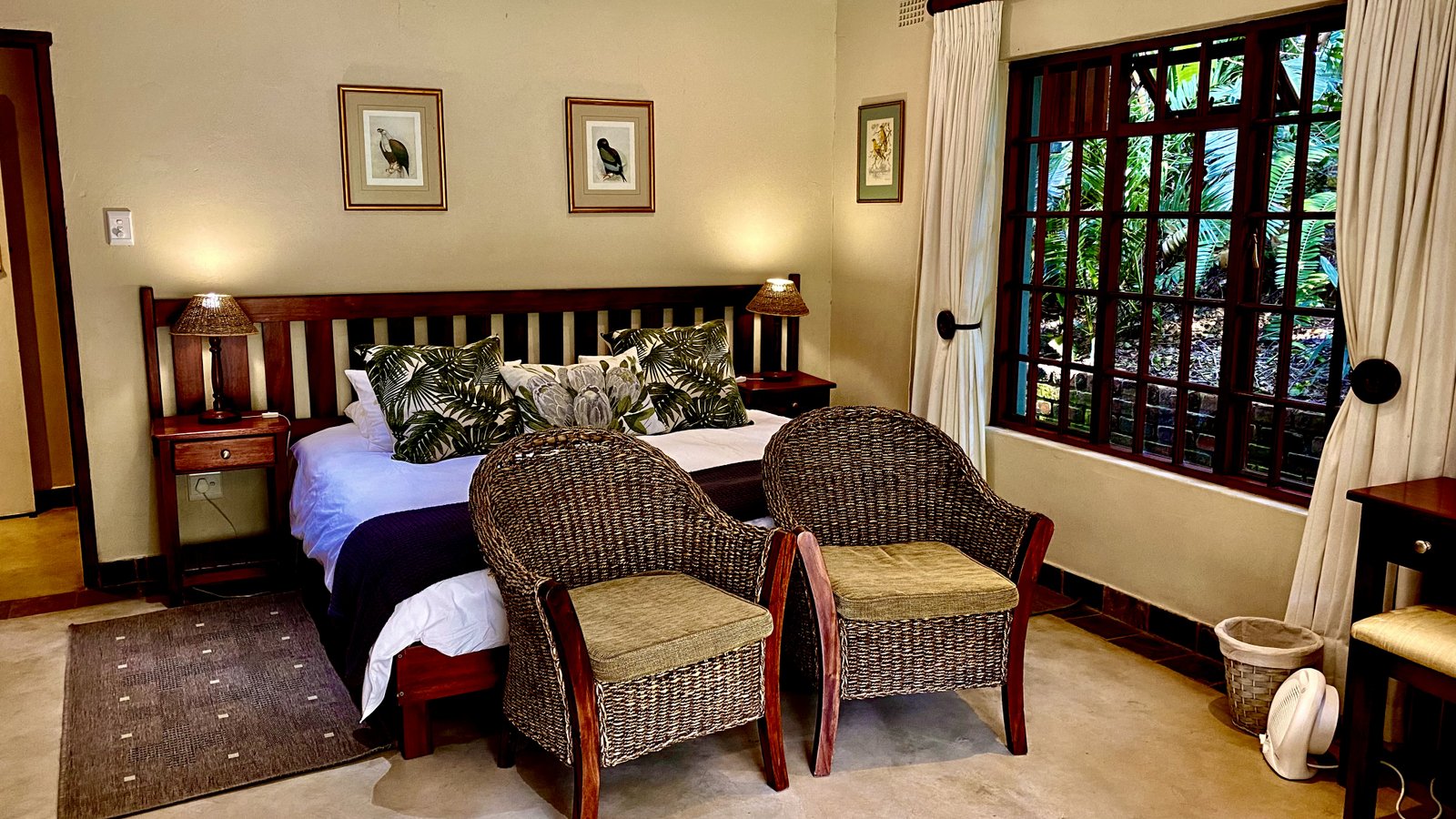
The reserve’s abundant birdlife includes Narina Trogon, African Finfoot, Crowned Eagle, Knysna Turaco and Olive Woodpecker among the 145 or so species that inhabit the area. Antelope such as nyala, impala, bushbuck and blue and grey duiker can also be seen, and if you’re fortunate you may even catch sight of a Cape clawless otter.

We offer two upmarket self-catering cottages, a small private campsite and a picnic area in addition to walking trails. Although the reserve borders the Margate golf course and is close to the main South Coast beaches and shopping centres, its rural location ensures a peaceful stay.

For bookings, please contact Andrew on 083 263 5537 or visit our website www.rivervalleynaturereserve.co.za

BirdLife Africa in Burkina Faso

1. The BirdLife Africa Regional Committee members.

2. The Double-spur Spurfowl is common in southern Burkina Faso.

3. Baobab trees are numerous in southern Burkina Faso.

4. The Exclamatory Paradise Whydah is not very common, but in its breeding plumage is impossible to miss.

5. Nazinga Game Ranch was lush and green after good rains.

6. Idrissa Zeba is the executive director of Naturama, the BirdLife Partner in Burkina Faso.

7. Naturama is a well-respected conservation NGO that is responsible for numerous projects across the country.

8. The White-headed Lapwing is relatively common in southern Burkina Faso.

9. The Yellow-crowned Gonolek is a striking bird.

10. During a short field trip, the ARC members visited the legendary Clark Lungren, who was responsible for establishing the well-known Nazinga Game Ranch. Clark is still active in several conservation and education projects.

11. The White-shouldered Black Tit has a conspicuous pale eye and white shoulders.

12. Vulture numbers in Burkina Faso have declined and only 16 vultures – 12 Hooded and four White-backed – were seen during a drive from Ougadougou to Po (about 120km) and then at Nazinga Game Ranch.

Key Biodiversity Areas: what sets them apart?

As the Key Biodiversity Area (KBA) Community Chair, Daniel Marnewick sits on the global KBA Committee. He believes that what sets the global KBA Programme apart from other similar initiatives – and stands out as one of its most important aspects – is that it has behind it the full weight of 12 of the largest conservation NGOs in the world. This means that advocacy for KBAs packs a powerful punch.

KBAs are ‘sites contributing significantly to the global persistence of biodiversity’ in terrestrial, freshwater and marine ecosystems. Sites qualify as global KBAs if they meet one or more of 11 criteria, clustered into five categories: threatened biodiversity; geographically restricted biodiversity; ecological integrity; biological processes; and irreplaceability. The KBA criteria can be applied to both species and ecosystems.

Currently South Africa has 168 KBAs, a network that constitutes sites previously designated as IBAs as well as those KBAs that have been identified under the previous KBA criteria by the Critical Ecosystem Partnership Fund (CEPF). These sites will soon be reassessed to ensure that they meet the new KBA criteria. New KBAs will then also be proposed so that other priority species and ecosystems are covered. This is a project in partnership with BirdLife South Africa and the South African National Biodiversity Institute (SANBI).

For more information, contact daniel.marnewick@birdlife.org.za

Left: KBA Partner and Committee representatives at the recent KBA Committee meeting held at the David Attenborough Building, Cambridge, UK

Pelagic birding on 2 October 2017

Conditions were calm when BirdLife South Africa’s seabird team and its Namibian fisheries observer guests set off from Hout Bay in a boat chartered from Hooked on Africa. Shortly after leaving the safety of the bay, we came across three humpbacked whales that appeared to be actively foraging. There were dozens of seals feeding in association with the whales, but remarkably few birds.

Our skipper had located a couple of trawlers quite far in the west and after a long steam we found them, but had missed the first haul of the day. As soon as we slowed down to take stock of the situation, a massive Wandering Albatross cruised by! The views of it weren’t amazing – it was heading into the sun – but it was a good find to start the day. There were a few late Pintado Petrels still about, but almost no Great Shearwaters, a species that we had expected to be abundant. Clearly most of them had returned to their Tristan and Gough breeding grounds to prepare nesting burrows and begin courting. We were pleasantly surprised to see good numbers of Black-bellied Storm Petrels, a few early arrivals of Sabine’s Gulls and even a Spectacled Petrel while we waited for the net to be hauled in. There were good numbers of other common albies in all stages of maturity (good for observers to get their heads around!) and decent views of both Giant Petrel species. On the way home, close to Hout Bay, two sharpish-looking Parasitic Jaegers must have recently arrived from Europe. It was unusual to see so many Kelp Gulls and Cape Gannets around the boat, and there were scores of Swift and ‘Commic’ terns kicking around the deep too
Above: Spectacled Petrel
Right: Shy Albatross and White-Chinned Petrels

Pelagic images by Grant Scholtz

The following is a list of pelagic species seen, with ballpark numbers, throughout the day:

  1. Wandering Albatross: 1
  2. Shy Albatross: ~300
  3. Black-browed Albatross: ~300
  4. Indian Yellow-nosed Albatross: 2
  5. Atlantic Yellow-nosed Albatross: 10
  6. Southern Giant Petrel: 3
  7. Northern Giant Petrel: 1
  8. White-chinned Petrel: ~500
  9. Spectacled Petrel: 2
  10. Pintado Petrel: 10
  11. Sooty Shearwater: ~100
  12. Great Shearwater: ~20
  13. Black-bellied Storm Petrel: 10
  14. Wilson’s Storm Petrel: 20
  15. Sabine’s Gull: 3
  16. Subantarctic Skua: 5
  17. Parasitic Jaeger: 2
  18. Common Tern: 50
  19. Arctic Tern: 10
BirdLife South Africa’s 2018 calendar

Buy a BirdLife South Africa calendar and for each month of 2018 you’ll enjoy a spectacular full-page colour photograph of one of this country’s magnificent birds. The calendars are selling at R140 each (excluding postage) and, as stocks are limited, we recommend that you order soon to avoid disappointment. The calendar will make an amazing festive season gift. Please contact Shireen Gould at membership@birdlife.org.za to place your order.

A gift for a friend – or yourself

The IgerBook features the photographic talents of local Instagram enthusiasts, or Igers, and showcases the city of Johannesburg in a new and artistic light. From street scenes and urban architecture to powerful portraits, it captures the essence of the city in all its glory.

All proceeds from the sale of this coffee-table book go to BirdLife South Africa’s Important Bird and Biodiversity Areas (IBA) Programme to support habitat management in identified IBAs.

Make the most of our limited Christmas offer and buy your copy of the book for only R375 from www.igerbook.com

Training seabird conservationists

For the week of 2–5 October, the Seabird Conservation Programme office was busier than an albatross breeding colony when the parents return to their chicks from a foraging expedition. Under the Common Oceans Areas Beyond National Jurisdiction (ABNJ) Tuna Project, Bronwyn Maree and Nini van der Merwe, with help from Ross Wanless, Andrea Angel and Reason Nyengera, as well as the Namibian Albatross Task Force (ATF) team of Clemens Naomab and Samantha Matjila, hosted the Namibian Observer Training workshop. Four Namibian observers took part, one of whom was the coordinator of the Fisheries Observer Agency, and we were also pleased to welcome the new Port-Based Outreach (PBO) officer for Fiji, James Nagan.

The main aim of this workshop was to inform the fisheries observers about the use of best-practice seabird bycatch mitigation measures. The hope is that this will accelerate the uptake of such measures by fleets operating in critical fishing areas of the Atlantic and Indian oceans.

The workshop started off with a full day ‘in the field’, focusing on seabird ID skills’ training on a pelagic birding trip. Three days of lectures followed, as well as a harbour visit to view a local tuna longline vessel. Overall, the event created an invaluable opportunity to develop our working relationship with our neighbours to the north, and also for our team to get a better understanding of the challenges that observers face in the field.

Capacity building of the fisheries observers and PBO officer was achieved through teaching them about the effective use of seabird bycatch mitigation measures, including practical demonstrations at sea; enhancing their seabird identification skills; and informing them of data collection and reporting requirements as stipulated by tuna Regional Fisheries Management Organisations (tRFMOs). This type of training is important as it builds long-term sustainability by developing not only individuals involved in the local fishing fleets, but also coordinators of the observer programmes to further the training in their own countries.

The Namibian ATF team’s visit to Cape Town enabled it to gain experience in presenting in a workshop setting and gave it a valuable opportunity to strategise with the South African ATF so that joint goals for southern Africa could be streamlined and approaches to fishing industry-related matters could be aligned.

All in all, the workshop was a great success. The observers and James Nagan excelled in learning about seabirds and have returned to their home countries with an increased understanding of why these birds are so important and why it is our duty to protect them.

We look forward to continuing our engagement with the Namibia Fisheries Observer Agency and the Republic of Namibia’s Ministry of Fisheries and Marine Resources as we work together to ensure the relevant mitigation measure regulations are implemented and the collection of seabird data is included as part of observer protocols in the near future.

For more information about the ABNJ Tuna Project, please contact Nini van der Merwe at nini.vdmerwe@birdlife.org.za or call the Seabird Conservation Programme on 021 419 7347.

Above: An excited, albeit somewhat bruised and battered group return from a full day’s pelagic seabird identification practical training session, led by Ross Wanless.
Right: During the pelagic trip the skipper sailed close to a fishing trawler so that the observers could practise their identification skills on the birds that gathered while the net was being hauled in.

Farmers help to revive the Lower Berg River Conservancy
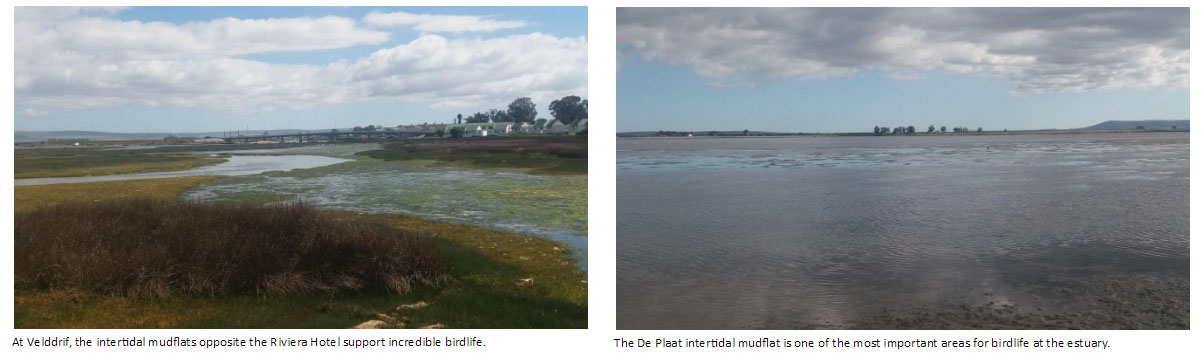
A workshop comprising riparian farmers, where the revival of the Lower Berg River Conservancywas proposed by BirdLife South Africa and the issue of erosion was discussed.

Although established in 1997 and active during its early years, the Lower Berg River Conservancy has been dormant until recently. Through a series of workshop presentations and individual discussions, BirdLife South Africa’s Western Cape Estuaries Conservation Project introduced the idea of a revived conservancy and the benefits it would bring to landowners. This was a first step in seeking formal protection for the estuary’s floodplain and riparian lands through Biodiversity Stewardship.


Led by a handful of dedicated farmers, the community mobilised to revive this voluntary forum. At the opening meeting in September this year, members emphasised the need for a united voice for farmers at the estuary and agreed that the conservancy would provide a recognised vehicle for collective action on a number of environmental issues. BirdLife South Africa presented on the proposed Ramsar application for the estuary and the upcoming biodiversity site assessments as part of ongoing stewardship negotiations. The issue of erosion was also high on the agenda, and BirdLife South Africa is an active partner in the development of an erosion control programme for the estuary.

The revived conservancy comprises all members of the original forum as well as several new members, bringing to more than 20 000ha the extent of riparian land within its borders. It will strengthen this committed group of landowners’ continued efforts to improve environmental conservation on private land.

Farewell to Mr B and Pete

Farewell Mr B! It is with mixed feelings that we say goodbye to Bokamoso Lebepe, or ‘Mr B’ as he is affectionately called by the seabird team, as he leaves us to rejoin his family back in Limpopo. For the past four years he has been part of the Albatross Task Force (ATF) team, having joined in September 2013. During his time as an ATF instructor, Bokamoso facilitated dialogue and good working relationships with people in the fishing industry. He spent many days at sea, often under strenuous working conditions, collecting data on seabirds and the use of mitigation measures by the longline fleets. His experience as a research assistant for three months on the SA Agulhas II was put to good use when he took over trialling the hook pod, a hook-shielding device aimed at preventing seabirds from getting caught while scavenging for bait behind longline vessels.

Much of Mr B’s work involved harbour visits, where he was good at striking up a rapport with the fishermen and explaining to them the work of the ATF. He was also the lead instructor in our engagements with foreign-flagged vessels, ensuring that they fully understood our local fishing operations. Bokamoso’s light-heartedness, good humour and cooperative nature made him an esteemed and much-valued colleague – and he was definitely the prankster in the office! However, being away from his family for long periods has been hard for him, especially since his daughter was born two years ago. We therefore understand his need to leave and wish him all the best in his new endeavours.

Left: The Seabird Team’s farewell golf game for beginners was loads of fun!

Pete Watt-Pringle has been with the Common Oceans team within BirdLife South Africa’s Seabird Conservation Programme for almost 18 months and has played an integral role in achieving the first port awareness outreach to foreign fishing vessels docking in Cape Town harbour. His was the difficult task of liaising with agents and coordinating translators, vessel access and skippers to ensure that these vessels have a good understanding of the regulations and mitigation measures they are required to use on the high seas. Pete’s leadership and help on various other awareness interventions with the public were enhanced by his friendly manner, while his scientific bent ensured that he was always quick to grasp concepts and worked in a systematic manner to achieve the required outcome. We will miss his analytical and quiet approach, and wish him the best as he departs for his next adventure!
Andrea Angel and Bronwyn Maree

Think Birds!

BirdLife South Africa’s new ‘Love Birds’ campaign will encourage all South Africans to think about birds – or ‘Think Birds’. Developed and executed by our advertising agency Utopia and our marketing committee, the campaign has come up with a number of clever adverts that play on the double meaning of names such as ‘cranes’ and ‘petrel’. Twelve billboards, sponsored by JCDecaux, carry these witty messages.

Peanut butter sandwiches, a puppy – and birds

Once a month, a trusty band of birders convene at what is known as the Kingfisher Pond at the Paarl Bird Sanctuary for the monthly Coordinated Waterbird Count (CWAC) – a ritual that started in January 1993. At the heart of this long-running count is coordinator Yvonne Weiss, who celebrated her 90th birthday in September this year.
It was Yvonne who, in 1994, prompted the town engineer of the Paarl (now Drakenstein) Municipality to give the birds that roost, feed and breed at the local sewage works proper protection. And although it has had its security challenges over the years, the sanctuary remains a favourite on many a committed birder’s list.
Regular counter and photographer Rita Meyer says, ‘The bird lady! Yvonne taught me everything about birds. She has never missed a count, come rain or shine. And those sandwiches!’ The sandwiches (peanut butter jazzed up with rocket or nasturtium leaves) are Yvonne’s speciality and a welcome snack for the team after they have counted every pond and furrow at the works.

According to the CWAC website, the Paarl Bird Sanctuary had been counted 254 times by the end of April 2017 – the highest count for any single site in the Western Cape. For Yvonne, it has not only been a 24-year labour of love, but is also where she found her beloved companion, Kwezi. Driving around the works one Saturday after a count, she saw a group of children running across the road. One of them thrust a wet puppy in the window, saying ‘Take this, take this!’ Yvonne surmises they had been sent to dispatch the pup but didn’t have the heart to do so – and that’s how Kwezi (now also advancing in age) came into her life. The two soldier on together in spite of what Yvonne calls their mutual ‘creaking’ due to arthritis.

James Harrison, who served on the first advisory committee for the Paarl Bird Sanctuary, recalls, ‘Yvonne made sure that the regular CWAC counts were meticulously executed and recorded. She epitomises the type of citizen scientist who takes conservation and environmental education forward. We need more like her.’

Happy birthday, Yvonne, and thank you for your commitment to the cause!

Andrew Weiss

All the fun of the (Bird) Fair

A variety of exhibitors and a range of activities at The African Bird Fair ensured that visitors were entertained throughout the weekend. We would like to thank everyone who supported us and joined in the fun. And we look forward to seeing you all again next year! BirdLife South Africa would also like to thank the following for their support of The African Bird Fair: Eskom, Jay van Rensburg, JC Decaux, Nikon, Struik Nature and the Walter Sisulu National Botanical Garden.

An evening with the ‘voice of cycling’

Join us for an evening of cocktails and canapés with guest speaker Phil Liggett, a well-known cycling commentator who specialised in the Tour de France. Take this opportunity to meet and chat to this patron of BirdLife South Africa and listen to his anecdotes from more than 30 years of experiences in cycling, especially from the ‘Le Tour’.
All funds raised through this event will go to BirdLife South Africa’s Important Bird and Biodiversity Areas Programme to help conserve important bird habitats across South Africa.

For event details and bookings, please see above.
Early bird bookings made before 30 September will receive a 10% discount.

Buy a calendar, support bird conservation

Buy a BirdLife South Africa calendar and for each month of 2018 you’ll enjoy a stunning full-page colour photograph of one of this country’s magnificent birds. The calendars are selling at R140 each (excluding postage) and, as stocks are limited, we recommend that you order soon to avoid disappointment. The calendar will make an amazing festive season gift. Please contact Shireen Gould at membership@birdlife.org.za to place your order.

African Birdlife magazine

The latest issue of African Birdlife takes us right around South Africa, from Cape Point to Msikaba and up to the Blyde River Canyon, with a side-trip to Erongo in Namibia. There’s quite a bit about plants too, like the persuasive strategies of subtropical species to entice bird pollinators and which are good in bushveld bird gardens, as well as their diminishing role in providing cavities for nesting (and how competition for those cavities plays out). Falcons and eagles, larks and weavers, vultures and shearwaters – you’ll find them all in this issue.

Jono joins BirdLife South Africa

The BirdLife South Africa Policy and Advocacy team welcomes Jonathan Booth into its ranks. Jono has an Honours degree in Ecology and has just begun an MSc in Wildlife, Biodiversity and Ecosystem Health at the University of Edinburgh (via correspondence). After guiding at MalaMala, he spent two years in London working for the Department of Environment, Food and Rural Affairs and the Office of Gas and Electricity Markets (Ofgem, the UK’s official energy regulator). On returning to South Africa in 2010, he joined KPMG and worked in the Climate Change and Sustainability team for three years and the Internal Audit team for 18 months. Subsequently he ran his own small business and worked as an independent sustainability consultant.

Whether visiting game reserves, exercising or working in his garden, Jono loves spending time in the outdoors and has a great appreciation for our unspoiled landscapes. He’s a keen mountain biker, canoeist and trail runner and has travelled extensively in the region’s national parks with his wife and family. Some of his greatest bush memories come from encounters with birds in Botswana, Zambia, the Lowveld and Zululand.

An enduring passion for conservation has precipitated Jono’s move back into the field. He is thrilled to be joining the dynamic BirdLife South Africa team and hopes to make full use of his skills and experience to make a positive impact for birds

Nedbank Reader Evenings

Join us in October for a Nedbank Reader Evening in either Johannesburg or Cape Town.
In Johannesburg on 5 October, Albert Froneman will talk about the art of bird photography. Acknowledged as one of the leading bird photographers in southern Africa, Albert understands that beautiful images of birds play a vital role in creating awareness for bird conservation, and in this spirit he works closely with BirdLife South Africa. During the lecture he will share interesting facts about the birds as well as tips, tricks and field techniques for capturing top-class images.

Date: Thursday, 5 October 2017
Time: 18h00 to 20h30
Venue: Nedbank Auditorium (parking entrance 2), 135 Rivonia Road, Sandton
Please click here to book.

In Cape Town on 19 October, Professor Peter Ryan will discuss the scourge of marine plastic pollution. Director of the FitzPatrick Institute of African Ornithology, Peter studied the impact of ingesting plastic on seabirds for his Masters degree in the mid-1980s, long before there was widespread concern about plastic pollution in the world’s oceans. He will explain why the increasing amount of plastic entering the environment is alarming and what we can do to tackle the problem.

Date: Thursday, 19 October 2017
Time: 18h00 to 20h30
Venue: Nedbank Clocktower Auditorium (parking Clocktower Precinct, Silo District level P2), V&A Waterfront
Please click here to book.

Both events are brought to you by Nedbank Green Affinity in partnership with WWF Nedbank Green Trust, BirdLife South Africa and African Birdlife. A light dinner and refreshments will be served after the talks. The events are free, but seating is limited and booking is essential.

Job shadowing at BirdLife South Africa

When Joshua Olszewski (left) job shadowed the Terrestrial Bird Conservation team, his daily duties ranged from tracking gulls to attending meetings. Describing the experience, he said ‘I was lucky to have spent two weeks in August (21 August to 1 September) being taught and mentored by Dr Hanneline Smit-Robinson and Dr Melissa Whitecross in conservation and ornithology at BirdLife South Africa’s offices in Dunkeld West. This experience formed part of the compulsory job shadowing hours required by my school.

‘When it came to choosing an occupational field in which to complete my job shadowing hours, I knew for a fact that I would ideally want to shadow an ornithologist, a field biologist or a wildlife conservationist; basically, anyone who was working with birds in order to conserve them and their habitats. My reason for choosing this career path stems from my deep-seated passion for birds and other wildlife, a passion that I’ve carried with me from a very young age, as well as a desire to study and protect them.

‘When it came to recalling friends and acquaintances in this line of work whom I could shadow, I remembered that I knew people in higher places. Once settled in my mind that BirdLife South Africa was the way to go, I wasted no time in e-mailing the CEO, Mark Anderson, requesting permission to shadow Melissa. This led to me being able to shadow Hanneline for the first week and Melissa for the second. I felt extremely lucky to be working with such respected individuals in my preferred future career path.

‘During the job shadowing, I attended a number of meetings for various conservation projects and initiatives, from the Ingula Partnership and the Flufftail Festival to potential conflict between Cape Vultures and wind farms, and new work on Ludwig’s Bustards. These also included my first official meetings, which made me feel rather important.

‘I was also privileged enough to witness the capture, ringing and attachment of satellite-tracking devices to three Grey-headed Gulls near the O R Tambo International airport, as part of a new project BirdLife South Africa is running in collaboration with Airports Company South Africa (ACSA), to track the movements of these birds around the airport, specifically near the runway. This was a special event for me as I had never seen a bird being ringed before, let alone for such an amazing project.

‘Through job shadowing at BirdLife South Africa, I was able to meet many wonderful people and experience at first hand the exciting happenings in the world of conservation and ornithology. I am incredibly thankful to Mark Anderson for allowing me to shadow such highly respected and esteemed conservationists, and to Hanneline and Melissa for giving their time and efforts to mentoring me and teaching me about avian conservation, and for helping me to complete my job shadowing hours. I am most definitely looking forward to all the exciting developments that are coming up in BirdLife South Africa and will hopefully be doing more work with them in the near future.’

JOSHUA OLSZEWSKI, GRADE 11, ST BENEDICTS COLLEGE

Flock on the West Coast 2018, with LAB

Block out 6–11 March 2018 in your calendar now and make sure to get to the Flock 2018 website to secure your spot for a great week of birding and bird-nerding in the Western Cape. Delegates who book for the Learn About Birds (LAB) Conference before 30 September 2017 stand a chance to win a free pelagic trip out of Saldanha Bay during Flock on the West Coast 2018.

All LAB delegates will be entered into a draw to win a free pair of Zeiss binoculars during the conference.
Information about the event can be found here and any additional queries can be directed to Melissa Whitecross, Emma Askes or Gisela Ortner at flock2018@birdlife.org.za


Win with Birding Big Day 2017

Last year, within a 24-hour period, more than a thousand birders recorded 654 bird species across the country and in doing so raised valuable funds, awareness and data for bird conservation. BirdLife South Africa strives to conserve birds, their habitats and biodiversity through scientifically based programmes, by supporting the sustainable and equitable use of natural resources and by encouraging people to enjoy and value nature. In order to do this, BirdLife South Africa needs funding.

While Birding Big Day (BBD) is all about finding and recording as many birds as possible, the sightings records help to determine bird population distributions. At the same time, the funds raised from the day are channelled into work conducted by the Important Bird and Biodiversity Areas (IBA) and Terrestrial Bird Conservation programmes, as well as to BirdLasser.
To assist in the fundraising initiative and to reward the team that raises the most funds (on average per member), this year the organising committee has added an exciting new category to BBD in the form of a fund-raising competition that all teams can participate in.

RETURNAfrica Pafuri Collection has generously offered a prize, to the value of more than R16 000, of two nights for four guests on a walking trail at Pafuri Trails Camp, including accommodation, all meals and walks on each day. This prize will be awarded to the team that raises the most funds (per member) for BirdLife South Africa’s conservation programmes.

Teams can raise sponsorship by asking people or companies to pay either a certain amount per species seen or a fixed amount, independent of the number of species seen. The sponsorship can be sourced before, during or after the event, although payment must be made by 15 December 2017. BirdLife South Africa can provide any company or individual who donates more than R500 with a Section 18A tax certificate.
In addition to this fundraising prize, there will be some lucky draw prizes, including two copies of Michael Mills’ new book, The Birder’s Guide to Africa.

For more information about prizes and how the fundraising aspect of BBD will work, and for sponsorhip forms and fundraising letters, please visit the BBD page.

Support Team Fast & Featherless

This is your last chance to join Team Fast & Featherless and ride the Telkom 947 Cycle Challenge for bird conservation. All funds raised by cyclists taking part for BirdLife South Africa will go to the Important Bird and Bioidversity Area Programme, which works to conserve valuable bird habitats across South Africa. Join us for a day of fun in the name of conservation.

For more information about how to register to ride with BirdLife South Africa’s team, contact Romy at romy.wuth@birdlife.org.za. Riders’ details must be submitted before 28 August 2017.

Managing habitat for fynbos birds

BirdLife South Africa members probably recall Dr Alan Lee for the incredible 2400km cycle ride that took him across the Western Cape’s highest mountain ranges to study the impacts of climate change on bird species that are endemic to fynbos. The study now completed, Alan has joined Dale Wright to form the ‘fynbos birds team’, which has produced a user-friendly booklet that showcases birds endemic to fynbos, gives interesting pointers about their ecology and summarises the major threats facing them. The text also provides a set of management recommendations that private landowners or reserve managers could use to enhance their fynbos habitats to support these species. The booklet is available for free from the BirdLife South Africa website, and we encourage interested members to download and share this beautiful resource far and wide.
Get your copy here.

Image Credit: Alan Lee

On the road with Ross

The UK in summer. Again. I was there in June last year and found myself back there this July, with a sneaky little trip to Rome in between. But my eyes were set firmly on Scotland… Read more.

Membership team visits Kyalami Prep

On Friday, 21 July Shireen Gould and Elaine Cherrington of the membership team visited the Eco Club at Kyalami Prep to talk to the learners about vultures and how they fly. The lesson started off with a short talk about the five vulture species found in South Africa and why vultures are so important in nature. It then proceeded to the flight of vultures, illustrated by a short YouTube clip by David Attenborough. Afterwards, the learners made their own paper gliders, which they took out onto the field to fly.

Each of the pupils received a copy of the March/April issue of African Birdlife, which included the Bird of the Year poster and a vulture pin badge. They especially loved the pin badges, as they were allowed to wear them on their school blazers for the two weeks following the visit.

Learn About Birds 8–9 March 2018

The fourth biennial Learn About Birds (LAB) conference, co-hosted by BirdLife South Africa and the FitzPatrick Institute of African Ornithology (Fitz), promises to be even bigger and better than its predecessors. With a new programme format, exciting speakers lined up for both Science and Layman’s LABs and excellent evening entertainment to help attendees relax in typical West Coast fashion, this LAB will surely be one not to miss.

The plenary speakers for the Science LAB will be Dr Mark Brown and Dr Alan Lee. Mark is the current programme director at the Nature’s Valley Trust (NVT), a small NPO dedicated to integrating conservation into the communities of the Garden Route through education initiatives, research programmes and conservation partnerships. He is also an honorary researcher at the University of KwaZulu-Natal’s School of Life Sciences and is a Y2 NRF-rated scientist. Mark’s diverse range of research interests includes conservation biology, raptor ecology, physiology, pollination biology and climate change impacts. He has contributed to several books, including Roberts VII, and has published more than 70 peer-reviewed scientific articles. Having co-supervised more than 25 postgraduate students, he describes himself as a passionate and dedicated mentor of young conservationists – and his extensive education work through the NVT is testament to that. Mark is no stranger to the podium, having presented his research at national and international conferences, and he will no doubt deliver an exciting and engaging plenary talk during LAB 2018.

Alan took over as the editor of Ostrich: Journal of African Ornithology in July 2016 and aims to make it one of the flagship publication outlets for ornithological research in Africa. He joined the Fitz in 2012 as a post-doctoral researcher supervised by Phoebe Barnard and Phil Hockey, investigating the impacts of a changing climate on the bird communities of the fynbos biome. Alan is still at the Fitz, where his main research interests are the conservation biology of endemic birds and using SABAP2 data to inform conservation policy and management decisions. Alan and his father co-founded the Blue Hill Nature Reserve at the edge of the Baviaanskloof. He has received awards for his photography and research presentations, and we look forward to his plenary during LAB 2018.

Layman’s LAB will run in parallel with the Science LAB and is designed to give attendees of Flock who don’t have a science background an opportunity to enjoy easily accessible talks about birds, birding, research and conservation efforts. Some of the topics and speakers currently lined up for LAB include Rob Simmons from the Fitz, who will highlight the Black Harrier research conducted in the West Coast National Park; Etienne Marais from Indicator Birding, who will talk about finding and identifying the tricky specials of western South Africa; and Kevin Shaw from CapeNature, who will give an in-depth view of the history of Dassen Island and the ecology of its avian residents.

The first call for abstract submissions has been opened and we encourage all students, post-doctoral researchers and lecturers to submit their presenter registration forms to Melissa Whitecross (flock2018@birdlife.org.za) before 30 September 2017. Forms can be downloaded here and all other information pertaining to the event can also be found there.

Avoid Flock FOMO (fear of missing out) and register online now for a top week of bird-related fun! Flock on the West Coast will take place from 6 to 11 March 2018. The speakers listed above may change due to unforeseen circumstances.

The Birder’s Guide to Africa

The Birder’s Guide to Africa covers all the continent’s mainland territories and its islands. The introduction presents an overview of birding in the region and highlights key destinations for different kinds of travellers. It is followed by country accounts, which detail travelling and birding in each territory and include a comprehensive list of important bird taxa to be targeted on a visit. In the family accounts, each family recorded from the region is described briefly and illustrated with spectacular photographs. Finally, the species accounts provide information about the distribution, status, habitat, subspecies and taxonomic issues of each species, as well as the best places to see it. Any serious world lister or keen African eco-traveller will find an abundance of information.
Specifications: 544 pages, full colour. Available from goawaybirding@gmail.com from late August. Retail price R450. Special offer: place your order before the end of September and pay only R400!

The African Bird Fair

2018 BirdFair logo RGBBe sure not to miss The African Bird Fair at the Walter Sisulu National Botanical Garden over the weekend of 9 and 10 September. An exciting variety of exhibitors will be showcasing all things birding, such as binoculars and spotting scopes, bird books, birding apps, bird feeders, wildlife art and birding holiday destinations and tour operators. There will also be lots of things happening throughout the weekend, including guided bird and botanical walks, photography workshops by well-known wildlife photographer Jay van Rensburg (booking essential) and fascinating presentations by experts such as Faansie Peacock and Jonathan Leeming.

The Fair will be open 08h00–17h00 on both Saturday and Sunday. For more information, please visit our website or contact Emma Askes at emma.askes@birdlife.org.za

Don’t miss Birding Big Day 2017!

BBD BL Logo Med RGBSpotPlotPlay Red bannerBirding Big Day (BBD) 2017 could be the best yet! Last year (BBD 2016) saw more than 1000 birders record 654 different bird species during the 24-hour event thanks to our partnership with BirdLasser. This year we hope to break that record.
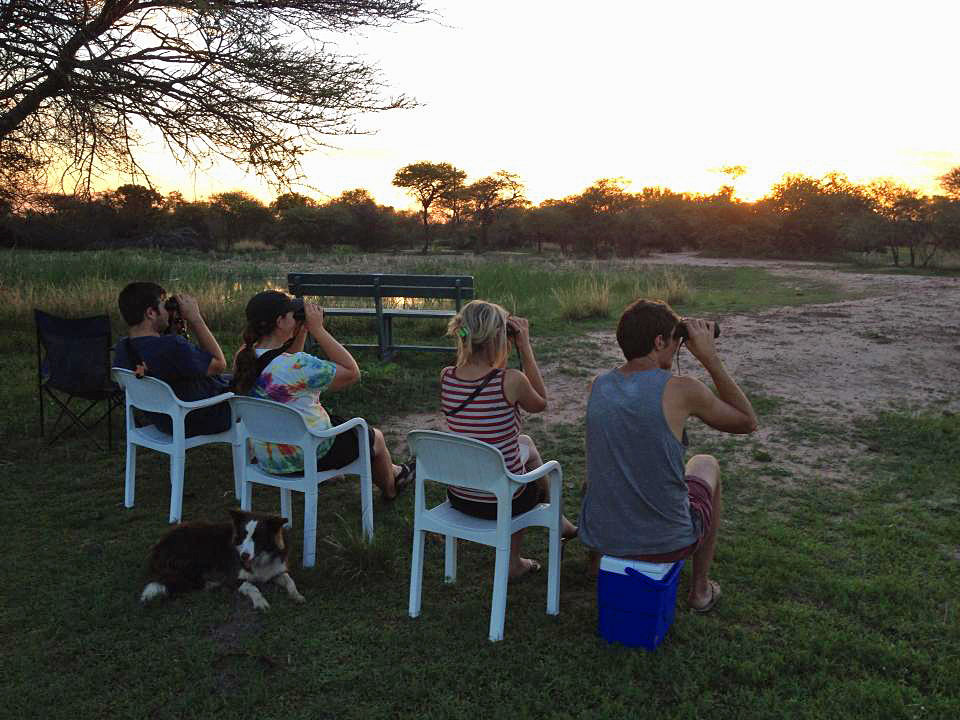
Are you prepared to enter a team and spend 24 hours on 25 November 2017 searching every corner of a selected 50km radius anywhere in South Africa to find every bird species you can? If you are ready for that kind of adrenalin-pumping action, then sign up now as an open category team with up to four members. All rules for the competition can be viewed on the BBD website.

All teams can sign up to have their progress monitored via the BirdLasser app, which is free to download from both Android and IOS application stores. BirdLasser will make logging your species during BBD a smooth and hassle-free process and track exactly when and where in your 50km radius you saw what. It also enables everyone to follow all the teams’ real-time progress via the BirdLasser challenge page. During BBD, the challenge page will automatically update as teams record their sightings, thus adding to the excitement of the day. Progress will be reported on social and other media and teams can submit live videos and photos during the event.

community bbd ryan thomas

The community category allows larger groups, such as bird clubs, to participate together in Birding Big Day. Photo by: Ryan Thomas

This year the BBD organising committee has added an exciting new category to BBD in the form of a fund-raising competition that all BBD teams can participate in. We know that BBD is all about finding birds, but it is important to conserve them too. Much-needed conservation funds raised through the competition will be channelled into work conducted by the Important Bird and Biodiversity Areas and Terrestrial Bird Conservation programmes, as well as to BirdLasser. For more information about how the fundraising aspect of BBD will work, please visit the BBD website.

In another innovation this year, BirdLife South Africa has partnered with RETURNAfrica to offer a great deal for BBD teams wishing to take on the Pafuri region for their challenge. RETURNAfrica: The Pafuri Collection is offering special rates to guests staying at Pafuri Camp and Baobab Hill Bush House for BBD 2017 and a percentage of each night sold will go to BirdLife South Africa’s conservation projects. Pafuri, located in the northernmost region of the Kruger National Park, is well known as a birding hotspot. Guests will also have access to specialist bird guides for their BBD activities.
To book, contact RETURNAfrica via info@returnafrica.com  and be sure to use the code ‘BBD17’ so that the special offer will apply. For more information, go to www.returnafrica.com or call 011 646 1391.
Registrations for BBD 2017 are open and should be completed before the event by submitting the online form on the BBD website. There is no entry fee, but a minimum donation of R300 per team is required for its members to qualify for a BirdLife South Africa Birding Big Day 2017 cloth badge. Please note that only four cloth badges will be produced per team of four members; for teams with more than four members, an additional R45 will be added per member.

For more information, please visit the BBD website. Team registrations can be submitted via the ‘Register’ link on the website; queries can be directed to bbd@birdlife.org.zaBirding Big Day 2013 Whatever your style of birdwatching, BBD is for everyone. Photo by: Melissa Whitecross

Flock on the West Coast 2018 with LAB

Flock 2018 LAB logos RGBFlock on the West Coast 2018 (6-11 March) promises to be a week of spectacular birding! The organising committee has secured excursions that will have you dreaming about all the exciting birds to see and places to visit with the assistance of world-class bird guides and knowledgeable local birders. The excursions will cover a diverse range of habitats to maximise the number of species that could be seen during the week. Pelagic trips will give delegates a chance to view the offshore seabirds up close, while boat trips to Dassen, Malgas and the Saldanha Bay islands will enable them to see breeding colonies of African Penguins and Cape Gannets.
For those who still need to tick off the Western Cape’s fynbos endemics, a full-day excursion to the Groot Winterhoek Wilderness Area will be sure to boost your life list. Local birding will take place in the nearby West Coast National Park and at the Berg River Estuary in Velddrif.

For more information about the excursions, please visit the Flock 2018 website, where a link to the downloadable PDF excursion information booklet is available. Places are limited, so book now to avoid missing out.

FitzLogo 10x10cm300dpiblsaThe bi-annual Learn About Birds (LAB) conference will be co-hosted by BirdLife South Africa and the FitzPatrick Institute of African Ornithology. At this two-day event, scientists from around the globe will showcase their research and highlight the important role it plays in furthering bird conservation. For delegates who prefer talks that are slightly less technical than understanding the genetic differences between species X and species Y, the Layman’s LAB will be run in conjunction with the Science LAB and popular interest talks will be given by BirdLife South Africa staff, respected bird enthusiasts and top researchers and conservationists. The call for abstracts will be announced via e-mail and on the Flock 2018 website, while guidelines for abstracts are on the presenter registration forms, which can also be downloaded from the Flock 2018 website. Please contact Melissa Whitecross flock2018@birdlife.org.za  for more information about LAB.

The BirdLife South Africa AGM will be taking place on 10 March 2017 and will be followed by a delicious dinner and an evening of socialising and story-swapping of the week’s birding exploits.

Keep an eye on BirdLife South Africa’s social media feeds for updates on other exciting developments leading up to Flock on the West Coast 2018. All information relating to the event will be posted here and booking forms can be filled in online via the website.

Soweto pupils learn about wetlands

On 13 June 2017, Melissa Whitecross (BirdLife South Africa), Raymond Rampolokeng (local bird guide trained by BirdLife South Africa) and Rand Water’s Water Wise team (Themba Nkuna, William Nissel, Faith Chauke and Sizwe Mndawe) met Grade 6 and 7 learners from Lakeview, Sekwate and Isaacson primary schools at Tokoza Park, Soweto.

Raymond and Melissa took learners on guided walks of the wetlands, dams and fields in the park, showing them the many different bird species that utilise this important green space. Sightings highlights included Grey Heron, Blacksmith Lapwing, Egyptian Goose, Red-knobbed Coot, African Darter, Grey Go-Away Bird, Southern Masked Weaver and Southern Fiscal. The learners showed impressive memory skills and were able to begin identifying the birds on their own after spending only a few minutes with them. It is hoped that when they return to their schools and families they will encourage them to enjoy the park and its birds. As Senegalese forestry engineer Baba Dioum famously said in 1968, ‘In the end we will conserve only what we love, we will love only what we understand, and we will understand only what we are taught.’

melissThe second part of the day was spent teaching learners how to conduct a miniSASS assessment, which is designed as a quick tool to assess the health of a stream or river. SASS is an acronym for the South African Scoring System, which ranks the presence of different invertebrates based on their sensitivity to pollutants within the stream and enables users to calculate a health score. A miniSASS is designed as a simplified version that enables school-level learners who have no knowledge of invertebrates to engage with practical wetland monitoring techniques. 

The learners from Soweto were given nets and large white trays that they used to collect and examine the invertebrates from the Tokoza Park stream. The results of the assessment indicated that the stream is in fair condition. All results were uploaded to the miniSASS website and learners were given posters and magazines to take back to school to teach their fellow pupils about this process. This collaboration highlighted the importance of conserving urban green spaces and the biodiversity living in them and exposed a new generation of potential future conservationists to ways in which they can help advocate for nature.

Melissa Whitecross (BirdLife South Africa) teaches learners from Sekwati Primary School about the feeding behaviour of a Southern Fiscal that they were watching. (Photo: Willem Nissel)

Nini joins the Common Oceans Programme

nini2Although Nini van der Merwe joined the Seabird Conservation Programme team more than a year ago, being part of the team is not the same as being on the staff. Then, as the Common Oceans Programme reshaped towards the end of last year, it became apparent that Nini could take on some of the project’s important aspects. With funding all but guaranteed, we decided to formalise the work and create a position. Having completed an external recruitment process, we offered Nini the position and are pleased to welcome her officially as the full-time international liaison officer and office administrator. She will be working on the Common Oceans’ Areas Beyond National Jurisdiction (ABNJ) project, which provides a series of awareness and training workshops for targeted international countries to help them reduce seabird bycatch in their tuna longline fishing operations on the high seas. She also assists the seabird team with general office administration and offers support to the various projects as required.

Nini came to seabird conservation via an unorthodox route. While sitting 2m from a Black-browed Albatross chick at the edge of a breeding colony at Steeple Jason in the Falklands, she became aware of how amazing these birds are. That was more than a year ago and since then her passion for conserving these majestic birds and their environment has only grown. Nini’s background in design and teaching has proved useful in her work, while her love of travelling is also handy in view of the amount of international travel that her work requires. And as a bonus, her colleagues on the seabird team have reason to be grateful for another of her hobbies: cooking.

Welcome Nini, we’re happy that you are now officially part of the seabird family!

Ford Wildlife Foundation supports conservation

fordIn order to engage with landowners in grassland areas, members of the Biodiversity Stewardship Project spend a lot of time travelling to remote aFord Hand Over Teamreas on roads that are often in bad condition. The Ford Ranger will therefore be a valuable asset in ensuring that the project, which aims to increase the protection of our grasslands, is successful. The handover forms part of Ford Motor Company of Southern Africa’s (FMCSA) commitment to protecting the environment in sub-Saharan Africa.

Over the past 25 years, FMCSA has supported more than 150 conservation projects and invested over R30-million to help maintain wildlife and ecosystems in South Africa. In September 2014, it officially established the Ford Wildlife Foundation to continue that support.

The Ford Wildlife Foundation is unique in that rather than giving a cash donation to the conservation projects it supports, it equips its partner organisations with Ford Rangers. The vehicles are provided to help with essential operational tasks and are monitored and serviced by Ford’s extensive dealer network to ensure they operate at peak efficiency.

Thanks to Ford, conservation manager Ernst Retief can now safely cover many kilometres in the important Grassland Biome.

Durban pelagic trips

Pelagic birding trips off Durban have hit a purple patch recently, starting with a landmark sighting of a Barau’s Petrel in October 2013. This was followed the next month by a visit from seabird guru Hadoram Shirihai, who came out on three trips with the primary purpose of photographing Great-winged Petrels. Hadoram introduced to us a highly successful chumming technique that we have employed ever since.

Equally important has been the involvement of Johannesburg-based birder Niall Perrins and local birder Rich Everett in the organisation and running of these trips. Indeed, it was Niall’s idea to chum well away from any trawlers that resulted in the first Barau’s Petrel encounter. It’s clear that the smaller, rarer seabirds are more likely to be found while chumming away from trawlers where large numbers of the bigger, dominant species such as albatrosses and White-chinned Petrels tend to ‘frighten off’ their shyer cousins. Also critical has been the support of both local and upcountry birders whose participation has made it all possible.

All our subsequent sightings of Barau’s have occurred between September and November, which fits in well with tracking studies of this species conducted at its Réunion breeding island. According to these studies, the males make regular pre-breeding visits to our coastline at this time. Essentially, there is a better-than-even chance of seeing the species on pelagic trips during these months. We’ve also learnt that ‘gadfly’ Pterodroma petrels, of which Barau’s is one, are particularly responsive to our chumming. Great-winged Petrel is the most abundant of these Pterodroma species and on some days we’ve had more than a hundred of them buzzing around our chum spot. Another exciting Pterodroma is Soft-plumaged Petrel, which occurs in small numbers earlier in the year than Barau’s, with all our recent sightings occurring in July and August.

The other two groups of small seabirds especially attracted to chumming are prions and storm petrels. The common prion off Durban is Antarctic, although we have recorded the occasional Slender-billed. These attractive birds are strictly winter visitors with all sightings between June and August; on one memorable occasion (July 2016) about 70 Antarctic Prions visited our chum.

The most common storm petrel is Wilson’s, which occurs throughout the year but with largest numbers between May and November (at times we see more than 100). Small numbers of European Storm Petrels are also regularly attracted to the chum and as they are visitors from the northern hemisphere, they are seen mainly between November and March. More exciting have been Black-bellied Storm Petrels, recorded as probable passage migrants in May and again between August and November. But best of all in the storm-petrel department was the single White-faced Storm Petrel seen while we were still steaming out to our chum spot in May 2014, followed by an unbelievable two birds at the chum in June 2016.

Although our chumming is aimed primarily at the smaller species, we’ve also had three memorable albatross attendants. The first was a fully adult Wandering Albatross in June 2015 and the next a mind-blowing juvenile Sooty Albatross the following year, also in June. Over the years we’ve also occasionally seen albatrosses looking more like the Atlantic Yellow-nosed Albatross than our run-of-the-mill local Indian counterpart. But it was in November 2016 that we finally had a totally convincing adult Atlantic at close range, with the distinctive features – grey hood and mantle contrasting with the white rump and dark ‘mascara-like’ markings around the eyes – clearly to be seen.

These advances mean that pelagic trips from Durban have progressed way beyond just being the best southern African chance at Flesh-footed Shearwater. If you’d like to come on one of these trips, please see the website for more details or contact either Niall Perrins (niall@kitech.co.za; 083 657 5511) or David Allan (davidallan@telkomsa.net; 082 361 0261) directly.

Photo Credit: David Allan

Using Birdlasser to help the IBA Programme

The Important Bird and Biodiversity Area (IBA) Programme needs population data for the trigger species (usually a threatened species such as Blue Crane) of each IBA – and there are 112 IBAs in South Africa. Data relating to bird populations and distributions are very important in justifying and supporting the declaration and protection of IBAs, but it can be challenging to obtain them. We hope that with this new addition to the BirdLasser app we will receive valuable data that will help the IBA team to conserve these areas.

To support this initiative, please download the latest version of the app from the Playstore or iStore, then under ‘Settings and Causes’ select the IBA Cause (and all the others). Also tick the box next to ‘Quick’. (You can also tick the box next to ‘Advanced’ if you want to). Click on the little map icon and select from the list of IBAs near you.

BirdLasser Screenshot 1Under ‘Settings and Causes’ select the IBA Cause.

Once this is done, you will be able to see the boundaries of the selected IBAs on the map view on the app. You can then easily see if you are birding within an IBA. In the image below, the boundary of the Magaliesberg IBA is shown.BirdLasser Screenshot 2

The boundaries of IBAs will be displayed on the map view of the app.

When you log an IBA trigger species, a screen will pop up to ask you to enter the number of birds seen and if it is an estimate or an exact count. Please note, you will be asked this question whether you are within an IBA or not.BirdLasser Screenshot 3

When you log a sighting of a trigger species, a screen will pop up to request the number of birds sighted.

All the information you collect will automatically be sent to Ernst Retief and the IBA team, who will then analyse it. To enter the number of birds seen takes only a few seconds and you will be making a valuable contribution. BirdLife South Africa and BirdLasser also hope to roll out this initiative to the rest of Africa, where our BirdLife partners struggle to obtain regular count data within IBAs.

Join the Fast & Featherless team

Ride this year’s Telkom 94.7 Cycle Challenge as part of BirdLife South Africa’s Fast & Featherless Charity Bond Team. All funds raised by cyclists taking part will go to the Important Bird and Biodiversity Areas (IBA) Programme, which works to conserve important bird habitats across South Africa. Join us for a day of fun in the name of conservation.

For more information about how to register to ride with the BirdLife Team, contact Romy at romy.wuth@birdlife.org.za

94.7 Cyclists new shirts

BirdLife South Africa Staff Meeting 2017

BirdLife South Africa staff visited Harold Porter National Botanical Garden during the three-day staff meeting.
Credit: Mark D. Anderson

In May the BirdLife South Africa staff and interns travelled to the Western Cape for the annual staff meeting. The team presented on their achievements over the past year, and many valuable discussions were held on how to continue ‘giving conservation wings’. Read more.

Goodbye and thank you

When Elaine Cherrington joined BirdLife South Africa, African Birdlife was a fairly new publication and as the magazine’s subscription administrator she has watched it grow from strength to strength. A valued team member in the Membership Programme, she has always been willing to help wherever needed, assisting at various expos that the programme champions, The African Bird Fair and events held at Isdell House, as well as visits to schools. She has always taken the work in her stride and even assisted with the membership administration when Ntombi took ill.
Elaine won’t be leaving BirdLife South Africa completely, as she has offered to volunteer in the library with Eleanor-Mary Cadell, our volunteer librarian, and at upcoming events and expos. We wish her well in her retirement and know that John is looking forward to having her at home more.

Thank you Elaine for all you have done at BirdLife South Africa and for your patience, friendliness and willingness. You will be missed!

Flock on the West Coast 2018

If you enjoyed Flock at Sea earlier this year, don’t miss BirdLife South Africa’s next AGM, which will feature the Learn About Birds Symposium! Block out 7–11 March 2018 in your calendars and join us on the West Coast for outstanding birding and interesting talks. Read more.

African Black Oystercatcher is Bird of the Year 2018 and occurs all along the West Coast.
Credit: Melissa Whitecross

ACSA-sponsored guide training course

ACSA guides

Having completed six months of their course, 12 would-be bird guides have finally landed in the Lowveld to begin their final month of training. They flew into Phalaborwa as part of the experience organised and sponsored by Airports Company South Africa (ACSA) and the next few weeks will see them exposed to more than 300 bird species as well as various animals, including the Big 5. In two groups of six, they will spend the month improving their theory and practical knowledge before undergoing the FGASA assessments to become qualified field guides. Read more.

Shop For the Birds!

At Shop For the Birds! we have books, T-shirts, bird feeders, pin badges, posters and cards. The T-shirts are 100% quality cotton and the pattern is printed Direct to Garment so it won’t fade or peel. A variety of designs are available, ranging in price from R140 to R300 (excluding postage).

Just arrived!

We have just received stock of the must-have 2017 Bird of the Year T-shirts, which are grey with an image of a Lappet-faced Vulture printed on the front – and only R300 each (excluding postage).

Among the books we have in stock are Guide to Seabirds of Southern Africa, 101 Kruger Tales, Roberts Bird Guide (2nd edition), Eagles of Africa, South African Birdfinder, Guide to Birds of the KNP, Guide to Dragonflies & Damselflies and the two ever-popular Chamberlain’s guides, LBJs and Waders. We have also just received a range of brilliant kiddies’ nature and birding books, as well as the stories of Landy. Our range of bird feeders and suet and seed products are locally sourced and made, including the new Suet Pop, a feeder with a difference.

Shop For the Birds! is open Monday to Friday, 08h00 to 14h30, at Isdell House, 17 Hume Road, Dunkeld West in Johannesburg. Arrangements can also be made to have merchandise posted. Contact Janine on 011 789 1122 or janine.goosen@birdlife.org.za

The unsung heroes of seabird conservation

The men and women of the Ocean View Association for Persons with Disabilities are the unsung heroes of seabird conservation. They turn rope and hose pipe into bird-scaring lines, which have contributed to a 97 per cent reduction in the deaths of albatrosses in the demersal hake trawl fishery and saved the lives of thousands of seabirds in southern African waters. Some of them attended Flock at Sea AGAIN! 2017 to see for the first time the birds they are helping to protect. Read more.

Unsung heroes

Ten happy OVAPD members, including Merle and Ronald Stevens who looked after the team,

with Andrea Angel and Bokamoso Lebepe of the Albatross Task Force aboard the MSC Sinfonia.

On the road with Ross

Tommy Melo (blue shirt) and the crew of Biosfera’s boat take shelter after a long, wind-tossed day at sea.

As regular readers of this blog can attest, field work for me usually involves meetings in exciting locations and squeezing in a day or so on the side for birding. Not so for this trip, as I headed off to Cape Verde… Read more.

What the Flock is all the fuss about AGAIN?

Tuesday, 25 April 2017 was a day that few people on Flock at Sea AGAIN! will ever forget. By now it is probably also etched in many bird books, notebooks, spreadsheets and apps as the day a lucky few (hundred) got to tick off lifer after lifer after lifer. ‘GREY PETREL! SHY ALBATROSS! WHITE-HEADED PETREL! WANDERING ALBATROSS RIGHT BEHIND THE BOAT!’ were just a few of the IDs shouted by guides throughout the morning. Read more.

Shop For the Birds!

At Shop For the Birds! we have books, T-shirts, bird feeders, pin badges, posters and cards. The T-shirts are 100% quality cotton and printed Direct to Garment so the pattern won’t fade or peel. A variety of designs are available, ranging in price from R140 to R300 (excluding postage).

Among the books we have in stock are Guide to Seabirds of Southern Africa, 101 Kruger Tales, Roberts Bird Guide (2nd edition), Eagles of Africa, South African Birdfinder, Guide to Birds of the KNP, Guide to Dragonflies & Damselflies and the two ever-popular Chamberlain’s guides, LBJs and Waders. We have also just received a range of brilliant kiddies’ nature and birding books, as well as the stories of Landy. Our range of bird feeders and suet and seed products are locally sourced and made, including the new Suet Pop, a feeder with a difference.
Shop For the Birds! is open Monday to Friday, 08h00 to 14h30, at Isdell House, 17 Hume Road, Dunkeld West in Johannesburg. Arrangements can also be made to have merchandise posted. Contact Janine on 011 789 1122 or janine.goosen@birdlife.org.za

Fast & Featherless

Ride this year’s Telkom 94.7 Cycle Challenge as part of BirdLife South Africa’s Fast & Featherless Charity Bond Team. All funds raised by cyclists taking part will go to the Important Bird and Bioidversity Area Programme, which works to conserve important bird habitats across South Africa. Join us for a day of fun in the name of conservation. To find out how to register to ride with the BirdLife Team, contact Romy at romy.wuth@birdlife.org.za

Verlorenvlei Conservancy

The manager of the Verlorenvlei Protected Areas Project has been working with the community of landowners around Verlorenvlei for a number of years as part of the WWF Nedbank Green Trust-funded project in the area. Recently six landowners, primarily farmers living next to the Verlorenvlei Estuary, have come together to form the Verlorenvlei Conservancy. Their properties currently cover an area of 14 000 hectares on both the southern and northern banks of the estuary, between the Elands Bay bridge and the Redelinghuys bridge. Their main goals for the coming year are to increase the membership of the conservancy and to document the threatened biodiversity – especially vegetation types – on their properties. The project manager will be helping the conservancy to finalise its registration with CapeNature and supplying information about alien clearing, reed management and other environment-related matters. The conservancy could act as a buffer for the Verlorenvlei Estuary Important Bird and Biodiversity Area (IBA), helping to mitigate negative environmental impacts on the IBA.

The Verlorenvlei Conservancy and the Moutonshoek Valley Protected Environment form part of the Sandveld Corridor within the Greater Cederberg Biodiversity Corridor (GCBC), and the conservancy will play a direct role in furthering the GCBC’s conservation goals. The GCBC’s focus is essentially on people, primarily rural communities and landowners, and how they utilise their land. The initiative strives to introduce people to sustainable ways of using both the land and the natural resources of this unique and diverse region, while maintaining or restoring ecological connectivity across the landscape.

Already the GCBC includes the Cederberg Mountains and Verlorenvlei Estuary IBAs, but to achieve its goals it needs to stimulate the creation of additional protected areas through voluntary stewardship agreements such as conservancies, biodiversity agreements and contract nature reserves. The introduction of more benign land-use strategies and the restoration of degraded lands in key sites are also important. The Verlorenvlei Protected Areas Project has been working to address these goals, in particular supporting landowners keen on signing voluntary stewardship agreements. Our work in this region is helping to maintain ecological connectivity, support livelihoods and protect threatened biodiversity.

Swarovski binoculars

We are very pleased to announce that on the Flock at Sea AGAIN! 2017 cruise we received no fewer than 66 applications for Conservation League Membership, bringing the total number of Conservation League Members to 152. Thank you to all who took part in the lucky draw for the Swarovski binoculars; your support helps us to conserve South Africa’s birds and their habitats. Additional thanks are due to Andrew Whysall of Whylo Distributors, the generous donor of the binoculars.

A World Penguin Day to remember!

On World Penguin Day, participants in the Flock at Sea AGAIN! 2017 cruise were generous in both word and deed. We received a multitude of personal sustainability pledges, whereby people promised to eat only sustainable seafood, stop using single-use plastic items and get involved in coastal clean-ups. These pledges went onto the ‘colony wall’, a visual display of everyone’s promises. We also asked people to support us financially by donating to penguin conservation – and we are delighted to announce that passengers pledged R51 000! A big, heartfelt thanks from everyone in the Seabird Office! This sum will make a big difference to the work we do, from ensuring there are enough fish in the sea for penguins to creating new penguin colonies. Special thanks go to Zeiss, who pledged R20 000.

We also officially launched BirdLife International’s #ProtectAPenguin campaign to raise funds for penguin conservation both within South Africa and globally. Please visit https://penguin.birdlife.org/ to see how you can help.

The highlight of World Penguin Day aboard MSC Sinfonia was undoubtedly the Captain’s Dinner, when we asked everyone to dress up as penguins and join us for drinks at the ship’s various bars. What a sight that was – hundreds of ‘penguins’ sipping champagne! We would like to thank everyone who made an effort, from a picture of a penguin stuck to their shirt to masks and full-on penguin onesies!
If you were not at Flock at Sea AGAIN! 2017 but would also like to contribute to the penguin work we do, please contact christina.hagen@birdlife.org.za

On the high seas
Steve’s poem:

Out on the limitless ocean
Nothing to see but the waves:
Ever changing, peaking, subsiding,
All the same but each detail different.
Cairns upon hills upon mountains,
Rolling, swirling, constantly in motion.
Now smooth, now rough,
Now blue, now white,
Wind whipping the spray along. Read more.

On the road with Ross

In early April my colleague Bronwyn Maree and I headed to Hoi An in Vietnam to run the second regional workshop on seabird bycatch. We’re trying to build consensus among the key nations that catch lots of seabirds in tuna longline operations that a global review should be undertaken. And then we need to figure out the hows and whys. It’s always tricky going into a meeting not knowing if there will be agreement, especially as the first regional workshop (in Kruger Park) laid groundwork but didn’t finish the plan. Would that groundwork still be acceptable? Could we get agreement on a final plan? Would the recent significant changes in Japan’s structures mean that progress made with that country at the first workshop would be undone? Read more.

African Birdlife magazine

African Birdlife MayNests is a recurring theme in the latest issue of African Birdlife. There’s a feature on the ‘tiny tailors’ of nest-building, a portfolio of nest photography, and the shocking revelation of the culprits in nest predation, as uncovered by camera-trap sleuths… It’s not just about the home front, though; for a really exotic birding trip, why not head up to Cameroon? But not before you’ve enjoyed all the regular rare bird news, snippets from science, readers’ input and competitions, plus a new gardening column.

Penguins must not fall!

Penguins are one of the most endangered seabird species worldwide and threats to their survival include habitat loss, food shortages, oil spills, predation, climate change and mortality caused by fishing nets. The African Penguin faces all these threats and its populations in South Africa and Namibia, the only two countries where it occurs, are decreasing.

The #ProtectAPenguin campaign launched by BirdLife South Africa in conjunction with the BirdLife International Partnership aims to improve the fortunes of penguins around the world by tackling the major threats that are driving declines. To achieve this, it intends to
• identify the most important places at sea for penguins and advocate for their protection
• tackle bycatch in fisheries
• carry out scientific and advocacy work to improve fisheries management
• protect important colonies by controlling predators, restoring habitat and improving security
• establish new colonies where appropriate
• monitor penguin populations to assess the effectiveness of conservation action

BirdLife South Africa is working to save the African Penguin by creating colonies in new locations and protecting vital marine habitat. To read more about our work, visit https://goo.gl/hpJFst

If you would like to help #ProtectAPenguin, visit https://penguin.birdlife.org/ today to see how you can contribute to our research and conservation efforts.

Focus on Paarl Bird Sanctuary

Human population pressure is encroaching on Paarl Bird Sanctuary (PBS) as it is on many other wildlife refuges, such as Important Bird and Biodiversity Areas (IBAs) and Ramsar sites. A project has been started to inform communities that PBS and the adjacent Waste Water Treatment Works (WWTW) are unique assets for environmental and health education, as well as for tourism, recreation and research purposes. This asset belongs to the people. The main objective of the project is to persuade communities to use the asset wisely and help to protect it in perpetuity. To begin with, the project will be targeting schools so that teachers and children can feed information back to the communities they serve.

Five modern, well-equipped and fully staffed schools serve the Mbekweni community, which lies adjacent to PBS. A slide show presentation about PBS has been staged for teachers at these Mbekweni schools, as well as two in an adjacent community. Ninety pupils from Desmond Tutu High School toured the WWTW and PBS in September 2016. A number of children spoke favourably about the visit. Among their comments were:
‘I learnt many different things about birds, their behaviour and how they raise their children. It was the most awesome lesson I ever had.’
‘I enjoyed each and every moment I spent. I learnt so many new things about birds and nature and it made me more curious to study about nature.’

In addition, 150 scholars from Groenheuwel Primary School toured PBS over two days in February 2017. The focus for these younger children was on birds and there was great excitement when they got close-up views of Greater Flamingos. Telescopes were manned by volunteers and 50 pairs of binoculars were on loan from the Cape Bird Club. Colourful laminated bird ID charts were distributed to the children, together with a score card (in three languages), and they were asked to identify as many of the birds shown on the chart as they could. There was also a tour around the pans by bus, with stops to see and identify birds. As the photos confirm, a great time was had by all.

It is essential for children to get the environmental education that can only be provided by this type of outdoor excursion. In this way, and by creating neighbourly good will and support, we are hoping to put Paarl Bird Sanctuary back on the birding map.

For more information or to offer support, please contact John Fincham at fincham04@gmail.com

Back at the Berg to clear aliens

Continuing their efforts to eradicate alien vegetation from the Berg River estuary, the BirdLife South Africa team sprayed herbicide and hacked out plants from a stretch of the riverbank more than six kilometres long. The typical problem species were in evidence again, and work focused on the removal of coppicing blue gum, Sesbania species and ‘boetebos’ Xanthium spinosum. The team also recorded the location of significant erosion points along this stretch of the Berg River for input into the developing erosion control programme.

Funded by the Western Cape Estuaries Conservation Project, these practical conservation actions are identified in collaboration with farmers and, by producing tangible and positive results, they have helped to establish good relations with landowners. The primary objective of the Estuaries Conservation Project is to achieve formal protection for valuable, but highly vulnerable estuaries, such as that of the Berg River, through Biodiversity Stewardship or similar conservation models. The support of landowners is key to attaining this objective, and it is only by working together that we will achieve protection for the Berg River Estuary and ensure a safe haven for its incredible birdlife.

For more information, please contact Giselle Murison at giselle.murison@birdlife.org.za

An addition to the IBA team

A welcome addition to the Important Bird and Biodiversity Areas (IBA) Programme, Romy Antrobus-Wuth will assist with marketing, media and fundraising and will provide general conservation support. She conducted research for her Master’s degree in Geography and Environmental Studies on the Makuleke Wetlands, a Ramsar site in the Pafuri section of the Kruger National Park, and is practised at conducting environmental impact assessments and management plans and at giving GIS support. Romy loves being outdoors and exploring wild places – the more remote, the better. She grew up in a family of avid birders and runs a green lifestyle blog to encourage people to make environment-friendly choices in their everyday lives.

Romy is looking forward to experiencing the different and inspiring work environment of a conservation NGO and to being part of the BirdLife South Africa team.

Buy this book, help IBAs

Joburg through the Eyes of Igers is a limited-edition coffee-table book that features the photographic talents of local Instagram enthusiasts (or Igers) and showcases the city of Johannesburg in a new and artistic light. From street scenes and urban architecture to powerful portraits, it captures the essence of the city in all its glory.
All proceeds from the sale of the book go to BirdLife South Africa’s Important Bird and Biodiversity Areas (IBA) Programme and will support habitat management in identified IBAs.

Buy your copy for only R795 from www.igerbook.com

Roberts artwork for sale

Paintings commissioned for the two editions of the Roberts bird guide have now been available for purchase for two months and are selling briskly. The artworks by Ingrid Weiersbye, Penny Meakin, Graham Arnott and Ronald Cook include plates of cisticolas, raptors, waders and seabirds. Income from the sale of the plates goes to the John Voelcker Bird Book Fund and BirdLife South Africa to enable them to continue their work for the present and future welfare of birds. Go to http://www.robertsbirds.co.za/fieldguide-images  to view the plates for sale.

‘Big 6’ T-shirts for a small price!

We have a limited supply of beautiful ‘Big 6’ T-shirts, which are made of 100% pure cotton. The design is printed Direct to Garment so it won’t fade or peel, and you can tick off the ‘Big 6’ birds with permanent marker as you see them.

The T-shirts can be purchased directly from ‘Shop For the Birds!’ (open Monday to Friday from 08h00 to 14h30) at Isdell House, 17 Hume Road, Dunkeld West in Johannesburg. Arrangements can also be made to have them posted. Contact Janine on 011 789 1122 or janine.goosen@birdlife.org.za

BBD at Mongena Game Lodge

Take Flight to Mongena Game Lodge in Dinokeng Game Reserve for an exciting Birding Big Day event as part of Witwatersrand Bird Club’s 70th anniversary celebrations. The target for this BBD event is 200 bird species. Proceeds in aid of BirdLife South Africa conservation projects. Click here for more information.

Peter Steyn’s latest book

Peter Steyn’s travels have taken him from the Arctic to the Antarctic as well as to remote islands such as Ascension. Seven of the twenty-one chapters deal specifically with his seventeen years in Zimbabwe. The book is illustrated with 425 of his photographs. The price of the book, which can only be ordered from books@netbooks.co.za, is R300 with delivery additional (depending on the buyer’s delivery preference). It is NOT in bookshops.

Roberts’ bird art

The absolutely magnificent original art from the “Roberts Bird Guide” is available for sale. See http://www.robertsbirds.co.za/fieldguide-images/ for

images of the 397 plates, prices, and details about how to purchase the art. Note that 25% of the proceeds of all sales will go to BirdLife South Africa, thus contributing to the conservation of birds in South Africa.

On the Road with Ross

Albatrosses in Kruger! No, this was not another freak landfall of seabirds in the park after Cyclone Dineo. It was a seabird workshop that we hosted in Skukuza, after our first-choice venue proved insufficiently attractive to invitees. Read more.

Valentine’s Day Winner

To celebrate the month of love, BirdLife South Africa ran a promotion for our loyal members to stand a chance to win a mid-week break for six people at the gorgeous self-catering Crab Apple Cottages. Delightfully comfortable, Crab Apple’s AA Superior Cottages are set on the edge of the Kilgobbin Forest and the Dargle Valley Conservancy, and is a popular Birder Friendly Establishment. Members were asked to send in their best photos of “birds being lovey”. While we received many entries, Geoffrey Lautenbach, with his photo of “Penguins in love”, won the grand prize. We’d also like to make special mention of John Jellema and André Stapelberg, our runners-up who both won a Robins of Africa coffee-table book. Thank you to all who entered.

Meet Isabel Human, BirdLife South Africa’s new staff member

BirdLife South Africa welcomes Isabel Human, who took up the position of “HR Manager/PA to CEO” on 6 March 2017. Isabel was since 2006 the Professional Services Officer at the Zoology and Entomology Department, University of Free State. She has a Master’s Degree in Governance and Political Transformation, which included a Human Resource Management component. She’s also familiar with labour legislation, and has experience in disciplinary processes, performance management, Employment Equity, and much more. Isabel speaks several languages, including seSotho and seTswana. Isabel is also a passionate conservationist, and in her spare time she has completed a PhD degree on the ecology of the panhandle of the Okavango Delta (she will graduate in a few months’ time). Welcome Isabel, and we wish you an enjoyable and productive time in your new career.

Monitoring penguin predators

We’ve been monitoring a site for the new African Penguin colony to see what potential penguin predators are there, so we can set up the best predator deterring measures possible. We’ve identified four potential predators and photographed some other endearing animals. Read more.

Monty Brett Arm Chair Courses

Attend the famous Monty Brett courses, from the comfort of your armchair. Download

Flufftail Festival

BirdLife South Africa’s third annual Flufftail Festival kicked off at Maponya Mall in Soweto on 31 January. Coinciding with World Wetlands Day, celebrated on 2 February, the festival focused on a subject that could not be more relevant in drought-stricken South Africa today: the conservation of our most critical natural resource, water.

A giant maze led mall-goers past five stations, each focusing on a different aspect of water, wetland and waterbird conservation. Stations were manned by representatives from BirdLife South Africa, Rand Water, Eskom and the Department of Environmental Affairs, as well as Joburg City Parks and Zoo (JCPZ), Bay of Grace Tours (Raymond Rampolokeng) and Youth Africa Birding. By filling in an entry form and answering five different questions relating to the different stations in the maze, children of all ages stood a chance to win great prizes from Woolworths, Mr Price, Panarotti’s and JCPZ.

We were especially pleased to welcome learners aged between 7 and 12 from four different primary schools in the Soweto area. First the children were treated to the excellent ‘Waxi the Hero’ puppet show, presented by the Rare Finch Conservation Group in one of the Ster-Kinekor theatres. Eagerly they helped Waxi to find Fluffy, a very rare White-winged Flufftail that had mysteriously disappeared. Once Fluffy had been found, the children were guided through the maze and given the chance to absorb the festival’s main message: without healthy wetlands and clean water, the Fluffies of our planet will disappear for good.

It is especially gratifying that interest in the Flufftail Festival skyrocketed this year, with record numbers of people passing through the maze during the week-long festival. This annual event has grown with each passing year, and it is with great excitement that we anticipate its continued success in the future.

Research into fynbos birds continues…

Phylogeography is the study of the genetic relationships among individuals or populations (the ‘phylo’ part) and how they are affected by location (the ‘geography’ part). It paints a picture of gene flow within a species, telling us where individuals have moved, identifying barriers and corridors for dispersal, and predicting how species might respond to changes in climate and land use.

As part of ongoing research into birds endemic to fynbos, Campbell Fleming and Krista Oswald are examining these relationships in the Cape Sugarbird and Cape Rockjumper. In order to do this, they need to collect genetic material from across the species’ ranges. BirdLife South Africa recognises that this work can provide valuable insights for the conservation of fynbos endemics and in late 2016 provided funding for a field trip to two important sampling locations.

The team first visited the majestic Cederberg–Koue Bokkeveld Complex Important Bird and Biodiversity Area (IBA) and established a base at Driehoek Guest Farm. Cape Sugarbirds were targeted here by setting up mistnets among protea stands. This was very successful, with a total of 32 Cape Sugarbirds sampled. Cape Rockjumpers, on the other hand, proved to be far more tricky. Instead of using mistnets, the researchers baited spring-loaded traps with mealworms. Sometimes they spent a whole day bagging a rockjumper, first locating a bird (usually very high on a steep slope), then guessing where it might move and setting traps. Then they waited – and more than likely were pulling out their hair in frustration as the rockjumper moved off in a completely different direction! Fortunately Krista has been working with this species for years and is familiar with its behaviour. She predicted the birds’ movements and placed traps with uncanny accuracy, catching a total of 10 rockjumpers.

The next sampling stop was Anysberg Nature Reserve IBA, where CapeNature staff escorted the team up the rough 4×4 track to camp at Anysberg peak. Bad weather made this trip less successful than the Cederberg exercise (one morning the mistnets were found frozen shut!), but the researchers still managed to sample eight Cape Sugarbirds and two Cape Rockjumpers. The Anysberg is a fynbos ‘island’ separated from the Swartberg and Langeberg by a considerable expanse of renosterveld and Karoo vegetation, so the relationships between these populations and neighbouring ones could reveal interesting patterns in movement or important corridors for conservation.

Image credits:
Campbell Fleming: Rockjumper in hand, mountain camp

BirdLasser workshops a huge success

There is a close partnership between BirdLife South Africa and BirdLasser, whose mobile app enables you to log the birds you see, and it’s a partnership with mutual benefits. BirdLife South Africa promotes the use of the app to its members and the general public, and in return receives data about threatened bird species. Birders also use the app to submit data to the Southern African Bird Atlas Project (SABAP2), and these are used extensively by BirdLife South Africa.

Over the past two years, Ernst Retief of BirdLife South Africa and Henk Nel of BirdLasser have held a number of workshops across the country, travelling from Nelspruit, Pretoria and Johannesburg to Newcastle, Durban, Richards Bay and St Lucia, and on to East London and Port Elizabeth. During the two- to three-hour workshops, Henk explains how to create a trip card, log a species and support conservation causes and SABAP2, while Ernst demonstrates all the steps live on a screen. By the end of the session, participants are able to use all the app’s functions. These workshops are well received and many participants started using the app soon afterwards. BirdLife South Africa covers all the travel and accommodation costs, which currently stand at about R30 000. A few more workshops are planned, including ones in Cape Town, Gauteng and possibly the Northern Cape.

On the road with Ross…

2016 ended with quite a bang – so big, in fact, that it rolled on into 2017. I spent most of December on leave in Australia with my family, followed by a three-week sabbatical placement with BirdLife Australia, giving me almost seven weeks in that fabulous land of the wallaroo and wombat, platypus and paddymelon (those are all endemic mammals, by the way!). The December bit was pure holiday, spent in New South Wales and including a trip to Cabbage Tree Island, where I was able to tick Gould’s Petrel.

We spent Christmas in Darwin – at the Top End of Down Under – and just before New Year travelled to Cairns, where I spent three weeks working with Dr Golo Maurer, BirdLife Australia’s (BLA) IBA coordinator. I was there to discuss marine IBAs and seabird conservation more generally, as our sister organisation currently has no seabird conservation programme to speak of, yet there is a real need for one. It was a great opportunity to provide some ideas and explore opportunities for BLA to initiate conservation work on seabirds. There are a few challenges, but overcoming the first – getting funds to support someone who will undertake some of the basic work – is likely to be the watershed that is required. Once a person is in place, I am sure BLA will fast become a serious player in seabird conservation.

Readers of my travel blog will know that I’ve visited Australia twice before – Tasmania and the Perth area – so it was by a combination of luck and design that I ended up going to places that gave me access to new habitats and, critically, many new bird species! Of the 256 species that I saw in the seven weeks, 132 were lifers and 141 were new to my Australia list. A real highlight, after days of fruitless searching, was a weekend trip to Etty Bay, south of Cairns, where we had amazing views of a Southern Cassowary. It was also immensely satisfying to ‘page out’ on Australia’s stunning rosella parrots and find all its ‘rainbow’ birds (lorikeet, bee-eater and pitta), while getting to grips with some of the continent’s most celebrated mammals. Lumholtz’s tree-kangaroo and the wombats feeding on my colleague Nicholas Carlile’s lawn take first prize!

My next trip, in February, is local – to the Kruger National Park for a workshop. I’ll probably see more mammal species in two days than I saw in seven weeks in Oz, but I suspect I’ll see fewer birds…

Exciting news about Africa’s rarest seabird

There are probably several contenders for the ‘rarest bird’ in Africa; even under the seabird banner there are a few. But among the latter, the cryptic Reunion/Mascarene Petrel Pseudobulweria aterrima is top of the list in my view. Its population size is unknown, although we’re pretty certain it is extremely small and probably decreasing. Barely any information exists about the species at all. It breeds exclusively on Reunion Island in the Mascarenes and is a member of the enigmatic Pseudobulweria group, which comprises four species. Of these, only one is not Critically Endangered and has a known nesting site. Every year a few Mascarene Petrel fledglings are found in a particular coastal town on Reunion, downed by street and house lights at night, and there are a few scattered records of the species at sea. And that’s it. Or at least, that was it until earlier this year.

Dr Patrick Pinet and his colleagues reported in January that, after many years of searching, they have finally found a small breeding colony! This beats other teams trying to find colonies of Fiji Petrel P. macgillivrayi and Beck’s Petrel P. becki. Now, at last, we can learn more about the Reunion Petrel’s breeding ecology, estimate the population size and possibly locate other colonies on the island (if they exist). More importantly, however, the national parks authority in Reunion can start active predator control. Feral house cats and introduced rats are ubiquitous on the island and are a source of significant mortality for all Reunion’s endemic birds, including its other endemic petrel, the Endangered Barau’s Petrel Pterodroma baraui.
Image credit: Hadoram Shirihai

Welcome to the team

BirdLife South Africa’s Terrestrial Bird Conservation Programme is pleased to welcome Melissa Whitecross, an intern with a highly impressive pedigree. Her MSc on the benefits of early-greening phenology (for us lesser mortals, that means when deciduous trees flush their new leaves ahead of the start of seasonal rainfall) was upgraded to a PhD and was submitted for examination at the end of 2016. Despite this unforgivable lapse into savanna ecology, soon-to-be Dr Whitecross is an avid and passionate birder, with a keen interest in branching off into ornithological research in the future.
Having grown up on the East Rand, young Melissa’s passion for nature was sparked by her grandparents, who took her into their garden or the nearby park to admire birds, butterflies and flowers. We are eternally grateful to them as Melissa, now a newly fledged scientist, is ready to enter the world of conservation and use her remarkable skills to help us save South Africa’s birds. Oh, and when she is not chasing year lists, she hikes, runs and plays field hockey. In other words, a woman not to be taken lightly.

Welcome, Melissa. We look forward to working with you!

Stanford Youth Eco-Camp

This summer, participants in the Stanford Youth Eco-Camp were given the opportunity to help gather ecological data for a number of different conservation projects at the Klein River. Organised by Whale Coast

Conservation, the camp drew local learners of all ages. Activities ranged from frogging and fishing to dragonfly monitoring and birding.

Giselle Murison, BirdLife South Africa’s Estuaries Conservation Project Manager, took the lead on birding and gave a short introductory presentation on the local birds. Then, helped by Stanford Bird Club members, learners first practised with binoculars, focusing on photos of birds and, more interestingly, a nearby African Harrier-Hawk nest with attending adult.

Practice was followed by a birding walk through Stanford, with the young birders checking species off their lists of common local birds provided and using field guides to add to their tallies. The group followed the ‘Wandelpad’ through the reedbed and gardens, ticking species like African Paradise Flycatcher and Common Waxbill before finishing at the Willem Appel Dam bird hide with Black Crake, African Swamphen and Malachite Kingfisher.

A research project is currently being developed to monitor bird activity in and around the dam and several of the youngsters from the camp will help with future monitoring. With more than 40 species recorded and fun had by all, the day proved to be an enjoyable introduction to Stanford birding!

The eco-camp was made possible through the support of Ds. Jan Bronkhorst (NG Church, Stanford), Overstrand Municipality and WWF South Africa’s Table Mountain Fund.

Bird of the Year 2017 pin badges

For 2017 the iconic Lappet-faced Vulture has been chosen as BirdLife South Africa’s Bird of the Year. We are using this majestic bird to highlight the plight of all Africa’s vultures. By purchasing and wearing a pin badge, you will go a long way towards raising awareness of these threatened and often misunderstood, but very necessary birds.

As usual, the pin badges are of very high quality, with information about the species printed on the backing card. They cost R25 each.

Pin badges can be purchased directly from ‘Shop For the Birds!’ (open Monday to Friday from 08h00 to 14h30) at Isdell House, 17 Hume Road, Dunkeld West in Johannesburg. Arrangements can also be made to have them posted.
Contact Janine on 011 789 1122 or janine.goosen@birdlife.org.za

Selati Game Reserve’s annual birding weekend

Birders from around South Africa gathered at Selati Game Reserve in the Greater Kruger Area in November last year to participate in the conservancy’s annual birding weekend. Divided into eight groups, they identified 168 species, including four new sightings (Brown-backed Honeybird, African Jacana, Common Myna and Speckled Pigeon) to increase the reserve’s official list to 300 species.

Although some of the rarer species, such as Arnot’s Chat, were not seen, several sightings of Thick-billed Cuckoo, a vocal Coqui Francolin and the nesting antics of a pair of Grey Penduline-tits got air-time at the end-of-day refreshment hour.

The success of this new annual initiative is helping to ensure a heightened awareness of the birdlife heritage on this 23-year-old, 27 000-hectare Lowveld conservancy.

Saving the White-winged Flufftail

WwF by Arno EllmerIn addition to her efforts for the planned White-winged Flufftail Research Facility at the National Zoological Gardens in Pretoria, Professor Antoinette Kotzé and her team have been involved in scientific research that is unravelling the mysteries of the White-winged Flufftail, including pioneering work on immunogenetic variation in the species.

Four academic papers have been completed, the first of which – by Dr Desire Dalton, Dr Elaine Vermaak, Dr Hanneline Smit-Robinson and Professor Kotzé – has been accepted for publication in the prestigious peer-reviewed international journal Scientific Reports. Titled ‘Lack of diversity in innate immunity Toll-like receptor genes in the Critically Endangered White-winged Flufftail (Sarothrura ayresi)’, the paper confirms low genetic diversity in the flufftail similar to that observed in other bird species that have experienced population bottlenecks. The species is thus likely to be more vulnerable to changes in the environment, such as exposure to a new disease.

It is critical that the current conservation and research be continued and that the White-winged Flufftail’s habitat be protected from additional human impact. Professor Kotzé also serves on the national White-winged Flufftail working group of the Department of Environmental Affairs.

Networking for European RollersLilac breasted Roller IMG6448

A familiar and much-admired bird across the bushveld region of South Africa, the European Roller is a charismatic summer visitor from Europe and Asia. During their non-breeding season, the rollers escape the cold northern winter and migrate south, spreading out across much of sub-Saharan Africa to enjoy the region’s abundant food resources.

A common thread running through most of the presentations on Afro-Palaearctic migratory birds was that most research in the past has focused on their breeding grounds in Europe, resulting in a significant lack of information about Afro-Palaearctic species on their non-breeding grounds in Africa. This is certainly true in the case of the European Roller. We hope that the newly formed monitoring network in Africa will help us to fill in some of the vital missing pieces of the migration puzzle, such as population status and trends and the threats these birds face on our continent. This information will then help to inform practical conservation action in the future that will contribute to the conservation of this charismatic species. The Pan African Ornithological Congress in Dakar provided an ideal opportunity to network with conservation organisations and research institutions across different range states in order to set up an active African network.

Helene Loon, BirdLife Species Guardian for European Roller monitoring and conservation

Strandfontein Birding Area Habitat Initiative

StrandfonteinThe Strandfontein Birding Area, part of the False Bay Nature Reserve Important Bird and Biodiversity Area in Cape Town, has been extremely generous of late, providing not only fantastic birding, but also a number of national rarities. There was, for example, a Rufous-tailed Scrub Robin in July 2016, while in December we had a Temminck’s Stint, an American Golden Plover, Pectoral Sandpipers and a Red-necked Phalarope – all at the same time!

But many people may not realise that a tremendous amount of long-term effort and resources goes into the maintenance of this area as a haven for migratory waders and many other bird species, culminating in these great sightings. It’s not just the ‘ponds’ where the rarities have been seen; there are many others that are in dire need of alien vegetation clearing. With this in mind, we launched the Strandfontein Birding Area Habitat Initiative in December 2016 and encouraged our members and other birders to give back to this fantastic site. We were overwhelmed by the initial response and have already accumulated a substantial proportion of our R50 000 target! Thus we wanted to send out huge thanks to those members who have already made generous contributions.

The funds generated so far have been raised via the accumulation of many small donations, showing the true power of our large membership base. We would also like to make one last call for support and encourage our members to contribute to this worthy project – no amount is too small to make a difference! All donations for the future habitat management of this site could go a long way to further improving and maintaining the area.
All monies collected will go directly to habitat management interventions at this site.

Click here to make your donation.

For more information, please contact Dale Wright.

Migratory species and climate change

An international task force has been established to reconcile the need for the rapid deployment of renewable energy while protecting migratory bird species. The Energy Task Force’s first meeting was held in Cape Town late last year and BirdLife South Africa was privileged to share experiences and insights with the group. Read more.

African Birdlife magazine

AB coverThe latest issue of African Birdlife is full of surprises – like observations of unexpected sparrow-lark breeding behaviour and Lesser Jacanas bent on drowning each other. There’s also a feature on scrub robins and the Karoo Scrub Robin ‘misfit’, a profile on one of South Africa’s leading bird photographers and an introduction to the new Bird of the Year. Add in prizes to be won, readers’ photographic observations, rare bird sightings and snippets of scientific news and you’ll want to be sure to get your copy.

Happy holidays

On behalf of the team of dedicated and hardworking staff who’re doing all they can to conserve South Africa’s birds, I’d like to wish you restful and enjoyable holidays. The staff are very grateful for all the support they have received from collaborators, donors and our organisation’s members. Thank you for helping us to ‘give conservation wings’.

Mark D. Anderson
Chief Executive Officer
BirdLife South Africa

Saving seabirds

For the Seabird Conservation Programme, 2016 has been a year of steady progress on existing work and expansion into new areas. Our staff also grew to 11 in Cape Town, with two others in West Africa – a great boost to productivity. Read more.

 Hosting events

The Events Programme over the past 12 months was as versatile as ever and new twists to familiar themes proved to be very popular.

On behalf of everyone at BirdLife South Africa, I’d like to say a big thank you to everyone who supported our Events Programme for making this year a great one. With 2016 drawing to a close, it’s always nice to look back and reflect on the year gone by. Click here for some of the Events Programme highlights of 2016.

Are IBAs better off at the end of 2016?

The IBA Programme contributed to the declaration of 17 000 hectares of priority grassland and wetland protected in the Grasslands IBA. We have another 120 000 hectares in the pipeline in estuaries and grasslands. Read more.

Money matters

There’s good news for BirdLife South Africa on the financial front, largely thanks to the generosity of our supporters who, like us, believe in the importance of ‘giving conservation wings’ .
BirdLife South Africa will end the 2016 financial year with an operating surplus for the seventh year running – a surplus that will be invested wisely to ensure the long-term sustainability of the organisation. This enviable financial situation is thanks largely to the many generous donors who understand that successful conservation projects need to be supported by a sustainable and effective administration. On behalf of the Business Division of BirdLife South Africa, I would like to thank all our supporters. With your continued aid we look forward to taking our organisation to even greater heights in 2017.

Fanie du Plessis
Finance & Operations Manager

What’s going on at Wakkerstroom

It’s been a year of change and progress at the Wakkerstroom Tourism and Education Centre, a year in which we’ve all grown a little more and learnt new things along the way. Albert Einstein said, ‘Life is like a bicycle: to keep your balance, you must keep moving.’ So why don’t you move towards Wakkerstroom in 2017? Click here to book your trip soon to avoid disappointment! Read more.

Advocating for our birds and their habitats

2016 seems to have been an eventful year for everyone with whom I have chatted and it’s been no different for the Policy and Advocacy Programme. We provided extensive support to our partners through the IUCN, worked with BirdLife International and the World Parrot Trust to advocate for the uplisting of African Grey Parrots at the CITES CoP17 and are currently collaborating with a plethora of talented and committed people and organisations to improve the lot of African vultures. Read more.

Working around the subregion

2016 was a very busy year for the Avitourism & Special Projects Programme, which has been involved in the East Atlantic Flyway Initiative, partner development work in southern Africa and the State of South Africa’s Birds Report and regional Red List publications, as well as the revived BirdLife South Africa Bird Guide Training Project. We are exceptionally grateful to our funders and collaborators for the support they have provided in 2016 and look forward to building on 2016’s successes in the year ahead. Read more.

Fledge: Young Birders Conservation Club.

BirdLife South Africa is excited to introduce its newest, hippest, coolest exclusive membership programme aimed at the YOUth: Fledge! On this creative and dynamic platform, education meets the digital age and everything is social. Whether you are an avid birder or a wandering scientist or you’re looking for the next big social trend, here it is – birding. And it promises to be lit! Click here to read more.

Fledge: Young Birders Conservation Club

BirdLife South Africa is excited to introduce its newest, hippest, coolest exclusive membership programme aimed at the YOUth: Fledge! On this creative and dynamic platform, education meets the digital age and everything is social. Whether you are an avid birder or a wandering scientist or you’re looking for the next big social trend, here it is – birding. And it promises to be lit! Click here to read more.

Dullstroom Flufftail FestivalFlufftail Festival Final Logo

Please save the date for the Dullstroom Flufftail Festival, an exciting new event that will take place from 24 to 26 February 2017. The programme of events and registration details will be announced soon.

On the road with Ross

Mbour map

It’s time to go to Senegal again? This month’s travel insert sees Ross Wanless heading off to Dakar, where a cancelled meeting gave him a one-day window for some birding… Read more.

ST MARY’S DSG PRETORIA, ECO-FAIR STALL RAISES R1000 FOR PENGUIN PROJECTSt Marys

Four Grade 6 learners who manned a stall at an Eco-Fair held at St Mary’s DSG in Pretoria on Friday, 7 October decided to support BirdLife South Africa’s African Penguin Project and to donate their profits to this worthy cause. Each girl provided different items for sale at their stall, which was decorated with a coastal theme. They were very excited to explain why they were supporting this cause, sharing their enthusiasm for conserving our environment and our birds and mammals. They were thrilled when they counted up their takings – R1000!

(Left to right) Mikaela Collins, Emma Theron, Emma Divall and Jenna du Preez.

A fair exchange: A much needed computer in exchange for bird scaring lines to save seabirds!

resize ovapd

The Ocean View Association for People with Disabilities (OVAPD) centre has been given a boost in the form of a much-needed desktop computer. The centre runs the Tori Line project, which produces the bird-scaring lines used on fishing vessels to prevent seabirds from being killed. Read more.

Bringing Ocean View to the oceanholding albi

Flock At Sea Again! in April 2017 will have some special guests. The team from the Ocean View Association for People with Disabilities (OVAPD) centre that makes our bird-scaring lines will be joining us on board, thanks to the generous sponsorship of Rand Merchant Bank. Read more

Robins of Africa winners

These five members receive a free copy of the magnificent Robins of Africa for renewing their membership in September:

Bernard Heritage, Janet Haskin, Erick Schafer, Gideon Scheepers and Nick du Plessis

Birding Big Day 2016

13962572 1425041367522421 5233721078068151255 nThis year’s BBD will be held on Saturday, 26 November. BirdLife South Africa has partnered with the mobile app BirdLasser to show the progress of teams live on an interactive map. In addition, an operations centre will be established at Isdell House to report on social and other media how teams are progressing.

For more information about the different categories and rules, visit the BirdLife South Africa website,  to see which teams have already registered, go click here. To add your team to this map, complete the online form.

For more information about BirdLasser, visit www.birdlasser.com or e-mail support@birdlasser.com

Oceans of Life – a retrospective

Bringing together the top images from the annual Oceans of Life Photographic Competition since 2009, this exhibition opened on 6 October at the Iziko South African Museum in Cape Town and runs until 25 November, from 10h00 to 17h00 daily. It aims to demonstrate how conservation, love and knowledge are interrelated and how these three elements are needed to preserve our most vital life source – our oceans.

We apologise to readers who were unable to access this link in last month’s newsletter.

Roberts Bird Guide reworked

November sees the launch of the all-new Roberts Bird Guide, with new artwork (about 240 annotated colour plates) and updated distribution maps and breeding and seasonality bars. The individual species descriptions are concise but informative and include details of the species’ calls and eating habits. Covering almost 1000 species found in South Africa, the guide is an essential addition to birders’ libraries.

The launch will take place at Isdell House, 17 Hume Road, Dunkeld West, Johannesburg, from 18h00 on Wednesday, 30 November. RSVP to rsvp@jacana.co.za

Fledge: Young Birders Conservation Club.

Fledge Icon Web

BirdLife South Africa is excited to introduce its newest, hippest, coolest exclusive membership programme aimed at the YOUth: Fledge! On this creative and dynamic platform, education meets the digital age and everything is social. Whether you are an avid birder or a wandering scientist or you’re looking for the next big social trend, here it is – birding. And it promises to be lit! Click here to read more.

Mziki Private Game Farm:logo mziki

Nestled beneath shady karee trees in the heart of Mziki Private Game Reserve, just two hours’ drive from Johannesburg, Mziki Safari Lodge offers a natural, affordable haven for eco-travellers. The reserve is home to 372 bird species, making it one of the best birding areas in South Africa. BirdLife South Africa members receive 15% discount PLUS a free upgrade! To book, e-mail reservations@mziki.co.za and quote ‘BirdLife SA’ or call +27 (0)82 902 2058. See more: www.mziki.co.za

Namibian National Awareness Workshop

Through a series of workshops, the Common Oceans Tuna Project aims to reduce the impacts of pelagic (tuna) longline fisheries on albatross and petrel populations and ensure that the implementation of best-practice seabird by-catch measures is accelerated. Read about the latest National Awareness Workshop in October, which was aimed at government officials, fishing industry representatives and fisheries observers. Click here to read more.

Birding Big Day 2016
13962572 1425041367522421 5233721078068151255 n

This year’s BBD will be held on Saturday, 26 November. BirdLife South Africa has partnered with the mobile app BirdLasser to show the progress of teams live on an interactive map. In addition, an operations centre will be established at Isdell House to report on social and other media how teams are progressing.

For more information about the different categories and rules, visit the BirdLife South Africa website, to see which teams have already registered, go click here. To add your team to this map, complete the online form.

For more information about BirdLasser, visit www.birdlasser.com or e-mail support@birdlasser.com

 Birding with CITES

CITES COP image

An opportunity arose for Hanneline Smit-Robinson, Linda van den Heever and Rowan Martin (World Parrot Trust) to accompany the secretariat staff from CITES to the Magaliesberg area to view Cape Vultures.

The BirdLife South Africa and CITES secretariat staff visited the Magaliesberg on Saturday 1 October. They had great views of soaring Cape Vultures, and an additional highlight was protracted views of another threatened species, Black Stork. A single adult stork was seen flying along the high ridges and then joining the vultures as they took to the thermals. The outing provided an ideal opportunity to discuss some pressing trade and conservation issues, such as the illegal trade in wild-sourced African Grey Parrots and the trade in vulture body parts that is contributing to the African vulture crisis. With thanks to James Smith for hosting us at his magnificent property, Lance Robinson for leading the outing and Gisela Ortner for assisting with logistics and accompanying us.

Brush up on seabirds before Flock At Sea AGAIN! 2017

flock yeahMost of us landlocked birders don’t get to sea very often and are a bit rusty when we do. This pre-cruise course is for you. On Saturday 25 March 2017, Dr Ross Wanless, BirdLife South Africa’s Seabird Conservation Programme manager, will run a course in Sandton on the birds we hope to see on the cruise. Click here for more information.

Oceans of Life – a retrospective

Bringing together the top images from the annual Oceans of Life Photographic Competition since 2009, this exhibition opened on 6 October at the Iziko South Africa Museum in Cape Town and runs until 25 November, from 10h00 to 17h00 daily. It aims to demonstrate how conservation, love and knowledge are interrelated and how these three elements are needed to preserve our most vital life source – our oceans.

On the road with Ross

The Seychelles is a tropical island paradise with a swathe of endemic species and stunning landscapes. Ross Wanless reports on his tuna commission meeting and finding endemic frogs, visiting a seabird island and seeing most of those endemic birds… Read more

Book donation

On behalf of my group of enthusiastic children, I would like to thank you for the box of informative bird field guides and beautiful bird photography books, which I shall use as special prizes. BirdLife South Africa’s donation has significantly boosted our small collection and will help so much on our field trips. Thank you!

Christine Harries, Facilitator, North School Birding and Environment Group.

Jaci’s Lodges Big Birding Safari

This unique safari, led by Etienne Marais and Trevor Hardaker, will take place 24–27 November 2016!

Madikwe boasts more than 300 bird species and sightings of the elusive African Finfoot, Greater Painted-snipe and yellow morph Crimson-breasted Shrike. Jaci’s Lodges is the perfect location to enjoy BirdLife South Africa’s Birding Big Day. Our Big Birding Safari offer will combine the best in birding with twice-daily safaris, luxury accommodation and outdoor dining experiences. It will be led by experts Etienne Marais and Trevor Hardaker. For rates and more information, please e-mail reservations@jacislodges.co.za or call +27 (0)83 700 2071 or +27 (0)83 447 7929.

Birding at Marakele National Park

The SANParks Honorary Rangers, Marakele Region, will achieve a birding first in this Big 5 national park with guided walks in the wild to tick birds and do some atlasing.

Download here.

Guide training

Over the past month, 10 students from KZN have been studying really hard on a bird specialist course. The course is endorsed by FGASA and skill, dedication and hard work are needed to get the desired results. Congratulations to Lethukuthula Nxele, Bongiwe Nxumalo and Simphiwe Gumede, who have made the grade. Although further assessments are still to be done next year before they get the regional birding certificate from FGASA, they are on the right road. Read more.

Tracking penguins

African Penguins picThis winter, BirdLife South Africa’s Seabird Conservation Programme joined Dr Richard Sherley and fellow penguin researchers to deploy GPS loggers and gather data on the foraging ecology of the African Penguins on Robben Island during the breeding season. These data provide the science needed to ensure penguins are considered in the management of the small pelagic fishing industry along the west coast of South Africa.

Wilge Stewardship Project

The Wilge River runs through the grasslands of the beautiful eastern Free State, an area that contains many threatened bird species and is an important water catchment. Its formal protection is a matter of urgency, which is why BirdLife South Africa and partners are undertaking the Wilge Stewardship Project. Read more.

Cape Big Day

On Saturday 8 October, a team comprising Garth Shaw, Dominic Rollinson, Frans-Hendrik Joubert and Andrew de Blocq did their own Cape version of Birding Big Day. In 24 hours they visited Kirstenbosch, West Coast National Park, Paarl Bird Sanctuary and the Tankwa Karoo, recorded 191 bird species and raised more than R11 000 for BirdLife South Africa.

Welcome Bianca

11141250 10153065709483721 6790849884768619038 nBianca Hare has recently joined us at Isdell House in the role of membership administrator. After matriculating, she spent a year working in the UK and travelling around Europe before returning to South Africa to complete a degree in marketing management. Bianca’s interests lie in wildlife conservation, charity work and green business practices, and it has long been her dream to work for BirdLife South Africa. She is eager to do her part to increase membership and thus ensure BirdLife South Africa’s continued success in its important work for conservation.

The African Bird FairThe African Bird Fair 2016

The African Bird Fair took place over the weekend of 3 and 4 September at the beautiful Walter Sisulu National Botanical Garden – and what a weekend it was! The weather certainly played its part and the glorious sunshine throughout the weekend helped to show off the variety of eye-catching stands of the more than 50 exhibitors who took part.

It was wonderful to see the garden teeming with bird enthusiasts who had flocked to the Fair to visit the exhibitor stands, go on guided walks and attend presentations and photography workshops.

The African Bird Fair was a huge success and we would like to thank everyone who supported us and joined in the fun. We look forward to seeing you all again next year!

BirdLife South Africa would like to thank the following for their support of The African Bird Fair: Canon, Eskom, Jalapeno Advertising and Promotion, JCDecaux, Mark and Christine Read, People’s Weather, Struik Nature, the Walter Sisulu National Botanical Garden, Swarovski and Zeiss.

The African Bird Fair 5

Visit the Bird Fair Website

 Thank you from Zeekoevlei Primary

Dragon boat rides lrgBirdLife South Africa and its partners, with financial support from Melomed Private Hospitals, host the False Bay Nature Reserve Birdathon at Strandfontein Birding Area each year. Part of the event includes a competition for the schools in attendance to win an overnight environmental education camp with our partner, the Cape Town Environmental Education Trust. This camp is an exciting and rewarding nature-based experience for children who may never otherwise have such an opportunity.

This year the three-day, two-night camp was won by Zeekoevlei Primary School, whose children thoroughly enjoyed a wonderful experience. ‘For many of our children it was their first experience out of their respective communities,’ said the teacher in charge of the group in a thank-you letter penned to BirdLife South Africa and other partners. ‘They learned new things, gained valuable knowledge and were exposed to many new experiences. Their night walks and dragon boat activities rated the most popular!’ It is nature experiences such as this that leave long-lasting memories in the minds of these children, helping to create the next generation of environmental stewards.

Membership Renewal Competition

The lucky draw has been done for BirdLife South Africa members who renewBMImg 11339 11339 oatley robins webed their membership in July 2016.

Congratulations to the five members who will each receive a copy of the beautifully illustrated Robins of Africa coffee-table book:

Jono Savadier
Kate Armstrong
Shirley van der Merwe
Thys Meyer
Petro Theron

Birding Big Day 2016

Red squareThis year’s BBD will be held on Saturday, 26 November. BirdLife South Africa has partnered with the mobile app BirdLasser to show the progress of teams live on an interactive map. In addition, an operations centre will be established at Isdell House to report on social and other media how teams are progressing.
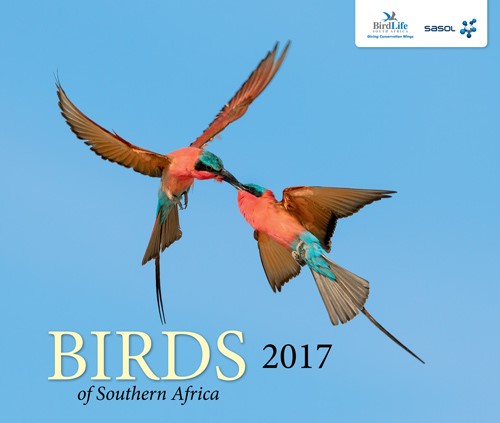
For more information about the different categories and rules, visit the BirdLife South Africa website. To see which teams have already registered, click here. To add your team to this map you need to complete the online Fledge.

For more information about BirdLasser, visit www.birdlasser.com or e-mail support@birdlasser.com

Bird of Southern Africa 2017 calendarscal

The Birds of Southern Africa 2017 calendars are now in stock! With a stunning, full-page colour photograph for each month, they will make lovely gifts for local and international family and friends. They are selling at R130 each (excluding postage). Please contact Shireen Gould at membership@birdlife.org.za to place your order or for more information. We suggest you don’t delay – stocks are limited!

Farewell to Ntombi Stungu

ntoBirdLife South Africa staff countrywide bid a very sad farewell to Ntombi Stungu, who passed away suddenly on 24 August 2016 after a short illness. Ntombi started working with BirdLife South Africa, in 2003, initially as a cleaner and then progressing to become our membership administrator. Our condolences go to her son Mzi, her daughter Aphiwe and her little grandson Lathitha. The staff and volunteers of BirdLife South Africa remember and honour her friendship, loyalty and commitment and will sorely miss her presence at Isdell House.

The ’Mericans

In J une and July BirdLife South Africa had the pleasure of hosting two student interns from the United States. Mitul Patel, from the University of Maryland, and Jennifer Mitul and JennyReiss, from the University of Houston, were hand-picked by Prof. Bill Bowerman (University of Maryland) from a number of applicants to travel to Johannesburg and assist BirdLife South Africa in conducting a literature study on the levels and sources of environmental lead in South Africa, as well as the risks the lead poses to people and wildlife alike. The input from this study will form the basis of BirdLife South Africa’s future lead strategy document.

The harmful effects of lead on human health and the environment have been extensively researched. In humans it has been linked to decreased intelligence, hearing loss and aggressive behaviour, among other conditions. Likewise, it has been shown that chronic lead exposure has a severe impact on bird populations (especially scavenging birds), causing increased lethargy, decreased hunting ability and decreased spatial awareness. With Africa’s plummeting vulture populations, it is vitally important that BirdLife South Africa treat the possible impact of heavy metals such as lead as a matter of urgency.

We would like to thank Mitul and Jennifer (aka ‘the ’Mericans’) for their invaluable contribution to this project. The amount of literature they covered over the span of two short months is nothing short of inspiring. We especially miss Jenny’s dry sense of humour and Mitul’s propensity for bursting into song. We wish you both the best of luck in what could only be highly successful future careers. Your presence in the RJ Downie Conservation Wing is sorely missed.

A bitter-sweet farewell to an IBA Team member

It is with heavy hearts that the Important Bird and Biodiversity Areas (IBA) Team says farewell to Nick Theron, the IBA Programme’s regional conservation manager in KwaZulu-Natal. After six years of tireless dedication to conserving IBAs, Blue Swallows, Cape Parrots and Rudd’s Lark, he (with his wife Rina and their two young boys) will be pursuing new frontiers in Limpopo Province. Our solace, though, is that Nick is not lost to BirdLife South Africa; we will continue to work closely with him in Limpopo as he takes up the position of Biodiversity Stewardship coordinator for the Kruger2Canyons Biosphere Reserve.

Nick joined BirdLife South Africa’s IBA Programme in 2010 as the project manager for the Cata Forest Ecotourism Development Initiative. After completing a successful project by setting up bird tourism in this rural Eastern Cape community, he took up the position of the IBA Programme’s regional conservation manager in KwaZulu-Natal. At the same time, his wife Rina became the Blue Swallow monitor for Ezemvelo KZN Wildlife and together they became a formidable conservation force in southern KwaZulu-Natal.

Nick remains an IBA champion and we expect he will lobby hard for the conservation and protection of IBAs in Limpopo. Nick and Rina’s undying commitment to threatened species and IBAs has resulted in numerous achievements for the IBA Programme. These include expanding the IBA network for the benefit of White-backed and Cape vultures; monitoring and advocating for Blue Swallows; finding a remnant population of Rudd’s Lark in the Eastern Cape; and obtaining improved management and protection for key grassland sites in the highly fragmented southern KwaZulu-Natal.

BirdLife South Africa wishes Nick and his family all the best in their new venture and we look forward to a continued partnership to conserve our birds and their habitats.

Mziki Private Game Reserve

safNestled beneath shady karee trees in the heart of Mziki Private Game Reserve, just two hours’ drive from Johannesburg, Mziki Safari Lodge offers a natural, affordable haven for eco-travellers seeking an authentic, unaffected encounter with the African bush. The reserve is home to 372 different bird species, making it one of the best birding areas in South Africa. All BirdLife South Africa members receive 15% discount PLUS a free upgrade! To book this special, e-mail reservations@mziki.co.za and quote ‘BirdLife SA’ or call +27 (0)82 902 2058.

Birding weekends in KZN

The Johannesburg Region of SANParks Honorary Rangers, in partnership with BirdLife South Africa, invites you to a three-night birding weekend at two of South Africa’s premier birding destinations: Ndumo (20–23 October 2016) and Mkhuze (28–31 October 2016) game reserves in northern KwaZulu-Natal. Accommodation is available in comfortable chalets or safari tents or at shady camping sites.

For more information or to book, contact Tim or Dave at info@birding.org.za. More details are also available at click here.