

Known as the Witkruisvleivalk in Afrikaans, mmankgodi-wa-dihlaba in Sesotho and umamhlangenomnyama in isiZulu, the Black Harrier is categorised as “near-endemic”, meaning that the majority of its population occurs within South Africa, and it has the unfortunate distinction of being by far the most threatened near-endemic raptor in our country.
With a core range in the Western Cape province, the Black Harrier is also migratory and highly nomadic within South Africa: you could be lucky enough encounter this Endangered bird anywhere from Langebaan to Lesotho, depending on the season.
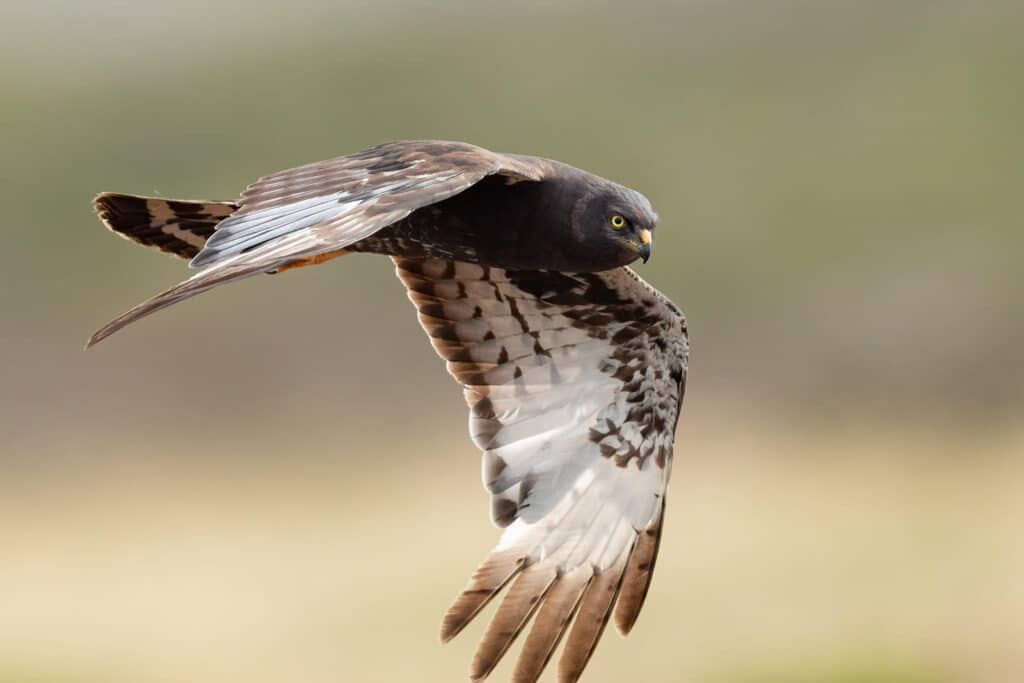

With fewer than 800 adult birds remaining on Earth, and a conservation status of Endangered, this bird is in serious danger of extinction without the implementation of some key interventions. The main threats faced by this species include loss of its favoured breeding habitats, within the Fynbos, Karoo and Grassland biomes. Additional significant threats also include collisions with power lines and wind turbines, a reminder that even renewable energy infrastructure still poses a threat to biodiversity. Ironically, climate change is also predicted to contribute to this species’ decline, as warming climates force them out of habitats and into limited fragements of coastal strandveld and renosterveld.
The conservation of this magnificent raptor has been overseen for several years by the partners on the Black Harrier Task Force, whose research and conservation efforts have contributed substantially to our understanding of the threats facing Black Harriers and the mitigation measures required to protect this charismatic species. Ecological research on the species has been led by Dr Rob Simmons of Birds and Bats Unlimited, while the Overberg Renosterveld Trust has made remarkable strides towards securing important tracts of endangered Renosterveld Fynbos habitats in which some of the highest densities of breeding harriers are found. We will be working throughout 2026 with the Overberg Renosterveld Trust and other partners to raise awareness about this bird and the existential threats they face.
Lesson Plans
Explore our exciting series of four lesson plans designed for the Intermediate Phase (Grades 4–6), centred on South Africa’s very own Black Harrier (Circus maurus). All four lesson plans are free to download, ready-to-use, and designed for Grades 4–6. They combine subject learning with conservation awareness to inspire the next generation of bird protectors.
Lesson Plan 1: English
Learners explore the Black Harrier through an engaging informational text. Activities focus on reading comprehension, vocabulary building, synonyms, a word search, and labelling key features to distinguish this endemic raptor.
Lesson Plan 2: English
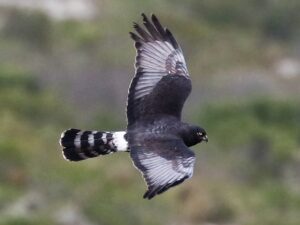
This lesson helps learners tell the Black Harrier apart from the similar-looking Black Sparrowhawk. Includes comparison reading, colouring and labelling activities, and a short writing task explaining why the two birds are often confused.
Lesson Plan 3: Mathematics
A fun maths lesson linked to the Black Harrier’s flight. Learners solve distance, speed and time problems, convert measurements, work with data tables, draw a bar graph, and complete a dot-to-dot activity.
Lesson Plan 4: Natural Science & Technology
Learners discover the Black Harrier’s habitat, distribution across South Africa, and its role as a predator. Activities include map labelling, food chain construction, and understanding why this endangered bird needs open grasslands and fynbos.
Lesson Plan 5: Natural Science & Technology
Learners study the Black Harrier’s life cycle, parental care, and threats while writing a short story and designing a life cycle poster.
.
Lesson Plan 6: Visual/Creative Arts
Through drama and eco-friendly art, learners create a short play and build a model ground nest using natural materials.
Lesson Plan 7: Social Sciences
Learners investigate the Black Harrier’s regional migration patterns, threats like wind farms and climate change, and conservation solutions.
Lesson Plan 8: Natural Sciences and Technology
Learners discover the ecological importance of the Black Harrier, its role in the food chain, and the ecosystem services it provides.
Lesson Plan 9: Consolidation
As a culminating activity, groups create and present posters on different aspects of the Black Harrier covered in previous lessons.
Lesson Plan 10: Reporting Back
Learners and teachers report on how they implemented the Bird of the Year 2026 campaign in their school.
Stay tuned to this web page, as BirdLife South Africa will create awareness about the Black Harrier through the production of educational materials, such as posters, infographics, and learning resources for schools that will be free to download on this web page; articles in African Birdlife magazine; social media posts; and presentations to interested groups. Black Harrier merchandise, such as T-shirts and pin badges, will also be on sale through BirdLife South Africa’s Shop for the Birds! from January 2026.
We would like to share our gratitude with our Bird of the Year sponsor, the Hans Hoheisen Charitable Trust, for once again making this initiative possible through the funds they generously donate towards BirdLife South Africa and the conservation of birds and biodiversity.
We would also like to thank our partners Overberg Renosterveld Trust and Bird and Bats Unlimited for the invaluable knowledge and insights they have shared with us, ensuring that our information on the Black Harrier remains accurate and up to date.


Posters and Infographics

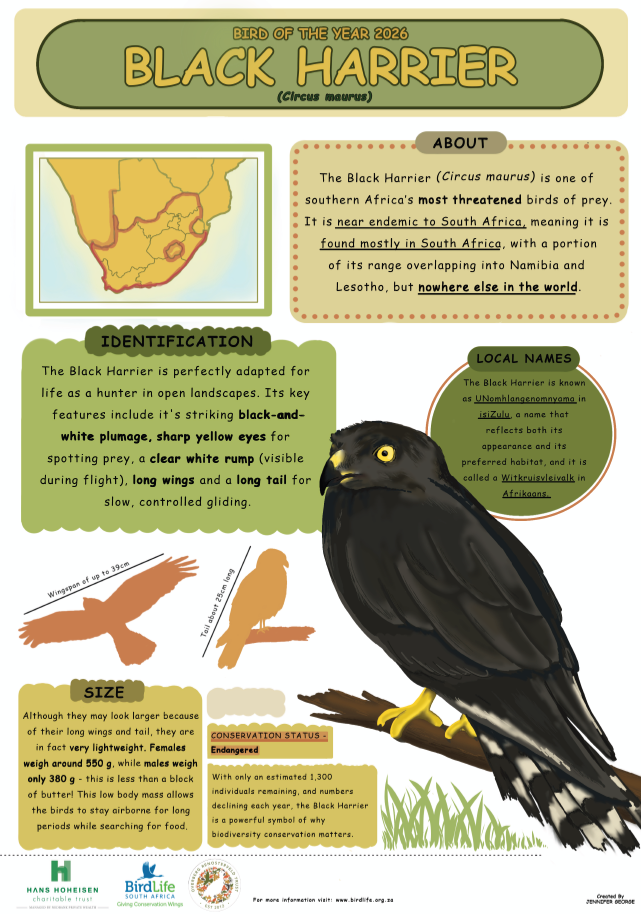
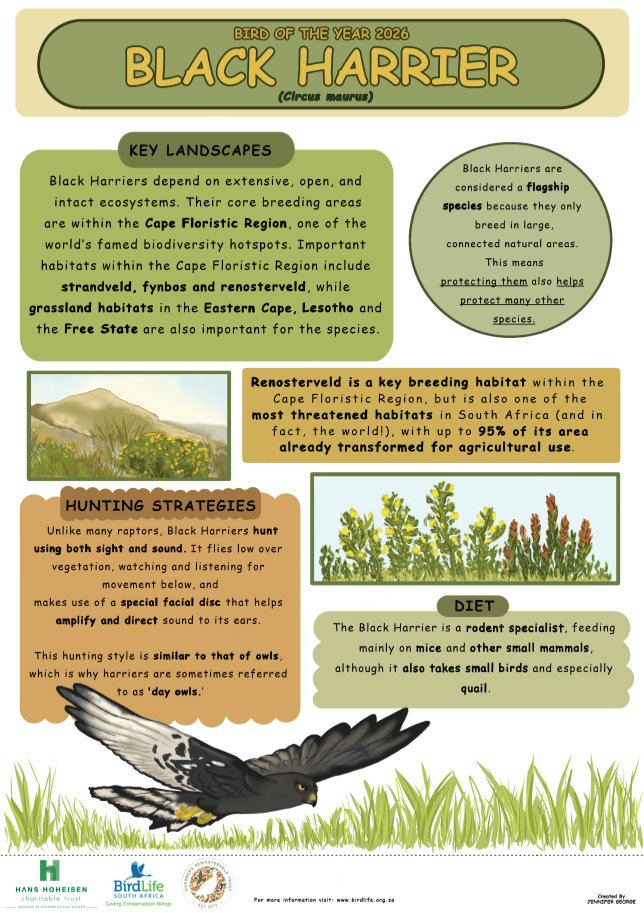
These two infographics provide an engaging overview of the 2026 Bird of The Year, highlighting key facts about the species, its habitat, conservation status, and the importance of protecting it. The infographics were creatively designed and developed by Jennifer George to raise awareness and inspire appreciation for the Black Harrier.
Previous Birds of the Year
Additional previous Birds of the Year have been:
2021- Cape Rockjumper
2020- Southern Ground-Hornbill
2019 – Secretarybird
2018 – African Black Oystercatcher
2017 – Lappet-Faced Vulture
2016 – Sociable Weaver
2015 – Blue Crane
2014 – Tristan Albatross
2013 – White-winged Flufftail
2012 – African Fish Eagle
2011 – Barn Swallow
2010 – Lesser Flamingo
2009 – Cape Robin-chat
2008 – Spotted Eagle-Owl
2007 – African Penguin