


Yellow-throated Sandgrouse
Pterocles gutturalis

Number Of Mature
Individuals (Regional)
5 000 – 10 000

Regional
Population Trend
Decreasing
2025
Regional Category
Near Threatened
Search by species
CONTENTSOverview
Names
|
IOC English Name: |
Yellow-throated Sandgrouse |
|
SA & IOC Scientific Name: |
Pterocles gutturalis |
|
BirdLife International Taxonomy (scientific name): |
Pterocles gutturalis |
|
Order: |
PTEROCLIFORMES |
|
Family: |
Pteroclidae |
|
Species name author: |
Smith A 1836 |
|
Afrikaans: |
Geelkeelsandpatrys |
|
Sesotho (South Africa): |
Kokwi ya mmetsosehla |
|
Sesotho (Lesotho): |
|
|
Siswati: |
|
|
Zulu: |
unogwadulontamephuzi |
Current Assessment Status
|
2025 Regional Category [Criteria] |
NT [C2a(ii)] |
|
2024 Global Category [Criteria] |
LC (BirdLife International 2024) |
|
Population size (Regional) |
5000 – 10 000 mature individuals |
|
Population size (Global) |
Unknown (BirdLife International 2024) |
|
Distribution size (EOO) (Regional) km2 |
21 313 (Lee 2024) |
|
Distribution size (EOO) (Global) km2 |
5 070 000 (BirdLife International 2024) |
|
Distribution size (AOO) (Regional) km2 |
5876 (Lee 2024) |
|
Generation time |
5.6 years (BirdLife International 2024) |
|
Status change reason |
No change |
|
Migrant (in the region) |
Resident and supplemented with migrants from outside the region (Tarboton et al. 1999) |
|
Regional endemic |
No |
Historic Listing Information
|
2000 Regional Status |
NT |
|
2015 Regional Status |
NT [C2a(i,ii)] |
|
Status change reason (if applicable) |
No change |
|
2015 Population size (Regional) |
<1000 mature individuals |
|
2015 Global Status |
LC |
Reason for Inclusion
Reason for Inclusion in the Assessment
The Yellow-throated Sandgrouse Pterocles gutturalis was listed as regionally Near Threatened in both the 2000 (Barnes 2000) and 2015 (Evans and Peacock 2015) regional assessments.
Category Justification
Category Justification
The Yellow-throated Sandgrouse’s regional population is considered c. 5000 – 10 000 mature individuals with an inferred continuing decline in the subpopulation. All the mature individuals are in one subpopulation. Consequently, this species might meet the criteria for Vulnerable C2a(ii). However, the rate of decline is unknown. In addition, due to the irruptive nature of this species, a rescue effect is likely should the regional population go extinct. Therefore, the assessment is adjusted to Near Threatened. It must be emphasised that this species remains poorly studied.
Based on rate of decline and population size, this species meets the criteria for Vulnerable C2a(ii). However, due to the irruptive nature of this species, a rescue effect is likely should the regional population go extinct. Therefore, the assessment is adjusted to Near Threatened. The Extent of Occurrence (EOO) also meets thresholds for Near Threatened under Criterion B1 (Lee 2024). It must be stressed that this species remains poorly studied.
Population Justification
The global and regional population size for Yellow-throated Sandgrouse is unknown (BirdLife International 2024).
Tarboton et al (1999) estimated that there were 300 – 500 individuals in their 95 km2 study area in South Africa. In the previous Red List assessment, Evans and Peacock (2015) estimated the South African population <1000 mature individuals. However, based on the Tarboton et al. (1999) estimate and Lloyd (2005) stating that there may be thousands of birds in the region, this should probably be revised to <10 000 birds that are all within one sub-population.
The regional population size is likely to be c. 5000 –10 000 mature birds. Confidence in this estimate is low.
Trend Justification
Globally, Yellow-throated Sandgrouse is considered to be in decline (BirdLife International 2024).
The regional trend is not known but is projected to be in decline. Regionally, Ayres (1885) described the status of the Yellow-throated Sandgrouse in the North-West Province as “tolerably plentiful”. A century later, Tarboton et al. (1987) noted that the species had declined in range and abundance. Based on this historical data, the bird’s regional EOO is likely to continue decreasing (Evans and Peacock 2015). Confidence in this estimate is low.
Tarboton et al. (1987) agreed with Brooke (1968) that it was mainly an irruptive, non-breeding visitor to the area. Subsequently, a breeding population of the Yellow-throated Sandgrouse was found near Northam in the North-West Province, South Africa (Tarboton et al. 1999).
Biology & Ecology
Taxonomy
Two subspecies are recognised, based mainly on plumage differences. The nominate P. g. gutturalis occurs from southern Zambia southwards to South Africa, while P. g. saturatior extends from northern Zambia to Ethiopia (de Juana 1997).
Identification
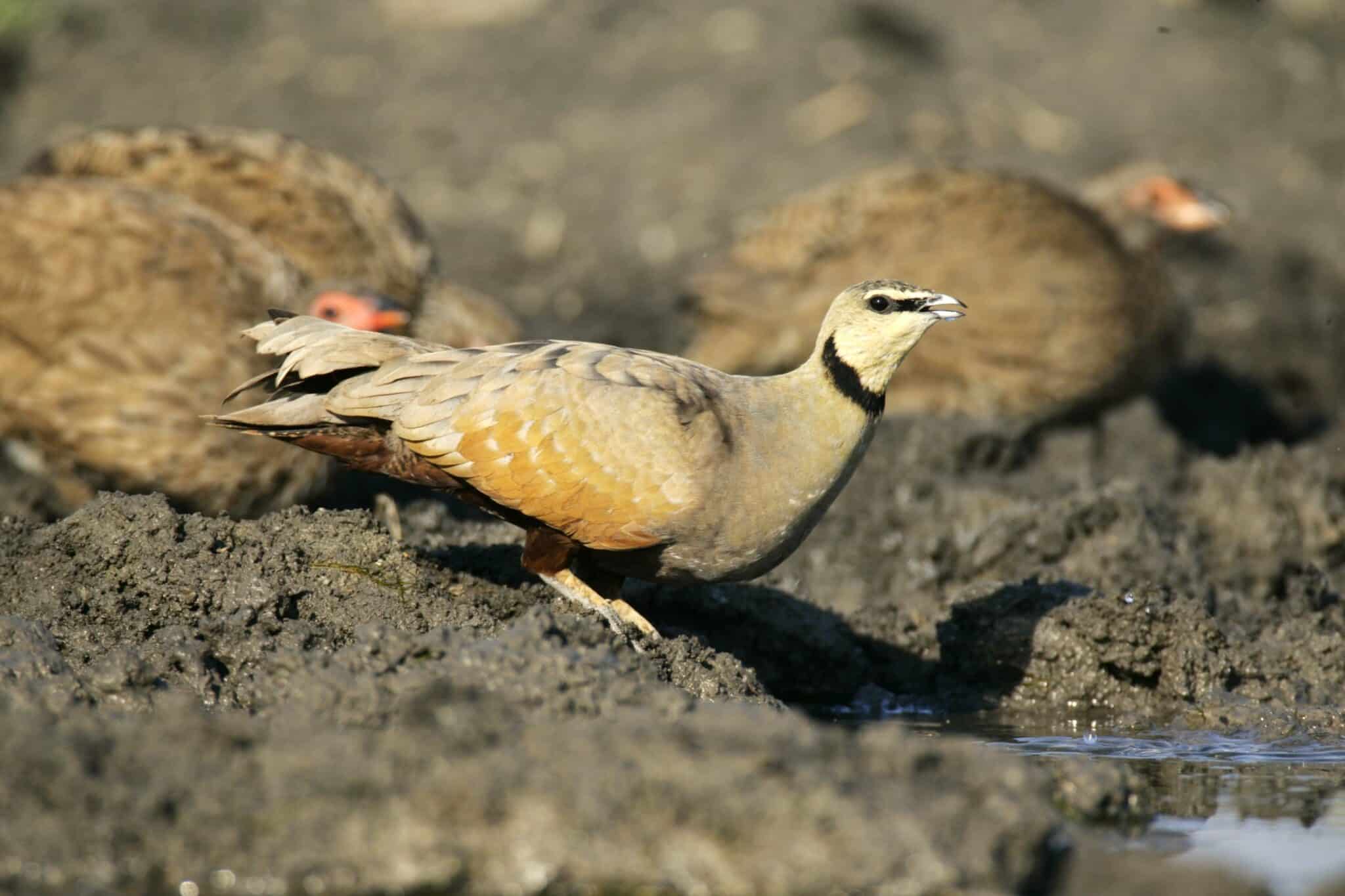
30 cm, 350 g. A large, bulky sandgrouse with a characteristic call. Sexes similar in size, but dimorphic in plumage. Male has yellow throat and supercilium, accentuated by black collar and lores. Chest grey, belly chestnut. Remiges and underwing coverts black. Upperparts grey, washed yellow, with dark sub-terminal marks creating a scaly effect. Wing coverts tinted rufous. Bill pale blue-grey. Eyes dark, surrounded by grey orbital ring. Legs and feet pinkish brown. Female has plain pale-yellow face, with dark mottling on nape and crown. Belly chestnut and finely barred black. Upperwings, back and lower chest mottled black, white and brown. Immature similar to female but mottled with finer mottling, plus narrow olive-buff bars on upperwing, back and lower chest (Lloyd 2005).
Distribution
The Yellow-throated Sandgrouse has a highly fragmented distribution in East and Southern Africa, that extends from Ethiopia to South Africa (Urban et al. 1986, Madge and McGowan 2002, Lloyd 2005). In Southern Africa it occurs in northeastern Namibia, north-central and northern Botswana, northwestern Zimbabwe, and in South Africa in southwestern Limpopo Province and adjacent North-West Province (Urban et al. 1986, Tarboton et al. 1987, Brewster 1991, Maclean 1997, Lloyd 2005). There are a few records of Yellow-throated Sandgrouse from the Etosha region of Namibia, the Nossob River in the Kgalagadi Transfrontier Park, and the Limpopo River valley (Lloyd 2005). Its range within the region has contracted significantly since the 20th century (Maclean 1997), and the species is now absent from the vicinity of Kuruman, Potchefstroom, Zeerust and Middelburg, where specimens were collected in the 1800s (Stark and Sclater 1906, Brooke 1968).
Its movements are not well understood: the species was previously viewed as an irruptive nomadic visitor in the region, but it appears that a stable, resident population has become established thanks to the Yellow-throated Sandgrouse’s ability to forage and breed in a transformed agricultural matrix (Blane and Tarboton 1980, Maclean 1997, Tarboton et al. 1999). Farmers report that the birds have been resident since at least 1960 (Blane and Tarboton 1990).
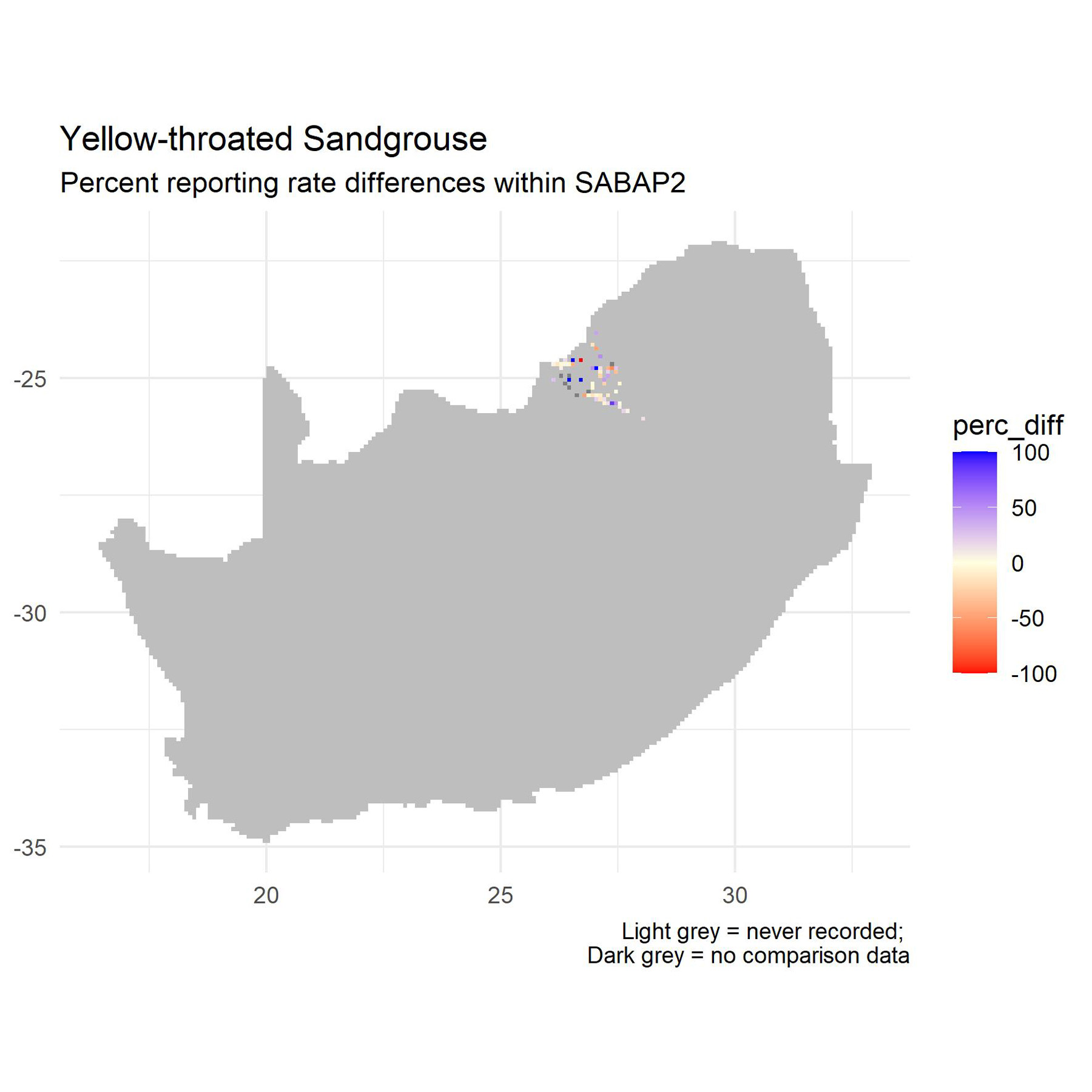
Figure 1: Southern African Bird Atlas Project 2 (SABAP2) distribution records for Yellow-throated Sandgrouse as of the end of 2023. Percentage declines between the 2007-2015 and 2016-2023 periods are indicated, with red indicating a decline, and blue an increase. Map from Lee (2024).
Ecology
The ecology of this species was examined during a long- term study by Blane and Tarboton (1990) and Tarboton et al. (1999) in the Northam-Thabazimbi area. The Yellow-throated Sandgrouse is a monogamous, solitary nester with strong pair bonds (Tarboton et al. 1999). The nest is a scrape or hollow in the ground, sometimes a hoof-print, often partly hidden by a tuft of grass or stubble (de Juana 1997). Nesting pairs appear to be clustered, with up to five nests in a 6-ha field, and some nests may be only 40–45 m apart; conversely, some apparently suitable fields are not occupied (Tarboton et al. 1999). Egg-laying occurs April-October, with a peak in June (Tarboton et al. 1999). A generation length of 5.6 years is provided by BirdLife International (2024). Based on the well-studied Northam population, average productivity is estimated at 0.42–0.85 young/pair/year; mean clutch size is 2.85, and nesting success is 24.8% including clutches accidentally destroyed by ploughing, or 37.9% if ploughing losses are excluded. The daily nest predation rate is 2.55% (Tarboton et al. 1999). The species inhabits flat plains with dark-coloured clay ‘turf’ soils that overlie the basic rocks of the Bushveld Igneous Complex and avoids coarser sandy or rocky soils derived from quartzite, granite and felsites in surrounding areas (Tarboton et al. 1999). The documented preference for plains near swamps and rivers is thus more likely a reflection of the birds’ dependence on fine alluvial soils, than the wetlands themselves; birds drink mostly from small stock-watering dams with a bare, flat beach on one side to facilitate easy approach and belly-wetting behaviour (Tarboton et al. 1999). However, before wide-scale habitat transformation through agriculture, the flooding and drying cycles on floodplains may have been important in preventing full plant succession in natural habitats (Tarboton et al. 1999).
Within their South African range, Yellow-throated Sandgrouse almost exclusively forage and nest in agricultural landscapes, and especially in fields left fallow for a season or more, allowing for the establishment of pioneer plant communities which provide abundant food resources; seeds of Amaranthus and Crotalaria species appear to be of particular importance (Tarboton et al. 1999). However, if left undisturbed such fields rapidly revert to thornveld savannah, and after about four years become unsuitable for use by sandgrouse. In addition, foraging and nesting also occur in recently harvested fields, especially of sunflower and soybean, and the birds sometimes forage in recently planted or ploughed fields, with the latter often used as night-time roosts (Tarboton et al. 1999).
Threats & Conservation
Threats
While there are no immediate concerns regarding the conservation of this species in the region (Little 2014), the reliance of Yellow-throated Sandgrouse on current crop farming cycles, especially the availability of and quality of fallow fields, make the birds susceptible to a change in agriculture practices (Tarboton et al. 1999). The winter breeding season coincides with peak ploughing of fields in preparation for planting of spring crops, and a high proportion of nests are destroyed by such activities, e.g. six of 13 nests found in one year were destroyed in this fashion (Blane and Tarboton 1990). The potential effects of agricultural herbicides should also be researched (Little 2014). Hunting (wing-shooting) of Yellow-throated Sandgrouse is not permitted in the North-West Province. Provided this law is enforced, the birds should not be at risk. As the birds are known to feed on fallen grains of commercial crops such as oats, wheat, barley, sorghum and soybean (Lloyd 2005), the species may be perceived as an agricultural pest, particularly where high densities occur locally. It may also be inadvertently shot during efforts to control the superficially similar Speckled Pigeon Columba guinea, an established agricultural pest. The potentially adverse effects of climate change and resultant changes in, e.g. farming practices, land use and levels of bush encroachment on the quality and quantity of suitable habitat should be investigated. A large number of mines are located within the range of this species, and it is a concern that the footprint of mines in the area is increasing; however, mining properties may indirectly safeguard remaining natural habitat, and provide additional drinking points.
Conservation Measures Underway
No species-specific conservation measures are currently underway. The Northern Turf Thornveld Important Bird and Biodiversity Area (IBA) (1998 and 2015: SA009) was designated specifically to safeguard the last remnant of the Yellow-throated Sandgrouse population in the region (Barnes 1998, Marnewick et al. 2015). Key Biodiversity Areas (KBAs) have replaced IBAs. Approximately a third of the bird’s distribution range in South African is within the Madikwe-Athersone KBA 100844 (Key Biodiversity Areas Partnership 2024a) and a small portion of its distribution is located in the southwestern corner of the Waterberg KBA 100977 (Key Biodiversity Areas Partnership 2024b).
Conservation Measures Proposed
The survival of this species in South Africa is dependent on crop farming and is therefore linked to education and awareness of private landowners. Tarboton et al. (1999) identified three key factors that would affect the survival of the Yellow-throated Sandgrouse in the region: (1) availability of one-year fallow fields, (2) timing of ploughing of lands, and (3) the availability of drinking sites; all of these can be managed within the existing agricultural framework, e.g. by ploughing mainly in the summer non-breeding season, or providing incentives to farmers to establish cycles that promote optimal breeding habitat. Tarboton et al. (1999) suggested that if such management strategies are implemented effectively, Yellow-throated Sandgrouse populations may even have the potential to be hunted sustainably, providing a financial motivation for long-term conservation planning. Nevertheless, given the relatively small, fluctuating and isolated regional population, continued monitoring is required.
Research Priorities and Questions
- The size of the regional population needs to be determined.
- The proportion of the regional population that is resident, and migratory or nomadic should be determined.
- The bird’s breeding success and recruitment to the regional population should be determined.
- The effects of habitat loss, fragmentation and management on the abundance and conservation of the Yellow-throated Sandgrouse should be determined.
- It should be determined why the bird’s range in the region contracted in the past and why it is currently so restricted.
Contributors & References
Assessor/s
Steven W Evans
Reviewer/s
James Westrip, Sanjo Rose
References
Ayres T. 1885. Additional notes on the ornithology of Transvaal. Ibis 18(8): 341–351.
Barnes KN. 1998. The Important Bird Areas of Southern Africa. Johannesburg, South Africa: BirdLife South Africa.
Barnes KN. 2000. Yellow-throated Sandgrouse. In: Barnes KN (ed), The Eskom Red Data Book of Birds of South Africa, Lesotho and Swaziland. Johannesburg, South Africa: BirdLife South Africa. pp 137–138.
BirdLife International. 2024. Pterocles gutturalis. The IUCN Red List of Threatened Species 2024: e.T22692998A263674036. https://dx.doi.org/10.2305/IUCN.UK.2024-2.RLTS.T22692998A263674036.en [Accessed on 19 February 2025].
Blane S, Tarboton WR. 1990. A year with the Yellow-throated Sandgrouse. African Wildlife 44: 272–274.
Brooke RK. 1968. The status of the Yellow-throated Sandgrouse south of the Zambezi. Ostrich 39: 33–34.
Brewster CA. 1991. Birds of the Gumare area, northwest Botswana. Babbler 21: 12–61.
de Juana E. 1997. Family: Pteroclidae (Sandgrouse). In: del Hoyo J, Elliott A, Sargatal J, Christie DA (eds), Handbook of the Birds of the World. Vol. 4. Barcelona, Spain: Lynx Edicions. pp 30–57.
Evans SW, Peacock F. 2015. Yellow-throated Sandgrouse Pterocles gutturalis. In: Taylor MR, Peacock F, Wanless RM (eds), The Eskom Red Data Book of Birds of South Africa, Lesotho and Swaziland. Johannesburg, South Africa: BirdLife South Africa. pp 377–379.
Key Biodiversity Areas Partnership. 2024a. Key Biodiversity Areas factsheet: Madikwe – Atherstone. Extracted from the World Database of Key Biodiversity Areas. Developed by BirdLife International, IUCN, American Bird Conservancy, Amphibian Survival Alliance, Conservation International, Critical Ecosystem Partnership Fund, Global Environment Facility, Re:wild, NatureServe, Rainforest Trust, Royal Society for the Protection of Birds, World Wildlife Fund, and Wildlife Conservation Society. Available: https://keybiodiversityareas.org/ [Accessed 18 June 2024].
Key Biodiversity Areas Partnership. 2024b. Key Biodiversity Areas factsheet: Waterberg. Extracted from the World Database of Key Biodiversity Areas. Developed by BirdLife International, IUCN, American Bird Conservancy, Amphibian Survival Alliance, Conservation International, Critical Ecosystem Partnership Fund, Global Environment Facility, Re:wild, NatureServe, Rainforest Trust, Royal Society for the Protection of Birds, World Wildlife Fund, and Wildlife Conservation Society. Available at https://keybiodiversityareas.org/ Accessed 18 June 2024.
Lee ATK. 2024. Regional Red Data Book of the Birds of South Africa, Lesotho and Eswatini: SABAP2 synthesis and supporting information and graphics for Yellow-throated Sandgrouse. Unpublished report. Johannesburg, South Africa: BirdLife South Africa.
Little RM. 2014. Yellow-throated Sandgrouse Pterocles gutturalis. In: Ginn PE, McIlleron G (eds), The Ultimate Companion for Birding in Southern Africa. The Unlimited.
Lloyd P. 2005. Yellow-throated Sandgrouse Pterocles gutturalis. In: Hockey PAR, Dean WRJ, Ryan PG (eds), Roberts birds of southern Africa 7th Edn. Cape Town, South Africa: Trustees of the John Voelcker Bird Book Fund.
Maclean GL. 1997. Yellow-throated Sandgrouse. In: Harrison JA, Allan DG, Underhill LG, Herremans M, Tree AJ, Parker V, Brown CJ (eds), The Atlas of Southern African Birds. Vol. 1. Johannesburg, South Africa: BirdLife South Africa. pp 100–101.
Madge S, McGowan P. 2002. Pheasants, Partridges & Grouse: Including Buttonquails, Sandgrouse, and Allies. London, UK: Christopher Helm.
Marnewick MD, Retief EF, Wright DR, Theron NT. 2015. South Africa’s Important Bird and Biodiversity Areas Status Report 2015. Johannesburg, South Africa: BirdLife South Africa.
Stark A, Sclater W. 1906. The Birds of South Africa. Vol. IV: Game-birds, Shore-birds, and Sea-birds. London, UK: RH Porter.
Tarboton WR, Blane S, Lloyd P. 1999. The biology of the Yellow-throated Sandgrouse Pterocles gutturalis in a South African agricultural landscape. Ostrich 70: 214–219.
Tarboton WR, Kemp MI, Kemp AC. 1987. Birds of the Transvaal. Pretoria, South Africa: Transvaal Museum.
Urban EK, Fry CH, Keith S. 1986. The Birds of Africa. Vol. 2. London, UK: Academic Press.
Citation
Evans SW 2025. Yellow-throated Sandgrouse. In: Lee ATK, Rose S, Banda S, Bezeng SB, Maphalala MI, Maphisa DH, Smit-Robinson H (eds), The 2025 Red Data Book of Birds of South Africa, Lesotho and Eswatini. Johannesburg, South Africa: BirdLife South Africa. Available at: https://www.birdlife.org.za/red-list/yellow-throated-sandgrouse/
Our generous sponsors


