


Yellow-breasted Pipit
Anthus chloris

Number Of Mature
Individuals (Regional)
2 260 (1 600 – 3 160)

Regional
Population Trend
Decreasing
2025
Regional Category
Vulnerable
Search by species
CONTENTSOverview
Names
|
IOC English Name: |
Yellow-breasted Pipit |
|
SA & IOC Scientific Name: |
Macronyx chloris |
|
BirdLife International Taxonomy (scientific name): |
Hemimacronyx chloris |
|
Order: |
PASSERIFORMES |
|
Family: |
Motacillidae |
|
Species name author: |
Lichtenstein 1842 |
|
Afrikaans: |
Geelborskoester |
|
Sesotho (South Africa): |
Tshaase-petatshehla |
|
Sesotho (Lesotho): |
Tšaase-petasehla |
|
siSwati: |
|
|
Zulu: |
Ingcelekeshephuzi |
Current Assessment Status
|
2025 Regional Status [Criteria] |
VU [A3c; C1+2a(i)] |
|
2024 Global Status [Criteria] |
VU [A3c; C2a(i); D1] (BirdLife International 2021) |
|
Population size (Global) |
2260 (1600 – 3160) (Colyn et al. 2024a) |
|
Population size (Regional) |
2260 (1600 – 3160) (Colyn et al. 2024a) |
|
Distribution size (EOO) (Global) km2 |
99 730 (summer breeding range) 207 000 – 257 200 (all seasons) |
|
Distribution size (EOO) (Regional) km2 |
99 730 (summer breeding range) 207 000 – 257 200 (all seasons) |
|
Distribution size (AOO) km2 |
2870 (Colyn et al. 2024a) |
|
Generation time |
3.0 years (BirdLife International 2021) |
|
Status change reason |
No change |
|
Migrant (in the region) |
Yes (Altitudinal migrant) |
|
Regional endemic |
Yes |
Historic Listing Information
|
2000 Regional Status |
VU [A2c; B1+2c; C1] |
|
2015 Regional Status |
VU [A2bc+4c; B1bc+2bc; C1] |
|
Status change reason (if applicable) |
No change |
|
2015 Population size (Regional) |
<5000 |
|
2015 Global Status |
VU [A3c; B1ab] |
Reason for Inclusion
Reason for Inclusion in the Assessment
The Yellow-breasted Pipit Macronyx chloris is endemic to the region. In addition, the species was listed as regionally Vulnerable in the 2015 regional assessment and is currently listed as globally Vulnerable (Little 2015, BirdLife International 2021).
Category Justification
Category Justification
The endemic Yellow-breasted Pipit meets the criteria for being regionally (and globally) Vulnerable in that ongoing and predicted future habitat loss, predominantly owing to overgrazing, too frequent burning, habitat conversion and numerous renewable energy infrastructure projects proposed for this species’ core range, are likely to result in future population declines approaching or exceeding 30% in the next 10 years. In addition, the Yellow-breasted Pipit’s population size is estimated to number 1000 individuals. This, together with the projected future population declines, also qualifies this species as Vulnerable.
Population Justification
A coarse early estimate by Siegfried (1992) suggested that there were 1500 – 5000 individuals, while Barnes (2000) subsequently estimated that there were 2500 – 6000 individuals, roughly equivalent to 1700 – 4300 mature individuals (BirdLife International 2021). Little (2015) estimated the total population to number 2000 – 4800 individuals, roughly equating to 1400 – 3360 mature individuals. The most recent population estimate, which incorporated 250 walked transects and distance sampling, generated a mean population estimate of 2260 (1600 – 3160) mature individuals (Colyn et al. 2024a). Transect data were sampled across the species’ range as informed by a national species distribution model, spanning the northern breeding periphery in Verloren Valei Nature Reserve near Dullstroom (Mpumalanga province) through to Cathcart (Eastern Cape province).
There are local population fluctuations in response to prevailing climatic conditions, particularly drought (Pietersen et al. 2018). Heat extremes, particularly extended heat waves, have been noted to reduce the probability of breeding and could have impacts on subsequent recruitment (Colyn et al. 2024b).
Considering the amount of recent research attention directed at this species, confidence in the aforementioned parameters is medium to high.
Trend Justification
The population is suspected to have declined at a moderate rate, corresponding to loss and degradation of its grassland habitat (Pietersen et al. 2018). It should be noted that even in core parts of the distribution range, and in ostensibly suitable habitat, the Yellow-breasted Pipit’s occurrence is reliant on conservative land-management. In the Wakkerstroom area in southern Mpumalanga province, for example, this species has undergone a considerable reduction in range and abundance because of intensive grazing and frequent burning of its grassland habitat. Within the 3573 km2 of suitable summer habitat as defined by a national species distribution model, only c. 40% meets the species’ requirements given the functional state of grassland in response to fire and grazing (Colyn et al. 2024a).
Management currently has a significant impact on the quantity and distribution of habitat for the species, with an estimated 30% reduction in suitable grassland habitat between 2003-2023 in the core Free State and Mpumalanga province regions (Colyn et al. 2024a). In addition to the impact of management disturbance regimes (fire and grazing), climate can also greatly impact the breeding success of the species (Colyn et al. 2024b). Yellow-breasted Pipits appear to be vulnerable to temperature extremes with a negative association between breeding activity and the number of days with temperatures exceeding 32°C (Colyn et al. 2024b). The increased prevalence and duration of summer heat waves/extremes could pose a direct threat to breeding activity, success and subsequent recruitment (Colyn et al. 2024b).
In addition to incompatible grazing and burning practices, there are a slew (>2000) of applications to site renewable energy (mostly wind) farms along the eastern escarpment of South Africa. These developments are likely to result in further habitat loss and degradation for this species, while the wind turbines also pose a direct threat. A recent study assessing aerial display flight heights relative to average wind turbine rotor swept areas suggests that this species’ collision risk is very high (Colyn et al. 2024a). Based on these threats, it is suspected that the global population of Yellow-breasted Pipit could decrease by up to 30% or more in the next ten years (or three generations). Increased habitat fragmentation, and resultant isolation of subpopulations, is also a concern, with no subpopulation currently estimated to support >1000 individuals, and these subpopulation sizes likely to decrease even further.
Biology & Ecology
Taxonomy
Originally described in the genus Anthus (Lichtenstein 1842), Roberts (1922) proposed a new genus Hemimacronyx in view of this species’ many peculiarities, some of which are more reminiscent of longclaws Macronyx (Roberts 1922, Cooper 1985). The morphologically and ecologically nearly indistinguishable Sharpe’s Longclaw Macronyx sharpei was later also transferred to this new genus (Cooper 1985). Current taxonomy varies widely between authors, with Clements (2019), Howard and Moore (2021), BirdLife International (2021), eBird (2023) and Handbook of the Birds of the World (Tyler and Boesman 2023) using the genus Hemimacronyx, while Little (2015), African Bird Club (2010), Avibase (2023) and IOC (Gill et al. 2024) use Anthus chloris as the valid species name. Bizarrely, though, most authors treat the morphologically and ecologically nearly indistinguishable Sharpe’s Longclaw as a member of the genus Macronyx. The most recent taxonomic study clearly indicates that Anthus chloris is nested within the genus Macronyx, and proposed that Anthus chloris be transferred to that genus based on genetic, plumage and ecological grounds (Pietersen et al. 2019). This proposal has not been widely accepted by the various listing authorities, although no evidence to refute this proposed taxonomic change has been proffered by these listing authorities either. As such, we follow the most recent taxonomic study and follow Pietersen et al. (2019) in treating Anthus chloris as a member of the genus Macronyx.
The species is monotypic.
Identification
16–18 cm, 25 g. A brightly coloured longclaw of high-lying grasslands, although unlike most other longclaws this species lacks a black gorget. Adults show slight dimorphism in colour in the breeding season (the female having a more buffy and less streaked breast), but the sexes are similar in size. The only longclaw in the region that lacks a black gorget. Unmistakable in breeding plumage, with bright lemon-yellow underparts, central belly and vent paler. Dorsally, grey brown with distinct scaling formed by pale edges to dark mantle feathers. Axillaries and most of underwing coverts bright yellow, greater underwing coverts black with white tips. Outermost rectrices mostly white. Legs and feet yellowish pink to pinkish. Hind-claw long. Bill dark horn with a variable greyish or orange-yellow base to lower mandible. Non-breeding birds are duller in colouration, lacking the diagnostic yellow underparts, and are consequently probably widely overlooked; such birds still retain a yellow spot on the central belly and yellow underwing coverts. Juvenile similar to non- breeding adult, but shows a yellowish wash below (Keith et al. 1992, Voelker 2005, Peacock 2006).
Distribution
Nearly endemic to South Africa, with a small population occurring in Lesotho. This species is restricted to moist highland grasslands along the eastern escarpment of South Africa during its austral summer breeding season, with some individuals dropping off the escarpment (predominantly to the west) during the non-breeding season. Due to its cryptic colouration during the non-breeding season, the non-breeding distribution is not well known. It has an estimated summer distribution range of 99 730 km2. However, within this summer range, the species is highly habitat specific, and it is estimated that <5% of habitat within its range meets its needs. The Lesotho subpopulation was probably previously more widely distributed, although now largely restricted to Sehlabathebe National Park (Osborne and Tigar 1990), the areas around Katse Dam and other isolated spots due to excessive grazing and burning of non-conserved areas resulting in unsuitable habitat. It occurs marginally in Eswatini, although the population there is little known, and the species appears to be restricted to high-lying grasslands in the west of the country. In South Africa, the core summer distribution extends in a narrow strip along the Eastern Escarpment from Dordrecht in the Eastern Cape province east to Elands Height, and from there north through Kwa-Zulu-Natal province along the eastern slopes of the main escarpment in the uKhahlamba-Drakensberg National Park. From there the distribution extends northwards along the Free State province eastern border until it reaches its northernmost limits in the Steenkampsberg Mountain range around Dullstroom in Mpumalanga province.
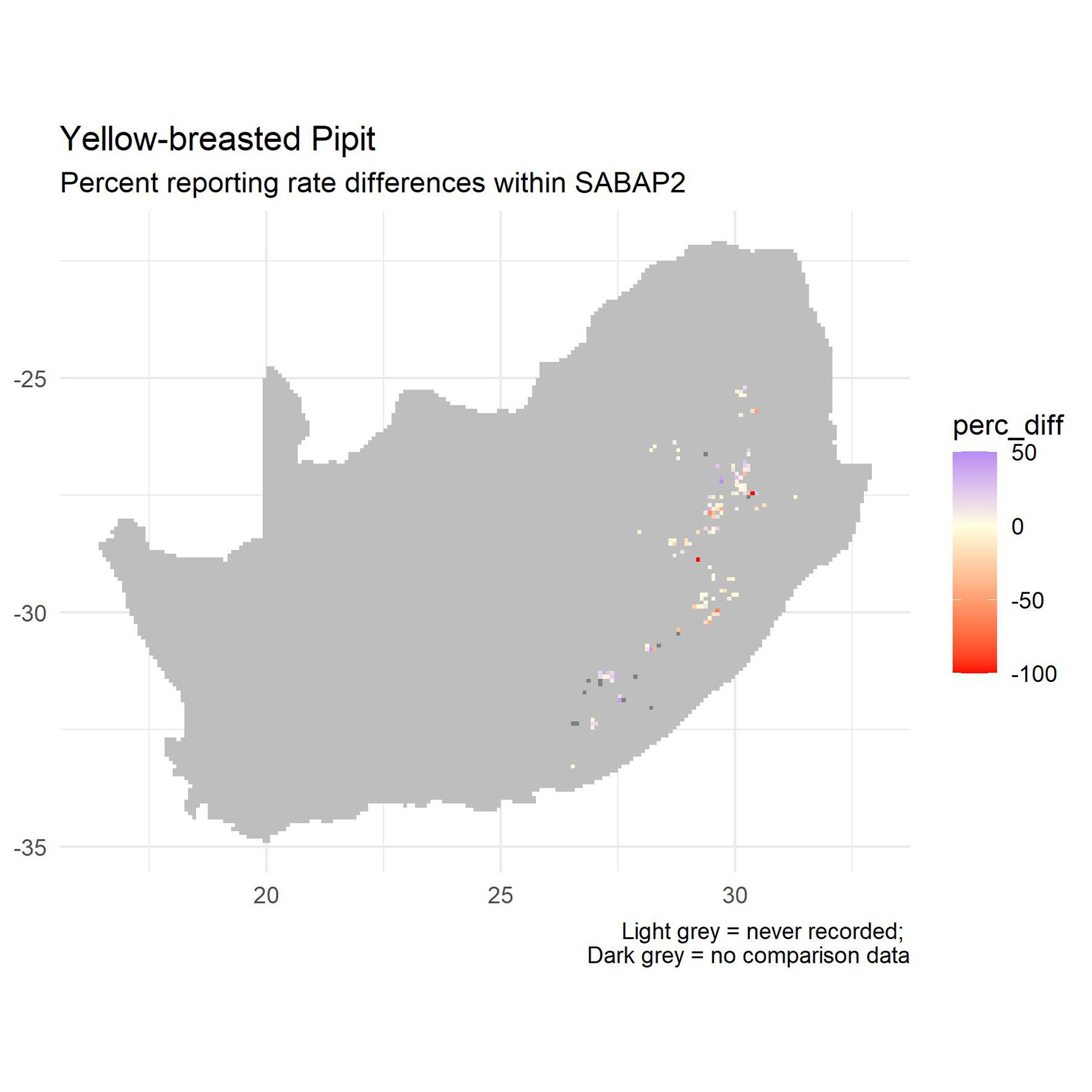
Figure 1: SABAP2 distribution map for Yellow-breasted Pipit. Colours represent change in reporting rate as percentage between the early and late SABAP2 periods (2007-2015 and 2016-2023).
It was previously claimed that populations in the northern interior parts of the Eastern Cape province appear to have contracted, presumably due to intensive grazing and burning, and habitat transformation (Barnes 2000). Although this is possible, a subsequent Environmental Niche Model analysis suggested that there is limited suitable summer breeding habitat for this species in the Eastern Cape province, and suggested that this purported range contraction may be a data artefact rather than a genuine contraction (Pietersen et al. 2018). Well-managed highland grassland habitats between Cathcart and Dordrecht and around Matatiele in the Eastern Cape province have been noted to still host local breeding populations (Colyn et al. 2024a). Concurrent surveys at some of these lower elevation sites (e.g. Ncora Dam, Cathcart) in the Eastern Cape province have yielded species absences across consecutive years, suggesting possible stochastic use of some sites based on fluctuating habitat suitability and rainfall. Recent sightings (2018-2020) at some of these peripheral sites were recorded in years with above average seasonal rainfall (Colyn et al. 2024a). The non-breeding distribution, although still fairly poorly known, is larger, with birds migrating to lower elevations predominantly west and south, but also east, of their high-elevation breeding grounds. The non-breeding range extends from Makhanda (previously Grahamstown) in the Eastern Cape province, in a broad swathe up the Eastern Escarpment to eastern Free State province and Suikerbosrand Nature Reserve in Gauteng province, and as far east as Ithala Game Reserve in KwaZulu-Natal province, with an isolated record from the coastal grasslands of KwaZulu Natal province in the east (Peacock 2006).
Trend data suggest that the overall distribution has remained fairly consistent between 1997 (Southern African Bird Atlas (SABAP1), Clancey 1997) and 2023 (SABAP2) (Figure 1, Lee 2024).
Ecology
During the breeding season, the Yellow-breasted Pipit is restricted to sub-montane (>1400 m but more commonly >2000 m asl) sour grasslands which are c. 150–300 mm in height (Tarboton et al. 1987). It prefers moist, lush, rather tall but tussocky grassland, often interspersed with flowers and forbs, and nesting sites are usually situated on flat to gently undulating terrain (Tarboton 2001, Little 2011). It is sensitive to disturbance and land-cover changes, and is usually absent from areas with excessive grazing or frequent (annual) burning (Muchai 2002, Little 2011, Little et al. 2013). Habitat suitability modelling using transect data collected across the species’ range suggests that larger intact grassland patch size (>350 ha), high basal biomass and grass cover, and lower fire prevalence increase the probability of this species’ presence (Colyn et al. 2024a). Yellow-breasted Pipit were more tolerant of taller average grass height compared to the sympatric endemic habitat specialist, Rudd’s Lark Heteromirafra ruddi (Colyn et al. 2024a). Some sites where Yellow-breasted Pipit was recorded on transects yielded very low fire prevalence (one in seven years), with grass structure largely maintained through grazing regimes (Colyn et al. 2024a). Primary defoliation through the use of fire, as opposed to functional grazing regimes, decreased habitat suitability, with numerous (>10) annually burnt local study sites in Wakkerstroom, Memel and Amersfoort yielding species’ absence during surveys between 2017 and 2020 (Colyn et al. 2024a).
A recent study (Colyn et al. 2024a, 2024b) recorded the highest Yellow-breasted Pipit densities in management units with moderate grazing intensity (<1 large animal unit [LAU]/15 ha). Average breeding densities recorded in management units with low grazing intensities was 0.23 pairs·ha-1 (range 0.05–0.52), whilst in units with no large ungulate grazing and high (>1 LAU/15 ha) grazing intensities, breeding densities were notably lower at 0.08 (range 0–0.2) and 0.04 (range 0–0.14) pairs·ha-1, respectively (Colyn et al 2024b). Furthermore, habitat suitability and naïve occupancy rates were higher in mixed livestock (cattle and sheep), sheep dominant (≥60%), and winter cattle grazing regimes, and/or stringent rotational grazing regimes (Colyn et al. 2024a). No study units with persistent year-round intensive cattle grazing and annually burnt grasslands yielded any breeding records. Exclusive cattle grazing for extended periods can lower grass cover and increase forb composition (Toth et al. 2016), thereby possibly reducing habitat suitability for Yellow-breasted Pipit (Colyn et al. 2024a).
Conversely, sheep dominant grazing regimes and/or mixed livestock grazing lower forb composition, whilst increasing grass composition, percentage organic matter, and basal cover (Abaye et al. 1997), which in turn favours habitat suitability for Yellow-breasted Pipit (Colyn et al. 2024a). Between 2007 and 2017, the South African government reported a 28% decrease in sheep farming, coupled with an 11% and 8% increase in cattle and mixed (crops and cattle) farming, respectively (Census of Commercial Agriculture 2017). Initial surveys in the Wakkerstroom area in southern Mpumalanga province in the late 1980s (Tarboton et al. 1987) reported sheep as the dominant livestock farmed, whilst recent surveys only recorded sheep on 5% of study sites in the area. Livestock type may indeed play a more important role in habitat suitability for this endemic habitat specialist species than grazing intensity and requires further investigation (Colyn et al. 2024a).
The generation length of 3.0 years is the mean of two calculated values derived from published and/or extrapolated estimates of mean age at first breeding, maximum longevity in the wild and mean annual adult survival (BirdLife International 2021).
Threats & Conservation
Threats
The grasslands of South Africa, on which the Yellow-breasted Pipit and a plethora of other threatened species rely, are very poorly conserved with <2.7% under formal protection and an estimated 33% already irreversibly transformed (Carbutt et al. 2011, Carbutt and Martindale 2014). Only around 1.5% of moist highland grasslands, on which this species specifically depends, are formally protected (Neke and du Plessis 2004, Mucina and Rutherford 2006). In moist high-elevation grasslands, where this species breeds, agricultural practices and commercial afforestation have historically led to destruction of the majority of this species’ habitat (Allan et al. 1997). Habitat conversion to crop agriculture is continuing, owing to the growing human population and the resultant increased food demands. Areas that are not under cultivation are almost all grazed by domestic livestock, and in many areas overgrazing is further reducing the available habitat of this disturbance-sensitive species (Little 2011). This pattern can be seen in previously well-populated areas, including the Wakkerstroom grasslands. Significantly, 30% of suitable highland grasslands within this species’ range have already been lost to direct land-use alteration, whilst as much as 60% of currently remaining grassland habitat is unsuitable due to associated management regimes (Colyn et al. 2024a).
Overly frequent burning and spring (breeding season) burns further limit available habitat for the Yellow-breasted Pipit and only allow breeding attempts late in the season when the grass sward has recovered (Little 2011). In areas where heavy grazing succeeds late burns, grass cover may not recover sufficiently in a season for nesting (Little 2011). Another major threat that has emerged in recent years is the dramatically increased extent of open-cast coal mining within the species’ range. Given its adaptation to high-elevation grasslands, the Yellow-breasted Pipit is likely to be significantly impacted by climate change and was identified as a high-risk species in this regard by Simmons et al. (2004).
Changes in the frequency, intensity and duration of peak summer heat extremes (e.g., heat waves) could pose a threat to breeding activity, success and associated recruitment (Colyn et al. 2024b). A study of the breeding activity of grassland birds at Ingula Nature Reserve (on the border between KwaZulu-Natal and Free State provinces) suggested that the influence of temperature extremes (i.e. number of days >32°C) on breeding activity was most marked among ground-nesting species (Colyn et al. 2024b). Of the species observed, Yellow-breasted Pipit exhibited the strongest susceptibility to temperature extremes, with the probability of maintaining breeding activity halving during periods of extensive heat extremes (10–15 consecutive days >32°C). Current climate change projections suggest an increase in surface temperature, mean temperature and temperature extremes across the highland region of South Africa (Tadross et al. 2005, Jury 2012, SAWS 2017). The availability of varied grass structure provides species with more choices regarding nest site selection and the availability of thermally buffered microhabitats (Carroll et al. 2015). As a result, promoting structural heterogeneity within grasslands, particularly grass height and cover, may reduce the effects of high temperature extremes during breeding, increase breeding success and promote overall abundance of ground-nesting grassland birds (Carroll et al. 2015, Hovick et al. 2015, Maphisa et al. 2017).
An emerging threat is that of renewable energy infrastructure. There has been a slew of applications for renewable energy developments (>2000 applications for environmental authorisation), predominantly wind energy, along the eastern escarpment of South Africa, including several areas within this species’ core breeding range. These proposed developments pose a direct threat to the species through habitat destruction for the erection of turbines and associated infrastructure (including roads), as well as disturbance. The turbine blades pose an additional threat to this species through direct collisions and barotrauma (changes in air pressure caused by the moving blades). Small passerines that exhibit extended aerial display flights frequently within wind turbine rotor sweep heights, including Yellow-breasted Pipit, are noted as having high collision risk and are often one of the most frequently found carcasses under wind turbines (Powlesland 2009, Bose et al. 2020, Garvin et al. 2024).
Yellow-breasted Pipit are noted to conduct extensive aerial display flights during the breeding season (October-April) and a recent study estimated that >60% of flight display time is within average rotor sweep height (Colyn et al. 2024a). Flight height display data yielded a median display height of 46 m (interquartile range: 20–90 m; Colyn et al. 2024a, M. Pretorius unpubl data), with exposure to collision being highest from November to January, but possibly prevalent from September to February given rainfall and climate. In light of the associated flight exposure rate of Yellow-breasted Pipit and the comparative published fatality rates of similar aerial displaying larks, the precautionary approach would suggest that Yellow-breasted Pipit could be highly susceptible to collision risk and that wind farm development could pose a significant risk to the persistence of local populations and recruitment (Colyn et al. 2024a). One often overlooked impact, namely noise disturbance, was noted to negatively affect the acoustic landscape on operational wind farms and significantly alter the acoustic frequencies used by displaying Skylarks Alauda arvensis in close proximity to turbines (Szymanski et al. 2017).
One of the secondary effects of afforestation has been a significant increase in the abundance of Accipiter hawks, and particularly the Rufous-breasted Sparrowhawk Accipiter rufiventris. This species frequently preys on Yellow-breasted Pipit and other terrestrial grassland passerines, and the Yellow-breasted Pipit’s bright colouration and extended aerial display may make it especially vulnerable to predation (Pietersen et al. 2018). Although not quantified, increased predation from accipiters may constitute a severe threat to this species.
Conservation Measures Underway
No species-specific conservation measures are currently being implemented, although several conservation NGOs are driving protected area expansion across the species’ range and there is a national drive for the protection of Strategic Water Source Areas, which constitute a significant proportion of this species’ range. The recently proclaimed Wilge Protected Environment (2022), Eeram Protected Environment (2023) and Northern Drakensberg Nature Reserve (2024) are good examples of progress towards securing this species’ biodiversity-rich habitat.
Conservation Measures Proposed
The area of moist high-elevation grassland under formal conservation needs to be further increased, and ideally no more of the little remaining intact grassland should be lost. The proposed Grasslands National Park in the Eastern Cape province of South Africa and the proposed Grassland Biosphere Reserve (IBA SA020) in southern Mpumalanga and northern KwaZulu-Natal provinces could play a critical role in the conservation of this species. Important populations also persist in the uKhahlamba-Drakensberg Park and Steenkampsberg, in particular. Expansion of the protected area network across the intact grassland regions of the Eastern Cape province, between Cathcart and Matatiele, would be of significant conservation benefit. Highland grassland regions around Molteno and Dordrecht in the Eastern Cape province have yielded very high densities of both Rudd’s Lark and Yellow-breasted Pipit and would be of great conservation value for promoting the persistence of these species.
Livestock grazing on intact grasslands should be conducted in a conservative manner without overgrazing or frequent burning, and summer burns should be avoided. A low stocking rate (>5 ha/LAU) and triennial or less frequent burning, in winter (June) or before the onset of the first rains (September), are recommended. Education of private, state and community landowners are important, and incentives to landowners to manage their properties for particular species, such as Yellow-breasted Pipit, could prove to be effective conservation strategies. These could include carbon credits, given that management for Yellow-breasted Pipits and associated species also supports significant soil carbon sequestration.
Given the specific habitat requirements of this species, any formal or informal habitat protection must be coupled with adaptive management practices and guidelines that accommodate its habitat requirements. Several nature reserves that were declared with threatened avifauna in mind have subsequently experienced significant declines in breeding densities of Yellow-breasted Pipit due to livestock exclusion and fire predominating as a means of defoliation.
Research Priorities and Questions
Research has been conducted on upland grassland threatened passerines (Muchai 2002, Little 2011), including the Yellow-breasted Pipit (Pietersen 2018, Colyn et al. 2024ab). The following research components and questions are proposed:
- Determine individual territory sizes, and estimate required size of conservation areas needed to support sustainable populations, through population modelling.
- Review current population estimates, and model future population trends taking agricultural expansion, renewable energy, mining and other development linked risk projections into account.
- Assess the relationship between remote sensing and SABAP2 data, in relation to ground truthing of current distribution and densities.
- Investigate the roles of thermal microclimates and predation risk in determining nest location and breeding success.
- Determine whether Yellow-breasted Pipit are approaching minimum viable population size, through a population-level genetic analysis and the development of microsatellite markers for the species.
- Quantify the threat posed by Accipiter hawks.
Contributors & References
Assessor/s
Darren Pietersen, Robin Colyn
Reviewer/s
Ian Little
References
Abaye OA, Allen VG, Fontenot JP. 1997. Grazing sheep and cattle together or separately: effect on soils and plants. Agronomy Journal 89: 380–386.
Allan DG, Harrison JA, Navarro RA, van Wilgen BW, Thompson MW. 1997. The impact of commercial afforestation on bird populations in Mpumalanga Province, South Africa: insights from bird atlas data. Biological Conservation 79: 173–185.
Barnes KN. 2000. Yellow-breasted Pipit Hemimacronyx chloris. In: Barnes KN (ed), The Eskom Red Data Book of birds of South Africa, Lesotho and Swaziland. Johannesburg: BirdLife South Africa. pp 126–128.
BirdLife International. 2021. Yellow-breasted Pipit Hemimacronyx chloris. The IUCN Red List of Threatened. [Accessed 25 May 2024]. Available: https://www.iucnredlist.org/species/22718444/180132223
Bose A, Durr T, Klenke RA, Henle K. 2020. Assessing the spatial distribution of avian collision risks at wind turbine structures in Brandenburg, Germany. Conservation Science and Practice 2: https://doi.org/10.1111/csp2.199.
Carbutt C, Martindale G. 2014. Temperate indigenous grassland gains in South Africa: lessons being learned in a developing country. Parks 20: 101–121.
Carbutt C, Tau M, Stephens A, Escott B. 2011. The conservation status of temperate grasslands in southern Africa. Grassroots 11: 17–23.
Carroll JM, Davis CA, Elmore RD, Fuhlendorf SD. 2015. A ground-nesting Galliform’s response to thermal heterogeneity: implications for ground-dwelling birds. PLoS One 10: 1–20.
Clancey PA. 1997. Yellow-breasted Pipit Hemimacronyx chloris. In: Harrison JA, Allan DG, Underhill LG, Herremans M, Tree AJ, Parker V, Brown CJ (eds), The atlas of southern African birds. Vol. 2: Passerines. Johannesburg: BirdLife South Africa. pp 398–399.
Colyn RB, Rossouw W, Lee ATK, Smit-Robinson H, Ryan PG. 2024a. The distribution, population status and habitat requirements of three threatened endemic avian species in South Africa. PhD chapter.
Colyn RB, Pienaar C, Smit-Robinson H, Chetty K, Lee ATK, Ryan PG. 2024b. The impact of climate, grazing and fire on the breeding activity and density of threatened birds in a highland grassland ecosystem in South Africa. In peer review.
Cooper MR. 1985. A review of the genus Macronyx and its relationship to the yellow-bellied pipit. Honeyguide 31: 81–92.
Garvin JC, Simonis JL, Taylor JL. 2020. Does size matter? Investigation of the effect of wind turbine size on bird and bat mortality. Biological Conservation 291: 110474.
Gill F, Donsker D, Rasmussen P. (eds). 2024. IOC World Bird List (v14.1). [Accessed on 25 May 2024]. Available: https://www.worldbirdnames.org/new/ioc-lists/master-list-2.
Hovick TJ, Elmore RD, Fuhlendorf SD, Dahlgren DK. 2015. Weather constrains the influence of fire and grazing on nesting greater prairie-chickens. Rangeland Ecology & Management 68: 186–193.
Jury MR. 2012. Climate trends in southern Africa. South African Journal of Science 109: 1–11.
Keith S, Urban EK, Fry CH (eds). 1992. The Birds of Africa. Vol. IV. Broadbills to Chats. New York: Academic Press.
Lee ATK. 2024. Regional Red Data Book of the Birds of South Africa, Lesotho and Eswatini: SABAP2 synthesis and supporting information and graphics for Yellow-breasted Pipit. Unpublished report. BirdLife South Africa: Johannesburg.
Lictenstein MHK. 1842. Verzeichniss einer Sammlung von Säugethieren und Vögeln aus dem Kaffernlande: nebst einer Käfer-Sammlung, welche am 14ten März 1842 durch den Königl. gerichtlichen Auctions-Commissarius Rauch öffentlich meistbietend verkauft werden sollen. Koniglichen Akademie der Wissenschaften, Berlin, Germany.
Little IT. 2011. Bird reproductive success and faunal habitat selection as tools for understanding the impacts of land-use management on moist highland grassland biodiversity in South Africa. PhD Thesis, University of Cape Town, South Africa.
Little IT. 2015. Yellow-breasted Pipit Anthus chloris. In: Taylor MR, Peacock F, Wanless RW (eds), The Eskom Red Data Book of birds of South Africa, Lesotho and Swaziland. Johannesburg: BirdLife South Africa. pp 261–263.
Little IT, Hockey PAR, Jansen R. 2013. A burning issue: fire overrides grazing as a disturbance driver for South African grassland bird and arthropod assemblage structure and diversity. Biological Conservation 158: 258–270.
Maphisa DH, Smit-Robinson H, Underhill LG, Altwegg R. 2017. Management factors affecting densities of common grassland birds of high elevation grasslands of eastern South Africa: Ingula as a case study. Avian Research 8: 1–13.
Muchai SM. 2002. Going through the motions: The impacts of frequent fires and grazing pressure on reproduction by montane grassland birds. PhD Thesis, University of Cape Town, South Africa.
Mucina L, Rutherford MC (eds). 2006. The Vegetation of South Africa, Lesotho and Swaziland. Pretoria: SANBI. Strelitzia 19.
Neke KS, du Plessis M. 2004. The threat of transformation: quantifying the vulnerability of grasslands in South Africa. Conservation Biology 18: 466–477.
Osborne PE, Tigar BJ. 1990. The status and distribution of birds in Lesotho. United Kingdom, Newbury: Nature Conservation Bureau Ltd.
Peacock F. 2006. Pipits of southern Africa. Pretoria: Published by the author.
Pietersen DW, Little IT, Jansen R, McKechnie AE. 2018. Predicting the distribution of the vulnerable Yellow-breasted Pipit (Anthus chloris) using species distribution modelling. EMU 118: 166–172.
Pietersen DW, McKechnie AE, Jansen R, Little IT, Bastos AD. 2019. Multi‐locus phylogeny of African pipits and longclaws (Aves: Motacillidae) highlights taxonomic inconsistencies. Ibis 161: 781–792.
Powlesland RG. 2009. Impacts of wind farms on birds: a review. Science for Conservation 289.
Roberts A. 1922. Review of the nomenclature of South African birds. Annals of the Transvaal Museum 8: 187–272.
SAWS. 2017. A climate change reference atlas. South African Weather Service, South Africa.
Szymanski P, Deoniziak K, Losak K, Osiejuk TS. 2017. The song of Skylarks Alauda arvensis indicates the deterioration of an acoustic environment resulting from wind farm start-up. Ibis 159: 769–777.
Tadross M, Jack C, Hewitson B. 2005. On RCM‐based projections of change in southern African summer climate. Geophysical Research Letters 32: 1–4.
Tarboton WR. 2001. A guide to the nests and eggs of southern African birds. Cape Town: Struik.
Toth E, Deak B, Valko O, Keleman A, Miglecz T, Tothmeresz B, Torok P. 2016. Livestock type is more crucial than grazing intensity: traditional cattle and sheep grazing in short-grass Steppes. Land Degradation and Development 29: 231–239.
Voelker G. 2005. Yellow-breasted Pipit Anthus chloris. In: Hockey PAR, Dean WRJ, Ryan PG (eds), Roberts birds of southern Africa 7th Edn. Cape Town: Trustees of the John Voelcker Bird Book Fund. pp 1100–1101.
Citation
Pietersen D, Colyn R 2025. Yellow-breasted Pipit. In: Lee ATK, Rose S, Banda S, Bezeng SB, Maphalala MI, Maphisa DH, Smit-Robinson H (eds), The 2025 Red Data Book of Birds of South Africa, Lesotho and Eswatini. Johannesburg, South Africa: BirdLife South Africa. Available at: https://www.birdlife.org.za/red-list/yellow-breasted-pipit/
Our generous sponsors


