


Yellow-billed Stork
Mycteria ibis

Number Of Mature
Individuals (Regional)
150 – 350

Regional
Population Trend
Decreasing
2025
Regional Category
Vulnerable
Search by species
CONTENTSOverview
Names
|
IOC English Name: |
Yellow-billed Stork |
|
SA & IOC Scientific Name: |
Mycteria ibis |
|
BirdLife International Taxonomy (scientific name): |
Mycteria ibis |
|
Order: |
CICONIIFORMES |
|
Family: |
Coconiidae |
|
Species name author: |
Linnaeus, 1766 |
|
Afrikaans: |
Nimmersat |
|
Sesotho (South Africa): |
mokotatsie-lomosehla |
|
Sesotho (Lesotho): |
mokotatsie-lomosehla |
|
Siswati: |
Incecelegu |
|
Zulu: |
unomlomophuzi |
Current Assessment Status
|
2025 Regional Category [Criteria] |
VU [D1] |
|
2024 Global Category [Criteria] |
LC (BirdLife International 2016) |
|
Population size (Regional) |
150 – 350 (Evans 2015) |
|
Population size (Global) |
75 000 – 100 000 (excluding Madagascar) (Nagy and Langendoen 2018) |
|
Distribution size (EOO) (Regional) km2 |
1 145 406 (Lee 2024) |
|
Distribution size (EOO) (Global) km2 |
26 500 000 (BirdLife International 2016) |
|
Distribution size (AOO) (Regional) km2 |
311 612 (Lee 2024) |
|
Generation time |
8.4 years (BirdLife International 2016) |
|
Status change reason |
Error Correction |
|
Migrant (in the region) |
Resident, nomadic (Hancock et al. 1992), and partial migrant (Anderson 2005) |
|
Regional endemic |
No |
HISTORICAL LISTING INFORMATION
|
2000 Regional Status |
NT [C1] |
|
2015 Regional Status |
EN [B2c(i,v); D] |
|
Status change reason (if applicable) |
Incorrect designation of the bird’s AOO |
|
2015 Population size (Regional) |
150 – 350 mature individuals |
|
2015 Global Status |
LC |
Reason for Inclusion
Reason for Inclusion in the Assessment
More than 5% of the global distribution of Yellow-billed Stork Mycteria ibis falls within the region. In addition, the species was listed as regionally Endangered in 2015 (Evans 2015).
Category Justification
Category Justification
The regional population is fewer than 1000 mature individuals, hence qualifying the species as Vulnerable (D1). The regional population is estimated to be between 150 – 350 mature individuals, subject to large fluctuations (Evans 2015). Regular immigration of birds into the region means that the upper limit of this population estimate is considered (rather than assessing the species as Endangered, which a population size of <250 could justify).
Previously, the Area of Occupancy (AOO) was incorrectly defined as the area of the one site at which it was known to breed in the region in 2015 (Evans 2015). The correct AOO of 311 612 km2 no longer meets the criteria for Endangered. In addition, this species is now known to intermittently breed at various other sites in the region, including the Makuleke Wetlands Ramsar Site (Site No. 1687) (McKenzie 2022).
Population Justification
The global population size is unknown (BirdLife International 2016). The population in sub–Saharan Africa was estimated at 75 000 – 100 000 mature individuals (Dodman 2006, 2014, Nagy and Langendoen 2018). Johnson (2000) estimated a mean of 300 mature individuals for South Africa, with 200 in KwaZulu–Natal, although Anderson (2005) believed this to be an underestimate. The highest total recorded anywhere in South Africa was a flock of 170 in the Kruger National Park (Tarboton et al. 1987). Parker (1994) estimated 10 mature individuals in Eswatini. Bowker and Downs (2012) provided data for breeding pairs at Nsumo Pan from 1986-2010 which show large fluctuations in numbers. A minimum of five pairs was recorded in 1989 and a maximum of 163 pairs (326 adults) was observed in 2009. Sixty-four pairs (128 adults) were recorded in 2010.
McKenzie (2022) counted 55 and 181 immature Yellow-billed Stork at the breeding colony in the Makuleke Wetlands Ramsar Site (Site No. 1687) within the Greater Kruger National Park Key Biodiversity Area (KBA 100795) in May 2017 and July 2021, respectively. Adjacent to the region, a colony of Yellow-billed Stork at Lake Urema, Gorongosa National Park, Mozambique contained 983 nests in March-April 2014 (Stalmans et al. 2014). The regional population is estimated to range between 150 – 350 mature individuals, although subject to large fluctuations (Evans 2015). Johnson (2000) cautioned that these large fluctuations could mask any real decline if and when it occurs. Confidence in this regional population estimate is low.
Trend Justification
Based on data from Nsumo Pan, Bowker and Downs (2012) considered the regional population to have increased over the three generations (25 years) prior to 2015. Southern African Bird Atlas Project 2 (SABAP2) trends indicate that the reporting rate and distribution range appear stable throughout the region between the periods 2007-2015 (n = 2558 pentads) and 2016-2023 (n = 2756 pentads) (Figures 1 and 2) (Lee 2024). It is likely, therefore, that despite the fluctuations, the regional Yellow-billed Stork population has not changed significantly between these two time periods (Lee 2024). The regional population is, therefore, assumed to be stable. Confidence in this trend estimate is medium.

Figure 1: Distribution for Yellow-billed Stork within the region, showing pentad level change in reporting rate between 2007-2015 and 2016-2023. Blue indicates areas where the reporting rate has increased, red indicates areas where the reporting rate has decreased and yellow indicates areas where the reporting has not changed. Map from Lee (2024).
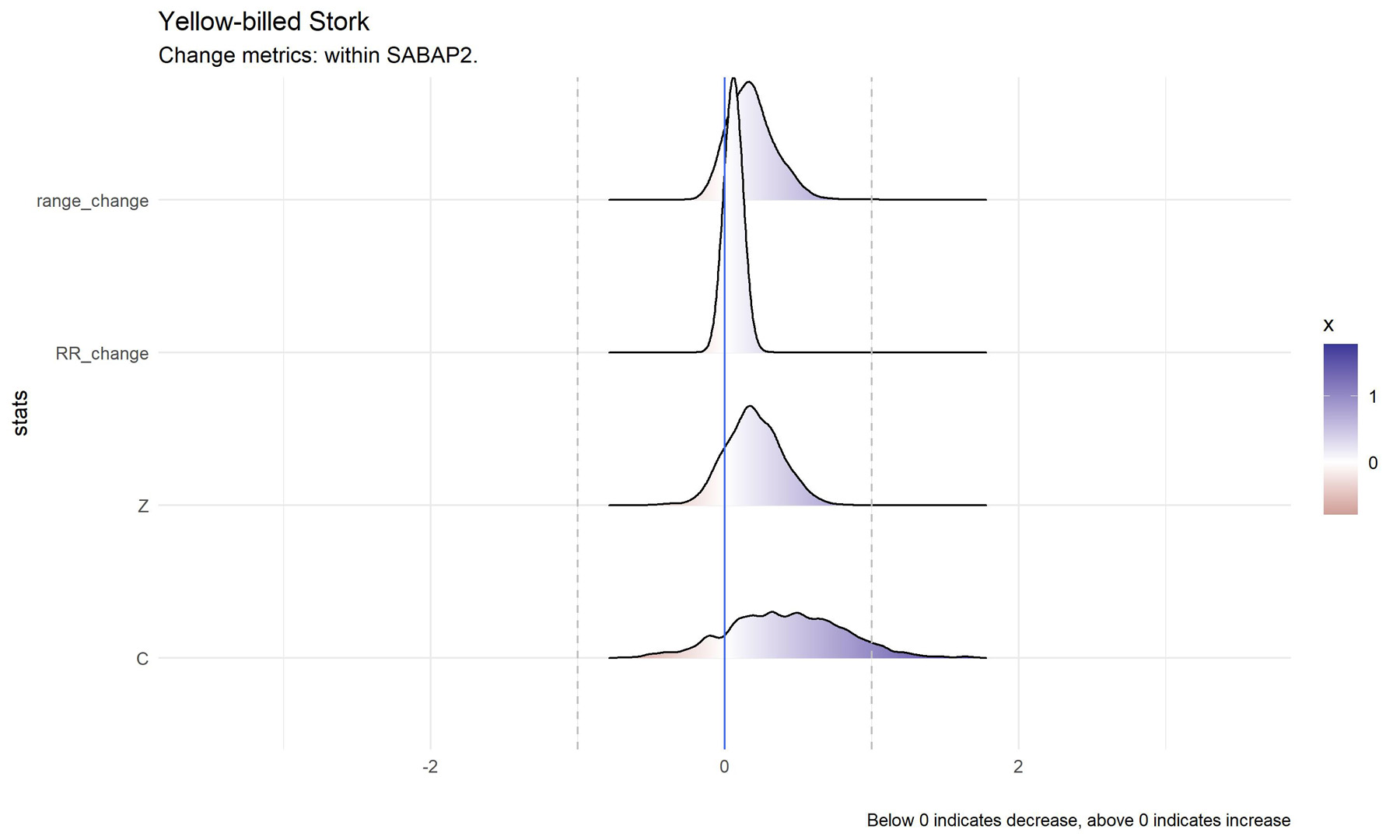
Figure 2: Bootstrap results of ‘naive’ change metrics (potential confounding variables are not controlled for) for the Yellow-billed Stork from SABAP2 data. Reporting rate and range change are bounded by -1 and 1, and if they are strongly centered on 0, it indicates little change. Map from Lee (2024).
Biology & Ecology
Taxonomy
There are no notable issues.
Identification
97 cm, 2 kg. The sexes are similar in plumage, but the males are larger. The bird’s wing and tail feathers are black. The feathers of the Yellow-billed Stork’s back, wing coverts, breast and belly are white with a pink tinge, and with reddish tips to some. The bird’s bill is bright yellow, is thicker at the base, and is long and slightly decurved. The bird has bare orange-red facial skin. Its legs are dull red. When breeding, the colours of certain features intensify. First-year birds are generally greyish brown with dark brown wings and tails, greyish yellow bills, dull orange faces and greyish legs (del Hoyo et al. 1992, Anderson 2005).
Distribution
The Yellow-billed Stork occurs throughout sub-Saharan Africa and western Madagascar (del Hoyo et al. 1992, Gula et al. 2022, Figure 3). It is thought to have declined substantially in central and western Africa (Gula et al. 2022).
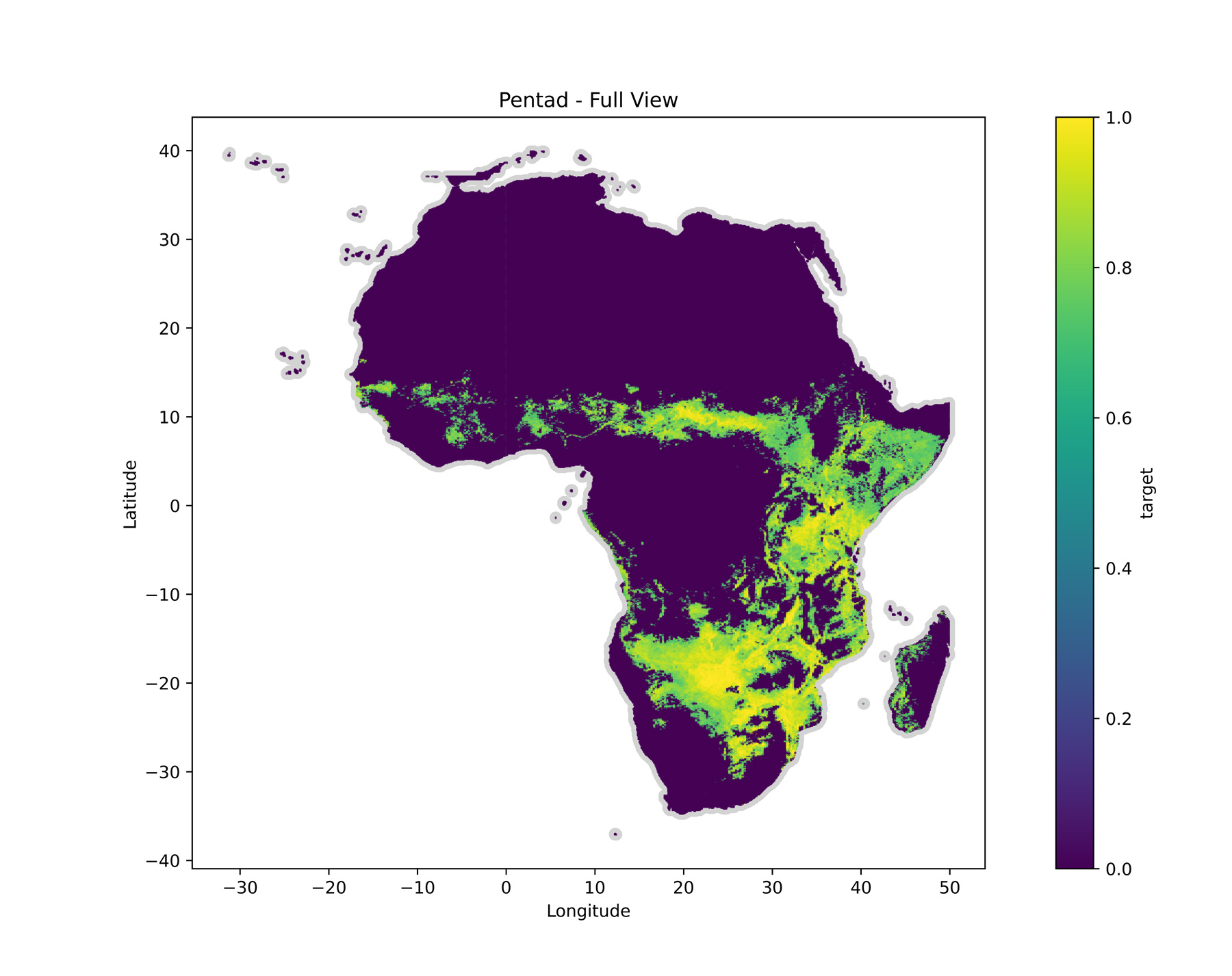
Figure 3: Probability distribution map for Africa of Yellow-billed Stork from iNaturalist, eBird and African Bird Atlas Project (ABAP) data, with high probability of presence in yellow. Map from Lee (2024).
The Yellow-billed Stork is widespread within the region but avoids the arid western areas (del Hoyo et al. 1992, Anderson 1997, Figure 4). The Yellow-billed Stork has been described as ‘facultatively nomadic’ (Hancock et al. 1992) as it follows the drying conditions after rains which results in the concentration of fish and results in them being more easily available to the birds. This behaviour could be responsible for the fluctuation in numbers at the edge of the bird’s range (Johnson 2000).
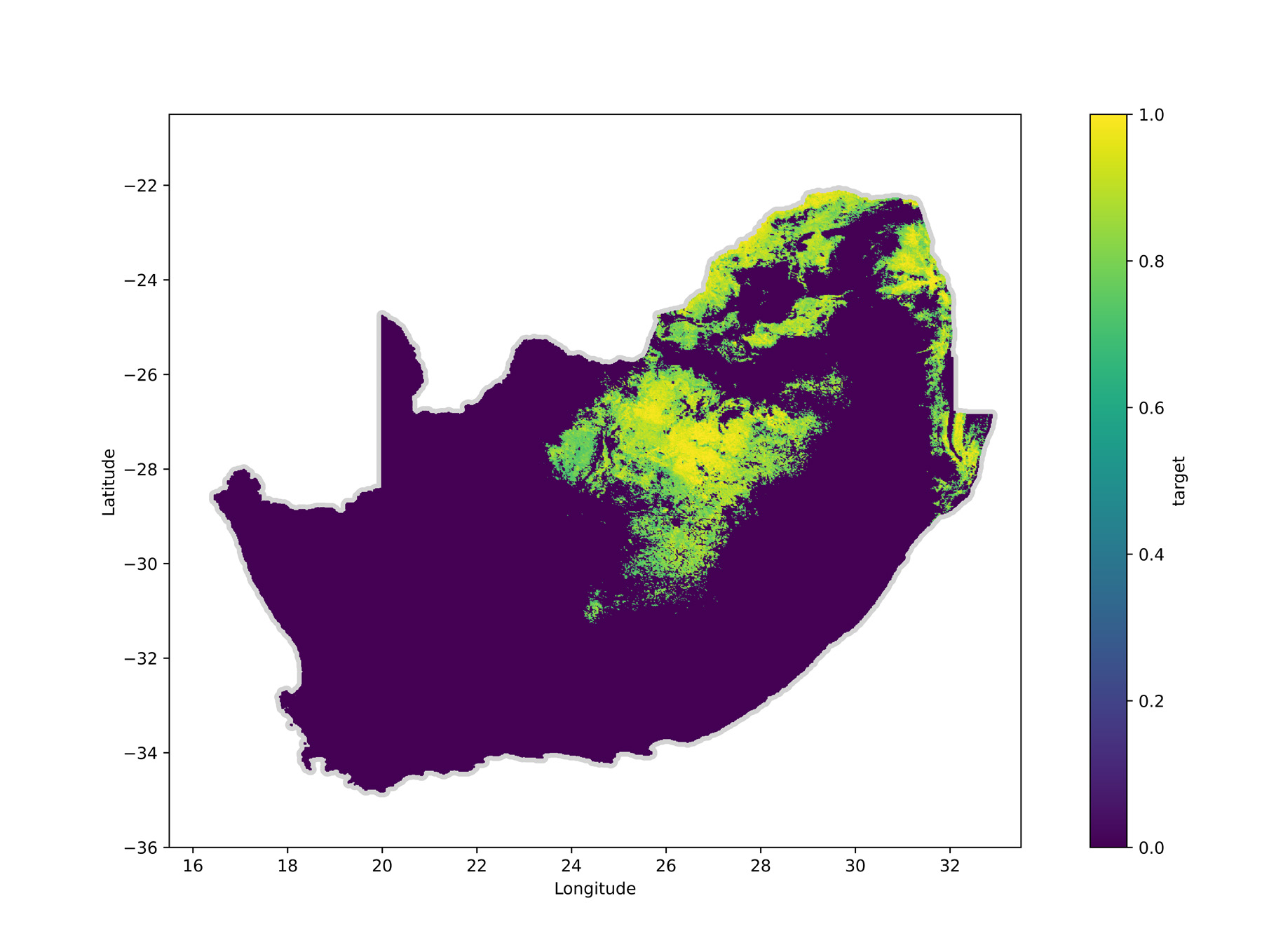
Figure 4: Probability distribution map for Yellow-billed Stork from iNaturalist, eBird and SABAP2 data, with high probability of presence in yellow. Map from Lee (2024).
Within the region, there appears to be both resident and migratory individuals present (Anderson 1997). In the summer, the regional population experiences an influx of migrants from the north during summer (Anderson 1997, Figure 5). Some of these migrants may breed in South Africa (Anderson 1997). Coordinated Waterbird Counts (CWAC) confirm that breeding occurs regularly at Nyamiti Pan in Ndumo Game Reserve (KBA 100882) and Nsumo Pan in Mkuze Game Reserve (KBA 100812) in KwaZulu-Natal (Bowker and Downs 2012). Infrequent breeding has been recorded in the Makuleke Wetlands Ramsar Site (KBA 100795) with 55 and 181 immature birds counted in May 2017 and July 2021, respectively (McKenzie 2022).
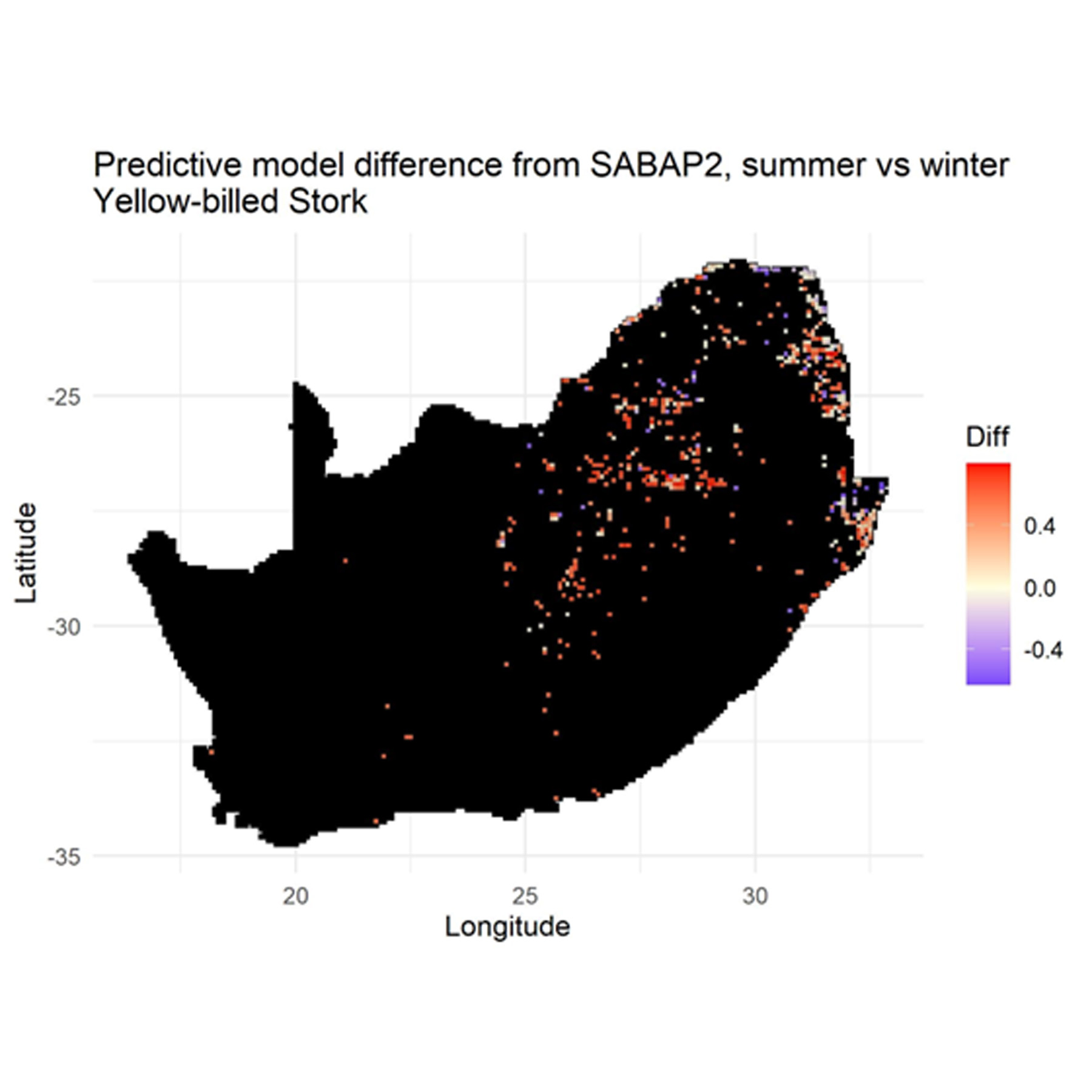
Figure 5: Reporting rate difference in the region for Yellow-billed Stork in the ‘winter period’ (months May-September) and summer (month November-March). Red indicates higher probability of reporting for the ‘summer’ period. Map from Lee (2024).
There are historical breeding records from Pongola Nature Reserve in 1985-1986 (Tarboton et al. 1987) with no suitable nest trees remaining there (Johnson 2000). There are isolated breeding records from Engelhardt Dam, Kruger National Park (Newman 1980) and Nylsvley (Tarboton 1996).
Ecology
Yellow-billed Storks will forage in a wide variety of permanent and seasonal wetland habitats that have open shallow water and are generally free of vegetation (e.g. del Hoyo et al. 1992, Hancock et al. 1992). Food includes frogs, small fish and other small aquatic prey (del Hoyo et al. 1992). This species is usually gregarious (e.g. Tarboton et al. 1987) and is often found with other waterbirds (Anderson 1997). A generation length of 8.4 years is provided by BirdLife International (2016).
Threats & Conservation
Threats
The main threat to the Yellow-billed Stork in the region is thought to be the loss of wetland habitat on which the species depends for foraging. These include pans, marshes and floodplains, which are all threatened habitats (Monadjem et al. 2003, Anderson 2005). In KwaZulu-Natal, flood regimes are determined by water catchment management outside of the reserves (Johnson 2000). The loss of suitable trees in which the birds were nesting in Pongola Nature Reserve resulted in the loss of a breeding colony of around 20 nests in the 1980s (Tarboton et al. 1987).
Conservation Measures Underway
There are no species-specific conservation measures underway within the region although many of the important foraging sites are currently protected. Nyamiti Pan is located in Ndumo Game Reserve (KBA 100882) and Nsumo Pan is situated within the Mkuze section of the iSimangaliso Wetland Park (KBA 100812). The Park is listed as a provincial nature reserve as well as an UNESCO World Heritage Site. Globally, the Yellow-billed Stork is listed on Appendix II of the Bonn Convention. Regionally, it is listed as Near Threatened in Eswatini and is protected under the Eswatini Game Act (1991).
Conservation Measures Proposed
Nesting sites for large, water-associated, colonially nesting birds are crucial for recruitment and maintenance of the population status and conservation of such species (Evans 2015). Maintenance of the Nyamiti Pan and Nsumo Pan sites are essential to retain the Yellow-billed Stork as a regionally breeding species. Monitoring of the Nyamiti Pan and Nsumo Pan colonies, in partnership with relevant stakeholders, needs to be sustained. Reassessment of current and historical breeding sites may suggest possibilities for rehabilitation and re-occupation particularly through the establishment of artificial nesting sites at suitable locations. There has been an increase in the use of urban nesting and roosting sites by Yellow-billed Stork in Kenya (Wachira 2017). Consequently, suitable urban areas need not be excluded from the establishment of artificial nesting sites.
Research Priorities and Questions
- The effects of habitat loss and fragmentation on the relative abundance and conservation of the Yellow-billed Stork should be determined.
- The respective sizes of the regional resident and migratory portions of the regional Yellow-billed Stork population should be determined.
- Incidental breeding or irruptive occurrences, in possible response to the aftermath of rains, needs to be determined to clarify regional movements.
- The requirements of a Yellow-billed Stork breeding colony should be determined and used, where appropriate, to rehabilitate historical breeding colonies and establish new breeding colonies.
- Dedicated surveys should be conducted to determine other sites at which the birds are potentially breeding in the region.
- The suspected movements of individuals between Nsumo Pan and Makuleke Wetlands Ramsar Site (Site No. 1687) to neighbouring countries (e.g. Lake Urema, Mozambique) need to be confirmed.
- The effects of environmental conditions on the dynamics of the Nyamiti Pan, Nsumo Pan and Makuleke Wetlands Ramsar Site colonies need to be investigated.
- A Population Viability Analysis (PVA) and Biodiversity Management Plan (BMP) should be completed for the Yellow-billed Stork.
Contributors & References
Assessor/s
Steven W. Evans
Reviewer/s
Meyrick Bowker
References
Anderson MD. 1997. Yellow-billed Stork. In: Harrison JA, Allan DG, Underhill LG, Herrmans M, Tree AJ, Parker V, Brown CJ (eds), The Atlas of Southern African Birds. Vol 1. Johannesburg, South Africa: BirdLife South Africa. pp 100–101.
Anderson MD. 2005. Yellow-billed Stork. In: Hockey PAR, Dean WRJ, Ryan PG. Roberts birds of southern Africa 7th Edn. The Trustees of the John Voelcker Bird Book Fund, Cape Town. pp 617–618.
BirdLife International. 2016. Mycteria ibis. The IUCN Red List of Threatened Species 2016: e.T22697654A93628112. https://dx.doi.org/10.2305/IUCN.UK.2016-3.RLTS.T22697654A93628112.en. [Accessed on 22 April 2025].
Bowker MB, Downs CT. 2012. Breeding of Large, Water-Associated, Colonially Nesting Birds of the North-Eastern Region of KwaZulu-Natal, South Africa. Waterbirds 35(2): 270– 291.
del Hoyo J, Elliot A, Sargatal J. 1992. Handbook of the Birds of the World, Volume 1. Ostrich to Ducks. Barcelona: Lynx Editions.
Dodman T. 2006. Status, estimates and trends of waterbird populations in Africa. Dakar: Wetlands International.
Dodman T. 2014. Status, Estimates and Trends of Waterbird Populations in Africa: AEWA-listed African populations. Wetlands International. (CSR6 African populations).
Evans SW. 2015. Yellow-billed Stork Mycteria ibis. In: Taylor MR, Peacock F, Wanless RM (eds), The Eskom Red Data Book of Birds of South Africa, Lesotho and Swaziland. Johannesburg, South Africa: BirdLife South Africa. pp 162–163.
Gula J, Green MC, Fritts S, Dean WRJ, Sunder KSG. 2022. Assessments of range-wide distribution of six African storks and their relationships with protected areas. Ostrich 93(1): 34–52.
Hancock JA, Kushlan JA, Kahl MP. 1992. Storks, ibises and spoonbills of the world. London: Academic Press.
Johnson DN. 2000. Yellow-billed Stork Mycteria ibis. In: Barnes KN (ed), The Eskom Red Data Book of birds of South Africa, Lesotho and Swaziland. Johannesburg: BirdLife South Africa. pp 137–138.
Lee ATK. 2024. Regional Red Data Book of the Birds of South Africa, Lesotho and Eswatini: SABAP2 synthesis and supporting information and graphics for Yellow-billed Stork. Unpublished report. Johannesburg: BirdLife South Africa.
McKenzie D. 2022. The Importance of the Makuleke Wetlands Ramsar Site as an Important Breeding Locality for Yellow-billed Stork Mycteria ibis. Afrotropical Bird Biology 2. DOI: https://doi.org/10.15641/abb.v2i.1249
Monadjem A, Boycott RC, Parker V, Culverwell J. 2003. Threatened Vertebrates of Swaziland. Swaziland Red Data Book: Fish, Amphibians, Reptiles, Birds and Mammals. Mbabane, Swaziland: Ministry of Tourism, Environment and Communications,
Nagy S, Langendoen T. 2018. Report on the Conservation Status of Migratory Waterbirds in the Agreement Area. 7th ed. (AEWA). Durban, South Africa: Wetlands International, 7th Session of the Meeting of the Parties to the Agreement on the Conservation of African-Eurasian Migratory Waterbirds. pp 77.
Newman K. 1980. Birds of Southern Africa. 1. Kruger National Park: A Comprehensive Checklist. South Africa: Macmillan.
Parker V. 1994. Swaziland bird atlas 1985-1991. Mbabane, Swaziland: Websters.
Stalmans M, Davies GBP, Trollip J, Poole G. 2014. A Major Waterbird Breeding Colony at Lake Urema, Gorongosa National Park, Mozambique. Durban Natural Science Museum Novitates 37: 54–57
Tarboton WR, Kemp MI, Kemp AC. 1987. Birds of the Transvaal. Pretoria: Transvaal Museum.
Tarboton WR. 1996. A new breeding species for Nylsvley. Africa – Birds and Birding 1: 11.
Wachira W. 2017. Notes on the increasing use of urban nesting and roosting sites in Kenya: a nesting site for Yellow-billed Storks Mycteria ibis and Pink-backed Pelicans Pelecanus rufescens in Naivasha. Scopus: Journal of East African Ornithology 37(1): 24–27.
Citation
Evans SW 2025. Yellow-billed Stork. In: Lee ATK, Rose S, Banda S, Bezeng SB, Maphalala MI, Maphisa DH, Smit-Robinson H (eds), The 2025 Red Data Book of Birds of South Africa, Lesotho and Eswatini. Johannesburg, South Africa: BirdLife South Africa. Available at: https://www.birdlife.org.za/red-list/yellow-billed-stork/
Our generous sponsors


