


Yellow-billed Egret
Ardea brachyrhyncha

Number Of Mature
Individuals (Regional)
1 386 – 5 536

Regional
Population Trend
Decreasing
2025
Regional Category
Near Threatened
Search by species
CONTENTSOverview
Names
| IOC English Name: | Yellow-billed Egret |
| SA & IOC Scientific Name: | Ardea brachyrhyncha |
| BirdLife International Taxonomy (scientific name): | Ardea brachyrhyncha |
| Order: | PELECANIFORMES |
| Family: | Ardeidae |
| Species name author: | Brehm 1854 |
| Afrikaans: | Geelbekwitreier |
| Sesotho (South Africa): | |
| Sesotho (Lesotho): | |
| Siswati: | |
| Zulu: | umanyatheludaka |
Current Assessment Status
| 2025 Regional Status [Criteria] | NTo |
| 2024 Global Status [Criteria] | LC (BirdLife International 2024) |
| Population size (Regional) | 1386 – 5536 |
| Population size (Global) | 16 700 – 66 700 (BirdLife International 2024) |
| Distribution size (EOO) (Regional) km2 | 1 412 042 (Lee 2024) |
| Distribution size (EOO) (Global) km2 | 25 500 000 (BirdLife International 2024) |
| Distribution size (AOO) (Regional) km2 | 170 325 (BIRDIE 2024) |
| Generation time | 5.4 years (BirdLife International 2024) |
| Status change reason | No change |
| Migrant (in the region) | No |
| Regional endemic | No |
Historic Listing Information
|
2000 Regional Status |
Not Evaluated |
|
2015 Regional Status |
Not Evaluated |
|
Status change reason (if applicable) |
Not applicable |
|
2015 Population size (Regional) |
Unknown |
|
2015 Global Status |
LC |
Reason for Inclusion
Reason for Inclusion in the Assessment
This species was not previously formally assessed regionally, and was presumed to be Least Concern. Preliminary screening of Coordinated Waterbird Counts (CWAC) data indicated a significant decline in the number of Yellow-billed Egret Ardea brachyrhyncha counted per year (Lee 2024).
Category Justification
Category Justification
The regional population of the Yellow-billed Egret has a large regional Extent of Occurrence (EOO) of 1 412 042 km² and Area of Occupancy (AOO) of 170 325 km², which do not approach the thresholds for threatened categories under Criterion B (Lee 2024). The Southern African Bird Atlas Project (SABAP2) trend analysis shows a significantly lower probability of reporting, but the confidence in this trend is low (Lee 2024). The predicted range change suggests a 9.10% decrease over 10 years or three generations, which does not meet the threshold for a threatened category under Criterion A2. However, given the population is likely 10% over three generations, this satisfies Criterion C1 Vulnerable. However, given an increasing global population and uncertainty in the data quality, the Near Threatened category is recommended.
Population Justification
The global population is 16 700 – 66 700 (BirdLife International 2024). The South Africa, Lesotho and Eswatini region hosts 8.3% of the modelled range at the pentad level (Lee 2024). This suggests the regional population is 1386 – 5536 assuming even distribution across the species range. Cross checking with CWAC data, the highest count is 210 from Nylsvlei, a minimum overall population of approximately 1216 individuals across surveyed sites based on the mean across counted sites where the species occurs, with a maximum of 2858 individuals from cumulative site maxima. These estimates are likely underestimates due to incomplete survey coverage across all potential locations, but these do not exceed the population estimate derived from extrapolation of range and global population estimates. As such, we can be confident the regional population is <10 000.
Historical data that exists for Yellow-billed Egret indicate that in 1995-1996 they were absent in two largest mixed heronries in the Free State while in Willem Pretorius Game Reserve there were 6020 occupied nests; Kopij 1997) and Sandveld Game Reserve a total of 5690 occupied nests were counted (Kopij and Nuttall 1996). Apparently, it is absent as breeding species in Lesotho, where in 2000-2005 in 14 heronries with more than 3000 nests of various species, no Yellow-billed Egret nests were recorded (Kopij 2008).
Trend Justification
The global population is believed to be increasing (BirdLife International 2024). The regional population trend appears to be in decline. SABAP2 data analysis shows a significantly lower probability of reporting, but with low confidence (Lee 2024). The predicted range change suggests a 9.10% decrease over 10 years or three generations (Table 1, Lee 2024). CWAC data indicates a moderate decline, with an estimated 20% decrease in individuals counted per year from 2007 to 2023 (three generations), though the confidence interval (-39% to +2.6%) suggests uncertainty in the trend (Figure 1, Lee 2024). Taken together, a 10% decline over three generations is likely, satisfying Criterion C1 for Vulnerable, given the population is likely <10 000. However, given the likelihood of a rescue effect from outside of the region, a category adjustment to Near Threatened is justified.
Table 1: Prediction range change in AOO during the early (2007-2015) and late (2016-2023) SABAP2 periods for Yellow-billed Egret (from Lee 2024).
|
Information |
|
|
Pentads 2015 |
3615 |
|
Pentads 2023 |
3315 |
|
Annual rate of change |
0.989 |
|
Percent change (10 years or 3 generations) |
-9.10% |
|
Category (A2) |
LC |
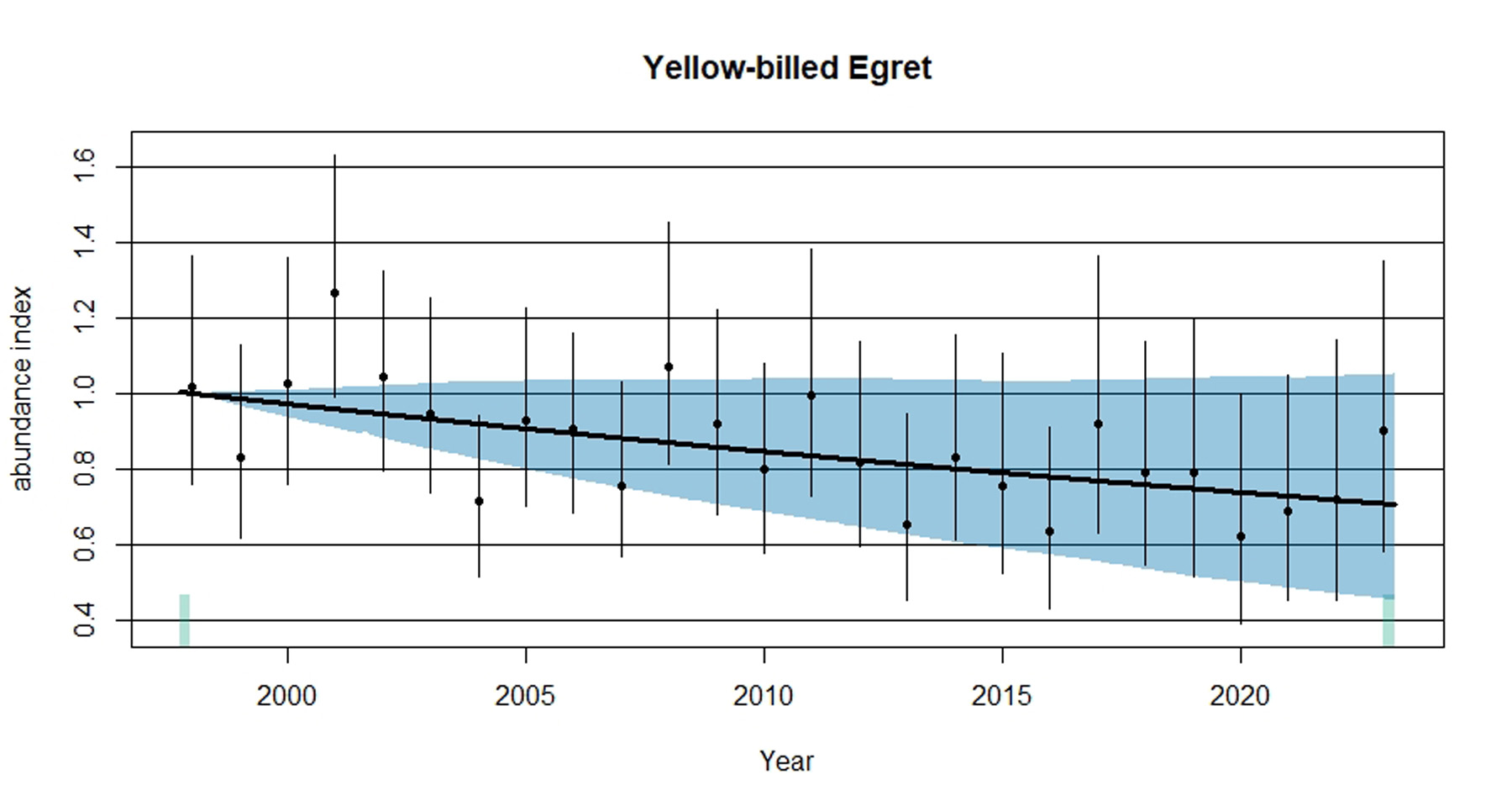
Figure 1: The Coordinated Waterbird Counts (CWAC) trends for Yellow-billed Egret, illustrated with a GAM model with a smooth temporal random effect fitted to assess trends across locations and seasons. The estimated percent change from 2007 to 2023 indicates a 20% decline in the population, though with wide confidence intervals ranging from -39% to +2.6%.
Biology & Ecology
Taxonomy
Yellow-billed Egret (del Hoyo et al. 2014) was previously placed in the genus Mesophoyx and lumped as M. intermedia with A. intermedia and A. plumifera following Sibley and Monroe (1990, 1993) (BirdLife International 2024).
Identification
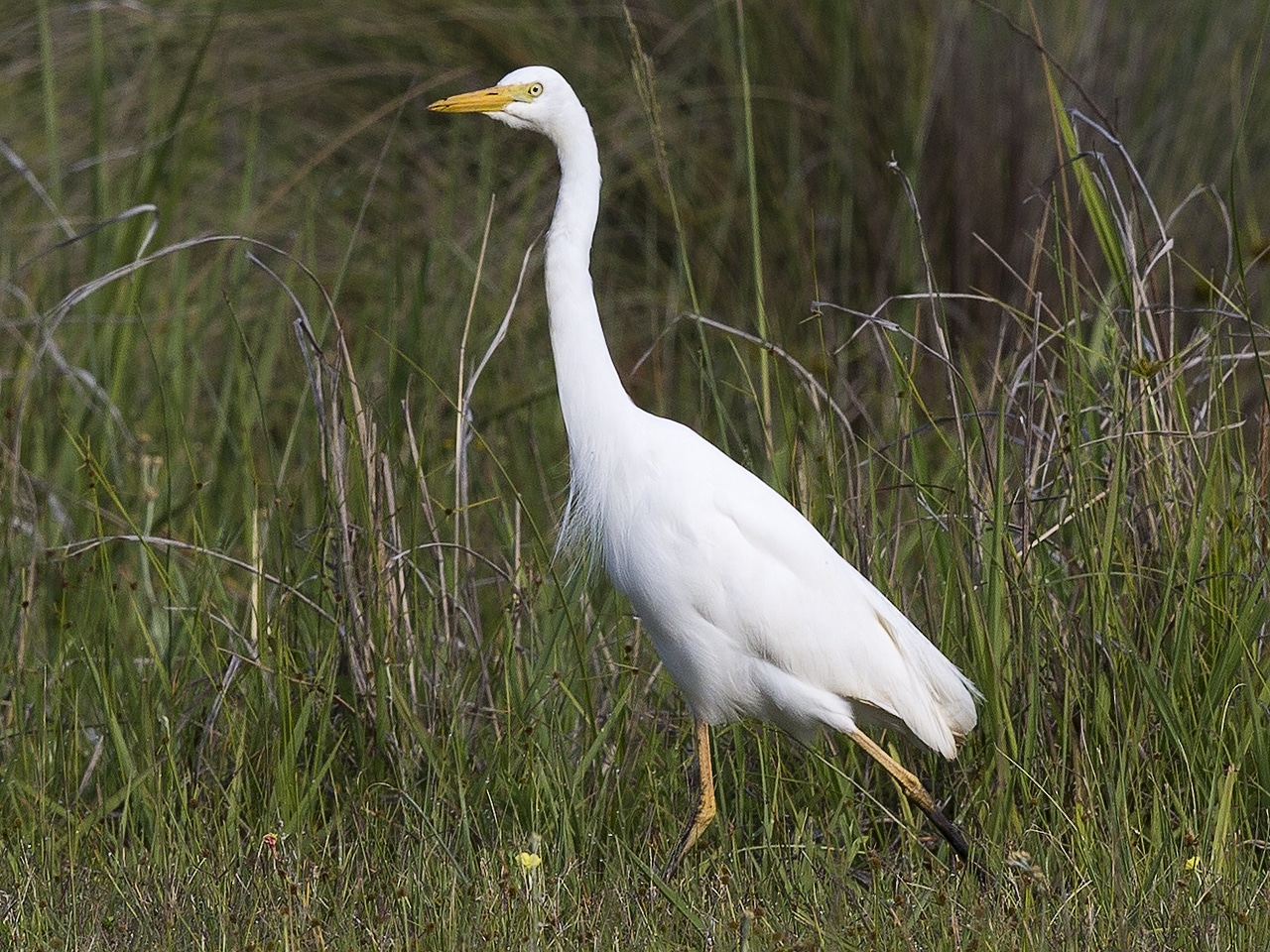
69 cm, male 460 g, female 370 g. Sexes are alike in plumage colouration. The breeding plumage is entirely white; adults have a moderate crest during breeding. Elongated scapular feathers (aigrettes) extend beyond the tail. The bill is red, tipped orange. The eyes are bright red, with a green eye ring and lores. Legs above tarsal joint are crimson, and the lower legs and feet are black.
In non- breeding adults the bill is yellow to yellow-orange, with yellow lores. The eyes and eye ring are yellow. The legs above tarsal joint are yellow, greenish-yellow or occasionally blackish, and the lower legs and feet are black.
Juvenile: as non-breeding adult (Louw 2005).
Distribution
In South Africa, it is widely distributed across various wetland habitats, with a higher concentration in the central-eastern and northern parts of the region (Figure 2, Lee 2024).
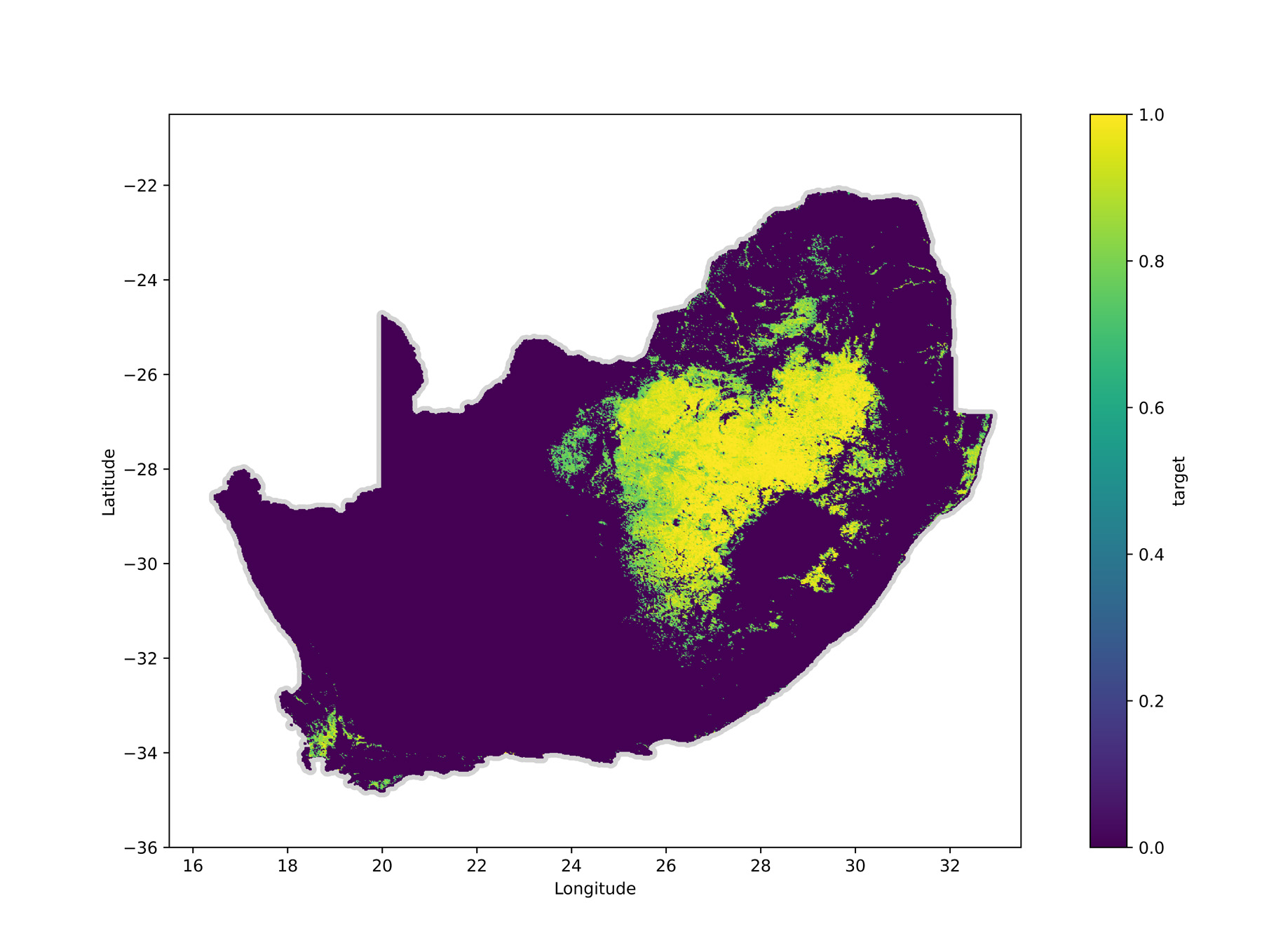
Figure 2: Probability distribution map of Yellow-billed Egret at the 2×2 km resolution, with high probability of presence as yellow (Lee 2024).
Ecology
Habitat:
Inhabits various wetland habitats, including permanent and seasonal freshwater marshes, rivers, lakes, and flooded grasslands. It also frequents coastal lagoons, mangrove swamps, and artificial wetlands such as reservoirs and sewage farms (BirdLife International 2024).
Migration:
Considered non-migratory in the region but ecology is poorly known. There are strong seasonal patterns in reporting from most provinces, being higher in summer and this is also seen with modelled spatial distribution patterns (Figure 3, Lee 2024).
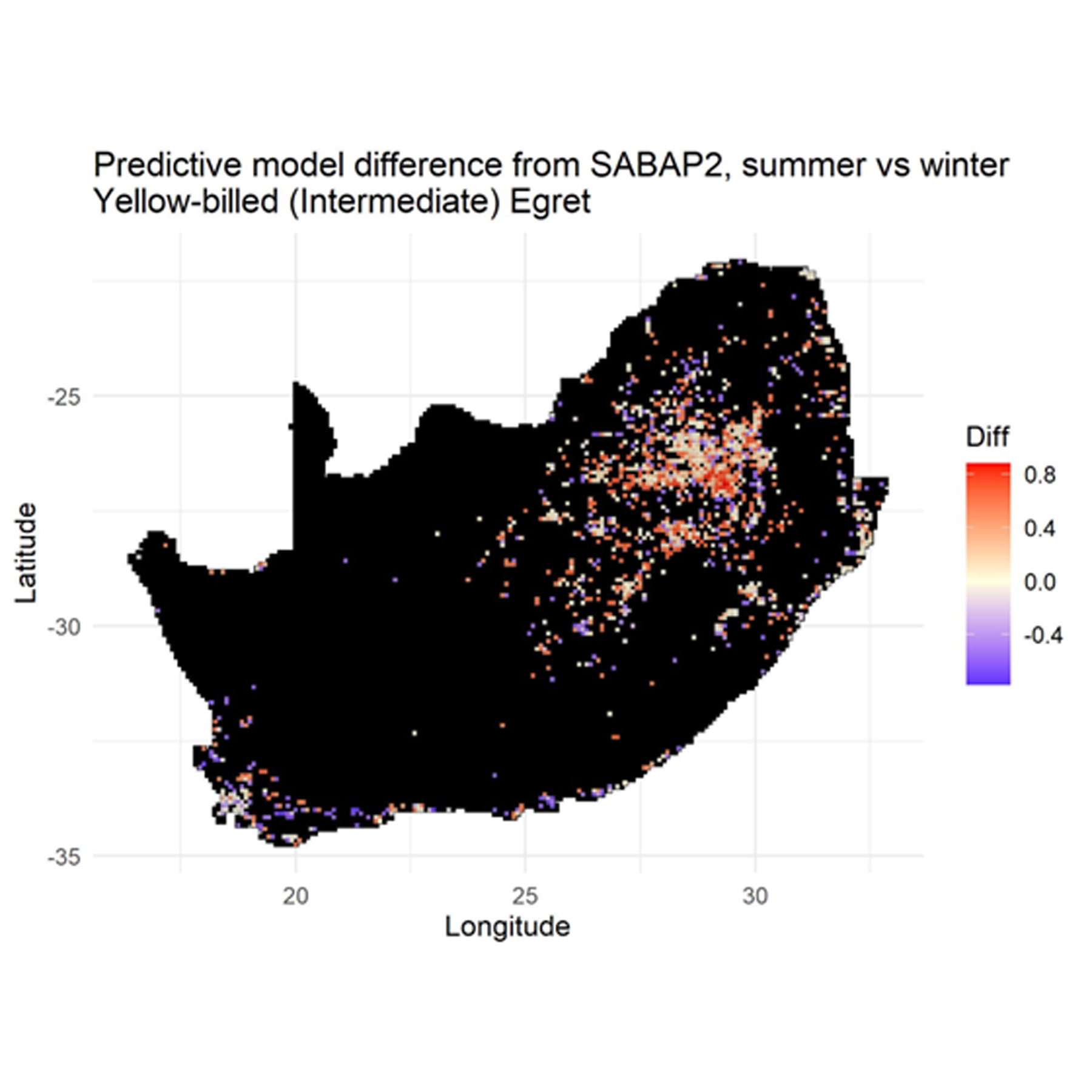
Figure 3: Modelled difference in abundance between the ‘winter’ (May – September) and ‘summer’ (November – March) periods. Red indicates higher probability of reporting for the ‘summer’ period. With the exception of the Western Cape, there is higher probability of reporting this species over summer.
Breeding:
Breeding typically occurs during the rainy season. The species often nests in mixed-species colonies, building platform nests in trees or reeds near water bodies (Louw 2005).
Diet:
Feeds primarily on fish, amphibians, and aquatic invertebrates, which it catches by standing still or walking slowly through shallow water (Louw 2005).
Threats & Conservation
Threats
- Habitat loss and degradation due to drainage of wetlands for agriculture and development (BirdLife International 2024).
- Pollution of wetlands from agricultural runoff and industrial effluents (BirdLife International 2024).
- Disturbance at breeding colonies by humans and introduced and indigenous predators (Louw 2005).
- Climate change, which may alter wetland habitats and water availability (BirdLife International 2024).
Conservation Measures Underway
No species-specific conservation measures are known to be in place. The species occurs in certain protected areas within its range, with 227 pentads in National Parks or Nature Reserves and 143 pentads in other protected areas but yielding a low protected area ratio of 0.3 (Lee 2024).
Conservation Measures Proposed
- Protect and manage key wetland habitats, particularly those important for breeding.
- Monitor and mitigate the impacts of pollution on wetland habitats.
- Raise awareness about the ecological importance of wetlands and their associated species.
- Include the species in waterbird monitoring programs to better track population trends.
Research Priorities and Questions
- Determine the population size and trends for the region.
- Investigate the reasons for the apparent decline in reporting rates and CWAC counts.
- Elucidate human influence on disturbance of breeding success.
- Assess the impacts of habitat loss, degradation, and pollution on regional populations.
- Investigate the potential impacts of climate change on the species’ distribution and abundance in Southern Africa.
- Examine the species’ movement patterns and habitat use in response to changing environmental conditions.
Contributors & References
Assessor/s
David Ehlers Smith
Reviewer/s
Jonah Gula, Grzegorz Kopij
References
BIRDIE. 2024. An online platform for African wetland and waterbird data. Available at https://biodiversityadvisor.sanbi.org/contentmanagement/index?guid=42305260-12b0-4a92-912e-7d801d15fdac [Accessed 30 September 2024].
BirdLife International. 2024. Ardea brachyrhyncha (amended version of 2016 assessment). The IUCN Red List of Threatened Species 2017: e.T22727677A111868830. Available at https://dx.doi.org/10.2305/IUCN.UK.2017-1.RLTS.T22727677A111868830.en.
del Hoyo J, Collar NJ, Christie DA, Elliott A, Fishpool LDC. 2014. HBW and BirdLife International Illustrated Checklist of the Birds of the World, vol. 1: Non-passerines. Barcelona, Spain and Cambridge, UK: Lynx Edicions & BirdLife International.
Kopij G. 1997. Quantitative studies on birds in the Willem Pretorius Game Reserve. Mirafra 14: 17–21.
Kopij G, Nuttall RJ. 1996. Heronries at Sandveld Nature Reserve. Mirafra 13: 11–19.
Kopij G. 2008. Range and population expansion of the Cattle Egret Bubulcus ibis in Lesotho. Ostrich 79: 245–248.
Lee ATK. 2024. Regional Red Data Book of the Birds of South Africa, Lesotho and Eswatini: SABAP2 synthesis and supporting information and graphics for Yellow-billed (Intermediate) Egret. Unpublished report. Johannesburg: BirdLife South Africa.
Louw K. 2005. Yellow-billed Egret Ardea brachyrhyncha. In: Hockey PAR, Dean WRJ, Ryan PG (eds), Roberts birds of southern Africa (7th Edn). Cape Town: Trustees of the John Voelcker Bird Book Fund.
Sibley CG, Monroe BL. 1990. Distribution and Taxonomy of Birds of the World. New Haven, USA: Yale University Press.
Sibley CG, Monroe BL. 1993. A Supplement to “Distribution and Taxonomy of Birds of the World.” New Haven, USA: Yale University Press.
Citation
Ehlers Smith DA 2025. Yellow-billed Egret. In: Lee ATK, Rose S, Banda S, Bezeng SB, Maphalala MI, Maphisa DH, Smit-Robinson H (eds), The 2025 Red Data Book of Birds of South Africa, Lesotho and Eswatini. Johannesburg, South Africa: BirdLife South Africa. Available at: https://www.birdlife.org.za/red-list/yellow-billed-egret/
Our generous sponsors


