


White-fronted Plover
Anarhynchus marginatus

Number Of Mature
Individuals (Regional)
6 700

Regional
Population Trend
Decreasing
2025
Regional Category
Least Concern
Search by species
CONTENTSOverview
Names
|
IOC English Name: |
White-fronted Plover |
|
SA & IOC Scientific Name: |
Charadrius marginatus |
|
BirdLife International Taxonomy (scientific name): |
Charadrius marginatus |
|
Order: |
CHARADRIIFORMES |
|
Family: |
Charadriidae |
|
Species name author: |
Vieillot 1818 |
|
Afrikaans: |
Vaalstrandkiewiet |
|
Sesotho (South Africa): |
patapeta– tshwinyana |
|
Sesotho (Lesotho): |
patapeta– toinyana |
|
Siswati: |
|
|
Zulu: |
umathantatha |
Current Assessment Status
|
2025 Regional Category [Criteria] |
LC |
|
2024 Global Category [Criteria] |
LC (BirdLife International 2024) |
|
Population size (Regional) |
3829 – 5581 |
|
Population size (Global) |
66 000 – 90 000 (Wiersma et al. 2023) |
|
Distribution size (EOO) (Regional) km2 |
1 417 943 (Lee 2024) |
|
Distribution size (EOO) (Global) km2 |
25 800 000 (BirdLife International 2024) |
|
Distribution size (AOO) (Regional) km2 |
22 556 (Lee 2024) |
|
Generation time |
5.2 years (BirdLife International 2024) |
|
Status change reason |
No change |
|
Migrant (in the region) |
Coastal subspecies sedentary Inland subspecies local migrant |
|
Regional endemic |
No |
Historic Listing Information
|
2000 Regional Status |
Not Evaluated |
|
2015 Regional Status |
Not Evaluated |
|
Status change reason (if applicable) |
Not applicable |
|
2015 Population size (Regional) |
Unknown |
|
2015 Global Status |
LC |
Reason for Inclusion
Reason for Inclusion in the Assessment
White-fronted Plover Charadrius marginatus was not previously assessed and thus presumed to be Least Concern. Preliminary screening of Coordinated Waterbird Counts (CWAC) data totals flagged this species as declining (Lee 2024).
Category Justification
Category Justification
White-fronted Plover occurs along the entire South African coastline and are relatively common in the region. There is some evidence of decline from the second Southern African Bird Atlas Project (SABAP2) data in the past three generations, as well as a decline in the number of birds counted annually during CWAC (Lee 2024) but these rates of declines are small (2.4 and 1.4% respectively) and do not yet meet the threshold for Vulnerable.
No recent regional population estimate exists. An estimate from 1987 puts the population size at approximately 7000 mature individuals (Summers et al. 1987). It is unlikely that the current population has increased significantly, and it is therefore assumed that the regional population still numbers 10% in ten years or three generations, or with a specified population structure).
At present monitoring data for White-fronted Plover suggests that the population is declining at a very low rate and consequently this species is assessed as regionally Least Concern. It is important to note however that the regional population very likely still numbers less than 10 000 mature individuals. It is very important therefore that ongoing conservation measures and monitoring continue to detect any future increases in the rate of decline.
Population Justification
Wiersma et al. (2023) indicated the estimated early 2000 global population to be 66 000 – 90 000 individuals (c. 44 000 – 60 000 mature individuals). Global population sizes per subspecies are:
- C. m. marginatus (Central Namibia to Cape Agulhas: 18 000 individuals (c. 12 000 mature individuals)
- C. m. arenaceus (Southern Mozambique to Cape Agulhas): 8000 – 12 000 (c. 5300 –8000 mature individuals)
- C. m. arenaceus (West Africa to Central African Republic): 10 000 – 15 000 (c. 6700 – 10 000 mature individuals)
- C. m. mechowi (inland eastern and central Africa): 10 000 – 15 000 (c. 6700 – 10 000 mature individuals)
- C. m. mechowi (coastal eastern Africa): 15 000 – 25 000 (c. 10 000 – 17 000 mature individuals)
The population of White-fronted Plovers within the region consists of three subspecies:
- C. m. marginatus (Orange River to Cape Agulhas)
- C. m. arenaceus (Cape Agulhas to South Africa/Mozambique border)
- C. m. mechowi (inland along the larger rivers in the Lowveld and occasionally on the edges of larger pans and dams on the Highveld).
There are no recent estimates for the regional population. Tarboton et al. (1987) indicates that for C. m. mechowi most records are from the larger rivers in the Kruger National Park, where flocks of up to 38 are recorded. It is probable that the numbers of this subspecies are very low and would not contribute much to the regional population. Summers et al. (1987) estimated the South African coastal population of White-fronted Plovers to be 10 635 individuals (c. 7000 mature individuals). This number included individuals on coastal wetlands and islands. These estimates are based on data from earlier surveys (e.g. Summers et al. 1977, Underhill et al. 1980 and Ryan et al. 1986 and others) and are outdated. The region holds a modelled 6.7% of the African range (Lee 2024). By extrapolation to the global population estimate of 57 300 – 83 300 (BirdLife International 2024) provides a regional population estimate of 3829 – 5581 mature individuals.
There is evidence that the White-fronted Plover has undergone declines (see below), so it seems reasonable that the regional population is less than 10 000 mature individuals. Confidence in the size of the regional population is low.
Trend Justification
Globally, some White-fronted Plover populations are decreasing, while others are increasing, stable, or have unknown trends, resulting in an overall global status of “Unknown” (BirdLife International 2024). At a regional level, several lines of evidence were examined to assess population trends.
Logistic regression models were used to estimate the probability of recording White-fronted Plover from SABAP2. The assumption is that a higher probability of recording the species reflects higher numbers of birds. A model controlling for factors such as season, BirdLasser effects, completeness of habitat surveys, sampling hours, and random effects (pentad or observer) indicated a stable probability of recording, identified with high confidence (Lee 2024).
A separate analysis of SABAP2 presence–absence data split the records into two periods, 2007–2015 and 2016–2023. Static models predicted a 2.4% decrease in Area of Occupancy (AOO) between these intervals (Lee 2024). The portion of the coastline north of the Olifants River was under-surveyed, likely biasing model outputs, yet this area is also heavily mined. Thus, there is a possibility that mining activity has indeed reduced local populations.
State-space models, applied to counts at 53 wetlands across the region, predicted a 1.4% decline over 15 years (BIRDIE 2024). Meanwhile, Ryan (2012) reported a 40% decline along 278 km of coastline when comparing surveys from 1980/81 to 2010/11, although more recent (2020/21) surveys of these same sections indicated a 43% increase, restoring numbers to near 1980/81 levels. This recovery was least evident on the Cape Peninsula, where the 2020/21 population remained 42% lower than in 1980/81. It is not clear whether these changes reflect true population fluctuations or movements triggered by local environmental conditions.
Overall, none of the estimated declines, except for that reported by Ryan (2012), exceed the thresholds for any of the population criteria. The 40% decrease documented in 2010/11 appears to have reversed in most areas by 2020/21. The current evidence suggests only a small decline in the regional population, although the overall confidence in this finding remains low.
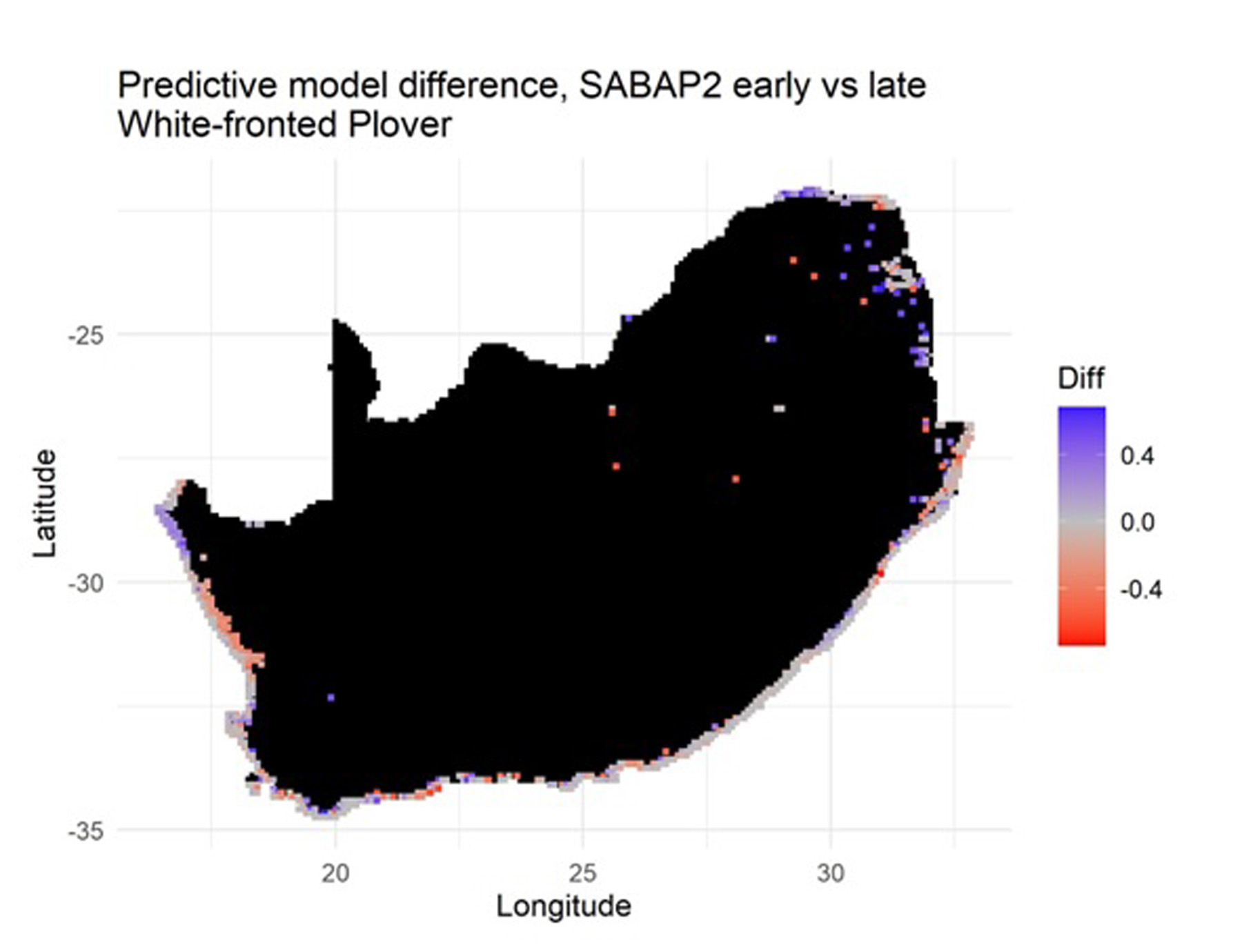
Figure 1: Predictive occurrence model results comparing data from 200– 2015 and 2016-2023. Red indicates a lower probability of recording for the latter period while blue indicates a higher recording (from Lee 2024).
Biology & Ecology
Taxonomy
Wetlands international (2024) recognise eight subspecies but Turpie and Tree (2005) and Wiersma et al. (2023) recognise four subspecies of White-fronted Plover Charadrius marginatus. Support for the four putative subspecies further north is poor and therefore the taxonomy as set out in the publications supporting four subspecies is followed. There is also discrepancy regarding the distribution ranges of the various subspecies. This assessment uses those ranges as described by Turpie and Tree (2005):
C. m. marginatus – West coast from central Namibia south to Cape Agulhas W. Cape, South Africa.
C. m. arenaceous – Southern Mozambique coast south to Cape Agulhas, W. Cape, South Africa.
C. m. mechowi – Africa Inland south of the Sahara to northern Angola, Botswana and Mozambique. Non-breeding visitor to east coast as far south as Cape St Francis Eastern Cape.
C. m. tenellus– Madagascar.
Identification
35–40 cm, 15–50 g. The White-fronted Plover exhibits slight plumage colour differences between sexes. The face is mainly white, with a blackish– brown stripe extending from behind the eye to the ear. The mantle, back, and rump display a light greyish– brown hue, often with pale brown to grey fringed feathers. Black upper covert and central tail feathers contrast with white lateral feathers. Their primaries and secondaries are dark brown with white shafts, bases, and inner webs. White-fronted Plover also sport a pale dusky– brown lateral patch on the upper breast, with white under parts, sometimes featuring a washed chestnut lower breast and upper belly. Their eyes are brown, bills black, and legs pale grey, green– grey, or pale green/olive. Adult females closely resemble males but with a less defined and thinner black crown band, which may even be absent in some cases. Additionally, females have slightly longer wings than males (Turpie and Tree 2005).
Juveniles mirror adult females’ markings but lack the crown band altogether, and their head lores are brown. Also the lateral breast patch varies in extent (Turpie and Tree 2005).
Differences in plumage between the three subspecies are (Chittenden et al. 2012):
C. m. marginatus – upper parts greyer and paler than arenaceus and mechowi
C. m. arenaceus – overall browner than mechowi
C. m. mechowi – paler than arenaceous, darker and browner than marginatus
Distribution
The White-fronted Plover is found in sub– Saharan Africa and occurs from Somalia to South Africa, mainly along the coastlines (Wiersma et al. 2023). In South Africa (Figure 2) the species is present along the entire coast (Turpie and Tree 2005), however, some are also found inland mostly along the large rivers in the Lowveld but also erratically at dams and pans on both the Highveld and Lowveld (Tarboton et al. 1987).
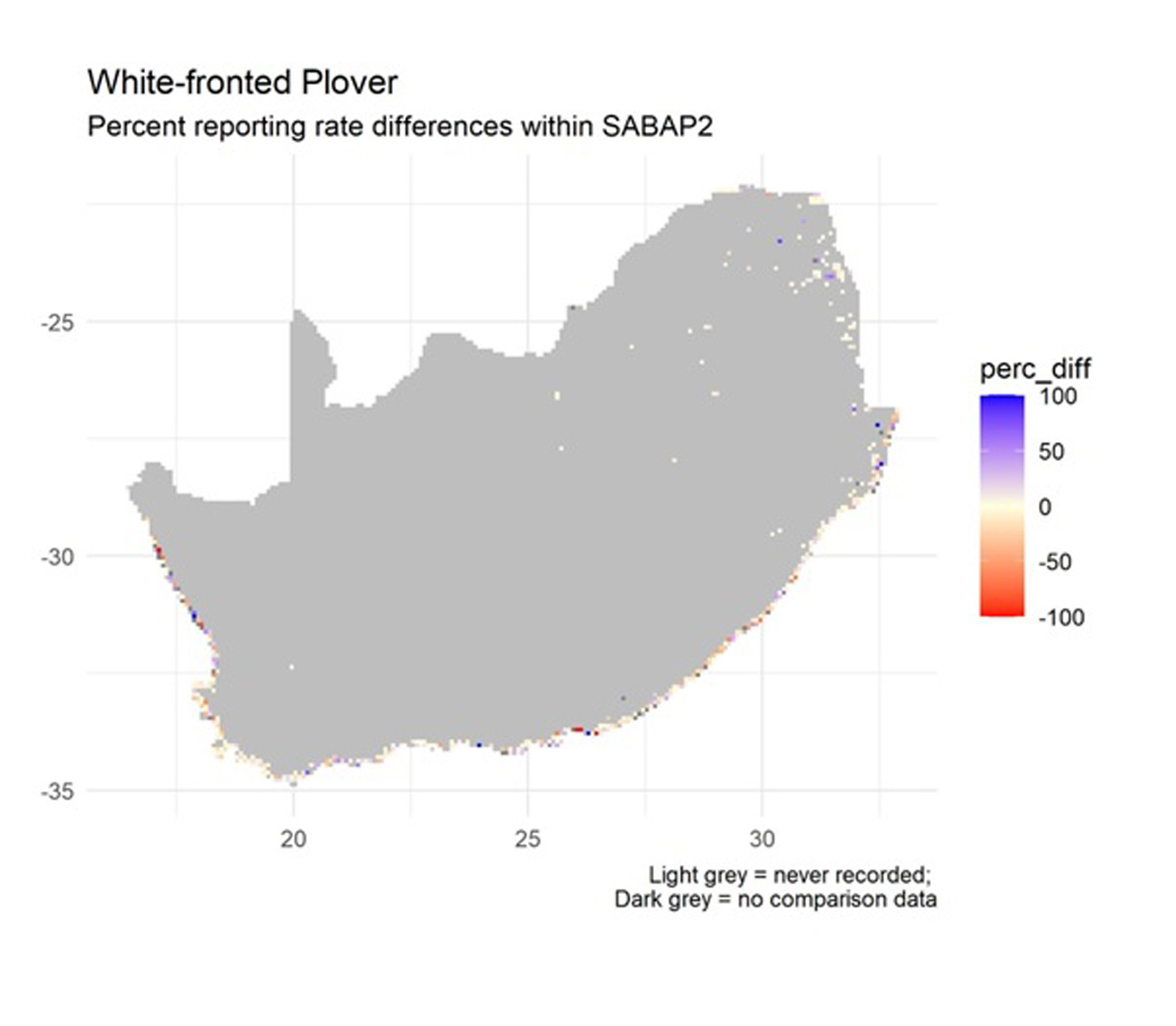
Figure 2: Distribution map of White-fronted Plover also showing pentad level change between SABAP2 periods 2007–2015 and 2016–2023 (from Lee 2024).
Ecology
Habitat:
White-fronted Plover is mainly found on sandy seashores, coastal dunes, rocky shores, coastal and inland mudflats, lagoons, saltpans, estuaries as well as sandy shores of inland rivers and lakes (Turpie and Tree 2005).
Migration:
Coastal subspecies typically remain sedentary but may seek sheltered shores during harsh winters. Inland populations may migrate in response to flooding, with movements mainly occurring from December to May, shifting from inland habitats to Southern Africa’s East coast (Turpie and Tree 2005). Tarboton et al. (1987) indicate inland populations may move to inland dams and pans to breed during drought conditions.
Breeding:
The White-fronted Plover is a monogamous bird and can stay together with their mate for life. They breed year–round along the coast, allowing them to synchronise their reproductive efforts with local environmental conditions and resource availability (Turpie and Tree 2005).
The nest of the White-fronted Plover is a shallow scrape in sandy or gravelly substrates. The nest is constructed by both male and female plovers. The nests are typically placed close to some object that disrupts the background (e.g. beach debris, vegetation), and serve as secure nesting sites where eggs can be incubated and chicks raised (Tarboton 2001). The nest is typically constructed more than 70 m above the high-water mark to minimise the risk of flooding from tides and waves. This elevated positioning offers protection to both eggs and chicks, ensuring their safety throughout the nesting period while offering adults an unrestricted view of the surroundings (Turpie et al 2005).
The female lays 1–3 eggs, usually 2, which are deposited at intervals of 1–4 days (Tarboton 2001). The eggs have a pale cream background adorned with fine blackish– brown points and lines (Turpie and Tree 2005). Incubation of the eggs is a shared responsibility between both male and female plovers and lasts approximately 26– 33 days (Tarboton 2001). After hatching, chicks are capable of feeding themselves shortly after emergence but still rely on their parents for protection and guidance. Adults lead their young to foraging areas which may be located up to 2.2 km from the nest. Chicks remain in the nest area for approximately 35–38 days, after which they fledge (Turpie and Tree 2005).
Diet:
The White-fronted Plover diet consists mainly of insects such as sand flies, grasshoppers, termites, and mosquito pupae. It also consumes fairy shrimp, gastropods, bivalves, isopods, crabs as well as other small crustaceans, isopods and worms (Turpie and Tree 2005).
Threats & Conservation
Threats
C. m. mechowi found along the Lowveld rivers, are threatened by changes in the river flow regime due to dam impoundments, floods and/or droughts. Tarboton et al. (1987) stated that these birds move off to more suitable habitat in surrounding pans and dams when conditions on the rivers become unsatisfactory. Because of this, it is probable that these threats may have a limited impact on this small mobile population. Along the coast the threat of disturbance from humans and dogs using the beaches on all three subspecies is probably the most obvious. Ryan (2012) found that the numbers declined by 72% on open beaches. However, in the same study a 45% decline was observed on protected beaches, indicating other possible unknown threats. Baudains et al. (2007) showed that there was a significant increase in nest mortality over an eight year period along an open access beach due to the increased number of visitors from a nearby expanding town. The same study showed that the birds adapted to disturbance through shorter flight distances and shorter nest exposure times after disturbance than nests in protected areas with significantly less disturbances. Also, it was found that predation on nests was higher on beaches in protected areas than in those on open access areas. This is probably due to fewer predators in disturbed areas and may explain some of the decline observed by Ryan (2012) in protected areas if natural predation was excessive. Climate change will have an impact on the species through the increase in sea level and frequency of large storm events. Large storms along the coastline can have an impact on the species either through the swamping of nests or the destruction of dunes reducing the available breeding habitat. K. Webster (pers comm) indicated that along the south and east coast it can take 2–3 years or longer for ideal nesting habitat to recover after a storm.
Conservation Measures Underway
Very little conservation measures are specifically aimed at this species. There are a number of wetlands which are inhabited by White-fronted Plover that are either in protected areas (e.g. Table Mountain National Park, De Mond Nature Reserve, etc.) or declared Ramsar Sites (West Coast National Park, Berg River). In addition to these wetlands, sections of coastline adjacent to coastal reserves are also protected and while they are visited by people, numbers are far less and no dogs are allowed. Surveys are undertaken for the species, but cover only a small percentage of the coastline and/or coastal wetlands. While wetlands surveys are carried out biannually as part of the CWAC project, coastal surveys where the greatest numbers occur are done at substantially longer intervals. In addition there have been a number of local campaigns sensitising beach goers to the species during the breeding season, which have shown very good results. This is done by sectioning off fore-dune habitat where nest sites are known to occur, erecting informative signboards about shorebirds and allocation of dog zones on beaches.
Conservation Measures Proposed
- Identify key sites for conservation action, including enforcement of dog regulations on beaches.
- Regional population estimates need updating. Certain sections of the coastline have never been surveyed e.g. Section between the Olifants and Orange River along the West Coast. Strong recommendation that a coastal survey be carried out, but in such a way that the results can be analysed per subspecies as well as with past surveys.
- Although the region hosts only a small percentage of the subspecies C. m. mechowi, surveys along the major Lowveld rivers is recommended to gain insight into the size of the regional population.
- Awareness campaigns along beaches experiencing high numbers of visitors and investigate the possibility of zoning beaches, similar to what has been done along sections of the Garden Route (Bitou Municipal area) and East Coast.
Research Priorities and Questions
- The reason for the declines set out in Ryan (2012) is not fully understood nor the subsequent increase observed by the same author (Ryan pers comm) in a survey of the same area in 2020/21. Are these genuine fluctuations in the population or is there movement of birds according to local environmental conditions?
- The high predation rates observed by Baudains et al. (2007) within the Table Mountain National Park needs to be explored further. Is it unique to this protected area, is this a recent phenomenon, can the population sustain such a high mortality rate, etc?
- The importance of the regional population of C. m. marginatus, which occurs along the West Coast of South Africa extending into southern Namibia. No surveys have been done from the Olifants River northwards up till just south of Walvis Bay. It is not known what the size of the Namibian population of this subspecies is, or how many birds occur from the Olifants River north to the Orange River.
Contributors & References
Assessor/s
Kevin Shaw
Reviewer/s
Kayla Webster
References
Baudains TP, Lloyd P. 2007. Habituation and habitat changes can moderate the impacts of human disturbance on shorebird breeding performance. Animal Conservation 10: 400–407.
BIRDIE. 2024. An online platform for African wetland and waterbird data – White-fronted Plover. Available at https://biodiversityadvisor.sanbi.org/contentmanagement/index?guid=42305260-12b0-4a92-912e-7d801d15fdac [Accessed on 28 June 2024].
BirdLife International. 2024. Charadrius marginatus. The IUCN Red List of Threatened Species 2024: e.T22693828A265007237. Available at https://dx.doi.org/10.2305/IUCN.UK.2024-2.RLTS.T22693828A265007237.en [Accessed on 19 November 2024].
Chittenden H, Allan D, Weiersbye I. 2012. Roberts geographic variation of southern African birds. Cape Town: John Voelcker Bird Book Fund.
Lee ATK. 2024. Regional Red Data Book of the Birds of South Africa, Lesotho and Eswatini: SABAP2 synthesis and supporting information and graphics for White-fronted Plover. Unpublished report. Johannesburg: BirdLife South Africa.
Ryan PG, Cooper J, Hockey PAR, Berruti A. 1986. Waders (Charadrii) and other waterbirds on the coast and adjacent wetlands of Natal 1980–81. Lammergeyer 36: 1–33.
Ryan PG. 2012. Medium-term changes in coastal bird communities in the Western Cape, South Africa. Austral Ecology 38(3): 1–9.
Summers RW, Cooper J, Pringle JS. 1977. Distribution and numbers of coastal waders (Charadrii) in the southwestern Cape, South Africa, summer 1975–76. Ostrich 48(3): 85–97.
Summers RW, Underhill LG, Pearson DJ, Scott DA. 1987. Wader migration systems in southern and eastern Africa and western Asia. Wader Study Group Bulletin 49 (Suppl.)/IWRB Special Publication 7: 15–34.
Tarboton WR, Kemp MI, Kemp AC. 1987. Birds of the Transvaal. Pretoria: Transvaal Museum.
Tarboton W. 2001. A guide to the nests & eggs of southern African birds. Cape Town: Struik Publishers.
Turpie JK, Tree AJ. 2005. White-fronted Plover Charadrius marginatus. In: Hockey PAR, Dean WRJ, Ryan PG (eds), Roberts birds of southern Africa (7th Edn). Cape Town: Trustees of the John Voelcker Bird Book Fund. pp 403–404
Underhill LG, Cooper J, Waltner M. 1980. The status of waders (Charadrii) and other birds in the coastal region of the southern and Eastern Cape, summer 1978/79. Western Cape Wader Study Group, Cape Town.
Wetlands International. 2024. Waterbird Populations Portal. Available at https://wpp.wetlands.org/ [Accessed on 25 June 2024].
Wiersma P, Kirwan MG, Boesman PFD. 2023. White-fronted Plover (Anarhynchus marginatus), version 1.2. In: del Hoyo J, Elliott A, Sargatal J, Christie DA, de Juana E (eds), Birds of the World. Ithaca, NY: Cornell Lab of Ornithology. https://doi.org/10.2173/bow.whfplo1.01.2.
Citation
Shaw K 2025. White-fronted Plover. In: Lee ATK, Rose S, Banda S, Bezeng SB, Maphalala MI, Maphisa DH, Smit-Robinson H (eds), The 2025 Red Data Book of Birds of South Africa, Lesotho and Eswatini. Johannesburg, South Africa: BirdLife South Africa. Available at: https://www.birdlife.org.za/red-list/white-fronted-plover/
Our generous sponsors


