


Western Cattle Egret
Ardea ibis

Number Of Mature
Individuals (Regional)
>50 000

Regional
Population Trend
Decreasing
2025
Regional Category
Least Concern
Search by species
CONTENTSOverview
Names
|
IOC English Name: |
Western Cattle Egret |
|
SA and IOC Scientific Name: |
Bubulcus ibis |
|
BirdLife International Taxonomy (scientific name): |
Bubulcus ibis |
|
Order: |
PELECANIFORMES |
|
Family: |
Ardeidae |
|
Species name author: |
Linnaeus 1758 |
|
Afrikaans: |
Veereier |
|
Sesotho (South Africa): |
leholosiane-la-dikgomo |
|
Sesotho (Lesotho): |
leholosiane-la-likhomo |
|
Siswati: |
Lilanda |
|
Zulu: |
ilanda, umlindankomo |
Current Assessment Status
|
2025 Regional Status [Criteria] |
LC |
|
2025 Global Status [Criteria] |
LC (BirdLife International 2019) |
|
Population size (Global) |
4 000 000 – 9 999 999 (BirdLife International 2019) |
|
Population size (Regional) |
>50 000 |
|
Distribution size (EOO) (Regional) km2 |
1 554 942 (Lee 2024) |
|
Distribution size (EOO) (Global) km2 |
394 000 000 (BirdLife International 2019) |
|
Distribution size (AOO) (Regional) km2 |
566 700 (BIRDIE 2024) |
|
Generation time |
8.1 years (BirdLife International 2019) |
|
Status change reason |
No change |
|
Migrant (in the region) |
Resident and Migrant |
|
Regional endemic |
No |
Historic Listing Information
|
2000 Regional Status |
Not Evaluated |
|
2015 Regional Status |
Not Evaluated |
|
Status change reason (if applicable) |
Not Evaluated |
|
2015 Population size (Regional) |
Unknown |
|
2015 Global Status |
LC (BirdLife International 2016) |
Reason for Inclusion
Reason for Inclusion in the Assessment
Preliminary screening of Coordinated Waterbird Counts (CWAC) data indicated a significant decline in number of Western Cattle Egret Bubulcus ibis counted per year (Lee 2024).
Category Justification
Category Justification
Western Cattle Egret have a large and widespread regional population. Although there is evidence of population decline, the rate of decline does not meet the ≥30% threshold under Criterion A. Population size assumed to still exceed 10 000 (Louw 2005). This species appears resilient to changing habitats and anthropomorphic pressure globally and has undertaken massive range expansions in the past several decades (Telfair 2023).
Within Southern Africa, Western Cattle Egret are assumed to occur in large numbers (Louw 2005, BirdLife International 2019). Both Area of Occupancy (AOO) (566 700 km2 BIRDIE 2024) and Extent of Occurence (EOO) (1 554 942 km2, Lee 2024) exceed threat thresholds. Although not considered a migrant species, Western Cattle Egrets can disperse widely tracking food and can disperse several hundred kilometers from the nest territory in the first year (Siegfried 1970, Louw 2005, Kopij 2017, Oschadleus et al. 2019). These factors mean that a rescue effect for this species from outside of the region is very likely should the regional population become very scarce.
Considering the large range of the species (both within and outside the region) and reasonably low rate of decline, the regional population of Western Cattle Egret is assessed as Least Concern.

Figure 1: Modelled results from a predictive occurrence modelling routine using early (data up to and including 2015) and late second Southern African Bird Atlas Project (SABAP2) records. Results are displayed as a heatmap (late minus early), with red indicating lower probability of recording for the more recent period, and blue indicating higher (from Lee 2024).
Population Justification
The global population is estimated to be very large, within a band of 4 000 000 to 10 000 000 individuals (BirdLife International 2019).
The regional population is unknown but assumed to be over 50 000 individuals. In the Free State Province alone, about 12 000 breeding pairs were recorded in six colonies in mid-1990’s (Kopij and Nuttall 1996). If second Southern African Bird Atlas Project (SABAP2) reporting rate is assumed to be a reasonable proxy for abundance, predicted reporting rates at the pentad level using a Random Forest type model can be mapped to give an indication of ‘density’ within a species distribution (Figure 2, Lee 2024). This abundance estimate map for Western Cattle Egret shows high abundance throughout the region (Figure 2, Lee 2024).
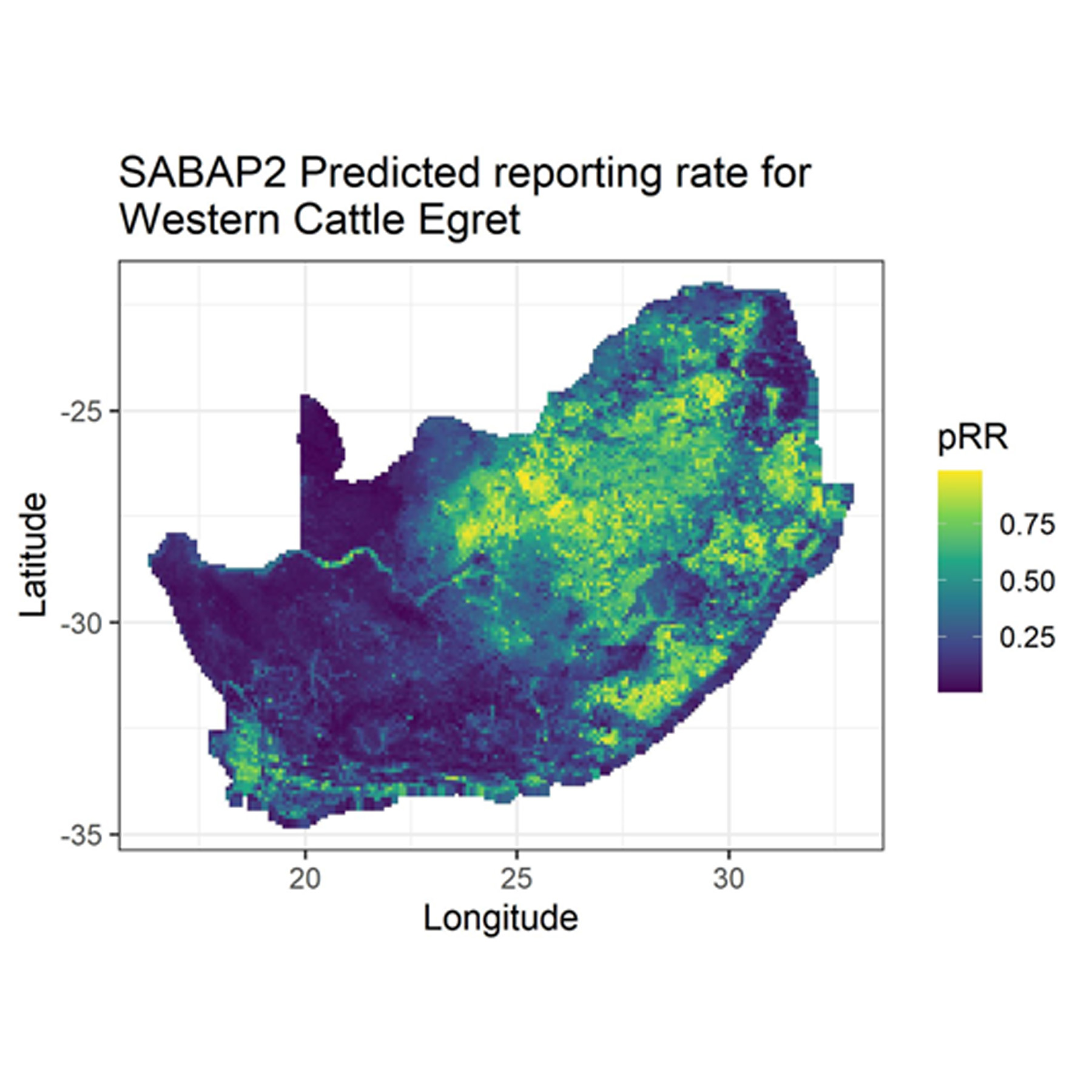
Figure 2: Predicted SABAP2 reporting rates using a Random Forest type model. These predicted reporting rates can be used as a proxy for abundance, giving an indication of ‘density’ within a species distribution (Lee 2024).
Trend Justification
The global population is considered to be increasing (BirdLife International 2016). Regionally, both SABAP2 and CWAC data point to a declining trend. Declines are evident across metrics: both in AOO, reporting rate, total number counted and between SABAP1 and 2. Yet, currently these declines do not meet the threshold for Vulnerable. Confidence in this trend estimate is high. In Lesotho, an increase was recorded from only one heronry with about 50 breeding pairs in 1961-1970, 160– 250 breeding pairs in 1981-1990, about 1200 breeding pairs in seven colonies in 1996-2000 and 2500-3000 breeding pairs in 14 colonies in 2001-2005 (Kopij 2008).
Biology & Ecology
Taxonomy
English name changed to Western Cattle Egret when split from Eastern Cattle Egret B. coromandus (Payne and Risley 1976, McAllan and Bruce 1989, Rasmussen and Anderton 2005). Western and Eastern Cattle Egrets are considered conspecifics by some authorities (Telfair 2023). Occasionally placed in genus Ardeola or Egretta.
Identification
46–54 cm. Sexes are similar however males are larger. This bird has whitish plumage, short neck and is stocky build with a slightly hunched posture (Telfair 2023). During breeding they have elongated orange-buff plumes on their breast, head and lower back (Telfair, 2023, Hockey et al. 2005). Bill is orange/red with red eyes and legs and feet are yellow-green except for when in breeding then bill, legs and irises are red (Telfair 2023, Hockey et al. 2005). Chicks have an entirely white plumage but with black bill and legs and yellow eyes (Telfair 2023, Hockey et al. 2005).
Distribution
Originally native to only Southern Spain and Portugal, tropical Africa and southern and eastern Asia (Brown et al. 1982, del Hoyo et al. 1992, Martin 1997). However, at the end of the 19th century its range expanded, making it a cosmopolitan species. Exists throughout South Africa but sparse in drier regions such as Karoo and Kalahari (Martin 1997).
Ecology
This species is typically found in open grassland and grassy savanna, as well as man-made pastures and agricultural lands located away from water and avoids dense woodland, forest, and desert areas (Hancock and Kushlan 1984, Marchant and Higgins 1990, del Hoyo et al. 1992).
This bird is a partial migrant making long-distance movements (to over 3000 km) in relations to food availability and rainfall (del Hoyo et al. 1992). Birds from the former Transvaal overwinter in central Africa, those from the Western Cape in the eastern coast, and those from KwaZulu-Natal in central and SE Africa (Kopij 2017).
Colonial nester, usually with other waterbird species (Brown et al. 1982, Kopij and Nuttall 1996). Commonly nests in urban areas. Breeding time varies across South Africa. The age of first breeding is 2 years old, but some do breed at 1 year of age (Brown et al. 1982). Lays between 1 and 7 eggs; average clutch size in the Free State 3 eggs (n = 1217 clutches) (Kopij 1996), with incubating lasting for 22 to 26 days with both sexes participating (Brown et al. 1982). Chicks become independent at 45 days (Brown et al. 1982).
Breeding success: In the Western Cape, nests located in the colony center tend to be more successful compared to those on the periphery, with 34% of eggs laid producing fledged young (Siegfried 1972). The production of young in the Western Cape varies annually, averaging between 0.13 and 0.59 young per adult (Siegfried 1972). In the Free State, out of 1201 clutches, hatching success was 47%, fledgling success 63%, reproductive success 29% (Kopij 1999a). The annual mortality rate is estimated at 37% in the first year and 25% in subsequent years (Siegfried 1971, Brown et al. 1982). Ring recoveries indicate that some Western Cattle Egrets have been recaptured after 7 to 23 years, with 11-28% of recaptures occurring after more than six years (Middlemiss and Skead 1962, Elliott and Jarvis 1970, Elliott and Jarvis 1973, Morake 1994, Underhill et al. 1999). This suggests that the life expectancy of the Western Cattle Egret can be up to two decades. Out of 46 160 ringed as chicks in South Africa, 481 were recaptured; 2/3 of them after 0–2 years and only 1.2% more than 14 years. 4.9 years on average (Kopij 2016).
Feeds on a variety of insects, arachnids, mollusks, crustaceans, frogs, lizards, and small mammals and birds (Siegfried 1971, Kopij 1999a, 1999b, 2005). In the Free State, insects comprised 83% of dry diet mass of 119 adult birds (including 53% Orthoptera and 12% Isoptera) and vertebrates 16%; while in chicks insects comprised 55.4% of dry mass (n =330 chicks), frogs 25%, other vertebrates 15% (Kopij 1999b). They are also largely associated with cattle and other grazing mammals and remove ticks and flies from the cattle and consume them (Telfair 2023).
Threats & Conservation
Threats
Their close association with wet habitats, especially during nesting, makes them vulnerable to a variety of Avian haemosporidian infections (see Villar Couto et al. 2019). Foraging in agricultural landscapes places Western Cattle Egrets at risk of pesticide and heavy metal poisoning (Kwon et al. 2004, Telfair 2023). There are records of persecution in urban environments where colony trees have been removed to prevent ‘fouling’.
Conservation Measures Underway
No specific conservation measures are currently in place for the Western Cattle Egret.
Conservation Measures Proposed
However, several strategies can be employed to manage populations and their habitats effectively:
Nesting Colony Protection: Since Western Cattle Egrets are beneficial to the cattle industry due to their insectivorous diet, efforts should be made to protect, enhance, or establish breeding colonies, particularly in areas where they do not conflict with human activities. Techniques to attract and support breeding include using artificial decoys, creating nest platforms, and planting resilient tree species to replace those damaged by guano.
Management of Nuisance Heronries: Large heronries near residential or sensitive areas can become problematic due to noise, odour, and potential health hazards. In such cases, early detection of heronry formation followed by intervention (e.g., dispersal or relocation) is critical (Harebottle et al. 2019). Community involvement and interagency coordination can help manage these conflicts effectively. Harebottle et al. 2019 provides guidance for interventions that relate to colonial breeding waterbirds causing human-wildlife conflict.
Habitat Restoration and Monitoring: Maintaining healthy heronry sites through habitat restoration, such as replanting vegetation after the breeding season, is essential for long-term conservation. Monitoring colonies for potential environmental impacts, including guano accumulation and vegetation damage, is also important.
Research Priorities and Questions
- Mapping of important nesting and roosting sites.
- The regional population needs to be estimated.
- This species is in decline regionally, continuous monitoring through projects such as SABAP2 and CWAC are critical to assess when this species may reach the Vulnerable threshold of decline.
- Regular monitoring of these sites to estimate mortality and better understand to what extent the regional population is in decline.
Contributors & References
Assessor/s
Sanjo Rose, Maria Paul
Reviewer/s
Jonah Gula, Grzegorz Kopij
References
BIRDIE. 2024. An online platform for African wetland and waterbird data. https://biodiversityadvisor.sanbi.org/contentmanagement/index?guid=42305260-12b0-4a92-912e-7d801d15fdac. [Accessed on 8 September 2024].
BirdLife International. 2019. Bubulcus ibis (amended version of 2016 assessment). The IUCN Red List of Threatened Species 2019: e.T22697109A155477521. https://dx.doi.org/10.2305/IUCN.UK.2019-3.RLTS.T22697109A155477521.en. [Accessed on 17 April 2024].
Brown LH, Urban EK, Newman K. 1982. The Birds of Africa. Volume I. London: Academic Press.
del Hoyo J, Elliott A, Sargatal J. 1992. Handbook of the Birds of the World. Vol. 1: Ostrich to Ducks. Barcelona, Spain: Lynx Edicions.
Elliott CCH, Jarvis MJF. 1970. Fourteenth ringing report. Ostrich 41: 1–117.
Elliott CCH, Jarvis MJF. 1973. Fifteenth ringing report. Ostrich 44: 34–78.
Hancock J, Kushlan J. 1984. The Herons Handbook. London: Croom Helm.
Harebottle DM, Smit-Robinson HA, Froneman A. 2019. National guidelines for interventions that relate to colonial breeding waterbirds causing human-wildlife conflict in South Africa. Johannesburg: BirdLife South Africa. https://www.birdlife.org.za/wp-content/uploads/2020/03/BLSA-Guidelines-Heronry-Human-Wildlife-Conflict.pdf
Hockey PAR, Dean WRJ, Ryan PG (eds). 2005. Roberts – Birds of Southern Africa (7th Edn). Cape Town: Trustees of the John Voelcker Bird Book Fund.
Kopij G. 1999a. Diet of Cattle Egret Bubulcus ibis chicks in an intensively managed farmland in South Africa. Acta Ornithologica 38: 155–157.
Kopij G. 1999b. Food of the Cattle Egret (Bubulcus ibis) in South African grassland. Vogelwarte 40: 98–109.
Kopij G. 1999c. Breeding success in the Cattle Egret in relation to clutch size. South African Journal of Wildlife Research 29: 112–113.
Kopij G. 2005. Diet of Cattle Egret Bubulcus ibis in Lesotho. Alauda 73: 457-458.
Kopij G. 2008. Range and population expansion of the Cattle Egret Bubulcus ibis in Lesotho. Ostrich 79: 245–248.
Kopij G. 2016. Mortality of South African Cattle Egrets Bubulcus ibis from 1951-1987. Ring 38: 57–62.
Kopij G. 2017. Migratory connectivity of South African Cattle Egrets (Bubulcus ibis, Ciconiiformes, Ardeidae). Zoologicheskiy Zhurnal 96: 418–428.
Kopij G, Nuttall RJ. 1996. Mixed heronries in Sandveld Nature Reserve. Mirafra 13: 11–19.
Kwon YK, Wee SH, Kim JH. 2004. Pesticide poisoning events in wild birds in Korea from 1998 to 2002. Journal of Wildlife Diseases 40(4): 737–740.
Lee ATK. 2024. Regional Red Data Book of the Birds of South Africa, Lesotho and Eswatini: SABAP2 Synthesis and Supporting Information and Graphics for Western Cattle Egret. Unpublished report. Johannesburg: BirdLife South Africa.
Louw B. 2005. Population dynamics and dispersal of the Cattle Egret in southern Africa. Unpublished report.
Maclean GL. 1993. Roberts’ Birds of Southern Africa (6th Edn). Cape Town: John Voelcker Bird Book Fund.
Marchant S, Higgins PJ. 1990. Handbook of Australian, New Zealand and Antarctic Birds. Vol. 1: Ratites to Ducks. Melbourne: Oxford University Press.
Martin AP. 1997. Cattle Egret. In: Harrison JA et al. (eds), The Atlas of Southern African Birds. Vol. 1. Johannesburg: BirdLife South Africa. pp 61–63.
McAllan IAW, Bruce MD. 1989. The Birds of New South Wales—A Working List. Turramurra, NSW: Biocon Research Group.
Middlemiss E, Skead D. 1962. Hints at longevity. Bokmakierie 14: 15.
Morake B. 1994. Breeding success of Black-headed Heron Ardea melanocephala and Cattle Egret Bubulcus ibis at Phakalane sewage ponds. Babbler 28: 7–13.
Oschadleus HD, Paijmans D, Rose S. 2019. How far and how old: Longevity and displacement records from the South African Bird Ringing Scheme for Ardeidae, Threskiornithidae, and Ciconiidae. Bothalia-African Biodiversity and Conservation 49: 1–8.
Payne RB, Risley CJ. 1976. Systematics and evolutionary relationships among the herons (Ardeidae). Miscellaneous Publications, Museum of Zoology, University of Michigan 150.
Rasmussen PC, Anderton JC. 2005. Birds of South Asia: The Ripley Guide. Volumes 1 and 2. Washington, DC: Smithsonian Institution and Barcelona, Spain: Lynx Edicions.
Siegfried WR. 1970. Mortality and dispersal of ringed Cattle Egrets. Ostrich 41: 122–135.
Siegfried WR. 1971. Population dynamics of the Cattle Egret. African Zoology 6: 289–292.
Siegfried WR. 1972. Breeding success and reproductive output of the Cattle Egret. Ostrich 43: 43–55.
Telfair II RC. 2023. Western Cattle Egret (Bubulcus ibis), version 1.0. In: Rodewald PG, Keeney BK, Billerman SM, Bridwell MA (eds), Birds of the World. Ithaca, NY: Cornell Lab of Ornithology. https://doi.org/10.2173/bow.categr1.01.
Tarboton W. 2001. A Guide to the Nests and Eggs of Southern African Birds. Cape Town: Struik Publishers.
Underhill LG, Tree AJ, Oschadleus HD, Parker V. 1999. Review of Ring Recoveries of Waterbirds in Southern Africa. Cape Town: Avian Demography Unit, University of Cape Town.
Villar Couto CM, Cumming GS, Lacorte GA, Congrains C, Izbicki R, Braga EM, Rocha CD, Moralez-Silva E, Henry DA, Manu SA, Abalaka J, 2019. Avian haemosporidians in the cattle egret (Bubulcus ibis) from central-western and southern Africa: High diversity and prevalence. PLoS One 14(2): e0212425.
Citation
Rose S, Paul M 2025. Western Cattle Egret. In: Lee ATK, Rose S, Banda S, Bezeng SB, Maphalala MI, Maphisa DH, Smit-Robinson H (eds), The 2025 Red Data Book of Birds of South Africa, Lesotho and Eswatini. Johannesburg, South Africa: BirdLife South Africa. Available at: https://www.birdlife.org.za/red-list/western-cattle-egret/
Our generous sponsors


