


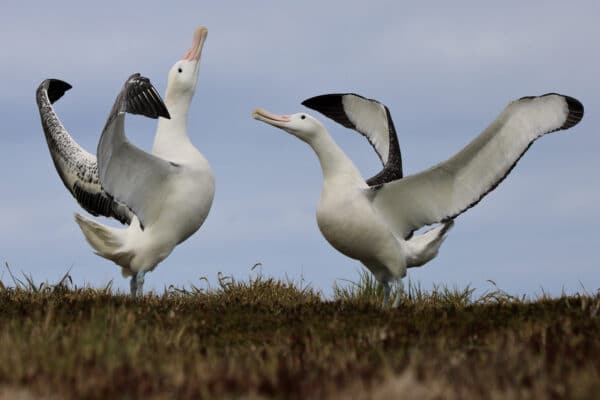
Wandering Albatross
Diomedea exulans

Number Of Mature
Individuals (Regional)
14 000 – 27 000

Regional
Population Trend
Decreasing
2025
Regional Category
Vulnerable
Search by species
CONTENTSOverview
Names
|
IOC English Name: |
Snowy Albatross |
|
SA & IOC Scientific Name: |
Diomedea exulans |
|
BirdLife International Taxonomy (scientific name): |
Snowy Albatross (Diomedea exulans) |
|
Order: |
PROCELLARIIFORMES |
|
Family: |
Diomedeidae |
|
Species name author: |
Linnaeus 1758 |
|
Afrikaans: |
Grootalbatros |
|
Sesotho (South Africa): |
Masikaledikepe yo moholo |
|
Sesotho (Lesotho): |
|
|
Siswati: |
|
|
Zulu: |
Unozulane |
Current Assessment Status
|
2025 Regional Category [Criteria] |
VU [A3e; D2] |
|
2024 Global Category [Criteria] |
VU [A4bd] (BirdLife International 2018) |
|
Population size (Regional) |
14 000 – 27 000 mature individuals (PFIAO unpubl) |
|
Population size (Global) |
58 000 mature individuals (ACAP 2009) |
|
Distribution size (EOO) (Regional) km2 |
3500 (breeding, foraging; Orgeret et al. 2021) |
|
Distribution size (EOO) (Global) km2 |
128 000 000 (BirdLife International 2018) |
|
Distribution size (AOO) (Regional) km2 |
334 (breeding) |
|
Generation time |
23.9 (Bird et al. 2020) |
|
Status change reason |
No Change |
|
Migrant (in the region) |
Native and non-breeding visitor |
|
Regional endemic |
No |
Historic Listing Information
|
2000 Regional Status |
VU [A1ad+2b] |
|
2015 Regional Status |
VU [A4bd; D2] |
|
Status change reason (if applicable) |
No Change |
|
2015 Population size (Regional) |
c. 3650 pairs (c. 12120 mature individuals) |
|
2015 Global Status |
VU [A4bd] |
Reason for Inclusion
Reason for Inclusion in the Assessment
The Wandering Albatross Diomedea exulans was previously assessed regionally as Vulnerable (Wanless 2015) and is currently globally assessed as Vulnerable (BirdLife International 2018).
Category Justification
Category Justification
The Wandering Albatross is a quasi-biennially breeding seabird with c. 7000 pairs breeding at two locations within the region, namely Prince Edward Island and Marion Island. The global population is listed as Vulnerable (VU) due to past global declines. Within the region, this species qualifies for VU under Criterion A3 due to projected future declines based on expert-assessed extinction horizons due principally to the threat of House Mice on Marion Island (Preston et al. 2019). While there is limited direct evidence of ongoing population decline currently, predictive assessments suggest that the species may experience a significant reduction over the next three generations. The extinction horizon estimates indicate that the species’ population may decline by 49% within this period, well exceeding the threshold for VU under A3 (Lee 2025).
The species also qualifies as regionally VU under Criterion D2 due to its breeding on only two islands (locations) in the region, and the plausible future threat of the ongoing decline in breeding success, mercury contamination in the Southern Ocean and mice predation.
A Regional Rescue Effect is not applicable and the Category is retained as VU.
Population Justification
The global population of the Wandering Albatross has been quantified at c. 58 000 mature individuals (Gales 1998, Ryan et al. 2009, Poncet et al. 2017, Weimerskirch 2018, Cooper 2020) with approximately 47% located on the Prince Edward Islands (27 000). For 2019, the last year in which data is available for both islands, it was estimated that there were c. 7000 breeding pairs (calculated using Delord et al. 2008) breeding in the region. According to the most recent population counts, there are c. 2466 pairs breeding biennially on Marion Island (in 2022) and c. 1754 breeding pairs on Prince Edward Island (in 2019, aerial count adjusted for nest failure at the time of census). It should be noted that the 3650 pairs value given in Wanless (2015) was for pairs breeding annually, not the total number of breeding pairs. The IUCN global estimate (BirdLife International 2018) and those in the literature have been corrected for the biennial breeding biology of the species.
Trend Justification
Globally, long-term population studies have been conducted on all five of the island sites where this species breeds. All populations have shown decreases in the past (Birdlife international 2018). The unit of monitoring is the number of breeding pairs, a subset of the regional population. On a regional basis, the well-monitored Marion Island sub-population decreased at roughly 1.5% per year from 1975-1990, to reach a level of c. 1200 annual breeding pairs. This downward trend reversed from the early 1990s through to around the new millennium at a rate of 5.5% per year, peaking at c. 1800 pairs (Nel et al. 2002a, Ryan et al. 2009). Over the last two decades between 2000-2019, the population trend has steadily been increasing by 1.4% per year and the overall rate of population increase between 1975 and 2022 was 0.85% per year (95% CI = 0.77–0.93; ACAP 2009, FitzPatrick Institute of African Ornithology, unpubl data). However, breeding success has fallen from an average of 74.6% between 1984-1993 to 67.7% between 2012-2021 (FitzPatrick Institute of African Ornithology, unpubl data, DZ Keys). Long-term census data have not been collected on Prince Edward Island, but trends are thought to mirror those of Marion Island (Nel et al. 2002a, Ryan et al. 2009).
Future population projections based on extinction horizon estimates suggest that significant reductions may occur within the next three generations (Preston et al. 2019). While no significant recent declines have been observed, the potential for future declines justifies careful consideration under Criterion A3 (Lee 2025). Ongoing monitoring is essential to validate these projections and determine whether the species is experiencing measurable population decreases.
Biology & Ecology
Taxonomy
The Wandering Albatross Diomedea exulans has been the subject of longstanding taxonomic debate (Nunn et al. 1996). The major albatross phylogenetic revisions settled the taxonomy into four species of wandering-type albatrosses, namely the Tristan D. dabbenena, Antipodean D. antipodensis, Amsterdam D. amsterdamensis and Wandering (D. exulans; Nunn et al. 1996, Burg and Croxall 2004, Milot et al. 2008, Rains et al. 2011). The two royal albatrosses form a discrete clade within the genus (Robertson and Nunn 1998).
Identification
110–135 cm, females: 8 kg, males: 10 kg; wingspan 2.7–3.5 m. An extremely large, hump-backed albatross. Sexes alike, although the male is c. 20% larger (Shaffer et al. 2001). Wide varieties of plumages occur where males and females both fledge with a dark chocolate-brown plumage with white face marks and becomes whiter with age. Within the first four years of fledging, males develop white adult plumage faster than females and older males are typically entirely white except for black flight feathers by the age of 30 (Weimerskirch et al. 1987). The bill is pink and tipped creamy yellow and legs are a flesh colour. Adults often have a pinkish crescent on the side of their necks, which is absent from royal albatrosses (Ryan 2017).
Distribution
The species has a circumpolar distribution across the Southern Ocean, seldom venturing into continental shelf waters (Ryan 2005). Birds breed biennially and if they are successful, they can migrate long distances during their sabbatical year. During their sabbatical, some birds may circumnavigate Antarctica (Ryan 2005, Weimerskirch et al. 2015), however, most remain relatively near their breeding colonies (Weimerskirch et al. 2015, unpubl data MAPRU NMU and FitzPatrick Institute of African Ornithology). After fledging, juvenile Wandering Albatrosses disperse throughout the subtropical Indian Ocean (25–40 ◦S) and forage up to the South African and Australian shelves, and the Tasman Sea; but also avoiding continental shelf waters (de Grissac et al. 2017). Like adults, juveniles quickly start exploiting particular oceanographic features, such as sea mounts and ridges, and demonstrate similar large-scale movement behaviours (de Grissac et al. 2017).
They breed at six different island sites including South Georgia, the Prince Edward Islands, the Crozet Archipelago, the Kerguelen Islands and Macquarie Island. The three island groups in the Indian Ocean sector, namely Crozet, Kerguelen, and the Prince Edward islands, together account for approximately 86% of the global population. Birds forage up to 4 000 km away from breeding colonies (Carpenter-Kling et al. 2020) and foraging strategies change throughout the breeding season (Nel et al. 2002b). During the breeding period, birds from Marion Island and Crozet segregate sexually, with females foraging in a more northerly direction towards the subtropics whereas males forage more towards the south (Orgeret et al. 2021). Birds ringed at South Georgia, Crozet, Kerguelen, and Marion Islands have been recovered in the waters off southern Africa (Morant et al. 1983). The one bird recovered on Marion Island was an individual that hatched on Crozet and bred on Marion Island 9 years later (Mougin 1977).
Ecology
The Wandering Albatross is a quasi-biennial breeding species, with a very small proportion of successful breeders attempting to breed the following year (Barbraud and Weimerskirch 2012). Their breeding season lasts up to 13 months (ACAP 2009). On average, birds start breeding at 10 years of age (Weimerskirch et al. 1997a), live up to 50 years (Cooper et al. 2003), and have an estimated generation length of 23.3 years (Birdlife International 2018). Breeding birds nest at low elevations relatively close to the coast, in coastal vegetation (Momberg et al. 2023). The species is predominantly a diurnal feeder (Phalan et al. 2007) and prey is mainly obtained by surface-seizing (Prince et al. 1994) or by scavenging (Cooper et al. 1992, Croxall and Prince 1994). Breeding birds primarily consume cephalopods and fish (Cooper et al. 1992, Cherel and Klages 1998, Weimerskirch et al. 1997b). The species is known to trail behind ships and has been shown to change its flight direction and head towards fishing vessels up to 30 km away (Collet et al. 2015), and interact with the vessels after attraction (Weimerskirch 2018).
Threats & Conservation
Threats
Over the last half century, Wandering Albatross populations from the Prince Edward Islands, Crozet, and Kerguelen have shown similar population trends (Ryan et al. 2009), suggesting that similar factors impact fluctuations in population sizes (Weimerskirch 2018). The decline of these populations have largely been attributed to high bycatch rates by large-scale longline tuna fisheries in the Indian Ocean high seas (Weimerskirch et al. 1997a, Nel et al. 2002a, Nel et al. 2003) and, to a lesser extent, the Patagonian longline toothfish fisheries fishing around the sub-Antarctic shelf edges and seamounts (Weimerskirch et al. 1997). However, it should be noted that this species is seldom killed in the South African longline fishery (Petersen et al. 2009), or the Patagonian toothfish fishery within the Prince Edwards Islands’ EEZ (Nel et al. 2002b), and mitigation measures have been implemented by the toothfish fisheries within the French EEZs which have substantially reduced the bycatch rates (Weimerskirch 2018). Wandering Albatross are attracted to fishing vessels more than other types of vessels (Weimerskirch et al. 2020) and despite the implementation of technologies intended to reduce bycatch, long line tuna fisheries in international waters, illegal, uncontrolled, or non-declared fisheries operating without mitigation measures are still a concern of bycatch risk for this species (Huang and Liu 2010, Delord and Weimerskirch 2011, Tuck et al. 2015, Weimerskirch 2018, Weimerskirch et al. 2020).
Invasive species are a significant threat to many seabird species (Dias et al. 2019), and it has been suggested that their behaviour has possibly changed during recent decades as a result of climate change (van Aarde and Jackson 2007, Davies et al. 2015, Barbraud et al. 2021). Marion Island has been free of feral cats Felis catus since 1991 (Bester et al. 2000), and although suggested, there was no evidence that they preyed on Wandering Albatross, they predominantly preyed on burrowing petrels (Van Aarde 1981). However, more recently on Kerguelen Island, feral cats have been predating on chicks, drastically decreasing the breeding success (Barbraud et al. 2021). Control experiments have demonstrated that removal of the feral cats will allow for breeding success to recover (Barbraud et al. 2021). Predation by Mice Mus musculus on Marion Island have been recorded since 2003 (Dilley et al. 2016), and while only recorded at low levels, predation on albatross chicks and the increase of attacks around the island is a cause for concern (Wanless et al. 2007, Jones and Ryan 2010, Dilley et al. 2016). There are no rodents at Prince Edward Island (Chown et al. 2002).
Wandering Albatross are bioindicators of contaminants in the Southern Ocean and are exposed to a variety of organic and inorganic contaminants (Carravieri et al. 2014, Perold et al. 2020), with particularly high mercury (Hg) concentrations (Carravieri et al. 2014, Cherel et al. 2018). High levels of blood Hg have long term breeding consequences for Wandering Albatrosses which may negatively affect population growth through decrease in long-term breeding probability, hatching and fledging probabilities (Goutte et al. 2014). Furthermore, adult Wandering Albatross ingest and feed their chicks anthropogenic debris such as mesoplastics, macroplastics (Perold et al. 2020, Phillips and Waluda 2020), and fishing gear (Nel et al. 2002b, Phillips et al. 2010, Perold et al. 2020) which can reduce seabird body condition (Ryan 1987) and lead to fatalities (Nel and Nel 1999).
Conservation Measures Underway
Internationally, the Wandering Albatross receives protection under the Agreement on the Conservation of Albatrosses and Petrels (Annex 1), 2018 IUCN Red List of Threatened Species, and the Convention on Migratory Species (Appendix II).
Regionally, it receives protection in South Africa under the Sea Birds and Seals Protection Act, 1973 (Act No. 46 of 1973), Marine Living Resources Act (Act No. 18 of 1998): Publication of Policy on the Management of Seals, Seabirds and Shorebirds: 2007 and the National Plan of Action (NPOA) for Reducing the Incidental Catch on Seabirds in Longline Fisheries (2008). The Prince Edward Islands are listed as a Ramsar Wetland of International Importance, and as a Special Nature Reserve under the Environment Conservation Act (No 73 of 1989) and the Prince Edward Islands Management Plan 1996. The Prince Edward Islands Marine Protected Area was proclaimed in 2013.
BirdLife South Africa’s Albatross Task Force (ATF) is actively researching new technologies to reduce incidental mortality in fisheries by working directly with fishermen to achieve “win-win practical solutions”. It also monitors observer data and estimates annual bycatch in selected fisheries and promotes the development and enforcement of best practice to reduce incidental mortality. It supports the construction and distribution of devices such as Bird Scaring Lines for fishing vessels. BirdLife International is actively lobbying regional fisheries management organisations, particularly the Indian Ocean Tuna Commission and the International Commission for the Conservation of Atlantic Tuna, to improve the conservation measures required of longline fishing vessels. It is also supporting moves to create regional observer programmes and strengthen observer data collection and reporting procedures. Several fisheries management organizations and the Agreement for the Conservation of Albatrosses and Petrels (ACAP) have recommended the Hookpod as a stand-alone best practice bycatch mitigation measure, and since 2019, it has been included in the South African Longline Fisheries Permit Conditions to mitigate seabird bycatch. In 2022, the ATF initiated trails with new reusable mini-Hookpods that aims to further prevent seabird bycatch in longline fisheries. In 2021, the Imvelo Bird-scaring Line (BSL) compliance device trials were carried out by the ATF with funding from ACAP and in collaboration with Imvelo Blue Environmental Consultancy to continue the improvement of the electronic compliance monitoring device.
Conservation Measures Proposed
Ongoing measures by BirdLife South Africa, BirdLife International, Conservation of Antarctic Marine Living Resources (CCAMLR) and the Albatross Task Force (ATF), to improve pelagic longline fishing operations in the high seas and reduce incidental mortality of seabirds should be supported and extended to distant fishing nations operating in the Southern Ocean. The South African Government should continue promoting international best-practice for reducing seabird mortalities at bodies such as the Indian Ocean Tuna Commission, International Commission for the Conservation of Atlantic Tuna, and the Commission for the Conservation of Southern Bluefin Tuna. Regional and national observer programmes and reporting of their data remain of paramount importance in understanding the scale of incidental mortality and potential effectiveness of (and level of compliance with) mitigation measures employed. Programmes to survey the sub-population at Prince Edward Island regularly and tracking birds to assess degree of overlap with various fisheries remain important tools for assessing and addressing the ongoing threats from fishery interactions.
Research Priorities and Questions
- The population trends and the number of breeding pairs for the largest colonies have drastically changed since the last global assessment. Therefore, it is important to conduct a global assessment of Wandering Albatross to update their global conservation status.
- Continued, non-invasive demographic studies and monitoring on Marion Island – which can include remote sensing tools such as aerial photography, GPS tracking, and recording audio and video data.
- Continued tracking studies to assess the spatial overlap with fisheries and responses to climate change.
Contributors & References
Assessor/s
Danielle Z Keys
Reviewer/s
Pierre Pistorius
References
Agreement on the Conservation of Albatrosses and Petrels. 2009. ACAP Species assessment: Wandering Albatross Diomedea exulans. Available: http://www.acap.aq [Accessed on 2 February 2023].
Barbraud C, Des Monstiers B, Chaigne A, Marteau C, Weimerskirch H, Delord K. 2021. Predation by feral cats threatens great albatrosses. Biological Invasions 23: 2389–2405.
Barbraud C, Weimerskirch H. 2012. Estimating survival and reproduction in a quasi-biennially breeding seabird with uncertain and unobservable states. Journal of Ornithology 152: 605–615.
Bester M, Bloomer J, Bartlett P, Muller D, Van Rooyen M, Buchner H. 2000. Final eradication of feral cats from sub-Antarctic Marion Island, southern Indian Ocean. South African Journal of Wildlife Research 30: 53–57.
Bird JP, Martin R, Akçakaya HR, Gilroy J, Burfield IJ, Garnett ST, Symes A, Taylor J, Şekercioğlu ÇH, Butchart SH. 2020. Generation lengths of the world’s birds and their implications for extinction risk. Conservation Biology 34: 1252–1261. DOI: 10.1111/cobi.13486.
BirdLife International. 2018. The IUCN Red List of Threatened Species 2018: Diomedea exulans. Available: https://dx.doi.org/10.2305/IUCN.UK.2018-2.RLTS.T22698305A132640680.en [Accessed on 15 February 2023].
Burg TM, Croxall JP. 2004. Global population structure and taxonomy of the wandering albatross species complex. Molecular Ecology 13: 2345–2355.
Carpenter‐Kling T, Reisinger RR, Orgeret F, Connan M, Stevens KL, Ryan PG, Makhado A, Pistorius PA. 2020. Foraging in a dynamic environment: Response of four sympatric sub‐Antarctic albatross species to interannual environmental variability. Ecology and Evolution 10: 11277–11295.
Carravieri A, Bustamante P, Tartu S, Meillère A, Labadie P, Budzinski H, Peluhet L, Barbraud C, Weimerskirch H, Chastel O. 2014. Wandering albatrosses document latitudinal variations in the transfer of persistent organic pollutants and mercury to Southern Ocean predators. Environmental Science and Technology 48: 14746–14755.
Cherel Y, Barbraud C, Lahournat M, Jaeger A, Jaquemet S, Wanless RM, Phillips RA, Thompson DR, Bustamante P. 2018. Accumulate or eliminate? Seasonal mercury dynamics in albatrosses, the most contaminated family of birds. Environmental Pollution 241: 124–135.
Cherel Y, Klages N. 1998. A review of the food of albatrosses. In: Robertson G, Gales R (eds), Albatross Biology and Conservation. Chipping Norton, Australia: Surrey Beatty and Sons. pp 113–136.
Chown S, McGeoch M, Marshall D. 2002. Diversity and conservation of invertebrates on the sub-Antarctic Prince Edward Islands. African Entomology 10: 67–82.
Collet J, Patrick SC, Weimerskirch H. 2015. Albatrosses redirect flight towards vessels at the limit of their visual range. Marine Ecology Progress Series 526: 199–205.
Cooper J, Henley S, Klages N. 1992. The diet of the wandering albatross Diomedea exulans at subantarctic Marion Island. Polar Biology 12: 477–484.
Cooper J, Battam H, Loves C, Milburn P, Smith L. 2003. The oldest known banded wandering albatross Diomedea exulans at the Prince Edward Islands. African Journal of Marine Science 25: 525–527.
Cooper J. 2020. Wandering Albatrosses on Australia’s Macquarie Island are having a better breeding season. Available: https://www.acap.aq/latest-news/3663-wandering-albatrosses-on-australia-s-macquarie-island-having-a-good-breeding-season [Accessed on 13 July 2021].
Croxall J, Prince P. 1994. Dead or alive, night or day: how do albatrosses catch squid? Antarctic Science 6: 155–162.
Davies D, Dilley B, Bond A, Cuthbert R, Ryan P. 2015. Trends and tactics of mouse predation on Tristan Albatross Diomedea dabbenena chicks at Gough Island, South Atlantic Ocean. Avian Conservation and Ecology 10: 5.
de Grissac S, Bartumeus F, Cox SL, Weimerskirch H. 2017. Early‐life foraging: Behavioral responses of newly fledged albatrosses to environmental conditions. Ecology and Evolution 7: 6766–6778.
Delord K, Besson D, Barbraud C, Weimerskirch H. 2008. Population trends in a community of large Procellariiforms of Indian Ocean: potential effects of environment and fisheries interactions. Biological Conservation 141: 1840–1856.
Delord K, Weimerskirch H. 2011. New information on distribution of albatrosses and petrels breeding in the Indian Ocean and assessment of potential overlap with the IOTC fisheries. Unpublished report to the Indian Ocean Tuna Commission, Working Party on Ecosystems and Bycatch. p. 16.
Dias MP, Martin R, Pearmain EJ, Burfield IJ, Small C, Phillips RA, Yates O, Lascelles B, Borboroglu PG, Croxall JP. 2019. Threats to seabirds: a global assessment. Biological Conservation 237: 525–537.
Dilley BJ, Schoombie S, Schoombie J, Ryan PG. 2016. ‘Scalping’of albatross fledglings by introduced mice spreads rapidly at Marion Island. Antarctic Science 28: 73–80.
Gales R. 1998. Albatross populations: status and threats. In: Robertson G, Gales R (eds), Albatross Biology and Conservation. Chipping Norton, Australia: Surrey Beatty and Sons. pp. 20–45.
Goutte A, Barbraud C, Meillère A, Carravieri A, Bustamante P, Labadie P, Budzinski H, Delord K, Cherel Y, Weimerskirch H. 2014. Demographic consequences of heavy metals and persistent organic pollutants in a vulnerable long-lived bird, the wandering albatross. Proceedings of the Royal Society B: Biological Sciences 281: 20133313.
Huang H-W, Liu K-M. 2010. Bycatch and discards by Taiwanese large-scale tuna longline fleets in the Indian Ocean. Fisheries Research 106: 261–270.
Jones M, Ryan PG. 2010. Evidence of mouse attacks on albatross chicks on sub-Antarctic Marion Island. Antarctic Science 22: 39–42.
Lee ATK. 2025. The application of IUCN Regional Red List Criteria to the species of South Africa’s Prince Edward Islands. Unpublished report. Johannesburg: BirdLife South Africa.
Milot E, Weimerskirch H, Bernatchez L. 2008. The seabird paradox: dispersal, genetic structure and population dynamics in a highly mobile, but philopatric albatross species. Molecular Ecology 17: 1658–1673.
Momberg M, Ryan PG, Hedding DW, Schoombie J, Goddard KA, Craig KJ, Le Roux PC. 2023. Factors determining nest‐site selection of surface‐nesting seabirds: a case study on the world’s largest pelagic bird, the Wandering Albatross (Diomedea exulans). Ibis 165: 190–203.
Mougin J-L. 1977. Nidification à l’île Marion (46°53´S, 37°52´E) d’un Grand Albatros (Diomedea exulans) né à l’île de la Possession, archipel Crozet (46°25´S, 51°45´E). Comptes Rendus de l’Académie des Sciences Paris 274: 2277–2280.
Morant P, Brooke R, Abrams R. 1983. Recoveries in southern Africa of seabirds breeding elsewhere. Ringing and Migration 4: 257–268.
Nel DC, Nel J. 1999. Marine debris and fishing gear associated with seabirds at sub-Antarctic Marion Island, 1996–1997 and 1997–1998: In relation to longline fishing activity. CCAMLR Science 6: 85–96.
Nel DC, Ryan PG, Crawford RJ, Cooper J, Huyser OA. 2002a. Population trends of albatrosses and petrels at sub-Antarctic Marion Island. Polar Biology 25: 81–89.
Nel DC, Ryan PG, Nel JL, Klages NT, Wilson RP, Robertson G, Tuck GN. 2002b. Foraging interactions between Wandering Albatrosses Diomedea exulans breeding on Marion Island and long‐line fisheries in the southern Indian Ocean. Ibis 144: E141–E154.
Nel DC, Ryan PG, Watkins BP. 2002c. Seabird mortality in the Patagonian toothfish longline fishery around the Prince Edward Islands, 1996–2000. Antarctic Science 14: 151–161.
Nunn GB, Cooper J, Jouventin P, Robertson CJR, Robertson GG. 1996. Evolutionary relationships among extant albatrosses (Procellariiformes: Diomedeidae) established from complete cytochrome-b gene sequences. The Auk 113: 784–801.
Orgeret F, Reisinger RR, Carpenter‐Kling T, Keys DZ, Corbeau A, Bost CA, Weimerskirch H, Pistorius PA. 2021. Spatial segregation in a sexually‐dimorphic central place forager: competitive exclusion or niche divergence? Journal of Animal Ecology 90: 2404–2420.
Petersen SL, Honig MB, Ryan PG, Underhill LG. 2009. Seabird bycatch in the pelagic longline fishery off southern Africa. African Journal of Marine Science 31: 191–204.
Perold V, Schoombie S, Ryan PG. 2020. Decadal changes in plastic litter regurgitated by albatrosses and giant petrels at sub-Antarctic Marion Island. Marine Pollution Bulletin 159: 111471.
Phalan B, Phillips RA, Silk JR, Afanasyev V, Fukuda A, Fox J, Catry P, Higuchi H, Croxall JP. 2007. Foraging behaviour of four albatross species by night and day. Marine Ecology Progress Series 340: 271–286.
Phillips RA, Ridley C, Reid K, Pugh PJ, Tuck GN, Harrison N. 2010. Ingestion of fishing gear and entanglements of seabirds: monitoring and implications for management. Biological Conservation 143: 501–512.
Phillips RA, Waluda CM. 2020. Albatrosses and petrels at South Georgia as sentinels of marine debris input from vessels in the southwest Atlantic Ocean. Environment International 136: 105443.
Poncet S, Wolfaardt AC, Black A, Browning S, Lawton K, Lee J, Passfield K, Strange G, Phillips RA. 2017. Recent trends in numbers of wandering (Diomedea exulans), black-browed (Thalassarche melanophris), and grey-headed (Thalassarche chrysostoma) albatrosses breeding at South Georgia. Polar Biology 40: 1347–1358.
Preston GR, Dilley BJ, Cooper J, Beaumont J, Chauke LF, Chown, SL, Devanunthan N, Dopolo M, Fikizolo L, Heine J, Henderson S, Jacobs CA, Johnson F, Kelly J, Makhado AB, Marais C, Maroga J, Mayekiso M, McClelland G, Mphepya J, Muir D, Ngcaba N, Ngcobo N, Parkes JB, Paulsen F, Schoombie S, Springer K, Stringer C, Valentine H, Wanless RM, Ryan PG. 2019. South Africa works towards eradicating introduced house mice form the sub-Antarctic Marion Island: the largest island yet attempted for mice. In: Island Invasives: Scaling up to Meet the Challenge. Veitch CR, Clout MN, Martin AR, Russell JC, West CJ (eds), Occasional Paper of the IUCN Species Survival Commission; Vol. 62 pp 40–46. IUCN. https://portals.iucn.org/library/node/48358.
Prince P, Huin N, Weimerskirch H. 1994. Diving depths of albatrosses. Antarctic Science 6: 353–354.
Rains D, Weimerskirch H, Burg TM. 2011. Piecing together the global population puzzle of wandering albatrosses: genetic analysis of the Amsterdam albatross Diomedea amsterdamensis. Journal of Avian Biology 42: 69–79.
Robertson CJR, Nunn GB. 1998. Towards a new taxonomy for albatrosses. In: Robertson G, Gales R (eds), Albatross Biology and Conservation. Chipping Norton, Australia: Surrey Beatty and Sons. pp 13–19.
Ryan PG. 1987. The effects of ingested plastic on seabirds: correlations between plastic load and body condition. Environmental Pollution 46: 119–125.
Ryan PG. 2005. Wandering Albatross Diomedea exulans. In: Hockey PAR, Dean WRJ, Ryan PG (eds), Roberts – Birds of Southern Africa, 7th Edn. Cape Town, South Africa: The Trustees of the John Voelcker Bird Book Fund. pp 641–642.
Ryan PG. 2017. Albatrosses. Guide to Seabirds of Southern Africa. Cape Town, South Africa: Penguin Random House South Africa. pp 40–41.
Ryan PG, Jones MG, Dyer B, Upfold L, Crawford RJ. 2009. Recent population estimates and trends in numbers of albatrosses and giant petrels breeding at the sub-Antarctic Prince Edward Islands. African Journal of Marine Science 31: 409–417.
Shaffer SA, Weimerskirch H, Costa D. 2001. Functional significance of sexual dimorphism in wandering albatrosses, Diomedea exulans. Functional Ecology 15: 203–210.
Tuck GN, Thomson RB, Barbraud C, Delord K, Louzao M, Herrera M, Weimerskirch H. 2015. An integrated assessment model of seabird population dynamics: can individual heterogeneity in susceptibility to fishing explain abundance trends in Crozet wandering albatross? Journal of Applied Ecology 52: 950–959.
van Aarde RJ. 1981. The diet and feeding behaviour of feral cats, Felis catus at Marion Island. South African Journal of Wildlife 11: 123–128.
van Aarde RJ, Jackson TP. 2007. Food, reproduction and survival in mice on sub-Antarctic Marion Island. Polar Biology 30: 503–511.
Wanless RM, Angel A, Cuthbert RJ, Hilton GM, Ryan PG. 2007. Can predation by invasive mice drive seabird extinctions? Biology Letters 3: 241–244.
Wanless RM. 2015. Wandering Albatross Diomedea exulans. In: Taylor MR, Peacock F, Wanless RM (eds), The 2015 Eskom Red Data Book of Birds of South Africa, Lesotho and Swaziland. Johannesburg: BirdLife South Africa. pp 189–191.
Weimerskirch H, Clobert J, Jouventin P. 1987. Survival in five southern albatrosses and its relationship with their life history. The Journal of Animal Ecology. 1:1043–55.
Weimerskirch H, Brothers N, Jouventin P. 1997a. Population dynamics of wandering albatross Diomedea exulans and Amsterdam albatross D. amsterdamensis in the Indian Ocean and their relationships with long-line fisheries: conservation implications. Biological Conservation 79: 257–270.
Weimerskirch H, Cherel Y, Cuenot-Chaillet F, Ridoux V. 1997b. Alternative foraging strategies and resource allocation by male and female wandering albatrosses. Ecology 78: 2051–2063.
Weimerskirch H, Delord K, Guitteaud A, Phillips RA, Pinet P. 2015. Extreme variation in migration strategies between and within wandering albatross populations during their sabbatical year and their fitness consequences. Scientific reports 5(1): 8853.
Weimerskirch H. 2018. Linking demographic processes and foraging ecology in Wandering Albatross—Conservation implications. Journal of Animal Ecology 87(4):945–55.
Citation
Keys DZ 2025. Wandering Albatross. In: Lee ATK, Rose S, Banda S, Bezeng SB, Maphalala MI, Maphisa DH, Smit-Robinson H (eds), The 2025 Red Data Book of Birds of South Africa, Lesotho and Eswatini. Johannesburg, South Africa: BirdLife South Africa. Available at: https://www.birdlife.org.za/red-list/wandering-albatross/
Our generous sponsors


