


Taita Falcon
Falco fasciinucha

Number Of Mature
Individuals (Regional)
<25

Regional
Population Trend
Decreasing
2025
Regional Category
Critically Endangered
Search by species
CONTENTSOverview
Names
|
IOC English Name: |
Taita Falcon |
|
SA and IOC Scientific Name: |
Falco fasciinucha |
|
BirdLife International Taxonomy (scientific name): |
Falco fasciinucha |
|
Order: |
FALCONIFORMES |
|
Family: |
Falconidae |
|
Species name author: |
Reichenow and Neumann 1895 |
|
Afrikaans: |
Taitavalk |
|
Sesotho (South Africa): |
Phakwe ya Taita |
|
Sesotho (Lesotho): |
|
|
Siswati: |
|
|
Zulu: |
Ukletshana wamawa |
Current Assessment Status
|
2025 Regional Category [Criteria] |
CR [B1ab(i,ii,iii,v); C1; D] |
|
2024 Global Category [Criteria] |
VU [A2ab+3b+4ab; C2a(i); D1] (BirdLife International 2020) |
|
Population size (Regional) |
<25 mature individuals (Van Zyl and Jenkins 2023) |
|
Population size (Global) |
500 – 1000 mature individuals (BirdLife International 2020) |
|
Distribution size (EOO) (Regional) km2 |
83 (Van Zyl and Jenkins 2023) |
|
Distribution size (EOO) (Global) km2 |
2 690 000 (BirdLife International 2020) |
|
Distribution size (AOO) (Regional) km2 |
12 (Van Zyl and Jenkins 2023) |
|
Generation time |
4.1 years (BirdLife International 2020) |
|
Status change reason |
No Change |
|
Migrant (in the region) |
No |
|
Regional endemic |
No |
Historic Listing Information
|
2000 Regional Status |
Not Evaluated |
|
2015 Regional Status |
CR [D] |
|
Status change reason (if applicable) |
Increased knowledge about distribution and population |
|
2015 Population size (Regional) |
<50 mature individuals |
|
2015 Global Status |
VU [C2a(i); D1] |
Reason for Inclusion
Reason for Inclusion in the Assessment
The species was assessed as regionally Critically Endangered in 2015 (Taylor 2015).
Category Justification
Category Justification
The Taita Falcon Falco fasciinucha is patchily distributed and generally rare throughout its global range. Its known occurrence in the region was first noted in the late 1980s (Milstein 2000), and it currently has an extremely small estimated regional population size of 60% over 25% over three years or one generation. Extent of Occurrence (EOO) and Area of Occupancy (AOO) measures based on the distribution of occupied territories have decreased by 59% (204 km2 to 83 km2) and 63% (32 km2 to 12 km2) respectively over the same period (Van Zyl and Jenkins 2023). Hence, the species satisfies the population size Criteria C, B1ab(i,ii,iii,v) and D for Critically Endangered, with a realistic expectation of extinction in <10 years. Note that at present the South African enclave remains the second largest known breeding sub-population globally. While acknowledging that recent data are lacking for many parts of the species historical distribution there are no current grounds for considering this small, dwindling aggregation of breeding pairs as insignificant or peripheral to the species’ global conservation status.
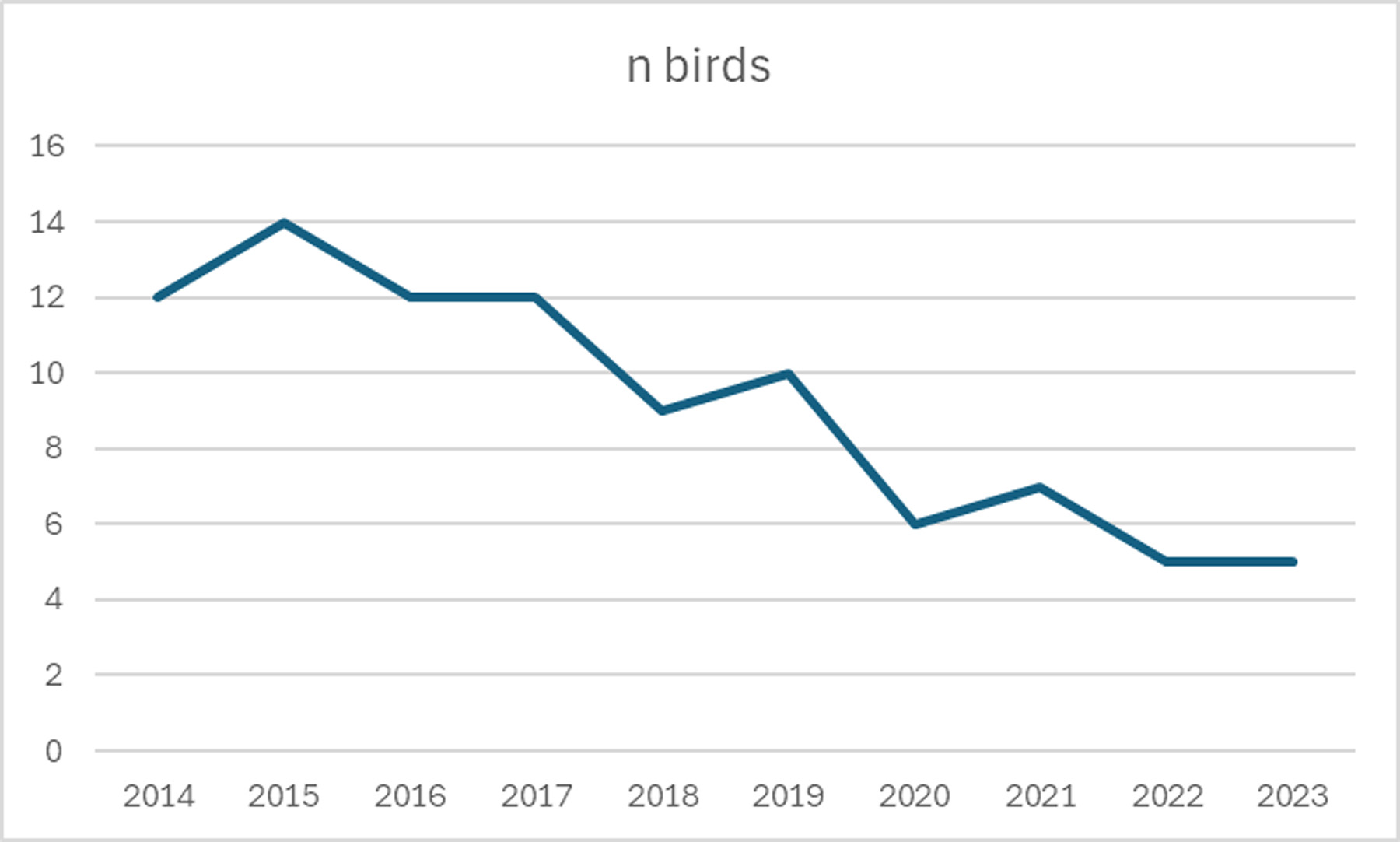
Figure 1: The number of adult Taita Falcons counted in annual surveys of known nesting territories in the region showing the drop from a peak of 14 birds in 2015, to just five birds in 2023 (Van Zyl and Jenkins 2023).
Population Justification
The global population is currently estimated at 500 – 1000 mature individuals (BirdLife International 2020). This figure is likely an overestimate, given that there are <25 currently occupied nesting territories known across its entire range (Hartley 2000, Jenkins et al. 2008). While there are no recent data for other historically significant areas for the species, including Kenya (Thomsett 1998), Tanzania, Uganda, Zambia and Malawi, surveys within the last decade have yielded no breeding pairs in the Batoka Gorge on the Zimbabwe/Zambia border (a location that supported at least six pairs until the late 1990s – Hartley 2000), but 14 pairs in Niassa Special Reserve in northern Mozambique (now considered to hold the core of the global population – Jenkins et al. 2022).
The South African population has included up to 11 recently occupied territories, although with only eight occupied concurrently over the period 2010-2023 (Jenkins et al. 2023, Van Zyl and Jenkins 2023). The known regional population currently stands at five mature individuals. While the eastern escarpment area has not been fully surveyed since 2014 (Jenkins et al. 2023), and previously occupied territories are not re-surveyed annually, confidence in this regional population estimate is at least medium.
Trend Justification
The global population is very likely decreasing, with significant decreases in numbers from two areas recently surveyed: the Limpopo/Mpumalanga escarpment in South Africa, and the Batoka Gorge on the Zimbabwe/Zambia border. The discovery of at least 14 breeding pairs in the Niassa Special Reserve, Northern Mozambique (Jenkins et al. 2022), confirms this as the core area of the species’ global distribution, but the long-term prognosis for this reserve and comparable habitat around it is uncertain.
Annual surveys of the South African population indicate a >60% decrease in numbers (from 14 mature individuals dispersed over eight occupied territories, to five mature individuals dispersed over three occupied territories) over the last decade. Confidence in this regional population trend estimate is high.
Biology & Ecology
Taxonomy
No known issues.
Identification
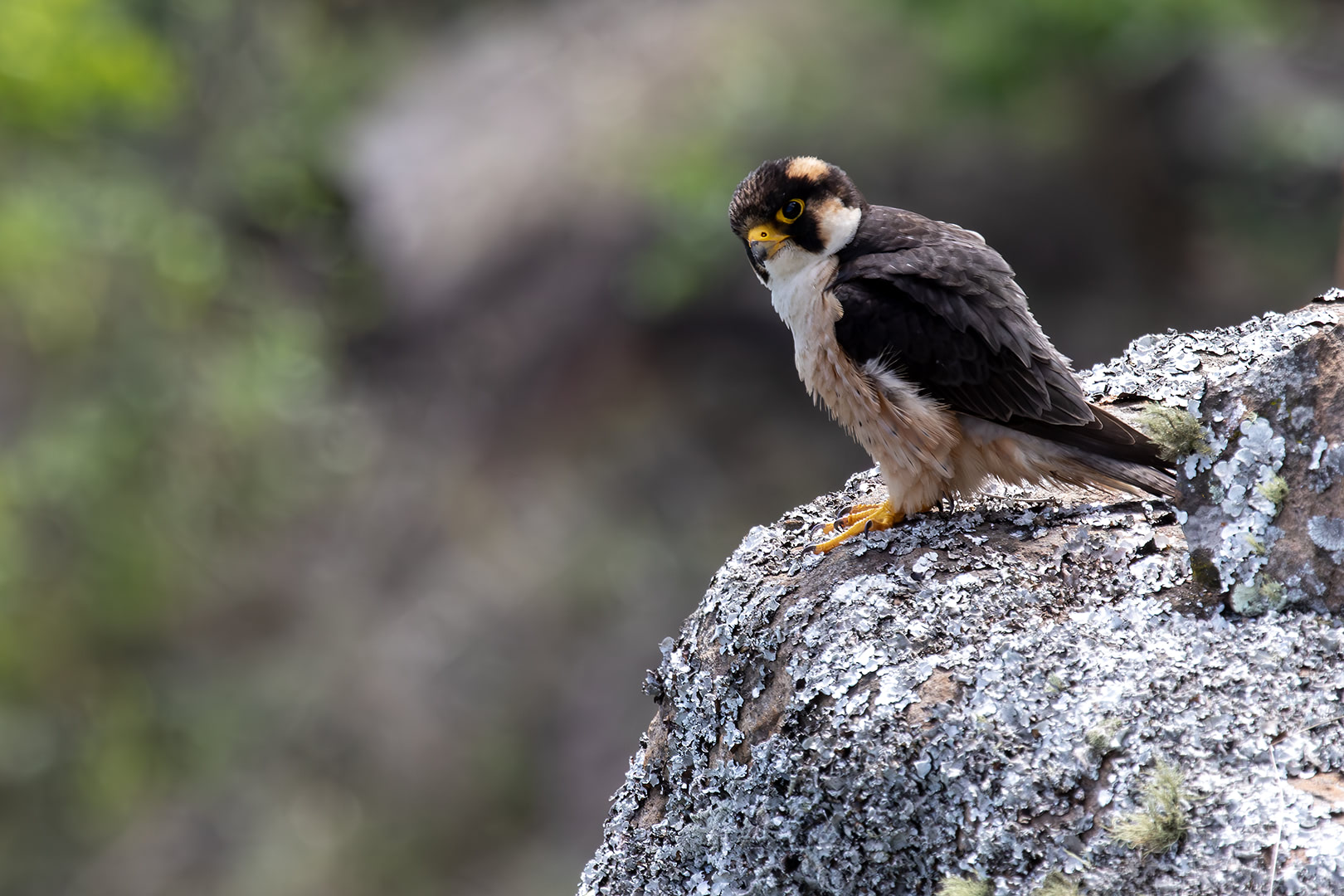
25–28 cm, 210–320 g. Sexes alike. A small, compact falcon. Black moustachial stripes contrast with white cheek and throat. Underparts rufous. Forehead, ear and nape patches are large and cinnamon, remainder of nape and mantle dark slate grey. Flight feathers black with narrow buff edges, rump pale grey; undersides grey, barred blackish with cinnamon-rufous coverts. Under-tail grey, barred blackish. Bill blackish with orange-yellow cere. Eyes dark brown with orange-yellow eye-ring. Legs and feet orange-yellow (Jenkins and Hartley 2005).
Distribution
While the estimated global EOO exceeds 2.5 million km2 (BirdLife International 2020), the distribution of Taita Falcon, throughout its range from southern Ethiopia to South Africa, is extremely fragmented (Ferguson-Lees and Christie 2001). Even within areas where conditions would seem to be ideal it is rare. Based on the distribution of breeding territories, a decrease from eight simultaneously occupied territories in 2015 to just three occupied territories in 2023 indicate a 59% reduction in EOO (from 204 km2 to 83 km2), and a corresponding 73% reduction in AOO (from 44 km2 to 12 km2), in <10 years or three generations. There are no credible indications of the species occurring anywhere outside the regularly surveyed and annually monitored Mpumalanga/Limpopo escarpment area. Confidence in this regional distribution estimate is high.
Ecology
The species is largely restricted to well-wooded habitats, and to mountains or incised river valleys where high, sheer rock faces are available as nesting and foraging sites (Jenkins et al. 2023). Information from Zimbabwe (Hustler 1989, Hartley 2000), Uganda (Möller 1989), and South Africa (South African Taita Falcon Survey Team, unpubl data) suggest that Taita Falcon preys almost exclusively on small birds (<20 g), including abundant granivores such as Red-billed Quelea Quelea quelea, aerial insectivores, and woodland passerines. Estimates of key life-history parameters derived from small samples of captive Zimbabwean and Zambian birds suggest that breeding success of the species is generally low (Hartley et al. 1993). On average, over the period 2010-2023, only 67% of monitored breeding territories in the South African population were occupied annually, and only 22% bred successfully, with an overall productivity of 0.43 young fledged per monitored territory (n = 154 territory-years), and 0.83 young fledged per occupied territory (n = 79 occupied territory-years).
Threats & Conservation
Threats
The main threat to the Taita Falcon regionally is probably the loss of intact savanna and forest to the simultaneous encroachment of intensive agriculture on the eastern foot of the Drakensberg escarpment, and rural settlement and subsistence farming along its upper, western edge (Jenkins et al. 2023). This large-scale transformation of habitat may simultaneously reduce prey availability for Taita Falcon pairs and improve conditions for larger, socially dominant Peregrine Falcon F. peregrinus and especially Lanner Falcon F. biarmicus (Jenkins et al. 2023). Five of 11 Taita Falcon territories in the monitored South African population were taken over by Lanner Falcon (n = 3) and Peregrine Falcon (n = 2) pairs over the period 2010-2023 (South African Taita Falcon Survey Team, unpubl data). The proximity of sophisticated, commercial farming activities may also expose the regional population to the detrimental effects of persistent pesticides, as was suspected in northern Zimbabwe (Hartley 2000). The small, isolated nature of the population may also result in low genetic diversity and associated limitation of reproductive potential.
Conservation Measures Underway
The species is listed under the National Environmental Management: Biodiversity Act (10/2004): Regulations pertaining to Threatened or Protected Terrestrial Species and Freshwater Species [G 47984 – GoN 3009], and under Schedule 2: Specially Protected Wild Animal under the Limpopo Environmental Management Act No 7 of 2003.
Conservation-driven research over the last 18 years has focused on periodic surveys of the regional population, and annual monitoring of occupancy and breeding success at known nesting territories. This has yielded long-term numerical trends and informed a quantitative assessment of the respective roles of habitat and raptor community structure in determining the distribution of nesting territories (Jenkins et al. 2023).
Five of the 11 documented nesting sites in the region (but only one of the three sites still occupied) are located within formally protected areas.
Conservation Measures Proposed
Scope for implementing effective conservation of this species is limited by a lack of information on fundamental aspects of its biology – diet, breeding behaviour and success, foraging range, competitors and predators. A far more intensive and hands-on research approach will be required to fill these information gaps and properly define and prioritise whatever practical conservation measures may be possible.
Given that more than half of the known Taita Falcon nesting territories in the region are located on private land, guarding against ongoing or future land use changes within appropriate buffer areas imposed around these sites – perhaps by the institution of a species-focused stewardship programme – is a practical intervention that could be made now, even without fully understanding the species’ constraints or critical threats.
Research Priorities and Questions
- Consolidation of demographic data accumulated for the regional population since 2006, possibly informing a Population and Habitat Viability Analysis, set in the broader context of the species’ conservation status across the continent.
- Use of remote cameras at nest sites to document nesting phenology, diet, and parental care, and to better understand resource requirements and causes of breeding failure.
- Use of existing (museum-based) material and/or collection of fresh material from active nests to investigate levels of heterozygosity either within the regional population and/or across the species’ global range.
- Collection of material from active nests to investigate levels of agrochemical contamination.
- Further research on the Niassa Taita Falcon population, to ground-truth modelled estimates of the total population of the Niassa Special Reserve, to collect data on all aspects of the species’ ecology from a larger number of resident pairs, and to better understand the importance of the South African population in a global context.
Contributors & References
Assessor/s
Andrew Jenkins, Anthony van Zyl
Reviewer/s
Mark Brown, Christiaan Willem Brink
References
BirdLife International. 2020. Falco fasciinucha. The IUCN Red List of Threatened Species 2020: e.T22696523A174219122. https://dx.doi.org/10.2305/IUCN.UK.2020-3.RLTS.T22696523A174219122.en. [Accessed on 27 January 2022].
Ferguson-Lees J, Christie DA. 2001. Raptors of the World. London: Christopher Helm.
Hartley RR. 2000. Ecology of Taita Falco fasciinucha, Peregrine F. peregrinus and Lanner F. biarmicus Falcons in Zimbabwe. In: Chancellor RD, Meyburg BU (eds), Raptors at Risk. Berlin: WWGBP/Hancock House. pp 87–105.
Hartley RR, Bodington G, Dunkley AS, Groenewald A. 1993. Notes on the breeding biology, hunting behavior, and ecology of the Taita Falcon in Zimbabwe. Journal of Raptor Research 27: 133–142.
Hustler K. 1989. The ecological relationship of Taita and Peregrine Falcons. Honeyguide 35: 158–160.
Jenkins AR, South African Taita Falcon Survey Team. 2022. Paradise found: searching for Taita Falcons in the Niassa Special Reserve. African BirdLife November/December: 48–53.
Jenkins AR, Hartley RR. 2005. Taita Falcon Falco fasciinucha. In: Hockey PAR, Dean WRJ, Ryan PG (eds), Roberts – Birds of Southern Africa. 7th edn. Cape Town: Trustees of the John Voelcker Bird Book Fund. pp 559.
Jenkins AR, Allan DG, Botha A, Harvey A, Kemp AC, Monadjem A, Rodrigues L, Rushworth D, Stephenson A, van Zyl AJ. 2008. Preliminary survey of the Taita Falcon Falco fasciinucha in the Drakensberg escarpment region of Mpumalanga and Limpopo Provinces, South Africa. African Bird Club Bulletin 15: 53–58.
Jenkins AR, Van Zyl AJ, Magunje I, Matsvimbo F, Rodrigues L, Robinson L, Sebele L, Tiran D, Smit-Robinson H. 2019. Status of Taita Falcon (Falco fasciinucha) and other cliff-nesting raptors in Batoka Gorge, Zimbabwe. Journal of Raptor Research 53: 46–55.
Jenkins AR, Van Zyl AJ, Colyn RB, Brink CW, Smit-Robinson HA, Whitecross MA. 2023. Drivers of scarcity in the globally threatened Taita Falcon Falco fasciinucha: competition and habitat quality in the eastern escarpment region of South Africa. Bird Conservation International. https://doi.org/10.1017/S0959270923000205.
Milstein P Le S. 2000. Correction: Discovery of Taita Falcon in South Africa. Hornbill 59: 51–52.
Möller P. 1989. The Taita Falcon Falco fasciinucha: results of a study at Mount Elgon. In: Meyburg BU, Chancellor RD (eds), Raptors in the Modern World: Proceedings of the 3rd World Conference on Birds of Prey and Owls. Berlin, London, Paris: WWGBP. pp 315–319.
Taylor MR. 2015. Taita Falcon. In: Taylor MR, Peacock F, Wanless RM (eds), The Eskom Red Data Book of Birds of South Africa, Lesotho and Swaziland. Johannesburg, South Africa: BirdLife South Africa. pp 39–40.
Thomsett S. 1998. Distribution and status of the Taita Falcon in Kenya and adjacent areas of East Africa, with notes on ecology and behaviour. Journal of African Raptor Biology 13: 15–20.
Van Zyl A, Jenkins A. 2023. South African Taita Falcon survey report: December 2023. Unpublished report. Johannesberg: BirdLife South Africa.
Citation
Jenkins A, van Zyl A 2025. Taita Falcon. In: Lee ATK, Rose S, Banda S, Bezeng SB, Maphalala MI, Maphisa DH, Smit-Robinson H (eds), The 2025 Red Data Book of Birds of South Africa, Lesotho and Eswatini. Johannesburg, South Africa: BirdLife South Africa. Available at: https://www.birdlife.org.za/red-list/taita-falcon/
Our generous sponsors


