


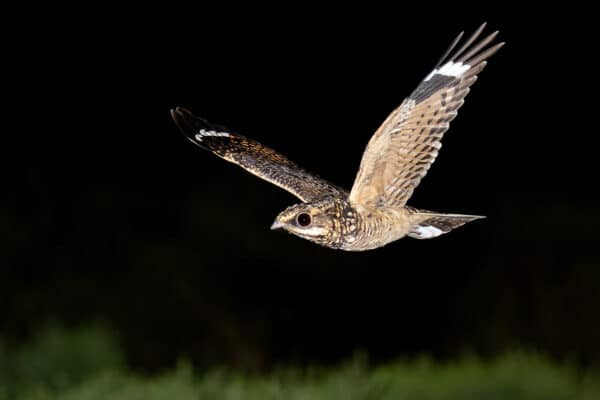
Swamp Nightjar
Caprimulgus natalensis

Number Of Mature
Individuals (Regional)
<1 000

Regional
Population Trend
Decreasing
2025
Regional Category
Vulnerable
Search by species
CONTENTSOverview
Names
|
IOC English Name: |
Swamp Nightjar |
|
SA & IOC Scientific Name: |
Caprimulgus natalensis |
|
BirdLife International Taxonomy (scientific name): |
Caprimulgus natalensis |
|
Order: |
CAPRIMULGIFORMES |
|
Family: |
Caprimulgidae |
|
Species name author: |
Smith 1845 |
|
Afrikaans: |
Natalse Naguil |
|
Sesotho (South Africa): |
Semanamasamohlaka |
|
Sesotho (Lesotho): |
|
|
Siswati: |
|
|
Zulu: |
umhlohlongwane |
Current Assessment Status
|
2025 Regional Category [Criteria] |
VU [D1] |
|
2024 Global Category [Criteria] |
LC (BirdLife International 2024) |
|
Population size (Regional) |
<1000 (Davies 2015) |
|
Population size (Global) |
Unknown (BirdLife International 2024) |
|
Distribution size (EOO) (Regional) km2 |
26 573 (Lee 2024) |
|
Distribution size (EOO) (Global) km2 |
16 200 000 (BirdLife International 2024) |
|
Distribution size (AOO) (Regional) km2 |
3372 (Lee 2024) |
|
Generation time |
4.4 years (BirdLife International 2024) |
|
Status change reason |
No Change |
|
Migrant (in the region) |
Not a migrant (resident) |
|
Regional endemic |
No |
Historic Listing Information
|
2000 Regional Status |
VU [B1+2c; C1+2a] |
|
2015 Regional Status |
VU [B2a; C1+2a] |
|
Status change reason (if applicable) |
No Change |
|
2015 Population size (Regional) |
<1000 mature individuals |
|
2015 Global Status |
LC |
Reason for Inclusion
Reason for Inclusion in the Assessment
The species was listed as Vulnerable in the 2000 and 2015 Regional Red List assessments (Davies 2015). Very fragmented global range, with the regional and Mozambique population apparently isolated from the rest of the African range.
Category Justification
Category Justification
Poorly known species. The small estimated regional population (<1000 mature individuals) satisfies the Vulnerable category under the very small or restricted population criteria. The Swamp Nightjar Caprimulgus natalensis does not approach any of the population size reduction and geographic range criteria. The regional population of Swamp Nightjar is assessed as Vulnerable [D1]. This species has a very fragmented distribution and hence is not considered a good candidate for a rescue effect.
Population Justification
The global population size for this species is unknown (BirdLife International 2024). Regionally, the population is still estimated at <1000 mature individuals (Davies 2015) as there is no evidence to suggest that the population has increased since the 2015. The population is concentrated around the protected area of the iSimangaliso Wetlands Park, with scattered records as far south as Port Edward. Confidence in this estimate is low.
Trend Justification
Globally Swamp Nightjar is suspected to be in decline based on loss of habitat (BirdLife International 2024). However, the rate of decline is not known.
Within the region there is insufficient Southern African Bird Atlas (SABAP2) data to model predicted range change (Lee 2024). The species was recorded in 22 pentads for the 2007-2015 SABAP2 period and 29 pentads for the 2016-2023 (Lee 2024). Although an apparent increase, this may just represent greater effort from birdwatchers to locate this species and therefore cannot be translated into indices of population change. As a result, the regional population trend is not known but presumed to be stable within protected areas. Confidence in this trend is low.
Biology & Ecology
Taxonomy
The species is polytypic. There are, however, differences of opinion regarding the number of subspecies which vary between four and seven, based mostly on plumage differences (Cleere et al. 2021). The species occurring within the region belongs to the race Caprimulgus natalensis natalensis (Cleere et al. 2021).
Identification
23 cm, 60–65 g. The sexes differ in plumage colouration. Females have buff-cream outermost retrices as opposed to white in the males with tawny coloured spots on the outer primaries whereas the spots on the males are white (Davies and Allan 2005). The species is a short compact, long-legged nightjar, with a brown to grey colouration and with conspicuous facial markings. The Swamp Nightjar is often confused with the Square-tailed Nightjar C. fossii, but can be differentiated from the latter through distinctive vocal array, habitat preference and a more spotted appearance (Davies and Allan 2005).
Distribution
The species is restricted to mainland Africa south of the Sahara Desert where the distribution can be described as widespread and highly fragmented (Cleere et al. 2021). In the region the species is mostly confined to the coastal region of Kwa-Zulu Natal, north of the Tugela River mouth (Figure 1). This population just extends into southern Mozambique. There is a relict population that occurs in the coastal region of the Eastern Cape, extending into southern Kwa-Zulu Natal (Davies and Alan 2005). Recent recordings suggest that the species still occurs on at Oribi Gorge Nature and Umtamvuna Nature Reserves in southern Kwa-Zulu Natal (SABAP2 unpubl data). The regional population is isolated from the remainder of the African range; the next closest population is in northern Botswana and north-western Zimbabwe (Maclean 1997).
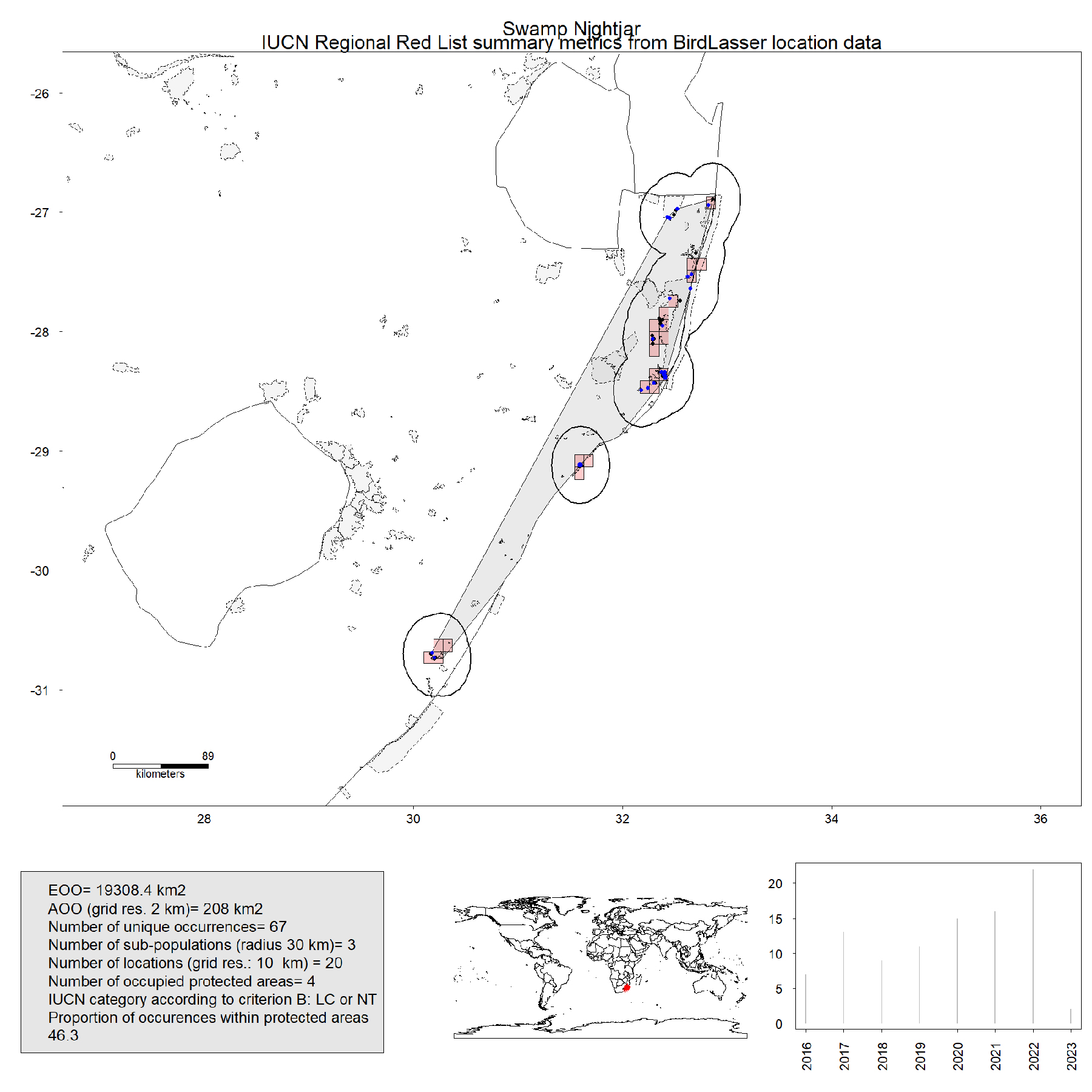
Figure 1: Distribution map of Swamp Nightjar within the Region from BirdLasser app records. Data is from 2016-2023. Map from Lee (2024).
Ecology
Habitat:
The species prefers permanently wet or damp habitats sustained year-round in the same state by a high-water table or ground water seepage, sparsely vegetated with tufts or clumps of grasses, plants and other vegetation. These habitats occur in grasslands, floodplains swamps, marshes, vleis, and along lagoon edges. Burnt habitats are generally unsuitable and birds tend to move out of areas after fires (Cleere et al. 2021).
Migration:
Swamp Nightjar are considered resident and sedentary (Davies and Allan 2005), but are subject to nomadic wanderings (Tree 1967) probably due to unfavourable local conditions due to flooding, fires, etc.
Breeding:
The Swamp Nightjar is a solitary nester laying their eggs on bare sandy or clay soil next to or under a tuft of grass. They prefer treeless nesting areas, avoiding areas that are burnt unless there are unburnt patches which can be/and are chosen for nest sites. Incubating birds blend into the environment, but the eggs are conspicuous if they are not covered by the bird. The clutch consists of two eggs and is incubated by both adults. The female incubates during the day and the male at night. The incubation period is less than 20 days. Little is known about the development and care of the young other than the chicks are brooded by both parents (Tarboton 2001)
Diet:
Swamp Nightjars feed predominantly on flying insects that area available between dusk and dawn (Jackson 2003). Birds usually rise up from the ground to catch passing prey alighting immediately afterwards, but they have been seen foraging from posts and hawking insects from sustained flight (Davies and Allan 2005). The species does, however, have robust tarsi and toes and the presence of pupae in stomach contents suggest it may run on the ground after insects (Jackson 2003). Prey which is predominantly beetles and moths is generally swallowed live and whole (Jackson 2003).
Threats & Conservation
Threats
Regionally, threats are poorly understood but loss of habitat is assumed to constitute the predominant threat facing the Swamp Nightjar. This is mostly due to agriculture, urban development, afforestation and wetland drainage (Davies 2015). The level of road mortality for the species is very low for the species (Jackson 2002).
Conservation Measures Underway
There are no conservation measures currently in place specifically for this species. However, the regional population appears well represented within nature reserves (e.g. iSimangaliso Wetland Park, Oribi Gorge and Umtamvuna Nature Reserves in Kwa-Zulu Natal and Mkambati Nature Reserve in the Eastern Cape Province) (Davies 2015). Lake St Lucia within the Isimangaliso Wetland Park supports an estimate 400 – 500 birds (Johnson et al.1998), which is more than 50% of the estimated regional population.
Conservation Measures Proposed
- Preservation and correct management of nature reserves will ensure security of the species within the region.
- The 2015 assessment proposed a species action plan (Davies 2015). This has unfortunately not materialised, and would be of great value, providing a coordinated effort to address issues facing the species
Research Priorities and Questions
- Much of what is known about the species emanate from several papers compiled by H.D. Jackson on the Swamp Nightjar, mostly from his research on nightjars in Zimbabwe in the early 2000’s. However this is a different subspecies, which is larger and may have a different biology. Within the region other than observational notes it is not clear what the habitat requirements of the species is, nor other aspects of its biology e.g. fledgling period and foraging methods. A detailed study looking into some of the less understood biological aspects of the species is required.
- The regional population size needs to be established.
- The taxonomy of the species needs clarification. Some authors recognise only one subspecies while other recognise two subspecies within southern Africa. It is currently accepted that the bulk of the subspecies C.n.natalensis occurs within the region, extending marginally into southern Mozambique. This is a fairly isolated population, the nearest population occurring in northern Botswana, north-western Zimbabwe which is the subspecies C.n.carpi (Davies and Allan 2005). If C.n.natalensis is an accepted subspecies and does not occur further north, then the conservation of the species within the region is of utmost importance.
Contributors & References
Assessor/s
Kevin Shaw
Reviewer/s
James Bradley
References
BirdLife International. 2024. Caprimulgus natalensis. The IUCN Red List of Threatened Species 2024: e.T22689972A263648579. https://dx.doi.org/10.2305/IUCN.UK.2024-2.RLTS.T22689972A263648579.en. [Accessed on 27 January 2025].
Cleere N, Kirwan GM, Boesman PFD 2021. Swamp Nightjar (Caprimulgus natalensis). In: Schulenberg TS, Keeney BK (eds), version 2.0. In Birds of the World. Ithaca, NY, USA: Cornell Lab of Ornithology. https://doi.org/10.2173/bow.swanig1.02
Davies GBP. 2015. Swamp Nightjar Caprimulgus natalensis. In: Taylor MR, Peacock F, Wanless RW (eds), The Eskom Red Data Book of Birds of South Africa, Lesotho and Swaziland. Johannesburg, South Africa: BirdLife South Africa. pp 238–238.
Davies GBP, Allan DG. 2005. Swamp Nightjar (Natal Nightjar) Caprimulgus natalensis. In: Hockey PAR, Dean WRJ, Ryan PG (eds), Roberts – Birds of Southern Africa, 7th Edn. Cape Town: The Trustees of the John Voelcker Bird Book Fund. pp 268–269.
Jackson HD. 2003. A review of foraging and feeding behaviour, and associated anatomical adaptations, in Afrotropical nightjars. Ostrich 74(3-4): 187–204.
Johnson DN, Barnes KN, Taylor B. 1998. The Important Bird Areas of Kwa-Zulu Natal. In: Barnes KN (ed), The Important Bird Areas of southern Africa. Johannesburg: BirdLife South Africa. pp 141–196.
Lee ATK. 2024. Regional Red Data Book of the Birds of South Africa, Lesotho and Eswatini: SABAP2 synthesis and supporting information and graphics for Swamp Nightjar. Unpublished report. Johannesburg: BirdLife South Africa.
Maclean GL. 1997.Natal Nightjar Caprimulgus natalensis. In: Harrison JA, Allan DG, Underhill LG, Herremans M, Tree AJ, Parker V, Brown, CJ (eds), The atlas of southern African birds. Vol 1: Non-passerines. Johannesburg: Birdlife South Africa. pp 468–469.
Parker V. 2000. Natal Nightjar Caprimulgus natalensis. In: Barnes KN (ed), The Eskom Red Data Book of Birds of South Africa, Lesotho and Swaziland. Johannesburg, South Africa: BirdLife South Africa. pp 114–115.
Tarboton W. 2001. A guide to the nests & eggs of southern African birds. Cape Town: Struik Publishers.
Tree AJ. 1967. Notes on the Caprimulgidae of the Kafue Basin. Ostrich 38:189–193.
Citation
Shaw K 2025. Swamp Nightjar. In: Lee ATK, Rose S, Banda S, Bezeng SB, Maphalala MI, Maphisa DH, Smit-Robinson H (eds), The 2025 Red Data Book of Birds of South Africa, Lesotho and Eswatini. Johannesburg, South Africa: BirdLife South Africa. Available at: https://www.birdlife.org.za/red-list/swamp-nightjar/
Our generous sponsors


