


Striped Flufftail
Sarothrura affinis

Number Of Mature
Individuals (Regional)
440 – 2 150

Regional
Population Trend
Decreasing
2025
Regional Category
Vulnerable
Search by species
CONTENTSOverview
Names
|
IOC English Name: |
Striped Flufftail |
|
SA & IOC Scientific Name: |
Sarothrura affinis |
|
BirdLife International Taxonomy (scientific name): |
Sarothrura affinis |
|
Order: |
GRUIFORMES |
|
Family: |
Sarothruridae |
|
Species name author: |
Smith A, 1828 |
|
Afrikaans: |
Gestreepte Vleikuiken |
|
Sesotho (South Africa): |
motsuwane-o-mereto |
|
Sesotho (Lesotho): |
motsuoane-o-mereto |
|
Siswati: |
|
|
Zulu: |
ubhavuzilomidwayidwa |
Current Assessment Status
|
2025 Regional Category [Criteria] |
VU [C1] |
|
2024 Global Category [Criteria] |
LC (BirdLife International 2024) |
|
Population size (Regional) |
1440 – 2150 mature individuals (Taylor 1997, Barnes 1998) |
|
Population size (Global) |
Unknown |
|
Distribution size (EOO) (Regional) km2 |
563 965 (366 633 – 674 274) (Lee 2024) |
|
Distribution size (EOO) (Global) km2 |
4 280 000 (BirdLife International 2024) |
|
Distribution size (AOO) (Regional) km2 |
17 852 (7272 – 33 140) (Lee 2024) 8694 – 8770 (Ehlers Smith, unpublished data) |
|
Generation time |
2.9 years (BirdLife International 2024) |
|
Status change reason |
No change |
|
Migrant (in the region) |
No |
|
Regional endemic |
No |
Historic Listing Information
|
2000 Regional Status |
VU [A1c+2c; C1+2a] |
|
2015 Regional Status |
VU [A2c; C1+2a(i)] |
|
Status change reason (if applicable) |
No change |
|
2015 Population size (Regional) |
1440 – 2150 mature individuals |
|
2015 Global Status |
LC |
Reason for Inclusion
Reason for Inclusion in the Assessment
Previously assessed as Vulnerable in 2000 [A1c+2c; C1+2a] and 2015 [A2c; C1+2a(i)] (Taylor 2000, Peacock 2015).
Category Justification
Category Justification
The Striped Flufftail Sarothrura affinis qualifies as Vulnerable under Criterion C1. The population was estimated at 1440 – 2150 mature individuals in 1998 (Taylor 2000), although confidence in this estimate is now low. Continuing decline, inferred from habitat degradation due to decline in habitat quality through inappropriate fire regimes, grazing, agriculture, and afforestation is observed. The extent of the decline is unknown, but likely to exceed 10% over 10 years (Peacock 2015), thus invoking Criterion C1. Birds show strong site fidelity, with recorded densities highest in well-managed protected areas (1 pair/11 ha), dropping significantly in degraded habitats (Taylor 1994). Fire-related mortality and poor dispersal ability compound population impacts.
Population Justification
Regional population estimate of 1440 – 2150 mature individuals is derived from territory mapping and density studies (Taylor 2000). Confidence in this estimate is currently low. At Mount Currie Nature Reserve, 59 territories identified with 16–33 occupied seasonally, reaching maximum density of 1 pair/11 ha (Taylor 1994). Territories average 1.64 ± 0.36 ha (range 1.05–2.30 ha), with home ranges of 2.58 ± 0.38 ha (range 2.00–3.24 ha) (Taylor 1994).
Protected area estimates indicate 466 – 618 breeding pairs in Important Bird Areas (IBAs), with additional non-IBA populations totalling 586 – 738 pairs (Barnes 1998).
Trend Justification
Global population trends are decreasing (BirdLife International 2024). From the Southern African Bird Atlas (SABAP2), reporting rates show regional variation: mean reporting rate increased from 3.6% (2007-2015) to 4.0% (2016-2023), while median rates rose from 0.4% to 1.2% (Lee 2024). Confidence in population estimates is medium, but suggests that the population trend may not be declining. SABAP2 reporting rates show stable trends but low confidence, with significant regional variation (Lee 2024). Higher reporting rates in protected areas (mean = 4.0%) versus unprotected areas (mean = 0.4%, Lee 2024) indicate dependence on well-managed habitat, which is supported as the majority of the population is located in the Ukhahlamba-Drakensberg Protected Environment (Taylor 1994). Life history traits of Striped Flufftail (nocturnal, cryptic and shy) mean that inferring trends or population size from citizen science datasets need to be done with caution as the species is likely underrepresented by the SABAP2 dataset.
Striped Flufftail are considered to be in decline within the region based on the ongoing decline in habitat quality and availability. This species is sensitive to changes in vegetation height and disturbance (e.g. Taylor and Kirwan (2020)). Habitat degradation through alteration of the natural fire regime, with documented direct mortality; intensive grazing impacting ground cover; afforestation reducing available habitat, and alien plant invasion, particularly in fynbos (Taylor 1994, Hockey 2005), but also in montane (upland) grassland in southern KwaZulu-Natal and Drakensberg (Smit-Robinson, pers obs) all contribute to regional declines. Despite the rate of decline, there is insufficient evidence to show that a downlisting is warranted.
Biology & Ecology
Taxonomy
Two races described: nominate race endemic to South Africa and Eswatini; S. a. antonii from Zimbabwe northwards. The latter may include two undescribed taxa from Kenyan Highlands east and west of Rift Valley (Keith et al. 1970, Taylor and van Perlo 1998). Previously known as Sarothrura lineata.
Identification
14–15 cm, c. 25–30 g. Small, secretive rallid with sexual dimorphism. Male: chestnut crown, face and nape; white chin and throat; dark blackish-brown body with white streaks; chestnut undertail coverts and tail. Female: browner overall; dark blackish-brown upperparts with buff barring; white chin and throat; spotted underparts. Both sexes: dark bill, paler at base of lower mandible; dark eyes; pinkish-brown to pinkish-grey legs (Taylor and van Perlo 1998, Hockey 2005).
Distribution
The Striped Flufftail occurs from South Sudan through central-east Africa into South Africa (BirdLife International 2024). In the region, it occurs in fragmented populations from Cape Peninsula through Eastern Cape to southern KwaZulu-Natal and Drakensberg, extending to south-eastern Mpumalanga and Eswatini (Malolotja National Park) (Parker 1994). Sparse records in Limpopo include Wolkberg and Haenertsburg areas. Eastern Free State records suggest more continuous distribution than previously thought (Hockey 2005). No recent confirmed records from Lesotho (Ambrose 2020). Highest densities in southern KwaZulu-Natal.
Additionally, 61.3% of occurrences fall within protected areas. Distribution is divided between 31 pentads in National Parks/Nature Reserves, five in other protected areas, and 30 in unprotected areas (Lee 2024).
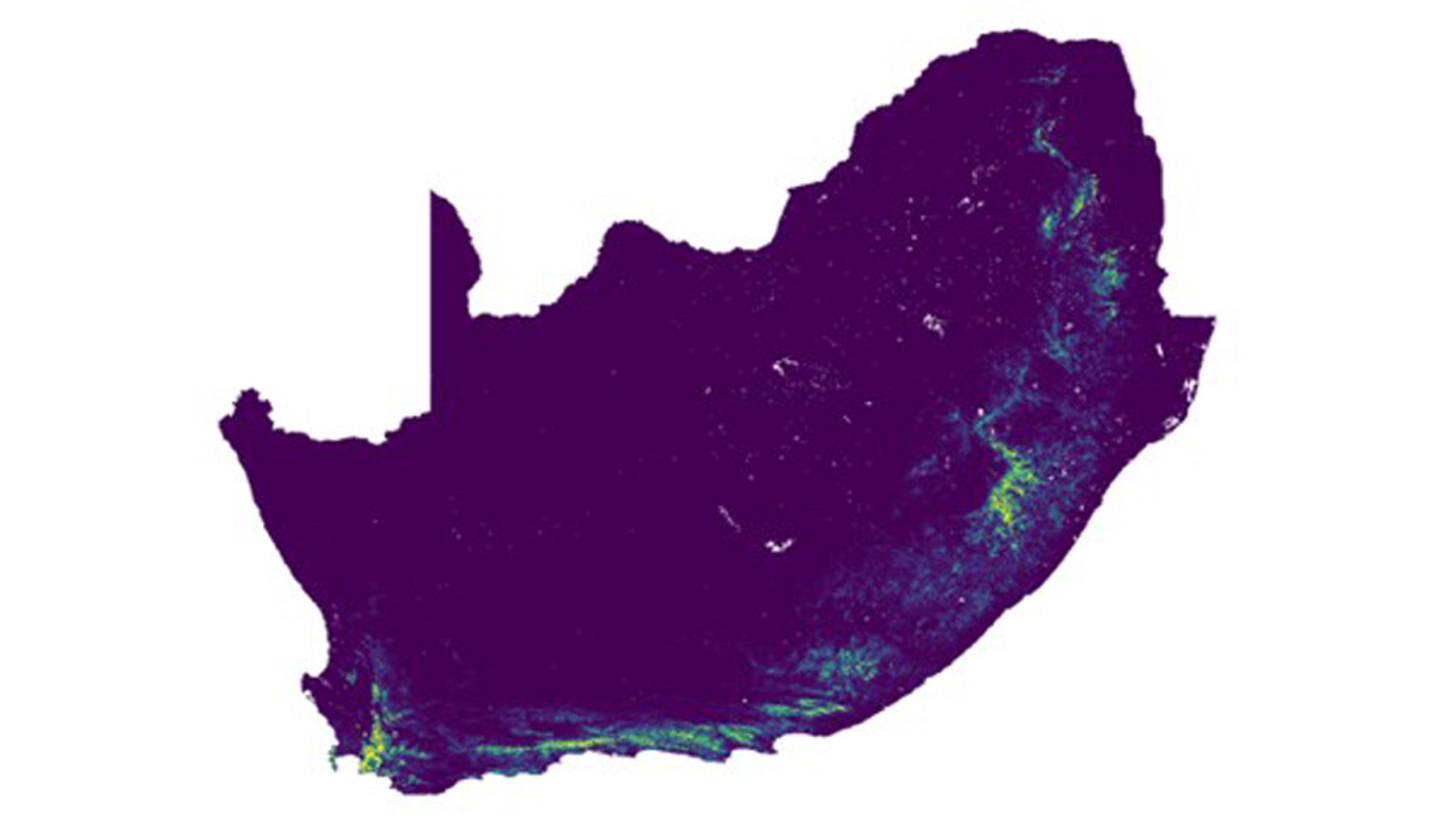
Figure 1: Species distribution map for Striped Flufftail derived from SABAP2 data and produced in MaxEnt (DA Ehlers Smith unpubl data).
Inhabits dense vegetation with open foraging ground. Primary habitats include upland sourveld grassland dominated by Themeda triandra with associated grasses (Hyparrhenia, Festuca, Tristachya, Cymbopogon), often with woody elements. In fynbos, occurs in Psoralea-Osmitopsis vegetation near water courses (Taylor and van Perlo 1998).
Optimal habitat appears to be vegetation 0.35–1.0 m tall, mean height ≤60 cm, 80–100% ground cover on slopes 4–26° (Taylor 1994). Most territories include drainage features. The altitudinal range extends from sea level to 2100 m in KwaZulu-Natal. The species does not return to burned areas until the vegetation and invertebrate populations have sufficiently recovered.
Breeds September-March, peaking December-February (summer rainfall regions) and September (Western Cape). Monogamous and territorial during breeding; may form post-breeding groups at lower altitudes (Hockey 2005) and may show seasonal altitudinal movement. These birds show strong site fidelity and poor dispersal, abandoning territories only when the habitat becomes completely unsuitable (Taylor 1994).
Threats & Conservation
Threats
- Habitat degradation through:
- Inappropriate fire regimes causing direct mortality;
- Intensive grazing reducing ground cover;
- Agricultural expansion and afforestation;
- Urban development in coastal areas;
- Alien plant invasion, in fynbos and montane (upland) grasslands.
- Wind energy facility collisions with documented mortality in Eastern and Western Cape Provinces (BirdLife South Africa 2025).
- Climate change impacts on montane habitats (Simmons et al. 2004). Montane grasslands will become drier and face additional ecosystem-altering effects.
- Being highly sought-after by birdwatchers, disturbance by avitourists may pose a secondary threat through excessive playback of calls and trampling at popular birding sites.
Conservation Measures Underway
No species-specific measures implemented. Benefits from habitat protection within formal conservation areas, with 61.3% of occurrences in protected areas (Lee 2024). The Striped Flufftail may benefit from habitat conservation efforts aimed at the White-winged Flufftail in areas where the species occur in close proximity in montane grasslands adjacent to sedge dominated habitats.
Conservation Measures Proposed
- Expand protected area network to include newly discovered sites.
- Implement appropriate fire and grazing management regimes.
- Control invasive vegetation, particularly in fynbos and in montane grassland.
- Investigate and mitigate wind energy development impacts and implement guidelines for responsible wind energy developments.
- Create habitat patches in farming areas through less intensive grazing and biennial burning cycles.
Research Priorities and Questions
- Conduct comprehensive population surveys. Passive monitoring may be an important tool.
- Establish patterns of seasonal movement and altitudinal migration.
- Quantify fine-scale habitat requirements and responses to management.
- Assess climate change vulnerability.
- Monitor wind energy facility collision rates.
- Study breeding biology across habitat types.
- Investigate winter habitat use and movements.
Contributors & References
Assessor/s
Hanneline Smit-Robinson, David Ehlers Smith
Reviewer/s
Kyle Loyd, Kevin Shaw
References
Ambrose D. 2020. Annotated Checklist of Birds of Lesotho. Roma, Lesotho: House 9 Publications.
Barnes KN. 1998. The Important Bird Areas of southern Africa. Johannesburg: BirdLife South Africa.
BirdLife International. 2024. Sarothrura affinis. The IUCN Red List of Threatened Species 2024: e.T22692236A265021845. https://dx.doi.org/10.2305/IUCN.UK.2024-2.RLTS.T22692236A265021845.en. [Accessed on 17 February 2025].
BirdLife South Africa. 2025. Summary Bird Monitoring Reports from Operational Wind Energy Facilities in South Africa. Technical Report, Johannesburg: BirdLife South Africa.
Hockey PAR. 2005. Striped Flufftail Sarothrura affinis. In: Hockey PAR, Dean WRJ, Ryan PG (eds), Roberts Birds of Southern Africa (7th Edn). Cape Town: The Trustees of the John Voelcker Bird Book Fund.
Keith GS, Urban EK, Fry CH. 1970. The Birds of Africa, Vol. 4. London: Academic Press.
Lee ATK. 2024. Regional Red Data Book of the Birds of South Africa, Lesotho and Eswatini: SABAP2 synthesis and supporting information and graphics for Striped Flufftail. Unpublished report. Johannesburg: BirdLife South Africa.
Parker V. 1994. Swaziland Bird Atlas 1985-1991. Mbabane: Websters.
Peacock F. 2015. Striped Flufftail Sarothrura affinis. In: Taylor MR, Peacock F, Wanless RM (eds), The Eskom Red Data Book of Birds of South Africa, Lesotho and Swaziland. Johannesburg: BirdLife South Africa. pp 98–99.
Simmons RE, Barnard P, Dean WRJ, Midgley GF, Thuiller W, Hughes G. 2004. Climate change and birds: perspectives and prospects from southern Africa. Ostrich 75: 295–308.
Taylor PB. 1994. The biology, ecology and conservation of four flufftail species, Sarothrura (Aves: Rallidae). PhD thesis, University of Natal.
Taylor B, van Perlo B. 1998. Rails: A Guide to the Rails, Crakes, Gallinules and Coots of the World. Sussex: Pica Press.
Taylor PB. 2000. Striped Flufftail Sarothrura affinis. In: Barnes KN (ed), The Eskom Red Data Book of Birds of South Africa, Lesotho and Swaziland. Johannesburg: BirdLife South Africa. pp 98–99.
Citation
Smit–Robinson H, Ehlers Smith DA 2025. Striped Flufftail. In: Lee ATK, Rose S, Banda S, Bezeng SB, Maphalala MI, Maphisa DH, Smit-Robinson H (eds), The 2025 Red Data Book of Birds of South Africa, Lesotho and Eswatini. Johannesburg, South Africa: BirdLife South Africa. Available at: https://www.birdlife.org.za/red-list/striped-flufftail/
Our generous sponsors


