


Spur-winged Goose
Plectropterus gambensis

Number Of Mature
Individuals (Regional)
>50 000

Regional
Population Trend
Decreasing
2025
Regional Category
Least Concern
Search by species
CONTENTSOverview
Names
|
IOC English Name: |
Spur-winged Goose |
|
SA & IOC Scientific Name: |
Plectropterus gambensis |
|
BirdLife International Taxonomy (scientific name): |
Plectropterus gambensis |
|
Order: |
ANSERIFORMES |
|
Family: |
Anatidae |
|
Species name author: |
Linnaeus 1766 |
|
Afrikaans: |
Wildemakou |
|
Sesotho (South Africa): |
letsikgwi |
|
Sesotho (Lesotho): |
letsikhoi |
|
Siswati: |
Injigi |
|
Zulu: |
ihhoye |
|
isiXhosa |
ihoye |
Current Assessment Status
|
2025 Regional Category [Criteria] |
LC |
|
2024 Global Category [Criteria] |
LC (BirdLife International 2016) |
|
Population size (Regional) |
South African population estimated >50 000 individuals (Colahan 1997) |
|
Population size (Global) |
200 000 – 330 000 mature individuals (Wetlands International 2024) |
|
Distribution size (EOO) (Regional) km2 |
1 421 087 (Lee 2024) |
|
Distribution size (EOO) (Global) km2 |
22 900 000 (BirdLife International 2024) |
|
Distribution size (AOO) (Regional) km2 |
712 510 (56 2186 – 79 6515) (BIRDIE 2024) |
|
Generation time |
8.5 years (BirdLife International 2024) |
|
Status change reason |
No change |
|
Migrant (in the region) |
Semi-nomadic movements |
|
Regional endemic |
No |
Historic Listing Information
|
2000 Regional Status |
LC |
|
2015 Regional Status |
LC |
|
Status change reason (if applicable) |
Not applicable |
|
2015 Population size (Regional) |
Unknown |
|
2015 Global Status |
LC |
Reason for Inclusion
Reason for Inclusion in the Assessment
This species was not previously assessed. Preliminary screening of Coordinated Waterbird Counts (CWAC) data indicated a significant decline in number of Spur-winged Goose Plectropterus gambensis counted per year (Lee 2024).
Category Justification
Category Justification
The range of the Spur-winged Goose at a regional level does not meet the threshold for Vulnerable under the range size criterion (Extent of Occurrence (EOO) <20 000 km2 and Area of Occupancy (AOO) <2 000 km2).
The regional population is estimated to be >50 000 individuals (c. 33 000 mature individuals), which is significantly higher than the threshold for Vulnerable under the population size criterion.
Trend data from citizen science datasets showed conflicting results. Static and dynamic models of the AOO based on second Southern African Bird Atlas Project (SABAP2) occurrence predicted a decline of 0.9% and 9.6% respectively. Modelled reporting rates from SABAP2, predict with a high confidence a significant increase in the probability of reporting rates. This may be linked to dispersal and is not necessarily representative of an increasing population.
Analysis of population data predicted a decline of 12%, while analysis of the same data for African Eurasian Waterbird Agreement (AEWA) indicated the population was stable. CWAC predicted a decline of uncertain magnitude, but approaching 30% in some scenarios.
Data from the Coordinated Avifaunal Roadcounts (CAR) show an increase in the number of birds/km implying an increase in the population.
The conflicting data trends make it extremely difficult to predict with confidence whether the regional population is increasing, decreasing or stable. While this is concerning and needs to be addressed, none of the trends indicating declines approached the thresholds for Vulnerable under the population criteria and the species is assessed as Least Concern.
Population Justification
BirdLife International (2024) lists the global population as unknown. Wetlands International (2024) estimates the global population to be 300 000 to 500 000 individuals (c. 200 000 – 330 000 mature individuals) of which the southern African population is 50 000 – 100 000 (c. 33 000 – 67 000 mature individuals). However, these figures have remained unchanged since the second publication of Waterfowl Population Estimates in 1997 (Rose and Scott 1997). There have been three subsequent Waterfowl Population Estimate publications and five Conservation Status Reports the last compiled in 2020 where the estimates are indicated as a “Best Guess”. Regionally, surveys carried out on 147 wetlands as part of the CWAC Project estimated the population for these sites based on summer counts to be 1310 individuals (BIRDIE 2024). Considering that these wetlands comprise a small percentage of the range of the species, this number is certainly a severe underestimate of the regional population, given its relatively recent exploitation of wetlands impoundments and croplands. Also, these are based on summer counts where the numbers of birds counted are substantially less than the winter counts. Colahan (2005) estimate that the South African population is in excess of 50 000 birds (c. 33 000 mature individuals). The regional population is considered with high confidence to exceed the population criterion threshold for Vulnerable (10 000 mature individuals).
Trend Justification
The global population assessed in 2016 is considered to be increasing (BirdLife International 2016).
The different data sources and analysis demonstrate varying outcomes which is concerning and making it difficult to predict trends at a regional level. Currently this is not a concern as none of the negative trends exceed any Red List category thresholds. The analysis undertaken by Nagy et al. (2020) and the subsequent trend (stable population) would probably be the best prediction based on the years of experience that has been established within Wetlands International on waterbird trend analysis.
Three datasets and various analytical pathways were used to determine population trends (BIRDIE 2024, Lee 2024).
Reporting rates from SABAP2 were used as a proxy for population size, with the reasoning that higher numbers would result in higher reporting rates. Modelling the probability of reporting a species, accounting for season, BirdLasser effects, if all habitats were surveyed, sampling hours and with pentad or observer as random effect, showed with high confidence a significant increase in probability of reporting rates (Lee 2024).
Presence absence data collected per pentad through SABAP2 (grid approximately 9 km x 7 km) for the entire region were divided into two periods (2007-2014 and 2015-2023) and static models were used to predict the number of pentads species could occur in within each period. The models predicted a decrease in the AOO between the two periods of 1.4% (Lee 2024). Using the same data and available habitat per year, the number of pentads in which the species could occur were predicted annually between 2008 and 2022. Data emanating from these dynamic models estimated that the AOO declined 9.6% (BIRDIE 2024).
Using SABAP2 pentad level models, the static models (Lee 2024) indicated a slight decrease in AOO, while the dynamic models (BIRDIE 2024), predicted a decline of 9.6%. State-spaced models were applied to population counts carried out at various wetlands across the region to estimate the true number of individuals at each wetland for which adequate counts existed. Analysis of the data predicted a population decline of 12% over a 26-year period for these wetlands. More importantly, the decline was driven by the winter count estimates, as the summer counts varied considerably resulting in unpredictable trends. This is due to the species concentrating on large wetlands during moult and then dispersing to breed nearby smaller bodies of water.
Analyses of CWAC counts indicated significant declines across various modelled pathways, the magnitudes of which depended on whether historic very large counts were included (Lee 2024). This species was recorded at 539 of 719 CWAC sites. Mean winter count was 37.7, median was 0, and max was 3462. Mean summer count was 12.8, median was 0 and max was 2080. The maximum of 3462 was recorded at Krugersdrift Dam (Free State Province) on 5 August 2003. Over the 35 counts at that dam, mean count was 564, with standard deviation 703. Estimated percent change over three generations, from Year = 1997.75 to 2023 was -32% (-48%, -9.7%). However, some sites with large counts were no longer surveyed as of 2015, so there is low confidence in this trend.
CAR surveys are done twice a year (January and July) along set routes according to a set methodology, targeting amongst others specific large terrestrial birds. Data collected from 1993-2020 indicated a definite increase (Figure 1) in the average number of birds per/km from c. 0.28 birds/km in 1993 to c. 0.44 birds/km in 2020 (Lee 2024).
Data from the state space models predicted a decline in population numbers but only for 147 wetlands for which there was sufficient data. Considering the widespread distribution of the species within the region (Figure 2) it could be argued that these wetlands are not a representative sample size especially considering that only about 15 of these sites held more than 100 birds at any given time. The decline was, however, determined using the winter counts as this species congregates on large impoundments during this period to moult. Summer counts were extremely variable and nearly four times lower year for year than the winter counts. Also, there were very few sites contained in the entire data set showing high (>100 individuals) numbers of birds that were excluded in the state-spaced modelling exercise. Colahan (1997) does, however, state that numbers at moult sites in the Free State Province may vary greatly from year to year and in addition utilise new impoundments for moult sites. It is probable that between year fluctuations, plus the ability to utilise new impoundments as moult sites, would impact winter counts and subsequently trends.
Wetlands International (2024) indicate with reasonable confidence that the Southern African population is likely stable, based on longer-term survey data analysed by Nagy and Langendoen (2020), where they also determined that the trend over three generations to be stable. It must be noted that Nagy and Langendoen (2020) used data from the same data set that was used in the state-space models above. They were, however, less strict with the site selection criteria, and their data set included sites from Botswana, Eswatini and Zimbabwe as well, but the data contributing to the totals for this species is almost exclusively from South Africa.
The increase shown by the data emanating from the road counts (Figure 1) is to be expected as the routes cover large areas of agricultural land. The species is known to have relatively recently adapted to the croplands and associated artificial wetlands (Underhill et al. 1999, Harebottle and Harrison 2003, Colahan 2005). Increases in the Western Cape, (Overberg and Swartland), KwaZulu-Natal and Eastern Karoo areas (Figure 1) where significant numbers of birds are found on croplands (Harebottle and Harrison 2003) is driving the increase in the trend. It is difficult to determine with the available data whether this is an increase in population size or displacement from natural wetlands to more favourable cropland habitat.

Figure 1: The average number of individuals recorded per route across all CAR routes. Thin lines are the contributing precincts (with routes nested in precincts), the black line the trend with the grey shading representing the confidence interval. Due to falling participation in the project the data was truncated at 2020 (Lee 2024). Precinct codes are: EE = Northeastern Cape; EP = Eastern Cape Karoo; FN = Northeastern Free State; FS = Southern Free State; FW = Northwestern Free State; KD = KwaZulu-Natal Dundee; KM = KwaZulu-Natal Midlands; NK = Eastern Karoo; OV = Overberg; SW = Swartland.
Biology & Ecology
Taxonomy
Two subspecies are recognised, Plectropterus gambensis gambensis (Linnaeus 1766) – Gambia to Ethiopia south to Angola and Mozambique and P.g. niger (Sclater 1877) – Namibia and Zimbabwe through to South Africa.
Identification
85–98 cm (Colahan 2005). The males are much larger than the females and can be distinguished from females by their larger red facial patches and a distinctive knob at the base of their upper bill (Clancey 1967, Ginn et al. 1989, Bell 1996). It is primarily black with striking green to violet iridescence wings and back (Colahan 2005). Their legs and feet are a reddish pink hue in colour (Colahan 2005). During flight, the distinctive white forewings, when paired with the black body, set it apart from other waterfowl found in the region (Colahan 2005).
Confusing species:
Could be confused with Knob-billed Duck Sarkidiornis melanotos, however, Spur-winged Goose, is much larger.
Records of hybridisation has been noted between Muscovy Duck, Egyptian Goose Alopochen aegyptiaca and European Shelduck Tadorna (Davies 1911, Gray 1958).
Distribution
The species occurs across most of sub-Saharan Africa, except for the arid areas of north- east Africa, the Namib, central Kalahari and western Mozambique as well as the forest areas of the Congo Basin (Colahan 2005). Within the region (Figure 2) the species is widespread but only locally common in Eswatini, a summer visitor to the lowlands of Lesotho, common in the Western and Eastern Cape Provinces, with the stronghold in KwaZulu-Natal and the central plateau of South Africa (Colahan 2005). Spur-winged Goose are largely absent from arid regions, extreme north-east of South Africa and much of Lesotho (Taylor 1999).

Figure 2: Distribution map of Spur-winged Goose also showing pentad level change between SABAP2 periods 2007-2015 and 2016-2023 (from Lee 2024).
Ecology
Habitat:
Can occur on any permanent or seasonal inland water body but do prefer large wetland bodies for moulting (Taylor et al. 1999). During breeding, birds disperse to more secluded pans, dams or marsh with emergent vegetation or fringing cover (Tarboton et al. 1987). Pasture and veld habitats are also used with significant use of crops in certain areas of the Western Cape, Free State and KwaZulu-Natal Provinces (Harebottle and Harrison 2003).
Migration:
Oatley et al. (1986) found that the Spur-winged Goose undertook no migratory movement, but occasional long-distance movements, with no recorded movement exceeding 700 km. The distance of only 6 of 221 ring recoveries from 3377 ringed birds were found to be greater than 500 km and none were recovered outside the region although inter-country movements certainly do occur (Underhill et al. 1999). Colahan (2005) indicated that the species was probably nomadic, and movement was triggered by rainfall and cultivation of favourite food crops. An analysis of SABAP2 data shows remarkable seasonal trends, with a double of reporting rate in the Free State over summer (Lee 2024, Figure 3). How much is migration and/or seasonal range contraction as birds congregate to moult is unclear.
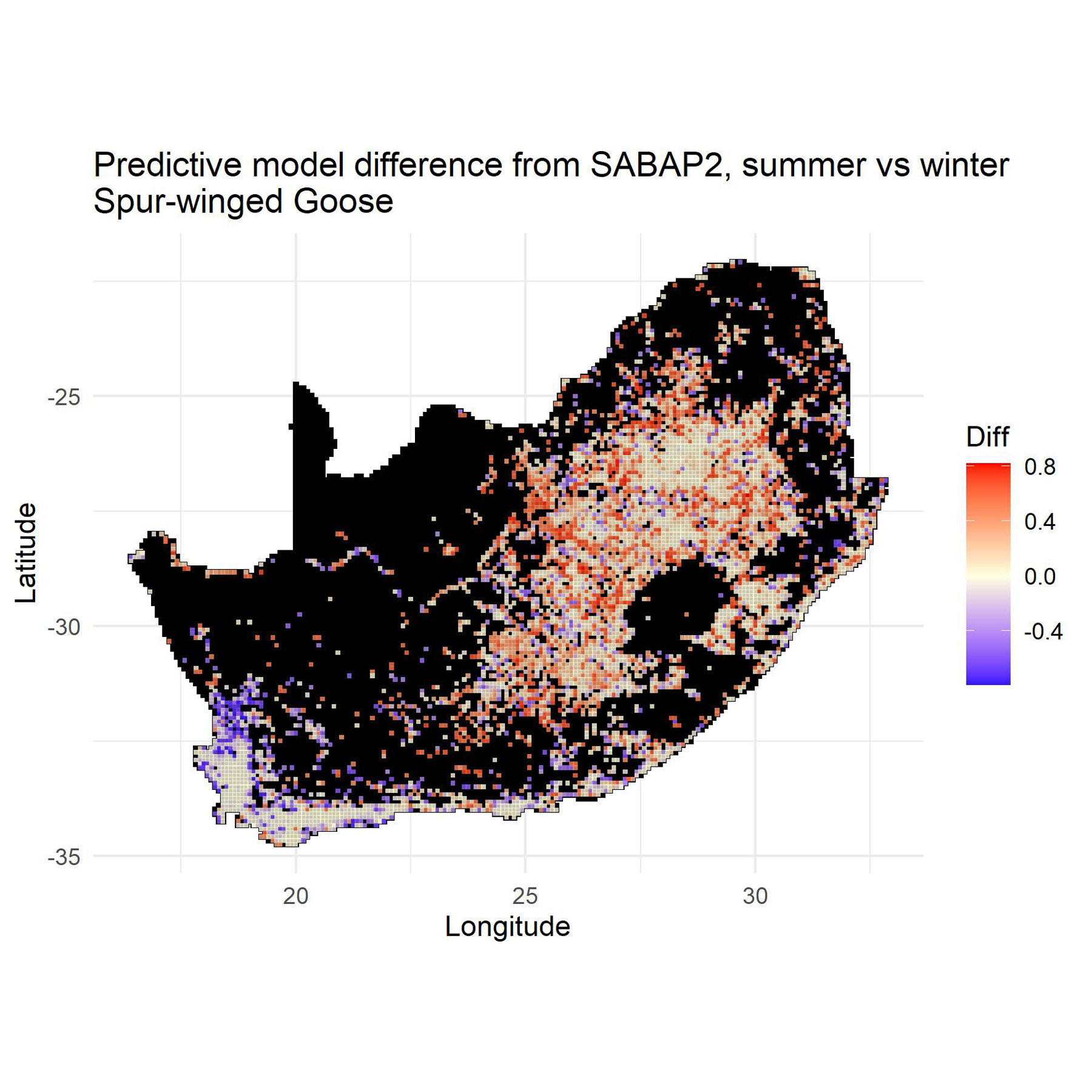
Figure 3: The map is the result of the difference for two modelled ‘seasons’: the ‘winter’
(months May – September) and ‘summer’ period (November-March). Red indicates higher probability of reporting for the ‘summer’ period (from Lee 2024).
Breeding:
Is possibly monogamous (Colahan 2005), although Douthwaite (1978) mentions breeding groups of one male and 1–5 females suggesting that the species may sometimes be polygynous, and Tarboton (2001) states the species is polygynous. Usually a solitary, territorial nester. Males reach sexual maturity at one year, while females likely mature in their second year (Halse 1985a). The species is reported to breed in its third year (Zaloumis 1987). Laying dates vary depending on region (Colahan 2005). The nest is a shallow scrape on the ground and is made by materials that are on site and lined with finer material (Colahan 2005). Nest sites vary, but usually on dry ground with thick grass cover, close to water. Nests are frequently placed above the ground as high as 16m above the ground in large tree cavities, nests of Martial and Fish Eagles or on top of Hamerkop and Sociable Weaver nests (Tarboton 2001). Clutch size 7–14 eggs, in cases where the number of eggs exceeds 14, Clark (1980) suggests this is due to a second female laying eggs in the nest. The eggs are incubated by the female for about 30 days, and she tends the young during the fledgling period, which is about 10 weeks (Tarboton 2001). The male plays no part in the incubation or the caring of the young (Clark 1980). Chicks fledge at 85 days (Zaloumis 1987). Based on ring recoveries, four birds were recorded to live more than five years. The longest recorded lifespan was 7 years and 9 months for a bird ringed as an immature, while three others lived up to 6 years and 11 months, having been ringed as adults (Underhill et al. 1999).
Breeding success: The breeding cycle lasts about 180 days, indicating that the species is likely single-brooded (Zaloumis 1987), and productivity is low, as indicated by smaller brood sizes (Clark 1980). Shewell (1959) reported that approximately 40% of the birds returning to Barberspan in the North West Province after breeding were classified as juveniles.
Diet:
The bulk of the diet consists of plant material. Natural food is mostly the leaves, rhizomes and stolons of wetland plants while artificial food sources include the seedlings and ripe kernels of a variety of small grain crops, lucerne, peanuts, sunflower seeds, potato, sweet potato rice and overripe figs (Colahan 2005). A very small quantity of animal matter may be ingested and include a variety of insects e.g. termite alates, beetles and butterfly larvae (Halse 1985).
Other:
The species also moves to large impoundments where they concentrate during the flightless moult period (Underhill et al. 1999).
Threats & Conservation
Threats
Colahan (1997) indicated that Spur-winged Goose were favoured by the planting of grain crops in the south-western Cape and had the potential to become a pest in areas where these crops are grown. Concerns of crop damage have been raised by grain farmers in the Swartland wheat producing area (KA Shaw pers obs). In the northern parts of the region, they concentrate in large numbers on cultivated fields and are considered pests (Tarboton1987). This conflict could create animosity and pose a threat to the species. The species is hunted and while hunting is currently controlled and is not a threat, it has the potential to become one if not managed sustainably (Little et al. 1995, Colahan 1997), especially in the light of the conflict with farmers. Herremans (1998) found that this species was impacted by hunting pressure outside protected areas in Botswana suggesting that unsustainable hunting will have an impact on the species. In a study investigating birds colliding with power lines in the Overberg area, Western Cape, Spur-winged Goose was the 3rd most numerous of 18 species involved in collisions (Shaw et al. 2010). Although the numbers were somewhat less than the top two species, power lines must be considered a possible threat especially in those areas where large concentrations occur. The tendency of Spur-winged Geese to congregate in large numbers during moult is a concern. Waterbirds in general tend to be sensitive to disturbance during moult and any negative impacts at moult sites could have lasting impacts on the regional population.
Conservation Measures Underway
In those provinces where hunting of Spur-winged Goose is allowed, stipulated hunting seasons and bag limits are set as per the hunting regulations. Certain important waterbodies that contain at least 1% of the regional population (e.g. Barberspan Nature Reserve, Seekoeivlei Nature Reserve and Mkhuze Game Reserve) occur within protected areas. Other important wetlands that also hold more than 1% of the regional population are proclaimed Ramsar sites (e.g. De Hoop Nature Reserve).
In addition, the species is listed under the AEWA which is an intergovernmental treaty dedicated to the conservation of migratory waterbirds and their habitats developed under the framework of the Convention on the Conservation of Migratory Species of Wild Animals (CMS). The treaty places an obligation on signatory countries, of which South Africa is one, to conserve migratory waterbirds and their habitats.
Conservation Measures Proposed
Hunting regulations will require deliberation, taking into consideration the difference in population size between provinces and probably different breeding seasons.
It is speculated that not all sites containing this species are surveyed and possibly some sites that were counted in the past are not surveyed anymore. Resuming surveys of previously surveyed sites and expansion of monitoring to cover all important wetlands for this species is recommended enabling a better insight into population trends. Moult sites where birds congregate in significant numbers would be the best sites to target for the conservation of this species. During the breeding season they disperse to smaller waterbodies scattered over large areas which would require substantial effort to obtain population estimates.
Improve adoption of the 1% criterion to identify key sites for conservation action. There are a number of privately owned waterbodies that meet the 1% criteria (e.g. Blood River Vlei in KwaZulu-Natal). These sites may require conservation actions to ensure the relevance to the species remains intact.
Apply mitigation measures to power lines around wetlands, especially moult sites where the species concentrates in large numbers.
Research Priorities and Questions
- Movement patterns within the Southern African region and how this can improve the conservation of the species.
- Determine impacts of Spur-winged Goose on small grain agriculture.
- Are available moult sites and/or conditions thereof restricting population growth in the light of increased numbers in the agricultural landscape?
Contributors & References
Assessor/s
Kevin Shaw, Maria Paul
Reviewer/s
Chevonne Reynolds, Alan Lee
References
Bell CGV. 1996. Seasonal dimorphism, inter- and intraspecific recognition in Southern African waterfowl. Honeyguide 42: 137–145.
BIRDIE. 2024. An online platform for African wetland and waterbird data. https://biodiversityadvisor.sanbi.org/contentmanagement/index?guid=42305260-12b0-4a92-912e-7d801d15fdac. [Accessed on 8 September 2024].
BirdLife International. 2016. Plectropterus gambensis. The IUCN Red List of Threatened Species 2016: e.T22680057A92840685. https://dx.doi.org/10.2305/IUCN.UK.2016-3.RLTS.T22680057A92840685.en. [Accessed on 08 May 2024].
BirdLife International. 2024. Species factsheet: Plectropterus gambensis. Downloaded from https://datazone.birdlife.org/species/factsheet/spur-winged-goose-plectropterus-gambensis [Accessed on 08 May 2024].
Clark A. 1980. Notes on the breeding biology of the Spur-winged Goose. Ostrich 51: 179–182.
Clancey PA. 1967. Gamebirds of Southern Africa. Cape Town: Purnell.
Colahan BD. 1997. The Spur-winged Goose in South Africa. Pelea 16: 15–23.
Colahan BD. 2005. Spur-winged Goose. In: Hockey PAR, Dean WRJ, Ryan PG (eds), Roberts – Birds of Southern Africa 7th Edn. Cape Town: Trustees of the John Voelcker Bird Book Fund.
Davies CG. 1911. Notes on the birds of the district of Matatiele, East Griqualand. Journal of the South African Ornithological Union 7: 23–48.
Douthwaite RJ. 1978. Geese and Red-knobbed Coot on the Kafue Flats in Zambia, 1970–1974. East African Wildlife Journal 16: 29–47.
Ginn PJ, McIlleron WG, Milstein P le S. 1989. The Complete Book of Southern African Birds. Cape Town: Struik Winchester.
Gray AP. 1958. Bird Hybrids: A Check-list with Bibliography. Edinburgh: Commonwealth Bureau of Animal Breeding and Genetics.
Halse SA. 1985. Diet and size of the digestive organs of Spur-winged Geese. Wildfowl 36: 129–134.
Halse SA. 1985a. Gonadal cycles and levels of luteinizing hormone in wild Spur-winged Geese Plectropterus gambensis. Journal of Zoology 205: 335–355.
Harebottle D, Harrison JA. 2003. Spur-winged Goose Plectropterus gambensis. In: Young DJ, Harrison JA, Navarro RA, Anderson MD, Colahan BD (eds), Big Birds on Farms: Mazda CAR Report 1993–2001. Cape Town: Avian Demography Unit. pp 95–99.
Herremans M. 1998. Conservation status of birds in Botswana in relation to land use. Biological Conservation 86: 139–160.
Hockey PAR, Underhill LG, Neatherway M, Ryan PG. 1989. Atlas of the Birds of the Southwestern Cape. Cape Town: Cape Bird Club.
IUCN. 2024. Spur-winged Goose Plectropterus gambensis. The IUCN Red List of Threatened Species. Version 2023-1. https://www.iucnredlist.org. [Accessed on 08 May 2024].
Lee ATK. 2024. Regional Red Data Book of the Birds of South Africa, Lesotho and Eswatini: SABAP2 Synthesis and Supporting Information and Graphics for Spur-winged Goose. Unpublished report. Johannesburg: BirdLife South Africa.
Little RM, Vester KC, Crowe TM. 1995. Temporal and spatial patterns of breeding activity of 12 duck species (Anatidae) in the Cape provinces, South Africa, and their implications for hunting seasons. South African Journal of Wildlife Research 25: 17–22.
Nagy S, Langendoen T. 2020. Flyway Trend Analyses Based on Data from the African Eurasian Waterbird Census from the Period of 1967-2018. Wageningen, The Netherlands: Wetlands International. Online publication.
Oatley TB, Prys-Jones RP. 1986. A comparative analysis of movements of southern African waterfowl based on ringing recoveries. South African Journal of Wildlife Research 16: 1–6.
Rose PM, Scott DA. 1997. Waterfowl Population Estimates (2nd Edn). Wageningen, The Netherlands: Wetlands International. Wetlands International Publication No. 44. p106.
Shaw JM, Jenkins AR, Ryan PG, Smallie JJ. 2010. A preliminary survey of avian mortality on power lines in the Overberg, South Africa. Ostrich 81: 109–113.
Shewell AL. 1959. The waterfowl of Barberspan. Ostrich Suppl. 3: 160–179.
Tarboton WR, Kemp MI, Kemp A. 1987. Birds of the Transvaal. Pretoria: Transvaal Museum.
Tarboton W. 2001. A Guide to the Nests & Eggs of Southern African Birds. Cape Town: Struik Publishers (Pty) Ltd.
Taylor PB, Navarro RA, Wren-Sargent M, Harrison JA, Kieswater SL. 1999. Total CWAC Report: Coordinated Waterbird Counts in South Africa, 1992-1997. Cape Town: Avian Demography Unit.
Underhill LG, Tree AJ, Oschadleus HD, Parker V. 1999. Review of Ring Recoveries of Waterbirds in Southern Africa. Cape Town: Avian Demography Unit, University of Cape Town.
Wetlands International. 2024. Waterbirds Populations Portal. https://wpp.wetlands.org. [Accessed on 08 May 2024].
Zaloumis EA. 1987. The nesting requirements of southern African waterfowl. In: Milstein P le S, Middleton E (eds), Partial Proceedings of the Gamebird Symposium. Pretoria: South African Wildlife Management Association. pp 126–135.
Citation
Shaw K, Paul M 2025. Spur-winged Goose. In: Lee ATK, Rose S, Banda S, Bezeng SB, Maphalala MI, Maphisa DH, Smit-Robinson H (eds), The 2025 Red Data Book of Birds of South Africa, Lesotho and Eswatini. Johannesburg, South Africa: BirdLife South Africa. Available at: https://www.birdlife.org.za/red-list/spur-winged-goose/
Our generous sponsors


