


Spotted Ground Thrush
Geokichla guttata

Number Of Mature
Individuals (Regional)
<1 000

Regional
Population Trend
Decreasing
2025
Regional Category
Endangered
Search by species
CONTENTSOverview
Names
|
IOC English Name: |
Spotted Ground Thrush |
|
SA & IOC Scientific Name: |
Geokichla guttata |
|
BirdLife International Taxonomy (scientific name): |
Geokichla guttata |
|
Order: |
PASSERIFORMES |
|
Family: |
Turdidae |
|
Species name author: |
Vigors 1831 |
|
Afrikaans: |
Natallyster |
|
Sesotho (South Africa): |
|
|
Sesotho (Lesotho): |
|
|
Siswati: |
|
|
Zulu: |
umunswi wehlathi |
Current Assessment Status
|
2025 Regional Category [Criteria] |
EN [B2b(ii,iii,v)] |
|
2024 Global Category [Criteria] |
VU [C2a(i); D1] (BirdLife International 2021) |
|
Population size (Regional) |
Unknown |
|
Population size (Global) |
250 – 999 mature individuals (BirdLife International 2021) |
|
Distribution size (EOO) (Regional) km2 |
37 083 (Lee 2024) |
|
Distribution size (EOO) (Global) km2 |
72 300 (BirdLife International 2021) |
|
Distribution size (AOO) (Regional) km2 |
471 (Ehlers Smith, unpubl data) |
|
Generation time |
3.45 years (BirdLife International 2021) |
|
Status change reason |
Improved knowledge |
|
Migrant (in the region) |
Complex littoral/altitudinal migrant |
|
Regional endemic |
No |
Historic Listing Information
|
2000 Regional Status |
EN [B1+2ce; C2a] |
|
2015 Regional Status |
EN [A4c; B2b(i,ii,iii,iv,v)] |
|
Status change reason (if applicable) |
No change |
|
2015 Population size (Regional) |
<600 mature individuals |
|
2015 Global Status |
EN [C2a(i)] |
Reason for Inclusion
Reason for Inclusion in the Assessment
The species was assessed as Endangered in the 2015 Regional Red Data Book Assessment. The regional population is the largest of the several fragmented populations found throughout Africa. The species was globally downlisted to Vulnerable in 2020 (C2a[i]).
Category Justification
Category Justification
The Spotted Ground Thrush is assessed as regionally Endangered under Criteria B2b(ii,iii,v). The Area of Occupancy (AOO) within its fragmented distribution is estimated to be 471 km², which is below the threshold of 500 km² for Endangered under Criterion B2. This estimate is the result of a combination of the Species Distribution Model and remaining suitable habitat within the distribution (Ehlers Smith, unpubl data). The species is experiencing a continuing decline in (ii) area of occupancy and (iii) area, extent and/or quality of its natural forested habitat. Given the ongoing loss of habitat, it is logical that (v) the species is experiencing a decline in mature individuals. The species is restricted to scattered fragments of Indian Ocean Coastal Belt and Coastal Scarp Forests and regenerating Coastal Forests in South Africa. Additionally, the species is expected to experience a retraction in 99% of its core habitat patches, with variable severity, under climate change scenarios to 2050 (Colyn et al. 2020).
Population Justification
Globally, the species is estimated to have 250 – 999 mature individuals (BirdLife International 2021). The regional population size is unknown. Previous estimates suggested 800 – 1600 mature individuals in the region (Harebottle and Barnes 2000), but this was later revised to <600 mature individuals (as of 2015). However, there have been no recent assessments of the species' population, and confidence in population estimates is low, pending further research. In the southern Indian Ocean Coastal Belt Forest, its occupancy rate in forest patches is 39% (Ehlers Smith et al. 2017a).
Trend Justification
The global population is declining due to habitat loss and degradation occurring throughout its range (BirdLife International 2021). Regionally, the Southern African Bird Atlas Project 2 (SABAP2) trend analysis indicates a stable probability of reporting with high confidence using logistic regression (presence – absence) models at the pentad scale (Lee 2024). However, this contrasts with the observed decline in reporting rates and range between SABAP1 and SABAP2 periods. The Indian Ocean Coastal Belt Forest, which forms a significant part of the species’ habitat, has continued to decline in both fragment size and isolation distance (Olivier et al. 2013). The species is experiencing ongoing habitat loss and degradation regionally in KwaZulu-Natal and Eastern Cape (Ehlers Smith et al. 2017b). Given the ongoing reduction in AOO, it is logical that the population is reducing under the pressure, therefore the trend is suspected to be declining, with medium confidence.
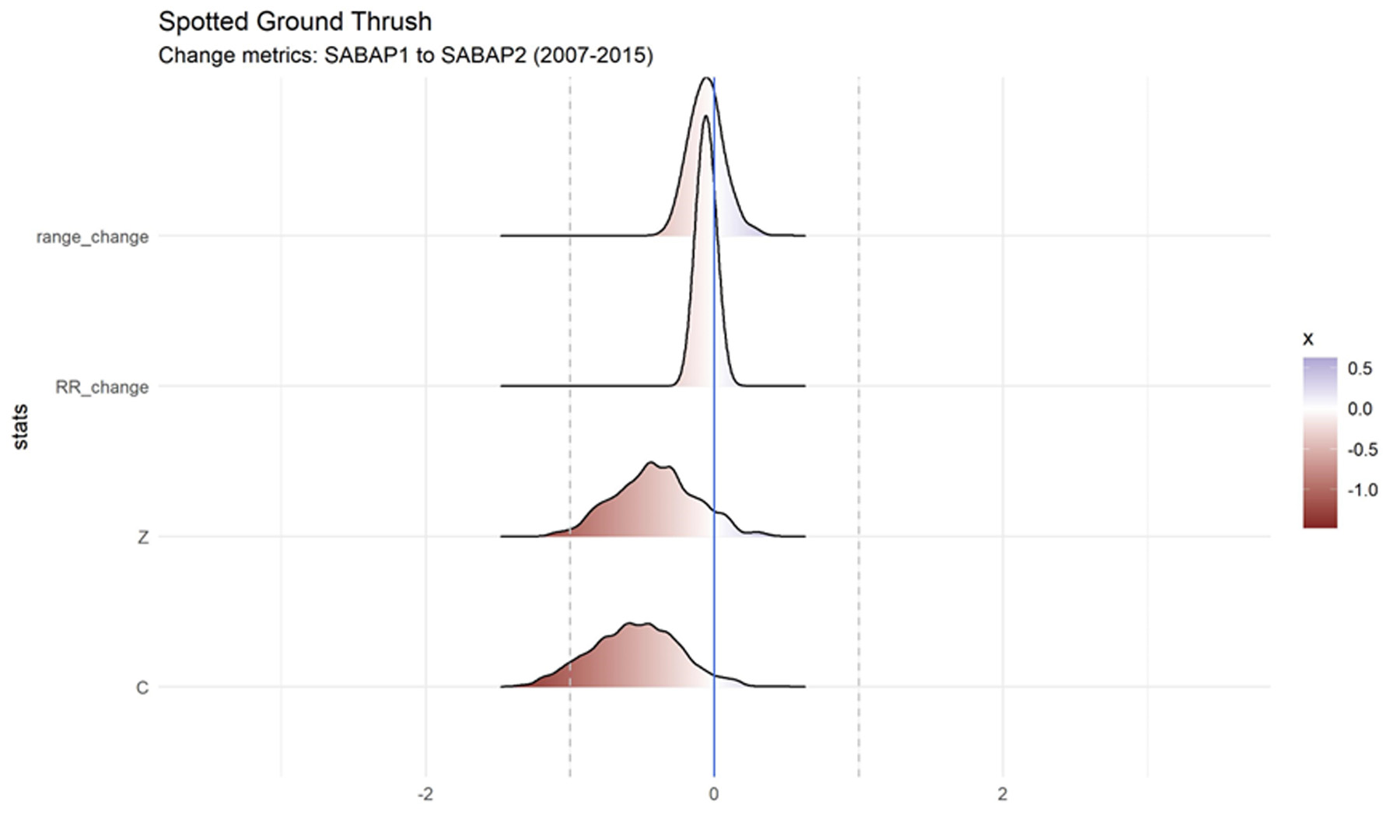
Figure 1: Bootstrap results of ‘naive’ change metrics between SABAP1 and SABAP2 reporting rates, indicating a decline in reporting rates for Spotted Ground Thrush. Reporting rate and range change are bounded by -1 and 1. The Underhill Z score is confidence in change one way or another as a result of the number of contributing lists: if there are more lists for a pentad or region, these scores get higher – they don’t indicate magnitude of change. The Underhill C score is a potential magnitude of population change (from Lee 2024).
Biology & Ecology
Taxonomy
There are five races of Spotted Ground Thrush in Africa, of which the nominate G. g. guttata occurs in South Africa. Harebottle et al. (1997) found no morphological reasons for splitting South African taxa from the other four races. The species was previously placed in the genus Zoothera.
Identification
22–23 cm, 68 g. Sexes are alike in plumage colouration, but males are slightly larger. Upperparts, including crown and scapulars, are rusty olive-brown. Moustachial area, lores and ear coverts white. Malar stripe black. Upper-wings mostly brown. Underparts white, breast and flanks often tinged buff, with large, bold, black drop-shaped spots. Two distinctive white bars adorn the wing coverts. Eye dark brown. Bill black to grey-black; base of lower mandible whitish, pale yellow or pinkish. Legs and feet pale pink. Juvenile similar but upperparts mottled with buff (Chittenden 2005).
Distribution
Within the region, breeding populations occur in mature coastal forests in Eastern Cape (including Mkambati Nature Reserve, Dwesa-Cwebe Nature Reserve, Egossa Forest, Ntsubane Forest, Mtambalala Forest, Mpame Forest and Manubi Forest), and in Coastal Scarp and Valley forests in southern KwaZulu-Natal (Umtamvuna Nature Reserve, Oribi Gorge) and northern KwaZulu-Natal (Ngoye Forest, Entumeni Forest and Dhlinza Forest). The current southernmost limit of the regional population is around the Kei River in the Eastern Cape Province. Non-breeding birds undertake localised movements in winter, moving to scattered fragments of forests along the coast from the Mozambique border to Wavecrest in the Eastern Cape.
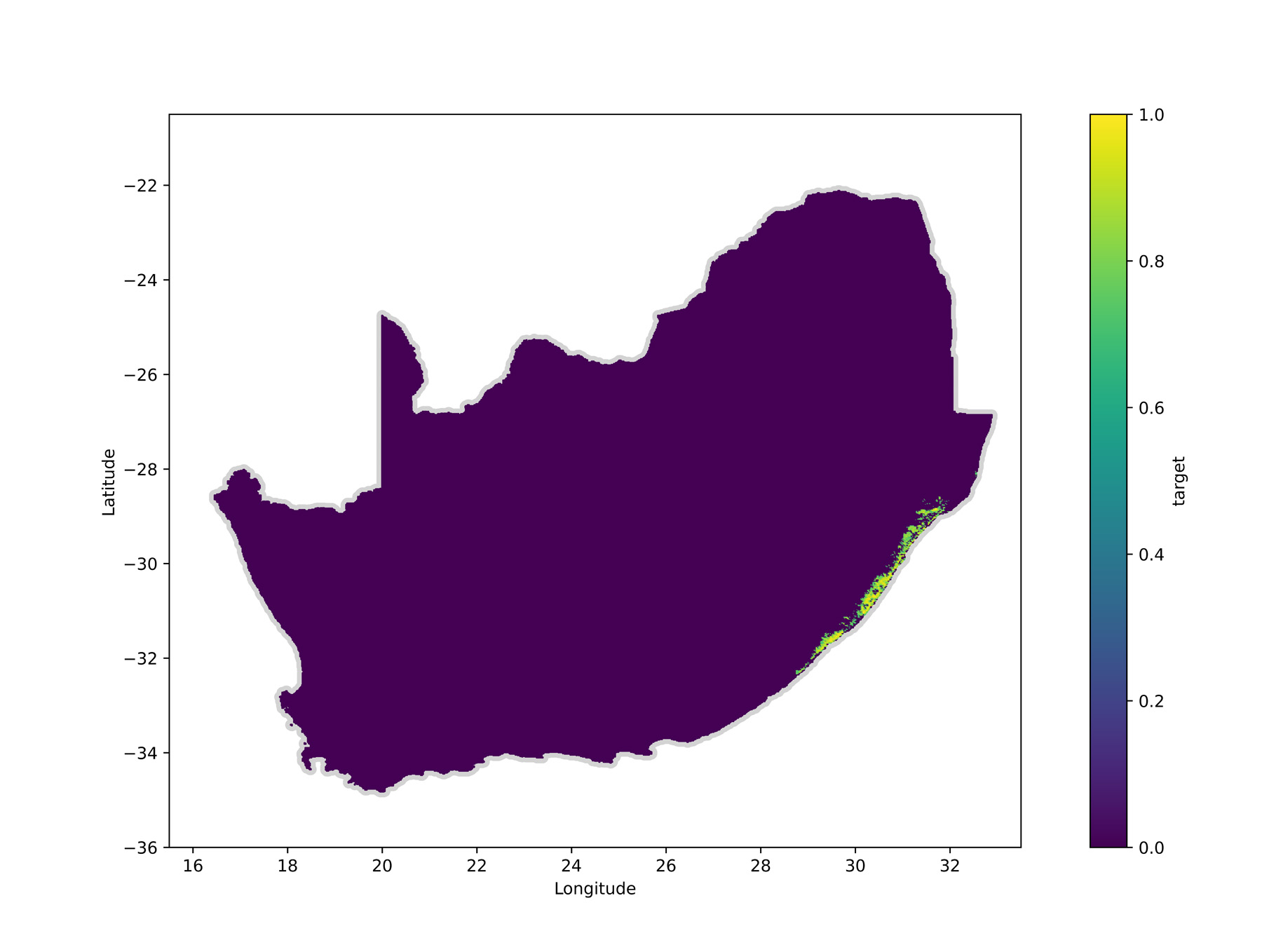
Figure 2: The predicted range for the 2016-2023 period for Spotted Ground Thrush based on BirdLasser, eBird and iNaturalist data at a 2×2 km grid scale (from Lee 2024).
Ecology
Found mostly in dappled, open areas in forest understorey, tending to avoid both dense thickets and open areas (Harebottle 1994, Ehlers Smith et al. 2017a). The species undertakes two different migration patterns: Eastern Cape breeders migrate to KwaZulu-Natal coastal forests in March-May and return in August-September; populations breeding in northern KwaZulu-Natal undertake a partial altitudinal migration eastward to coastal forests in March-May and return in August (Harebottle 1994, Chittenden 2005). This is apparently in response to prey abundance (Harebottle 1994). Density in Dhlinza Forest, a breeding locality in northern KwaZulu-Natal, ranges from 3.4–4.1 birds/ha (Ndang’ang’a et al. 2005). The diet consists mostly of earthworms, as well as other invertebrates, including snails. Birds forage singly or in pairs in leaf litter on the forest floor.
Threats & Conservation
Threats
The primary threat is habitat loss and degradation, particularly as the species is highly localised and naturally restricted to a geographically limited vegetation type. Specific threats include:
- Overgrazing and trampling of seedling and sapling recruits by livestock entering forests and opening understorey.
- Introduction of weeds and pioneer plants along forest clearings and pathways.
- Degradation and destruction of forested habitat through clearing for cultivation/agriculture, harvesting of forest plants for traditional medicine, and removal of wood for fuel or building materials.
- Climate change impacts on habitat suitability.
- Collisions with human infrastructure during night-time migration.
Conservation Measures Underway
The Spotted Ground Thrush is present in 16 pentads within National Parks or Nature Reserves and an additional one pentad in other protected areas. However, the ratio of the species’ range in protected areas to unprotected areas is only 0.33, indicating that most of its range falls outside of formal protection (Lee 2024). The species is protected under the Eswatini Game Act, but otherwise, no species-specific conservation measures are currently underway.
Conservation Measures Proposed
- Conduct a full review of the species’ conservation status, focusing on all forest patches that support this population.
- Expand protected areas to include more of the species’ range.
- Develop and implement species-specific management practices, both on privately- and state-owned properties, as well as in existing conservation areas.
- Raise awareness among local communities and stakeholders about the importance of forest conservation for this species.
Research Priorities and Questions
- Conduct comprehensive surveys of all forest patches that support this species to obtain accurate estimates of population size and occurrence densities.
- Investigate the factors driving the observed decline in reporting rates between SABAP1 and SABAP2, considering changes in land use, habitat quality, and climate change impacts.
- Study the species’ breeding biology, survival rates, and population dynamics in different habitat types.
- Assess the impact of habitat fragmentation and isolation on population viability.
- Evaluate the effectiveness of current protected areas in safeguarding the species and identify priority areas for additional protection or management.
Contributors & References
Assessor/s
David Ehlers Smith
Reviewer/s
Mark Brown
References
BirdLife International. 2021. Geokichla guttata. The IUCN Red List of Threatened Species 2021: e.T22708464A180490672. https://dx.doi.org/10.2305/IUCN.UK.2021-3.RLTS.T22708464A180490672.en. [Accessed on 12 September 2024].
Chittenden HN. 2005. Spotted Ground-Thrush Zoothera guttata. In: Hockey PAR, Dean WRJ, Ryan PG (eds), Roberts – Birds of Southern Africa 7th Edn. Cape Town, South Africa: Trustees of the John Voelcker Bird Book Fund. pp 902–903.
Colyn RB, Ehlers Smith DA, Ehlers Smith YC, Smit-Robinson H, Downs CT. 2020. Predicted distributions of avian specialists: a framework for conservation of endangered forests under future climates. Diversity and Distributions 26: 652–667.
Ehlers Smith DA, Ehlers Smith YC, Ramesh T, Downs CT. 2017a. Camera-trap data elucidate habitat requirements and conservation threats to an endangered forest specialist, the Spotted Ground Thrush (Zoothera guttata). Forest Ecology and Management 400: 523–530.
Ehlers Smith DA, Ehlers Smith YC, Downs CT. 2017b. Indian Ocean coastal thicket is of high conservation value for preserving taxonomic and functional diversity of forest-dependent bird communities in a landscape of restricted forest availability. Forest Ecology and Management 390: 157–165.
Harebottle DM. 1994. Conservation biology of the Spotted Ground Thrush Zoothera guttata guttata in southern Africa. Unpublished MSc thesis. Pietermaritzburg, South Africa: University of Natal.
Harebottle DM, Taylor PJ, Berruti A. 1997. The subspecies status of spotted ground thrush Zoothera guttata guttata (Aves: Turdidae) in South Africa-a multivariate analysis. Durban Museum Novitates 22: 32–36.
Harebottle DM, Barnes KN. 2000. Spotted Ground Thrush Zoothera guttata. In: Barnes KN (ed), The Eskom Red Data Book of Birds of South Africa, Lesotho and Swaziland. Johannesburg, South Africa: BirdLife South Africa. pp 51–53.
Lee ATK. 2024. Regional Red Data Book of the Birds of South Africa, Lesotho and Eswatini: SABAP2 Synthesis and Supporting Information and Graphics for Spotted Ground Thrush. Unpublished report. Johannesburg: BirdLife South Africa.
Ndang’ang’a K, Sande E, Evans SW, Buckley P, Newbery P, Hoffmann DA, John J (eds). 2005. International species action plan for the Spotted Ground Thrush Zoothera guttata. Nairobi, Kenya: BirdLife International and Sandy, Bedfordshire, UK: Royal Society for the Protection of Birds.
Olivier PI, van Aarde RJ, Lombaard AT. 2013. The use of habitat suitability models and species–area relationships to predict extinction debts in coastal forests, South Africa. Diversity and Distributions 19: 1353–1365.
Citation
Ehlers Smith DA 2025. Spotted Ground Thrush. In: Lee ATK, Rose S, Banda S, Bezeng SB, Maphalala MI, Maphisa DH, Smit-Robinson H (eds), The 2025 Red Data Book of Birds of South Africa, Lesotho and Eswatini. Johannesburg, South Africa: BirdLife South Africa. Available at: https://www.birdlife.org.za/red-list/spotted-ground-thrush/
Our generous sponsors


