


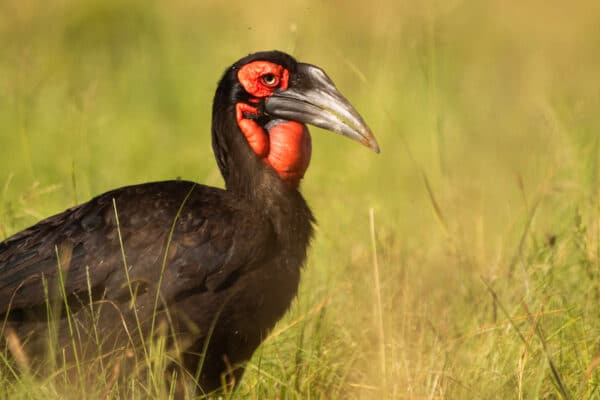
Southern Ground Hornbill
Bucorvus leadbeateri

Number Of Mature
Individuals (Regional)
<2 500

Regional
Population Trend
Decreasing
2025
Regional Category
Endangered
Search by species
CONTENTSOverview
Names
|
IOC English Name: |
Southern Ground Hornbill |
|
SA & IOC Scientific Name: |
Bucorvus leadbeateri |
|
BirdLife International Taxonomy (scientific name): |
Bucorvus leadbeateri |
|
Order: |
BUCEROTIFORMES |
|
Family: |
Bucerotidae |
|
Species name author: |
Vigors 1825 |
|
Afrikaans: |
Bromvoël |
|
Sesotho (South Africa) |
Lehututu (singular), Mahututu (plural) |
|
Sesotho (Lesotho): |
|
|
Siswati: |
Insingizi, Ingududu |
|
Zulu: |
iNgududu, iNsingizi |
Current Assessment Status
|
2025 Regional Category [Criteria] |
EN [C1] |
|
2024 Global Category [Criteria] |
VU [A4bcd] (BirdLife International 2016) |
|
Population size (Regional) |
<2500 (Kemp 2024, unpubl data) |
|
Population size (Global) |
Unknown (BirdLife International 2016) |
|
Distribution size (EOO) (Regional) km2 |
505 855 (Lee 2024), 567 748 (Kemp 2024: ConR) |
|
Distribution size (EOO) (Global) km2 |
7 140 000 (Birdlife International 2016) |
|
Distribution size (AOO) (Regional) km2 |
58 514 (Kemp 2024, unpubl data), 74 608 (Lee 2024) |
|
Generation time |
31.1 years (BirdLife International 2016) |
|
Status change reason |
No change |
|
Migrant (in the region) |
No |
|
Regional endemic |
No |
Historic Listing Information
|
2000 Regional Status |
VU [C1] |
|
2015 Regional Status |
EN [A2bcd+4bcd; C1] |
|
Status change reason (if applicable) |
Genuine (recent) |
|
2015 Population size (Regional) |
<1500 |
|
2015 Global Status |
VU [A4bcd] |
Reason for Inclusion
Reason for Inclusion in the Assessment
>5% of the global range of Southern Ground Hornbill Bucorvus leadbeateri occurs within the region. The species was listed as regionally Vulnerable in the 2000 assessment, and Endangered in 2015 (Kemp 2000, Taylor and Kemp 2015). The Southern Ground Hornbill is listed as globally Vulnerable (BirdLife International 2016).
Category Justification
Category Justification
The regional population of Southern Ground Hornbill is assessed as regionally Endangered based on a small declining population. Both Area of Occupancy (AOO) and Extent of Occurrence (EOO) exceed the thresholds of Criterion B. During 2020-2024 the regional population size was reassessed at numbering <2500 mature individuals (Kemp 2024, unpubl data). This number is not thought to represent an increase from the 2015 estimate but rather reflects improved sampling effort and coverage (Kemp 2024, unpubl data).
Using modelled predicted AOO from Southern African Bird Atlas (SABAP2) data as a proxy for population size suggests that the rate of population decline may be less than the >50% indicated in 2015 (Taylor and Kemp 2015) and therefore Southern Ground Hornbill would not qualify as regionally Endangered under criteria A (Lee 2024). From the modelled AOO, the decline over two and three generations is c. 22% and 31%, respectively (Lee 2024). This rate of decline, along with the small population size meets the threshold for Endangered under Criterion C.
Southern Ground Hornbills are a long-lived species with slow reproduction rates and low breeding success and long generation length of 31 years (BirdLife International 2016). 49% of breeding attempts fledge one chick and 31% of fledged chicks survive to maturity (Kemp 2005, Carstens et al. 2019). Mean recruitment is extremely low, with groups fledging an average of only one chick every 9.3 years (n = 14 groups, 20 breeding seasons; Kemp 1988), although this can increase in areas supplemented with nest boxes (e.g. Carstens 2017). This low recruitment makes the species exceptionally vulnerable to any type of increased mortality.
Threats for this species are well known with many that are expected to continue in the future (see Threats section). Besides existing threats which are not expected to cease in the near future, emerging threats such the development of wind farms, the spread of disease such as avian influenza, and the impacts of climate change (embryo survival during the hottest months, changes in rainfall patterns and reduced foraging time while seeking shade) are expected to place additional pressure on this species.
It is therefore considered likely that the current rate of decline will continue at least over the next two generations. This species remains listed as regionally Endangered according to Criterion C1.
Population Justification
The global population of Southern Ground Hornbill has not been quantified, owing to insufficient monitoring (BirdLife International 2016). Previous estimates of 1500 – 2000 Kemp (2000) provided a regional population estimate of mature individuals based on densities from studies within Kruger National Park and central KwaZulu-Natal of territories of 100 km2/group (Kemp and Kemp 1974, Knight 1990), a breeding structure of one alpha breeding pair per group (Kemp and Kemp 1980) and a mean group size of 3.6 birds (Vernon 1986, Kemp et al. 1989, Knight 1990).
A recent census (2020-2024) was undertaken to update the population estimate aimed at reaching rural areas where SABAP2 reporting rate for Southern Ground Hornbills are unreliable. This census employed various methods including collating existing citizen science data, ground surveys and an intensively marketed WhatsApp-based citizen science program (Kemp 2024, unpubl data). A total of 92 WhatsApp groups are still active and generating sighting and mortality records.
The 2020-2024 census identified 826 pentads that are occupied by Southern Ground Hornbill (Kemp 2024, unpubl data). This is a considerable increase from the baseline dataset (2009-2019) of just 567 pentads (Kemp 2024, unpubl data). A pentad is the sampling unit in SABAP2 and has long been used as a proxy for population size for this species, as one pentad size corresponds roughly to the territory size of a family group of Southern Ground Hornbills (e.g. Kemp et al. 2023). The data thus suggests, at the average group size of 3.6 used for previous estimates a regional population of 826 groups and thus alpha females, 3270 individuals or 2478 contributing adults.
The almost doubling of the population estimate is not considered representative of a population increase, but represents the increased survey effort. While some expansion can be attributed to the reintroduction programme, the increase should largely be ascribed to better monitoring in remote areas.
Trend Justification
Southern Ground Hornbills are in decline throughout its range, with declines reported in Zimbabwe, Botswana, Malawi, and Kenya, hence the increased global concern, which resulted in the elevation of this species to globally Vulnerable (BirdLife International 2016).
Historically, within the region, this species experienced significant range contraction leading to population declines (e.g. Kemp 2017, Kemp and Boesman 2020). Some estimates suggest that, in South Africa, 70% loss of range has occurred although it is unclear over which time period this was calculated (Kemp and Boesman 2020).
The updated population estimate, and range generated by the 2020-2024 census provides a new baseline for estimating population trends as the number of pentads in which Southern Ground Hornbill have been reported in doubled. Using Lee’s (2024) modelled annual rate of change in AOO between the early (2007-2015) and late (2016-2023) an updated annual change in population size was estimated (Table 1). A generation length of 31.3 years is estimated based on mean age at first breeding, maximum longevity in the wild and mean annual adult survival (BirdLife International 2016). These results suggest that historical declines of c. 22% over two generations and c. 31% over three generations occurred (Table 2).
Table 1. Modelled predicated number of pentads that Southern Ground Hornbills could occupy for the period up to 2015, and then until the end of 2023. Data from Lee (2024).
|
Information |
|
|
Pentads 2015 |
761 |
|
Pentads 2023 |
533 |
|
Annual rate of change |
0.956 |
|
Percent change* (10 years or 3 generations) |
-30.30% |
* Used to calculate an annual rate of change which can then be used to determine annual change in population size
Table 2. Using the annual rate of change in AOO as a proxy for determining the rate of population level change for Southern Ground Hornbill over two and three generations (data from Lee 2024 and BirdLife International 2016).
|
Explanation |
Value |
|
Annual rate of change in AOO (Lee 2024) |
0.956 |
|
Annual change in population size = (1-rate of decline over three generations)1/three generations years |
(1-0.3)(1/93) (from Lee 2024) = 0.996 |
|
Decline over two generations (62 years) |
1-0.99662 = 0.22 or 22% |
|
Decline over three generations (93 years) |
1-0.99693 = 0.311 or 31% |
Considerable conservation efforts are underway for this species (as discussed under ‘Conservation Measures Underway’ below). In South Africa, these conservation efforts started in earnest in the late 1990s, when it first became apparent that the species was in serious decline (Engelbrecht et al. 2007). At that stage, basic population parameters and biology were unknown, except for a long-term study in Kruger National Park (Kemp and Kemp 1980, Kemp 1988, 1995a, Kemp, Joubert and Kemp 1989, Kemp and Begg 1996, 2001). Several conservation strategies were and continue to be tested and implemented, with successful reintroduction (Kemp et al. 2020) and artificial nest hollow (Carstens et al. 2019) protocols being developed. While caution should be used in interpreting these results it could be that some of these conservation measures are paying off and that as a result some slowing in the rate of decline is now detectable.
Despite these conservation measures, many of the threats faced by this species continue and are projected to increase in the future. Threats include poisoning, persecution, habitat loss and embryo death from rising air temperatures continue (summarised in Kemp et al. 2023). It is therefore critical that conservation measures and monitoring continue.
Biology & Ecology
Taxonomy
There are currently no notable issues, and recent genetic work (Kemp et al. 2024) suggests the species is largely panmictic but that the precautionary principle be employed for conservation captive breeding programmes as there is some isolation-by-distance between the northern and southern extremes of the range. The whole genome of the species has also been sequenced and assembled (Patel et al. 2025).
Identification
90–130 cm, 3.3–4.4 kg. An unmistakable, large, black bird with white primaries. Adults have bare, red, inflatable skin on the throat and face, with females showing a blue patch across the throat at the base of the lower mandible. Males have a larger bill and casque than females at all ages. Juveniles are sooty black, their white primaries flecked with black. Dull grey eyes change to yellow as birds mature. Immatures have dull grey facial skin, which changes to creamy yellow, then orange and later red as they mature over 4–6 years. The legs and bill are black, but immatures have paler grey areas on the proximal sides of their mandibles (Kemp 1995).
Distribution
The species occurs in suitable habitat in Kenya, Tanzania, Democratic Republic of Congo, Malawi, Zambia, Zimbabwe, Angola, Mozambique, Namibia, Botswana, Eswatini, and South Africa (Kemp 1995, Figure 1). In Eswatini, only three localities have been reported for the past four years (MGHP census dataset: mid 2020 -2024), all within the Lowveld (Figure 2). Groups outside this stronghold are patchily distributed in areas unaffected by expansion of rural communities, afforestation, bush encroachment, livestock diseases and cultivation (Morrison et al. 2005, Jordan 2011). Birds are resident and occupy territories of up to 100–250 km2/group, depending on habitat quality (Jordan 2011, Theron 2011). Females occasionally move between groups and are sometimes found singly or in small groups of 2–3 members (Kemp 1995). Throughout the species’ range, it occurs in habitats broadly classified as grassland and savannah, but it is absent from arid semi-deserts and extensive forests (Kemp 1995, Jordan 2011).
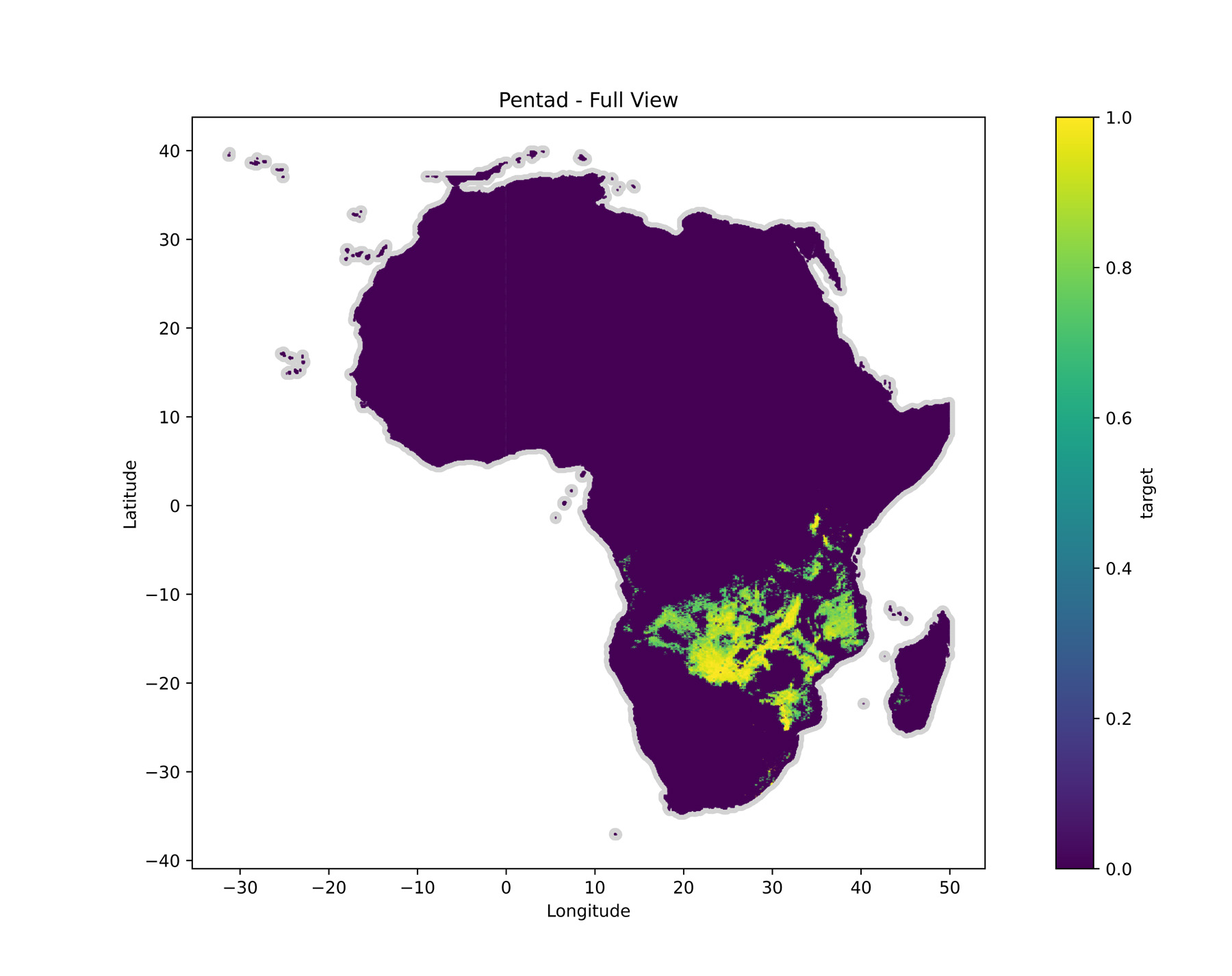
Figure 1: Probability distribution for Southern Ground Hornbill, produced from BirdLasser location data at pentad grid scale, including iNaturalist and eBird records. This represents the predicted range for the 2016-2023 period, pentad scale p>0.5 with yellow showing greater probability (from Lee 2024).
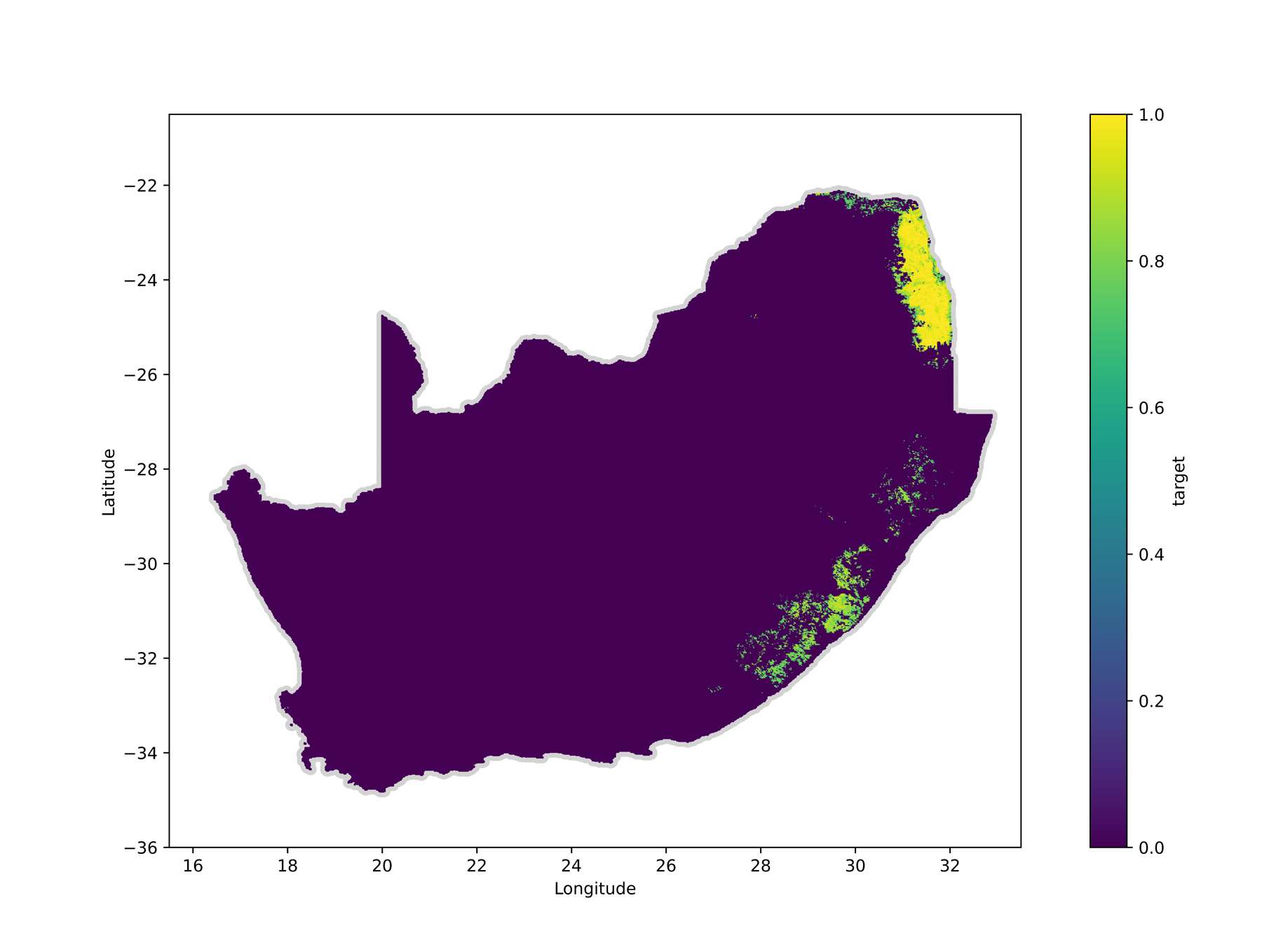
Figure 2: Probability distribution for Southern Ground Hornbill, produced from BirdLasser location data at 2×2 km grid scale, using iNaturalist and eBird as absence data only. This represents the predicted range for the 2016-2023 period, pentad scale p>0.5 with yellow showing greater probability (from Lee 2024).
Ecology
The Southern Ground Hornbill is a monogamous, cooperative breeder with a single, dominant breeding pair within a group supported by mainly male helpers (Kemp 2005). Natural cavities in live or dead trees are most used, but also cliffs and, occasionally, self-excavated hollows in earth banks or old stick nests of other species. Artificial cavities are readily accepted. Chicks hatch asynchronously with the second hatched chick normally falling victim to obligate brood reduction, being unable to compete with its larger sibling (Kemp 2005), or occasionally to parental cannibalism. The species has a catholic diet, feeding on a range of invertebrates and small amphibians, reptiles, mammals and birds, and will scavenge on even large carcasses.
Threats & Conservation
Threats
The primary threats to the Southern Ground Hornbill are secondary poisoning, and in particular lead toxicosis from spent lead ammunition, electrocution and persecution of groups for breaking windows of buildings or cars when hammering at their own reflections with their bills (Kemp et al. 2023). Other factors that contribute to declines in population numbers include habitat alteration, and especially loss of large trees with suitable cavities for nesting, as well as afforestation of grassland, or bush encroachment of woody savannah (Kemp 2005). The birds are only rarely collected for belief-based use, but they still occasionally appear in markets (Bruyns et al. 2013, Whiting et al. 2013, Mbongwa N. unpubl data).
Emerging threats include the development of wind farms within their range and the spread of disease such as avian influenza, as well as the impacts of climate change that: (a) may affect embryo survival during the hottest months, (b) result in changes in rainfall patterns, and (c) cause reduced foraging time while seeking shade as average daily temperatures increase.
Conservation Measures Underway
Protected status under legislation:
South Africa: Threatened or Protected Species (ToPS: NEMA,2004) and also protected at a provincial level.
A Southern Ground Hornbill Action Group was formed in 2005 after an initial Population and Habitat Viability Assessment (PHVA) was conducted (Morrison et al. 2007) to ensure a coordinated and science-led effort by all role-players focused on the conservation and monitoring of this iconic African species. This group conducted a Species Recovery Plan (Jordan et al. 2011), then revised the Population Habitat Viability Assessment (PHVA, Kemp et al. 2017) and most recently a national Biodiversity Management Plan (BMP)for the species was gazetted (Kemp et al. 2023). These documents guide all the work needed to be undertaken by the Southern Ground Hornbill Action Group (now the Thunderbird Task Team). Conservation activities include:
- Establishment of a small captive-breeding population;
- Reintroduction of redundant, second-hatched, artificially reared chicks to re-establish groups within areas of the historical range that are still considered suitable for this purpose;
- Protection of transformer boxes;
- Vaccination programme for reintroduces birds;
- Removal of redundant second-hatch chicks for incorporation into the captive breeding or wild release program;
- Provision of climate-proof artificial nests;
- Custodianship to engage landowners on a territory-by-territory basis;
- Nationwide awareness campaigns.
Conservation Measures Proposed
Aside from the ongoing conservation measures mentioned above, the actions with the BMP must be implemented, for which the prioritized STRATEGIC OBJECTIVES are as follows:
- Long-term monitoring of Southern Ground Hornbill through citizen science and the Custodianship Programme needs to continue.
- Strong integration of cultural and ecological values in the conservation of the species.
- Effective communication, collaboration and coordination between stakeholders and the public for Southern Ground Hornbill conservation.
Research Priorities and Questions
An extensive list of future research was identified as important during both the BMP and PHVA workshops. Many of these have yet to be initiated. It was emphasised that research needs to speak to desired outcomes and achievable outcomes. This is in addition to ensuring all existing data is analysed and published, and that no data lies dormant with agencies, but is used to continue to grow the evidence-base for conservation planning and action. To improve the Regional Red List category, the key threats known to be driving population decline need to be better understood and addressed. Therefore, the list of Research Priorities and Questions summarised here are as follows:
- Careful monitoring of existing conservation measures (reintroduction, artificial nest provision, range-expansion, custodianship) through enhanced monitoring to determine whether increased pentads do in fact represent an increase in population size.
- Initiate toxicology studies to understand the levels of toxic substances that Southern Ground Hornbills are exposed to.
- Identification and dissemination of information of the agrochemicals (herbicides, pesticides) that will impact Southern Ground hornbill health and survival.
- Model current potential impacts of agrochemicals on Southern Ground hornbill.
- Investigate drugs used in agriculture (herbicides, pesticides) that can impact on the health and survival of Southern Ground hornbill.
- Identify areas of different uses and availability including rural areas.
- Model the overlap of transformer boxes with species distribution range.
- Determine the number of transformer boxes over distribution range.
- Investigate more suitable infrastructure.
- Conduct behavioural studies as to why birds use the infrastructure.
- Conduct a study to investigate alternative mitigation measures e.g. detracting the birds from using transformers (noise, height).
- Investigate and develop alternative monitoring and evaluation technologies.
Contributors & References
Assessor/s
Lucy Kemp, Sanjo Rose
Reviewer/s
Kate Carstens, Yvette Ehlers Smith
References
BirdLife International. 2016. Bucorvus leadbeateri. The IUCN Red List of Threatened Species 2016: e.T22682638A92955067. Available: https://dx.doi.org/10.2305/IUCN.UK.2016-3.RLTS.T22682638A92955067.en [Accessed on 07 January 2025].
Bruyns RK, Williams VL, Cunningham AB. 2013. Finely ground hornbill: The sale of Bucorvus cafer in a traditional medicine market in Bulawayo, Zimbabwe. In: Alves R, Rosa IL (eds), Animals in Traditional Folk Medicine. Berlin: Springer. pp 475–486.
Carstens KF. 2017. Breeding and dispersal implications for the conservation of the Southern Ground-Hornbill Bucorvus leadbeateri. PhD thesis, University of Cape Town, South Africa. Available at http://hdl.handle.net/11427/26943.
Carstens KF, Kassanjee R, Little RM, Ryan PG, Hockey PAR. 2019. Breeding success and population growth of Southern Ground-Hornbills Bucorvus leadbeateri in an area supplemented with nest-boxes. Bird Conservation International 1–17. https://doi.org/10.1017/S0959270919000108.
Engelbrecht D, Theron N, Turner A, Van Wyk J, Pienaar K, Kemp AC, Kemp MI. 2007. The status and conservation of Southern Ground-Hornbills, Bucorvus leadbeateri, in the Limpopo Province, South Africa. In: Proceedings of the 4th International Hornbill Conference. Mabula Game Lodge, South Africa. pp 1–5.
Jordan M (ed). 2011. Southern Ground-Hornbill (Bucorvus leadbeateri) Species Recovery Plan for South Africa. Johannesburg: Johannesburg Zoo/Endangered Wildlife Trust.
Kemp AC, Kemp M. 1974. Don’t forget the big birds. African Wildlife 28(2): 12–13.
Kemp AC, Kemp MI. 1980. The biology of the Southern Ground-Hornbill Bucorvus leadbeateri (Vigors) (Aves: Bucerotidae). Annals of the Transvaal Museum 32: 65–100.
Kemp AC. 1988. The behavioural ecology of the Southern Ground-Hornbill: Are competitive offspring at a premium? In: van den Elzen R, Schuchmann K-L (eds), Proceedings of the International 100 DO-G Meeting: Current Topics in Avian Biology. Bonn, Germany. pp 267–271.
Kemp AC, Joubert SCJ, Kemp MI. 1989. Distribution of Southern Ground-Hornbills in the Kruger National Park in relation to some environmental features. South African Journal of Wildlife Research 19: 93–98.
Kemp AC. 1995. The Hornbills. Oxford: Forlaget.
Kemp AC, Begg KS. 1996. Nest sites of the Southern Ground-Hornbill Bucorvus leadbeateri in the Kruger National Park, South Africa, and conservation implications. Ostrich 67: 9–14.
Kemp AC. 2000. Southern Ground-Hornbill Bucorvus leadbeateri. In: Barnes KN (ed), The Eskom Red Data Book of Birds of South Africa, Lesotho and Swaziland. Johannesburg: BirdLife South Africa. pp 117–119.
Kemp AC, Begg KS. 2001. Comparison of time-activity budgets and population structure for 18 large-bird species in the Kruger National Park, South Africa. Ostrich 72: 179–184.
Kemp AC. 2005. Southern Ground-Hornbill Bucorvus leadbeateri. In: Hockey PAR, Dean WRJ, Ryan PG (eds), Roberts birds of southern Africa 7th Edn. Cape Town: Trustees of the John Voelcker Bird Book Fund. pp 158–159.
Kemp LV, Bruford MW (eds). 2017. Southern Ground-Hornbill Population and Habitat Viability Assessment Workshop – Final Report. IUCN SSC Conservation Planning Specialist Group.
Kemp AC, Boesman PFD. 2020. Southern Ground-Hornbill (Bucorvus leadbeateri). In: del Hoyo J, Elliott A, Sargatal J, Christie DA, de Juana E (eds), Birds of the World, version 1.0. Ithaca, NY: Cornell Lab of Ornithology. https://doi.org/10.2173/bow.soghor1.01.
Kemp LV, Birss C, Smit-Robinson HA, Kotze A, Tate G, Little RM. 2023. Biodiversity Management Plan for the Southern Ground-Hornbill in South Africa. Jointly developed by the South African Southern Ground-Hornbill Action Group and the Department of Environment, Forestry and Fisheries. Version 1.0.
Kemp L, Dalton DL, Mwale M, Grobler JP, Madisha MT, Van Wyk AM, Mokgokong PS, Jansen R, Kotze A. 2024. Broad-scale genetic assessment of Southern Ground-Hornbills (Bucorvus leadbeateri) to inform population management. Global Ecology and Conservation 52: e02963.
Knight GM. 1990. A preliminary investigation into the status, distribution and some aspects of the foraging ecology of the Southern Ground-Hornbill (Bucorvus cafer) in Natal. MSc thesis, University of Natal, South Africa.
Lee ATK. 2024. Regional Red Data Book of the Birds of South Africa, Lesotho and Eswatini: SABAP2 synthesis and supporting information and graphics for Southern Ground-Hornbill. Unpublished report. Johannesburg: BirdLife South Africa.
Morrison KL, Daly B, Burden D, Engelbrecht D, Jordan M, Kemp A, Kemp M, Potgieter C, Turner A, Friedmann Y. 2005. Southern Ground-Hornbill (Bucorvus leadbeateri) PHVA Workshop Report. Conservation Breeding Specialist Group (SSC/IUCN)/CBSG South Africa.
Morrison KL, Daly B, Burden D, Engelbrecht D, Jordan M, Kemp AC, Kemp MI, Potgieter C, Turner A, Friedmann Y. 2007. A conservation plan for the Southern Ground-Hornbill Bucorvus leadbeateri in South Africa. Proceedings of the Active Management of Hornbills and Their Habitats for Conservation. Bela Bela, South Africa.
National Environmental Management: Biodiversity Act, 2004 (Act No. 10 of 2004): Threatened or Protected Species (ToPS) Regulations, 2007.
Patel J, Botes A, Mollett J, et al. 2025. Whole genome sequencing, assembly and annotation of the Southern Ground-Hornbill – Bucorvus leadbeateri. Scientific Data 12: 58. https://doi.org/10.1038/s41597-025-04412-2.
Taylor MR, Kemp LV. 2015. Southern Ground-Hornbill. In: Taylor MR, Peacock F, Wanless RM (eds), The 2015 Eskom Red Data Book of Birds of South Africa, Lesotho and Swaziland. Johannesburg: BirdLife South Africa. pp. 119–121.
Theron NT. 2011. Genetic connectivity, population dynamics and habitat selection of the Southern Ground-Hornbill (Bucorvus leadbeateri) in the Limpopo Province. MSc thesis. University of the Free State, South Africa.
Vernon CJ. 1986. The ground hornbill at the southern extremity of its range. Ostrich 57: 16–24.
Whiting MJ, Williams VL, Hibbitts TJ. 2013. Animals traded for traditional medicine at the Faraday market in South Africa: Species diversity and conservation implications. In: Alves R, Rosa IL (eds), Animals in Traditional Folk Medicine. Berlin: Springer. pp 421–473.
Citation
Kemp L, Rose SJ 2025. Southern Ground Hornbill. In: Lee ATK, Rose S, Banda S, Bezeng SB, Maphalala MI, Maphisa DH, Smit-Robinson H (eds), The 2025 Red Data Book of Birds of South Africa, Lesotho and Eswatini. Johannesburg, South Africa: BirdLife South Africa. Available at: https://www.birdlife.org.za/red-list/southern-ground-hornbill/
Our generous sponsors


