


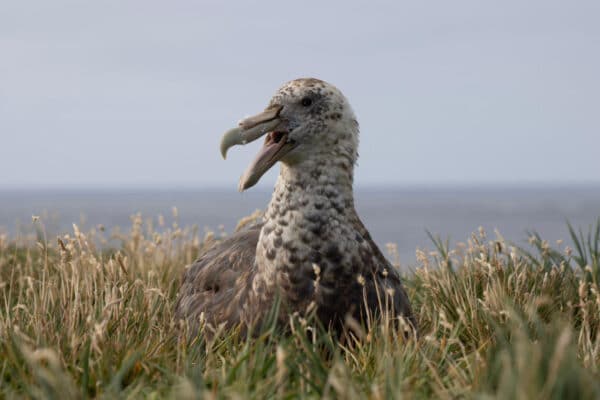
Southern Giant Petrel
Macronectes giganteus

Number Of Mature
Individuals (Regional)
9 500

Regional
Population Trend
Decreasing
2025
Regional Category
Near Threatened
Search by species
CONTENTSOverview
Names
|
IOC English Name: |
Southern Giant Petrel |
|
SA & IOC Scientific Name: |
Macronectes giganteus |
|
BirdLife International Taxonomy (scientific name): |
Macronectes giganteus |
|
Order: |
PROCELLARIIFORMES |
|
Family: |
Procellariidae |
|
Species name author: |
Gmelin 1789 |
|
Afrikaans: |
Reusenellie |
|
Sesotho (South Africa): |
|
|
Sesotho (Lesotho): |
|
|
Siswati: |
|
|
Zulu: |
inqeyolwandle yaseNingizimu |
Current Assessment Status
|
2025 Regional Category [Criteria] |
NT° [A3e] |
|
2024 Global Category [Criteria] |
LC (BirdLife International 2018) |
|
Population size (Regional) |
c. 2850 breeding pairs (c. 9500 mature individuals) (Ryan et al. 2009) |
|
Population size (Global) |
95 600 – 108 000 mature individuals (ACAP 2011, BirdLife International 2018) |
|
Distribution size (EOO) (Regional) km2 |
720 (breeding) |
|
Distribution size (EOO) (Global) km2 |
140 000 000 (BirdLife International 2018) |
|
Distribution size (AOO) (Regional) km2 |
334 (breeding) |
|
Generation time |
20.6 (Bird et al. 2020) |
|
Status change reason |
No Change |
|
Migrant (in the region) |
Native breeding visitor |
|
Regional endemic |
No |
Historic Listing Information
|
2000 Regional Status |
NT [A1ad] |
|
2015 Regional Status |
NT [D2] |
|
Status change reason (if applicable) |
No Change |
|
2015 Population size (Regional) |
c. 2783 pairs |
|
2015 Global Status |
LC |
Reason for Inclusion
Reason for Inclusion in the Assessment
The Southern Giant Petrel Macronectes giganteus was previously assessed as Near Threatened in the 2000 and 2015 regional assessments (Huyser 2000, Wanless and Taylor 2015).
Category Justification
Category Justification
The regional population of Southern Giant Petrel satisfies the criterion for regionally Vulnerable under D2 in that it breeds on two islands within the region (Marion and Prince Edward). However, population trends are believed to be stable, possibly even increasing, preventing the application of this criterion. This species qualifies for Vulnerable (VU) under Criterion A3 due to projected future declines based on expert-assessed extinction horizons due principally to the threat of House Mice Mus musculus on Marion Island (Preston et al. 2019). While there is limited direct evidence of ongoing population decline currently, predictive assessments suggest that the species may experience a significant reduction over the next three generations. The extinction horizon estimates indicate that the species’ population may decline by 47% within this period, exceeding the threshold for VU under A3 (Lee 2025). Since a Regional Rescue Effect is applicable given the pelagic nature of the species, plus a non-threatened global population, the Category is modified to: NTo [A3e].
Population Justification
The global population is estimated at 95 600 – 108 000 mature individuals, with about 40% of the global breeding population found on the Falkland Islands (ACAP 2011; BirdLife International 2018). Ryan et al. (2009) estimated the total Prince Edward Island population to be c. 1350 pairs and the Marion Island population to have stabilised around c. 1500 pairs. Thus, the total number of pairs at the Prince Edward Islands is at least c. 2850 pairs (c. 9500 mature individuals). There is need for an updated estimate.
Trend Justification
The global population is said to be increasing (BirdLife International 2018). The last regional trend was calculated in 2008 and suggested that Marion Island had stabilised since the late 1990s (Ryan et al. 2009). The 2008 count of Southern Giant Petrels on Prince Edward Island was 28% higher than the 2001 count, but this might reflect improved coverage and inter-annual differences in breeding success (Ross and Taylor 2015). Based on this, the regional population could be stable or increasing, but there have been no published updates to ascertain the current trend.
Future population projections based on extinction horizon estimates suggest that significant reductions may occur within the next three generations (Preston et al. 2019). While no significant recent declines have been observed, the potential for future declines justifies careful consideration under Criterion A3 (Lee 2025). Ongoing monitoring is essential to validate these projections and determine whether the species is experiencing measurable population decreases.
Biology & Ecology
Taxonomy
Some authorities suggest that the two Macronectes taxa should be conspecific. Bourne and Warham (1966) listed the differences in plumage colouration, behaviour and breeding biology (ACAP 2011), while Nunn and Stanley (1998) presented genetic evidence indicating two lineages, supporting the M. halli and M. giganteus designations (Techow et al. 2010).
Identification
A large petrel, similar in size to an albatross, measuring 80–100 cm and weighing 3.9–4.8 kg. It has a massive horn-coloured bill with a green tip. Both sexes share similar plumage, though males are larger with bulkier bills. The head and neck are dark grey, with mottled brown body and wing coverts. It displays polymorphism: most are brown, but a smaller proportion are white with scattered brown feathers. White morphs are rare near the Prince Edward Islands but occasionally breed on Marion. Juveniles are uniformly blackish brown, becoming paler with age, especially on the head. Legs and feet are dark grey, with variable eye colour.
Distribution
The Southern Giant Petrel breeds at ice-free sites in coastal Antarctica, sub-Antarctic islands, the Falklands and along the Patagonian coast of South America (Marchant and Higgins 1990, Cooper et al. 2001). Within the region, the Southern Giant Petrel breeds at both Marion and Prince Edward islands. It has an extensive pelagic range with juveniles, pre-breeders and wintering birds dispersing widely across the Southern Ocean and into subtropical waters (up to 20˚S). It is present in continental South African waters in both summer and winter.
Ecology
Southern Giant Petrels breed annually in loose colonies, arriving from July to August depending on location and latitude of the breeding site (Marchant and Higgins 1990). Eggs are laid from October to November with fledging taking place the following year in April (Conroy 1972). Although birds show a high degree of fidelity to their breeding island, location of their actual nest site varies (Voisin 1988). The species is an indiscriminate scavenger, with an extremely varied diet (de Bruyn et al. 2007). Males and females exhibit significant sexual segregation in foraging habitats (Reisinger et al. 2020). Male SGPs have recently been recorded attacking and killing adult albatross on the nest on Gough Island (Risi et al. 2021). Birds frequently scavenge around fishing vessels (Ryan and Moloney 1988). The species is long-lived, with a generation length of 20.6 years (Bird et al. 2020).
Threats & Conservation
Threats
The most Southern Giant Petrel deaths that have been recorded in the region have been due to incidental capture and mortality in both longline and trawl fisheries (Petersen et al. 2009a, 2009b). Plastic ingestion, pollution and human disturbance have been listed as threats (ACAP 2011), but the amount of ingested litter has markedly decreased on Marion Island (Perold et al. 2020). The species is occasionally preyed upon by sharks (Hunter 1984), but this is not considered a major threat. Chicks, and possibly adults, are impacted by house mice on Marion Island (M. Risi. pers obs). Globally, a climate-induced range contraction is of concern for this species (Krüger et al. 2017).
Conservation Measures Underway
The species receives international protection under the Agreement on the Conservation of Albatrosses and Petrels – Annex 1 and the Convention on the Conservation of Migratory Species of Wild Animals – Appendix II. Within the region it is protected under the Sea Birds and Seals Protection Act, 1973 (Act No. 46 of 1973), Marine Living Resources Act (Act No. 18 of 1998) and the National Plan of Action (NPOA) for Reducing the Incidental Catch on Seabirds in Longline Fisheries (2008). The Prince Edward Islands are listed as a Ramsar Wetland and a Special Nature Reserve. The Prince Edward Islands Marine Protected Area was proclaimed in 2013. BirdLife South Africa is planning to eradicate house mice on Marion Island.
Conservation Measures Proposed
Monitoring and tracking programmes to assess overlap with key fisheries are needed, and the existing measures to avoid seabird bycatch in the Patagonian Toothfish fishery should continue. Risks to breeding birds on the Prince Edward Islands should be fully evaluated.
Research Priorities and Questions
- Investigate the reasons for the lack of recovery of this sub-population after the collapse in the 1990s.
- Juvenile and immature survival rates are key population demographic parameters that remain unknown for this population. Assessing possible threats to all age- and stage-classes and both sexes should be undertaken, preferably through tracking of fledglings.
- Need to monitor how climate change and extreme weather events will affect the breeding population on Marion.
- Determine how the planned mouse eradication will affect the population on Marion through secondary poisoning.
Contributors & References
Assessor/s
Michelle Risi, Shamiso Banda
Reviewer/s
Maëlle Connan
References
Agreement on the Conservation of Albatrosses and Petrels. 2011. ACAP Species assessment: Southern Giant Petrel Macronectes giganteus. Available: http://www.acap.aq. [Accessed on 8 July 2014].
Bird JP, Martin R, Akçakaya HR, Gilroy J, Burfield IJ, Garnett ST, Symes A, Taylor J, Şekercioğlu ÇH, Butchart SH. 2020. Generation lengths of the world’s birds and their implications for extinction risk. Conservation Biology 34: 1252–1261. Available: 10.1111/cobi.13486.
BirdLife International. 2018. Macronectes giganteus. The IUCN Red List of Threatened Species 2018: e.T22697852A132608499. Available: https://dx.doi.org/10.2305/IUCN.UK.2018-2.RLTS.T22697852A132608499.en. [Accessed on 14 August 2023].
Bourne WRP, Warham J. 1966. Geographical variation in the giant petrels of the genus Macronectes. Leiden, The Netherlands: EJ Brill.
Conroy JWH. 1972. Biological aspects of the biology of the giant petrel, Macronectes giganteus (Gmelin), in the maritime Antarctic. British Antarctic Survey Bulletin 75: 75.
Cooper J, Brooke MdL, Burger AE, Crawford RJM, Hunter S, Williams AJ. 2001. Aspects of the breeding biology of the Northern Giant Petrel (Macronectes halli) and the Southern Giant Petrel (M. giganteus) at sub-Antarctic Marion Island. International Journal of Ornithology 4: 53–68.
de Bruyn PJN, Cooper J, Bester MN, Tosh CA. 2007. The importance of land-based prey for sympatrically breeding giant petrels at Subantarctic Marion Island. Antarctic Science 19: 25–30.
Hunter S. 1984. Movements of giant petrels Macronectes spp. ringed at South Georgia. Ringing and Migration 5: 105–112.
Huyser O. 2000. Southern Giant-Petrel Macronectes giganteus. In: Barnes KN (ed), The Eskom Red Data Book of Birds of South Africa, Lesotho and Swaziland. BirdLife South Africa. Johannesburg, South Africa. pp 134.
Krüger L, Ramos JA, Xavier JC, Grémillet D, González-Solís J, Petry MV, Phillips RA, Wanless RM, Paiva VH. 2017. Projected distributions of Southern Ocean albatrosses, petrels and fisheries as a consequence of climate change. Ecography 41(1): 195–208.
Lee ATK. 2025. The application of IUCN Regional Red List Criteria to the species of South Africa’s Prince Edward Islands. Unpublished report. Johannesburg: BirdLife South Africa.
Marchant S, Higgins PJ. 1990. Handbook of Australian, New Zealand and Antarctic birds, Volume I: Ratites to Ducks. Melbourne, Australia: Oxford University Press.
Nunn GB, Stanley SE. 1998. Body size effects and rates of cytochrome b evolution in tube-nosed seabirds. Molecular Biology and Evolution 15: 1360–1371.
Perold V, Schoombie S, Ryan PG. 2020. Decadal changes in plastic litter regurgitated by albatrosses and giant petrels at sub-Antarctic Marion Island. Marine Pollution Bulletin 159:111471.
Petersen SL, Honig MB, Ryan PG, Underhill LG. 2009a. Seabird bycatch in the pelagic longline fishery off southern Africa. African Journal of Marine Science 31: 191–204.
Petersen SL, Honig MB, Ryan PG, Underhill LG, Goren M. 2009b. Seabird bycatch in the demersal longline fishery off southern Africa. African Journal of Marine Science 31: 205–214.
Preston GR, Dilley BJ, Cooper J, Beaumont J, Chauke LF, Chown, SL, Devanunthan N, Dopolo M, Fikizolo L, Heine J, Henderson S, Jacobs CA, Johnson F, Kelly J, Makhado AB, Marais C, Maroga J, Mayekiso M, McClelland G, Mphepya J, Muir D, Ngcaba N, Ngcobo N, Parkes JB, Paulsen F, Schoombie S, Springer K, Stringer C, Valentine H, Wanless RM, Ryan PG. 2019. South Africa works towards eradicating introduced house mice form the sub-Antarctic Marion Island: the largest island yet attempted for mice. In: Veitch CR, Clout MN, Martin AR, Russell JC, West CJ (eds), Island Invasives: Scaling up to Meet the Challenge. Occasional Paper of the IUCN Species Survival Commission; Vol. 62 pp 40–46. IUCN. https://portals.iucn.org/library/node/48358.
Reisinger RR, Carpenter-Kling T, Connan M, Cherel Y, Pistorius PA. 2020. Foraging behaviour and habitat-use drives niche segregation in sibling seabird species. Royal Society Open Science 7: 200649.
Risi MM, Jones CW, Osborne AM, Steinfurth A, Oppel S. 2021. Southern Giant Petrels Macronectes giganteus depredating breeding Atlantic Yellow-nosed Albatrosses Thalassarche chlororhynchos on Gough Island. Polar Biology 44(3): 593–599.
Ryan PG, Jones MG, Dyer BM, Upfold L, Crawford RJ. 2009. Recent population estimates and trends in numbers of albatrosses and giant petrels breeding at the Subantarctic Prince Edward Islands. African Journal of Marine Science 31: 409–417.
Ryan PG, Moloney CL. 1988. Effect of trawling on bird and seal distributions in the southern Benguela Region. Marine Ecology Progress Series 45: 1–11.
Techow NMSM, O’Ryan C, Phillips RA, Gales R, Marin M, Patterson-Fraser D, Quintana F, Ritz MS, Thompson DR, Wanless RM. 2010. Speciation and phylogeography of giant petrels Macronectes. Molecular Phylogenetics and Evolution 54: 472–487.
Voisin J-F. 1988. Breeding biology of the northern giant petrel Macronectes halli and the southern giant petrel M. giganteus at Ile de la Possession, Iles Crozet, 1966-1980. Cormorant 16: 65–97.
Wanless RM, Taylor MR. 2015. Southern Giant-Petrel Macronectes giganteus. In: Taylor MR, Peacock F, Wanless RM (eds), The 2015 Eskom Red Data Book of Birds of South Africa, Lesotho and Swaziland. Johannesburg, South Africa: BirdLife South Africa. pp 355–356.
Citation
Risi M, Banda S 2025. Southern Giant Petrel. In: Lee ATK, Rose S, Banda S, Bezeng SB, Maphalala MI, Maphisa DH, Smit-Robinson H (eds), The 2025 Red Data Book of Birds of South Africa, Lesotho and Eswatini. Johannesburg, South Africa: BirdLife South Africa. Available at: https://www.birdlife.org.za/red-list/southern-giant-petrel/
Our generous sponsors


