


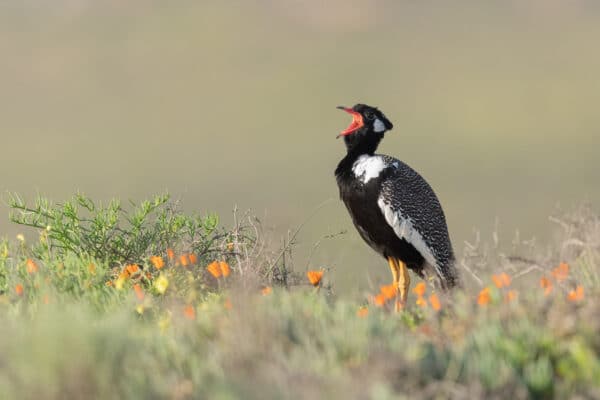
Southern Black Korhaan
Afrotis afra

Number Of Mature
Individuals (Regional)
Unknown

Regional
Population Trend
Decreasing
2025
Regional Category
Vulnerable
Search by species
CONTENTSOverview
Names
|
IOC English Name: |
Southern Black Korhaan |
|
SA & IOC Scientific Name: |
Afrotis afra |
|
BirdLife International Taxonomy (scientific name): |
Afrotis afra |
|
Order: |
OTIDIFORMES |
|
Family: |
Otididae |
|
Species name author: |
Linnaeus 1758 |
|
Afrikaans: |
Swartvlerkkorhaan |
|
Sesotho (South Africa): |
Lekakarane |
|
Sesotho (Lesotho): |
Lekakarane |
|
Siswati: |
|
|
Zulu: |
iseme laseKapa |
Current Assessment Status
|
2025 Regional Category [Criteria] |
VU [A4bc] |
|
2024 Global Category [Criteria] |
VU [A4bc] (BirdLife International 2016) |
|
Population size (Regional) |
Unknown |
|
Population size (Global) |
Unknown |
|
Distribution size (EOO) (Regional) km2 |
1 509 628 (Lee 2024) |
|
Distribution size (EOO) (Global) km2 |
1 509 628 (Lee 2024) |
|
Distribution size (AOO) (Regional) km2 |
648 952 (Lee 2024) |
|
Generation time |
10.3 years (BirdLife International 2016) |
|
Status change reason |
No change |
|
Migrant (in the region) |
No |
|
Regional endemic |
Yes |
Historic Listing Information
|
2000 Regional Status |
Not Evaluated |
|
2015 Regional Status |
VU [A2bc+4bc] |
|
Status change reason (if applicable) |
Not applicable |
|
2015 Population size (Regional) |
Unknown |
|
2015 Global Status |
VU [A4bc] |
Reason for Inclusion
Reason for Inclusion in the Assessment
The Southern Black Korhaan Afrotis afra is endemic to South Africa and was listed as regionally Vulnerable in 2015 (Hofmeyr and Taylor 2015).
Category Justification
Category Justification
The population of the endemic Southern Black Korhaan is suspected to have undergone at least >30% decline over the past three generations, qualifying it as regionally Vulnerable (Hofmeyr and Taylor 2015, Evans 2023, BirdLife International 2016). While no population estimates exist, the rapid decline is suspected to be due to the loss and fragmentation of its habitat because of agricultural conversion. This loss is ongoing and likely irreversible (Moncrieff 2021, Evans 2023).
Population Justification
The global (and therefore regional) population size remains unknown (Hofmeyr and Taylor 2015).
Trend Justification
Based on estimates of the historically (prior to large scale human settlements) and current (2020) habitat available to the birds of 30 124 km2 and 20 355 km2 respectively, the availability of suitable habitat for Southern Black Korhaan has declined by an estimated 32% (Evans 2023). Prior to 2020, between 52% and 61% of the habitat for Southern Black Korhaan was estimated to have been lost in the Overberg and Swartland regions (Evans 2023). Coordinated Avifaunal Roadcounts (CAR) data suggest that the Overberg and Swartland populations declined between 1998 and 2010, while a small portion of the Eastern Cape population showed a slight increase in numbers over a similar period (Hofmeyr 2012). Evans (2023) estimated a greater decline in the relative abundance of Southern Black Korhaan in the Eastern Cape than did Hofmeyr (2012). The decline in the Southern Black Korhaan’s reporting rate from the first (1987-1991) to the second Southern African Bird Atlas Projects (2007-ongoing) (SABAP) suggests that its population has declined by >30% over the past three generations (Evans 2023).
Biology & Ecology
Taxonomy
Afrotis (del Hoyo et al. 2014) was previously placed in the genus Eupodotis. The Southern Black Korhaan was previously considered conspecific with the Northern Black Korhaan A. afraoides and was consequently not assessed in 2000 (Dowsett and Forbes-Watson 1993, Allan 1997, Barnes 2000). The two taxa were split based on behavioural, ecological, genetic and morphological differences (Sibley and Monroe 1990, 1993, Crowe et al. 1994, Allan 2005, Evans 2022a).
Identification
50–53 cm, c. 700 g. The sexes differ in colouration. The male is black with a contrasting white patch on its ear coverts. Upper parts barred black and brown; a white collar extends across the mantle. Crown brown. Wing coverts white, forming a broad edge on folded wing, conspicuous in flight (but lacks white primaries of Northern Black Korhaan). Bill red with grey tip and pale sub-terminal bar. Legs bright yellow. Smaller female has head, neck and breast buff-brown, with black restricted to belly, and lacks white mantle bar. Juvenile resembles female but dorsal and flight feathers pale-tipped (Allan 2005). The Southern Black Korhaan could be confused with the Northern Black Korhaan, especially where their ranges overlap along the Great Fish River north of Cookhouse to west and south of Cradock (Evans 2022a).
Distribution
The Southern Black Korhaan is a South African endemic that is restricted to the winter- and mixed winter/summer-rainfall areas of the Northern Cape Province west of the Great Escarpment, and to the area south of the Great Escarpment in the Western Cape, and the western section of the Eastern Cape Province (Crowe et al. 1994, Tarboton 2001, Allan 2005, Hofmeyr and Taylor 2015, Evans 2023). Records in Limpopo, Gauteng, Free State and the northern extremities of Northern Cape are attributed to misidentifications of Northern Black Korhaan.
Ecology
The majority of the Southern Black Korhaan’s range is in the Fynbos Biome, extending into the Succulent Karoo and extreme southern part of the Nama Karoo Biome in the north and western sections of its range and the Albany Thicket in the eastern part of its range (Crowe et al. 1994, Mucina and Rutherford 2006, Hofmeyr 2012, Evans 2023). Patches of natural habitat that are larger and nearer to each other are better for Southern Black Korhaan (Evans 2023). The species shows a distinct preference for natural habitats over transformed land (Hofmeyr 2012, Evans 2023). However, it has been observed, and was presumed to be feeding, in cultivated fields, crop stubble, pastures, and fallow fields (Hockey et al. 1989, Martin and Pepler 1995, Cohen and Spottiswoode 2003, Young et al. 2003, Hofmeyr 2012). Southern Black Korhaan nests with eggs have occasionally been found in wheat fields (Uys 1988). However, the extent to which the birds breed successfully, i.e. raise offspring that survive to breed at least once, in transformed habitat remains unknown. The extent to which agricultural activities may disrupt (through disturbance) feeding and breeding attempts remains unknown. It is therefore unknown whether these transformed areas represent sources or sinks. However, the large decline in the relative abundance of the birds, estimated at >30%, suggests that the transformed areas are probably sinks (Hofmeyr and Taylor 2015, Evans 2023). An estimated generation length of 10.3 years is provided by BirdLife International (2016).
Threats & Conservation
Threats
The primary threat to the Southern Black Korhaan is habitat loss due to cultivation (Hofmeyr 2012, Evans 2023). This has resulted in increased fragmentation of the natural vegetation available to Southern Black Korhaan (Evans 2023). The fragmentation was caused by a reduction in the size and consequently an increase in the distance between patches of natural vegetation (Evans 2023). Edge effects, such as increased predation by corvids or changes in microclimate, might be affecting the Southern Black Korhaan population in natural grasslands but not in its fynbos habitat (Evans 2023). Additional potential causes of the decline in the population of this species include climate change, human disturbance and increased nest predation by corvids (Hofmeyr 2012). Southern Black Korhaan is only moderately protected by the current network of protected areas throughout its distribution range (Skowno et al. 2019).
Conservation Measures Underway
There are no conservation measures currently in place for this species. However, according to South African legislation, the presence of Southern Black Korhaan on a site proposed for development requires that a specialist (e.g. Evans 2022b) complete an assessment of the impact posed by the proposed development on this species and makes appropriate recommendations to either avoid or minimise any adverse impact on the species and the habitat on which it depends (Environmental Impact Assessment Regulations 2014 under the National Environmental Management Act 107 of 1998). Young et al. (2003) advocated engagement with landowners to develop and implement appropriate measures to protect large terrestrial birds. Following consultation and discussions with landowners, the then Animal Demography Unit of the University of Cape Town published a booklet titled Farming for the future: farming sustainably with nature, which includes information on conservation measures to be put in place for large terrestrial bird species such as the Southern Black Korhaan. The conservation of natural habitat on farms and the prevention of excessive disturbance of natural veld by livestock are advocated for this species in particular.
Conservation Measures Proposed
A total of 11 549 km2 or 57% of the total area of habitat suitable for the Southern Black Korhaan was estimated to have been within protected areas, critical biodiversity areas, and ecosystem support areas in 2020 (Evans 2023). These critical biodiversity areas and ecosystem support areas, identified in the provincial biodiversity spatial conservation plans (Holness and Oosthuyzen 2016, Pool-Stanvliet et al. 2017, Department of Economic Development and Environmental Affairs 2019), must be conserved and, where required (critical biodiversity areas 2 and ecosystem support areas 2), rehabilitated to conserve Southern Black Korhaan and the habitats on which it and the other biodiversity within its distribution range depend (Evans 2023).
Conserving the critical biodiversity areas, and ecosystem support areas would provide corridors of indigenous vegetation linking isolated patches of natural vegetation that would benefit this species. Biodiversity stewardship programmes to formalise the protection of these key areas and habitats is a priority.
Coordinated Avifaunal Roadcounts (CAR) must continue, and participants should ideally collect basic habitat availability data along the length of routes to improve habitat use models (Hofmeyr and Taylor 2015).
A population viability analysis (PVA) and biodiversity management plan, as provided for in the National Environmental Management Biodiversity Act No. 10 of 2004, should be completed for the Southern Black Korhaan.
Research Priorities and Questions
An updated assessment of the effects of habitat loss and fragmentation on the relative abundance and conservation of Southern Black Korhaan should be completed whenever a new land-use land-cover map (e.g. Department of Environment, Forestry and Fisheries 2021) is developed for South Africa (e.g. Evans 2023). The 2022 South African National Land Cover map was available from May 2024 (https://egis.environment.gov.za/sa_national_land_cover_datasets#).
The population size, density and movement patterns of Southern Black Korhaan in and between the fynbos, grassland, succulent karoo, and nama karoo habitats that it occupies should be determined (Hofmeyr and Taylor 2015, Evans 2023). It would then be possible to assess the changes in the size of the bird’s population more directly and accurately over time and assess its risk of extinction.
Determining the breeding success of Southern Black Korhaan in the centre and along the edges of its range (i.e. the quarter degree grid cells in which the species was recorded in SABAP2 and not SABAP1) would improve our understanding of which parts of its range represent source and sink populations (Evans 2023).
Other priorities are determining whether the network of protected areas, critical biodiversity areas, and ecosystem support areas are sufficient to conserve a viable population of Southern Black Korhaan, and whether habitat patch area and/or fragmentation thresholds exist below which the population would decline more rapidly than the current rate at which it is declining (Evans 2023).
In addition to habitat loss, it is also important to determine the magnitude of the threats facing the species, which include climate change, human disturbance and the possible impact of chick and egg predation by Pied Crows Corvus albus and Cape Crows C. capensis.
Contributors & References
Assessor/s
Steven W. Evans
Reviewer/s
Sally Hofmeyr, Matt Pretorius
References
Barnes KN. 2000. The Eskom Red Data Book of Birds of South Africa, Lesotho and Swaziland. Johannesburg, South Africa: BirdLife South Africa.
Allan DG. 1997. Black Korhaan and Whitewinged Black Korhaan and E. afraoides. In Harrison JA, Allan DG, Underhill LG, Herremans M, Tree AJ, Parker V, Brown CJ (eds), The atlas of Southern African birds Vol. 1: passerines, Johannesburg, South Africa: BirdLife South Africa.
Allan DG. 2005. Southern Black Korhaan Afrotis afra. In: Hockey PAR, Dean WRJ, Ryan PG (eds), Roberts birds of southern Africa 7th Edn. Cape Town, South Africa: Trustees of the John Voelcker Bird Book Fund. pp 298.
BirdLife International. 2016. Afrotis afra. The IUCN Red List of Threatened Species 2016: e.T22691975A93331501. https://dx.doi.org/10.2305/IUCN.UK.2016-3.RLTS.T22691975A93331501.en. [Accessed on 01 October 2024].
Cohen C, Spottiswoode N. 2003. Black Korhaan Eupodotis afra. In: Young DJ, Harrison JA, Navarro RA, Anderson MD, Colahan BD (eds), Big birds on farms: Mazda CAR Report 1993–2001. Cape Town, South Africa: Avian Demography Unit.
Crowe TM, Essop MF, Allan DG, Brooke RK, Komen J. 1994. ‘Over-looked’ units of comparative and conservation biology: a case study of a small African bustard, the Black Korhaan Eupodotis afra. Ibis 136: 166–175.
del Hoyo J, Collar NJ, Christie DA, Elliott A, Fishpool LDC. 2014. HBW and BirdLife International Illustrated Checklist of the Birds of the World. Lynx Edicions , Barcelona, Spain and Cambridge, UK: BirdLife International.
Department of Economic Development and Environmental Affairs. 2019. Eastern Cape biodiversity conservation plan handbook (ECBCP). Compiled by Hawley G, Desmet P, Berliner D. King Williams Town, South Africa: Department of Economic Development and Environmental Affairs.
Department of Environment, Forestry and Fisheries. 2021. South African National Land-Cover 2020 Accuracy Assessment Report. Computer Automated Land-Cover (CALC) System. Version v1.0.4, Public Release Report. Pretoria, South Africa: Department of Environment, Forestry and Fisheries.
Dowsett RJ, Forbes-Watson AD. 1993. Checklist of birds of the Afrotropical and Malagasy regions, volume one: Species limits and distribution. Liege: Tauraco Press. Octavo.
Evans SW. 2022a. Identification of the landscape and bioclimatic characteristics that contribute to maintaining the allopatric distribution ranges of the Northern Black Korhaan Afrotis afraoides and the Southern Black Korhaan Afrotis afra. Ostrich 93: 53–69.
Evans SW. 2022b. Specialist Avifaunal Assessment of portions of the farm Jagfontein no. 85, near Calitzdorp – New Pomegranate Orchard. Steven W Evans Avifaunal Assessments, Unpublished report.
Evans SW. 2023. The effects of habitat loss and fragmentation on the relative abundance and conservation of Southern Black Korhaan Afrotis afra, a South African endemic. Bird Conservation International 33 e71. DOI: https://doi.org/10.1017/S0959270923000230
Hockey PAR, Underhill LG, Neatherway M, Ryan PG. 1989. Atlas of the birds of the Southwestern Cape. Cape Town, South Africa: Cape Bird Club.
Hofmeyr SD. 2012. Impacts of Environmental Change on Large Terrestrial Bird Species in South Africa: Insights from Citizen Science Data. PhD thesis. Cape Town: University of Cape Town, South Africa.
Hofmeyr SD, Taylor MR. 2015. Southern Black Korhaan Afrotis afra. In: Taylor MR, Peacock F, Wanless RM (eds), The Eskom Red Data Book of Birds of South Africa, Lesotho and Swaziland. Johannesburg, South Africa: BirdLife South Africa. pp 58-60.
Holness SH, Oosthuysen E. 2016. Critical biodiversity areas of the Northern Cape: technical report. Kimberley, South Africa: Nelson Mandela Metropolitan University/Northern Cape Department of Environment and Nature Conservation.
Lee ATK. 2024. Regional Red Data Book of the Birds of South Africa, Lesotho and Eswatini: SABAP2 synthesis and supporting information and graphics for Southern Black Korhaan. Unpublished report. Johannesburg: BirdLife South Africa.
Martin R, Pepler D. 1995. Birds feeding in lucerne. Promerops 219: 11.
Moncrieff GR. 2021. Locating and dating land cover change events in the Renosterveld, a Critically Endangered shrubland ecosystem. Remote Sensing 13: 834.
Mucina L, Rutherford MC. 2006. The Vegetation of South Africa, Lesotho and Swaziland. Strelitzia 19. Pretoria, South Africa: South African National Biodiversity Institute.
Pool-Stanvliet R, Duffell-Canham A, Pence G, Smart R. 2017. The Western Cape biodiversity spatial plan handbook. Stellenbosch, South Africa: CapeNature.
Sibley CG, Monroe BL. 1990. Distribution and Taxonomy of Birds of the World. Yale University Press, London
Sibley CG, Monroe BL. 1993. A World Checklist of Birds. Yale University Press, New Haven and London: [I]-XIX, 1-393.
Skowno AJ, Poole CJ, Raimondo DC. 2019. National biodiversity assessment 2018: the status of South Africa’s ecosystems and biodiversity; synthesis report. Pretoria, South Africa: South African National Biodiversity Institute.
Tarboton W. 2001. A guide to the nests and eggs of Southern African birds. Cape Town, South Africa: Struik.
Uys CJ. 1988. The Black Korhaan in the Western Cape. Promerops 183: 10–11.
Young DJ, Harrison JA, Navarro RA, Anderson MD, Colahan BD. 2003. Big birds on farms: Mazda CAR Report 1993–2001. Cape Town, South Africa: Avian Demography Unit.
Citation
Evans SW 2025. Southern Black Korhaan. In: Lee ATK, Rose S, Banda S, Bezeng SB, Maphalala MI, Maphisa DH, Smit-Robinson H (eds), The 2025 Red Data Book of Birds of South Africa, Lesotho and Eswatini. Johannesburg, South Africa: BirdLife South Africa. Available at: https://www.birdlife.org.za/red-list/southern-black-korhaan/
Our generous sponsors


