


Southern Banded Snake Eagle
Circaetus fasciolatus

Number Of Mature
Individuals (Regional)
40 – 50

Regional
Population Trend
Decreasing
2025
Regional Category
Critically Endangered
Search by species
CONTENTSOverview
Names
|
IOC English Name: |
Southern Banded Snake Eagle |
|
SA & IOC Scientific Name: |
Circaetus fasciolatus |
|
BirdLife International Taxonomy (scientific name): |
The same as SA & IOC |
|
Order: |
ACCIPITRIFORMES |
|
Family: |
Accipitridae |
|
Species name author: |
Kaup 1850 |
|
Afrikaans: |
Dubbelbandslangarend |
|
Sesotho (South Africa): |
Lejanoha la setonometjhato |
|
Sesotho (Lesotho): |
|
|
Siswati: |
|
|
Zulu: |
indlanyokempunga |
Current Assessment Status
|
2025 Regional Category [Criteria] |
CR [D] |
|
2024 Global Category [Criteria] |
NT [A2c+3c+4c; D1] (BirdLife International 2021) |
|
Population size (Regional) |
40 – 50 mature individuals |
|
Population size (Global) |
670 – 2000 (BirdLife International 2021) |
|
Distribution size (EOO) (Regional) km2 |
15 972 (Lee 2024) |
|
Distribution size (EOO) (Global) km2 |
2 130 000 (BirdLife International 2021) |
|
Distribution size (AOO) (Regional) km2 |
8724 (Lee 2024) |
|
Generation time |
8.07 years (BirdLife International 2021) |
|
Status change reason |
No change |
|
Migrant (in the region) |
No |
|
Regional endemic |
No |
Historic Listing Information
|
2000 Regional Status |
NT [C1+2a(i)] |
|
2015 Regional Status |
CR [C2a(i,ii); D] |
|
Status change reason (if applicable) |
Revision of threat status criteria and increased knowledge |
|
2015 Population size (Regional) |
40 – 50 mature individuals |
|
2015 Global Status |
NT [C1+2a(i)] |
Reason for Inclusion
Reason for Inclusion in the Assessment
The species was assessed as Critically Endangered during the 2015 assessment (Taylor 2015).
Category Justification
Category Justification
Southern Banded Snake Eagle Circaetus fasciolatus remains rare and poorly studied in the region. This species is suspected to have a single small population in an area that has historically experienced extensive habitat loss. The 2015 uplisting to Critically Endangered was motivated by an expert opinion-based population estimate of 40 – 50 mature individuals, thereby qualifying for the status under Criterion D (Taylor 2015). No new population estimate is available, and population numbers are therefore assumed to be unchanged given trends from citizen science data. Recent analysis of Southern African Bird Atlas (SABAP2) data indicates that there has been some decline in reporting rates and Area of Occupancy (AOO) regionally (Lee 2024). While confidence in these two trends is low (Lee 2024), in the absence of contradictory evidence the population is assumed not to have increased since 2015. Given that the regional population is isolated from the rest of the African range this species is not considered a good candidate for a rescue effect.
The species therefore remains Critically Endangered under Criterion D. Urgent monitoring is required to determine the regional population size and trend.
Population Justification
The global population is estimated at 670 – 2000 mature individuals (BirdLife International 2021). No recent nor reliable data exists on regional population numbers. The estimated 40 – 50 mature individuals indicated in the 2015 assessment was purely based on expert-opinion and the confidence in these numbers are therefore low (Taylor 2015). SABAP2 data indicates that reporting rates and AOO have declined in recent years and while confidence in these trends is low, it suggests continued population decline in the absence of contradictory information (Lee 2024). The population is therefore assumed to be less than 50 mature individuals. Confidence in this estimate is low.
Trend Justification
The global population is in decline (BirdLife International 2021). In South Africa, regression analysis of citizen science data from SABAP2 shows some evidence of a decreasing trend in reporting rates within the SABAP2 period but there was weak confidence in these findings and no change could be shown between the SABAP1 (1986-1991) and SABAP2 (2007-2015) (Lee 2024). A decrease of 15% in pentads in which the species has been reported does indicate a potential range contraction but roughly 60% of its current range falls within protected areas such as the iSimangaliso Wetland Park (Lee 2024). While limited, the only evidence currently available suggests continued regional declines, albeit marginal (Lee 2024). Confidence in this estimate is low.
Biology & Ecology
Taxonomy
No notable issues. Species also referred to as the Fasciated Snake-Eagle.
Identification
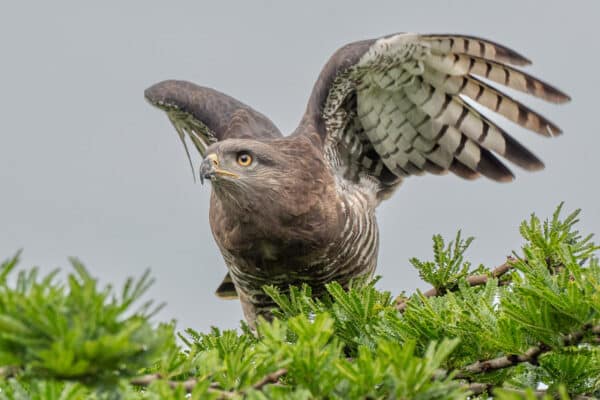
At a buzzard-sized 55–60 cm in length and weighing 1–1.2 kg, the Southern Banded Snake Eagle is an inconspicuous raptor that favors forest edges. While the sexes are similar, females hold a slight size advantage. Adults have dark grey-brown upperparts, including the crown, nape, throat and upper breast. Their bellies are white with distinct, narrow, horizontal brown bars. The tail is blackish grey and displays three clear diagnostic bands of a paler grey-brown. The tarsi are unfeathered and heavily scaled. They have large heads with prominent pale-yellow eyes. The black bill is contrasted by a yellow cere. Juveniles can be distinguished by their white-streaked crown, brown nape, and black-and-white streaked face. Their white throat transitions to an off-white belly, while the remaining underparts are a pale buffy grey with faint brown barring on the flanks and thighs. Juveniles have eyes and cere of a deeper yellow than that of adults (Chittenden 2005).
Distribution
The Southern Banded Snake Eagle has a wide but fragmented distribution along Africa’s east coast (Ferguson-Lees and Christie 2001). Three sub-populations exist within southern Africa. In South Africa, the population is concentrated in Maputaland, northern KwaZulu-Natal (Figure 1). The iSimangaliso Wetland Park forms the core of its range in the region but other important sites of occurrence include Phinda Private, Ndumo and Mkuze Game Reserves. Sightings have been recorded further south with SABAP2 data suggesting regular occurrence up to the Tugela Mouth and BirdLife South Africa has mapped the territory of a tracked male just south of Mtunzini (Whitecross unpubl data). Inland from this area birds have also been reported in Dhlinza forest and Ngoye forest (SABAP2, Brookes et al. 2022). Records of birds spotted further south from SABAP2 are sparse and likely due to juvenile dispersal. Dispersal and movement are poorly understood.
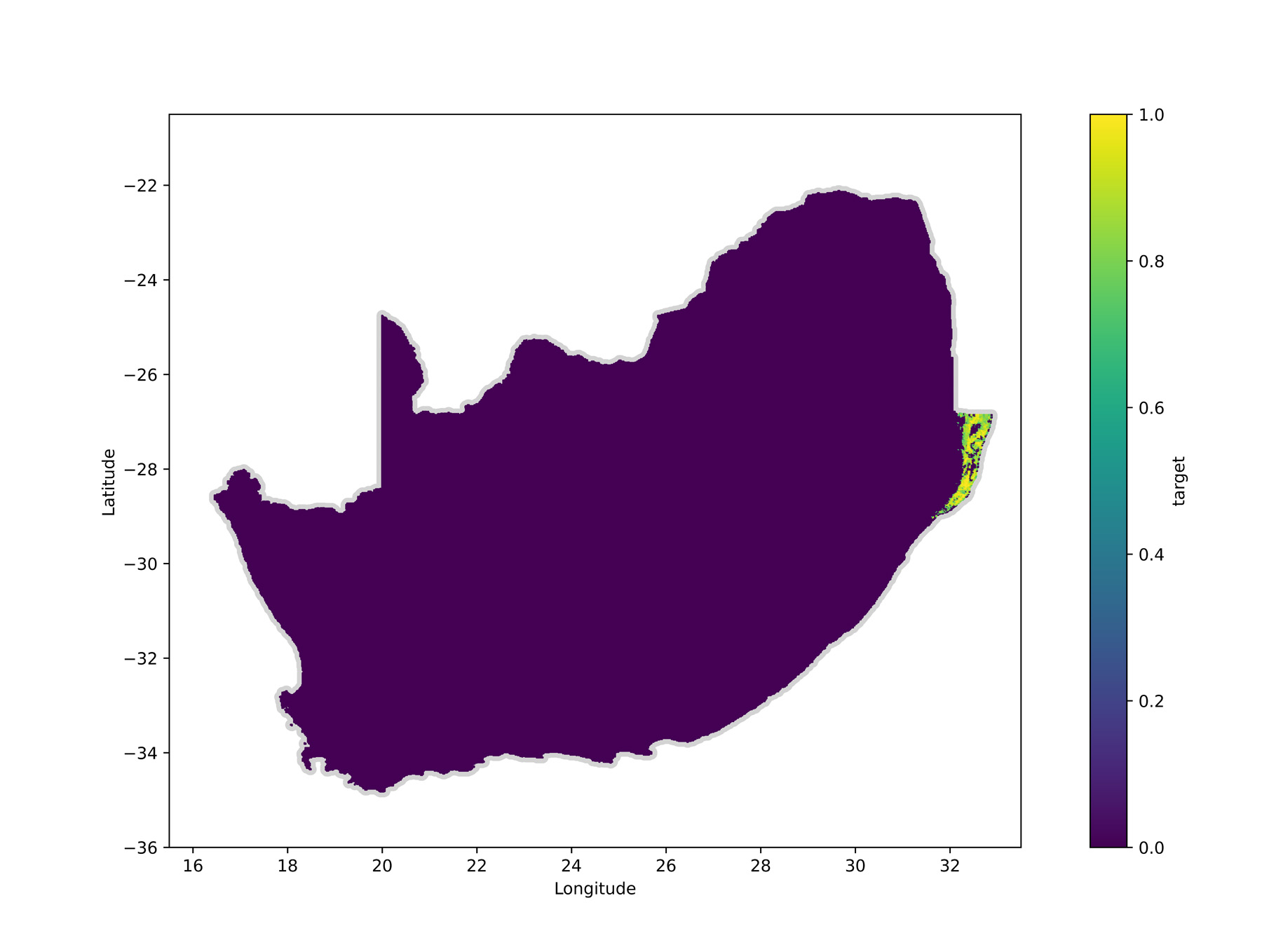
Figure 1: South Africa Southern Banded Snake Eagle probability distribution map, produced from BirdLasser location data at 2x2km grid scale, using iNaturalist and eBird as absence data only. This represents the predicted range for the 2016-2023 period, at a pentad scale p>0.5. Brighter colour indicates greater probability. Map from Lee (2024).
Ecology
This shy raptor hunts from a perch, mostly targeting snakes and lizards (Brown 1982) but rodents, amphibia, arthropods and birds have all been recorded as part of its diet (del Hoyo et al. 1994). They only lay a single egg in nests that are constructed from sticks and well concealed within the forest canopy by creeping plants (del Hoyo et al. 1994, Parkes 2007, McPherson 2017). Typical habitat includes dense coastal and riverine forests and foraging in adjacent marshes and floodplains (del Hoyo et al. 1994). In South Africa, Sand Forest thickets and lowland Coastal Dune Forest margins interspersed with clearings and coastal grasslands are preferred (Chittenden 2005), with some evidence for the use of habitats that are a mosaic of exotic plantations and pockets of natural forest (McPherson 2017). A two-year BirdLife South Africa survey of forest fragments within the mosiac of Eucalyptus plantations from Amatikhulu to Richards Bay located at least nine active territories were located using call-backs with five concentrated in the Kwambonambi block. A telemetry study of a male and female from neighboring territories in Mtunzini indicated that adults will occupy a small, productive territory (<2 km2) (Whitecross unpubl data). The dispersal dynamics of immature birds are unknown.
Threats & Conservation
Threats
The historical decline of the Southern Banded Snake Eagle in South Africa is directly linked to habitat loss driven by 20th-century forestry, agriculture, and tourism development (Chittenden 2005). In South Africa protected areas like iSimangaliso Wetland Park and other private reserves in the Hluhluwe area now provide refuge from these pressures, the neighboring sub-population in Mozambique faces escalating threats due to ongoing habitat destruction (Parker 1999). Fortunately, given this species’ diet, they are unlikely to be perceived to be a threat to livestock or game and therefore unlikely to be persecuted by landowners (Brooke 1984). However, the core issue remains – ongoing habitat degradation and fragmentation. Coastal forests, crucial for the eagle’s survival, are threatened by activities like wood extraction for timber, charcoal, and firewood (Burgess and Muir 1994, del Hoyo et al. 1994). Slash-and-burn agriculture and land-use changes further squeeze their range (Cooper 2015). Over 80% of the Indian Ocean Coastal Belt Forest has already been lost and climate change is projected to significantly affect the remaining habitat (Colyn et al. 2020). Electrical infrastructure also poses a threat and multiple electrocutions by pole mounted transformer boxes have been recorded (BirdLife South Africa unpubl data).
Conservation Measures Underway
BirdLife South Africa has a project dedicated to this species which includes a tracking study to investigate the movement ecology of this species and annual surveys with the help of citizen scientists to start monitoring the population. The project has, in collaboration with ESKOM, retrofitted transformer boxes in the core of this species’ range through northern KwaZulu-Natal to prevent further electrocutions.
Conservation Measures Proposed
Bird-safe power infrastructure design should be implemented throughout the habitat of this species and existing transformer boxes should be retrofitted with insulation to prevent animal electrocutions. Further habitat degradation of dune forests and coastal grasslands should be prohibited. Engagement with the forestry industry to ensure the protection of remaining pockets of natural forests in the forestry mosaic, breeding birds have been discovered in these pockets. Community outreach and environmental education are required to avoid the disturbance of breeding birds and the degradation of their habitat through firewood gathering and slash-and-burn agriculture. Importantly, maintaining the forest-grassland ecotone appears to be a critical intervention to maintain suitable foraging sites.
Research Priorities and Questions
Little is known about the species and its biology and the species needs dedicated research in the following topics:
- Breeding distribution, density and productivity need to be established.
- Survival rates of the different age classes need to be established.
- Population surveying needs to be conducted to verify assumed population size and its trajectory.
- Further tracking is required to understand the dispersal dynamics and foraging ecology of the species.
- Rate of habitat loss and change in the region needs to be monitored.
- The relationship between the three sub-populations in southern Africa needs to be ascertained.
- A Population and Habitat Viability Assessment (PHVA) is recommended once the necessary demographic data has been collected.
Contributors & References
Assessor/s
Christiaan Willem Brink
Reviewer/s
Melissa Whitecross, Mark Brown
References
BirdLife International. 2021. Circaetus fasciolatus. The IUCN Red List of Threatened Species 2021: e.T22695277A200956033. https://dx.doi.org/10.2305/IUCN.UK.2021-3.RLTS.T22695277A200956033.en. [Accessed on 25 May 2024].
Brooke RK. 1984. South African Red Data Book–Birds. Pretoria, South Africa: Foundation for Research Development: CSIR.
Brooks M, Rose S, Altwegg R, Lee ATK, Nel H, Ottosson U, Retief E, Reynolds C, Ryan PG, Shema S, Tende T. 2022. The African Bird Atlas Project: a description of the project and BirdMap data-collection protocol. Ostrich 93(4): 223–232.
Brown LH. 1982. The prey of the crowned eagle Stephanoaetus coronatus in Central Kenya. Scopus 6: 91–94.
Burgess ND, Muir C. 1994. Coastal forests of Eastern Africa: biodiversity and conservation. Society for Environmental Exploration and Royal Society for the Protection of Birds, Dar Es Salaam, Tanzania and Sandy, UK.
Chittenden HN. 2005. Southern Banded Snake-Eagle Circaetus fasciolatus. In: Hockey PAR, Dean WRJ, Ryan PG (eds), Roberts – Birds of Southern Africa, 7th Edn. Cape Town, South Africa: The Trustees of the Hohn Voelcker Bird Book Fund. pp 495–497.
Colyn RB, Ehlers Smith D, Ehlers Smith Y, Smit-Robinson H, Downs C. 2020. Predicted distributions of avian specialists: A framework for conservation of endangered forests under future climates. Diversity and Distributions DOI: 10.1111/ddi.13048.
Cooper TJG. 2015. The effects of land use changes on the distribution of forest dependent bird species in South Africa. PhD thesis, Stellenbosch University, South Africa.
del Hoyo J, Elliott A, Sargatal J. 1994. Handbook of the Birds of the World, vol. 2: New World Vultures to Guineafowl. Barcelona, Spain: Lynx Edicions.
Ferguson-Lees J, Christie DA. 2001. Raptors of the World. New York, United States of America: Houghton Mifflin Company.
Lee ATK. 2024. Regional Red Data Book of the Birds of South Africa, Lesotho and Eswatini: SABAP2 synthesis and supporting information and graphics for Southern Banded Snake Eagle. Unpublished report. Johannesburg: BirdLife South Africa.
McPherson S. 2017. Southern Banded Snake Eagle Project Report. Prepared for BirdLife South Africa.
Parker V. 1999. The atlas of the birds of Sul do Save, southern Mozambique. Cape Town, South Africa: University of Cape Town.
Parkes DA. 2007. Notes on the breeding of the Southern Banded Snake-eagle. Honeyguide 53(1– 2): 9–12.
SABAP2. South African Bird Atlasing Project 2. FitzPatrick Institute of Ornithology, University of Cape Town. Available: https://sabap2.birdmap.africa/. [Accessed on 30 January 2025].
Taylor MR. 2015. Souther Banded Snake Eagle Circaetus fasciolatus. In: Taylor MR, Peacock F, Wanless RW (eds), The Eskom Red Data Book of Birds of South Africa, Lesotho and Swaziland. Johannesburg, South Africa: BirdLife South Africa. pp 37–38.
Whitecross MA. Unpublished data. Southern Banded Snake Eagle Accipitridae South Africa. Movebank Data Repository. Available: https://www.movebank.org/cms/webapp?gwt_fragment=page=studies,path=study2271908813. [Accessed on 30 January 2025].
Citation
Brink CW 2025. Southern Banded Snake Eagle. In: Lee ATK, Rose S, Banda S, Bezeng SB, Maphalala MI, Maphisa DH, Smit-Robinson H (eds), The 2025 Red Data Book of Birds of South Africa, Lesotho and Eswatini. Johannesburg, South Africa: BirdLife South Africa. Available at: https://www.birdlife.org.za/red-list/southern-banded-snake-eagle/
Our generous sponsors


