


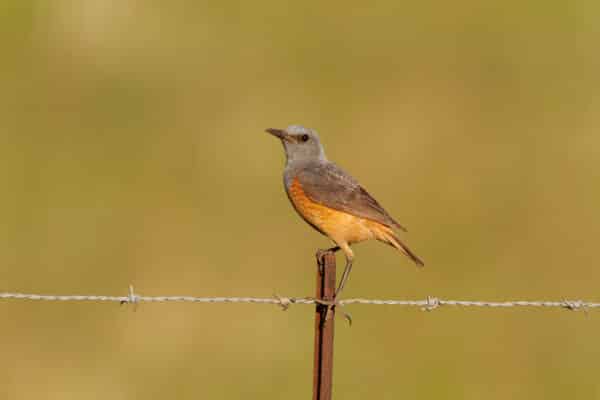
Sentinel Rock Thrush
Monticola explorator

Number Of Mature
Individuals (Regional)
187 098

Regional
Population Trend
Decreasing
2025
Regional Category
Least Concern
Search by species
CONTENTSOverview
Names
|
IOC English Name: |
Sentinel Rock Thrush |
|
SA & IOC Scientific Name: |
Monticola explorator |
|
BirdLife International Taxonomy (scientific name): |
Monticola explorator |
|
Order: |
PASSERIFORMES |
|
Family: |
Muscicapidae |
|
Species name author: |
Vieillot 1818 |
|
Afrikaans: |
Langtoonkliplyster |
|
Sesotho (South Africa): |
thume-kokotloputswa |
|
Sesotho (Lesotho): |
thume-kokotloputsoa |
|
Siswati: |
|
|
isiZulu: |
ikhwelematsheni |
Current Assessment Status
|
2025 Regional Category [Criteria] |
LC |
|
2024 Global Category [Criteria] |
NT [A2bc+3bc+4bc] (BirdLife International 2021) |
|
Population size (Regional) |
c. 187 098 mature individuals |
|
Population size (Global) |
Unknown (BirdLife International 2021) |
|
Distribution size (EOO) (Regional) km2 |
783 576 (629 332 – 864 312) (Lee 2025) |
|
Distribution size (EOO) (Global) km2 |
818 000 (BirdLife International 2021) |
|
Distribution size (AOO) (Regional) km2 |
93 084 (75 076 – 118 920) (Lee 2025) |
|
Generation time |
3.2 years (BirdLife International 2021) |
|
Status change reason |
No change |
|
Migrant (in the region) |
No |
|
Regional endemic |
Yes |
Historic Listing Information
|
2000 Regional Status |
Not Evaluated |
|
2015 Regional Status |
LC |
|
Status change reason (if applicable) |
No change |
|
2015 Population size (Regional) |
Unknown |
|
2015 Global Status |
LC |
Reason for Inclusion
Reason for Inclusion in the Assessment
The Sentinel Rock Thrush Monticola explorator, a regionally endemic species, was previously assumed to be of Least Concern. A historical analysis comparing Southern African Bird Atlas Project (SABAP1 and SABAP2) data indicated potential changes in abundance and range that might qualify the species as Near Threatened (Lee et al. 2017). As a result, BirdLife International (2021) took a precautionary approach and globally uplisted the species to Near Threatened under Criterion A.
Category Justification
Category Justification
The global red listing, completed in 2021, adopts a conservative approach and indicates a moderately rapid decline for the species. Based on the comparison of SABAP1 and SABAP2 data by Lee et al. (2017), this has resulted in its classification as Near Threatened under Criteria A2bc+3bc+4bc.
The regional population is classified as Least Concern under Criterion A2 due to a 5.3% decrease in Area of Occupancy (AOO), Extent of Occurrence (EOO), and habitat quality over 10 years (the equivalent of three generations) according to the SABAP2 trend analysis (Lee 2025). This 5.3% decline is well below the 30% threshold required for listing under the A criteria and, therefore, does not warrant classification as Near Threatened.
The large EOO (c. 783 576 km²) and AOO (c. 93 084 km²) greatly exceed the threatened status threshold under Criterion B. The global and regional population size of the Sentinel Rock Thrush is currently unknown (BirdLife International 2021), but likely exceed 10 000 by a large margin and hence Criterion C1 could not be applied.
Population Justification
The global and regional population size of the species has not been quantified. It is described as fairly common at elevations above 1500 m in South Africa and as common at elevations above 2500 m in Lesotho. Recent analyses, which incorporate citizen science data from SABAP2 and BirdLasser, as well as habitat-suitability modelling (Lee 2025), have refined our understanding of the species’ AOO to c. 93 084 km². Osborne and Tigar (1990) reported densities ranging from 3 –12 birds/km2. Similarly, Kopij observed the species at varying densities across different altitudes and regions of Lesotho (Kopij 2002, 2013, 2015a, 2015b), the highest of those corresponding to 2.4 birds/km² in optimal Afro-alpine Grassland habitat at 2500–3500 m asl (Kopij 2015a). Based on a density estimates of 3 birds/km², the regional total population is calculated to be c. 279 252 individuals. Assuming that approximately 67% are mature (a typical percentage for passerines), this translates to c. 187 098 mature individuals. Our confidence in this estimate is low, and these numbers are approximate. The species density is expected to be significantly lower outside the Drakensberg region, particularly in the western and southern extents of its range. Point counts and supplementary atlas data will help in refining a more accurate population estimate in the future.
Trend Justification
Although past analyses (comparing SABAP1 and early SABAP2 data) indicated moderately rapid declines in reporting rates, contributing to its global Near Threatened classification by BirdLife International in 2021, the time period for these declines exceeds 10 years or three generations. However, issues of survey scale and protocol between those projects confounds confidence in resulting change metrics (Brooks et al. 2022). Adopting a precautionary approach due to potential moderate declines over three generations, the species was globally uplisted.
A more detailed and recent SABAP2 trend analysis (2007-2023) suggests only a slight reduction in range (around 5% over the past three generations), well below the Near Threatened Category. This historical analysis indicated a 34.4% decline in pentad reporting rate, a 48.7% decline in overall range, and a 38.5% decline in core range (Lee et al. 2017). The reporting range declined from 1327 pentads in 2015 to 1264 pentads in 2023 (Lee 2025).
Biology & Ecology
Taxonomy
Two subspecies are currently recognised: M. explorator explorator (Vieillot 1818) found in eastern and southern South Africa, and M. e. tenebriformis (Clancey 1952) located in Lesotho and southern Mozambique (Gill et al. 2025). These subspecies primarily differ in plumage colouration (Dean 2005).
Identification
16.5–18 cm, c. 50 g. Sexes dimorphic in plumage colouration. The male features a striking bright blue-grey head, mantle, and lower back, along with the scapulars and breast. The rump and upper tail coverts are vivid rufous-orange. The underparts are predominantly orange-brown, while the wings are slaty with buffy fringes. The female’s upper parts are greyish-brown (not blue-grey), with faint buff mottling and darker wings that have pale fringes. The rest of the underparts are a pale buffy-orange, and the tail is duller than that of the male. The juvenile resembles the female but is duller in appearance and has light spotting on its upper parts. The species can be confused with the Cape Rock Thrush M. rupestris (sympatric in some parts of its range) and Short-toed Rock Thrush (marginal overlap). The male Cape Rock Thrush has an orange (not blue-grey) upper breast and a dark brown and rufous (not blue-grey) back. The male Short-toed Rock Thrush has a whitish (not blue-grey) crown (Dean 2005, Collar and Sharpe2020).
Distribution
Endemic to South Africa, Lesotho and Eswatini, distributed from the Western Cape (as far west as the Cederberg) through the Karoo, Free State, Lesotho and highlands of KwaZulu-Natal to Mpumalanga and western eSwatini (Dean 2005) and potentially into the extreme south of Mozambique (Collar 2017). Mostly found at elevations between 2000 and 3200 m. The species’ population is primarily concentrated in Lesotho, thriving in areas above 2000 m where it is abundant (Hockey et al. 2005, Taylor et al. 2015). However, outside the Drakensberg region, it is found more sparsely and in a fragmented manner (Taylor et al. 2015). During the winter, the species migrates to coastal areas in the eastern Cape and eastern KwaZulu-Natal (Dean 2005), as well as to the grasslands of Gauteng (Taylor et al. 2015, pers obs).
Additionally, 33.4% of pentads where the species has been recorded contain protected areas. The distribution is divided between 83 pentads in National Parks/Nature Reserves, 44 in other protected areas, and 253 in unprotected areas (Lee 2025).
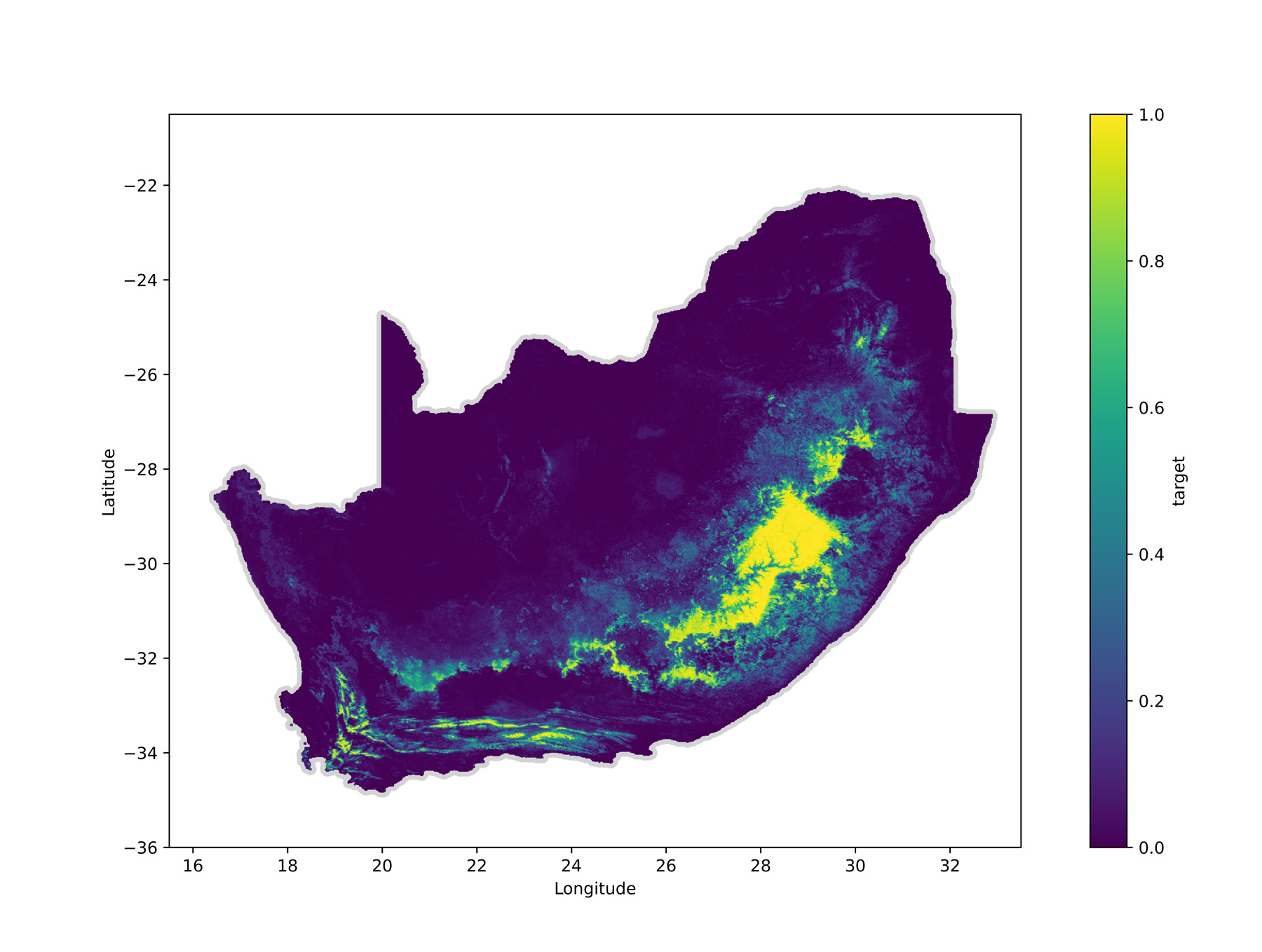
Figure 1: Distribution of Sentinel Rock Thrush at the 2×2 km grid level, as predicted using BirdLasser records for the period 2016-2023, with eBird and iNaturalist as absence data (from Lee 2025).
Ecology
This species inhabits high-altitude grasslands and heathlands with rocky areas, exposed rocks, and grassy rangelands scattered with stones (Dean 2005). It is a resident species in some regions, such as Lesotho and the Drakensberg region, but in other areas, it may undergo seasonal, altitudinal movements (Dean 2005). It is only a winter visitor to the grasslands in Gauteng (Taylor et al. 2015).
The species does not occur in the Lesotho lowlands (2500 m), Sentinel Rock Thrush comprises more than 90% of all Monticola breeding pairs, making it a dominant species in the avian community (Kopij 2010, 2014, 2015a, 2015b).
The species is monogamous, nesting solitarily from September to January. It forages on the ground, moving among grass tufts, rocks, and surrounding vegetation. It typically perches on stones, cow pats, or small stumps while searching for food. Its diet primarily consists of insects, but it may contain fruit and seeds (Dean 2005).
Threats & Conservation
Threats
The species’ dependence on high-altitude mountain-top habitats may make it vulnerable to the effects of climate change (Taylor et al. 2015). Climate change is considered a threat, causing habitat contraction and additional ecosystem-altering impacts (Simmons et al. 2004). Potential wind energy and other infrastructure developments could disturb habitats. Dean (2005) reports that the species’ numbers have declined in the western parts of its range for unknown reasons since the 1980s.
Conservation Measures Underway
There are no targeted conservation measures for Sentinel Rock Thrush. General biodiversity stewardship and improved land management practices could indirectly benefit the species. The species is present in some protected areas in the Western Cape. In contrast, there is less protection for its habitat in the eastern part of the range.
Conservation Measures Proposed
- Promote sustainable grazing practices that preserve the patchwork of rocky outcrops and prevent habitat degradation.
- Expand the protected area network.
- Implement guidelines for responsible wind energy and other infrastructural developments.
Research Priorities and Questions
- Determine population estimates, including density and distribution data across the species range, and especially in the western and southern parts of its range.
- Study breeding biology across habitat types.
- Establish patterns of seasonal movement and altitudinal migration.
- Assess climate change vulnerability.
- Evaluate whether the species’ numbers have decreased across the western parts of its range and identify the reasons for this decline.
- Understand ecological differences at subspecies level, such as local movements in the western and southern parts of its range.
- Investigate and identify whether any other threats could cause the species to decline.
Contributors & References
Assessor/s
Hanneline Smit-Robinson
Reviewer/s
Alan Lee
References
BirdLife International. 2021. Species factsheet: Sentinel Rock-thrush Monticola explorator. Downloaded from https://datazone.birdlife.org/species/factsheet/sentinel-rock-thrush-monticola-explorator. [Accessed on 25 February 2025].
Brooks M, Rose S, Altwegg R, Lee ATK, Nel H, Ottosson U, Thomson RL. 2022. The African Bird Atlas Project: a description of the project and BirdMap data-collection protocol. Ostrich 93(4): 223–232. https://doi.org/10.2989/00306525.2022.2125097
Collar N. 2017. Sentinel Rock-thrush (Monticola explorator). In: del Hoyo J, Elliott A, Sargatal J, Christie DA, de Juana E (eds), Handbook of the Birds of the World Alive. Lynx Edicions, Barcelona. Available: http://www.hbw.com/node/58407 [Accessed on 23 August 2017].
Collar N, Sharpe CJ. 2020. Sentinel Rock-Thrush (Monticola explorator), version 1.0. In: del Hoyo J, Elliott A, Sargatal J, Christie DA, de Juana E (eds), Birds of the World. Ithaca, NY, USA: Cornell Lab of Ornithology. https://doi.org/10.2173/bow.serthr1.01
Dean WRJ. 2005. Sentinel Rock Thrush. In: Hockey PAR, Dean WRJ, Ryan PG (eds), Roberts Birds of Southern Africa 7th Edn. Cape Town: Trustees of the John Voelcker Bird Book Fund. pp 898–899.
Gill F, Donsker D, Rasmussen P (eds). 2025. IOC World Bird List (v15.1).
Kopij G. 2002. The birds of Sehlabathebe National Park, Lesotho. Koedoe 45(1): 65–78.
Kopij G. 2010. Avian assemblages in the area around Thabana Ntlenvana, the highest peak of southern Africa. Zeszyty Naukowe UP Wrocław. Biologia i Hodowla Zwierząt 60: 67–76.
Kopij G. 2013. Avian assemblages of river gorges in the Maloti/Drakensberg ‘hot-spot’ region, southern Africa. Zoology & Ecology 23(3): 171–182.
Kopij G. 2014. Die Vogelgemeinschaft des afromontanen Themeda-Festuca Graslandes der endemitenreichen Drakensberg-Region, Südafrica [Avian assemblages in the Festuca-Themeda in the Drakensbergs endemic region, southern Africa]. Ornithologische Mitteilungen (Halle) 66(3): 99–107.
Kopij G. 2015a. Avian diversity along altitudinal gradient in Highveld/Drakensberg grasslands. Vestnik Zoologii 49(2): 451–456.
Kopij G. 2015b. Avian assemblages in the Afro-mountain and Alti-mountain Grasslands in the endemic Maloti/Drakensberg region of Lesotho. Zoology & Ecology 25(4): 319–326.
Lee ATK. 2025. Regional Red Data Book of the Birds of South Africa, Lesotho and Eswatini: SABAP2 synthesis and supporting information and graphics for Sentinel Rock Thrush. Unpublished report. Johannesburg: BirdLife South Africa,
Lee ATK, Altwegg R, Barnard P. 2017. Estimating conservation metrics from atlas data: the case of southern African endemic birds. Bird Conservation International 27(3): 323–336. https://doi.org/10.1017/S0959270916000307
Osborne PE, Tigar BJ. 1990. The status and distribution of birds in Lesotho. Newbury, United Kingdom: Nature Conservation Bureau Ltd.
Simmons RE, Barnard P, Dean WRJ, Midgley GF, Thuiller W, Hughes G. 2004. Climate change and birds: perspectives and prospects from southern Africa. Ostrich 75: 295–308.
Taylor MR, Peacock F, Wanless RM (eds). 2015. The 2015 Eskom Red Data Book of Birds of South Africa, Lesotho and Swaziland. Johannesburg, South Africa: BirdLife South Africa. pp 417.
Citation
Smit–Robinson H 2025. Sentinel Rock Thrush. In: Lee ATK, Rose S, Banda S, Bezeng SB, Maphalala MI, Maphisa DH, Smit-Robinson H (eds), The 2025 Red Data Book of Birds of South Africa, Lesotho and Eswatini. Johannesburg, South Africa: BirdLife South Africa. Available at: https://www.birdlife.org.za/red-list/sentinel-rock-thrush/
Our generous sponsors


