


Sclater’s Lark
Spizocorys sclateri

Number Of Mature
Individuals (Regional)
50 000 (20 000 – 150 000)

Regional
Population Trend
Decreasing
2025
Regional Category
Near Threatened
Search by species
CONTENTSOverview
Names
|
IOC English Name: |
Sclater’s Lark |
|
SA & IOC Scientific Name: |
Spizocorys sclateri |
|
BirdLife International Taxonomy (scientific name): |
Spizocorys sclateri |
|
Order: |
PASSERIFORMES |
|
Family: |
Alaudidae |
|
Species name author: |
Shelley 1902 |
|
Afrikaans: |
Namakwalewerik |
|
Sesotho (South Africa): |
|
|
Sesotho (Lesotho): |
|
|
Siswati: |
|
|
Zulu: |
unocingetsheni |
Current Assessment Status
|
2025 Regional Category [Criteria] |
NT [A2b+3c] |
|
2024 Global Category [Criteria] |
NT [C2a(i)] (BirdLife International 2017) |
|
Population size (Regional) |
50 000 (20 000 –150 000) |
|
Population size (Global) |
Unknown |
|
Distribution size (EOO) (Regional) km2 |
246 301 (195 188 – 303 235) (Lee 2024) |
|
Distribution size (EOO) (Global) km2 |
382 000 (BirdLife International 2017) |
|
Distribution size (AOO) (Regional) km2 |
68 936 (30 000 – 84 964) (Lee 2024) |
|
Generation time |
3.8 years (BirdLife International 2017) |
|
Status change reason |
No change |
|
Migrant (in the region) |
No |
|
Regional endemic |
No |
Historic Listing Information
|
2000 Regional Status |
NT |
|
2015 Regional Status |
NT [C2a(i)] |
|
Status change reason (if applicable) |
No change |
|
2015 Population size (Regional) |
Unknown |
|
2015 Global Status |
NT |
Reason for Inclusion
Reason for Inclusion in the Assessment
>50% of this species’ global range occurs in South Africa. In addition, it was assessed as regionally Near Threatened from 2000 and is currently listed as globally Near Threatened. There are no known populations in any nationally protected areas.
Category Justification
Category Justification
Sclater’s Lark Spizocorys sclateri is a sparse, desert specialist, restricted to western South Africa and southern Namibia. The population was previously suggested to be c.10 000, with suspected declines and number of mature individuals in each subpopulation c.1000 [C2i] (Peacock 2015). However, the most southerly Aberdeen population is suggested to be c. 2000 (Lee and Theron 2023) with a minimum regional population estimate of 20 000 (Lee et al. 2019a). However, Southern African Bird Atlas Project (SABAP2) data suggest that Sclater’s Lark warrants monitoring, with some analyses suggesting declines in reporting rate and range attributable to rangeland degradation coupled with increased developments in the Karoo (Lee et al. 2017, Lee and Wright 2024). However, it is unlikely these declines exceed 30% (Lee 2024). Thus, as a precautionary measure, Near Threatened with Criterion A2b is recommended, together with A3c as some of the species’ preferred habitat is easy to develop and there are currently planned renewable energy projects in the pipeline in important parts of its range. It inhabits a very specific habitat that is currently under threat by development of wind- and solar farms, mining and even overstocking. Hydraulic fracturing, in particular, may have devastating consequences for this species, which is more reliant on water resources than would be expected of an arid-zone bird community (Lee et al. 2019b)
Population Justification
Sclater’s Lark is rare and localized. Population estimates at their widest are 20 000 – 500 000 (Lee et al. 2019a) based on a regression algorithm linking SABAP2 reporting rate to density. Lee et al. (2018) suggested 60 000 – 150 000, but Lee and Theron (2023) argue this is an overestimate given large areas of unsuitable habitat over which this estimate is projected. The total South African population is likely c. 50 000 individuals based on extrapolation of a density estimate of 0.77 individuals/km2 to a range of 1000 pentads (Lee and Theron 2023). The distribution almost exactly matches the distribution of Salsola tuberculata (Lee and Theron 2023). Polygons mapped according to the colouration of aerial photos of ‘blomkoolgannaveld’ aggregates to about 30 000 km² over the region (Lee and Theron 2023). Even though the Area of Occupancy (AOO) might be 30 000 km², they do not tend to move more than 2 km from a watering point so with fewer watering points and an estimated population density of between 0.92 and 2.37 birds/ km² (Lee et al. 2018) the total individuals may be below 20 000 in the region. We thus suggest the population is 50 000 with a range of 20 000 (Lee et al. 2019a) to 150 000 (from Lee et al. 2018) in South Africa.
Trend Justification
There is some uncertainty regarding the population trend, with declines detected between SABAP1 and SABAP2, but not seen within SABAP2 (Lee and Wright 2024, Lee 2024). However, given known threats to the species and observed habitat degradation, we advocate that declines are likely. The ‘stable’ (or even slightly increasing) trend observed for SABAP2 (Lee 2024) we attribute to change in the understanding of the ecology and habitats from 2019 onwards (as described in Lee and Theron 2023), allowing easier detection and an increased reporting rate as a consequence, especially since Theron is one of the most active contributors to the SABAP2 project within the species range.
Biology & Ecology
Taxonomy
Three subspecies have been described: the nominate S. s. sclateri, S. s. capensis and S. s. theresae, but these are poorly differentiated, and the species is generally considered monotypic (Keith et al. 1992, Lloyd 2005).
Identification
13–14 cm, 20 g. Sexes alike. A small, stocky, finch-like lark with a robust bill that appears recurved. Crown and mantle brownish with darker streaking. Face pattern well developed, with a prominent supercilium contrasting with a dark eye stripe, and a pale crescent below the eye bordered below by a dark crescent and dark vertical band; ear coverts brown with a paler patch towards base of bill; dark malar stripes usually striking. Chin and throat whitish. Breast and flanks rich, dark orange to buff, with bold breast streaks and sometimes diffuse flank streaks. Tail dark brown with white panels on outer webs of outer 2–3 rectrices, forming a conspicuous chat-like pattern. Remiges dark brown with pale buff edges. Bill long and heavy with brownish pink base and darker culmen and tip. Eyes brown. Legs and feet pale brown. Juvenile similar, but with less distinct face pattern, more diffuse breast spots and spotted pattern above due to whitish feather tips (Keith et al. 1992, Lloyd 2005, Peacock 2015).
Distribution
Sclater’s Lark is endemic to the barren, open landscapes of western South Africa and southern Namibia (Dean 1997). The centre of distribution lies in Northern Cape’s Nama Karoo Biome, where this species occurs in a highly fragmented fashion across a vast area. It is very habitat specific with a strong correlation between the occurrence of Sclater’s Lark and a type of veld characterized by calcrete geological intrusions, distinctively with the presence of a small shrub Salsola tuberculata, known locally as ‘blomkoolganna’ (Lee and Theron 2023). An apparently isolated outlying population is found in Western Cape near Beaufort West (Dean 1997). Its movements are poorly understood, and, depending on localised rainfall events, it may be a nomadic opportunist at the fringes of its range. However, in the core of its range, it is considered sedentary or at most locally nomadic and may breed in the exact same locality in consecutive years, irrespective of rainfall (Lloyd 1999). Indeed, Lloyd (1999) recorded the highest breeding densities in drought years. For AOO, we use the estimation of 30 000 km2 from Lee and Theron (2023), and the mean and upper values from Lee (2024), which are based on confidence intervals from the species distribution model illustrated in Figure 1. It is likely that this is an overestimate of preferred habitat: blomkoolgannaveld.
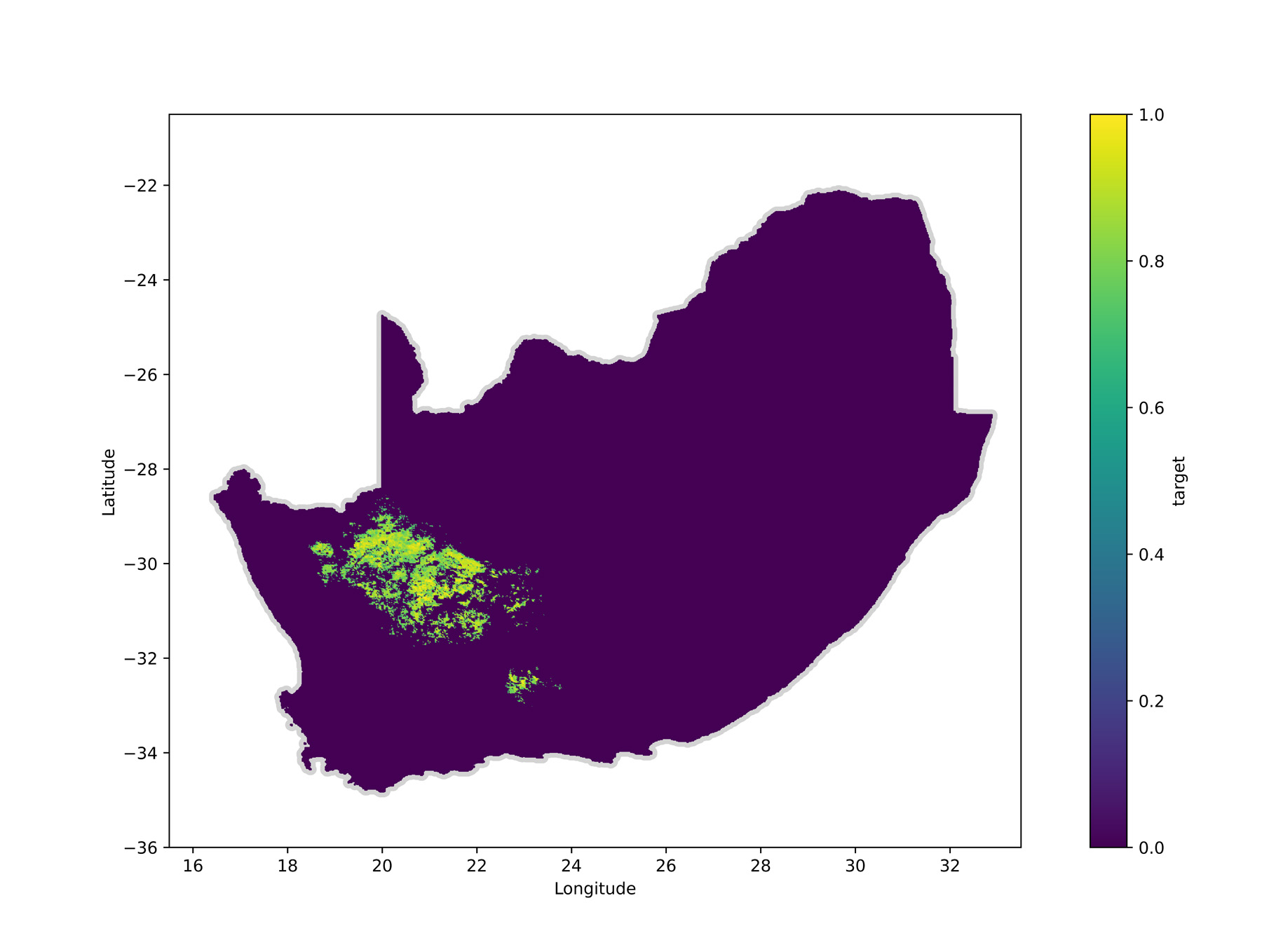
Figure 1: Sclater’s Lark distribution across South Africa based on BirdLasser, iNaturalist and eBird data highlighting the Aberdeen sub-population in the southeast (from Lee 2024).
Ecology
Sclater’s Lark occurs on arid to semi-arid gravelly and stony plains with scattered dwarf shrubs and grass tufts on well drained, elevated calcrete patches. It is often found in areas with extensive bare patches of gravel, virtually devoid of vegetation (Keith et al. 1992, Dean 1997, Lloyd 2005). Sclater’s Lark is one of the very few bird species that thrives in its specific habitat. Its breeding biology is optimised to survival in arid conditions; for example, it invariably lays a single egg, which is nearly constantly shaded against the sun by adults (Lloyd 1999). However, breeding is usually in the cooler months from May to October (Lloyd 2005). Sclater’s Lark is primarily granivorous, its large bill enabling it to obtain large seeds hidden in the basal leaf sheaths of dead grasses; a valuable resource generally not available to other granivores (Lloyd 2005). Insects such as termites, caterpillars, grasshoppers, ants and small beetles are also eaten (Lloyd 2005). It drinks frequently (including from artificial stock watering points), and nests are typically constructed <1 km from a water source (Lloyd 2005). Absence from regular drinking locations suggest they get enough moisture from plants for weeks after rains, depending on temperature (Theron pers obs).
Threats & Conservation
Threats
The species is not represented in formally protected areas; it persists on privately owned farms. Its range is small, fragmented and appears to be contracting. The sudden explosion of renewable energy development across much of the species’ range is a significant cause for concern: the main population stronghold close to Beaufort West is earmarked for development of a big solar energy development. Although the impact of collision risk related to wind energy infrastructure is suspected to be low compared to other sympatric threatened lark species such as Red Lark Calendulauda burra, the cumulative impact of habitat disturbance, degradation and loss could be significant. Understanding the distribution of core habitat for this species will be of utmost importance in order to motivate for the avoidance and/or necessary mitigation of associated developments in core areas of its range. The potential effects of climate change on Sclater’s Lark need to be properly investigated especially in relation to veld recovery after overgrazing.
Conservation Measures Underway
No conservation measures are currently underway, and the species is not represented in protected areas with the possible exception of the new Meerkat National Park.
Conservation Measures Proposed
Before an effective management plan can be compiled for this species, more data on its population size and distribution are required (Peacock 2015). Responsibility for the species’ long-term conservation will lie with private landowners and appropriate management of their properties. Education of landowners and compilation of management guidelines provided by conservation institutions will be beneficial in this regard (e.g. Wright et al. 2019). Support for the creation and expansion of protected areas, especially based on blomkoolgannaveld are important. Awareness must be raised of the importance of this species with alternative energy developers: we concur with Dean and Siegfried (1997) that this is one of the highest priority Karoo endemic species.
Research Priorities and Questions
- Complete SABAP coverage throughout the historic range of the species including Namibia, preferably by an experienced observer familiar with this species and its ecology, is important.
- Investigate population dynamics and reproductive output, to ensure effective management principles.
- Assess the nature and severity of threats to Sclater’s Lark, especially the consequences of solar farms on abundance and breeding.
- Basic life history parameters, e.g. descriptions of moult, parental care etc. are required.
- A colour ringing or similar tracking exercise to determine movements and rates of visitation at drinking sites would be beneficial. This could also inform a local population estimate with mark-recapture methods.
Contributors & References
Assessor/s
Stefan Theron, Alan Lee
Reviewer/s
Robin Colyn
References
BirdLife International. 2017. Spizocorys sclateri. The IUCN Red List of Threatened Species 2017: e.T22717356A118398308. http://dx.doi.org/10.2305/IUCN.UK.2017-3.RLTS.T22717356A118398308.en
Dean WRJ. 1997. Sclater’s Lark. In: Harrison JA, Allan DG, Underhill LG, Herremans M, Tree AJ, Parker V, Brown CJ (eds), The atlas of southern African birds. Vol. 2: Passerines. Johannesburg: BirdLife South Africa. pp 894–895.
Dean WRJ, Siegfried WR. 1997. The protection of endemic and nomadic avian diversity in the Karoo, South Africa. South African Journal of Wildlife Research 27: 11–21.
Keith S, Urban E, Fry CH. 1992. The Birds of Africa, Vol IV: Broadbills to Chats. New York, United States of America: Academic Press.
Lee ATK, Altwegg R, Barnard P. 2017. Estimating conservation metrics from atlas data: the case of southern African endemic birds. Bird Conservation International 27(3): 323–336.
Lee ATK, Fleming C, Wright DR. 2018. Modelling bird atlas reporting rate as a function of density in the southern Karoo, South Africa. Ostrich 89: 363–372.
Lee ATK, Fleming C, Wright DR. 2019a. Update: Modelling bird atlas reporting rate as a function of density in the southern Karoo, South Africa. Ostrich 90: 281–282.
Lee ATK, Geary C, Wright DR, Dean WRJ. 2019b. Vulnerability of birds to contaminated water sources in the Karoo region of South Africa. Ostrich 90: 397–406.
Lee ATK, Theron S. 2023. Distribution and habits of the Sclater’s Lark Spizocorys sclateri on the Aberdeen Plain, South Africa. Afrotropical Bird Biology: Journal of the Natural History of African Birds 23: 3.
Lee ATK, Wright DR. 2024. A conservation assessment of birds in the Karoo region of South Africa: densities, populations, ranges, and trend estimates. Ostrich 95(2): 129–139. https://doi.org/10.2989/00306525.2024.2331162
Lee ATK. 2024, Regional Red Data Book of the Birds of South Africa, Lesotho and Eswatini: SABAP2 synthesis and supporting information and graphics for Sclater’s Lark. Unpublished report. Johannesburg: BirdLife South Africa.
Lloyd P. 1999. Rainfall as a breeding stimulus and clutch size determinant in South African arid zone birds. Ibis 141: 637–643.
Lloyd P. 2005. Sclater’s Lark Spizocorys sclateri. In: Hockey PAR, Dean WRJ, Ryan PG (eds), Roberts Birds of Southern Africa 7th Edn. Cape Town, South Africa: The Trustees of the John Voelcker Bird Book Fund. pp 894–895.
Peacock F. 2015. Sclater’s Lark Spizocorys sclateri. In: Taylor MR, Peacock F, Wanless RM (eds), The 2015 Eskom Red Data Book of Birds of South Africa, Lesotho and Swaziland. Johannesburg, South Africa: BirdLife South Africa. pp 322–324.
Wright DR, Theron S, Lee ATK. 2019. Birds of the Karoo: Ecology and Conservation. Johannesburg, South Africa: BirdLife South Africa.
Citation
Theron S, Lee ATK 2025. Sclater’s Lark. In: Lee ATK, Rose S, Banda S, Bezeng SB, Maphalala MI, Maphisa DH, Smit-Robinson H (eds), The 2025 Red Data Book of Birds of South Africa, Lesotho and Eswatini. Johannesburg, South Africa: BirdLife South Africa. Available at: https://www.birdlife.org.za/red-list/sclaters-lark/
Our generous sponsors


