


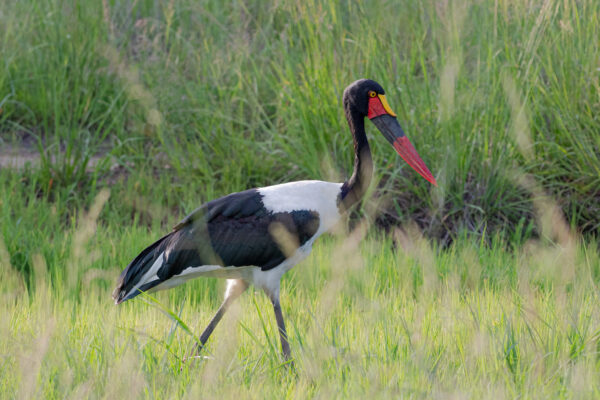
Saddle-billed Stork
Ephippiorhynchus senegalensis

Number Of Mature
Individuals (Regional)
160

Regional
Population Trend
Decreasing
2025
Regional Category
Endangered
Search by species
CONTENTSOverview
Names
|
IOC English Name: |
Saddle-billed Stork |
|
SA & IOC Scientific Name: |
Ephippiorhynchus senegalensis |
|
BirdLife International Taxonomy (scientific name): |
Ephippiorhynchus senegalensis |
|
Order: |
CICONIIFORMES |
|
Family: |
Ciconiidae |
|
Species name author: |
Shaw 1800 |
|
Afrikaans: |
Saalbekooievaar |
|
Sesotho (South Africa): |
kololwane |
|
Sesotho (Lesotho): |
kololoane |
|
Siswati: |
|
|
Zulu: |
umadolabomvu |
Current Assessment Status
|
2025 Regional Category [Criteria] |
EN [D] |
|
2024 Global Category [Criteria] |
LC (BirdLife International 2016) |
|
Population size (Regional) |
c. 160 mature individuals |
|
Population size (Global) |
670 – 17 000 (BirdLife International 2016) |
|
Distribution size (EOO) (Regional) km2 |
867 835 (Lee 2024) |
|
Distribution size (EOO) (Global) km2 |
20 600 000 (BirdLife International 2016) |
|
Distribution size (AOO) (Regional) km2 |
63 472 (54 660 – 74 148) (Lee 2024) |
|
Generation time |
16.1 years (BirdLife International 2016) |
|
Status change reason |
No change |
|
Migrant (in the region) |
No |
|
Regional endemic |
No |
Historic Listing Information
|
2000 Regional Status |
EN [C1] |
|
2015 Regional Status |
EN [D] |
|
Status change reason (if applicable) |
Not applicable |
|
2015 Population size (Regional) |
120 – 150 mature individuals |
|
2015 Global Status |
LC |
Reason for Inclusion
Reason for Inclusion in the Assessment
>5% of the global distribution of this species occurs within the area. In addition, the Saddle-billed Stork Ephippiorhynchus senegalensis was listed as regionally Endangered in 2015 (Taylor 2015).
Category Justification
Category Justification
No new population estimates exist with which to update the 2015 Regional Red List assessment outcome. Citizen science Southern African Bird Atlas Project (SABAP2) data indicate that the regional range may be stable or slightly increasing (Table 1, Figure 1, Lee 2024) but how this relates to population size is unknown. The regional population of Saddle-billed Stork therefore still meets Criterion D for regionally Endangered (population size <250 mature individuals).
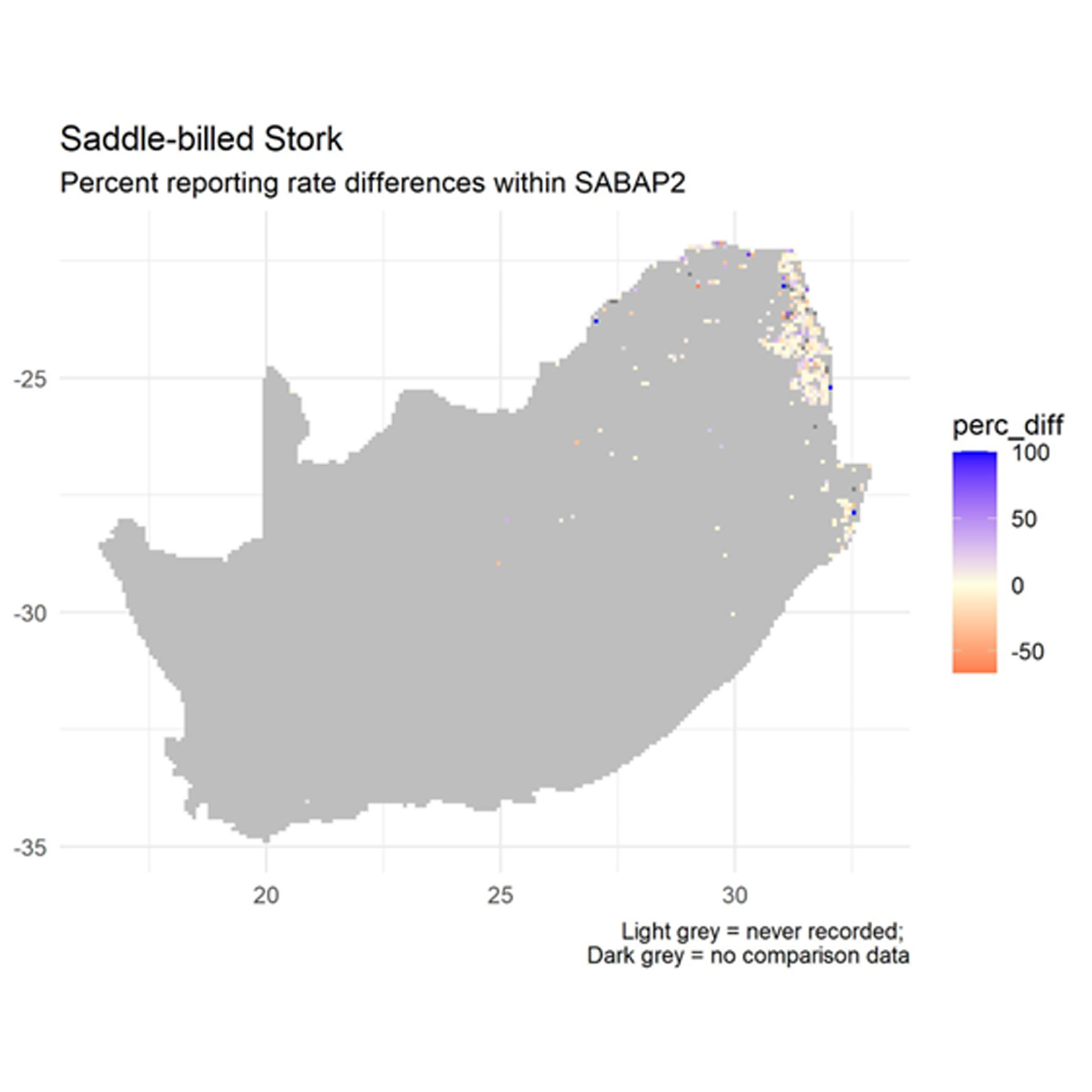
Figure 1: Distribution map of Saddle-billed Stork showing pentad level change between SABAP2 periods 2007-2015 and 2016-2023 (from Lee 2024).
Population Justification
The global population is estimated at 1000 – 25 000 birds (BirdLife International 2016). Historically, the species has never been abundant in South Africa, most likely because the region is at the periphery of the species’ geographic distribution. Taylor et al. (1999) estimated there to be 100 – 200 mature individuals in the region. A survey by van den Hoven and Reily (2012) reported a minimum of 40 mature individuals in the southern portion of Kruger National Park. Extrapolated to the entire park, the population may be in the order of 100 mature individuals. Although regular sightings are reported from sites in northern KwaZulu-Natal as well as along the Limpopo River, the number of birds in the region is unknown. If an estimate of 30 mature individuals is assumed for the Limpopo River and northern KwaZulu-Natal each, the total regional population would be c. 160 mature individuals (Taylor 2015). The confidence in this regional population estimate is medium, but the estimates are outdated.
Trend Justification
The global population trend is decreasing (BirdLife International 2016). Data from SABAP2 indicates a stable population state, and the trend from Coordinated Waterbird Counts (CWAC) suggests an increasing number in the region (Lee 2024). Without an accurate estimate of the regional population size and given that the population might be very small, confidence in these trend results is low.
Table 1: Prediction models using SABAP2 data of the number of pentads Saddle-billed Stork could occur in from reporting period 2007-2015, and 2015-2023 (from Lee 2024).
|
Information |
|
|
Pentads 2015 |
597 |
|
Pentads 2023 |
625 |
|
Annual rate of change |
1.006 |
|
Percent change (10 years or three generations) |
5.10% |
|
Category (A2) |
LC |
Biology & Ecology
Taxonomy
Monotypic. No recognised subspecies. The taxonomy of the species has varied over time, and it has variously been placed in the genera Ciconia, Ardea (Sharpe and Ogilvie-Grant 1898), and Xenorhynchus (together with Black-necked Stork Ephippiorhynchus asiaticus, Johnston 1884) before finally being placed in Ephippiorhynchus (Kahl 1971).
Identification
150 cm, c. 7 kg. Pied plumage coupled with long, multicoloured bill and long legs make the adults unmistakable. Sexes are distinguished by the larger size and dark brown iris of males (yellow in females). Yellow to orange-red wattles at the base of the bill may be present or absent in both sexes. Juveniles are duller than adults with dark grey plumage in areas that are black in adults, and pale grey in areas that are white.
Distribution
Saddle-billed Storks occur in suitable habitat throughout sub-Saharan Africa (Gula et al. 2022), but in South Africa (at the southernmost extreme of the global range), the species is restricted to subtropical areas in association with large, perennial rivers and other waterbodies (Benn 1997). The Kruger National Park and adjacent areas (Important Bird and Biodiversity Area (IBA SA002) and Key Biodiversity Area (KBA 100795) ) form the core of the species’ range in the region, together with three Zululand IBAs, namely iSimangaliso Wetland Park (IBA SA058, KBA 100812), Mkuze Game Reserve (IBA SA057, KBA 100812) and Hluhluwe-iMfolozi Park (IBA SA 060, KBA 100805). Birds are also resident along the Limpopo River, west of the Kruger National Park. In Eswatini, Parker (1994) mentioned that the species occurred sparsely in the Mbuluzi River system in the north-east of the country. Adults tend to be resident with no evidence of seasonal movements (Benn 1997), but immatures disperse widely. Records in the North West and Free State Provinces and elsewhere are likely to be immature or vagrant birds.
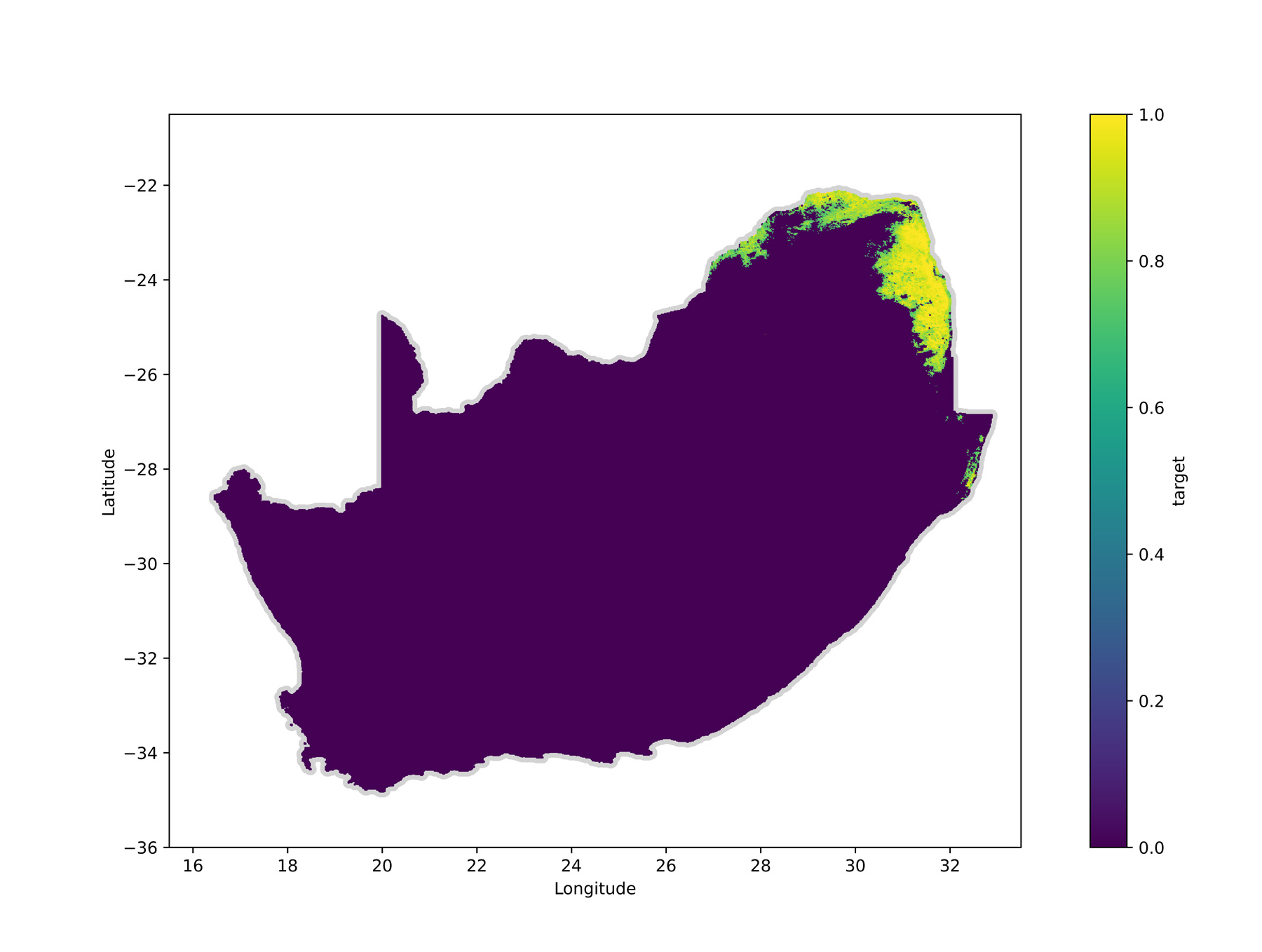
Figure 2: South African Saddle-billed Stork probability distribution map, produced from BirdLasser location data at 2x2km grid scale, using iNaturalist and eBird as absence data only. This represents the predicted range for the 2016-2023 period, at the pentad scale p>0.5 (from Lee 2024).
Ecology
Saddle-billed Storks occur in aquatic habitats, which include large and small rivers, floodplains, wetlands and pans. There is no known evidence of migration in the species from the region. Pairs nest and roost in large trees, often away from water. The generation length of 16.1 years is extrapolated from the mean generation length of Ciconia storks (BirdLife International 2016). No recent breeding ecology exists for this species in the region. Historically, the breeding season was determined to be March – July (Tarboton et al. 1987, Maclean 1993). The species mainly feeds on fish up to 500 g, which are caught by a stabbing action either in open water or among inundated vegetation. Saddle-billed Storks also feed on amphibians, small reptiles, small mammals, molluscs and other aquatic invertebrates. Birds are found singly or in pairs and are generally resident with limited movements in response to hydrological conditions.
Threats & Conservation
Threats
Threats to the region’s Saddle-billed Stork population are poorly understood but likely include general threats to wetland habitats such as declining water quality/pollution, water extraction and impoundment, and severe drought.
Conservation Measures Underway
The core of the species’ range in South Africa falls within the Kruger National Park, which is a well-protected conservation area, albeit with ongoing threats to its river systems. Current efforts to prevent further degradation of river and wetland habitats within its range should also benefit this species. It is listed under Schedule 2: Specially Protected Wild Animal under the Limpopo Environmental Management Act No 7 of 2003. The Saddle-billed Stork is listed as Endangered under the South African National Environmental Management: Biodiversity Act (Act 10 of 2004) and as Endangered in Eswatini and is protected under the Swaziland Game Act of 1991.
Regionally, >60% of the pentads in which the species was recorded are protected (Lee 2024).
Conservation Measures Proposed
Adequate protection of known breeding sites is an important conservation intervention. The potential impact on this species should be considered during the assessment of development applications in catchments. Conservation efforts should prioritise the monitoring and improvement of the water quality of rivers and waterbodies utilised by the Saddle-billed Stork within the region.
Research Priorities and Questions
- Determine regional population size and trends.
- A monitoring programme across its regional range to update the breeding ecology data. Specifically, an updated understanding of breeding success and requirements.
- Investigate how climate factors affect breeding and population trends.
Contributors & References
Assessor/s
Anonymous
Reviewer/s
Andre Botha, Colleen Downs, Sanjo Rose
References
Benn GA. 1997. Saddle-billed Stork. In: Harrison JA, Allan DG, Underhill LG, Herremans M, Tree AJ, Parker V, Brown CJ (eds), The Atlas of Southern African Birds. Vol. 1. Johannesburg: BirdLife South Africa.
BirdLife International. 2016. Ephippiorhynchus senegalensis. The IUCN Red List of Threatened Species 2016: e.T22697706A93631820. https://dx.doi.org/10.2305/IUCN.UK.2016-3.RLTS.T22697706A93631820.en. [Accessed on 02 May 2024].
Gula JM, Green MC, Fritts S, Dean WRJ, Sundar KSG. 2022. Assessments of range-wide distribution of six African storks and their relationships with protected areas. Ostrich 93: 34–52.
Johnston H. 1884. The River Congo: From Its Mouth to Bólóbó; with a General Description of the Natural History and Anthropology of Its Western Basin. Detroit, MI: Negro History Press.
Kahl MP. 1971. Social behavior and taxonomic relationships of the storks. The Living Bird 10: 151–170.
Lee ATK. 2024. Regional Red Data Book of the Birds of South Africa, Lesotho and Eswatini: SABAP2 Synthesis and Supporting Information and Graphics for Saddle-billed Stork. Unpublished report. Johannesburg: BirdLife South Africa.
Maclean GL. 1993. Roberts’ Birds of Southern Africa (6th Edn). Cape Town: John Voelcker Bird Book Fund.
Parker V. 1994. Swaziland Bird Atlas 1985-1991. Mbabane, Swaziland: Websters.
Sharpe B, Ogilvie-Grant WR. 1898. Catalogue of the Birds in the British Museum. London: Longmans and Co., British Museum of Natural History.
Tarboton WR, Kemp MI, Kemp AC. 1987. Birds of the Transvaal. Pretoria, South Africa: Transvaal Museum.
Taylor MR. 2015. Saddle-billed Stork Ephippiorhynchus senegalensis. In: Taylor MR, Peacock F, Wanless RM (eds), The Eskom Red Data Book of Birds of South Africa, Lesotho and Swaziland. Johannesburg: BirdLife South Africa.
Taylor PB, Navarro RA, Wren-Sargent M, Harrison JA, Kieswetter SL. 1999. TOTAL CWAC Report: Coordinated Waterbird Counts in South Africa, 1992–1997. Cape Town: Avian Demography Unit, University of Cape Town.
van den Hoven M, Reilly B. 2012. Estimating population size of Saddle-billed Storks Ephippiorhynchus senegalensis in southern Kruger National Park, South Africa. Ostrich 83: 153–159. https://doi.org/10.2989/00306525.2012.738254.
Citation
Anonymous 2025. Saddle-billed Stork. In: Lee ATK, Rose S, Banda S, Bezeng SB, Maphalala MI, Maphisa DH, Smit-Robinson H (eds), The 2025 Red Data Book of Birds of South Africa, Lesotho and Eswatini. Johannesburg, South Africa: BirdLife South Africa. Available at: https://www.birdlife.org.za/red-list/saddle-billed-stork/
Our generous sponsors


