


Ruddy Turnstone
Arenaria interpres

Number Of Mature
Individuals (Regional)
19 000

Regional
Population Trend
Decreasing
2025
Regional Category
Near Threatened
Search by species
CONTENTSOverview
Names
|
IOC English Name: |
Ruddy Turnstone |
|
SA & IOC Scientific Name: |
Arenaria interpres |
|
BirdLife International Taxonomy (scientific name): |
Arenaria interpres |
|
Order: |
CHARADRIIFORMES |
|
Family: |
Scolopacidae |
|
Species name author: |
Linnaeus 1758 |
|
Afrikaans: |
Steenloper |
|
Sesotho (South Africa): |
Lekitinyane |
|
Sesotho (Lesotho): |
Lekitinyane |
|
Siswati: |
|
|
Zulu: |
Umaphendulamatshe |
Current Assessment Status
|
2025 Regional Category [Criteria] |
NT [A2ac] |
|
2024 Global Category [Criteria] |
NT [A2bcd+4bcd] (BirdLife International 2024) |
|
Population size (Regional) |
c. 19 000 (Summers et al. 1989) |
|
Population size (Global) |
750 000 – 1 750 000 (BirdLife International 2024) |
|
Distribution size (EOO) (Regional) km2 |
1 245 454 (Lee 2024) |
|
Distribution size (EOO) (Global) km2 |
17 000 000 (BirdLife International 2024) |
|
Distribution size (AOO) (Regional) km2 |
11 048 (Lee 2024), 87 150 (BIRDIE 2024) |
|
Generation time |
6.01 years (BirdLife International 2024) |
|
Status change reason |
Genuine change in status |
|
Migrant (in the region) |
Full Migrant, some overwinter |
|
Regional endemic |
No |
Historic Listing Information
|
2000 Regional Status |
Not Evaluated |
|
2015 Regional Status |
Not Evaluated |
|
Status change reason (if applicable) |
Not applicable |
|
2015 Population size (Regional) |
19 000 |
|
2015 Global Status |
LC |
Reason for Inclusion
Reason for Inclusion in the Assessment
Ruddy Turnstone Arenaria interpres has not been assessed regionally before. Global waterbird declines appear mirrored regionally, with research documenting declines for several wader species (Ryan 2013), including Ruddy Turnstone (Simmons et al. 2015, Lee 2024). As such, it was identified as a species that should be assessed in the 2025 Regional Red Data Book.
Category Justification
Category Justification
Ruddy Turnstone is a non-breeding migrant in the region. Globally the species was uplisted to Near Threatened at the end of 2024, with global declines estimated at 20–29% over the past three generations (BirdLife International 2024).
These declines are mirrored regionally. Reporting rates and modelled Area of Occupancy (AOO) from Southern African Bird Atlas Project (SABAP2) data suggest declines of 26.4% in the past three generations (Figure 1). While the number of Ruddy Turnstone counted during the bi-annual Coordinated Waterbird Counts (CWAC) also show declines, these declines are not significant (31% (95: CI: -71%, 57%) over the past three generations.
In the region, Ruddy Turnstone have a large range which exceeds thresholds for Criterion B. No recent population size estimate exists, with the c. 19 000 from Summers et al. (1989) considered the baseline.
Ruddy Turnstone is assessed as regionally Near Threatened based on the declines from SABAP2 and considering the global trends and threats faced on its breeding grounds.
Population Justification
The global population is estimated at 750 000 – 1 750 000 mature individuals (BirdLife International 2024). The regional population size is unknown. The last regional population estimate, extrapolated from local count data, is 19 000 (Summers et al. 1989). Confidence in this estimate is low. Wetlands International (IWC 2018) estimated the South African and Siberian population to be around 100 000 individuals (approximately 67 000 mature individuals). The highest annual IWC count total between 2014–2018 was 10 025 individuals. However, confidence in this estimate is low due to low levels of coverage.
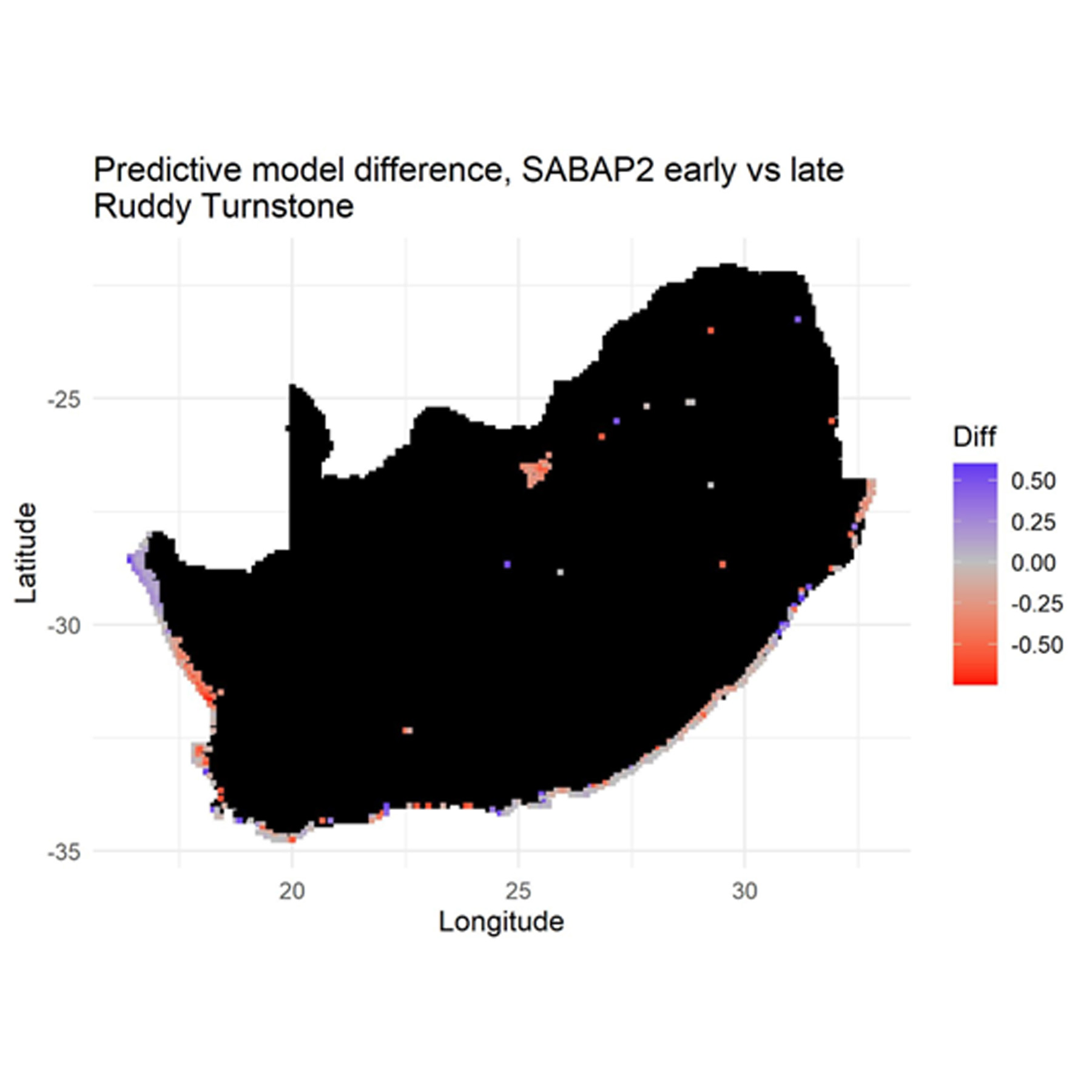
Figure 1a: Predictive modelled range change for Ruddy Turnstone over three generations between early (2007-2015) and late (2016-2023) SABAP2. Red indicating regions of decline. Note the disproportionate amount of decline around Barberspan in the north.
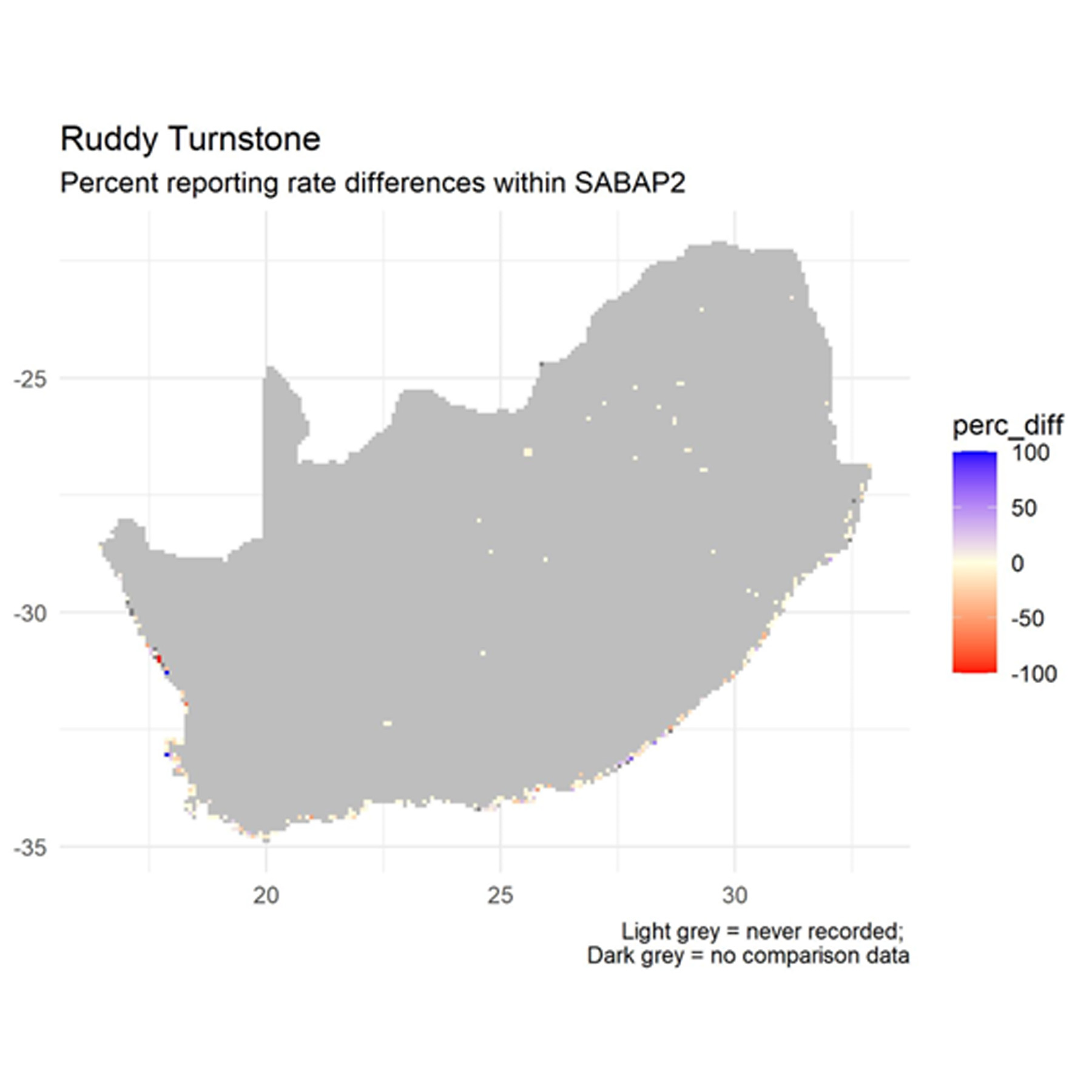
Figure 1b. The map of SABAP2 data, showing percentage reporting rate change within SABAP2. Yellow indicates no change, blue an increase and red a decrease (from Lee 2024).
Trend Justification
Globally, the overall population trend is estimated at 20–29% decline over the past three generations (BirdLife International 2024). These declines are driven by the panoply of threats faced by this species across its massive range, including habitat loss and degradation, illegal killing, disturbance and possibly reduced breeding productivity caused by factors associated with climate change (e.g. Nettleship 2020, BirdLife International 2024).
Modelled predicted change in AOO using SABAP2 suggests that the regional population may have declined by as much as 26.4% in the past three generations (Lee 2024). While the number of Ruddy Turnstone counted during the bi-annual CWAC also show declines, these declines are not significant (31% (95: CI: -71%, 57%) over the past three generations. These declines seem to be taking place especially in the Western Cape and KwaZulu-Natal Provinces (Lee 2024).
Determining trends of shorebirds in South Africa is challenging as no dedicated monitoring is in place. This means our only regional data at hand is from citizen science programmes like CWAC and SABAP2. CWAC is biased towards inland sites, and SABAP2 does not report abundance estimates. Nevertheless, despite these shortcomings, the authors are confident that the regional population is in decline, mirroring global trends. Monitoring key sites is recommended.
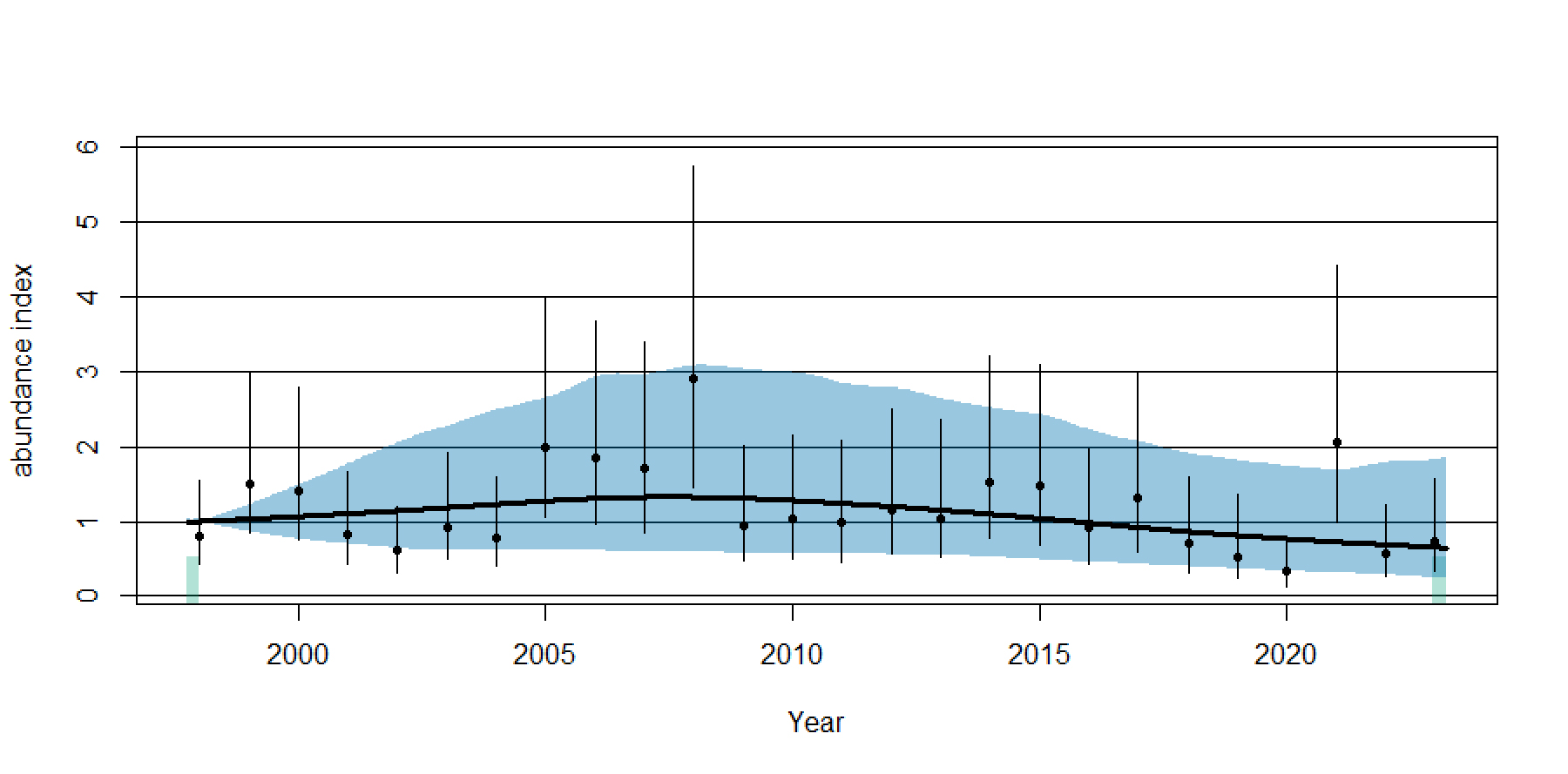
Figure 2: Results from poptrend analyses (Knape 2016) of CWAC count totals in summer, showing a decline for Ruddy Turnstone over the past three generations (from Lee 2024).
Biology & Ecology
Taxonomy
Two subspecies are recognised, of which only Arenaria interpres interpres is found in the region (Nettleship 2020, Gill et al. 2024).
Identification
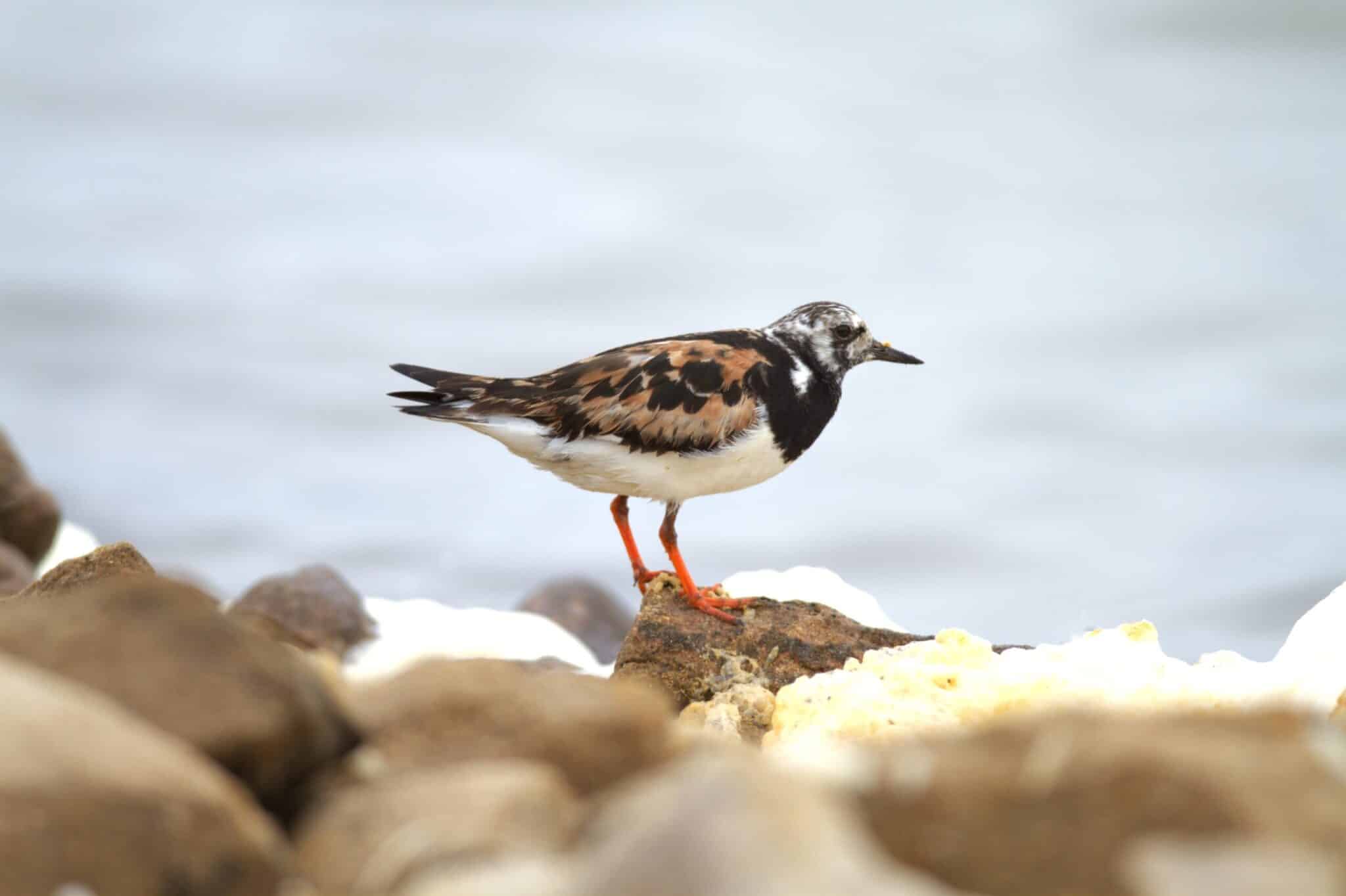
21–25 cm (Turpie 2005). Ruddy Turnstones are small shorebirds that are generally relatively easy to identify, especially when in breeding plumage. In flight adult Ruddy Turnstones have a distinct pattern of dark-brown and white appearance, with the rump, back, and uppertail coverts being white (Nettleship 2020). While the sexes are similar, some subtle differences occur in breeding plumage (Turpie 2005, Nettleship 2020). Relatively short-legged, Ruddy Turnstones have an overall dark plumage on the upperparts with orange-coloured legs (Turpie 2005).
Distribution
Globally, Ruddy Turnstone has a vast breeding range largely across the low Arctic, the coastline of Canada, North America, north and northeast Greenland, Svalbard, northern Europe, Scandinavia, Siberia and across the Bering Sea (Nettleship 2020) mostly north of 65 °N (Turpie 2005). In the non-breeding season, it winters in coastal areas from north California across large swathes of North America, throughout Bermuda, the West Indies and along both coasts of South America, and along the Atlantic coasts in west and southern Europe south to South Africa and coastally in the Pacific from Hawaii south to south Asia, and Micronesia, Polynesia, Australia and New Zealand (Nettleship 2020, BirdLife International 2024). Regionally, it is found almost exclusively along the coastline of South Africa and is particularly common on the west coast (Turpie 2005, Figure 1).
Ecology
Non-breeding in the region. Ruddy Turnstones reside almost exclusively in coastal habitats in the region during the non-breeding season and are usually found on stony, rocky, and kelp-covered shores, estuarine mud- and sand flats, especially those covered in eelgrass, although they can be occasionally seen on sandy beaches too (Turpie 2005). It can be gregarious, being found in small flocks, and often associated in groups with other waders. They forage primarily by day and have a diverse diet. The oldest ringed bird recorded was 19 years and 8 months (Cramp and Simmons 1983, Staav 1998). Although classified as fully migratory (del Hoyo et al. 1996), some individuals do apparently overwinter in the region.
Threats & Conservation
Threats
Poorly understood within the region, but the impacts of disturbance by people and companion animals (dogs) along the coastline, especially at key foraging sites, need to be assessed. In the breeding range known threats include habitat loss and degradation, illegal killing, disturbance and possibly reduced breeding productivity caused by factors associated with climate change (BirdLife International 2024).
Conservation Measures Underway
Listed in Appendix II in both Convention on the Conservation of Migratory Species of Wild Animals (CMS) and African-Eurasian Waterbird Agreement (AEWA) since 1979. However, there are no specific conservation measures currently in place for this species for this region. Ruddy Turnstone occurs mostly outside of the protected areas network, with only 26% of pentads in which the species was recorded being found in protected areas (Lee 2024).
Conservation Measures Proposed
A collective conservation effort for estuaries and coastal shorelines needs to be implemented in South Africa to benefit this and other species that utilise this habitat type.
Research Priorities and Questions
- A better understanding of the population size in the region is needed. The last estimate was in 1989 (Summers et al. 1989).
- Focused research on localised movements within the region with telemetry or GPS units would add value to our understanding of their movements.
- The impacts of disturbance by people and companion animals (dogs) along the coastline, especially at key foraging sites, need to be assessed.
Contributors & References
Assessor/s
Mark Brown, Maria Paul
Reviewer/s
Garret Skead
References
BirdLife International. 2024. Arenaria interpres. The IUCN Red List of Threatened Species 2024: e.T22693336A254413189. https://dx.doi.org/10.2305/IUCN.UK.2024-2.RLTS.T22693336A254413189.en. [Accessed on 22 January 2025].
BIRDIE. 2024. An online platform for African wetland and waterbird data. Available at: https://biodiversityadvisor.sanbi.org/contentmanagement/index?guid=42305260-12b0-4a92-912e-7d801d15fdac
Convention on Migratory Species. Available at https://www.cms.int/en/species/arenaria-interpres. [Accessed on 26 September 2024].
Cramp S, Simmons KEL. 1983. The Birds of the Western Palearctic. Vol. 3. Oxford: Oxford University Press.
del Hoyo J. Elliott A, Sargatal J. 1996. Handbook of the Birds of the World, Vol. 3: Hoatzin to Auks. Barcelona, Spain: Lynx Edicions.
Gill F, Donsker D, Rasmussen P (eds). 2024. IOC World Bird List (v14.1).
Knape J. 2016. Decomposing trends in Swedish bird populations using generalized additive mixed models. Journal of Applied Ecology 53: 1852–1861.
Lee ATK. 2024. Regional Red Data Book of the Birds of South Africa, Lesotho and Eswatini: SABAP2 synthesis and supporting information and graphics for Ruddy Turnstone. Unpublished report. Johannesburg: BirdLife South Africa.
Nettleship DN. 2020. Ruddy Turnstone (Arenaria interpres), version 1.0. In Birds of the World (S. M. Billerman, Editor). Ithaca, NY, USA: Cornell Lab of Ornithology. https://doi.org/10.2173/bow.rudtur.01
Ryan PG. 2013. Medium‐term changes in coastal bird communities in the Western Cape, South Africa. Austral Ecology 38: 251–259.
Simmons RE, Kolberg H, Braby R, Erni B. 2015. Declines in migrant shorebird populations from a winter-quarter perspective. Conservation Biology 29: 877–887.
Summers RW, Underhill LG, Clinning CF, Nicoll M. 1989. Populations, migrations, biometrics and moult of the Turnstone Arenaria interpres on the east Atlantic coastline, with special reference to the Siberian population. Ardea 77: 145–168.
Staav R. 1998. Longevity list of birds ringed in Europe. Euring Newsletter 2: 9–17.
Turpie JK. 2005. Ruddy Turnstone Arenaria interpres. In: Hockey PAR, Dean WRJ, Ryan PG (eds). Roberts – Birds of Southern Africa (7th Edn). Cape Town, South Africa: The Trustees of the John Voelcker Bird Book Fund.
Wetlands International. 2015. Waterbird Population Estimates. Available at wpe.wetlands.org [Accessed on 17 September 2024].
Citation
Brown M, Paul M 2025. Ruddy Turnstone. In: Lee ATK, Rose S, Banda S, Bezeng SB, Maphalala MI, Maphisa DH, Smit-Robinson H (eds), The 2025 Red Data Book of Birds of South Africa, Lesotho and Eswatini. Johannesburg, South Africa: BirdLife South Africa. Available at: https://www.birdlife.org.za/red-list/ruddy-turnstone/
Our generous sponsors


