


Red Knot
Calidris canutus

Number Of Mature
Individuals (Regional)
<10 000

Regional
Population Trend
Decreasing
2025
Regional Category
Near Threatened
Search by species
CONTENTSOverview
Names
|
IOC English Name: |
Red Knot |
|
SA & IOC Scientific Name: |
Calidris canutus |
|
BirdLife International Taxonomy (scientific name): |
Calidris canutus |
|
Order: |
CHARADIFORMES |
|
Family: |
Scolopacida |
|
Species name author: |
Linnaeus 1758 |
|
Afrikaans: |
Knoet |
|
Sesotho (South Africa): |
Seyalelebopo se sefubedu |
|
Sesotho (Lesotho): |
|
|
Siswati: |
|
|
Zulu: |
unovimba |
Current Assessment Status
|
2025 Regional Category [Criteria] |
NTo [A2ac; C1] |
|
2024 Global Category [Criteria] |
NT [A2bcd+4bcd] (BirdLife International 2024) |
|
Population size (Regional) |
<10 000 |
|
Population size (Global) |
2 000 000 – 3 000 000 (BirdLife International 2024) |
|
Distribution size (EOO) (Regional) km2 |
37 035 (Lee 2024) |
|
Distribution size (EOO) (Global) km2 |
17 800 000 (BirdLife International 2024) |
|
Distribution size (AOO) (Regional) km2 |
2472 (Lee 2024) |
|
Generation time |
6.8 years (BirdLife International 2018) |
|
Status change reason |
Genuine change in status |
|
Migrant (in the region) |
Full migrant |
|
Regional endemic |
No |
Historic Listing Information
|
2000 Regional Status |
Not Evaluated |
|
2015 Regional Status |
Not Evaluated |
|
Status change reason (if applicable) |
Not applicable |
|
2015 Population size (Regional) |
c. 7000 mature individuals |
|
2015 Global Status |
LC |
Reason for Inclusion
Reason for Inclusion in the Assessment
This species was not previously assessed. Preliminary screening of Coordinated Waterbird Counts (CWAC) data indicated a significant decline in number of Red Knot Calidris canutus counted per year (Lee 2024). Approximately 5% of the global population of the subspecies C. c. canutus visits South Africa, although there is uncertainty on the exact percentage, and with recent local declines it may now be lower. Local expert concerns for this species suggested an assessment was required.
Category Justification
Category Justification
Globally the Red Knot is listed as Near Threatened (A2bcd+4bcd), i.e. population decline observed and expected into the future (BirdLife International 2024). Regionally population and Area of Occupancy (AOO) trends agree with the global assessment of Near Threatened but only for the Criterion A2ac. The regional population is less than 10 000 mature individuals and population trends exceed the 10% decline over three generations threshold meeting the criteria for Vulnerable (C1). However, the species is a non-breeding migrant to the region and the global population of the regional subspecies is significantly large enough to allow for a Regional Rescue Effect. The assessment outcome was therefore adjusted to Near Threatened [A2ac; C1].
Population Justification
BirdLife International (2024) estimate that global population to be c. 2 000 000 – 3 000 000 mature individuals. The population of the subspecies migrating to South Africa, C. c. canutus is estimated to be 260 000 – 275 000 mature individuals (van Roomen et al. 2022) but may be an underestimate based on breeding densities elsewhere (BirdLife International 2024).
The population size of the species within South Africa is uncertain. Summers et al. (1987) and Underhill (1997) estimated the Southern African population to be 13 000 birds, but Hockey (2005) indicates that this is too high as only seven sites within Southern Africa support more than 100 birds. Langebaan Lagoon within the West Coast National Park supports on average c. 63% of the birds visiting South Africa (CWAC unpubl data). This percentage is likely an underestimate as the species was recorded irregularly on many of the sites contributing to the average total used to calculate this percentage. BIRDIE (2024) estimated totals for Red Knot suggest that Langebaan Lagoon supports more than 95% of the South African population. Summer counts for Langebaan for the period 1976-2023 recorded a median population of 2066 birds with a minimum of 80 and a maximum of 6219 birds (CWAC unpubl data). It is therefore highly unlikely that the regional population would exceed 10 000 mature birds, meeting the threshold of Vulnerable under Criterion C1, having undergone a decline of 10% in three generations (see Trend Justification below).
It is important to place the Southern African population in a global context: Hockey and Douie (1995) indicate that 98% of the C. c. canutus world population winters on two sites, Banc d’Arguin in Mauritania and Archipelago dos Bijagos in Guinea-Bissau. This implies that the Southern African population (c.13 000 birds) is less than 2% of the global population of this subspecies.
Trend Justification
The following were used to determine population trends.
- The probability of reporting the target species on a checklist from the second Southern African Bird Atlas Project (SABAP2) were used as a proxy for presence. Modelling the probability of reporting a species, accounting for observer effects including season, BirdLasser effects, if all habitats were surveyed, sampling hours and with pentad or observer as random effect, suggested with high confidence a stable probability of reporting (Lee 2024).
- Data collected for SABAP2. This is presence absence data collected per pentad (grid approximately 9 km x 7 km). Data from the project was divided into two periods (2007-2015 and 2016-2023) and static variable models were used to predict the number of pentads species could occur in within each period (Figure 1). The models predicted a decline in the AOO between the two periods of 20.6% (Lee 2024).
- Summer counts for Langebaan Lagoon for the period 1976-2004 were used as a proxy to determine population trend for the region. The data showed a population decline of 13.5% for the 27-year period (unpubl CWAC data). While the decline is for this site only and may not represent the trend of the regional population the decline is similar to that obtained for the area of occupancy.
- Literature: Nagy and Langendoen (2020) and van Roomen et al. (2018) state that the global between 1997-2017, Nagy and Langendoen (2020) calculated that the C. c. canutus population has declined by 11% over three generations (19 years). Wearne and Underhill (2005) undertook biannual surveys at Walvis Bay between January 1997 and January 2005 and when compared to an earlier survey done in 1977 found that the species had declined from 1100 to 61 birds. This strong decline in numbers was also evident within the nine-year study period. Ryan (2012) comparing survey data from the 2010’s to 1980’s indicated a >50% decline in Red Knot numbers from a small base population.
BirdLife International (2024) and Wetlands International (2024) affirm that the species has declined. The global population is currently listed as Near Threatened [A2bcd+4bcd] as a result of the decline (BirdLife International 2024). The declining trend in the regional population does not exceed the threshold for the Vulnerable category but are sufficient to meet the criteria for Near Threatened [A2ac].

Figure 1: Predictive occurrence model results comparing data from 2007-2015 and 2016-2023. Red indicates a lower probability of recording for the latter period while blue indicates a higher recording (from Lee 2024).
Biology & Ecology
Taxonomy
Baker et al (2020) and Wetlands International (2024) recognise six subspecies of Red Knot Calidris canutus:
C. c. canutus – Breeds northern Siberia; migrates to west and southern Africa
C. c. icelandica – Breeds northeast Canada and Greenland; migrates to Western Europe
C. c. rufa – Breeds Canadian low arctic; migrates to northeast and southern South America
C. c. roselari – Breeds Wrangle Island, northwest Alaska; migrates to southern Panama and possibly Florida and Northern Venezuela
C. c. rogersi – Breeds Chukotskiy peninsula, far northeast Russia; migrates to New Guinea, Australia and New Zealand
C. c. piersma – Breeds new Siberian archipelago; migrates to Australia and possibly New Zealand
Identification
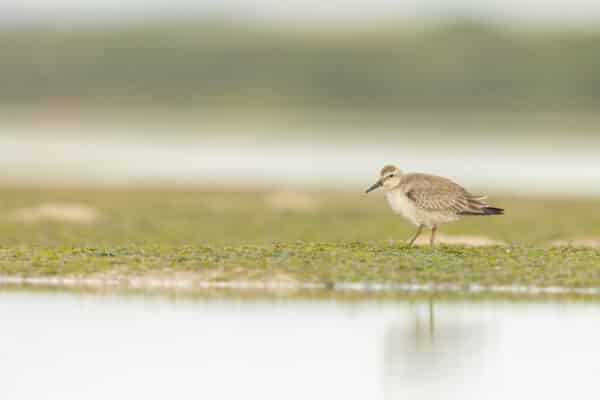
24 cm, sexes are alike in plumage (Hockey 2005). This bird is described as “large, short-legged and dumpy” (Hockey 2005). In breeding plumage, it has a black and rufous-streaked forehead and crown, a reddish chestnut face and neck, and a rufous-cinnamon back with black streaks (Hockey 2005). Its lower mantle is black edged with rufous-cinnamon, and the rump and tail are mostly white with black bars (Hockey 2005). The wings are grey with white-tipped coverts (Hockey 2005). Non-breeding adults have a paler, greyer appearance with less pronounced markings, and their underparts are mostly white with grey spots and chevrons (Hockey 2005). The bill is black, and the legs are blackish with an olive tinge. Juveniles resemble non-breeding adults, but upper feathers have creamy tips bordered by a black bar (Prater et al. 1977). Legs and feet are yellowish grey-green (Cramp and Simmons 1983, Hayman et al. 1986, Rosair and Cottridge 1995).
Distribution
The Red Knot breeds in the high Arctic tundra mostly North of 70⁰N (Hockey and Douie 1995). During the non-breeding season, the species is wide ranging with the main non-breeding grounds situated in the Western Palearctic, southeast Asia, Australasia, central and southern South America, and Western and Southern Africa (Hockey 2005).
In South Africa (Figure 2) the species occurs mainly on the west coast from Langebaan to the Orange River and sporadically along the southern and eastern coasts (Underhill 1997, Lee 2024).
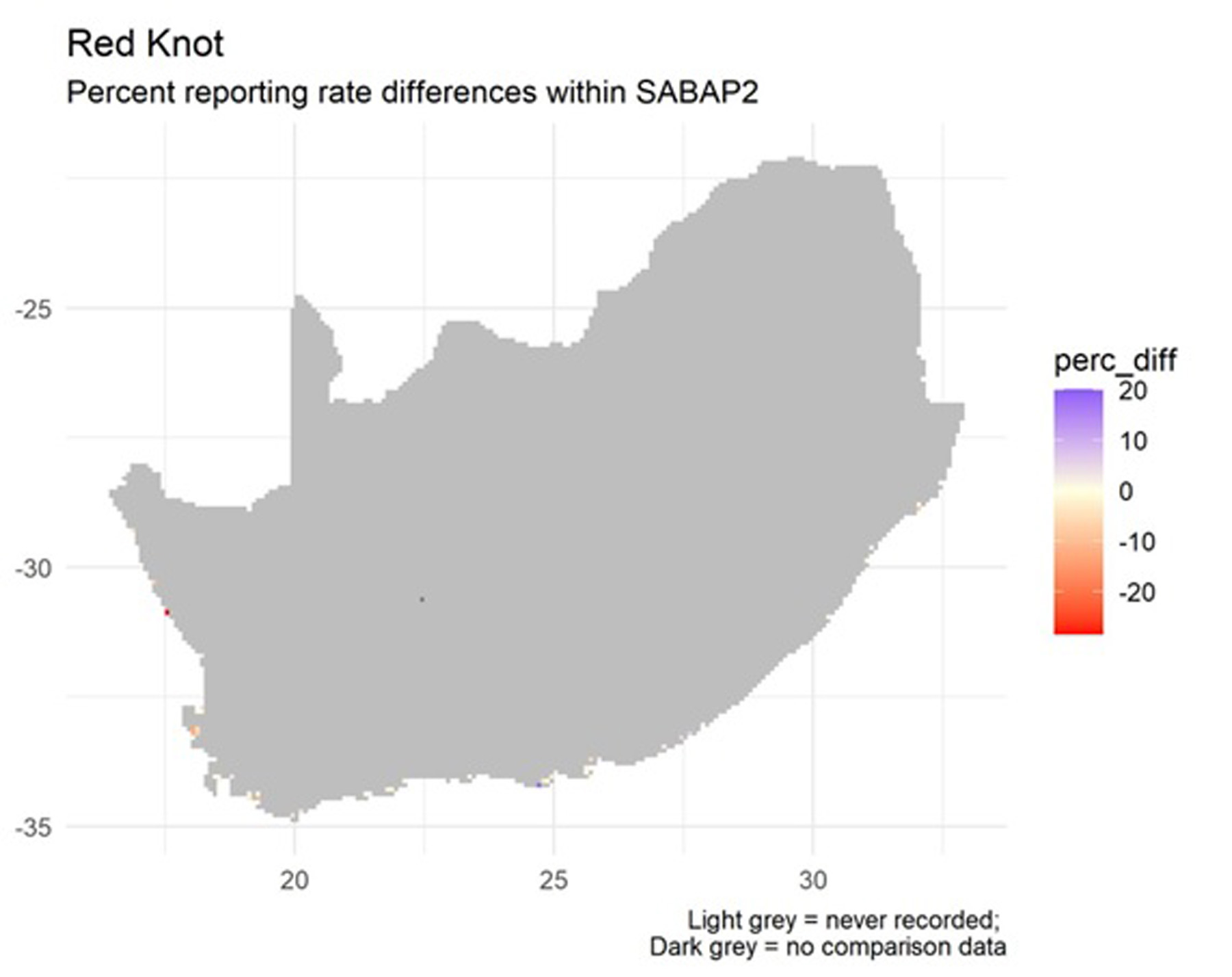
Figure 2: Distribution map of Red Knot also showing pentad level change between SABAP2 periods 2007-2015 and 2016-2023 (from Lee 2024).
Ecology
Habitat:
Regionally the species prefers sheltered bays and coastal lagoons, favouring extensive mud and sand flats. Habitat preference is linked to their specialised diet of molluscs, especially bivalves (Hockey and Douie 1995).
Migration:
The nominate race C. c. canutus found within the region migrates from the Siberian Peninsula, specifically the Taimyr peninsula, to Western and Southern Africa (Underhill et al. 1989, Wetlands International 2024). Colonisation within the region is a relatively recent phenomenon, implying that the species has discovered a previously unexploited niche (Hockey 2005). Birds arrive in September/October and depart in April with first year birds remaining in the region for the austral winter (Underhill 1997). Not many birds overwinter in South Africa. Over–wintering data for Langebaan lagoon indicate a median value of 63 birds (min 4; max 2596) over a 25-year period (CWAC unpubl data). The 2596 overwintering birds recorded in 1980 was unusual in that very few birds migrated northwards and it is speculated that this was due to poor body condition not allowing for long-distance migration (Hockey 2005).
Breeding:
The Red Knot is a non-breeding migrant to the region. Adult birds arrive on the breeding grounds in early June and lay later in the month (Hockey and Douie 1995). Nests are shallow scrapes in the ground. They lay one clutch per season, with clutch size usually four eggs laid over a period of 4–6 days. Incubation is approximately 22 days with young birds leaving the nest within 24 hours of hatching. Fledgling period is estimated to be 18 days (Niles et al. 2007).
Diet:
On the breeding grounds Red Knots feed predominantly on terrestrial invertebrates, switching to predominantly bivalves, but also gastropods, amphipods and occasionally polychaetes at staging and wintering sites (Niles et al. 2007).
Threats & Conservation
Threats
The species is a habitat specialist and siltation of feeding grounds poses a threat. Hockey (2005) mentions this specifically in reference to Langebaan Lagoon, a significantly important site for this species within the region. The impact of climate change is anticipated to be the greatest at the polar and temperate latitudes, where Red Knots breed and overwinter respectively. Loss of breeding habitat due to warming and loss of staging and wintering sites due to sea level change is anticipated to have severe impacts on the species (Baker et al. 2020). Loss of staging sites to reclamation activities poses a real threat to migratory birds as evidenced by the loss of 65% of the tidal flats within the Yellow Sea region and subsequent impacts on migratory birds (Piersma et al. 2016). Development along the edges of important overwintering sites like the Banc d’Arguin National Park in Mauritania which holds 75% of the C. c. canutus population, is resulting in habitat fragmentation (Brown et al. 2014).
Hunting has in the past decimated certain populations e.g. C. c. rufa in the Americas (Baker et al. 2020). While C. c. canutus is not hunted in the region, hunting is allowed for example in France (BirdLife International 2024), and if not managed could have an impact on the species.
Conservation Measures Underway
Within the region no specific conservation measures for the species. The largest concentration of the species occurs on the Langebaan Lagoon, which is incorporated within the West Coast National Park and is also a declared Ramsar Site. Five of the subspecies including C. c. canutus were proposed for Cooperative Action under the Convention on the Conservation of Migratory Species of Wild Animals (CMS) in 2014 (Leyrer et al. 2014). C. c. canutus is listed in Column B category 2a (Populations numbering more than around 100,000 individuals and considered to be in need of special attention as a result of concentration onto a small number of sites at any stage of their annual cycle) and category 2c (Populations numbering more than around 100,000 individuals and considered to be in need of special attention as a result of showing significant long-term decline) of the African-Eurasian Migratory Waterbird Agreement (AEWA) Action Plan (Leyrer et al. 2014).
Both the Ramsar convention and the AEWA are intergovernmental treaties dedicated to the conservation of migratory waterbirds and their habitats and place an obligation on signatory countries, of which South Africa is one, to conserve these species and their habitats.
Conservation Measures Proposed
- Langebaan Lagoon is a critical site for this species. Future human activity (e.g. recreation, disturbance, infrastructure development) will impact negatively on this species, especially along the mudflats. While a large section of the lagoon resides within the National Park the rest of the bay is a popular water sports destination and contains harbours with associated shipping, and the threat of oil spillage and the impact thereof poses a threat to wildlife in the lagoon. New and existing developments need to be monitored for undesirable impacts on the sensitive ecosystems on which the wading birds depend upon.
- Thorough surveys need to be conducted along the entire South African coastline to identify other sites used by Red Knot and determine the importance of the sites for the species.
Research Priorities and Questions
- It is unclear where the South African birds migrate to breed. Two ringing records suggest that they breed in Siberia specifically on the Taimyr Peninsula. However, no hard evidence exists for this as none of the birds ringed in South Africa have been recovered at sites that would corroborate this statement. There is, however, evidence that the birds may breed elsewhere as two birds ringed in South Africa have been recovered during the breeding season a considerable distance east of the Taimyr Peninsula.
- The cause for the regional population decline is unknown and therefore difficult to mitigate. A possible reason is the numerous developments that have occurred within the Saldanha Bay which may have caused changes in sea conditions altering the mudflats substrate.
- Habitat selection in the region is determined by the presence/absence of molluscs especially small bivalves. A study of the bivalve population dynamics would help assess how much additional predation pressure these bivalves can sustain and may also provide insight into the current population declines of Red Knots.
Contributors & References
Assessor/s
Kevin Shaw
Reviewer/s
Alan Lee
References
Baker A, Gonzalez P, Morrison RIG, Harrington BA. 2020. Red Knot (Calidris canutus), version 1.0. In: Billerman SM (ed), Birds of the World. Ithaca, NY, USA: Cornell Lab of Ornithology. https://doi.org/10.2173/bow.redkno.01
BIRDIE. 2024. An online platform for African wetland and waterbird data – Red Knot. Available: https://biodiversityadvisor.sanbi.org/contentmanagement/index?guid=42305260-12b0-4a92-912e-7d801d15fdac. [Accessed on 06 August 2024].
BirdLife International. 2024. Calidris canutus. The IUCN Red List of Threatened Species 2024: e.T22693363A154080160. [Accessed on 12 November 2024].
BirdLife International. 2024. Species factsheet: Red Knot Calidris canutus. Available: https://datazone.birdlife.org/species/factsheet/red-knot-calidris-canutus. [Accessed on 06 August 2024].
Brown D, Crockford N, Sheldon R. 2014. Drivers of population change and conservation priorities for the Numeniini populations of the world. Conservation statements for the 13 species and 38 biogeographic populations of curlew, godwits and the upland sandpiper. UNEP/CMS/COP11/Inf.33.
Cramp S, Simmons KEL. 1983. The Birds of the Western Palearctic, Vol. 3. Oxford: Oxford University Press.
Hayman P, Marchant J, Prater T. 1986. Shorebirds: an identification guide to the waders of the world. London: Croom Helm.
Hockey P, Douie C. 1995. Waders of southern Africa. Cape Town: Struik Winchester.
Hockey PAR. 2005. Red Knot Calidris canutus. In: Hockey PAR, Dean WRJ, Ryan PG (eds), Roberts – Birds of Southern Africa 7th Edn. Cape Town: The Trustees of the John Voelcker Bird Book Fund. pp 362–363.
Lee ATK. 2024. Regional Red Data Book of the Birds of South Africa, Lesotho and Eswatini: SABAP2 synthesis and supporting information and graphics for Red Knot. Unpublished report. Johannesburg: BirdLife South Africa.
Leyrer J, van Nieuwenhove N, Crockford N, Delany S. 2014. Proposals for Concerted and Cooperative Action for Consideration by CMS COP 11, November 2014. BirdLife International and International Wader Study Group.
Nagy S, Langendoen T. 2020. Flyway trend analyses based on data from the African-Eurasian Waterbird Census from the period of 1967–2018. Online publication. Wetlands International, Wageningen, The Netherlands.
Niles LJ, Sitters HP, Dey AD, Atkinson PW, Baker AJ, Bennett KA, Clark KE, Clark NA, Espoz C, González PM, Harrington BA, Hernández DE, Kalasz KS, Matus RN, Minton CDT, Morrison RIG, Peck MK, Serrano IL. 2007. Status of the Red Knot (Calidris canutus rufa) in the Western Hemisphere. Pleasantville, New Jersey: U.S. Fish & Wildlife Service.
Piersma T, Lok T, Chen Y, Hassell CJ, Yang H-Y, Boyle A, Slaymaker M, Chan Y-C, Melville DS, Zhang Z-W, Ma Z. 2016. Simultaneous declines in summer survival of three shorebird species signals a flyway at risk. Journal of Applied Ecology 53: 479–490.
Prater AJ, Marchant J, Vuorinen J. 1977. Guide to the identification and aging of Holarctic waders. Tring: British Trust for Ornithology.
Rosair D, Cottridge D. 1995. Hamlyn photographic guide to the waders of the world. London: Hamlyn.
Ryan PG. 2012. Medium-term changes in coastal bird communities in the Western Cape, South Africa. Austral Ecology 38(3): 1–9.
Summers RW, Cooper J, Pringle JS. 1977. Distribution and numbers of coastal waders (Charadrii) in the southwestern Cape, South Africa, Summer 1975–76. Ostrich 48(3): 85–97.
Summers RW, Underhill LG, Pearson DJ, Scott DA. 1987. Wader migration systems in southern and eastern Africa and western Asia. Wader Study Group Bulletin 49 (Suppl.)/IWRB Special Publication 7: 15–34.
Underhill LG, Waltner M, Summers RW. 1989. Three-year cycles in breeding productivity of Knots Calidris canutus wintering in southern Africa suggest Taimyr Peninsula provenance. Bird Study 36(2): 83–87.
Underhill LG. 1997. Knot. In: Harrison JA, Allan DG, Underhill LG, Herremans M, Tree AJ, Parker V, Brown CJ (eds), The Atlas of Southern African Birds, Vol. 1. Johannesburg: BirdLife South Africa. pp 422–423.
van Roomen M, Nagy S, Citegetse G, Schekkerman H (eds). 2018. East Atlantic Flyway Assessment 2017: the status of coastal waterbird populations and their sites. Wilhelmshaven, Germany: Wadden Sea Flyway Initiative, Wetlands International, Wageningen, The Netherlands, BirdLife International, Cambridge, United Kingdom.
van Roomen M, Citegetse G, Crowe O, Dodman T, Hagemeijer W, Meise K, Schekkerman H. 2022. East Atlantic Flyway Assessment 2020: the status of coastal waterbird populations and their sites. Wilhelmshaven, Germany: Wadden Sea Flyway Initiative, Wetlands International, Wageningen, The Netherlands, BirdLife International, Cambridge, United Kingdom.
Wearne K, Underhill LG. 2005. Walvis Bay, Namibia: a key wetland for waders and other coastal birds in southern Africa. Wader Study Group Bulletin 107: 24–30.
Wetlands International. 2024. Waterbirds Populations Portal. Available: https://wpp.wetlands.org/. [Accessed on 06 August 2024].
Citation
Shaw K 2025. Red Knot. In: Lee ATK, Rose S, Banda S, Bezeng SB, Maphalala MI, Maphisa DH, Smit-Robinson H (eds), The 2025 Red Data Book of Birds of South Africa, Lesotho and Eswatini. Johannesburg, South Africa: BirdLife South Africa. Available at: https://www.birdlife.org.za/red-list/red-knot/
Our generous sponsors


