


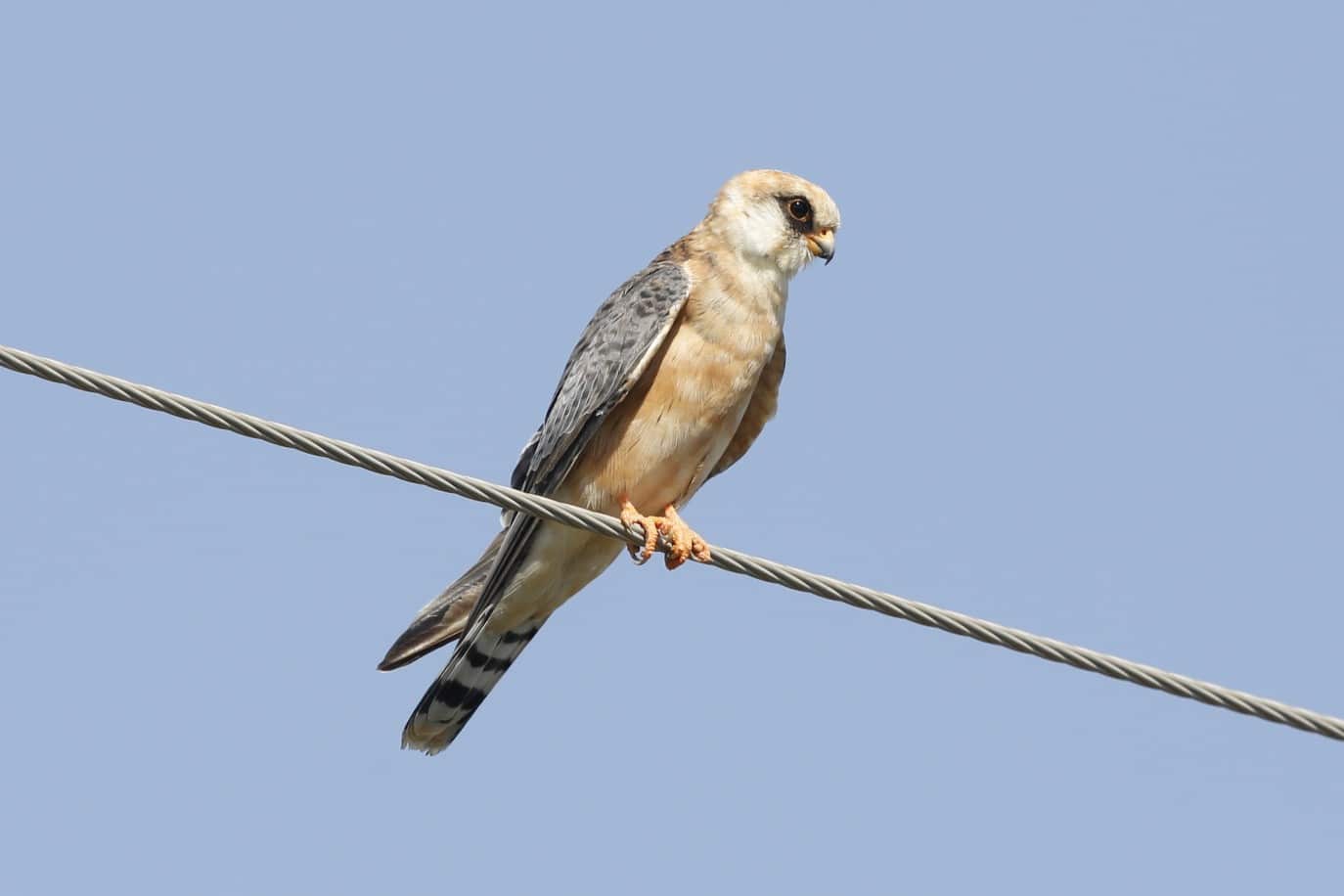
Red-footed Falcon
Falco vespertinus

Number Of Mature
Individuals (Regional)
Unknown

Regional
Population Trend
Decreasing
2025
Regional Category
Vulnerable
Search by species
CONTENTSOverview
Names
|
IOC English Name: |
Red-footed Falcon |
|
SA & IOC Scientific Name: |
Falco vespertinus |
|
BirdLife International Taxonomy (scientific name): |
Falco vespertinus |
|
Order: |
FALCONIFORMES |
|
Family: |
Falconidae |
|
Species name author: |
Linnaeus 1766 |
|
Afrikaans: |
Westelike Rooipootvalk |
|
Sesotho (South Africa): |
Seotsanyana-pheontsho |
|
Sesotho (Lesotho): |
Seotsanyana-pheeont |
|
Siswati: |
|
|
Zulu: |
Uklebonyawobomvu |
Current Assessment Status
|
2025 Regional Category [Criteria] |
VU [A2bc] |
|
2024 Global Category [Criteria] |
VU [A2abc+3bc+4abc] (BirdLife International 2021) |
|
Population size (Regional) |
Unknown |
|
Population size (Global) |
287 500 – 400 000 (BirdLife International 2021) |
|
Distribution size (EOO) (Regional) km2 |
986 269 (Lee 2024) |
|
Distribution size (EOO) (Global) km2 |
3 360 000 (BirdLife International 2021) |
|
Distribution size (AOO) (Regional) km2 |
238 984 (Lee 2024) |
|
Generation time |
4.11 years (BirdLife International 2021) |
|
Status change reason |
Improved knowledge |
|
Migrant (in the region) |
Yes |
|
Regional endemic |
No |
Historic Listing Information
|
2000 Regional Status |
LC |
|
2015 Regional Status |
NT [A2bc+3bc+4bc] |
|
Status change reason (if applicable) |
Change in population size |
|
2015 Population size (Regional) |
Unknown |
|
2015 Global Status |
NT [A2bc+3bc+4bc] |
Reason for Inclusion
Reason for Inclusion in the Assessment
Virtually the entire global population of the Red-footed Falcon Falco vespertinus, which is listed as globally Vulnerable, migrates to southern African in the austral summer (Ferguson-Lees and Christie 2001). This species was assessed as Near Threatened in the 2015 Regional Red List for South Africa (Taylor 2015), and Namibia (Simmons et al. 2015).
Category Justification
Category Justification
Analyses of the predicted range change based on bird atlas (SABAP2) data show a 70% decline in Area of Occupancy (AOO) for this species over the past three generations (Lee 2024). This meets the threshold of Endangered under Criterion A. However, the actual decline is believed to be significantly less than 70% as the reporting rate for the species has declined by 44% between the early period of SABAP2 (2007-2015) and the late period (2016-2023) (Lee 2024). Additionally, there is a potential for immigration from its main non-breeding grounds (Botswana, northern Namibia and southern Angola). Consequently, the assessment outcome is adjusted to Vulnerable [A2bc], in line with the global assessment.
Population Justification
The species has a large global population estimated to be between 287 500 – 400 000 mature individuals (BirdLife International 2021). The number of birds visiting the region in the austral summer is unknown: while the majority of the world population spends the non-breeding season in southern Africa (particularly Botswana, northern Namibia, and southern Angola), the species is relatively uncommon within South Africa’s borders (Mendelsohn and Herremans 1997). Confidence in the global population estimate is medium.
Trend Justification
Recent evidence suggests that the global population is in decline (Palatitz et al. 2009). The European population of 57 800 – 84 800 pairs suffered a decline during 1970-1990 while further declines have been reported from Russia, Ukraine, eastern Siberia, Hungary and Bulgaria (Tucker and Heath 1994, BirdLife International 2004, Purger 2008, Palatitz et al. 2009). SABAP2 data indicates that the population declined by over 50%, which requires the uplisting of the species to regionally Vulnerable (Lee 2024). Confidence in this trend is medium.
Biology & Ecology
Taxonomy
No notable issues.
Identification
28–30 cm, 155–170 g. A small, gregarious falcon that hunts in open landscapes and roosts communally in tall trees. Sexes differ in plumage colouration, and female is slightly larger. Male predominantly dark blue-grey, darkest on head, mantle, upperwing coverts and tail. Vent rufous. Eyes dark brown, surrounded by fleshy reddish ring. Bill base and cere orange, tip dark. Legs and feet orange-red. Female has slaty-grey mantle and scapulars, featuring darker barring. Underparts mostly ginger-buff, sometimes with brown streaking. Throat and ear coverts whiter. Dark mask around eye, forming short malar stripe. Head brown. Tail and flight feathers whitish, with prominent grey bars. Bare parts as in male. Juvenile similar to female but shows heavier streaking on underparts (Jenkins 2005).
Distribution
The Red-footed Falcon is a Palearctic migrant whose breeding range extends from Central and Eastern Europe through northern Central Asia westwards as far east as Lake Baikal, Russia (Palatitz et al. 2009). The southern limit of the breeding range passes through Serbia, Bulgaria, Ukraine, southern Russia and northern Kazakhstan (Cramp 1983, Purger 2008). It migrates south in the austral summer across a broad front, with Botswana, northern Namibia and southern Angola being the main non-breeding grounds (Mendelsohn and Herremans 1997, Figure 1 Lee 2024, https://satellitetracking.eu/inds/showtable). Within the region it prefers large, open, grassy spaces in arid woodland, as found in the western portions of South Africa (Mendelsohn and Herremans 1997). There it is present from October to November, with numbers peaking in January to February. It is relatively uncommon and is prone to localised movements in response to rainfall and resultant insect irruptions (Mendelsohn and Herremans 1997), especailly termite alates (Simmons et al. 2015). In the eastern parts of South Africa, the species is often overlooked amongst flocks of Lesser Kestrels F. naumanni and Amur Falcons F. amurensis. It departs for the breeding grounds in April, arriving in natal areas from late May onwards (https://satellitetracking.eu/inds/showtable).
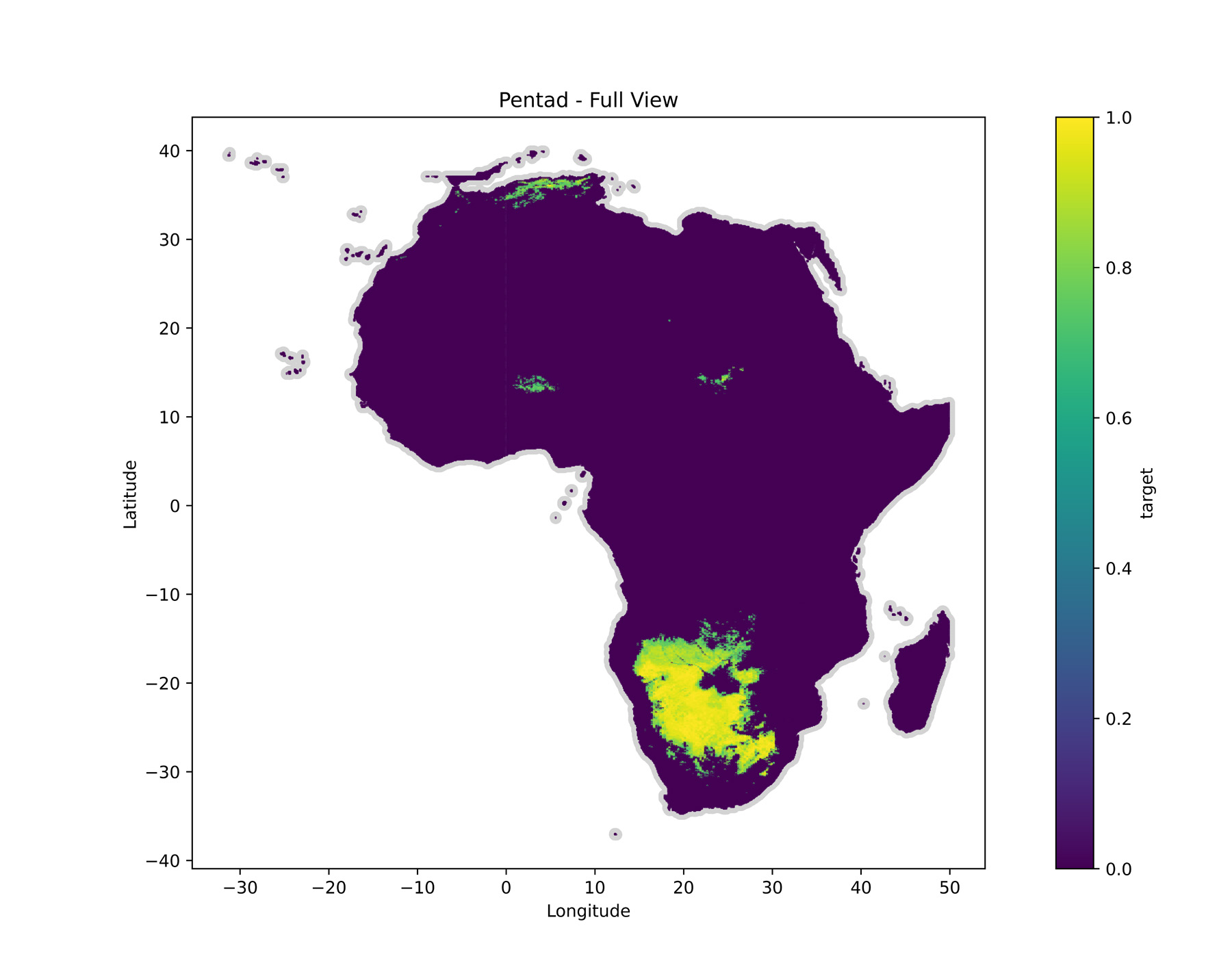
Figure 1: African Red-footed Falcon probability distribution map, produced from BirdLasser location data at 2x2km grid scale, using iNaturalist and eBird as absence data only. This represents the predicted range for the 2016-2023 period, pentad scale with p>0.5 as yellow (Lee 2024).
Ecology
The Red-footed Falcon is highly gregarious and is usually seen in flocks of 10–50 birds in open country (Mendelsohn and Herremans 1997), with occasionally hundreds of birds observed together (Simmons et al. 2015). One observation of thousands of birds descending on the Nyae Nyae Pans in Namibia is known (Simmons et al. 1999). It is a generalist predator but typically an insectivore that typically hunts on the wing but will also take prey from the ground (Mendelsohn and Herremans 1997). Its diet consists primarily of arthropods, including insects, centipedes, solifugids and occasionally small vertebrates. The species is a non-breeding visitor to Africa, but on its Eurasian breeding grounds it is a facultative colonial breeder making use of a variety of nesting opportunities such as Rook Corvus frugilegus colonies, Hooded Crow Corvus corone cornix and Buzzard Buteo spp. nests, as well as cavities in trees. In certain areas of the breeding range (e.g. Hungary) up to 60% of the population breeds in nest boxes (Palatitz et al. 2009). The species roosts communally, congregating in large numbers around traditional roosts (typically tall alien trees in rural towns) at dusk. The generation length for this species is 5.7 years (BirdLife International 2021).
Threats & Conservation
Threats
The primary threat to the Red-footed Falcon on its breeding grounds is habitat loss and modification which drives a loss of nest sites (Palatitz et al. 2009). Agricultural intensification that has taken place in the western parts of its breeding range has led to significant loss of grasslands associated with the decline of traditional livestock husbandry (Böhning‐Gaese and Bauer 1996). This, along with the cultivation of inter- tilled crops such as maize and sunflower, has reduced the suitable foraging habitats of the species, making its hunting technique less effective (Fehérvári et al. 2009). Declines can be partly attributed to a reduction in the Rook population between 1980-2006, limiting the availability of nest sites to Red-footed Falcons. Illegal shooting occurs during their migration (Palatitz et al. 2009). Threats to the species across its non-breeding grounds remain poorly known although the majority of threatened Palearctic migrants are limited to specific areas (Kirby et al. 2008) and it is likely that Red-footed Falcon is similarly affected. Spraying of insecticides to control locust outbreaks may have a limited effect on this species (Simmons et al 2015). Small falcons that use roadside telephone and electricity wires as hunting perches are frequently killed by vehicles. The species’ habit of roosting communally in localised large trees makes it inherently vulnerable; such trees are often alien species situated in rural towns, where the birds may be seen as a nuisance and their roost trees felled. Red-footed Falcons are at risk of being shot at migration bottlenecks (Katzner et al. 2021).
Conservation Measures Underway
A European Species Action Plan for the Red-footed Falcon was completed in 2009 (Palatitz et al. 2009). The species is listed under Category 1 of the Conservation of Migratory Birds of Prey in Africa and Eurasia 1979. No species-specific conservation measures are currently underway within the region, although the different regional awareness projects of the Endangered Wildlife Trust’s Birds of Prey Working group would benefit this species.
Conservation Measures Proposed
Efforts to conserve migratory birds in a portion of their range are less effective if unaddressed threats are reducing these species’ populations and habitats elsewhere (Kirby et al. 2008). While the threats to the Red-footed Falcon across its southern African non-breeding grounds remain poorly known and largely undocumented (Palatitz et al. 2009), it is essential that an effort is made by local conservation groups, through collaboration with northern hemisphere counterparts, to obtain a firmer understanding of the threats and to address them. This can be undertaken by utilising the extensive tracking data from Europe that are largely unused (https://satellitetracking.eu/inds/showtable) to identify areas where birds roost and forage across the subcontinent. Local conservation measures would flow from the results of research questions listed here, but could also include a register of roost trees that are utilised by this species, which should be earmarked for protection.
Research Priorities and Questions
Expert assessment of threats facing the species in southern Africa (including from collaborators in South Africa, Namibia and Botswana) is required.
- The identification of key non-breeding grounds in southern Africa, with the aim of informing the delineation of potential IBAs, needs to be undertaken.
- Identification of traditional communal roost sites should be a priority. Such localised sites can be relatively easily conserved, and provide valuable opportunities for counts and population estimates.
- The impact that primary and secondary poisoning has on non-breeding Red-footed Falcon populations within the region needs to be established.
- Conduct further research into the effects of changes in land-use through agriculture and land-management on this species within the region.
Contributors & References
Assessor/s
Machawe Maphalala
Reviewer/s
Rob Simmons, Sanjo Rose
References
BirdLife International. 2004. Birds in Europe: population estimates, trends and conservation status. Cambridge, UK: BirdLife International.
BirdLife International. 2021. Falco vespertinus. The IUCN Red List of Threatened Species 2021: e.T22696432A200136196. https://doi.org/10.2305/IUCN.UK.20213.RLTS.T22696432A200136196.en
Böhning‐Gaese K, Bauer HG. 1996. Changes in species abundance, distribution, and diversity in a central European bird community. Conservation Biology 10(1): 175–187.
Cramp S. 1983. The handbook of the birds of Europe, the Middle East and North Africa. Oxford, UK: Oxford University Press.
Fehérvári P, Harnos A, Neidert D, Solt S, Palatitz P. 2009. Modeling habitat selection of the Red-footed Falcon (Falco vespertinus): a possible explanation of recent changes in breeding range within Hungary. Applied Ecology and Environmental Research 7(1): 59–69.
Ferguson-Lees J, Christie DA. 2001. Raptors of the world. Boston, USA: Houghton Mifflin Company.
Jenkins AR. 2005. Red-footed Falcon (Falco vespertinus). In: Hockey PAR, Dean WRJ, Ryan PG (eds), Roberts’ birds of southern Africa, 7th Edn. Cape Town, South Africa: Trustees of the John Voelcker Bird Book Fund. pp 551–552.
Katzner T, Bragin E, Miller T. 2021. Red-footed Falcon (Falco vespertinus). In: Panuccio M, Mellone U, Agostini N (eds), Migration strategies of birds of prey in Western Palearctic. Boca Raton, USA: CRC Press. pp 217–224.
Kirby JS, Stattersfield AJ, Butchart SHM, Evans MI, Grimmett RFA, Jones VR, O’Sullivan J, Tucker GM, Newton I. 2008. Key conservation issues for migratory land-and waterbird species on the world’s major flyways. Bird Conservation International 18(1): 49–73.
Lee ATK. 2024. Regional Red Data Book of the Birds of South Africa, Lesotho and Eswatini: SABAP2 synthesis and supporting information and graphics for Red-footed Falcon. Unpublished report. Johannesburg, South Africa: BirdLife South Africa.
Mendelsohn JM, Herremans MJL. 1997. Western Red-footed Kestrel (Falco vespertinus). In: Harrison JA, Allan DG, Underhill LG, Herremans MJL, Tree AJ, Parker V, Brown CJ (eds), The atlas of southern African birds, Vol. I: Non-passerines. Johannesburg, South Africa: BirdLife South Africa. pp 260–261.
Palatitz P, Fehérvári P, Solt S, Barov B. 2009. European Species Action Plan for the Red-footed Falcon (Falco vespertinus). BirdLife International for the European Commission.
Purger JJ. 2008. Numbers and distribution of Red-footed Falcons (Falco vespertinus) breeding in Voivodina (northern Serbia): a comparison between 1990–1991 and 2000–2001. Belgian Journal of Zoology 138(1): 3.
Simmons RE, Barnard PE, Jamieson IG. 1999. What precipitates influxes of birds to ephemeral pans in arid landscapes? Ostrich 70: 145–148.
Simmons RE, Brown CJ, Kemper J. 2015. Birds to watch in Namibia: red, rare and endemic species. Windhoek, Namibia: Ministry of Environment and Tourism and Namibia Nature Foundation.
Tucker GM, Heath MF. 1994. Birds in Europe: their conservation status. Cambridge, UK: BirdLife International.
Taylor MR. 2015. Red-footed Falcon. In: Taylor MR, Peacock F, Wanless RM (eds), The Eskom Red Data Book of Birds of South Africa, Lesotho and Swaziland. Johannesburg, South Africa: BirdLife South Africa. pp 299–301.
Satellite Tracking. EU. Accessed 25 June 2024. https://satellitetracking.eu/inds/showtable
Citation
Maphalala M 2025. Red-footed Falcon. In: Lee ATK, Rose S, Banda S, Bezeng SB, Maphalala MI, Maphisa DH, Smit-Robinson H (eds), The 2025 Red Data Book of Birds of South Africa, Lesotho and Eswatini. Johannesburg, South Africa: BirdLife South Africa. Available at: https://www.birdlife.org.za/red-list/red-footed-falcon/
Our generous sponsors


