


Red-billed Teal
Anas erythrorhyncha

Number Of Mature
Individuals (Regional)
126 690 – 244 110

Regional
Population Trend
Decreasing
2025
Regional Category
Near Threatened
Search by species
CONTENTSOverview
Names
|
IOC English Name: |
Red-billed Teal |
|
SA & IOC Scientific Name: |
Anas erythorhyncha |
|
BirdLife International Taxonomy (scientific name): |
Anas erythorhyncha |
|
Order: |
ANSERIFORMES |
|
Family: |
Anatidae |
|
Species name author: |
Gmelin 1789 |
|
Afrikaans: |
Rooibekeend |
|
Sesotho (South Africa): |
sefudi |
|
Sesotho (Lesotho): |
sefuli |
|
Siswati: |
|
|
Zulu: |
idadelimlomobomvu |
Current Assessment Status
|
2025 Regional Category [Criteria] |
NTo [A2a] |
|
2024 Global Category [Criteria] |
LC (BirdLife International 2024) |
|
Population size (Regional) |
126 690 – 244 110 |
|
Population size (Global) |
410 000 – 790 000 (BirdLife International 2024) |
|
Distribution size (EOO) (Regional) km2 |
1 494 024 (Lee 2024) |
|
Distribution size (EOO) (Global) km2 |
15 400 000 (BirdLife International 2024) |
|
Distribution size (AOO) (Regional) km2 |
584 394 (404 589 – 774 656) (BIRDIE 2024) |
|
Generation time |
3.6 years (BirdLife International 2024) |
|
Status change reason |
Genuine change in status |
|
Migrant (in the region) |
Nomadic; portion of population possibly partial migratory. |
|
Regional endemic |
No |
Historic Listing Information
|
2000 Regional Status |
Not Evaluated |
|
2015 Regional Status |
Not Evaluated |
|
Status change reason (if applicable) |
Not applicable |
|
2015 Population size (Regional) |
Unknown |
|
2015 Global Status |
LC |
Reason for Inclusion
Reason for Inclusion in the Assessment
This species was not previously assessed and was presumed to be Least Concern. Preliminary screening of Coordinated Waterbird Counts (CWAC) data indicated a significant decline in the number of Red-billed Teal Anas erythorhyncha counted per year (Lee 2024).
Category Justification
Category Justification
Both CWAC and the Southern African Bird Atlas Project (SABAP2) indicate that Red-billed Teal is declining in the region although the magnitude of decline varies. Modelled Area of Occupancy (AOO) from SABAP2 data shows a decline of 15.9% in the past three generations. Dynamic models using BIRDIE (2024) data point to a decline of 9.46%. Poptrend (Knape 2016) analyses using CWAC data yield an estimated population trend of -53% (95% CI: -74%, -20%) over the past three generations. Considered together it seems likely that the rate of decline could exceed 30%, the threshold for Vulnerable under Criterion A2.
The regional population size estimates exceeded thresholds under Criterion C. The regional range of the Red-billed Teal far exceeds the threshold for Vulnerable under Criterion B (AOO <2000 km2 and Extent of Occurrence (EOO) <20 000 km2).
Red-billed Teal is a highly mobile species and has an extensive range throughout Southern Africa. Given the uncertainty of the rate of decline, as well as the high probability of a rescue effect should it be needed, the assessment outcome is adjusted to Near Threatened.
Population Justification
Wetlands International estimates the global population to be between 615 000 – 1 185 000 mature individuals (Wetlands International 2024). Confidence in these estimates is low as it is based on best guess for the southern Africa and Madagascar population and expert opinion for the eastern Africa population. BirdLife International (2024) provides a population estimate of mature individuals of 410 000 – 790 000. 30.9% of the modelled range occurs in South Africa, Lesotho and Eswatini (Lee 2024), suggesting a regional population of 126 690 – 244 110.
The species is fairly widespread occurring throughout the region except for very arid areas and at very high altitudes. Tarboton et al. (1987) estimated that the population on the Highveld areas of Mpumalanga, Limpopo and Northwest Provinces alone numbered 50 000 birds which is substantially more than the minimum threshold for Criterion C.
Trend Justification
Globally Red-billed Teal are considered to be in decline (BirdLife International 2024). Although probability of reporting from SABAP2 indicated a stable trend, both SABAP2 and CWAC show declines in either population numbers or AOO (Lee 2024).
Data collected for SABAP2 from the project was divided into two periods (early 2007-2014 and late 2015-2023) and models were used to predict the number of pentads species could occur in within each period (Figure 1). The models predicted a decline of 15.96% in AOO between the two periods (Lee 2024).
Using the same data and available habitat per year the number of pentads in which the species could occur were predicted annually between 2008-2022. These dynamic models estimated a decline in occupancy of 9.7% (BIRDIE 2024).
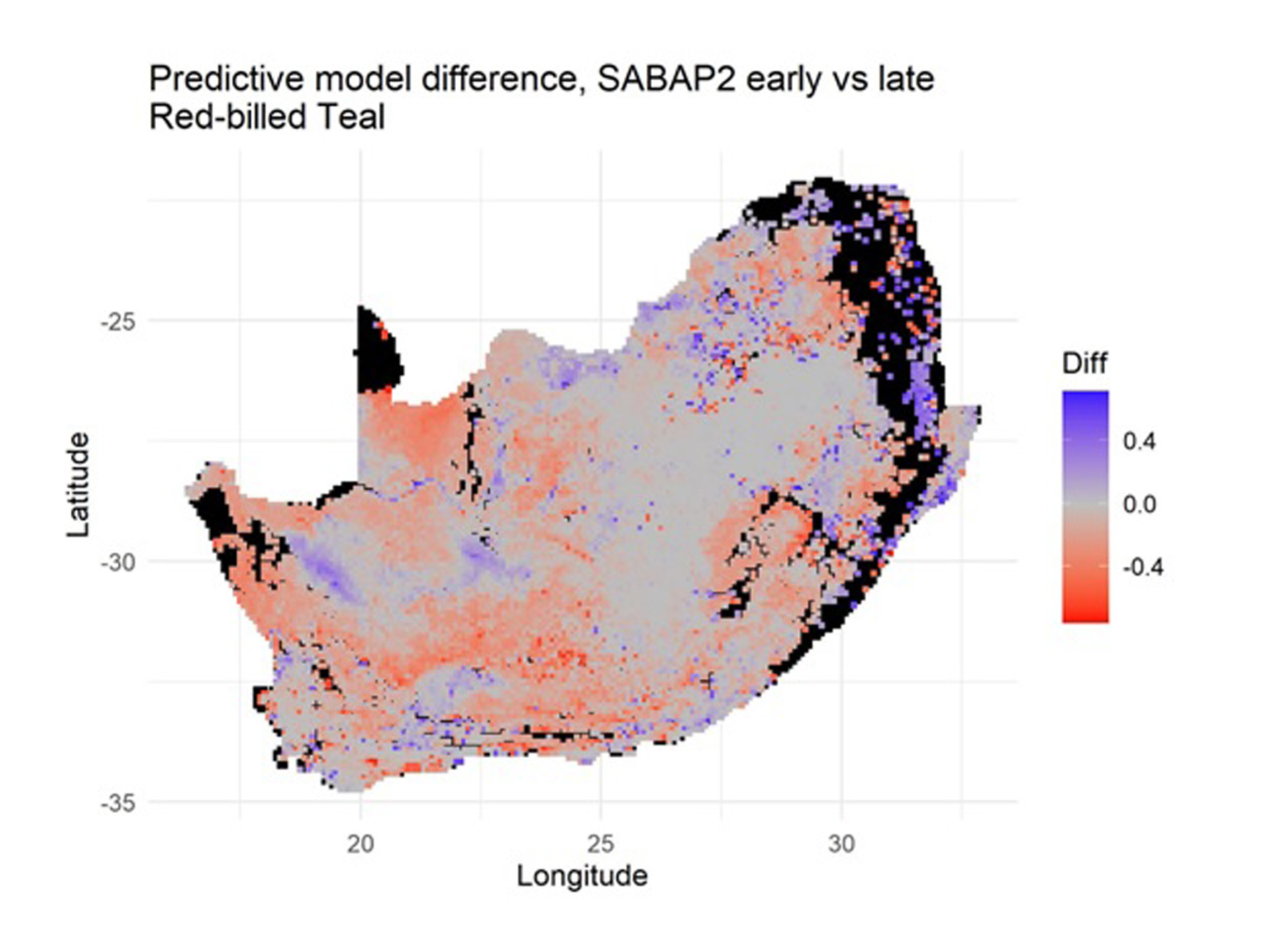
Figure 1: Predictive occurrence model results comparing data from 2007-2015 and 2016-2023. Red indicates a lower probability of recording for the latter period while blue indicates a higher recording (from Lee 2024).
State-spaced models using CWAC data via BIRDIE (2024) were applied to population counts carried out at 145 wetlands across the region to estimate the true number of individuals at each wetland. The data predicted a population decline of 21.9% over a 20-year period for these wetlands.
Percentage population decline modelled from CWAC data using the poptrend package (Knap 2016) predicted a decline of -53% (95% CI: -74%, -20%) over three generations (Figure 2).
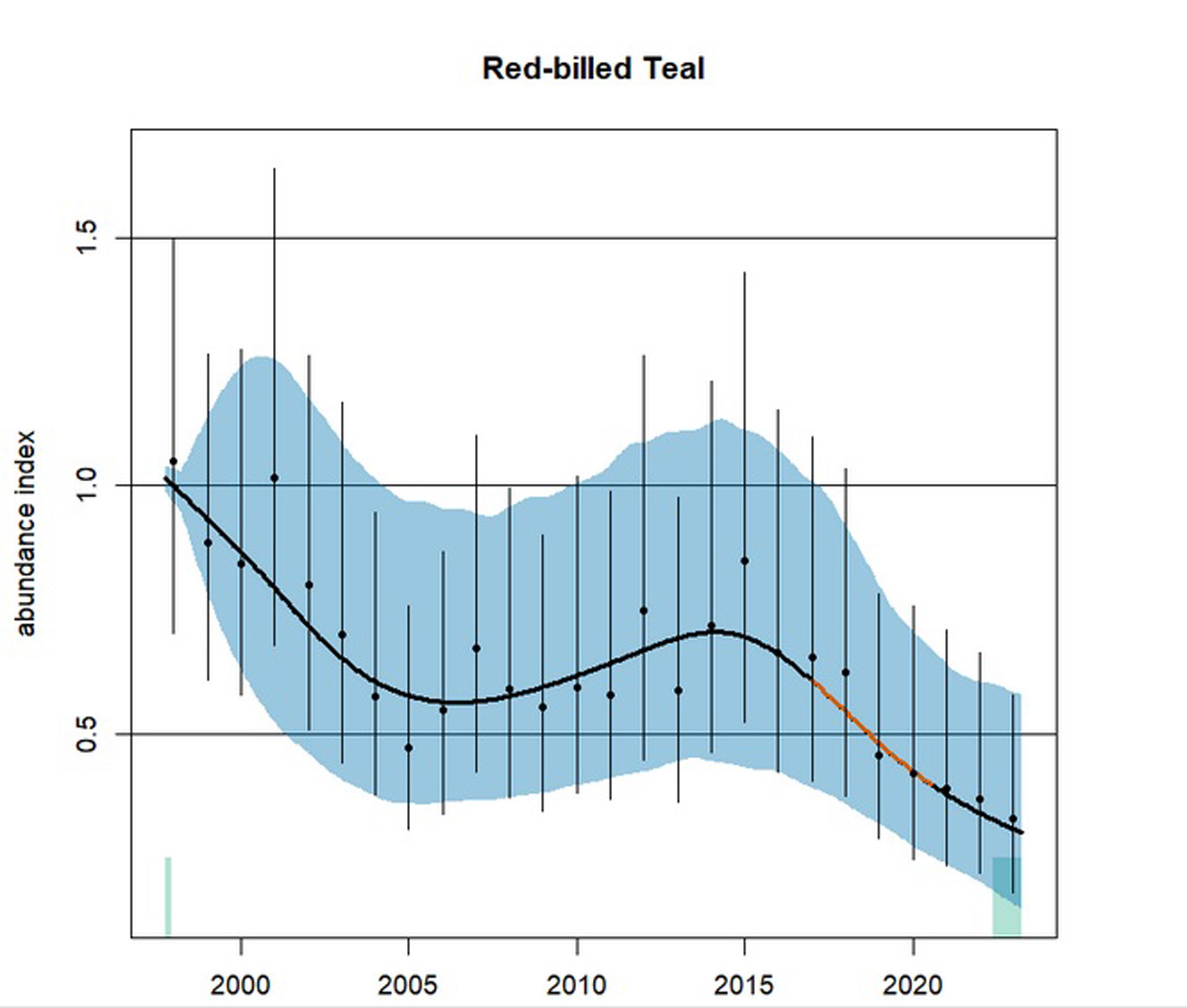
Figure 2: Figures of Poptrend plots for Red-billed Teal. Red indicates periods of significant decline. The pattern is similar using data with >500 counts filtered out.
Nagy and Langendoen (2020) estimate that the Southern African population of Red-billed Teal declined by 13% between 2005-2017 (12 years = three generations). Based on the growth rate between 2008-2017 they predict that the population will decrease by 29% in three generations compared to population levels in 2008. Sufficient count data at 145 wetlands counted during CWAC indicate that numbers have declined by 21.9% in the past 20 years at these sites. Considering the widespread distribution of the species within the region (Figure 3), it is probable that these wetlands are not a representative sample size. A linear trend model from the top 20 counted sites with Red-billed Teal predicted annual rates of decline of 2.8% (95% CI: -5.4, -0.17) (Lee 2024).
As illustrated by Thomas et al. (2015) more fine scale monitoring by CWAC is needed to confidently determine regional trends for Red-billed Teal. Red-billed Teal numbers vary considerably yet predicably with rainfall trends, yet these peaks are not well captured by the current timing of the CWAC counts (Thomas et al. 2015). It is important that declines detected by SABAP2 be investigated, for example there appears to be a localised disappearance of Red-billed Teal in the southwestern part of the Western Cape Province (Figure 3).
Despite the uncertainties in the scale of decline there is high confidence that Red-billed Teal is experiencing a decline regionally. This is supported by both Wetlands International (2024) and Nagy and Langendoen (2020) who indicated that the Southern African population is probably in decline.
Biology & Ecology
Taxonomy
Monotypic.
Identification
43–48 cm (Colahan 2005). Adult male: has a dark brown cap extending down the nape of the neck and sides of the face to below the eyes (Colahan 2005). Below this is a buff white area around the chin extending to the upper throat which becomes browner with fine speckling eventually becoming more speckled on lower neck (Colahan 2005). Upper parts of the body are brown while lower part is buff coloured, and are mottled or barred. Bill bright pink with dark culmen ridge and nails blackish (Colahan 2005). Legs and feet are slate grey in colour (Clancey 1964, Woodall 1981, Brown et al. 1982). Eyes are brown (Brickell et al. 1988). Males tend to have a brighter red bill during breeding and larger flank feathers (Bell 1997). Adult female: similar to males but females tend to have a slightly steeper forehead and the black culmen ridge tends to be broader than the male (Day 1977, Woodall 1981). Juvenile: similar to adults but are duller and greyer (Clancey 1967, Woodall 1981).
Distribution
The species occurs southwards from southern Sudan and Ethiopia to southern Somalia, Kenya, Uganda, Rwanda, United Republic of Tanzania, eastern Democratic Republic of the Congo, Angola, Zambia, Malawi, Zimbabwe, Namibia, South Africa, and Madagascar (Brickell et al. 1988). Data from the Waterbirds Populations Portal (Wetlands International 2024) indicate that the Southern African population is significantly larger than the East African population, the latter only contributing 24% of the total. Red-billed Teal occur over much of South Africa (Figure 3), is sparse to absent in the arid areas with the largest concentrations on the Highveld and in the Western Cape (Tarboton et al.1987, Hockey et al. 1989, Maclean 1997, Colahan 2005).
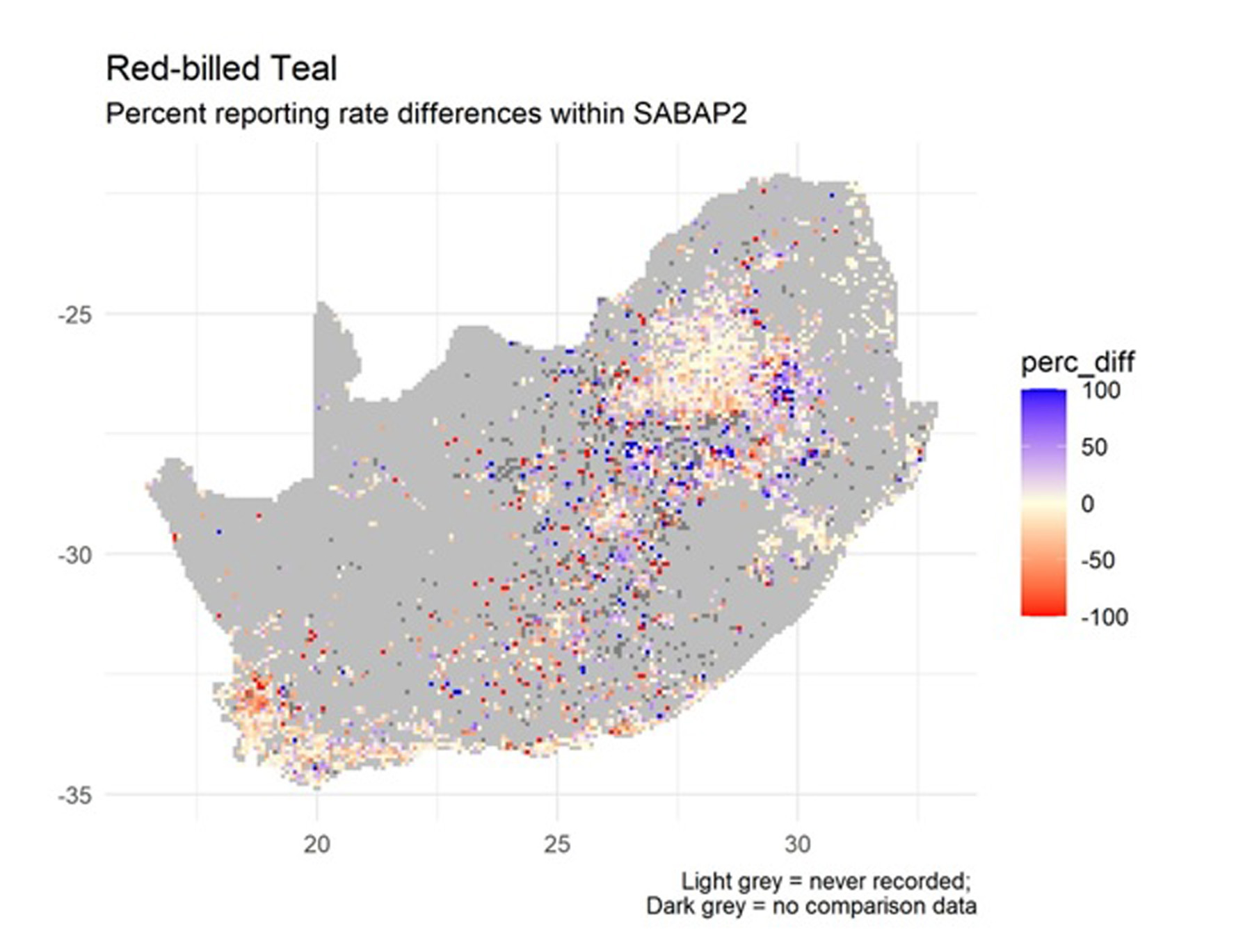
Figure 3: Distribution map of Red-billed Teal showing pentad level change between the early (2007-2015) and late (2016-2023) SABAP2 periods (from Lee 2024).
Ecology
The Red-billed Teal prefers shallow permanent or temporary eutrophic freshwater wetlands including, dams, sewage ponds and other artificial wetlands, with submerged, floating and peripheral vegetation (Johnsgard 1978, del Hoyo et al. 1992). Known to breed on shallow wetlands or shallow bays of larger ones with fringing emergent vegetation (Colahan 2005). Movement behaviour is poorly understood in Red-billed Teal. Benson (1982) describes the species as strongly dispersive based on literature from surveys done in the Free State, while Douthwaite (1977) describes the movements as partial migratory from ring recoveries documenting movement between southern Africa and the Kafue Flats in Zambia. Colahan (2005) suggest that the species is most probably nomadic in southern Africa. It is clear from the literature (e.g. Cumming et al. 2012.) and the reporting rate graphs emanating from the SABAP2 that the species undertakes nomadic movements, making use of temporal waterbodies during periods of rain for breeding and then moving onto more permanent waterbodies to moult during the dry season. Some seasonal movement appears to be taking place, with SABAP2 data indicating an influx of birds into the winter rainfall Western Cape and away from the summer rainfall provinces during winter (Figure 4). Oatley et al. (1986) determined that 5% of ringed recoveries recorded distances over 1000 km, suggesting that at least some long-distance movements between southern African countries was taking place. This movement might be linked to moulting behaviour as this species assembles on large waterbodies to moult (e.g. Douthwaite 1977).
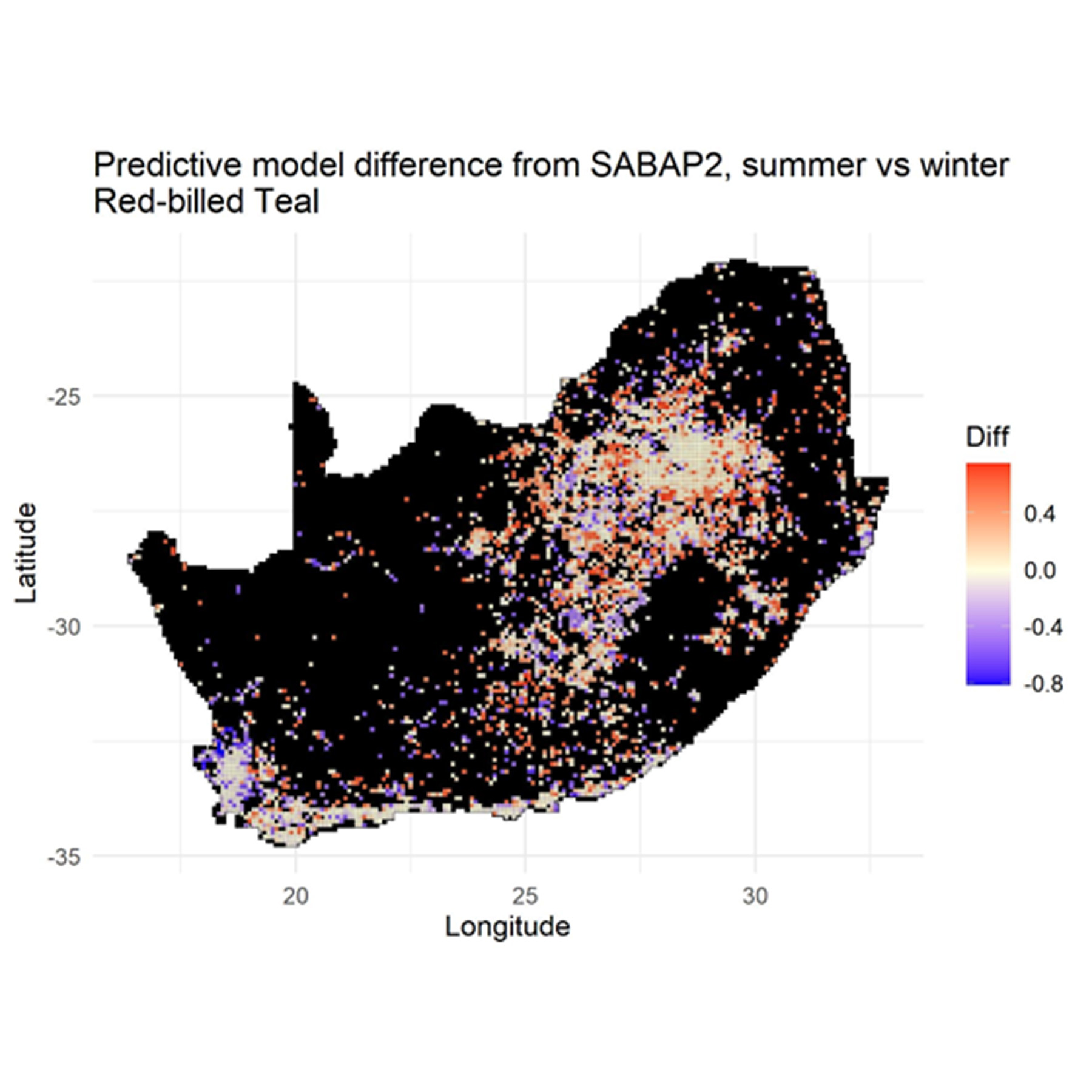
Figure 4: Seasonal variation of SABAP2 reporting rate. Blue indicates region of increased reporting rate during winter, red indicating higher reporting rates in summer and grey showing no change (from Lee 2024).
Breeding can take place throughout the year in the Northern and Western Cape (Little et al. 1995) peaking in Mar-April (Cummings 2016), but showing a peak in the Western Cape Aug-Nov (Colahan 2005), whereas in other provinces it is more seasonal and varies, between provinces; Eastern Cape Nov-Dec (Little et al. 1995); KwaZulu-Natal Dec-Apr and Free State Jan-Apr (Colahan 2005). The nest is a shallow scrape lined with grass and down always on dry ground within 100 m of water and is typically on raised ground surrounded by water (Tarboton 2001). Clutch size is usually 5–12 in Western Cape and 6–15 in rest of South Africa (Johnson 1934, Siegfried 1964, Dean 1971, Hockey et al. 1989, Jarvis et al. 1999). Incubation is 25–27 days and is performed by the females only (Siegfried 1962). Young cared mostly by female with male assisting until fledged at about 60–65 days (Tarboton 2001). The longevity of the Red-billed Teal can range from about 4–15 years in the wild (Irwin 1981, Underhill et al. 1999). Breeding success is poorly known although in one example 97% of 33 eggs successfully hatching (Colahan 2005).
Red-billed Teal feeds on plant material, mostly seeds of various grasses and water plants as well as stems of these plants. Aquatic invertebrates that are consumed include molluscs, crustaceans, worms, arachnids and insects (Colahan 2005). Some variation occurs in terms of the quantity of animal versus plant material consumed. Petrie (1996) found that birds at Nylsvlei consumed predominantly plant material (77–98%) with the variation attributed to sex and stage of reproductive activity. Mitchell (1983) on the other hand found that birds at Barberspan consumed predominantly (76%) animal matter.
Threats & Conservation
Threats
There is a potential threat from infestation with Theromyzon cooperi and Placobdella garoui leeches which may lead to mortality in infested birds. Red-billed Teal is also hunted with records of the species comprising between 5.2 and 19.5% of total waterfowl bag limits (Colahan 1984, Clinning and Bailie 1987, Smuts 1987). While hunting is currently controlled and not considered a threat, it has the potential become one if not managed sustainably (Little et al. 1995).
Conservation Measures Underway
Stipulated hunting seasons and bag limits are set as per the hunting regulations for those provinces where hunting of Red-billed Teal is allowed. While none of the wetlands surveyed met the 1% criteria for this species, the largest numbers obtained for this species were on a number of wetlands within protected areas (e.g. Lake St Lucia, Rietvlei Wetland Nature Reserve in the Western Cape and De Hoop Nature Reserve in the Western Cape).
In addition, the species is listed under the African Eurasian Waterbird Agreement (AEWA) which is an intergovernmental treaty dedicated to the conservation of migratory waterbirds and their habitats developed under the framework of the Convention on the Conservation of Migratory Species of Wild Animals (CMS). The treaty which covers Africa, Europe, the Middle East, Central Asia, Greenland and the Canadian Archipelago places an obligation on signatory countries, of which South Africa is one, to conserve migratory waterbirds and their habitats.
Conservation Measures Proposed
Hunting regulations will require deliberation, taking into consideration the difference in population size between provinces and probably different breeding seasons as well as probable decline in numbers.
It is speculated that not all sites containing this species are surveyed and possibly some sites that were counted in the past are not surveyed anymore. Resuming surveys of previously surveyed sites and expansion of monitoring to cover all important wetlands for this species is recommended enabling a more thorough investigation into population trends.
Looking at the ecology and biology of the species and the number of CWAC wetlands on which this species occurs (73% of South African CWAC Count wetlands), it is clear that this is a highly mobile species and possibly a better survey method would be to concentrate on those wetlands where they congregate during the moulting period.
Improve adoption of the 1% criterion to identify key sites for conservation action. Considering what the data for South Africa are indicating, it is postulated that the 1% level (currently 7100 birds – Wetlands International Waterbirds Populations Portal 2024) is too high and needs to be rectified through better estimates of regional population numbers.
Research Priorities and Questions
- Movement patterns within the Southern African region and how this can improve the conservation of the species – especially in the light of variation in hunting regulations between the provinces.
- Size of regional population needs to be determined. Improved monitoring is recommended. Thomas et al. (2015) and Cumming et al. (2012) made pertinent suggestions for how population monitoring for this species could be improved using the existing CWAC and SABAP2 protocols.
- Determine the cause/s for the decline in both population numbers and AOO.
Contributors & References
Assessor/s
Kevin Shaw, Maria Paul
Reviewer/s
Sanjo Rose
References
Bell CGV. 1997. Field sexing of some monomorphic Zimbabwean ducks. Honeyguide 43: 76–79.
Benson CW. 1982. Migrants in the Afrotropical region south of the equator. Ostrich 53(1): 31–49.
BIRDIE. 2024. An online platform for African wetland and waterbird data. Available at: https://biodiversityadvisor.sanbi.org/contentmanagement/index?guid=42305260-12b0-4a92-912e-7d801d15fdac [Accessed on 12 September 2024].
BirdLife International. 2024. Anas erythrorhyncha. The IUCN Red List of Threatened Species 2024: e.T22680290A264985091. Available: https://dx.doi.org/10.2305/IUCN.UK.2024-2.RLTS.T22680290A264985091.en [Accessed on 10 February 2025].
Brickell N, Shirley RM. 1988. Ducks, Geese and Swans of Africa and Its Outlying Islands. Fourways: Frandsen Publishers.
Brown LH, Urban EK, Newman K. 1982. The Birds of Africa, vol. 1. London: Academic Press.
Clancey PA. 1964. The Birds of Natal and Zululand. London: Oliver & Boyd.
Clancey PA. 1967. Gamebirds of Southern Africa. Cape Town: Purnell.
Clinning CF, Bailie EJ. 1987. Transvaal gamebird hunting statistics. In: Milstein P le S, Middleton E (eds), Partial Proceedings of the Gamebird Symposium, Pretoria, 9–11 July 1984. Pretoria: South African Wildlife Management Association. pp 154–160.
Colahan BD. 1984. The Ecology and Conservation of Waterfowl in Natal. Unpublished MSc thesis. Pietermaritzburg: University of Natal.
Colahan BD. 2005. Red-billed Teal. In: Hockey PAR, Dean WRJ, Ryan PG (eds), Roberts birds of southern Africa (7th Edn). Cape Town: Trustees of the John Voelcker Bird Book Fund. pp 111–113.
Cumming GS, Gaidet N, Ndlovu M. 2012. Towards a unification of movement ecology and biogeography: conceptual framework and a case study on Afrotropical ducks. Journal of Biogeography 39(8): 1401–1411.
Day DH. 1977. A morphological study of Yellow-billed Duck and Red-billed Teal. Ostrich (Suppl. 12): 86–96.
Dean WRJ. 1971. Breeding data for the birds of Natal and Zululand. Durban Museum Novitates 9: 59–91.
del Hoyo J, Elliott A, Sargatal J (eds). 1992. Handbook of the Birds of the World, vol. 1: Ostrich to Ducks. Barcelona: Lynx Edicions.
Douthwaite RJ. 1977. Filter-feeding ducks of the Kafue Flats, Zambia. Ibis 119(1): 44–66.
Hockey PAR, Underhill LG, Neatherway M, Ryan PG. 1989. Atlas of the Birds of the Southwestern Cape. Cape Town: Cape Bird Club.
Irwin MPS. 1981. The Birds of Zimbabwe. Salisbury: Quest Publishing.
Jarvis AM, Robertson A, Brown CJ, Simmons RE. 1999. Namibian Avian Database. Unpublished report. Windhoek: National Biodiversity Programme, Ministry of Environment & Tourism.
Johnsgard PA. 1978. Ducks, Geese and Swans of the World. Lincoln and London: University of Nebraska Press.
Johnson KC. 1934. Notes on nesting birds of the Orange Free State. Ostrich 5: 49–56.
Knape J. 2016. Decomposing trends in Swedish bird populations using generalized additive mixed models. Journal of Applied Ecology 53: 1852–1861.
Lee ATK. 2024. Regional Red Data Book of the Birds of South Africa, Lesotho and Eswatini: SABAP2 synthesis and supporting information and graphics for Red-billed Teal. Unpublished report. Johannesburg: BirdLife South Africa.
Little RM, Vester KC, Crowe TM. 1995. Temporal and spatial patterns of breeding activity of 12 duck species (Anatidae) in the Cape provinces, South Africa, and their implications for hunting seasons. South African Journal of Wildlife Research 25(1): 17–22.
Maclean GL. 1997. Red-billed Teal Anas erythrorhyncha. In: Harrison JA, Allan DG, Underhill LG, Herremans M, Tree AJ, Parker V, Brown CJ (eds), The Atlas of Southern African Birds, vol. 1. Johannesburg: BirdLife South Africa. pp 134–135.
Mitchell RJH. 1983. Preliminary feeding data on Red-billed Teal, Cape Teal and Cape Shoveller at Barberspan. South African Journal of Wildlife Research 13(2): 47–48.
Nagy S, Langendoen T. 2020. Flyway Trend Analyses Based on Data from the African-Eurasian Waterbird Census from the Period of 1967–2018. Wageningen: Wetlands International.
Oatley TB, Prys-Jones RP. 1986. A comparative analysis of movements of southern African waterfowl based on ringing recoveries. South African Journal of Wildlife Research 16(1): 1–6.
Petrie SA. 1996. Red-billed Teal foods in semiarid South Africa: a north-temperate contrast. The Journal of Wildlife Management 60(4): 874–881.
Siegfried WR. 1962. Nesting behaviour of the Red-billed Teal Anas erythrorhyncha Gmelin. Cape Department of Nature Conservation Investigational Report 2: 19–24.
Siegfried WR. 1964. Parasitic egg laying in South African Anatidae. Ostrich 35: 61–62.
Smuts GL. 1987. Harvesting and managing waterfowl on the Blesbokspruit. In: Milstein P le S, Middleton E (eds), Partial Proceedings of the Gamebird Symposium, Pretoria, 9–11 July 1984. Pretoria: South African Wildlife Management Association. pp 126–135.
Tarboton WR, Kemp MI, Kemp AC. 1987. Birds of the Transvaal. Pretoria: Transvaal Museum.
Tarboton WR. 2001. A Guide to the Nests & Eggs of Southern African Birds. Cape Town: Struik Publishers.
Thomas HL, Hockey PAR, Cumming GS. 2015. Solving the challenges of monitoring mobile populations: insights from studies of waterbirds in southern Africa. Ostrich 86(1–2): 169–178.
Underhill LG, Tree AJ, Oschadleus HD, Parker V. 1999. Review of Ring Recoveries of Waterbirds in Southern Africa. Cape Town: Avian Demography Unit, University of Cape Town.
Wetlands International. 2024. Waterbird Populations Portal. Available: http://wpp.wetlands.org/ [Accessed on 3 April 2024].
Woodall PF. 1981. Aspects of age, sex, reproductive development and weight in the redbilled teal. African Journal of Wildlife Research 11:67–77
Citation
Shaw K, Paul M 2025. Red-billed Teal. In: Lee ATK, Rose S, Banda S, Bezeng SB, Maphalala MI, Maphisa DH, Smit-Robinson H (eds), The 2025 Red Data Book of Birds of South Africa, Lesotho and Eswatini. Johannesburg, South Africa: BirdLife South Africa. Available at: https://www.birdlife.org.za/red-list/red-billed-teal/
Our generous sponsors


