


Purple Heron
Ardea purpurea

Number Of Mature
Individuals (Regional)
>10 000

Regional
Population Trend
Decreasing
2025
Regional Category
Least Concern
Search by species
CONTENTSOverview
Names
|
IOC English Name: |
Purple Heron |
|
SA & IOC Scientific Name: |
Ardea purpurea |
|
BirdLife International Taxonomy (scientific name): |
Ardea purpurea |
|
Order: |
PELECANIFORMES |
|
Family: |
Ardeidae |
|
Species name author: |
Linnaeus 1766 |
|
Afrikaans: |
Rooireier |
|
Sesotho (South Africa): |
kokolofitwe-lalatshehla |
|
Sesotho (Lesotho): |
kokolofitoe-lalatehla |
|
Siswati: |
Gilonki |
|
Zulu: |
unokhoboyi |
Current Assessment Status
|
2025 Regional Category [Criteria] |
LC |
|
2024 Global Category [Criteria] |
LC (BirdLife International 2019) |
|
Population size (Regional) |
Unknown |
|
Population size (Global) |
180 000–380 000 (BirdLife International 2019) |
|
Distribution size (EOO) (Regional) km2 |
1 418 728 (Lee 2024) |
|
Distribution size (EOO) (Global) km2 |
131 000 000 (BirdLife International 2019) |
|
Distribution size (AOO) (Regional) km2 |
158 250 (BIRDIE 2024) |
|
Generation time |
10.5 years (BirdLife International 2019) |
|
Status change reason |
No change |
|
Migrant (in the region) |
Resident |
|
Regional endemic |
No |
Historic Listing Information
|
2000 Regional Status |
Not Evaluated |
|
2015 Regional Status |
Not Evaluated |
|
Status change reason (if applicable) |
N/A |
|
2015 Population size (Regional) |
Unknown |
|
2015 Global Status |
LC |
Reason for Inclusion
Reason for Inclusion in the Assessment
Preliminary screening of Coordinated Waterbird Counts (CWAC) data indicated a significant decline in the number of Purple Heron Ardea purpurea counted per year (Lee 2024). As a result, the species was included in the Regional Red Data Assessment.
Category Justification
Category Justification
This species has a large regional range and hence does not approach the thresholds for Vulnerable under the geographic range size criterion (Extent of Occurrence (EOO) <20 000 km2, or Area of Occupancy (AOO) <2000 km2 combined with a declining or fluctuating range size, habitat extent/quality, or population size and a small number of locations or severe fragmentation). Even though the population trend, inferred from changes in AOO, appears to be decreasing, the decline is not sufficiently rapid to approach the thresholds for Vulnerable under the population trend criterion (>30% decline over ten years or three generations). The population size is unknown in the region, but it is assumed to exceed
10 000 mature individuals. For these reasons, the species is evaluated as Least Concern.
Population Justification
The global population has been estimated at 180 000–380 000 mature individuals (BirdLife International 2019). There are no reliable population size estimates for the region. While the population is assumed to exceed 10 000 mature individuals, confidence in this estimate is low. The only regional population estimates are from CWAC. However, due to the secretive and sculking nature of Purple Herons, it is seriously under-recorded in these counts (Taylor et al. 1999), and therefore the total represents minimum figures. The population is widely dispersed in wetlands supporting large and dense stands of reedbeds which the birds use for feeding and as breeding sites, making it very challenging to get reliable estimates of the population size. As of May 2024, Purple Heron has been recorded in 383 sites (53% of CWAC sites), with a total of 2924 individuals (total of maximum count per site) (CWAC unpubl data). Updated population estimates are required.
Trend Justification
The global population trend is decreasing, although some populations may be stable, and others have unknown trends (Wetlands International 2015). The East Europe & South-west Asia/Sub-Saharan Africa population trend is estimated to be decreasing (BirdLife International 2015).
Regionally, no species-specific monitoring is in place, so trends are inferred from citizen science data. Using data from the Southern African Bird Atlas Project (SABAP2) a declining regional trend is inferred. Predicted modelled AOO from SABAP2 indicates that AOO has declined by 16.8% in the past three generations (Lee 2024).
As yet this rate of decline does not meet the threshold for either Vulnerable or Near Threatened. Continued monitoring is required, and monitoring at key breeding sites is recommended.
Biology & Ecology
Taxonomy
Three subspecies are formally recognised:
- A. p. purpurea Linnaeus, 1766; nominate. Found in W Palearctic, including parts of N Africa, E to Kazakhstan and Iran, Africa S of Sahara.
- A. p. madagascariensis van Oort, 1910. Found in Madagascar.
- A. p. manilensis Meyen, 1834. Found in S and SE Asia, S and E China and Taiwan to Russian Far East, and S to Greater Sundas, Philippines, Sulawesi, Moluccas (Buru) and Lesser Sundas.
Bourne’s or Cape Verde Heron (A. p. bournei) is not recognised as a valid subspecies (Hancock and Kushlan 1984, del Hoyo et al. 1992).
Identification
78–90 cm with a 120–150 cm wingspan (Snow and Perrins 1998). Its distinguishing features include a black crown with two long plumes, which are elongated feathers that are typically displayed during courtship or breeding displays (Martínez-Vilalta et al. 2016). An attractive head with chestnut to orange-buff sides of the head and neck, and a white chin (Martínez-Vilalta et al. 2016). Its back and upper-wings are slate-grey, with a chestnut mantle and a deep red shoulder patch (Martínez-Vilalta et al. 2016). During flight, its dark grey to black flight feathers display a buffy-chestnut leading edge (Martínez-Vilalta et al. 2016).
The bill of the Purple Heron is yellow with a horn-coloured tip, and its eyes are yellow (Martínez-Vilalta et al. 2016). Compared to similar species like the Grey Heron –, the Purple Heron is slimmer, smaller, and darker, with distinctive plumage patterns and a longer, thinner bill (Martínez-Vilalta et al. 2016).
Male Purple Herons are larger, heavier, and darker than females, often displaying a slate-grey colour with a purple gloss, while females are typically olive-grey (Kushlan and Hancock 2005). Juveniles have a more uniform brown colour with buff fringes on their feathers and lack the distinct plumage features of adults (Martínez-Vilalta et al. 2016).
Distribution
Widely distributed over Europe, southern Asia, and Africa (Figure 1, Tarboton 2001). In Africa, a resident population mainly in the eastern part of the continent south of the equator and Palearctic winter migrant widespread throughout the continent, except for the rain forest zone (Brown et al. 1982, del Hoyo et al. 1992). In the region it is a widespread common resident and nomad on seasonal wetlands, absent from the arid parts of South Africa (Figure 2, Taylor et al. 1999). Purple Heron is very rare in Lesotho and has only been recorded breeding at two sites (with 5–10 breeding pairs) in the lowlands (Kopij 2014).
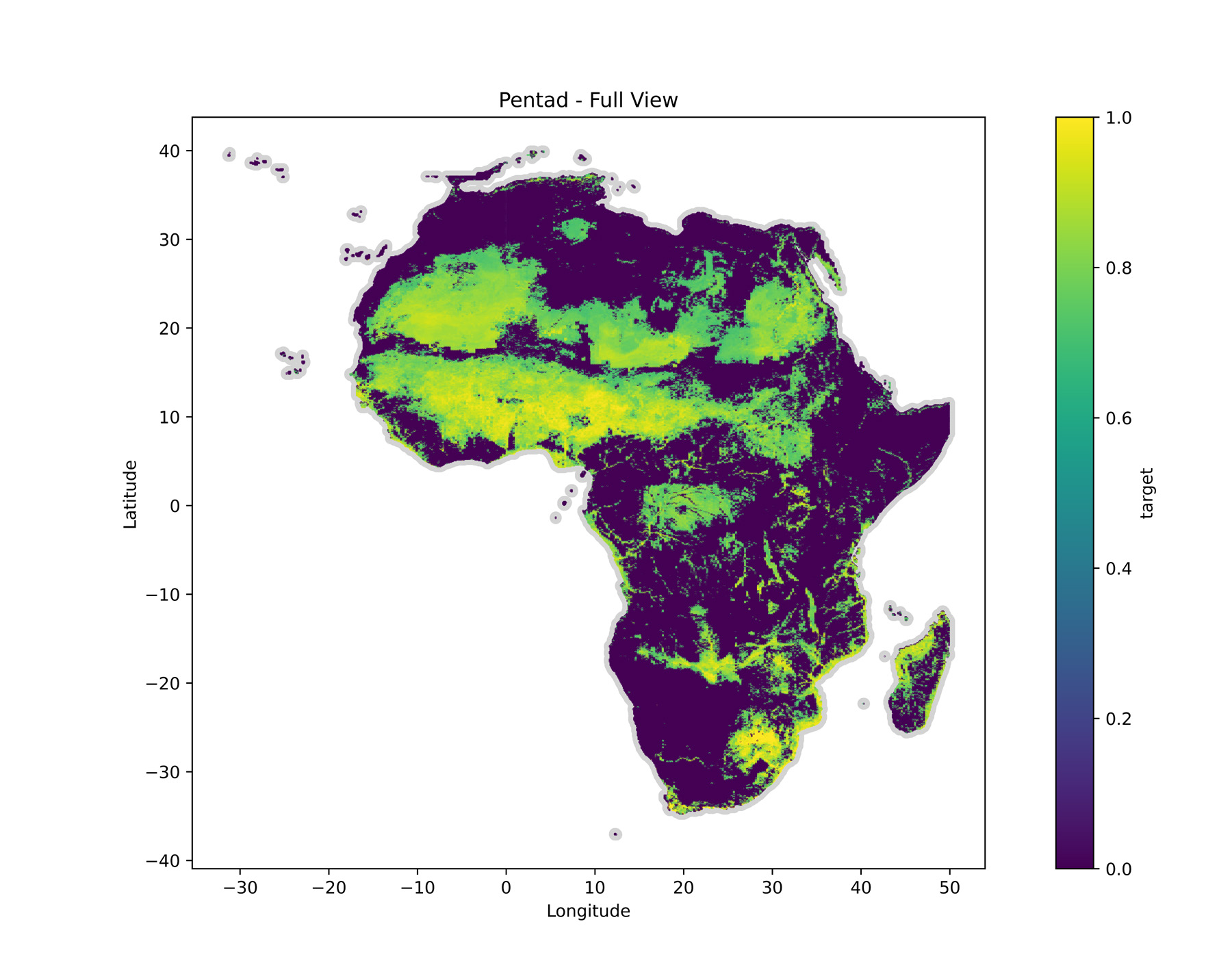
Figure 1: Africa distribution maps produced from ABAP, iNaturalist and eBird data for Purple Heron using a Random Forest model and various predictor variables. Colour gradient is predicted probability of occurrence, with a 0.5% threshold applied. Brighter colours = higher probability of occurrence. From Lee 2024.
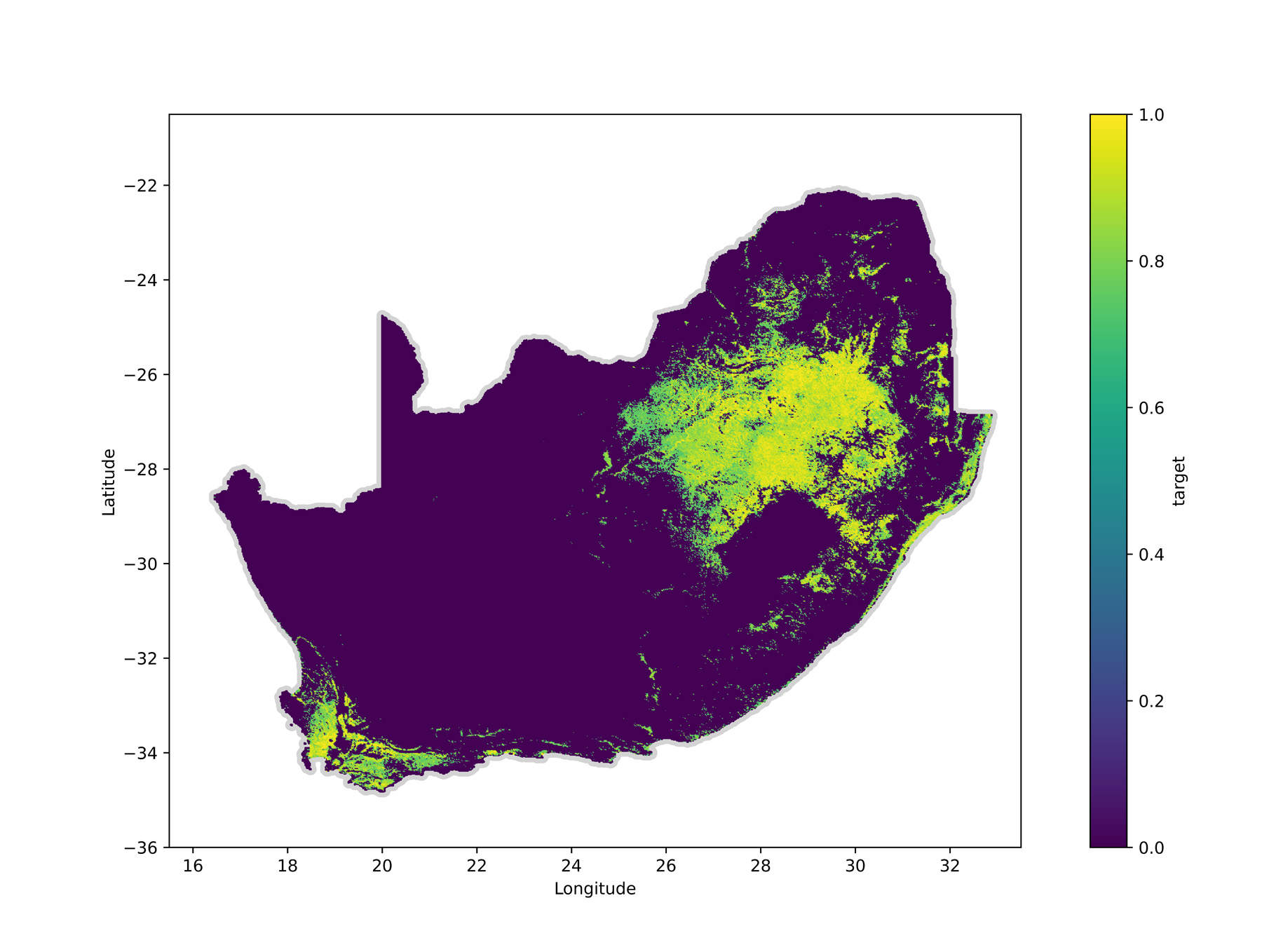
Figure 2: Regional distribution maps produced from BirdLasser location data at 2×2 km grid scale, iNaturalist and eBird data for Purple Heron using a Random Forest model and various predictor variables. Colour gradient is predicted probability of occurrence, with a 0.5% threshold applied. Brighter colours = higher probability of occurrence. From Lee (2024).
Ecology
Habitat:
The Purple Heron primarily resides in wetland habitats such as marshes, lagoons, and lakes enveloped by dense vegetation (Kushlan and Hancock 2005). While it occasionally ventures into mangrove swamps along coastal areas, it predominantly favours freshwater environments, especially those with Phragmites reed beds and papyrus vegetation (Kushlan and Hancock 2005). Additionally, it frequents mudflats, riverbanks, ditches, and canals (Witherby 1943).
Migration:
The Purple Heron is a non-migratory resident in the region. However, the Palearctic population is migrant and a winter visitor to mainly West Africa (Brown et al. 1982).
Breeding:
Monogamous breeds throughout the year, peaking in August to September and January to February (Tarboton 2001). Purple Herons usually nest colonially, often in small, loose groups but rarely in larger gatherings of hundreds, either mono-specifically or with other species of herons (Tarboton 2001). The nest is built by both sexes, typically built over or beside water, particularly in extensive reedbeds like Phragmites, Typha, Scirpus, or papyrus. Less frequently, nests can be found in bushes, mangroves, or trees (Tarboton 2001, Kushlan and Hancock 2005). Clutch consists of 3–4 eggs laid at 1-day intervals. The incubation period lasts for 25–30 days, and both sexes take turns incubating the eggs, starting with the laying of the first egg. Chicks hatch asynchronously, fledging occurs approximately 45–50 days after hatching, chicks are cared for and fed by both parents until well after fledging (Brown et al. 1982, Tarboton 2001).
Diet:
The Purple Heron feeds in shallow water by grabbing its prey with its powerful beak, it waits quietly for its prey or stalks its victims slowly. The Purple Heron primarily feeds on fish up to 15cm long, small mammals, and amphibians, but it also consumes nestling birds, snakes, lizards, crustaceans, water snails, insects, and spiders (Witherby 1943, Kushlan and Hancock 2005, Kopij 2006). A variety of insects have been recorded as food, especially terrestrial beetles, water beetles, aquatic larvae, grasshoppers, dragonflies, bees and flies (Witherby 1943).
Threats & Conservation
Threats
Within the region, Purple Heron remains poorly studied. The main threat globally to this species is the loss of reedbeds and papyrus either due to direct elimination to reduce sedimentation or reed cane harvesting (Kushlan and Hancock 2005). Habitat loss and degradation due to factors such as urbanization, agriculture, and drainage of wetlands also play a role in decreasing population size (Kushlan and Hancock 2005). Extensive and non-sustainable reed harvesting in Maputaland, KwaZulu-Natal (Tarr 2007) could pose a threat by reducing the preferred breeding habitat of Purple Herons.
Conservation Measures Underway
The species is listed under category 1C of the Africa-Eurasian Migratory Waterbird Agreement (AEWA) and under Appendix II of the Convention on the Conservation of Migratory Species of Wild Animals (CMS). In South Africa, provincial hunting regulations protects the species from hunting.
Conservation Measures Proposed
Key feeding and breeding sites should be identified, protected, and monitored. Anthropogenic threats need to be addressed, including sustainable harvesting of reeds in poor rural areas.
Research Priorities and Questions
- The regional population size needs to be determined.
- Key breeding sites should be identified and monitored to establish population trends.
- Threats in the region should be identified, specifically around reed harvesting takes place.
Contributors & References
Assessor/s
Rene A. Navarro, Maria Paul
Reviewer/s
Jonah Gula, Grzegorz Kopij
References
BIRDIE. 2024. An online platform for African wetland and waterbird data. Available at: https://biodiversityadvisor.sanbi.org/contentmanagement/index?guid=42305260-12b0-4a92-912e-7d801d15fdac [Accessed on 12 September 2024].
BirdLife International. 2019. Ardea purpurea. The IUCN Red List of Threatened Species 2019: e.T22697031A154816177. Available at: https://dx.doi.org/10.2305/IUCN.UK.2019-3.RLTS.T22697031A154816177.en [Accessed on 5 April 2024].
BirdLife International (2024) Species factsheet: Ardea purpurea. Available at: https://datazone.birdlife.org/species/factsheet/purple-heron-ardea-purpurea [Accessed on 5 April 2024].
Brown LH, Urban E, Newman K, Fry C, Keith S. 1982. The Birds of Africa, Vol. I. London, United Kingdom: Academic Press.
CWAC. 2024. Coordinated Waterbird Counts (CWAC). FitzPatrick Institute of African Ornithology, University of Cape Town. Available at: http://cwac.adu.org.za [Accessed on 5 May 2024].
del Hoyo J, Elliott A, Sargatal J. 1992. Handbook of the Birds of the World, Vol. 1: Ostrich to Ducks. Barcelona, Spain: Lynx Edicions.
Kopij G. 2006. Avian predation of the Common Platanna Xenopus laevis. African Herp News 39: 2-4.
Kopij G. 2014. Distribution and Numbers of Breeding Cormorants (Phalacrocoracidae) and Herons (Ardeidae) in Lesotho. South African Journal of Wildlife Research 44: 189-192.
Kushlan JA, Hancock JA. 2005. The Herons. Oxford University Press, Oxford, UK.
Lee ATK. 2024. Regional Red Data Book of the Birds of South Africa, Lesotho and Eswatini: SABAP2 synthesis and supporting information and graphics for Purple Heron. Unpublished report. Johannesburg: BirdLife South Africa.
Martínez-Vilalta A, Motis A, Kirwan GM. 2020. Purple Heron (Ardea purpurea), version 1.0. In: del Hoyo J, Elliott A, Sargatal J, Christie DA, de Juana E (eds). Birds of the World. Cornell Lab of Ornithology, Ithaca, NY, USA. Available at: https://doi.org/10.2173/bow.purher1.01 [Accessed on 15 May 2024].
Snow DW, Perrins CM (eds). 1998. The Birds of the Western Palearctic. Concise Edition. Volume 1. Non-passerines. Oxford University Press, Oxford, UK.
Tarboton W. 2001. Guide to Nests & Eggs of Southern African Birds. Struik Nature.
Tarr JA. 2007. An evaluation of the Phragmites australis reed use by communities neighboring the Tembe Elephant Park, Maputaland, KwaZulu-Natal, South Africa. MS Thesis, University of Pretoria. Available at: http://hdl.handle.net/2263/23606 [Accessed on 15 May 2024].
Taylor PB, Navarro RA, Wren-Sargent M, Harrison JA, Kieswetter SL. 1999. TOTAL CWAC Report. Coordinated Waterbird Counts in South Africa, 1992-1997. Cape Town, South Africa: Avian Demography Unit, University of Cape Town.
Wetlands International. 2024. Waterbird Population Estimates. Available at: https://wpe.wetlands.org/ [Accessed on 20 May 2024].
Witherby HF (ed). 1943. Handbook of British Birds, Volume 3: Hawks to Ducks. H. F. and G. Witherby Ltd. pp 133–137.
Citation
Navarro RA, Paul M 2025. Purple Heron. In: Lee ATK, Rose S, Banda S, Bezeng SB, Maphalala MI, Maphisa DH, Smit-Robinson H (eds), The 2025 Red Data Book of Birds of South Africa, Lesotho and Eswatini. Johannesburg, South Africa: BirdLife South Africa. Available at: https://www.birdlife.org.za/red-list/purple-heron/
Our generous sponsors


