


Pink-backed Pelican
Pelecanus rufescens

Number Of Mature
Individuals (Regional)
600 – 900

Regional
Population Trend
Decreasing
2025
Regional Category
Vulnerable
Search by species
CONTENTSOverview
Names
|
IOC English Name: |
Pink-backed Pelican |
|
SA & IOC Scientific Name: |
Pelecanus rufescens |
|
BirdLife International Taxonomy (scientific name): |
Pelecanus rufescens |
|
Order: |
PELECANIFORMES |
|
Family: |
Pelecanidae |
|
Species name author: |
Gmelin JF, 1789 |
|
Afrikaans: |
Kleinpelikaan |
|
Sesotho (South Africa): |
Leya le lenyenyane |
|
Sesotho (Lesotho): |
|
|
Siswati: |
|
|
Zulu: |
ivubelincane |
Current Assessment Status
|
2025 Regional Category [Criteria] |
VU [A2c; D2] |
|
2017 Global Category [Criteria] |
LC (BirdLife International 2024) |
|
Population size (Regional) |
600 – 900 mature individuals |
|
Population size (Global) |
50 000 – 100 000 individuals (33 000 – 66 000 mature individuals) (Wetlands International 2024) |
|
Distribution size (EOO) (Regional) km2 |
895 628 (Lee 2024) |
|
Distribution size (EOO) (Global) km2 |
27 700 000 (BirdLife International 2024) |
|
Distribution size (AOO) (Regional) km2 |
99 975 (BIRDIE 2024) |
|
Generation time |
11.12 years (BirdLife International 2024) |
|
Status change reason |
No change |
|
Migrant (in the region) |
No |
|
Regional endemic |
No |
Historic Listing Information
|
2000 Regional Status |
VU [D1] |
|
2015 Regional Status |
VU [D2] |
|
Status change reason (if applicable) |
No change |
|
2015 Population size (Regional) |
600 – 900 mature individuals |
|
2015 Global Status |
LC |
Reason for Inclusion
Reason for Inclusion in the Assessment
The species was previously assessed as regionally Vulnerable [D1] in 2000 and Vulnerable [D2] in 2015. The region contains a significant portion (600 – 900 mature individuals) of the global population (c. 33 000 – 66 000 mature individuals) (Bowker 2015, Wetlands International 2024).
Category Justification
Category Justification
The Pink-backed Pelican Pelecanus rufescens maintains its status as Vulnerable under Criterion D2 based on a small population (600 – 900 mature individuals), restricted to very few locations for breeding (currently only three known active breeding sies). Additionally, Southern African Bird Atlas Project (SABAP2) data shows a predicted 39% decline in Area of Occupancy (AOO) over three generations, with pentads decreasing from 149 in 2015 to 90 in 2023 (Figure 1). This trend also supports a status of Vulnerable under Criterion A2c.
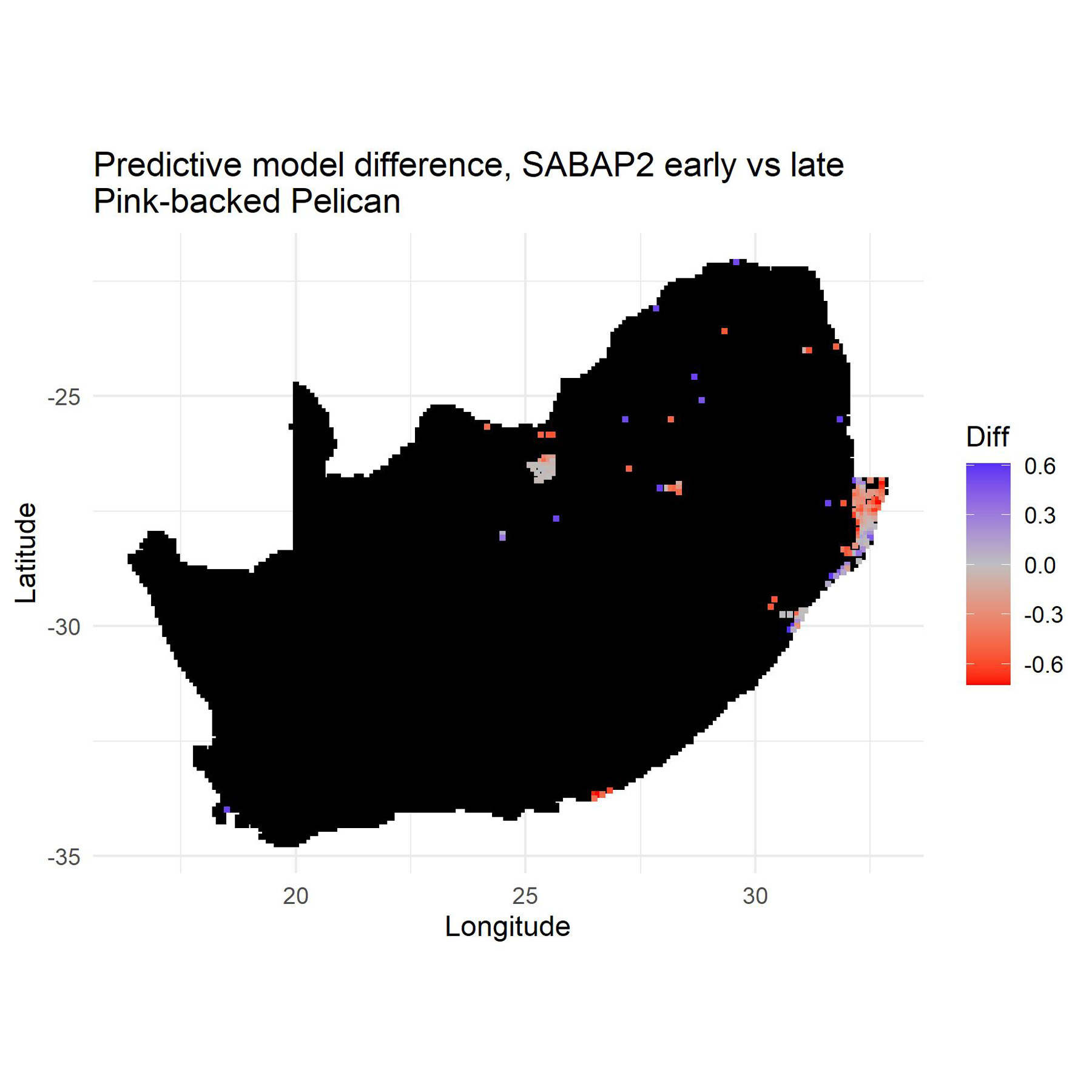
Figure 1: Predictive occurrence model results comparing data from 2007-2015 and 2016-2023. Red indicates a lower predicted probability of recording for the latter period while Blue indicates a higher predicted probability of recording Pink-backed Pelican (from Lee 2024).
Population Justification
The global population is estimated 50 000 – 100 000 individuals (c. 33 000 – 66 000 mature individuals) (Wetland International 2024). It should be noted that this estimate has not changed for several years and is based on Dodman (2002).
The regional population estimate of 600 – 900 mature individuals from the 2015 assessment (Bowker 2015) remains the most recent comprehensive estimate. This population is concentrated at three key sites: Nsumo Pan and Nyamithi Pan (breeding) and Lake St Lucia (foraging), allowing for invoking of Criterion D2. The confidence in this estimate remains medium due to the species’ mobility and seasonal movements between sites.
Trend Justification
SABAP2 data shows contrasting trends:
- Stable probability of reporting with high confidence.
- 39% decline in predicted AOO over three generations (Figure 2).
- Decrease in predicted number of occupied pentads from 149 (2015) to 90 (2023).
Coordinated Waterbird Counts (CWAC) data shows an overall negative trend across sites but a positive trend coefficient for certain sites (Figure 4, coefficient 0.173, p < 0.001). The negative trend is driven by CWAC winter counts, once birds have dispersed after the breeding season. Bowker and Downs (2010) indicated that summer counts were higher than winter counts and that birds are dispersing to other sites within and outside the region. It is probable that several of these sites are not covered by the CWAC project. The positive trend (Figure 3) may reflect improved counting at key sites rather than a genuine population increase. The uncoordinated and irregular surveys of the species as well as the movement patterns and anthropogenic impacts on breeding and foraging habitat, and the response of the species to these impacts makes it difficult to interpret any trends emanating from the CWAC data.
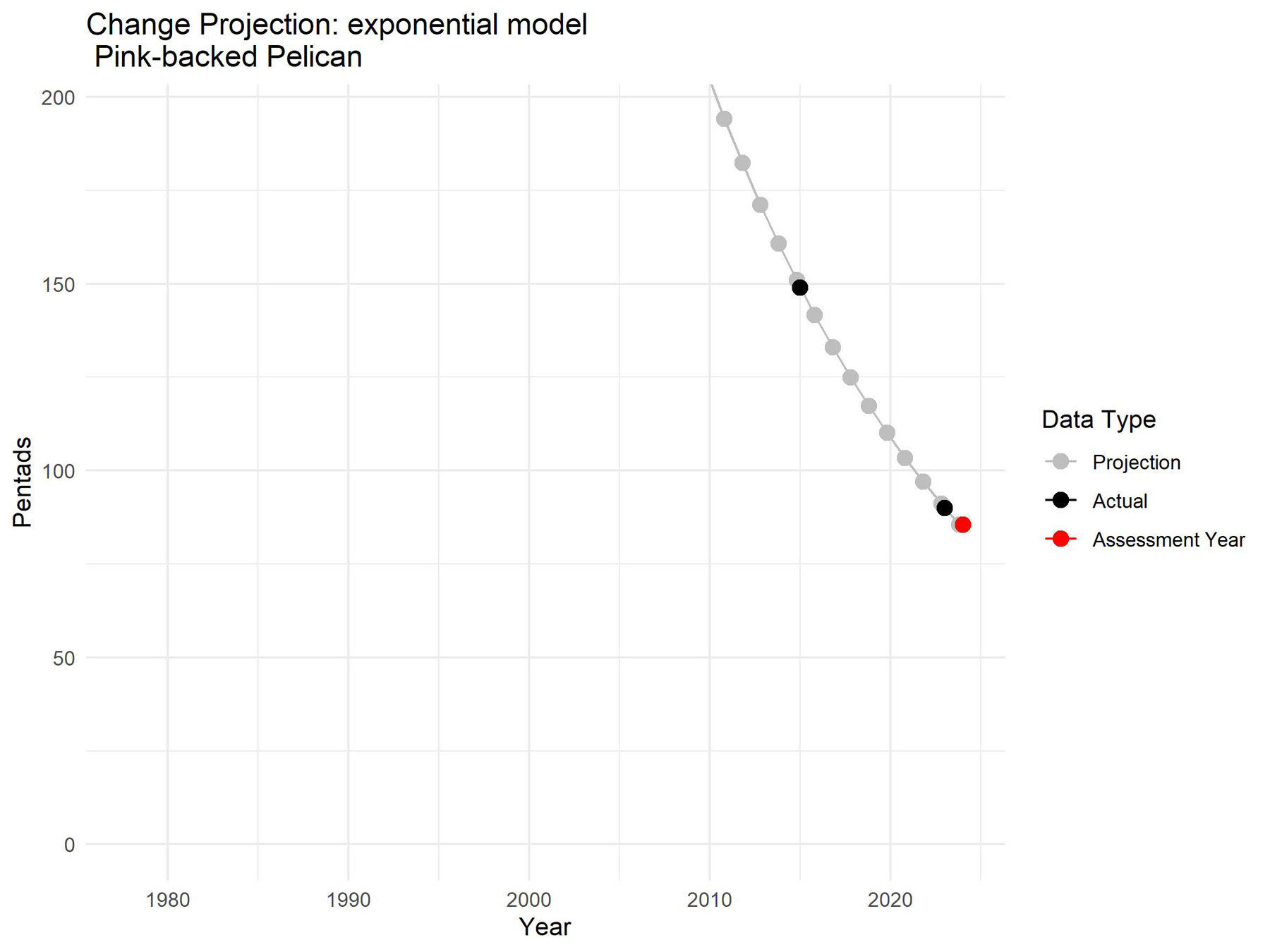
Figure 2: A visualisation of potential range change of Pink-backed Pelican since 2010, applicable to Category A, with pentads a surrogate for Area of Occupancy (AOO), using generation length and an exponential model of change.
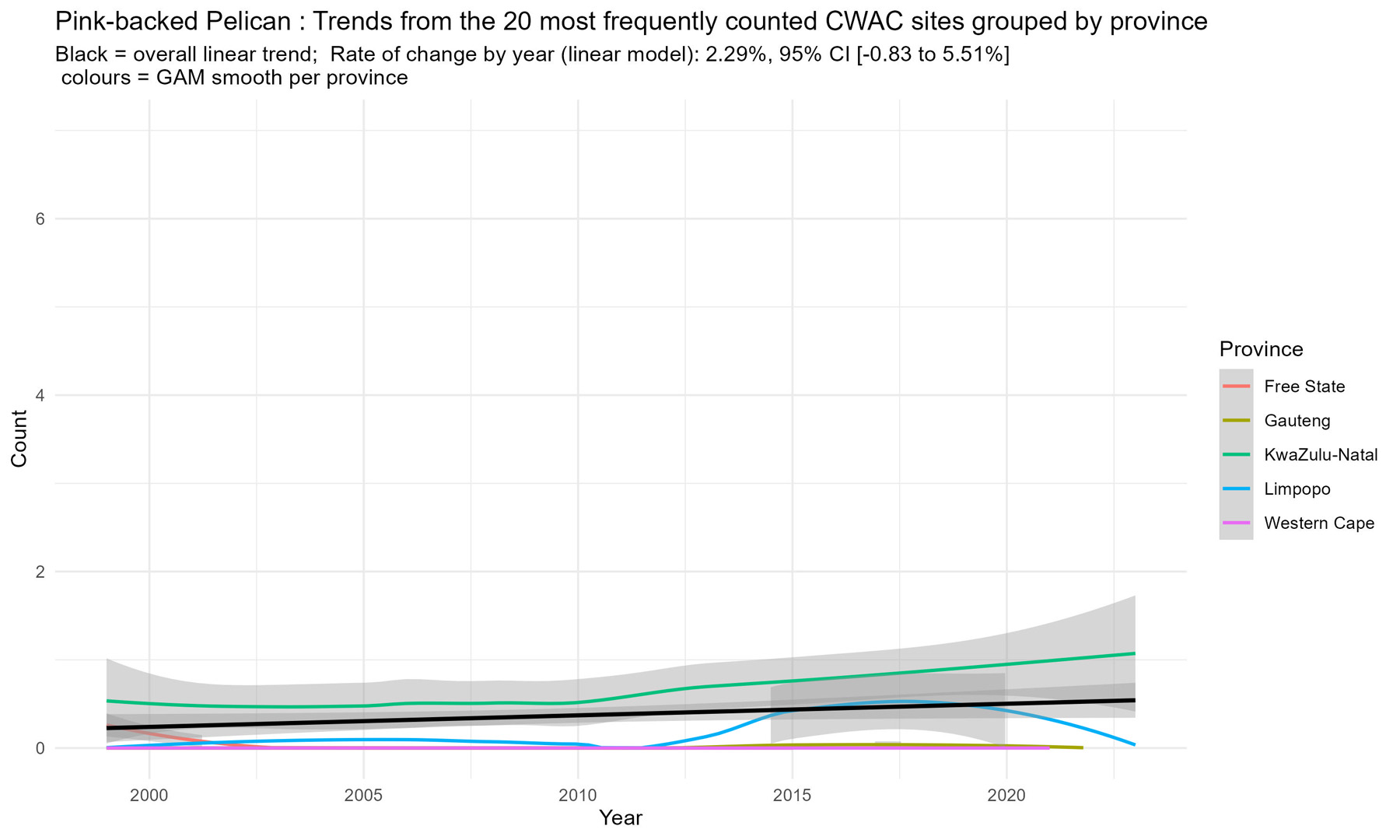
Figure 3: Trends from CWAC counts of Pink-backed Pelican from the 20 most frequently surveyed regions, showing individual variation and increasing trends at some sites.
Biology & Ecology
Taxonomy
The species is monotypic, with no taxonomic issues noted.
Identification
135–150 cm, 4.9–6 kg. The sexes are alike. The species is smaller and greyer than the Great White Pelican Pelecanus onocrotalus. Pink-backed Pelican have a dark spot in front of the eye which is lacking in the Great White Pelican. The crown is pale grey with a distinctive grey crest. The underparts are pale, often faintly washed pink or yellow. The mantle, back and rump are pale grey, with a pinkish tinge, especially during breeding. Flight feathers are grey, not black (cf. Great White Pelican), contrasting with paler underwing coverts. The bill is yellow with yellow-red nail, and the pouch a deep yellow. The eyes are red or brown. The legs and feet are greyish pink to yellow (Ryan 2005).
Distribution
The species has a wide Afrotropical range extending to Arabia (Elliot et al 2020). Two core populations are in southern Africa: the Caprivi/Okavango system and the coastal plain of southern Mozambique/northern KwaZulu-Natal (Williams and Borello 1997) (Figure 5). In the region, the breeding areas of Pink-backed Pelicans are restricted to protected areas, but foraging sites of the species are not all protected (Bowker and Downs 2008a).
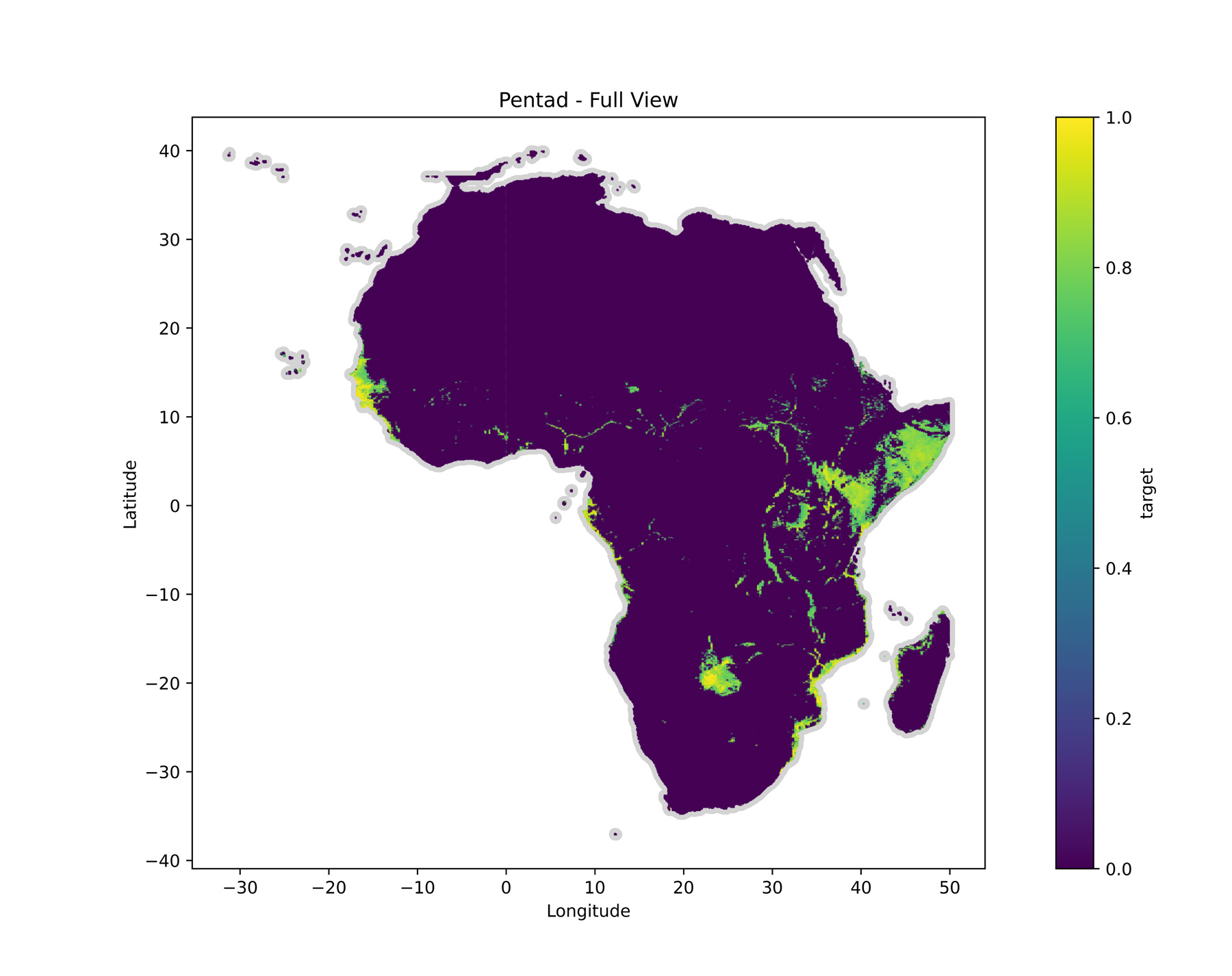
Figure 5: An Africa-wide probability distribution model of Pink-backed Pelican at the pentad scale, trained by data from ABAP, iNaturalist and eBird data using a Random Forest model. Map from Lee (2024).
Ecology
The species is a colonial breeder, nesting in trees near water. The onset of breeding is triggered by rains and flooding around nest trees. Pink-backed Pelicans are predominantly monogamous. The species forages in various wetlands, both fresh and saline. The species breeds in trees (Din and Eltringham 1974); trees used for breeding are often killed by guano deposits, necessitating colony relocation. The species shows strong site fidelity to key breeding and foraging areas (Bowker and Downs 2008b). Within the region breeding has been recorded at four sites, Nsumo Pan in the Mkhuze Game Reserve, Nyamithi Pan in the Ndumu Game Reserve, Lake St Lucia in the iSimangaliso Wetland Park and in the Durban Botanical Gardens. The latter is a very small breeding colony <10 breeding pairs. The species has not bred at Lake St Lucia for many years after the colony relocated to Nsumo Pan in the mid 80’s (Bowker and Downs 2008b).
Threats & Conservation
Threats
- Disturbance at breeding sites (there are only two key and one marginal breeding sites in the region) although the species is possibly less susceptible to human disturbance (Din and Eltringham 1974, Bowker and Downs 2008b).
- Changes to natural flooding regimes affecting breeding triggers (Bowker 2015).
- Potential loss of suitable breeding trees through elephant impact and guano effects (Din and Eltringham 1974, Bowker 2015).
- Bioaccumulation of toxins due to their piscivorous diet may impact reproductive success (Bowker 2015).
- Climate change impacts on wetland systems.
- Loss of habitat as suitable pans and flood plains are altered through drainage, cultivation and damming of rivers (Taylor 2000).
Conservation Measures Underway
The species occurs in 48 pentads within National Parks/Nature Reserves and six in other protected areas, versus 69 in unprotected areas, yielding a protected area ratio of 0.78 (Lee 2024). The Pink-backed Pelican is listed under the African Eurasian Waterbird Agreement (AEWA), an intergovernmental treaty dedicated to the conservation of migratory waterbirds and their habitats developed under the framework of the Convention on Migratory Species. The treaty which covers Africa, Europe, the Middle East, Central Asia, Greenland and the Canadian Archipelago places an obligation on signatory countries, of which South Africa is one, to conserve Migratory waterbirds and their habitats. The Southern African subspecies is listed in Column B Category 1 (Populations numbering between around 25 000 and around 100 000 individuals and which do not fulfil the conditions in respect of Column A) (AEWA 2022).
Conservation Measures Proposed
- Develop a monitoring protocol enabling annual, standardised and effective monitoring of the number of breeding pairs at breeding colonies.
- Investigate the possibility of establishing additional breeding sites through habitat management.
- Protect and manage existing breeding trees and investigate artificial nesting platform options.
- Maintain healthy aquatic ecosystems at key sites.
- Minimise disturbance at breeding colonies.
Research Priorities and Questions
- Update population estimates across all key sites.
- Investigate requirements for successful breeding site establishment.
- Assess the potential impact of elephants on nesting trees and develop management strategies and interventions, should they be required.
- Study if there are effects of accumulation of toxins on breeding success.
- Monitor seasonal movements between breeding and foraging sites.
- Investigate potential climate change impacts on breeding triggers and success.
Contributors & References
Assessor/s
David Ehlers Smith, Kevin Shaw
Reviewer/s
Meyrick Bowker
References
AEWA. 2022. Agreement on the Conservation of African-Eurasian Migratory Waterbirds (AEWA) – Agreement Text and Annexes. As amended at the 8th Session of the Meeting of the Parties to AEWA. UNEP/AEWA Secretariat. 26 – 30 September 2022, Budapest, Hungary.
BIRDIE. 2024. An online platform for African wetland and waterbird data. Available at: https://biodiversityadvisor.sanbi.org/contentmanagement/index?guid=42305260-12b0-4a92-912e-7d801d15fdac [Accessed on 12 September 2024].
BirdLife International. 2024. Pelecanus rufescens. The IUCN Red List of Threatened Species 2024: e.T22697595A265010010. [Accessed on 28 November 2024].
Bowker MB, Downs CT. 2008a. The status of habitat of great white and pink-backed pelicans in northeastern KwaZulu-Natal, South Africa: a review. African Zoology 43: 90–98.
Bowker MB, Downs CT. 2008b. Breeding incidence of the Great White Pelican Pelecanus onocrotalus and the Pink-backed Pelican P. rufescens in south-eastern Africa from 1933 to 2005. Ostrich 79: 23–35.
Bowker MB, Downs CT. 2010. Population estimates and conservation status of pelican species in the St. Lucia/Pongola River Floodplain Ramsar site in South Africa: a study in regional perspective. African Zoology 45: 230–243.
Bowker MB, 2015. Pink-backed Pelican Pelecanus rufescens. In: Taylor MR, Peacock F, Wanless RW (eds), The Eskom Red Data Book of Birds of South Africa, Lesotho and Swaziland. Johannesburg, South Africa: BirdLife South Africa. pp 245–247.
Din NA, Eltringham SK. 1974. Breeding of the Pink-backed Pelican Pelecanus rufescens in Ruwenzori National Park, Uganda. Ibis 116: 477−493.
del Hoyo J, Elliott A, Sargatal J. 1992. Handbook of the Birds of the World, Vol. 1: Ostrich to Ducks. Barcelona, Spain: Lynx Edicions.
Dodman T. 2002. Waterbird Population Estimates in Africa. Unpublished report to Wetlands International.
Elliott A, Christie DA, Jutglar F, Garcia E, Kirwan GM. 2020. Pink-backed Pelican (Pelecanus rufescens). In: del Hoyo J, Elliott A, Sargatal J, Christie DA, de Juana E (eds), Birds of the World version 1.0. Ithaca, NY, USA: Cornell Lab of Ornithology. Available: https://doi.org/10.2173/bow.pibpel1.01.
Lee ATK. 2024. Regional Red Data Book of the Birds of South Africa, Lesotho and Eswatini: SABAP2 synthesis and supporting information and graphics for Pink-backed Pelican. Unpublished report. Johannesburg: BirdLife South Africa.
Ryan PG. 2005. Pink-backed Pelican Pelecanus rufescens. In: Hockey PAR, Dean WRJ, Ryan PG (eds), Roberts Birds of Southern Africa (7th Edn). Cape Town: The Trustees of the John Voelcker Bird Book Fund.
Taylor RH. 2000. Pink-backed Pelican Pelecanus rufescens. In: Barnes KN (ed), The Eskom Red Data Book of Birds of South Africa, Lesotho and Swaziland. Johannesburg, South Africa: BirdLife South Africa. pp 62−63.
Wetlands International. 2024. Waterbirds Populations Portal https://wpp.wetlands.org/ [Accessed on 23rd October 2024].
Williams AJ, Borello WD. 1997. Pink-backed Pelican Pelecanus rufescens. In: Harrison JA, Allan DG, Underhill LG, Herremans M, Tree AJ, Parker V, Brown CJ (eds), The atlas of southern African birds. Vol1: Non-passerines. Johannesburg: BirdLife South Africa. pp 26– 27.
Citation
Ehlers Smith DA, Shaw K 2025. Pink-backed Pelican. In: Lee ATK, Rose S, Banda S, Bezeng SB, Maphalala MI, Maphisa DH, Smit-Robinson H (eds), The 2025 Red Data Book of Birds of South Africa, Lesotho and Eswatini. Johannesburg, South Africa: BirdLife South Africa. Available at: https://www.birdlife.org.za/red-list/pink-backed-pelican/
Our generous sponsors


