


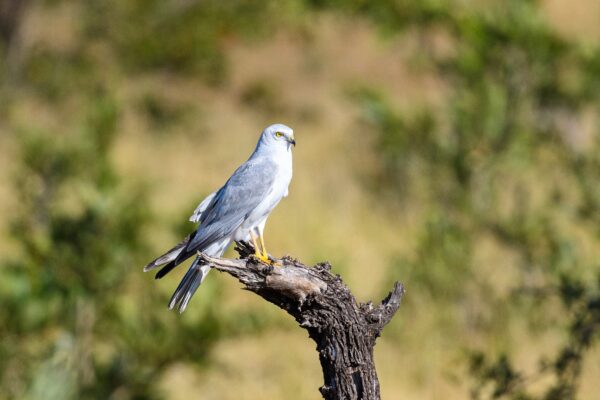
Pallid Harrier
Circus macrourus

Number Of Mature
Individuals (Regional)
<300

Regional
Population Trend
Decreasing
2025
Regional Category
NA
Search by species
CONTENTSOverview
Names
|
IOC English Name: |
Pallid Harrier |
|
SA & IOC Scientific Name: |
Circus macrourus |
|
BirdLife International Taxonomy (scientific name): |
Circus macrourus |
|
Order: |
ACCIPITRIFORMES |
|
Family: |
Accipitridae |
|
Species name author: |
Gmelin SG 1770 |
|
Afrikaans: |
Witborsvleivalk |
|
Sesotho (South Africa): |
mmankgodi-wa-dithota |
|
Sesotho (Lesotho): |
’mankholi-oa-lithota |
|
Siswati: |
|
|
Zulu: |
umamhlangenompunga |
Current Assessment Status
|
2025 Regional Category [Criteria] |
NA |
|
2024 Global Category [Criteria] |
NT [A2cde+3cde+4cde] (BirdLife International 2021) |
|
Population size (Regional) |
<300 |
|
Population size (Global) |
18 000 – 30 000 (BirdLife International 2021) |
|
Distribution size (EOO) (Regional) km2 |
491 925 (Lee 2025) |
|
Distribution size (EOO) (Global) km2 |
10 900 000 (BirdLife International 2021) |
|
Distribution size (AOO) (Regional) km2 |
72 376 (Lee 2025) |
|
Generation time |
5.68 years (BirdLife International 2021) |
|
Status change reason |
Error Correction |
|
Migrant (in the region) |
Yes |
|
Regional endemic |
No |
Historic Listing Information
|
2000 Regional Status |
NT [A1a] |
|
2015 Regional Status |
NT [A2cde+3cde+4cde] |
|
Status change reason (if applicable) |
No change |
|
2015 Population size (Regional) |
Unknown |
|
2015 Global Status |
NT [A2cde+3cde+4cde] |
Reason for Inclusion
Reason for Inclusion in the Assessment
The Pallid Harrier Circus macrourus was previously assessed regionally as Near Threatened [A2cde+3cde+4cde] (Taylor 2015) and the current global status is Near Threatened [A2cde+3cde+4cde] (BirdLife International 2021).
Category Justification
Category Justification
The Pallid Harrier is currently listed globally as Near Threatened and is listed in both the Convention on the Conservation of Migratory Species of Wild Animals (CMS) and the Raptors MOU, placing an obligation on South Africa as a signatory to both these treaties. Despite this, the regional range comprises less than 1% of the African overwintering range and probably supports less than 2% of the global population. Given that this is well below the 5% threshold for inclusion in a Regional Red List, Pallid Harrier was therefore assessed as ‘Not Applicable’ and is removed from the Regional Red List.
Population Justification
The only global population estimate for the Pallid Harrier (9000 – 15 000 breeding pairs) is that published in the Species Action Plan in 2003 (Galushin et al. 2003). This equated to 18 000 – 30 000 mature individuals (BirdLife International 2021). The broad-front migration strategy, difficulty in-field identification (especially the females), and rarity of the species makes it difficult to obtain accurate population estimates of the species within the region (Taylor 2015). The species was considered common in the 19th century in the Bushveld and Highveld regions of the Transvaal but is now considered a rare vagrant within this same area (Tarboton and Allen 1984). Simmons (2005) estimated the population visiting Southern Africa to be <500 individuals (<300 mature individuals). This value would be even less for the region. Confidence in both the global and regional population estimates are low although Pallid Harrier is considered rare.
Trend Justification
Globally, it is estimated that the population decline is 10–20%, but this is a precautionary trend as the partial nomadic nature and fluctuating numbers of the species complicates the assessments of trends (BirdLife International 2021). It is estimated that 30% of the population was lost in Europe between1970-1990 (Tucker et al. 1994), and the population continued to decline between 1990-2000 when overall trends exceeded 30% over three generations (BirdLife International 2004).
Tarboton and Allen (1984) suggest that these declines resulted in decreased numbers of the species in the Transvaal. Within in the region the species remains poorly known although data from the Southern African Bird Atlas Project (SABAP2) does support a declining trend (Lee 2025). The exact rate of decline remains speculative however, considering the nomadic nature of the species, the difficulty of identifying the species in the field and the fluctuating global numbers. South Africa very likely represents the edge of its migratory route and currently does not appear to be a primary migratory destination for this species (Tarboton and Allen 1984, Galushin et al. 2003, Terraube et al. 2012, Limiñana et al. 2015). Confidence in both the global and regional trends for Pallid Harrier are low.
Biology & Ecology
Taxonomy
Monotypic (Orta et al. 2020).
Identification
40–48 cm, 310–440 g. Males and females differ in plumage colouration. Both sexes have bright yellow eyes (immature birds have brown eyes), yellow legs and feet, grey bill, and yellow cere. The males are pale silvery grey in colour, with barred grey and white upper tail coverts. The underwing is white with a dark primary edge. Other than the black-brown primary feathers (P5-P9) which form a dark wedge in the wing tip, the upper wings are pale, silver-grey in colour. Females are rufous-brown in colour with a pale to white throat narrowly streaked with brown. The breast and belly are pale, rufous-brown, streaked brown to red-brown, with the breast being more heavily streaked. The undertail is off-white with 4–5 brown bars (Simmons 2005).
In the region, the species can be confused with the visually similar Montagu’s Harrier Circus pygargus. Male Montagu’s Harriers have a black wing bar, noticeably blacker in the wings, and the breast is streaked as opposed to the Pallid Harriers’ plain breast. The neck streaking of the female Montagu’s Harrier extends almost to the dark face patch (which is smaller than that of Pallid Harrier and is confined to the rear of the eye) and is not separated by the whitish collar (Simmons 2005).
Distribution
The breeding range of the Pallid Harrier extends from Finland, Ukraine, and Southwest Russia eastwards to the lower Balkhash region, northwest China, and possibly northern Mongolia. It may breed irregularly farther westwards, towards Sweden, Germany, and Netherlands, and has also bred in Turkey. The non-breeding range is mainly sub-Saharan Africa, but also migrates to the region extending from Pakistan, India, Maldives, and Sri Lanka eastwards to Myanmar (Orta et al 2020). In South Africa, the species is most frequently encountered in the northeastern parts of the interior and parts of coastal Eastern Cape.
Ecology
Habitat:
In the region the species inhabits grasslands and croplands associated with open pans or flood plains (Simmons 2005). Pallid Harriers do, however, hunt amongst trees in light woodland areas and may sporadically occur in much drier areas like the Kalahari (Steyn 1982).
Migration:
Most of the population migrates to the Afrotropics and the Indian subcontinent, leaving the breeding grounds in August/September (Orta et al. 2020) and arriving in South Africa from November (Simmons 1997). Numbers of Pallid Harriers reach a peak in December through to February, departing again between March and April for the breeding grounds (Simmons 1997). No individuals remain in South Africa during the winter months (Steyn 1982). The species migrates on a broad front concentrating only at migration route bottlenecks (Orta et al. 2020).
Breeding:
The Pallid Harrier is a non-breeding migratory species to the region. It’s breeding range stretches from Finland across Ukraine and southwestern Russia to the lower Balkhash region, northwest China and possibly northern Mongolia. They nest either solitary or in loose colonies of between 3-5 pairs. Nests are situated in dry meadows, weeds, swamps, or low scrub and consist of a pile of grass placed on the ground (Orta et al. 2020). Terraube et al. (2009) found that the breeding habitat chosen by the species in terms of vegetation structure, cover, and proximity to water was diverse and that the species was not averse to breeding in non-intensive agricultural areas.
Diet:
Pallid Harriers feed predominantly on insects (locusts, grasshoppers, and beetles) but also prey on small mammals, birds, and lizards (Steyn 1982). Prey is predominantly caught on the ground, but birds and insects are also taken in the air. Forages using flap-sail quartering flight about 1–5m above the vegetation (Simmons 2005). On the breeding grounds, the species is highly dependent on small rodents (Terraube et al. 2012).
Threats & Conservation
Threats
The predominant threat to Pallid Harriers on the breeding grounds is the loss and degradation of natural, semi-natural, and marginal humid grassland habitat due to conversion to arable farming, burning of vegetation, clearing of shrubs and tall “weeds” intensive grazing of wet pastures and drainage of wetlands. The intercontinental migratory divide and broad wintering range of the species (Terraube et al. 2012) subjects the species to a wide variety of threats on the non-breeding grounds. The principal threat is the loss of grasslands through burning, cutting, and overgrazing (Galushin et al. 2003). The same authors also indicate the use of harmful pesticides, rodenticides and other toxic chemicals are a problem in the non-breeding areas and cite examples from India. Espin et al. (2018) found overall low concentrations of contaminant levels in Pallid Harriers breeding in Kazakhstan. It is unclear how much of a threat this is to the species within the region. Illegal shooting and trapping, mostly along the migratory route are also a threat. Galushin et al. (2003) indicated that this threat has a low impact on the species, but other authors (e.g. van Maanen et al. 2001, Attar 2005, Terraube et al. 2012) indicate that this threat may be more severe than originally speculated.
It should be noted that the species is poorly studied, especially in the non-breeding areas. The threats identified within these areas and the magnitudes thereof were based on general conservation issues known to occur within the non-breeding ranges rather than evidence of direct impact on the species.
Conservation Measures Underway
Regionally there are no specific conservation measures currently in place for this species. Globally a species action plan was developed for the Pallid Harrier in 2002, and while the tenure of a species action plan is usually five years, many of the issues identified are still valid (Galushin et al. 2003). The species is listed under Category 1 (Globally threatened and Near Threatened species as defined according to the latest IUCN Red List and listed as such in the BirdLife International World Bird Database) in the Memorandum of Understanding (“MOU”) on the Conservation of Migratory Birds of Prey in Africa and Eurasia (Raptors MOU 2023). The Pallid Harrier is also currently listed under Appendix II of the Convention on the Conservation of Migratory Species of Wild Animals (CMS 2024), although in the Raptors MOU, a submission to the CMS Parties to include all Category 1 species into Appendix I of the CMS is one of the actions that were identified. South Africa is a signatory to both of these multilateral environmental agreements.
Conservation Measures Proposed
Review area management at roosts, most urgently in areas where agriculture is changing due to new irrigation and agricultural schemes, and pursue any necessary conservation action, including landowner engagement and Other Effective Area-based Conservation Measures.
Encourage full legal protection of important wintering sites for the species.
Research Priorities and Questions
Survey areas within the range of the species and determine if any key wintering areas occur within the region.
As males are easier to identify and there are significant differences in habitat preferences between the sexes (Buij et al 2012), there is a lack of information on the distribution and habitat requirements of female Pallid Harriers. In addition, most research on the wintering grounds has been conducted north of the equator (Buij et al. 2012, Terraube et al. 2012, Limiñana et al. 2015) and this research needs to be extended to more southerly wintering areas.
Conduct research into pesticide residues in corpses and the overall use of pesticides through private and industry-based activities within the species’ known wintering range.
Closely monitor known roosts and ensure sufficient and effective engagement with landowners and nearby communities to ensure adequate mitigation of human-induced threats.
All tracked birds caught in Kazakhstan have not migrated further south than the Equator (Terraube et al. 2012, Liminana et al. 2015). Birds in South Africa need to be tracked to understand where they breed and what migration routes they follow. This would also help evaluate the primary causes of mortality and assess the impacts of these threats.
Understand climate change impacts within the winter range of the species.
Contributors & References
Assessor/s
Kevin Shaw
Reviewer/s
Julien Terraube, John Kinghorn
References
Attar W. 2005. National report on hunting. Syrian Arab Republic. Building capacity for sustainable hunting of migratory birds in Mediterranean third countries. Life project.
BirdLife International. 2021. Circus macrourus. The IUCN Red List of Threatened Species 2021: e.T22695396A201209093. https://dx.doi.org/10.2305/IUCN.UK.2021-3.RLTS.T22695396A201209093.en. [Accessed on 27 December 2024].
Buij R, van der Goes D, de Jongh HH, Gagare S, Haccou P, Komdeur J, de Snoo G. 2012. Interspecific and intraspecific differences in habitat use and their conservation implications for Palaearctic harriers on Sahelian wintering grounds. Ibis 154: 96–110.
CMS 2024. Text and Appendices of the Convention on the Conservation of Migratory Species of Wild Animals. https://www.cms.int/en/convention-text. [Accessed on 01 January 2025].
Espín S, Terraube J, Arroyo B, Camarero PR, Mateo R, Limiñana R, Vázquez-Pumariño X, Pinilla A, García JT, Mougeot F. 2018. Blood concentrations of p, p′-DDE and PCBs in harriers breeding in Spain and Kazakhstan. Science of the Total Environment 624: 1287–97.
Galushin V, Clarke R, Davygora A. 2003. International Action Plan for the Pallid Harrier (Circus macrourus). Cambridge, UK: BirdLife International.
Lee ATK. 2025. Regional Red Data Book of the Birds of South Africa, Lesotho and Eswatini: SABAP2 synthesis and supporting information and graphics for Pallid Harrier. Unpublished report. Johannesburg: BirdLife South Africa.
Limiñana R, Arroyo B, Terraube, J, McGrady M, Mougeot F. 2015. Using satellite telemetry and environmental niche modelling to inform conservation targets for a long-distance migratory raptor in its wintering grounds. Oryx 49: 329–337.
Orta J, Christie DA, Kirwan GM. 2020. Pallid Harrier (Circus macrourus), version 1.0. In: del Hoyo J, Elliott A, Sargatal J, Christie DA, de Juana E (eds), Birds of the World version 1.0. Ithaca, NY, USA: Cornell Lab of Ornithology. Available at https://doi.org/10.2173/bow.palhar1.01.
Raptors MOU. 2023. Agreement text and Annexures of the Memorandum of Understanding on the Conservation of Migratory Birds of Prey in Africa and Eurasia. https://www.cms.int/raptors/en/page/agreement-text. [Accessed on 01 January 2025].
Simmons RE. 1997. Pallid Harrier Circus macrourus. In: Harrison. JA, Allan, DG, Underhill, LG, Herremans, M, Tree, AJ, Parker, V, Brown CJ (eds), The atlas of southern African birds. Vol1: Non-passerines. Johannesburg: BirdLife South Africa. p 240.
Simmons RE. 2005. Pallid Harrier Circus macrourus. In: Hockey PAR, Dean WRJ, Ryan PG (eds), Roberts – Birds of Southern Africa (7th Edn). The Trustees of the John Voelcker Bird Book Fund, Cape Town. pp 503–504.
Steyn P. 1982. Birds of prey of southern Africa. Claremont, Cape Town: David Philip.
Tarboton WR, Allan DG. 1984. The status and conservation of birds of prey in the Transvaal. Pretoria, South Africa: Transvaal Museum.
Taylor MR. 2015. Pallid Harrier Circus macrourus. In: Taylor MR, Peacock F, Wanless RW (eds), The Eskom Red Data Book of Birds of South Africa, Lesotho and Swaziland. Johannesburg, South Africa: BirdLife South Africa. pp 308–310.
Terraube J, Arroyo BE, Mougeot F, Madders M, Watson J, Bragin EA. 2009. Breeding biology of the pallid harrier Circus macrourus in north-central Kazakhstan: implications for the conservation of a Near Threatened species. Oryx 43: 104–112.
Terraube J, Mougeot F, Cornulier T, Verma A, Gavrilov A, Arroyo B. 2012. Broad wintering range and intercontinental migratory divide within a core population of the near threatened pallid harrier. Diversity and Distributions 18: 401–409.
Tucker G, Heath M, Tomialojc L, Grimmett R, Socha C. 1994. Birds in Eu- rope: their conservation status. Cambridge, United Kingdom: BirdLife International.
van Maanen E, Goradze I, Gavashelishvili A, Goradze R. 2001. Trapping and hunting of migratory raptors in western Georgia. Oryx 11: 77–92.
Citation
Shaw K 2025. Pallid Harrier. In: Lee ATK, Rose S, Banda S, Bezeng SB, Maphalala MI, Maphisa DH, Smit-Robinson H (eds), The 2025 Red Data Book of Birds of South Africa, Lesotho and Eswatini. Johannesburg, South Africa: BirdLife South Africa. Available at: https://www.birdlife.org.za/red-list/pallid-harrier/
Our generous sponsors


