


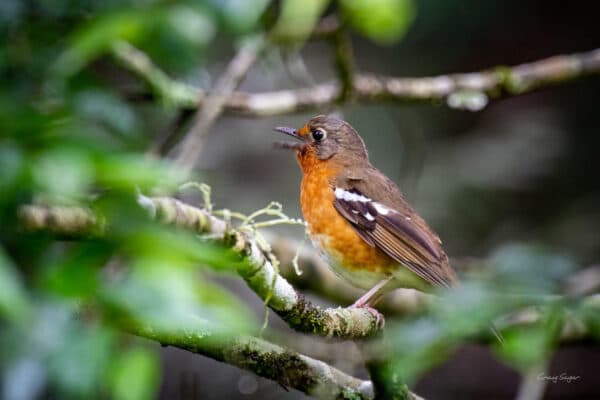
Orange Ground Thrush
Geokichla gurneyi

Number Of Mature
Individuals (Regional)
3 254 (1 025 – 11 377)

Regional
Population Trend
Decreasing
2025
Regional Category
Vulnerable
Search by species
CONTENTSOverview
Names
|
IOC English Name: |
Orange Ground Thrush |
|
SA & IOC Scientific Name: |
Geokichla gurneyi |
|
BirdLife International Taxonomy (scientific name): |
Geokichla gurneyi |
|
Order: |
PASSERIFORMES |
|
Family: |
Turdidae |
|
Species name author: |
Hartlaub 1864 |
|
Afrikaans: |
Oranjelyster |
|
Sesotho (South Africa): |
|
|
Sesotho (Lesotho): |
|
|
Siswati: |
|
|
Zulu: |
inswinswi |
Current Assessment Status
|
2025 Regional Category [Criteria] |
VU [B2b(ii,iii)] |
|
2024 Global Category [Criteria] |
LC (BirdLife International 2018) |
|
Population size (Regional) |
3254 (1025 – 11 377) (Ehlers Smith, unpubl data) |
|
Population size (Global) |
Unknown |
|
Distribution size (EOO) (Regional) km2 |
248 911 (Lee 2024) |
|
Distribution size (EOO) (Global) km2 |
5 400 000 (BirdLife International 2018) |
|
Distribution size (AOO) (Regional) km2 |
1179 (Ehlers Smith, unpubl data) |
|
Generation time |
3 years (BirdLife International 2018) |
|
Status change reason |
Improved knowledge |
|
Migrant (in the region) |
No |
|
Regional endemic |
No |
Historic Listing Information
|
2000 Regional Status |
NT [A2c; B1+2c] |
|
2015 Regional Status |
NT [A2c; B2b(ii,iii)] |
|
Status change reason (if applicable) |
No change |
|
2015 Population size (Regional) |
Unknown |
|
2015 Global Status |
LC |
Reason for Inclusion
Reason for Inclusion in the Assessment
The species was assessed as Near Threatened in the 2015 Regional Red Data Book Assessment (Taylor and Peacock 2015).
Category Justification
Category Justification
The Orange Ground Thrush Geokichla gurneyi is restricted to scattered fragments of Afrotropical and Afrotemperate forests in South Africa and Eswatini. Within the region the species is suspected to have undergone a population decline which, together with an Area of Occupancy (AOO) <2000 km2, means that it meets the criteria for regionally Vulnerable. The AOO within its fragmented distribution is estimated to be 1179 km2 using BirdLasser point location data and Maxent modelling (Ehlers Smith, unpubl data), with ongoing degradation and habitat loss (Leaver et al. 2019). Alternative data analysis suggests an AOO of 6628 km2 from Southern African Bird Atlas Project 2 (SABAP2) pentad data (Lee 2024), but preference is given to the analysis of the AOO at higher resolution and accuracy. Thus, the species reaches the criteria of Vulnerable based on B2b(ii,iii). Additionally, the species is expected to experience a contraction in 99% of its core habitat patches, with variable severity, under climate change scenarios to 2050 (Colyn et al. 2020). The population estimate is <10 000, but the clauses to invoke Criterion C do not have enough supporting information.
Population Justification
The global population size is unknown (BirdLife International 2018). The regional population is estimated to be 3254 (1025 – 11 377) (Ehlers Smith, unpubl data). This is based on a novel method of deriving population density from point count surveys via a bounded count method, extrapolated to the AOO (Lee et al. in review). However, additional clauses lack data to support invoking Criterion C. Camera-trap survey data indicate the species has an occupancy rate of 51% in forest patches in which it occurs (Gumede et al. 2020).
Trend Justification
The global population is thought to be declining (BirdLife International 2018). The SABAP2 trend analysis indicates a significant decline in the probability of reporting, but with low confidence (Lee 2024). However, the predicted range change suggests a 10.60% increase over 10 years or three generations (Table 1), highlighting the low confidence in trend reporting. The modelled population estimate does not have a previous baseline estimate, which makes determining the regional trend impossible.
Table 1: Prediction model of the number of pentads Orange Ground Thrush could occur in for the period up to 2015, and then until the end of 2023.
|
Information |
|
|
Pentads 2015 |
85 |
|
Pentads 2023 |
93 |
|
Annual rate of change |
1.011 |
|
Percent change (10 years or three generations) |
10.60% |
|
Category (A2) |
LC |
Biology & Ecology
Taxonomy
Two races are recognised: gurneyi occurs in South Africa’s Eastern Cape and KwaZulu-Natal Provinces, while disruptans extends from Mpumalanga and Limpopo north into Zimbabwe and Mozambique. The species was previously placed in Zoothera (del Hoyo et al. 2016).
Identification
21–23 cm, 64 g. A colourful but surprisingly cryptic forest thrush. Sexes alike, but the female is slightly larger. The crown, mantle, scapulars, flight feathers and tail are olive-brown. Black greater and median wing coverts tipped white, forming two conspicuous white wing bars. The underparts and lores are orange. Belly and vent white. Outer rectrices have narrow white tips when fresh. Bill black. The eyes are brown, surrounded by a striking white ring. Legs and feet flesh coloured. Juvenile as adult, but spotted buff above, and mottled below (Oatley 2005).
Distribution
The Orange Ground Thrush has a wide but highly fragmented Afrotropical distribution extending from the Democratic Republic of the Congo to South Africa. An isolated population occurs in the highlands of Angola (Dean et al. 2019). Within the region, it is found in Afromontane forests from the Soutpansberg in Limpopo Province, through KwaZulu-Natal and as far south as the Amatola Mountains, Eastern Cape. In Eswatini it is known only from Mgwayiza Forest in Malolotja Nature Reserve (Boycott and Monadjem 1998). The species is largely sedentary, with local seasonal movements possibly dictated by soil moisture and related prey availability (Earlé and Oatley 1983). The bird is suspected to undertake altitudinal migrations (Quickelberge 1989), although Oatley (2005) makes mention that these movements may be ascribed to juvenile dispersal or drought conditions.

Figure 1: The predicted range for the 2016-2023 period for Orange Ground Thrush based on BirdLasser, eBird and iNaturalist data at a 2×2 km grid scale (from Lee 2024).
Ecology
The species is a territorial, monogamous, solitary breeder (Earlé and Oatley 1983) with territories in optimal habitat in the order of 1 ha. Egg-laying peaks in October-November (Earlé and Oatley 1983). The Orange Ground Thrush is a terrestrial forager (Earlé and Oatley 1983), focusing on invertebrates, and leaf-litter arthropods (Oatley 2005). The species is found between 500–2500 m asl.
Threats & Conservation
Threats
Habitat loss is the primary threat to this species, particularly as it is highly localised and naturally restricted to a geographically limited vegetation type. Trampling and grazing by livestock entering forests is also considered to be a threat (Allan 2000). Through their dung, hides and hooves, live- stock animals also introduce weeds and pioneer plants along forest clearings and pathways; it is thought that the establishment of a dense, weedy understorey layer will be detrimental to the Orange Ground Thrush and other terrestrial forest insectivores. Additionally, animals may create additional paths and serve to open up the forest, which allows more sunlight to penetrate to the forest floor and exacerbates the establishment of a dense understorey devoid of leaf-litter. Homogenisation of forest structures and edge effects are detrimental to the occupancy rates of Orange Ground Thrushes in fragmented forest patches (Gumede et al. 2020). Additional threats to indigenous forests include degradation through clearing for cultivation, harvesting of forest plants for traditional medicine purposes, and removal of wood for fuel or building materials. Indigenous forest corridors may be damaged during harvesting of adjacent alien commercial plantations (Allan 2000, Leaver et al. 2019). Eswatini’s Mgwayiza Forest, despite being located within a protected area, is facing threats from mining (Monadjem et al. 2003). Habitat destruction is also noted as a cause of decline in the global assessment (BirdLife International 2018) and regionally (Leaver et al. 2019).
Conservation Measures Underway
The species is protected in 24 pentads in which it occurs, and unprotected in 47 pentads, giving a protection ratio of 0.51 (Lee 2024). The species is protected under the Swaziland Game Act, but otherwise, no species-specific conservation measures are currently underway.
Conservation Measures Proposed
The ongoing protection of fragmented patches of Afromontane Forest distributed along the south-eastern and Eastern Escarpment is essential for the protection of this species. Many of the forests where it occurs are nominally protected, and a full review of its conservation status is recommended.
Research Priorities and Questions
- Conduct surveys of all forest patches that supports this species to obtain accurate estimates of population size and occurrence densities. Territory mapping based on singing males in accessible parts of forests may be a practical way of estimating population sizes.
- In particular, the isolated forests in the Eastern Cape Province should be surveyed.
- Further research into the population status to aid in resolving the discrepancy between different trend indicators (e.g., SABAP2 reporting probability vs. predicted range change).
Contributors & References
Assessor/s
David Ehlers Smith
Reviewer/s
Mark Brown
References
Allan DG. 2000. Orange Ground Thrush Zoothera gurneyi. In: Barnes KN (ed), The Eskom Red Data Book of Birds of South Africa, Lesotho and Swaziland. Johannesburg, South Africa: BirdLife South Africa. pp 147.
BirdLife International. 2018. Geokichla gurneyi. The IUCN Red List of Threatened Species 2018: e.T22708426A131947992. https://dx.doi.org/10.2305/IUCN.UK.2018-2.RLTS.T22708426A131947992.en. [Accessed on 14 August 2025].
Boycott RC, Monadjem A. 1998. First record of Orange Ground Thrush in Swaziland. Africa – Birds and Birding, 3: 16
Colyn RB, Ehlers Smith DA, Ehlers Smith YC, Smit-Robinson H, Downs CT. 2020. Predicted distributions of avian specialists: a framework for conservation of endangered forests under future climates. Diversity and Distributions 26: 652–667 .
Dean WRJ, Melo M, Mills MSL. 2019. The Avifauna of Angola: Richness, Endemism and Rarity. In: Huntley B, Russo V, Lages F, Ferrand N (eds), Biodiversity of Angola. Cham: Springer. https://doi.org/10.1007/978-3-030-03083-4_14
del Hoyo J, Collar NJ, Christie DA, Elliott A, Fishpool LDC, Boesman P, Kirwan GM. 2016. HBW and BirdLife International Illustrated Checklist of the Birds of the World. Volume 2: Passerines. Barcelona, Spain and Cambridge, UK: Lynx Edicions and BirdLife International.
Earlé RA, Oatley TB. 1983. Populations, ecology and breeding of the Orange Thrush at two sites in eastern South Africa. Ostrich 54: 205-212.
Gumede ST, Ehlers Smith DA, Ehlers Smith YC, Ngcobo SP, Sosibo M, Maseko MST, Downs CT. 2020. Occupancy of two forest specialist birds in the Southern Mistbelt Forests of KwaZulu-Natal and Eastern Cape, South Africa. Bird Conservation International. DOI: 10.1017/S0959270920000544
Leaver J, Mulvaney J, Ehlers Smith DA, Ehlers Smith YC, Cherry M. 2019. Response of bird functional diversity to forest product harvesting in the Eastern Cape, South Africa. Forest Ecology and Management 445: 82–95.
Lee ATK. 2024. Regional Red Data Book of the Birds of South Africa, Lesotho and Eswatini: SABAP2 synthesis and supporting information and graphics for Orange Ground Thrush. Unpublished report. Johannesburg: BirdLife South Africa.
Lee ATK, Ehlers Smith DA, Leaver J, Bitani N, Mulvaney J, Downs CT. In review. Comparative Density Estimates of South Africa’s Forest Birds: Integrating Distance Sampling, Fixed Radius Counts, and Trait-Based Predictive Models.
Monadjem A, Boycott R C, Parker V, Culverwell J. 2003. Threatened vertebrates of Swaziland: Swaziland red data book: fishes, amphibians, reptiles, birds and mammals. Ministry of Tourism, Environment and Communications.
Oatley TB 2005. Orange Ground-Thrush Zoothera gurneyi. In: Hockey PAR, Dean WRJ, Ryan PG (eds), Roberts Birds of South Africa 7th Edn. The Trustees of the John Voelcker Bird Book Fund. pp 901–902.
Taylor MR, Peacock F. 2015. Orange Ground Thrush. In: Taylor MR, Peacock F, Wanless RM (eds), The Eskom Red Data Book of Birds of South Africa, Lesotho and Swaziland. Johannesburg, South Africa: BirdLife South Africa. pp 393–394.
Quickelberge CD. 1989. Birds of the Transkei. Durban: Durban Natural History Museum.
Urban, EK, Fry CH, Keith S. 1997. The birds of Africa Vol. V. London: Academic Press.
Citation
Ehlers Smith DA 2025. Orange Ground Thrush. In: Lee ATK, Rose S, Banda S, Bezeng SB, Maphalala MI, Maphisa DH, Smit-Robinson H (eds), The 2025 Red Data Book of Birds of South Africa, Lesotho and Eswatini. Johannesburg, South Africa: BirdLife South Africa. Available at: https://www.birdlife.org.za/red-list/orange-ground-thrush/
Our generous sponsors


