


Melodious Lark
Mirafra cheniana

Number Of Mature
Individuals (Regional)
91 766 – 207 436

Regional
Population Trend
Decreasing
2025
Regional Category
Near Threatened
Search by species
CONTENTSOverview
Names
|
IOC English Name: |
Melodious Lark |
|
SA & IOC Scientific Name: |
Mirafra cheniana |
|
BirdLife International Taxonomy (scientific name): |
Mirafra cheniana |
|
Order: |
PASSERIFORMES |
|
Family: |
Alaudidae |
|
Species name author: |
Smith A 1843 |
|
Afrikaans: |
Spotlewerik |
|
Sesotho (South Africa): |
nketsisane-otoputswa |
|
Sesotho (Lesotho): |
nketsisane-otoputsoa |
|
Siswati: |
|
|
Zulu: |
unontilomzwilili |
Current Assessment Status
|
2025 Regional Category [Criteria] |
NT [A2b+3b+4b] |
|
2024 Global Category [Criteria] |
LC (BirdLife International 2017) |
|
Population size (Regional) |
91 766 – 207 436 |
|
Population size (Global) |
Unknown |
|
Distribution size (EOO) (Regional) km2 |
549 256 (mean) (Lee 2024) |
|
Distribution size (EOO) (Global) km2 |
581 000 (BirdLife International 2017) |
|
Distribution size (AOO) (Regional) km2 |
77 114 (Ehlers Smith, unpubl data) |
|
Generation time |
3.8 years |
|
Status change reason |
Genuine change in status |
|
Migrant (in the region) |
No |
|
Regional endemic |
Yes |
Historic Listing Information
|
2000 Regional Status |
NT |
|
2015 Regional Status |
LC |
|
Status change reason (if applicable) |
Improved knowledge |
|
2015 Global Status (Regional) |
LC |
|
2015 Population size |
Unknown |
Reason for Inclusion
Reason for Inclusion in the Assessment
The Melodious Lark Mirafra cheniana was identified for assessment due to a significant decline in the probability of reporting the species based on the Southern African Bird Atlas Project (SABAP2) trend analysis (Lee 2024) and was previously listed as Near Threatened (BirdLife International 2016, Barnes 2000). Melodious Lark was not assessed as a species of conservation concern previously in the regional assessment as declines did not reach thresholds over three generations, but Taylor (2015) did note that ongoing monitoring is recommended given the near-endemic status and grassland habitat requirements.
Category Justification
Category Justification
The Melodious Lark is assessed as Near Threatened under criteria A2b, A3b, and A4b due to suspected population declines which are likely to continue into the future. Data from SABAP2 trend analysis indicates a significant reduction in the probability of reporting the species, suggesting a potential population decline or range contraction. A comparison between SABAP1 and SABAP2 also shows a decrease in reporting rates and range, further supporting this trend.
While some conflicting data exist, such as a modelled increase in range, these results are considered unreliable due to sparse distribution. As an endemic species, regional threats are considered reflective of global trends. The population estimate remains unknown, but is estimated as >10 000.
The precautionary principle is applied due to uncertainty in data, maintaining the Near Threatened status to ensure conservation measures. The species’ Area of Occupancy (AOO) (77 114 km²) does not meet the thresholds for the Vulnerable category, and ongoing threats, such as habitat degradation, persist. The species was listed as Near Threatened in Global Assessments preceding 2017 (BirdLife International 2004, 2008, 2012, 2016).
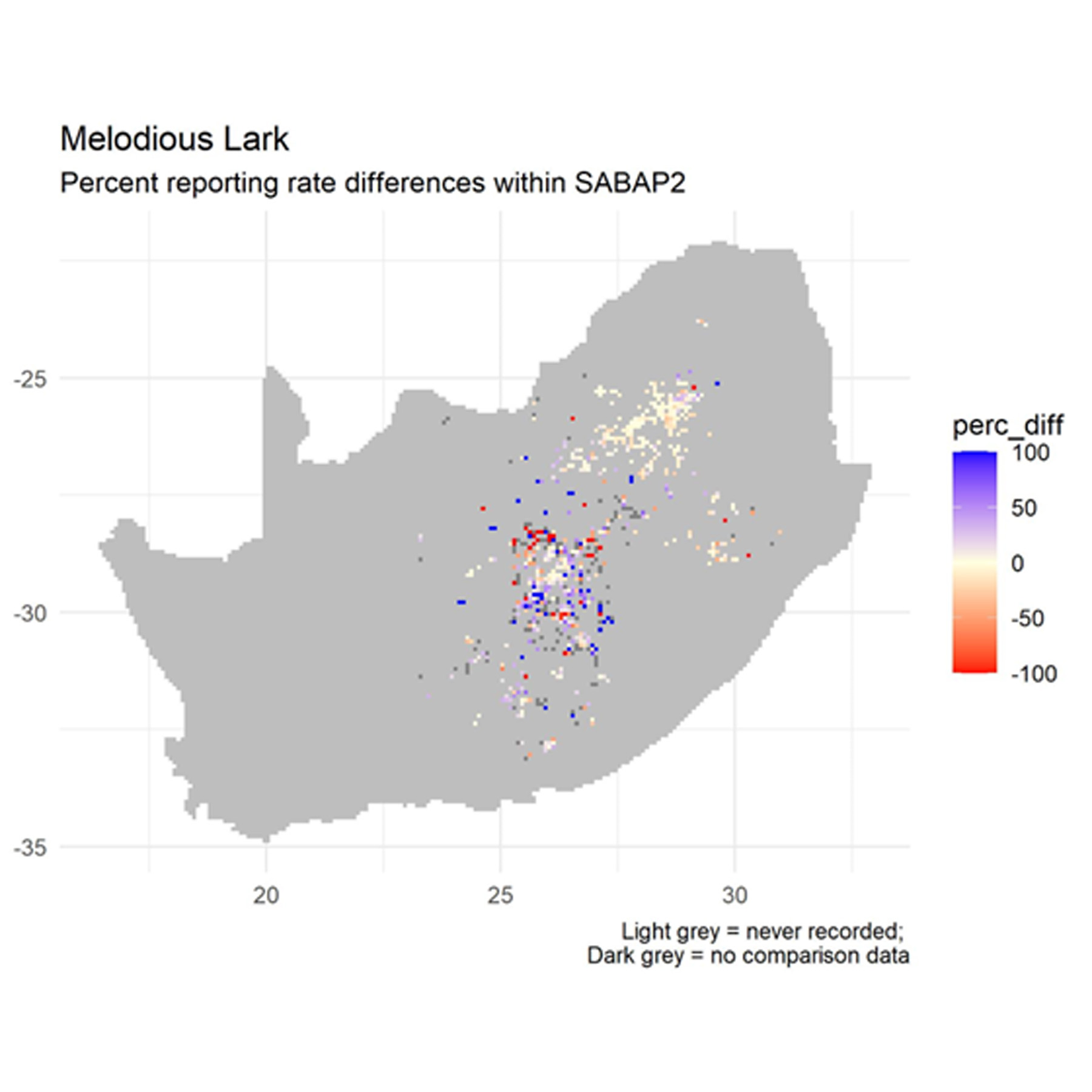
Figure 1: Pentad level change between SABAP2 periods 2007-2015 and 2016-2023, being roughly comparable in terms of time and effort. Blue indicates higher reporting rate, red indicates lower, while cream is no change. Grey is not recorded, which could be either the species was not recorded or there is no data (from Lee 2024).
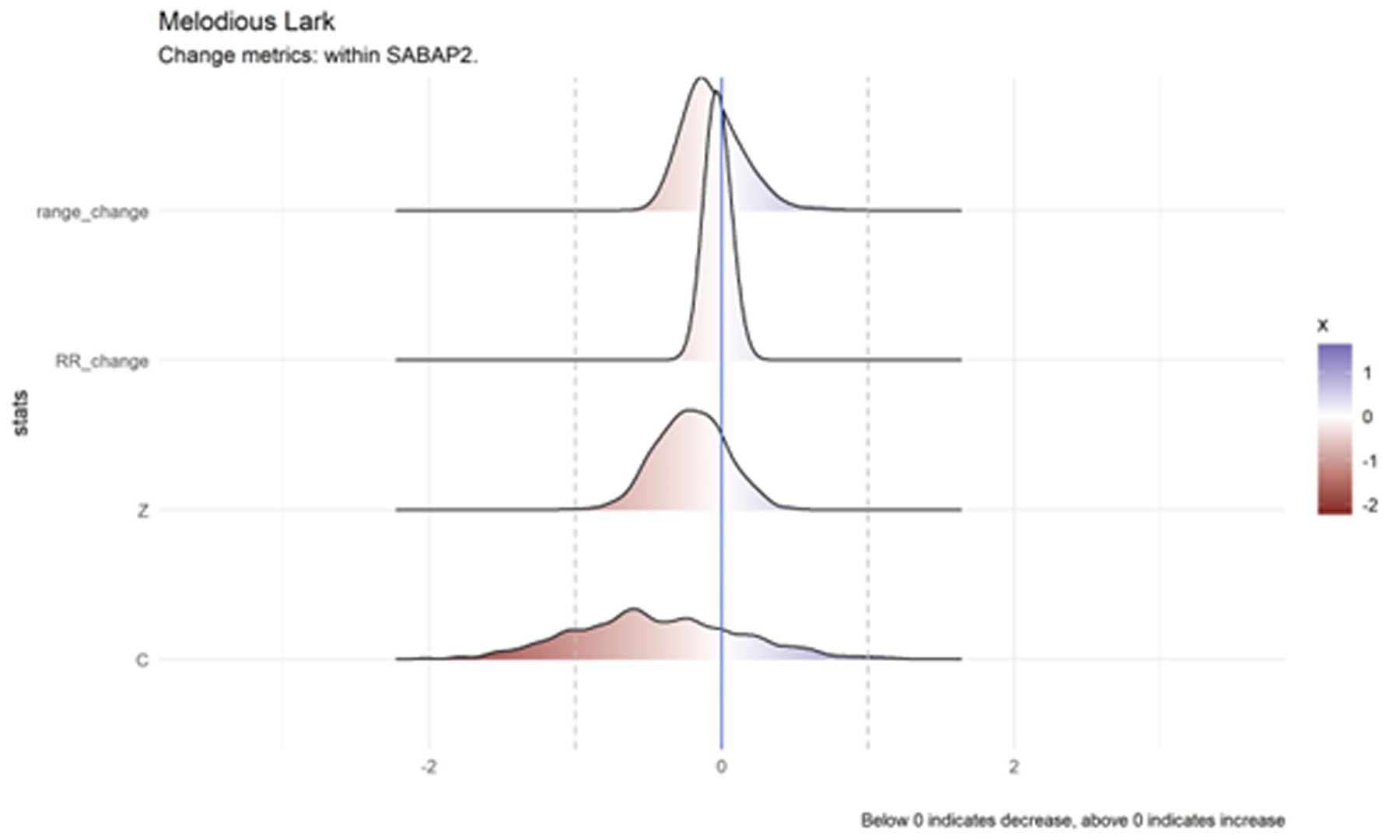
Figure 2: Bootstrap results of ‘naive’ change metrics Reporting rate and range change are bounded by -1 and 1, and if they are strongly centred on 0, it indicates little change. The Underhill Z score is confidence in change one way or another as a result of the number of contributing lists: if there are more lists for a pentad or region, these scores get higher – they don’t indicate magnitude of change. The centred C score used here is a potential magnitude of population change. Z and C can span beyond 1, and if they do so it suggests significant change in reporting rate. While this may represent reporting rate and associated abundance change, it may also be the result of changing observer patterns. Taken from Lee (2024).
Population Justification
The regional and global population sizes of the Melodious Lark are unknown. No specific data on home range, territory size, or population density were found in the literature to infer a population estimate. As an interim population estimate, we use population estimates for two other southern African larks to conservatively estimate a population estimate: Karoo Long-billed Lark Certhilauda subcoronata and Eastern Clapper Lark Corypha fasciolata occur at densities of 1.19 and 2.69 individuals/km2 respectively (Lee and Wright 2024). Multiplying these by the AOO of 77 114 provides a range of 91 766 – 207 436. There is low confidence in this, which serves as placeholder value until bespoke surveys are undertaken. However, taken together, it is likely the population >10 000 threshold to invoke Criterion C based on population size and decline.
Trend Justification
The SABAP2 trend analysis by Lee (2024) indicates a significantly lower probability of reporting the Melodious Lark, with high confidence in this trend. Changes between SABAP1 and SABAP2 also suggest a decline in the species’ range and reporting rate (Lee 2024). However, these do not appear to reach the 30% over 10 years or three generations required for Vulnerable. Confidence in the trend is medium. The global assessment trends suggest ongoing decline.
However, there are some conflicting modelled results. The percentage of predicted range change analysis suggests a 46.50% increase in the number of pentads that could be occupied by the species over 10 years or three generations, which would classify the species as Least Concern under Criterion A2 (Lee 2024). Additionally, the early vs late SABAP2 modelling results show an increase in the probability of recording the species in some areas, particularly in the central and eastern parts of its range. This analysis may be unreliable due to the sparse distribution.
Biology & Ecology
Taxonomy
The taxonomy of the Melodious Lark follows the IOC World Bird List version 14.1 (Gill et al. 2024), for which no subspecies are described.
Identification
12 cm, c. 20 g. The Melodious Lark has a distinct pale supercilium that contrasts with its brown ear coverts, creating a striking facial pattern. The wings feature a rufous panel formed by the rufous edges of the flight feathers. The bill is horn-coloured and relatively slender. The Melodious Lark can be distinguished from similar species such as the Monotonous Lark M. passerina, which is larger and has a less contrasting supercilium, and the Pink-billed Lark Spizocorys conirostris, which possesses a stouter, pink bill. One of the most notable features of the Melodious Lark is its impressive vocal abilities. During its song flight, the bird produces a protracted series of trills and whistles, which are repeated 2–4 times and interspersed with mimicry of over 70 other bird species (Dean 2005).
Distribution
The Melodious Lark is found primarily in South Africa, with scattered, small populations also occurring in Zimbabwe and Botswana. Within South Africa, its range is concentrated in the northern regions of the Eastern Cape and Free State Provinces. However, the species’ distribution is fragmented and patchy, with populations also found in various localities across the North West Province, Gauteng, and KwaZulu-Natal (BirdLife International 2017).
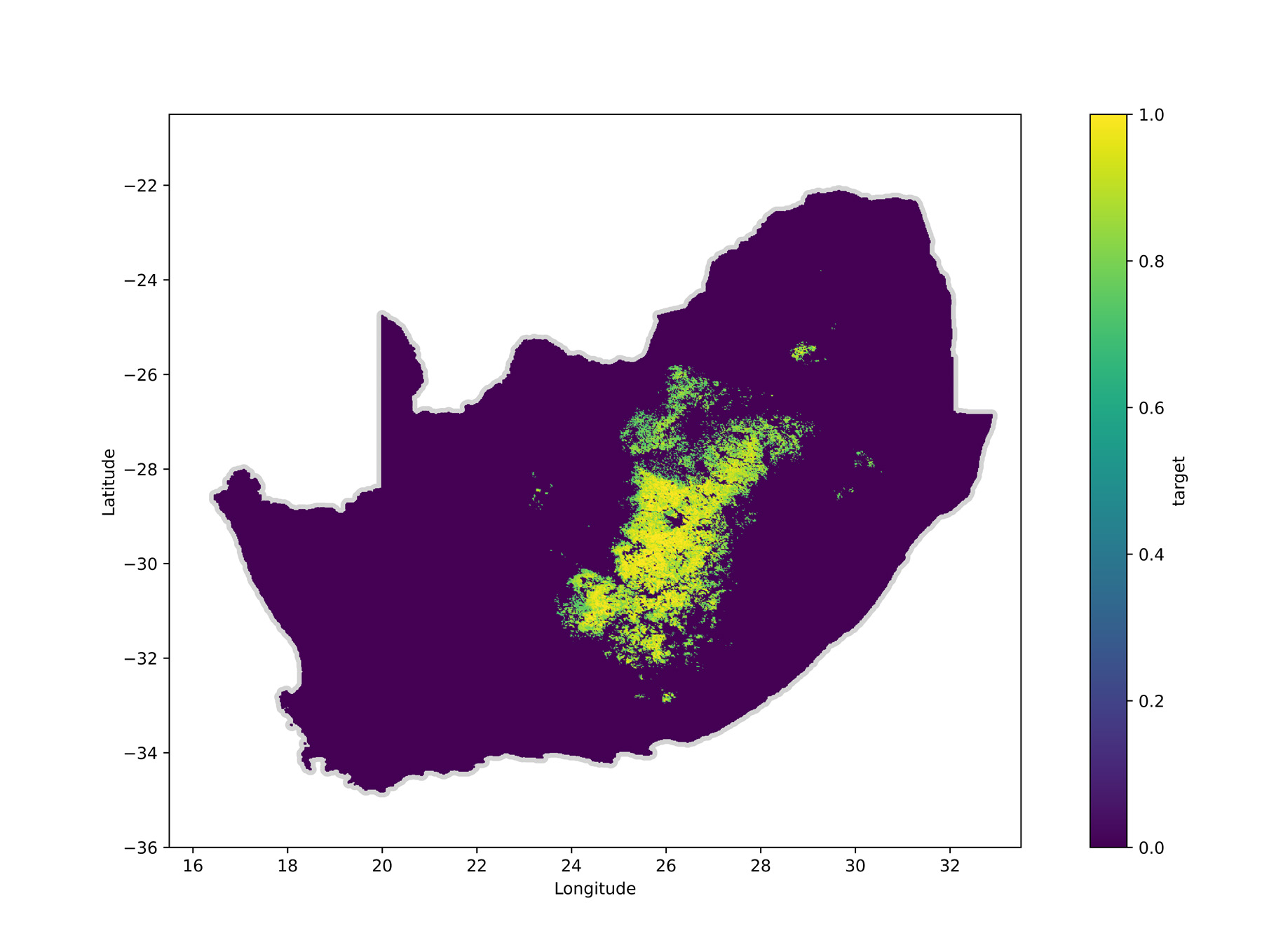
Figure 3: Probability distribution map, 2×2 km scale produced from BirdLasser location data at 2×2 km grid scale, using iNaturalist and eBird as absence data only. This represents the predicted range for the 2016-2023 period.
Ecology
The preferred habitat of the Melodious Lark consists of grassland slopes with open spaces between tussocks. The species favours areas where the grass height is shorter than 50 cm and tends to avoid wetter lowland regions (del Hoyo et al. 2004). Foraging occurs on the ground, with the lark primarily consuming grass seeds and occasionally insects. The breeding season in South Africa spans from September-March, with a peak in activity from November-January. In Zimbabwe, breeding takes place between January and March. The Melodious Lark is likely monogamous and territorial. Nests are constructed as domed structures with a side entrance, using coarse grasses for the outer layer and finer grass leaves for lining. Clutch size ranges from 2–4 eggs. While generally resident, the species may exhibit seasonal fluctuations and local movements in response to dry-season fires (del Hoyo et al. 2004).
Threats & Conservation
Threats
The Melodious Lark appears to be sensitive to overgrazing and has disappeared from heavily grazed areas in the Northern Cape and KwaZulu-Natal. Crop farming and industrialisation have also transformed a large proportion of its favoured grassland habitat. Land-use changes in the next 20 years may severely impact this species. Some habitat in Zimbabwe has been lost to bush encroachment (del Hoyo et al. 2004). The species may also be threatened by climate change, as its preferred grassland habitat requires a specific rainfall regime (del Hoyo et al. 2004).
Conservation Measures Underway
No species-specific conservation measures are in place for Melodious Lark. Only 87 of the pentads within which it is recorded are protected, while 376 are not: better representation in protected networks is required through expanding biodiversity stewardship initiatives (Lee 2024).
Conservation Measures Proposed
- Encourage grassland management practices that favour the species, both within and outside protected areas.
- Identify and protect key grassland habitats for the Melodious Lark, focusing on areas currently not under formal protection.
- Raise awareness among landowners and communities about the importance of grassland conservation for the species and promote sustainable land-use practices.
- Collaborate with conservation authorities to expand the protected area network to include more of the species’ range and key habitats.
Research Priorities and Questions
- Conduct surveys to obtain a total regional population estimate for the Melodious Lark.
- Monitor population trends through regular surveys and assess the rates of habitat loss and degradation, both within and outside protected areas.
- Study the species’ habitat requirements, breeding biology, and ecological interactions to better inform conservation efforts.
- Investigate the potential impacts of climate change on the Melodious Lark and its grassland habitat.
- Evaluate the effectiveness of current protected areas in safeguarding the species and identify priority areas for conservation action.
Contributors & References
Assessor/s
David Ehlers Smith
Reviewer/s
Sanjo Rose
References
Barnes KN. 2000. Melodious Lark Mirafra cheniana. In: Barnes KN (ed), The Eskom Red Data Book of Birds of South Africa, Lesotho and Swaziland. Johannesburg, South Africa: BirdLife South Africa. pp 146.
BirdLife International. 2004. Mirafra cheniana. The IUCN Red List of Threatened Species 2004: e.T22717008A30940166. [Accessed on 07 April 2025].
BirdLife International. 2008. Mirafra cheniana. The IUCN Red List of Threatened Species 2008: e.T22717008A30939650. [Accessed on 07 April 2025].
BirdLife International. 2012. Mirafra cheniana. The IUCN Red List of Threatened Species 2012: e.T22717008A38684741. https://dx.doi.org/10.2305/IUCN.UK.2012-1.RLTS.T22717008A38684741.en. [Accessed on 07 April 2025].
BirdLife International. 2016. Mirafra cheniana. The IUCN Red List of Threatened Species 2016: e.T22717008A94517783. https://dx.doi.org/10.2305/IUCN.UK.2016-3.RLTS.T22717008A94517783.en. [Accessed on 07 April 2025].
BirdLife International. 2017. Mirafra cheniana. The IUCN Red List of Threatened Species 2017: e.T22717008A118389631. https://dx.doi.org/10.2305/IUCN.UK.2017-3.RLTS.T22717008A118389631.en. [Accessed on 19 June 2024].
Dean WRJ. 2005. Melodious Lark. In: Hockey PAR, Dean WRJ, Ryan PG (eds), Roberts birds of southern Africa (7th Edn). Cape Town: Trustees of the John Voelcker Bird Book Fund. pp 861–862.
del Hoyo J, Elliott A, Christie D. 2004. Handbook of the Birds of the World, Vol. 9: Cotingas to Pipits and Wagtails. Barcelona, Spain: Lynx Edicions.
Ehlers Smith DA. Unpubl data. Area of Occupancy for the Melodious Lark based on species distribution modelling, altitudinal limits, and grassland habitat availability.
Gill F, Donsker D, Rasmussen P (eds). 2024. IOC World Bird List v14.1. https://doi.org/10.14344/IOC.ML.14.1
Lee ATK. 2024. Regional Red Data Book of the Birds of South Africa, Lesotho and Eswatini: SABAP2 synthesis and supporting information and graphics for Melodious Lark. Unpublished report. Johannesburg: BirdLife South Africa.
Lee ATK, Wright DR. 2024. A conservation assessment of birds in the Karoo region of South Africa: densities, populations, ranges, and trend estimates. Ostrich 95(2): 129–139. DOI: 10.2989/00306525.2024.2331162
Taylor MR. 2015. Melodious Lark Mirafra cheniana. In: Taylor MR, Peacock F, Wanless RM (eds), The Eskom Red Data Book of Birds of South Africa, Lesotho and Swaziland. Johannesburg, South Africa: BirdLife South Africa. pp 412.
Citation
Ehlers Smith DA 2025. Melodious Lark. In: Lee ATK, Rose S, Banda S, Bezeng SB, Maphalala MI, Maphisa DH, Smit-Robinson H (eds), The 2025 Red Data Book of Birds of South Africa, Lesotho and Eswatini. Johannesburg, South Africa: BirdLife South Africa. Available at: https://www.birdlife.org.za/red-list/melodious-lark/
Our generous sponsors


