


Mangrove Kingfisher
Halcyon senegaloides

Number Of Mature
Individuals (Regional)
<240

Regional
Population Trend
Decreasing
2025
Regional Category
Endangered
Search by species
CONTENTSOverview
Names
|
IOC English Name: |
Mangrove Kingfisher |
|
SA & IOC Scientific Name: |
Halcyon senegaloides senegaloides |
|
BirdLife International Taxonomy (scientific name): |
Halcyon senegaloides |
|
Order: |
CORACIIFORMES |
|
Family: |
Alcedinidae |
|
Species name author: |
Smith A, 1834 |
|
Afrikaans: |
Manglietvisvanger |
|
Sesotho (South Africa): |
Seinodi sa lebopo |
|
Sesotho (Lesotho): |
|
|
siSwati: |
|
|
Zulu: |
unonkalankala |
Current Assessment Status
|
2025 Regional Category [Criteria] |
EN [D1; C2a(i,ii)] |
|
2024 Global Category [Criteria] |
LC (BirdLife International 2024) |
|
Population size (Regional) |
<240 |
|
Population size (Global) |
Unknown |
|
Distribution size (EOO) (Regional) km2 |
56 028 (52 916–58 086) (Lee 2024) |
|
Distribution size (EOO) (Global) km2 |
1 760 000 (BirdLife International 2024) |
|
Distribution size (AOO) (Regional) km2 |
3012 (1896– 4744) (Lee 2024) |
|
Generation time |
3.82 years (BirdLife International 2024) |
|
Status change reason |
No Change |
|
Migrant (in the region) |
Migrant |
|
Regional endemic |
No |
Historic Listing Information
|
2000 Regional Status [Criteria] |
VU [B1+2c; C1] |
|
2015 Regional Status [Criteria] |
EN [A2c; B2b(ii,iii); C2a(i)] |
|
Status change reason (if applicable) |
Genuine Change in Status |
|
2015 Global Status [Criteria] |
LC |
|
2015 Population size (Regional) |
<250 |
Reason for Inclusion
Reason for Inclusion in the Assessment
The Mangrove Kingfisher was previously assessed as regionally Endangered (Davies 2015). Approximately 5% of the species range occurs in the region. The regional EOO represents 24% of the global EOO of the H.s.senegaloides race or subspecies.
Category Justification
Category Justification
The regional population size meets the threshold for Endangered (≤250 mature individuals) under the small population size criterion (D1). While population change (-4.4% over three generations, or 12 years, based on estimated tree cover loss) does not meet the thresholds under the population size reduction criteria (Criterion A) or the population decline criteria (C2a), the Area of Occupancy (AOO) meets the Vulnerable threshold (≤2000 km²) under the range size criterion [B2b(ii, iii)]. The regional population is estimated at 240 mature individuals, all of which are concentrated in a single subpopulation. This meets the threshold for Criterion C2a(i). Furthermore, the population shows evidence of continuing decline due to habitat degradation along riparian areas and other region-specific threats, satisfying C2a(ii). Therefore, the species is additionally assessed as Endangered under Criterion C2a(i,ii).
Therefore, the Mangrove Kingfisher is assessed as Endangered [D1; C2a(i,ii)]. A regional rescue effect is considered possible but unlikely due to the irreversible loss of habitat leading to the declines and small population, coupled with a lack of evidence for dispersal outside the region.
Population Justification
The global assessment for the species was undertaken in 2024 and a population estimate could not be quantified (BirdLife International 2024). Regionally, Chittenden’s unpublished data provide estimates of 25-35 birds each from St Lucia and Richards Bay and 5-6 birds in Mtunzini (Turpie 2005), totalling 55-76 wintering in KwaZulu-Natal. No dates are provided for these estimates. In the Important Bird Areas (IBA) report Johnson et al. (1998) provided the following estimates for IBAs in KwaZulu-Natal: St Lucia and Mkuze Swamps, 10-20; Kosi Bay System, 4-10; Umlalazi Nature Reserve, 20-30; and Richards Bay Nature Reserve 5-10. Total estimate for the overwintering population in KwaZulu-Natal according to the report was 39-70 individual birds. The only site within the breeding range of the species that was included in the same report was the Dweza and Cwebe Nature Reserve with an estimate of 2-8 breeding pairs and 8-20 individual birds (Barnes 1998). Information on the size of the breeding population is lacking. The size of the non-breeding (wintering) population was estimated to be <150 individuals (~<100 mature individuals) in the last assessment (Davies 2015). Based on this figure Davies (2015) estimated that the breeding population in the Eastern Cape is <250 mature individuals. Using the estimated decline in tree cover since 2015 (-4%) as an estimate of the species population growth it is postulated that the current population is < 240 mature individuals. Confidence in this estimate is low.
Trend Justification
Globally the Mangrove Kingfisher population is considered to be declining, based on the decline in forest habitat (BirdLife International 2024).
Using presence absence data collected for the South African Bird Atlas Project and static models to predict the number of pentads the species may occur in within two periods (2007-2014 and 2015-2023) an increase in pentads of 7% over 3 generations was predicted (modelled from 31 to 33 pentads, and reported from 27 to 30 pentads) (Lee 2024). This result should be viewed with caution as the species has a very restricted range, and requires very few sightings (3-4 new pentads) outside its current recorded range to obtain this increase. Considering the migratory nature of the species sightings of this nature are plausible.
Its medium dependency on forest habitat allows the usage of the Global Forest Watch tool to estimate trends in tree cover within the distribution range of the Mangrove Kingfisher. It is estimated that 8170 ha of tree cover were lost between 2001-2023 (Figure 1) equating to a 8.6% decrease in tree cover since 2000 (Global Forest Watch 2024, using Hansen et al. (2013) data and methods disclosed therein). Over a 3-generation period (12 years) for the species, loss of tree cover was estimated to be 4.4%. It is assumed that the decline in tree cover would result in a similar rate of decline in the population of Mangrove Kingfisher over the same period. Confidence in these trends is low.
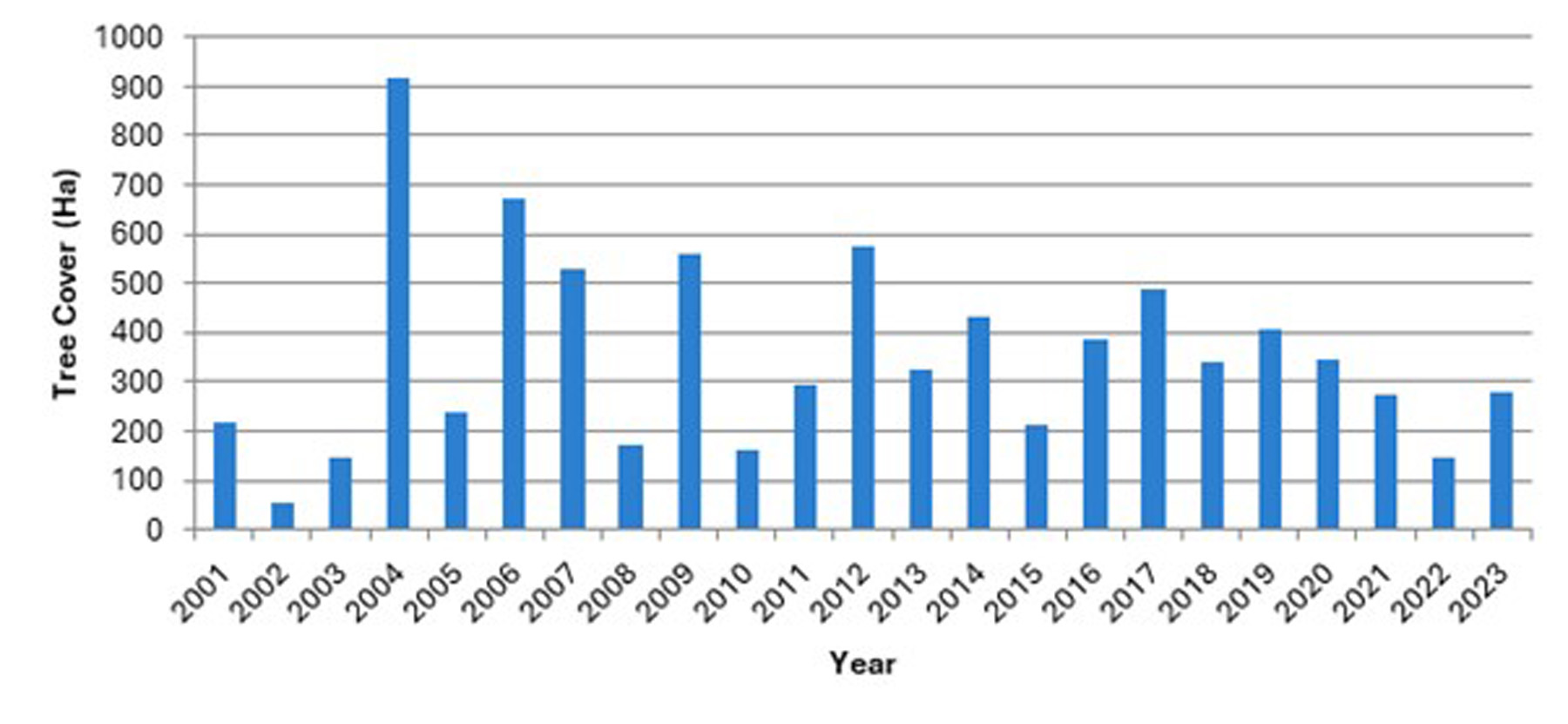
Figure 1. Annual tree cover loss within the pentad distribution range of the Mangrove Kingfisher. Data obtained from the Global Tree Watch website (Global Forest Watch 2024)
Biology & Ecology
Taxonomy
Clancy (1992) recognizes two species based predominantly on size:
H. s. senegaloides – Coastal Eastern Cape, KwaZulu-Natal, Mozambique to Pemba Island in Tanzania. The birds are larger; the blues are not as bright and tinged with green
H. s. ranivorus – North eastern Tanzania, south-eastern Kenya to the Shabelle River in southern Somalia. The birds are smaller, paler above, blue on the wings and tail brighter and whiter below.
It is possible that the variation is clinal, but Turpie (2005) indicates that separation into subspecies may be justified as the breeding ranges of the two populations are probably highly disjunct. The subspecies are supported by Clements (2018), but the IOC does not recognize the subspecies.
Identification
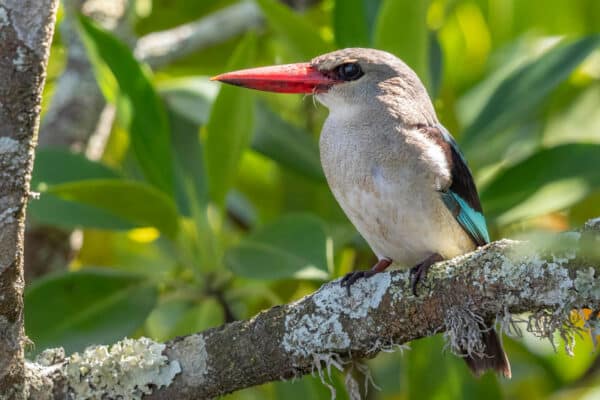
22-24 cm, 85 g. Sexes are alike in plumage (Turpie 2005). The crown and nape are greyish brown, mantel and scapulars cerulean blue, and the tail, rump and lower back a glossy cerulean blue. The lore and eyelids are black; face light grey with a white superciliary streak. The underside is white. The underwing has a characteristic prominent black carpal patch (Clancy 1992). The eyes are dark brown, and the bill is red. Legs are reddish with dark brown to black feet. Juveniles are duller than adults and have a mostly dark brown to black bill (Turpie 2005).
The Mangrove Kingfisher may be confused with the slightly smaller Woodland Kingfisher H. senegalensis. The latter do not have the black carpal patch on the underwing, nor the all-red, heavier keeled bill of the Mangrove Kingfisher. There are, however, aberrant Woodland Kingfishers that may exhibit these characteristics. However, Mangrove Kingfishers have reddish legs (not black), lack the black mark extending beyond the eye and have a darker forehead and crown (Turpie 2005). Tarboton (1987) does question the reliability of records of Mangrove Kingfishers due to the similarity with the Woodland Kingfisher.
Distribution
The species is confined to the eastern coastlands of Africa with disjunct records from southern Somalia (middle to lower Shebelle Valley) south along the coast, including offshore islands (Mafia, Zanzibar and Pemba Islands), to the Great Kei River in eastern South Africa (Clancy 1992). They can generally be found within 20 km of the coast, but on the Jubba River in Somalia (Woodall 2020), and on the Zambezi River in Mozambique they can occur 150 km inland Woodall (2020). Allan et al. (2000) recorded the species 120 km inland on the Save River in Mozambique.
The global Extent of Occurrence (EOO) is listed as 1.76 million square kilometers (BirdLife International 2024). However, this is presumed to be an error: using iNaturalist distributional data which stretches across the species range to the border of Kenya and Somalia, global EOO was calculated as 717 000 to 740 000 km2 using ConR and red packages in R. The regional EOO of 56 028 (52 916–58 086 km2 from modelled range based on BirdLasser data from Lee 2024) represents 7.5–7.8% of the lower global EOO. However, modelled distribution across Africa at the pentad level (Lee 2024) suggests the regional range is only 1.9% of the global range due to the tighter coastal distribution in the region compared to deeper inland prediction in countries like Mozambique. The regional AOO is also based on modelled distribution at the 2×2 km grid level from BirdLasser data from Lee (2024).
The EOO of the two subspecies from iNaturalist records is 162 601 km2 for ranivorus and 230 224 km2 for senegaloides (Figure 2). The regional EOO is thus 24% of the global EOO for senegaloides.
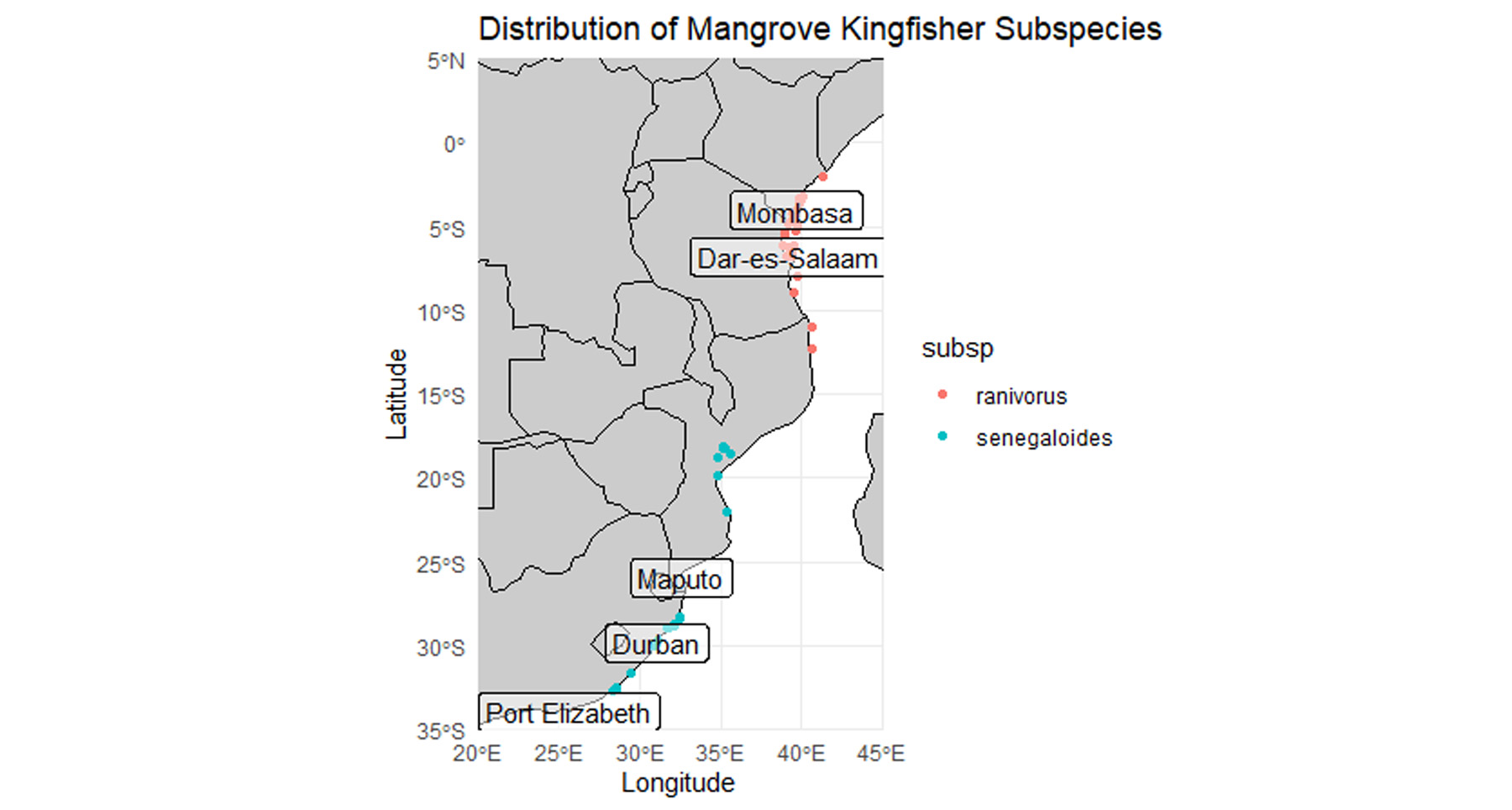
Figure 2: Distribution of Mangrove Kingfisher subspecies according to iNaturalist research grade records as of December 2024.
In the region the species occurs from Morgans Bay in the Eastern Cape northwards to Mtunzini in KwaZulu-Natal (Figure 3). Distribution is patchy with concentrations in the area between Morgans Bay and Mbotyi in the summer as well as around the estuaries in St Lucia, Richards Bay and Mtunzini in the winter (Turpie 2005). Sightings of the species further south are probably vagrants (Berruti 1997)

Figure 3. The distribution of the Mangrove Kingfisher within South Africa indicating seasonal distribution patterns, with red indicating a higher probability of reporting in pentads in summer, and blue higher probability of reporting in winter (based on Lee 2024).
Ecology
Habitat
In the breeding season they can be found along the banks of forested rivers, streams and estuaries at or near the coast. During the non-breeding season they can be found in mangroves and wooded estuaries (Woodall 2020). They are sometimes even found in parks and suburban gardens presumably while migrating (Berruti 1997).
Migration
The species undertakes seasonal movement between the summer breeding grounds in the Eastern Cape Province and the coastal wintering grounds in KwaZulu-Natal Province and could therefore be considered a partial migrant (Berruti et al. 1994, Berruti 1997).
Breeding
The species is monogamous, solitary nester and territorial (Tarboton 2001). Nests are built in old barbet and woodpecker tree holes (Boon 2000) as well as arboreal termitaria (Davies et al. 2012). The eggs are laid in the period October to January (Woodall 2020). Clutch size is unrecorded for South Africa, but in East Africa three eggs have been recorded. No information is available regarding incubation and nestling/fledgling period (Tarboton 2001).
Diet
The diet consists of crabs, prawns, fish, lizards, and insects (beetles, grasshoppers, mantids and dragonflies). Birds perch quietly in a tree, flying to ground or water when prey is sighted or flying up into foliage when hunting in the tree canopy (Turpie 2005). Mangrove Kingfishers are efficient at catching larger fish and occasionally visit ponds in parks and gardens to prey on captive fish (Clancy 1992).
Threats & Conservation
Threats
In the region substantial loss of habitat in some areas, e.g. mangrove habitat in Durban Bay, and destruction of rivers and riverine vegetation is the predominant threat (Berruti 1997, Barnes 2000, Woodall 2020). Birds, mainly juveniles, are killed flying into wires and light-coloured buildings presumably during migration (Woodall 2020) but this is regarded as a minor threat (Davies 2015). A cause for concern is that the species appears to concentrate in about six localities in the KwaZulu-Natal Province increasing its vulnerability to habitat destruction (Davies 2015).
Conservation Measures Underway
There are no specific conservation measures in place for the Mangrove Kingfisher. A limited amount of habitat is, however, included in the Dweza-Cwebe Nature Reserve (Eastern Cape Province) and iSimangaliso Wetland Park and Umlalazi Nature Reserve (KwaZulu-Natal Province), the latter two are important over wintering sites for the species.
Conservation Measures Proposed
- Carry out surveys in the breeding and non-breeding areas to identify critical habitat/areas for the species. Using the suite of options in the National Environmental Management – Protected Areas Act (No 57 of 2003) develop strategies to protect the identified areas.
- A management plan needs to be compiled for the species, either in the form of an IUCN Species Action Plan or a Biodiversity Management Plan as per the National Environmental Management- Biodiversity Act (No 10 of 2004).
- A precursor to the abovementioned measure would be the undertaking of a population and habitat viability assessment as this would identify gaps in the knowledge of the species that need to be addressed in the management plans.
Research Priorities and Questions
- Determine whether the assumption that the “southern” (H. s. senegaloides) and “northern” (H. s. ranivorus) populations are isolated from one another and warrant subspecies separation.
- Undertake surveys specifically in breeding range (Eastern Cape Province) to determine the size of the breeding population, but also in the non-breeding range (Kwa-Zulu Natal).
- Initiate satellite tracking studies to understand migration patterns and routes of the species and also possibly mortality rates and causes.
Contributors & References
Assessor/s
Kevin Shaw
Reviewer/s
Alan Lee
References
Allan DG, Davies GBP, Parker V. 2000. The birds (Aves) of the middle Save River valley, Mozambique. Durban Museum Novitates 25: 18–24.
Berruti A, Harrison JA, Navarro RA. 1994. Seasonal migration of terrestrial birds along the southern and eastern coasts of southern Africa. Ostrich 65: 54–65.
Berruti A. 1997. Mangrove Kingfisher Halcyon senegaloides. In: Harrison JA, Allan DG, Underhill LG, Herremans M, Tree AJ, Parker V, Brown CJ (eds). The atlas of southern African birds. Vol. 1: Non-passerines. BirdLife South Africa, Johannesburg. pp. 652–653.
BirdLife International. 2024. Halcyon senegaloides. The IUCN Red List of Threatened Species 2024: e.T22683265A264164648. Accessed on 23 December 2024.
Boon R. 2000. Nest sites of the Mangrove Kingfisher in the Eastern Cape. Bird Numbers 9: 34–36.
Clancey PA. 1992. Kingfishers of sub-Saharan Africa. Jonathan Ball Publishers, Johannesburg, South Africa.
Davies GBP, Symes CT, Chittenden HN, Peek JR. 2012. Mangrove Kingfishers (Halcyon senegaloides; Aves: Alcedinidae) nesting in arboreal Nasutitermes (Isoptera: Termitidae: Nasutitermitinae) termitaria in central Mozambique: scientific notes. Annals of the Ditsong National Museum of Natural History 2: 146–152.
Davies GBP. 2015. Mangrove Kingfisher Halcyon senegaloides. In: Taylor MR, Peacock F, Wanless RM (eds). The Eskom Red Data Book of Birds of South Africa, Lesotho and Swaziland. BirdLife South Africa, Johannesburg, South Africa. pp. 130–131.
Global Forest Watch. 2024. Interactive Forest Change Mapping Tool. Available at: http://www.globalforestwatch.org/.
Hansen MC, Potapov PV, Moore R, Hancher M, Turubanova SA, Tyukavina A, Thau D, Stehman SV, Goetz SJ, Loveland TR, Kommareddy A, Egorov A, Chini L, Justice CO, Townshend JRG. 2013. High-resolution global maps of 21st-century forest cover change. Science 342(6160): 850–853.
Johnson DN, Barnes KN, Taylor B. 1998. Important Bird Areas of Kwa-Zulu Natal. In: The Important Bird Areas of southern Africa. BirdLife South Africa, Johannesburg. pp. 141–196.
Lee ATK. 2024. Regional Red Data Book of the Birds of South Africa, Lesotho and Eswatini: SABAP2 synthesis and supporting information and graphics for Mangrove Kingfisher. Unpublished report. BirdLife South Africa, Johannesburg.
Tarboton WR, Kemp MI, Kemp AC. 1987. Birds of the Transvaal. Transvaal Museum, Pretoria.
Turpie JK. 2005. Mangrove Kingfisher Halcyon senegaloides. In: Hockey PAR, Dean WRJ, Ryan PG (eds). Roberts – Birds of Southern Africa, VIIth ed. The Trustees of the John Voelcker Bird Book Fund, Cape Town.
Woodall PF. 2020. Mangrove Kingfisher (Halcyon senegaloides). In: del Hoyo J, Elliott A, Sargatal J, Christie DA, de Juana E (eds). Birds of the World, version 1.0. Cornell Lab of Ornithology, Ithaca, NY, USA. https://doi.org/10.2173/bow.mankin2.01.
Citation
Shaw K 2025. Mangrove Kingfisher. In: Lee ATK, Rose S, Banda S, Bezeng SB, Maphalala MI, Maphisa DH, Smit-Robinson H (eds), The 2025 Red Data Book of Birds of South Africa, Lesotho and Eswatini. Johannesburg, South Africa: BirdLife South Africa. Available at: https://www.birdlife.org.za/red-list/mangrove-kingfisher/
Our generous sponsors


