


Little Grebe
Tachybaptus ruficollis

Number Of Mature
Individuals (Regional)
10 000 – 50 000

Regional
Population Trend
Decreasing
2025
Regional Category
Least Concern
Search by species
CONTENTSOverview
Names
|
IOC English Name: |
Little Grebe |
|
SA & IOC Scientific Name: |
Tachybaptus ruficollis |
|
BirdLife International Taxonomy (scientific name): |
Tachybaptus ruficollis |
|
Order: |
PODICIPEDIFORMES |
|
Family: |
Podicipedidae |
|
Species name author: |
Pallas 1764 |
|
Afrikaans: |
Kleindobbertjie |
|
Sesotho (South Africa): |
setswatsana |
|
Sesotho (Lesotho): |
setsoatsana |
|
Siswati: |
|
|
Zulu: |
imvukwane |
Current Assessment Status
|
2025 Regional Category [Criteria] |
LC |
|
2024 Global Category [Criteria] |
LC (Birdlife International 2019) |
|
Population size (Regional) |
10 000 – 50 000 mature individuals |
|
Population size (Global) |
408 700 – 2 345 000 (Wetlands International 2015) |
|
Distribution size (EOO) (Regional) km2 |
1 541 643 (Lee 2024) |
|
Distribution size (EOO) (Global) km2 |
170 000 000 (BirdLife International 2019) |
|
Distribution size (AOO) (Regional) km2 |
1 071 876 (Lee 2024) |
|
Generation time |
5.4 years (BirdLife International 2019) |
|
Status change reason |
No change |
|
Migrant |
Resident |
|
Regional endemic |
No |
Historic Listing Information
|
2000 Regional Status |
Not Evaluated |
|
2015 Regional Status |
Not Evaluated |
|
Status change reason (if applicable) |
No change |
|
2015 Population size (Regional) |
Unknown |
|
2015 Global Status |
LC |
Reason for Inclusion
Reason for Inclusion in the Assessment
Little Grebe Tachybaptus ruficollis was included in the 2025 Regional Red List assessment as the regional population has shown a decline in distribution size using Southern African Bird Atlas Project (SABAP) data analysed in several different ways and a decrease in count numbers from Coordinated Waterbird Counts (CWAC) (Lee 2024).
Category Justification
Category Justification
The regional population of the Little Grebe does not meet the thresholds for inclusion in any of the Regional Red List Threatened categories. Though a decrease in regional distribution was inferred (Lee 2024), the changes remain well below the threatened thresholds for listing under Criterion A, and the Extend of Occurrence (EOO) and Area of Occupancy (AOO) are above thresholds for Criterion B. Within the region, Little Grebe is widely distributed with a population size likely above 10 000, which is above thresholds for Criteria C and D. Thus, the Little Grebe is regionally listed as Least Concern.
Population Justification
The global population size for the Little Grebe was estimated in 2015 at c. 610 000 – 3 500 000 individuals (Wetlands International 2015). The regional population has not been unquantified. The species is described as ‘common to locally abundant’ throughout its Southern African range (Dean 2005). The regional population is assumed to be >10 000 mature individuals as some CWAC counts can be >1000 individuals (e.g. Strandfontein, Western Cape 2021 recorded 1813 individuals), with mean CWAC counts of 27 individuals. We can calculate an upper bound using the proportion of the local EOO of the global EOO and upper population estimate =2 345 000 × 0.009 ≈ 21 273. Note that this method applied to the lower bound is 3707, deemed unfeasible. Summing the 95% Confidence Intervals from BIRDIE (2024) gives 46 718, rounded to 50 000 as an upper bound. Confidence in this estimate is low.
Trend Justification
The global population is decreasing (BirdLife International 2019). The regional population trend appears to be declining, both from SABAP2 and CWAC data (Lee 2024). Little Grebe has not been well studied regionally but have been recorded in a wide variety of wetland habitats and are considered highly adaptable (Dean 2005); thus, these declines are surprising.
Within the Garden Route National Park lakes, there is evidence of on-going decline (Russell 2023). The drivers of decline are not clear but could be linked to increased competition with other divers as well as the impact of invasive fish species (Russell 2023).
Determining regional trends are complicated by the fact that Little Grebe undertake seasonal migrations, typically moving inland during the winter months (Figure 1, Skead and Dean 1997, Russell et al. 2014, Russell 2023, Lee 2024).
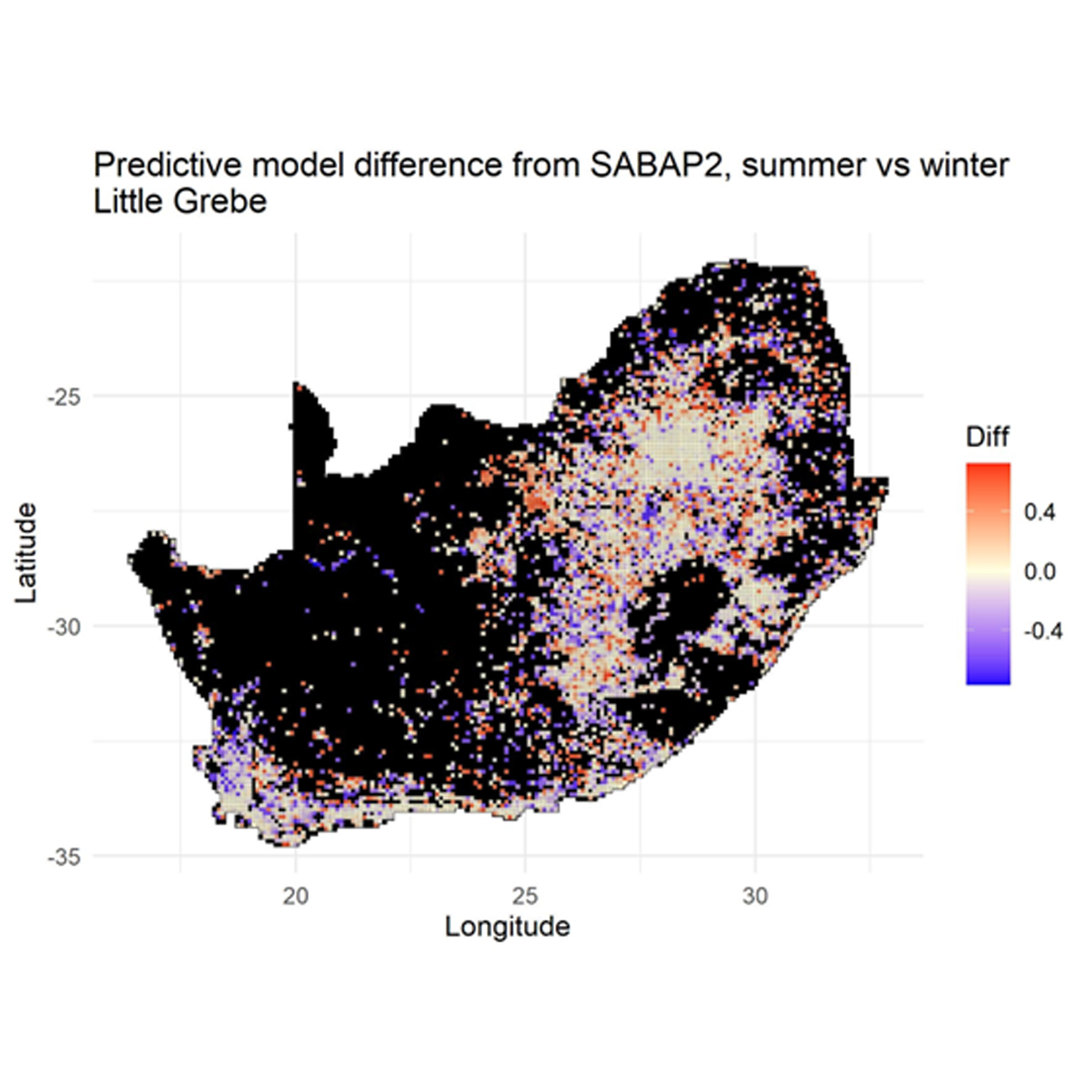
Figure 1: Seasonal variation in reporting rate from SABAP2 for Little Grebe. Blue indicates where reporting rate tends to be higher in winter, whereas red indicates summer reporting rates.
However, it is not clear whether the decline is occurring across the range or is driven by local factors. Consequently, the confidence in the trend estimate is medium.
Biology & Ecology
Taxonomy
Little Grebe was first described as Colymbus ruficollis by Pallas (1764), Vroëg’s Cat. Raisonné Coll. Oiseaux, Adumbr., p6; Holland. Six subspecies are currently recognised but only one is found in southern Africa: Tachybaptus ruficollis capensis, described by Salvadori (1884), Ann. Mus. Civ. Stor. Nat. Genova 21; p123 (Ogilvie and Rose 2003). Its previous common name was the Dabchick.
Identification
25–29 cm. Small and stout build. Sexes are similar in plumage, with females slightly smaller than males (Llimona et al. 2014). Breeding adults display a blackish-brown cap extending just below the eye and to the chin and upper throat with a noticeable light spot near the mouth (L McLachlan and Liversidge 1938, limona et al. 2014). The back and wing feathers are blackish-brown, and flight feathers are grey-brown with some white on the secondaries (Llimona et al. 2014). The lower throat, foreneck, and sides of the neck exhibit a chestnut colouration, contrasting with the darker grey-brown plumage from the base of the neck to the flanks and breast (Llimona et al, 2014). The bill is short, pointed and black with a small whitish tip and a pale yellowish patch at the gape (Llimona et al. 2014). In non-breeding adults, the plumage is paler overall, with dark grey-brown upperparts and ochre-brown lower and rear face and neck (Llimona et al. 2014). Juveniles resemble non-breeding adults but often retain some dark markings on the face (Llimona et al. 2014). Little Grebe is also easily detected by hearing their distinctive descending trills.
Confusing species: could be confused with the Black-necked Grebe Podiceps nigricollis, however they are much larger and have a longer neck with bright red eyes (Dean 2005).
Distribution
Little Grebe occurs in Europe, central and southern Asia, sub-Saharan Africa, Pacific islands and Australia. The species is widely distributed throughout Southern Africa but is absent from arid regions of the central Kalahari (Figures 2,3, Dean 2005, Lee 2024).
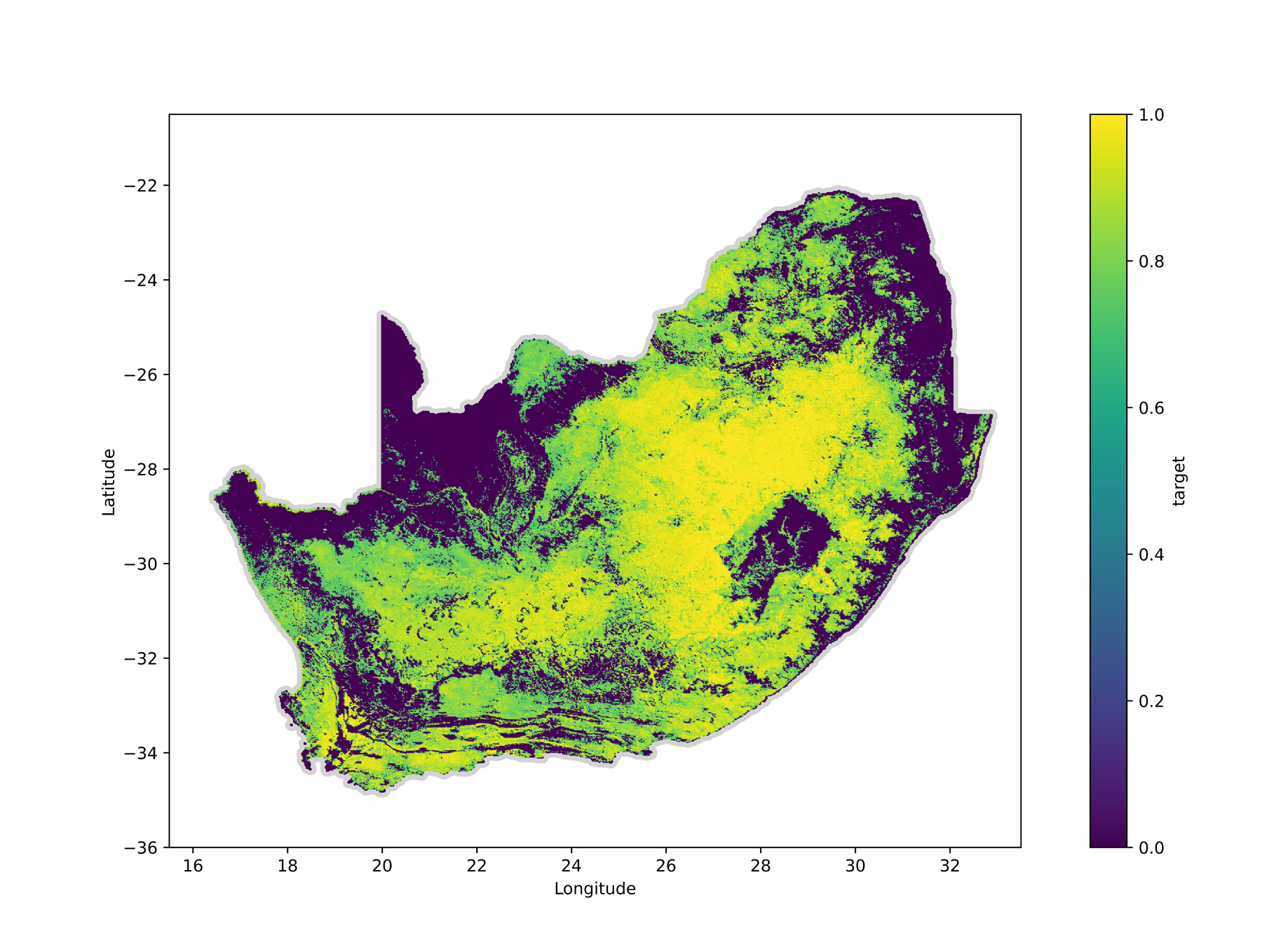
Figure 2: Little Grebe distribution across South Africa based on BirdLasser, iNaturalist and eBird data (Lee 2024).
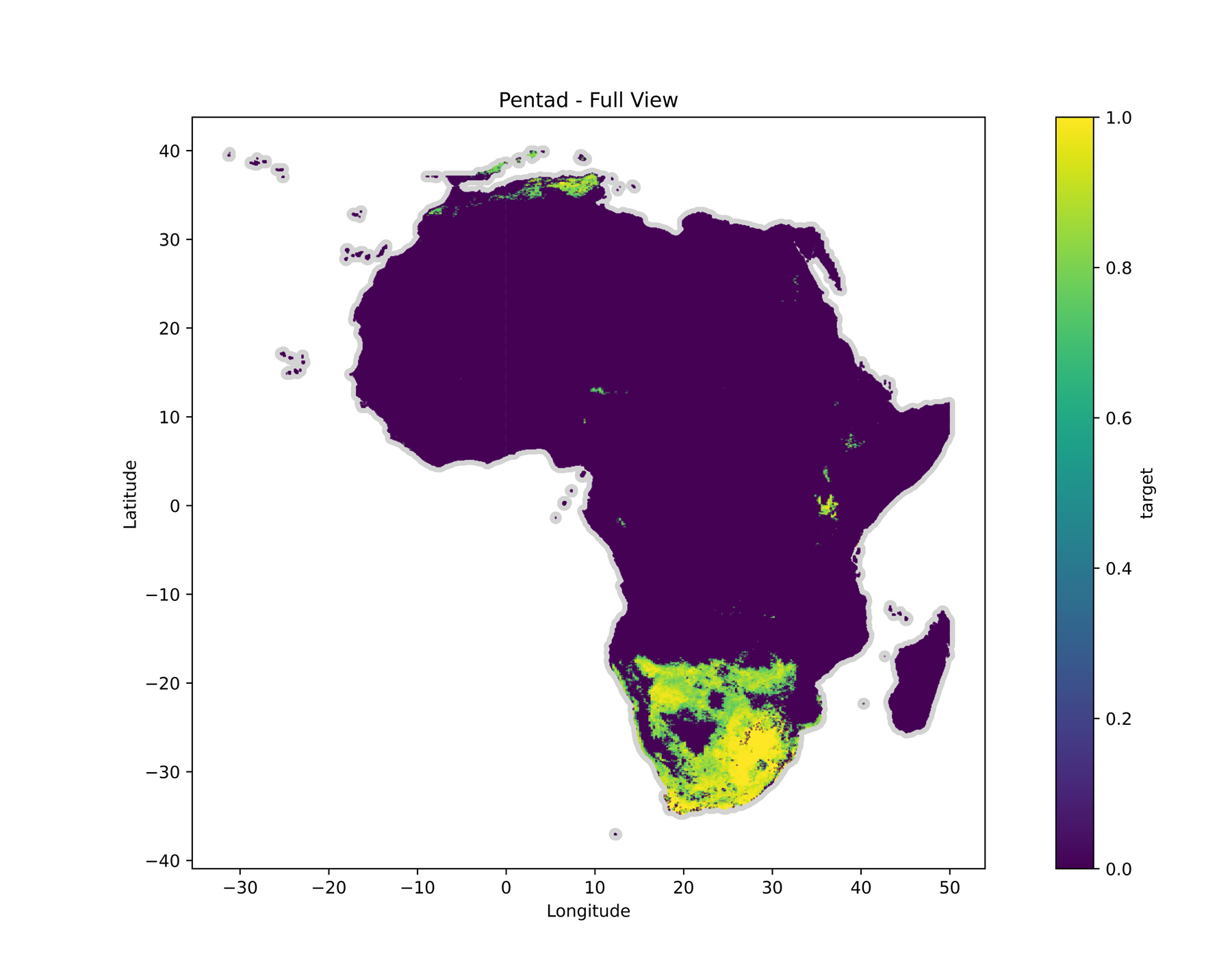
Figure 3: Little Grebe distribution across Africa based on ABAP, iNaturalist and eBird data, p >0.5 threshold applied (Lee 2024).
Ecology
Occupies a wide range of wetlands that are small and shallow usually less than a meter deep (Fjeldsa 2004). Wetlands with rich vegetation and high densities of aquatic invertebrates are preferred; the species tends to avoid waters with large predatory fish (Konter 2001). Little Grebe thrives in a variety of habitats, including small lakes, ponds, sheltered bays, and vegetated shores (del Hoyo et al. 1992). The species is also found in larger freshwater lakes and reservoirs (Brown et al. 1982, del Hoyo et al. 1992), slow-flowing rivers, canals, floodplain oxbows, coastal brackish lagoons (Brown et al. 1982), seasonally inundated areas and swamps (Fjeldsa 2004).
Migration is sedentary to locally dispersive or fully migratory, depending upon the winter temperatures in its breeding regions (del Hoyo et al. 1992). Additionally, in Africa, some dispersive movements are triggered by seasonal rains and the emergence of temporary wetlands (Brown et al. 1982). Generally resident in Southern Africa.
Timing of breeding varies geographically in accordance with vegetation and water levels (del Hoyo et al. 1992). Breeding has been recorded in all months, but mainly October-November in the Western Cape and December-March everywhere else (Tarboton 2001). The nest of the Little Grebe is a floating platform made of sodden aquatic plants anchored to submerged vegetation. It has a shallow cup on top, placed 50–100 mm above the water (Tarboton 2001). The nest is built by both sexes and material is added to the nest throughout incubation period (Tarboton 2001). The Little Grebe lays clutches of 2 to 5 eggs at 1-day intervals (Tarboton 2001). The incubation period for little grebe eggs ranges from 20 to 25 days and the incubation of the eggs is carried out by both parents. Young birds fledge around 44–48 days after hatching (Tarboton 2001). Breeding success is low, as there were no surviving young in four breeding attempts (Tarboton 1998), on average probably less than 1 fledged young in a single breeding attempt (Brown et al. 1982).
Diet primarily consists of insects and their larvae, with a particular preference for mayflies, stoneflies, various water bugs, beetles, flies, caddisflies, and dragonfly larvae (Llimona et al. 2014). Little Grebe also consumes molluscs, crustaceans, and amphibians such as small frogs and newts (Llimona et al. 2014). Their diet may also include small fish up to 11cm (del Hoyo et al. 1992, Llimona et al. 2014). In Europe the flight feathers are moulted simultaneously, causing flightlessness for a few weeks, but this has not been recorded in Southern Africa (Hockey et al. 2005).
Threats & Conservation
Threats
Little Grebe is vulnerable to avian flu (Melville and Shortridge 2006) as well as wetland degradation and/or transformation. Little Grebe may be threatened locally by competition with other diving species and habitat changes created by large invasive fish species (Russell 2023).
Conservation Measures Underway
No conservation measures are currently in place specifically for Little Grebe.
Conservation Measures Proposed
General conservation of wetlands could benefit Little Grebe, but research is first needed to determine the reasons for the observed decline in the species.
Research Priorities and Questions
- The size of the regional population needs to be determined.
- Drivers of decline need to be investigated and established so that mitigation measures can be implemented.
- Extent of decline needs to be established (i.e. are declines localised, or widespread?).
Contributors & References
Assessor/s
Dieter Oschadleus, Maria Paul, Karis Daniel
Reviewer/s
Sanjo Rose, Alan Lee
References
BIRDIE. 2024. An online platform for African wetland and waterbird data. https://biodiversityadvisor.sanbi.org/contentmanagement/index?guid=42305260-12b0-4a92-912e-7d801d15fdac. [Accessed on 30 September 2024].
BirdLife International. 2019. Tachybaptus ruficollis (amended version of 2017 assessment). The IUCN Red List of Threatened Species 2019: e.T22696545A155540155. https://doi.org/10.2305/IUCN.UK.2019-3.RLTS.T22696545A155540155.en. [Accessed on 04 April 2024].
BirdLife International. 2024. Species factsheet: Tachybaptus ruficollis. Downloaded from https://datazone.birdlife.org/species/factsheet/little-grebe-tachybaptus-ruficollis [Accessed on 04 April 2024].
Brown LH, Urban E, Newman K, Fry C, Keith S. 1982. The birds of Africa, Vol. I. London, United Kingdom: Academic Press.
Dean WRJ. 2005. Little Grebe. In: In: Hockey PAR, Dean WRJ, Ryan PG (eds), Roberts – Birds of Southern Africa (7th Edn). Cape Town, South Africa: Trustees of the John Voelcker Bird Book Fund. pp 559–561.
del Hoyo J, Elliott A, Sargatal J. 1992. Handbook of the Birds of the World, Vol. 1: Ostrich to Ducks. Barcelona, Spain: Lynx Edicions.
Fjeldså J. 2004. The grebes. Oxford, UK: Oxford University Press. In: BirdLife International (2024) Species factsheet: Little Grebe Tachybaptus ruficollis. Downloaded from https://datazone.birdlife.org/species/factsheet/little-grebe-tachybaptus-ruficollis [Accessed on 17 July 2024].
Konter A. 2001. Grebes of our world. Barcelona, Spain: Lynx Edicions. In: BirdLife International (2024) Species factsheet: Little Grebe Tachybaptus ruficollis. Downloaded from https://datazone.birdlife.org/species/factsheet/little-grebe-tachybaptus-ruficollis on [Accessed on 17 July 2024].
Lee ATK. 2024. Regional Red Data Book of the Birds of South Africa, Lesotho and Eswatini: SABAP2 synthesis and supporting information and graphics for Little Grebe. Unpublished report. Johannesburg, South Africa: BirdLife South Africa.
Llimona F, del Hoyo J, Christie DA, Jutglar F, Garcia EFJ, Kirwan GM. 2020. Little Grebe (Tachybaptus ruficollis), version 1.0. In: del Hoyo J, Elliott A, Sargatal J, Christie DA, de Juana E (eds), Birds of the world. Ithaca, NY, USA: Cornell Lab of Ornithology. https://doi.org/10.2173/bow.litgre1.01
McLachlan GR, Liversidge R. 1938. Roberts Birds of South Africa. Cape Town, South Africa: Trustees of John Voelcker Bird Book Fund.
Melville DS, Shortridge KF. 2006. Migratory waterbirds and avian influenza in the East Asian-Australasian Flyway with particular reference to the 2003–2004 H5N1 outbreak. In: Boere G, Galbraith C, Stroud D (eds), Waterbirds around the world. Edinburgh, UK: The Stationery Office. pp 432–438.
Ogilvie MA, Rose C. 2003. Grebes of the world. Uxbridge, UK: Bruce Coleman Books.
Russell IA, Randall RM, Hanekom N. 2014. Spatial and temporal patterns of waterbird assemblages in the Wilderness Lakes Complex, South Africa. Waterbirds: The International Journal of Waterbird Biology 1–18.
Russell IA. 2023. Waterbird community changes in the Wilderness Lakes, South Africa (Part 1 of 3): herbivores and omnivores. Koedoe 65(1): a1770.
Skead DM, Dean WRJ. 1977. Status of the Barberspan avifauna, 1971–1975. Ostrich Suppl. 12: 3–42.
Tarboton W. 1998. Dabchick days. Africa – Birds & Birding 3(1): 30–35.
Tarboton W. 2001. Guide to nests & eggs of Southern African birds. Cape Town, South Africa: Struik Nature.
Wetlands International. 2015. Waterbird population estimates. Available at: wpe.wetlands.org. [Accessed on 28 May 2024].
Citation
Oschadleus D, Paul M, Daniel K 2025. Little Grebe. In: Lee ATK, Rose S, Banda S, Bezeng SB, Maphalala MI, Maphisa DH, Smit-Robinson H (eds), The 2025 Red Data Book of Birds of South Africa, Lesotho and Eswatini. Johannesburg, South Africa: BirdLife South Africa. Available at: https://www.birdlife.org.za/red-list/little-grebe/
Our generous sponsors


