


Light-mantled Albatross
Phoebetria palpebrata

Number Of Mature
Individuals (Regional)
840

Regional
Population Trend
Decreasing
2025
Regional Category
Vulnerable
Search by species
CONTENTSOverview
Names
|
IOC English Name: |
Light-mantled Albatross |
|
SA & IOC Scientific Name: |
Phoebetria palpebrata |
|
BirdLife International Taxonomy (scientific name): |
Phoebetria palpebrata |
|
Order: |
PROCELLARIIFORMES |
|
Family: |
Diomedeidae |
|
Species name author: |
Forster 1785 |
|
Afrikaans: |
Swartkopalbatros |
|
Sesotho (South Africa): |
Masikaledikepe wa hlohontsho |
|
Sesotho (Lesotho): |
|
|
Siswati: |
|
|
Zulu: |
unozulanyanompunga |
Current Assessment Status
|
2025 Regional Category [Criteria] |
VU° [A2bde+3e; B2ab(v)] |
|
2024 Global Category [Criteria] |
NT [A4bd] (BirdLife International 2018) |
|
Population size (Regional) |
c. 420 breeding pairs (Ryan et al. 2009, Schoombie et al. 2016) |
|
Population size (Global) |
58 000 (BirdLife International 2018) |
|
Distribution size (EOO) (Regional) km2 |
c. 720 (breeding) |
|
Distribution size (EOO) (Global) km2 |
100 000 000 |
|
Distribution size (AOO) (Regional) km2 |
334 (breeding) |
|
Generation time |
44 years (BirdLife International 2018) |
|
Status change reason |
Genuine Change in Status |
|
Migrant (in the region) |
Full Migrant |
|
Regional endemic |
No |
Historic Listing Information
|
2000 Regional Status |
NT [A2d; C1] |
|
2015 Regional Status |
NT [A4bd; D2] |
|
Status change reason (if applicable) |
No change |
|
2015 Population size (Regional) |
c. 720 pairs |
|
2015 Global Status |
NT [A4bd] |
Reason for Inclusion
Reason for Inclusion in the Assessment
Light-mantled Albatross Phoebetria palpebrata breed at the Prince Edward Islands and is a rare visitor to South African waters. It was assessed as regionally Near Threatened in 2000 and 2015, and is currently listed as globally Near Threatened. While the regional population is now <5% of the last global population estimate, uncertainty around historical population estimates and because global and regional population estimates are based on dated data, complicating application of a 5% filter a cautionary approach was adopted and the species was included in the assessment.
Category Justification
Category Justification
The global population status of the Light-mantled Albatross is poorly documented. However, due to the impact of invasive predators on breeding colonies and mortalities from longline bycatch, the global population is suspected to be in decline, justifying its current global Near Threatened (NT) status.
Within the assessed region, the Light-mantled Albatross population is estimated at fewer than 1000 mature individuals, breeding at two subpopulations (Prince Edward Island and Marion Island). Marion Island is significantly affected by invasive predators. The most recent population estimate for Marion Island is approximately half of the previous estimate, while the Prince Edward Island population trend is unknown. This decline, particularly on Marion Island, meets the threshold for Endangered under Criterion A2bde, which considers population reductions where threats have not ceased, are not fully understood, or may not be reversible. Furthermore, this species qualifies for Endangered under Criterion A3 due to projected future declines based on expert-assessed extinction horizons due principally to the threat of House Mice Mus musculus on Marion Island (Preston et al. 2019). The regional population also meets the thresholds for Endangered under Criterion B (based on small Area of Occupancy (AOO), number of locations and continuing decline).
While there is limited direct evidence of ongoing population decline currently, predictive assessments suggest that the species may experience a significant reduction over the next three generations. The extinction horizon estimates indicate that the species’ population may decline by 50% within this period, exceeding the threshold for Endangered under A3 (Lee 2025).
However, a potential regional rescue effect remains possible despite global population declines, and the planned removal of a key threat could mitigate the ongoing decline. Accordingly, the species’ regional status is downlisted to Vulnerable (VU) A3 and B2.
Population Justification
The global annual breeding population has been quantified at 58 000 mature individuals (BirdLife International 2018). Regionally, Ryan et al. (2009) estimated there to be 120 pairs on Prince Edward Island and recent counts estimate c. 300 pairs on Marion Island (Schoombie et al. 2016, FitzPatrick Institute of African Ornithology (FIAO), unpubl data), giving a regional population estimate of c. 420 pairs. This is c. 300 pairs less than the previous estimate of c. 720 pairs in 2006. Light-mantled Albatrosses are notably difficult to count due to their dark plumage and cliff nesting habits (Ryan et al. 2009), lowering the confidence in this regional population estimate to medium.
Trend Justification
Limited information is available to determine global population trends for the species but declines have been reported at all sites where repeated surveys have been carried out (ACAP 2010). The Marion Island population decreased by 25% between 1990 and 1998 or at about 2.6% per year (Crawford et al. 2003), then increased by 5% per year up to 2005 (Ryan et al. 2009), but have declined at 9% per year since 2006 (Schoombie et al. 2016). The current Marion Island population estimate is about half of what was reported in the 2015 assessment. This rate of decline, if ongoing, could lead to very rapid population reductions within one generation. Future population projections based on extinction horizon estimates suggest that significant reductions may occur within the next three generations (Preston et al. 2019). While no significant recent declines have been observed, the potential for future declines justifies careful consideration under Criterion A3 (Lee 2025). Ongoing monitoring is essential to validate these projections and determine whether the species is experiencing measurable population decreases.
Biology & Ecology
Taxonomy
Monotypic. No notable issues.
Identification
The Light-mantled Albatross is a small species, measuring about 85–90 cm in length and weighing between 2.4–2.7 kg. Males are slightly larger than females, but both sexes look very similar. This bird is mostly chocolate-brown, with a noticeable pale, yellow-brown mantle (back and shoulders) that looks bleached compared to the rest of its velvety brown plumage. Its upper breast and mantle are lighter in colour, and there’s a distinctive white crescent shape above and behind the eye. The bill is black with a blue line (sulcus) running along it.
Juveniles and immatures look much like the adults. In contrast, dark, pale-billed Giant Petrels (Macronectes spp.) are bulkier with shorter, stubbier wings. Another similar species, the Sooty Albatross P. fusca, is uniformly brown and has a yellow sulcus, lacking the pale mantle of the Light-mantled Albatross.
Distribution
The Light-mantled Albatross breeds on the Prince Edward Islands as well as Iles de Kerguelen, Iles Crozet (France), Heard and Macquarie islands, (Australia), South Georgia, and the Auckland, Campbell and Antipodes islands (New Zealand) (ACAP 2010). They range widely across the Southern Ocean, seldom venturing into continental shelf waters (Ryan 1997, Carpenter-Kling et al. 2020). It has a much more southerly distribution than its sister species, the Sooty Albatross, and is associated with the edge of the pack ice and Antarctic waters (Figure 1, Reisinger et al. 2018, Carpenter-Kling et al. 2020). Two Light-mantled albatrosses breeding at Marion Island were tracked during their non-breeding season; both travelled southwest into Antarctic waters of the southern Atlantic Ocean before moving east into lower latitudes in the southern Indian Ocean. One of the birds continued east, completing a winter circumnavigation of the globe and spending about 56 days in regions south of Australia (Schoombie 2015).
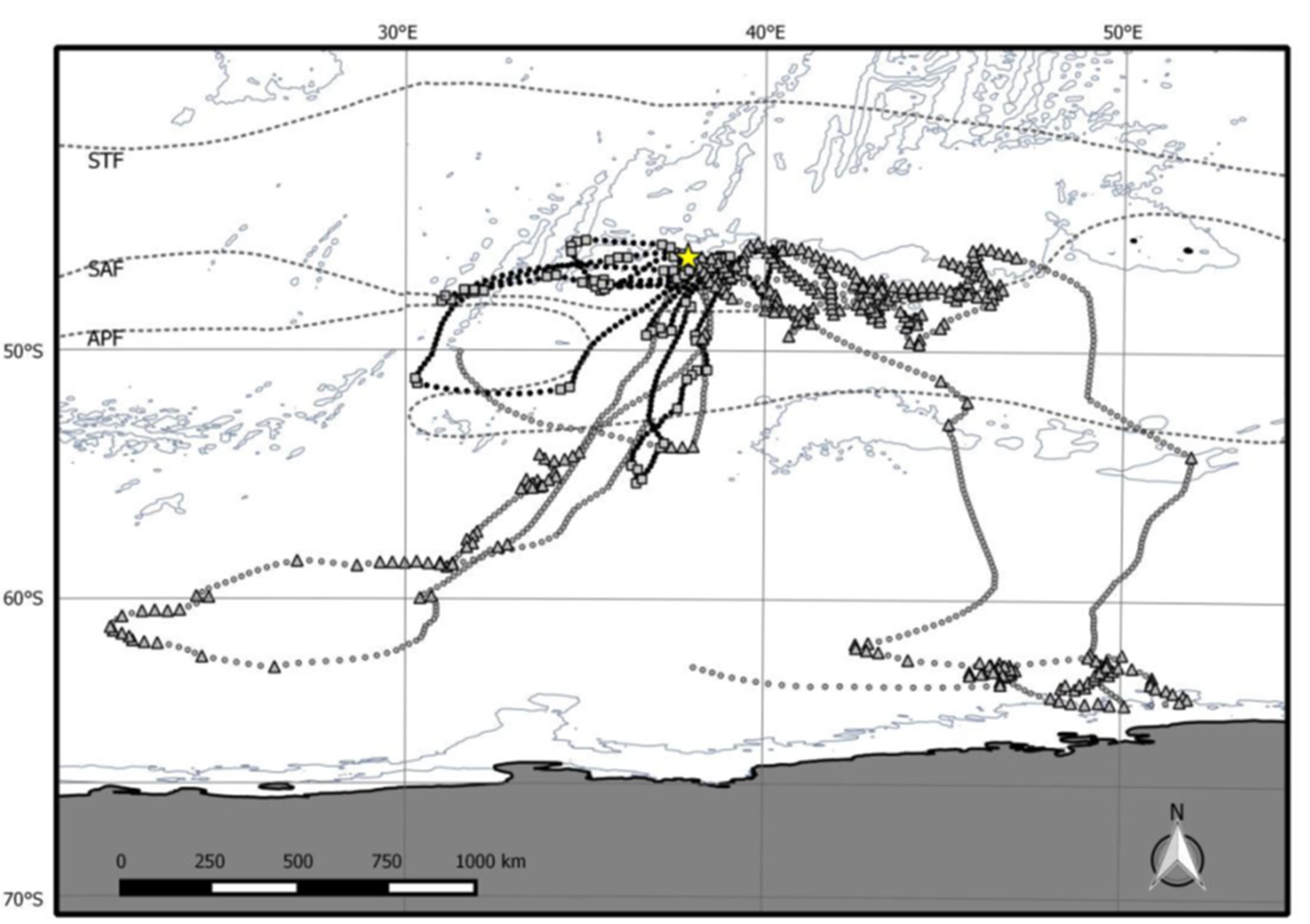
Figure 1: Tracks of breeding light-mantled albatrosses from Marion Island (star). Probable foraging areas during incubation are indicated by triangles, and those during brood guarding by squares. The average positions of major fronts are based on Orsi et al. (1995), with bathymetry shown at 3000 m. Map from Schoombie (2015).
Ecology
The Light-mantled Albatross nests solitarily or in small colonies on sea cliffs and inland cliffs, showing high natal fidelity. It is a biennial breeder, laying a single egg in October-November (Weimerskirch et al. 1986). Breeding success in 1978 on Marion Island was 31% (Berruti 1979, FIAO unpubl data). Feeding is mainly through surface-seizing with squid, fish, and crustaceans featuring prominently in the diet (Cherel and Klages 1998, Connan et al. 2014). At Marion Island, carrion comprised an important part of the diet, presumably from scavenging carcasses (Cooper and Klages 1995, Connan et al. 2014). It seldom follows or associates with ships (Ryan 2005). It can dive to 10 m and its dark plumage may be related to nocturnal foraging (Prince et al. 1994, Cooper and Klages 1995). Birds breeding on Marion Island forage in subantarctic and Antarctic waters, exhibiting spatial segregation from sympatric Sooty Albatrosses and Grey-headed Albatrosses (Connan et al. 2014). Indeed, nine breeding adults at Marion Island were tracked and found to forage south of the Prince Edward islands (Schoombie 2015).
Threats & Conservation
Threats
The primary threat at sea is from bycatch in tuna longline fishing (Nel et al. 2002). Trawling on sea-mounts in the south-west Indian Ocean is a potential threat but data are lacking. Population decreases are considered to be due to at sea mortality associated with fisheries, particularly longline fishing vessels (Delord et al. 2008). Introduced House Mice have been reported to have preyed on a single chick of the closely related Sooty Albatross at Marion Island (Jones and Ryan 2010), and more widespread attacks occurred in 2015 (Dilley et al. 2016), with various albatross species facing this threat as of 2023.
Conservation Measures Underway
Internationally, the Light-mantled Albatross is protected by the Agreement on the Conservation of Albatrosses and petrels – Annex 1 and by the Convention on the Conservation of Migratory Species – Appendix II. Within the region it is protected under the Sea Birds and Seals Protection Act, 1973 (Act No. 46 of 1973), Marine Living Resources Act (Act No. 18 of 1998): Publication of Policy on the Management of Seals, Seabirds and Shorebirds: 2007 and the National Plan of Action (NPOA) for Reducing the Incidental Catch on Seabirds in Longline Fisheries (2008). The Prince Edward Islands are listed as a Ramsar Wetland of International Importance, and a Special Nature Reserve under the Environment Conservation Act (No 73 of 1989) and are managed through the Prince Edward Islands Management Plan 1996. The Prince Edward Islands Marine Protected Area was proclaimed in 2013.
Conservation Measures Proposed
Ongoing efforts by BirdLife International, as well as BirdLife South Africa, to reduce incidental mortality of seabirds in fisheries industries should be supported. Observer programmes, essential for the reporting of the scale of incidental mortality and potential effectiveness of mitigation measures, must be continued. The eradication of introduced mice on Marion Island is anticipated, based on results of research into the patterns and scale of mouse predation on the chicks of Light-mantled Albatross and other pelagic seabirds.
Research Priorities and Questions
The following research questions, mostly related to demography and population dynamics are proposed:
- What is the nature, scale and spatio-temporal pattern of Prince Edward predation by introduced House Mice on Light-mantled Albatross chicks?
- At what age do Phoebetria albatrosses at the Islands recruit?
- What is the degree of population exchange between oceanic islands (i.e. how likely is the regional rescue effect)?
- What are the sex-, stage- and age-specific foraging distributions at sea?
- Are Phoebetria albatrosses serially monogamous and common in extra-pair paternity?
- Is this species genuinely less at risk from longline bycatch, or is this an overlooked threat?
- Under what conditions do pairs breed every year?
- What is the population-level frequency distribution of two or three-year sabbaticals?
Contributors & References
Assessor/s
Shamiso Banda
Reviewer/s
Stefan Schoombie
References
Agreement on the Conservation of Albatrosses and Petrels. 2010. ACAP species assessment: Light-mantled Albatross Phoebetria palpebrata. Available: https://www.acap.aq/resources/acap-species/255-light-mantled-albatross/file. [Accessed on 17 August 2023].
Berruti A. 1979. The breeding biologies of the Sooty Albatrosses Phoebetria fusca and P. palpebrata. Emu 79: 161–175.
BirdLife International. 2018. Phoebetria palpebrata. The IUCN Red List of Threatened Species 2018: e.T22698448A132647449. Available: https://dx.doi.org/10.2305/IUCN.UK.2018-2.RLTS.T22698448A132647449.en. [Accessed on 17 August 2023].
Carpenter-Kling T, Reisinger RR, Orgeret F, Connan M, Stevens KL, Ryan PG, Makhado A, Pistorius PA. 2020. Foraging in a dynamic environment: response of four sympatric sub-Antarctic albatross species to interannual environmental variability. Ecology and Evolution 10(20): 11277–11295.
Cherel Y, Klages N. 1998. A review of the food of albatrosses. In: Robertson CGR, Gales R (eds), Albatross Biology and Conservation. Chipping Norton, Australia: Surrey Beatty and Sons. pp. 113–136.
Connan M, McQuaid CD, Bonnevie BT, Smale MJ, Cherel Y. 2014. Combined stomach content, lipid, and stable isotope analyses reveal spatial and trophic partitioning among three sympatric albatrosses from the Southern Ocean. Marine Ecology Progress Series 497: 259–272.
Cooper J, Klages NTW. 1995. The diets and dietary segregation of sooty albatrosses (Phoebetria spp.) at subantarctic Marion Island. Antarctic Science 7: 15–15.
Crawford RJM, Cooper J, Dyer BM, Greyling MD, Klages NTW, Ryan PG, Petersen SL, Underhill LG, Upfold L, Wilkinson W. 2003. Populations of surface-nesting seabirds at Marion Island, 1994/95–2002/03. African Journal of Marine Science 25: 427–440.
Delord K, Besson D, Barbraud C, Weimerskirch H. 2008. Population trends in a community of large Procellariiforms of Indian Ocean: potential effects of environment and fisheries interactions. Biological Conservation 141: 1840–1856.
Dilley BJ, Schoombie S, Schoombie J, Ryan PG. 2016. Scalping of albatross fledglings by introduced house mice spreads rapidly at Marion Island. Antarctic Science 28(2): 73–80.
Jones MGW, Ryan PG. 2010. Evidence of mouse attacks on albatross chicks on subantarctic Marion Island. Antarctic Science 22: 39–42.
Lee ATK. 2025. The application of IUCN Regional Red List Criteria to the species of South Africa’s Prince Edward Islands. Unpublished report. Johannesburg: BirdLife South Africa.
Nel DC, Ryan PG, Crawford RJ, Cooper J, Huyser OA. 2002. Population trends of albatrosses and petrels at Subantarctic Marion Island. Polar Biology 25: 81–89.
Orsi H, Whitworth III T, Nowlin W. 1995. On the meridional extent and fronts of the Antarctic Circumpolar Current. Deep-Sea Research 1 42: 641–673.
Preston GR, Dilley BJ, Cooper J, Beaumont J, Chauke LF, Chown, SL, Devanunthan N, Dopolo M, Fikizolo L, Heine J, Henderson S, Jacobs CA, Johnson F, Kelly J, Makhado AB, Marais C, Maroga J, Mayekiso M, McClelland G, Mphepya J, Muir D, Ngcaba N, Ngcobo N, Parkes JB, Paulsen F, Schoombie S, Springer K, Stringer C, Valentine H, Wanless RM, Ryan PG. 2019. South Africa works towards eradicating introduced house mice form the sub-Antarctic Marion Island: the largest island yet attempted for mice. In: Island Invasives: Scaling up to Meet the Challenge. Veitch CR, Clout MN, Martin AR, Russell JC, West CJ (eds), Occasional Paper of the IUCN Species Survival Commission; Vol. 62 pp 40–46. IUCN. https://portals.iucn.org/library/node/48358.
Prince PA, Huin N, Weimerskirch H. 1994. Diving depths of albatrosses. Antarctic Science 6: 353–354.
Reisinger RR, Raymond B, Hindell MA, Bester MN, Crawford RJM, Davies D, de Bruyn N, Dilley BJ, Kirkman SP, Makhado AB, and others. 2018. Habitat modelling of tracking data from multiple marine predators identifies important areas in the Southern Indian Ocean. Diversity and Distributions 24(4): 535–550.
Ryan PG. 1997. Light-mantled Sooty Albatross Phoebetria palpebrata. In: Harrison JA, Allan DG, Underhill LG, Herremans M, Tree AJ, Parker V, Brown CJ (eds). The atlas of southern African birds. Vol. 1: Non-passerines. BirdLife South Africa, Johannesburg. pp 757.
Ryan PG. 2005. Light-mantled Albatross Phoebetria palpebrata. In: Hockey PAR, Dean WRJ, Ryan PG (eds). Roberts – Birds of Southern Africa, 7th Edn. Cape Town: The Trustees of the John Voelcker Bird Book Fund. pp 653–654.
Ryan PG, Jones MG, Dyer BM, Upfold L, Crawford RJ. 2009. Recent population estimates and trends in numbers of albatrosses and giant petrels breeding at the Subantarctic Prince Edward Islands. African Journal of Marine Science 31: 409–417.
Schoombie S. 2015. The population status, breeding success and foraging ecology of Phoebetria albatrosses on Marion Island. MSc dissertation, University of Cape Town.
Schoombie S, Crawford RJM, Makhado AB, Dyer BM, Ryan PG. 2016. Recent population trends of sooty and light-mantled albatrosses breeding on Marion Island. African Journal of Marine Science 38(1): 119–127.
Weimerskirch H, Jouventin P, Stahl JC. 1986. Comparative ecology of the six albatross species breeding on the Crozet Islands. Ibis 128: 195–213.
Citation
Banda S 2025. Light-mantled Albatross. In: Lee ATK, Rose S, Banda S, Bezeng SB, Maphalala MI, Maphisa DH, Smit-Robinson H (eds), The 2025 Red Data Book of Birds of South Africa, Lesotho and Eswatini. Johannesburg, South Africa: BirdLife South Africa. Available at: https://www.birdlife.org.za/red-list/light-mantled-albatross/
Our generous sponsors


