


Lesser Jacana
Microparra capensis

Number Of Mature
Individuals (Regional)
<2 000

Regional
Population Trend
Decreasing
2025
Regional Category
NA
Search by species
CONTENTSOverview
Names
|
IOC English Name: |
Lesser Jacana |
|
SA & IOC Scientific Name: |
Microparra capensis |
|
BirdLife International Taxonomy (scientific name): |
Microparra capensis |
|
Order: |
CHARADRIIFORMES |
|
Family: |
Jacanidae |
|
Species name author: |
Smith A, 1839 |
|
Afrikaans: |
Dwerglangtoon |
|
Sesotho (South Africa): |
Mohatsakwena e monyenyane |
|
Sesotho (Lesotho): |
|
|
Siswati: |
|
|
Zulu: |
unondwayizomncane |
Current Assessment Status
|
2025 Regional Category [Criteria] |
NA |
|
2024 Global Category [Criteria] |
LC (BirdLife International 2024) |
|
Population size (Regional) |
<2000 (Taylor and Peacock 2015) |
|
Population size (Global) |
25 000 – 100 000 individuals (c. 16 700 – 66 700 mature individuals) (Wetlands International 2024) |
|
Distribution size (EOO) (Regional) km2 |
241 970 (Lee 2024) |
|
Distribution size (EOO) (Global) km2 |
17 600 000 (BirdLife International 2024) |
|
Distribution size (AOO) (Regional) km2 |
660 (Lee 2024) |
|
Generation time |
4.02 years (BirdLife International 2024) |
|
Status change reason |
Application of criteria |
|
Migrant (in the region) |
Not a migrant |
|
Regional endemic |
No |
Historic Listing Information
|
2000 Regional Status |
NT [B1+2c] |
|
2015 Regional Status |
VU [C1] |
|
Status change reason (if applicable) |
Genuine change in status |
|
2015 Population size (Regional) |
<2000 |
|
2015 Global Status |
LC |
Reason for Inclusion
Reason for Inclusion in the Assessment
The Lesser Jacana Microparra capensis was previously assessed as regionally Vulnerable (Taylor and Peacock 2015).
Category Justification
Category Justification
Lesser Jacana is assessed as regionally ‘Not Applicable’ as the regional Extent of Occurrence (EOO) for the species is 1.4% of the global EOO. In addition, the regional population size is less than 4.8% of the average global population estimate. Despite the species satisfying the threshold of Vulnerable [C1] the small regional proportion of the global range and population did not meet the 5% filter set for the region. In addition, indications are that historically the species was not that common within the region.
Population Justification
Wetlands International (2024) indicate that the global population is 25 000 – 100 000 individuals (c. 16 500 – 66 000 mature individuals). This estimate is a best guess, based on data emanating from Fishpool and Evans (2001).
In terms of the regional population no overall estimate exists. Where count data exists, there are conflicting results. At St Lucia, Tarboton and Fry (1986) estimated that there were 22 birds in an area of c. 100 ha of pan habitat. The authors extrapolated this density to all suitable habitats in the eastern shore region of St Lucia, indicating that the Lesser Jacana population at this site probably numbered hundreds of birds implying that the local population is more than 100, but less than 1000. However, Coordinated Waterbird Counts (CWAC) carried out at Lake St Lucia between 1992-2020 (CWAC unpubl data) did not record a single Lesser Jacana. Caroline Fox (pers comms), the coordinator of these surveys has indicated that although Lesser Jacana was seen at other times, the species was not recorded during the surveys suggesting that they may not be as common as Tarboton and Fry (1986) implied. Dr Richard Taylor (pers comms) who was the park ecologist at St Lucia for many years indicated that most of the lake habitat is unsuitable for Lesser Jacana, with only a few places where suitable habitat may occur on the eastern shores of the lake after prolonged freshwater conditions and occurrence of lots of emergent macrophytes. Further evidence of the scarcity of the species is illustrated in Berutti (1980) where the species was described as a scarce localised resident of freshwater pans on the Eastern and Western shores of Lake St Lucia.
Estimation of the population size is problematic as the Lesser Jacana is a highly mobile habitat specialist capable of moving between areas according to favourable environmental conditions. Taylor and Peacock (2015) indicate that the regional population probably numbers <2000 mature individuals, but that this number probably fluctuates depending on habitat conditions.
There is evidence (see below) of recent range contraction. However, whether that has translated into population declines is not known. Therefore, it is assumed that the regional population still number <2000. Confidence in this estimate is low.
Trend Justification
Establishing the trend of such a highly mobile species is challenging. Presence absence data collected per pentad (grid approximately 9 km x 7 km) for the second Southern African Bird Atlas Project (SABAP) was divided into two periods (2007-2015 and 2016-2023). Static variable models were used to predict the number of pentads the species could occur in within each period (Figure 1). The models predicted a decline in the Area of Occupancy (AOO) between the two periods of 17.2% (Lee 2024). It is probable that this decline is underestimated as the model predicts an increase in areas (most notably the interior) where the species is considered an infrequent visitor.
Bootstrap analyses show that there was a decline between SABAP1 and SABAP2, but the analyses between SABAP2 periods 2007-2015 and 2016-2023 show a stable trend. Repeat surveys at specific wetlands in Zimbabwe just north of the region between 1992 and 2017 indicated stable trends while in the northwest of Zimbabwe there appeared to be an increasing trend (Tarakini et al. 2020).
Confidence levels in these trend analyses can be categorised as medium.
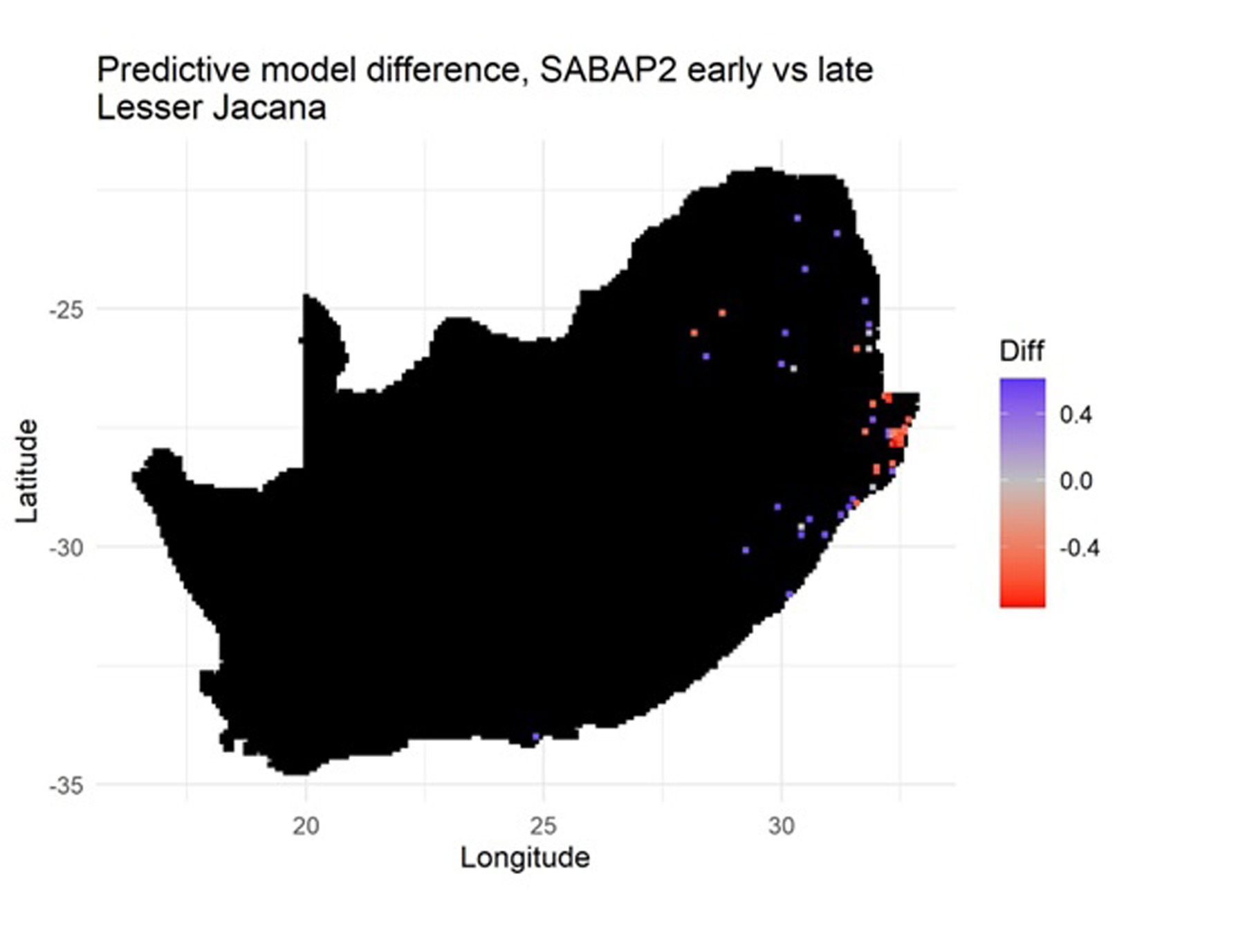
Figure 1: Predictive occurrence model results comparing data from 2007–2015 and 2016–2023. Red indicates a lower probability of recording for the latter period while Blue indicates a higher recording (from Lee 2024).
Biology & Ecology
Taxonomy
The species is monotypic (Tarboton 2005, Jenni and Kirwan 2020).
Identification
15–16 cm, 41 g. The female is slightly larger than the male, but there is no distinguishable difference in plumage colouration. The bill is pale brown, while the legs and feet are greenish grey. The forehead is golden rufous changing to a cinnamon colour on the crown and nape, becoming darker on the hind neck, mantle and back. The supercilium is white with a brown eye-stripe. The cheeks and underbelly are white, while the wings are dark with white trailing edges on the primaries and secondaries. The eyes are brown. Lesser Jacana may be confused with juvenile African Jacana Actophilornis africanus, but the latter are larger, have a frontal shield and do not have white tipped secondary feathers (Tarboton 2005, Jenni and Kirwan 2020).
Distribution
The Lesser Jacana has a scattered distribution from Mali east to South Sudan and Ethiopia, south through Uganda, Kenya and Zambia to Zimbabwe and Botswana, west to central Angola and northern Namibia and east to Mozambique and north-eastern South Africa (Tarboton 2005, Jenni and Kirwan 2020). In Zimbabwe, they have been recorded on more than 70 sites across the whole country except the high altitudes in the east (Tarakini et al. 2020). In South Africa (Figure 2) the species occurs mostly at scattered localities in northern KwaZulu-Natal, but also occur in the Mpumalanga, Limpopo and Gauteng provinces and Eswatini. Tarboton (1997) describes the species as an infrequent non-breeding visitor to these latter areas. Tarboton et al. (1987) raise the possibility that a number of the sightings from the interior could be misidentified juvenile birds of the more common African Jacana. Whittington (2004) has also reported a breeding pair and at least one other adult further south along the coast from the Eastern Cape.
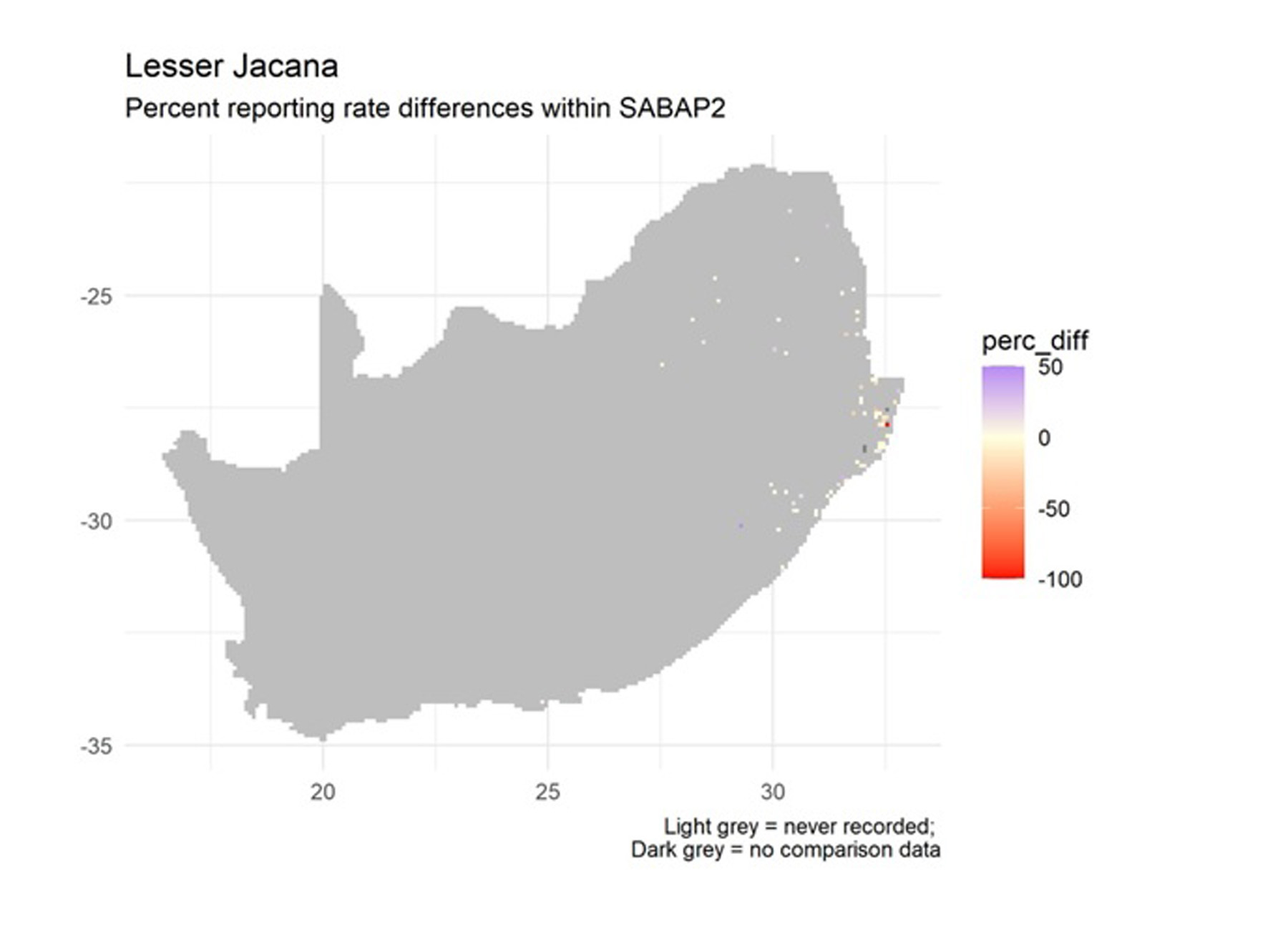
Figure 2: Distribution map of Lesser Jacana also showing pentad level change between SABAP2 periods 2007-2015 and 2016-2023 (from Lee 2024).
Ecology
Habitat:
The Lesser Jacana inhabits shallow freshwater wetlands (often those that only flood seasonally or erratically) and are vegetated by grasses and sedges rather than by water lilies and where there is relatively sparse plant cover (Tarboton and Fry 1986).
Migration:
A significant part of the population can be considered nomadic. The ephemeral nature of its habitat in the region compels birds to move in response to changing conditions, especially flooding levels (Tarboton and Fry 1986). It is possible that seasonal migration into and out of the region may occur (Hockey and Douie 1995).
Breeding:
Lesser Jacana are monogamous. Breeding in the region occurs sporadically with pairs nesting solitary. However, in ideal conditions several pairs may nest close to one another. The nests are small floating platforms of aquatic plant stems screened by emergent grass and placed next to a tuft of grass or sedge. The nest is built by both parents. Eggs are laid in most months, but the peak is in March/April. Clutch size is 2–4 (usually three) eggs which are incubated for 19 days by both parents who contribute equally to the care for the young after hatching. The fledgling period is unknown (Tarboton 2001).
Diet:
Lesser Jacana feed on insects that are gleaned from the vegetation or plucked from the surface of the water, with the latter being done mostly while bird is swimming. Foraging is chiefly done by walking at water level on emergent vegetation pecking insects off the surface of the vegetation, often pulling submerged stems from below the water to search for insects (Tarboton and Fry 1986).
Threats & Conservation
Threats
Historically the species occurred over a much larger area within South Africa and the reason for the contraction in the range is unclear. Hockey and Douie (1995) ascribe this to the probability of drainage and reclamation of large wetlands. The construction of dams and resultant river flow restrictions reduces the flood frequency of ephemeral pans and back waters of natural wetlands thereby decreasing the amount of available habitat for the species (Taylor and Peacock 2015). It is possible that pollution may also be considered a threat as the species disappeared from a pan where they regularly bred following a number of pollution events (Taylor and Peacock 2015). In seasonal shallow water pans in protected areas, breeding may be disturbed by elephant activities especially during drought years.
Conservation Measures Underway
There are no species-specific conservation measures in place. The species does occur in a number of protected sites e.g. iSimangaliso Wetland Park, which contains two Ramsar sites as per the Convention on Wetlands of International Importance especially as Waterfowl Habitat (Ramsar 2024a, Ramsar 2024b). In addition, the species is protected in terms of the provincial legislation and is included as a key species within the province’s systematic conservation plan (Taylor and Peacock 2015). There are numerous regulations and acts that govern the development along/around wetlands and waterbodies and usage of water resources that would ensure that species and their habitats are considered in the decision-making process.
Conservation Measures Proposed
The wetland habitat of the Lesser Jacana relies on the river systems feeding into them, which in turn depend on the integrity of the catchments as well as anthropological impacts along the length of these river systems. It is essential that a coordinated strategy is put in place to manage, conserve and/or protect the entire wetland system to ensure the sustainability of the habitat that the species depends upon.
The Lesser Jacana is a small secretive species, prone to nomadic movements; hence information on population numbers and trends are mainly lacking. A species’ specific long term monitoring program at identified sites where the species is regularly observed (e.g. Masibekela wetlands in the Mpumalanga Province) is required to address this issue.
Research Priorities and Questions
- Research into the impacts on the hydrology of the systems feeding into the wetlands is required and need to take into account anthropological influences from the source in the catchment areas, along the length of the river and the wetlands themselves.
- Investigating the impacts that climate change may have on these wetlands’ habitats would provide scenarios of future threats.
Contributors & References
Assessor/s
Kevin Shaw
Reviewer/s
Tawanda Tarakini
References
Allan DG. 2000. Lesser Jacana Microparra capensis. In: Barnes KN (ed), The Eskom Red Data Book of Birds of South Africa, Lesotho and Swaziland. Johannesburg, South Africa: BirdLife South Africa. pp 141–142.
BirdLife International. 2024. Microparra capensis. The IUCN Red List of Threatened Species 2024: e.T22693536A265018254. Available at https://dx.doi.org/10.2305/IUCN.UK.2024-2.RLTS.T22693536A265018254.en. [Accessed on 28 January 2025].
Berruti A. 1980. Status and review of the waterbirds breeding at Lake St Lucia. Lammergeyer 28: 1–19.
Fishpool LDC, Evans MI (eds). 2001. Important Bird Areas in Africa and associated islands: Priority sites for conservation. Newbury and Cambridge, UK: Pisces Publications and BirdLife International (BirdLife Conservation Series No. 11).
Hockey P, Douie C. 1995. Waders of southern Africa. Cape Town: Struik Winchester.
Jenni DA, Kirwan GM. 2020. Lesser Jacana (Microparra capensis). In: del Hoyo J, Elliott A, Sargatal J, Christie DA, de Juana E, (eds), Birds of the World version 1.0. Ithaca, NY, USA: Cornell Lab of Ornithology. Available: https://doi.org/10.2173/bow.lesjac1.01
Lee ATK. 2024. Regional Red Data Book of the Birds of South Africa, Lesotho and Eswatini: SABAP2 synthesis and supporting information and graphics for Lesser Jacana. Unpublished report. Johannesburg: BirdLife South Africa.
Ramsar. 2024a. St Lucia System. Ramsar Sites Information Service. Available: https://rsis.ramsar.org/ris/345 [Accessed on 02 October 2024].
Ramsar. 2024b. Lake Sibaya. Ramsar Sites Information Service. Available: https://rsis.ramsar.org/ris/528 [Accessed on 02 October 2024].
Tarakini T, Mundy P, Fritz H. 2020. Trends in savannah waterbirds: protected area effect and influence of global threats on differing guilds. Ostrich 91(2): 1–11. Available: 10.2989/00306525.2020.1722972.
Tarboton WR, Fry CH. 1986. Breeding and other behaviour of the Lesser Jacana. Ostrich 57: 233–243.
Tarboton WR, Kemp MI, Kemp AC. 1987. Birds of the Transvaal. Pretoria: Transvaal Museum.
Tarboton WR. 1997. Lesser Jacana Microparra capensis. In: Harrison JA, Allan DG, Underhill LG, Herremans M, Tree AJ, Parker V, Brown CJ (eds), The atlas of southern African birds. Vol1: Non–passerines. Johannesburg: Birdlife South Africa. pp 370–371.
Tarboton W. 2001. A guide to the nests & eggs of southern African birds. Cape Town: Struik Publishers.
Tarboton WR. 2005. Lesser Jacana Microparra capensis. In: Hockey PAR, Dean WRJ, Ryan PG (eds), Roberts Birds of Southern Africa (7th Edn). Cape Town: John Voelcker Bird Book Fund. pp 383–385.
Taylor MR, Peacock F. 2015. Lesser Jacana Microparra capensis. In: Taylor MR, Peacock F, Wanless RW (eds), The Eskom Red Data Book of Birds of South Africa, Lesotho and Swaziland. Johannesburg, South Africa: BirdLife South Africa. pp 227–229.
Whittington PA. 2004. Lesser Jacanas breeding in the Eastern Cape. Bee–eater 55: 2–4.
Citation
Shaw K 2025. Lesser Jacana. In: Lee ATK, Rose S, Banda S, Bezeng SB, Maphalala MI, Maphisa DH, Smit-Robinson H (eds), The 2025 Red Data Book of Birds of South Africa, Lesotho and Eswatini. Johannesburg, South Africa: BirdLife South Africa. Available at: https://www.birdlife.org.za/red-list/lesser-jacana/
Our generous sponsors


