


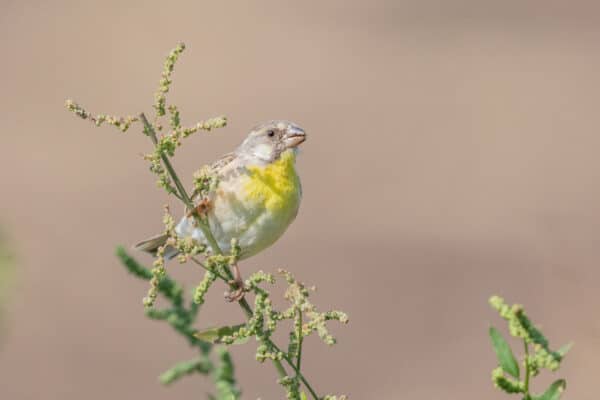
Lemon-breasted Canary
Crithagra citrinipectus

Number Of Mature
Individuals (Regional)
<10 000

Regional
Population Trend
Decreasing
2025
Regional Category
Near Threatened
Search by species
CONTENTSOverview
Names
|
IOC English Name: |
Lemon-breasted Canary |
|
SA & IOC Scientific Name: |
Crithagra citrinipectus |
|
BirdLife International Taxonomy (scientific name): |
Crithagra citrinipectus |
|
Order |
Passeriformes |
|
Family: |
Fringillidae |
|
Species name author: |
Clancey and Lawson 1960 |
|
Afrikaans: |
Geelborskanarie |
|
Sesotho (South Africa): |
|
|
Sesotho (Lesotho): |
|
|
Siswati: |
|
|
Zulu: |
umalaleni |
Current Assessment Status
|
2025 Regional Status [Criteria] |
NT [B2] |
|
2024 Global Category [Criteria] |
LC (BirdLife International 2018) |
|
Population Size (Regional) |
<10 000 |
|
Population Size (Global) |
Unknown (BirdLife International 2018) |
|
Distribution size (EOO) (Regional) km2 |
53 930 (Lee 2024) |
|
Distribution size (EOO) (Global) km2 |
519 000 (BirdLife International 2018) |
|
Distribution Size (AOO) km2 |
3600 (Lee 2024) |
|
Generation time |
3.8 years (BirdLife International 2018) |
|
Status Change Reason |
No change |
|
Migrant |
No |
|
Regional Endemic |
No |
Historic Listing Information
|
2000 Regional Status |
NT [C1] |
|
2015 Regional Status |
NT [A2c] |
|
Status change reason (if applicable) |
Not applicable |
|
2015 Population size (Regional) |
<10 000 mature individuals |
|
2015 Global Status |
LC |
Reason for Inclusion
Reason for Inclusion in the Assessment
The species was assessed as Near Threatened in the 2015 and 2000 assessments and as Rare in the 1984 assessment.
Category Justification
Category Justification
Concerns for the conservation of the Lemon-breasted Canary Crithagra citrinipectus stem mainly from its globally restricted range and general poor knowledge of the species. It is not known whether this species is still exported in large numbers from Southern Mozambique (which directly borders this regional population). Population estimates and trends are still poorly understood.
Regionally, Extent of Occurrence (EOO) is large and does not approach the Vulnerable threshold (<20 000 km2, Lee 2024). However, the two regional populations are apparently isolated from each other and may be considered fragmented. There is no evidence of extreme fluctuations in Area of Occupancy (AOO), EOO, number of locations or number of mature individuals. From the SABAP2 atlas data there is no apparent evidence of decline in AOO in the region (Lee 2024).
AOO is estimated to be 3600 km2 based on the number of pentads in which this species has been recorded (Lee 2024). Given that Lemon-breasted Canary occurs at low densities (and thus is unlikely to occur throughout the pentad, due to very specific and limited habitat availability) this is almost certainly an over estimation.
There is insufficient data to downlist this species given the uncertainty of the scale of the pet bird trade in particular. The 2015 assessment outcome of Near Threatened is maintained but the Criterion have changed to B2.
Population Justification
The global population size has not been quantified, but the species is described as local and uncommon within its limited range, although occasionally abundant (Clement et al. 1999), forming flocks of hundreds during suitable environmental conditions. Parker (1999) suspected that the population in southern Mozambique exceeds 50 000 birds. No population estimates exist for South Africa, but the number of birds in the region is certainly <10 000 mature individuals (Taylor and Peacock 2015). Confidence in this regional population estimate is low, and an updated regional population size is needed.
Trend Justification
The global population is suspected to be in overall decline owing to harvesting pressures on the palms with which it is strongly associated, plus trapping for the cage-bird trade (Allan 2000, Clement et al. 1999). The utilisation of the Lemon-breasted Canary in the bird-trade is mentioned as far back as the early 1970s (Clancey 1971), while Parker (1999) noted that up to 2000 birds are exported per year from southern Mozambique. No recent data on this trade exists. A lack of population data complicates inferring a population trend. Previously considered to be in decline (Taylor and Peacock 2015) there is no recent evidence of decline based on changes in AOO. Confidence in the regional population trend estimate is low and requires verification.
Biology & Ecology
Taxonomy
Barring taxonomic ‘splits’, the Lemon-breasted Canary was the last new species to be described from southern Africa, from material collected near Panda, southern Mozambique (Clancey and Lawson 1960). The Lemon-breasted Canary is generally regarded as the eastern counterpart of the Black-throated Canary C. atrogularis, and the two taxa have mutually exclusive ranges. The species is monotypic.
Identification
12 cm, 11 g. A tiny lowland canary. Sexes differ in plumage. Face greyish with dark grey malar stripe; supra-loral spot, spot at base of bill, and spot on ear coverts white or yellowish. Upperparts pale grey-brown with broad dark brown streaks. Male has diagnostic yellow breast patch, contrasting with white belly; breast buff in female. Flight feathers blackish- brown with wing bars showing flashes of white. Rump bright yellow. Tail tipped white (Berruti 1997, Dean 2005).
Distribution
The Lemon-breasted Canary is an uncommon, highly localised near-endemic to the region. It is one of four species with global ranges of <50 000 km2 defining the South-east African Coast Endemic Bird Area (Stattersfield et al. 1998). Its range is centred in Mozambique, which encompasses the majority of its global distribution, but it also extends to southern Malawi and the lowlands of south-eastern Zimbabwe. Within the region, it occurs in north-eastern Zululand, from about St Lucia northwards, and marginally into the north-eastern portion of Kruger National Park (Allan 2000). Its southern distribution is linked to that of the Southern Lala Palm Hyphaene coriacea, a common tree in Maputaland where large stands of the palm grow almost to the exclusion of anything else. In the far northern Kruger National Park its distribution is linked to the extensive floodplains of the Limpopo and Luvuvhu Rivers which are dominated by the Northern Lala Palm H. petersiana and the robust grass Sporobolus consimilis (D. McKenzie pers obs). Since 2015 EOO has contracted very slightly (c. 1%) based on SABAP2 data, with AOO remaining very similar (Lee 2024). Its numbers are variable at the same locality from year to year with movements probably being linked to irregular rainfall (Berruti 1997). The species has been recorded from five IBAs including Kruger National Park, Kosi Bay System, Mkuze Game Reserve, Hluhluwe-iMfolozi Park and the iSimangaliso Wetland Park.
Ecology
The species is found in lowland palm savannah, floodplain grasslands, clearings in dry woodland, Brachystegia scrub and grassland, invariably below 750 m asl (Robson 1990, McKenzie et al. 2023). It appears to benefit from moderate levels of habitat modification, and is often common around rural gardens, road verges and edges of cultivation, for example. The species is a monogamous, solitary nester with breeding taking place from December to February (Tarboton 2011). Outside the breeding season it is gregarious, often forming nomadic flocks with Yellow-fronted Canary C. mozambica that wander in search of seeding grass (Hustler 1991). Nests are often placed in fronds of Lala Palms and constructed largely with palm fibres.
Threats & Conservation
Threats
The Lala Palm is one of the most economically important plants in Maputaland and adjacent Mozambique, supplying sap used for the brewing of alcoholic wine, material for cane furniture and fibre, for domestic consumption and sale. Overexploitation likely poses a threat to Lemon-breasted Canaries. Conversely, woodland clearing, and small-scale agriculture probably provides additional habitat for the Lemon-breasted Canary. In neighbouring Mozambique, the collection of birds for the cage-bird trade is of concern; it is unknown whether this constitutes a threat in South Africa.
Conservation Measures Underway
No species-specific measures are underway.
Conservation Measures Proposed
The species is well represented in protected areas. However, it is also commonly reported in unprotected areas (Figure 1, Table 1, Lee 2024).
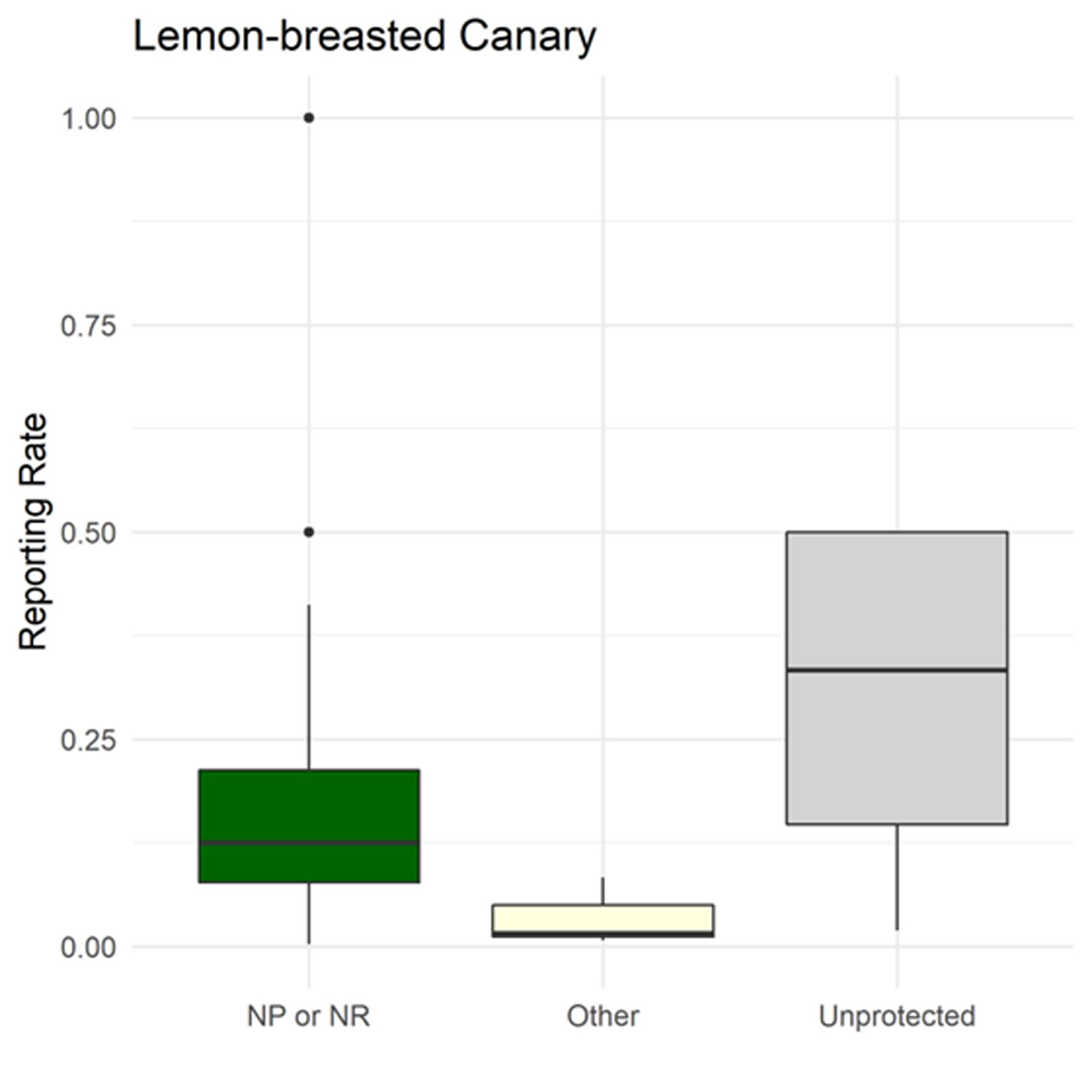
Figure 1: Boxplot comparisons of SABAP2 reporting rates of pentads within National Parks (NP)/Nature Reserves (NR), ‘Other’ (conservancies, Biosphere Reserves, etc.) and ‘Unprotected’ areas in the range of Lemon-breasted Canary. The ratio of range (number of pentads) in both protected categories to unprotected is 3.9. Values over 1 indicate most of the range is in a protected area. See Table 1 below for a breakdown. From Lee 2024.
Table 3: Lemon-breasted Canary occurrence within National Parks (NP)/Nature Reserves (NR), ‘Other’ (conservancies, Biosphere Reserves, etc.) and ‘Unprotected’ areas in the range of Lemon-breasted Canary. From Lee 2024.
|
Protection status |
Pentads |
|
NP or NR |
36 |
|
Other |
3 |
|
Unprotected |
10 |
Research Priorities and Questions
- Establishing the scale of the pet bird trade in Mozambique and South Africa is urgently required.
- Establishing the population size of the regional population to better understand trends and threats is required.
- A better understanding of the impacts of the harvesting and clearing of Lala Palms is likely required.
- Determine if the apparently isolated population in the northern Kruger National Park is linked to coastal populations along the floodplains of the Limpopo River in Mozambique.
Contributors & References
Assessor/s
Dominic Rollinson
Reviewer/s
Duncan McKenzie
References
Allan DG. 2000. Lemon-breasted Canary Crithagra citrinipectus. In: Barnes KN (ed), The Eskom Red Data Book of Birds of South Africa, Lesotho, and Swaziland. Johannesburg, South Africa: BirdLife South Africa. pp 150.
Berruti A. 1997. Lemonbreasted Canary Serinus citrinipectus. In: Harrison JA, Allan DG, Underhill LG, Herremans M, Tree AJ, Parker V, Brown CJ (eds), The atlas of southern African birds Vol II: Passerines. Johannesburg, South Africa: BirdLife South Africa. pp 649.
BirdLife International. 2018. Species factsheet: Lemon-breasted Canary Crithagra citrinipectus. Available: http://www.birdlife.org [Accessed on 25 July 2024].
Clancey PA. 1971. A handlist of the birds of Southern Moçambique. Part 2. Passeriformes. Memórias do Instituto de Investigação Científica de Moçambique 11: 1-167.
Clancey PA, Lawson W. 1960. A new species of canary from southern Portuguese East Africa. Durban Museum Novitates 6(4): 61–64.
Clement P, Harris A, Davis J. 1999. Finches and Sparrows: An Identification Guide. London, UK: Christopher Helm.
Dean WRJ. 2005. Lemon-breasted Canary Serinus citrinipectus. In: Hockey PAR, Dean WRJ, Ryan PG (eds), Roberts – Birds of Southern Africa. 7th Edn. Cape Town, South Africa: The Trustees of the John Voelcker Bird Book Fund. pp 1122–1123.
Hustler K. 1991. Current status of the Lemon-breasted Canary in Zimbabwe. Honeyguide 37: 185–186.
Lee ATK. 2024. Regional Red Data Book of the Birds of South Africa, Lesotho and Eswatini: SABAP2 synthesis and supporting information and graphics for Lemon-breasted Canary. Unpublished report. Johannesburg: BirdLife South Africa.
McKenzie D, Chittenden H, Whyte I. 2023. Roberts Bird Guide: Greater Kruger National Park. 2nd Edn. Cape Town, South Africa: The John Voelcker Bird Book Fund.
Parker V. 1999. The atlas of the birds of Sul do Save, southern Mozambique. Cape Town: Avian Demography Unit, University of Cape Town.
Robson NF. 1990. First recorded nest of the Lemon-breasted Canary in the field. Ostrich 61: 84– – 85.
Stattersfield AJ, Crosby MJ, Long AJ, Wege DC. 1998. Endemic Bird Areas of the World: Priorities for Biodiversity Conservation. Cambridge, UK: BirdLife International.
Tarboton WR. 2011. Roberts Nests and Eggs of Southern African Birds. Cape Town, South Africa: The Trustees of the John Voelcker Bird Book Fund.
Taylor MR, Peacock F. 2015. Lemon-breasted Canary Crithagra citrinipectus. In: Taylor MR, Peacock F, Wanless RW (eds), The Eskom Red Data Book of Birds of South Africa, Lesotho and Swaziland. Johannesburg, South Africa: BirdLife South Africa. pp 287– 288.
Citation
Rollinson D 2025. Lemon-breasted Canary. In: Lee ATK, Rose S, Banda S, Bezeng SB, Maphalala MI, Maphisa DH, Smit-Robinson H (eds), The 2025 Red Data Book of Birds of South Africa, Lesotho and Eswatini. Johannesburg, South Africa: BirdLife South Africa. Available at: https://www.birdlife.org.za/red-list/lemon-breasted-canary/
Our generous sponsors


