


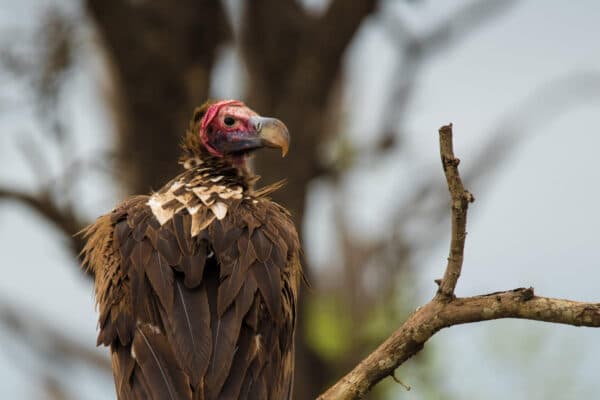
Lappet-faced Vulture
Torgos tracheliotos

Number Of Mature
Individuals (Regional)
160

Regional
Population Trend
Decreasing
2025
Regional Category
Critically Endangered
Search by species
CONTENTSOverview
Names
|
IOC English Name: |
Lappet-faced Vulture |
|
SA & IOC Scientific Name: |
Torgos tracheliotos |
|
BirdLife International Taxonomy (scientific name): |
Torgos tracheliotos |
|
Order: |
ACCIPITRIFORMES |
|
Family: |
Accipitridae |
|
Species name author: |
Forster 1796 |
|
Afrikaans: |
Swartaasvoël |
|
Sesotho (South Africa): |
letlaka-pipi |
|
Sesotho (Lesotho): |
letlaka-pipi |
|
Siswati: |
Lingce |
|
Zulu: |
indlangamandla |
Current Assessment Status
|
2025 Regional Category [Criteria] |
CR [A2bde+3de+4bde; C1] |
|
2024 Global Category [Criteria] |
EN [A2abcd+3bcd+4abcd] (BirdLife International 2021) |
|
Population size (Regional) |
160 |
|
Population size (Global) |
6500 (BirdLife International 2021) |
|
Distribution size (EOO) (Regional) km2 |
1 129 197 (Lee 2024) |
|
Distribution size (EOO) (Global) km2 |
34 200 000 (BirdLife International 2021) |
|
Distribution size (AOO) (Regional) km2 |
325 152 (Lee 2024) |
|
Generation time |
14.7 (BirdLife International 2021) |
|
Status change reason |
Genuine Change in Status |
|
Migrant (in the region) |
No |
|
Regional endemic |
No |
Historic Listing Information
|
2000 Regional Status |
VU [C1] |
|
2015 Regional Status |
EN [A3d; C2a(ii)] |
|
Status change reason (if applicable) |
Genuine Change in Status |
|
2015 Population size (Regional) |
338 |
|
2015 Global Status |
EN [A2bcd+3bcd+4bcd] |
Reason for Inclusion
Reason for Inclusion in the Assessment
The Lappet-faced Vulture Torgos tracheliotos was assessed in 2015 as regionally Endangered (Allan 2015).
Category Justification
Category Justification
Lappet-faced Vulture qualifies as Critically Endangered (CR) in the regional context based on two criteria. Under Criterion A, the species demonstrates a substantial population decline, estimated at 97% over three generations (approximately 44 years, considering a generation time of 14.69 years), attributed to poisoning, habitat loss, and exploitation. This decline satisfies thresholds for A2bde (past reduction), A3de (future reduction), and A4bde (past and future reduction), where the causes of decline are neither reversible, ceased, nor fully understood. Under Criterion C1, the regional population size is estimated at 160 mature individuals, which is well below the threshold for CR (<250 mature individuals). The ongoing annual decline rate of 7.9%, inferred from systematic monitoring across core regions such as the Kruger National Park and KwaZulu-Natal, supports C1. Given the extent of population crashes across its global range, a ‘regional rescue effect’ is considered unlikely. Due to its restricted population and persistent threats, the regional status of the Lappet-faced Vulture has justifiably escalated to CR.
Population Justification
BirdLife International (2021) estimate the global population to be 6500 mature individuals but intimated that this was an overestimate considering the current trends for the species. This estimate is based on dated information, e.g. 1997 for Zimbabwe, 2000 for South Africa and 2005 for Tanzania, Ethiopia and Egypt.
The regional population was estimated by Allan (2015) to be 338 mature individuals (169 breeding pairs). This was based on 78 pairs for the Kruger National Park, 50 pairs in the Northern Cape Province, 18 pairs in KwaZulu-Natal, three pairs in Eswatini and perhaps a further 20 pairs outside these areas. Current available data for the species is six pairs for KwaZulu-Natal (Ezemvelo KZN Wildlife 2023) and 28 pairs for Kruger National Park (Botha, Murn et al. In prep), no breeding in Eswatini for at least a decade (A. Monadjem pers comm) and unknown for the other areas. Applying the percentage decline estimated from available data (see Trend Justification) to Allan’s (2015) regional population estimate (169 breeding pairs) it is postulated that the regional population is c. 80 breeding pairs (c. 160 mature individuals). Confidence in this estimate is medium.
Trend Justification
Ogada et al. (2015) estimated that the African population of the species was declining at 3.5% (-2.3%, -4.5%) per year c. 79% over three generations. In order to analyse regional trends data were obtained from surveys in the Kruger National Park (Hawk Conservancy Trust and the Endangered Wildlife Trust (EWT) Vultures for Africa Programme), KwaZulu-Natal (Ezemvelo KZN-Wildlife) and Northern Cape (EWT’s Birds of Prey Programme for six localised areas within the province with a maximum of nine nests). Percentage declines for each area were calculated and ratios applied according to Allan (2015) population sizes for the respective areas. It was estimated that the population is declining at 8.5% per year c. 98% over three generations. Confidence in this estimate is high.
Biology & Ecology
Taxonomy
The Lappet-faced Vulture is considered sufficiently distinct to merit a monospecific genus, but there have been suggestions to merge the genus with Aegypius (White 1951, Streseman and Amadon 1979, Wink and Sauer-Gürth 2004). Three subspecies are recognised although morphological variation appears to be largely individual and clinal placing doubt on the validity of races (Kemp et al. 2020):
- T.t. tracheliotos: S Mauritania E to Somalia, Ethiopia and Kenya, S to Namibia, N South Africa and Eswatini; extinct in NW Africa (SW Morocco, Western Sahara);
- T.t. nubicus: SE Egypt and N Sudan;
- T.t. negevensis: Arabian Peninsula; extinct as a breeding species in S Israel.
The original spelling of the species name has been disputed between “tracheliotos” and “tracheliotus”, but Mundy et al. (1992) ascribe the latter species name to an incorrect spelling in early translations of manuscripts.
Identification
98–105 cm, 4.4–8.5 kg (Mundy et al. 1992). Sexes are alike in the subspecies T.t. tracheliotos. The Lappet-faced Vulture is substantially larger than other vultures, having an overall dark (brown to black) appearance with the belly and thighs covered in white silky down. The breast has long dark brown lanceolate feathers, through which the white down feathers are visible giving a streaked appearance. The head is large, bare with a pink to blue colouration and has prominent skin folds and lappets (Piper 2005). The bill is massive yellowish in colour with a blue grey base. Eyes are blackish brown, with blue-grey legs and feet. Juvenile birds may be confused with juvenile White-headed Vulture Aegypius occipitalis and Hooded Vulture Necrosyrtes monachus. The latter is half the size of a Lappet-faced Vulture with a slender bill. White-headed Vultures have a square tail (not wedge-shaped and have pale (as opposed to dark) tips to the underwing coverts (Piper 2005).
Distribution
Historically the distribution of the Lappet-faced Vulture would have covered much of the African continent but is now restricted to south-western Morocco and Africa south of the Sahara, Egypt and northern Sudan, southern Israel and the Arabian Peninsula (Mundy et al. 1992). Regionally the species occurred over a much wider area but is now restricted to the northern regions of South Africa and in eastern Eswatini (Mundy 1997, Figure 1). The species is however no longer a breeding a breeding resident in Eswatini (A. Monadjem pers comm). Comparing distribution maps of the first South African Bird Atlas Project (SABAP1) (1986-1997) with second (current, 2007- ongoing, SABAP2) atlas the distribution appears similar except in the latter there are records of the species further west in Kwa-Zulu Natal (Allan 2015) and west/southwest of Upington in the Northern Cape.
Comparing data within SABAP2 (2007-2015 versus 2016-2023), the reporting rates for the species in the western portion of Kwa-Zulu Natal have remained similar indicating that the species is still utilizing the area, and those areas to the west/southwest of Upington the reporting rates indicate a relatively recent “extension” to the distribution range (Lee 2024). This may be due to sightings of birds dispersing from Namibia.
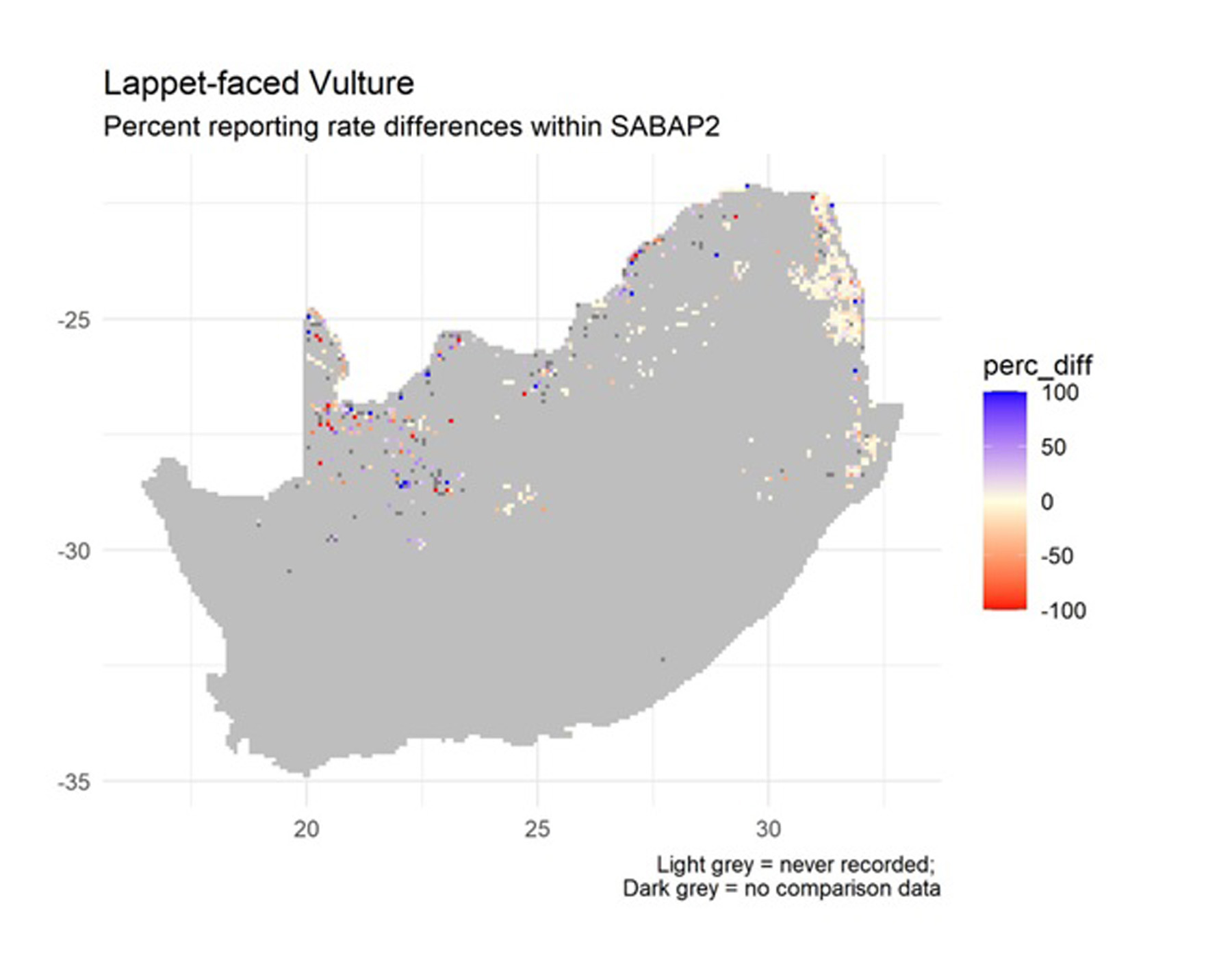
Figure 1: Distribution map of Lappet-faced Vulture also showing pentad level change between SABAP2 periods 2007-2015 and 2016-2023. Map from Lee (2024).
Ecology
Habitat:
Lappet-faced Vultures occur in semi-arid regions showing a marked preference for open woodlands (Mundy et al. 1997).
Migration:
Adult Lappet-faced Vultures are predominantly resident (Oatley et al. 1998), but young birds do move over long distance, but it is unclear whether these are nomadic or dispersal movements (Piper 2005).
Breeding:
The species is a solitary nester and are territorial around the nest, although nests can be situated close (<700 m) to one another (Mundy et al. 1992). They are monogamous and probably pair for life (Mundy et al. 1992). Nests constructed of large sticks, lined with grass, hair and skin are placed in the crown of isolated, flat-crowned trees, and are built by both parents (Tarboton 2001). Usually, one egg is laid, rarely two, and a replacement clutch is laid following an early failure. The eggs are incubated by both sexes for a period of 55–56 days, followed by a nestling fledgling period of 125–28 days, brooded and fed by both sexes (Mundy et al. 1997).
Diet:
Lappet-faced Vultures visit carcasses of large animals (impala to elephant) more for social interaction than for feeding (Mundy et al. 1987). They will often wait until activity around the carcass has dissipated before feeding on predominantly the skin, tendons and ligaments, using its strength to remove these items from the carcass (Mundy et al. 1997). The species seldom feeds on meat, organ and viscera but if a bird does secure a piece of meat, it usually moves away from the carcass to feed, using feet to hold the food item while ripping pieces off with the beak much like an eagle (Piper 2005, Mundy et al. 2007).
Recorded prey remains found in the nest were predominantly small animals (monitor lizards, birds, hares, rodents, etc.) suggesting that the species can catch its own prey (Mundy et al. 1997). The species has been recorded preying on young and adult Greater Phoenicopterus roseus and Lesser Flamingos P. minor at Lake Natron, Tanzania (Brown 2008) and on young and adult Lesser Flamingos at Makgadikgadi salt pans, Botswana (McCulloch 2004, McCulloch 2006). It is suspected that during the extended drought period of 2017-2023/4 Lappet-faced Vultures preyed upon weak newborn lambs in Namibia (A. Botha pers comm).
Threats & Conservation
Threats
The predominant threat to this species is poisoning (Simmons 1995, Oatley et al. 1998, Anderson 2000, Curk et al. 2024). Intentional poisoning (sentinel poisoning) was listed in both the International Vulture Multi-species Action Plan (Botha et al. 2017) and the Multi-species Biodiversity Management Plan for Vultures in South Africa (Department of Fisheries, Forestry and Environment 2024) as a threat to Lappet-Faced Vultures. Mander et al. 2007 indicate that the species is used by traditional healers albeit in low numbers. Shimelis et al. (2005) reported 49 mortalities due to electrocutions and powerline collisions between 1996 and 2003. The majority of these would have been from electrocutions on certain power line configurations in the Northern Cape Province reported by Kruger et al. (2004). While the areas of high risk have been identified and the line configuration changed to one that poses less risk to the species, vigilance is required to prevent further mortalities in new areas especially considering a possible range expansion in this province. Other threats include drowning in farm reservoirs (Anderson et al. 1999, Herholdt and Anderson 2006), disturbance at nest sites (Steyn 1982, Bridgeford and Bridgeford 2003), destruction of nesting trees (Simmons and Bridgeford 1997) continued destruction of natural habitats (Anderson 2000), and possibly collisions with wind turbines (McClure et al. 2021).
Conservation Measures Underway
South Africa’s National Vulture Task Force established by the Department of Forestry, Fisheries and the Environment coordinates vulture conservation efforts within South Africa and is the designated implementing agent of the Multi-species Biodiversity Management Plan for Vultures in South Africa that was gazetted in March 2024 (Department of Forestry, Fisheries and the Environment 2024). The EWT also has a “Vultures for Africa Programme” that implements specific actions identified in the Vulture Multi-species Action Plan under the Convention on the conservation of Migratory Species.
In 2008 South Africa signed the Convention on the Conservation of Migratory Species Memorandum of Understanding on Birds of Prey (CMS Raptors MOU) which is a non-binding Multilateral Environmental Agreement aiming to improve domestic legal protection for migratory birds of prey, which includes vultures. The objective of the MOU is to promote international coordinated actions to achieve and maintain the favourable conservation status of migratory birds of prey throughout their respective ranges in the African Eurasian region and to reverse their decline
The IUCN Vulture Specialist Group was established in 2011 to coordinate vulture conservation and research across all continents where vultures and condors occur. This group has its own scientific journal (Vulture News) which is a valuable resource for vulture monitoring and research projects. This Group was also the driving force behind the CMS Multi-species Action Plan to conserve African-Eurasian Vultures (Botha et al. 2017). The CMS Vulture MsAP provided the framework for the draft on the Multi-species Biodiversity Management Plan for Vultures in South Africa.
An international species action plan was compiled in 2005 specifically for the Lappet-faced Vulture (Shimelis et al. 2005) and while the term of the plan has expired information from this plan fed into the current multispecies action plan and the biodiversity management plan.
Monitoring programmes are in place to annually monitor the number of breeding attempts in Kwa-Zulu Natal (by Ezemvelo KZN Wildlife), Kruger National Park (EWT’s Vulture for Africa Programme and the Hawk Conservancy Trust), and Eswatini (University of Eswatini). The EWT/Hawk Conservancy Trust partnership is also assessing the impact of African Elephant damage on nesting trees, an issue that has been suggested as a possible threat in previous studies e.g. Rushworth et al. (2018) and Cook et al. (2025). The South African National Parks Board (managing authority for Kruger National Park) as from 2024 has formally included vulture nests to their annual wildlife census (A Botha pers comm). In addition to these, area wide monitoring programs several individual nests (pairs) are monitored in the Northern Cape by the EWT’s Birds of Prey Programme. Also tracking devices have been fitted to birds in the Greater Kruger National Park and Kwa-Zulu Natal Province (A Botha and B Coverdale pers comm) to study the movement biology of the species in the region.
The Lead Task Team, a task team of the Department of Forestry Fisheries and Environmental Affairs National Wildlife Poison Prevention Working Group, is addressing the issue of lead contamination in the environment, which would benefit the species preventing possible lead ingestion from carcasses of hunted species.
Conservation Measures Proposed
- Implementation of actions in South Africa’s 2024 gazetted Vulture Multi-species Biodiversity Management Plan (Department of Forestry, Fisheries and the Environment 2024) relevant to the Lappet-faced Vulture.
- Existing threats most notably the threat posed by poisoning will require continual investigation and will need to be addressed and mitigated.
- Regular and accurate censuses of Lappet-Faced Vulture in the key areas, KwaZulu-Natal, Kruger National Park and the Northern Cape Province are a high priority.
- In terms of vulture use in the belief-based use trade, Mander et al. (2007) requested that the following actions be undertaken: Reduce the demand for vultures through awareness campaigns; create policies that will improve regulation of the vulture trade; improve policing and enforcement of the trade and; improve understanding of the trade allowing more focused interventions.
- Implementation of effective measures to safeguard Lappet-faced Vulture nesting trees from disturbance and damage due to human activities and, in protected areas where the species shares the habitat with elephants, from damage by these mega-herbivores.
- Remain vigilant and work towards banning the veterinary use of potentially lethal NSAID’s and other drugs that could pose a threat to Lappet-faced Vultures.
Research Priorities and Questions
- Expansion of the satellite tracking effort to include more birds and other areas. As these birds move over large areas (especially young birds), flying into countries north of the region appropriate devices need to be used. Tracking studies will not only establish foraging patterns but may also help determine mortality factors and rates.
- Annual appropriate marking of nestlings needs to be initiated to compliment tracking studies as well as providing information on causes of mortality and survival rates.
- Using data from the tracking studies to investigate the potential value of supplementary feeding schemes. This should be done in conjunction with the needs of other vulture species.
- Periodic investigations into the use of Lappet-faced and other vultures are necessary to stay abreast of traditional health industry demands.
- Determine whether mitigation measures implemented on power infrastructures reduce mortalities to acceptable levels.
- Investigate the impact of land-use change on the availability of nesting trees for vultures and vulture breeding productivity.
- In protected areas investigate the impacts of elephants on nesting trees and implement appropriate mitigation measures to prevent further loss of nesting trees.
- Establish what the effects of untested nonsteroidal anti-inflammatory drugs (NSAIDS) are on Lappet-Faced Vultures by carrying out trials on more common, less threatened species where feasible.
Contributors & References
Assessor/s
Kevin Shaw
Reviewer/s
Lindy Thompson, Ara Monadjem, Andre Botha
References
Allan DG. 2015. Lappet-faced Vulture Torgos tracheliotos. In: Taylor MR, Peacock F, Wanless RW (eds), The Eskom Red Data Book of Birds of South Africa, Lesotho and Swaziland. Johannesburg, South Africa: BirdLife South Africa. pp 179–182.
Anderson MD, Maritz AWA, Oosthuysen E. 1999. Raptors drowning in farm reservoirs in South Africa. Ostrich 70: 139–144.
Anderson MD. 2000. Lappet-faced Vulture Torgos tracheliotos. In: Barnes KN (ed), The Eskom Red Data Book of Birds of South Africa, Lesotho and Swaziland. Johannesburg, South Africa: BirdLife South Africa. pp 77–79.
BirdLife International. 2021. Torgos tracheliotos. The IUCN Red List of Threatened Species 2021: e.T22695238A205352949. https://dx.doi.org/10.2305/IUCN.UK.2021-3.RLTS.T22695238A205352949.en. [Accessed on 06 November 2024].
Botha AJ, Andevski J, Bowden CGR, Gudka M, Safford RJ, Tavares J, Williams NP. 2017 Multispecies action plan to conserve African-Eurasian Vultures. CMS Raptors MOU Technical Publication No 5. CMS Technical Series no 35. Coordinating Unit of the CMS Raptors MOU, Abu Dhabi, United Arab Emirates.
Bridgeford P, Bridgeford M. 2003. Ten years of monitoring breeding Lappet-faced Vultures Torgos tracheliotos in the Namib-Naukluft Park Namibia. Vulture News 48: 3–11.
Brown LH. 2008. The breeding behaviour of the Lesser Flamingo Phoeniconaias minor. Ibis 113(2): 147–172.
Cook RM, Witkowski ETF, Henley MD. 2025. Impacts of African elephants and other environmental drivers on trees nested in by critically endangered white-backed vultures. Wildlife Biology e01335: 1–14.
Curk T, Melzheimer J, Aschenborn O, Amar A, Kolberg H, Garbett R, Maude G, Reading RP, Selebatso M, Berzaghi F, Hempson GP, Botha A, Thomson RL, Tate G, Spiegel O, Santangeli A. 2024. Integrating threat mapping and animal movement data to identify high risk areas for endangered mobile species. Animal Conservation DOI:10.1111/acv.12980.
Department of Forestry, Fisheries and the Environment. 2024. National Environmental Management: Biodiversity Act, 2004 (Act 10 of 2004): Public notice for the National Vulture Multi-Species Biodiversity Management Plan (BMP). Gazette No 50306 18th March 2024.
Kemp AC, Christie DA, Sharpe CJ. 2020. Lappet-faced Vulture (Torgos tracheliotos). In: del Hoyo J, Elliott A, Sargatal J, Christie DA, de Juana E (eds), Birds of the World version 1.0. Ithaca, NY, USA: Cornell Lab of Ornithology. Available: https://doi.org/10.2173/bow.lafvul1.01
Kruger R, Maritz A, van Rooyen C. 2004. Vulture electrocutions on vertically configured medium voltage structures in the Northern Cape Province, South Africa. In: Chancellor RD, Meyburg B-U (eds), World Working Group Birds of Prey and MME. Budapest: Birdlife Hungary.
Lee ATK. 2024, Regional Red Data Book of the Birds of South Africa, Lesotho and Eswatini: SABAP2 synthesis and supporting information and graphics for Lappet-Faced Vulture Canary. Unpublished report. BirdLife South Africa: Johannesburg.
Mander M, Diederichs N, Ntuli L, Mavundla K, Williams V, McKean S. 2007. Survey of the trade in vultures for the traditional health industry in South Africa. Unpublished Report.
McClure CJW, Dunn L, McCabe JD, Rolek BW, Botha A, Virani MZ, Buij R, Katzner TE. 2021. Flight Altitudes of Raptors in Southern Africa Highlight Vulnerability of Threatened Species to Wind Turbines. Frontiers in Ecology and Evolution 9: 667384. DOI: 10.3389/fevo.2021.667384
McCulloch G. 2004. Flamingo predation by Lappet-faced Vultures. Vulture News 51: 78.
McCulloch G. 2006. Lappet-faced Vultures – social hunters? Vulture News 55: 10–13.
Mundy P, Butchart D, Ledger J, Piper S. 1992. The Vultures of Africa. London: Academic Press Ltd.
Mundy PJ. 1997. Lappet-faced Vulture Torgos tracheliotos. In: Harrison. JA, Allan, DG, Underhill, LG, Herremans, M, Tree, AJ, Parker V, Brown CJ (eds), The atlas of southern African birds. Vol1: Non-passerines. Johannesburg: Birdlife South Africa. pp 162–163.
Oatley TB, Oschadleus HD, Navarro RA, Underhill LG. 1998. Review of ring recoveries of birds of prey in southern Africa: 1948-1998. Johannesburg: Endangered Wildlife Trust.
Ogada D, Shaw P, Beyers RL, Buij R, Murn C, Thiollay JM, Beale CM, Holdo RM, Pomeroy D, Baker N, Krüger SC, Botha A, Virani MZ, Monadjem A, Sinclair ARE. 2015. Another continental vulture crisis: Africa’s vultures collapsing toward extinction. Conservation Letters 1–9.
Piper SE. 2005.Lappet-faced Vulture Torgos tracheliotos. In: Hockey PAR, Dean WRJ, Ryan PG (eds), Roberts – Birds of Southern Africa, 7th Edn. Cape Town: The Trustees of the John Voelcker Bird Book Fund. pp 491–492.
Rushworth IA, Druce DJ, Craigie J, Coverdale B. 2018. Vulnerability of vulture populations to elephant impacts in KwaZulu-Natal. Bothalia 48(2): 1–10.
Shimelis A, Sande E, Evans S, Mundy P (eds). 2005. International Species Action Plan for the Lappet-faced Vulture, Torgos tracheliotos. Sandy, Bedfordshire, UK: BirdLife International, Nairobi, Kenya and Royal Society for the Protection of Birds.
Simmons RE.1995. Mass poisoning of Lappet-faced Vultures in the Namib Desert. Journal of African Raptor Biology 10.
Simmons RE, Bridgeford P. 1997. The status and conservation of vultures in Namibia. In: Boshoff AF, Anderson MD, Borello WD (eds), Vultures in the 21st Century: Proceedings of a workshop on vulture research and conservation in southern Africa. Johannesburg: Vulture Study Group. pp 67–75.
Steyn P. 1982. Birds of Prey of southern Africa. Cape Town, South Africa: David Philip.
Stresemann E, Amadon D. 1979. Order Falconiformes. In: Mayr E, Cottrell GW (eds), Check-list of birds of the world Vol 1. pp 271–425.
Tarboton W. 2001. A guide to the nests & eggs of southern African birds. Cape Town: Struik Publishers (Pty) Ltd.
White CMN. 1951. Systematic notes on African birds. Ostrich 22: 25–26.
Wink M, Sauer-Gürth H. 2004. Phylogenetic relationships in diurnal raptors based on nucleotide sequences of mitochondrial and nuclear marker genes. In: Chancellor RD, Meyburg BU (eds), Raptors Worldwide: Proceedings of the Sixth World Conference on Birds of Prey and Owls. Berlin and Budapest: World Working Group on Birds of Prey. pp 483– 495.
Citation
Shaw K 2025. Lappet-faced Vulture. In: Lee ATK, Rose S, Banda S, Bezeng SB, Maphalala MI, Maphisa DH, Smit-Robinson H (eds), The 2025 Red Data Book of Birds of South Africa, Lesotho and Eswatini. Johannesburg, South Africa: BirdLife South Africa. Available at: https://www.birdlife.org.za/red-list/lappet-faced-vulture/
Our generous sponsors


