


Lanner Falcon
Falco biarmicus

Number Of Mature
Individuals (Regional)
<10 000

Regional
Population Trend
Decreasing
2025
Regional Category
Near Threatened
Search by species
CONTENTSOverview
Names
|
IOC English Name: |
Lanner Falcon |
|
SA & IOC Scientific Name: |
Falco biarmicus |
|
BirdLife International Taxonomy (scientific name): |
Falco biarmicus |
|
Order: |
FALCONIFORMES |
|
Family: |
Falconidae |
|
Species name author: |
Temminck 1825 |
|
Afrikaans: |
Edelvalk |
|
Sesotho (South Africa): |
phakwe-ya-badisa |
|
Sesotho (Lesotho): |
phakoe-ea-balisa |
|
Siswati: |
|
|
Zulu: |
uklebamawa |
Current Assessment Status
|
2025 Regional Category [Criteria] |
NT [C1] |
|
2024 Global Category [Criteria] |
LC (BirdLife International 2021) |
|
Population size (Regional) |
<10 000 (Taylor 2015) |
|
Population size (Global) |
67 000 – 670 000 (BirdLife International 2021) |
|
Distribution size (EOO) (Regional) km2 |
1 132 356 (Lee 2024) |
|
Distribution size (EOO) (Global) km2 |
42 800 000 (BirdLife International 2021) |
|
Distribution size (AOO) (Regional) km2 |
1 543 777 (1 096 676 – 1 159 052; Lee 2024) |
|
Generation time |
5.0 years (Bird et al. 2020, BirdLife International 2021) |
|
Status change reason |
Improved knowledge |
|
Migrant (in the region) |
No |
|
Regional endemic |
No |
Historic Listing Information
|
2000 Regional Status |
NT |
|
2015 Regional Status |
VU [A1c+2c] |
|
Status change reason (if applicable) |
Genuine (recent) |
|
2015 Population size (Regional) |
<10 000 |
|
2015 Global Status |
LC |
Reason for Inclusion
Reason for Inclusion in the Assessment
>5% of the global distribution occurs in the region. Lanner Falcon Falco biarmicus was assessed as regionally Vulnerable in 2015 (Taylor 2015), and Near Threatened in 2000 (Barnes and Jenkins 2000).
Category Justification
Category Justification
The previous finding that the regional population of Lanner Falcon was decreasing at a rate sufficient to satisfy the population-trend criterion for regionally Vulnerable (>30% decline over 10 years or three generations; Taylor 2015) is not supported by current data (Lee 2024). In addition, there are marginal increases in mean reporting rate and pentads occupied from 2007-2015 to 2016-2023 (Lee 2024). Lanner Falcon appears to be adapting to anthropogenic landscapes and activities such as clearing of woodland, subsistence or intensive agriculture and informal poultry farming (Jenkins et al. 2023).
While there are historical and more recent indications of localized declines in sub-populations in Gauteng (Kemp 1993), in the Nelspruit area, Mpumalanga (G. Batchelor pers comm), and in the Makhanda area of the Eastern Cape (Stephenson 2002), survey data collected over the present assessment period from the Mpumalanga/Limpopo escarpment region (Jenkins et al. 2023), and the Lesotho Highlands (Allan and Jenkins 2014a, 2014b, Avisense Consulting 2017), suggest that these areas support healthy and at least stable numbers of breeding pairs.
No updated population estimate exists, so the regional population is still assumed to be <10 000 mature individuals (Taylor 2015). There is no credible evidence available to suggest any significant change in this number over the last decade.
Hence, while there is no empirical support for a reassessment of Lanner Falcon as regionally Vulnerable, the species retains a Near Threatened status under Criterion C1 because the total regional population is relatively small, and there are examples of recent, localized extinctions or numerical declines in the region which may approach 10% over three generations.
Population Justification
Confidence around the global population estimate for Lanner Falcon is very low (BirdLife International 2021), but the minimum number almost certainly exceeds 65 000 – 70 000 mature individuals (Ferguson-Lees and Christie 2001). A preliminary estimate for the region of <10 000 mature individuals seems reasonable, but confidence in this figure is equally low (Taylor 2015).
Previous, published population figures include 18 000 – 36 000 mature individuals for the region (Cade 1982), and 3800 adults in the former Transvaal alone (Tarboton and Allan 1984). While these are very likely significant overestimates, the regional population could still constitute as much as 5–10% of the global total. Published survey data for sub-populations include nine breeding pairs along 80 km of the Soutpansberg range, Limpopo Province (Jenkins 2000a), 10 – 17, 4 – 11, and 10 breeding pairs respectively in the upper catchments of the Katse, Senqunyane and Senqu Rivers in the Lesotho Highlands (Allan and Jenkins 2014a and b, Avisense Consulting 2017), and at least 29 breeding pairs in an area of about 1245 km2 of the Mpumalanga/Limpopo escarpment (Jenkins et al. 2023).
Trend Justification
The global population has suffered local declines, focused particularly on the southern European race F.b. feldeggii (BirdLife International 2021, 2022), and the Middle Eastern race F.b. tanypterus (Binothman 2016, Alabdulhafith et al. 2022). Within the region, localized decreases in numbers of breeding pairs have been documented for the grasslands just southeast of Pretoria (from seven breeding pairs to none, from 1970-1988; Kemp 1993), in the Nelspruit area, Mpumalanga (from nine breeding pairs to six, with three taken over by Peregrine Falcon F. peregrinus, over the last 20 years, G. Batchelor pers comm), and in the Makhanda (formally Grahamstown) area of the Eastern Cape (reduction in breeding pairs, thought to be linked with the transition in land use from agriculture to game farming (A. Stephenson pers comm). However, more recent, repeated surveys of the Mpumalanga/Limpopo escarpment area suggest a stable (and possibly increasing) population (Jenkins et al. 2023). Citizen science data are similarly equivocal, with atlas data suggesting some level of spatial flux in numbers and distribution, but indications of only subtle, area-wide change of aggregate range (with a modelled 2.4% increase over the next three generations – Lee 2024) or relative abundance (with overall reporting rate increasing from 7.1 to 8.7% from 2007-2015 to 2016-2023, Lee 2024). Given caveats associated with interpretation of citizen science data, the Lanner Falcon population has apparently remained stable since 2015, but confidence associated with this trend estimation is low.
Biology & Ecology
Taxonomy
The Lanner Falcon has five subspecies, namely F. b. biarmicus (southern Africa), F. b. abyssinicus (western, central and eastern Africa), F. b. tanypterus (northern Africa and Israel), F. b. erlangeri (north-west Africa) and F. b. feldeggi (southern Italy and eastward to Azerbaijan) (Jenkins 2005).
Identification
36–48 cm, 440–840 g. A large, powerful falcon, which is distinguished by its rufous crown and nape and small black cap that extends past the eyes to form narrow malar stripes. Sexes similar in plumage (although males tend to have whiter underparts and more saturated colouring), but females larger. Upperparts brownish to slate grey. Underparts whitish to creamy beige with limited fine streaking and light spotting, mainly on the lower abdomen and flanks. Bill grey with dark tip and yellow cere. Legs and feet yellow; claws black. Juvenile differs in having a pale brown crown and nape and heavy streaking on the underparts, and (in younger birds) a blue-grey cere and orbital ring (Jenkins 2005).
Distribution
The Lanner Falcon is widespread across Africa, the Arabian Peninsula, and the Western Palaearctic (Leonardi 2015, BirdLife International 2021). Within the region, the species occurs widely but sparsely throughout South Africa, Lesotho, and Eswatini, with the highest densities of breeding pairs probably present in the grasslands of eastern Mpumalanga, the midlands of KwaZulu-Natal and the interior and coastal strip of the Eastern Cape and Wild Coast. The species is a partial seasonal migrant, with a post-breeding (late summer) exodus from the core breeding range in the eastern sour grasslands, with apparent movements westwards into Fynbos, Nama Karoo and southern Kalahari, returning east in May-June (Van Zyl et al. 1994, Lee 2024). Movements may be more variable and nomadic in character, and are probably related to rainfall and the distribution and abundance of prey. Ringing data show movements between countries within southern Africa with a maximum recorded movement of 2087 km (Oatley et al. 1998) The species has been able to take advantage of existing corvid nests on transmission poles in the Karoo, enabling it to inhabit large expanses of otherwise treeless habitat (Jenkins and Barnes 2000). Citizen science data suggest localized changes in distribution, but the overall picture is one of widespread stability (or marginal increase) over the assessment period.
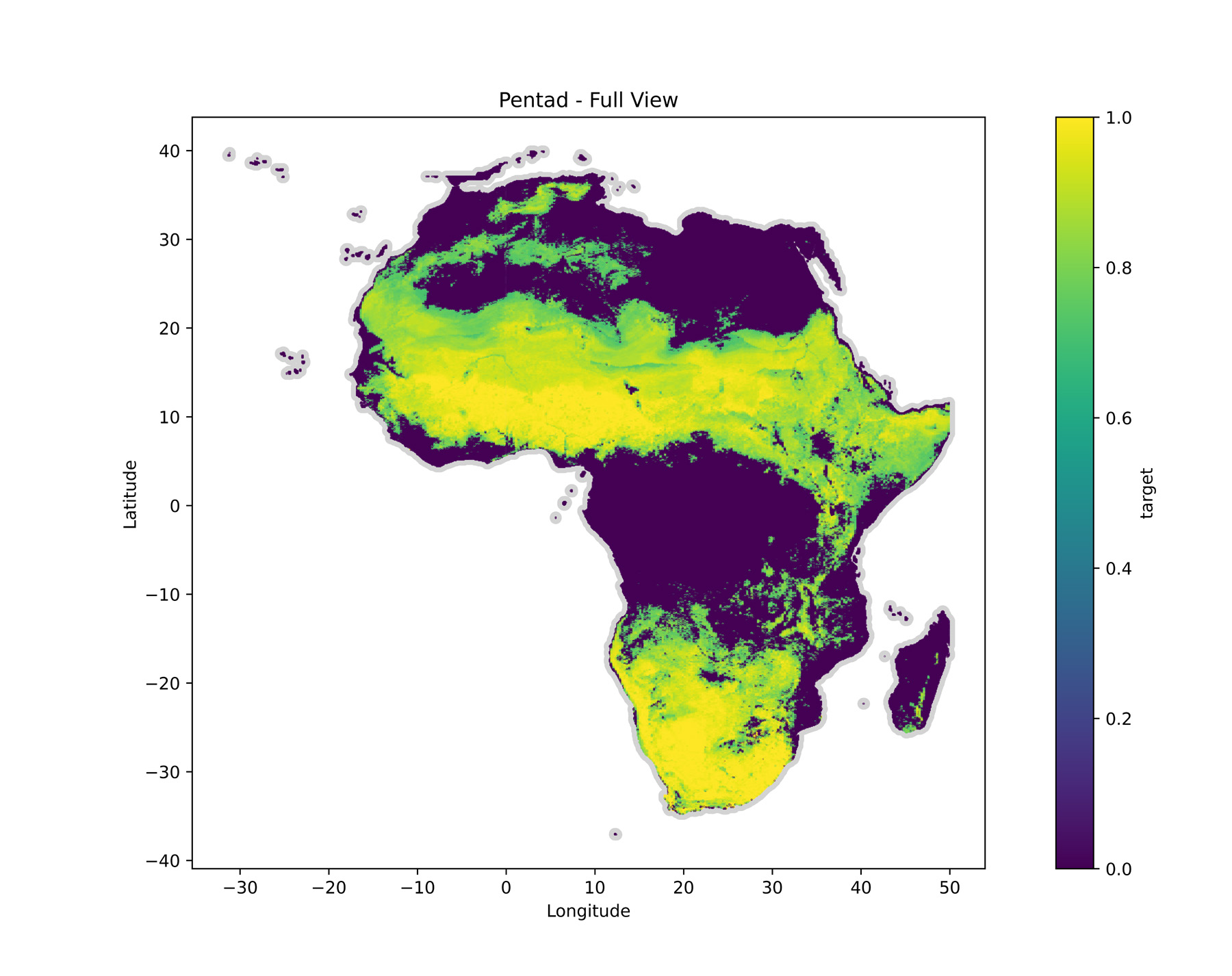
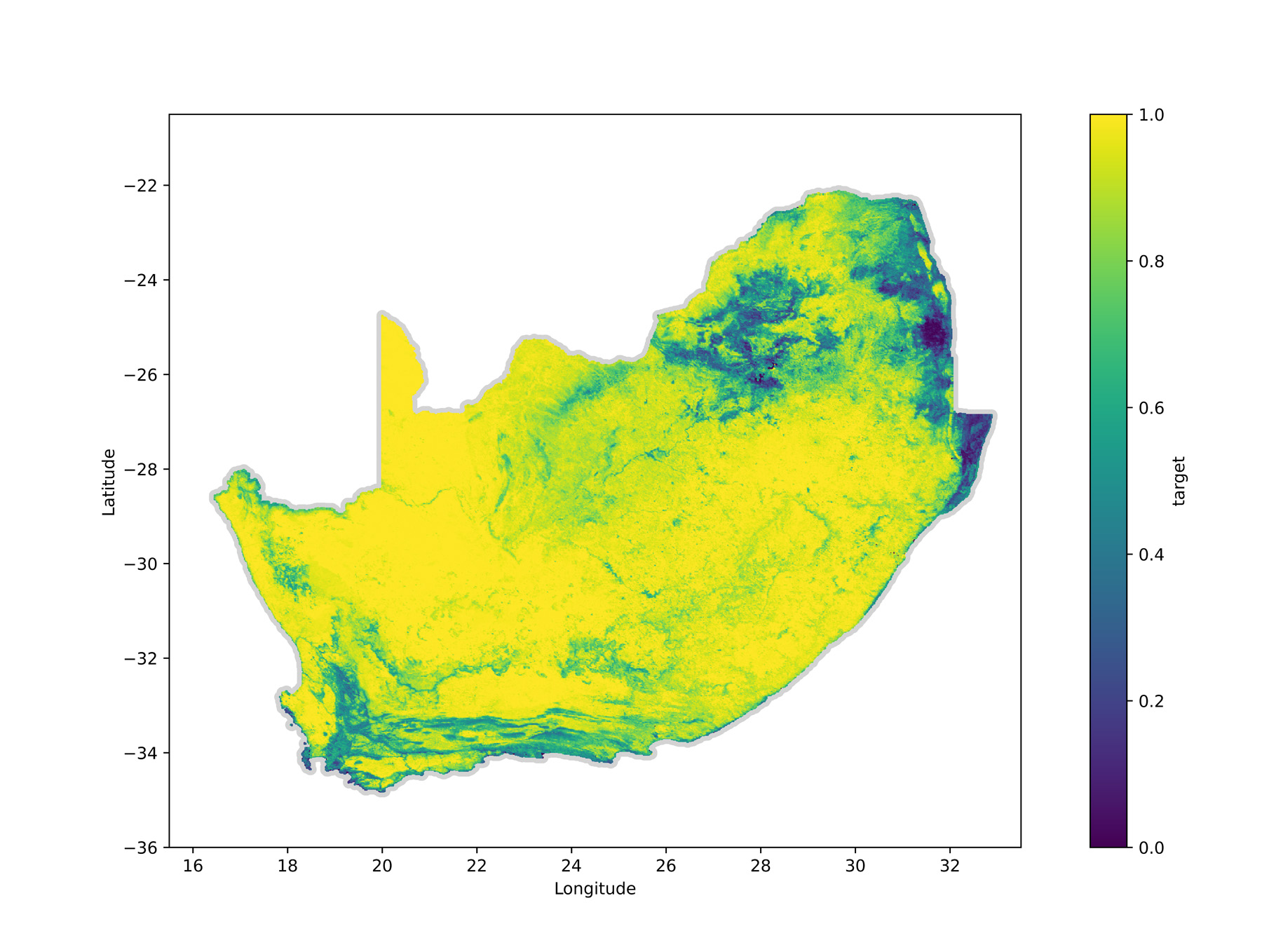
Figure 1: Lanner Falcon modelled distribution across Africa (top) and South Africa (bottom) based on BirdLasser, iNaturalist and eBird data. The Africa distribution is modelled at the pentad level, while the South Africa distribution is modelled at a 2x2km grid level (Lee 2024).
Ecology
Lanner Falcon favours open, mesic grassland, succulent Karoo, cleared woodlands and agricultural areas. Breeding pairs favour sheer cliffs or quarry faces as nesting and roosting sites, although they can breed in nest structures built by other species (corvids, herons, other raptors, storks – Jenkins 2005) in trees, telephone poles, power pylons and on buildings. Clutch size in the region averages 3.5, and productivity averages 1.3–2.2 young fledged/territorial pair/year (Jenkins 2000a, 2005). The dominant prey group is birds in the 50–500 g mass range, followed by small mammals, reptiles and insects (Jenkins and Avery 1999, Jenkins 2000b). In subsistence or communal farming areas, the small chicks of free-range chickens can make up >40% of the diet. The species is known to be susceptible to collision with both overhead power lines and the blades of wind turbines (Perold et al. 2020, S. Ralston-Paton pers comm). Estimated generation time is 5.0 years (Bird et al. 2020, BirdLife International 2021).
Threats & Conservation
Threats
Raptor populations globally are under escalating pressure from a range of anthropogenic factors (McClure et al. 2018, Shaw et al. 2024), and large falcons are notoriously prone to catastrophic population crashes. The European population of Lanner Falcon F. b. feldeggii is presently listed as Endangered (De Rosa et al. 2019, BirdLife International 2022), while Middle Eastern populations of Lanner Falcon are apparently severely depleted (Binothman 2016, Alabdulhafith et al. 2022). Furthermore, the rapid spread of Highly Pathogenic Avian Influenza is already being linked with significant decreases in Peregrine Falcon F. peregrinus numbers across North America (B. Anderson, pers comm), suggesting that contagion alone represents a genuine, existential threat to this and other bird- and fish-eating raptors (El Zowalaty et al. 2022, Graziosi et al. 2024).
Hence, the primary threats to this species include:
- The loss or transformation of habitat within the Grassland Biome, directly through the spread of urbanisation, intensive agriculture, and afforestation, and indirectly through the incipient effects of climate change, with corresponding reductions in preferred prey and foraging opportunities.
- Direct persecution by rural communities in defense of their free-range poultry.
- Direct mortality and/or systemic effects on physiology and breeding success associated with the use of persistent, toxic agrochemicals.
- Collision mortality associated with the ongoing expansion of the power transmission and distribution networks in the region, and the rapid spread of industrial-scale wind energy development (Jenkins 2005, Perold et al. 2020).
- The spread of Highly Pathogenic Avian Influenza into the Lanner Falcon food chain, with potentially significant implications for adult survival and breeding success.
Conservation Measures Underway
No species-specific actions are currently underway. The breeding population of the Mpumalanga/Limpopo escarpment is periodically surveyed as part of ongoing research on Taita Falcon Falco fasciinucha in that area (Jenkins et al. 2023).
Conservation Measures Proposed
- Effective, science-based regulation of environmentally damaging agrochemicals.
- Science-based intervention in situations of harmful conflict between informal poultry farmers and Lanner Falcons regularly preying on free-range chickens.
- Strict regulation of energy development to effectively mitigate power line and wind turbine collision impacts.
Research Priorities and Questions
- Developing a more accurate estimate of the size and general health of the regional population is critical. A simple, practical research goal would be to gather comparative, contemporary data on the number, distribution and success of breeding pairs in previously surveyed and monitored areas of the region. These could include the Soutpansberg, Limpopo Province (Jenkins 2000a) and other sampled areas of the former Transvaal Province (Tarboton and Allan 1984), the grasslands around Makhanda, Eastern Cape Province (Stephenson 2002), and the dam sites of the Lesotho Highlands Water Scheme (Allan and Jenkins 2014a, 2014b, Avisense Consulting 2017).
- Understanding the costs and benefits for both Lanner Falcons and chicken owners of high levels of predation on free-range chickens in informal farming areas, focusing on ways to mitigate the harmful impacts of this conflict for both parties.
- Quantifying and understanding the local and regional impacts of escalating levels of collision mortality of this species associated with the rapid expansion of both the national power grid and utility-scale wind farms.
- Determining the extent to which Lanner Falcon is susceptible and currently exposed to a growing list of other anthropogenic impact factors, including the degradation or transformation of grasslands, the use of persistent, toxic agrochemicals, the spread of pathogenic and treatment resistant diseases (e.g. avian influenza, Graziosi et al. 2024), and the pervasive effects of climate change (e.g. De Rosa et al. 2019).
Contributors & References
Assessor/s
Andrew Jenkins, Anthony van Zyl
Reviewer/s
Andre Botha, Mark Brown
References
Alabdulhafith B, Binothman A, Alwahiby A, Haig SM, Prommer M, Lionardi G. 2022. Predicting the potential distribution of a near extinct avian predator on the Arabian Peninsula: implications for its conservation management. Environmental Monitoring and Assessment 194: 535.
Allan DG, Jenkins AR. 2014a. Biological resources monitoring within Phase 1 of the LHWP catchments 2014-14: Birds of the Katse Dam Catchment. LHDA Contract 1273. Report to Anchor Environmental.
Allan DG, Jenkins AR. 2014b. Biological resources monitoring within Phase 1 of the LHWP catchments 2014-14: Birds of the Mohale Dam Catchment. LHDA Contract 1273. Report to Anchor Environmental.
Avisense Consulting. 2017. Professional Services for the Environmental & Social Impact Assessment (ESIA) for the Polihali Reservoir & Associated Infrastructure: Bird specialist report. Report to ERM Southern Africa.
Barnes KN, Jenkins AR. 2000. Lanner Falcon. In: Barnes KN (ed), The Eskom Red Data book of birds of South Africa, Lesotho and Swaziland. Johannesburg: BirdLife South Africa. pp 140.
Binothman A. 2016. Current status of falcon populations in Saudi Arabia. Theses and Dissertations 976: http://openprairie.sdstate.edu/etd/976.
Bird JP, Martin R, Akçakaya HR, Gilroy J, Burfield IJ, Garnett ST, Symes A, Taylor J, Şekercioğlu ÇH, Butchart SH. 2020. Generation lengths of the world’s birds and their implications for extinction risk. Conservation Biology 34: 1252–61.
BirdLife International. 2021. Falco biarmicus. The IUCN Red List of Threatened Species 2021: e.T22696487A200013311. https://dx.doi.org/10.2305/IUCN.UK.2021-3.RLTS.T22696487A200013311.en. [Accessed on 28 May 2024].
BirdLife International. 2022. Falco biarmicus (Europe assessment). The IUCN Red List of Threatened Species 2022: e.T22696487A216980922. https://dx.doi.org/10.2305/IUCN.UK.2022-1.RLTS.T22696487A216980922.en. [Accessed on 31 May 2024].
Cade TJ. 1982. The falcons of the world. London: Collins.
De Rosa D, Di Febbraro, M, De Lisio L, De Sanctis A, Loy A. 2019. The decline of the lanner falcon in Mediterranean landscapes: competition displacement or habitat loss. Animal Conservation 22: 24–34.
El Zowalaty ME, DeBeauchamp J, Jeevan T, Franks J, Friedman K, Pretorius R, Young SG, Webster RG, Webby RJ. 2022. Molecular detection of influenza A viruses and H5 subtype among migratory Amur Falcons (Falco amurensis) and captive birds of prey. Transboundary and emerging diseases 69: 369–377.
Ferguson-Lees J, Christie DA. 2001. Raptors of the World. London: Christopher Helm.
Graziosi G, Lupini C, Catelli E, Carnaccini S. 2024. Highly Pathogenic Avian Influenza (HPAI) H5 Clade 2.3.4.4b virus infection in birds and mammals. Animals 14: 1372.
Jenkins AR. 2000a. Factors affecting breeding success of Peregrine and Lanner Falcons in South Africa. Ostrich 71: 385–392.
Jenkins AR. 2000b. Variation in the quality of parental care at falcon nests in South Africa as evidence for postulated differences in food availability. Ardea 88: 17–32.
Jenkins AR. 2005. Lanner Falcon Falco biarmicus. In: Hockey PAR, Dean WRJ, Ryan PG (eds), Roberts – Birds of Southern Africa, 7th Edn. Cape Town: The Trustees of the John Voelcker Bird Book Fund. pp 556–557.
Jenkins AR, Avery M. 1999. Diets of breeding Peregrine and Lanner Falcons in South Africa. Journal of Raptor Research 33: 190–206.
Jenkins AR, Van Zyl AJ, Colyn RB, Brink CW, Smit-Robinson HA, Whitecross MA. 2023. Drivers of scarcity in the globally threatened Taita Falcon Falco fasciinucha: competition and habitat quality in the eastern escarpment region of South Africa. Bird Conservation International https://doi.org/10.1017/S0959270923000205.
Lee ATK. 2024. Regional Red Data Book of the Birds of South Africa, Lesotho and Eswatini: SABAP2 synthesis and supporting information and graphics for Lanner Falcon. Unpublished report. Johannesburg: BirdLife South Africa.
Leonardi G. 2015. The Lanner Falcon. Italy: Private publication.
McClure CJW, Westrip JRS, Johnson JA, Schulwitz SE, Virani MZ, Davies R, Symes A, Wheatley H, Thorstrom R, Amar A, Buij R, Jones VR, Williams NP, Buechley ER, Butchart SHM. 2018. State of the world’s raptors: distribution, threats and conservation. Biological Conservation 227: 390–402.
Oatley TB, Oschadleus HD, Navarro RA, Underhill LG. 1998. Review of ring recoveries of birds of prey in southern Africa: 1948-1998. Johannesburg: Endangered Wildlife Trust.
Perold V, Ralston-Paton S, Ryan P. 2020. On a collision course? The large diversity of birds killed by wind turbines in South Africa. Ostrich 228: https://doi.org/10.2989/00306525.2020.1770889
Shaw P, Ogada D, Dunn L, Buij R, Amar A, Garbett R, Herremans H, Virani MZ, Kendall CJ, Croes BM, Odino M, Kapila S, Wairasho P, Rutz C, Botha A, Gallo-Orsi U, Murn C, Maude G, Thomsett S. 2024. African savanna raptors show evidence of widespread population collapse and a growing dependence on protected areas. Nature Ecology and Evolution 8: 45–56.
Stephenson A. 2002. Ecology and breeding biology of Lanner Falcons in the Eastern Cape Province, South Africa. MSc Thesis, Rhodes University, South Africa.
Taylor MR. 2015. Lanner Falcon Falco biarmicus. In: Taylor MR, Peacock F, Wanless RM (eds), The Eskom Red Data Book of Birds of South Africa, Lesotho and Swaziland. Johannesburg, South Africa: BirdLife South Africa. pp 191–192.
Van Zyl AJ, Jenkins AR, Allan DG. 1994. Evidence for seasonal movement by Rock Kestrels Falco tinnunculus and Lanner Falcons F. biarmicus in South Africa. Ostrich 65: 111–121.
Kemp AC. 1993. Breeding biology of Lanner Falcons near Pretoria, South Africa. Ostrich 64: 26–31.
Tarboton WR, Allan DG. 1984. The status and conservation of birds of prey in the Transvaal. Transvaal Museum Monographs 3: 1–115.
Citation
Jenkins A, van Zyl A 2025. Lanner Falcon. In: Lee ATK, Rose S, Banda S, Bezeng SB, Maphalala MI, Maphisa DH, Smit-Robinson H (eds), The 2025 Red Data Book of Birds of South Africa, Lesotho and Eswatini. Johannesburg, South Africa: BirdLife South Africa. Available at: https://www.birdlife.org.za/red-list/lanner-falcon/
Our generous sponsors


