


Knysna Warbler
Bradypterus sylvaticus

Number Of Mature
Individuals (Regional)
9 114 (6 592 – 118 780)

Regional
Population Trend
Decreasing
2025
Regional Category
Near Threatened
Search by species
CONTENTSOverview
Names
|
IOC English Name: |
Knysna Warbler |
|
SA & IOC Scientific Name: |
Bradypterus sylvaticus |
|
BirdLife International Taxonomy (scientific name): |
Bradypterus sylvaticus |
|
Order: |
PASSERIFORMES |
|
Family: |
Locustellidae |
|
Species name author: |
Sundevall 1860 |
|
Afrikaans: |
Knysnaruigtesanger |
|
Sesotho (South Africa): |
|
|
Sesotho (Lesotho): |
|
|
Siswati: |
|
|
Zulu: |
ujamelamafuku waseKapa |
Current Assessment Status
|
2025 Regional Category [Criteria] |
NT [C1+2a(i)] |
|
2024 Global Category [Criteria] |
VU [B1ab(i,ii,iii,iv,v); C2a(i)] |
|
Population size (Regional) |
9114 (6592 – 118 780) |
|
Population size (Global) |
3500 – 15 000 (BirdLife International 2016) |
|
Distribution size (EOO) (Regional) km2 |
187 267 (185 253 – 195 479) (Lee 2024) |
|
Distribution size (EOO) (Global) km2 |
123 000 (BirdLife International 2016) |
|
Distribution size (AOO) (Regional) km2 |
18 228 (13 184 – 23 756) (Lee 2024) |
|
Generation time |
3.5 years (BirdLife International 2016) |
|
Status change reason |
Improved knowledge |
|
Migrant (in the region) |
No |
|
Regional endemic |
Yes |
Historic Listing Information
|
2000 Regional Status |
VU [B1+2abcd; C2a] |
|
2015 Regional Status |
VU [A3c; B2b(ii,iii,v); C1+2a(i)] |
|
Status change reason (if applicable) |
No change |
|
2015 Population size (Regional) |
<2500 |
|
2015 Global Status |
VU [B1ab(i,ii,iii,iv,v); C2a(i)] |
Reason for Inclusion
Reason for Inclusion in the Assessment
The Knysna Warbler Bradypterus sylvaticus is endemic to the region. In addition, the species was listed as regionally Vulnerable in 2015 and is currently listed as globally Vulnerable (Taylor 2015, BirdLife International 2016).
Category Justification
Category Justification
The Knysna Warbler was previously classified as regionally Vulnerable (VU) due to its small, severely fragmented range and small population (c. 2500 mature individuals (Taylor 2015)). In addition, there was a perceived continuing decline in population size, range size, and area, extent and quality of habitat. However, analysis of population trends and recent analysis from the Southern African Bird Atlas (SABAP2) database show no significant severe declines, neither between SABAP1 and SABAP2, nor within SABAP2: rather, the species has been recorded more frequently on the eastern regions of its range where it was thought to be locally extinct, although the declines of the Table Mountain population are also evident (Lee 2024). Available trend data suggest the population does not approach VU under Criterion A. In addition, due to the geographic spread of the species neither Extent of Occurrence (EOO) nor Area of Occupancy (AOO) approach thresholds for VU under Criterion B. However, the population is likely <10 000 (see below) with <1000 mature individuals in each subpopulation with the exception of the Knysna population, with population loss within parts of its range approaching 10% in three generations, approaching the threshold for VU under C1 and C2a(i). Given the uncertainty in the population estimate, NT C1+2a(i) is recommended for this assessment period.
Population Justification
The population estimate is based on a regression algorithm based on point counts of forest birds in the Cape Floristic Region during 2023. The survey undertook 536 counts, mostly in the Knysna forests, but stretching westwards through Afromontane forest patches to Cape Town, with Knysna Warbler encountered only six times, being insufficient to robustly estimate a density estimate. Density estimates were calculated for those species with sufficient encounters, from which a prediction algorithm of density based on group encounter rate, dietary guild and ranked group size was developed (Lee et al in prep). This algorithm predicted Knysna Warbler density estimates (individuals/km2) of 5 with prediction interval of 0.5 to 58. The upper prediction is unfeasible given the specific habitat requirements known for Knysna Warbler and very low encounter rates, suggesting a more realistic density within this region of its range of 0.5 to 5 individuals/km2. Applying these values to its predicted AOO give values of 9114 (6592 – 118 780), with the upper population bound also unlikely given previous estimates of 10 000s (Berruti et al. 1993, Smith 2005). This suggests the Knysna subpopulation of the Knysna Warbler may be >1000, but certainly all other of the eight suggested subpopulations (Figure 1, e.g. Cape Town, Port Alfred, Port Edward etc) are likely <1000. As forest counts are based on calling individuals, these values would represent mature individuals. Confidence in this estimate is low.
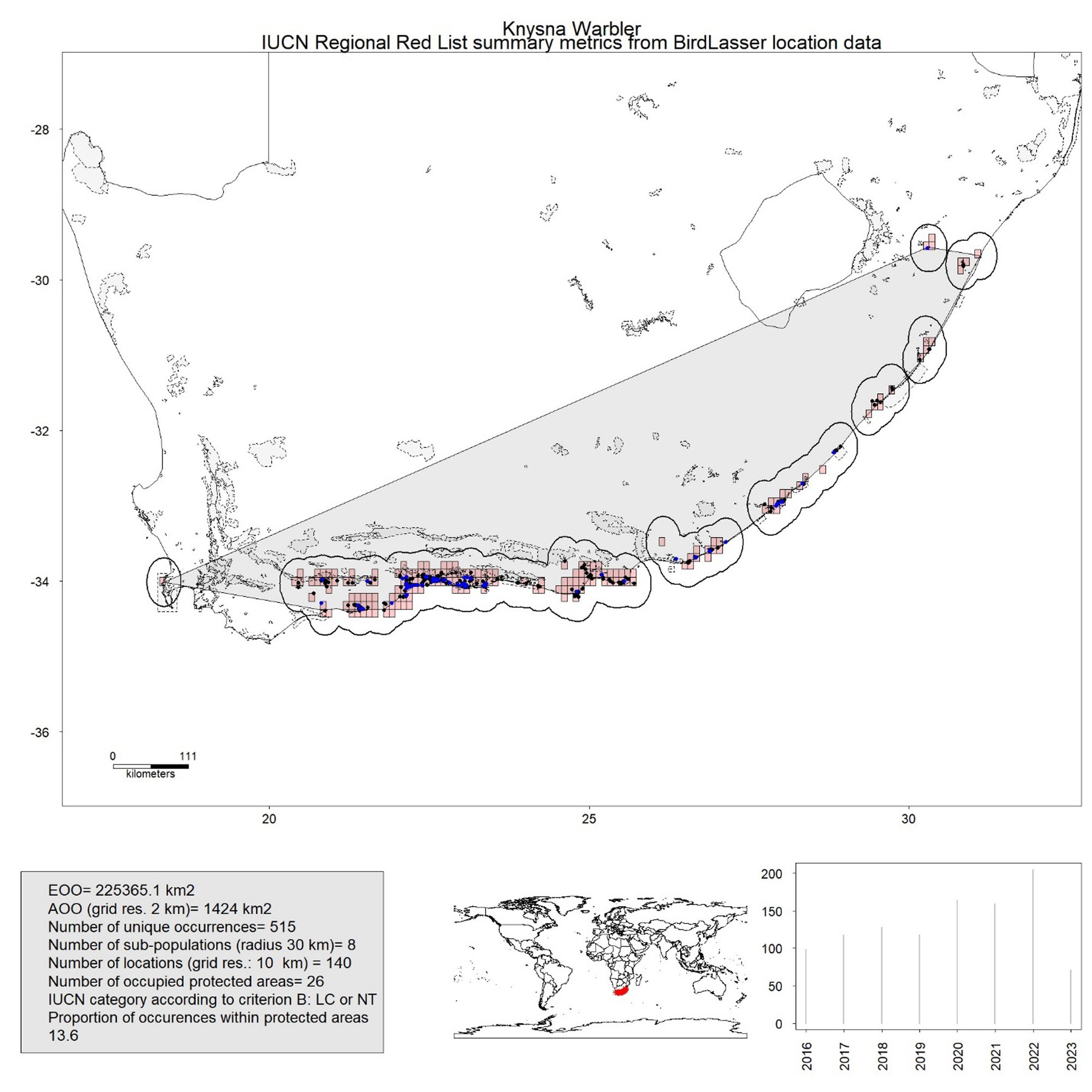
Figure 1: BirdLasser records for Knysna Warbler (black points), with locations (pink grids), subpopulations (rounded polygons) and EOO (angular polygon), together with summary metrics (lower left) from the ConR package (Dauby 2020). The barplot (lower right) indicates the number of points contributed per year, with incomplete data for 2023. Note, the EOO and AOO provided in the summary table at the start of the species account are based on the predicted range (see Figure 2 below, from Lee 2024).
Trend Justification
Taylor (2015) wrote that the Knysna Warbler, especially the eastern subspecies, had undergone a severe range contraction in the past 60 years. However, there has either been a reversal of fortunes or better recording of the species recently. Recent population trends for Knysna Warbler are based on SABAP (Brooks et al. 2022). Knysna Warbler trends have been analysed between SABAP1 (1987-1992) and SABAP2 (2007 onwards) and within SABAP2 using various metrics and statistical approaches, none of which have indicated any significant population level declines for Knysna Warbler (Lee et al. 2015, Lee and Hammer 2022, Lee 2024), with range and reporting rates broadly similar, or even increasing. The Knysna subpopulation is well represented in the protected area network of the Garden Route National Park and adjacent CapeNature properties.
There are localised exceptions to the stable trend, notably Table Mountain National Park. Pryke et al. (2011) made mention that the Knysna Warbler had declined precipitously on the Cape Peninsula. There the clearance of habitat for developments, agriculture and silviculture will have led to decreases in the amount of available habitat, as well as its quality, resulting in a decrease in the population. Feral and free roaming domestic cats are a likely cause for direct population declines (Seymour et al. 2020). The subpopulation there is now known from only one locality (City of Cape Town Media 2023).
Nonetheless, over the rest of its range there is evidence the species is a suburban adaptor when garden structure is adequate along its preferred watercourse habitats (Taylor 2015). However, urban growth and increasing human population and associated free roaming pet density in the vicinity of George, in the species primary population stronghold, are cause for concern. Overall, the population trend is either stable or weakly declining, and this decline would approach 10% based on the loss of the Table Mountain population. Confidence in the trend is low.
Biology & Ecology
Taxonomy
Clancey (1966) recognised two subspecies, with the nominate sylvaticus type (from Knysna) being replaced by pondoensis (from Port St Johns) in the coastal forests of the Eastern Cape (Taylor 2015). The interface between them is poorly defined but may lie between Gqeberha (formerly Port Elizabeth) and East London. Genetic support for the subspecies split is supportive (Alström et al. 2011) but further work is required. An earlier common name was the ‘Knysna Scrub Warbler’ (e.g. Siegfried et al. 1976).
Identification
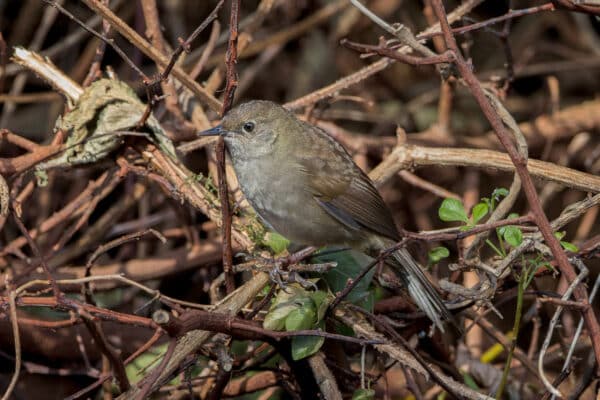
14–15 cm, c. 16.5 ± 1.5 g (n = 39 adults of unknown sex, excluding outliers of >30 g, SAFRING unpubl data extracted June 2024). A medium-sized, drab brown secretive warbler usually overlooked unless singing. Males have chocolate or olive-brown upperparts and an indistinct greyish supercilium. Females lack the dark loral spot (Visser and Hockey 2002). Juveniles have a yellowish wash on the face and underparts (Smith 2005).
Distribution
The Knysna Warbler is endemic to the coastal regions of South Africa, primarily within the Eastern and Western Cape Provinces, as well as Afromontane forest within the Fynbos and specifically riparian zones within this. AOO was modelled based on BirdLasser records and environmental predictor variables at a 2×2 km grid resolution (Lee 2024) and suggests it is around 18 228 km2 (13 184–23 756). Even if this is an overprediction, it substantially exceeds the 2000 km2 to invoke Criterion B, even at the lower bound.
Its distribution is highly naturally fragmented, although this has likely been exacerbated by anthropogenic activities, especially agriculture and urbanisation. Populations are isolated in several distinct zones according to BirdLasser and SABAP2 records. It appears there are up to eight subpopulations, of which five are clearly disjunct. We comment on this further here:
Northernmost Zone: A collection of scattered records from Pietermaritzburg and north of Durban (northern most record is near Tugela mouth) to Port Edward, mostly in coastal pentads, with the three Pietermaritzburg pentads an exception. Several of the records from this zone could be described as their own subpopulations (Figure 1).
Wild Coast: From north of Port St Johns to East London, restricted to the coastal zone.
Port Alfred: from Mpekweni north of Port Alfred to Bosfontein, i.e. the coastal section of Addo Elephant National Park.
Gqeberha (formerly Port Elizabeth) to Tsitsikamma. Coastal and inland pentads, and poorly distinguished from the Knysna subpopulation (ConR (Figure 1) places this within the Knysna subpopulation).
Nature’s Valley to Gouritzmond (the ‘Knysna’ subpopulation): This is the largest subpopulation, including the Knysna Forests and Afromontane patches of the Outeniqua Mountains. One pentad 3400_2215 with 112 cards has a reporting rate (SABAP2 measure of abundance) of 63%, being the highest for this species, although those around George are in the range of 25–40%. This is substantially higher than the reporting rate from across the species range (7% for 2007-2015, 11% for 2016-2023, from Lee 2024).
Stilbaai to Witsand: Some pentads in this region have a relatively high reporting rate, with scattered records extending to Witsand. This region is highly transformed by agriculture and is included in the Knysna subpopulation according to ConR analysis in Figure 1.
Langeberg Mountains: From Herbertsdale to Swellendam. Isolated populations persist on the southern slopes of the Langeberg Mountains, including Grootvadersbos Nature Reserve. This area is characterized by dense Afromontane forest patches, which provide suitable habitat for the species, in a matrix of Fynbos.
Cape Peninsula: The smallest most isolated sub-population occurs on the southeastern slopes of Table Mountain on the Cape Peninsula. Historically more widespread, this population has declined significantly to the point of extinction, with notable reductions in habitat due to urban development and habitat transformation. SABAP2 reporting rate is 1% or lower for this population.
The amount of dispersal between populations is unknown. The species is poorly represented in the SAFRING database. Of two individuals recaptured, both were recaptured three times, and in all cases in the original capture locations. However, isolated SABAP2 records suggest some dispersal.
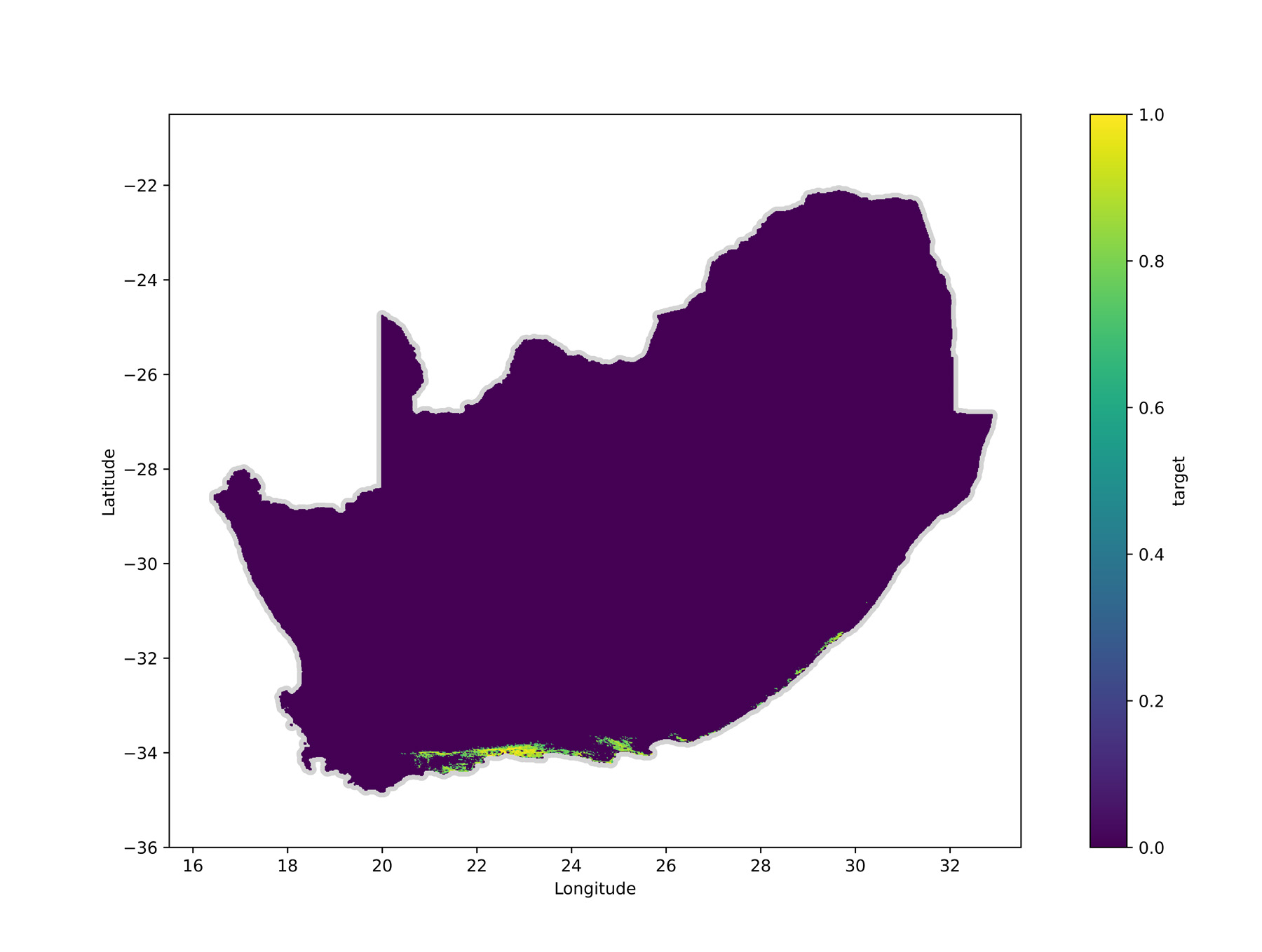
Figure 2: Knysna Warbler distribution across South Africa based on BirdLasser, iNaturalist and eBird data indicating the main population in association with the Afrotemperate Knysna Forests, and the eastern population strongly tied to the littoral zone (Lee 2024).
Ecology
The Knysna Warbler occurs along the edges of Afro-temperate forests and in thick, tangled vegetation along the banks of watercourses or drainage lines in forest patches in the Fynbos Biome (Berruti 1997). It has adapted to thickets of introduced Rubus brambles, where it can be locally common, particularly in the Western Cape. Birds may favour narrow belts of suburban riverine woodland with a dense, tangled understorey (Pryke et al. 2011). This was attributed to the availability of nesting substrate as opposed to prey availability (Pryke et al. 2011). In parts of the range, such as around George, the species is also regularly recorded in over-grown suburban gardens with dense understorey vegetation (PJ Ginn pers comm in Taylor 2015). With the exception of Cape Town, SABAP2 reporting rates are relatively higher in association with urban environments (e.g. George, Gqeberha, Port St Johns and Port Edward).
The Knysna Warbler is insectivorous, taking a range of invertebrates, but favouring arachnids and amphipods (Visser and Hockey 2002). It breeds in spring and early summer, August-December (Smith 2005).
Threats & Conservation
Threats
- Habitat loss due to development, agriculture, alien vegetation encroachment, and silviculture.
- Wildfires, particularly in areas with introduced pine trees associated with high burn intensity.
- Fragmentation and isolation of subpopulations, leading to inbreeding depression.
- Cats, pets and feral, in association with urban populations, especially Cape Town (Seymour et al. 2020).
Conservation Measures Underway
There are no specific conservation measures currently in place for this species.
Conservation Measures Proposed
- Maintenance of prime habitat within Afro-temperate forests.
- Restoration of natural fire regimes in Fynbos areas.
- Protection of dense riparian vegetation, including the expansion of the protected area network.
- Management to reduce rodent and cat predation on eggs and chicks.
Research Priorities and Questions
- Further genetic sampling is required to clarify the status of the two described sub-species, as well as the genetic diversity within and between subpopulations.
- Bespoke surveys are required to obtain regional population estimates of eastern subpopulations. The use of acoustic monitoring techniques would be useful in this regard.
- Survey isolated forest patches in the Eastern Cape Province.
- Investigate habitat restoration, especially along river courses in the Fynbos.
- Improve understanding of population size, trends, and survival probabilities.
Contributors & References
Assessor/s
Alan Lee
Reviewer/s
James Westrip, Mark Brown
References
Alström P, Fregin S, Norman JA, Ericson PJP, Christidis L, Olsson U. 2011. Multilocus analysis of a taxonomically densely sampled dataset reveal extensive non-monophyly in the avian family Locustellidae. Molecular Phylogenetics and Evolution 58(3): 513–526.
Berruti A, Taylor PJ, Vernon CJ. 1993. Morphometrics and distribution of the Knysna Warbler Bradypterus sylvaticus Sundevall and Barratt’s Warbler B. barratti Sharpe. Durban Museum Novitates 18: 29–36.
Berruti A. 1997. Knysna Warbler Bradypterus sylvaticus. In: Harrison JA, Allan DG, Underhill LG, Herremans M, Tree AJ, Parker V, Brown CJ (eds), The atlas of southern African birds Vol II: Passerines. Johannesburg, South Africa: BirdLife South Africa. pp 250.
BirdLife International. 2016. Bradypterus sylvaticus. The IUCN Red List of Threatened Species 2016: e.T22714480A94418244. http://dx.doi.org/10.2305/IUCN.UK.2016-3.RLTS.T22714480A94418244.en
Brooks M, Rose S, Altwegg R, Lee ATK, Nel H, Ottosson U, Retief E, Reynolds C, Ryan PG, Shema S, Tende T, Underhill LG, Thomson RL. 2022. The African Bird Atlas Project: a description of the project and BirdMap data collection protocol. Ostrich 93: 223–232. https://doi.org/10.2989/00306525.2022.2125097.
City of Cape Town Media. 2023. https://www.capetown.gov.za/Media-and-news/Knysna%20Warbler,%20known%20for%20its%20beautiful%20call,%20rediscovered%20on%20the%20Cape%20Peninsula. [Accessed on 15 June 2024].
Clancey PA. 1966. A catalogue of birds of the South African sub-region Part 4. Durban Museum Novitates 7(12): 466–544.
Dauby G. 2020. ConR: Computation of Parameters Used in Preliminary Assessment of Conservation Status. R package version 1.3.0. https://CRAN.R-project.org/package=ConR
Lee ATK. 2024. Regional Red Data Book of the Birds of South Africa, Lesotho and Eswatini: SABAP2 synthesis and supporting information and graphics for Knysna Warbler. Unpublished report. Johannesburg: BirdLife South Africa.
Lee ATK, Altwegg R, Barnard P. 2017. Estimating conservation metrics from atlas data: The case of southern African endemic birds. Bird Conservation International 27: 323–336. https://doi.org/10.1017/S0959270916000307
Lee ATK, Hammer SAJ. 2022. A comparison of migrant and resident bird population changes in South Africa using citizen science data: trends in relation to Northern Hemisphere distribution. Ostrich 93(3): 160–170. https://doi.org/10.2989/00306525.2022.2145383
Pryke JS, Samways MJ, Hockey PAR. 2011. Persistence of the threatened Knysna Warbler Bradypterus sylvaticus in an urban landscape: do gardens substitute for fire? African Journal of Ecology 49: 199–208.
Seymour CL, Simmons RE, Morling F, George ST, Peters K, O’Riain MJ. 2020. Caught on camera: The impacts of urban domestic cats on wild prey in an African city and neighbouring protected areas. Global Ecology and Conservation 23: e01198.
Siegfried WR, Frost PG, Cooper J, Kemp AC. 1976. Rare and vulnerable birds in South Africa. Biological Conservation 10(2): 83–93.
Smith N. 2005. Knysna Warbler. In: Hockey PAR, Dean WRJ, Ryan PG (eds), Roberts birds of southern Africa 7th Edn. Cape Town: Trustees of the John Voelcker Bird Book Fund. pp 793–794.
Taylor M. 2015. Knysna Warbler Bradypterus sylvaticus. In: Taylor MR, Peacock F, Wanless RM (eds), The Eskom Red Data Book of Birds of South Africa, Lesotho and Swaziland. Johannesburg, South Africa: BirdLife South Africa. pp 58–60.
Visser BG, Hockey PAR. 2002. Breeding behaviour and performance of the Knysna Warbler Bradypterus sylvaticus on the Cape Peninsula, South Africa. Ostrich 73: 83–86.
Citation
Lee ATK 2025. Knysna Warbler. In: Lee ATK, Rose S, Banda S, Bezeng SB, Maphalala MI, Maphisa DH, Smit-Robinson H (eds), The 2025 Red Data Book of Birds of South Africa, Lesotho and Eswatini. Johannesburg, South Africa: BirdLife South Africa. Available at: https://www.birdlife.org.za/red-list/knysna-warbler/
Our generous sponsors


