


Knob-billed Duck
Sarkidiornis melanotos

Number Of Mature
Individuals (Regional)
1 900 – 9 500

Regional
Population Trend
Decreasing
2025
Regional Category
Near Threatened
Search by species
CONTENTSOverview
Names
|
IOC English Name: |
Knob-billed Duck |
|
SA & IOC Scientific Name: |
Sarkidiornis melanotos |
|
BirdLife International Taxonomy (scientific name): |
Sarkidiornis melanotos |
|
Order: |
ANSERIFORMES |
|
Family: |
Anatidae |
|
Species name author: |
Pennant 1769 |
|
Afrikaans: |
Knobbeleend |
|
Sesotho (South Africa): |
letata-kotjwana |
|
Sesotho (Lesotho): |
letata-kotjoana |
|
SiSwati: |
Lidada lemfula |
|
Zulu: |
unosimila |
Current Assessment Status
|
2025 Regional Status [Criteria] |
NT° [C1] |
|
2024 Global Status [Criteria] |
LC (BirdLife International 2024) |
|
Population size (Global) |
60 000 – 227 000 (BirdLife International 2024) |
|
Population size (Regional) |
1900 – 9500 (CWAC, unpubl data) |
|
Distribution size (EOO) (Regional) km2 |
997 815 (Lee 2024) |
|
Distribution size (EOO) (Global) km2 |
53 300 000 (BirdLife International 2024) |
|
Distribution size (AOO) (Regional) km2 |
196 125 (BIRDIE 2024) |
|
Generation time |
8.63 years (BirdLife International 2024) |
|
Status change reason |
Genuine change in status |
|
Migrant (in the region) |
Resident and Migrant |
|
Regional endemic |
No |
Historic Listing Information
|
2000 Regional Status |
Not Evaluated |
|
2015 Regional Status |
Not Evaluated |
|
Status change reason (if applicable) |
Not applicable |
|
2015 Population size (Regional) |
Unknown |
|
2015 Global Status |
LC |
Reason for Inclusion
Reason for Inclusion in the Assessment
This species was not formally assessed previously and was thus presumed to be Least Concern. Preliminary screening of Coordinated Waterbird Counts (CWAC) data indicated a significant decline in number of Knob-billed Duck Sarkidiornis melanotos counted per year and especially in summer (Lee 2024).
Category Justification
Category Justification
Knob-billed Duck is poorly studied within the region. Considerable uncertainty exists from citizen science data on the rate of decline for this species. Modelled predicated change in Area of Occupancy (AOO) from the Southern African Bird Atlas projects (SABAP1 and SABAP2) indicate that reporting rate has declined but not AOO. Change in abundance from CWAC either show non-significant declines, or severe declines (when n = 8 counts of >500 individuals removed) of -71% (-91%, -12%) over the past three generations.
The updated 2024 Global Red List Status provided an updated population estimate of 60 000 – 227 000. Regionally, from CWAC data the population is estimated at 1900 – 9500. This estimate, along with the lowest bound of decline (12%) meets the threshold for Vulnerable (C1), following a precautionary principle. As this species has a very large range outside of the region, the outcome is adjusted to Near Threatened invoking a rescue effect.
Population Justification
Global population size is 60 000 – 227 000 (BirdLife International 2024).
A regional population estimate was determined from CWAC. The sum of mean of CWAC counts is 1703 and sum of maximum counts at CWAC sites is 5154 based on 3695 counts at all 173 sites where the species occurs, representing minimum estimates for the species, as not all sites where the species visits are counted. 3.8% of the modelled Africa pentad range occurs in the region (Lee 2024), which when applied to the Wetland International estimates suggests a range of 1900 – 9500, with the upper bound unlikely given the revised global population estimate. Taken together, we can be confident that the regional population is <10 000.
Trend Justification
The global population is assumed to be in decline (BirdLife International 2024). Predictive occurrence modelling using SABAP2 data tentatively indicates that no change in AOO has occurred over the past three generations (Lee 2024). A comparison of the reporting rate between SABAP1 (1987-1997) and SABAP2 (2007-2015) shows evidence of long-term declines in the reporting rate of this species, which may indicate a decline in population numbers or range shifts.
The trends from CWAC data are difficult to interpret, with wide confidence intervals for unfiltered data (Figure 2), but showing significant declines if counts >500 are excluded (Figure 3). The latter estimates a rate of decline over three generations of -71% (-91%, -12%) (Figure 3). This rate of decline is considerable. Determining trends from biannual counts for mobile waterbirds is difficult. Only a small part of the regional Knob-billed Duck range overlaps with the CWAC counts so extrapolating results throughout the range is difficult.
Despite the uncertainty, the regional population is considered to be in decline. Supporting this assumption is the overall poor state of freshwater habitats in the region. Knob-billed Duck prefer shallow seasonal pans for breeding (e.g. Colahan 2005) which are vulnerable to climate change and pressures, such as water abstraction, water pollution and sedimentation (van Deventer et al. 2019). An estimated 80% of South Africa’s inland wetlands are threatened and unprotected; with increasing anthropogenic pressures (van Deventer et al. 2019). Loss of suitable habitat will likely lead to reduced breeding success.
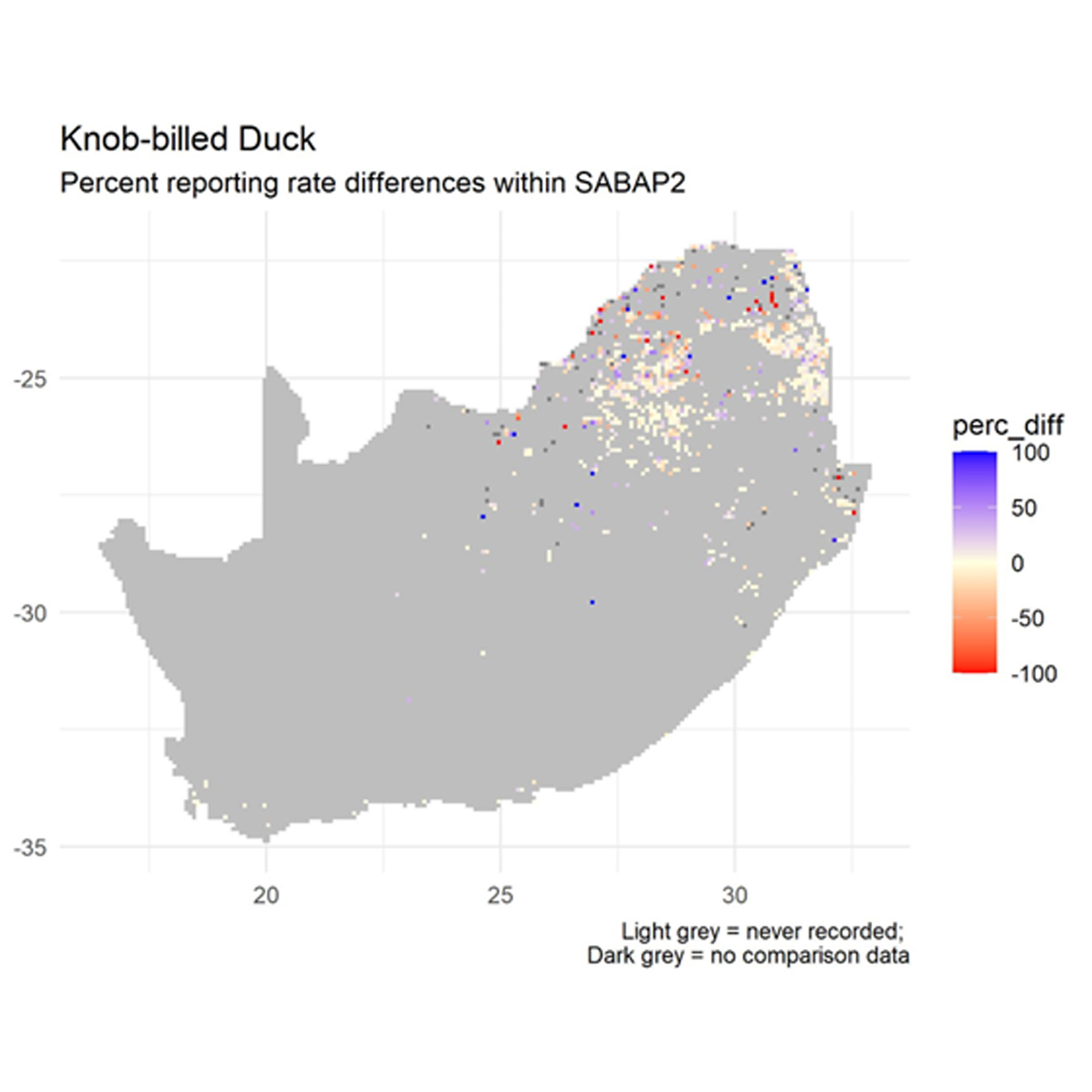
Figure 1: Showing reporting rate differences within the early (2007-2015) and late (2016-2023) SABAP2 periods. The map also indicates where Knob-billed Duck have been recorded in the region (from Lee 2024).
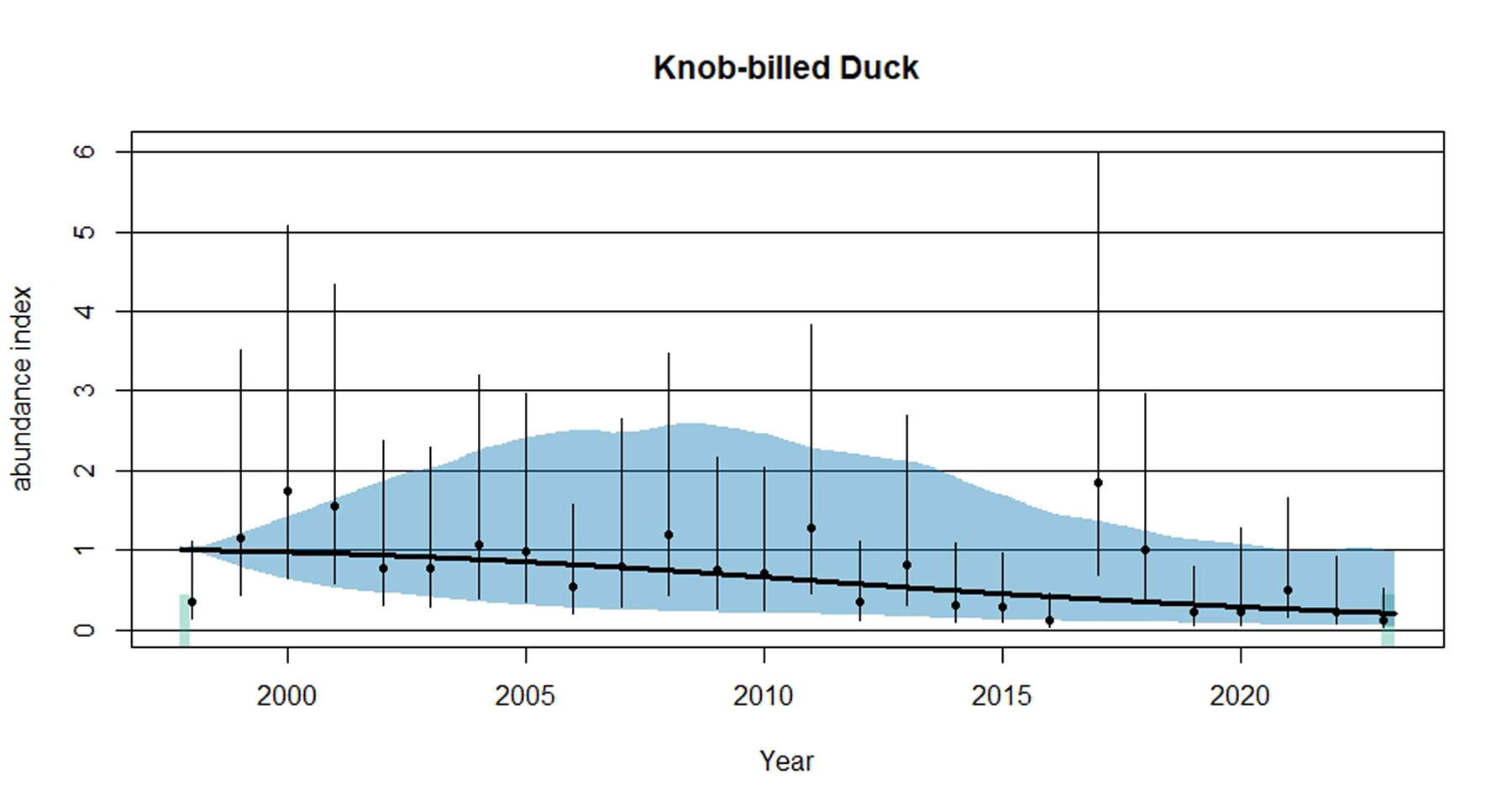
Figure 2: CWAC trends for all CWAC data: Estimated percent change from 1998 to 2023: -79% (-96%, 0.97%).
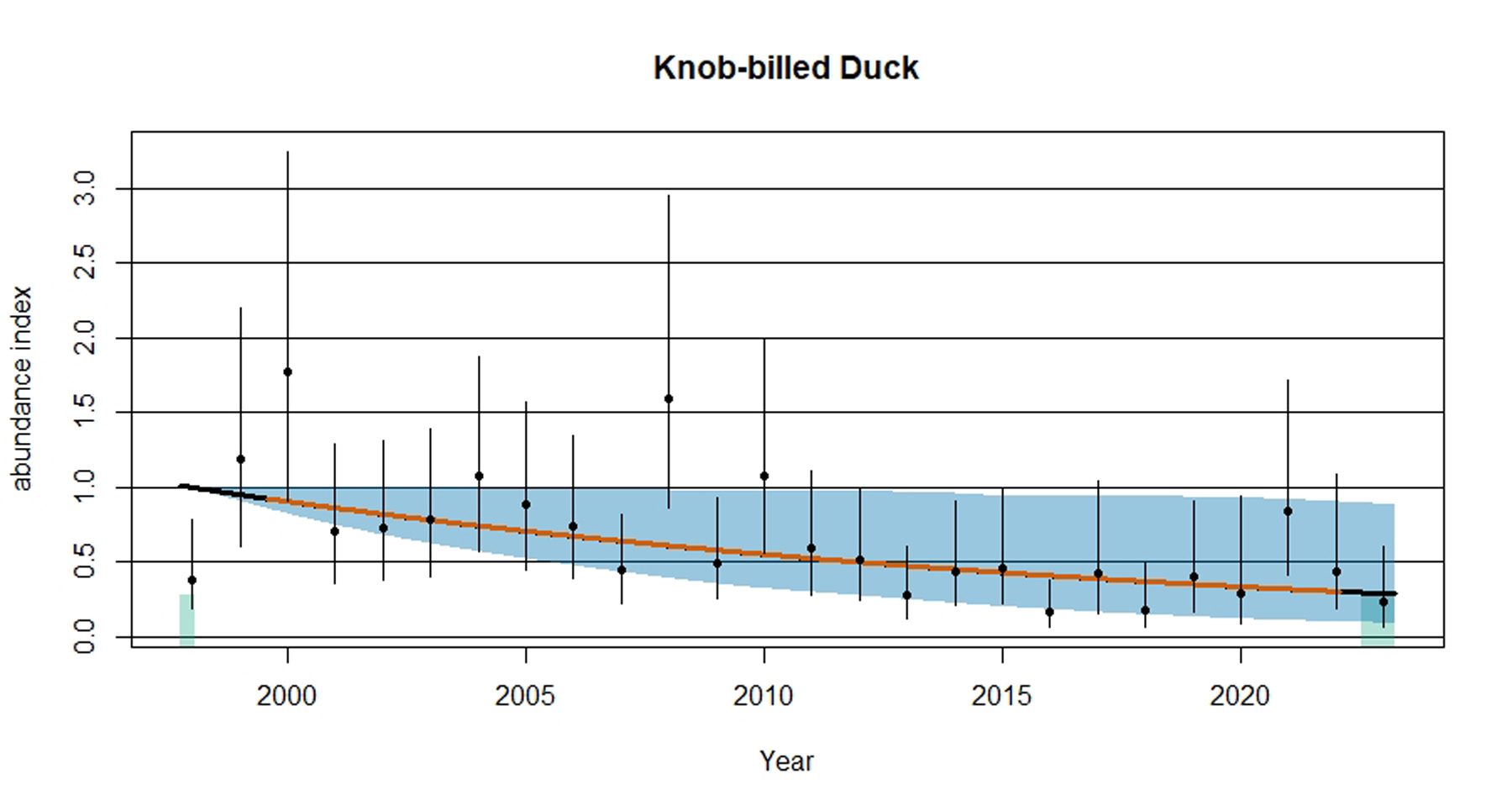
Figure 3: CWAC poptrend population trend for Knob-billed Duck excluding eight counts >500 (n = 3687 counts). Estimated percent change from 1998 to 2023: -71% (-91%, -12%).
Biology & Ecology
Taxonomy
Monotypic, assumed conspecific with S. sylvicola (Chesser et al. 2020).
Identification
Large duck at 75 cm (Colahan 2005). Sexes differ slightly in plumage colouration (Colahan 2005). Male adult breeding: head and neck are white with speckled black spots. Upper back, rump, upper tail coverts, tail, and wings, all with blue, green, and purple iridescence (Colahan 2005). The male has a large knob (comb) on the bill, which is prominent during the breeding season (Carboneras and Kirwan 2020). It has variable amounts of orange-buff on the side of the heads and behind the ear coverts, with specks of black on it (Colahan 2005). Black bill, dark grey legs and feet, and brown eyes (Carboneras and Kirwan 2020). Adult male non-breeding: knob is smaller and lacks the orange-buff (Smithers and MacKenzie 1973, Brown et al. 1982).
Adult female: similar to non-breeding male but duller and smaller, lacks the knob over the bill (Carboneras and Kirwan 2020). Bill is grey (Clancey 1967). Immature: similar to adult female but duller and male has rudimentary knob (Rudebeck 1955, Clancey 1967). Juvenile: the juvenile is dark brownish above, with a pale buff-brown neck, face and underparts, with a dark eye stripe and dark brown spotting on the flanks and breast (Colahan 2005). As it matures, it resembles the female (Colahan 2005).
Confusing species: in flight could be confused with Spur-winged Goose Plectropterus gambensis but lacks the white on the forewing, neck and underparts (Colahan 2005).
Distribution
This species is found in Sub-Saharan Africa and southern Asia (from Pakistan to southern China) (Colahan 2005). In Southern Africa, it mostly lives in the wetter areas of the northeast, and it is more scattered and irregular further west (Maclean 1997). It is common in Caprivi and Bushmanland in Namibia, and it is common on all major river systems in Botswana during the wet season (Penry 1994, Herremans 1999). In Zimbabwe, it is widespread and common, especially in major river valley systems (Irwin 1981).
In South Africa it is widespread in the lowveld and bushveld areas of the northeast (Tarboton et al. 1987) and in KwaZulu-Natal, it is common on the flood plains of the northeast but infrequent elsewhere (Figure 1). It is an irregular visitor or vagrant to the Free State, Eastern Cape, Western Cape, and Northern Cape Provinces (Hockey et al. 1989, Quickelberge and Clancey 1989, Allan 1994, Allan et al. 1995, Maclean 1997, Colahan 2005).
Ecology
Uses various wetlands such as rivers, freshwater swamps, lakes, rice fields, and artificial ones such as dams but not for breeding (Maclean 1997, Kear 2005, Dowsett-Lemaire and Dowsett 2006).
The regional migration movement is poorly known but at least a portion of the population is migratory (e.g. Figure 4).
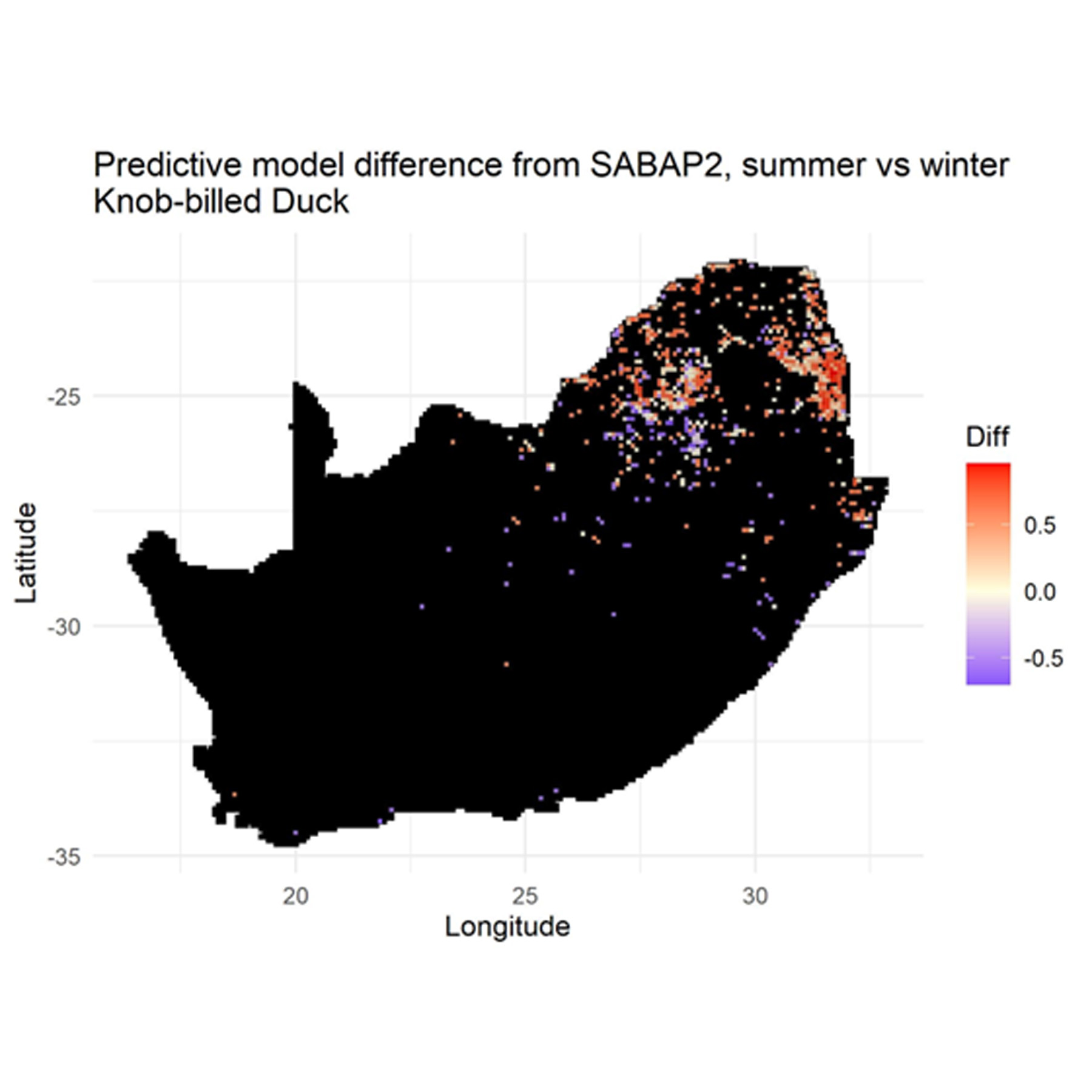
Figure 4: Seasonal variation in reporting probability between the ‘winter’ period (May-September) and summer (November-March). Red indicates higher probability of reporting for the ‘summer’ period. Map from Lee (2024).
Breeding time varies geographically (Carboneras and Kirwan 2020). Age of first breeding is within the first year (Zaloumis 1987). The nest is a rough structure made of twigs and coarse grass, lined with fine grass, leaves, and feathers (Carboneras and Kirwan 2020). The nest is built in a cavity in a tree, (often a dead tree that has been hollowed out by insects), occasionally on the ground in a cavity with a diameter of 200 mm or old Hamerkop nest (Hockey et al. 2005, Carboneras and Kirwan 2020). Females lay 6–20 eggs per clutch (larger clutches probably two females), with the incubation period lasting about 28–30 days starting with the last egg and is carried out by the female alone (Brown et al. 1982, Tarboton 2001, Carboneras and Kirwan 2020). They fledge approximately 65–70 days after hatching (Zaloumis 1987, Ginn et al. 1989). Males have not been observed caring for the ducklings, but a male may protect its mate and brood from intruding males (Colahan 2005).
Breeding success: Predation is reportedly high, and predators of ducklings include African Fish Eagle Haliaeetus vocifer (Hines and Raats 1989). Longevity record for the species is set by a bird recovered 21.5 years after being ringed (Demey and Kirwan 2001). Longevity data from ring recoveries also indicate lifespans ranging from 5–6 years (Underhill et al. 1999). In captivity, the longest recorded lifespans are 15–16 years (Hillgarth and Kear 1981).
Diet is primarily vegetable matter, particularly seeds of grasses, sedges, and aquatic plants (Safford and Hawkins 2013). It also consumes grains and supplements its diet with terrestrial and aquatic invertebrates, such as insects and molluscs (Safford and Hawkins 2013).
Threats & Conservation
Threats
This species is generally poorly studied in the region. Assumed to face the same plethora of threats as many other ducks and waterbirds: principally habitat destruction and modification (Carboneras and Kirwan 2020). It is not clear how much hunting pressure Knob-billed Duck experiences in the region, although this is a significant threat elsewhere in sub-Saharan Africa, especially during the breeding season (e.g. Lake Chilwa, Malawi (Dowsett-Lemaire and Dowsett 2006).
Conservation Measures Underway
There are no species-specific conservation measures currently underway. It is listed on CITIES II.
Conservation Measures Proposed
This species will benefit from improved conservation of freshwater habitats generally.
Research Priorities and Questions
- Confidence in the regional population size estimate needs to be improved by regular repeated monitoring at key locations for this species.
- Determine the rate of population decline in the region. Determine key drivers of decline and whether declines are taking place throughout the region, or in certain locations only.
- Determine what proportion of the regional population is migratory and identify species conservation requirements for the resident and migratory population. An improved understanding of the seasonal movement can help identify risks for this species.
Contributors & References
Assessor/s
Sanjo Rose, Maria Paul
Reviewer/s
Brian Colahan
References
Allan D. 1994. Rare birds in the Western Cape, 1993–1994 – the first report of the Cape Bird Club Rare Birds Committee. Promerops 216: 8–11.
Allan D, Fraser M, Graham J, Martin R. 1995. Rare birds in the Western Cape – the second report of the Cape Bird Club Rare Birds Committee. Promerops 221: 7–9.
BIRDIE. 2024. An online platform for African wetland and waterbird data. Available at https://biodiversityadvisor.sanbi.org/contentmanagement/index?guid=42305260-12b0-4a92-912e-7d801d15fdac [Accessed on 30 September 2024].
BirdLife International. 2024. Sarkidiornis melanotos. The IUCN Red List of Threatened Species 2024: e.T45953631A265011614. https://dx.doi.org/10.2305/IUCN.UK.2024-2.RLTS.T45953631A265011614.en. [Accessed on 05 November 2024].
Brown LH, Urban EK, Newman K. 1982. The Birds of Africa, vol. 1. London: Academic Press.
Carboneras C, Kirwan GM. 2020. Knob-billed Duck (Sarkidiornis melanotos). In: Billerman SM, Keeney BK, Rodewald PG, Schulenberg TS (eds), Birds of the World, version 1.0. Ithaca, NY: Cornell Lab of Ornithology. https://doi.org/10.2173/bow.comduc2.01.
Chesser RT, Billerman SM, Burns KJ, et al. 2020. Sixty-first supplement to the American Ornithological Society’s check-list of North American birds. The Auk: Ornithological Advances 137: 1–24.
Clancey PA. 1967. Gamebirds of Southern Africa. Cape Town: Purnell.
Colahan BD. 2005. Knob-billed Duck. In: Hockey PAR, Dean WRJ, Ryan PG (eds), Roberts birds of southern Africa (7th Edn). Cape Town: Trustees of the John Voelcker Bird Book Fund. pp 98–99.
Demey R, Kirwan G. 2001. Africa round-up: duck longevity records. Bulletin of the African Bird Club 8(1): 6.
Dowsett-Lemaire F, Dowsett RJ. 2006. The Birds of Malawi: An Atlas and Handbook. Liège: Tauraco Press & Aves.
Ginn PJ, McIlleron WG, Milstein P le S. 1989. The Complete Book of Southern African Birds. Cape Town: Struik Winchester.
Herremans M. 1999. Waterbird diversity, densities, communities and seasonality in the Kalahari Basin, Botswana. Journal of Arid Environments 43: 319–350.
Hillgarth N, Kear J. 1981. Diseases of perching ducks in captivity. Wildfowl 32: 156–163.
Hines GH, Raats W. 1989. Notes on the distribution and diet of the African Fish Eagle in north-east Namibia. Gabar 4: 7–10.
Hockey PAR, Underhill LG, Neatherway M, Ryan PG. 1989. Atlas of the Birds of the Southwestern Cape. Cape Town: Cape Bird Club.
Irwin MPS. 1981. The Birds of Zimbabwe. Salisbury: Quest Publishing.
Kear J (ed). 2005. Ducks, Geese and Swans, vol. 1: General chapters and species accounts (Anhima to Salvadorina). Oxford: Oxford University Press.
Lee ATK. 2024. Regional Red Data Book of the Birds of South Africa, Lesotho and Eswatini: SABAP2 synthesis and supporting information and graphics for Knob-billed Duck. Unpublished report. Johannesburg: BirdLife South Africa.
Maclean GL. 1997. Knob-billed Duck. In: Harrison JA et al. (eds), The Atlas of Southern African Birds, vol. 1. Johannesburg: BirdLife South Africa. pp 146–147.
Penry H. 1994. Bird Atlas of Botswana. Pietermaritzburg: University of Natal Press.
Quickelberge CD, Clancey PA. 1989. Birds of the Transkei. Durban: Durban Natural History Museum.
Rudebeck G. 1955. Aves I. On an old collection of birds from South West Africa and adjacent areas. South African Animal Life 2: 426–576.
Safford RJ, Hawkins AFA (eds). 2013. The Birds of Africa, vol. 8: The Malagasy Region. London: Christopher Helm.
Smithers RHN, MacKenzie MJS. 1973. Guide to the Waterfowl of Rhodesia. Salisbury: National Museums & Monuments of Rhodesia.
Tarboton W. 2001. A Guide to the Nests and Eggs of Southern African Birds. Cape Town: Struik.
Tarboton WR, Kemp MI, Kemp AC. 1987. Birds of the Transvaal. Pretoria: Transvaal Museum.
Underhill LG, Tree AJ, Oschadleus HD, Parker V. 1999. Review of Ring Recoveries of Waterbirds in Southern Africa. Cape Town: Avian Demography Unit, University of Cape Town.
Van Deventer H, Smith-Adao L, Collins NB, Grenfell M, Grundling A, Grundling PL, Impson D, Job N, Lötter M, Ollis D, Petersen C, Scherman P, Sieben E, Snaddon K, Tererai F, Van der Colff D. 2019. South African National Biodiversity Assessment 2018: Technical Report. Volume 2b: Inland Aquatic (Freshwater) Realm. South African National Biodiversity Institute, Pretoria: CSIR report number CSIR/NRE/ECOS/IR/2019/0004/A.
Wetlands International. 2024. Waterbird Populations Portal. Available at wpp.wetlands.org [Accessed on 22 August 2024].
Zaloumis EA. 1987. The nesting requirements of southern African waterfowl. In: Milstein P le S, Middleton E (eds), Partial Proceedings of the Gamebird Symposium, Pretoria, 9–11 July 1984. Pretoria: South African Wildlife Management Association. pp 126–135.
Citation
Rose S, Paul M 2025. Knob-billed Duck. In: Lee ATK, Rose S, Banda S, Bezeng SB, Maphalala MI, Maphisa DH, Smit-Robinson H (eds), The 2025 Red Data Book of Birds of South Africa, Lesotho and Eswatini. Johannesburg, South Africa: BirdLife South Africa. Available at: https://www.birdlife.org.za/red-list/knob-billed-duck/
Our generous sponsors


