


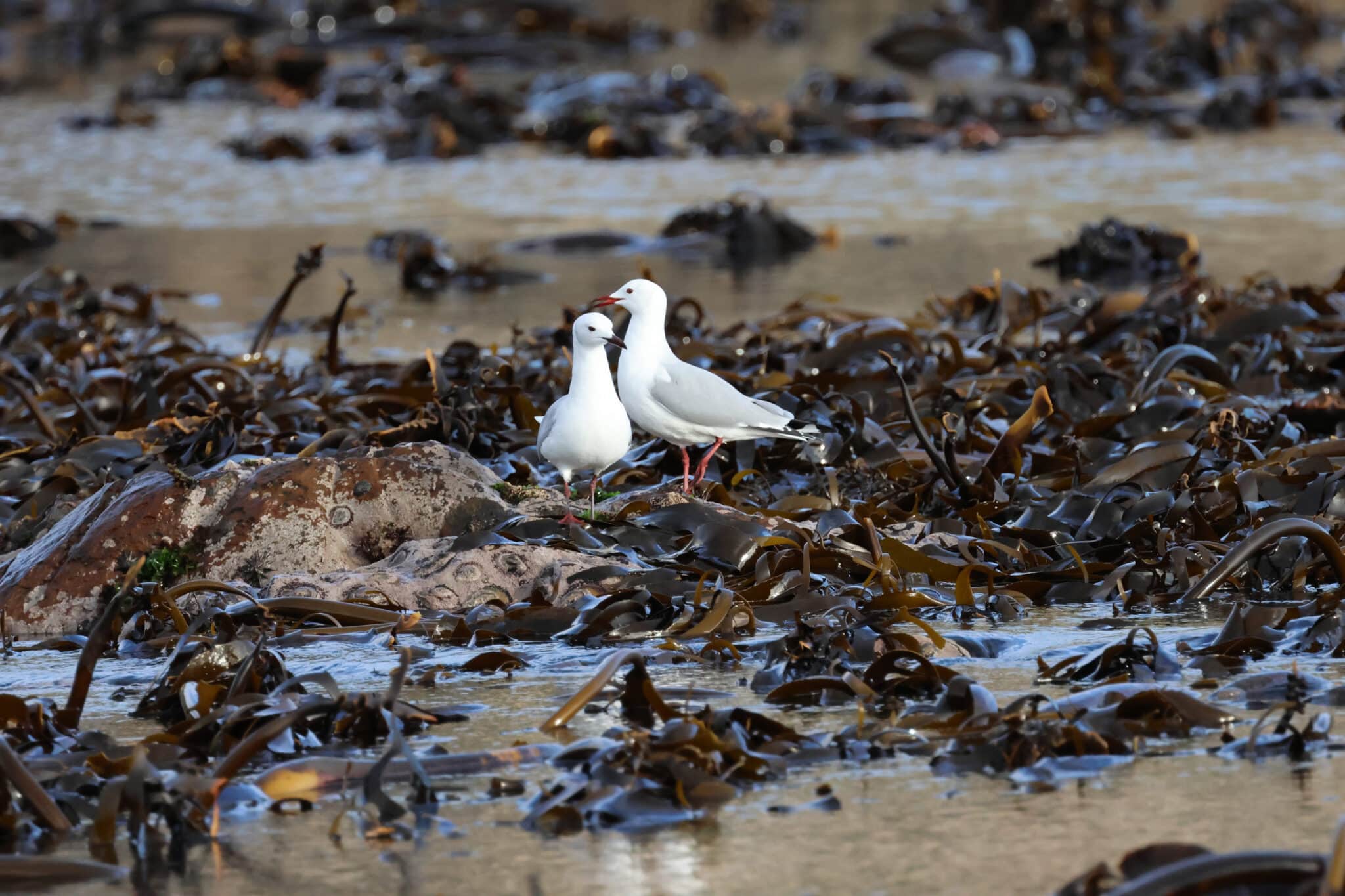
Hartlaub’s Gull
Chroicocephalus hartlaubii

Number Of Mature
Individuals (Regional)
11 600

Regional
Population Trend
Decreasing
2025
Regional Category
Vulnerable
Search by species
CONTENTSOverview
Names
|
IOC English Name: |
Hartlaub’s Gull |
|
SA & IOC Scientific Name: |
Chroicocephalus hartlaubii |
|
BirdLife International Taxonomy (scientific name): |
Larus hartlaubii |
|
Order: |
CHARADRIIFORMES |
|
Family: |
Laridae |
|
Species name author: |
Bruch 1853 |
|
Afrikaans: |
Hartlaubmeeu |
|
Sesotho (South Africa): |
|
|
Sesotho (Lesotho): |
|
|
Siswati: |
|
|
Zulu: |
unochweba waseKapa |
Current Assessment Status
|
2025 Regional Category [Criteria] |
VU [A2a] |
|
2024 Global Category [Criteria] |
LC (BirdLife International 2018) |
|
Population size (Regional) |
5800 pairs (Crawford et al. 2023) |
|
Population size (Global) |
Unknown (BirdLife International 2018) |
|
Distribution size (EOO) (Regional) km2 |
c. 63 000 |
|
Distribution size (EOO) (Global) km2 |
225 000 (BirdLife International 2018) |
|
Distribution size (AOO) (Regional) km2 |
c. 16 000 |
|
Generation time |
10.7 years (Crawford et al. 2023) |
|
Status change reason |
Genuine Change in Status |
|
Migrant (in the region) |
No |
|
Regional endemic |
Near-endemic |
Historic Listing Information
|
2000 Regional Status |
Not Evaluated |
|
2015 Regional Status |
LC |
|
Status change reason (if applicable) |
Improved Knowledge |
|
2015 Population size (Regional) |
5000 breeding pairs |
|
2015 Global Status |
LC |
Reason for Inclusion
Reason for Inclusion in the Assessment
In 2023, the regional population of the species was considered Vulnerable (Crawford et al. 2023).
Category Justification
Category Justification
Numbers of Hartlaub’s Gulls Chroicocephalus hartlaubii breeding in South Africa decreased by 52% between 1980-1989 and 2018-2022, which was equivalent to 49% in three generations. This met Criterion A2a for categorisation as Vulnerable.
Population Justification
The South African population decreased by 52% from c. 12 150 pairs in the 1980s (Williams et al. 1990) to c. 5800 pairs from 2018-2022 (Crawford et al. 2023). Numbers in the Western Cape likely decreased after the 1980s (Crawford and Underhill 2003). The global population decreased from c. 13 700 pairs in the 1980s (Williams et al. 1990) to c. 6280 pairs from 2018-2022 (Crawford et al. 2023).
Trend Justification
Age at first breeding (A) for Hartlaub’s Gull was three years (Crawford and Underhill 2003). Annual survivorship from fledging to 1 year was 0.76, from 1 to 2 years 0.79, and for birds older than 2 years (φα) 0.87 (Underhill and Underhill 1986). Based on these parameters, generation length (G) for Hartlaub’s Gulls was calculated as G = A + (1 / (1 − ϕa)) (Birdlife International 2000) = 10.7 years. Hence three generations is 32 years. The South African population decreased by 52% between 1986 and 2020, a period of 34 years, which approximated a decrease of 49% in 3 G and suggested a Vulnerable categorisation for the species in that country (Crawford et al. 2023). The Namibian population was classed as Vulnerable in 2015 (Simmons 2015) and held c. 485 pairs from 2018-2022 (Crawford et al. 2023). The global population decreased by 54% between 1986 and 2020, which approximated a decrease of 51% in 3 G. This is marginally above the threshold of 50% that separates Vulnerable from Endangered (IUCN 2022). However, for consistency Crawford et al. (2023) suggested a Vulnerable for the species’ overall population (Crawford et al. 2023). The species was adjudged Least Concern by BirdLife International (2018) but updated data were not available for that assessment.
Biology & Ecology
Taxonomy
Chroicocephalus is a genus of medium to relatively small gulls, which until recently were included in the genus Larus (Pons et al. 2005).
Identification
Adults are about 38 cm long and 265 g in weight. Breeding adults have a pale lavender-grey hood extending to the upper nape and throat, often showing as a faint darker ring at the lower edge. The mantle and back are pale silvery grey, while the neck, rump, tail, and upper tail coverts are white. The upper wings are pale silvery grey, with black outer primaries that have white tips and ‘mirrors.’ The mid-primaries are increasingly white towards the base. The underwing is dusky with a few translucent spots. The bill is deep red, eyes dark brown (sometimes pale), and legs and feet are dark red. Underparts are white (Hockey and Crawford 2005).
Distribution
Hartlaub’s Gulls are endemic to southern Africa, where they have bred patchily around the coast between Swakopmund in central Namibia and Algoa Bay on South Africa’s south coast (Crawford et al. 2023), a distance of c. 2100 km, at 67 sites. The species has nested up to 50 km inland (Crawford 1997), but most breeding localities are near the coast (Crawford et al. 2023). Up until the 1970s Hartlaub’s Gulls only bred west of Cape Agulhas. They were first seen in the Port Elizabeth vicinity in 1977 (Nicholls 1977) and were first recorded breeding in the Eastern Cape in 1982 (Crawford et al. 2009). They are not known to have bred between Dyer Island in the Western Cape and Algoa Bay in the Eastern Cape (Crawford et al. 2023).
The species seldom occurs >20 km out to sea (Crawford 1997) and usually remains within its breeding distribution (Hockey and Crawford 2005). Assuming average seaward and inland extents of 20 km and 10 km across its distribution, its Extent of Occurrence (EOO) would be c. 63 000 km2 and its Area of Occurrence perhaps 25% of that because of its patchy distribution within the EOO, so c. 16 000 km2.
Ecology
In 1990, 27 of 48 Hartlaub’s Gull colonies were at natural habitat, including offshore islands, coastal pans, rivers, and desert, and 21 were at man-made habitat, including sewage and salt works, harbours, and urban areas (Williams et al. 1990). Local populations of the species alternate breeding sites between seasons (Williams et al. 1990, Crawford et al. 1994, Simmons 2015). Hartlaub’s Gulls frequently breed in mixed colonies with Greater Crested Terns Thalasseus bergii and sometimes with Grey-headed Gulls C. cirrocephalus (Williams et al. 1990). They sometimes hybridise with Grey-headed Gulls (Simmons 2015, Martin and Whittington 2023). Small numbers of Hartlaub’s Gull may breed year-round but most nest between January and September (Crawford and Underhill 2003). They may double brood. Pairs lay 1–3 (mean 1.8, rarely 4 or 5) eggs (Hockey and Crawford 2005, BM Dyer unpubl data). Of eggs laid, 27% produced young (Steele 1992), which was equivalent to a breeding success of 0.49 chicks per pair.
Hartlaub’s Gulls feed in the nearshore marine environment, intertidal zone, estuaries and at inland fields on small fish, and marine and terrestrial invertebrates. They hawk aerial insects, including those attracted to lights at night. They scavenge food at fish factories, open-air restaurants and in urban environments (Hockey and Crawford 2005, BM Dyer pers obs). They can form large flocks; a maximum count of 3650 birds was recorded in February 2008 at the Swakopmund Sewage Works (Simmons 2015).
Threats & Conservation
Threats
Some suitable breeding habitat for Hartlaub’s Gulls has been lost. Nests on islands in salt and sewage works are Vulnerable to changing water levels that may flood them or, by receding, increase their accessibility to predators. Up to 75 pairs of Hartlaub’s Gulls bred at Mile 4 Saltworks, north of Swakopmund, in the 1970s and 1980s (Williams 1987), but subsequently the nature of the evaporation pans changed, they became more flooded and no suitable nesting habitat remained (Tom et al. 2023a). Human alteration of the Orange River Estuary reduced availability of breeding habitat there (Anderson et al. 2003). When Hartlaub’s Gulls breed in urban environments, they frequently nest on roofs (Steele 1992). Noise at the colony may disturb residents occupying buildings, and nests, feathers and corpses may block drains and gutters. Therefore, their nests are often cleared from roofs (Steele 1992). Sometimes chicks are rescued during such removals and taken to a rescue centre for rehabilitation and later return to the wild. Nests near airfields were destroyed because of the risk of bird strikes to air-traffic (du Toit et al. 2003).
An expansion of Lüderitz Harbour, Namibia, in 1998, consequently increased shipping/human activities at the harbour, and a simultaneous, large increase in the numbers of feral cats Felis catus around the harbour may have displaced Hartlaub’s Gulls from Lüderitz Harbour and Shark Island to breed at Penguin, Seal, and Halifax islands (Tom et al. 2023b). The joining of Marcus Island, Western Cape, to the mainland by means of a causeway allowed access to a variety of mainland predators and likely led to cessation of breeding there by Hartlaub’s Gulls (Makhado et al. 2023). It was thought that a burgeoning feral cat population at Robben Island displaced Hartlaub’s Gulls from breeding there in 1997 and 1998 (Crawford and Kroese 2000). Hartlaub’s Gulls were infected by highly pathogenic avian influenza (HPAI) (Khomenko et al. 2018) and are likely susceptible to other avian diseases.
Conservation Measures Underway
Colonies breeding in West Coast National Park and at Dassen and Dyer islands are protected from human disturbance.
Conservation Measures Proposed
In order to secure the future of Hartlaub’s Gulls, their main colonies should be protected from human disturbance and predators. Agreements in this regard should be entered into with Robben Island Museum and authorities operating salt or water-treatment works that support substantial colonies. Feral cats should be removed from Robben Island. Measures to prevent the spread of disease between different breeding localities should be implemented. Minimising provision of supplementary food in the greater Cape Town area may encourage birds to breed at more natural habitats and decrease adverse human-gull interactions (Crawford and Kroese 2000).
Research Priorities and Questions
- Variations in annual cycles of Hartlaub’s Gulls within and between breeding localities and years should be investigated to improve estimates of, and trends in, abundance.
- Further information on demographic parameters should be obtained for different regions, including through nest observations and banding.
- More information on inter-colony movements should be obtained using colour-coded banding.
- Seasonal closures to all persons, except bona fide researchers, of areas previously used at Robben Island by Hartlaub’s Gulls for breeding should be trialled. Should such areas be reoccupied, attempts should be made to catch and remove feral cats from their vicinity, and breeding success should be gauged.
- The diets of Hartlaub’s Gulls breeding in urban and natural habitats should be compared.
- Diseases present at the main Hartlaub’s Gull colonies should be identified.
Contributors & References
Assessor/s
Azwianewi Makhado, Bruce Dyer, Paul Martin, Phil Whittington, Robert Crawford
Reviewer/s
Alistair McInnes
References
Anderson MD, Kolberg H, Anderson PC, Dini J, Abrahams A. 2003. Waterbird populations at the Orange River mouth from 1980 – 2001: a reassessment of its Ramsar status. Ostrich 74: 159–172.
BirdLife International. 2000. Threatened birds of the world. Barcelona, Spain:
Lynx Edicions.
BirdLife International. 2018. Larus hartlaubii. The IUCN Red List of Threatened Species 2018: e.T22694393A132548041. Available: https://dx.doi.org/10.2305/IUCN.UK.2018-2.RLTS.T22694393A132548041.en. [Accessed on 24 March 2025].
Crawford RJM, Dyer BM, Brooke RK. 1994. Breeding nomadism in southern African seabirds – constraints, causes and conservation. Ostrich 65: 231–246.
Crawford RJM. 1997. Hartlaub’s Gull. In: Harrison JA, Allan DG, Underhill LG, Herremans M, Tree AJ, Parker V, Brown CJ (eds), Southern African Bird Atlas. BirdLife South Africa: Johannesburg. pp 466–467.
Crawford RJM, Kroese M. 2000. Gulls and terns return to Robben Island. Africa Birds and Birding 5(2): 24.
Crawford RJM, Underhill LG. 2003. Aspects of breeding, molt, measurements and population trend of Hartlaub’s Gull in Western Cape, South Africa. Waterbirds 26: 139–149.
Crawford RJM, Whittington PA, Martin AP, Tree AJ, Makhado AB. 2009. Population trends of seabirds breeding in South Africa’s Eastern Cape, and the possible influence of anthropogenic and environmental change. Marine Ornithology 37: 159–174.
Crawford RJM, Dyer BM, Martin AP, Tom DB, Upfold L, Visagie JL, Whittington PA, Makhado AB. 2023. Numbers, trends, status, and conservation of Hartlaub’s Gulls (Chroicocephalus hartlaubii) in southern Africa. In: Makhado AB, Amaro A, Crawford RJM, Gottlieb TB, Morais M, Mwaala DN, Nghimwatya L, Seakamela M, Tom DB, Witteveen M (eds), Atlas of marine turtles, seabirds, and seals in the Benguela Current and adjacent regions. Population sizes and trends, conservation status, and Important Bird and Biodiversity Areas for breeding. Benguela Current Convention; Cape Town.
du Toit M, Boere GC, Cooper J, de Villiers MS, Kemper J, Lenten B, Simmons RE, Underhill LG, Whittington PA. 2003. Conservation Assessment and Management Plan for southern African coastal seabirds. Animal Demography Unit; Cape Town and Conservation Breeding Specialist Group; Apple Valley. pp 198.
Hockey PAR, Crawford RJM. 2005. Hartlaub’s Gull. In: Hockey PAR, Dean WRJ, Ryan PG (eds), Roberts Birds of Southern Africa, 7th Edn. Cape Town: John Voelcker Bird Book Fund. pp 444–446.
IUCN. 2022. IUCN Red List Categories and Criteria: Version 3.1, 2nd Edn. Gland, Switzerland and Cambridge, UK: IUCN.
Khomenko S, Abolnik C, Roberts L, Waller L, Shaw K, Monne I, Taylor J, Dhingra M, Pittiglio C, Mugyeom M, Roche X, Fredrick K, Kamata A, Okuthe S, Kone P, Wiersma L, Von Dobschuetz S, Soumare B, Makonnen Y, Morzaria S, Lubroth J. 2018. 2016 – 2018 spread of H5N8 highly pathogenic avian influenza (HPAI) in sub-Saharan Africa: epidemiological and ecological observations. FOCUS ON No. 12, Rome.
Makhado AB, Dyer BM, Kock A, Masotla M, Upfold L, Crawford RJM. 2023. Breeding sites of seabirds from Cape Columbine to West Coast National Park. In: Makhado AB, Amaro A, Crawford RJM, Gottlieb TB, Morais M, Mwaala DN, Nghimwatya L, Seakamela M, Tom DB, Witteveen M (eds), Atlas of marine turtles, seabirds, and seals in the Benguela Current and adjacent regions. Population sizes and trends, conservation status, and Important Bird and Biodiversity Areas for breeding. Cape Town: Benguela Current Convention.
Martin AP, Whittington PA. 2023. Mainland breeding sites between Tsitsikamma National Park and Woody Cape. In: Makhado AB, Amaro A, Crawford RJM, Gottlieb TB, Morais M, Mwaala DN, Nghimwatya L, Seakamela M, Tom DB, Witteveen M (eds), Atlas of marine turtles, seabirds, and seals in the Benguela Current and adjacent regions. Population sizes and trends, conservation status, and Important Bird and Biodiversity Areas for breeding. Cape Town: Benguela Current Convention.
Nicholls G. 1977. A new gull for the Eastern Cape. The Bee-eater 28: 36.
Pons JM, Hassanin A, Crochet PA. 2005. Phylogenetic relationships within the Laridae (Charadriiformes: Aves) inferred from mitochondrial markers. Molecular Phylogenetics and Evolution 37: 686–699.
Simmons RE. 2015. Hartlaub’s Gull Chroicocephalus hartlaubii (Larus hartlaubii). In: Simmons RE, Brown CJ, Kemper J (eds), Birds to watch in Namibia: red, rare and endemic species. Windhoek: Ministry of Environment and Tourism and Namibia Nature Foundation. 86–87.
Steele WK. 1992. Breeding of Hartlaub’s Gull Larus hartlaubii at Hout Bay harbour, South Africa. Marine Ornithology 20: 75–79.
Tom DB, Boorman M, Crawford RJM. 2023a. Seabirds breeding at Mile 4 Saltworks, Swakopmund. In: Makhado AB, Amaro A, Crawford RJM, Gottlieb TB, Morais M, Mwaala DN, Nghimwatya L, Seakamela M, Tom DB, Witteveen M (eds), Atlas of marine turtles, seabirds, and seals in the Benguela Current and adjacent regions. Population sizes and trends, conservation status, and Important Bird and Biodiversity Areas for breeding. Cape Town: Benguela Current Convention.
Tom DB, Kemper J, Bartlett PA, Crawford RJM, Delport J-A, Dyer BM, Makhado AB, Jones R, Roux J-P. 2023b. Breeding sites of seabirds between Hottentots Bay and Grosse Bucht. In: Makhado AB, Amaro A, Crawford RJM, Gottlieb TB, Morais M, Mwaala DN, Nghimwatya L, Seakamela M, Tom DB, Witteveen M (eds), Atlas of marine turtles, seabirds, and seals in the Benguela Current and adjacent regions. Population sizes and trends, conservation status, and Important Bird and Biodiversity Areas for breeding. Cape Town: Benguela Current Convention.
Underhill LG, Underhill GD. 1986. An analysis of the mortality and survival of Hartlaub’s Gull. Ostrich 57: 216–223.
Williams AJ. 1987. New seabird breeding localities, and an extension of Bank Cormorant range, along the Namib coast of southern Africa. Cormorant 15: 98–102.
Williams AJ, Steele AK, Cooper J, Crawford RJM. 1990. Distribution, population size and conservation of Hartlaub’s Gull Larus hartlaubii. Ostrich 61: 66–76.
Citation
Makhado AB, Dyer B, Martin P, Whittington PA, Crawford RJM 2025. Hartlaub’s Gull. In: Lee ATK, Rose S, Banda S, Bezeng SB, Maphalala MI, Maphisa DH, Smit-Robinson H (eds), The 2025 Red Data Book of Birds of South Africa, Lesotho and Eswatini. Johannesburg, South Africa: BirdLife South Africa. Available at: https://www.birdlife.org.za/red-list/hartlaubs-gull/
Our generous sponsors


