


Hamerkop
Scopus umbretta

Number Of Mature
Individuals (Regional)
<10 000

Regional
Population Trend
Decreasing
2025
Regional Category
Near Threatened
Search by species
CONTENTSOverview
Names
|
IOC English Name: |
Hamerkop |
|
SA & IOC Scientific Name: |
Scopus umbretta |
|
BirdLife International Taxonomy (scientific name): |
Scopus umbretta |
|
Order: |
PELECANIFORMES |
|
Family: |
Scopidae |
|
Species name author: |
Gmelin JF 1789 |
|
Afrikaans: |
Hamerkop |
|
Sesotho (South Africa): |
mmamasianoke |
|
Sesotho (Lesotho): |
’mamasianoke |
|
SiSwati: |
Tsekwane |
|
Zulu: |
uthekwane |
Current Assessment Status
|
2025 Regional Status [Criteria] |
NT [A2c; C1] |
|
2024 Global Category [Criteria] |
LC (BirdLife International 2016) |
|
Population size (Regional) |
<10 000 |
|
Population size (Global) |
Unknown (BirdLife International 2016) |
|
Distribution size (EOO) (Regional) km2 |
1 521 523 (Lee 2024) |
|
Distribution size (EOO) (Global) km2 |
31 100 000 (BirdLife International 2016) |
|
Distribution size (AOO) (Regional) km2 |
639 900 (Lee 2024) |
|
Generation time |
8.8 years (BirdLife International 2016) |
|
Status change reason |
Improved knowledge |
|
Migrant (in the region) |
No |
|
Regional endemic |
No |
Historic Listing Information
|
2000 Regional Status |
Not Evaluated |
|
2015 Regional Status |
Not Evaluated |
|
Status change reason (if applicable) |
Not Evaluated |
|
2015 Population size (Regional) |
Unknown |
|
2015 Global Status |
LC |
Reason for Inclusion
Reason for Inclusion in the Assessment
Hamerkop Scopus umbretta was not assessed in the 2015 Regional Red List assessment. Preliminary screening of Coordinated Waterbird Counts (CWAC) data indicated a significant decline in number of Hamerkop counted per year.
Category Justification
Category Justification
Although widespread across the region, Hamerkop has suffered declines of at least 20% in Area of Occupancy (AOO) in the last three generations. This value approaches the 30% Vulnerable threshold of decline. The cause of decline is not well understood and has not ceased. Decline is likely associated with the increased aridity in the western part of the region which would lead to drier habitats which are unsuitable to Hamerkop (see for example Strydom et al. 2019).
While the regional population size is unknown it is estimated to be less than 10 000 mature individuals, hence invoking Criterion C1.
Hamerkop is assessed as Near Threatened [A2c; C1].
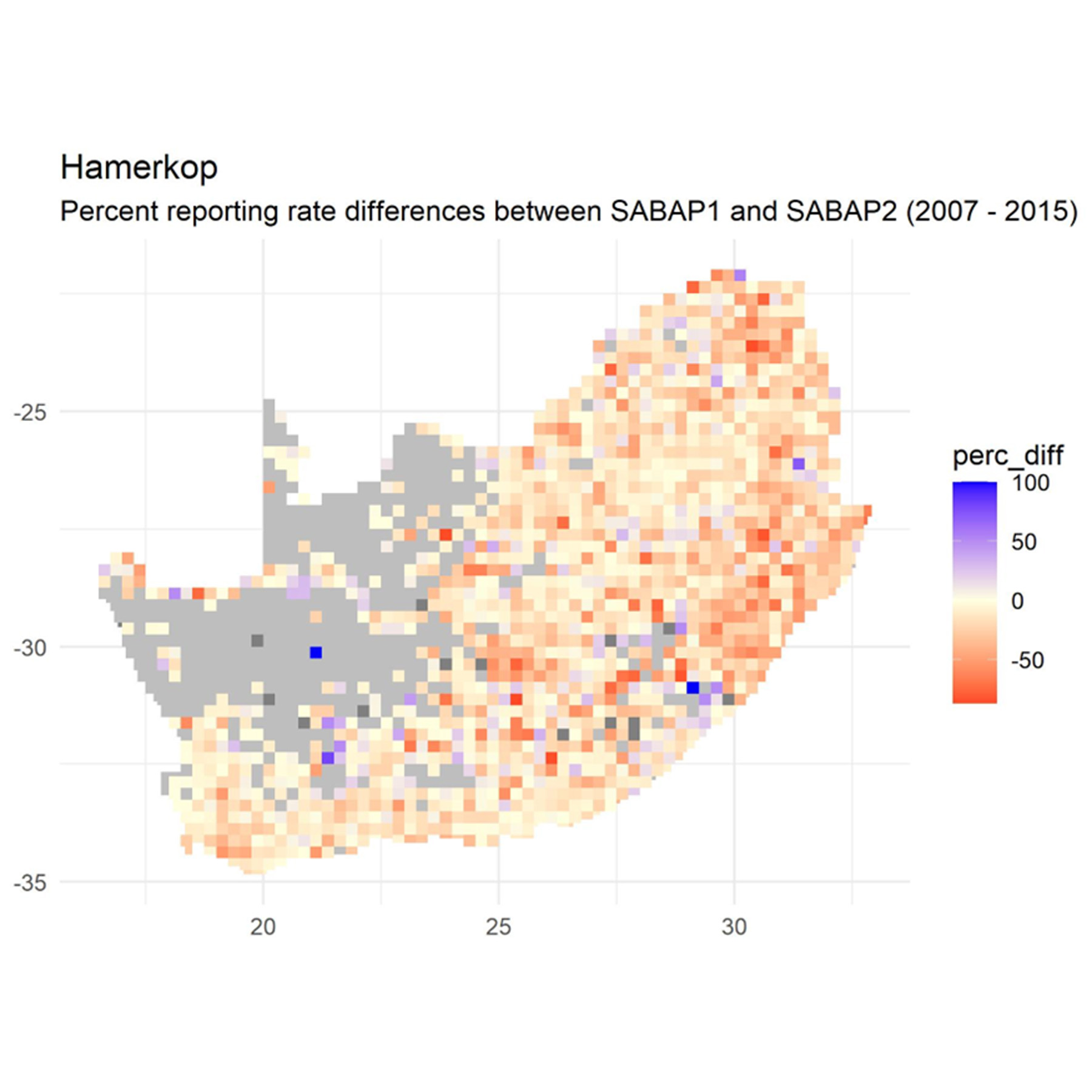
Figure 1a: SABAP distribution map for Hamerkop showing percent reporting rate change between SABAP1 (1987-1991) and SABAP2 (2007-2015), illustrating the extensive regional former range.
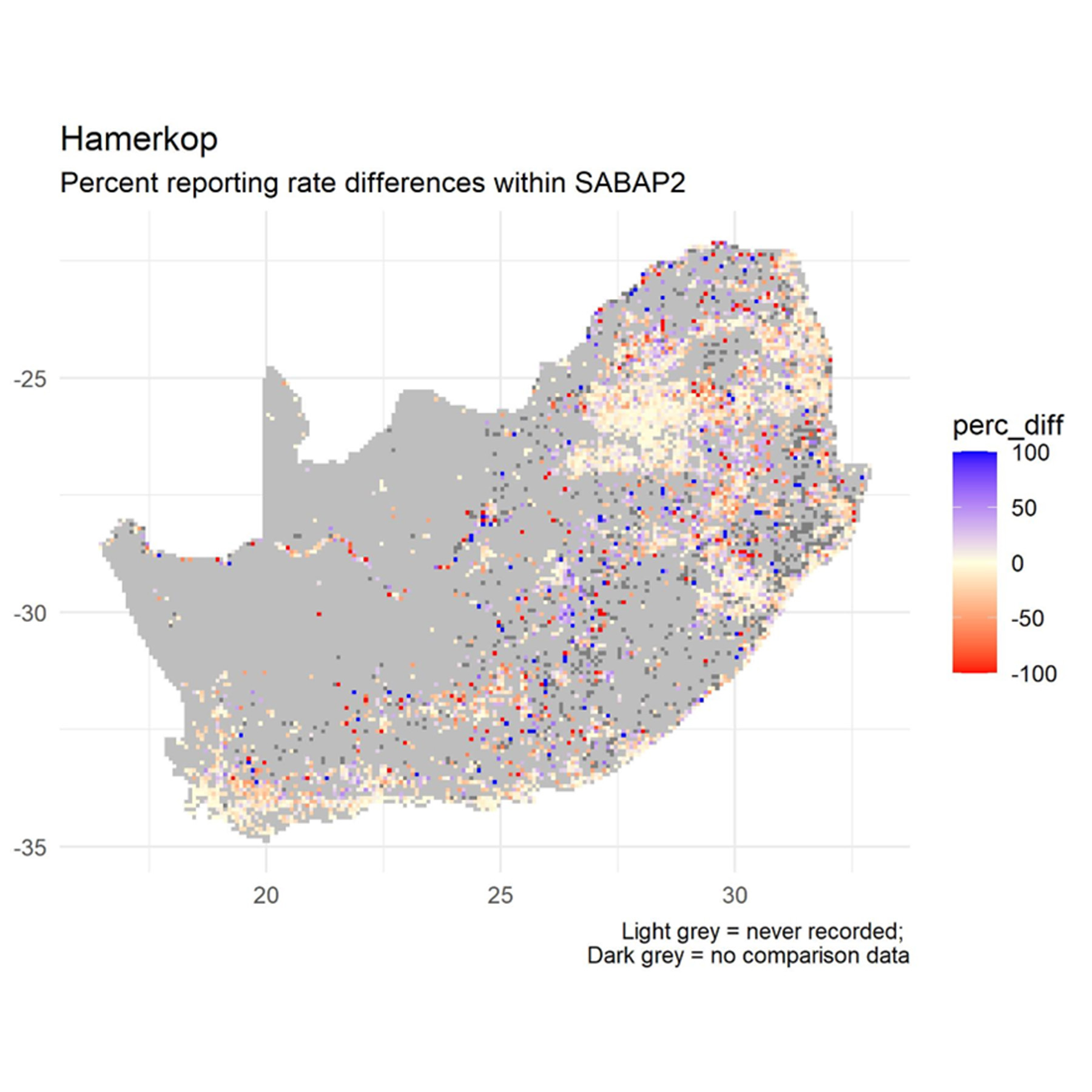
Figure 1b: Change in the percentage reporting rate for Hamerkop between early (2007-2015) and late (2016-2023) SABAP2 showing recent declines in the number of records during SABAP2.
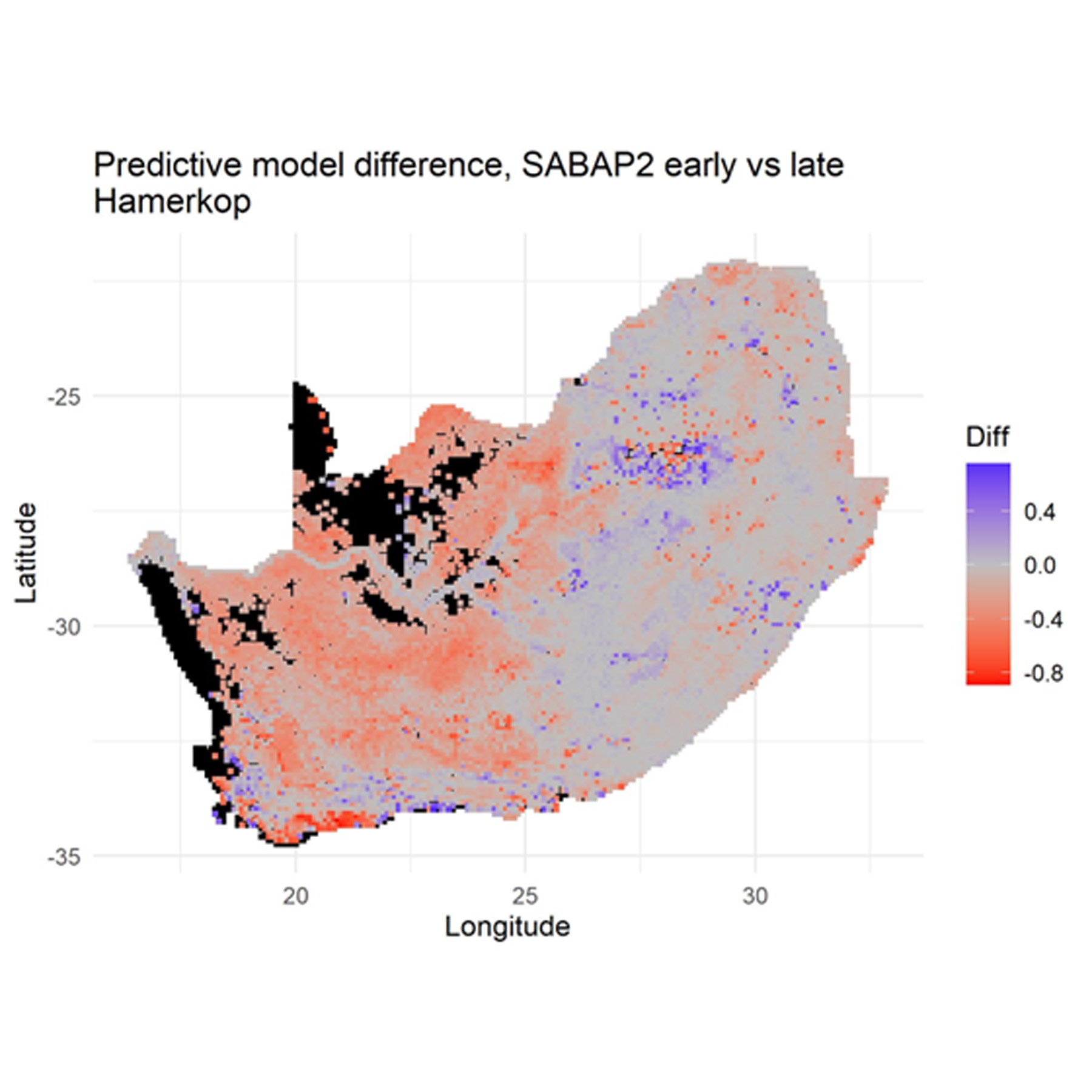
Figure 1c: Predictive modelled range change for Hamerkop over three generations between early (2007-2015) and late (2016-2023) SABAP2 with predicted range contraction especially in the interior regions. Red indicating regions of decline.
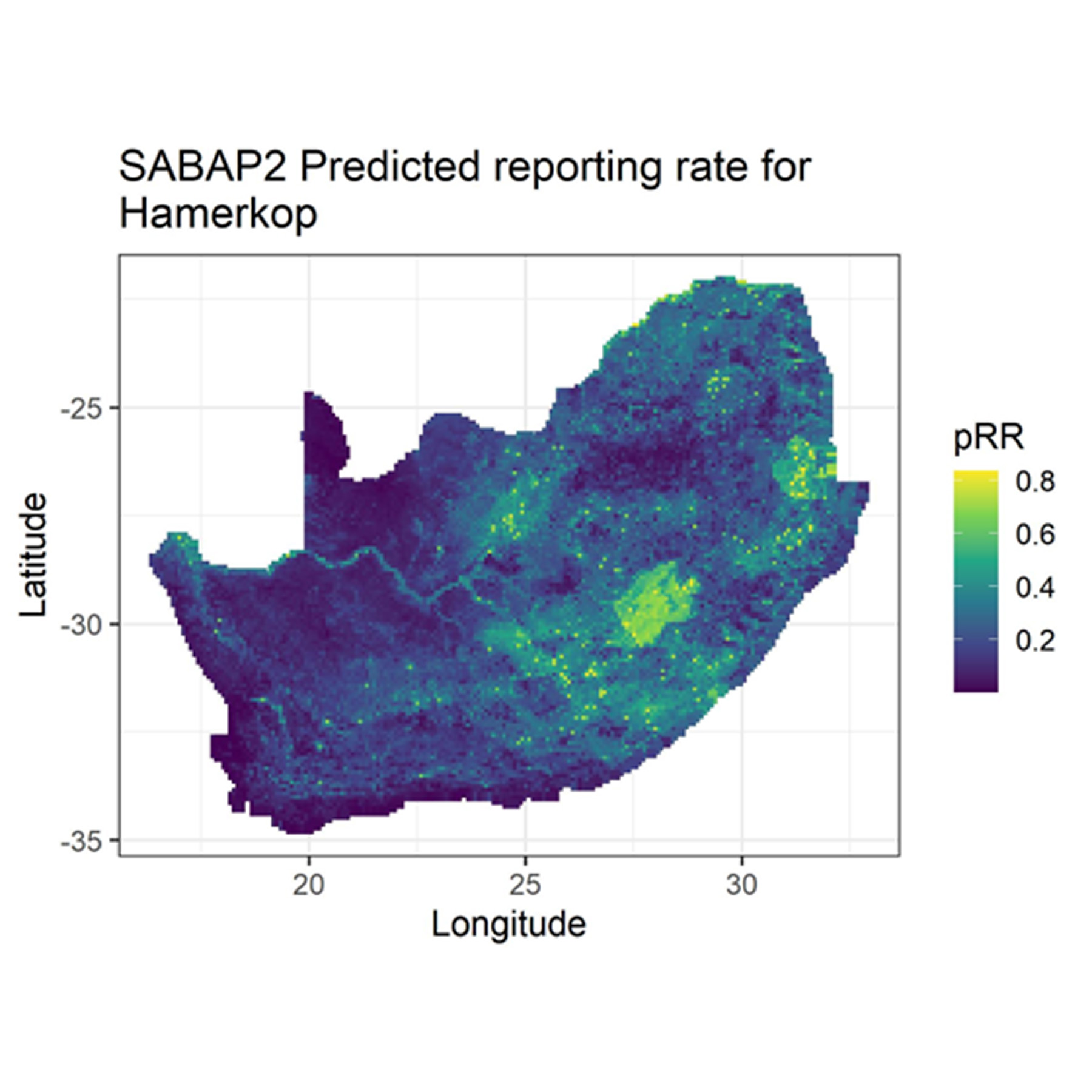
Figure 1d: The SABAP2 report rate prediction model indicates that Hamerkop is now restricted to certain population strongholds, notably Lesotho, Eswatini and the North West and the Eastern Cape Provinces (from Lee 2024).
Population Justification
Hamerkop are very poorly studied across their range (BirdLife International 2016, Elliott et al. 2020). The global population size is unknown. Regionally the population is estimated to <10 000. This estimate is based on the fact that Hamerkop have been recorded in 3000 – 4000 pentads. On the assumption that there is one pair per pentad (a fair assumption for a rare bird and that not all range is covered, but also that some records are dispersing non-breeding birds), that gives an estimate of 6000 – 8000 individuals.
Trend Justification
Globally, Hamerkop is considered stable (BirdLife International 2016) although it is unclear how this assumption is justified. Regionally, Hamerkop is inferred to be in decline based on the decline in modelled AOO (c. 20%) and yearly CWAC count numbers (Figures 1,2, Table 1, Lee 2024). There have been declines between Southern African Bird Atlas Projects (SABAP1 and SABAP2), as well as within SABAP2. Estimated percent change over three generations from CWAC data from 1998 to 2023 was -52% (95% CI: -70%, -22%). Confidence in this trend is high.
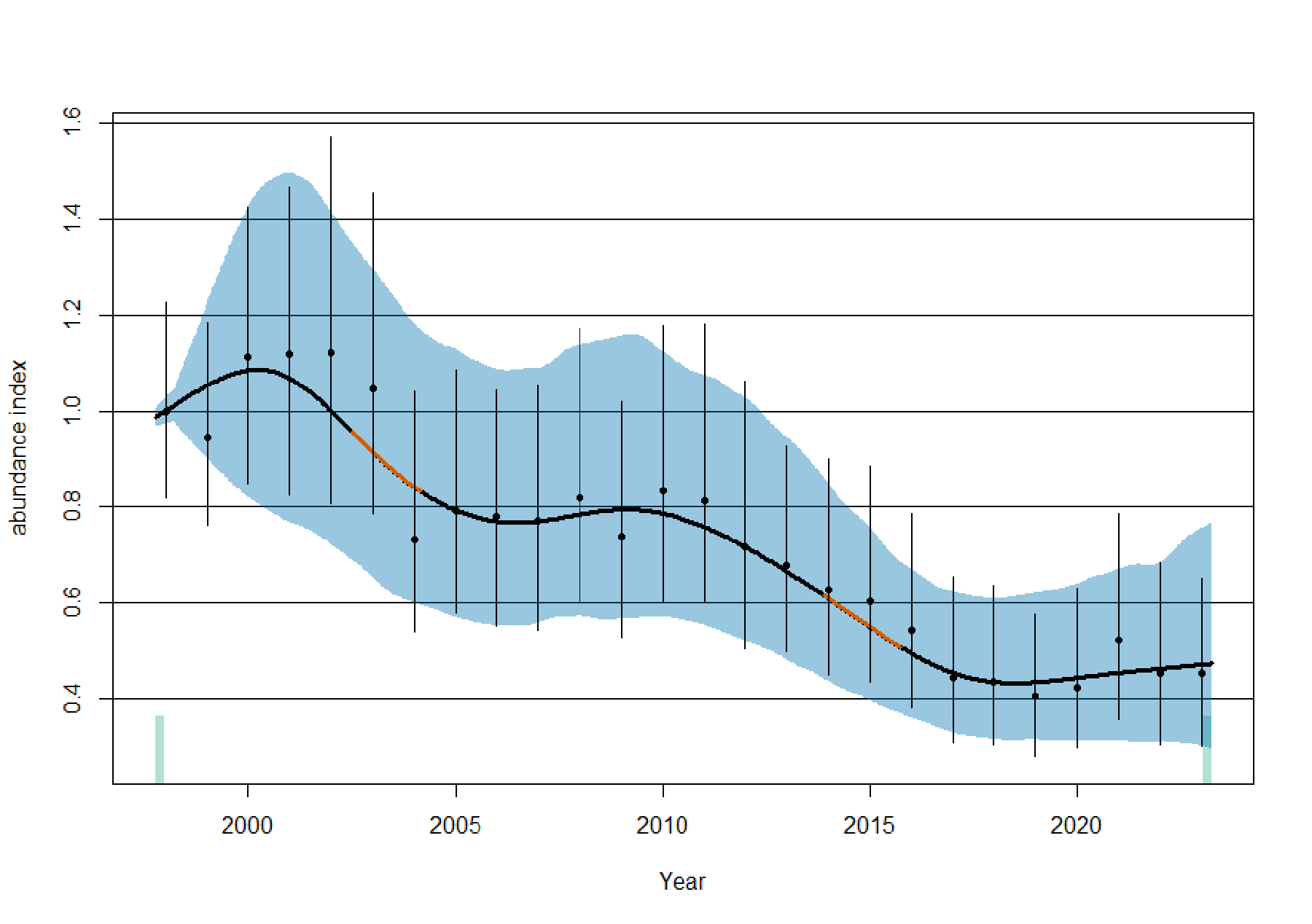
Figure 2: Poptrend model results for Hamerkop from CWAC data. Red indicates periods of significant decline, and green indicates periods of significant increase.
Table 1: Percentage predicted range change based on the number of pentads that Hamerkop could occur in, for the period of 2007-2015, and 2016-2023. These values are used to calculate an annual rate of change and the percentage change over the longer of 10 years or three generations (Criterion A) (from Lee 2024).
|
Information |
|
|
Pentads 2015 |
14817 |
|
Pentads 2023 |
11970 |
|
Annual rate of change |
0.974 |
|
Percent change (10 years or 3 generations) |
-20.50% |
|
Category (A2) |
NT |
Biology & Ecology
Taxonomy
This species is the only member of its taxonomic family (Scopidae) and genus (Scopus). Two subspecies recognised, S. u. umbretta in tropical Africa, Madagascar and southwestern Arabia and S. u. minor in coastal West Africa (IOC v14.2).
Identification
50–56 cm, 415–430 g. Unmistakable large brown bird with a peculiar wedge-shaped (hammer-like) head. Black bill. Uniform dark brown body with iridescent purplish gloss on back (Elliott et al. 2020). Juvenile similar to adult. Race S.u. minor is smaller.
Distribution
Widely distributed across sub-Saharan African, S. u. umbretta in tropical Africa, Madagascar and southwestern Arabia and S. u. minor in coastal West Africa (IOC v14.2).
Ecology
Associated with many aquatic habitats including estuarine, rivers, ponds, lakesides and irrigation systems and even occasionally recorded along rocky shorelines (Elliott et al. 2020). Requires trees for nesting and roosting (Elliott et al. 2020).
Sedentary but will move locally in response to rain. Does not appear to use the same nest for more than a few months (Elliott et al. 2020).
Mostly feeds on amphibians, both adults and tadpoles. Also known to take small fish and invertebrates (Elliott et al. 2020). Generally, wades in shallow water hunting but will also take prey from the surface of water during flight (Elliott et al. 2020).
Hamerkop builds one of the largest bird nests proportional to their body weight. The nest is large and comprised of sticks, with a central chamber, usually sited in fork of tree. A pair may construct multiple nests, some of which may never be used. A diversity of other animal species takes advantage of unoccupied nests as breeding sites or dens (e.g. Gula and Downs 2023).
Normally 3–6 eggs; incubation 28–32 days; chicks have grey down and broad, blunt bill; fledging 44–50 days; age of sexual maturity unknown. Breeding success variable, c. 0·3–0·9 chicks fledged per pair per year. Not usually considered a colonial nester but aggregations of nests reported from locations where species is abundant (Kaweesa et al. 2014).
Threats & Conservation
Threats
No specific threats are known but Hamerkop will likely be impacted by extended periods of drought. Degradation of freshwater habitats will also impact this species.
Conservation Measures Underway
No species-specific measures in place.
Conservation Measures Proposed
Increased protection of freshwater wetlands generally is necessary in the region.
Research Priorities and Questions
- The threats facing the species should be evaluated before targeted conservation actions are put in place.
- The regional population size needs to be established.
- Regular monitoring of the regional population is recommended to ensure that key strongholds of the species are protected.
Contributors & References
Assessor/s
Sanjo Rose, Maria Paul
Reviewer/s
Jonah Gula, Alan Lee
References
BirdLife International. 2016. Scopus umbretta. The IUCN Red List of Threatened Species 2016: e.T22697356A93610351. Available at: https://dx.doi.org/10.2305/IUCN.UK.2016-3.RLTS.T22697356A93610351.en [Accessed on 6 May 2024].
Elliott A, Garcia EFJ, Boesman PFD. 2020. Hamerkop (Scopus umbretta), version 1.0. In: del Hoyo J, Elliott A, Sargatal J, Christie DA, de Juana E (eds), Birds of the World. Ithaca, NY, USA: Cornell Lab of Ornithology. Available at: https://doi.org/10.2173/bow.hamerk1.01.
Gill F, Donsker D, Rasmussen P. (Eds). 2024. IOC World Bird List (v14.2). DOI: 10.14344/IOC.ML.14.1.
Gula J, Downs CT. 2023. Second-hand housing: a review of avian species using Hamerkop nests for breeding. African Zoology 58: 1–5.
Kaweesa SH, Jonkvorst RJ, Katebaka R, Ssemmanda R, Pomeroy D, Brouwer J. 2012. Is the Hamerkop Scopus umbretta a neocolonist or an opportunist nester? Scopus: Journal of East African Ornithology 32: 35–38.
Lee ATK. 2024. Regional Red Data Book of the Birds of South Africa, Lesotho and Eswatini: SABAP2 synthesis and supporting information and graphics for Hamerkop. Unpublished report. Johannesburg: BirdLife South Africa.
Strydom S, Savage MJ, Clulow AD. 2019. Long-term trends and variability in the dryland microclimate of the Northern Cape Province, South Africa. Theoretical and Applied Climatology 137: 963–975.
Citation
Rose S, Paul M 2025. Hamerkop. In: Lee ATK, Rose S, Banda S, Bezeng SB, Maphalala MI, Maphisa DH, Smit-Robinson H (eds), The 2025 Red Data Book of Birds of South Africa, Lesotho and Eswatini. Johannesburg, South Africa: BirdLife South Africa. Available at: https://www.birdlife.org.za/red-list/hamerkop/
Our generous sponsors


