


Ground Woodpecker
Geocolaptes olivaceus

Number Of Mature
Individuals (Regional)
Unknown

Regional
Population Trend
Decreasing
2025
Regional Category
Near Threatened
Search by species
CONTENTSOverview
Names
|
IOC English Name: |
Ground Woodpecker |
|
SA & IOC Scientific Name: |
Geocolaptes olivaceus |
|
BirdLife International Taxonomy (scientific name): |
Geocolaptes olivaceus |
|
Order: |
PICIFORMES |
|
Family: |
Picidae |
|
Species name author: |
Gmelin JF 1788 |
|
Afrikaans: |
Grondspeg |
|
Sesotho (South Africa): |
mohetle |
|
Sesotho (Lesotho): |
mohetle |
|
Siswati: |
|
|
isiZulu: |
umnqangqandolo |
Current Assessment Status
|
2025 Regional Category [Criteria] |
NT [A2c] |
|
2024 Global Category [Criteria] |
NT [A2bc+3bc+4bc] (BirdLife International 2017) |
|
Population size (Regional) |
Unknown |
|
Population size (Global) |
Unknown |
|
Distribution size (EOO) (Regional) km2 |
967 585 (953 032 – 994 293) (Lee 2025) |
|
Distribution size (EOO) (Global) km2 |
1 210 000 (BirdLife International 2017) |
|
Distribution size (AOO) (Regional) km2 |
177 512 (148 296 – 209 156) (Lee 2025) |
|
Generation time |
5 years (BirdLife International 2017) |
|
Status change reason |
Genuine change in status |
|
Migrant (in the region) |
No |
|
Regional endemic |
Yes |
Historic Listing Information
|
2000 Regional Status |
Not Evaluated |
|
2015 Regional Status |
LC |
|
Status change reason (if applicable) |
No change |
|
2015 Population size (Regional) |
Unknown |
|
2015 Global Status |
LC |
Reason for Inclusion
Reason for Inclusion in the Assessment
Ground Woodpecker Geocolaptes olivaceus was not previously formally assessed, and presumed to be Least Concern. It is a regionally endemic species and was globally uplisted to Near Threatened in 2017 [A2bc+3bc+4bc] (BirdLife International 2017).
Category Justification
Category Justification
The Ground Woodpecker is classified as Near Threatened (NT) under Criterion A2c due to a 26.9% decline in its Area of Occupancy (AOO), Extent of Occurrence (EOO), and habitat quality over the past 15 years (three generations), based on the second Southern African Bird Atlas Project (SABAP2) trend analysis (Lee 2025). As this decline approaches the 30% threshold for listing under Criterion A2, it invokes the Near Threatened category.
The large EOO (c. 967 585 km²) and AOO (c. 177 512 km²) greatly exceed the threatened status threshold under Criterion B. The global and regional population size of the Ground Woodpecker is currently unknown, and hence Criterion C1 could not be applied.
The global red listing completed in 2017 takes a conservative approach and suggests a moderately rapid decline for the species, placing it in the Near Threatened Category [A2bc+3bc+4bc] based on Lee et al. 2017. However, there remains uncertainty over the rate of decline, and the global Red List status calls for a status re-evaluation (BirdLife International 2017).
Population Justification
The species’ global (and regional) population size has not been quantified. However, it is reported to be common throughout most of its range.
Trend Justification
Global population trends suggest a moderately rapid decline across its range in South Africa, Lesotho and Eswatini over three generations (15 years). According to Lee et al. (2017), the reporting rate has decreased by 51.7%, the overall range has decreased by 43.3%, and the core range has decreased by 39.5% between the Southern African Bird Atlas Projects (SABAP1 and 2). More recent SABAP2 reporting rates showed a modelled 26.9% decline over 3 generations with an annual rate of change indicated as 0.97%, and the reporting rate changed from 3932 to 2977 pentads since 2015 (Lee 2025). The predictive model comparison between the early period (2007-2015) and the late period (2016-2023) of the SABAP2 indicates a lower probability of recording for the more recent period (Lee 2025).
Biology & Ecology
Taxonomy
Five subspecies were described based on variations in the intensity of red colouration and the barring on the under flank and undertail. Birds from the eastern part of the range are paler compared to those in the southwest (Tarboton 2005). However, no subspecies are currently recognized (Gill et al. 2025).
Identification
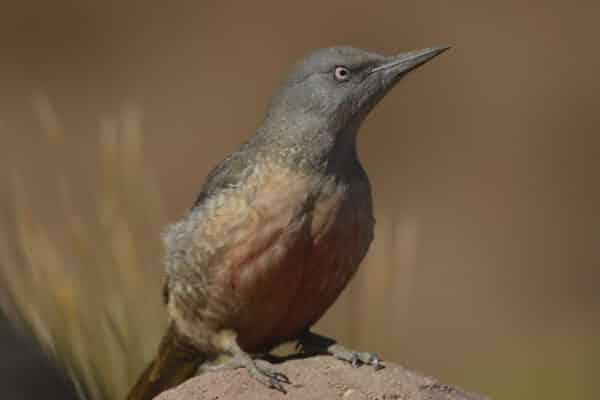
22–30 cm, c. 105–134 g. A large terrestrial woodpecker with a brownish-grey forehead and crown, a browner nape with slight red traces, grey sides of the head and neck, and a dark grey malar with fine red feather tips. Sexes differ in head markings; the female lacks the obvious black malar stripe with red flecking. In both sexes, the breast feathers are broadly tipped pinkish red, the belly is crimson with pale bases, and the flanks are barred grey-brown and whitish. The long bill is pointed and black, with a greyer base. Eyes are creamy white to yellow, rimmed pink, and legs are grey (Tarboton 2005, Winkler et al. 2020).
Distribution
The Ground Woodpecker is endemic to South Africa, Lesotho, and Eswatini. It inhabits treeless, hilly slopes and mountainous regions of the southern and western Karoo, Fynbos and Grassland biomes from northwestern Northern Cape, east to western Eswatini and southern Mpumalanga (Tarboton 2005, Taylor et al. 2015).
Additionally, 37.3% of pentads where the species has been recorded contain protected areas. The distribution is divided between 142 pentads in National Parks/Nature Reserves, 114 in other protected areas, and 428 in unprotected areas (Lee 2025).
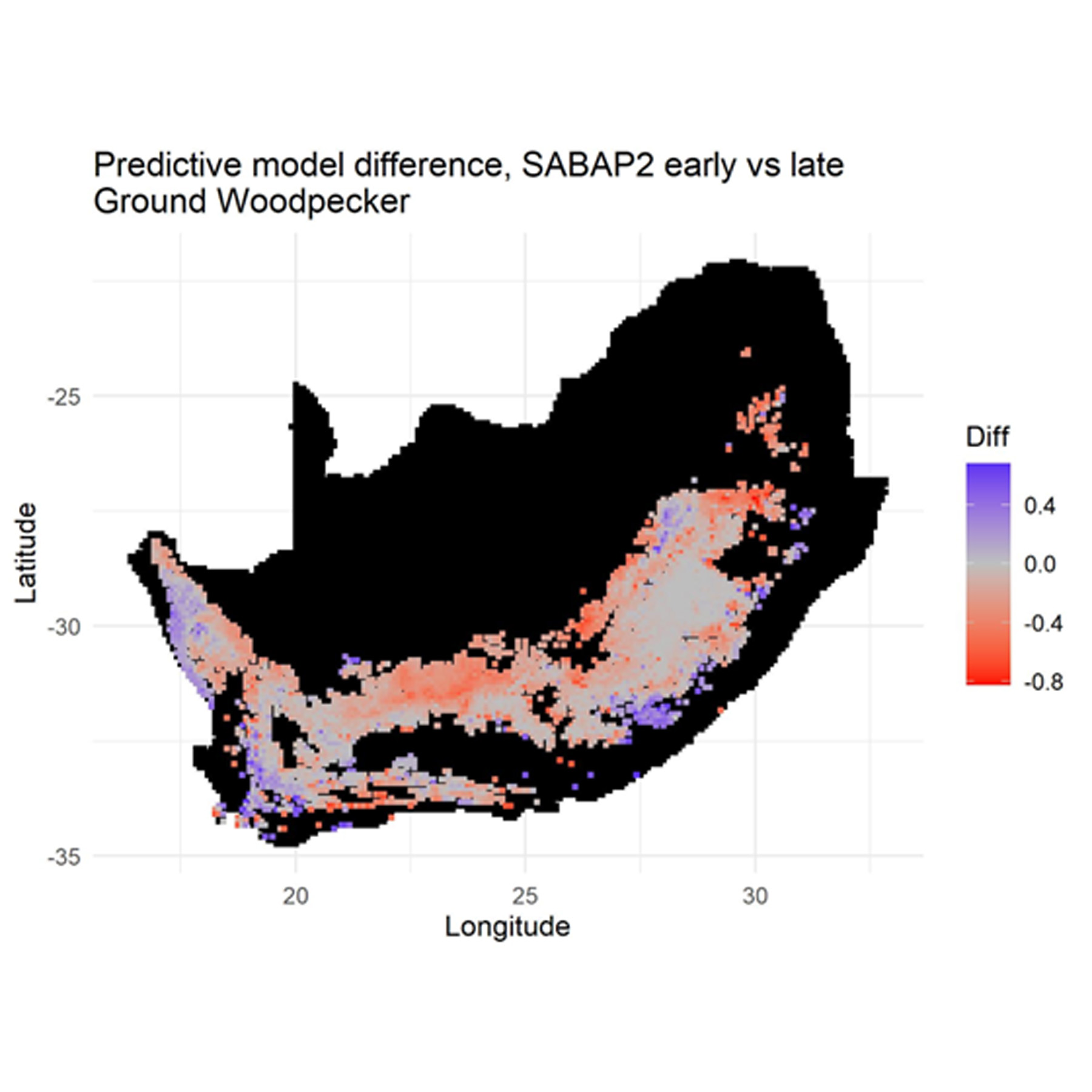
Figure 1: Distribution of the Ground Woodpecker. The predictive difference between the late (2016-2023) and early (2007-2015) SABAP models is displayed as a heatmap, with red indicating lower probability of recording for the more recent period (from Lee 2025).
Ecology
The Ground Woodpecker primarily inhabits rocky and boulder-strewn slopes in mountainous regions, usually found in treeless grasslands and shrublands. It is often seen in eroded gullies and along road cuttings. Both sexes excavate nesting holes in vertical earth banks. Breeding occurs from July to December, peaking in August and September. Ground Woodpeckers are monogamous and breed in pairs, possibly with the assistance of helpers (facultative cooperative breeders). For the rest of the year, they are found in family groups occupying 21–70 hectares and roost in the previous season’s nest holes. Their diet consists almost exclusively of ants, including their eggs and pupae. They forage by digging into subsurface ant nests and probing with their long, sticky tongues, mostly in the morning with a secondary peak of activity in the late afternoon. Ground Woodpeckers are mainly sedentary, but some evidence suggests they are altitudinal migrants in the alpine belt of KwaZulu-Natal, where they are recorded only in summer/during the breeding season (Tarboton 2005, Winkler et al. 2020).
Threats & Conservation
Threats
- Climate change is considered a potential threat: Rising temperatures and changing rainfall patterns may reduce suitable alpine habitat, forcing habitat contraction and additional ecosystem-altering effects (Simmons et al. 2004, Taylor et al. 2015).
- Habitat degradation and fragmentation through afforestation (Allan et al. 1997, Armstrong and van Hensbergen 1999).
- Infrastructure development: Potential wind energy and other developments could disturb habitats.
Conservation Measures Underway
There are no targeted conservation measures for Ground Woodpecker. General biodiversity stewardship and improved land management practices could indirectly benefit the species. The species occurs in some protected areas.
Conservation Measures Proposed
- Promote sustainable grazing practices that preserve the patchwork of rocky outcrops and prevent habitat degradation.
- Expand the protected area network.
- Implement guidelines for responsible wind energy and other infrastructural developments.
Research Priorities and Questions
- Determine population estimates, including density and distribution data.
- Study breeding biology across habitat types.
- Establish patterns of seasonal movement and altitudinal migration.
- Assess climate change vulnerability.
- Investigate and identify whether any other threats could cause the species to decline.
Contributors & References
Assessor/s
Hanneline Smit-Robinson
Reviewer/s
Alan Lee
References
Allan DG, Harrison JA, Navarro RA, van Wilgen BW, Thompson MW. 1997. The impact of commercial afforestation on bird populations in Mpumalanga Province, South Africa – insights from bird-atlas data. Biological Conservation 79: 173–185.
Armstrong AJ, van Hensbergen HJ. 1999. Identification of priority regions for animal conservation in afforestable montane grasslands of the northern Eastern Cape Province, South Africa. Biological Conservation 87: 93–103.
BirdLife International. 2017. Species factsheet: Ground Woodpecker Geocolaptes olivaceus. Available: from https://datazone.birdlife.org/species/factsheet/ground-woodpecker-geocolaptes-olivaceus. [Accessed on 24 February 2025].
Gill F, Donsker D, Rasmussen P (eds). 2025. IOC World Bird List (v15.1).
Lee ATK, Altwegg R, Barnard P. 2017. Estimating conservation metrics from atlas data: the case of southern African endemic birds. Bird Conservation International 27(3): 323–336. https://doi.org/10.1017/S0959270916000307.
Lee ATK. 2025. Regional Red Data Book of the Birds of South Africa, Lesotho and Eswatini: SABAP2 synthesis and supporting information and graphics for Ground Woodpecker. Unpublished report. Johannesburg: BirdLife South Africa.
Simmons RE, Barnard P, Dean WRJ, Midgley GF, Thuiller W, Hughes G. 2004. Climate change and birds: perspectives and prospects from southern Africa. Ostrich 75: 295–308.
Tarboton WR. 2005. Ground Woodpecker. In: Hockey PAR, Dean WRJ, Ryan PG (eds), Roberts Birds of Southern Africa 7th Edn. Cape Town: Trustees of the John Voelcker Bird Book Fund. pp 134–135.
Taylor MR, Peacock F, Wanless RM (eds). 2015. The 2015 Eskom Red Data Book of Birds of South Africa, Lesotho and Swaziland. Johannesburg, South Africa: BirdLife South Africa.
Winkler H, Christie DA, Kirwan GM, Sharpe CJ. 2020. Ground Woodpecker (Geocolaptes olivaceus), version 1.0. In: del Hoyo J, Elliott A, Sargatal J, Christie DA, de Juana E (eds), Birds of the World. Ithaca, NY, USA: Cornell Lab of Ornithology. Available: https://doi.org/10.2173/bow.growoo1.01.
Citation
Smit–Robinson H 2025. Ground Woodpecker. In: Lee ATK, Rose S, Banda S, Bezeng SB, Maphalala MI, Maphisa DH, Smit-Robinson H (eds), The 2025 Red Data Book of Birds of South Africa, Lesotho and Eswatini. Johannesburg, South Africa: BirdLife South Africa. Available at: https://www.birdlife.org.za/red-list/ground-woodpecker/
Our generous sponsors


