


Great White Pelican
Pelecanus onocrotalus

Number Of Mature
Individuals (Regional)
2 662

Regional
Population Trend
Decreasing
2025
Regional Category
Vulnerable
Search by species
CONTENTSOverview
Names
|
IOC English Name: |
Great White Pelican |
|
SA & IOC Scientific Name: |
Pelecanus onocrotalus |
|
BirdLife International Taxonomy (scientific name): |
Pelecanus onocrotalus |
|
Order: |
PELECANIFORMES |
|
Family: |
Pelecanidae |
|
Species name author: |
Linnaeus 1758 |
|
Afrikaans: |
Witpelikaan |
|
Sesotho (South Africa): |
Leya le leholo |
|
Sesotho (Lesotho): |
|
|
Siswati: |
|
|
Zulu: |
uvubelikhulu, ikhungula |
Current Assessment Status
|
2025 Regional Category [Criteria] |
VU [A2ab+4b; D2] |
|
2021 Global Category [Criteria] |
LC (BirdLife International 2021) |
|
Population size (Regional) |
c. 2662 mature individuals (Crawford et al 2024) |
|
Population size (Global) |
265 000 – 295 000 (BirdLife International 2021) |
|
Distribution size (EOO) (Regional) km2 |
1 370 436 (Lee 2024) |
|
Distribution size (EOO) (Global) km2 |
51 200 000 (BirdLife International 2021) |
|
Distribution size (AOO) (Regional) km2 |
2880 (Lee 2024) – 198 675 (BIRDIE 2024) |
|
Generation time |
12.5 years (BirdLife International 2021) |
|
Status change reason |
No change |
|
Migrant (in the region) |
No |
|
Regional endemic |
No |
Historic Listing Information
|
2000 Regional Status |
NT [A2c] |
|
2015 Regional Status |
VU [D2] |
|
Status change reason (if applicable) |
Application of criteria |
|
2015 Population size (Regional) |
c. 5000 |
|
2015 Global Status |
LC |
Reason for Inclusion
Reason for Inclusion in the Assessment
Great White Pelican Pelecanus onocrotalus was previously assessed as regionally Vulnerable in 2015 (Bowker 2015). Additionally, although the region may represent less than 5% of the global range, the region holds >20% of the global population.
Category Justification
Category Justification
The Great White Pelican is assessed as Vulnerable under Criterion D2 due to its regional restriction to only two breeding sites, Dassen Island and Lake St Lucia, both of which are subject to significant environmental and anthropogenic threats. Key vulnerabilities include susceptibility to fluctuating water levels and salinity at Lake St Lucia, human disturbance at breeding sites, and threats from pollution and disease. These factors create plausible scenarios where stochastic events or localized threats could rapidly escalate the species’ risk of extinction.
Count and citizen science data indicate substantial population declines potentially qualifying for Endangered status under Criterion A. Notably, a 61% decrease in breeding pairs from 2006 to 2021 (A2a) and projections of a 69.5% decline by 2037 given trends since 2010 (A4b). However, the confidence intervals surrounding these trends are broad, and the species’ mobility means a regional rescue effect is likely, meaning the species is assessed as Vulnerable under these criteria.
Population Justification
Crawford et al. (2024) estimates that the regional population breeding coastally in southern Africa is 1419 breeding pairs. This however includes 80 breeding pairs at Ilha dos Tigres in Angola and eight breeding pairs at Bird Rock Platform in Namibia. Regionally the estimate for 2021 was therefore 1331 breeding pairs (c. 2662 mature individuals) divided between the KwaZulu-Natal subpopulation (c. 1000 pairs) and the Western Cape subpopulation (c. 331 pairs). The confidence in this population estimate is low as surveys at breeding localities are not consistent.
Trend Justification
While multiple data sources suggest population declines, confidence in trend estimates varies. Comparing the 2006 Great White Pelican regional estimate of 3418 breeding pairs (Kemper at al. 2007) to the 2021 estimate of 1331 breeding pairs (Crawford et al. 2024) suggests a decline of 61% between the two periods.
Southern African Bird Atlas Project 2 (SABAP2) data show significantly lower reporting rates but with low confidence, a decrease in occupied pentads from 255 to 221 and mean Reporting Rate decline from 14.8% to 10.8% (Lee 2024). Coordinated Waterbird Counts (CWAC) data show significant declines but also fluctuations at key sites (Figures 1 and 2), particularly Lake St Lucia (0 – 7240 individuals, maximum July 2012). CWAC data indicates potential declines but with very wide confidence intervals: an overall decline of 39% (CI: -85% to +139%), 70% decline when excluding large counts (CI: -91% to +0.84%). However, the last count at the key site of St Lucia was in 2015.
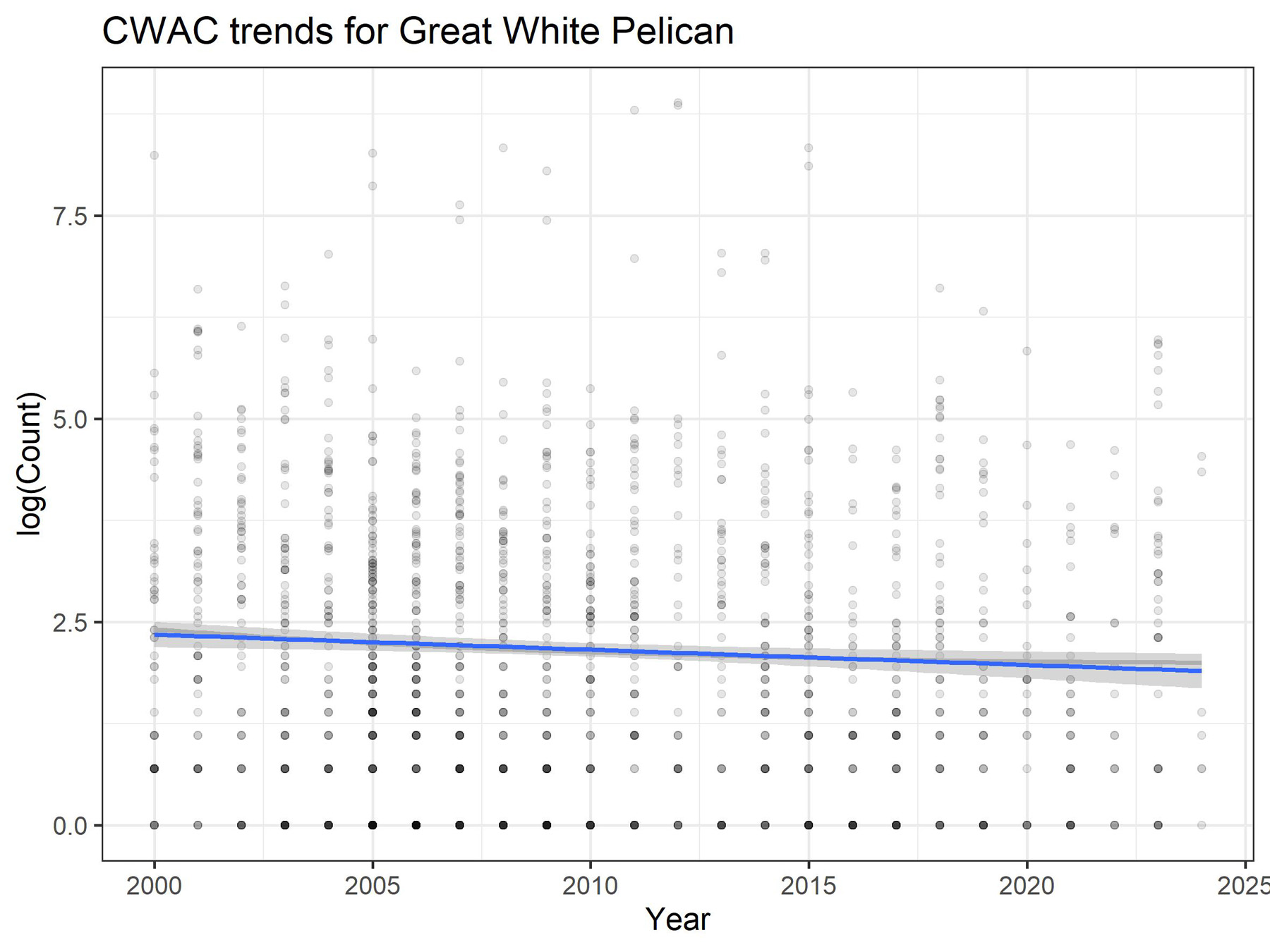
Figure 1: The Coordinated Waterbird Counts (CWAC) trends for Great White Pelican indicate a significant decline over time. Log transformed values of total counts per site per year are shown, with a linear regression as blue line with standard error as grey shading (from Lee 2024).
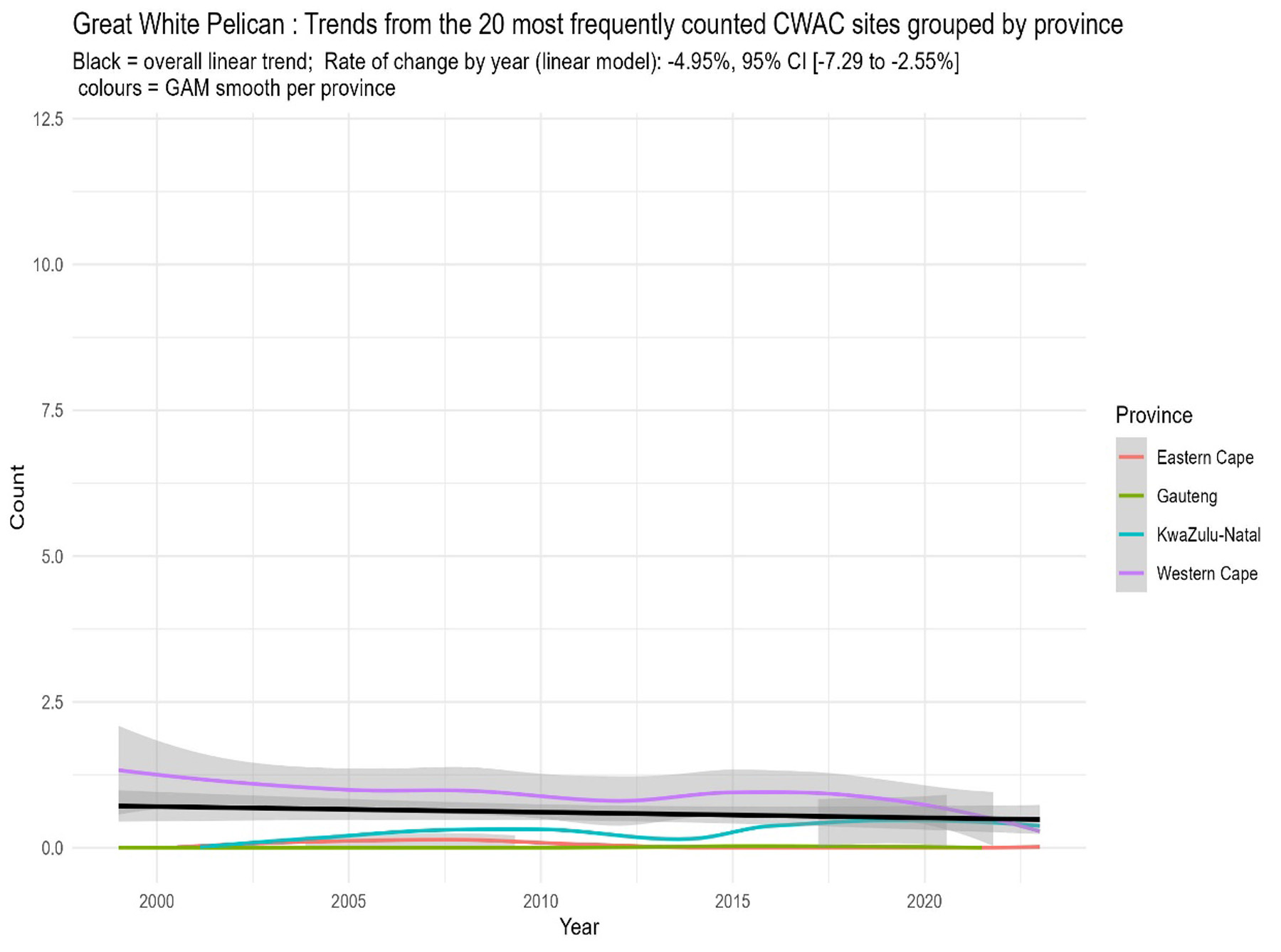
Figure 2: Trends from CWAC counts of Great White Pelican from the 20 most frequently surveyed regions, showing individual variation at sites (from Lee 2024).
Actual (Figure 3) and inferred estimates of breeding pairs demonstrate similar fluctuations to the data from the CWAC surveys. This is especially the case for St Lucia where flooding and drought (the latter allows predator access to the breeding locality) resulted in 23 (41%) failed breeding efforts out of a possible 56 breeding seasons (Bowker and Downs 2008).
The number of breeding pairs at Dassen Island and St Lucia were modelled using the poptrend package (Knape 2016). The estimated change over the period 1976-2024 (48 years) was -33% (-74%, 90%) (Figure 4). Using the population trend between the period 2000-2024 and projecting forward three generations (37.5 years), it is predicted that the population would decline by -69.5%. Confidence in these trends is low as declines were non-significant and confidence intervals were broad.
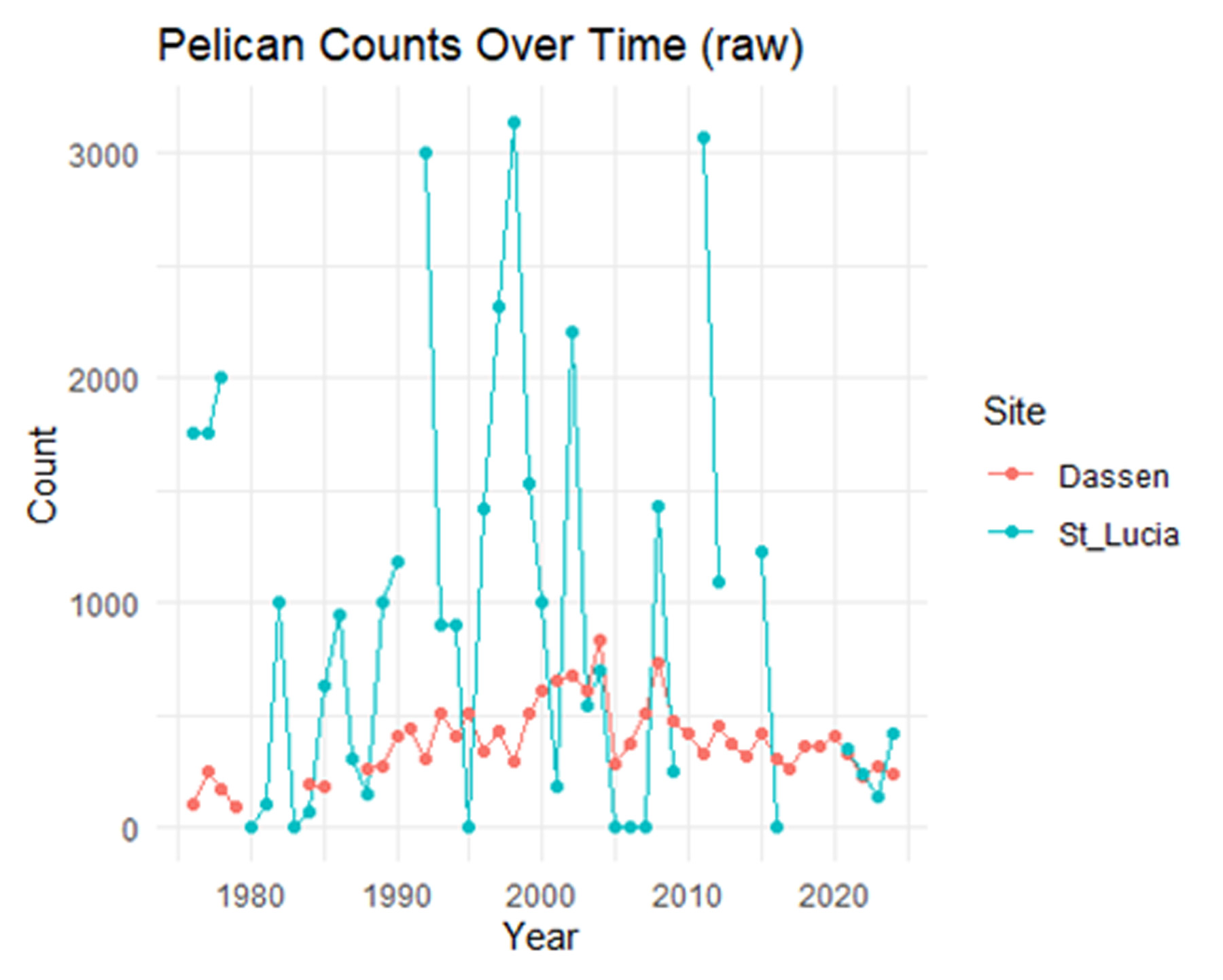
Figure 3. Number of breeding pairs at Dassen Island and St Lucia. Dassen Island data are annual estimates of the number of breeding pairs (CapeNature data set). St Lucia data is a mixture of breeding pair estimates and inferred number of breeding pairs either from number of adults or number of chicks (from KZN Ezemvelo Wildlife unpublished notes on breeding) (from Lee 2024).
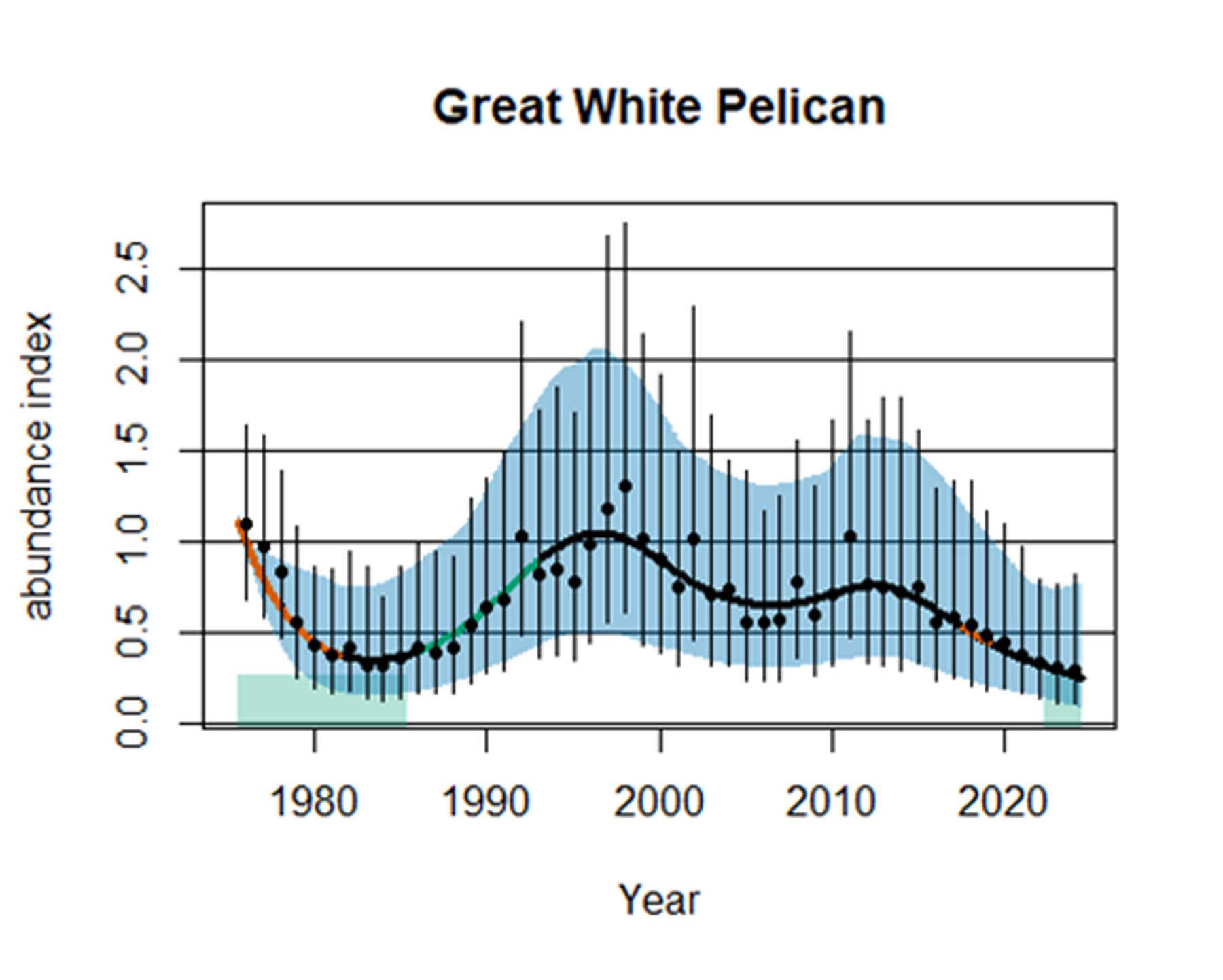
Figure 4: Poptrend plot for Great White Pelican. Red indicates periods of significant decline and green periods of significant increase (from Lee 2024).
Biology & Ecology
Taxonomy
The species is monotypic and there are no known issues.
Identification
140–216 cm, 9–15 kg. A huge, predominantly white pelican with a bulging yellow bill pouch and swollen knob-like forehead. The female is smaller, with longer occipital crest and bright orange facial skin. Breeding plumage shows pink-tinged white plumage and a yellow chest patch. Black remiges contrast with the white coverts. The bill is grey-blue, turning orange-yellow distally, with a red terminal nail. The eyes are dark red. Legs are pink with yellow feet. Non-breeders lack pink tinge and swollen forehead knob. The juvenile is duller and mottled brown, with greyer bill and dark feet (Crawford 2005).
Distribution
The species has a wide distribution across Saharan and sub-Saharan Africa, into the Horn of Africa and throughout the Great Lakes Region of Central Africa (Figure 5). The Extent of Occurrence (EOO) value (>1.3 million km2) was obtained from the ConR analysis in Lee (2024), which also provided a lower bound of 2880 km2 for Area of Occupancy (AOO). The upper bound of 198 675 km2 was obtained from the BIRDIE (2024) website, which projects range based on dynamic occupancy models at the pentad level, and identifies wetlands and waterbodies within the interior as suitable habitat.
In the region, breeding is now restricted to only two localities: Dassen Island (Western Cape), and Lake St Lucia (KwaZulu-Natal), after disappearance and displacement from several other breeding colonies over the last century (Dyer Island, Quoin Rock, Seal Island, Vondeling, Jutten Island). Birds disperse widely from these breeding sites along the West Coast of Western Cape, and in KwaZulu-Natal southward to Durban and northward into Mozambique. There is no confirmed movement between Western Cape and KwaZulu-Natal subpopulations. Non-breeding birds occur at larger waterbodies throughout other provinces. The species is a vagrant to Eswatini.
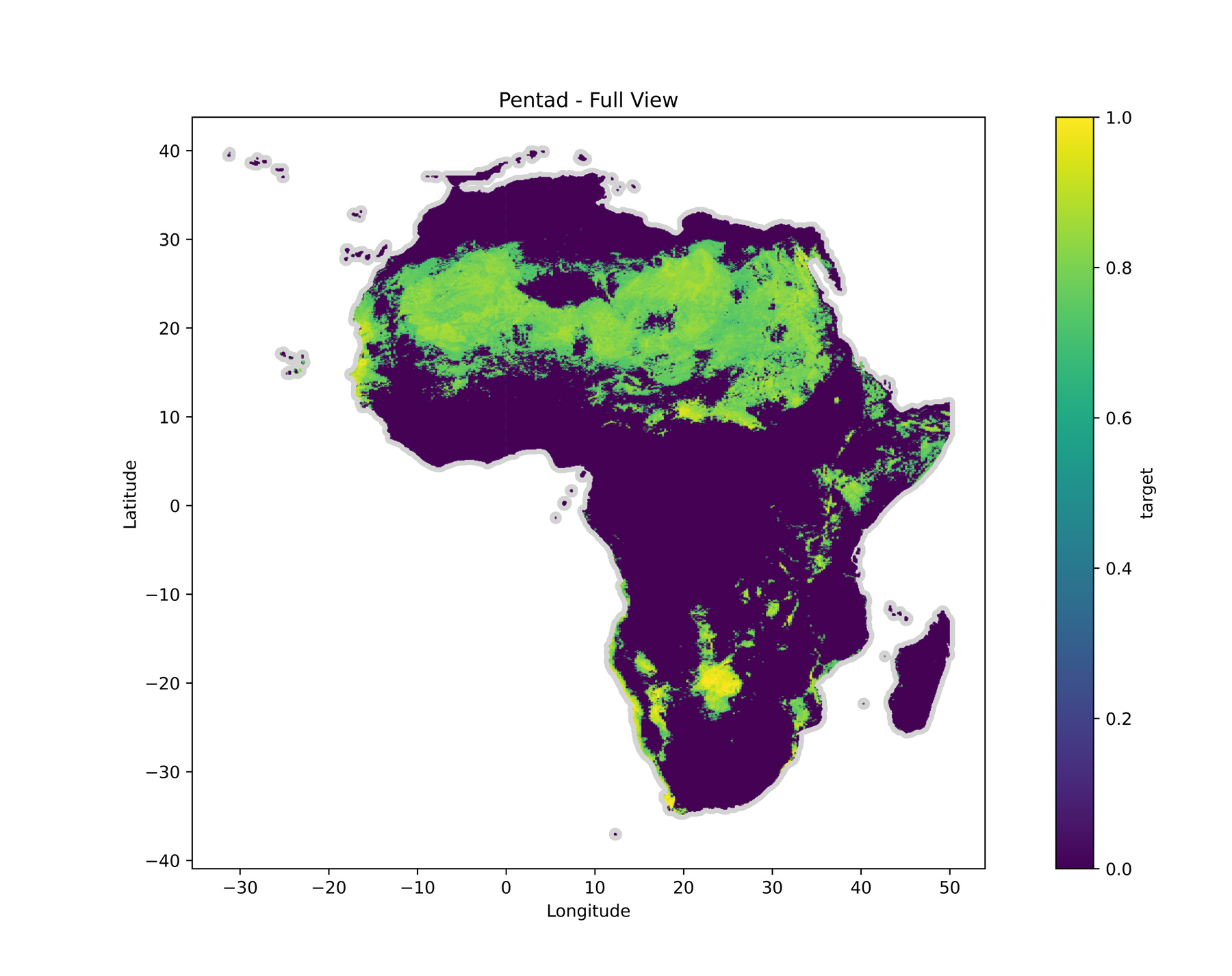
Figure 5: An Africa-wide probability distribution model of Great White Pelican at the pentad scale, trained by data from ABAP, iNaturalist and eBird data using a Random Forest model (from Lee 2024).
Ecology
Great White Pelicans are colonial breeders requiring predator-free islands or platforms. The species inhabits estuaries, lagoons, coastal bays, shallow lakes, and large waterbodies. It feeds primarily on fish, and occasionally on other seabirds (Kemper et al. 2007). It forms large breeding colonies of 200 – 40 000 pairs (del Hoyo et al. 1992). In the Western Cape, the species is increasingly dependent on foraging at pig and chicken farms. Great White Pelicans show strong breeding site fidelity but undertake extensive foraging movements.
Threats & Conservation
Threats
- Water level and salinity fluctuations at Lake St Lucia affecting breeding success (Bowker and Downs 2008).
- Collisions with power lines and wind farms (Jenkins et al. 2018).
- Human disturbance at breeding colonies (Berry et al. 1973), considering the restricted number of breeding colonies.
- Pollution, particularly agricultural pollutants and ingestion of plastics (Crawford et al. 1995).
- Potential climate change impacts on sea and water levels and breeding success.
- Contraction of diseases e.g. Avian Influenza and Avian Cholera that have already occurred in other breeding sea bird species on Dassen Island (Peyrot 2020).
Conservation Measures Underway
Both breeding sites in the region have protected status:
- Lake St Lucia (iSimangaliso Wetland Park): Provincial nature reserve, Ramsar Site, and World Heritage Site.
- Dassen Island: Provincial nature reserve, Ramsar site.
Regular monitoring of population numbers and breeding effort continues at key sites. The species is listed under Appendix I of the Convention on Migratory Species. The southern African population of Great White Pelican is also listed in Column A Category 3c (Populations numbering between around 25,000 and around 100,000 individuals and considered to be at risk as a result of showing long-term decline) and Category 3e (Populations numbering between around 25,000 and around 100,000 individuals and considered to be at risk as a result of showing rapid short-term decline) under the African-Eurasian Migratory Waterbird Agreement (AEWA 2022).
Conservation Measures Proposed
- Identify all sites that regularly hold large numbers of Great White Pelican and ensure they are managed appropriately and surveyed according to CWAC protocols.
- Protect and manage key breeding sites and ensure retention of breeding islands in the St Lucia system.
- Improve monitoring and control of water abstraction from Lake St Lucia’s catchments.
- Identify key foraging and roosting sites and implement conservation measures to manage and protect these sites.
- Monitor food sources available to pelicans.
- Implement measures to reduce power line and wind farm collisions.
Research Priorities and Questions
- Assess impacts of water level changes at Lake St Lucia on breeding success.
- Monitor impacts of new wind energy developments.
- Investigate impacts of climate change on breeding success.
- Update comprehensive population counts at all breeding sites.
- Investigate any potential movement patterns between KwaZulu-Natal and Western Cape subpopulations and with any colonies further north of the region.
- Assess effectiveness of current protected areas.
Contributors & References
Assessor/s
David Ehlers Smith, Kevin Shaw
Reviewer/s
Meyrick Bowker
References
AEWA. 2022. Agreement on the Conservation of African-Eurasian Migratory Waterbirds (AEWA) – Agreement Text and Annexes. As amended at the 8th Session of the Meeting of the Parties to AEWA. Budapest, Hungary: UNEP/AEWA Secretariat, 26–30 September 2022.
Berry HH, Stark HP, Vuuren AS. 1973. White Pelicans Pelecanus onocrotalus breeding on the Etosha Pan, South West Africa, during 1971. Madoqua 7: 17–31.
BIRDIE. 2024. An online platform for African wetland and waterbird data. Available at: https://biodiversityadvisor.sanbi.org/contentmanagement/index?guid=42305260-12b0-4a92-912e-7d801d15fdac [Accessed on 12 September 2024].
BirdLife International. 2021. Pelecanus onocrotalus. The IUCN Red List of Threatened Species 2021: e.T22697590A177120498. Available at: https://dx.doi.org/10.2305/IUCN.UK.2021-3.RLTS.T22697590A177120498.en [Accessed on 12 September 2024].
Bowker MB, Downs CT. 2008. Fluctuations in numbers of Great White Pelicans at Lake St Lucia in response to changing water levels. African Journal of Ecology 46: 282–290.
Bowker MB. 2015. Great White Pelican Pelecanus onocrotalus. In: Taylor MR, Peacock F, Wanless RW (eds), The Eskom Red Data Book of Birds of South Africa, Lesotho and Swaziland. Johannesburg, South Africa: BirdLife South Africa.
Crawford RJM, Cooper J, Dyer BM. 1995. Conservation of an increasing population of Great White Pelicans Pelecanus onocrotalus in South Africa’s Western Cape. South African Journal of Marine Science 15: 33–42.
Crawford RJM. 2005.Great White Pelican. In: Hockey PAR, Dean WRJ, Ryan PG (eds), Roberts – Birds of Southern Africa (7th Edn). Cape Town, South Africa: Trustees of the John Voelcker Bird Book Fund. pp 614–615.
Crawford RJM, Dyer BM, Cox C, Morais M, Tom DB, Upfold L, Visagie MJL, Makhado AB. 2024. Numbers, trends, status, and conservation of Great White Pelican (Pelecanus onocrotalus) breeding coastally in southern Africa. In: Makhado AB, Amaro A, Crawford RJM, Gottlieb TR, Morais M, Mwaala DN, Nghimwatya L, Seakamela M, Tom DB, Whittington PA, Witteveen M (eds). In: Atlas of Marine Turtles, Seabirds, and Seals in the Benguela Current and Adjacent Regions: Population Sizes and Trends, Conservation Status, and Important Bird and Biodiversity Areas for Breeding. Cape Town, South Africa: Benguela Current Convention and Department of Forestry, Fisheries and the Environment.
del Hoyo J, Elliott A, Sargatal J. 1992. Handbook of the Birds of the World, Vol. 1: Ostrich to Ducks. Barcelona, Spain: Lynx Edicions.
Jenkins AR, Reid T, du Plessis J, Colyn R, Benn G, Millikin R. 2018. Combining radar and direct observation to estimate pelican collision risk at a proposed wind farm on the Cape west coast, South Africa. PLoS ONE 13(2): e0192515.
Kemper J, Underhill LG, Crawford RJM. 2007. Revision of the conservation status of seabirds and seals breeding in the Benguela Ecosystem. In: Kirkman SP (ed), Final Report of the BCLME Project on Top Predators as Biological Indicators of Ecosystem Change in the BCLME. Cape Town, South Africa: Avian Demography Unit. pp 325–342.
Knape J. 2016. Decomposing trends in Swedish bird populations using generalized additive mixed models. Journal of Applied Ecology 53: 1852–1861.
Lee ATK. 2024. Regional Red Data Book of the Birds of South Africa, Lesotho and Eswatini: SABAP2 synthesis and supporting information and graphics for Great White Pelican. Unpublished report. Johannesburg: BirdLife South Africa.
Peyrot BM. 2020. Molecular characterization of highly pathogenic avian influenza clade 2.3.4.4b H5N8 viruses in terns and other coastal birds in South Africa in 2018 [MSc thesis]. Pretoria, South Africa: University of Pretoria.
Citation
Ehlers Smith DA, Shaw K 2025. Great White Pelican. In: Lee ATK, Rose S, Banda S, Bezeng SB, Maphalala MI, Maphisa DH, Smit-Robinson H (eds), The 2025 Red Data Book of Birds of South Africa, Lesotho and Eswatini. Johannesburg, South Africa: BirdLife South Africa. Available at: https://www.birdlife.org.za/red-list/great-white-pelican/
Our generous sponsors


