


Fynbos Buttonquail
Turnix hottentottus

Number Of Mature
Individuals (Regional)
15 878 (6 272 – 31 334)

Regional
Population Trend
Decreasing
2025
Regional Category
Near Threatened
Search by species
CONTENTSOverview
Names
|
IOC English Name: |
Fynbos Buttonquail |
|
SA & IOC Scientific Name: |
Turnix hottentottus |
|
BirdLife International Taxonomy (scientific name): |
The same as SA & IOC |
|
Order: |
CHARADRIIFORMES |
|
Family: |
Turnicidae |
|
Species name author: |
Temminck 1815 |
|
Afrikaans: |
Kaapse Kwarteltjie |
|
Sesotho (South Africa): |
Sekuwapana sa Borwa |
|
Sesotho (Lesotho): |
|
|
siSwati: |
|
|
Zulu: |
Ungoqo waseKapa |
Current Assessment Status
|
2025 Regional Category [Criteria] |
NT [B2ab(ii,iii); A2bc+3c] |
|
2024 Global Category [Criteria] |
LC (BirdLife International 2022) |
|
Population size (Regional) |
15 878 (6272 – 31 334) (This assessment) |
|
Population size (Global) |
22 248 – 88 553 mature individuals (median 59 721, BirdLife International 2022, from Lee et al. 2018) |
|
Distribution size (EOO) (Regional) km2 |
78 652 (46 127 – 124 359) (Lee 2024a) |
|
Distribution size (EOO) (Global) km2 |
126 000 (BirdLife International 2022) |
|
Distribution size (AOO) (Regional) km2 |
4812 (1960 – 9792) (Lee 2024a) |
|
Generation time |
3.5 years (BirdLife International 2022) |
|
Status change reason |
Improved Knowledge |
|
Migrant (in the region) |
No |
|
Regional endemic |
Yes |
Historic Listing Information
|
2000 Regional Status |
Not Evaluated |
|
2015 Regional Status |
EN [C1+2a(i)] |
|
Status change reason (if applicable) |
Taxonomic change |
|
2015 Population size (Regional) |
250 – 999 |
|
2015 Global Status |
EN [C2a(i)] |
Reason for Inclusion
Reason for Inclusion in the Assessment
The Fynbos Buttonquail Turnix hottentottus was previously assessed as Endangered in the 2015 regional Red List for South Africa, Lesotho, and Eswatini, primarily due to its small, estimated population size and restricted distribution within the Fynbos biome (Peacock 2015). This species is endemic to the region, and recent data and analyses from the Southern African Bird Atlas (SABAP2) and other published studies indicate significant changes in our understanding of its distribution and habitat requirements.
Category Justification
Category Justification
The Fynbos Buttonquail is assessed as Near Threatened under Criterion B2 due to its limited and declining Area of Occupancy (AOO), estimated to range from 1960 to 9792 km², with a mean of 4812 km² (Lee 2024a). This area is based on recent distribution records (2016-2023) and habitat suitability modelling using random forest models and various predictor variables (Lee 2024a). The AOO is smaller than the range modelled by Lee et al. (2019) using bespoke surveys in 2015 and Maxent suggesting 10 377–41 303 km2 (median 27 855 km2). This precautionary assessment (only the lower bound is <2000 km2) is supported by several conditions associated with Criterion B2:
Severely Fragmented Population or Locations <10 (B2a):
Given its preference for a specific vegetation structure, best observed with time since fire intervals of 2 – 5 years, the population will always have been naturally fragmented. However, fragmentation of natural habitat coupled with nine key threats associated with human activities means the current range is now increasingly unnaturally fragmented (Appendix 1). Given the dynamic nature of vegetation recovery, it is not possible to determine the distribution of the population according to IUCN fragmentation criteria or if we have breached the threshold for the natural ability to disperse. Therefore, it is unclear if 50% or more of the population is in small and isolated populations.
An analysis of BirdLasser presence records identified six ‘subpopulations’ isolated by extensive areas of unsuitable habitat altered by human influence, notably agricultural land conversion and alien vegetation encroachment (Figure 1). To this we add the Groot Winterhoek-Cederberg (with no recent records) and split the Agulhas plain into the better protected south, including Agulhas National Park and Nuwejaars Wetland Area from the agriculturally dominated Overberg. We treat these using the IUCN definition of ‘locations’ (interpreted as areas of threat), where a common threat needs to be applied across a set of sites (or subpopulations). From this exercise, alien vegetation emerges as a cross-cutting threat, but not at intensities that will result in the local extinction of any subpopulation without the interaction with other threats at this point in time. Overall, there are 14 locations defined variously by alien vegetation, agricultural expansion, bush encroachment, fire suppression, drought, urbanization, and cat predation (scores >7, Appendix 1).
Continuing Decline in Area of Occupancy (B2bii):
The AOO has been declining due to ongoing habitat loss and degradation. Conversion of natural fynbos to agricultural land and urban areas is widespread, particularly in coastal regions where the species once thrived (Skowno et al. 2021). The increase in grass cover over recent years in the Fynbos (Shaw pers comm, Lee pers obs) means fire return intervals are decreasing, and suitable habitat decreasing, as the likelihood of encountering Fynbos Buttonquail decreases with increasing grass cover (Lee et al. 2018).
Decline in Habitat Quality (B2biii):
Habitat quality has deteriorated significantly due to the spread of invasive alien vegetation, such as Acacia, Pine, Hakea, and Eucalyptus, which alter the structure and composition of Fynbos ecosystems and completely replace Fynbos in areas of severe infestation. Additionally, inappropriate fire regimes—either through suppression or increased fire frequency—disrupt the early-successional stages that the Fynbos Buttonquail relies on.
In addition, lower AOO values infer lower populations attributable to a large number of threats which extend into protected areas, suggesting declines are likely, ongoing, and will extend into the future. However, it is unlikely that these have happened or will occur at rates exceeding 30% over three generations, but may be approaching 20%. As such, the species is additionally considered Near Threatened under Criteria A2bc and A3c.
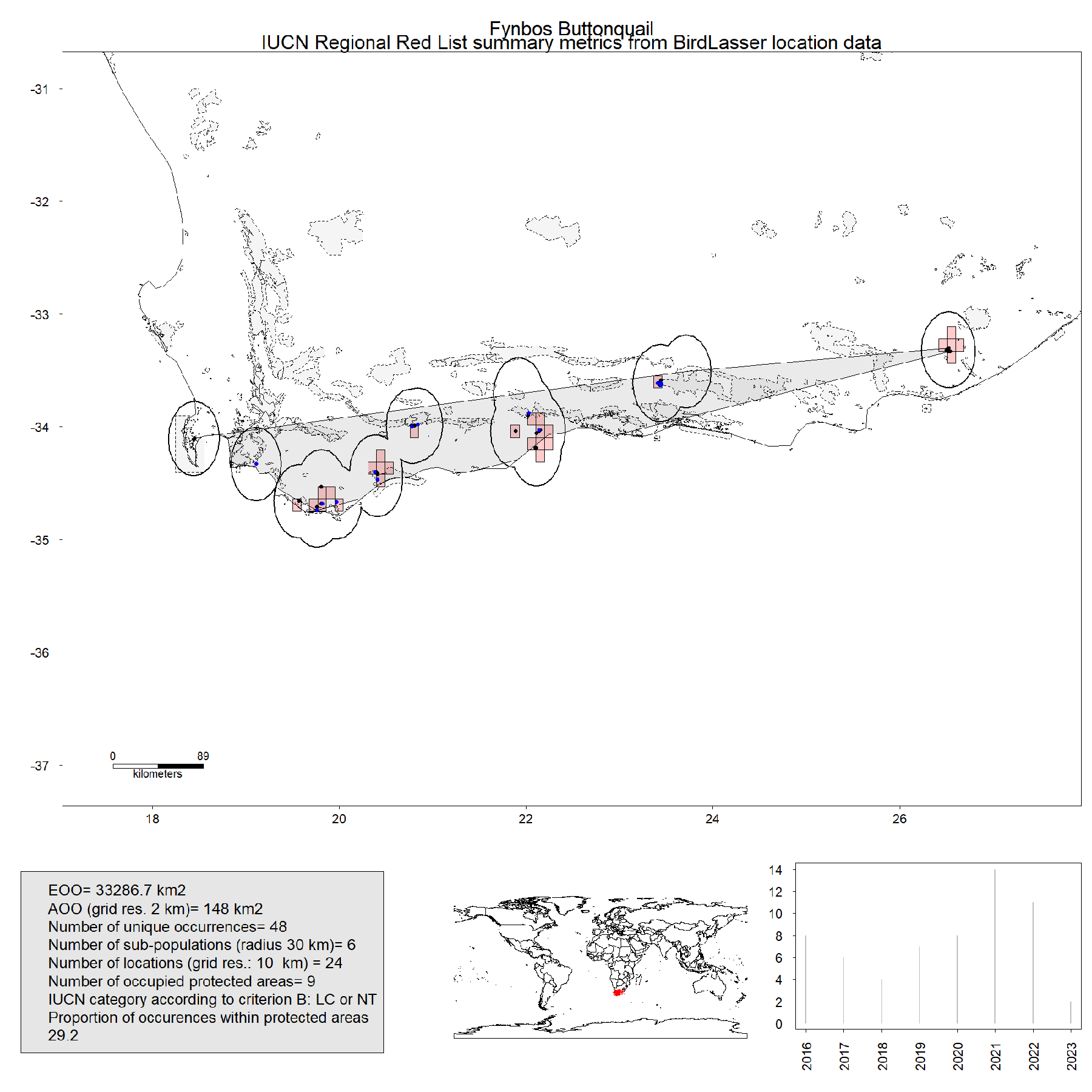
Figure 1: Location data of Fynbos Buttonquail from Birdlasser data (2016-2023) with associated locations and potential subpopulations. Notably, there have been no recent records from the Makhanda population (the far eastern subpopulation in this map). Note also the lack of records from the Cederberg, and the extraordinary low numbers of records from the Cape Peninsula (far western subpopulation).
Population Justification
The current population size of the Fynbos Buttonquail was estimated by extrapolating a density of 0.032 individuals per hectare, based on field studies by Lee et al. (2018), across the species’ recent AOO ranging from 1960 to 9792 km² (from Lee 2024a), which used presence data from eBird, iNaturalist and BirdLasser for the 2016-2023 period. This density was applied to the AOO values derived from habitat modelling data, yielding an estimated population range of approximately 6272 to 31 334 individuals. Using the mean AOO of 4812 km², a central population estimate of around 15 878 individuals is considered most plausible. However, the upper population estimate, based on a density of 0.162 individuals per hectare (Lee et al. 2018) and an AOO of 9792 km², could be as high as 158 630 individuals: this upper bound is considered unlikely. The population estimate provided by Lee et al. (2018) was 89 136 individuals (33 206 – 132 169). As methods differed, it cannot be said with confidence that this represents a population decrease, although deteriorating habitat conditions do lead to the expectation of a lower population for the more recent period.
Trend Justification
Quantifying the population trend of the Fynbos Buttonquail from citizen science data is challenging due to biases introduced by targeted surveys that increased detection rates from 2015 onwards, leading to an apparent increase in SABAP2 records (Lee 2024a). However, underlying habitat trends and local extinctions indicate a concerning decline, which are reflected in the lower more recent population estimates resulting from the lower AOO. The status of the Fynbos biome is deteriorating, with significant increases in agricultural land use and the encroachment of alien vegetation, both of which reduce the availability of suitable habitat (Skowno et al. 2021).
Recent data indicate the loss or significant decline of the buttonquail from historically occupied areas such as Makhanda (J Balmer pers comm) and greater Cederberg region (SABAP2 data), suggesting local extirpations in the extremes of its range. Likewise, the Cape Peninsula population, where it was once considered to be the 3rd most common bird (Ryan and Hockey 1995), appears to be greatly reduced (Figure 1). This mirrors the decline of other endemic Fynbos species, such as the Knysna Warbler Bradypterus sylvaticus and Victorin’s Warbler Cryptillas victorini, which have all but disappeared from Table Mountain National Park (Lee 2025). These factors collectively suggest an ongoing decline in the quality and extent of suitable habitat, warranting concern for the long-term viability of the species. The threats leading to population decreases in these locations extends to the over core locations: the Agulhas Plain, Stilbaai, Overberg and Swartberg-Kouga subpopulations. Alien vegetation has become a problem at one of the more popular sites to see this species near Arabella Estate (Kleinmond).
Taken together, declines are likely, ongoing, and will extend into the future. However, it is unlikely that these have happened or will occur at rates exceeding 30% over three generations, but may be approaching 20%.
Biology & Ecology
Taxonomy
The Fynbos Buttonquail was previously considered conspecific with the Black-rumped Buttonquail T. nanus by some authorities. However, Sibley and Monroe (1990) proposed that the two taxa are separate species, a view supported by their allopatric ranges, distinct habitat preferences, different movement patterns, and subtle differences in plumage and bare part coloration (Dean 2005). This taxonomic split is now widely accepted by BirdLife International, BirdLife South Africa, and the International Ornithologists’ Union. The common name was changed from Hottentot Buttonquail for cultural sensitivity reasons.
Identification
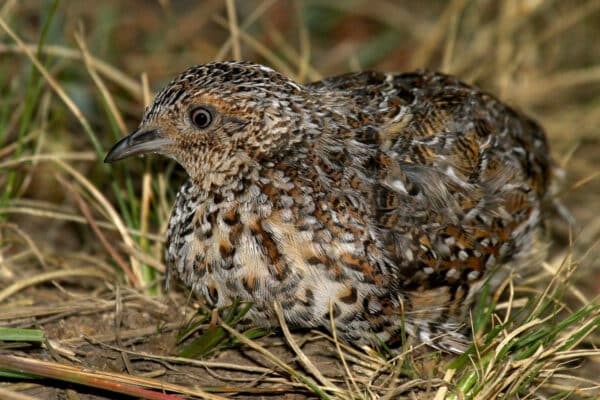
The Fynbos Buttonquail is a small, secretive bird measuring 14–15 cm in length and weighing between 40–60 g. The sexes are distinguishable by differences in plumage and bare part coloration. Males are drab and straw-colored, with extensive streaking and barring on the upper parts. The underparts are pale rufous, heavily spotted with black on the breast and flanks. In contrast, females are more richly colored, with slate-grey flight feathers contrasting against rich buff wing coverts, a rufous face, and a bright orange-rufous breast. They have yellowish legs and feet, a horn-colored bill with a paler lower mandible, and peach or yellow eyes. The species can be differentiated from the similar Black-rumped Buttonquail by the lack of a conspicuously darker rump and greyer iris (Ryan and Hockey 1995, Dean 2005).
Distribution
The Fynbos Buttonquail is restricted to the Fynbos biome of South Africa, with recent estimates of its Extent of Occurrence ranging from 46 127 km² to 124 359 km² and its AOO from 1960 km² to 9792 km², with a mean of 4812 km² (Figure 2, Lee 2024a). The species was recorded from only 35 pentads for the 2016-2023 period (Figure 2, Lee 2024a). The species has specific habitat requirements, favouring early-successional Fynbos 2 – 5 years post-fire, characterized by sparse vegetation and low grass cover (Lee et al. 2018). It avoids dense, overgrown habitats and transformed landscapes. Despite these habitats’ availability in the greater Cederberg area (Lee et al. 2018), there have been no recent records from citizen science data. This localized distribution pattern reflects the species’ sensitivity to habitat quality and ongoing threats such as fire suppression, alien plant invasion, and habitat transformation, which contribute to its fragmented presence.
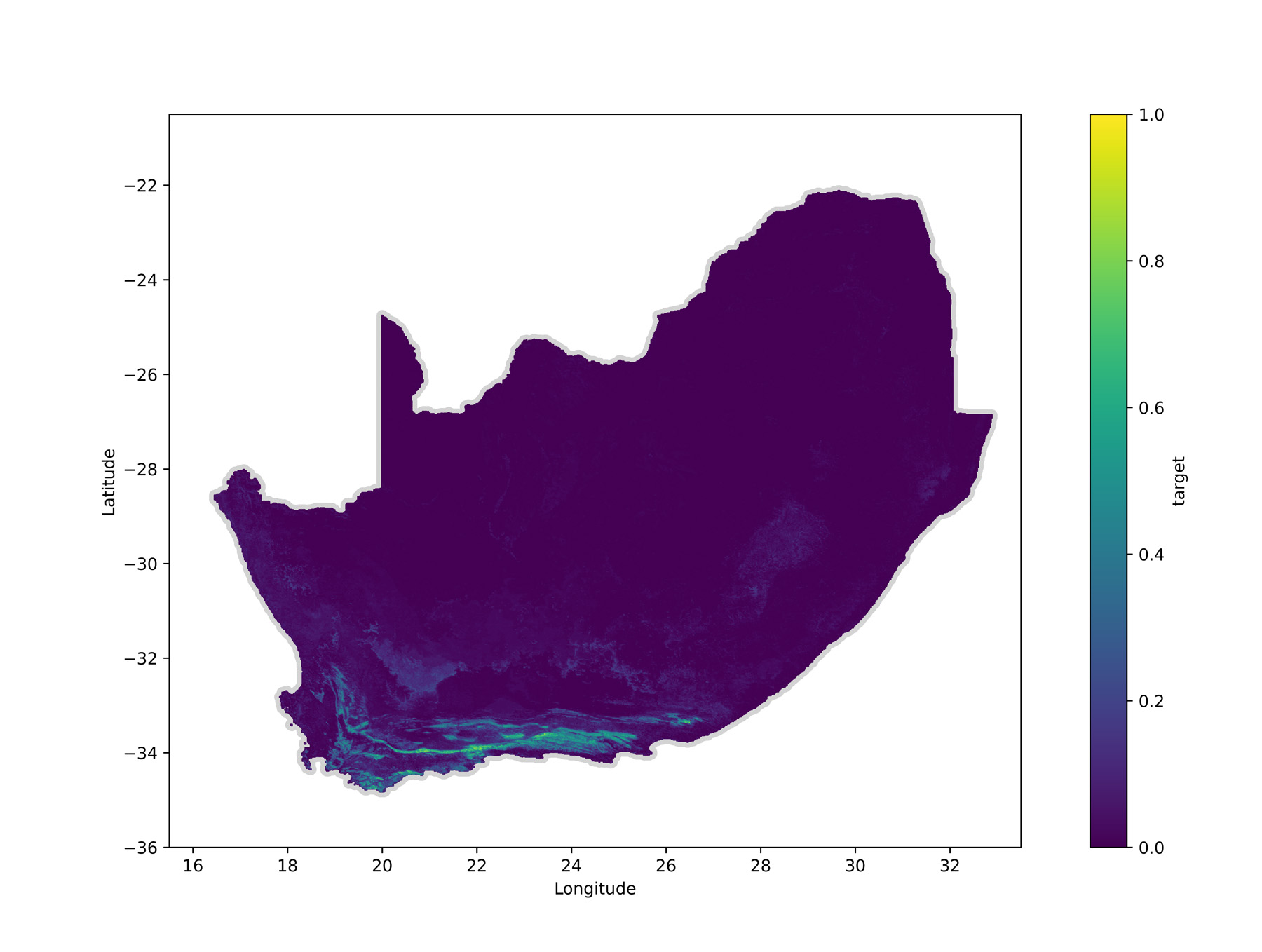
Figure 2: Species distribution model for Fynbos Buttonquail (from Lee 2024a) at a 2×2 km2 modelled resolution. This map illustrates potential range, but the actual range is dynamic depending on fire frequency. Applying a 0.5 probability threshold to this reduces the area substantially.
Ecology
The Fynbos Buttonquail is generally solitary but may be seen in pairs during the early to mid-summer breeding season (Lee 2013). It is cryptic and difficult to detect due to its unobtrusive behaviour and camouflage. Recent research highlights its preference for early-successional Fynbos, typically two to five years post-fire, avoiding both recently burnt and moribund veld (Lee et al. 2018). The species is associated with habitats that have low vegetation cover and gentle slopes, primarily in mountain and coastal Fynbos. Though records from atypical habitats such as farmland and Renosterveld exist, these are likely due to dispersal or perhaps misidentification.
The Fynbos Buttonquail is suspected to be locally nomadic, driven by changes in habitat quality following fire events and seasonal rainfall (Fraser 2014). Movements between habitat patches are not well understood, but some evidence suggests nocturnal movements. Like other buttonquails, it is probably territorial and polyandrous, with breeding occurring mainly between September and December, peaking in October (Winterbottom 1968, Tarboton 2011).
Threats & Conservation
Threats
The Fynbos Buttonquail is threatened by several factors that impact its restricted and specialized habitat within the Fynbos biome of South Africa (Appendix 1). Despite a relatively high proportion of its preferred Mountain Fynbos habitat being under formal conservation, ongoing habitat loss and degradation continue to pose serious challenges.
- Habitat Loss and Fragmentation: Rapid urban development and agricultural expansion in coastal regions are major threats to lowland populations. The transformation of natural Fynbos into vineyards, croplands, and urban areas fragments the landscape.
- Invasive Alien Vegetation: The invasion of alien woody shrubs such as Acacia, Pinus, and Eucalyptus, particularly in Mountain Fynbos areas, is a significant threat. These species alter the natural structure of the Fynbos, outcompeting native flora and disrupting fire regimes, which are essential for maintaining suitable open habitats for the buttonquail (Ryan and Hockey 1995).
- Inappropriate Fire Regimes: The Fynbos ecosystem is adapted to fire, but the Fynbos Buttonquail depends on a specific post-fire successional stage, typically 2-5 years post-burn, to create open, mixed fynbos habitats (Lee et al. 2018). Inappropriate fire management practices, such as fire suppression (in association with human infrastructure), or too frequent fires (in mountain habitat where fire is difficult to control), disrupt these habitats. Coastal and lowland areas are particularly affected by altered fire frequencies and intensities, which reduce the availability of suitable habitats.
- Increased predation: Recent citizen science data indicate concerning local disappearances from historically important areas, such as the Cape Peninsula, despite the presence of apparently suitable habitat. This decline mirrors those observed in other sensitive Fynbos-dependent bird species with poor flight capacity like the Knysna Warbler and Victorin’s Warbler in proximity to high density urban areas, where predation by cats is a concern (Seymour et al. 2020, Lee 2024b). Related to this, the population of Cape Mountain Leopard Panthera pardus is likely substantially reduced due to persecution over the last several decades. This may be leading to ‘mesopredator release’ where predators such as Cape Grey Mongoose Herpestes pulverulentus, more adept at preying on birds, have become more common. This may extend to Caracal Caracal caracal in the Table Mountain National Park area. While still likely a minor problem in the scope of the various threats presented here, it is still an additional factor which the Fynbos Buttonquail has to contend.
- Climate Change: Although the specific impacts of climate change on the Fynbos Buttonquail have not been fully studied, there is considerable concern due to its naturally restricted range and reliance on the Fynbos biome (Simmons et al. 2004). Climate change will likely alter the distribution and composition of Fynbos habitats, impacting the availability of suitable habitats and possibly intensifying the spread of invasive species. There is growing albeit still anecdotal evidence that increased fire frequency is leading to increased proportion of grass in Fynbos vegetation. While still speculative, droughts are also a concern and currently the leading reason behind the lack of recent records from the Cederberg area. This area is generally still in good condition ecologically speaking (Appendix 1), but is also the most arid of the buttonquail’s range. Increasing aridity may be a factor in the lack of recent records from this extensively visited region by citizen scientists.
Conservation Measures Underway
No conservation measures are currently underway. The range is well represented in the protected area network of the Western Cape.
Conservation Measures Proposed
- Habitat Management and Restoration: implement and maintain fire management practices that promote the early-successional fynbos habitats preferred by the Fynbos Buttonquail. This includes controlled burns at intervals of 8–25 years in suitable areas, while avoiding too frequent or intense fires that could damage vegetation structure and lead to habitat loss.
- Prioritize the removal and control of invasive alien vegetation that alter the fynbos ecosystem and reduce habitat quality.
- Strengthen the management of existing protected areas to include specific actions for the conservation of the Fynbos Buttonquail, particularly in key sites such as the Cape Peninsula and Cederberg regions, where populations may have declined.
- Expand the network of protected areas using stewardship and other effective conservation measures to include important unprotected habitats, especially in lowland fynbos and transition zones between coastal and mountain fynbos.
- Develop and implement a species-specific conservation action plan, including a National Species Recovery Plan, that outlines coordinated actions for habitat protection, management, and population monitoring.
- Promote community involvement and awareness programs to encourage local support for the conservation of the Fynbos Buttonquail and its habitat.
- Conduct regular, standardized surveys across the species’ range to monitor population trends and distribution changes. Incorporate both citizen science data and systematic surveys to cover under-surveyed regions.
- Use technology such as remote sensing and drones to monitor habitat quality, fire regimes, and the spread of invasive species across the buttonquail’s range.
Research Priorities and Questions
- Impact of Invasive Vegetation: Conduct a study on the long-term impacts of invasive alien plant species on the availability and quality of buttonquail habitat. Evaluate the success of various invasive species removal and control methods in restoring fynbos habitat.
- Climate Change Modelling: Develop climate models to predict the future distribution of suitable habitats under various climate change scenarios. Identify potential climate refugia and assess how shifting climate patterns could impact the buttonquail’s range and habitat suitability.
- Human-Wildlife Conflict and Urban Expansion: Investigate the impact of urban expansion and human activities on habitat fragmentation and disturbance. Propose mitigation strategies to reduce habitat loss and disturbance in areas undergoing development.
- Breeding Ecology Study: Conduct field studies on nesting site selection, clutch size, and breeding success. Investigate factors such as habitat quality, predation, and food availability that influence reproductive output.
- Seasonal Habitat Use: Use radio-tracking and remote sensing to study the seasonal movements and habitat preferences of the Fynbos Buttonquail. Assess whether the species exhibits nomadic behaviour in response to food availability or habitat condition.
- Foraging and Diet Analysis: Analyse the diet and foraging behaviour of the buttonquail across different habitat types and seasons. Determine how food availability influences habitat use and reproductive success.
- Genetic Diversity and Connectivity Assessment: Conduct a genetic study using samples from different populations across the range to assess levels of genetic diversity and structure. Identify populations with low genetic diversity that may be at risk of inbreeding. Study gene flow between subpopulations to understand the impact of habitat fragmentation on genetic exchange. Identify critical habitat corridors that need to be conserved or restored to maintain population connectivity.
Contributors & References
Assessor/s
Alan Lee
Reviewer/s
Dale Wright, Rob Martin
References
BirdLife International. 2022. Turnix hottentottus. The IUCN Red List of Threatened Species 2022: e.T22725519A173983646. https://dx.doi.org/10.2305/IUCN.UK.2022-1.RLTS.T22725519A173983646.en
Dean WRJ. 2005. Hottentot Buttonquail Turnix hottentottus. In: Hockey PAR, Dean WRJ, Ryan PG (eds), Roberts – Birds of Southern Africa 7th Edn. Cape Town, South Africa: The Trustees of the John Voelcker Bird Book Fund. pp 162–164.
Fraser MW. 2014. Birds of the Cape of Good Hope Nature Reserve, south western Cape, South Africa. Ornithological Observations 5: 139–247.
Lee A. 2013. Fynbos enigma – Hottentot Buttonquail in the Kouga Mountains. African Birdlife 1: 20–22
Lee ATK, Wright DR, Reeves B. 2018. Habitat variables associated with encounters of Hottentot Buttonquail Turnix hottentottus during flush surveys across the Fynbos biome. Ostrich 89(1): 13–18. https://doi.org/10.2989/00306525.2017.1343209.
Lee ATK, Reeves B, Wright DR. 2019. Hottentot Buttonquail Turnix hottentottus: Endangered or just overlooked? Bird Conservation International 29: 136–143.
Lee ATK. 2024a. Regional Red Data Book of the Birds of South Africa, Lesotho and Eswatini: SABAP2 synthesis and supporting information and graphics for Fynbos Buttonquail. Unpublished report. Johannesburg: BirdLife South Africa.
Lee ATK. 2024b. Knysna Warbler Bradypterus sylvaticus. In: Lee ATK, Banda S, Bezeng SB, Maphalala MI, Maphisa DH, Rose SJ, Smit-Robinson H (eds), The 2025 Red Data Book of Birds of South Africa, Lesotho and Eswatini. Johannesburg, South Africa: BirdLife South Africa.
Peacock F. 2015. Fynbos Buttonquail Turnix hottentottus. In: Taylor MR, Peacock F, Wanless RM (eds), The Eskom Red Data Book of Birds of South Africa, Lesotho and Swaziland. BirdLife South Africa, Johannesburg, South Africa. pp 101–103.
Ryan PG, Hockey PAR. 1995. Is the Hottentot Buttonquail really endangered? Ostrich 66(2-3): 92–93.
Seymour CL, Simmons RE, Morling F, George ST, Peters K, O’Riain MJ. 2020. Caught on camera: The impacts of urban domestic cats on wild prey in an African city and neighbouring protected areas. Global Ecology and Conservation 23: e01198.
Sibley CG, Monroe BL. 1990. Distribution and taxonomy of birds of the world. New Haven, CT: Yale University Press.
Simmons RE, Barnard P, Dean WRJ, Midgley GF, Thuiller W, Hughes G. 2004. Climate change and birds: perspectives and prospects from southern Africa. Ostrich 75: 295–308.
Skowno AL, Thompson MW, Hiestermann J, Ripley B, West AG, Bond WJ. 2021. Rates and patterns of habitat loss across South Africa’s vegetation biomes. South African Journal of Science 117: 1–9. https://doi.org/10.17159/sajs.2021/8182.
Tarboton WR. 2011. Roberts nests and eggs of southern African birds. Cape Town: Trustees of the John Voelcker Bird Book Fund.
Winterbottom JM. 1968. Observations on the birds of the south-western Cape. Ostrich 39: 61–80.
Appendix
Threat matrix for Fynbos Buttonquail by subpopulation. Scores are from 1 (low) to a theoretical 10 (high), representing scope and scale of the problem. Threat score is the sum of the row. Population is the estimated percentage of the total population represented by each subpopulation.
|
Fire suppression |
Increased Fire |
Urbanization |
Agricultural expansion |
Alien Vegetation |
Bush encroachment |
Cat predation |
Mesopredator release |
Drought |
Threat score |
Population |
|
|
Table Mountain |
8 |
5 |
7 |
1 |
5 |
5 |
7 |
5 |
3 |
46.0 |
1.0 |
|
Hottentots Holland |
5 |
3 |
4 |
4 |
6 |
3 |
5 |
4 |
3 |
37.0 |
9.0 |
|
Agulhas |
7 |
1 |
2 |
6 |
6 |
2 |
1 |
5 |
3 |
34.0 |
20.0 |
|
Overberg |
8 |
1 |
1 |
8 |
5 |
2 |
1 |
5 |
3 |
34.0 |
10.0 |
|
Stilbaai – George |
8 |
1 |
5 |
7 |
7 |
4 |
5 |
4 |
3 |
44.0 |
20.0 |
|
Swartberg – Kouga |
1 |
5 |
2 |
1 |
8 |
2 |
1 |
2 |
5 |
27.0 |
30.0 |
|
Makhanda |
8 |
1 |
4 |
3 |
7 |
8 |
4 |
4 |
4 |
43.0 |
1.0 |
|
Cederberg |
1 |
6 |
1 |
6 |
5 |
2 |
1 |
2 |
8 |
32.0 |
9.0 |
|
Mean score by threat |
5.9 |
2.9 |
3.3 |
4.5 |
6.1 |
3.5 |
3.1 |
3.9 |
4.0 |
100.0 |
Citation
Lee ATK 2025. Fynbos Buttonquail. In: Lee ATK, Rose S, Banda S, Bezeng SB, Maphalala MI, Maphisa DH, Smit-Robinson H (eds), The 2025 Red Data Book of Birds of South Africa, Lesotho and Eswatini. Johannesburg, South Africa: BirdLife South Africa. Available at: https://www.birdlife.org.za/red-list/fynbos-buttonquail/
Our generous sponsors


