


Drakensberg Rockjumper
Chaetops aurantius

Number Of Mature
Individuals (Regional)
28 000 – 71 000

Regional
Population Trend
Decreasing
2025
Regional Category
Least Concern
Search by species
CONTENTSOverview
Names
|
IOC English Name: |
Drakensberg Rockjumper |
|
SA & IOC Scientific Name: |
Chaetops aurantius |
|
BirdLife International Taxonomy (scientific name): |
Chaetops aurantius |
|
Order: |
PASSERIFORMES |
|
Family: |
Chaetopidae |
|
Species name author: |
Layard EL 1867 |
|
Afrikaans: |
Oranjeborsberglyster |
|
Sesotho (South Africa): |
modisadipela |
|
Sesotho (Lesotho): |
molisalipela |
|
Siswati: |
|
|
isiZulu: |
unogxumetsheni |
Current Assessment Status
|
2025 Regional Category [Criteria] |
LC |
|
2024 Global Category [Criteria] |
NT [A2bc+3bc+4bc] (BirdLife International 2021) |
|
Population size (Regional) |
c. 28 000 – 71 000 mature individuals |
|
Population size (Global) |
Unknown (BirdLife International 2021) |
|
Distribution size (EOO) (Regional) km2 |
229 308 (134 319 – 270 169) (Lee 2025) |
|
Distribution size (EOO) (Global) km2 |
174 000 (BirdLife International 2021) |
|
Distribution size (AOO) (Regional) km2 |
26 264 (23 700 – 28 988) |
|
Generation time |
3.6 years (BirdLife International 2021) |
|
Status change reason |
No change |
|
Migrant (in the region) |
No |
|
Regional endemic |
Yes |
Historic Listing Information
|
2000 Regional Status |
LC |
|
2015 Regional Status |
LC |
|
Status change reason (if applicable) |
No change |
|
2015 Population size (Regional) |
Unknown |
|
2015 Global Status |
LC |
Reason for Inclusion
Reason for Inclusion in the Assessment
A historic analysis of Southern African Bird Atlas Project data (SABAP1 (1987-1991) vs SABAP2 (2007-2015)) suggested abundance and range changes that could qualify the species as Vulnerable (Lee et al. 2017), and subsequently it was uplisted as a precautionary measure by BirdLife International 2021.
Category Justification
Category Justification
The Drakensberg Rockjumper Chaetops aurantius is regionally assessed as Least Concern (LC). While past analyses (SABAP1 vs. early SABAP2) indicated moderate declines in reporting rates (and contributed to its global Near Threatened classification), more recent SABAP2 modelling (2007-2023) suggests only a slight reduction in range (around 6% over the past three generations), which is well below the 30% threshold for listing under Criterion A (population reduction). Additionally, the large Extent of Occurrence (EOO c. 229 000 km²) and Area of Occupancy (AOO c. 26 000 km²) greatly exceed the thresholds for threatened status under Criterion B. The population is also almost certainly >10 000, precluding Criterion C and D. Although uncertainty remains, current evidence indicates that the regional population does not meet or approach the criteria for listing at a higher threat category.
Population Justification
A historic global population estimate for Drakensberg Rockjumper stood at 100 000 – 500 000 individuals (del Hoyo et al. 2007), partly informed by density observations of up to 4 birds/km² in Lesotho (Osborne and Tigar 1990). It is common in Alti-mountain habitat (high altitude montane), but less so in Afro-montane habitat (Kopij 2015). Recent analyses combining citizen science data (SABAP2, BirdLasser) and habitat-suitability modelling (Lee 2025) refine our understanding of the species’ AOO to roughly 26 000 km². Within that range, local densities appear to vary seasonally, being higher in summer (up to 4 birds/km²) versus lower in winter (1.6 birds/km²), and across different microhabitats in alpine and subalpine zones (Osborne and Tigar 1990). These values are in line with those for Cape Rockjumper C. frenatus. From these density bounds, the regional total population is estimated at 42 000 – 106 000 individuals; assuming approximately 67% are mature (as is typical for passerines), this equates to 28 000 – 71 000 mature individuals. While these figures remain approximate, point counts and additional atlas data will help refine a more reliable population estimate going forward.
Trend Justification
Earlier comparisons between SABAP1 (1987-1992) and early SABAP2 (2007-2014) signalled a 28.5% decline in reporting rate and a 42% contraction in range (Lee et al. 2017), prompting concern over rapidly deteriorating status. However, a more detailed recent SABAP2-based trend analysis spanning 2007-2023 (Lee 2025) found only a mild or near-stable trend (c. 6% decline over three generations), although the confidence in these results was low due to model conflicts. Consequently, the current best estimate is that populations are experiencing a slow to moderate decline, rather than the sharp reductions originally feared. Continued monitoring is warranted to confirm whether any decline accelerates in the future under ongoing habitat and climate pressures: this is a species with a range predicted to decline due to climate change (Simmons et al. 2004).
Biology & Ecology
Taxonomy
Drakensberg Rockjumper and Cape Rockjumper were historically lumped but are now widely recognised as separate species (Sibley and Monroe 1990). Drakensberg Rockjumper is considered monotypic.
Identification
21–22 cm, c. 50 g. A small ground-dwelling passerine with a distinctive black tail showing bold white tips. Males typically have a black face and throat, with a white supercilium and submoustachial stripe, a chestnut rump, and orange to sandy-orange underparts. Females are slightly paler above and have a mottled throat. It can be confused with the Cape Rockjumper, but ranges do not overlap (Allan 2005).
Distribution
Globally, Drakensberg Rockjumper is restricted to the high-altitude grasslands of the Lesotho highlands and immediately adjacent regions of South Africa (mainly in the Free State, KwaZulu-Natal, and Eastern Cape). Within South Africa, it inhabits rugged mountain slopes, rocky outcrops, and steep terrain typically above 2000 m. It remains most abundant in the upland landscapes of Lesotho, with smaller strongholds in the Drakensberg range of KwaZulu-Natal and the Eastern Cape (Allan 2005). It is also found in a thin band at high altitudes in the escarpment as far as Murraysburg (Western Cape).
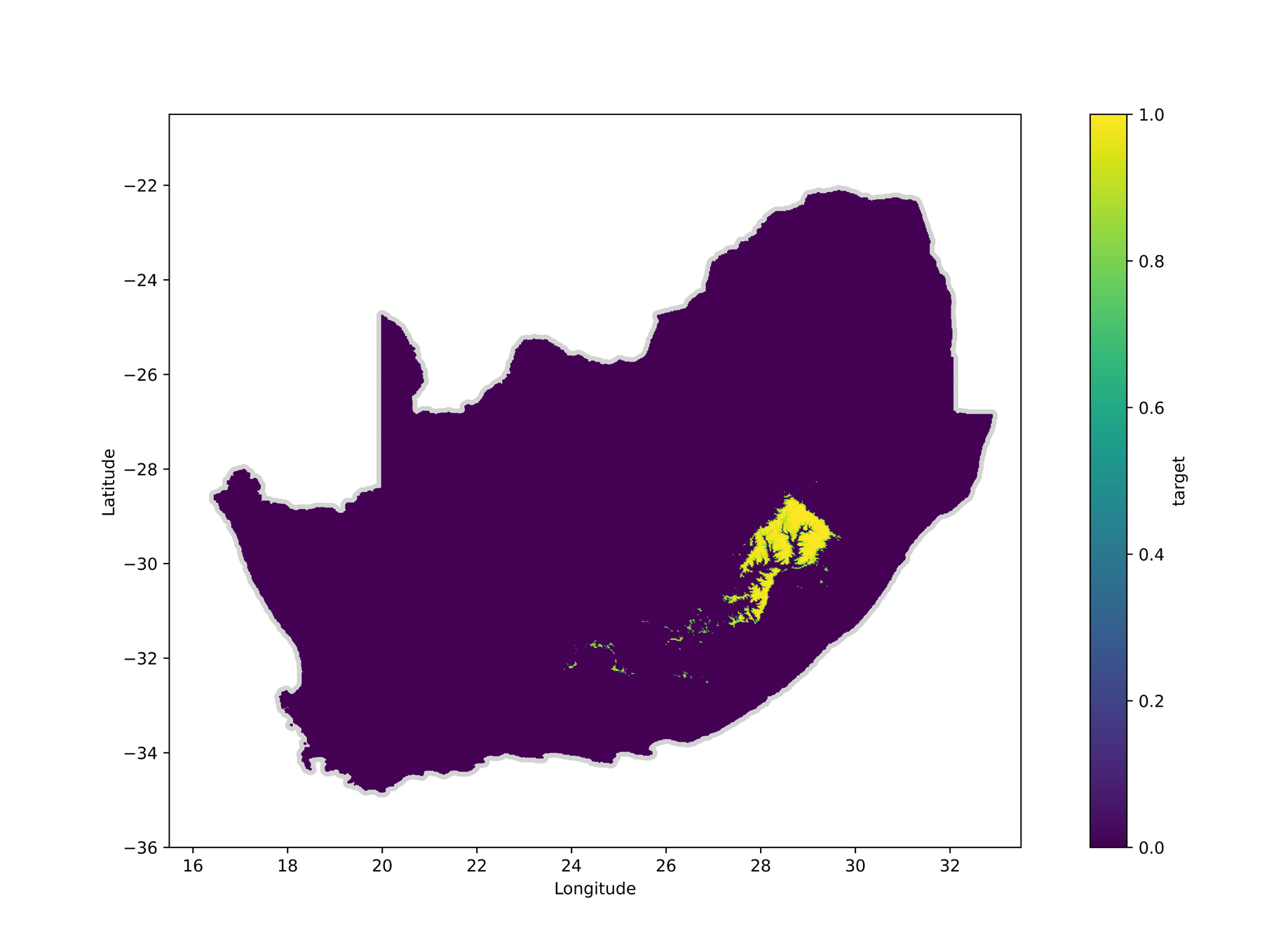
Figure 1: Distribution of Drakensberg Rockjumper at the 2×2 km grid level, as predicted using BirdLasser records for the period 2016-2023, with eBird and iNaturalist as absence data (from Lee 2025).
Ecology
Drakensberg Rockjumpers occupy alpine and subalpine grasslands interspersed with rocky scree and outcrops, feeding primarily on invertebrates (e.g., caterpillars, grasshoppers). The species is typically seen in small family groups (2–12 individuals) foraging on the ground by hopping between rocks and pecking at the soil. Breeding usually occurs in spring to early summer (Oct–Nov), with nests built under rock overhangs or in dense grass tussocks. Although largely sedentary, partial downslope movements may occur in harsh winter conditions (Collar et al. 2020).
Threats & Conservation
Threats
- Climate change: Warming temperatures and changing precipitation patterns may reduce suitable alpine habitat, forcing upslope shifts and habitat contraction.
- Habitat degradation and fragmentation: Overgrazing, trampling, and increased scrub encroachment in subalpine areas may reduce the mosaic of rocky grassland the species depends on.
- Infrastructure development: Potential wind energy and dam developments along the Drakensberg escarpment and within the Maluti Mountains could disturb habitats.
- Human disturbance: Though less acute than for many other species, expanding tourism and recreation in high-altitude areas can lead to disturbance of foraging and nesting sites if not managed.
Conservation Measures Underway
There are no targeted conservation measures specifically for Drakensberg Rockjumper; however, much of its core range overlaps with protected areas in the uKhahlamba-Drakensberg Park World Heritage Site (KwaZulu-Natal) and Sehlabathebe National Park (Lesotho). General stewardship and protected-area management (e.g., limiting intensive grazing, controlling fire regimes) may benefit the species indirectly.
Conservation Measures Proposed
- Protect key upland habitats by expanding or improving management of reserves, especially in sensitive montane grasslands.
- Conduct strategic alien plant clearing (where relevant) in subalpine zones.
- Implement guidelines for responsible wind energy and other infrastructural developments within the Drakensberg escarpment.
- Promote sustainable grazing practices that preserve the patchwork of rocky outcrops and prevent habitat degradation.
- Promote sustainable tourism and recreational activities that limit disturbance and human interference at foraging areas and nesting sites.
Research Priorities and Questions
- Investigate more precise population estimates, including density and distribution across both well-sampled and poorly sampled regions.
- Clarify adult survival rates and juvenile recruitment to inform potential Population Viability Analyses (PVA).
- Assess the magnitude and pattern of altitudinal movements and how climate warming may affect seasonal distribution.
- Assess vulnerability to climate change.
- Evaluate the potential impacts of infrastructure (e.g., wind farms and dam construction) on nesting success and local population persistence.
- Expand ring-recovery or banding studies to enhance understanding of dispersal and site fidelity in different subregions.
Contributors & References
Assessor/s
Alan Lee
Reviewer/s
Hanneline Smit-Robinson
References
Allan DG. 2005. Drakensburg Rockjumper. In: Hockey PAR, Dean WRJ, Ryan PG (eds), Roberts Birds of Southern Africa 7th Edn. Cape Town: Trustees of the John Voelcker Bird Book Fund. pp 735–736.
BirdLife International. 2021. Chaetops aurantius. The IUCN Red List of Threatened Species 2021: e.T22708101A179080997. Available: https://dx.doi.org/10.2305/IUCN.UK.2021-3.RLTS.T22708101A179080997.en. [Accessed on 24 February 2025].
Collar N, Robson C, Sharpe CJ. 2020. Drakensberg Rockjumper (Chaetops aurantius), version 1.0. In: del Hoyo J, Elliott A, Sargatal J, Christie DA, de Juana E (eds), Birds of the World. Ithaca, NY: Cornell Lab of Ornithology. Available: https://doi.org/10.2173/bow.orbroc1.01.
del Hoyo J, Elliott A, Sargatal J, Christie DA, de Juana E (eds). 2007. Handbook of the Birds of the World. Volume 12. Barcelona: Lynx Edicions.
Kopij G. 2015. Avian assemblages in Afro-mountain and Alti-mountain Grasslands in the endemic Maloti/Drakensberg region of Lesotho. Zoology and Ecology 25(4): 319–326. https://doi.org/10.1080/21658005.2015.1095854.
Lee ATK, Altwegg R, Barnard P. 2017. Estimating conservation metrics from atlas data: the case of southern African endemic birds. Bird Conservation International 27(3): 323–336. https://doi.org/10.1017/S0959270916000307.
Lee ATK. 2025. Regional Red Data Book of the Birds of South Africa, Lesotho and Eswatini: SABAP2 Synthesis and Supporting Information and Graphics for Drakensberg Rockjumper. Unpublished report. Johannesburg: BirdLife South Africa.
Osborne PE, Tigar BJ. 1990. The status and distribution of birds in Lesotho. Unpublished report. Oxford: Alexander Library, Department of Zoology, University of Oxford.
Sibley CG, Monroe BL. 1990. Distribution and Taxonomy of Birds of the World. New Haven: Yale University Press.
Simmons RE, Barnard P, Dean W, Midgley GF, Thuiller W, Hughes G. 2004. Climate change and birds: perspectives and prospects from southern Africa. Ostrich 75(4): 295–308. https://doi.org/10.2989/00306520409485458.
Citation
Lee ATK 2025. Drakensberg Rockjumper. In: Lee ATK, Rose S, Banda S, Bezeng SB, Maphalala MI, Maphisa DH, Smit-Robinson H (eds), The 2025 Red Data Book of Birds of South Africa, Lesotho and Eswatini. Johannesburg, South Africa: BirdLife South Africa. Available at: https://www.birdlife.org.za/red-list/drakensberg-rockjumper/
Our generous sponsors


