


Denham’s Bustard
Neotis denhami

Number Of Mature
Individuals (Regional)
<10 000

Regional
Population Trend
Decreasing
2025
Regional Category
Vulnerable
Search by species
CONTENTSOverview
Names
|
IOC English Name: |
Denham’s Bustard |
|
SA & IOC Scientific Name: |
Neotis denhami |
|
BirdLife International Taxonomy (scientific name): |
Neotis denhami |
|
Order: |
OTIDIFORMES |
|
Family: |
Otididae |
|
Species name author: |
Children and Vigors 1826 |
|
Afrikaans: |
Veldpou |
|
Sesotho (South Africa): |
kgupa-ya-dithota |
|
Sesotho (Lesotho): |
khupa-ea-lithota |
|
Siswati: |
Inseme |
|
Zulu: |
iseme |
Current Assessment Status
|
2025 Regional Category [Criteria] |
VU [C1] |
|
2024 Global Category [Criteria] |
NT [A2bcd+3bcd+4bcd] (BirdLife International 2016) |
|
Population size (Regional) |
Unknown (possibly <5000 pairs, Taylor 2015) |
|
Population size (Global) |
Unknown (BirdLife International 2016) |
|
Distribution size (EOO) (Regional) km2 |
819 654 (Lee 2024) |
|
Distribution size (EOO) (Global) km2 |
20 700 000 (BirdLife International 2016) |
|
Distribution size (AOO) (Regional) km2 |
106 736 (Lee 2024) |
|
Generation time |
10.3 years |
|
Status change reason |
No change |
|
Migrant (in the region) |
Yes |
|
Regional endemic |
No |
Historic Listing Information
|
2000 Regional Status |
VU [A1ac+2bc; C1] |
|
2015 Regional Status |
VU [A2bcd+3bcd+4bcd; C1] |
|
Status change reason (if applicable) |
No change |
|
2015 Population size (Regional) |
<5000 pairs |
|
2015 Global Status |
NT |
Reason for Inclusion
Reason for Inclusion in the Assessment
Denham’s Bustard Neotis denhami was previously assessed as Vulnerable in the region (Taylor 2015).
Category Justification
Category Justification
The 2015 Regional Red List status of Vulnerable with a small declining population, satisfying Criterion C1, is maintained for Denham’s Bustard following a precautionary approach given uncertainty in the regional population size. Modelled change in Area of Occupancy (AOO) from Southern African Bird Atlas Project (SABAP2) data over the past three generations shows a 15.50% decline in predicted range, supporting Vulnerable C1 (Lee 2024, Table 1). The species faces ongoing threats from habitat loss, collisions with power lines, and hunting which are projected to continue. No new data exists with which to update the 2015 population estimate which is therefore still estimated at <10 000, inferred to be between 2500 and 10 000 mature individuals. A rescue effect is considered unlikely for this species.
Population Justification
The exact population size remains unknown. The 2015 assessment estimated that fewer than <5000 pairs exist in the region. Other historical estimates are summarised by Collar and Garcia (2020) and put the Overberg winter population at <1000 and the old Transvaal region population at 300 individuals.
Various density estimates exist but are likely outdated and vary considerably. Mendelsohn (1978) reported a density of 0.05-0.08 birds/km² in the Springbok Flats area of Limpopo Province, while Tarboton (1989) recorded a density of 0.78 birds/km² in the Steenkampsberg near Dullstroom, Mpumalanga. Barnes (1998) provides a density estimate of 0.5–1.0 birds/km² while Allan (2002) reported winter density estimates of 0.04 birds/km² for the Overberg district of Western Cape. Denham’s Bustard is a wide-ranging species so it is probable that densities will vary considerably within the range. This makes estimating a population size from the extrapolation of density to area of occupancy difficult. In the absence of updated information, the regional population is still assumed to number <10 000. Confidence in this estimate is low.
Trend Justification
Globally Denham’s Bustard is considered to be in decline (BirdLife International 2016). Modelled change in AOO over the past three generations using SABAP2 reporting rates predict a decline of 15.50% (Lee 2024, Table 1) with evidence of long-term decline in reporting rate between SABAP1 to SABAP2 (Lee 2024; Figure 1). Data from the Coordinated Avifaunal Roadcounts (CAR) indicates an increase for that area covered by that survey, which is strongly influenced by the Overberg. Confidence in an overall decline trend is high.
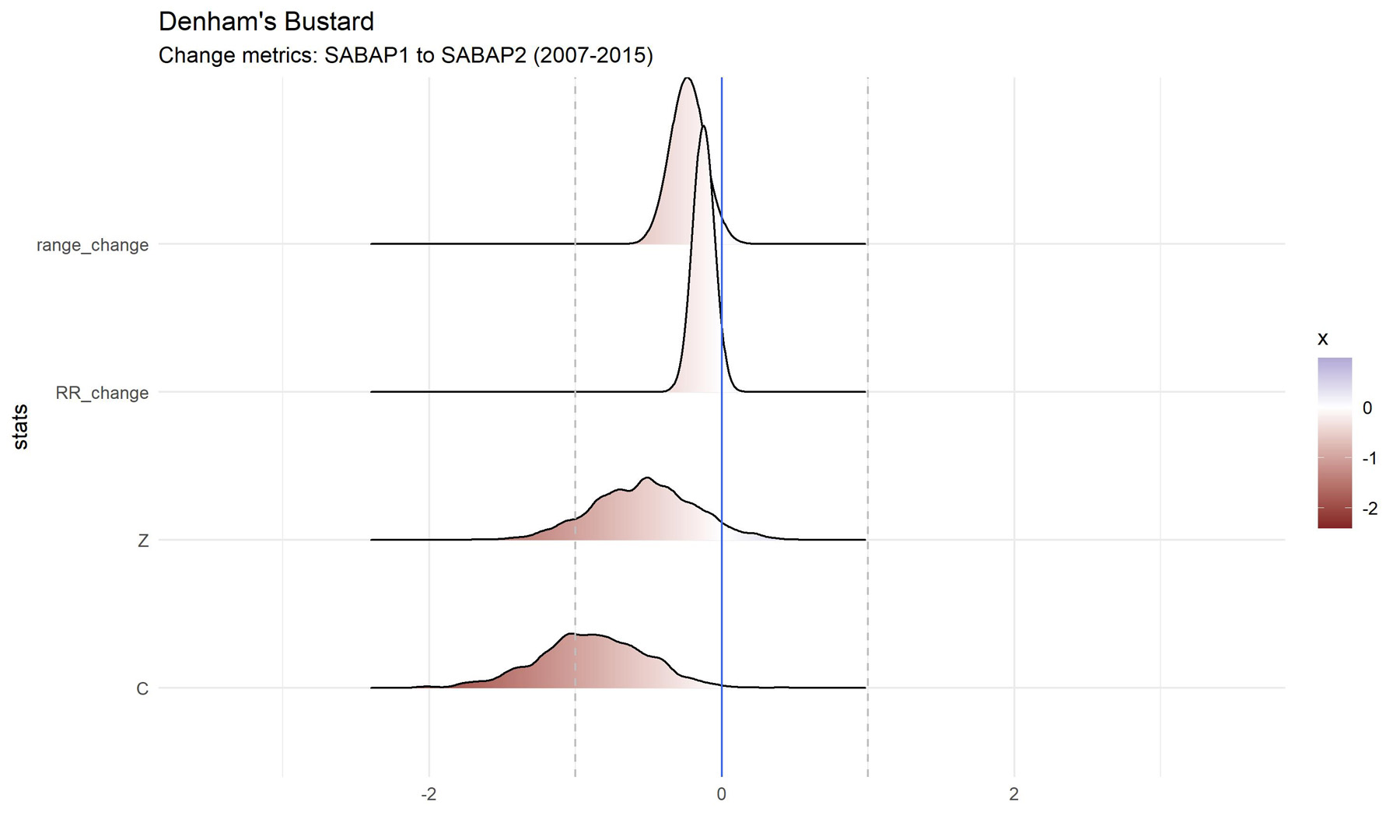
Figure 1: SABAP1 vs SABAP2 bootstrap results of ‘naive’ change metrics of reporting Denham’s Bustard (Lee 2024).
Table 1: Random Forest prediction models of the number of SABAP2 pentads Denham’s Bustard occurred in for the period 2007 to 2015, and then until the end of 2023.
|
Information |
|
|
Pentads 2015 |
1702 |
|
Pentads 2023 |
1442 |
|
Annual rate of change |
0.979 |
|
Percent change (10 years or 3 generations) |
-15.50% |
Biology & Ecology
Taxonomy
Three subspecies exist, with distinct distributions. N. d. denhami occurs in southwestern Mauritania, Senegal and Gambia then eastwards to Uganda and Ethiopia. N. d. jacksoni is found in Kenya and Tanzania and south to Zambia, Botswana and Zimbabwe, with populations also in Angola, and the Democratic Republic of Congo. N. d. stanleyi occurs in South Africa and Eswatini.
Identification
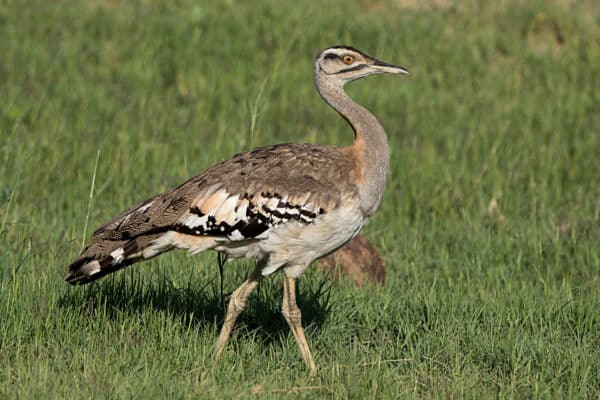
100–120 cm, 3.7–7.6 kg. A large, impressive bustard with striking black-and-white patterning on the wing coverts and remiges. Sexes dimorphic in plumage colouration and male further distinguished by its slightly larger size and thicker neck. Adult male has black crown, broad white supercilium, narrow blackish eye-stripe and bluish grey face. Throat white with fore-neck and upper breast bluish grey and lower breast white. In astonishing ‘balloon’ display, inflates neck and flares normally concealed white neck and breast plumes. Hind-neck and upper mantle deep chestnut; lower mantle, back and rump brown with fine black vermiculation. Tail blackish brown with 2-3 broad, creamy white bands. Upper- wing coverts and inner primaries boldly pied; lesser wing coverts vermiculated blackish brown. Underparts, including flanks and undertail, white. Males distinguished from females by unmarked white or grey fore-neck and breast as well as plainer upperparts (Allan 2002). Fore-neck and upper breast of female finely barred with sharply demarcated white underparts (Allan 2005).
Distribution
Denham’s Bustard has a wide but fragmented Afrotropical range. Within the region, it occurs widely but sparsely over much of the mesic eastern half of South Africa, from the Overberg in Western Cape through Eastern Cape and KwaZulu-Natal to the high-lying grasslands of Mpumalanga, with an outlying sub-population in Limpopo Province. It occurs marginally in Eswatini and is considered a non-breeding vagrant to Lesotho.
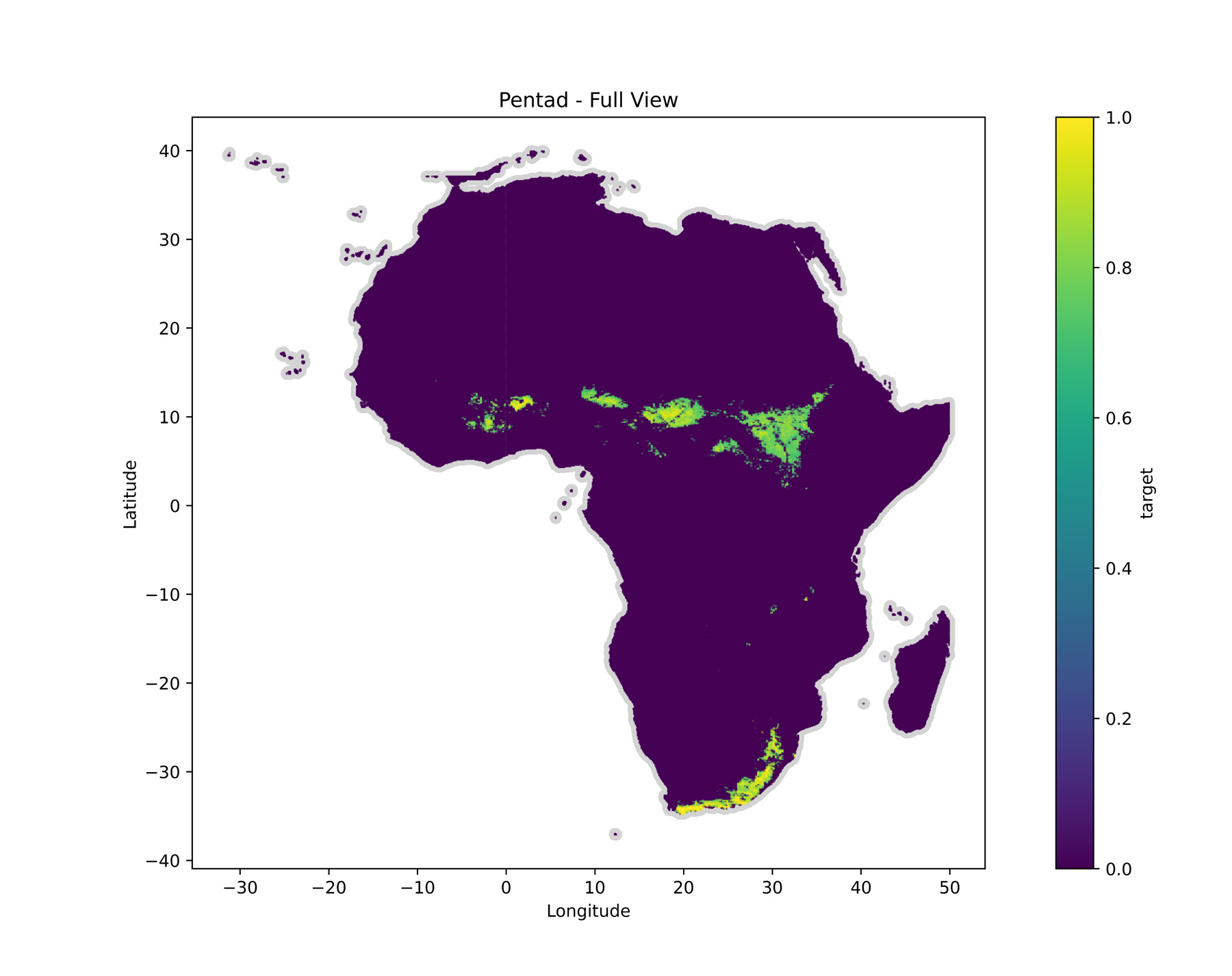
Figure 2: Probability distribution of Denham’s Bustard across the African continent at the pentad scale using ABAP, iNaturalist and eBird datasets. Yellow indicates regions of high probability of occurrence (Lee 2024).
Ecology
Very little recent work exists for Denham’s Bustard. Denham’s Bustard is usually encountered alone or in small groups of 2–7 birds, with occasional aggregations as large as 28 individuals (Allan 2002). Displaying males were recorded in the Overberg region of Western Cape between August and December, with egg-laying taking place in September to October (Allan 2005). The species is omnivorous (Collar 1996) and inhabits grasslands, grassy Acacia-studded dunes, fairly dense shrubland, light woodland, farmland, crops, and dried marsh areas up to 3000 m elevation (del Hoyo et al. 1996). Both sexes tend to form single-sex groups when flocking, and the species may have a polygamous mating system (Allan 2002).
Threats & Conservation
Threats
- Collisions with power lines, identified as a major threat
- Habitat loss through commercial afforestation and intensive agriculture
- Overgrazing (particularly in Eswatini)
- Hunting and snaring
- Potential impacts of climate change, including habitat shifting and droughts
- Accidental poisoning by agricultural pesticides may be a threat to birds foraging on farmland
- Collisions with wind turbines is a potential emerging threat.
Conservation Measures Underway
- The species is listed under Appendix II of CITES.
- It is protected under various regional environmental acts, including Schedule 2: Specially Protected Wild Animal under the Limpopo Environmental Management Act No 7 of 2003, and as Endangered under the Swaziland Game Act.
- The Bustard Working Group was established in 2009 to assess and address conservation concerns for South Africa’s bustard and korhaan species.
- Biannual surveys are conducted through the Coordinated Avifaunal Roadcount (CAR) Project.
- Of 810 pentads where the species occurs, 197 (24.3%) are within protected areas. This includes 127 pentads in National Parks or Nature Reserves and 70 in other protected areas. The ratio of range in protected areas to unprotected areas is 0.32 (Lee 2024).
- The species currently forms part of a larger bird GPS tracking project in Mpumalanga Province, to investigate its movement ecology and assess the potential impacts of renewable energy applications in the area.
- A global multi-species action plan (MsAP) for bustards, including Denham’s Bustard, is currently underway.
Conservation Measures Proposed
- Improve the protected area network, especially in Mpumalanga and KwaZulu-Natal provinces.
- Implement better management of fires and grazing regimes in conservation areas and on private land to create heterogeneity in the structural and floristic components of preferred habitats.
- Continue work with stakeholders in the power transmission sector to mitigate collision threats.
- Conduct more detailed population monitoring and trend analysis.
- Focus conservation efforts on areas identified as high probability of occurrence in the SABAP2 distribution maps, particularly those outside current protected areas.
- Investigate the frequency of wind turbine collision mortalities and determine the extent of future impacts from new renewable energy development applications.
Research Priorities and Questions
- Conduct a comprehensive population estimate and trend analysis using standardized methods.
- Investigate the taxonomic status of the species, especially in relation to its isolation from East African populations.
- Develop and implement specific mitigation measures for key threats, particularly power line collisions and habitat loss.
- Investigate the potential impacts of climate change on the species’ distribution and habitat quality.
- Investigate the discrepancy between the stable reporting rate trend and the declining predicted range to understand if this reflects a true population trend or is an artifact of sampling.
- Conduct more detailed analysis of the seasonal patterns of reporting identified in the SABAP2 synthesis, to better understand the species’ movements and habitat use throughout the year.
Contributors & References
Assessor/s
David Ehlers Smith
Reviewer/s
Sanjo Rose, Matt Pretorius
References
Allan DG. 2002. Abundance, sex ratio, group size and habitat of Stanley’s Bustard Neotis denhami in western South Africa. Durban Museum Novitates 27: 31–38.
Allan DG. 2005. Denham’s Bustard. In: Hockey PAR, Dean WRJ, Ryan PG (eds), Roberts birds of southern Africa 7th Edn. Cape Town: Trustees of the John Voelcker Bird Book Fund. pp 295–296.
Barnes KN (ed). 1998. The Important Bird Areas of Southern Africa. Johannesburg: BirdLife South Africa.
BirdLife International. 2016. Neotis denhami. The IUCN Red List of Threatened Species 2016: e.T22691905A93327715. Available: https://dx.doi.org/10.2305/IUCN.UK.2016-3.RLTS.T22691905A93327715.en [Accessed on 25 November 2024].
Collar N, Garcia E. 2020. Denham’s Bustard (Neotis denhami), version 1.0. In: del Hoyo J, Elliott A, Sargatal J, Christie DA, de Juana E (eds), Birds of the World. Ithaca, NY: Cornell Lab of Ornithology. Available: https://doi.org/10.2173/bow.stabus1.01.
Collar NJ. 1996. Otididae (Bustards). In: del Hoyo J, Elliott A, Sargatal J (eds), Handbook of the Birds of the World, vol. 3. Barcelona: Lynx Edicions. pp 240–273.
del Hoyo J, Elliott A, Sargatal J (eds). 1996. Handbook of the Birds of the World, vol. 3: Hoatzin to Auks. Barcelona: Lynx Edicions.
Lee ATK. 2024. Regional Red Data Book of the Birds of South Africa, Lesotho and Eswatini: SABAP2 synthesis and supporting information and graphics for Denham’s Bustard. Unpublished report. Johannesburg: BirdLife South Africa.
Mendelsohn JM. 1978. A study of the Black-bellied Korhaan. BSc Hons thesis. Johannesburg: University of the Witwatersrand, South Africa.
Tarboton WR. 1989. Breeding and distribution of Ludwig’s Bustard. Bustard Studies 4: 165–169.
Taylor MR. 2015. Denham’s Bustard. In: Taylor MR, Peacock F, Wanless RM (eds), The Eskom Red Data Book of Birds of South Africa, Lesotho and Swaziland. Johannesburg: BirdLife South Africa. pp 197–199.
Citation
Ehlers Smith DA 2025. Denham’s Bustard. In: Lee ATK, Rose S, Banda S, Bezeng SB, Maphalala MI, Maphisa DH, Smit-Robinson H (eds), The 2025 Red Data Book of Birds of South Africa, Lesotho and Eswatini. Johannesburg, South Africa: BirdLife South Africa. Available at: https://www.birdlife.org.za/red-list/denhams-bustard/
Our generous sponsors


