


Curlew Sandpiper
Calidris ferruginea

Number Of Mature
Individuals (Regional)
12 435 – 47 694

Regional
Population Trend
Decreasing
2025
Regional Category
Vulnerable
Search by species
CONTENTSOverview
Names
|
IOC English Name: |
Curlew Sandpiper |
|
SA & IOC Scientific Name: |
Calidris ferruginea |
|
BirdLife International Taxonomy (scientific name): |
Calidris ferruginea |
|
Order: |
CHARADRIIFORMES |
|
Family: |
Scolopacidae |
|
Species name author: |
Pontoppidan 1763 |
|
Afrikaans: |
Krombekstrandloper |
|
Sesotho (South Africa): |
seyalemabopo-lomokotsuopo |
|
Sesotho (Lesotho): |
seealemabopo-lomokotsuopo |
|
Siswati: |
|
|
Zulu: |
Ungozwana |
Current Assessment Status
|
2025 Regional Category [Criteria] |
VU [A2bc+4bc] |
|
2024 Global Category [Criteria] |
VU [A2bcd+4bcd] |
|
Population size (Regional) |
12 435 – 47 694 mature individuals |
|
Population size (Global) |
420 000 – 960 000 (BirdLife International 2024) |
|
Distribution size (EOO) (Regional) km2 |
1 405 765 (Lee 2024) |
|
Distribution size (EOO) (Global) km2 |
3 000 000 (BirdLife International 2024) |
|
Distribution size (AOO) (Regional) km2 |
88 245 (BIRDIE 2024) |
|
Generation time |
5.14 years |
|
Status change reason |
Genuine change in status |
|
Migrant (in the region) |
Yes |
|
Regional endemic |
No |
Historic Listing Information
|
2000 Regional Status |
Not Evaluated |
|
2015 Regional Status |
Not Evaluated |
|
Status change reason (if applicable) |
Not applicable |
|
2015 Population size (Regional) |
Unknown |
|
2015 Global Status |
NT [A4abc] |
Reason for Inclusion
Reason for Inclusion in the Assessment
Curlew Sandpiper Calidris ferruginea was not previously assessed. Preliminary screening of Coordinated Waterbird Counts (CWAC) and Southern African Bird Atlas Project (SABAP2) data flagged this species as declining. In addition, the species is globally listed as Vulnerable.
Category Justification
Category Justification
The species was recently assessed globally as Vulnerable due to population declines attributed to collapse of lemmings Lemmus sp. on the breeding grounds, habitat degradation, conversion and disturbance on staging and wintering grounds and hunting along migration routes (BirdLife International 2024). Regionally, population declines between 46% and 63% satisfy the thresholds for the Endangered category as per the population size reduction Criterion A2, and this decline is expected to continue given deterioration of conditions on the breeding grounds, meeting Criterion A4. The range of the Curlew Sandpiper within the region does not meet the threshold for Vulnerable under the range size criterion (Extent of Occurence (EOO) <20 000 km2 and Area of Occupancy (AOO) <2000 km2). The regional population of Curlew Sandpipers is postulated to be >10 000 mature individuals which is above the threshold for Vulnerable under the population size criteria C and D. Given that the species is migratory and subject to extensive conservation attention, a rescue effect is currently still feasible. The Curlew Sandpiper was therefore assessed regionally as Vulnerable VU [A2bc+4bcd].
Population Justification
Wetlands International (2024) estimate the global population of Curlew Sandpipers to number 1 040 000 – 1 240 000 individuals (c. 686 400 – 818 400 mature individuals). Using the same data but accounting for uncertainty in counts of some populations and declining trends BirdLife International (2024) estimate the global population to be 420 000 – 960 000 mature individuals and is assumed here to be a more realistic estimate.
The population of Curlew Sandpipers migrating to southwest Asia, eastern and southern Africa during the non-breeding season is estimated to be 400 000 individuals (Wetlands International 2024). Using the Wetlands International estimates for the global population (1 040 000 – 1 240 000 individuals) and dividing them by 400 000, upper and lower ratios of 0.38 and 0.32 were obtained of the global population that migrate to southwest Asia, eastern and southern Africa. This was applied to the estimate of BirdLife International (i.e. 420 000 – 960 000) to obtain an estimate of the population migrating to southwest Asia, eastern and southern Africa. It is estimated that this population numbers 161 500 – 309 700 mature individuals.
Underhill (1997) indicates that 10-20% of the population migrating to Africa reach southern Africa. Using these percentages and the southwest Asia, eastern and southern Africa population estimates above it is calculated that the number of Curlew Sandpiper spending the non-breeding season in southern Africa is 16 150 – 61 940 mature individuals (c. 24 470 – 93 850 individuals).
Summers et al. (1987) estimated that the South African and Namibian population combined was 115 000 individual birds, with South Africa contributing 77% to the total i.e. 89 000 individual birds (c. 58 740 mature birds). This estimate is however dated. The 77% does not take the populations from Botswana, Zimbabwe and southern Mozambique, and if applied to the 16 150 – 61 940, can be used to provide an estimate for South Africa of 12 435 – 47 694 mature individuals.
Taking the sum of the mean counts by site for all South African CWAC sites (sites = 241, 1898 counts) for the period 1997–2007 provides a total of the mean counts of 65 427 and the sum of the site maximum counts was 110 204. Repeating this for 2008–2023 (164 sites, 2033 counts) provides a total mean count of 16 728 and the sum of the site maximum counts is 48 659. Taken together, the population estimate is conservative given that CWAC counts do not count all sites, although the most important for this species have been regularly counted. However, the two different approaches to quantifying population sizes arrive at reassuringly similar numbers.
Taking the above into consideration and despite declining trends it is postulated that the regional population of Curlew Sandpiper still exceeds 10 000 mature individuals and therefore does not meet the thresholds for the IUCN small population criteria. The confidence in this statement is medium.
Trend Justification
Globally, the population of Curlew Sandpiper is in decline (BirdLife International 2024). Nagy and Langendoen (2020) using data from the International Waterbird Census program calculated (based on smoothed input totals of the population of Curlew Sandpipers migrating to Africa) a decrease in the population of 63% in 16 years (2001-2017). Using the growth rate between 2008 and 2017, they predicted that the population would decline by 93% in 16 years compared to the population levels in 2008. However, both these trends were uncertain as they lacked statistical power.
Summer counts at CWAC sites were modelled using the poptrend package (Knape 2016). An estimated percentage change of -57% (-74%, -24%) over three generations from year 2007-2023 was obtained (Figure 1). Using the summed site mean count method (see population account above) standardised to sites counted during both periods results in CWAC site population estimates of 29 080 (1997-2007) and 16 728 (2008-2023). These values, representing a subset of 164 locations counted during both periods and not all CWAC sites, represents a three-generation decline of 46.4%. This decline corresponds well with that of Nagy and Langendoen (2020). Confidence in trends is high.

Figure 1. Poptrend plot for Curlew Sandpiper, using summer CWAC counts. Red indicates periods of significant decline (from Lee 2024).
Using SABAP2 data, calculating the AOO using the total number of unique pentads in which the species was recorded between the two periods (2007-2015 and 2016-2023) showed a decline of 25% (Lee 2024). The modelled decline was 69%, but much of this was due to overprediction over the arid interior of South Africa.
Biology & Ecology
Taxonomy
Monotypic (Mlodinow and Medrano 2023).
Identification
18–20 cm, sexes differ slightly in plumage (Hockey 2005). It is characterised by its distinctly long, downward-curving bill (Mlodinow and Medrano 2023). During its breeding (alternate) plumage, the bird is primarily a striking brick-red colour, making it easily recognisable (Mlodinow and Medrano 2023). In non-breeding, juvenile, and immature plumages, its appearance is more subdued, with shades ranging from greyish-brown to brownish-grey on the upperparts and a whitish underside (Mlodinow and Medrano 2023). Juvenile plumage may display a buff tint on the chest (Mlodinow and Medrano 2023).
The Curlew Sandpiper can be confused with the following species: White-rumped Sandpiper Calidris fuscicollis (vagrant to the region) which is smaller with a shorter bill and legs and its wings extend beyond the tail tip (Hockey 2005). It can also be confused with similarly sized shorebirds that have reddish undersides, such as the Red Knot Calidris canutus and Red Phalarope Phalaropusfulicarius, as well as species with long, downward-curved bills, like the Dunlin Calidris alpina (Mlodinow and Medrano 2023).
Distribution
The breeding range of the Curlew Sandpiper is the high Arctic mainland, but during cold years they breed further south in the tundra zone (Lappo 1996). The non-breeding range is extensive, stretching from West Africa to New Zealand (Cramp and Simmons 1983, Higgins and Davies 1996). The species was widespread throughout Southern Africa, from Namibia to South Africa to Mozambique (Maclean 1985). In the region (Figure 2) the species is found virtually along the entire coastline, but also occurs on suitable inland wetlands, pans and dams mainly on the Highveld of the Free State, Gauteng, Mpumalanga, Limpopo and North West Provinces (Underhill 1997).
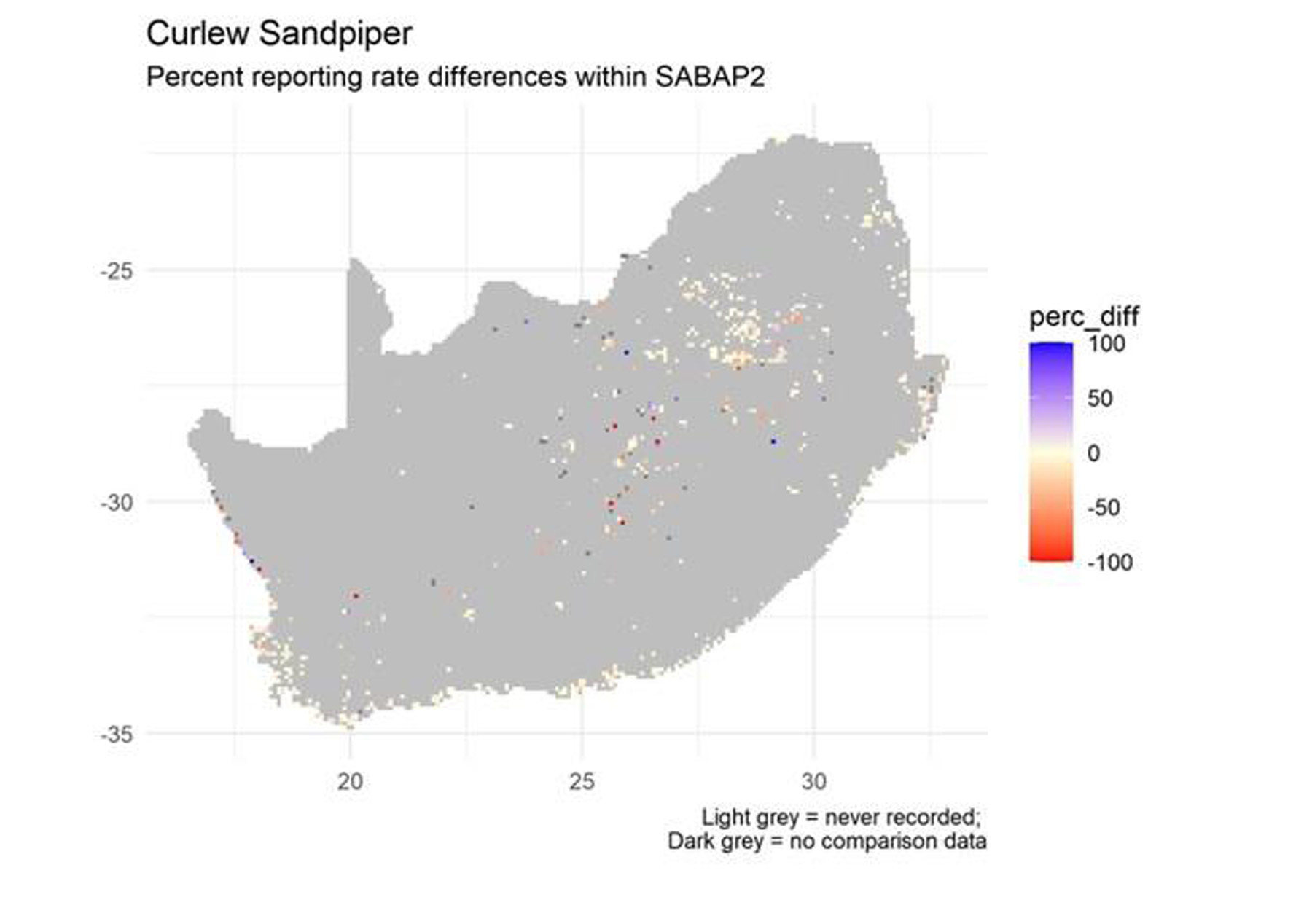
Figure 2: Distribution map of Curlew Sandpiper also showing pentad level change between SABAP2 periods 2007-2015 and 2016-2023 (from Lee 2024).
Ecology
Habitat:
In the region the Curlew Sandpiper is found at coastal lagoons, estuaries, and sheltered shorelines with abundant stranded algae. Inland, it inhabits wetlands with muddy edges and areas where water levels are receding. The scattered inland distribution of the species suggests that it is less selective in wetland choice compared to other migratory species e.g. Common Greenshank Tringa nebularia and Common Sandpiper Actitis hypoleucos (Underhill 1997).
Migration:
This species is a full migrant, traveling long distances from their breeding to non-breeding sites (del Hoyo et al. 1996, Snow and Perrins 1998). Southern African birds belong to the population that breed in central Siberia (Wetlands International 2024) that migrate to eastern and southern Africa via the Black and Caspian Seas, eastern Mediterranean and eastern African Rift Valley (Underhill 1997).
Breeding:
Nonbreeding regionally.
Diet:
During the breeding season, the Curlew Sandpiper primarily feeds on insects, including the adults, pupae, and larvae of Diptera (Johnsgard 1981) and beetles, as well as bugs and leeches (del Hoyo et al.1996). In the non-breeding season, its diet shifts to include polychaete worms, molluscs, crustaceans and occasionally insects and seeds (del Hoyo et al.1996).
Threats & Conservation
Threats
Globally, Curlew Sandpipers face numerous threats that contribute to their declining populations. Climate change impacts Arctic breeding habitats by disrupting ecological processes like lemming population cycles, which are closely tied to breeding success (Underhill 1987, Summers et al. 1998). Habitat loss and degradation are significant, with coastal development, land reclamation, and invasive species such as Spartina alterniflora reducing the quality and availability of wetlands and intertidal mudflats (Murray et al. 2014, IUCN 2023). Human disturbances, including tourism, fishing, and industrial activities, disrupt feeding and roosting behaviours, while offshore wind farms may displace birds (Wearne and Underhill 2005, IUCN 2024). Hunting and illegal trapping, though poorly quantified, pose additional threats in some regions (Brochet et al. 2016, Gallo-Cajiao et al. 2020). Furthermore, diseases like avian influenza and botulism have been identified as potential risks during outbreaks (Blaker 1967, van Heerden 1974, Melville and Shortridge 2006).
In the region the predominant threat is the loss of habitat. Underhill (1997) indicates that within the region the conservation of the species depends upon the establishment of protected areas at important sites. Other threats include human disturbances, mostly tourism and fishing activities.
Conservation Measures Underway
There are no specific conservation measures in place for Curlew Sandpipers. However, the Langebaan Lagoon and the Berg River are proclaimed Ramsar Sites in terms of The Convention on Wetlands of International Importance especially as Waterfowl Habitat, which provides a framework for the conservation and wise use of wetlands and their resources. In addition, the Langebaan Lagoon is situated within the West Coast National Park and is protected in terms of the legislation applicable to National Parks. The other important site for the species, the Bloemhof Dam, is surrounded by two protected areas, the Sandveld Nature Reserve on the Free State Province side and the Bloemhof Dam Nature Reserve on the North West Province side. These sites have recorded the highest number of Curlew Sandpipers (Langebaan Lagoon highest followed by Bloemhof Dam and then Berg River (West Coast)) over the last three decades and are considered important over-wintering sites for the species. In addition the Central Siberia/SW Asia, E & S Africa population of Curlew Sandpiper is listed in Column A Category 4 (Species, which are listed as Near Threatened on the IUCN Red List of Threatened species, as reported in the most recent summary by BirdLife International, but do not fulfil the conditions in respect of Categories 1, 2 or 3, and which are pertinent for international action) of the African-Eurasian Waterbird Agreement (AEWA 2022).
Conservation Measures Proposed
- Protection of important habitats of the species to prevent disturbance and habitat loss.
- Identify important wetlands for the species and ensure relevant conservation actions are implemented.
Research Priorities and Questions
- Identify important wetlands (e.g. Langebaan Lagoon, Bloemhof Dam, Berg River, etc.) for Curlew Sandpiper and ensure regular surveys are implemented over the entire wetland, addressing the uncertainty around regional population size and trends.
- Conduct research to understand the species dependence on key sites within the region and the threats facing these sites.
- Understand the threats impacting on the species within the region.
- Has the species benefitted from the creation of salt works/pans and dams?
Contributors & References
Assessor/s
Kevin Shaw, Maria Paul
Reviewer/s
Alan Lee
References
AEWA. 2022. Agreement on the Conservation of African-Eurasian Migratory Waterbirds (AEWA) – Agreement Text and Annexes. As amended at the 8th Session of the Meeting of the Parties to AEWA. UNEP/AEWA Secretariat, Budapest.
BIRDIE. 2024. Curlew Sandpiper data downloaded from https://biodiversityadvisor.sanbi.org/contentmanagement/index?guid=15eca08b-7f6a-4f34-8814-84a335a62d8e [Accessed on 16 December 2024.
BirdLife International. 2024. Calidris ferruginea. The IUCN Red List of Threatened Species 2024: e.T22693431A180593985. Available at: https://dx.doi.org/10.2305/IUCN.UK.2024-2.RLTS.T22693431A180593985.en. [Accessed on 03 December 2024].
Blaker D. 1967. An outbreak of Botulinus poisoning among waterbirds. Ostrich 38(2): 144–147.
Brochet A-L, van den Bossche W, Jbour S, Ndang’ang’a PK, Jones VR, Abdou Wali, Al-Hmoud AR, Asswad NG, Atienza JC, Atrash I, Barbara N, Bensusan K, Bino T, Celada C, Cherkaoui SI, Costa J, Deceuninck B, Etayeb KS, Feltrup-Azafzaf C, Figelj J, Gustin M, Kmecl P, Kocevski V, Korbeti M, Kotrosan D, Laguna JM, Lattuada M, Leitao D, Lopes P, Lopez-Jimenez N, Lucic V, Micol T, Moali A, Perlman Y, Piludu N, Portolou D, Putilin K, Quaintenne G, Ramadan-Jaradi G, Ruzic M, Sandor A, Sarajli N, Saveljic D, Sheldon RD, Shialis T, Tsiopelas N, Vargas F, Thompson C, Brunner A, Grimmett R, Butchart SHM. 2016. Preliminary assessment of the scope and scale of illegal killing and taking of birds in the Mediterranean. Bird Conservation International 26: 1–28.
Cramp S, Simmons KEL. 1983. The birds of the Western Palearctic. Vol. 3. Oxford: Oxford University Press.
del Hoyo J, Elliott A, Sargatal J. 1996. Handbook of the birds of the world. Vol. 3: Hoatzin to Auks. Barcelona: Lynx Edicions.
Gallo-Cajiao E, Morrison TH, Woodworth BK, Lees AC, Naves LC, Yong DL, Choi CY, Mundkur T, Bird J, Jain A, Klokov K. 2020. Extent and potential impact of hunting on migratory shorebirds in the Asia-Pacific. Biological Conservation 246: 108582.
Higgins PJ, Davies SJJF. 1996. Handbook of Australian, New Zealand and Antarctic birds. Vol. 3: Snipes to pigeons. Melbourne: Oxford University Press.
Hockey PAR. 2005. Curlew Sandpiper. In: Hockey PAR, Dean WRJ, Ryan PG (eds). Roberts – Birds of Southern Africa (7th Edn). Cape Town: The Trustees of the John Voelcker Bird Book Fund.
IUCN. 2024. The IUCN Red List of Threatened Species. Version 2024-2. Available at: https://www.iucnredlist.org.
Johnsgard PA. 1981. The plover sandpipers: ecology and behaviour of mixed-species feeding flocks. Lincoln: University of Nebraska Press.
Knape J. 2016. Decomposing trends in Swedish bird populations using generalized additive mixed models. Journal of Applied Ecology 53: 1852–1861.
Lappo EG. 1996. Comparisons of breeding range structure for Dunlin Calidris alpina and Curlew Sandpiper Calidris ferruginea: conservative and nomadic tundra waders. Wader Study Group Bulletin 80: 41–46.
Lee ATK. 2024. Regional Red Data Book of the Birds of South Africa, Lesotho and Eswatini: SABAP2 synthesis and supporting information and graphics for Curlew Sandpiper. Unpublished report. Johannesburg: BirdLife South Africa.
Maclean GL. 1985. Roberts’ birds of southern Africa (5th Edn). Cape Town: John Voelcker Bird Book Fund.
Melville DS, Shortridge KF. 2006. Migratory waterbirds and avian influenza in the East Asian-Australasian Flyway with particular reference to the 2003-2004 H5N1 outbreak. In: Boere GC, Galbraith CA, Stroud DA (eds), Waterbirds around the World. Edinburgh: The Stationery Office. pp 432–438.
Mlodinow SG, Medrano F. 2023. Curlew Sandpiper (Calidris ferruginea), version 2.0. In: Sly ND (ed). Birds of the World. Ithaca: Cornell Lab of Ornithology. Available: https://doi.org/10.2173/bow.cursan.02.
Murray NJ, Clemens RS, Phinn SR, Possingham HP, Fuller RA. 2014. Tracking the rapid loss of tidal wetlands in the Yellow Sea. Frontiers in Ecology and the Environment 12: 267–272.
Nagy S, Langendoen T. 2020. Flyway trend analyses based on data from the African-Eurasian Waterbird Census from the period of 1967–2018. Online publication. Wageningen: Wetlands International.
Snow DW, Perrins CM. 1998. The birds of the Western Palearctic: concise edition. Vol. 1: Non-passerines. Oxford: Oxford University Press.
Summers RW, Underhill LG, Pearson DJ, Scott DA. 1987. Wader migration systems in southern and eastern Africa and western Asia. Wader Study Group Bulletin 49: 15–34.
Summers RW, Underhill LG, Syroechkovski EE Jr. 1998. The breeding productivity of dark-bellied brent geese and curlew sandpipers in relation to changes in the numbers of Arctic foxes and lemmings on the Taimyr Peninsula, Siberia. Ecography 21: 573–580.
Underhill LG. 1987. Changes in the age structure of Curlew Sandpiper populations at Langebaan Lagoon, South Africa, in relation to lemming cycles in Siberia. Transactions of the Royal Society of South Africa 46: 209–214.
Underhill LG. 1997. Curlew Sandpiper. In: Harrison JA, Allan DG, Underhill LG, Herremans M, Tree AJ, Parker V, Brown CJ (eds), The atlas of southern African birds. Vol. 1: Non-passerines. Johannesburg: BirdLife South Africa. pp 468–469.
van Heerden J. 1974. Botulism in the Orange Free State goldfields. Ostrich 45(3): 182–184.
Wearne K, Underhill LG. 2005. Walvis Bay, Namibia: a key wetland for waders and other coastal birds in southern Africa. Wader Study Group Bulletin 107: 24–30.
Wetlands International. 2024. Waterbirds Populations Portal. Available at: https://wpp.wetlands.org/. [Accessed on 03 December 2024].
Citation
Shaw K, Paul M 2025. Curlew Sandpiper. In: Lee ATK, Rose S, Banda S, Bezeng SB, Maphalala MI, Maphisa DH, Smit-Robinson H (eds), The 2025 Red Data Book of Birds of South Africa, Lesotho and Eswatini. Johannesburg, South Africa: BirdLife South Africa. Available at: https://www.birdlife.org.za/red-list/curlew-sandpiper/
Our generous sponsors


