


Caspian Tern
Hydroprogne caspia

Number Of Mature
Individuals (Regional)
793

Regional
Population Trend
Decreasing
2025
Regional Category
Vulnerable
Search by species
CONTENTSOverview
Names
|
IOC English Name: |
Caspian Tern |
|
SA & IOC Scientific Name: |
Hydroprogne caspia |
|
BirdLife International Taxonomy (scientific name): |
Hydroprogne caspia |
|
Order: |
CHARADRIIFORMES |
|
Family: |
Laridae |
|
Species name author: |
Pallas 1770 |
|
Afrikaans: |
Reuse Sterretjie |
|
Sesotho (South Africa): |
Lepheulane le leholoholo |
|
Sesotho (Lesotho): |
|
|
Siswati: |
|
|
Zulu: |
ubhaklakliyo |
Current Assessment Status
|
2025 Regional Category [Criteria] |
VU [D1] |
|
2024 Global Category [Criteria] |
LC (BirdLife International 2019) |
|
Population size (Regional) |
c. 793 mature individuals (Crawford et al. 2024 estimate adjusted to account for non-breeding mature birds and reflect population trend of -2.3%) |
|
Population size (Global) |
240 000 – 455 000 (158 400 – 300 000 mature individuals) (Wetlands International 2024) |
|
Distribution size (EOO) (Regional) km2 |
1 309 391 (Lee 2024) |
|
Distribution size (EOO) (Global) km2 |
226 000 000 (BirdLife International 2019) |
|
Distribution size (AOO) (Regional) km2 |
3628 (Lee 2024) |
|
Generation time |
12.2 years (BirdLife International 2019) |
|
Status change reason |
No change |
|
Migrant (in the region) |
No |
|
Regional endemic |
No |
Historic Listing Information
|
2000 Regional Status |
NT [C1] |
|
2015 Regional Status |
VU [A2a; C1; D1+2] |
|
Status change reason (if applicable) |
Genuine change in status |
|
2015 Population size (Regional) |
600 – 650 mature individuals |
|
2015 Global Status |
LC |
Reason for Inclusion
Reason for Inclusion in the Assessment
The Caspian Tern Hydroprogne caspia was previously assessed in the 2015 regional assessment, where it was listed as Vulnerable [A2a; C1; D1+2] (Ortmann et al. 2015). About 45% of Africa’s modelled range falls within the region (Lee 2024).
Category Justification
Category Justification
Population trends from colony count data show a decline, but the magnitudes thereof are likely <30% and thus do not satisfy any threat status category under IUCN Criterion A. With a wide range, Extent of Occurrence (EOO) and Area of Occupancy (AOO) are greater than thresholds for Criterion B. The magnitude of decline was insufficient to invoke Criterion C with confidence, but could be applicable. The current population is estimated at c. 793 mature individuals. The Caspian Tern is assessed as Vulnerable [D1] because of the small regional population size.
Population Justification
The global population is estimated to number 240 000 – 455 000 individuals (c. 158 400 – 300 000 mature individuals) (Wetlands International 2024). Wetlands International (2024) using data collected 2013-2018 estimates the southern African population to be 2100 – 2600 individual birds (c. 1380 – 1700 mature birds). Ortmann et al. (2015) estimated the South African population to be 600 – 650 mature birds. Crawford et al. (2024) using maximum counts for the period 2017-2021 estimated the breeding population to number 262 breeding pairs (c. 870 mature individuals adding 66% to account for mature individuals that did not breed or were not breeding at the time of the survey) (estimate adapted from Crawford et al. 2024 for South Arica). The 2.3% annual decline (see below) was applied to the adapted Crawford et al. (2024) value to obtain a regional estimate numbering c. 793 mature individuals. This satisfies Criterion D1 for the category Vulnerable, which is retained as the likelihood of a regional rescue effect is low.
Trend Justification
Wetland International (2024) indicates that the Southern African population is declining based on census data collected between 2008-2017. Nagy and Langendoen (2020) determined that there was a moderate increase in the southern African population trend for the period 1992-2017, but that the population did show a moderate decline over the last ten years (2008-2017). Using the latter growth rate, they predicted that the population would decline by 93% in three generations compared to population levels in 2008. This analysis is, however, for Southern Africa and it includes data from Zambia and Namibia. The influence of the data and frequency of the data collection may impact calculated growth rates. Additionally, the data used from South Africa in this analysis is obtained from the Coordinated Waterbird Counts (CWAC) project. This data are collected by citizen scientists and interest in this project has declined substantially over the years as evidenced by the number of sites counted presently compared to in the past (CWAC unpubl data). It should be noted that the magnitude of decline calculated by Nagy and Langendoen (2020) was not observed in any of the analysis below and is therefore not considered valid.
Using the Southern African Bird Atlas Project (SABAP2) data and available habitat per year, the number of pentads in which the species could occur were predicted annually between 2008 and 2022. Data emanating from these dynamic models (BIRDIE 2024) estimated that the AOO declined by 18%. However, using total number of unique pentads for which the species was recorded in SABAP2 a 9% increase between the periods 2007-2015 and 2016-2023 was obtained (Lee 2024). It should be noted this is for foraging range, rather than breeding sites.
State-space models were applied to population counts carried out at various wetlands across the region to estimate the true number of individuals at each wetland for which adequate counts existed (58 wetlands). Analysis of the data predicted a total population decline of 1.7% over a 36-year period for these wetlands (BIRDIE 2024).
Crawford et al. (2024) used maximum numbers of breeding birds per site for Southern Africa and summed them for each of the five most recent decades. This decadal data were adapted to reflect figures for South Africa which showed an annual growth rate of -0.77% per annum equating to a 23.7% population decline over the last 36.6 years (three generations) or -17% over 24.4 years (two generations). The authors do note that the trends are influenced by the coverage of the colonies and the numbers of birds observed at Lake St Lucia. Figure 1 is data from surveys carried out at Lake St Lucia, KwaZulu-Natal and Kalkfontein Dam Nature Reserve, Free State (the two sites that together hold on average 48% of the summer population of Caspian Terns in South Africa) showing numbers of individual birds counted during summer of each year (CWAC unpubl data). These two sites illustrate the high variation in numbers between years complicating long term trend analysis.
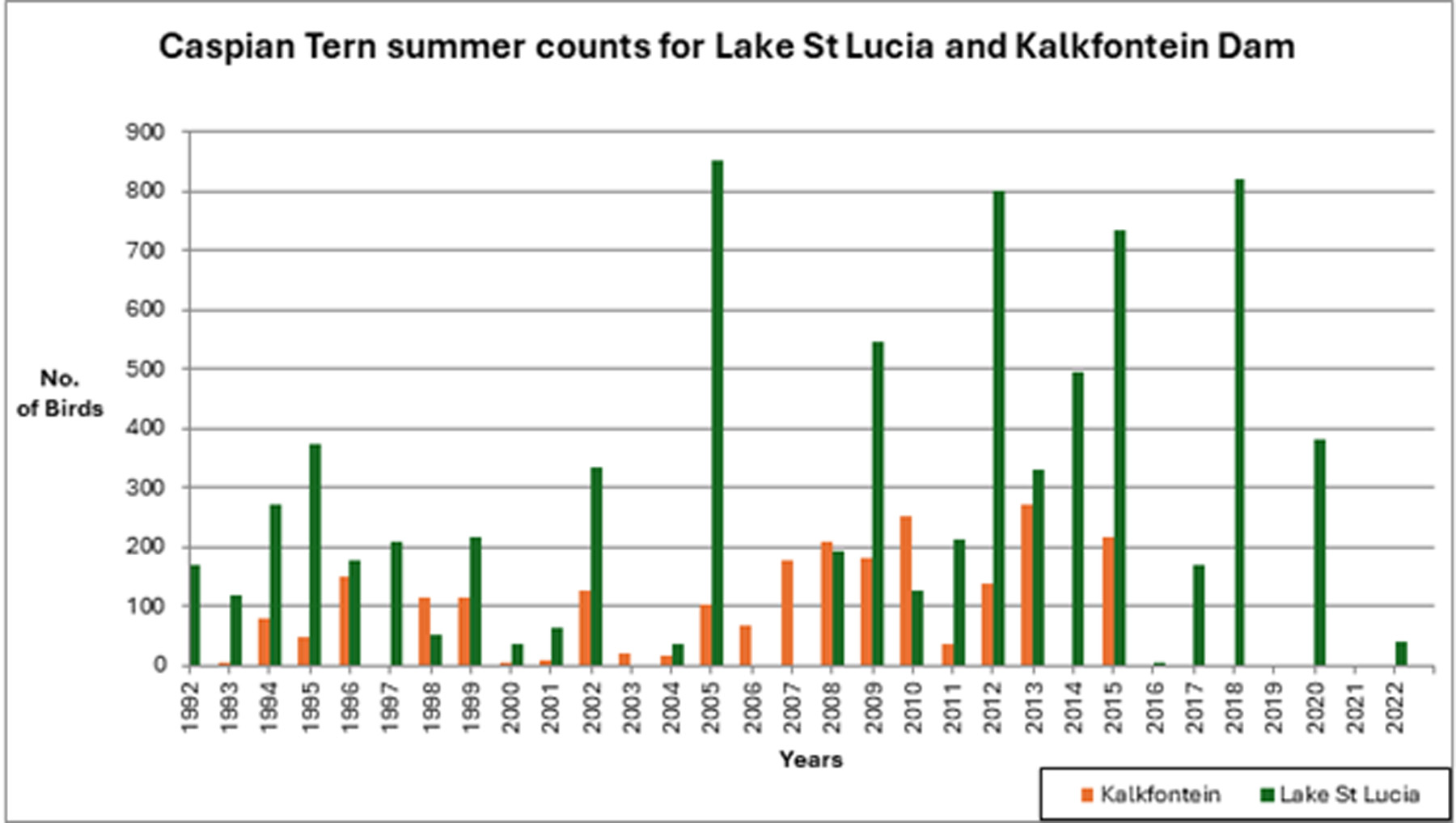
Figure 1: Summer counts of Caspian Tern at Lake St Lucia and Kalkfontein Dam Nature Reserve (the last survey for Kalkfontein was summer of 2015) illustrating variability in the number of birds between years.
The population data on which the above trends were calculated are very inconsistent, and while there is a high confidence that the population is experiencing a decline, the confidence in the magnitude of the decline is very low. It is for this reason that Criterion C, is not invoked.
Biology & Ecology
Taxonomy
The Caspian Tern has been placed in the monospecific genus Hydroprogne, based on morphological and molecular evidence (Bridge et al. 2005). Wetlands International (2024) recognises sixteen different geographical populations of this species of which four are geographically isolated. One of these is the Southern African population of Caspian Tern, which is perhaps genetically isolated (Cooper et al. 1992).
Identification
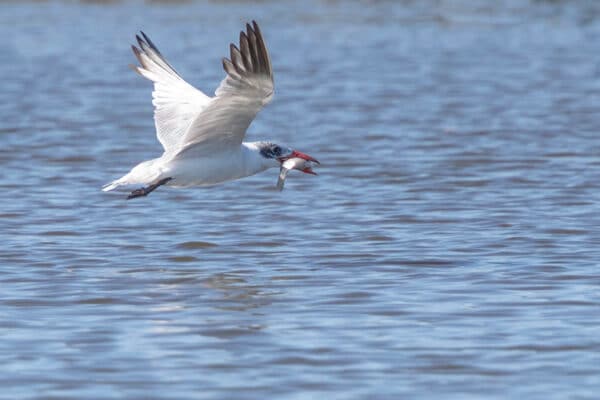
47–54 cm, c. 690 g. Sexes are alike, but females are slightly smaller. The cap is black with a pale grey nape, scapulars and back. The rump and tail are white. The underwing is white with diagnostic blackish grey outer primaries, while the upperwing is pale grey and depending on wear and moult may have a white trailing edge. Feet and legs are black, and the bill red with a pale tip and a black sub-terminal band. Non-breeding birds show white streaks on the crown. Juvenile birds have a paler more orange-toned bill, with greyish yellow to dark orange legs and a scaled pattern on the feathers of the mantle, scapulars and some wing coverts. The Caspian Tern may be confused with other larger terns (most notably the Swift Tern Thalasseus bergii but possibly with vagrant Lesser Crested Thalasseus bengalensis and Elegant Terns Thalasseus elegans) and perhaps from a distance some of the gulls (e.g. Hartlaub’s Gull Chroicocephalus hartlaubii). The Caspian Tern’s large size and bill colour differentiate this species from other terns. The juvenile Caspian Tern may be confused with Swift Tern but the species is differentiated from other young terns by the lack of a dark carpal (Tree 2005).
Distribution
The Caspian Tern occurs widely throughout the Holarctic, Australasian, Oriental and Afrotropical regions. In Southern Africa (Figure 2) the Caspian Tern is largely confined to the coastline, estuaries and to large river systems and inland water bodies (Cooper et al. 1992).
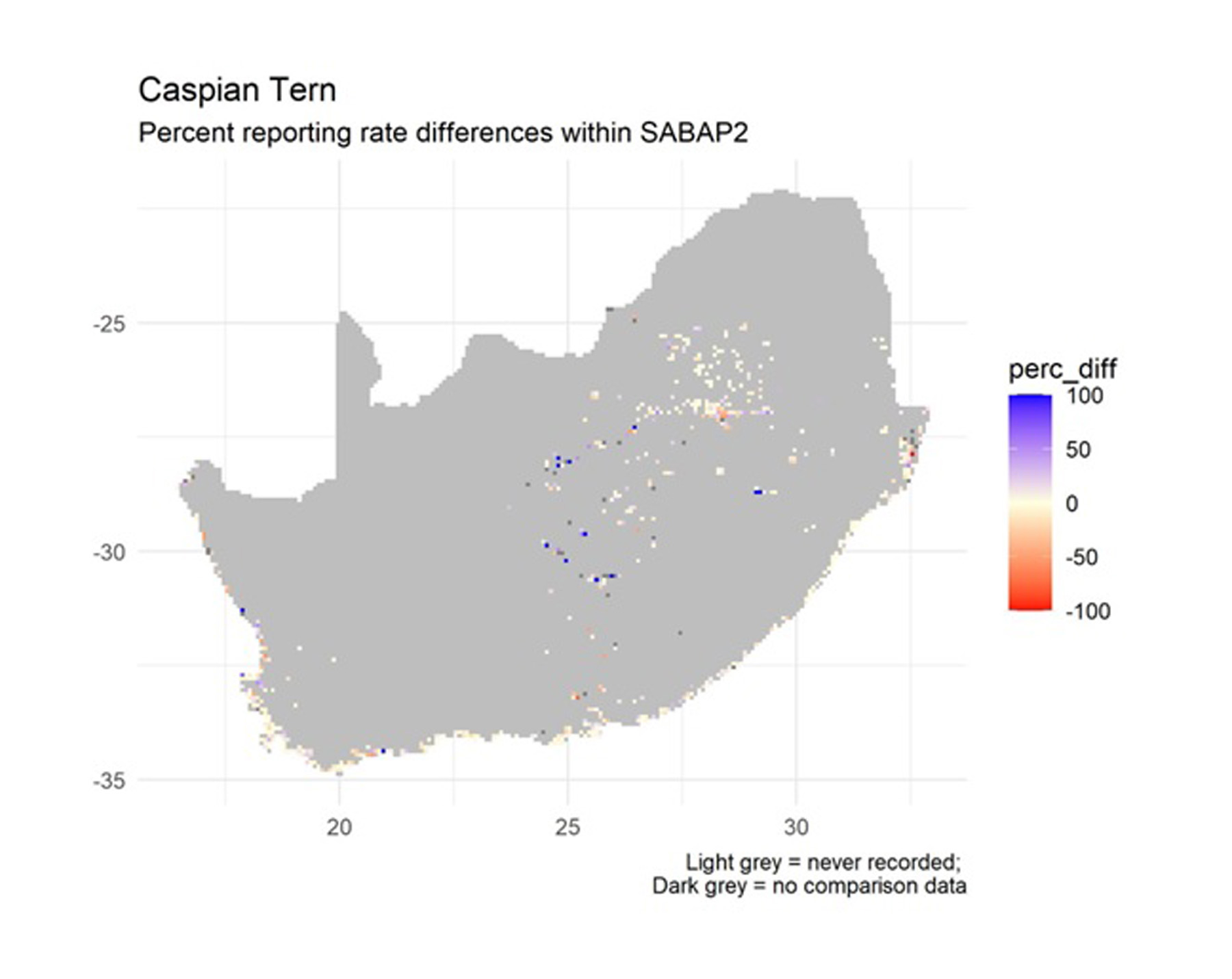
Figure 2: Distribution map of Caspian Tern also showing pentad level reporting rate change between SABAP2 periods 2007-2015 and 2016-2023 (from Lee 2024).
Ecology
Habitat:
Caspian Tern occurs mostly in sheltered bays and estuaries along the coast while inland occur both at natural and man-made waterbodies, showing preference for saline pans and large impoundments. At inland sites, it breeds on small low islets, while along the coast, primarily on offshore islands, but with increasing use of sandy beaches and islands at saltworks (Tree 2005).
Migration:
The species is resident at permanent waterbodies, but young birds may wander widely over the region (Taylor and Navarro 1999). Migrants and vagrants occur widely at inland water bodies (Crawford 1997).
Breeding:
Predominantly colonial breeders, but occasionally pairs may breed solitarily. Many breeding sites are re-used annually. Nest consists of a shallow scrape in dry mud or sand and is unlined. Clutch size is usually two eggs which are incubated for about 20–22 days by both sexes. Chicks leave the nest three days after hatching and first fly at 35–45 days (Tarboton 2001). Fledged young are partly dependent on parental feeding for up to eight months (Tree 2005).
Diet:
Caspian Tern feeds predominantly on fish 5–20 cm long, which are caught by plunge-diving into the water and swallowed head first while on the wing. Fish species consumed varies from area to area (Tree 2005). Caspian Terns are also known to scavenge on dead fish (Whitfield and Blaber 1978).
Threats & Conservation
Threats
The primary threat to the species is disturbance at breeding sites during the breeding season (Ortmann et al. 2015). Underhill (2000) considered ecotourism disturbance at breeding colonies to be a potential threat. Cooper et al. (1992) intimated that disturbance by army activity as a result of missile testing at Lake St Lucia may have contributed to breeding failure. Also, a large proportion of the breeding sites occur at artificial waterbodies, such as impoundments and saltworks, where disturbance is a common occurrence. In addition to this fluctuating water level at these artificial waterbodies due to management activities pose a risk of flooding nests or allowing predator access to nests when water levels drop too low (Underhill 2000).
Other lesser threats that may have an impact include: feral dog predation on chicks and collection of eggs (Martin and Randall 1987), bio-accumulation of heavy metals (Underhill 2000), entanglement in fishing lines or caught by fishing hooks (Cooper et al. 1992) and extreme weather events, such as heat waves, heavy rainfall and drought (du Toit et al. 2003).
Seabird colonies including some at which Caspian Terns breed, have been susceptible to outbreaks of disease such as highly pathogenic avian influenza (Khomenko et al. 2018) and avian cholera (Waller and Underhill 2007). These outbreaks have not yet impacted on the species, but the possibility thereof remains a threat.
Conservation Measures Underway
There are no conservation measures currently in place for this species. Important sites where large numbers of birds occur, e.g. Lake St Lucia (Key Biodiversity Area (KBA 100812)) and Kalkfontein Dam Nature Reserve, are, however, within protected areas and, in the case of the former, also a declared Ramsar Site. The Caspian Tern is also a listed species under the African-Eurasian Migratory Waterbird Agreement (AEWA). The southern African population is listed in Column A Category 1c (Populations, which number <10 000 individuals) (AEWA 2022).
Conservation Measures Proposed
- It is speculated that not all sites containing this species are surveyed and sites that were counted in the past are not surveyed anymore. Resuming surveys of previously surveyed sites especially important sites for this species (e.g. Vaal Dam in the Free State) and expansion of monitoring to cover all important wetlands for this species is recommended. This would provide the necessary data to enable an estimate of the regional population and a better understanding of population trends.
- Improve adoption of the 1% criterion used to recognise sites of importance for waterfowl as per the Ramsar Convention to identify key sites for Caspian Tern and implementation conservation actions benefitting the species.
- The species is susceptible to disturbance during the breeding period. Protection from and/or management of human activities needs to be investigated for, especially breeding, but also roost sites where this type of disturbance is prevalent.
- Investigation into limiting factors at existing protected breeding sites. In other parts of the world, the primary factor is the lack of suitable nest sites. The creation of artificial nest sites may increase the number of breeding pairs.
Research Priorities and Questions
- The impact of gull predation on eggs and chicks should be quantified.
- Long term data, collected regularly at important wetland sites for the species, is required to understand population trends. This is especially important at breeding sites. Reinstating CWAC counts at Lake St Lucia (KwaZulu-Natal), Kalkfontein Dam Nature Reserve (Free State) and Barberspan Nature Reserve (Northwest Province) is a priority.
- A better understanding of Caspian Tern movement within the region is required and may provide answers to population fluctuations reflected in the data at numerous sites.
- Determine the impact of the various threats on the species.
Contributors & References
Assessor/s
Kevin Shaw
Reviewer/s
Martin Taylor
References
AEWA. 2022. Agreement on the Conservation of African-Eurasian Migratory Waterbirds (AEWA) – Agreement Text and Annexes. As amended at the 8th Session of the Meeting of the Parties to AEWA. Budapest, Hungary: UNEP/AEWA Secretariat 26 – 30 September 2022.
BIRDIE. 2024. An online platform for African wetland and waterbird data. Available at https://biodiversityadvisor.sanbi.org/contentmanagement/index?guid=42305260-12b0-4a92-912e-7d801d15fdac [Accessed on 8 September 2024].
BirdLife International. 2019. Hydroprogne caspia (amended version of 2018 assessment). The IUCN Red List of Threatened Species 2019: e.T22694524A155509311. https://dx.doi.org/10.2305/IUCN.UK.2019-3.RLTS.T22694524A155509311.en. [Accessed on 15 August 2024].
Bridge ES, Jones AW, Baker AJ. 2005. A phylogenetic framework for the terns (Sternini) inferred from mtDNA sequences: implications for taxonomy and plumage evolution. Molecular and Phylogenetics Evolution 35(2): 459–469.
Cooper J, Brooke RK, Cyrus DP, Martin AP, Taylor RH, Williams AJ. 1992. Distribution, population size and conservation of the Caspian Tern Sterna caspia in southern Africa. Ostrich 63: 58–67.
Crawford AJM. 1997. Caspian Tern Hydroprogne caspia. In: Harrison. JA, Allan, DG, Underhill, LG, Herremans, M, Tree, AJ, Parker, V and Brown CJ (eds), The atlas of southern African birds. Vol1: Non-passerines. Johannesburg: BirdLife South Africa. pp 468–469.
Crawford RJM, Dyer BM, Fox C, Martin AP, Morais M, Tom DB, Upfold L, Whittington PA, Makhado AB. 2024. Numbers, trends, status, and conservation of Caspian Terns (Hydroprogne caspia) breeding coastally in southern Africa. In: Makhado AB, Amaro A, Crawford RJM, Gottlieb TR, Morais M, Mwaala DN, Nghimwatya L, Seakamela M, Tom DB, Whittington PA, Witteveen M (eds), Atlas of marine turtles, seabirds, and seals in the Benguela Current and adjacent regions. Population sizes and trends, conservation status, and Important Bird and Biodiversity Areas for breeding. Cape Town, South Africa: Benguela Current Convention and Department of Forestry, Fisheries and the Environment.
du Toit M, Boere GC, Cooper J, De Villiers MS, Kemper J, Lenten B, Peters- en SL, Simmons RE, Underhill LG, Whittington PA (eds). 2003. Conservation assessment and management plan for Southern African coastal seabirds. Cape Town, South Africa and Apple Valley, United States of America: Avian Demography Unit and Conservation Breeding Specialist Group.
Khomenko S, Abolnik C, Roberts L, Waller L, Shaw K, Monne I, Taylor J, Hangar M, Pittiglio C, Mugyeom M, Roche X, Fredrick K, Kamata A, Okuthe S, Kone P, Wiersma L, Von Dobschuetz S, Soumare B, Makonnen Y, Morzaria S, Lubroth J. 2018. 2016–2018 spread of H5N8 highly pathogenic avian influenza (HPAI) in sub-Saharan Africa: epidemiological and ecological observations. FOCUS ON 2. Rome.
Lee ATK. 2024. Regional Red Data Book of the Birds of South Africa, Lesotho and Eswatini: SABAP2 synthesis and supporting information and graphics for Caspian Tern. Unpublished report. Johannesburg: BirdLife South Africa.
Martin AP, Randall RM. 1987. Numbers of waterbirds at a commercial salt- pan, and suggestions for management. South African Journal of Wildlife Research 17: 75–81.
Nagy S, Langendoen T. 2020. Flyway trend analyses based on data from the African-Eurasian Waterbird Census from the period of 1967-2018. Online publication. Wageningen, The Netherlands: Wetlands International.
Ortmann HE, Hagen CT, Peacock F. 2015. Caspian Tern Hydroprogne caspia. In: Taylor MR, Peacock F, Wanless RW (eds), The Eskom Red Data Book of Birds of South Africa Lesotho and Swaziland. Johannesburg, South Africa: BirdLife South Africa. pp 269–271.
Tarboton W. 2001. A guide to the nests & eggs of southern African birds. Cape Town: Struik Publishers (Pty) Ltd.
Taylor PB, Navarro RA. 1999. Caspian Tern Hydroprogne caspia. In: Taylor PB, Navarro RA, Wren-Sargent M, Harrison JA, Kieswater SL (eds), Total CWAC Report: Coordinated Waterbird Counts in South Africa, 1992-1997. Cape Town: Avian Demography Unit.
Tree AJ. 2005. Caspian Tern Sterna caspia (Hydroprogne caspia). In: Hockey PAR, Dean WRJ, Ryan PG (eds), Roberts Birds of Southern Africa (7th Edn). Cape Town: John Voelcker Bird Book Fund. pp 450–451.
Underhill LG. 2000. Caspian Tern Hydroprogne caspia. In: Barnes KN (ed), The Eskom Red Data Book of Birds of South Africa, Lesotho and Swaziland. Johannesburg, South Africa: BirdLife South Africa. pp. 144–145.
Waller LJ, Underhill LG. 2007. Management of avian cholera Pasteurella multocida outbreaks on Dyer Island, South Africa, 2002–2005. African Journal of Marine Science 29: 105–111.
Wetlands International. 2024. Waterbirds Populations Portal https://wpp.wetlands.org/ on [Accessed on16 August 2024].
Whitfield AK, Blaber SJM. 1978. Feeding ecology of piscivorous birds at Lake St Lucia, Part 1: Diving Birds. Ostrich 49(4): 185–198.
Citation
Shaw K 2025. Caspian Tern. In: Lee ATK, Rose S, Banda S, Bezeng SB, Maphalala MI, Maphisa DH, Smit-Robinson H (eds), The 2025 Red Data Book of Birds of South Africa, Lesotho and Eswatini. Johannesburg, South Africa: BirdLife South Africa. Available at: https://www.birdlife.org.za/red-list/caspian-tern/
Our generous sponsors


