


Cape Shoveler
Spatula smithii

Number Of Mature
Individuals (Regional)
8 400 – 21 351

Regional
Population Trend
Decreasing
2025
Regional Category
Near Threatened
Search by species
CONTENTSOverview
Names
|
IOC English Name: |
Cape Shoveler |
|
SA & IOC Scientific Name: |
Spatula smithii |
|
BirdLife International Taxonomy (scientific name): |
Spatula smithii |
|
Order: |
ANSERIFORMES |
|
Family: |
Anatidae |
|
Species name author: |
Hartert EJO 1891 |
|
Afrikaans: |
Slopeend |
|
Sesotho (South Africa): |
Letatakgaba la Borwa |
|
Sesotho (Lesotho): |
|
|
Siswati: |
|
|
Zulu: |
unofoshol |
Current Assessment Status
|
2025 Regional Category [Criteria] |
NTo [A2bc] |
|
2024 Global Category [Criteria] |
LC (BirdLife International 2016) |
|
Population size (Regional) |
8 400 – 21 351 |
|
Population size (Global) |
13 000 – 33 000 (BirdLife International 2024) |
|
Distribution size (EOO) (Regional) km2 |
1 260 729 (Lee 2024) |
|
Distribution size (EOO) (Global) km2 |
3 380 000 (BirdLife International 2024) |
|
Distribution size (AOO) (Regional) km2 |
372 035 (198 912 – 493 173 km2 (BIRDIE 2024)) |
|
Generation time |
6.6 years (BirdLife International 2024) |
|
Status change reason |
Genuine Change in Status |
|
Migrant (in the region) |
No |
|
Regional endemic |
No |
Historic Listing Information
|
2000 Regional Status |
LC |
|
2015 Regional Status |
LC |
|
Status change reason (if applicable) |
Not Applicable |
|
2015 Population size (Regional) |
Unknown |
|
2015 Global Status |
LC |
Reason for Inclusion
Reason for Inclusion in the Assessment
Previously presumed to be Least Concern, preliminary screening of Coordinated Waterbird Counts (CWAC) data indicated a significant decline in the number of Cape Shoveler Spatula smithii counted per year (Lee 2024).
Category Justification
Category Justification
The Cape Shoveler’s regional extent of occurrence and area of occupancy do not meet the thresholds for listing as Vulnerable under the IUCN range size criterion. Although the total population size in the region is not precisely known, it is likely to exceed 10 000 mature individuals, which is above the threshold for Vulnerable under Criterion C.
Nonetheless, both dynamic and static models predict a decline in area of occupancy of 15.6% and 21.4% respectively, while analysis of CWAC count data indicates a 37% decline, which meets the threshold for Vulnerable based on population trends. If such declines are valid, there is a possibility of recolonisation from populations in neighbouring countries, making Near Threatened (NT) by Criterion A the most appropriate listing. Despite uncertainties surrounding these data, the consensus of three different models showing declines is concerning, and the Cape Shoveler is therefore assessed as Near Threatened [A2bc].
Population Justification
BirdLife International (2024) estimates the global population of Cape Shoveler at 13 000 – 33 000 mature individuals, lower than the estimates provided by Wetlands International (2024) but who do claim low confidence in their values. Given that 64.7% of the modelled global range lies within the region (Lee 2024), the regional population can be inferred at approximately 8 400 – 21 351 mature individuals. Confidence in these figures remains low, as they are based on limited and outdated data.
Historically, Siegfried (1965) postulated that the South African population would not exceed 20 000 birds. The species is most abundant on the Highveld and in the Western Cape (Taylor et al. 1999), with an estimated 4000 – 10 000 birds on the Highveld alone (Tarboton et al. 1987). Earlier CWAC surveys of 145 wetlands over 15 years recorded 3 314 individuals, but this was likely a severe underestimate given the limited number of surveyed sites. More recent CWAC data (2007–present) from 6 514 survey counts indicates a mean sum of 8125 individuals and a maximum sum of 25 384 across the surveyed wetlands. These updated figures suggest that the regional population exceeds 10 000 mature individuals—above the threshold for listing as Vulnerable under the population size criterion.
Trend Justification
Four analytical approaches, using data from the second South African Bird Atlas Project (SABAP2) and the CWAC, were used to assess population trends in Cape Shoveler. The first approach involved using logistic regression to estimate the probability of reporting Cape Shoveler on each bird list (or “card”) within its range between 2007 and 2023 (Brooks et al. 2022). This analysis accounted for potential sources of variation such as season, BirdLasser effects, completeness of habitat coverage, and sampling hours, with pentad or observer included as random effects (Lee 2024). It detected a statistically significant increase in the probability of reporting Cape Shoveler. However, this trend could reflect changes in dispersal rather than a genuine overall increase in population size, as has been noted for some waterbird species which have dispersed from breeding regions due to deteriorating conditions.
The second approach used both static and dynamic models derived from SABAP2 presence-absence data, split into two periods (2007–2014 and 2015–2023). The static models predicted a 21.4% reduction in the area of occupancy for the latter period (Lee 2024). A dynamic analysis that included available habitat data per year from 2008 to 2022 (BIRDIE 2024) showed a 15.6% decline in the AOO.
The third approach analysed CWAC data from 145 wetlands using state-space models. These models, which estimate true population size by correcting for observation error, indicated a 9.7% decline over a 20-year period (BIRDIE 2024). A fourth analysis employed the poptrend package (Knape 2016) on CWAC data from 2003 to 2023, yielding an estimated population decline of -37% (range -50% to -23%) over three generations.
Overall, while the logistic regression analysis of SABAP2 data suggested an increase in the probability of reporting (which could be linked to dispersal), the other three analyses documented population declines or reductions in area of occupancy. Cape Shoveler has its largest population within South Africa (Colahan 2005), yet global assessments by IUCN (2024), BirdLife International (2024), and Wetlands International (2024) show increasing trends. This discrepancy may be due to localised declines that are not apparent at a global scale. The CWAC-based declines, for instance, reflect data from a limited number of wetlands and might not be fully representative of the species’ use of habitats, while dynamic modelling results varied substantially from year to year. In addition, atlas coverage in the more arid regions of the Northern Cape and Northwest Province is sparse, and the species naturally occurs at lower densities in these areas, possibly inflating predicted declines. Even so, raw atlas data still show an overall 17% decrease in the number or area of pentads occupied over time. Despite the acknowledged uncertainties, three of the four analyses indicate declines, with one meeting the threshold for Vulnerable status under the applicable population criteria.
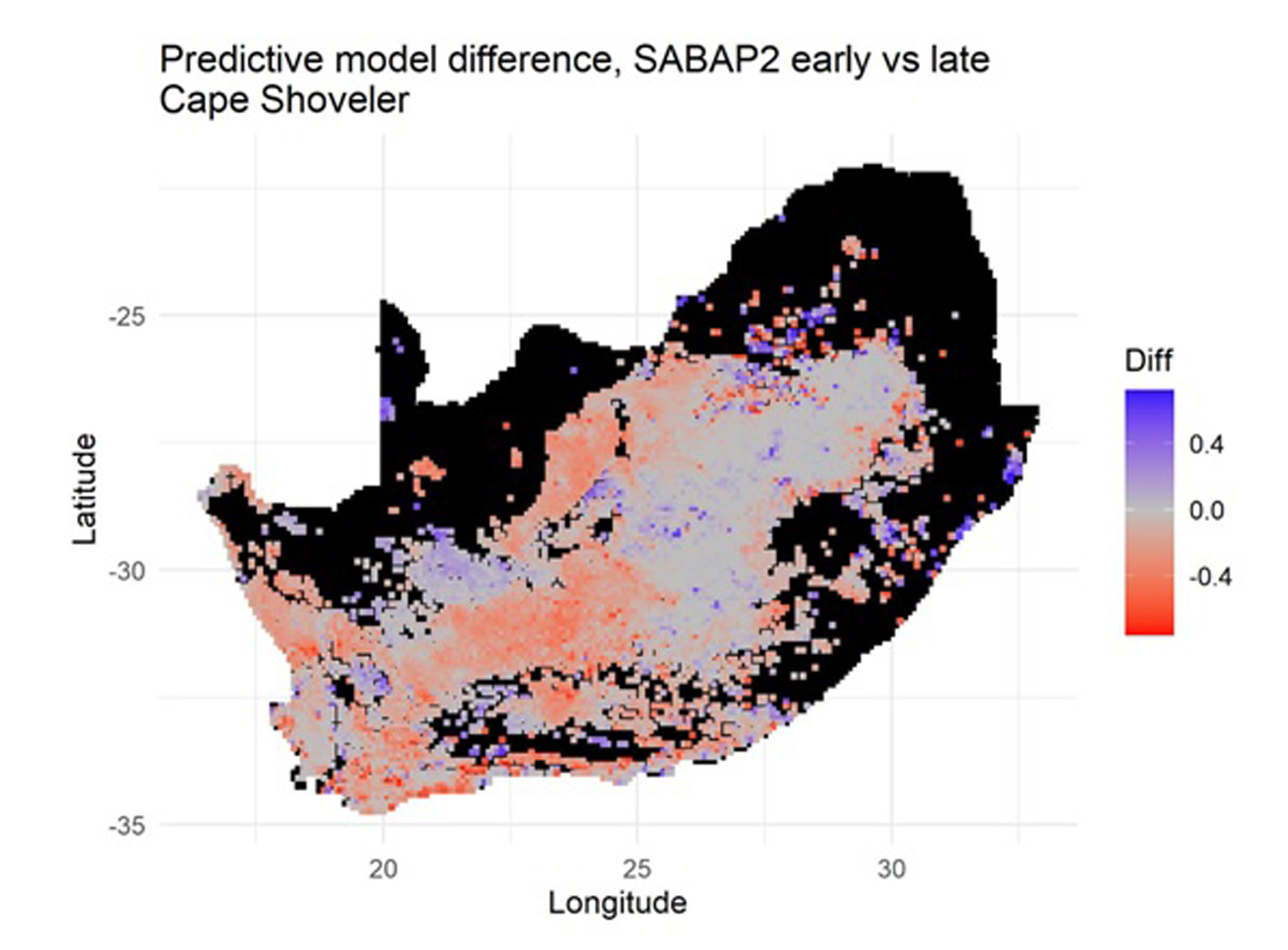
Figure 1: Predictive occurrence model results comparing data from 2007-2015 and 2016-2023. Red indicates a lower predicted probability of recording for the latter period while Blue indicates a higher predicted probability of recording Cape Shoveler (from Lee 2024).
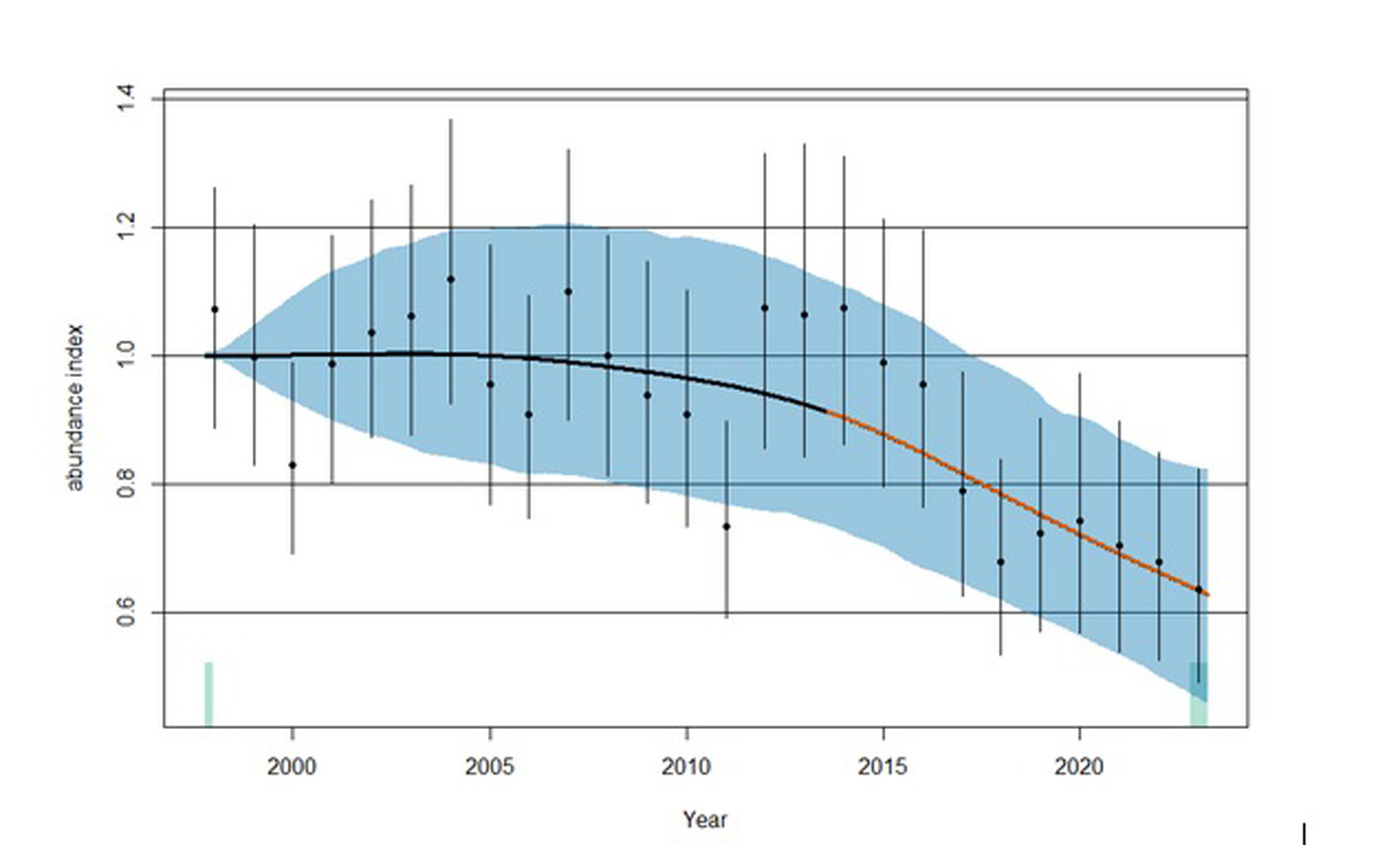
Figure 2. Figures of poptrend plots (GAM models, Knape 2016) for Cape Shoveler. Red indicates periods of significant decline. The pattern is similar using data with >200 counts filtered out.
Biology & Ecology
Taxonomy
Monotypic.
Identification
Cape Shoveler reaches a length of about 53 cm (Colahan 2005) and shows clear sexual dimorphism in plumage coloration (Siegfried 1965). Females are paler than males, with a dark grey bill, brownish eyes, and brownish olive legs and feet (Colahan 2005). In contrast, males have a larger, more colourful speculum, a black bill, pale yellow eyes, and yellow legs and feet (Colahan 2005). During breeding, the male’s eyes become a darker yellow, and the legs and feet turn orange (Clancey 1967, Bell 1996, Colahan 2005). Males also have a paler head and neck compared to the rest of the body, whereas females are more uniformly coloured (Siegfried 1965).
Confusing species include the female Northern Shoveler Anas clypeata, which is similar in appearance. However, Cape Shoveler tends to be darker and less rufous (Colahan. 2005) and has a smaller, uniformly dark bill, unlike Northern Shoveler’s bill with yellow-brown to orange edges (Colahan. 2005). In addition, Cape Shoveler’s tail feathers are brown and lack the white edges that appear on a swimming Northern Shoveler (Madge and Burn 1988).
Hybrids have been reported with Red-billed Teal Anas erythrorhyncha (Vanherck 1991) and Mallard Anas platyrhynchos (Marchant and Roberts 2002).
Distribution
The species occurs virtually entirely within southern Africa, extending marginally into southern Angola (Scott and Rose 1996, Dean 2000). Irregular visitor to Mozambique (Parker 1999), patchy in Namibia and Botswana (Ryan et al. 1984, Penry 1994, Maclean 1997). Irregular and scarce in Zimbabwe (Irwin 1981, Maclean 1997). South Africa has the largest population, most abundant in the lowlands of the Western Cape Province, but also in the Free State Highveld, Gauteng, North West Province and Mpumalanga (Colahan 2005). Also found scattered along the coastal belt of KwaZulu-Natal, the Eastern Cape and along the west coast through to southern Nama Karoo (Maclean 1997). Occasional visitor to the Lesotho lowlands and uncommon visitor to Eswatini (Bonde 1993, Parker 1994) (Figure 3).
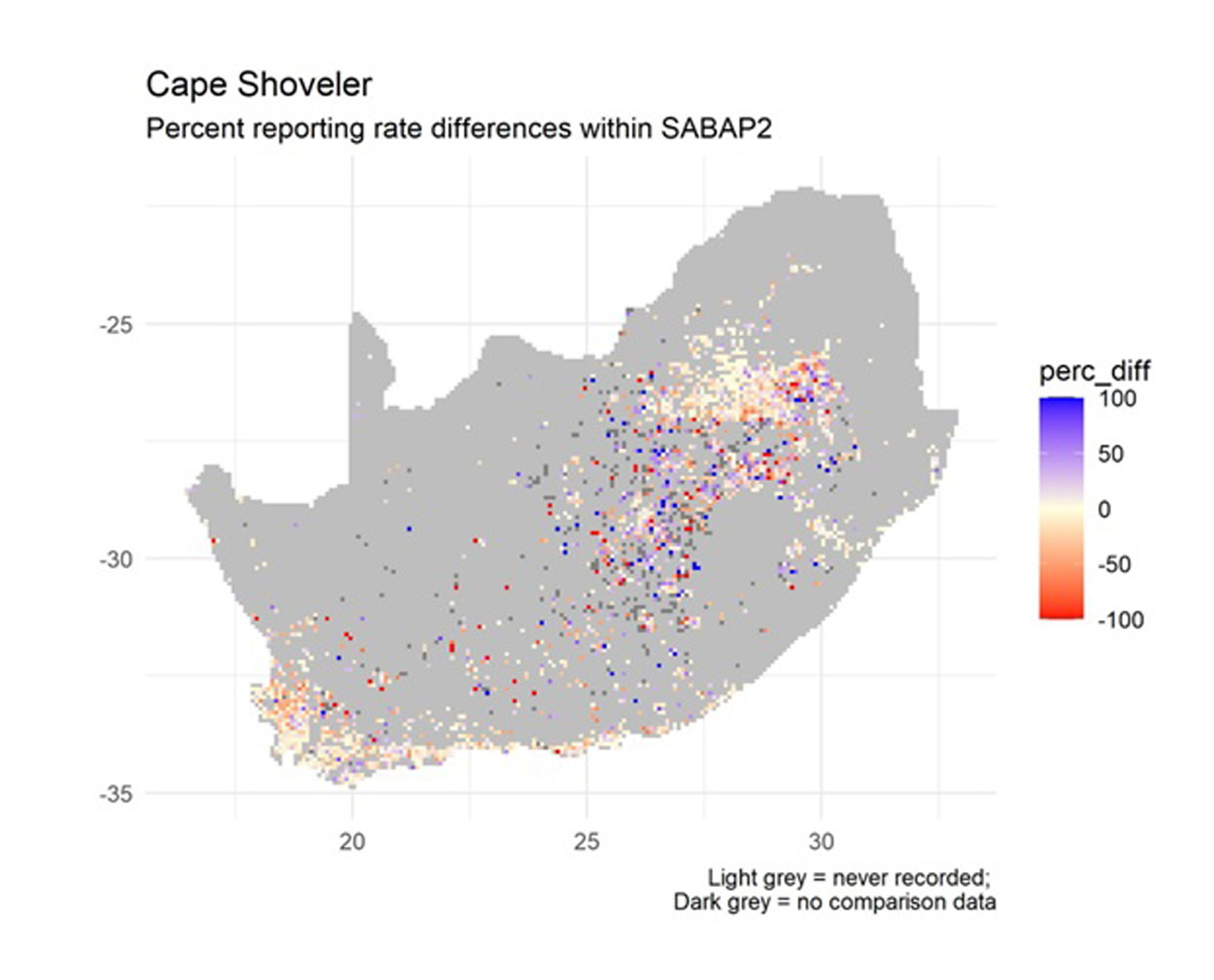
Figure 3: Distribution map of Cape Shoveler also showing pentad level change between SABAP2 periods 2007-2015 and 2016-2023 as percentage difference (from Lee 2024).
Ecology
Cape Shoveler prefers shallow, plankton-rich wetlands and dams, but it also occurs on tidal estuaries, saltpans, saline lagoons, and in the shallow bays and upper reaches of large dams (Siegfried 1965, Geldenhuys 1976, Tarboton et al. 1987). Food availability is likely the principal factor determining choice of breeding habitat (Siegfried 1965). In the Free State, the species shows a preference for pans covered with Swamp Grass (Geldenhuys 1982, Colahan 2005).
Movements of Cape Shoveler are not well understood. Siegfried (1965) described them as partly migratory, partly nomadic, and partly “local restlessness,” the latter referring to short-distance, often regular movements.
Breeding occurs throughout the year, with timing varying among South African provinces. The nest is built by the female close to water (Brown et al. 1982), consisting of a shallow scrape in the ground lined with grass and down (Siegfried 1965). Incubation, undertaken by the female alone, starts once the last egg is laid and lasts 27–31 days (Brand 1961; Pocock 1973, Siegfried 1965). Clutch size usually ranges from 5 to 12 eggs (Brown et al. 1982), and the female cares for the young for about eight weeks until they fledge (Tarboton 2001).
Cape Shoveler typically raises a single brood per breeding season (Siegfried 1965). Clutch sizes remain consistent during incubation, and 92% of eggs surviving this period hatch successfully (Colahan 2005). From a sample of 91 nests, 49.4% fledged at least one young (Colahan 2005). Mean brood size at hatching is 8.6 chicks, decreasing to 7.6 by one week (88% survival) and 6.6 by seven weeks (87% survival from weeks one to seven) (Brand 1961). Overall, the mean loss is 3.6 young per brood in the first seven weeks, with the highest mortality occurring during the initial three weeks (Siegfried 1965).
Cape Shoveler feeds primarily on insects, crustaceans, molluscs, tadpoles, and planktonic invertebrates. It seldom eats water plants and seeds (Colahan 2005).
Threats & Conservation
Threats
Potential threats include the reduction of suitable habitat (BirdLife International 2024), although Siegfried (1965) noted an increase in numbers due to artificial impoundments within its distribution range. Disturbance during moult periods and hybridisation with invasive Mallards Anas platyrhynchos (Colahan 2005) also pose risks. The species, like many waterfowl, is susceptible to avian botulism (K. Shaw pers obs), which may become problematic if outbreaks increase in frequency or severity. It is hunted, and while this is currently controlled and not considered a major threat, it could become one if not managed sustainably (Little et al. 1995).
Conservation Measures Underway
In those provinces where Cape Shoveler is allowed to be hunted, stipulated hunting seasons and bag limits are set as per the hunting regulations. Certain important waterbodies that contain at least 1% of the regional population (e.g. False Bay Nature Reserve, De Hoop Nature Reserve, Rocherpan Nature Reserve and Wilderness National Park) occur within protected areas. Other important wetlands that also hold more than 1% of the regional population are proclaimed Ramsar sites (e.g. Bot River and Orange River Mouth).
Conservation Measures Proposed
- Hunting regulations will require deliberation, taking into account the difference in population size between provinces and probably different breeding seasons as well as probable decline in numbers.
- It is speculated that not all sites containing this species are surveyed and possibly some sites that were counted in the past are not surveyed anymore. Resuming surveys of previously surveyed sites and expansion of monitoring to cover all important wetlands for this species is recommended enabling a more thorough investigation into population trends.
- Improve adoption of the 1% criterion (sites that regularly contain more than 1% of the global population) to identify key sites for conservation action.
Research Priorities and Questions
- Movement patterns within the southern African region and how this can improve the conservation of the species.
- Determine the cause/s for the decline in both population numbers and area of occupancy.
- Determine the size of the regional population.
Contributors & References
Assessor/s
Kevin Shaw, Maria Paul
Reviewer/s
Dave Whitelaw, Sanjo Rose
References
Bell CGV. 1996. Seasonal dimorphism, inter- and intraspecific recognition in Southern African waterfowl. Honeyguide 42: 137–145.
BIRDIE. 2024. An online platform for African wetland and waterbird data. Available at https://biodiversityadvisor.sanbi.org/contentmanagement/index?guid=42305260-12b0-4a92-912e-7d801d15fdac [Accessed on 8 September 2024].
BirdLife International. 2024. Species factsheet: Spatula smithii. Available at https://datazone.birdlife.org/species/factsheet/cape-shoveler-spatula-smithii [Accessed on 23 April 2024].
Bonde K. 1993. Birds of Lesotho: A Guide to Distribution Past and Present. Pietermaritzburg: University of Natal Press.
Brand DJ. 1961. A comparative study of the Cape Teal (Anas capensis) and the Cape Shoveler (Spatula smithii), with special reference to breeding biology, development, and food requirements. Unpublished PhD thesis. Pretoria: University of South Africa.
Brown LH, Urban EK, Newman K. 1982. The Birds of Africa, vol. 1. London: Academic Press.
Brooks M, Rose S, Altwegg R, Lee ATK, Nel H, Ottosson U, Retief E, Reynolds C, Ryan PG, Shema S, Tende T, Underhill LG, Thomson RL. 2022. The African Bird Atlas Project: a description of the project and BirdMap data-collection protocol. Ostrich 93(4): 223–232. https://doi.org/10.2989/00306525.2022.2125097.
Clancey PA. 1967. Gamebirds of Southern Africa. Cape Town: Purnell.
Colahan BD. 2005. Cape Shoveler Anas smithii. In: Hockey PAR, Dean WRJ, Ryan PG (eds), Roberts birds of southern Africa (7th Edn). Cape Town: Trustees of the John Voelcker Bird Book Fund.
Coordinated Waterbird Counts. 2024. Cape Shoveler (Spatula smithii) species summary. Available at https://cwac.birdmap.africa/species.php?spp=94 [Accessed on 26 April 2024].
Dean WRJ. 2000. The Birds of Angola: An Annotated Check-list. BOU Check-list No. 18. Tring: British Ornithologists’ Union.
Geldenhuys JN. 1976. Relative abundance of waterfowl in the Orange Free State. Ostrich 47: 27–54.
Geldenhuys JN. 1982. Classification of the pans of the western Orange Free State according to vegetation structure, with reference to avifaunal communities. South African Journal of Wildlife Research 12: 55–62.
IUCN. 2024. Cape Shoveler Spatula smithii. The IUCN Red List of Threatened Species. Version 2023-1. Available at https://www.iucnredlist.org [Accessed on 26 April 2024].
Irwin MPS. 1981. The Birds of Zimbabwe. Salisbury: Quest Publishing.
Knape J. 2016. Decomposing trends in Swedish bird populations using generalized additive mixed models. Journal of Applied Ecology 53: 1852–1861.
Lee ATK. 2024. Regional Red Data Book of the Birds of South Africa, Lesotho and Eswatini: SABAP2 synthesis and supporting information and graphics for Cape Shoveler. Unpublished report. Johannesburg: BirdLife South Africa.
Little RM, Vester KC, Crowe TM. 1995. Temporal and spatial patterns of breeding activity of 12 duck species (Anatidae) in the Cape provinces, South Africa, and their implications for hunting seasons. South African Journal of Wildlife Research 25(1): 17–22.
Maclean GL. 1997. Cape Shoveler. In: Harrison JA, Allan DG, Underhill LG, Herremans M, Tree AJ, Parker V, Brown CJ (eds), The Atlas of Southern African Birds, vol. 1. Johannesburg: BirdLife South Africa. pp 136–137.
Madge S, Burn H. 1988. Wildfowl: An Identification Guide to the Ducks, Geese and Swans of the World. London: Christopher Helm.
Marchant A, Roberts T. 2002. Mallard Duck – a serious threat. KZN Birds 2: 23–24.
Parker V. 1994. Swaziland Bird Atlas 1985–1991. Mbabane: Websters.
Parker V. 1999. The Atlas of the Birds of Sul do Save, Southern Mozambique. Cape Town & Johannesburg: Avian Demography Unit & Endangered Wildlife Trust.
Penry H. 1994. Bird Atlas of Botswana. Pietermaritzburg: University of Natal Press.
Pocock TN. 1973. Notes on some abnormal ducks. Ostrich 44: 263–265.
Ryan PG, Cooper J, Stutterheim CJ, Loutit R. 1984. An annotated list of the birds of Skeleton Coast Park. Madoqua 14(1): 79–90.
Scott DA, Rose PM. 1996. Atlas of Anatidae Populations in Africa and Western Eurasia. Wageningen: Wetlands International (Publication No. 41).
Siegfried WR. 1965. The Cape Shoveler Anas smithii (Hartert) in southern Africa. Ostrich 36(4): 155–198.
Tarboton WR, Kemp MI, Kemp AC. 1987. Birds of the Transvaal. Pretoria: Transvaal Museum.
Taylor PB, Navarro RA, Wren-Sargent M, Harrison JA, Kieswater SL. 1999. Total CWAC Report: Coordinated Waterbird Counts in South Africa, 1992–1997. Cape Town: Avian Demography Unit.
Underhill LG, Tree AJ, Oschadleus HD, Parker V. 1999. Review of Ring Recoveries of Waterbirds in Southern Africa. Cape Town: Avian Demography Unit, University of Cape Town.
Vanherck LRJ. 1991. Apparent Cape Shoveler × Red-billed Teal hybrids at Paarl. Ostrich 62: 79.
Wetlands International. 2024. Waterbird Census from the period of 1967–2018. https://iwc.wetlands.org/index.php/aewatrends8
Citation
Shaw K, Paul M 2025. Cape Shoveler. In: Lee ATK, Rose S, Banda S, Bezeng SB, Maphalala MI, Maphisa DH, Smit-Robinson H (eds), The 2025 Red Data Book of Birds of South Africa, Lesotho and Eswatini. Johannesburg, South Africa: BirdLife South Africa. Available at: https://www.birdlife.org.za/red-list/cape-shoveler/
Our generous sponsors


