


Cape Parrot
Poicephalus robustus

Number Of Mature
Individuals (Regional)
1483

Regional
Population Trend
Decreasing
2025
Regional Category
Vulnerable
Search by species
CONTENTSOverview
Names
|
IOC English Name: |
Cape Parrot |
|
SA & IOC Scientific Name: |
Poicephalus robustus |
|
BirdLife International Taxonomy (scientific name): |
Poicephalus robustus |
|
Order: |
PSITTACIFORMES |
|
Family: |
Psittacidae |
|
Species name author: |
Gmelin 1788 |
|
Afrikaans: |
Woudpapagaai |
|
Sesotho (South Africa): |
Heka ya moru |
|
Sesotho (Lesotho): |
|
|
Siswati: |
|
|
Zulu: |
isiKwenene |
Current Assessment Status
|
2025 Regional Category [Criteria] |
VU [C2a(i)] |
|
2024 Global Category [Criteria] |
VU [D1] (BirdLife International 2021) |
|
Population size (Regional) |
730 – 1200 (BirdLife International 2021), 1483 (Downs and Singh 2023) |
|
Population size (Global) |
730 – 1200 (BirdLife International 2021), 1483 (Downs and Singh 2023) |
|
Distribution size (EOO) (Regional) km2 |
270 000 (BirdLife International 2021) 225 528 (Lee 2024) |
|
Distribution size (EOO) (Global) km2 |
270 000 (BirdLife International 2021) 225 528 (Lee 2024) |
|
Distribution size (AOO) (Regional) km2 |
1215 (Leaver et al. In prep) |
|
Generation time |
12.12 years (BirdLife International 2021) |
|
Status change reason |
Improved Knowledge |
|
Migrant (in the region) |
No |
|
Regional endemic |
Yes |
Historic Listing Information
|
2000 Regional Status |
EN [A1a+2bc; B1+2c; C2a] |
|
2015 Regional Status |
EN [C1] |
|
Status change reason (if applicable) |
No Change |
|
2015 Population size (Regional) |
1250 mature individuals |
|
2015 Global Status |
Not recognised |
Reason for Inclusion
Reason for Inclusion in the Assessment
Cape Parrot Poicephalus robustus is endemic to the region. Although considered conspecific with the Grey-headed or Brown-necked Parrot P. fuscicollis at the time, Birdlife South Africa recommended the inclusion of the Cape Parrot as a separate species in the 2015 assessment (Downs 2015), following the precautionary principle. In 2017, the Cape Parrot was classified as a distinct species by BirdLife International, in its capacity as the IUCN Red List authority for birds, and the species was then listed as Vulnerable (BirdLife International 2021).
Category Justification
Category Justification
The population of the Cape Parrot satisfies the criterion for regionally Vulnerable (VU) based on a small, fragmented population of c. 1500 mature individuals, with inferred future declines. There are fewer than 1000 mature individuals in each subpopulation. Although the population and range for this species are small, the thresholds for Criteria D and B are not met.
While census data for this endemic species tentatively indicates that the regional population is stable or even increasing, this species faces numerous threats related to poaching, habitat loss and disease which could meet the 10% thresholds for Criterion C over the next three generations. Furthermore, this species occupies remote mountain areas where accurate monitoring of the breeding population is challenging. While its regional Endangered status is no longer supported, an assessment outcome of Vulnerable considers the risk of future threats.
This species warrants continuous monitoring.
Population Justification
The global assessment estimated the population at 730 – 1200 mature individuals (BirdLife International 2021).
The largest citizen science project on Cape Parrots provided an updated estimate of 1952 individuals (Downs and Singh 2023). This citizen science project, an annual census initiated in 1998, is known as the Cape Parrot Big Birding Day (CPBBD), which takes place across the species distribution range over a single weekend. The Amathole region in the southern Eastern Cape and the southern areas of KwaZulu-Natal hold the largest portion of the population, namely 751 birds and 987 birds, respectively (Downs and Singh 2023). However, flocks of up to 600 parrots have been observed in a single sighting at an exotic pecan orchard Carya illinoinensis in the Amathole region (Cape Parrot Project, (CPP) unpubl data).
Regular monthly monitoring of forests around the town of Hogsback by CPP indicates an average population of 120 Cape Parrots in this area (CPP unpubl data). The former Transkei in the northern Eastern Cape and Limpopo are estimated to each hold around 100 birds (Downs and Singh 2023). However, regular monitoring of Cape Parrots in Limpopo indicates larger flocks of parrots than previously estimated (up to 250 parrots) visit pecan orchards in the Magoebaskloof region (CPP, unpubl data).
Recent findings in the Amathole region indicate the adult proportion of the southern population is estimated to be on average 76% of the population, with an average age ratio of 3.1:1 adults per juvenile (Padfield et al. 2024). Extrapolating from the Amathole population, the number of mature adults in the national population is estimated at 1483, which is slightly higher than previously estimated (1250, Downs 2015). It is not known whether this represents a population increase, or a possible overestimation due to the large age ratio.
Further research by Padfield et al (2024), indicates that the Amathole population exhibits a sex ratio of 1.2 males per female.
The Eastern Cape and KwaZulu-Natal parrot populations remain genetically connected, whilst the sub-population of Limpopo remains genetically isolated from the southern KwaZulu-Natal populations over a distance of c. 600 km (Coetzer et al. 2020). The genetic isolation of the population is largely attributed to anthropogenic influences occurring in the last century (Coetzer et al. 2020).
Genetic analyses of Cape Parrots indicate three possible sub-populations within the Cape Parrot’s national distribution (Coetzer et al. 2020). However, the delineation of each subpopulation warrants further understanding and possible different conservation efforts (Coetzer et al. 2020). There also appears to be differences in dialect between these populations (Young et al. In prep), such that differences need to be explored further.
Trend Justification
The global assessment considered the species to be stable (BirdLife International 2021). In 2015, an analysis of 15 years of annual census data suggested that the population was stable, with an estimate showing an average of 1203 individuals, (Downs et al. 2014). The current population is estimated at 1952 individuals (Downs and Singh 2023), the highest estimate to date. Whether this increase is attributable to increased sampling effort or represent an actual population increase is not known (Downs et al. 2014). Localised declines in numbers have been observed at some sites (Downs and Singh 2023).
Large fluctuations in numbers have been noted in the Amathole region, where at a pecan orchard the numbers ranged from a maximum of 589 individuals on a single day in 2017 but as few as 189 in 2018 (Padfield et al. 2024). Further, extreme changes in the proportion of juvenile birds at the orchard (estimated to be 70% of the population in 2019 to <4% in 2020) have been noted, yet these reasons remain unknown. Little is known about their breeding success, with 58% a cautious estimate from the Amathole region (Carstens et al. 2022).
This species faces numerous threats, all of which have the capacity to decimate local populations. The impact of climate change and reduced food availability may have significant impacts, particularly in increasing the prevalence of Psittacine Beak and Feather Disease (PBFD) (Downs 2015). The effect of the disease on fledgling success is unknown. Projected decline of Cape Parrot numbers due to continued habitat degradation and deforestation of indigenous forests, most of which have little limited protection, will have a negative effect on nest site and food availability, given the species specialisation on this habitat (Lawes et al. 2004, Shackleton 2009, Leaver et al. 2019, Carstens et al. 2022). Illegal trade is also a concern, particularly the removal of adult birds from wild populations (Carstens et al. 2023), as the species can take up to four years to mature (Wirminghaus et al. 2001b). These negative factors may vary in intensity across the distribution range and affect the persistence of sub-populations to varying degrees. Given the variety and complexity of threats this species faces, along with challenges in accurate monitoring in remote mountains, this species is still considered to be in decline in parts of its range.
Biology & Ecology
Taxonomy
The Cape Parrot was previously treated as conspecific with the Grey-headed or Brown-necked Parrot P. fuscicollis (Clancey 1997, Wirminghaus et al. 2002a). However, morphological, biogeographical and ecological differences between these species indicated that the Cape Parrot should be treated as a distinct species (Clancey 1997, Wirminghaus et al. 2002a, Perrin 2005), and further molecular studies conducted in 2015 concluded that the degree of genetic divergence warrants the recognition of Cape Parrots as a separate species (Coetzer et al. 2015). The re-assessment of the Tobias criteria (Tobias et al. 2010) for Cape Parrots by Collar and Fishpool (2017), recognised the Cape Parrot as a distinct species based on morphological scoring associated primarily with plumage and beak size, with the difference augmented by voice.
Identification
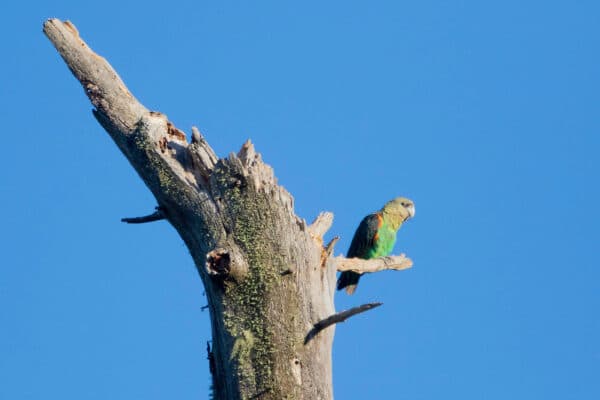
Adults c. 30 cm, 250–350 g. The species displays sexual dimorphism. The adult male is slightly larger in size and has a dark earth-brown forecrown with an olive-green crown. The cheeks and ear coverts are olive-green to yellow- green with matt-black lores while the head feathers have dusky centres. The tail is a dark slate while the back, rump and upper tail coverts are blue-green. The mantle, scapulars and upper wing coverts are dark green, edged with paler green. A band of orange-red coverts extends from the carpal joint to the dark slate primaries. The chin and throat are olive-brown and the upper breast is yellow-green. The lower breast, belly, flanks and undertail coverts are blue-green. The bill is coloured old ivory with a narrow, pale grey cere; the legs and feet are blue-grey. The adult female resembles the male, but has a variable orange forecrown plumage pattern across the forehead. The juvenile is similar to the adult bird, but both sexes have salmon pink on the forehead in first plumage, the colour extending further back onto the crown than in adult females. Juveniles lack orange-red on the tibia or shoulder (Skead 1971, Wirminghaus et al. 2001a, 2002a).
Distribution
The Cape Parrot is endemic to South Africa occupying naturally fragmented Southern and Northern Mistbelt Forests extending from the Amathole Mountains in the Eastern Cape, up through KwaZulu-Natal with a small, disjunct population in the Woodbush/Wolkberg area of Magoebaskloof in the Limpopo Province (Figure 1). This distribution is currently split into three “sub-populations” based on genetic analyses and defined by provincial boundaries, namely the south located in the Eastern Cape, the Central population centred around KwaZulu-Natal and the Northern population in the Limpopo Province (Coetzer et al. 2015, Figure 1).
Whilst strongly associated with high altitude forest patches (700–1400 m asl), dominated by yellowwood species (Afrocarpus/Podocarpus spp), the Cape Parrot is not confined to these patches, commuting to low lying agricultural orchards and coastal forests for food resources. It is currently unclear whether they are permanent residents and whether they breed in coastal areas. Important forests in the Eastern Cape are the Amathole Forest complex, Port St Johns to Mkambati Nature Reserve, and forests around Umtata and Mt Frere, while in KwaZulu-Natal forests near Kokstad and Riverside, Creighton, Bulwer, Dargle and Karkloof are important and in Limpopo, Woodbush forest (Downs 2000, Downs 2005a, Downs and Bowker 2010, Downs 2011, Leaver et al. In prep).
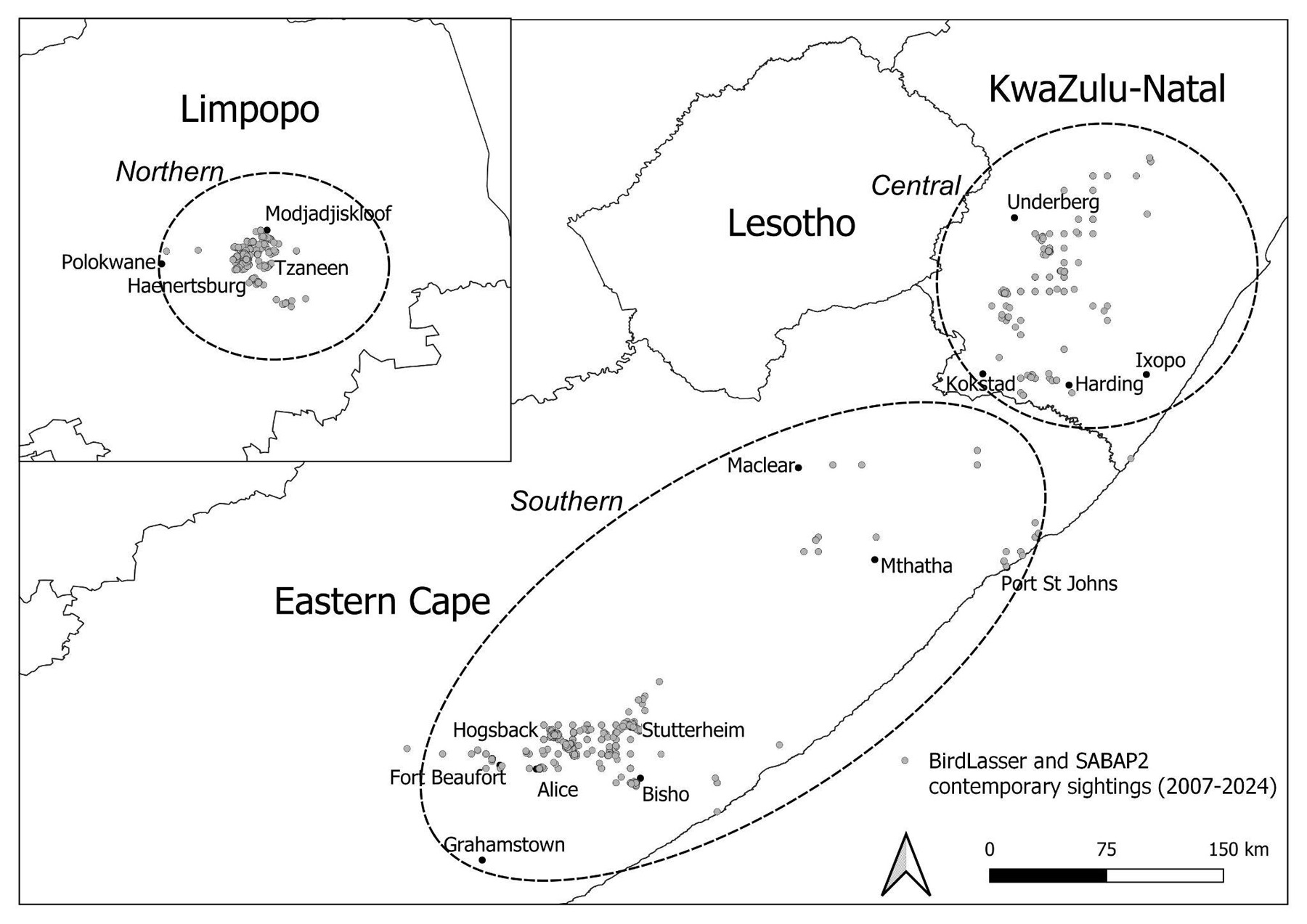
Figure 1: Cape Parrot distribution range (Birdlasser and SABAP2 sightings from 2007-2024) covering three provinces of South Africa, where dotted outlines indicate the three possible sub-populations based on Coetzer et al. (2015), namely Southern (Eastern Cape), Central (KwaZulu-Natal) and Northern (Limpopo). Map from Francis Brooke, Cape Parrot Project.
Ecology
Cape Parrots exhibit gregarious flocking behaviour, with flock size varying. They are found as singletons, pairs or large flocks. The nature of Cape Parrots to form large flocks may give the false impression of abundance (Wirminghaus et al. 2001a). Cape Parrots are considered food nomads, tracking the patchy distribution of food resources across the landscape (Skead 1964, Wirminghaus et al. 2002b, Kalle et al. 2018). Food resources utilised include both indigenous and exotic plant species, with the primary food source identified as Outeniqua Yellowwood Afrocarpus falcatus in the Eastern Cape (Wimberger et al. 2023) whilst the Real Yellowwood Podocarpus latifolius and Outeniqua Yellowwood are the primary food sources in KwaZulu-Natal (Wirminghaus et al. 2002b). Additionally, a high percentage of dietary items are recorded as exotic species (Skead 1964, 1971, Wimberger et al. 2023). During the autumn months, pecan nuts Carya illinoinensis form a large percentage of the species’ diet within the Amathole region, which does not appear to be linked to the lack of indigenous food availability (Wimberger et al. 2023). Whilst these pecan nuts have a relatively higher fat content than indigenous species (Wirminghaus et al. 2002b, Wimberger et al. 2023), further nutritional analysis (including calcium and fatty acids) is needed to gauge the impact of the consumption of these nuts on Cape Parrot health.
Feeding at these orchards increases their risk of poaching attempts, given that the species is concentrated in a single location, in high numbers and fly low between pecan trees compared with their flight within indigenous forests.
For breeding, Cape Parrots appear to be restricted to Afrotemperate mistbelt forests at high altitudes (Carstens et al. 2022). The species is a secondary, facilitative cavity nester who nest predominantly in Real and Outeniqua yellowwood species (Wirminghaus et al 2001b, Carstens et al 2022). Live but crown-damaged trees and dead trees are used for nesting sites (Wirminghaus et al. 2001b, Leaver et al. 2023). Nest cavities in KwaZulu-Natal are predominantly 6–12 m high (Wirminghaus et al. 2001b), whilst cavities in the Eastern Cape are between 10–28 m high (Carstens et al. 2022). The species exhibits nest site fidelity and reaches breeding age after four years (Wirminghaus et al. 2001b). Females lay between 2–5 eggs, which hatch asynchronously, after which nestlings fledge from 63–85 days (Wirminghaus et al. 2001b). Cape Parrots in the Amatholes in the Eastern Cape have a breeding success rate of 58% (Carstens et al. 2022).
Threats & Conservation
Threats
Cape Parrots face numerous threats including habitat loss and degradation and the consequent loss of breeding and feeding sites, the removal of wild individuals for the avicultural trade, and PBFD (Carstens et al. 2020). Future climatic changes may threaten the population.
Historical logging practices targeting hardwood species, notably yellowwoods, were carried out extensively in the 19th century, leading to the reduction of forest areas and forest quality, and the increase of forest fragmentation (Lawes et al. 2004, Adie et al. 2013, Grieve and Downs 2015), subsequently contributing to a shortage of suitable nesting sites (Wirminghaus et al. 1999, 2000, Downs and Symes 2004, Wilson et al. 2017). Within the Amathole forests, contemporary logging practices continue, targeting windfall and crownless trees and trees that have lost >70% of their crown (Mpisekaya et al. 2008, Leaver et al. 2023) and the selective logging of standing dead trees continues. These trees are important feeding and nesting sites, and the clear overlap in characteristics of Cape Parrot nesting trees and those selected for harvesting has a knock-on effect on nest site and food resource selection (Downs and Symes 2004, Lawes et al. 2004, Leaver et al. 2023).
Informal harvesting of sub-canopy trees for poles and the harvesting of bark for medicinal purposes at a subsistence level also contributes to habitat degradation (Lawes et al. 2004, Leaver et al. 2019). The loss of forest patches reduces food availability as, historically, the species would move between forest patches which display variable fruiting seasons and provide sufficient food year-round (Wirminghaus et al. 2002b, Hart et al. 2013). To sustain themselves, non-indigenous food species both inside and outside of forest areas are utilised because of the reliable fruiting times and abundance at certain times of the year (Symes and Downs 2002, Wirminghaus et al. 2002b, Wimberger et al. 2023). The use of commercial orchards threatens the species with persecution as a crop pest or with the illegal capturing of individuals for the illegal pet trade (Skead 1964, Boshoff 1989, Wirminghaus et al. 2002b, Carstens et al. 2023, CPP unpubl data). A small portion of individuals have been killed by motor vehicle collisions (Downs et al. 2015, CPP, unpubl data).
The presence of PBFD in the wild population of Cape Parrots was first suspected in 1997 (Downs et al. 2015). The PBFD viral load appears to be correlated with clinical signs (Regnard et al. 2014a), however, individuals may be infected even if they do not display signs of the disease (Regnard et al. 2014a, Downs et al. 2015). The prevalence of the disease fluctuates from year to year (Buyse et al. 2022), and in the Amatholes this has been tracked through the analysis of flock photographs (Padfield et al. 2024). Periods of drought seem to exacerbate the presence of the disease (Downs et al. 2015, Padfield et al. 2024), likely linked to the low food availability during periods of drought and subsequent poor nutrition, leading to immunosuppression (Regnard et al. 2014a, 2014b). Whilst juvenile Cape Parrots appear to succumb to the disease during periods of drought (Downs et al. 2015), the prevalence of the disease and the percentage of the juvenile population is not strongly correlated (Padfield et al. 2024). Increased disease-related mortality rates may increase with increasing anthropogenically induced climate change (Downs et al. 2015).
Current climatic conditions in South Africa show changes in rainfall and temperature patterns (MacKellar et al. 2014, Downs et al. 2015), which may hinder reproduction rates and the survival of Cape Parrots in the future (Wirminghaus et al. 2001a), and which may further be exacerbated by future climatic changes and extreme weather events. The impact of climate change on forest distribution poses a significant threat, with Colyn et al (2020) showing that reduction in forest cover is predicted to be greatest for mid-elevation forests, the predominant habitat of Cape Parrots. Moreover, forest degradation, as a major threat to the species, is known to be widespread in South Africa given the current management crisis facing indigenous forests in South Africa. While, in general, there is a lack of up-to-date information on the nature and extent of this degradation from the vast majority of Cape Parrot forests, there has been an estimated 58% decrease in distribution range size of Cape Parrots across South Africa over 12 years (Cooper et al. 2017). However, this used the available SABAP2 data at the time which had poor coverage of the former Transkei in the Eastern Cape so likely is an overestimate.
The emergence of the introduced Polyphagous shot-hole borer beetle Euwallacea fornicatus poses a threat to the Cape Parrot, as the fungus carried by the beetle results in a lack of nutrients and water moving through the sapwood, killing trees (Fryer 2019). Tree species currently infected include Real Yellowwoods, Cape Chestnut Calodendrum capense and Wild Plums Harpephyllum caffrum (Fryer 2019), all important feeding species for Cape Parrots (Wirminghaus et al. 2002b, Wimberger et al. 2023).
Conservation Measures Underway
The Cape Parrot and Mistbelt Forest Conservation Action Plan (Carstens et al. 2020) was developed in 2019 through collaborative efforts of stakeholders actively involved in Cape Parrots conservation and serves as a guiding framework for Cape Parrot conservation. This action plan provides recommendations for research and conservation actions within four key strategies, namely Species and Research, Habitat and Landscape, Community engagement and Law enforcement and Policy development. Under Species and Research, long-term population monitoring is an important conservation action. The annual Cape Parrot Big Birding Day, established in 1998 by the Cape Parrot Working Group (CPWG), encourages public engagement and is used to gather information on the overall status of Cape Parrots with regards to abundance (Downs et al. 2014, Kalle et al. 2018, Downs and Singh 2023). The Cape Parrot Project conducts monthly population counts in the Amathole region and the Limpopo Province to provide insights into population trends in the area (CPP unpubl data; Padfield et al. 2024). The species is listed as Critically Endangered on the current ‘Threatened or Protected species list (section 56 of the National Environmental Management: Biodiversity Act No. 10 (NEMBA) of 2004)’. It is also protected under several provincial ordinances.
CPP also continuously monitors disease prevalence in the population (Padfield et al. 2024; breeding success of the species (Carstens et al. 2022) and use of indigenous and exotic food sources (Wimberger et al. 2023), and the latter has also been examined in KwaZulu-Natal (Symes and Downs 2002). The provision of artificial nest boxes aimed at increasing breeding success does not appear to have been successful for Cape Parrots in KwaZulu-Natal (Downs 2005b) nor Eastern Cape and Limpopo provinces (Wimberger et al. 2017), although a new prototype is being trialled (CPP unpubl data).
Forest monitoring efforts are carried out to examine forest health and to inform restoration efforts in the Amathole region. Important priority forests across Cape Parrot distribution have recently been determined using Global Information Systems (GIS) analyses (Leaver et al. In prep), identifying forest with high habitat suitability for Cape Parrots with varying degrees of threat. These forests are to be targeted for long-term monitoring and conservation actions across the national Cape Parrot distribution. Conservation action includes restoration efforts, which are currently being conducted in the Amathole region, where CPP works with local communities to establish communal nurseries to grow indigenous seedlings, which are purchased and used in restoration efforts. Restoration teams are hired from local communities.
Habitat protection efforts can benefit from limiting the extent of formal logging in the Amathole region. A study using acoustic recording units to investigate the effects of logging of indigenous trees in the Amathole forests and the presence of Cape Parrots in these forests, indicated that the species were present in 15 of 16 forests surveyed, whilst breeding calls were identified in only seven forests (Rea et al. 2023). Further, due to the overlap between preferred breeding sites and trees selected for harvesting (Leaver et al. 2023), recommendations include limiting harvesting of yellowwood trees to wind fallen trees, ensuring that no potential nests are harvested, and that standing dead, dying or damaged trees be excluded. Recommendations to adjust harvesting guidelines have been partially incorporated into governmental harvesting guidelines (Leaver et al. 2023). It should be noted that these are currently only interim guidelines and that harvesting quotas remain in the Amathole region.
CPP’s educational initiatives and outreach includes awareness campaigns through social media platforms, collaboration with local environmental organisations targeting youth surrounding Cape Parrot habitat and the running of environmental camps to create awareness of the species and its habitat. The Cape Parrot Working Group’s educational outreach includes public talks, interactions with schoolchildren, provision of educational posters, DVDs and newsletters. The Biopharming Research Unit at University of Cape Town is currently in the process of developing a vaccine for PBFD in Cape Parrots. A successful vaccine has been developed and tested in captive African Grey Parrots Psittacus erithacus as a proxy for Cape Parrots. Next steps include manufacturing of the vaccine and testing on Cape Parrots. The logistical challenges of vaccinating the wild population of Cape Parrots also need to be addressed.
Conservation Measures Proposed
As per the Cape Parrot and Mistbelt Forest Action Plan (Carstens et al. 2020), proposed conservation actions identified includes the following:
- The development and implementation of protocols related to captive/ex-situ population including effective permitting and enforcement, genetic and health considerations.
- Public awareness and educational initiatives aimed at preventing the trade of wild parrots is needed. Law enforcement officers need to be educated on the identification of Cape Parrots to bring about effective prosecution of individuals illegally capturing Cape Parrots.
- Halting forest degradation to minimise the loss of nesting trees and food resources.
- Formal acceptance of interim harvesting guidelines to reduce the overlap between harvesting selection for logging and trees selected for nesting sites.
- The establishment of forest corridors to minimise the effects of habitat fragmentation, maintaining gene flow between populations, ensuring and maintaining genetic diversity.
- Elevating the protection status of partially protected or privately owned lands to formal protection status, and the subsequent implementation of law enforcement within identified areas.
Research Priorities and Questions
There are several research priorities and activities described in the Cape Parrot and Mistbelt Forest Action Plan (Carstens et al. 2020), which include:
- Establish whether the overall population is stable, increasing or declining. Also establish subpopulation trends.
- Continued work on differentiation between three sub-populations, including genetics, vocalisations, colour variation, diet, habitat use, breeding biology.
- Increase knowledge on breeding biology by collecting baseline data (e.g. nest characteristics, productivity, recruitment, brood sex ratios, and juvenile survival) from all parts of its range. Similar information from the captive populations is also needed.
- Increase knowledge on population size, distribution, and movement:
- Using telemetry to track parrot movements on a fine scale, including improvements on existing harness and transmitter design.
- Determine barriers of dispersal between three sub-populations e.g. “pinch-points”.
- Map population size and distribution, including covering areas missed by SABAP2.
- Understand historic, present and future suitable habitats for Cape Parrot
- Map Mistbelt and Afrotemperate forest niches to guide rehabilitation locations and facilitate corridor connectivity implementation; collate information on land use to map potential conflict linked to climate change.
Contributors & References
Assessor/s
Francis R Brooke, Kirsten Wimberger
Reviewer/s
Colleen Downs, Cassie Carstens
References
Adie H, Rushworth I, Lawes M. 2013. Pervasive, long-lasting impact of historical logging on composition, diversity and above ground carbon stocks in Afrotemperate forest. Forest Ecology and Management 310: 887–895.
BirdLife International. 2021. Poicephalus robustus. The IUCN Red List of Threatened Species 2021: e.T119194858A179406641. https://dx.doi.org/10.2305/IUCN.UK.2021-3.RLTS.T119194858A179406641.en. [Accessed on 17 August 2024].
Boshoff A. 1989. Uncertain future for southern race of Cape Parrot. The AFA Watchbird 16: 22–25.
Buyse M, van Zyl A, Wimberger K, Boyes R, Carstens JC, Rybicki E, Hitzeroth I. 2022. Recovery from beak and feather disease virus infection in a Cape Parrot (Poicephalus robustus) population in South Africa. Journal of Wildlife Disease 58: 882–886.
Carstens K, Wimberger K, Martin R, Downs C, Davies-Mostert H, Young Y, Singh P, Padfield C, Howes-Whitecross M, Wilkinson S, Morrison K. 2020. Cape Parrot and Mistbelt Forest Conservation Action Plan. Johannesburg: Wild Bird Trust.
Carstens K, Carstens JC, Wimberger, K. 2022. The breeding biology of the Cape Parrot Poicephalus robustus in the Eastern Cape Province, South Africa. Afrotropical Bird Biology 2: 1–9.
Carstens JC, Brooke FR, Wimberger K, Becich N. 2023. Injuries sustained by Cape Parrots (Poicephalus robustus) during poaching attempts. Journal of Avian Medicine and Surgery 37: 79–85.
Clancey P. 1997. The Cape Parrot: an additional valid species. Honeyguide 43: 61– 2.
Coetzer W, Downs C, Perrin M, Willows-Munro S. 2015. Molecular systematics of the Cape Parrot (Poicephalus robustus): Implications for taxonomy and conservation. PLoS ONE 10: 1–19.
Coetzer W, Downs C, Perrin M, Willows-Munro S. 2020. Influence of historical and contemporary habitat changes on the population genetics of the endemic South African parrot (Poicephalus robustus). Bird Conservation International 30: 236–259.
Collar N, Fishpool L. 2017. Is the Cape Parrot a species or subspecies, and does it matter to CITES? Bulletin of the African Bird Club 24: 156–170.
Colyn R, Ehlers Smith D, Ehlers Smith Y, Smit-Robinson H, Downs C. 2020. Predicted distributions of avian specialists: A framework for conservation of endangered forests under future climates. Biodiversity Research 26: 652–667.
Cooper TJG, Wannenburgh AM, Cherry MI. 2017. Atlas data indicate forest dependent bird species declines in South Africa. Bird Conservation International 27: 337–354.
Downs CT. 2000. Cape Parrot. In: Barnes K (ed), The 2000 Eskom Red Data Book of Birds of South Africa, Lesotho and Swaziland. BirdLife South Africa. pp 48–49.
Downs CT, Symes C. 2004. Snag dynamics and forest structure in Afromontane forests in KwaZulu-Natal, South Africa: implications for the conservation of cavity-nesting avifauna. South African Journal of Botany 70: 265–276.
Downs CT. 2005a. Cape Parrot Poicephalus robustus. In: Hockey PAR, Dean WRJ, Ryan PG (eds), Roberts birds of southern Africa (7th edn). Cape Town: Trustees of the John Voelcker Bird Book Fund. pp 221– 22.
Downs CT. 2005b. Abundance of the endangered Cape parrot Poicephalus robustus in South Africa: implications for its survival. African Zoology 40: 15–24.
Downs CT, Bowker M. 2010. Counting Parrots – Report on the 2010 Cape Parrot Big Birding Day, the 13th annual count.
Downs CT. 2011. 14th Annual Parrot Count – Report on the 2011 Cape Parrot Big Birding Day.
Downs CT, Pfeiffer M, Hart L. 2014. Fifteen years of annual Cape parrots (Poicephalus robustus) census: Current population trends and conservation contributions. Ostrich 85: 273–280.
Downs CT. 2015. Cape Parrot Poicephalus robustus. In: Taylor MR, Peacock F, Wanless RM (eds), The Eskom Red Data Book of Birds of South Africa, Lesotho and Swaziland. BirdLife South Africa, Johannesburg: South Africa. pp 143–145.
Downs CT, Brown M, Hart L, Symes CT. 2015. Review of documented beak and feather disease virus cases in wild Cape parrots in South Africa during the last 20 years. Journal of Ornithology 156: 867–875.
Downs CT, Singh P. 2023. 26th Annual Parrot Count – Report on the 2023 Cape Parrot Big Birding Day. Available at chrome-extension://efaidnbmnnnibpcajpcglclefindmkaj/https://cpwg.ukzn.ac.za/wp-content/uploads/2024/03/CPBBD-report-2023-compressed.pdf [Accessed on 17 September 2024].
Fryer H. 2019. List of trees impacted by Polyphagous Shot Hole Borer (PSHB) in South Africa. Johannesburg: Heuristic Guru (Pty) Ltd.
Grieve G, Downs CT. 2015. A checklist of the plants of the forests and grasslands in the Weza district, southern Kwazulu-Natal and a review of their status in the Red Data list. Koedoe 5: 1–7.
Hart L, Grieve G, Downs CT. 2013. Fruiting phenology and implications of fruit availability in the fragmented Ngele Forest Complex, KwaZulu-Natal, South Africa. South African Journal of Botany 88: 296–305.
Kalle R, Ramesh T, Downs C. 2018. When and where to move: Dynamic occupancy models explain the range dynamics of a food nomadic bird under climate and land cover change. Global Change Biology 24: e27–e39.
Lawes M, MacFarlane D, Eeley H. 2004. Forest landscape pattern in the KwaZulu-Natal midlands, South Africa: 50 years of change or stasis? Austral Ecology 29: 613–623.
Leaver J, Carstens JC, Cherry M. 2019. Harvesting of forest products and implications for Afrotemperate bird communities in a montane forest of the Eastern Cape, South Africa. Forest Ecosystems 6: 48.
Leaver J, Carstens JC, Wimberger K, Carstens K, Cherry M. 2023. The impact of timber harvesting on nest site availability for the Cape Parrot (Poicephalus robustus) in native Southern Mistbelt forests of the Eastern Cape, South Africa. Bird Conservation International 33: e21.
Lee ATK. 2024. Regional Red Data Book of the Birds of South Africa, Lesotho and Eswatini: SABAP2 synthesis and supporting information and graphics for Cape Parrot. Unpublished report. Johannesburg: BirdLife South Africa.
MacKellar N, New M, Jack C. 2014. Observed and modelled trends in rainfall and temperature for South Africa: 1960-2010. South African Journal of Science 110: 1–13.
Mpisekaya S, Kameni C, Viljoen I, Salukazana L. 2008. Amatole forests yellowwood harvesting levels. Department of Water, Agriculture and Forestry, Pretoria.
Padfield CJ, Carstens KF, Carstens JC, Brooke FR, Wimberger K. 2024. Population trends of the Cape Parrot Poicephalus robustus in the Amatholes, Eastern Cape: trialling ground-based flock photography for demographic and health assessment. Ostrich 95: 239-251.
Perrin M. 2005. A review of the taxonomic status and biology of the Cape Parrot Poicephalus robustus, with reference to the Brown-necked Parrot Poicephalus fuscicollis fuscicollis and the Grey-headed Parrot P.f. suahelicus. Ostrich 76: 195–205.
Rea M, Elliot J, Carstens JC, Leaver J, Carstens K, Wimberger K, Cherry MI. 2023. Using acoustic recording units to investigate the effects of logging of indigenous trees in the Amathole forests, South Africa on Cape Parrot Poicephalus robustus breeding and the presence of three primary cavity excavating bird species. Bird Conservation International 33: 1–7.
Regnard GL, Boyes RS, Martin R, Hitzeroth II, Rybicki EP. 2014a. Beak and feather disease virus: correlation between viral load and clinical signs in wild Cape parrots (Poicephalus robustus) in South Africa. Archives of Virology 160: 339–344.
Regnard GL, Boyes RS, Martin RO, Hitzeroth II, Rybicki EP. 2014b. Beak and feather disease viruses circulating in Cape parrots (Poicephalus robustus) in South Africa. Archives of Virology 160: 47–54.
Shackleton C. 2009. Will the real custodians of natural resource management please stand up. South African Journal of Science 105: 91–93.
Skead C. 1964. The overland flights and the feeding habits of the Cape Parrot Poicephalus robustus (Gmelin) in the eastern Cape Province. Ostrich 35: 202–223.
Skead C. 1971. The Cape Parrot in the Transkei and Natal. Ostrich 42: 165–178.
Symes CT, Downs CT. 2002. Occurrence of Cape Parrot Poicephalus robustus at non-forest feeding sites in South Africa: threats to a declining population. Bulletin of the African Bird Club 9: 27–31.
Tobias JA, Seddon N, Spottiswoode CN, Pilgrim JD, Fishpool LDC, Collar NJ. 2010. Quantitative criteria for species delimitation. Ibis 152: 724–746.
Wilson A, Bowker M, Shuttleworth A, Downs CT. 2017. Characteristics of snags and forest structure in southern mistbelt forests of the Amatole region, South Africa. African Journal of Ecology 55: 518–529.
Wimberger K, Carstens KF, Carstens JC, Boyes RS. 2017. Nest boxes for Cape Parrots Poicephalus robustus in the Hogsback area, Eastern Cape, South Africa. Ostrich 89:1– 7.
Wimberger K, Carstens K, Carsten J, Rautenbach F, Brooke F. 2023. Cape Parrot Poicephalus robustus diet in a nutshell: use of indigenous and exotic plants in the Eastern Cape province, South Africa. Ostrich 94: 28–39.
Wirminghaus JO, Downs CT, Symes C, Perrin M. 1999. Conservation of the Cape Parrot in southern Africa. South African Journal of Wildlife Research 29: 118–129.
Wirminghaus JO, Downs CT, Symes C, Perrin M. 2000. Abundance of the Cape parrot in South Africa. South African Journal of Wildlife Research 30: 43–52.
Wirminghaus JO, Downs CT, Perrin M, Symes CT. 2001a. Abundance and activity patterns of the Cape Parrot (Poicephalus robustus) in two afromontane forests in South Africa. African Zoology 36: 71–77.
Wirminghaus JO, Downs CT, Perrin MR, Symes CT. 2001b. Breeding biology of the Cape Parrot Poicephalus robustus. Ostrich 72: 159–164.
Wirminghaus JO, Downs CT, Perrin M, Symes C. 2002a. Taxonomic relationship of the subspecies of the Cape Parrot Poicephalus robustus (Gmelin). Journal of Natural History 36: 361–378.
Wirminghaus JO, Downs CT, Perrin M, Symes M. 2002b. Diet of the Cape Parrot Poicephalus robustus in Afromontane forests in KwaZulu-Natal, South Africa. Ostrich 73: 20–25
Citation
Brooke FR, Wimberger K 2025. Cape Parrot. In: Lee ATK, Rose S, Banda S, Bezeng SB, Maphalala MI, Maphisa DH, Smit-Robinson H (eds), The 2025 Red Data Book of Birds of South Africa, Lesotho and Eswatini. Johannesburg, South Africa: BirdLife South Africa. Available at: https://www.birdlife.org.za/red-list/cape-parrot/
Our generous sponsors


